
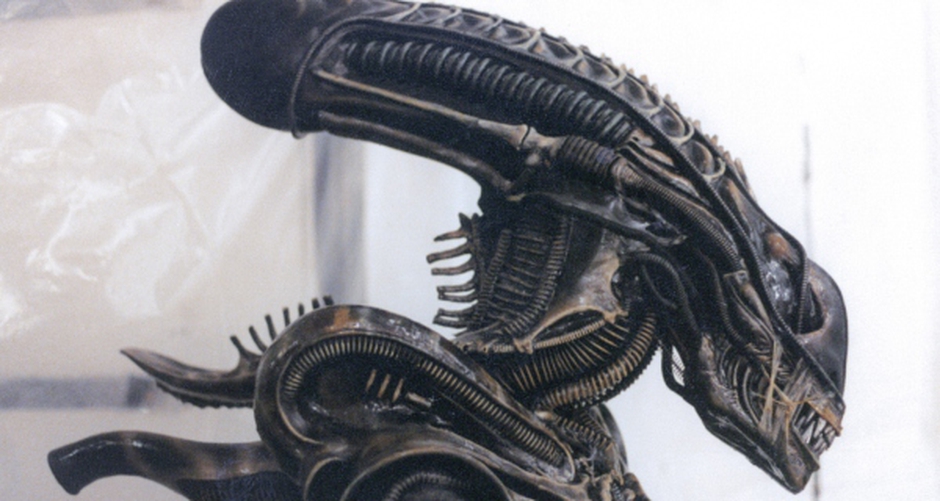
Jump To Section
- Expanding the Xenomorph Life Cycle with an Alien Queen
- Ellen Ripley Returns to LV-426 to Fight the Aliens
- Ridley Scott's Camera Magic and "Macaroni Mechanics" in the Original Alien
- Redesigning the Xenomorph Warriors for Aliens
- Building Xeno-suits for the Insect-Like Movements
- The Actors Behind the Alien Warriors
- 8-foot-tall Xenomorph Puppets and a Hero Xenomorph Drone
Expanding the Xenomorph Life Cycle with an Alien Queen
While developing the Aliens screenplay, James Cameron recognized that the story would lack punch if it featured only those alien organisms introduced in the first film. He needed an element of surprise in his movie’s third act. That surprise took the form of a giant alien queen, an ‘über-alien’ that, in addition to serving as the ultimate adversary, completed the alien reproduction cycle, never fully explained in Alien.
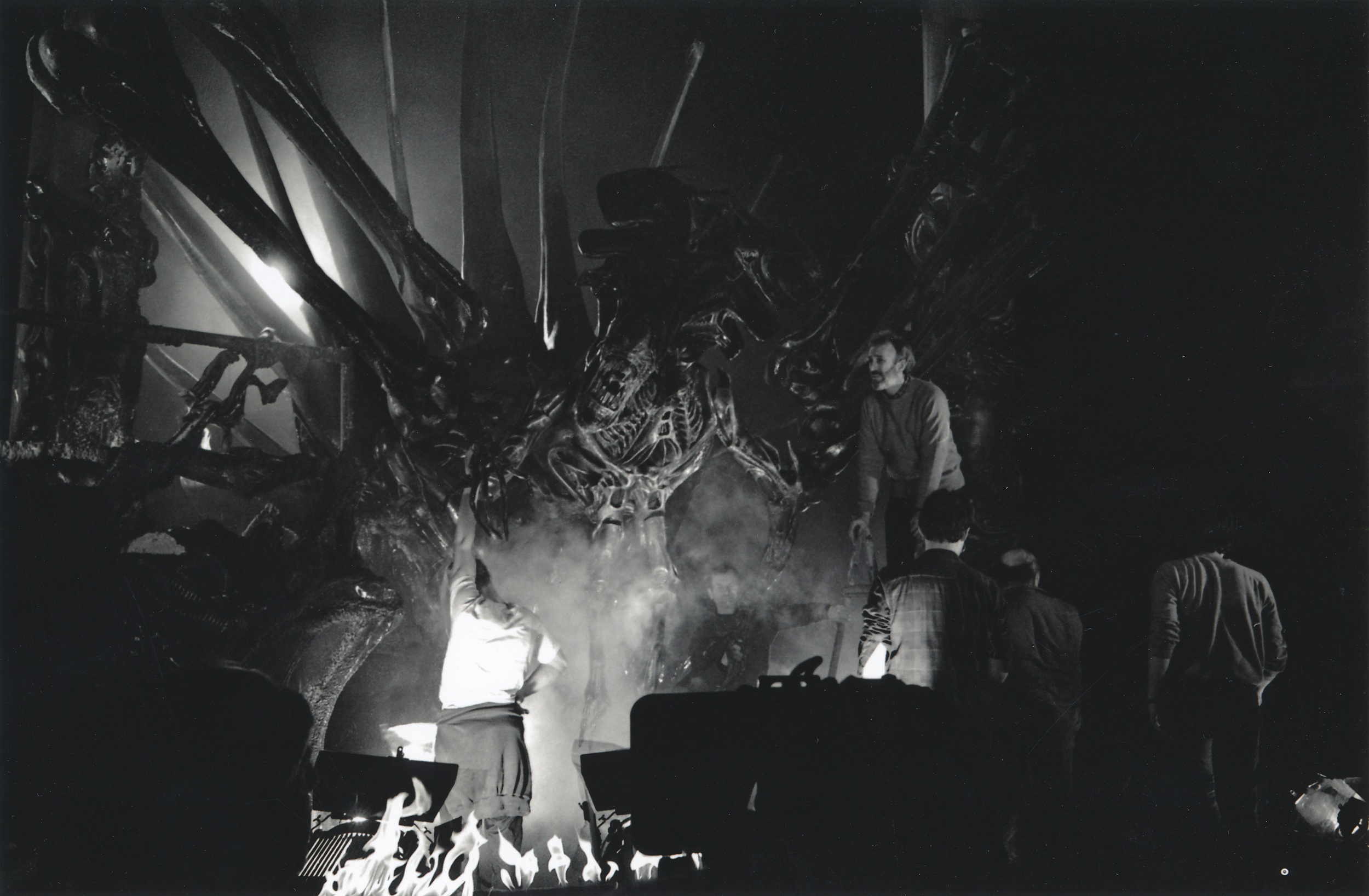 (Stan Winston oversees the setup of the alien queen on the set of Aliens (1986). Photo by Bob Penn. Image courtesy of 20th Century Fox.)
In Alien, “they’ve seen the eggs,” Cameron said, “they’ve seen the parasite that emerges from the eggs, they’ve seen the embryo laid by that parasite emerge from a host person, and they’ve seen the embryo grow up into a supposedly adult form. But that adult form — one of them, anyway — couldn’t possibly have laid the thousand or so eggs that filled the inside of the derelict ship. At least that was my theory. So working from that image — acres and acres of these quite large eggs — I began to focus on the idea of a hierarchical hive structure where the central figure is a giant queen whose role it is to further the species.”
Ellen Ripley Returns to LV-426 to Fight the Aliens
The alien queen would not make her on-screen appearance until the third act of the film. The story, as scripted by James Cameron, has Warrant Officer Ellen Ripley (Sigourney Weaver), the sole survivor of the space crew decimated by the alien in the original Ridley Scott film, returning to the planet where the derelict ship and its massive alien egg chamber were initially discovered. Accompanied by a band of roughneck military grunts, she seeks to determine the fate of colonists with whom contact has been lost. An army of alien warriors (aka xenomorphs), nested within the planet’s Atmosphere Processing Station, launches a series of deadly attacks on Ripley’s unit.
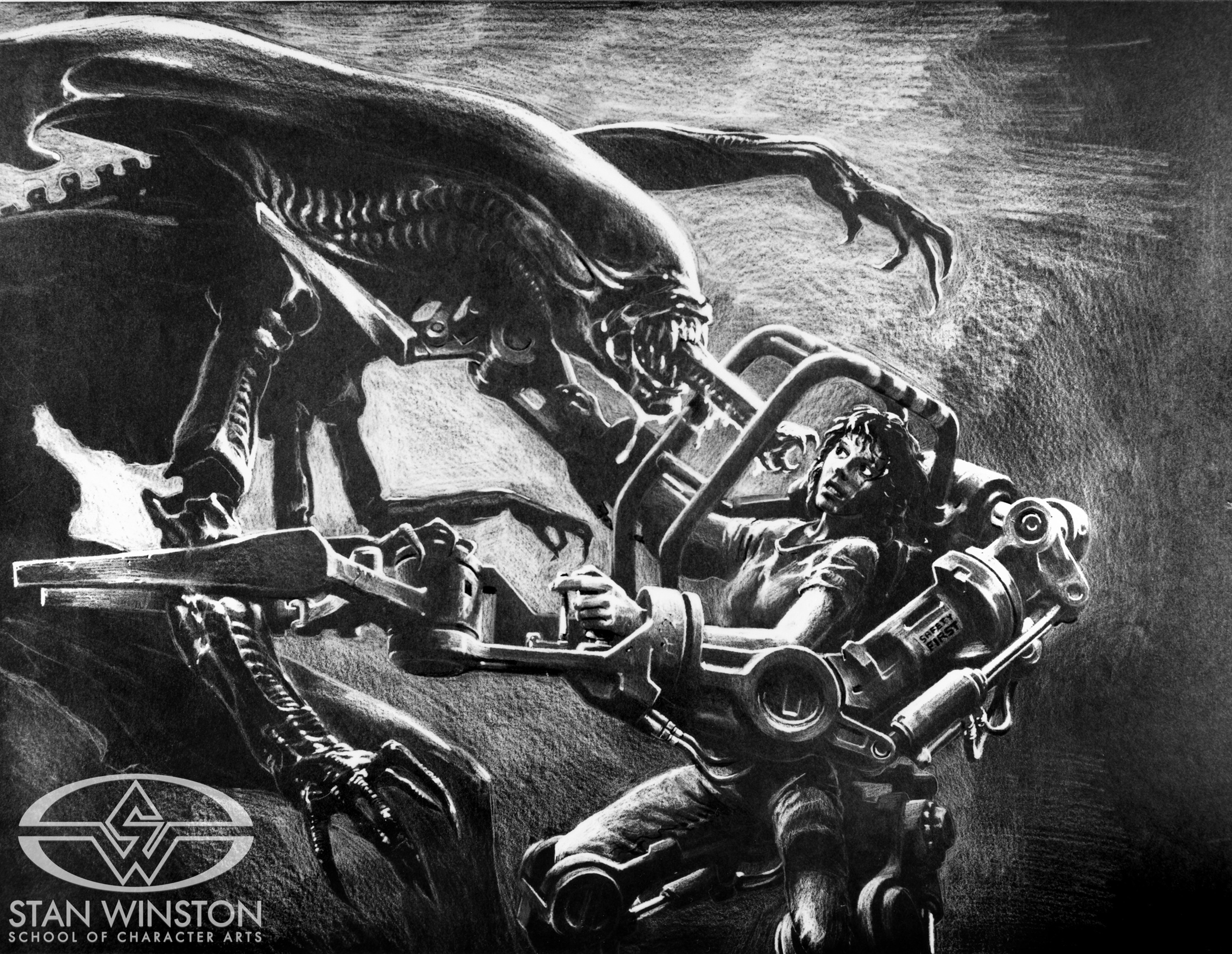 (James Cameron's concept art of the alien queen attacking Ellen Ripley.)
Ridley Scott's Camera Magic and "Macaroni Mechanics" in the Original Alien
The original Alien had featured a single creature, realized as a man-in-a-suit, which Ridley Scott filmed carefully in shadow, at odd angles, and covered in slime — all to disguise its basic human form. “You never really saw the entire alien until the very last shot of it in the movie,” noted Stan Winston, “when he is blown out of the airlock. Until that point, he was in shadows, in weird positions; only his head was in frame — and all of those filming techniques, meant to disguise the fact that this was a guy in a suit, were partly why the film worked as well as it did.”
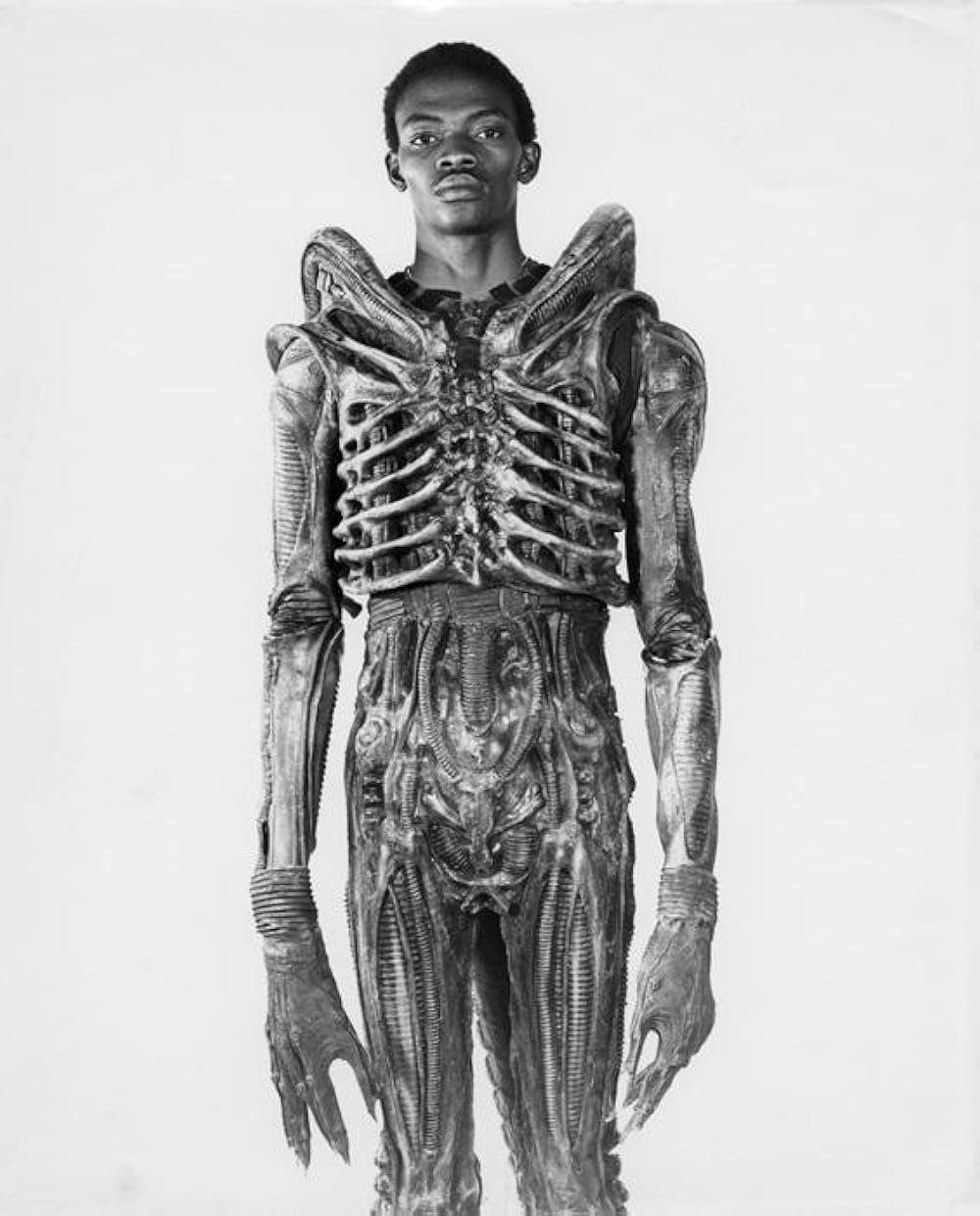 (Bolaji Badejo posing in the original alien suit for an Alien (1979) promo shot. Image courtesy of 20th Century Fox.)
Just how clever Scott had been in shooting the creature became clear to the crew when the original alien suit was sent to Stan Winston Studio for reference purposes. “We pulled this thing out of a crate,” Howard Berger recalled, “and it was unbelievable to see how it had been constructed. It had black-painted, hard macaroni pieces glued all over it to give it texture, with black-painted bottle caps at the waist. And the feet were just black Converse tennis shoes, covered with a slip-latex skin! When we got this thing out, put it on a mannequin, and saw it in broad daylight, it was amazing to realize what Ridley Scott had gotten away with, just by using slime and careful lighting and the right camera angles.”
Redesigning the Xenomorph Warriors for Aliens
Given a budget that only allowed for the building of twelve alien warriors, Cameron and Winston would have to be just as ingenious, if not more so, to create the illusion of an alien army.
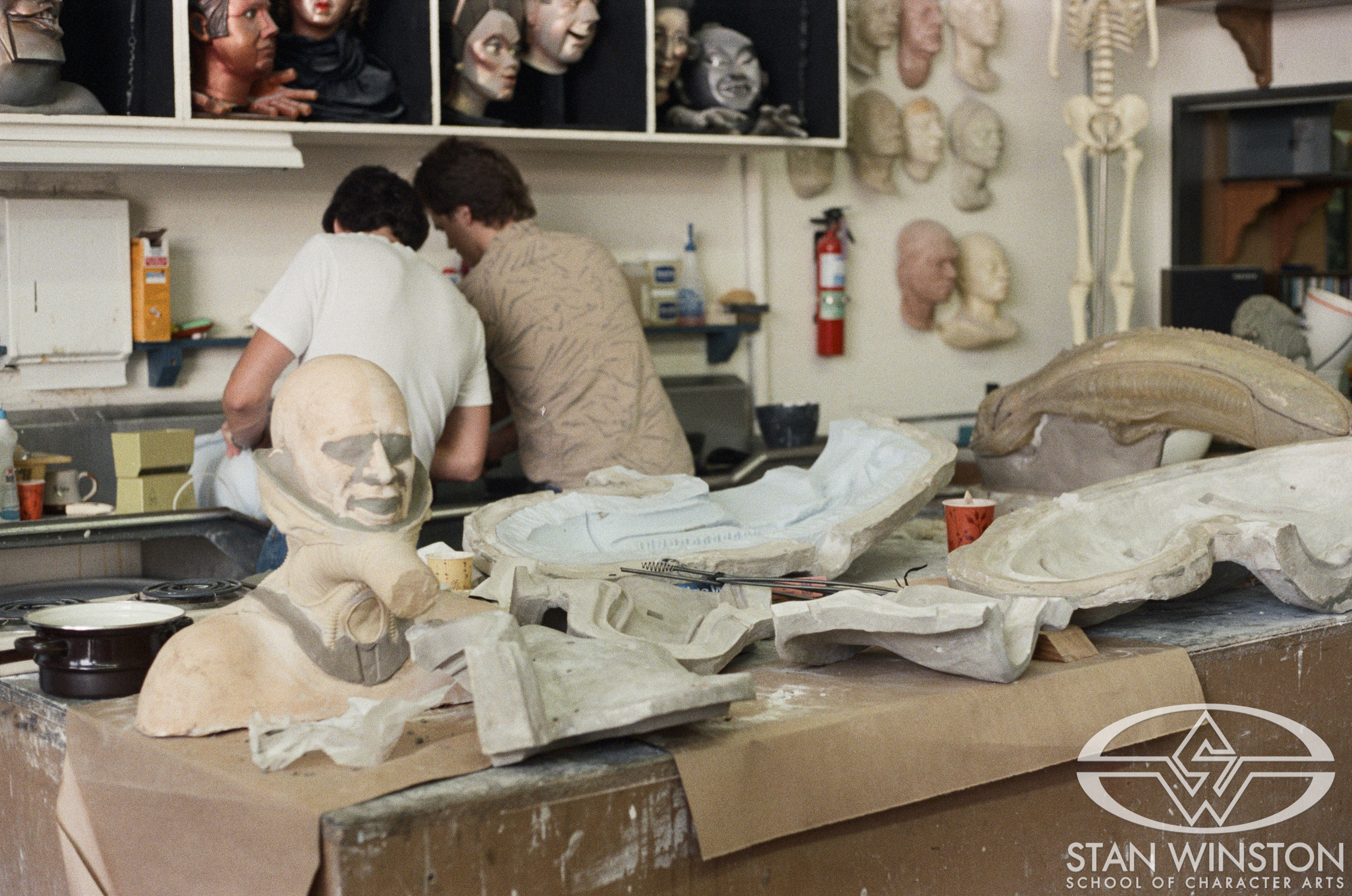 (Work-in-progress casting and molding a xenomorph head at Stan Winston Studio.)
After sculpting maquettes and making molds for alien characters, the Winston crew shipped everything to England. Winston and six supervisors soon followed, setting up a makeshift shop at Pinewood Studios, outside London. “This was a big thing for us, picking up and moving to London,” Winston recalled. “We set up our shop at Pinewood, and together with my guys I had brought over and the English guys, we put together a crew of artists to build the queen alien and the other creature effects.”
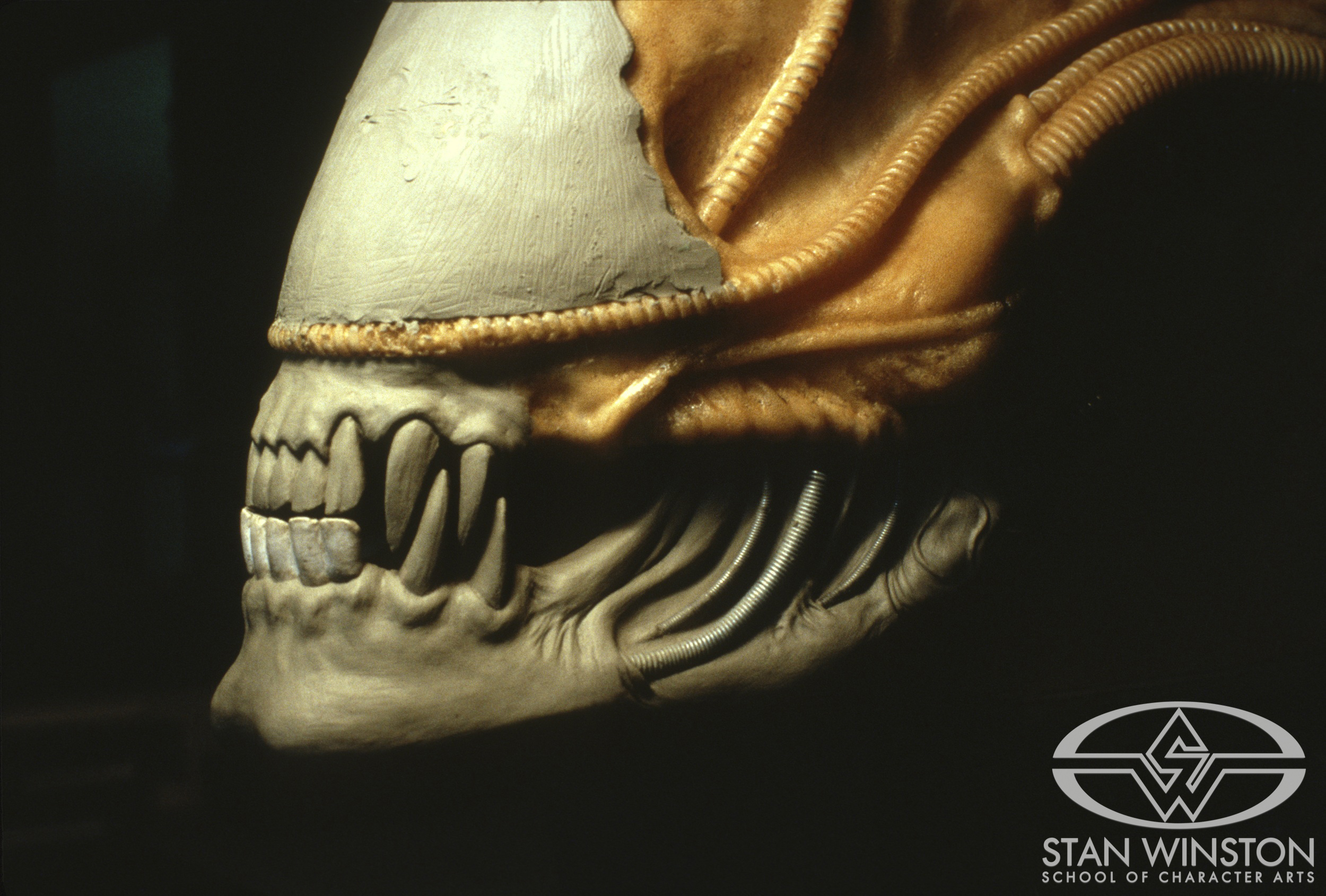 (Work-in-progress alien warrior clay sculpture at Stan Winston Studio.)
But before getting into the construction of the alien suits and heads, Winston and Cameron had settled on some subtle design changes, including doing away with the translucent cowl that had covered the alien’s head in the first film. “We planned to do the same thing with ours,” said Cameron, “and to that end, Stan had Tom Woodruff Jr. sculpt up a ribbed, bone-like understructure that would fit underneath and be slightly visible through the cowl."
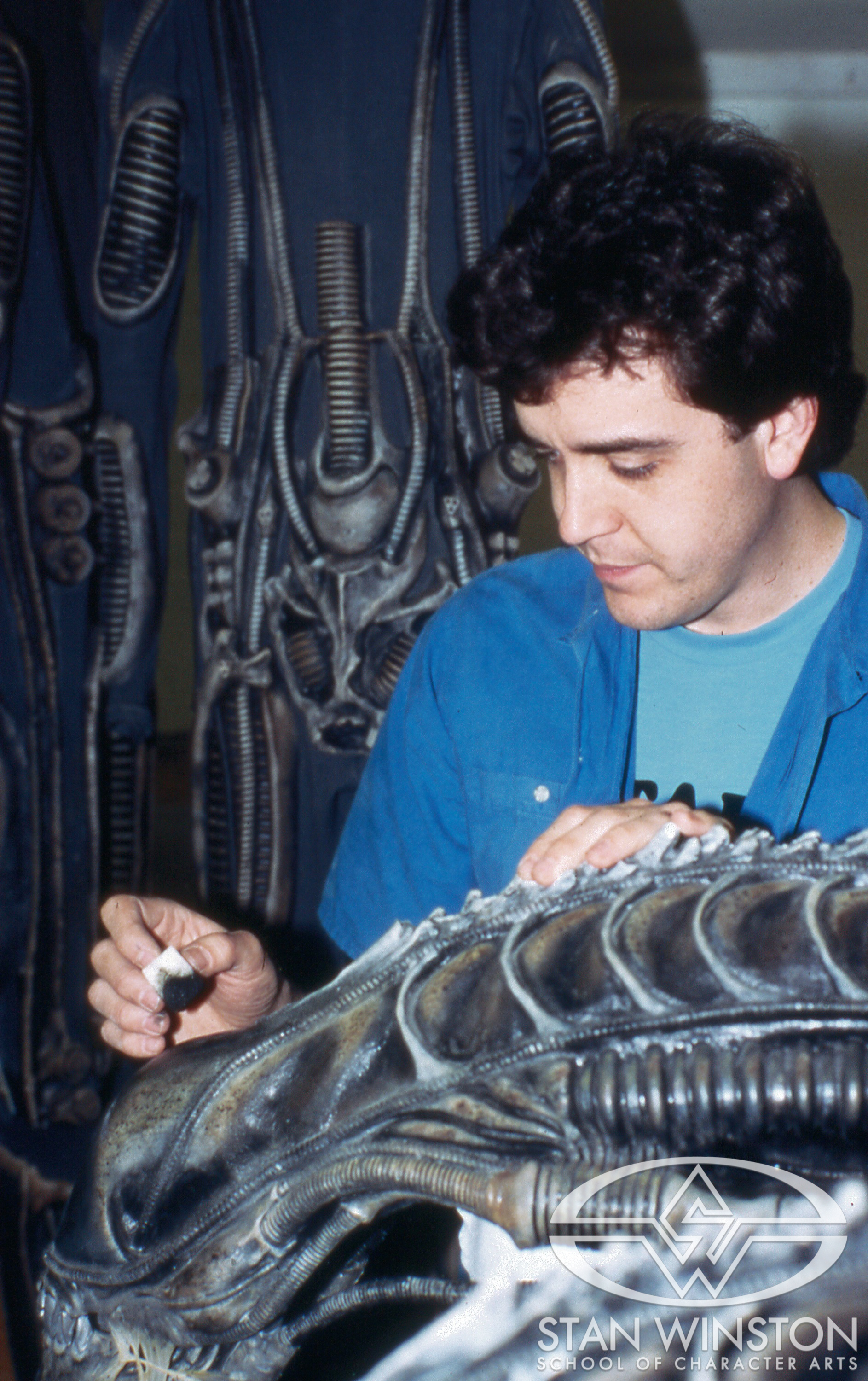 (Tom Woodruff Jr. paints one of the alien warrior heads at Pinewood Studios.)
"When it was finished," continued Cameron, "they gave it a real nice paint job, and I took a look at it and said, ‘Hey, this looks much more interesting the way it is.’ So we pitched the cowl and decided that this was just another generation of aliens — slightly mutated.”
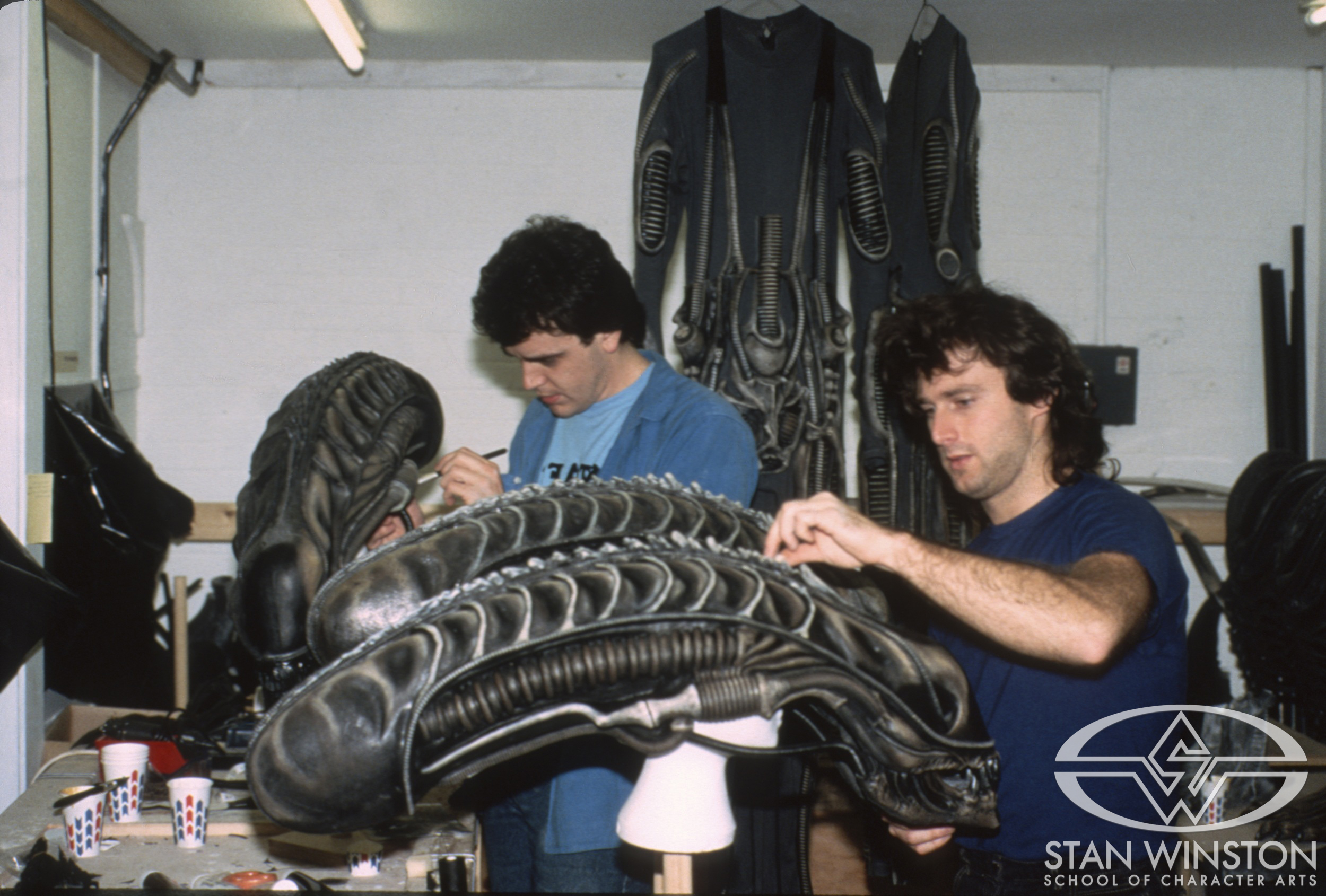 (Tom Woodruff Jr. and John Rosengrant paint xenomorph heads at Pinewood Studios.)
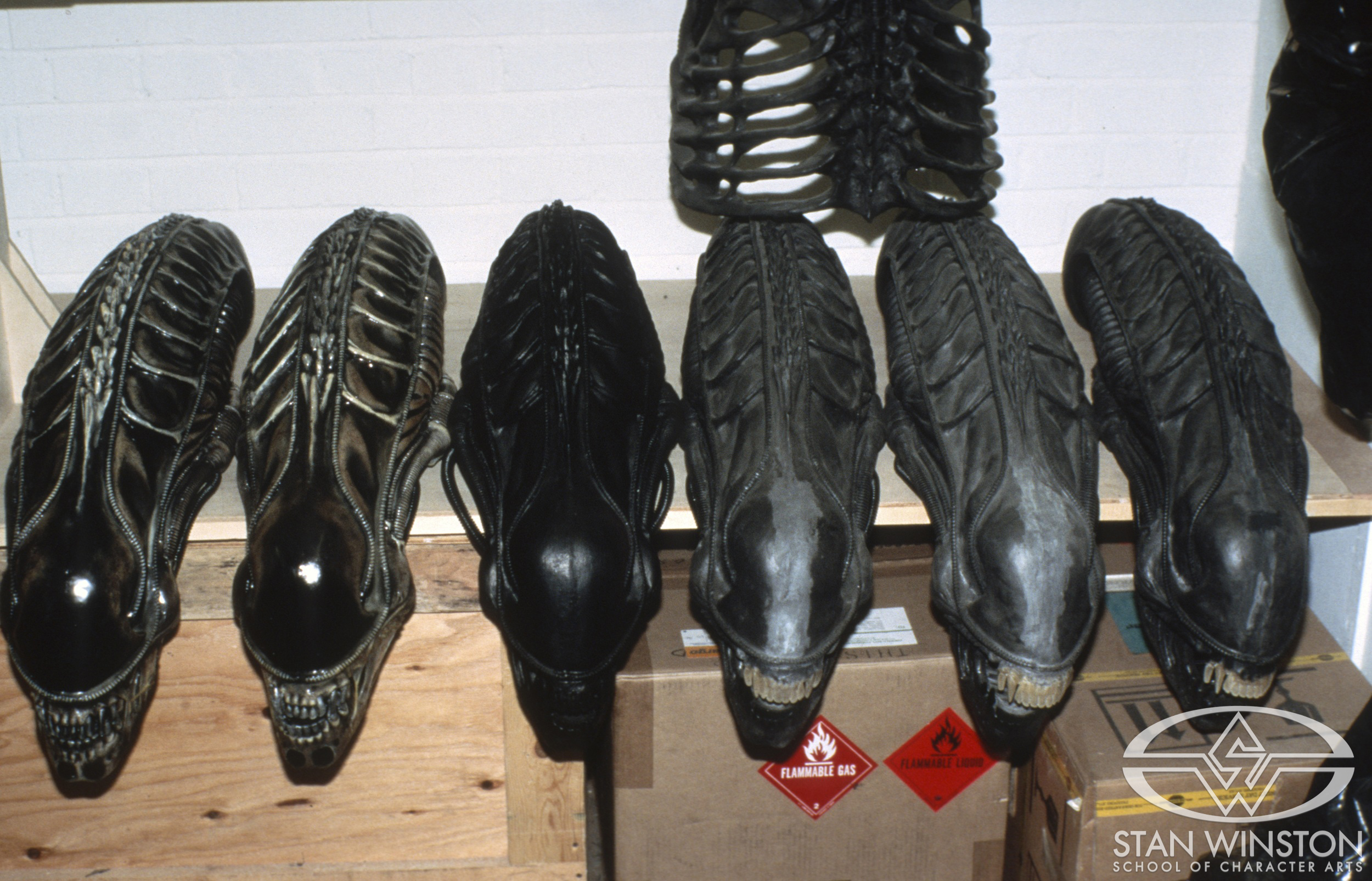 (Alien Warrior heads in various stages of completion.)
Other alterations included incorporating the inorganic and organic elements of the alien — which H.R. Giger had designed as a biomechanical creature — within the sculpture itself, rather than adding hoses and other mechanical devices to the suit after the fact. “It’s nothing you could ever detect on film,” said Winston, “just the kind of thing you do to keep from getting bored duplicating exactly what someone else has already done.”
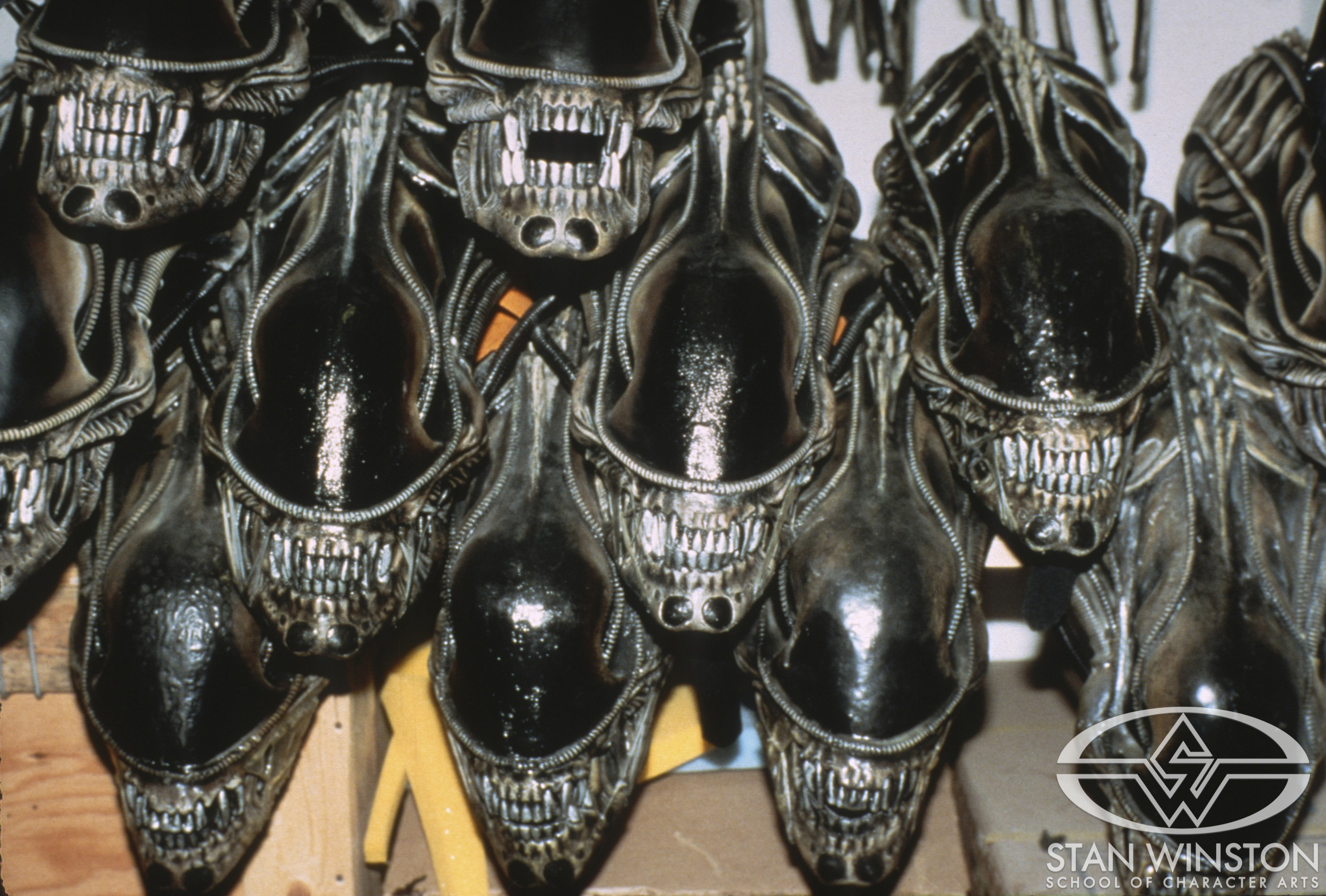 (Some of the ready-to-use alien warrior heads at Pinewood Studios.)
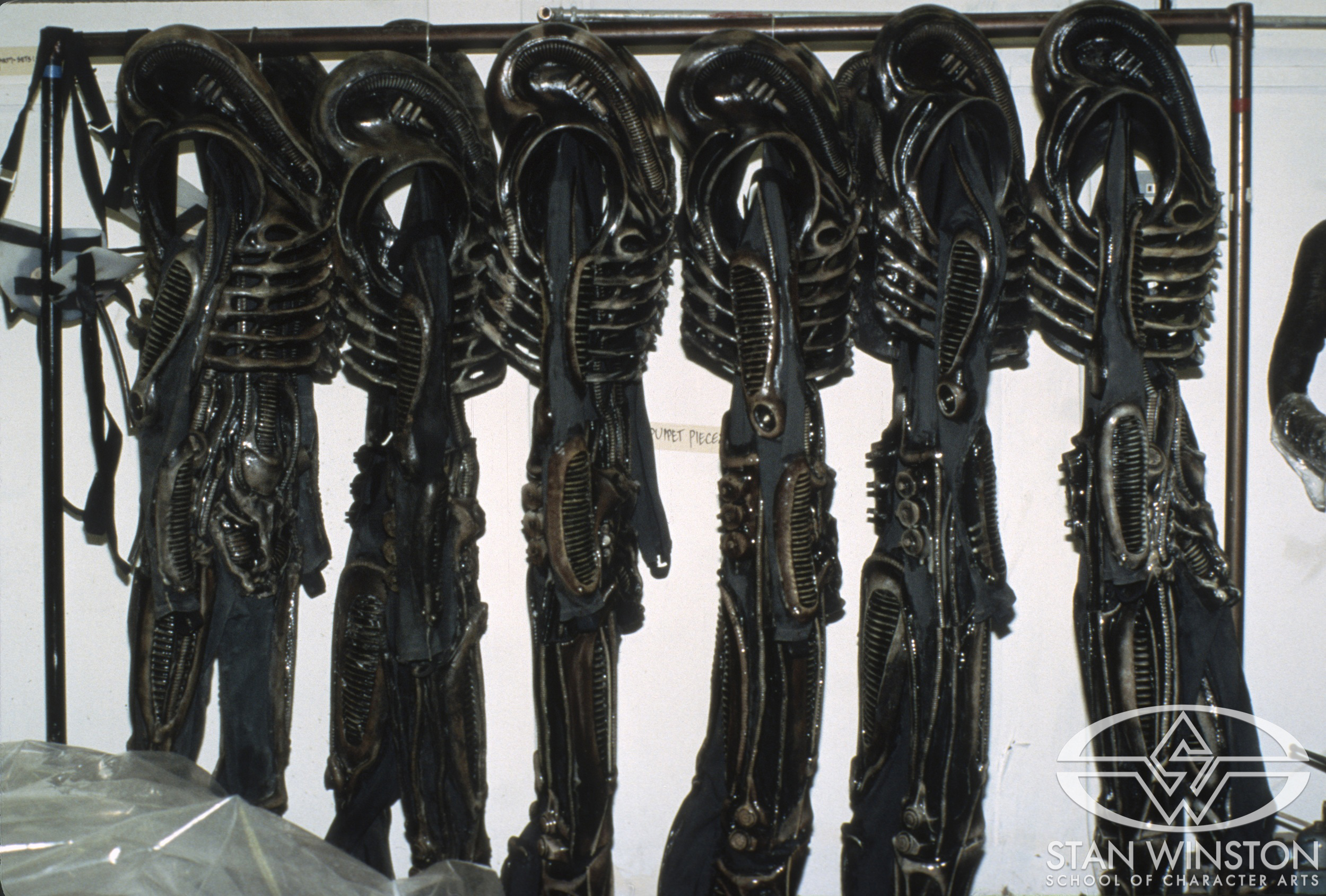 (Alien warrior suits ready for action.)
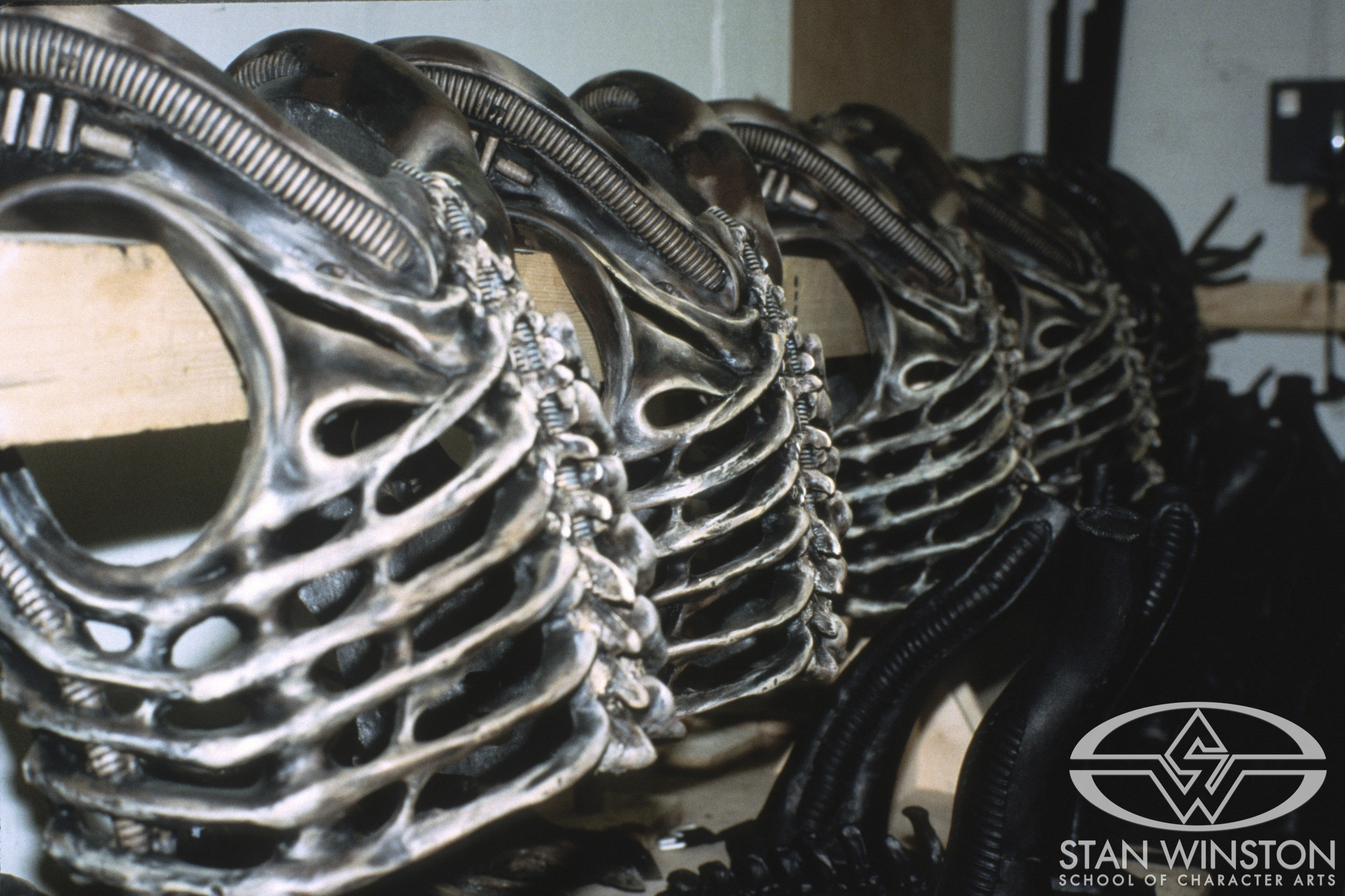 (Painted alien warrior chest pieces.)
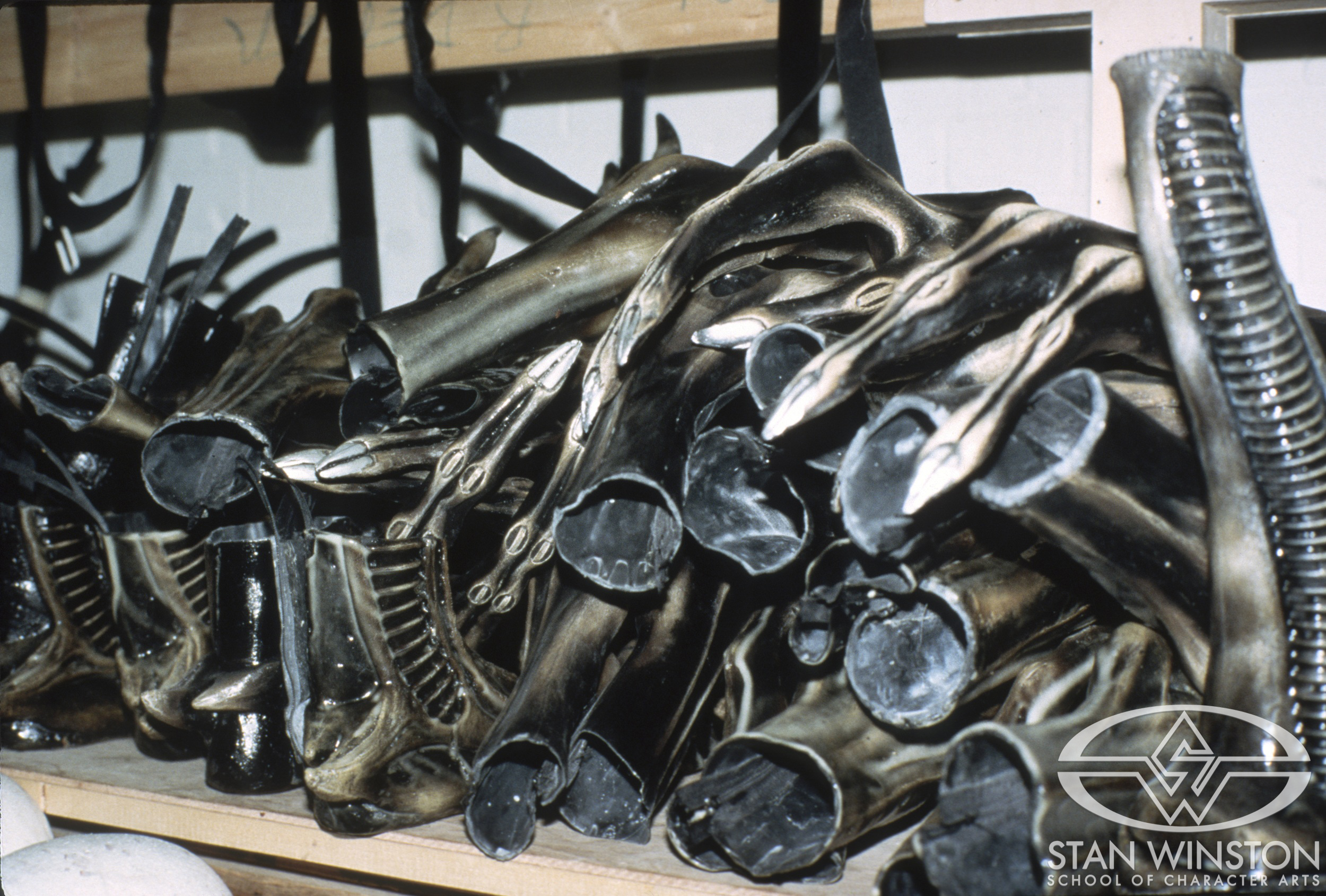 (A collection of xenomorph hands and feet.)
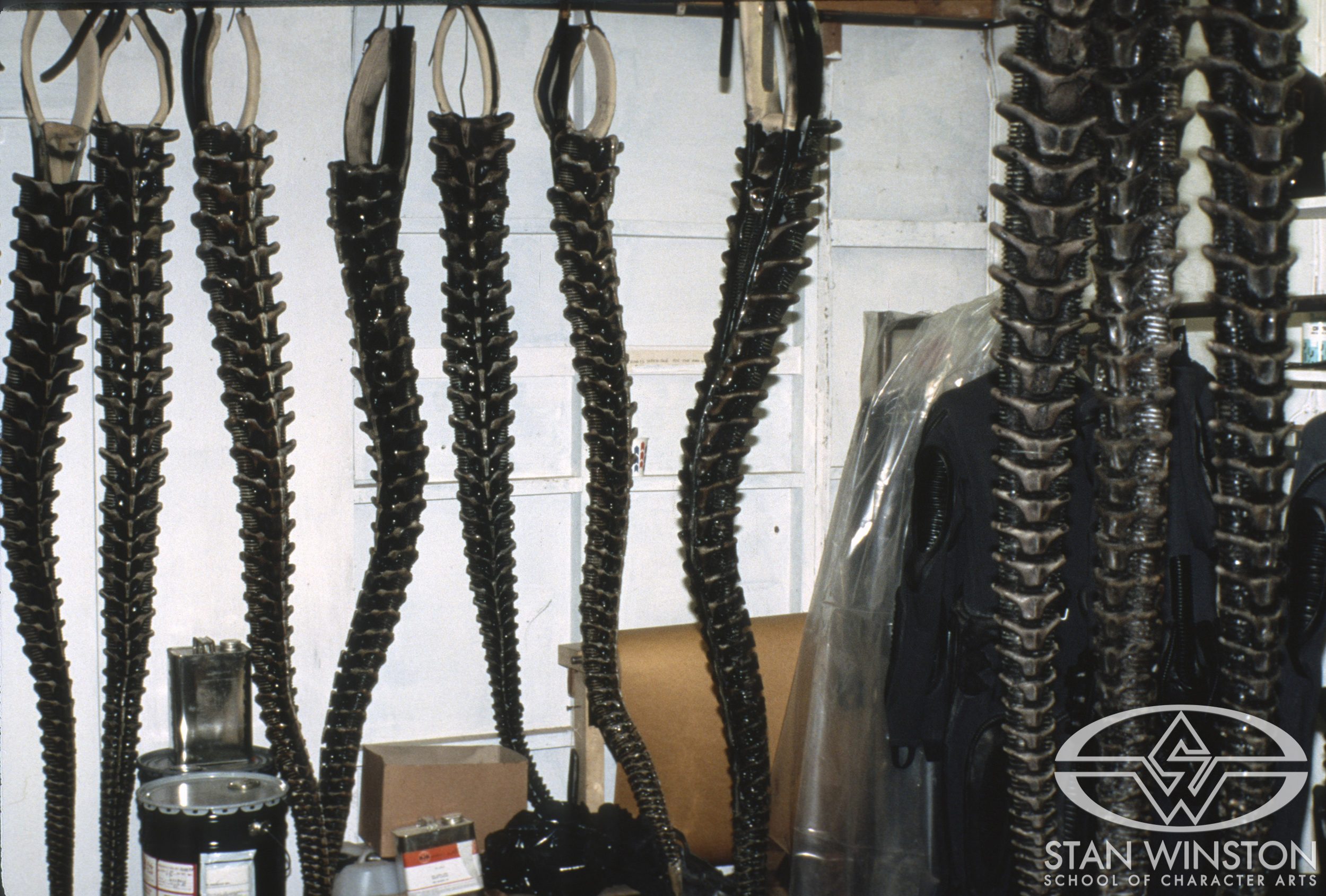
Building Xeno-suits for the Insect-Like Movements
The most significant change in the alien from the first movie to the second would be in the way the creature moved. To disguise the man-in-a-suit look, Cameron choreographed bizarre, insect-like alien movements, achieved in any number of ways, such as hanging performers on wires or dropping them down a corridor, then running the film in reverse to make it look as if they were scuttling upwards.
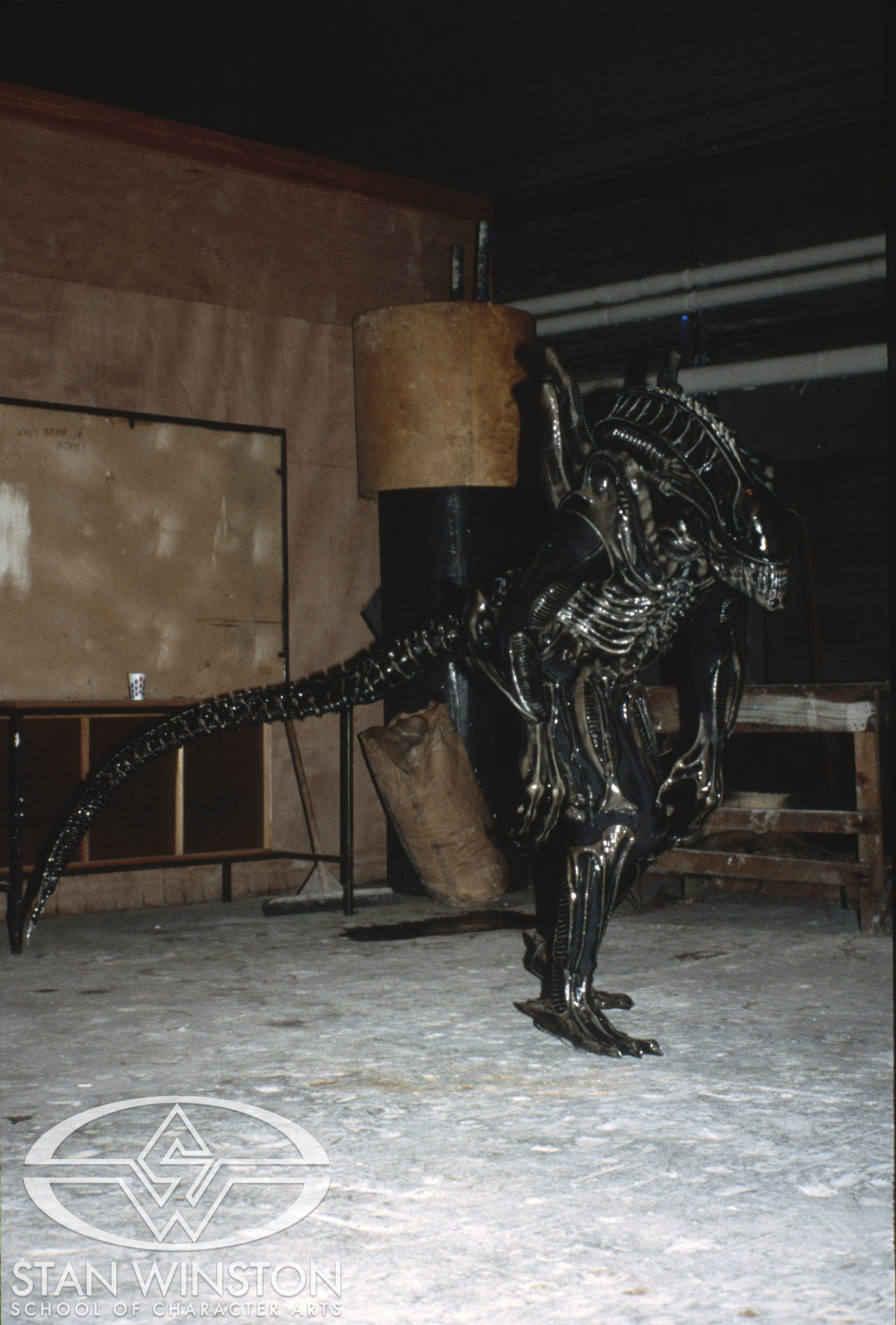 (Tom Woodruff Jr. tests a completed alien warrior suit and head.)
To give the alien performers the flexibility required by such choreography, Winston designed an alien suit that was far less restrictive than the original.
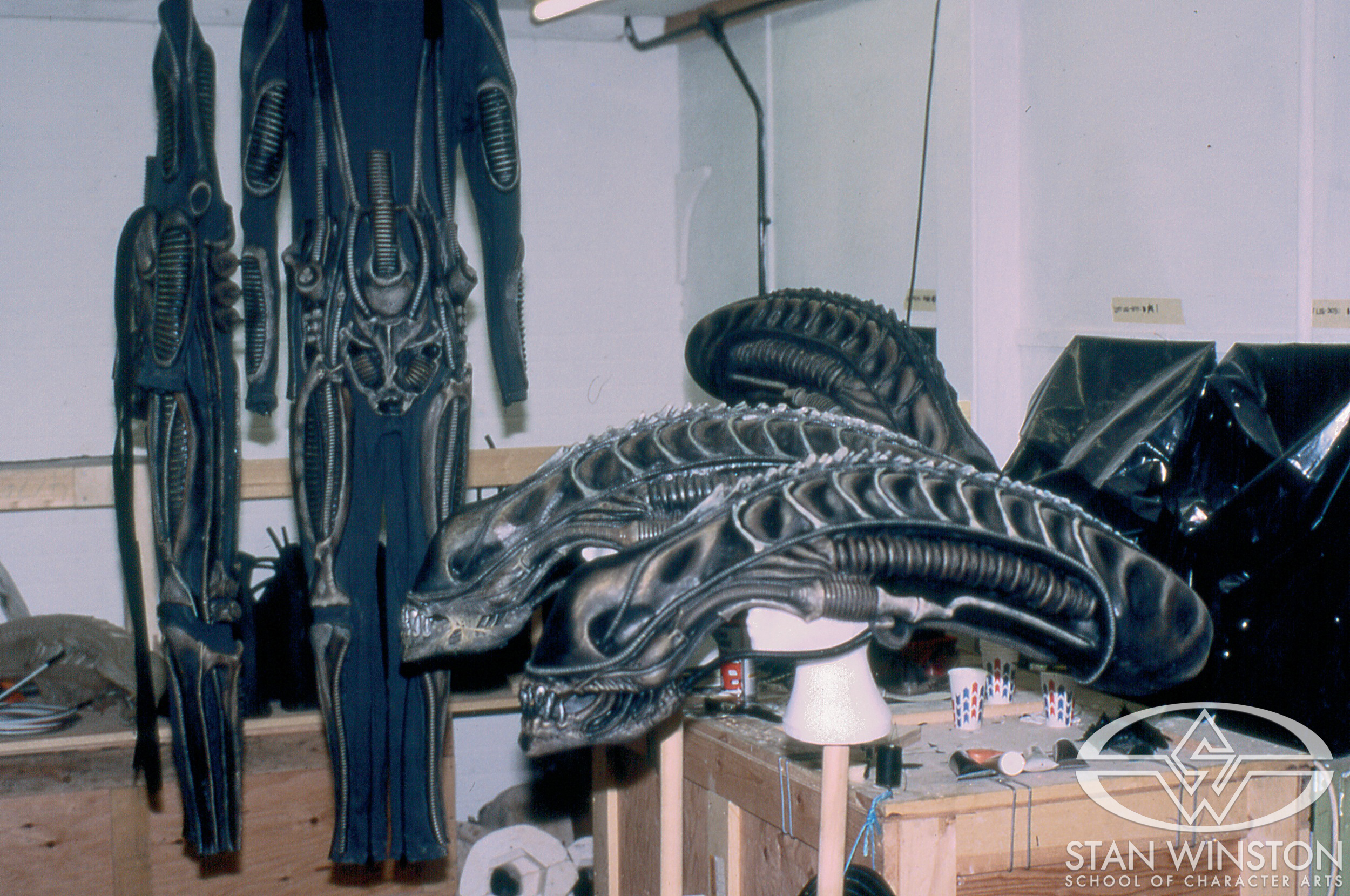 (Xenomorph heads and suits are ready for testing at Pinewood Studios.)
Rather than construct solid pieces that would cover performers from head to toe, Winston’s crew glued lightweight foam latex pieces to a black unitard.
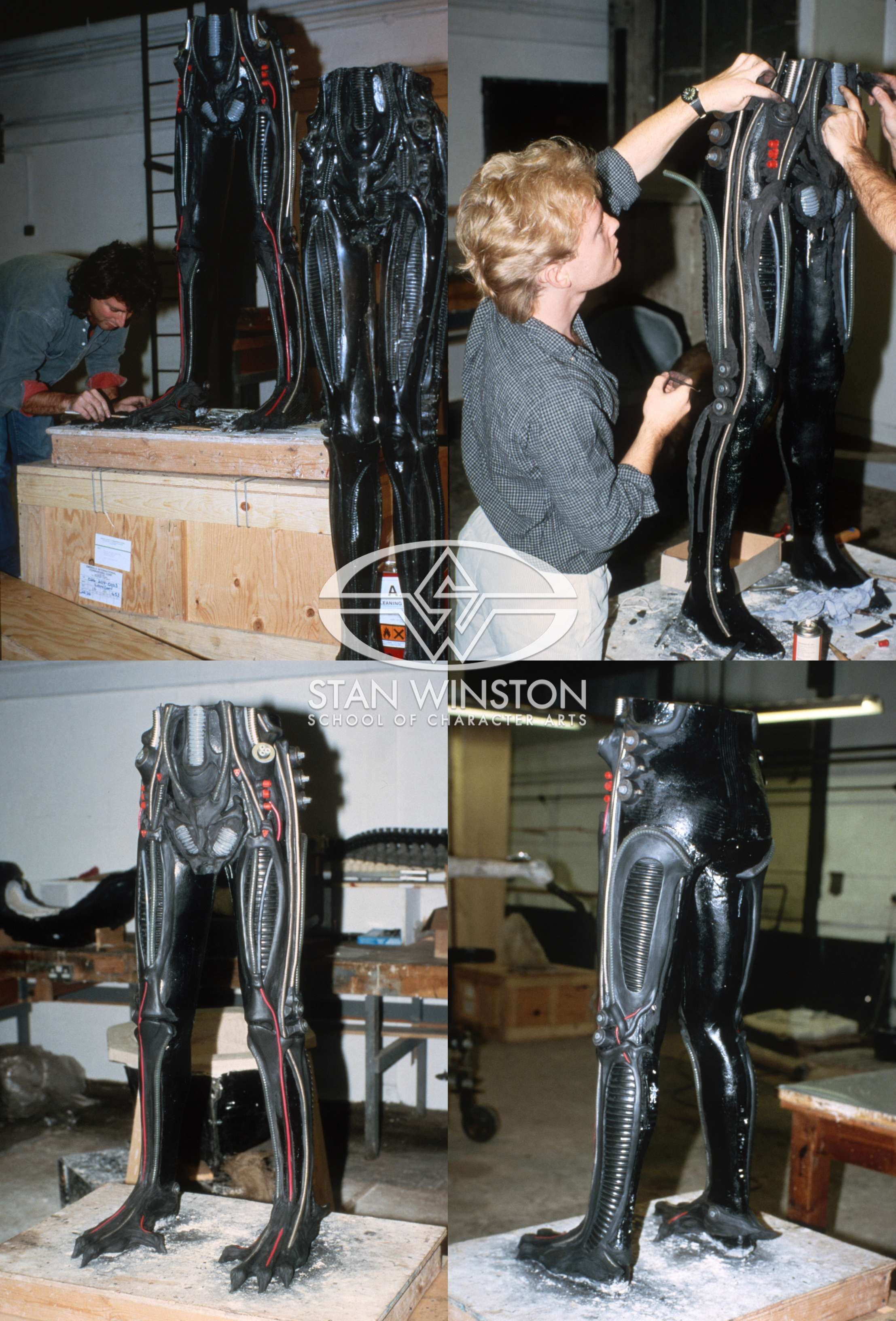 (John Rosengrant and Shane Mahan assemble the leg details for an alien warrior suit.)
“The silhouette of the alien was the most important thing,” Winston said, “and we were able to get that with these suits that were literally black leotards with pieces glued onto them. That gave the performers complete mobility, which allowed Jim to put them on wires and make them crawl up walls and flip the camera upside down so that it looked as if they were scurrying across the ceiling. He came up with all these gimmicks to make it look like they were bugs, not people in suits. And even when you saw them as full men in suits in Aliens, they never looked like men in suits because they weren’t acting that way. They were doing things a man in a suit couldn’t do.”
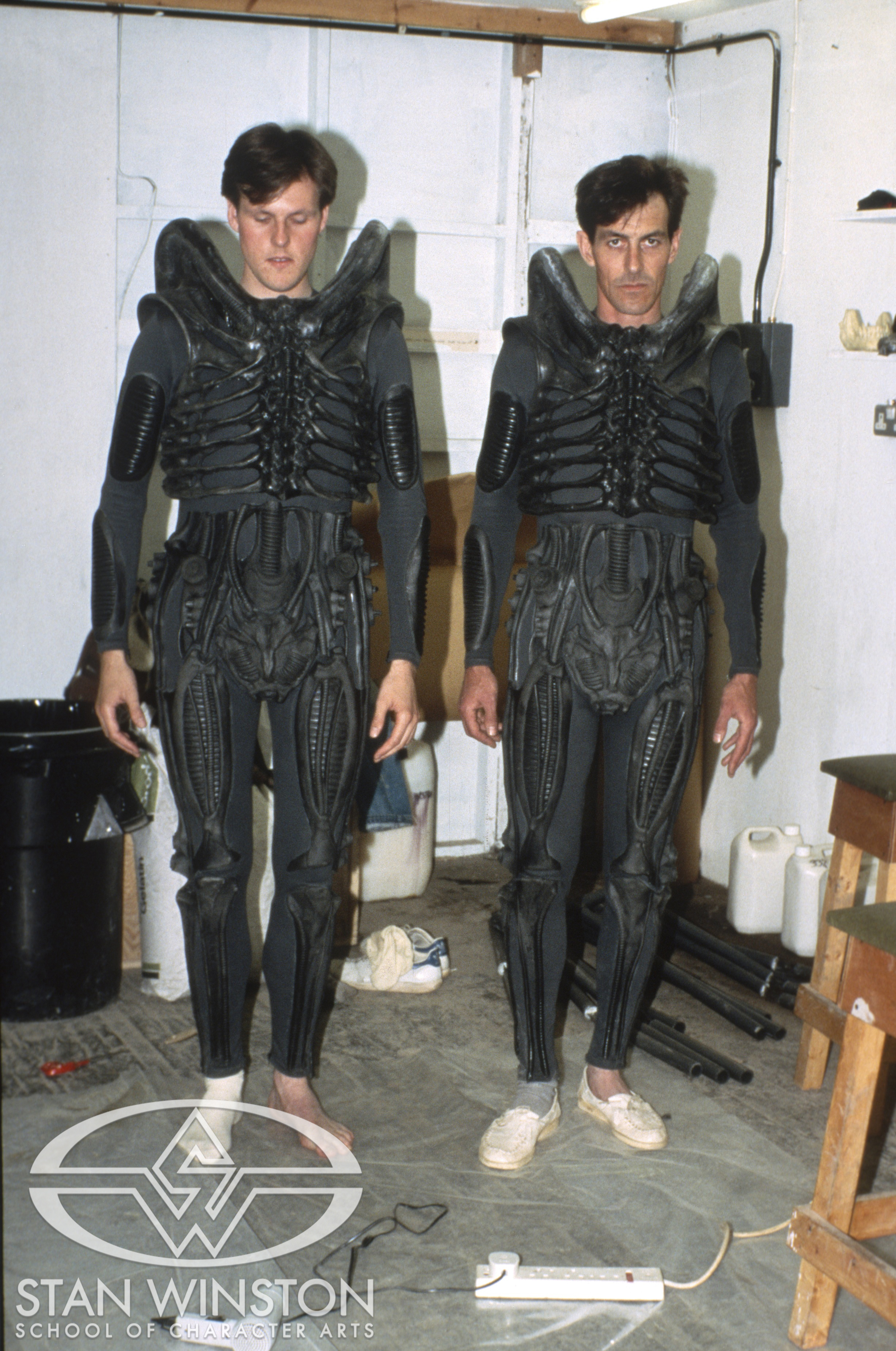 (Test-fitting alien warrior suits on stunt performers.)
The Actors Behind the Alien Warriors
The original alien had been portrayed by Bolaji Badejo, whose seven-foot height had made the character an imposing figure. For Aliens, Cameron and Winston looked for performers who were agile and athletic enough to perform the extremely strenuous moves, determining that camera angles and composition could create the impression of height when needed. Among the alien warrior performers was a stuntman named Simon Crane, who later would become a well-known stunt coordinator and action unit director.
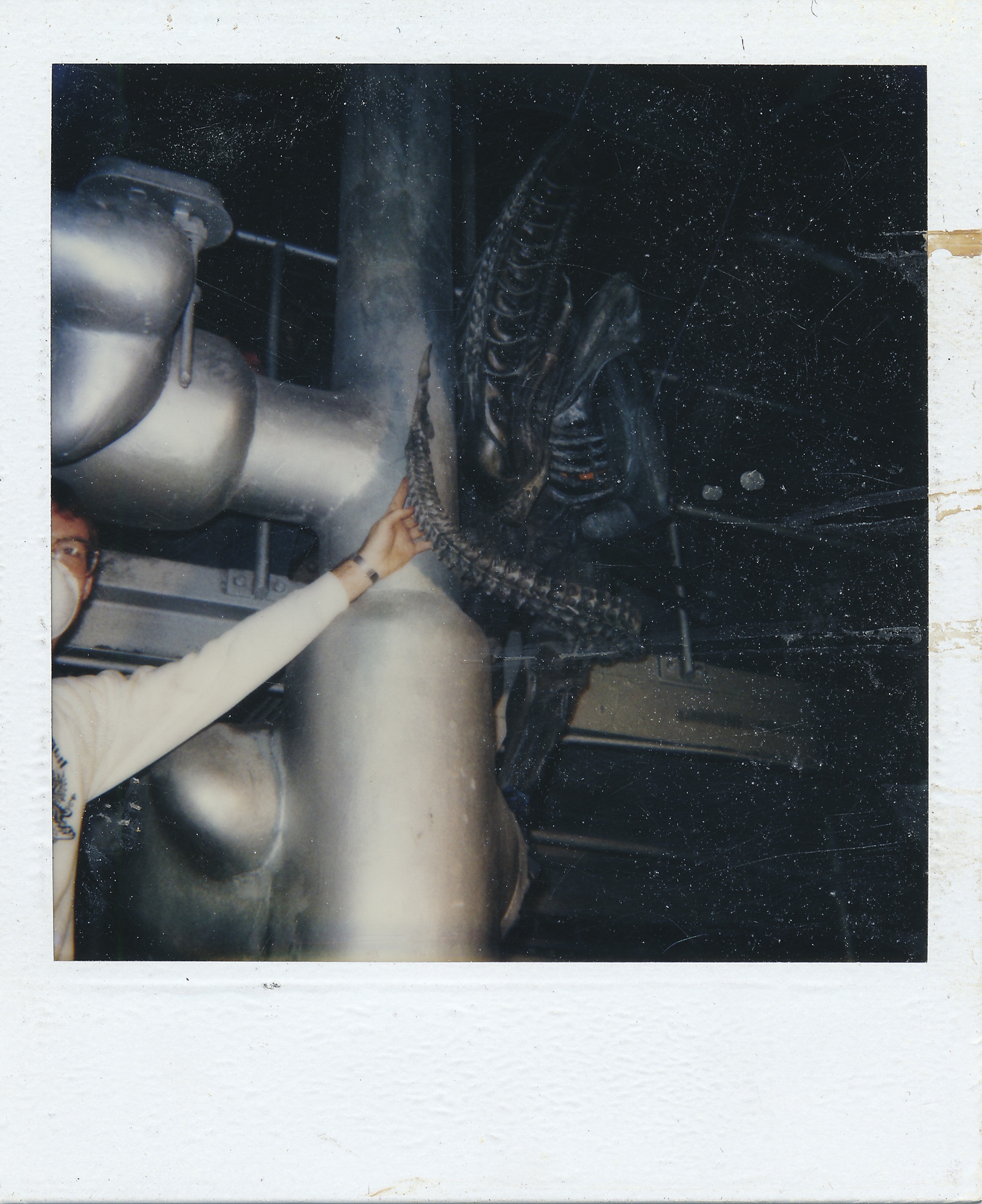 (Richard Landon shows the alien tail while a stunt performer in the alien suit positions himself for a shot on the set of Aliens (1986). Image courtesy of 20th Century Fox.)
Nearly twenty years after the Aliens shoot, John Rosengrant worked with Crane on Terminator 3: Rise of the Machines (2003). “One day on Terminator 3,” Rosengrant said, “Simon came up to me and said, ‘I’m going to get you, mate.’ I didn’t know what the hell he was talking about. And then he said: ‘I was one of those aliens wired up into a wall all day, and you were the guy who kept sliming me up! You had me up there for hours, putting slime on me!’ He’d been one of those poor stunt guys on Aliens, and he remembered me.”
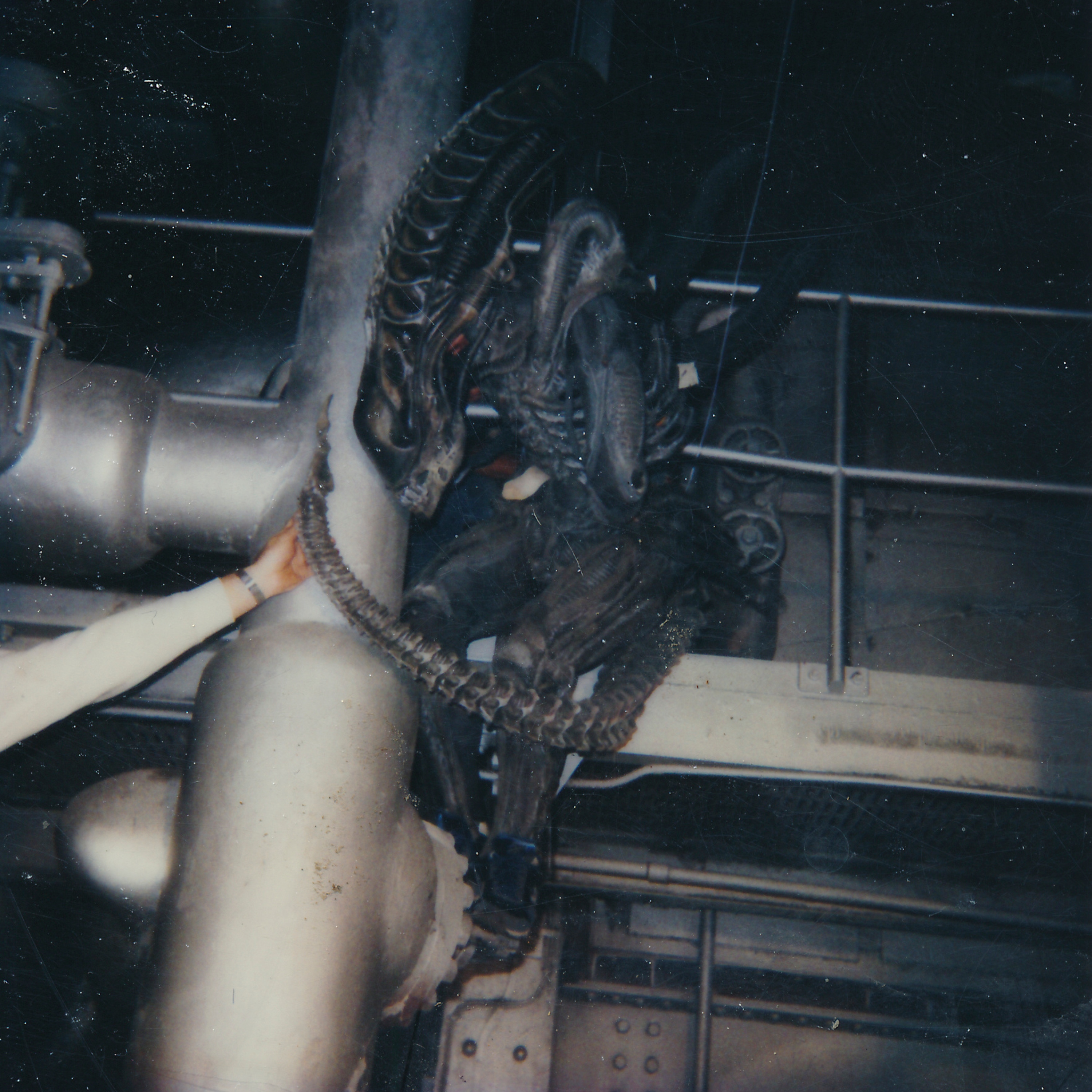 (A stunt performer in the xenomorph suit on the set of Aliens. Image courtesy of 20th Century Fox.)
8-foot-tall Xenomorph Puppets and a Hero Xenomorph Drone
For shots and actions that couldn’t be achieved with performers in suits, Winston and his crew built a half dozen eight-foot-tall alien warrior puppets. Some were rod- and cable-actuated; others were just floppy puppets used for stunt sequences.
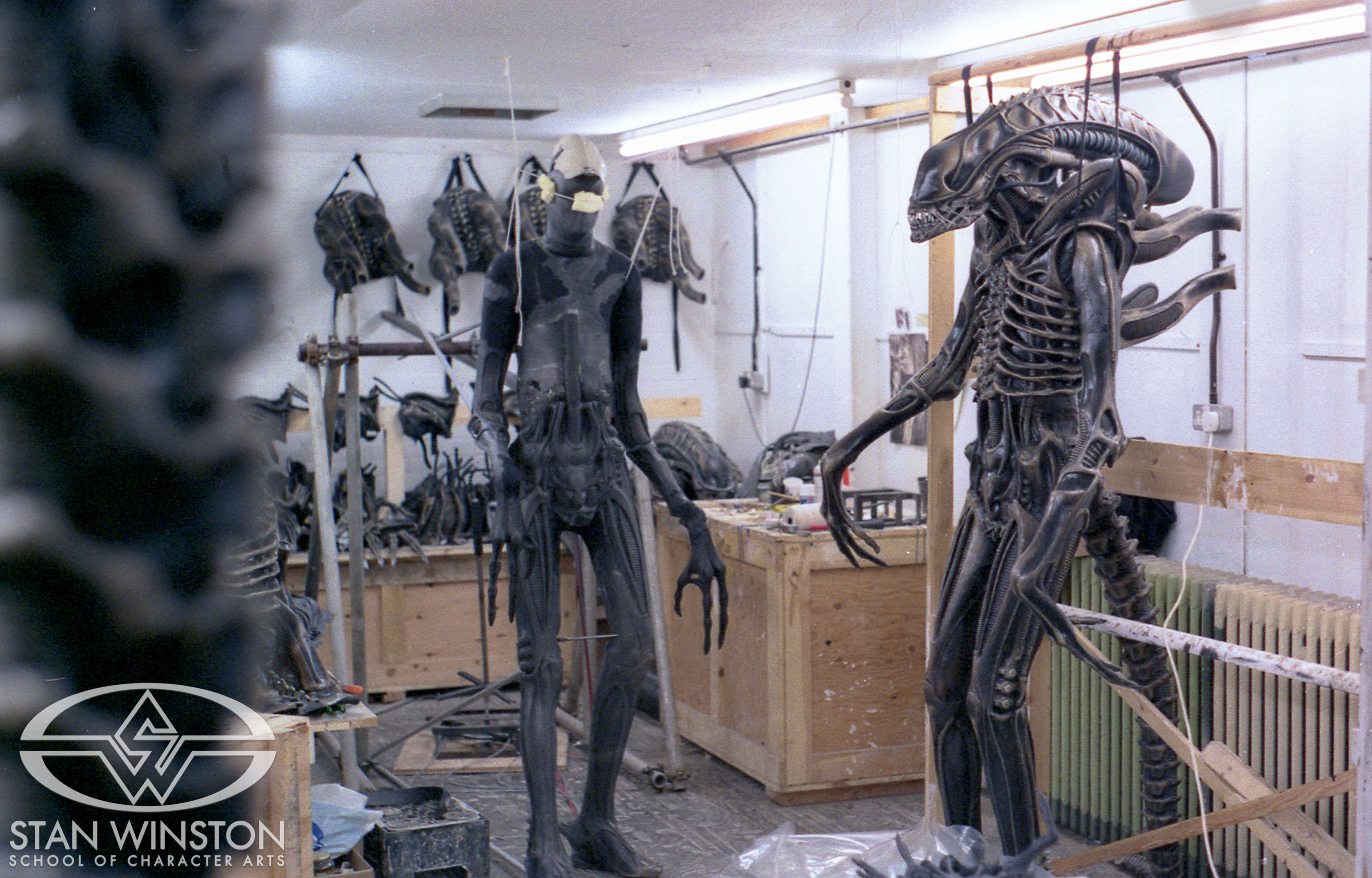 (Alien puppets at Pinewood Studios.)
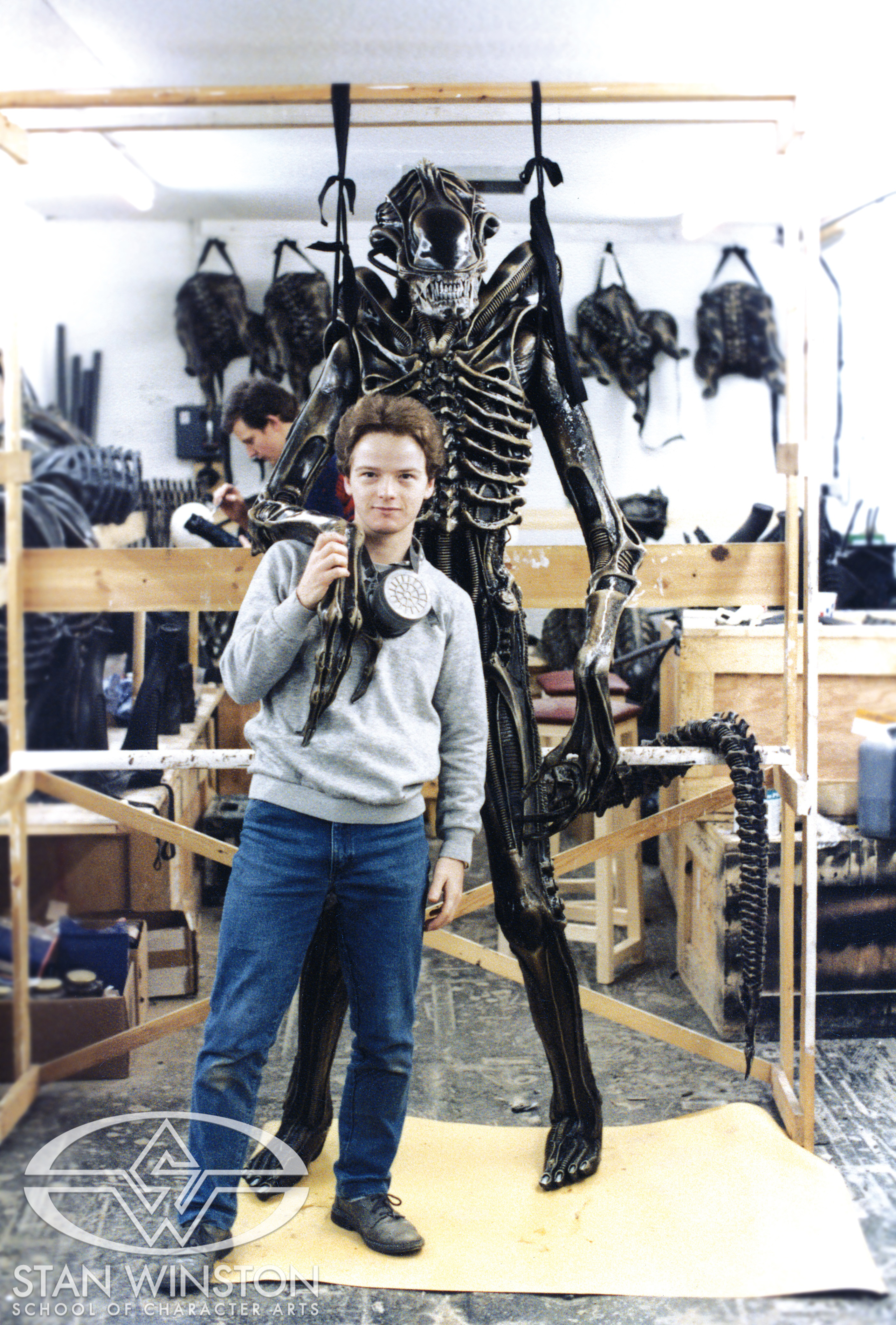 (Lindsay Macgowan poses with one of the eight-foot-tall xenomorph puppets at Pinewood Studios.)
Winston’s crew also built one completely articulated upper-torso puppet with mechanical lips, tongue and jaw, used for close-ups.
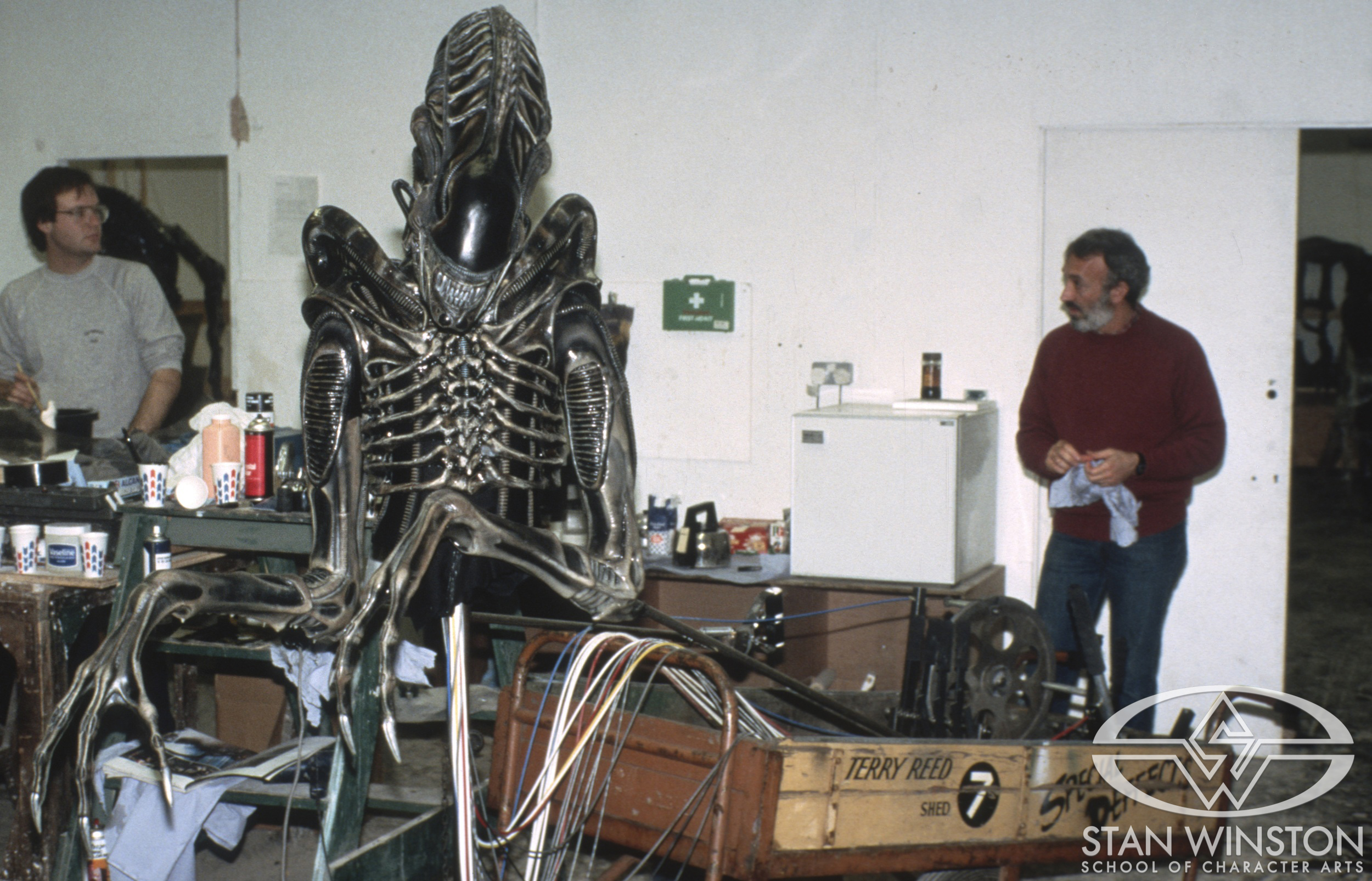 (Richard Landon and Stan Winston prepare the hero alien drone puppet for its on-set debut at Pinewood Studios.)
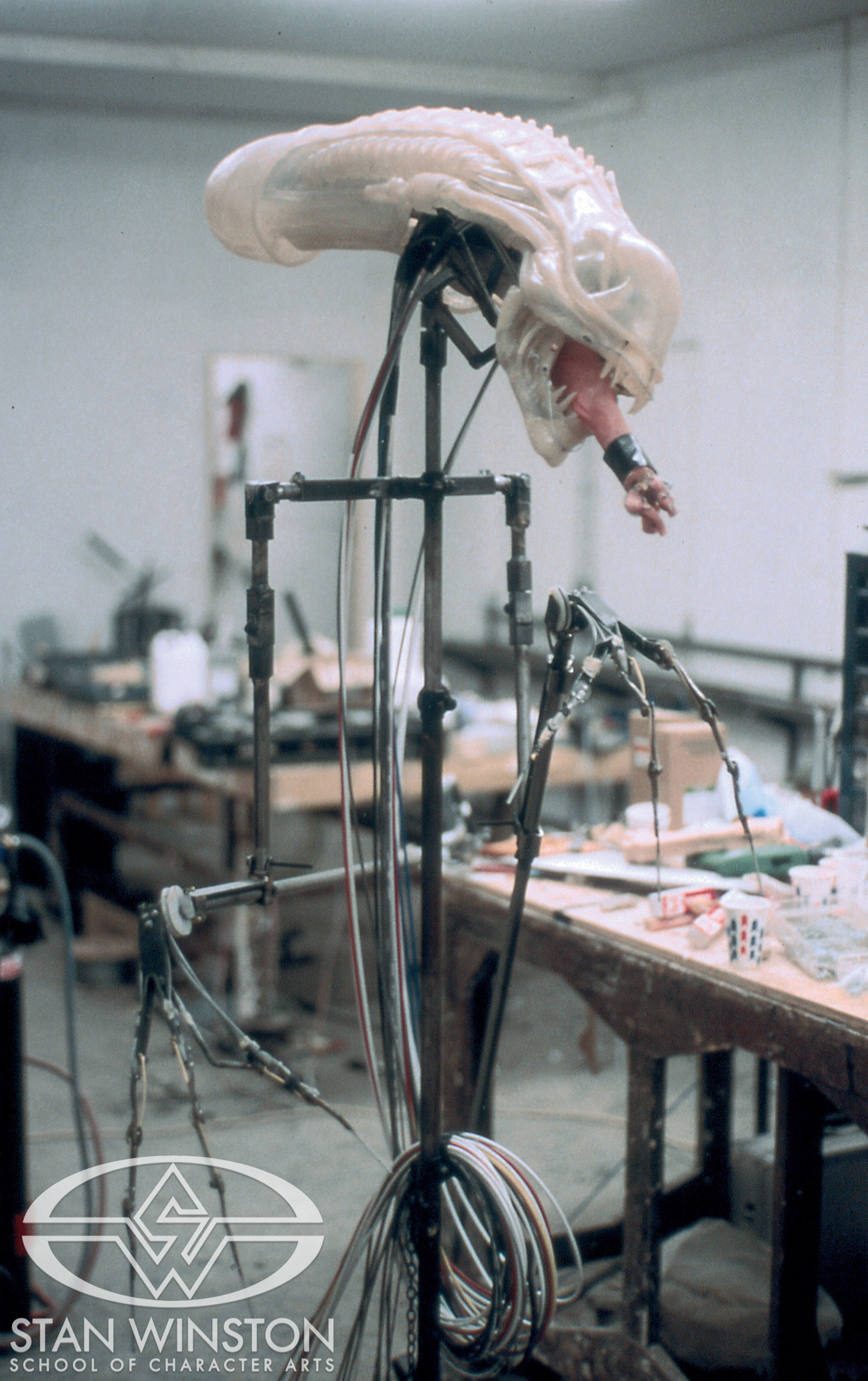 (Work-in-progress understructure of the articulated alien head.)
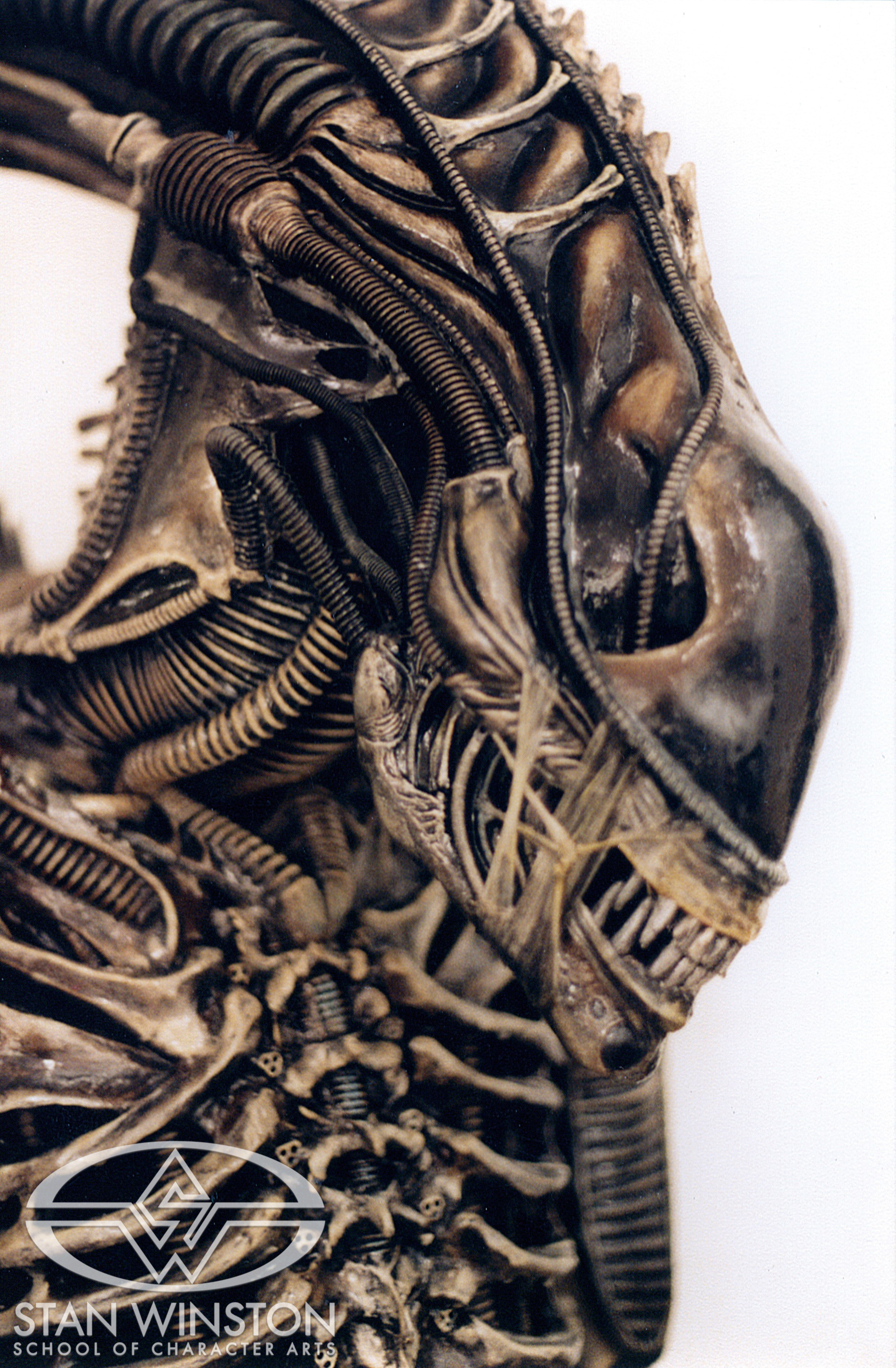 (The hero alien drone head and torso.)
The alien warriors were filmed at Pinewood for colony interiors, and at an abandoned power plant in Acton, North London, for scenes set at the Atmosphere Processing Station.
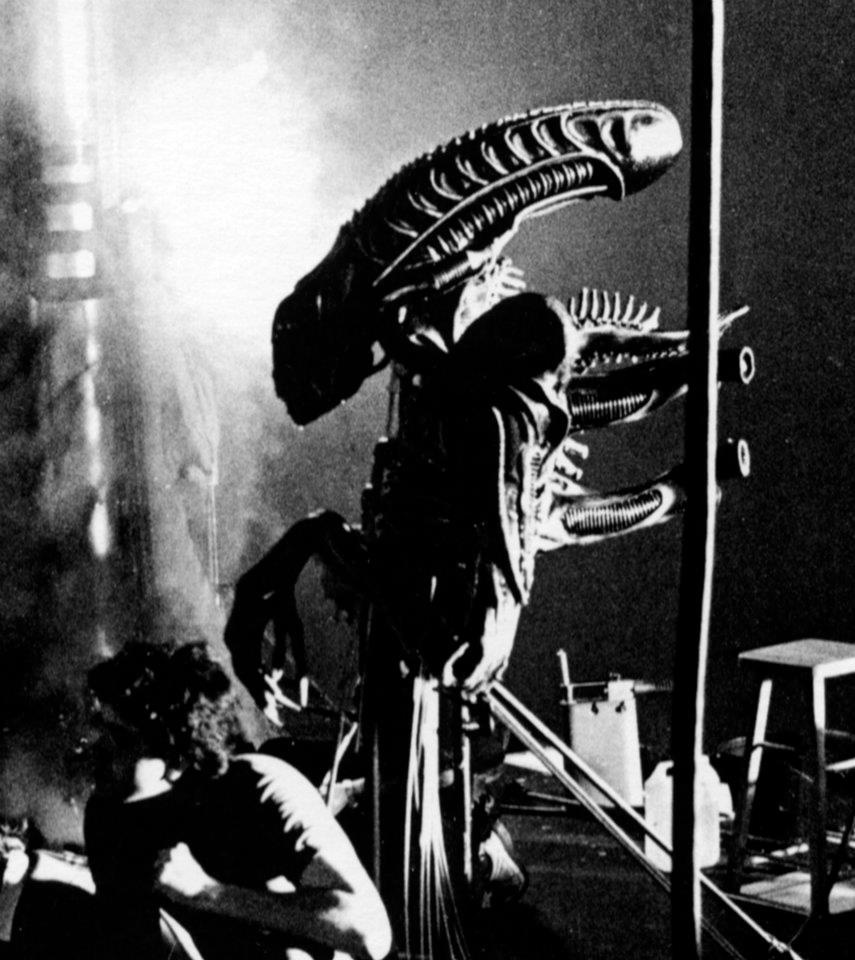 (The hero alien drone on the set of Aliens (1986). Image courtesy of 20th Century Fox.)
- Blog excerpted from The Winston Effect: The Art and History of Stan Winston Studio by Jody Duncan
For more Aliens behind-the-scenes stories, check out these blogs:
- Aliens 30th Anniversary! Revisit Aliens Behind the Scenes at Stan Winston Studio
- Aliens Behind the Scenes - The Facehugger
- Aliens Chestburster Behind-the-Scenes with Film Director and FX Designer Stephen Norrington
- Aliens Movie - The Making of a Xenomorph Drone
- Building Aliens Full-Size Alien Queen Puppet
- Aliens Behind the Scenes: Sculpting the Alien Queen Head with Shane Mahan
- Aliens Behind the Scenes - Alien Queen Attacks Bishop!
More from the Alien Franchise:
- The Real Alien Queen: Sigourney Weaver
- The Practical Effects of Alien: Romulus
- Aliens vs Predator: Requiem's "Predalien" by Amalgamated Dynamics, Inc.
Courses with the creators of Aliens (1986):
- Special Effects Sequence Design with Shane Mahan
- Hybrid Characters: Blending Practical & Digital FX with John Rosengrant
- Character Design Techniques: Sketching, Photoshop, Sculpting & Prosthetic Makeup Testing with Tom Woodruff Jr.
- Monster Suit Performance with Tom Woodruff Jr.
- Directing Creatures with Alec Gillis
- Make a Monster Suit - Part One: Creature Sculpting with Alec Gillis
- Make a Monster Suit - Part Two: Mold Making, Foam Latex & Paint with Alec Gillis
- Zombie Makeup: 3D Prosthetic Transfer Application with Howard Berger
- Animatronics Design Basics with Richard Landon
- Cable Mechanism Basics - Tentacles with Richard Landon
- How to Make Animatronic Characters - Organic Mechanics Part 1 with Rick Lazzarini
- How to Make Animatronic Characters - Organic Mechanics Part 2 with Rick Lazzarini