By Michael Martin
Warning: Massive Spoilers Throughout!
Watch Alien: Romulus at home! The film is now available at Digital retailers (Prime Video, Apple TV and Fandango at Home) and comes with never-before-seen bonus extras!
The Alien Franchise
Since the space tug Nostromo, hauling its interstellar ore refinery, first set down on LV-426 to answer a distress beacon in Alien (1979) directed by Ridley Scott (Blade Runner, Prometheus), the stunningly original xenomorph designs of Swiss artist H. R. Giger and strong performance by Sigourney Weaver as Ripley, have haunted filmgoers’ dreams and nightmares.
Ripley’s storyline continued with Aliens, directed by James Cameron (The Terminator, Avatar), where the lone human survivor from the Nostromo returns to LV-426 with a team of gung-ho Marines. More films followed in the long-running franchise, including prequels, a soon-to-be-released streaming series, an animated web series, and even a couple of crossover films with another Stan Winston Studio creation, the Predator.
Alien: Romulus (2024)
In the Alien timeline, Alien: Romulus takes place in the fifty-seven-year gap between the events of the first film, Ridley Scott's Alien, and the second film, James Cameron's Aliens. Romulus tells the story of a team of young colonists trying to escape their indentured servitude on a Weyland-Yutani-controlled planet who decide to scavenge stasis gear from a derelict space station in the hopes of using the equipment to flee to another planet outside of the multi-planet mega-corporation's reach.
Once on the station, however, they discover that the xenomorph from the original Nostromo wreckage has been found and bioengineered, with the station's crew being killed by the resultant alien creatures. The scavengers also realize that the station will soon crash into their planet's rings and be destroyed. With the clock ticking, the half-dozen scavengers will face more than just xenomorphs and facehuggers; they will encounter a new alien offspring.
 (Alien: Romulus director Fede Álvarez; the director studies the xenomorph at Legacy Effects. Images courtesy 20th Century Studios and Legacy Effects.)
Helmed by Uruguayan director Fede Álvarez (Don't Breathe, Evil Dead), Alien: Romulus stars Cailee Spaeny (Pacific Rim Uprising, The Craft: Legacy) as Rain, David Jonsson (the upcoming Bonhoeffer) as Andy, an android, Archie Renaux (Shadow and Bone) as Tyler, Isabela Merced (Transformers: The Last Knight) as Kay, Spike Fearn as Bjorn, and Aileen Wu as Navarro.
 (Top: Matt Winston, Shane Mahan, Alec Gillis. Middle - Viktoria Stieber, Iván Pohárnok, Ian Hunter. Bottom - Joe Dunckley, Cameron May)
Practical creature and spaceship effects for the film were created by a Murderers' Row of award-winning effects artists and shops, including many of whom had worked on James Cameron's Aliens with Stan Winston. Stan Winston School co-founder Matt Winston chatted with co-founder of Legacy Effects, Shane Mahan (Iron Man, The Mandalorian), Alec Gillis (Alien: Resurrection, The Predator) from Studio Gillis, Ian Hunter (Inception, Interstellar) from Pro Machina, Iván Pohárnok (The Witcher, Alien vs. Predator) and Viktoria Stieber (The Batman, John Wick: Chapter 4) from Filmefex, and Wētā Workshop's Joe Dunckley (Elysium, The Lord of the Rings: The Rings of Power) and facehugger animatronics supervisor, Cameron May.
Jump To Section
- Making Miniature Spaceships
- The Xenomorph Lifecycle
- Making Practical Facehuggers
- The Chestburster
- The "Offspring" Embryo
- Making Old and New Creatures for the Alien Franchise
- Designing the Xenomorph in Alien: Romulus
- A New Stage in the Alien Lifecycle
- The Making of the Offspring Hybrid Alien
- Sculpting the Original Nostromo's Dead Alien Head
- Building Futuristic Weapons
- Creating Realistic Body & Gore Effects
- Andy the Android
- Where Alien: Romulus Fits in the Franchise
Making Miniature Spaceships
It was director Fede Álvarez’s intention to lean heavily on practical effects for Alien: Romulus, including creature effects, weapons, and spaceships. To do this, he pulled in practical and miniature effects artists who had worked on previous films in the Alien franchise.
Both the original Alien and its sequel, Aliens, used highly detailed miniature effects to realize their futuristic visions. The original Nostromo model and its refinery were created by special effects supervisors Brian Johnson (Space: 1999, The Empire Strikes Back) and Nick Allder (Space: 1999, Underworld). The Space Marines’ dropship, the Sulaco, and the windblown LV-426 environs were created by a team led by Robert and Dennis Skotak (The Abyss, Titanic).
For the Alien: Romulus spaceships, Fede chose visual effects supervisor Ian Hunter and Alec Gillis, Camille Balsamo-Gillis, and Reid Collums's practical effects company Pro Machina. Two-time Oscar winner Hunter (Inception, Interstellar, Once Upon a Time in Hollywood) is no stranger to the Alien films and is also an SWSCA instructor.
Alien: Romulus is the second Alien franchise film that master miniature designer and builder Hunter has worked on. “We worked on Alien: Resurrection when I was part of Hunter/Gratzner Industries,” Hunter said. “For the crew that we had at Pro Machina working on the Alien: Romulus miniatures, it was a dream come true because they had grown up as kids seeing the Alien movies, which inspired them to get into the business.”
 (Alien: Romulus director Fede Álvarez reviews the completed spacecraft miniatures at Pro Machina. Images courtesy Pro Machina.)
According to Hunter, director Fede Álvarez “was really adamant that he wanted to place this movie between the first two [Alien films] because, to him, the first two are the best, you know?” Both Alien and Aliens sparked Álvarez’s interest in becoming a filmmaker. “So, he wanted to sort of go back to the style and the substance of those first two movies, which was to use a lot of practical effects, both with the creatures and, in our case, for the spaceships. He thinks practical work gives it the character, flavor, and style that inspired him and many others.”
"[Álvarez] wanted miniatures in this film," added Hunter. "He contacted us, sent us some designs, and we talked for quite a while over what to build.” Eventually, Pro Machina was tasked with building two miniature spacecraft for the movie.
Designing Alien: Romulus' Spaceships
“Alien: Romulus opens with a space probe that goes searching through space for a particular object, and that space probe was built as a miniature," said Hunter. "The hero spaceship is the Corbelan IV, which is this sort of dump truck that takes minerals from the planet up to space. And that was the other miniature that we built.”
 (The Corbelan IV rises above the planet and approaches the derelict space station. Images courtesy 20th Century Studios.)
“Matt Savage did the design, but he took a lot of cues from the original movie. So, there's a lot of cues from the Nostromo in there," said Hunter. The probe's design inspiration was taken from the Narcissus shuttle/lifeboat ship that Ripley uses at the end of the first film. "They were sending us pictures saying, here's the probe, this is the engine that we want to look like the one on the Narcissus, or, here's these exhausts, we want it to look like the ones from the Nostromo. So, we were actually incorporating a lot of that detail.” These decisions were all about visually communicating that the ships were all “from the same company," said Hunter. "It's the same world. So, you put those same design cues into the miniature. Audiences see that, and they know that they're in the same realm as the Alien movies.”
The Pro Machina team was relieved that there was a lot of good reference material to work from. “Fortunately, there's quite a bit of behind-the-scenes photographs of the miniatures [from Alien]. The Nostromo itself, not too long ago, had been restored and sold at auction. So, there were a lot of pictures of that," said Hunter. However, the goal was not simply to copy the earlier films' designs. “These were new designs, but they were incorporating that detail. Fede gave us a lot of leeway to just make it look like something from Weyland-Yutani. We also [found] our own references... to throw some more Alien-influenced details they hadn't picked out.”
Building Large-Scale Spaceships
When building miniatures for film, going bigger is better because more details can be included, making the miniature appear realistic on camera. An eight-foot-long Star Destroyer was used for The Empire Strikes Back and Return of the Jedi. The principal shooting model for James Cameron’s Titanic was almost thirty feet long. For the two model ships built for Alien: Romulus, the Pro Machina team went with 1/10th scale. "When there was some discussion about doing more elaborate work with the ships, including some crash scenes and some other action scenes, we decided we wanted to build them in a relatively large scale," said Hunter. "We came up with 1/10th scale, which made them large enough to hold up to close-up photography and potentially some action, but not so large that we couldn't actually maneuver them around to photograph them. The probe was maybe five or six feet long, and the Corbelan IV (the scavenger’s ship) ended up being about ten and a half feet long.”
 (L - Vacuform pieces ready to be trimmed and applied to the ship. R - The nearly assembled probe ship. Images courtesy Pro Machina.)
 (Pro Machina team members Jon K. Miller, Bonnie Ephraim, and Calder Greenwood add details to the miniature ships. Images courtesy Pro Machina.)
 (A view of the intricate detail added to the top of the probe model. Image courtesy Pro Machina.)

 (Views of the finished six-foot probe model. Images courtesy Pro Machina.)
“In order to get the [spaceship] models to have that kind of beat-up feel, they weren't completely done as 3D prints. They weren't completely done as hand fabrication either. It was a combination of the two to give it some character. We had [Matt Savage's] digital models to work with, and we sub-divided those digital models into smaller pieces. For some pieces, we CNC cut patterns to vacuform the main body. Some parts we 3D printed, all the little details, and some of the parts we had modelmakers actually making the details and then molding and fabricating them that way.” Once the parts were generated, the Pro Machina team began assembling them on an armature made out of a piece of truss.
 (Sara Villarreal, Devin Schneider, and Camille Balsamo-Gillis work on the Corbelan IV model and the space probe. Images courtesy Pro Machina.)
 (Reid Collums, Tawnya Diaz, Noah Jones, Jon K. Miller, and Emma Siate at work on the Corbelan IV. Images courtesy Pro Machina.)
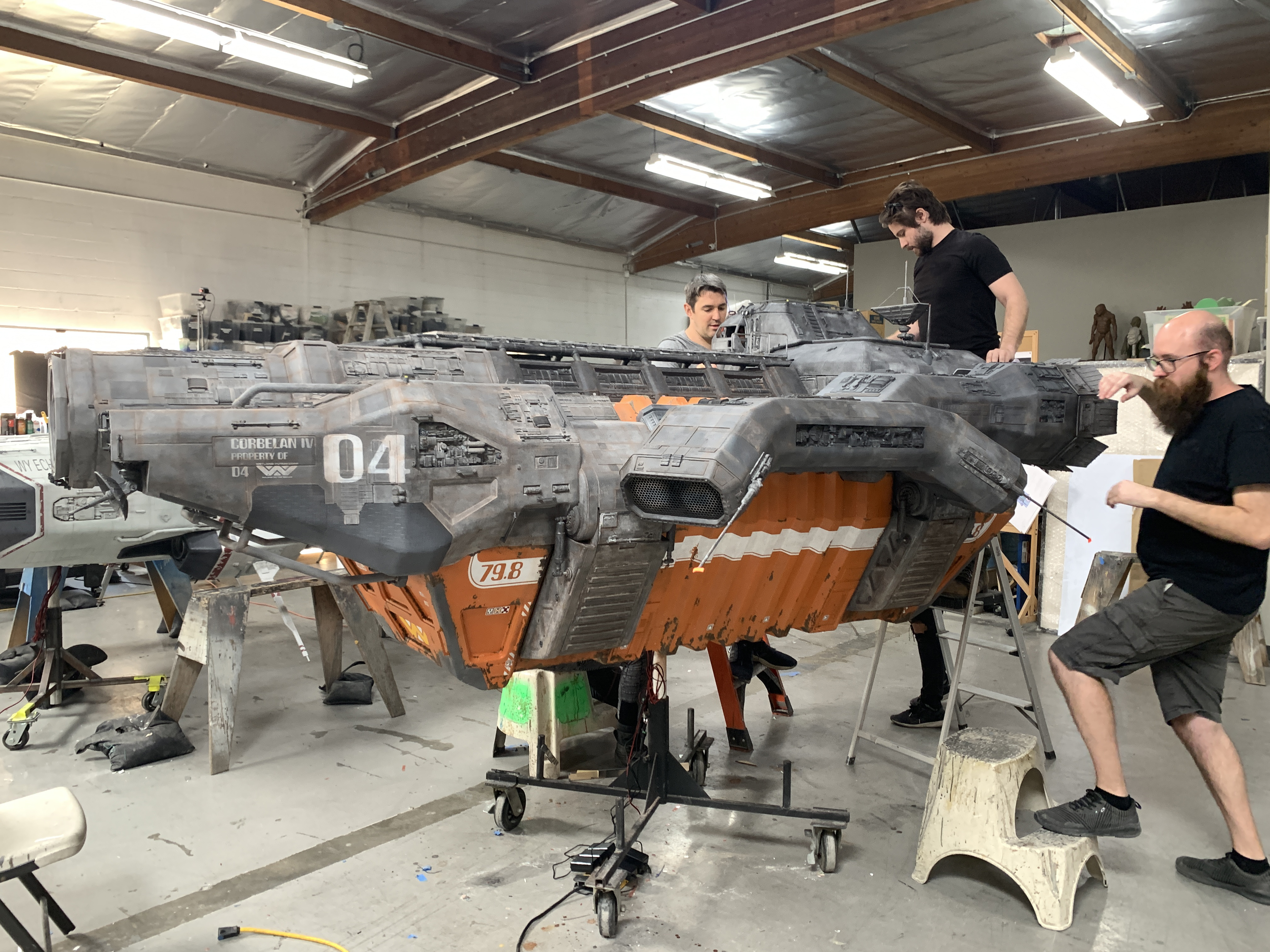 (Reid Collums, Zac Teller, and Jon K. Miller add final details to the nearly finished Corbelan IV. Image courtesy Pro Machina.)
Incorporating truss into the armature was a strategic decision. “The Pro Machina team used off-the-shelf film industry grip gear to construct the part of the armature that held the models." This approach enabled them to use speed rail fittings and other grip-related gear to support the model and make it user-friendly. Returning to the topic of combining high-tech and handcrafted elements, Ian Hunter said, "We handmade the heat blankets, the tile that you would expect to see on a space shuttle, in a couple of different patterns. Those were all vacuformed out and hand-applied in pieces onto the model. So, it gave it a man-made look because [the team] actually covered it with hand-applied details." This human touch helped to take the ships out of the purely digital world and make them appear as if they had been fabricated in the physical world by people welding steel together. “And the model makers loved it too," said Hunter. "They're used to working with 3D printed parts, but to them, there's something about taking that and then putting your hands on it and just really turning it into a piece of art. And I think that sort of comes through.”
Another detail that came through in the creation of the miniatures is the use of painted details requested by the director. “Fede asked that we put a bunch of graffiti on the containers. So, my painter went to town. She loves Blade Runner and Alien, so there are Tyrell references and other things, basically saying that the Alien universe and the Blade Runner universe are actually one and the same. But that's hidden.”

 (The finished Corbelan IV model. Images courtesy Pro Machina.)
Although they appear incredibly functional, there was no need to build any moving parts for the spacecraft models, just removable ones. For example, the Corbelan IV “did have things like the landing gear that could be swapped out for extended or retracted, depending on if it's in space or not in space."
Once Pro Machina finished the models, the plan unexpectedly changed, “Gentle Giant Studios came in, scanned the models, and then did photogrammetry. So, they had elaborate photographic maps of the paint and the texture. They had really accurate scans of the models, and then we put them in crates, and they went away. We were like, ‘Oh my God, all this work and we wanna photograph it. And it didn't happen.'"
Last Minute Shoots for Alien: Romulus
But that was not to be the end of the models and Ian Hunter and Pro Machina's involvement in Alien: Romulus. “Funny enough, we get a call, and the studio says, ‘Fede wants to do an EPK (Electronic Press Kit) with the [spacecraft] models.’ I said, ‘Well, okay, so we're gonna pull them out of storage, and we'll set them up on a stand,' at least with the model behind them, somebody will see them."
“A couple of days before the shoot, like on a Wednesday, we get a call, and they ask, ‘Can you guys do rain [effects] for the model?’ And we said, ‘Well, yeah, but like, it's Wednesday and we're gonna shoot Friday.’” So, the Pro Machina team scrambled to make it happen with sprayers, spray guns, air compressors, and fans. "We took that with us with the model to the stage.”
That was when Hunter and the Pro Machina crew discovered that the shoot was not going to be for a press kit after all, "that's just what Fede told the studio. Sneaky." What Fede really wanted was to get some practical model shots that he could cut into the film. The shots were to be used in the liftoff sequence when the Corbelan IV flies through a storm as it leaves the planet's surface.
“So, we go to this stage with an LED screen. And Fede's got the backgrounds. It's either space backgrounds or the space station, different backgrounds. So, he takes the camera; we wheel the spaceship in. Now we've got the digital background, we've got the real spaceship, and we've got the camera. And we shot probably around a dozen or so shots. [Fede] had us use fans and water, spraying everywhere, shaking the [model] to make it look like it's going through a storm. It was just an amazing gonzo attempt on his part to put a real model in the movie," said Hunter. “I talked to the VFX editor, and he asked me, ‘Were you part of that subversive miniature shoot?’ And I said, ‘Yeah, I was the guy shaking the ship.’ So, they were able to get a handful of [model shots in], which was fantastic for us."
 (The Pro Machina crew with the Corbelan IV build underway. Image courtesy Pro Machina.)
The Xenomorph Lifecycle
As depicted in the previous Alien films, the alien lifecycle starts with facehuggers, spider-like creatures that spring from their leathery eggs onto an unsuspecting host’s face. The facehugger then implants a xenomorph embryo inside the throat of the host and eventually falls off dead, its job in the lifecycle complete. However, The impregnated host is unaware that an alien lifeform is growing inside them. The first Alien featured one terrifying facehugger (although thousands of eggs were visible in the bowels of the spaceship found by the Nostromo crew). The second film, Aliens, featured a pair of facehuggers chasing Ripley and Newt around a water-soaked medical bay. For Alien: Romulus, Fede Álvarez wanted more. Much more.
The Alien: Romulus Facehuggers
Once onboard the derelict space station, the Alien: Romulus scavengers discover what happened to the original crew of the station. Unfortunately, they also accidentally release an army of facehuggers desperate to plant xenomorph embryos inside the scavenger’s bodies.
 (Image courtesy 20th Television.)
Wētā Workshop had already been working on facehuggers for the upcoming series Alien: Earth, so it was a no-brainer to have them do something similar on Alien: Romulus. Winston spoke with Joe Dunckley and Cameron May from Wētā Workshop about their work on Alien: Romulus and the challenge of creating an army of practical facehuggers for the film. “We're huge fans of the Alien franchise," said Dunckley. "It's probably one of the reasons why we're all sitting here today, actually. The experience of watching the first two films as a kid blew my mind, and I think it drove me to get into the industry.”
Making Practical Facehuggers
Dunckley talked about working with director Fede Álvarez, “He wanted everything to be physical. It's wonderful when you have a director who is a fan of physical effects.” Fede was a diehard Alien fan, to boot. "He's a huge fan of the franchise. And that comes across in the finished product. The franchise was in the best hands with him.” Dunckley continued, "We got the script, broke that down into sequences. Then we broke [the sequences] into actions and categories of puppets we would use for those actions. That meant that we ended up with many, many puppets. In the end, we produced seventy-three facehuggers.”
The Wētā Workshop team devised various types of facehugger puppets for the film. “All of them had a different purpose. The fully animatronic [hero] facehugger, which had individual control of every joint," said Dunckley. "We had remote control running ones for scuttling about on the set floor. We had one that was specifically for swimming underwater. And then we had various attack huggers that would carry out different types of attacks.”
And there were even more facehuggers. “Then we got into stunt-safe ones. We knew they’d be flying around everywhere, so we had ones that would be safe to throw at an actor. We had ones that were robust enough to fly across the set and slam into the set and not get broken.” And the hugger list keeps going. “Inside the cryo chambers, we had a different type, and silicone ones that could escape from those chambers. And then dead rotten huggers and just prop huggers as well.”
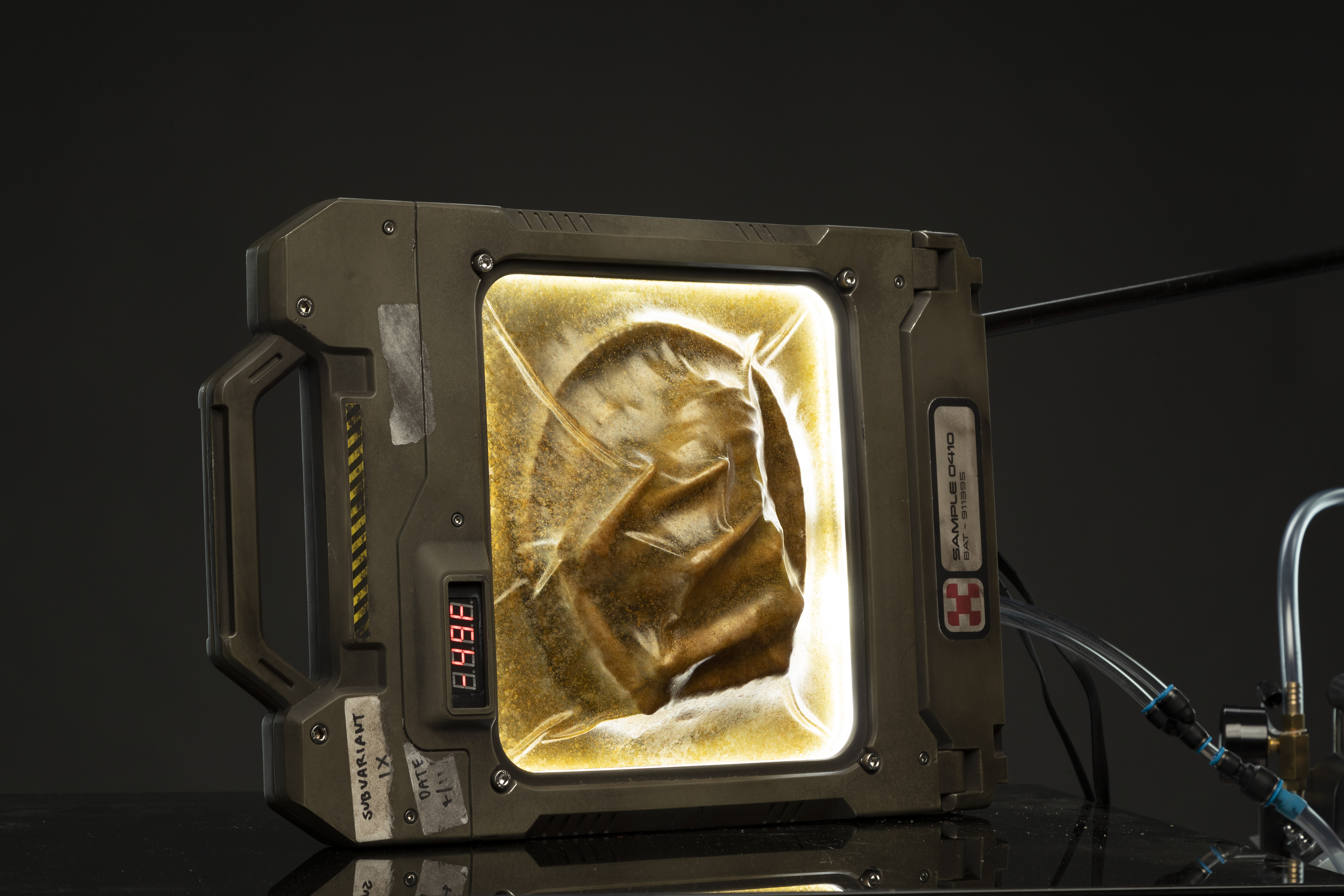 (One of the cryo-chamber facehuggers built by Wētā Workshop. Image courtesy Wētā Workshop.)
 (The scavengers find row upon row of bioengineered facehuggers on the derelict space station. Image courtesy 20th Century Studios.)
“We had such a vast range of them, and it was really Fede's insistence that he wanted to approach this in a practical manner that enabled us to get that specific on our builds," said Dunckley. "You don't often get the time to approach practical effects with the correct amount of rehearsal time and build time. So, from that perspective, it was a real pleasure, really unique.”
SWSCA Facehugger Secrets
Dunckley revealed that the team at Wētā Workshop took a similar approach to their practical facehuggers that the Stan Winston Studio crew had for Aliens. "The very first thing we did was, we went to YouTube, and we looked up the Stan Winston School video on the facehugger attacks [from Aliens]. We were like, okay, the best facehugger puppets we've seen were in Aliens, but what's out there? And it was your video. Giving away all [the] secrets to us.”
Building the Hero Facehugger
When asked about the methods of articulation for the hero facehugger puppet, Dunckley turns it over to Cameron May, his mechanical effects compatriot at Wētā Workshop. “With the hero, we were very much looking to the precedence of the past facehuggers for how they were built," said May. The Wētā hero facehugger puppet required thirty servos and as many points of articulation. “Each individual finger had three degrees of freedom, the knuckle joint and the two degrees of freedom in the finger itself. They're all cable-driven.” Depending on the shot, the cables ran out of the facehugger’s back or underneath the tail.
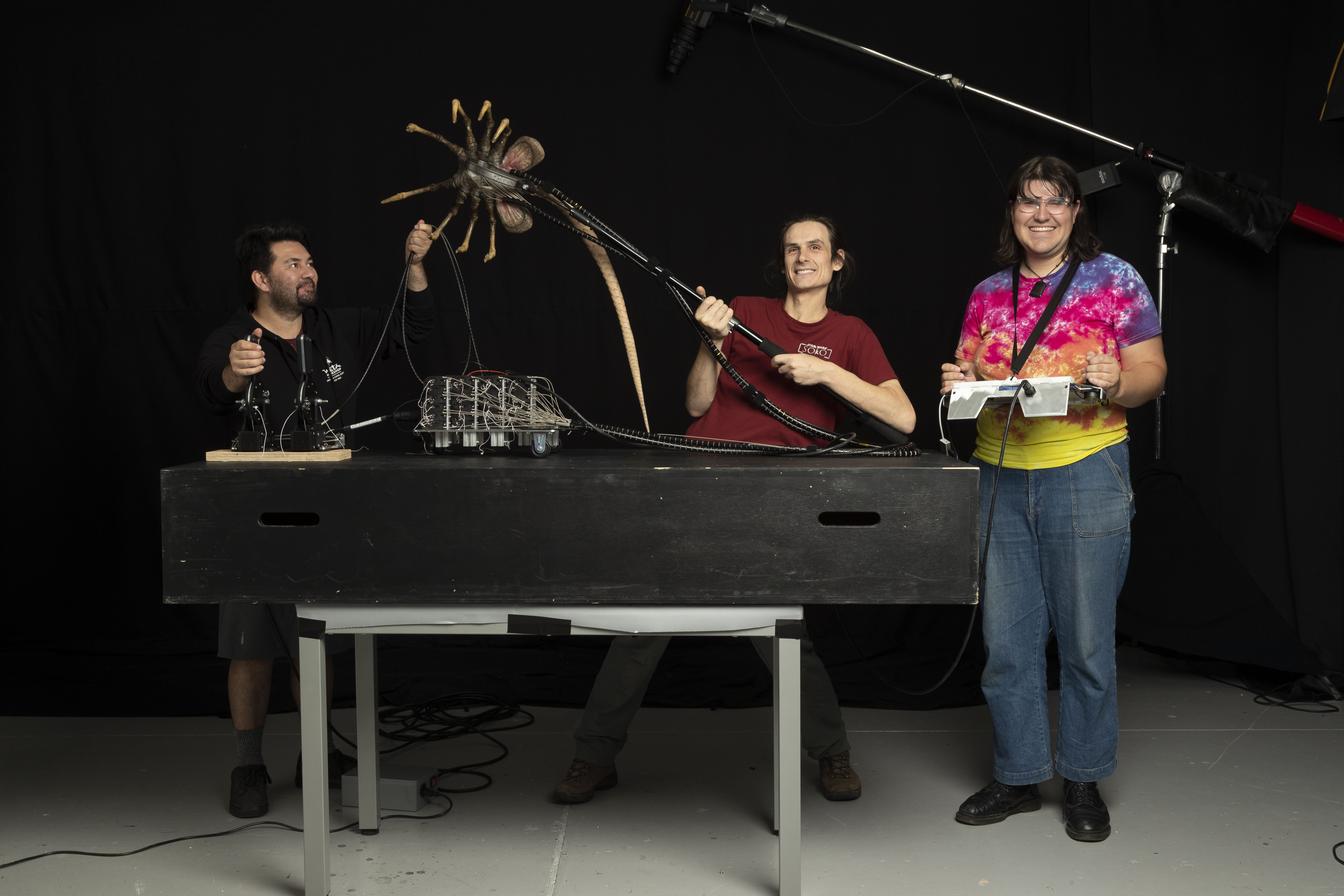 (Ra Smith, Joe Harlow, and Omelia Lliffe puppeteer a facehugger with a combination of cable control, rod puppetry, and RC-driven servos. Image courtesy Wētā Workshop.)
Because of all of the servos and articulation, the Wētā Workshop mechanical team worked to reduce the number of puppeteers, “We were just trying to get to two [operators], one that was doing the [finger] controls and then one that would be on the rod puppet to control the body position," said May. "We were really focused on how we could improve the puppeteering experience." Rather than having RC control of individual legs, May and his mechanical cohorts focused on finding a way to use software and one puppeteer on the control system to drive the thirty servos in the facehugger and achieve the articulation required. “We designed different kinematic gaits [how the joints move] for the facehugger and then had joysticks that could override those individual commands.” This focus on mechanical innovation meant that a single puppeteer, essentially with a tablet and a couple of joysticks, could control the multiple finger movements of the facehugger puppet.
 (Tyler Page and Craig Hobern test the range of motion of one of the 'hero' facehugger puppets. Images courtesy Wētā Workshop.)
 (Wētā Workshop puppeteers operate a "running" facehugger as it scurries across the ceiling conduits of the space station. Image courtesy 20th Century Studios.)
“One thing that we noticed early on is that so much of the language of the facehuggers was not about perfect control, but actually quite aggressive random articulation," said May. "So, we still had to have some of that kind of language in the way that the facehuggers operated because that's part of their history in terms of how they look and feel on screen.”
Facehugger Mechanics
The internal mechanisms of the facehugger puppets were primarily 3D-printed. “We relied quite heavily on 3D printed molds, 3D printed interiors, all of the mechanical components were 3D printed. We designed all the bearing and bushing housings, the interior core, and how the cables would run through in the actual 3D model as we built it, which meant that we could get quite a lot of control. We were able to make certain things uniform [across the various puppets], and certain things have a difference. That worked amazingly well for this project.”
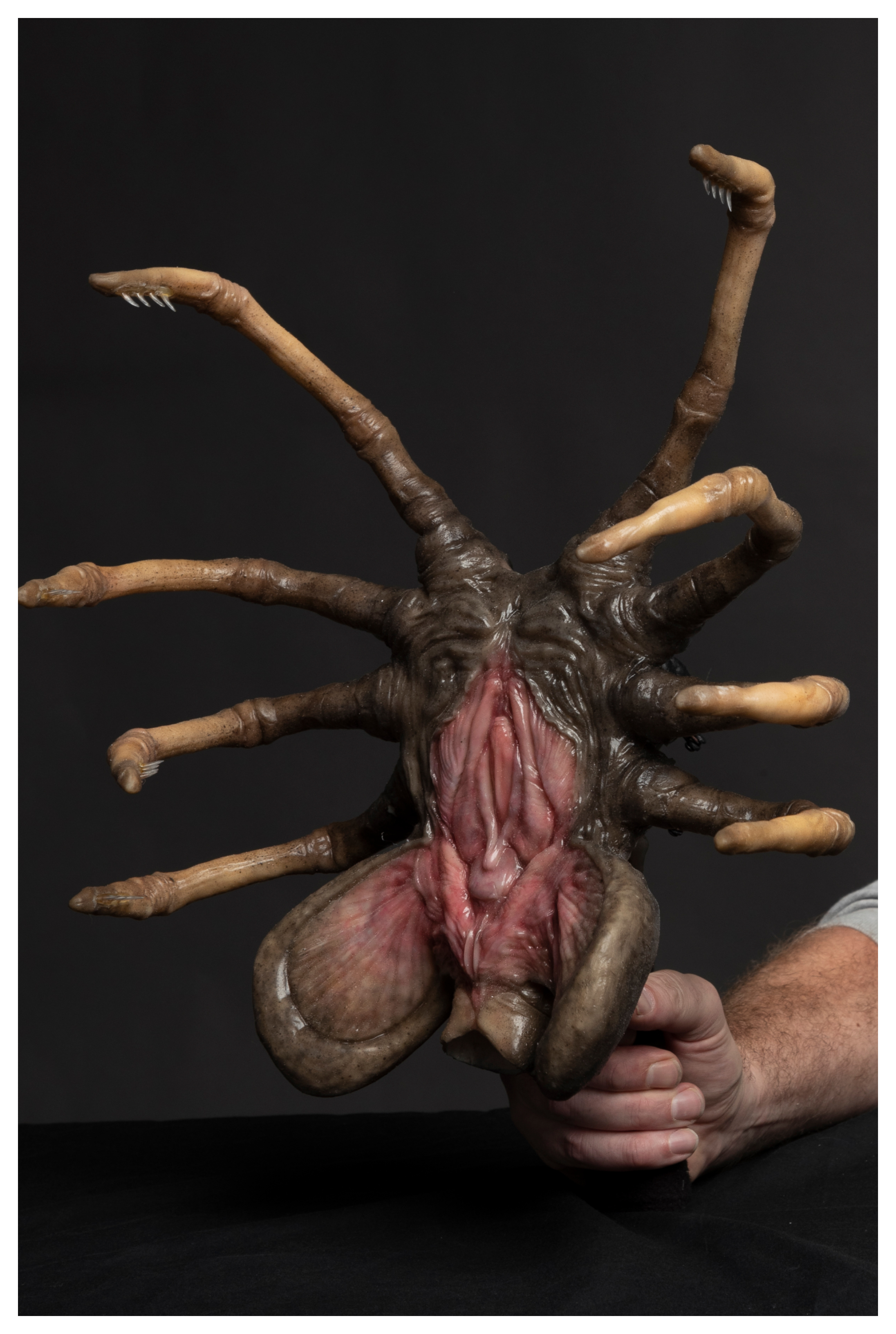 (The underside of a fully painted facehugger puppet with silicone skin and rigid nylon legs. Image courtesy Wētā Workshop.)
For the exterior of the facehugger puppets, Dunckley and May revealed that the workshop used silicone skins, while rigid nylon with flexible silicone gussets at the finger/knuckle joints was used for the fingers. “The reason for the rigid nylon legs was two-fold: durability and access," said May. "As soon as you create a mechanism that has to be skinned, you reduce the volume, the envelope, that you can work in. For the facehugger, we were trying to get the legs to be as spindly as possible. We went about that by making the legs hard surfaces to get more real estate inside the legs to work with mechanically. We made those sorts of decisions quite early on." Dunckley adds that the Wētā Workshop team "deployed different materials for different facehuggers. Sometimes we went [with firmer materials] when we needed added weight.”
Creating Running Facehuggers
In Alien: Romulus, some scenes called for facehuggers similar to the famous running ones built by Stan Winston Studio for Aliens. The Wētā Workshop team started by looking back at the running facehuggers engineered for Aliens by SWS mechanic Rick Lazarrini. It was a "massive influence. Full credit to them for having such a massive influence on where we are now," said Cameron May. This SWS design was based on a pull toy-type mechanism that moved the facehugger's legs in an organic way but was somewhat restricted in its movements due to the fact that it had to follow a thin monofilament line. For Alien: Romulus, the running facehuggers would have more range of movement and use a different toy as their inspiration: RC cars.
 (Cameron May reveals the mechanical innards of a running facehugger. Image courtesy Wētā Workshop.)
While the Stan Winston School Aliens behind-the-scenes video gave the team a great starting place in terms of controlling the gear train of the legs, "the things that we added to the mix were a pair of brushless motors, some wheels, and an RC remote," said May "The motors were then attached to the legs on each side of the body. So, if the runner ran forward, the legs ran forward; if it ran back, the legs ran back." There was a wheel mechanism underneath that connected to the legs. The faster it moved, the faster the legs moved. It turns out that director Fede is an RC enthusiast and took the remote facehuggers for a run. “We got a video from set of him running one around. I think he even posted it on Instagram," said Dunckley.
 (Cameron May demonstrates a remote-controlled running facehugger. Images courtesy Wētā Workshop.)
Regarding giving life to the facehugger tails, Dunckley explained, “We had a foam latex tail in the back of the facehugger. An individual motor with the gear on it made the tail wave. What was really good was that as [the facehuggers] were moving, the tail dynamics came naturally. The foam latex just bounced around beautifully." An added bonus was, "It's kind of scarier that the tail is erratic, that it's lashing around. When it connects to someone, that's when it gets dexterous. That's when it knows what it's gonna do.”
Alien: Romulus Facehugger Attacks
 (Facehugger attacks! Image courtesy 20th Century Studios.)
The 'attack' facehuggers were built and shot with methods similar to those used by James Cameron and the Stan Winston Studio team for the med lab scene in Aliens, where a pair of the creatures attack Ripley and Newt. As in Aliens “we planned on using reverse photography, since sticking the landing would be a difficult thing," revealed Dunckley. "We did some tests in-house, starting with a facehugger attached to a victim's face with the tail wrapped around the neck. We had spring-loaded fingers so that it's got tension on them." Wētā Workshop puppeteers would then release the finger tension and pull the facehugger off the victim. When played back in reverse, the creature appeared to jump onto the victim and grasp their face. This reverse photography trick allowed them to achieve "a more accurate landing than [a facehugger puppet] that's physically being thrown. It also gave us an opportunity to make it look more violent without actually hurting the person.”
Making Swimming Facehuggers
At one point in the film, an area of the derelict space station becomes partially flooded with water. The scavengers struggle through the flooded corridors with Wētā Workshop’s facehuggers swimming after them.
Álvarez was very specific about how he wanted to reveal the swimming facehuggers on camera, "He wanted to see like a bow wave out in front of them, so you weren't quite sure what it was at first," said Dunckley. So the “first thing we did was, we got a puppet, just a prop one, put it on a rod, went to the community swimming pool just down the block from us. Ben Price, the project supervisor on this, got in the pool, and I attacked him with that facehugger all day to see what sort of swimming motion we could get out of it, just on a rod. And we could get some nice motion and a good bow wake.”
“But it wasn't everything we needed," said Dunckley. Álvarez wanted to get a continuous shot over a facehugger in the water as it's approaching someone, and then it leaps up and attacks. "So our engineering department created a rail on a winch that would bring the facehugger along, just at the right height. The swimming motion was translated through a mechanism as it traveled along the rail." Cameron May elaborated on the technique: “On the rail, there was a wheel that was picking up the linear motion of the rail, translating it to rotary, and then there was a cam mechanism, which just essentially flipped the tail around in the water. It was a simple, old-school method, but it worked really well.”
We broke [the moment] up into two puppets in one shot," explained Dunckley. "Right at the last moment on the rail, the [swimming] facehugger exited the bottom of the frame, then we had [another puppet] at the end of the rail that we just flipped out of the water to jump up and attack." The facehugger that swam along the rail was silicone with a urethane foam core. The team tried several variations to get the buoyancy of the tail right. "We wanted to have a little bit of drag and weight in the water, but we wanted it to be just breaching the water. So, we did a series of tests in the pool, each time attacking Ben. It was good fun, really.”
Navarro’s Facehugger Attack
There is a graphic scene in the film where a facehugger attacks Navarro, played by Aileen Wu. In previous Alien franchise films, if anyone tries to remove a facehugger while it's implanting an embryo inside its host, the facehugger will tighten its tail and choke the person. But, this time, her friends successfully pull the facehugger off Navarro’s face, and we watch its proboscis tube withdraw from Navarro’s mouth. The rescue seems successful... at first.
 (Ra Smith and Fil Kopelman show off two of the seventy-three facehuggers built for Alien: Romulus. Images courtesy Wētā Workshop.)
 (Testing one of the facehuggers on team member Flo Foxworthy. Image courtesy Wētā Workshop.)
Three different types of proboscises were created to achieve this effect. “We had one that was mechanized, that could do the movements we've seen [in other Alien franchise films]. So, it was a tentacle mech in there," said Dunckley. "Second, we had one that was retractable. It could come in and out of the under orifice.” For the third puppet built for the scene, “The real challenge was that Fede wanted to see, as they were removing the facehugger, he wanted to see the proboscis being pulled out of the throat," said Dunckley. "So, what we did was, we had one that was hollow silicone, and we had just a bent piece of stainless steel in the correct shape with a little loop on the end. We then turned the [silicone proboscis] inside out and lubed it up. As it's being extracted, we could extend the steel loop, inflating the proboscis so it would look like it was coming from her throat.”
 (The facehugger attaches itself to Navarro. Image courtesy 20th Century Studios.)
 (The facehugger's hollow silicone proboscis is pulled out of Navarro's throat. Image courtesy 20th Century Studios.)
This approach is similar in concept to the effect used in Aliens, where the android Bishop (played by Lance Henriksen) is impaled on the Alien Queen’s tail. There, a monofilament line pulled a collapsible latex tail section out of Bishop’s shirt while the actual end of the Queen’s tail was attached to a mount on the actor’s back. As the collapsible tip of the tail emerges, it expands and appears to be coming out of the android’s chest.
 (In Aliens, Ripley tries to help the android Bishop when he is impaled by the Queen in a similar effect to the Navarro/facehugger scene in Alien: Romulus. Image courtesy 20th Century Studios.)
About the proboscis effect, Cameron May said, "This was like the moment that we were all genuinely disgusted with what we were doing. It was a horrible object, and to just play with it, you know?” Dunckley agreed, “When we were doing our tests, we were like, you know, it's really invasive what we're doing here. The actor is really gonna have to be up for it. And apparently, they absolutely were."
As Navarro will soon discover, the next stage in the alien lifecycle is the emergence of the implanted alien embryo from its host.
The Chestburster
 (The original chestburster from Alien. Image courtesy 20th Century Studios.)
One of the most iconic scenes from the first Alien film is the chestburster scene. Built by sculptor and effects artist Roger Dicken (The Land That Time Forgot, When Dinosaurs Ruled the Earth), the chestburster makes its horrific and unexpected appearance during a light moment at the dinner table with the Nostromo’s blue-collar crew. The sudden explosion of blood hitting actress Veronica Cartwright’s face is still shocking today.
Álvarez gave the task of building a new form of larval chestburster to Alec Gillis and his team at Studio Gillis. Gillis is an effects artist with a long history with the Alien franchise, going back to working on James Cameron’s masterpiece Aliens as part of the Stan Winston Studio team. After leaving SWS, he formed his own effects house, ADI, with another Winston vet, Tom Woodruff, Jr. ADI would go on to work on several other Alien movies, including Alien 3, Alien Resurrection, Alien vs. Predator, and Aliens vs. Predator: Requiem. Recently, Gillis has begun to create creatures under the banner of his new studio, Studio Gillis.
Chestburster Design for Alien: Romulus
The design of the chestburster alien was finessed a bit for the newer film. While the puppet in the original Alien had tiny vestigial arms sculpted flat against the creature’s torso, and the Aliens chestburster built by the original Stan Winston crew had tiny, mechanized arms, the latest iteration of the burster would have more pronounced limbs. “Much of this was established by Dane Hallett's artwork. With Fede overseeing that,” said Gillis. The thought was that since the creature was bred on a space station, maybe it was able to grow faster. "It's already coming out of the gate a little bit more developed; the timeframe is compressed. Maybe they're designing these things so that they gestate quicker," said Gillis.
 (The digital chestburster design model by Studio Gillis. Image courtesy Studio Gillis.)

 (Several angles of the painted digital chestburster sculpture. Images courtesy Studio Gillis.)
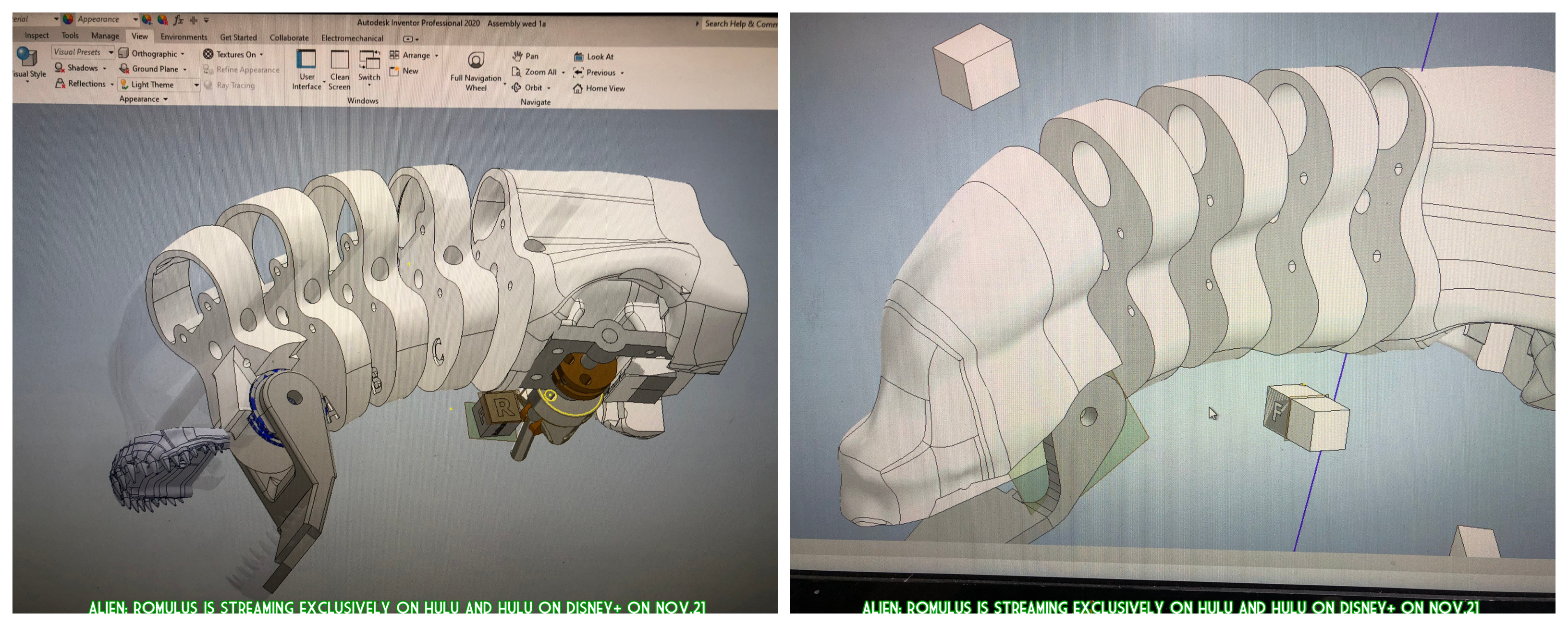 (3D CAD models of the internal mechanisms for the chestburster. Images courtesy Studio Gillis.)
 (L-R, Digital sculpt of the chestburster head mechanism, Zac Teller adjusts the head mech, closeup of the mouth mech. Images courtesy Studio Gillis.)
 (Zac Teller assembles the internal cable-driven 'tentacle' mechanism for the chestburster puppet. Images courtesy Studio Gillis.)
 (Garth Winkless, Zac Teller, Jon K. Miller, and Dave Penikas operate the chestburster puppet without its silicone outerskin. Image courtesy Studio Gillis.)
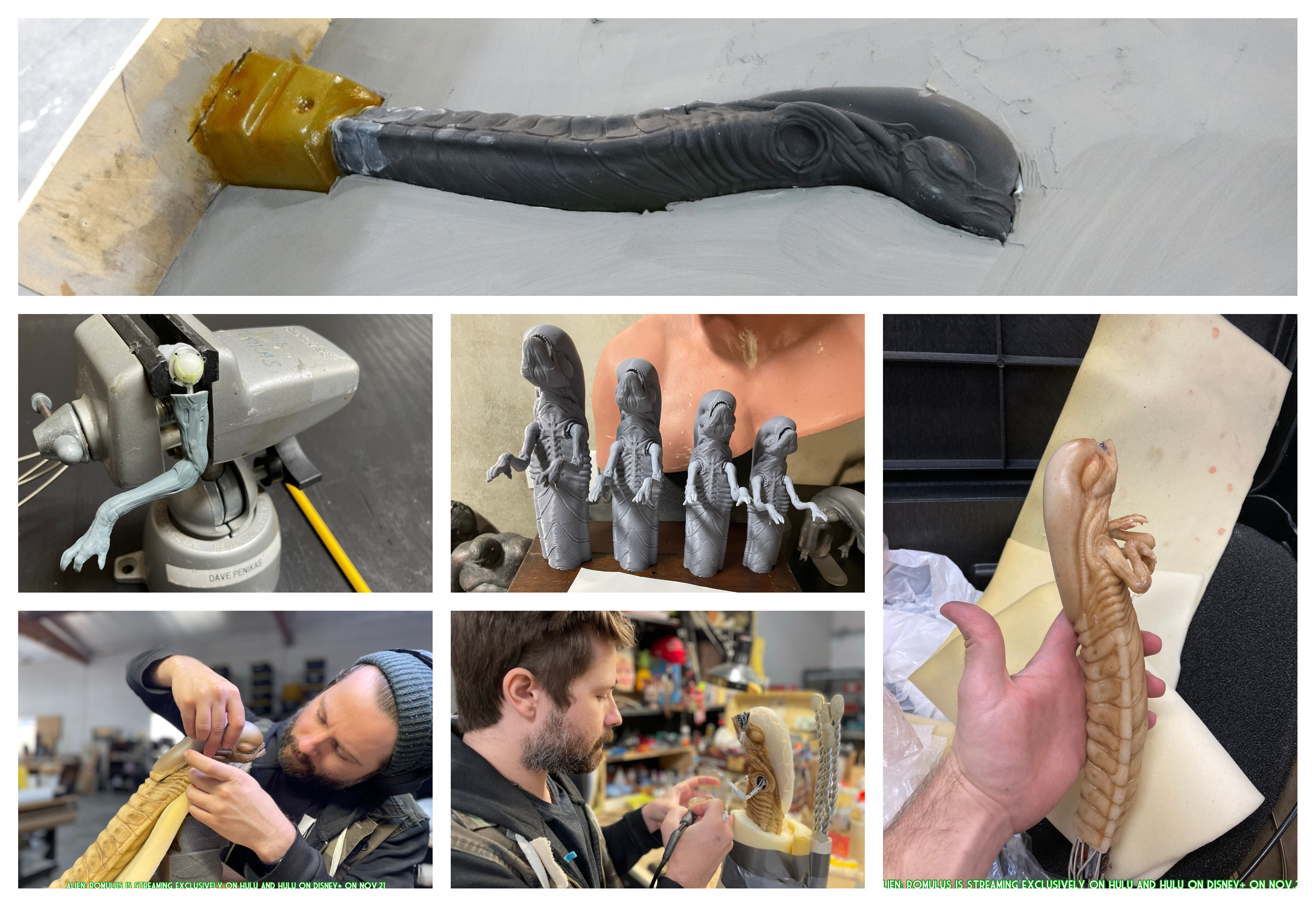 (Casting and assembling the chestburster. Images courtesy Studio Gillis.)
While previous films had the chestburster explode violently from their victim’s chests, Álvarez wanted to do something different. He wanted to "make it almost like a human birth. Something that's more slow and excruciating," revealed Gillis.
Gillis spoke with Álvarez about the birth cycle of the xenomorphs. “You go from this little larva, and, traditionally, it runs away. You find a shed skin, and then it's a full, beautiful, exoskeletal xeno. So, one of the things we talked about was what if it starts to change its tone? Its color?” At first, Gillis thought that the effect might be realized digitally. “And [Álvarez] said, 'No, I want it to happen before your very eyes.'”
Gillis described how he came up with the idea for pulling off the in-camera color change. “I always got a kick out of those [bleeding] Halloween masks. You have a squeeze bulb, and it's like two layers of plastic, and it appears to drip blood down the face. But it's all contained," said Gillis. “So I thought, well, that could work. Because, we have the clear dome on the head, so that affords us an opportunity. We cast [the dome] out of a very clear silicone, so it was a separate piece on the top of the chestburster's head. Naturally, there's a little air gap between one part and the other. Nick Reisinger, on my crew, who's very clever, was able to put tubes into it so that you'd have a tube that would pump clear water in between the dome and the head. Then we inject black acrylic paint into it, so it sort of clouds over. And then we could suction it out, and we could keep it going. You could do like a heartbeat effect. It was very expressive.”
 (The final chestburster seen in the film. Image courtesy 20th Century Studios.)
Of course, as with any innovative effect, it took some troubleshooting to get it right. “Initially, we had some problems with bubbles trapped in it, but we figured out how to get rid of those. When I saw the test, I was a little concerned that people might think it was a digital effect because it was very gradated and smooth. It lacked an organic, you know, chunkiness or something.” To add more organic visual interest, the Studio Gillis team added vein-like hollow channels inside the dome so that the color change would follow an organic pattern, which gave the eye of the viewer "a little bit of an anchoring point." Gillis felt this was a perfect example of how effects work is generally approached. “A lot of this stuff is like, 'Will it work?’ I don't know. Let's see."
Building Two Chestbursters
The Studio Gillis team built two sizes of chestbursters for Navarro’s chestburster 'birth' scene. "One was the size of a traditional chestburster. But Fede was surprised to see that they were that big. Aileen Wu (who played Navarro) is petite, so we had to scale the chestburster down," said Gillis. “Here's an advantage of sculpting in 3D in the computer. I can print up whatever size I want and change it to the director's desires. And it worked out really well.”
Gillis praised actor Aileen Wu for how much she endured. “Poor Aileen, I always love to give shout-outs to her. We brought her in a day early to cut the deck away and build a little slant board for her. She wore a torso created by Iván Pohárnok, a great Hungarian creature effects and makeup guy who worked for me on Alien vs. Predator,” said Gillis. "[Aileen] was super patient with us. And still, after all the hours of that work, found the energy and the terror, as did Isabela Merced.” Gillis added, "[Stan Winston's] words were ringing in my ears. He said, ‘Our work is only as good as the actors who are reacting to it.' And both those women did a fine job selling all of this stuff.”
The "Offspring" Embryo
Studio Gillis also created an offspring embryo for Alien: Romulus. We didn’t cover its creation in this interview, but were granted access to some excellent ‘making of’ images that you’ll find below.

 (Digital concepts of the offspring egg and embryo. Images courtesy Studio Gillis.)
 (Zac Teller adjusts the offpsring egg mechanism. Images courtesy Studio Gillis.)
 (L - A casting of the offspring inside the egg form. R - Tim Leach works on the nearly finished offspring egg. Images courtesy Studio Gillis.)
 (Sara Villarreal cleans up offspring egg and embryo parts. Images courtesy Studio Gillis.)
 (L - A test foam casting of the offspring embryo. Middle, R - The fully painted silicone offspring embryo. Images courtesy Studio Gillis.)
Making Old and New Creatures for the Alien Franchise
Shane Mahan, Lindsay Macgowan, Alan Scott, and their crew at Legacy Effects were responsible for creating some of the most recognizable and most surprising creature effects for the film: the xenomorphs, a cocoon birthing sequence, and a very disturbing new alien hybrid known as the Offspring.
After so many years had passed since he'd worked on Aliens as part of the Stan Winston Studio team, Shane Mahan thought he might never get the opportunity to work on another film in the franchise. "The films had taken different twists and turns and gone to different [creature effects] companies. Our dear friends Alec [Gillis] and Tom [Woodruff, Jr.] had done many of them," said Mahan. "And then the call came to Legacy Effects, and they asked, 'Would you be interested in reading the script?' and I was like, ‘Yes, I've been waiting 40 years.’”
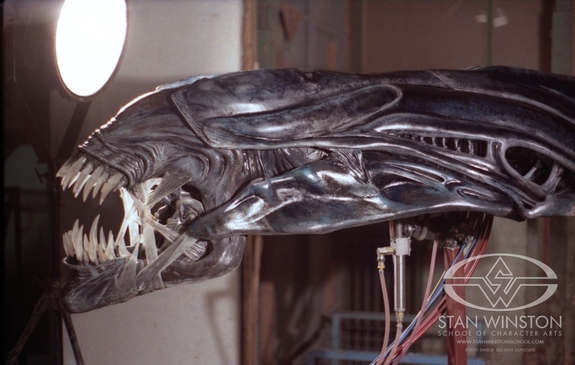 (A behind-the-scenes shot of the Alien Queen head built by Stan Winston Studio for Aliens using elastic condoms for the membranes at the sides of the mouth. Image courtesy Stan Winston Studio Archives.)
Having both worked on Aliens with Stan Winston, Mahan, and Lindsay Macgowan were determined to improve upon the things that they wished they could have done better on that film. As just one example, Mahan mentioned the changes in materials used by effects artists to build puppets and monsters that have developed over the nearly 40 years since they worked on Aliens. “We didn't have [a lot of options for flexible] translucent materials back then,” unlike the variety of translucent silicones so common in the industry today.
Originally, the skin over the jaw and the upper mandible of the Alien Queen was intended to "have a Giger-like transparency, like his paintings," said Mahan. However, the SWS team had to settle primarily for using opaque foam rubber. One exception was the cowl piece on the top of the Queen's head, which was translucent because it was a stiff urethane and blended well into fiberglass. The lack of flexible translucent materials "was disappointing because it was just foam rubber in the end, black foam rubber, and painted to look transparent, which bothered me for years because it wasn't what it was supposed to be.”
For the transparent elastic membranes in the xenomorph and Alien Queen's mouths, the Stan Winston Studio crew used latex condoms. "Condoms were a terrible thing to work with,“ especially on the Alien Queen because "her mouth opened a foot and a half, and after a while, they would break. I had a pocket full of them on set, and I was repairing them all the time with super glue, [all while] trying to keep the structure and paint job clean and not slowing the [filming] process down.” After that experience, Mahan thought, “There has to be a better way.”
One final example Mahan shared was the difficulty of maintaining a steady flow of slime from the xenomorph's mouths on Aliens. “John Rosengrant (SWS vet and co-founder of Legacy) and I would just pour cups of fluid in the Queen's mouth, and it would just run out. And then you have to run in again and keep doing it, as opposed to having a continuous flow, a chamber or plumbing in the face where you can just turn the thing on and off," which is what the Legacy Effects team devised for Alien: Romulus.
Designing the Xenomorph in Alien: Romulus
 (The Alien: Romulus xenomorph by Legacy Effects. Image courtesy 20th Century Studios.)
Swiss artist H. R. Giger designed the original xenomorph from Alien and built the suit alongside Italian makeup effects artist Carlo Rambaldi (King Kong, 1976, E.T. the Extra-Terrestrial), who devised the mechanical elements of the jaw and inner jaw. Now, 45 years later, Legacy Effects was responsible for bringing the xenomorph to life again.
 (Darnell Isom works on the Alien: Romulus xenomorph design. Image courtesy Legacy Effects.)
Mahan echoed what the other practical effects teams discovered about Fede Álvarez. He "is a real fan of effects. His mantra was whatever he could do in-camera, that's what he wanted, because he prefers the rich tactile sense on film, the look of it. He would say, ‘If we could do it [with practical effects] in '79 and '86, we can certainly do it now.’” It was left up to Legacy Effects to figure out how to make the xenomorph creature look its best, and then Álvarez would figure out ways to work around it on set.
Mahan referred back to the non-human proportions of the Alien Queen to illustrate what they planned to do with the xenomorph for Alien: Romulus. Her "silhouette was not human. It was a very narrow torso with very long legs and arms." To achieve that degree of inhuman proportions, the Legacy Effects team decided to build the 'hero' xenomorph as an animatronic eight-foot tall creature. Mahan emphasized, “What we didn't want it to be was an actor in a suit.”
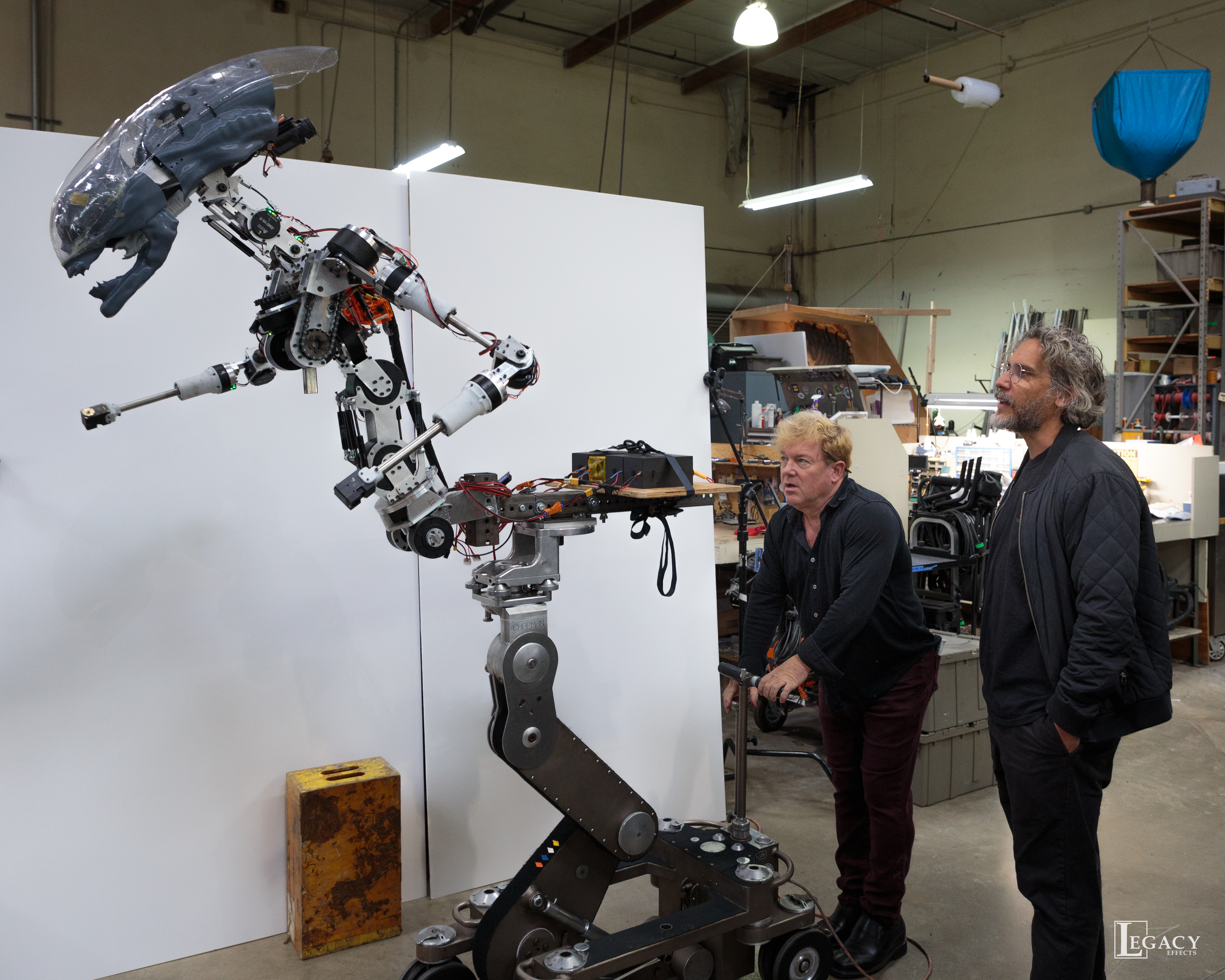 (Legacy Effects co-founder Shane Mahan demonstrates the in-progress xenomorph animatronic puppet for Fede Álvarez. Image courtesy Legacy Effects.)
 (The Legacy Effects team bring Fede Álvarez up-to-date on the progress of their hero animatronic xenomorph puppet. Images courtesy Legacy Effects.)
Cinematic Sleight of Hand
That's not to say the Legacy team limited themselves to bringing the xenomorph to life with just one method. “We had a man in a suit for shots when we couldn't make the animatronic do what we needed, like when we were bound by physics. You can't make a heavy animatronic crawl up the wall. It's impossible. Those are lessons learned from Predator. You can't have a preposterously heavy thing climb upside down or down a wall with dexterity," said Mahan. "So, for certain shots, we had to have a nimble guy on wires in a suit that matched the animatronic as much as possible." Fortunately, the Legacy crew ensured that the suit was, in many ways, a one-to-one match for the animatronic xenomorph, especially when shot from the right angles. "If you frame away from the legs and from the waist up, maybe the arms are a little shorter, but the chest is the same size, the head is the same size, and the illusion is pretty complete. And even though he's not eight-feet-tall, you can block him up on an apple box, and he's suddenly eight-feet-tall, and you can make it work.”
 (L - Legacy co-founders Shane Mahan and Lindsay Macgowan lead an Alien: Romulus xenomorph show-and-tell. R - Xenomorph actor Trevor Newlin considers the exciting challenges he'll be facing. Images courtesy Legacy Effects.)
 (Damian Fisher, Shane Mahan, Dave Merritt, and Toi Ogunyoku check the fit of the skull cap inside the xenomorph head that will be worn by Trevor Newlin. Images courtesy Legacy Effects.)
 (Legacy Effects model shop artist Toi Ogunyoku attaches the iconic translucent dome to the xenomorph's head. Images courtesy Legacy Effects.)
 (The completed xenomorph suit, to be worn by actor Trevor Newlin. Images courtesy Legacy Effects.)
“Then we had another version, a Bunraku puppet, which was an absolute one-to-one copy of the animatronic. But it was very, very light. It had a simpler head. And we could make that walk; we could make it run; we could make it squat down to the ground; we could make it pursue people. Full walking leg motions are hard for an animatronic because of the weight. You can make the animatronic look as though it's walking when you put it on dolly tracks and things like that. But you have to set those shots up and plan it out," said Mahan.
"So, the idea was to take the three [xenomorphs] and make them look like one creature.”
 (Legacy Effects co-founder Alan Scott checks the articulation of a cable-actuated xenomorph hand. Image courtesy of Legacy Effects.)
 (The xenomorph hunts the scavengers. Image courtesy 20th Century Studios.)
Building Xenoporph Puppets
In addition to the animatronic and actor-driven puppets, Legacy Effects built marionette xenomorph puppets for the weightless scene where Rain turns off the gravity in the station in an attempt to escape from the aliens. “We had six full-size [xenomorph] marionettes packed with organs, acid blood, and squibs in the zero-gravity scenes that get blown up and shot." The practical puppets were blended with CGI to create an unforgettable sequence, with living (and dead) xenomorphs and gobs of acid blood floating through the air.
 (A xenomorph takes an acid-spewing shot to the head. Image courtesy 20th Century Studios.)
A New Stage in the Alien Lifecycle
Alien: Romulus shows a previously unseen step in the alien lifecycle by having the full-grown, final-stage xenomorph emerge from a cocoon. An acid-shooting cocoon. Mahan recalled Álvarez's explanation, "This is a new stage of the lifecycle we've never seen before, and it may be just unique to this particular ship, or it might be unique to this particular story. Or maybe it was something that was just never seen in previous movies.’”
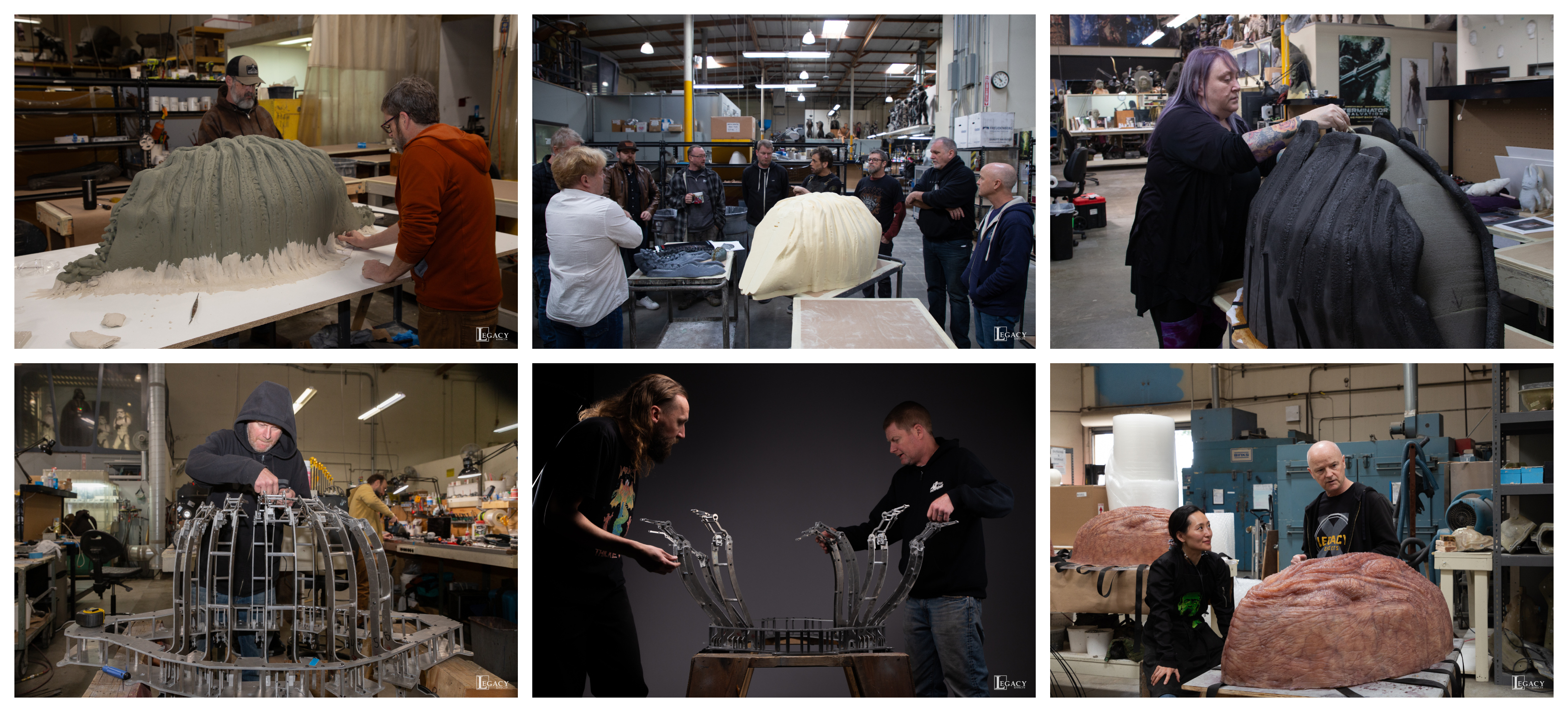 (Trevor Hensley, Mark Maitre, Tamara Carlson-Woodard, Seth Hayes, Mike West, Wen Zheng, and Lindsay Macgowan work on the cocoon, from sculpture to internal mechanics. Images courtesy Legacy Effects.)
 (Mike West operates the cable-driven mechanical 'petals' of the xenomorph cocoon. Images courtesy Legacy Effects.)
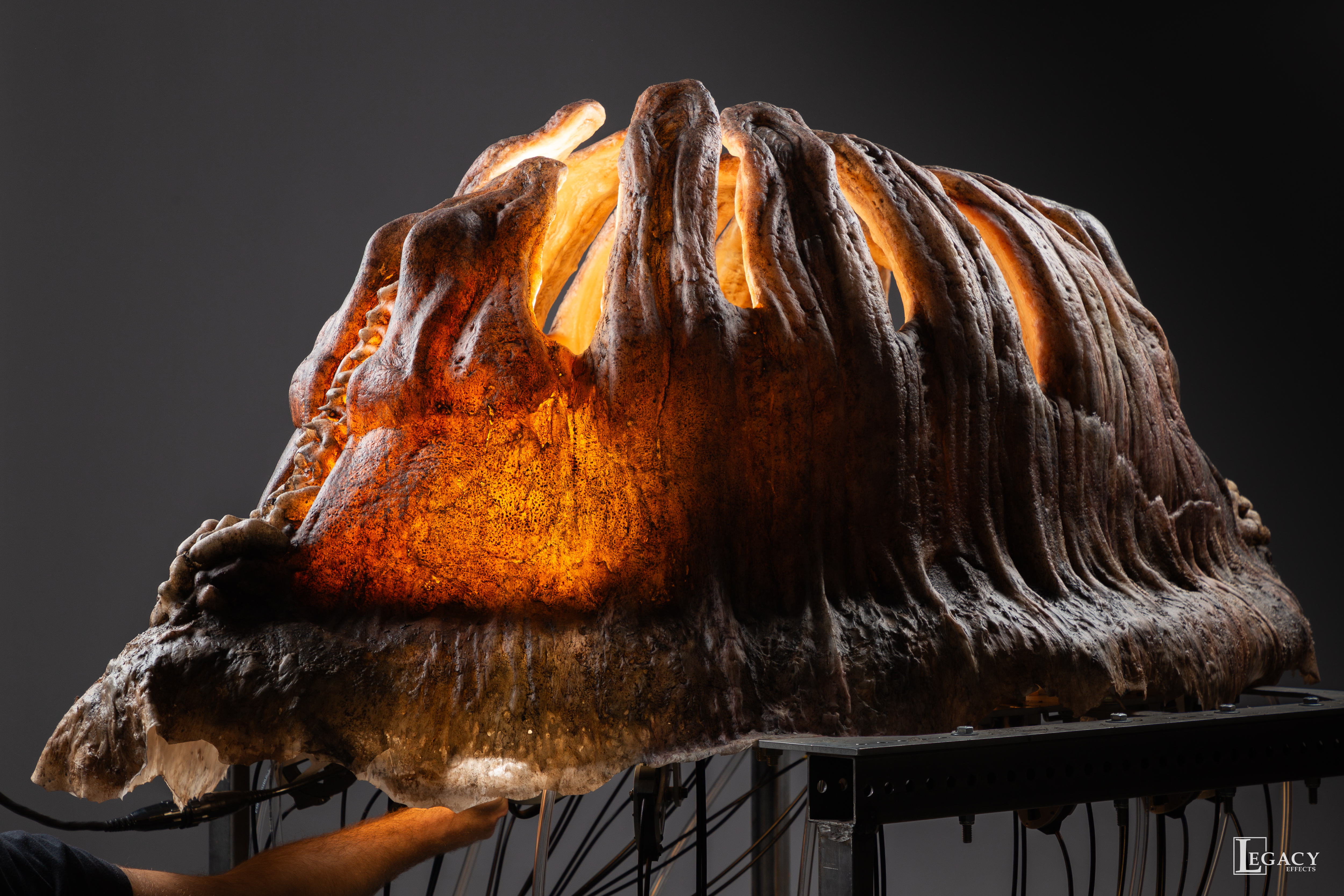 (The completed cocoon with glowing internal lighting effects. Image courtesy Legacy Effects.)
Legacy Effects built a xenomorph suit for the cocoon scene. “That secondary suit was for the birthing scene. That moment needed a lot of dexterity to come out [of the cocoon]. The best way to do that was with a suit actor.”
Using Practical Effects to Make Xenomorphs
One of the many benefits of shooting creature effects practically instead of solely relying on CGI is the way physical elements on set can tie characters realistically to their surroundings. “We were all really happy with the invention of putting high-speed wind under the (xenomorph) faces so their spit’s blowing up and sideways, and it's not just dripping down. You can't really tell where gravity's taking it. And then putting smoke in the mouth made it kinda like there was smoke coming out of the face, which was very interesting. And it made the closeups of the face look very, very organic.”
Creating Realistic Movement
Another mechanical innovation with the xenomorph puppet that was similar to the Queen from Aliens was the approach to its head movement. “The xenomorph's head has always been this long, stiff piece, so where the jaw is, we added a joint that moves the front of the face side to side, which is really cool," said Mahan. "And that's kind of reflective of the Alien Queen. Having that sort of joint, just a joint in the front of the face.” Álvarez requested another Queen-like element be incorporated as well. “Fede wanted parts of the creature to move, to just shudder and not just be this stiff thing. So, the [xenomorph's] neck is pulsing. We had a device in the rubber neck to make it vibrate. Something similar to what we accomplished on the Queen in Aliens.” Finally, the Legacy Effects team gave a big nod to the original xenomorph from Alien by making the skull underneath the domed head visible.
 (Ryan Pintar airbrushes the underside of the clear xenomorph head dome. Image courtesy Legacy Effects.)
The Making of the Offspring Hybrid Alien
 (Alien: Romulus's terrifying Offspring as portrayed by Robert Bobroczkyi. Image courtesy 20th Century Studios.)
A new form of alien appears in Alien: Romulus, a hybrid of xenomorph/human called the Offspring. Scavenger Kay (played by Isabela Merced) is pregnant when she comes onboard the derelict space station. A serum is introduced to her fetus, and the bioengineered Offspring is born. Because of the bioengineering, this new lifeform grows at an incredibly increased rate and quickly becomes larger than human-sized.
 (Early digital design concepts of the Offspring character. Images courtesy Legacy Effects.)
 (The final digital design for the Offspring sculpted on a scan of performer Robert Bobroczkyi. Image courtesy Legacy Effects.)
 (Lead Offspring designer Savannah Suderman paints the 3D-printed Offspring design maquette. Image courtesy Legacy Effects.)
Basketball Star Robert Bobroczkyi as the Offspring in Alien: Romulus
Director Fede Álvarez suggested casting 7-foot, 7-inch college basketball player Robert Bobroczkyi for the Offspring creature in Alien: Romulus. “He was drafted by a college in Michigan, the state I'm from, to play basketball. Someone showed a video of him playing basketball to Fede.” Mahan watched the video and agreed that Bobroczkyi would be perfect for the Offspring role. “Robert's very tall and very thin. He’s got really amazing long arms. Fede asked us, ‘Is this a crazy idea to cast a guy who's never been in a character makeup before, never been in a movie, as our Offspring?’ And I was like, ‘That's not crazy at all because we will never find anybody as interesting as this.’ And so we flew to Michigan and did life casts and digital scans of Robert at his college. Brought everything back and started working.” At that point, Savannah Suderman and "Scott Patton started doing designs on [Bobroczkyi], and the team started breaking down the makeup as sculptures.”
 (Dan Driscoll, A.J. Venuto, and Gary Yee make a master mold of Robert Bobroczkyi's full body from which they'll pull various positives for the sculpting and appliance running steps. Images courtesy Legacy Effects.)
Appliances for Alien: Romulus' Offspring
Mahan revealed that the Offspring makeup was not a complete suit but primarily silicone appliances glued directly to Bobroczkyi's skin. “There's a portion of the legs, to make it easy on him, there's a pair of foam rubber pants, from the knees to the waist, in case he's gotta get out of it really quick, I can get him out of it. But everything else is glued down silicone appliances with some of [Robert's] skin showing through.
 (Gary Yee, Rob Ramsdell, and Ryan Pintar mold, cast, and paint the Offspring's foam latex 'pants'. Images courtesy Legacy Effects.)
 (Jaime Siska and Gary Yee mold the Offspring's hands. Images courtesy Legacy Effects.)
 (Jim Charmatz digitally creates the collapsible core that will be used to run the Offspring gloves. Image courtesy Legacy Effects.)
 (A painted Offspring hand glove. Image courtesy Legacy Effects.)
 (Andy Bergholtz sculpts one of the Offspring's feet. Image courtesy Legacy Effects.)
 (Andy Bergholtz refers to the Offspring maquette as he works on the legs of the full-scale sculpture. Image courtesy Legacy Effects.)
 (L - The Offspring maquette with extended 'alien' tongue. R - Glenn Hanz and Andy Bergholtz work on the full-scale Offspring sculpt. Images courtesy Legacy Effects.)
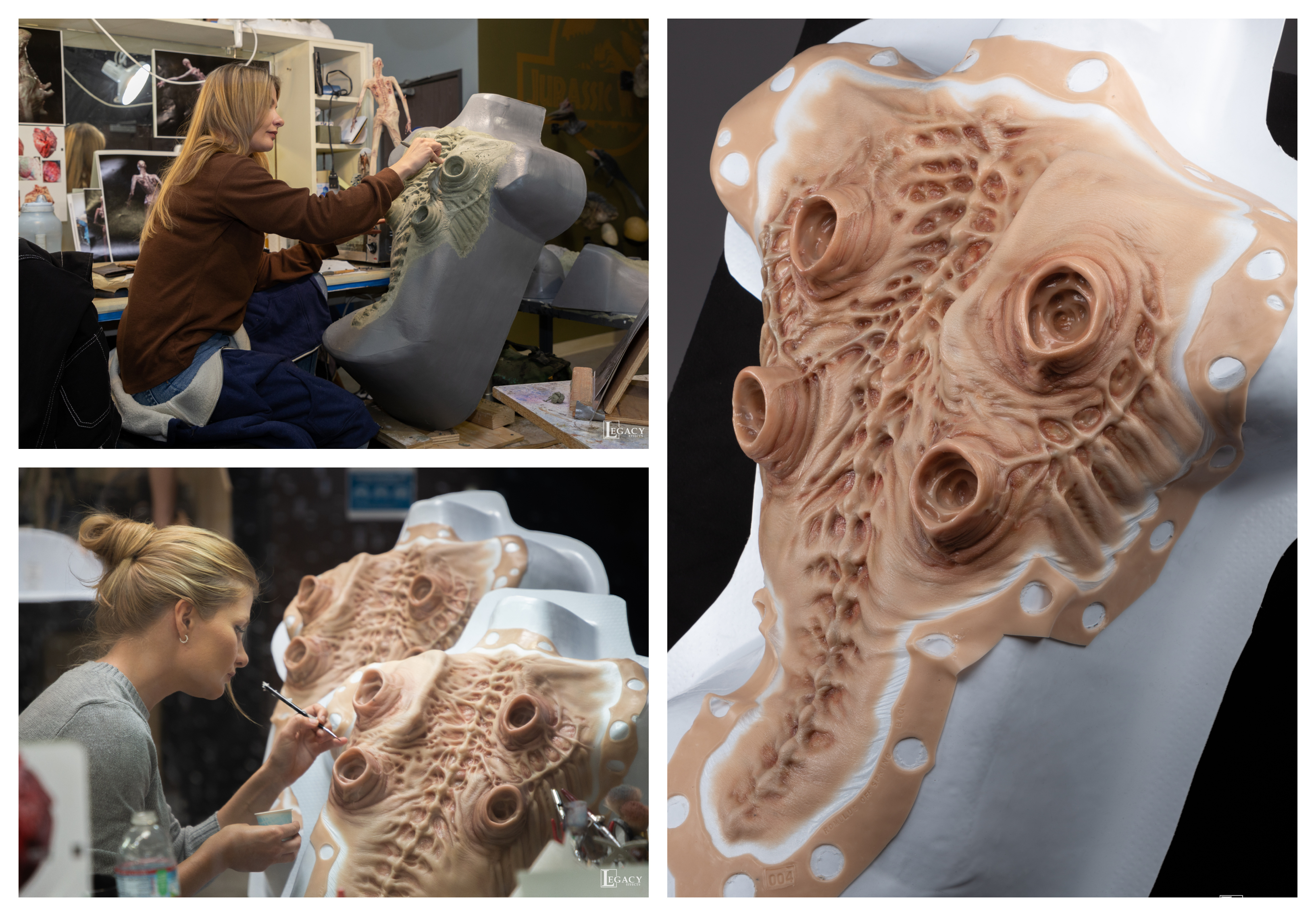 (Savannah Suderman sculpts and paints the Offspring's back appliance. Images courtesy Legacy Effects.)
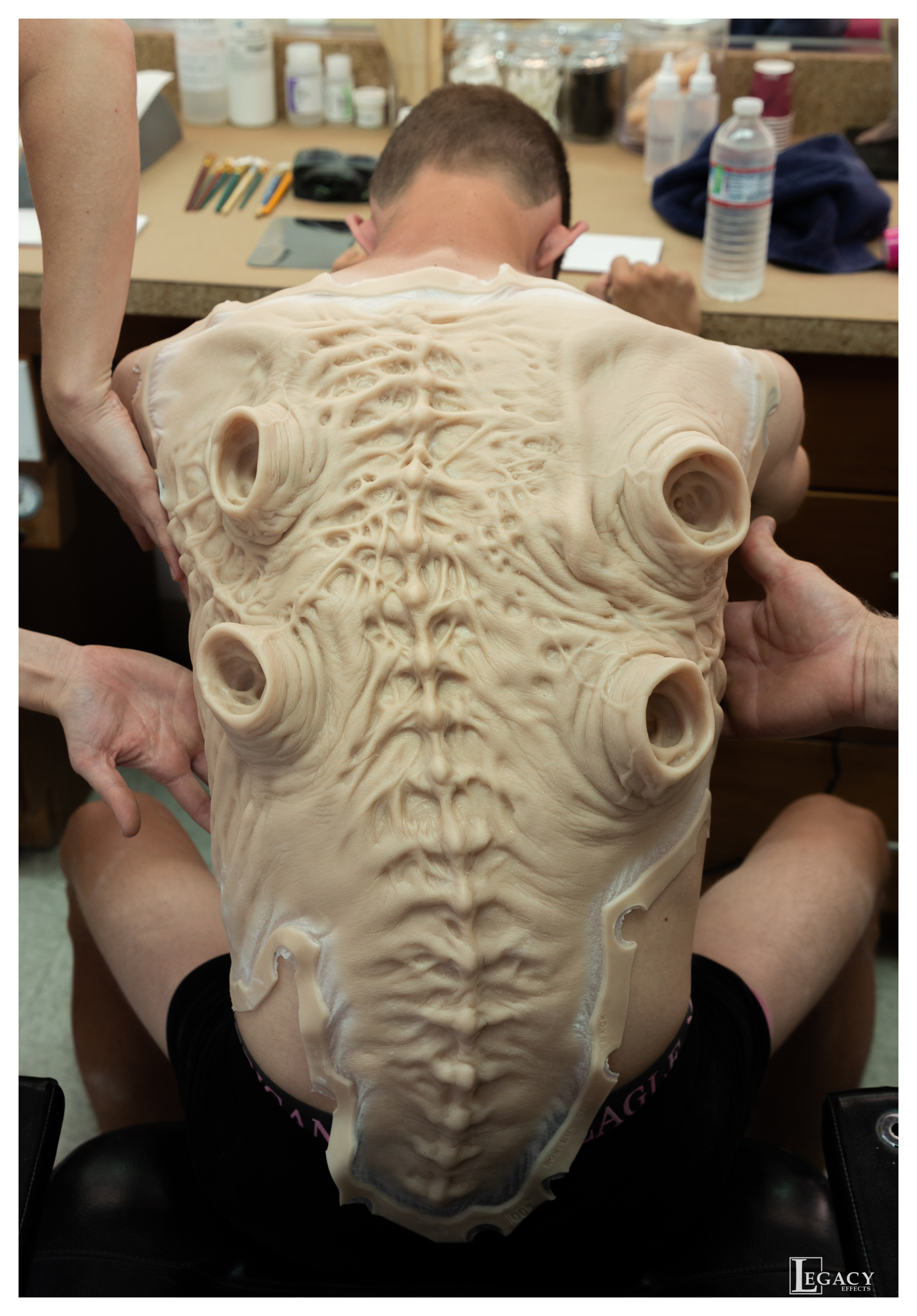 (Test fitting the back appliance to Offspring actor Robert Bobroczkyi. Image courtesy Legacy Effects.)
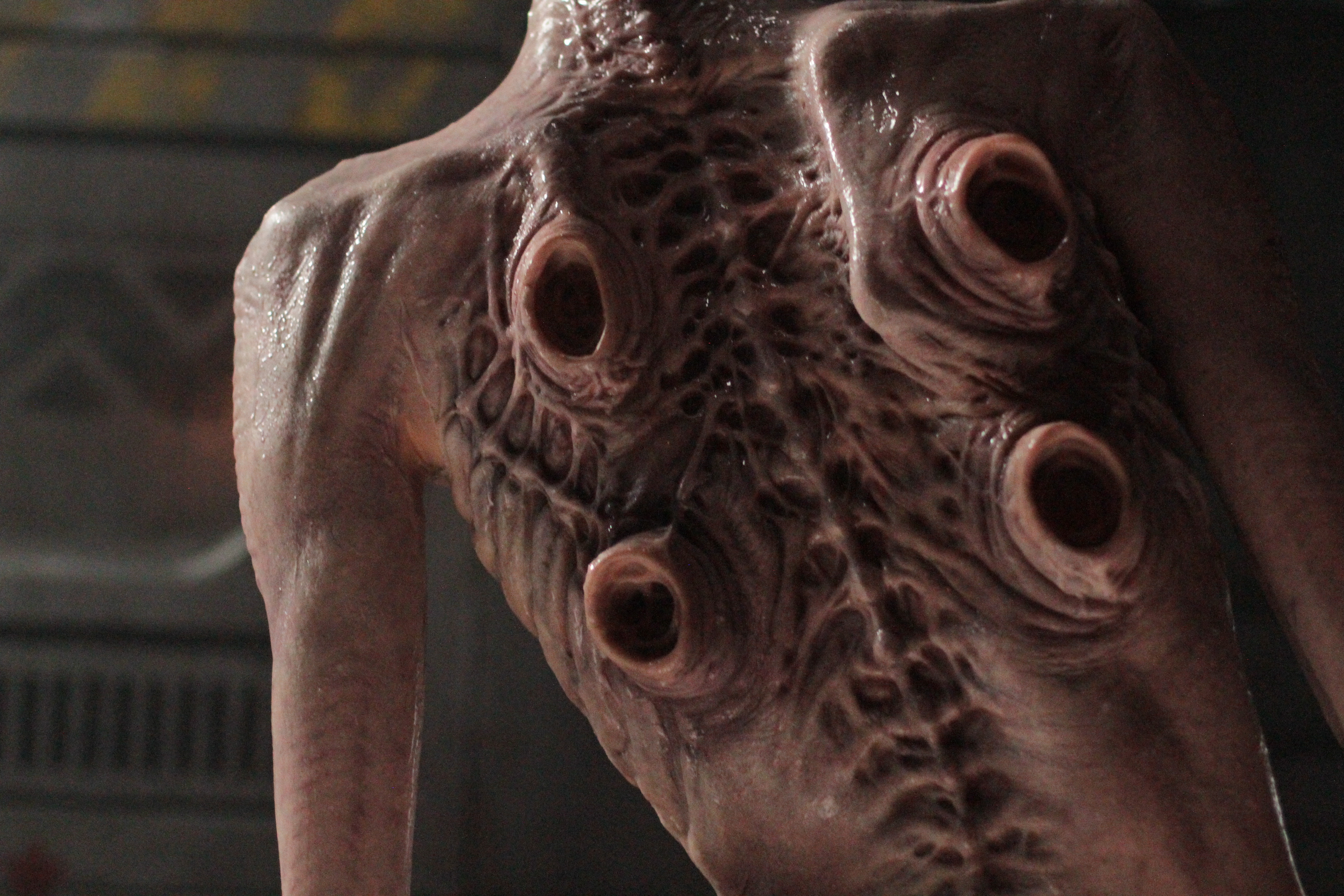 (Closeup on the Offspring back appliance on set. Image courtesy Legacy Effects.)
 (The Offspring facial appliance with embedded black eye shells, evoking the look of the "Engineers" introduced in Ridley Scott's Prometheus. Image courtesy Legacy Effects.)
 (Scott Patton inserts a black lens into the eye of a full-head silicone Offspring mask. Image courtesy Legacy Effects.)
 (Top - Scott Patton 3D sculpts the Offspring's 'tongue'. Bottom - the painted and mechanized tongue. Images courtesy Legacy Effects.)
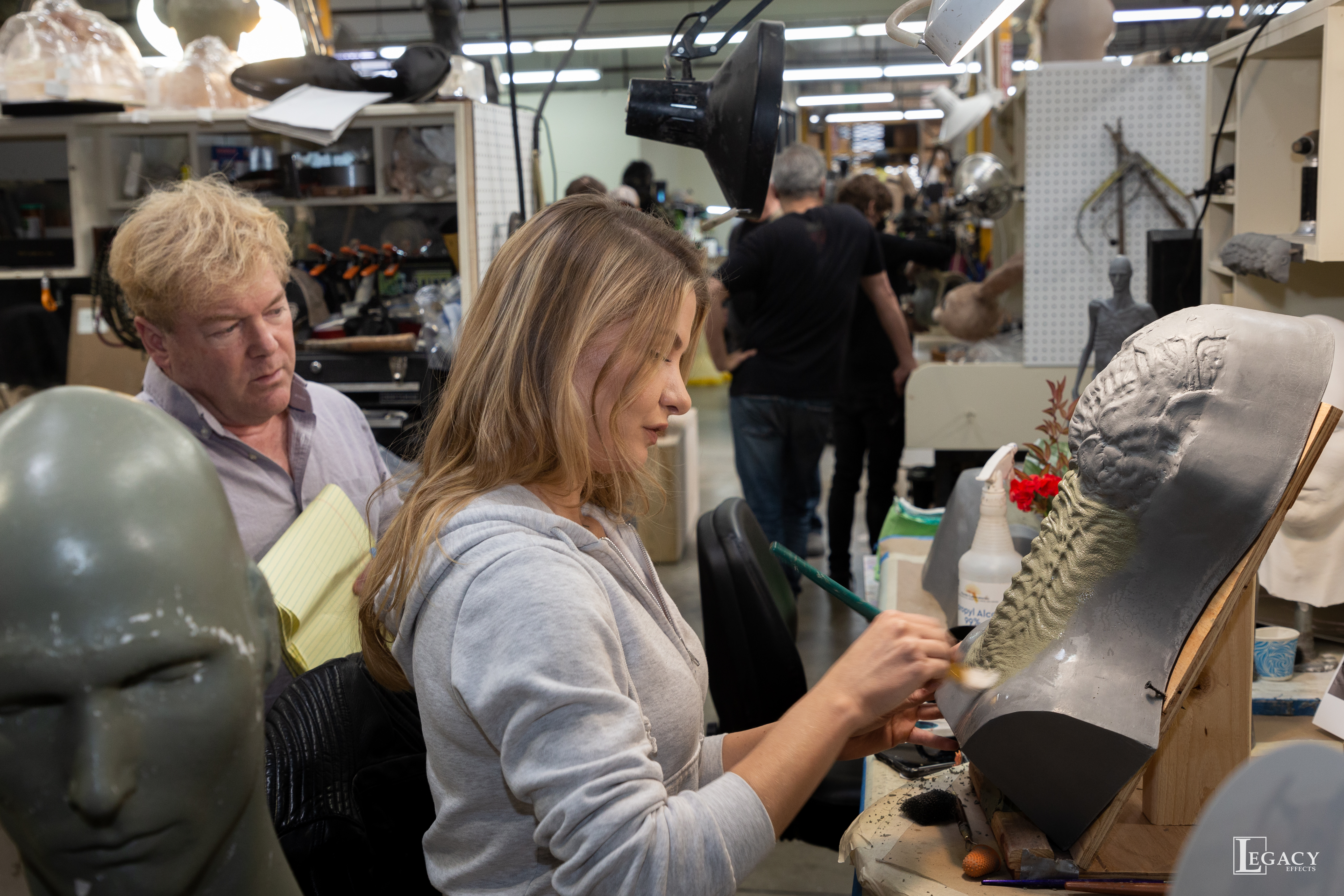 (Shane Mahan reviews Savannah Suderman's sculpting progress on the Offspring's neck appliance. Image courtesy Legacy Effects.)
 (Savannah Suderman details the Offspring's head and neck appliances while Cory Czekaj inspects a newly cast silicone Offspring mask. Images courtesy Legacy Effects.)
 (Savannah Suderman airbrushes an Offspring mask. Image courtesy Legacy Effects.)
Getting Bobroczkyi into the head-to-toe Offspring makeup took a team of makeup artists around three-and-a-half hours. His extreme size made for a challenging application. “I had a special chair made in Budapest [where the film was shot] because nothing exists that will work for him, you know?" The chair featured pedestals that Bobroczkyi could put his arms and feet on so some artists could work on his extremities while others worked on his back, chest, face, and neck. Although the artists left much of his skin showing, the effect was seamless once he was painted and glossed up, with black fluid dripping all over the place. Black shell eyes popped into the facial prosthetic, and custom teeth finished off the horrifying look. In post-production, the VFX team augmented his eyes digitally, added a CGI tail growing out of him, along with some other animated elements to make it appear as if he's continuously growing and changing.
 (L-R, Pepe Mora, Viktoria Stieber, Thomas Foldberg, and Goran Lundstrom apply the full body prosthetic Offspring makeup to Robert Bobroczkyi. Image courtesy Legacy Effects.)
Mahan was impressed with how seriously Bobroczkyi took on the challenge of becoming the Offspring. “It's an uncomfortable process, and he took it deadly seriously. He started working right away with an acting coach in Michigan, at the university. When he got to Budapest, he had another body movement coach. He didn't really talk to us at all while we were doing the makeup. He'd say good morning but wasn't chatty about anything." Despite his reserved demeanor in the makeup chair, Mahan was blown away by Bobroczkyi's transformation once they got him on set. "He would turn it on. We were like, ‘Who's this guy?’ Like, all of a sudden, he became Boris Karloff from Frankenstein. He pulled off a performance that was as good as any creature performer I've ever seen. I was so proud of him.”
 (Comparison of the digital Offspring design sculpture and Robert Bobroczkyi partially in makeup. Images courtesy Legacy Effects.)
 (Thomas Foldberg adds final paint details to the Offspring torso appliance. Image courtesy Legacy Effects.)
 (The Offspring towers over Rain played by Cailee Spaeny. Image courtesy Legacy Effects.)
 (The final Offspring makeup on set. Images courtesy Legacy Effects.)
 (The Offspring threatens Kay played by Isabela Merced. Image courtesy 20th Century Studios.)
Sculpting the Original Nostromo's Dead Alien Head
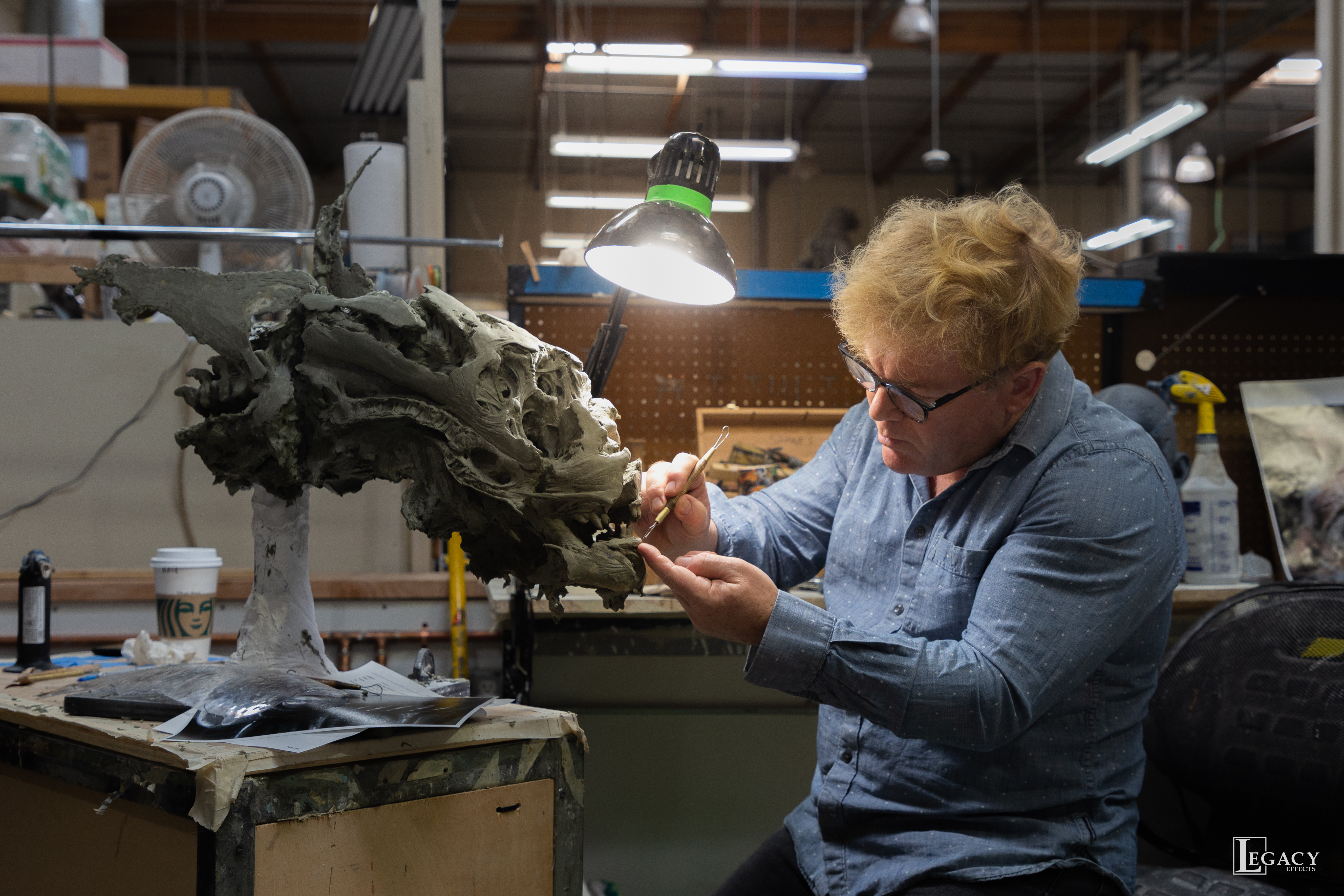 (Legacy Effects co-founder Shane Mahan sculpting the head of the dead xenomorph from the original Nostromo/Narcissus. Image courtesy Legacy Effects.)
As one of the leaders of Legacy Effects, overseeing the work of many artists, Mahan doesn’t get to have as much ‘hands in the clay time’ as he used to. But he revealed he actually got to do some hands-on sculpting for the film. And there was one effect that he really wanted to do. “I wanted to do the head of the burned mummified alien.” This was the xenomorph that had originally been on the Nostromo in Alien. “So, I would take that sculpture home at night or I'd come in and work on the weekends on it.”
 (Jason Matthews, Rob Ramsdell, and Lindsay Macgowan assemble the dead xenomorph body. Images courtesy Legacy Effects.)
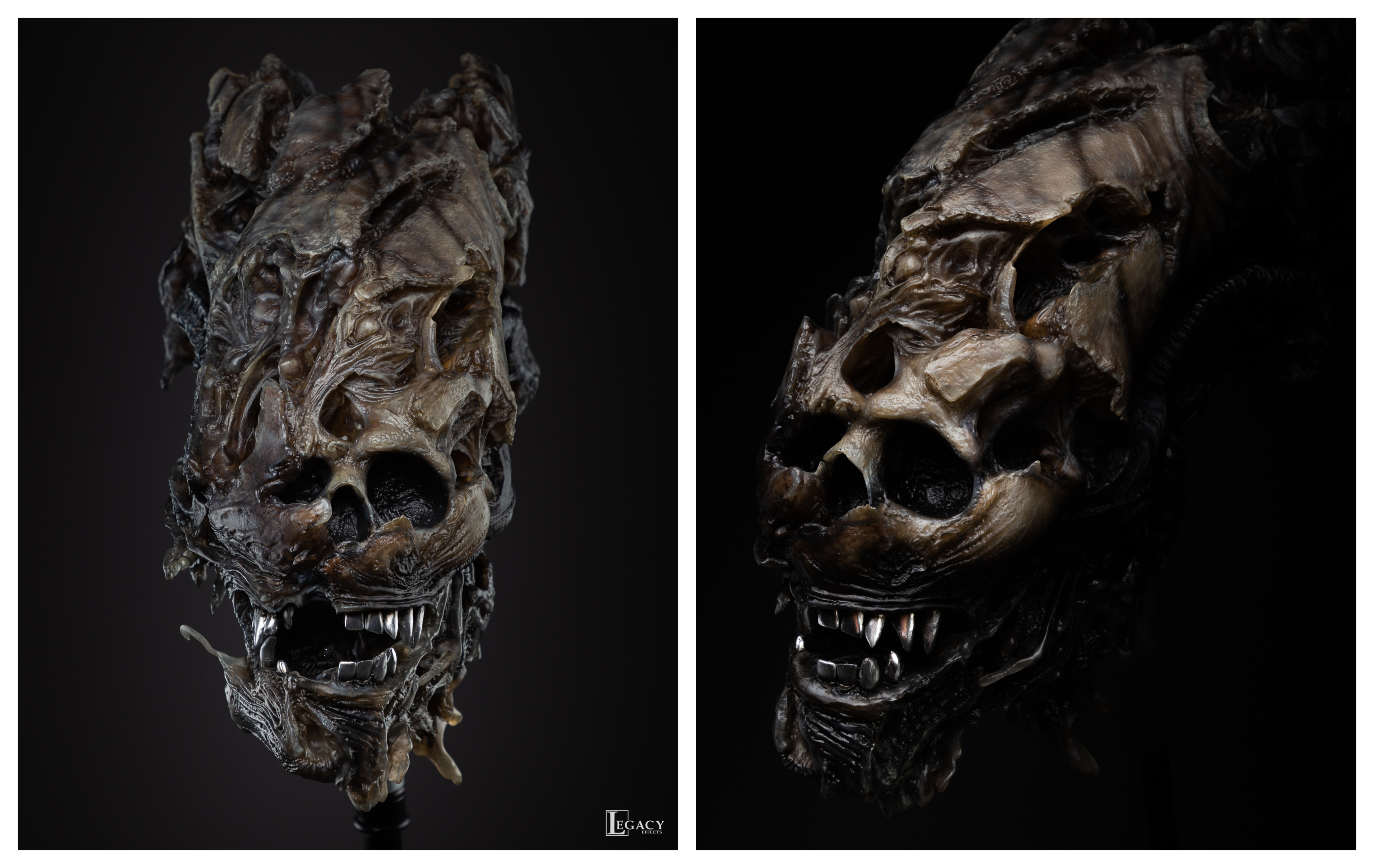
 (The completed dead xenomorph figure. Images courtesy Legacy Effects.)
Building Futuristic Weapons
Cool-looking weapons have been a staple of the Alien franchise since the first film, when Dallas and Ripley prowled the duct system of the Nostromo with their flame throwers. For James Cameron’s ‘Vietnam in Space’ Aliens, the weapons were actually built around real blank-firing firearms; the Pulse Rifles were based on World War II-era Thompson submachine guns.
Along with the practical facehugger puppets, Wētā Workshop was also responsible for building the futuristic prop weapons used in Alien: Romulus. Creating weapons for the new Alien film was nothing new for the shop. In the past, they had produced weapons for Avatar. Again, we talked with Joe Dunckley and Cameron May from Wētā Workshop.
 (Rain and her FF-44AA Pulse Rifle with Andy played by David Jonsson at her side. Image courtesy 20th Century Studios.)
Dunckley gushed about the prop weapons used in Aliens and the impression they made on him, “The guns, especially in Aliens, they were something that stuck with me from seeing that movie the first time. The Steadicam-held M-60-style weapons and those Marine weapons were just super cool," he said. “We've been developing guns for a long time now. So, the opportunity to get to produce a gun for an Aliens franchise film was something really special for the whole team here.”
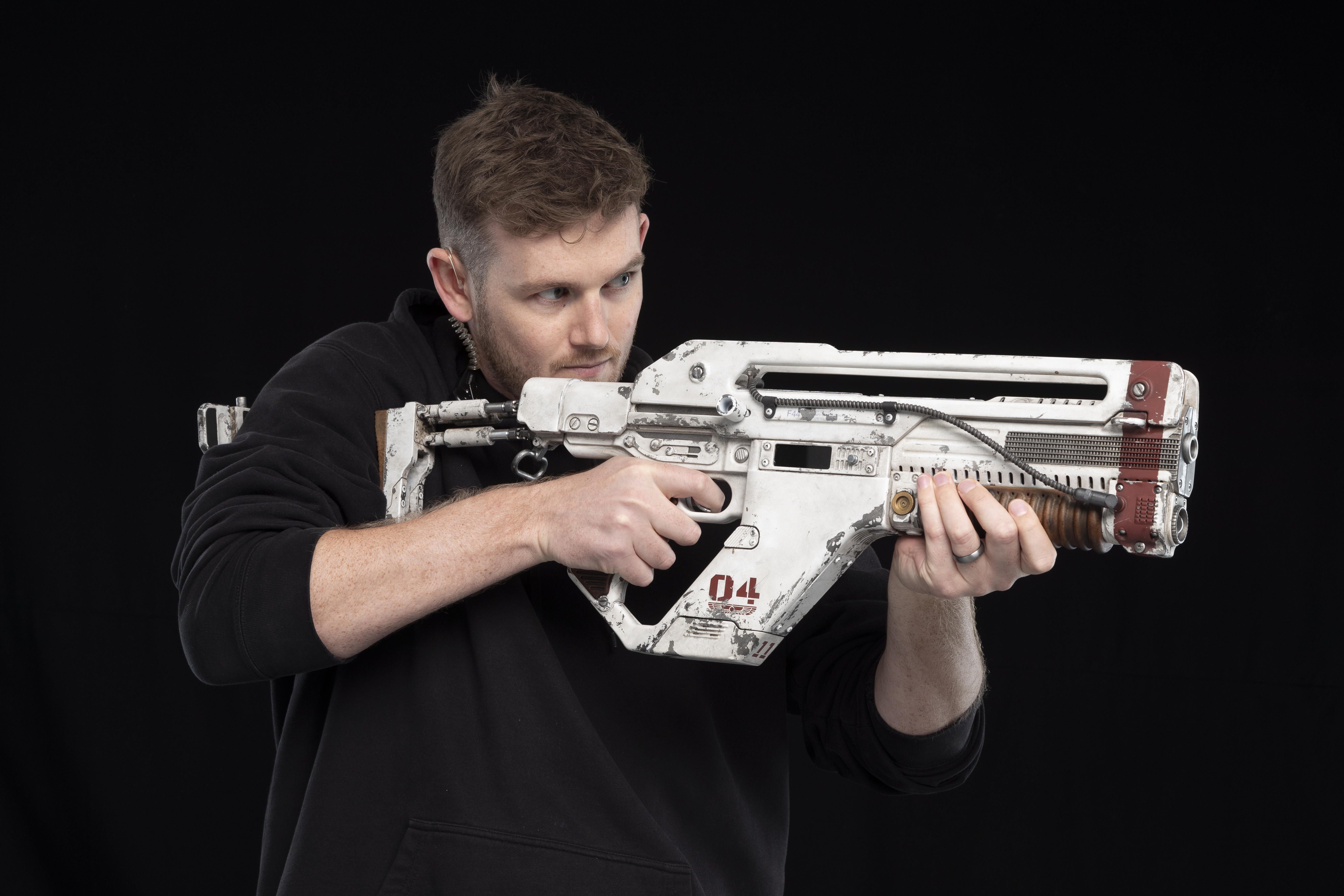 (Ben Fairless demonstrates a completed F-44AA Pulse Rifle. Image courtesy Wētā Workshop.)
Wētā Workshop built the prop F-44AA Pulse Rifles for the new movie, a precursor to the M-41A ones seen in Aliens. Dunckley said the problem with building prop weapons for film use is that "there's always a design compromise. We end up having to make the weapon wider to accommodate for the mechanics inside.” He explained, “A recoil mechanism, muzzle flash, smoke, it all takes up a certain amount of space. And so, we've been working really hard to slim that all down, get all the functions we want into a gun without compromising that aesthetic. We're really happy with how this one turned out. And again, this was Cameron's team that put this together.”
 (Side views of the FF-44AA Pulse Rifles. Image courtesy Wētā Workshop.)
Cameron May added “Like Joe said, we were trying to be uncompromising with the amount of features that we put in the gun.” To make the FF-44AA Pulse Rifles appear real, the barrel had, "a recoil neck, which is a linear motor," said May. "We had a muzzle flash with the kind of LED light that we can customize and color correct. An ammo counter, which is the kind where the bars are dropping on the side of the gun. And then we also had smoke ejection as well, which was in this case, a retrofitted vaporizer. So the smoke was being triggered with every single shot." To achieve the effect, the Wētā team incorporated pneumatic technology into the barrel system. "As it was being drawn in, it was compressing a little bladder which essentially was storing it. And then the act of the recoil was actually firing it out. The biggest challenge was just getting all those things and the controllers and the batteries and all the triggering systems to function and fit inside that gun, and it ended up working amazingly.”
 (Closeup of the ammo counter built into the side of Weta's FF-44AA Pulse Rifles. Image courtesy 20th Century Studios.)
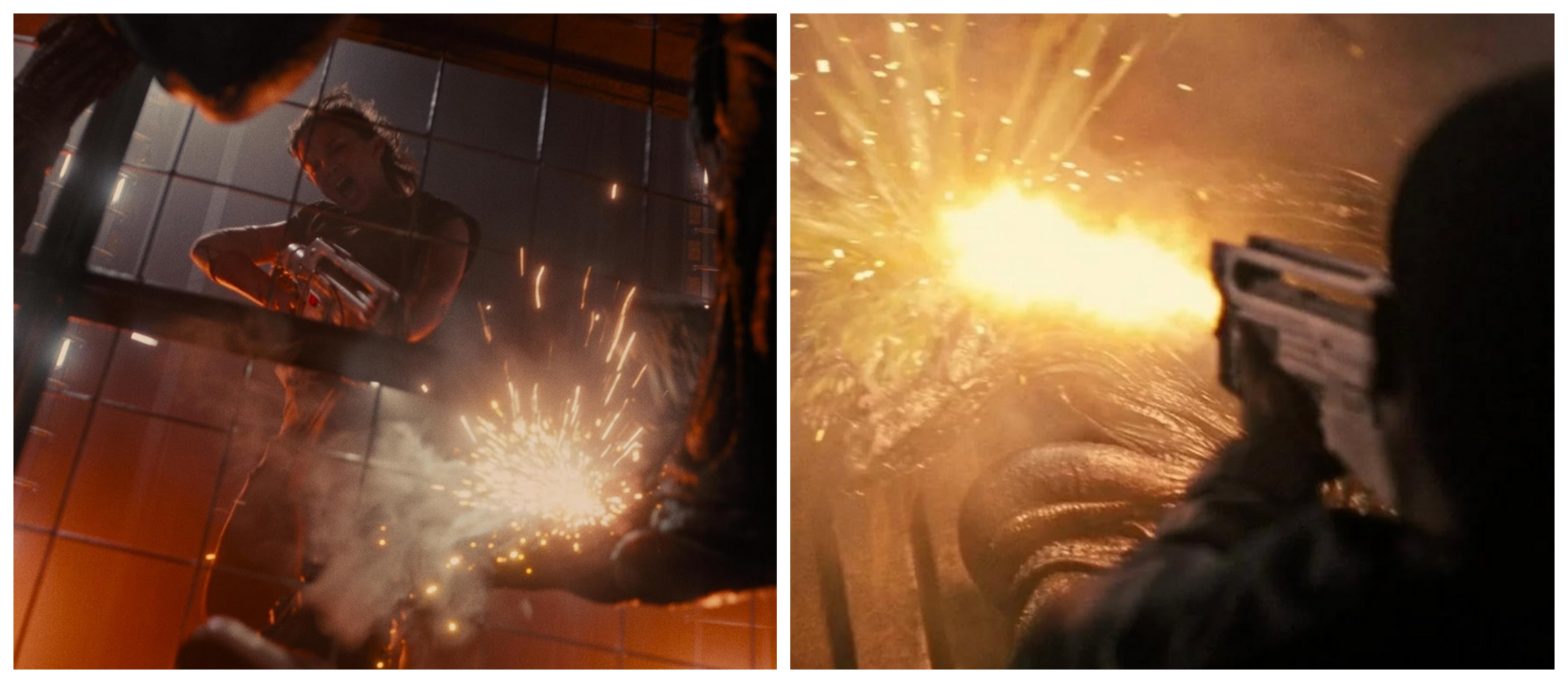
 (Rain takes on a swarm of xenomorphs with the help of an FF-44AA Pulse Rifle. Images courtesy 20th Century Studios.)
In the film, the FF-44AA Pulse Rifles also had a self-aiming feature. “The self-aiming was actually guided by the actor," said May. "That was not a mechanical control system. Instead, what we did was provide a series of pistons essentially that the actor could compress to give the look of self-aiming that gun.” Dunckley added, "And then, if it needed anything else on set, they just went with a bit of monofilament line. They just tied on a bit of mono and puppeteered it that way.”
Creating Realistic Body & Gore Effects
As if the enormous number of creature, weapon, and ship effects weren't enough, Alien: Romulus featured a variety of elaborate body and gore effects which were handled by a team of artists and mechanical effects designers led by Iván Pohárnok and Viktoria Stieber at Filmefex.
In addition to the more elaborate body effects created by Filmefex for the film, Pohárnok and Stieber's team created a variety of photo-realistic human dummies. For the dummies featured in the hive scene, the team was able to get an early start because they were generic and didn't have to match any of the principal actors. "I believe we did 12 of them that we painted to different stages of decay," recalled Stieber. Since the hive dummies wouldn't have to move, the internal armatures were basic, consisting of steel tubes and bendable aluminum armature wire for the joints. "It was basically just different silicone heads and arms attached to foam cores with positionable joints in certain areas like the elbows, shoulders, and knees. When we went to the hive set, we could put them in place and see how they best fit."
 (Hive dummies in various stages of decay. Image courtesy Filmefex.)
Pohárnok revealed a special cameo appearance by the film's director: "We made a dummy of Fede that was featured in the movie. He was a scientist who hung from the ceiling. Two little fingers came out of his mouth, and then the camera turned around, and you realized that half of his head was missing, and there's a facehugger sitting in his head cavity." Stieber laughed, "Fede was the jump scare!"
 (Fede Álvarez's 'dead scientist' dummy head. Image courtesy Filmefex.)
Compared with the generic 'hive dummies,' creating realistic dummies of the lead actors proved more challenging. "Some of the actors and actresses weren't cast until a few weeks before they started filming, so before they were cast, we got a list of how many African American, Asian, Caucasian, female, and male principal cast members there would be," said Pohárnok, "We had to get people in Hungary to match the list." Finally, when the lead actors arrived in Hungary about a week before principal photography, Pohárnok and Stieber's team were able to scan them and do traditional life casts as well. In some cases, like Navarro's, they needed head-to-toe life casts "because we weren't quite sure at that stage how her shirt would expose her chest when the chestburster explosion happened," explained Stieber, "So we did a full upper body silicone life cast of her."
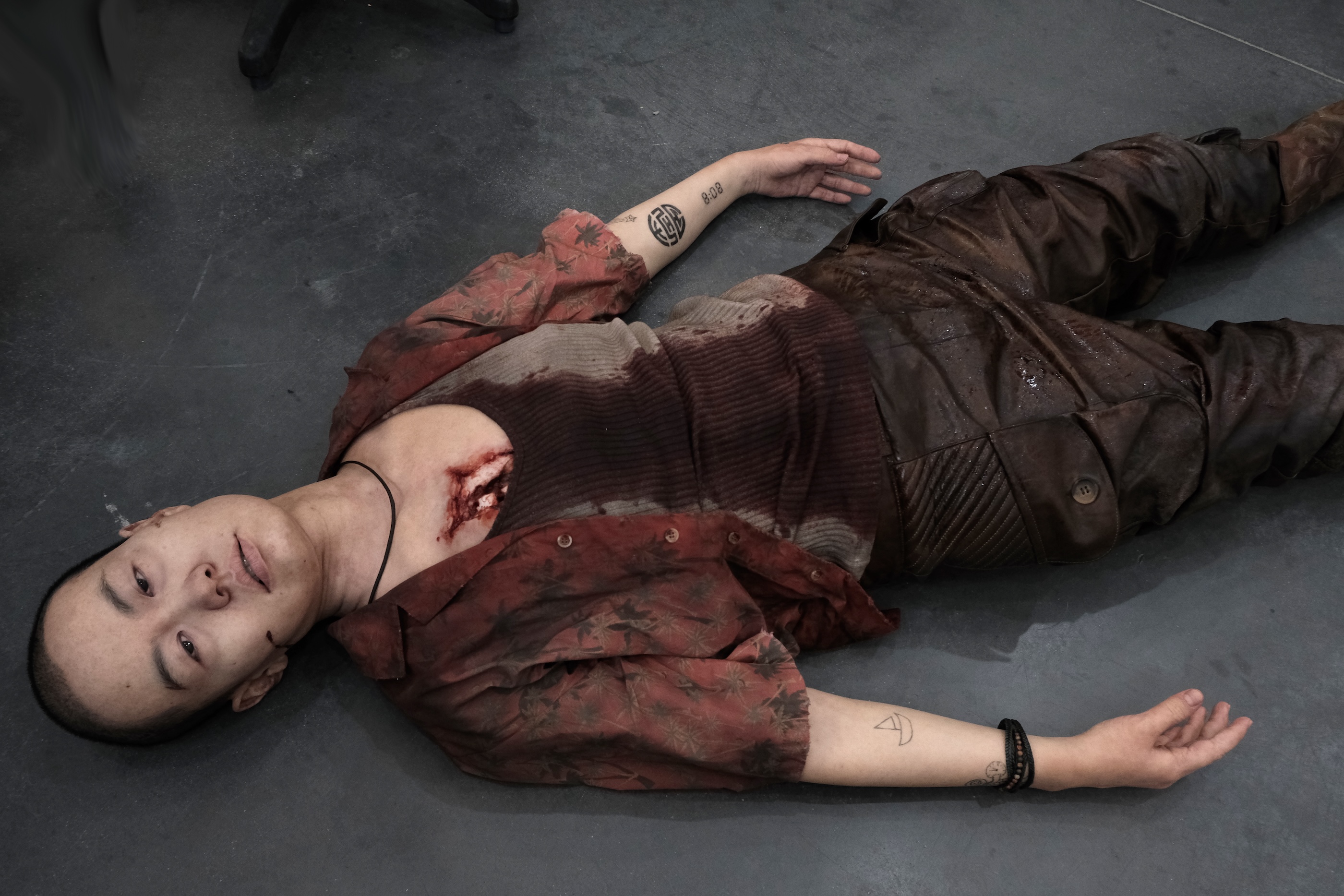 (Navarro's full body dummy. Image courtesy Filmefex.)
Although the team found the traditional lifecasting approach very useful, scanning was the preferred approach when it was necessary to capture a facial expression. "Especially for Tyler, where his dummy had to have an expression on his face, we worked from the scan because, unlike with a traditional life cast, with a scan, he could open his mouth and his eyes." Even though scanning and 3D printing have made huge strides, the team still needed to do some cleanup work. "We'd do a quick mold of the 3D prints, do a clay pour, and then resculpt all the details. We also had the life cast reference next to it because I still feel like a lot of the fine skin texture details come out better when you do a traditional life cast."
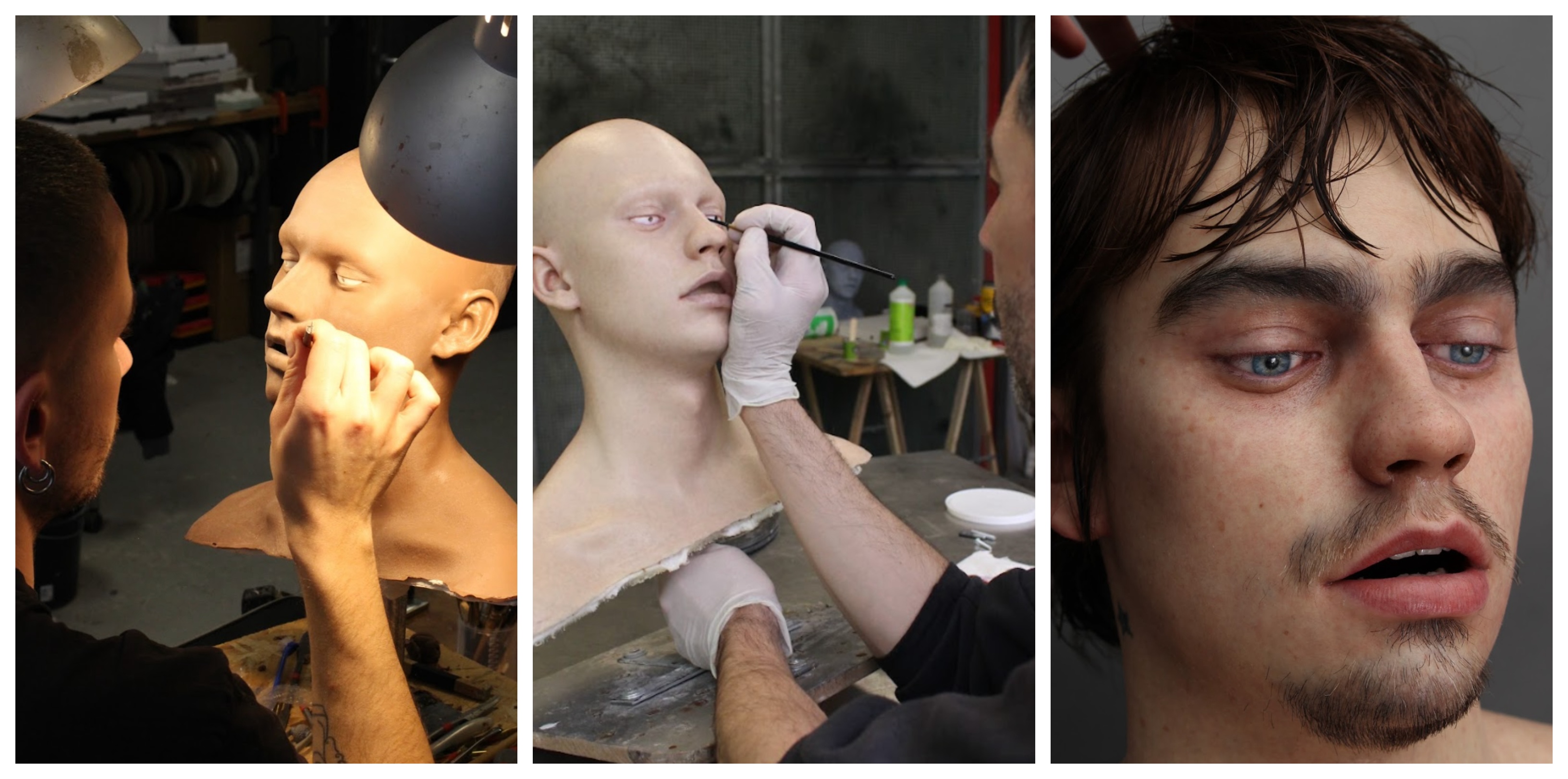 (Bringing the Bjorn dummy to life from sculpting to painting to final finish. Image courtesy Filmefex.)
To finish off the dummies, Pohárnok and Stieber's team added realistic paintwork, eyes, teeth, and hair. "For the teeth, we took casts of the actors' own teeth and then made them in the workshop," said Stieber. "For the eyes, we just printed out 2D irises from actors' reference photos and glued those irises to resin eyes. For the hair, we hair-punched basically everything.
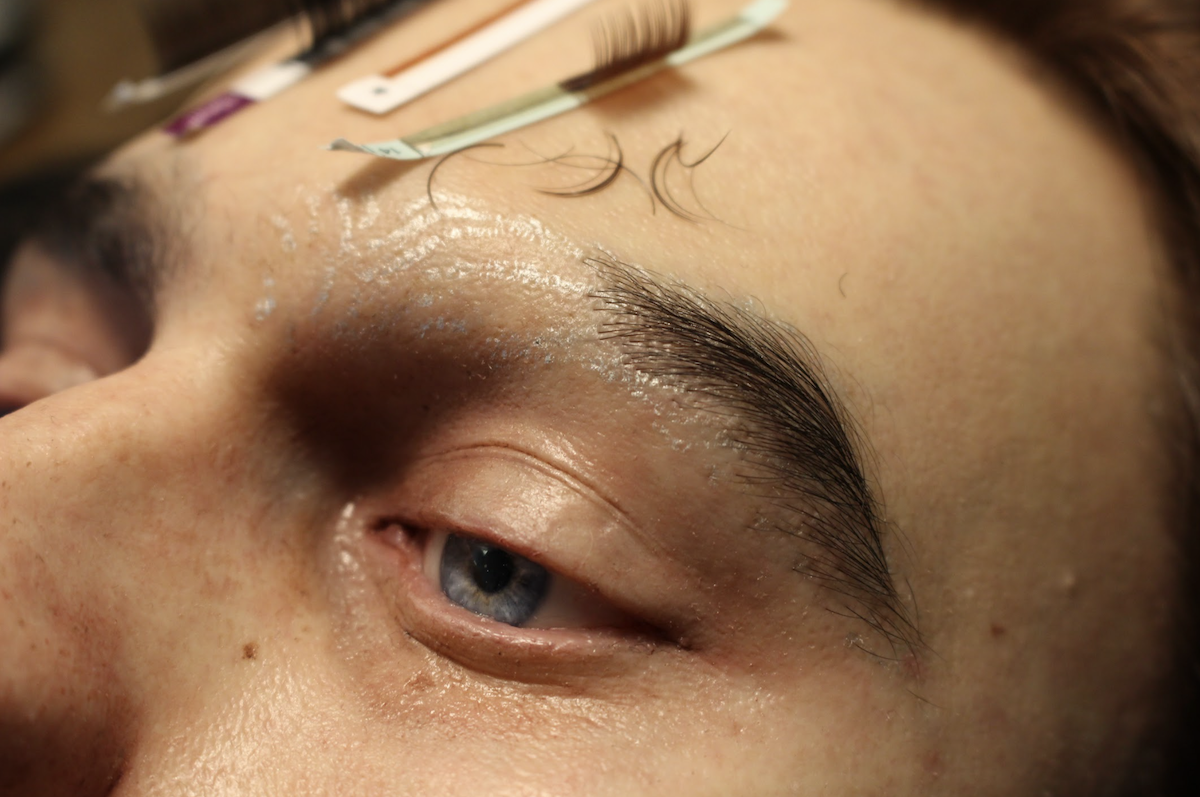 (Closeup view of the eyebrow punching process for the Bjorn dummy head. Image courtesy Filmefex.)
Of all the lead actor dummies, Tyler's was the trickiest one "because Fede wanted the xenomorph tongue to hit his eye and bite the eye out, and then basically explode half of his head. We spent a lot of time figuring out the mechanics of that. It was a fake head with a resin core," revealed Pohárnok, "we had to put a lot of little hinged plastic pieces that could close and open at the right time. It was very difficult to time it; we had to use relays that could kinda delay by microseconds the blood to start to pumping after the head opened up. It was difficult to engineer, but it worked great."
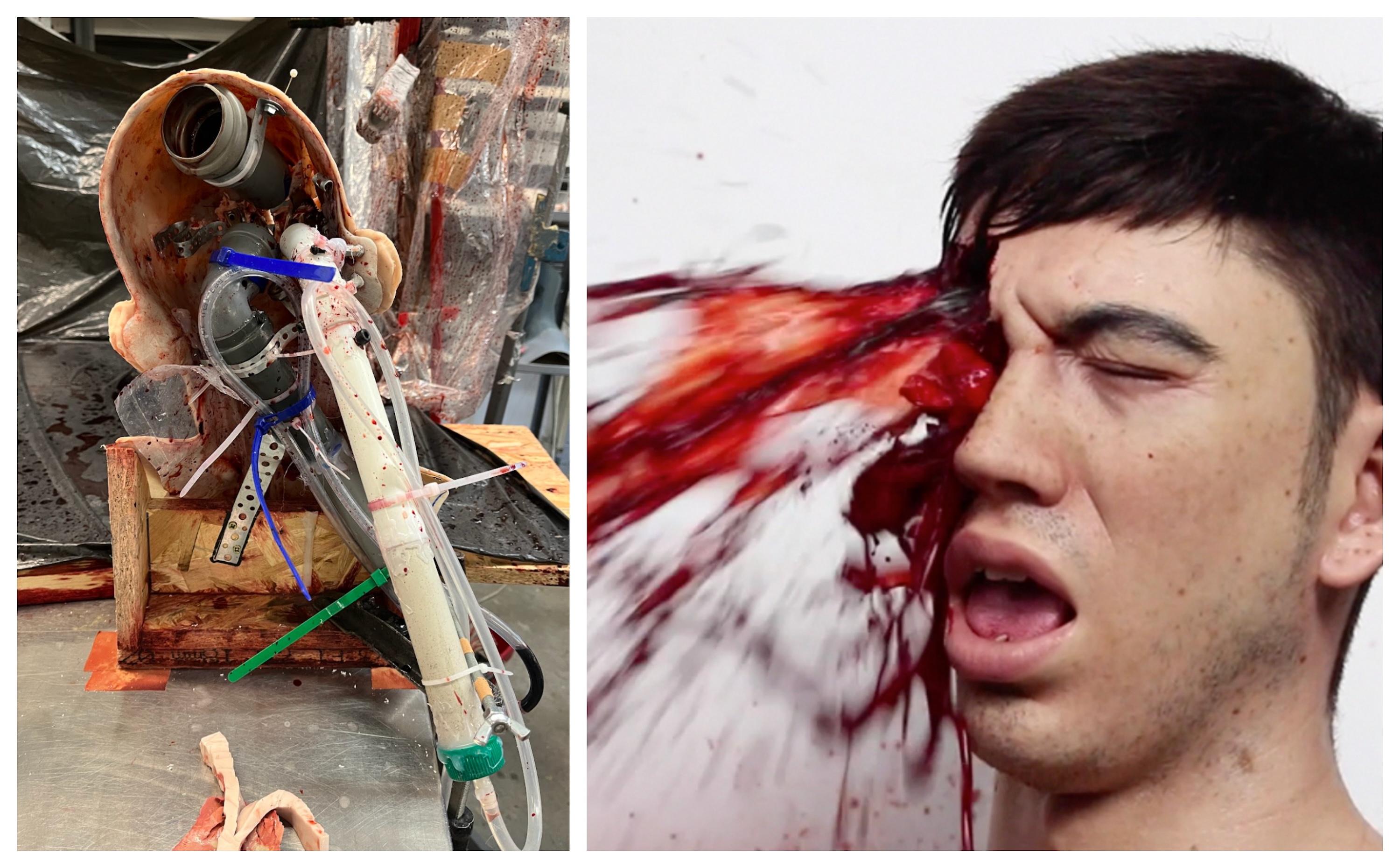 (Left - The internal mechanism inside the Tyler exploding head. Right - Testing the Tyler exploding head effect. Image courtesy Filmefex.)
Andy the Android
For Andy the Android, Fede Álvarez wanted Pohárnok and Stieber to create a little drawer that comes out of Andy's head. "He said, 'Okay, it should be like an old Nokia phone,'" recalled Pohárnok. "He wanted to see a little rubber cover. Once you pull it up, you see this little metal drawer piece. You push it, it pops out a little, and then you grab and pull it out. He also wanted a special key, like a safe code. You twist it this way, that way, and then a row of lights come on at each position. When the sequence is good, a green light comes on, and you can pull it out. Then you can remove this little card and close everything up again." As if all of that wasn't complicated enough, Alvarez also wanted a little liquid compartment that would light up like a little lighted aquarium… and all of this had to happen in a device that was only 2 or 3 inches big. "So I started drawing this, and once Fede approved it, it got passed to our 3D guys to start modeling," said Pohárnok. "While they were doing that, Viktoria started figuring out the prosthetic part of it."
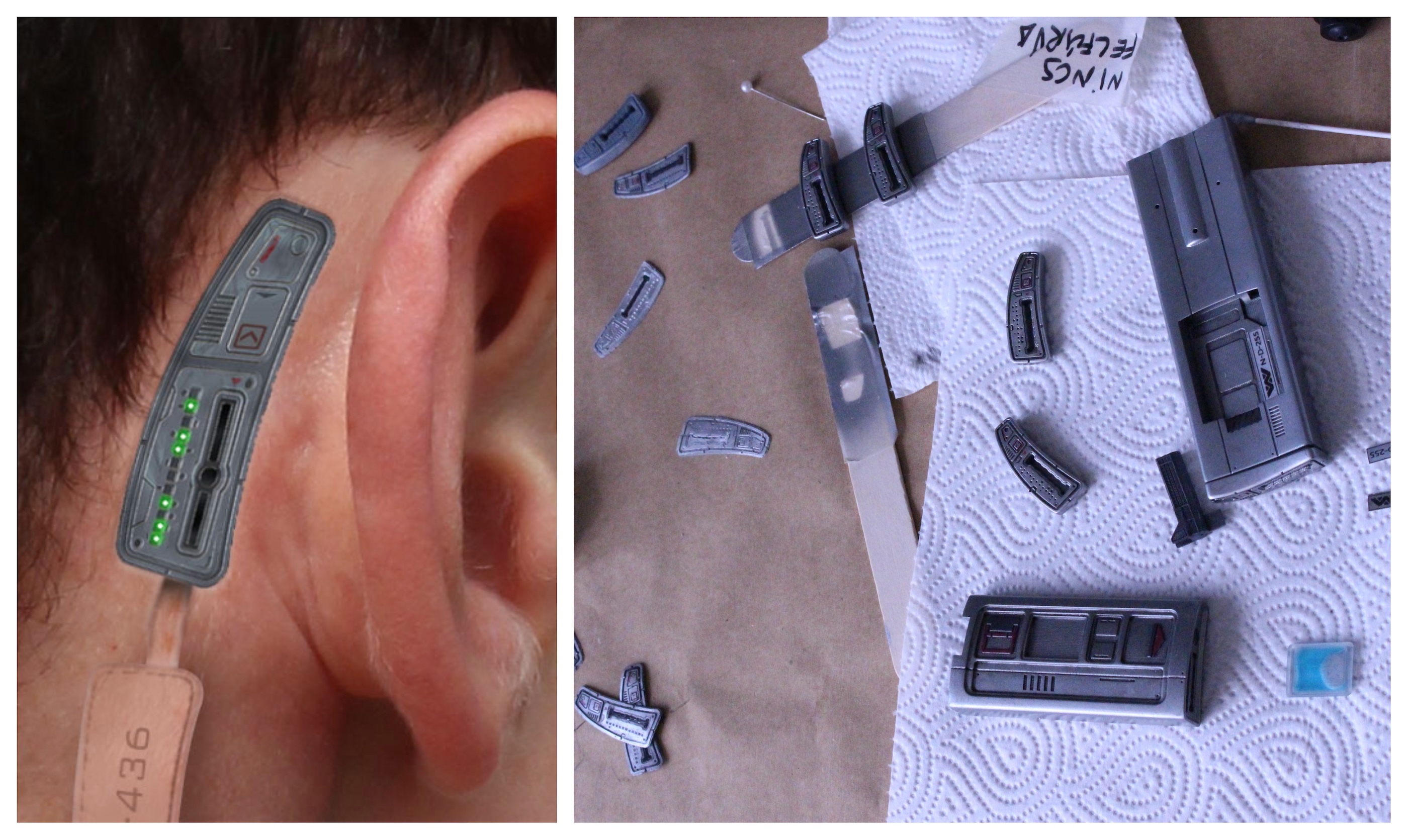 (3D printed, painted, and fiber optically illuminated parts for Andy's removable head module. Image courtesy Filmefex.)
"We had different stages of that effect because, on a lot of the days, we only saw the outlines of the skin cover," recalled Stieber. "Most of [the film] was quite dark so that you couldn't see it at all. But for the days where we would see it, we applied a little bondo piece just behind his ear." Stieber continued, "We made a more intricate silicone piece where we had the front of the drawer in a little plastic sheet with all the details and attached that to his skin. Over that, we applied a silicone prosthetic 'skin cover.' We only used this more intricate piece in the first scene, where Andy gets beaten up, and Rain goes to fix him."
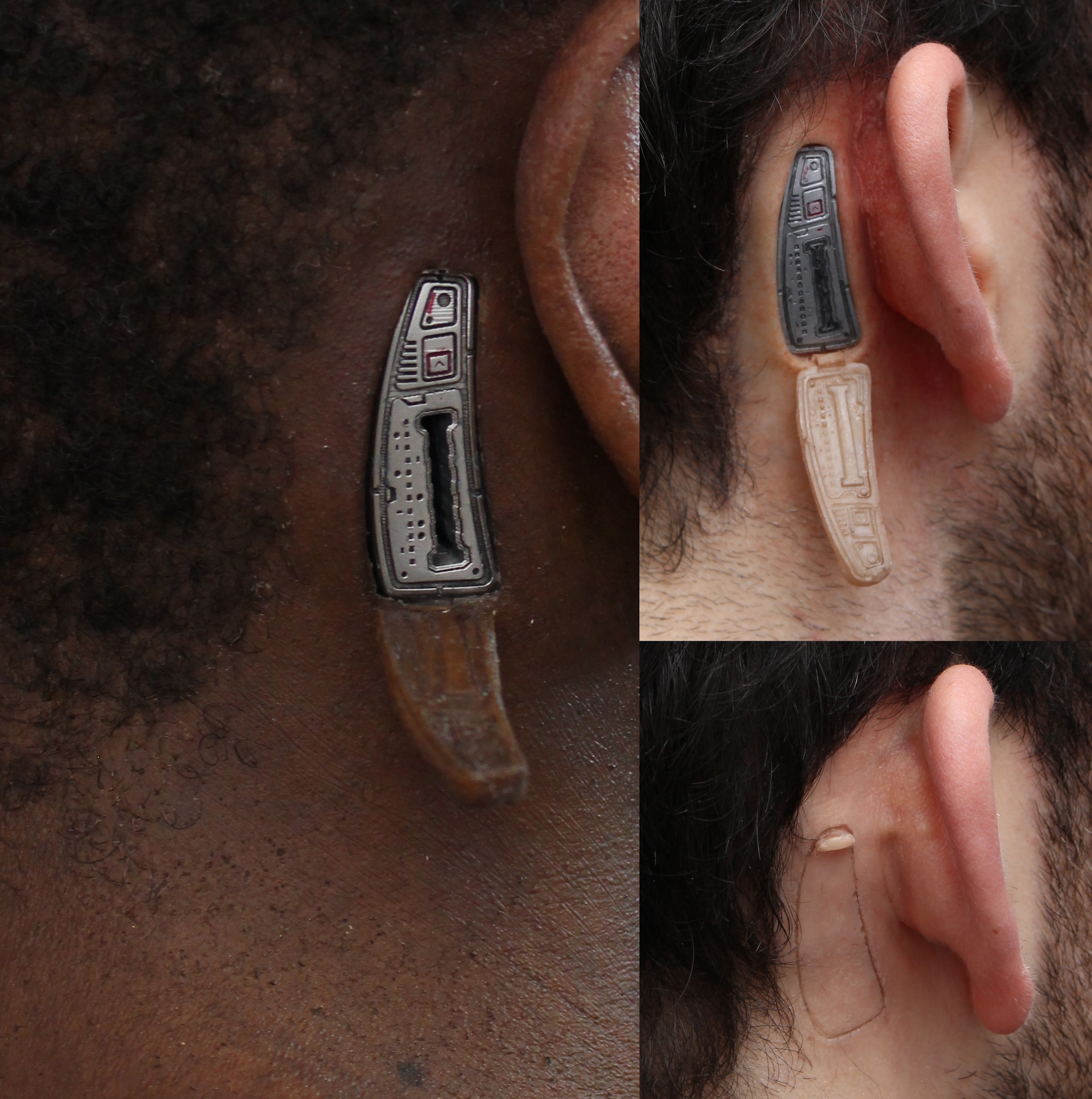 (Prosthetic module 'drawer' covers. Image courtesy Filmefex.)
Finally, the team created a photorealistic Andy head with fully hair-punched silicone skin and custom eyes. "We had to create a push button mechanism that would stay within Andy's dummy head but still work," explained Pohárnok. "The lights were so tiny that nothing really fit in there, so we had to use fiber optics and a controller that would allow us to change the lights depending on how the actors rotated the key. That all took time to build. It didn't look that complicated, but it was.
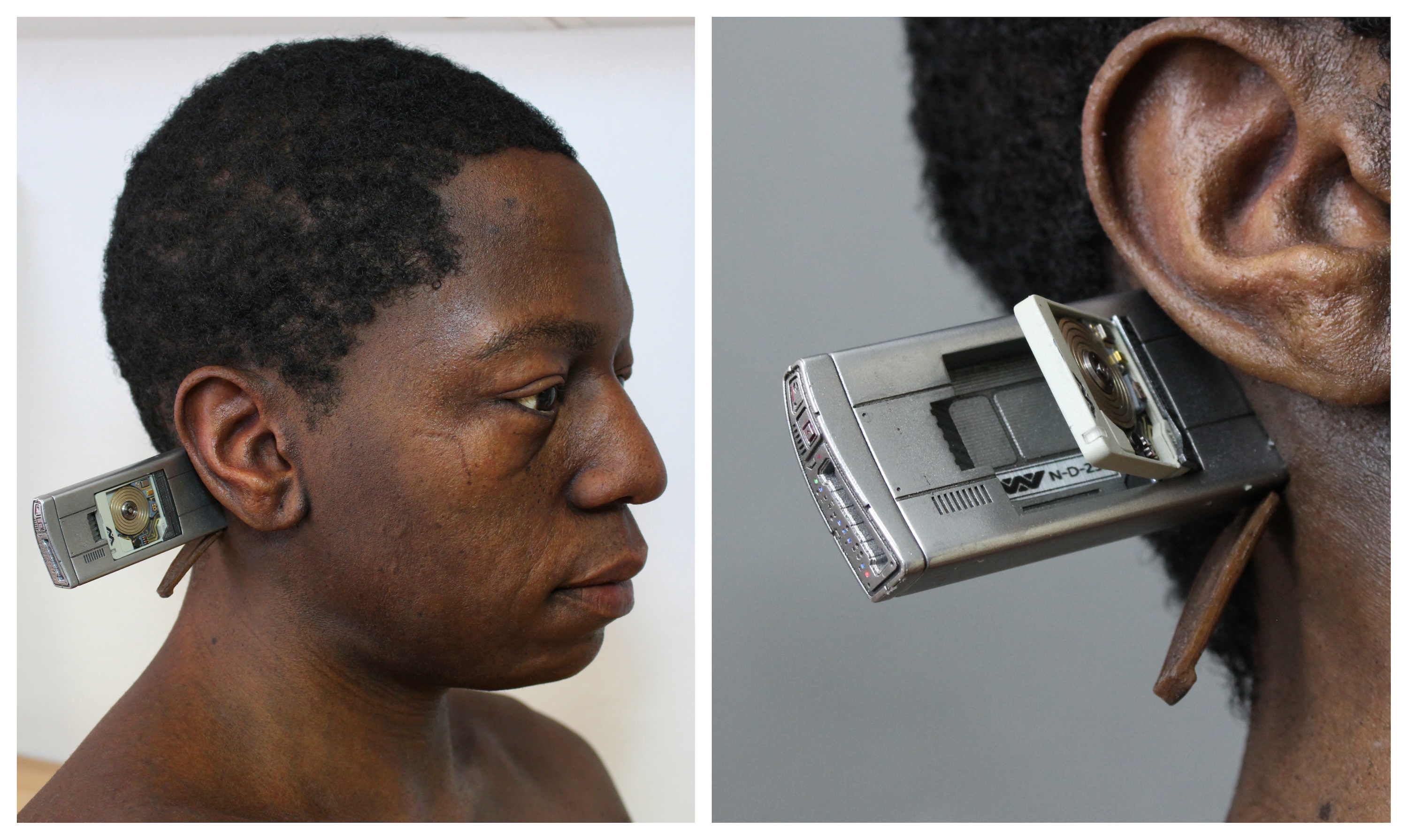 (The Andy dummy head with removable module and chip compartment. Image courtesy Filmefex.)
The Chestburster Scene: Engineering Meets Artistry
One of the film's most harrowing moments, and one that harkens to every Alien film in the franchise, is Navarro's chestburster scene, which required multiple stages of effects to accomplish. For the first stage, "a silicone prosthetic chest piece was attached to the front of Navarro's upper torso, which had rib pieces underneath that could push out and create this broken rib effect," explained Stieber.
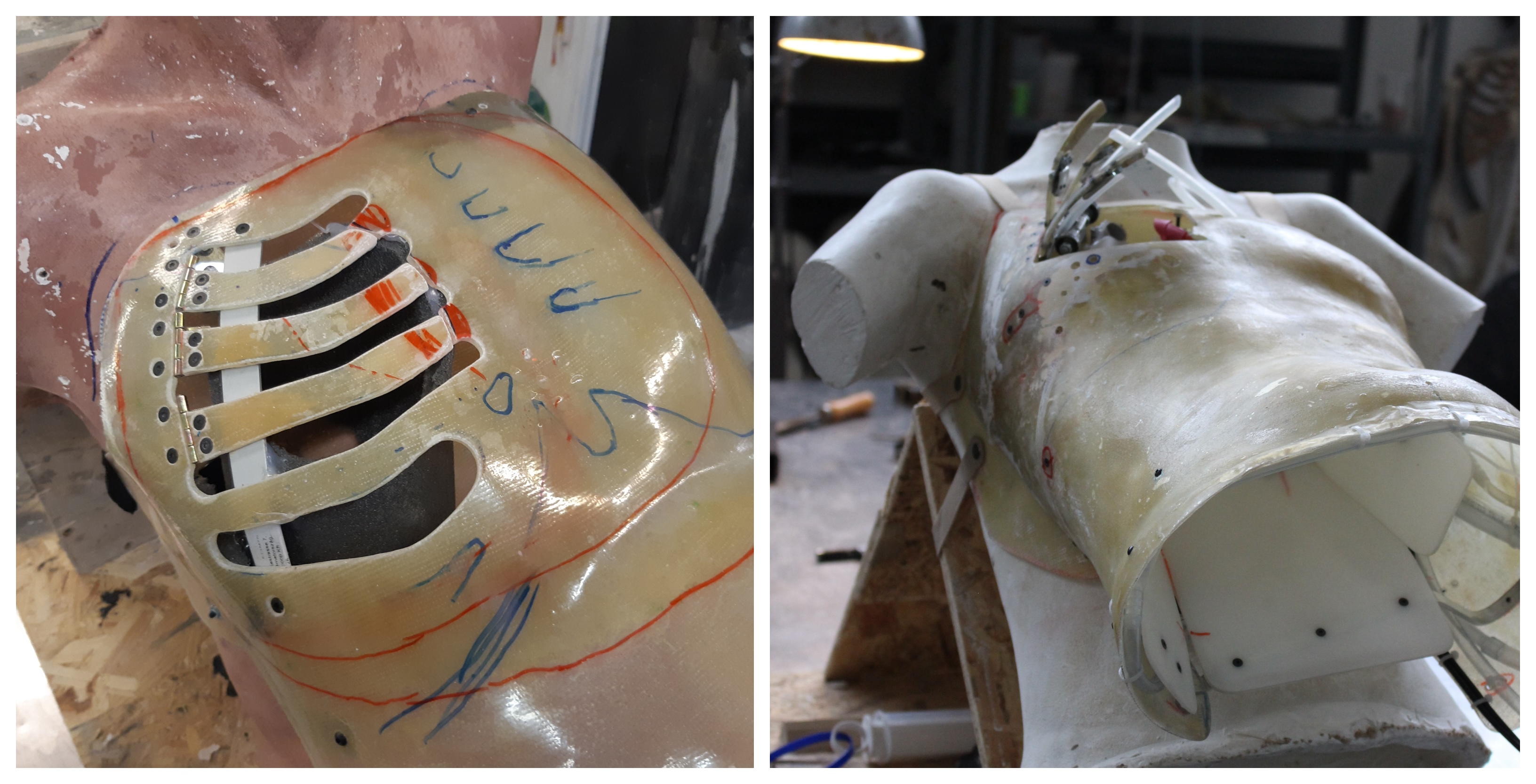 (The broken rib mechanism in closed and opened position. Image courtesy Filmefex.)
To ensure the repeatability of the rib-breaking effect, Pohárnok's mechanical crew engineered a system where plastic ribs hinged onto a resin plate and could be pneumatically controlled, "We could operate everything with buttons. It was much easier to time everything that way. Whenever something explodes or rips apart, I like to use repeatable options. We spend an extra few weeks figuring out how to mechanize the effect to look real. Then, with the push of a button, you can go back to zero and shoot it as many times as you want. We took this approach with Navarro and basically every other body effect." The blood effects, controlled via a pressure pot system, could also be fine-tuned for the perfect amount of gore.
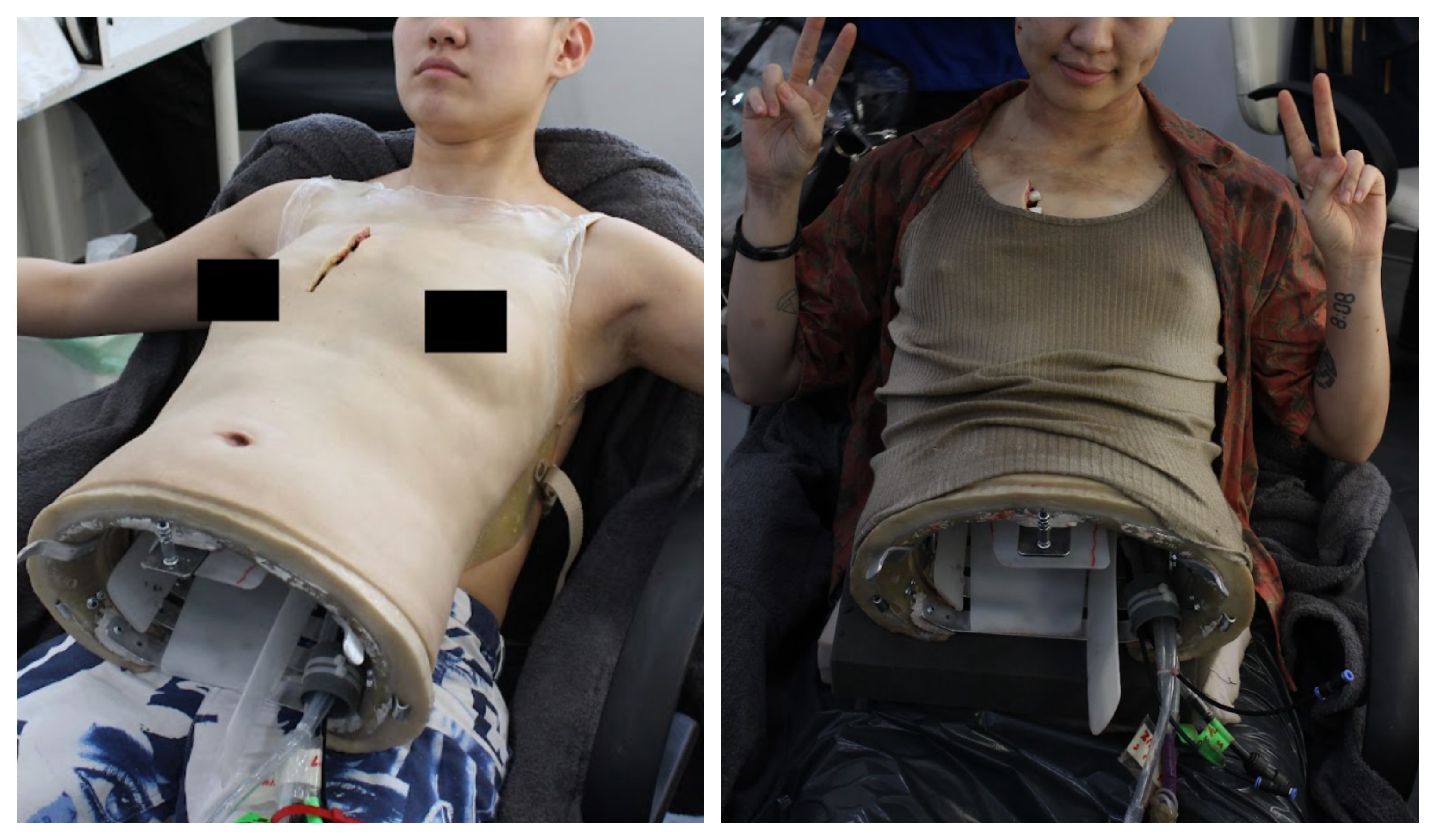 (Navarro's artificial torso prepped and ready for the chestburster to burst through. Image courtesy Filmefex.)
The second stage utilized a classic practical effect technique where Navarro was angled on a hidden slant board underneath an artificial silicone torso, which blended seamlessly into her neck, and which the chestburster could burst through. "We built that torso in two different sizes, the larger of which was one and a half scale, because Alec Gillis' team had created a larger version of the chestburster for the more detailed shots," said Stieber, "And finally, we had a prosthetic piece for the aftermath. We created a full dummy body of her as well."
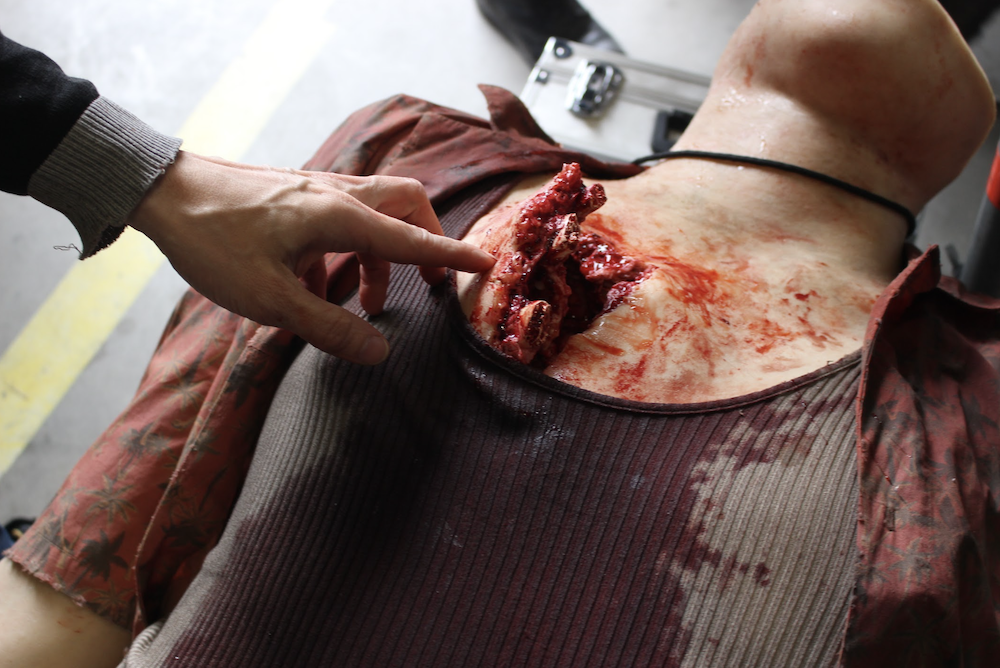 (Navarro's larger torso for shots featuring the scaled up chestburster puppet. Image courtesy Filmefex.)
The Birth Scene: Kay Delivers the Offspring
For the horrifying scene where Kay gives birth to the 'Offspring,' Pohárnok and Stieber's team built a partial torso consisting of "the chest downwards, some fake legs, and a hollow belly to puppeteer the egg through," said Stieber, "The legs were attached to puppeteering rods so we could give them a little bit of movement. We had lots of blood tubing in the belly cavity as well, but it was a simpler rig than was used for Navarro or Tyler's heads. We just used some syringes [to squirt the blood] because it didn't have to spray as much."
Elaborating on the reason for building Kay's fake body from the collarbone down, Pohárnok revealed that "Fede said he doesn't like cheating. He wants to see the whole thing. He wants to see the actress's face and her body while she's giving birth. So that's what we prepared for."
Where Alien: Romulus Fits in the Franchise
Director Fede Álvarez’s Alien: Romulus introduces an exciting new chapter to the Alien universe. It combines the horror and suspense of the original and the action set pieces that made Aliens so memorable. Álvarez is also responsible for putting together an all-star team of makeup, miniature, and creature effects artists from Legacy Effects, Studio Gillis, Wētā Workshop, Pro Machina, and Filmefex. These studios and their talented crews have raised the bar and paved the way forward for the next set of Alien tales.
Alec Gillis said working on the newest film with all of the previous Alien film alums had a kind of symmetry to it. Shane Mahan agreed, “You had myself, Lindsay Macgowan, Chris Swift, Rob Ramsdell, and Alec Gillis, and to a great extent, Pete Clarke, but from a later generation. We're all artists that worked for Stan Winston. That's why Fede wanted us to work on it. He was very honest about that. He chose us to work on it, to have a continuity of that, for that very reason.” Shane Mahan gave a shout-out to the entire Legacy Effects crew. “It's a collective team effort. I think everybody's work is stellar in this. Without that group of people, it just doesn't get done."
Looking back at Studio Gillis’ work on Alien: Romulus, Alec Gillis explained why he thinks practical effects look so good, “It's already in the real world. And that, to me, is part of the beautiful thing about practical effects. You don't have a hundred percent control over it. There's a bit of kismet and some physics involved, and like, how are the materials gonna react?” On director Fede Álvarez, Gillis said, “He is not afraid to take his time to get things right. And that is critical to practical effects. If you are doing digital effects, you can shoot a plate, and it's in the can; let's move on. But when you're doing practical effects, you've got puppeteers. You have an actor who's in an uncomfortable situation. Fede was terrific.”
Ian Hunter said Alien: Romulus is a "callback to the parts of Alien and Aliens that we really loved in terms of the thing around the corner that scares you. We know what the facehuggers are now, so there's no sense trying to spring that on us as a mystery. We know what they are. So then, instead of doing that, he's like, ‘Oh, I have a hundred of them chasing you.’ That's really scary. So, I think that's a really great thing. [Álvarez] has taken that, those cues that he loved from the past movies, and he has kind of pushed them again.”
Iván Pohárnok echoed the belief that practical effects continue to be a valuable tool in the filmmaker's kit. "Practical effects have a parallel life to visual effects nowadays. Hopefully, more and more people will realize that this looks better." Viktoria Stieber added that it's "not just for the camera, but also for the actors and actresses to have something to play with and look at. It is just a completely different feeling than acting in front of green screens and with tennis balls and all of that. It's more fun."
The last word goes to Joe Dunckley, who said that there is a group of directors coming up that like using practical effects. “They want to see a real alien and real facehuggers. They've still got that VFX tool, but they're lovers of the art of practical effects.” Dunckley acknowledges that VFX can add a lot, too, but it’s up to the director to know when to use which tool. “Because, when it comes down to it, it's about the audience experience isn't it? What journey can we take them on and can we freak them out with a monster?”
Watch Alien: Romulus at home! The film is now available at Digital retailers (Prime Video, Apple TV and Fandango at Home) and comes with never-before-seen bonus extras!
LEGACY EFFECTS ALIEN: ROMULUS CREW
Shane Mahan
Lindsay Macgowan
J. Alan Scott
Damon Weathers
Scott Patton
Darnell Isom
Savannah Suderman
Adam Milicevic
Greg Smith
Ben Ploughman
Jim Charmatz
Evan Hedges
Bodin Sterba
Trevor Hensley
Rob Ramsdell
Christopher Swift
Glenn Hanz
Mike Manzel
Andy Bergholtz
Cary Gunnar Lee
Mark Maitre
David Monzingo
Wen Zheng
Nicholas Winstead
Jason Matthews
Peter Clarke
David Covarrubias
Brian Poor
Seth Hays
Michael J. West
Lon Muckey
Rick Galinson
Victor Broadley
Matthew Winchell
Kennedy Necoechea
Damian Fisher
Dan Driscoll
Gary Yee
Jaime Siska
Jeff Deist
Nathan Fritzges
Steve Adkins
Tom Ovenshire
A.J. Venuto
Ryan Pintar
Parker Hensley
Derek Rosengrant
Lisette Santana
Jennifer Corona
Cory Czekaj
Blair Berens
Chris Grossnickle
Andrew Arrasmith
Erica Akin
Amber Quillen
Diego Porqueras
Rodrick Khachatoorian
Tracey Roberts
Alicia Dickens
Dawn Dininger
Ver Mar
Sean Kinsky
Tamara Carlson-Woodard
Dave Merritt
Toi Ogunyoku
Jonathan Faber
Josh Spooner
Connie Criswell
Kathy Macgowan
Goran Lundstrom
Pepe Mora
Thomas Foldberg
Samuel McBride
Nestor Castaneda
Benjamin Cobb
Lyn-Del Pedersen
Chaz Dupuis
Joe McLoone
Natalie Matranga
Stephanie Eccles
Alyssa Yule
Freddy Aguilar
Rachel Weaver
David Castinez
Jake Harbour
Chris Hamilton
Matt Alavi
PRO MACHINA ALIEN: ROMULUS CREW
Ian Hunter
Camille Balsamo-Gillis
Reid Collums
Dustan Boleski
Tawnya Diaz
Bonnie Ephraim
Colin Gillis
Liza Goldenberg
Calder Greenwood
Noah Benjamin Jones
Forest P. Fisher
Matthew Killen
Jon K. Miller
David Penikas
Melissa Ramirez
Nick Reisinger
Jen Roomes
Devin H. Schneider
Emma Siate
Zachery Teller
Sara Villarreal
WĒTĀ WORKSHOP ALIEN: ROMULUS CREW
Joe Dunckley
Ben Price
Ben Fairless
Jenna Nuthall
Danielle Prestidge
Kelsi Gemmell
Cameron May
Tyler Page
Tim Tozer
Joel Ahie-Drought
Craig Hobern
STUDIO GILLIS ALIEN: ROMULUS CREW
Alec Gillis
Consuelo Duran
Michael Heintzelman
Matthew Killen
Mike Larabee
Tim Leach
Peter Murphy
David Penikas
Nick Reisinger
Alice Rijn
Mauricio Ruiz
Zac Teller
Sara Villarreal
Garth Winkless
FILMEFEX ALIEN: ROMULUS CREW
Ivan Poharnok
Viktoria Stieber
Zsolt Egresy
Kriszta Katona
Andrea Kozma
Matyas Borda
Laura Breckner
Balint Feledy
Akos Badenszky
Csaba Bojthe
Piroska Bibok
Julian Hutcheson
Daniel Pifko
Ferenc Szabo
Attila Tilinger
Balazs Frank
Annamaria Nemeth
Marton Bojti
Gyorgy Szasz
Adam Gajdos
Tamas Savanya