
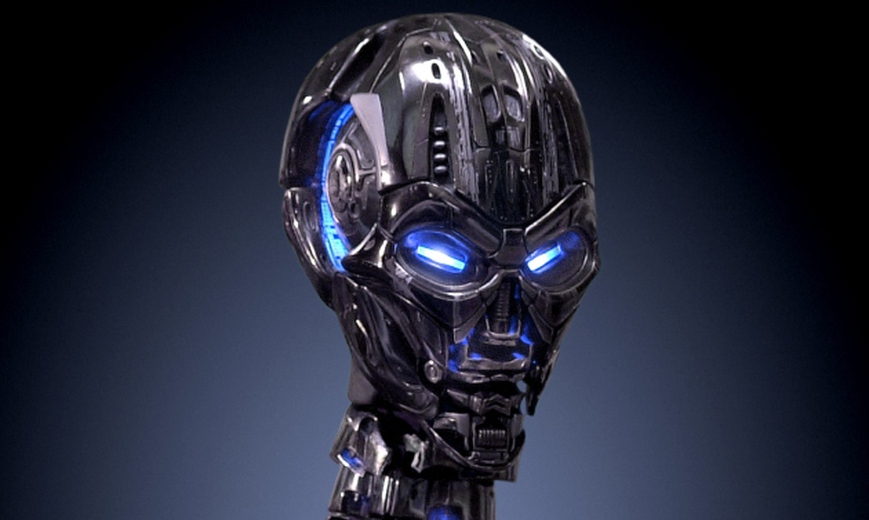
Creating the Terminatrix for Terminator 3
The first Terminator featured a single cyborg, and Terminator 2: Judgment Day featured two; so, it followed that Terminator 3 would boast three Terminators: the original, '800-series' cybernetic organism, again played by Arnold Schwarzenegger; the 'T-X,' a more sophisticated version of the T-1000 shape-shifter from the second film; and the 'T-1', a robot of a historically earlier design that is the crude prototype for future Terminators.1
In Terminator 3: Rise of the Machines, the more powerful Terminator is a Terminatrix, or T-X, played by Kristanna Loken, with a cool detachment reminiscent of Robert Patrick's T-1000 in Terminator 2. "She's much more destructive, though," Stan Winston commented. "Nothing is scarier than a woman on a mission more deadly."2
Jump To Section
- The Difference Between T-X and T-1000
- Designing Skynet's Newest Machine
- Planning a New Type of Liquid Metal Character
- Building the Terminatrix for T3
- Weapon Selections of the T-X in Terminator 3: Rise of the Machines
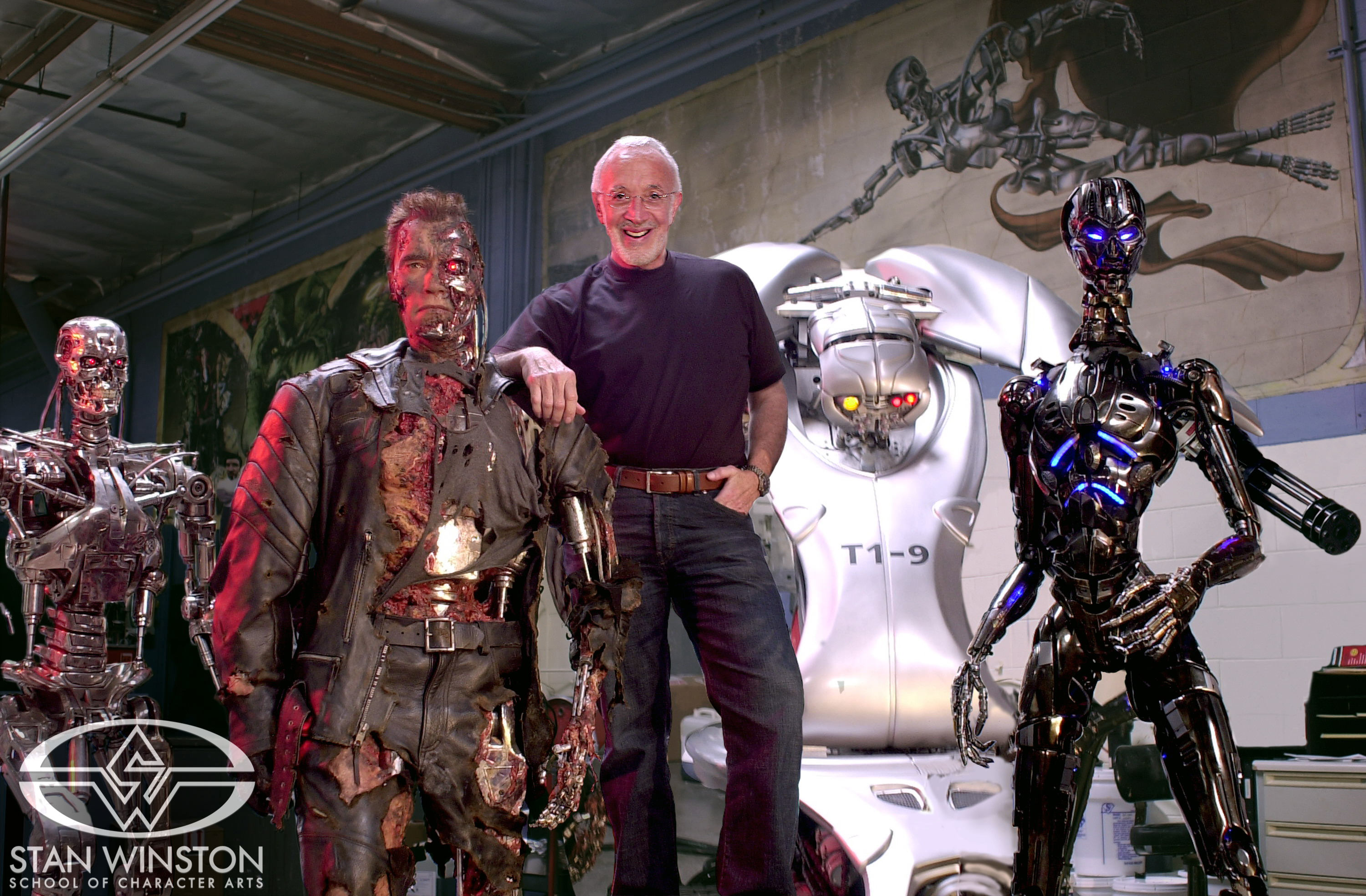 (Stan Winston, between the T-850, T-1, and T-X Terminators, built by Stan Winston Studio for Terminator 3: Rise of the Machines.)
The Difference Between T-X and T-1000
Beneath her human skin, T-X's shiny, black endoskeleton is covered by a liquid metal that makes her capable of shape-shifting, just as her male counterpart in Terminator 2 did. But whereas we only saw the T-1000 fashion blades and knives from his metallic substructure, this liquid metal terminator is able to transform her right arm into a plasma gun or buzz saw, and her index finger into a high-tech drill bit.2
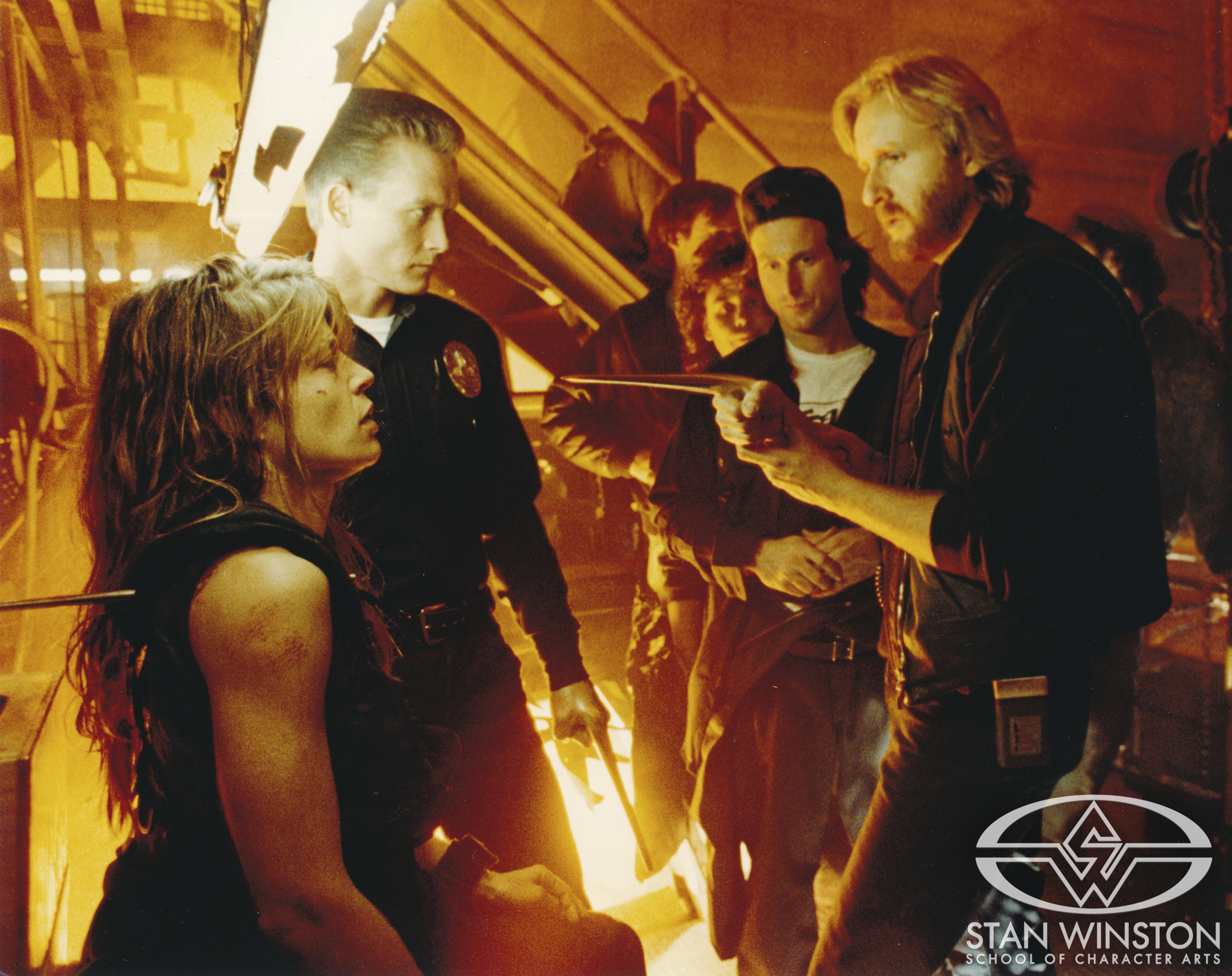 (Linda Hamilton and Robert Patrick, along with SWS team members Richard Landon, Christopher Swift, and John Rosengrant, take direction from James Cameron, who holds one of the T-1000's 'spike fingers' to illustrate its use on the set of Terminator 2: Judgment Day.)
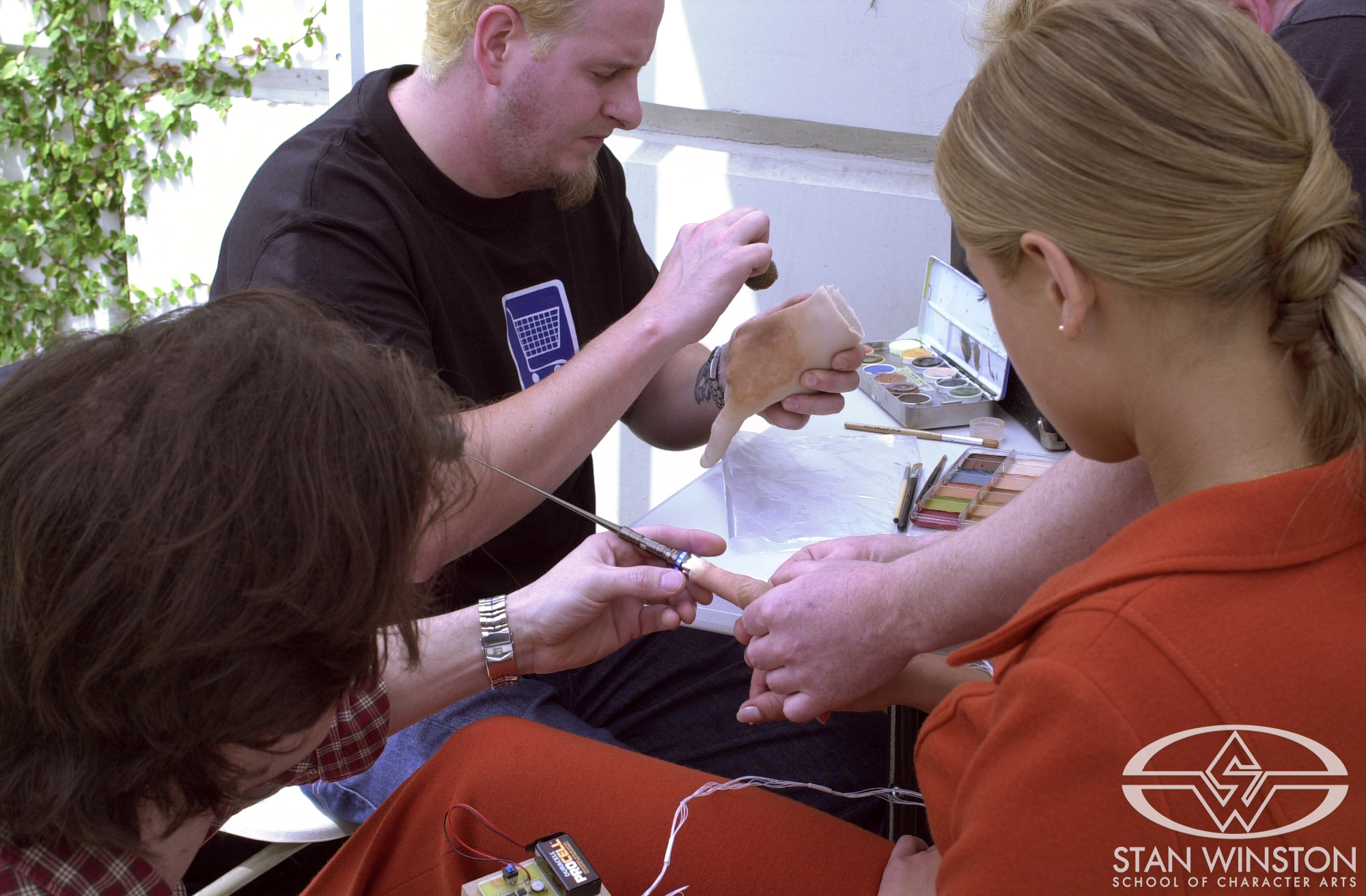 (John Rosengrant, Scott Stoddard, and Shane Mahan apply the finger drill prosthetic to Kristanna Loken on Terminator 3: Rise of the Machines.)
Designing Skynet's Newest Machine
Stan Winston Studio designed and built the endoskeleton of the T-X first, then ILM re-created it digitally. "Director Jonathan Mostow wanted something fresh, a new look," said Stan Winston Studio effects supervisor John Rosengrant.2 "We were trying to come up with something that could hold its ground with the original Terminator. That was such an iconic figure — coming up with something that looked even more fantastic when next to the original Terminator was one of the biggest design challenges on this show."1
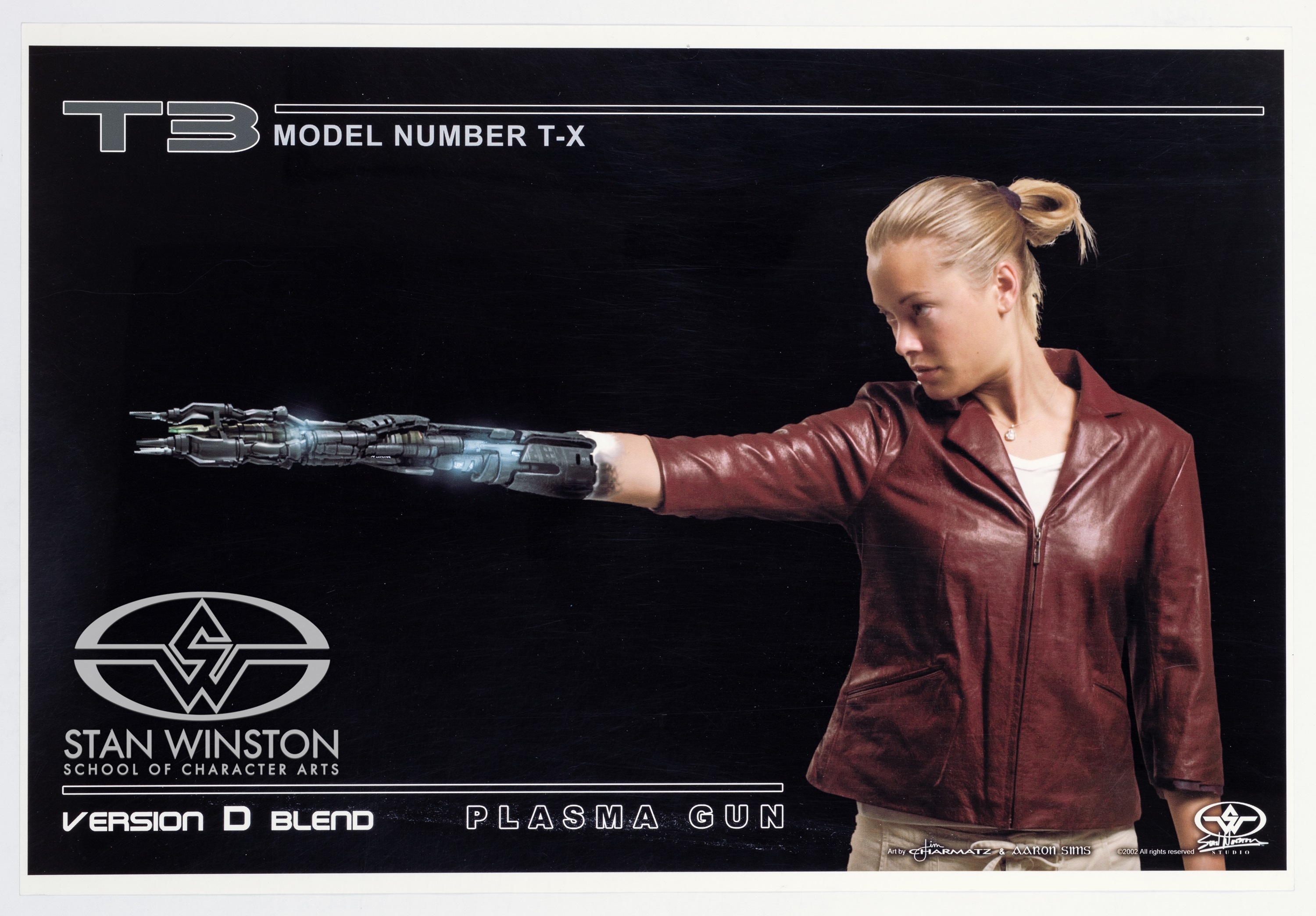 (SWS artist Jim Charmatz's concept art of Kristanna Loken's arm transformed into a lethal plasma gun.)
Computer design techniques were instrumental in meeting those challenges. Aaron Sims first sculpted the T-X endoskeleton as a 3D computer model. "I started doing some very rough 3D designs on the computer," Sims said. "I did a few poses, going back into the library of parts I'd created for AI [A.I. Artificial Intelligence (2001)] and remodeling and rearranging them to create a basic model. Then, I went into Photoshop and repainted everything. The great thing about working in the computer was that I could repaint very quickly and test out many different looks — instantly."1
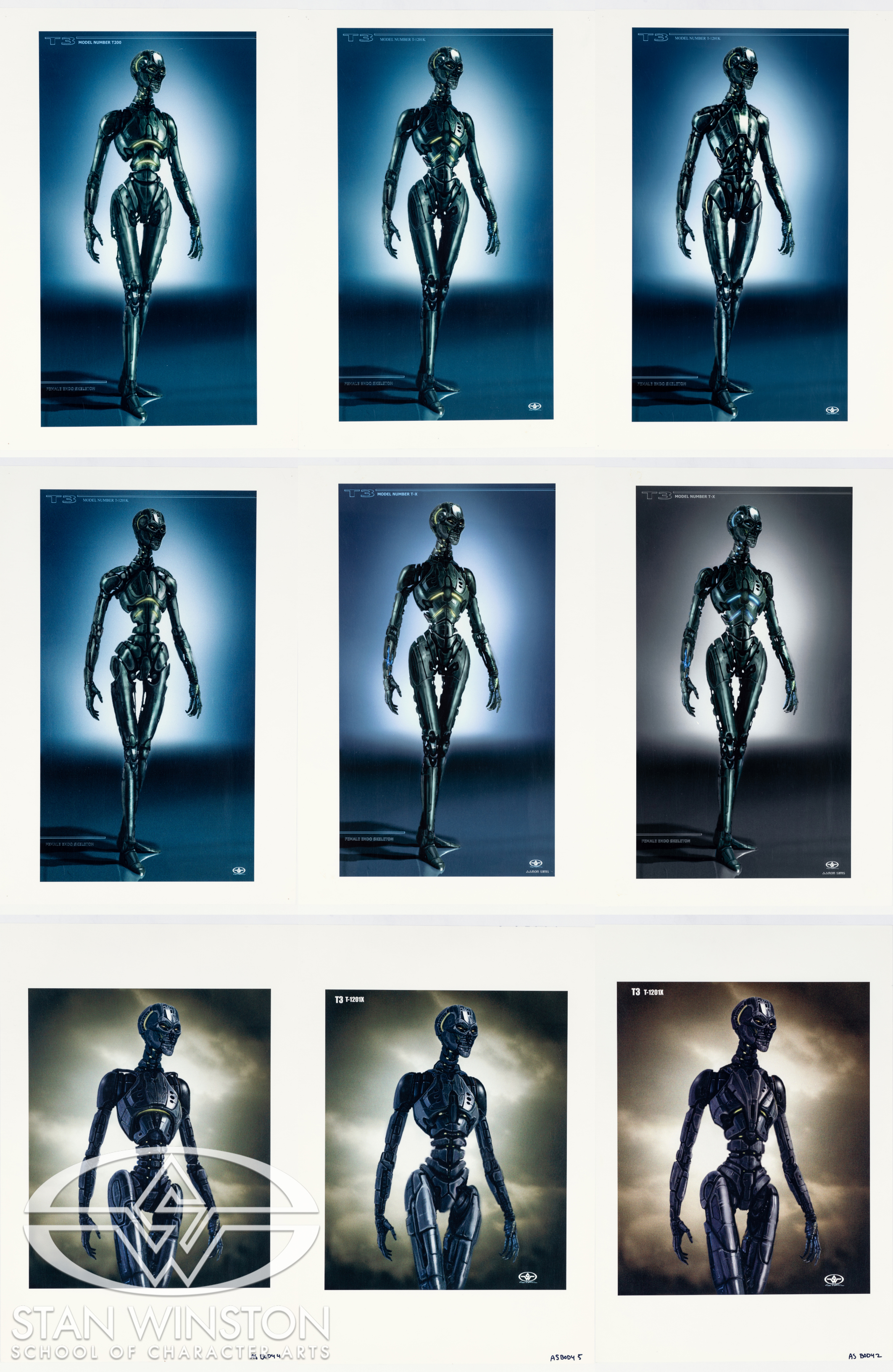 (Different iterations of the T-X endoskeleton design by SWS concept artist Aaron Sims for Terminator 3: Rise of the Machines.)
Planning a New Type of Liquid Metal Character
One of the key aesthetic considerations surrounding the T-X endoskeleton was whether it should be an androgynous form or one that reflected the female anatomy of the T-X in her human incarnation.1
 (Aaron Sims generated multiple T-X design iterations featuring a variety of facial anatomy and color schemes.)
"This was a liquid metal character that could change into anything, male or female," Sims noted, "and so it was difficult at first to figure out how its endoskeleton should look. Should it look like the human female character? The 'Arnold' endoskeletons looked like Arnold Schwarzenegger in a way — they had his basic bone structure and form. However, a liquid-metal endoskeleton was more changeable and could become any shape or form. So I played around with ideas on the computer — I think I did about a hundred designs for the T-X alone — until we got something the director liked. We wound up going with a very feminine shape."1
Building the Terminatrix for T3
Once the T-X 3D model was approved, Sims ran a test to ensure it would fit inside Loken's form — just as, for the first Terminator, Winston's crew had produced an endoskeleton skull that fit inside the structure of Schwarzenegger's head. The computer model was then cleaned up, detailed, broken up into segments, and printed out in full-scale using rapid prototyping.1,2 "It took a long time to break down the digital sculpture and make it watertight so that later when we put the real parts together, they would fit tightly. We had about a billion parts." added Sims.2
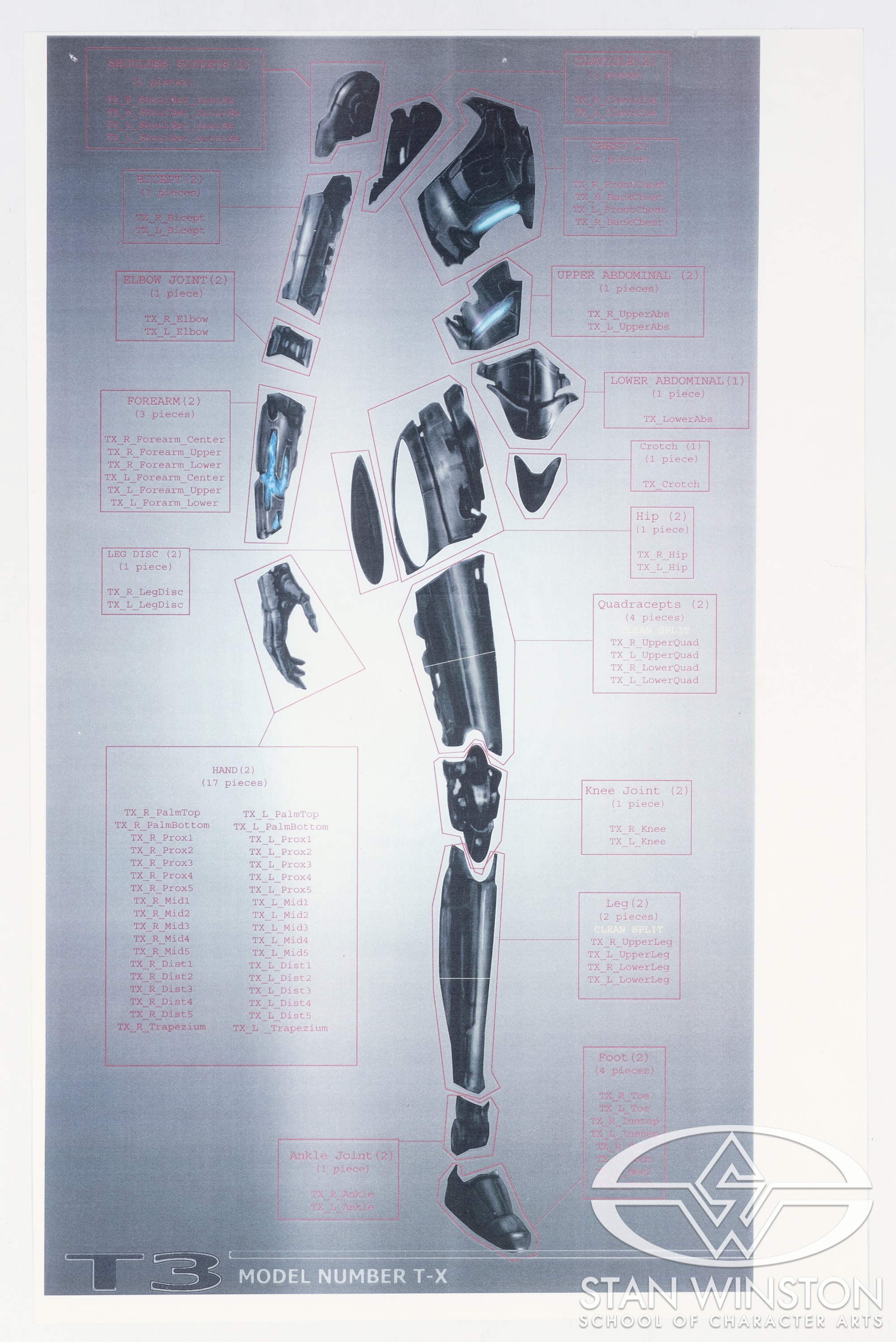 (A detailed diagram of the T-X 3D model's broken-up segments, which was displayed at Stan Winston Studio as guidance for rapid prototyping and assembly.)
There were so many parts that the Studio sent them to several vendors to produce. Once the Studio got those parts back, they made quick waste models in silicone and pulled resin copies; then each part had to be cleaned up and detailed because, although the forms were correct, the detail wasn't there.2
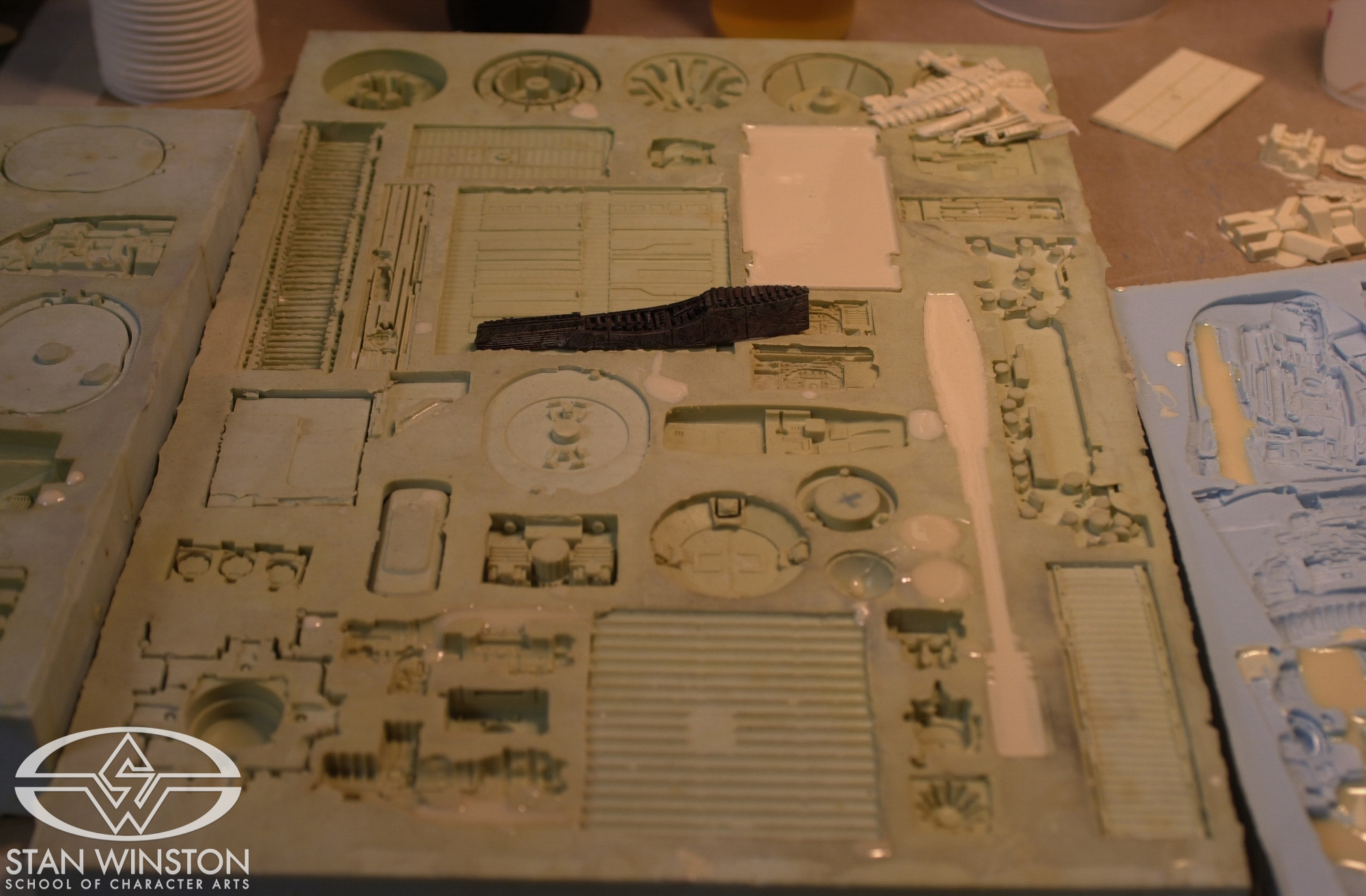
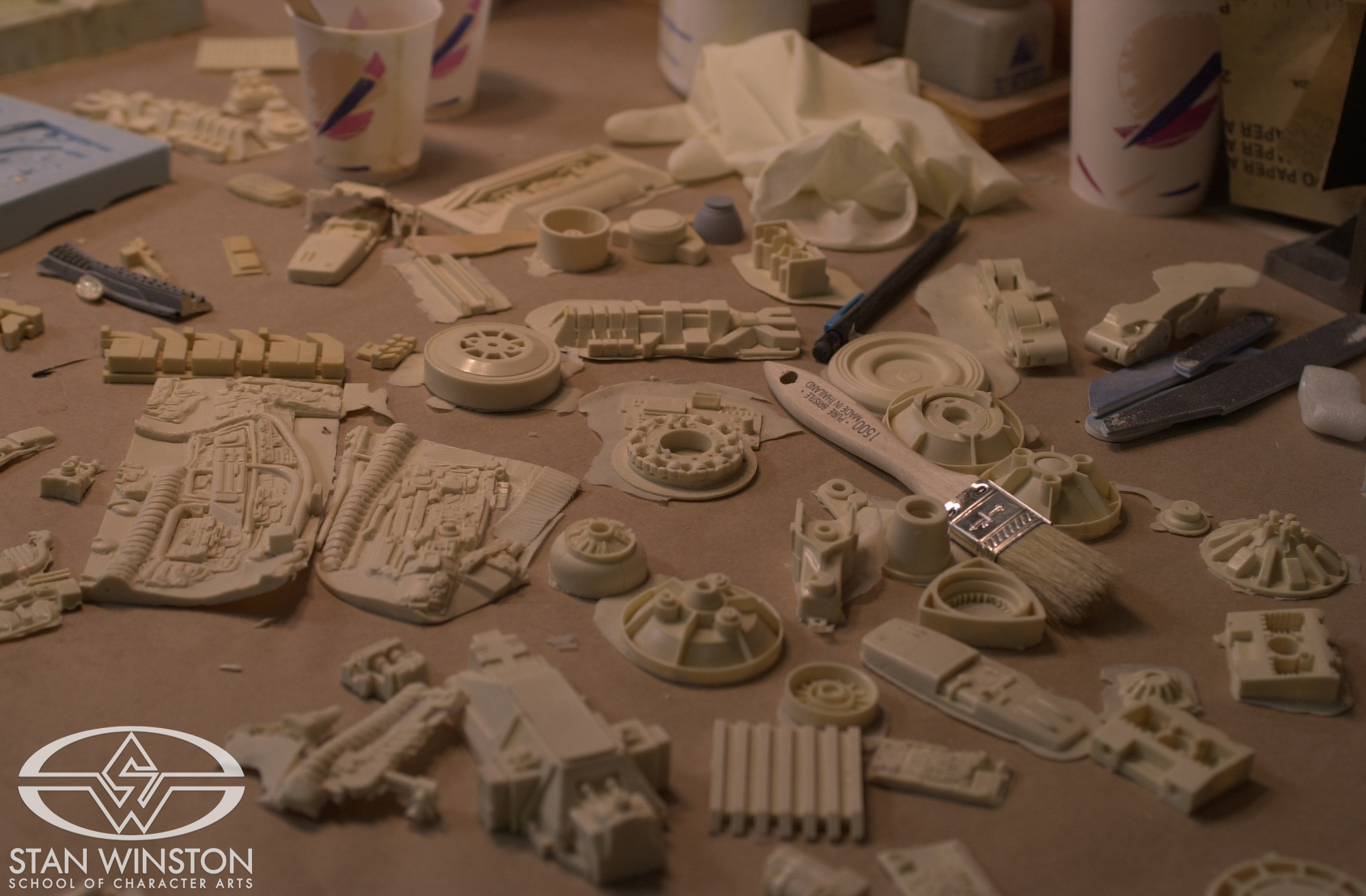 (Top: Silicone molds of T-X detail parts at SWS. Bottom: Resin castings of the T-X detail parts ready for cleanup and assembly.)
"Each part was hard-coated, sanded, polished, and machine-finished," said Rosengrant, "and we wound up with pieces that were all perfect and symmetrical. When we did the first Terminator, we sculpted all the endoskeleton parts by hand, and no matter how well we tried, they weren't symmetrical. This mathematically perfect model for the T-X, sculpted in the computer, was light-years ahead of the first Terminator endoskeleton."1
 (A rapid prototyped T-X head at Stan Winston Studio, ready for molding and casting in resin, after which it will be highly detailed, remolded, cast, and chrome-plated.)
 (An SWS model maker uses an X-Acto blade to add fine details to a resin casting of the T-X endoskull.)
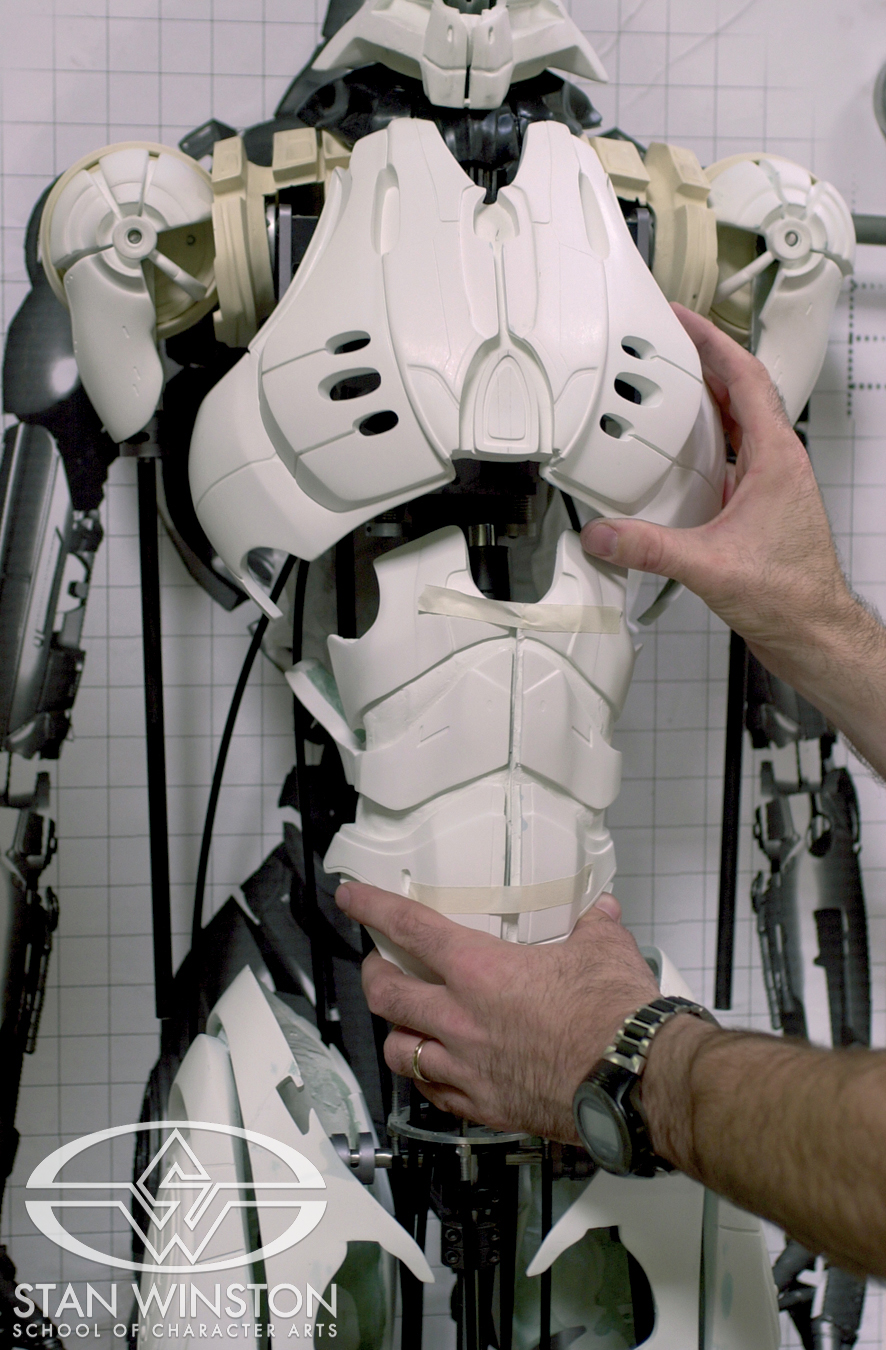 (Test fitting the perfectly symmetrical T-X chest and torso parts onto the underlying mechanisms.)
To distinguish the T-X endoskeleton from the previous chrome-plated Terminator, Winston's artists devised a black chrome look inspired by a cigar lighter that Winston used to carry in his pocket.1
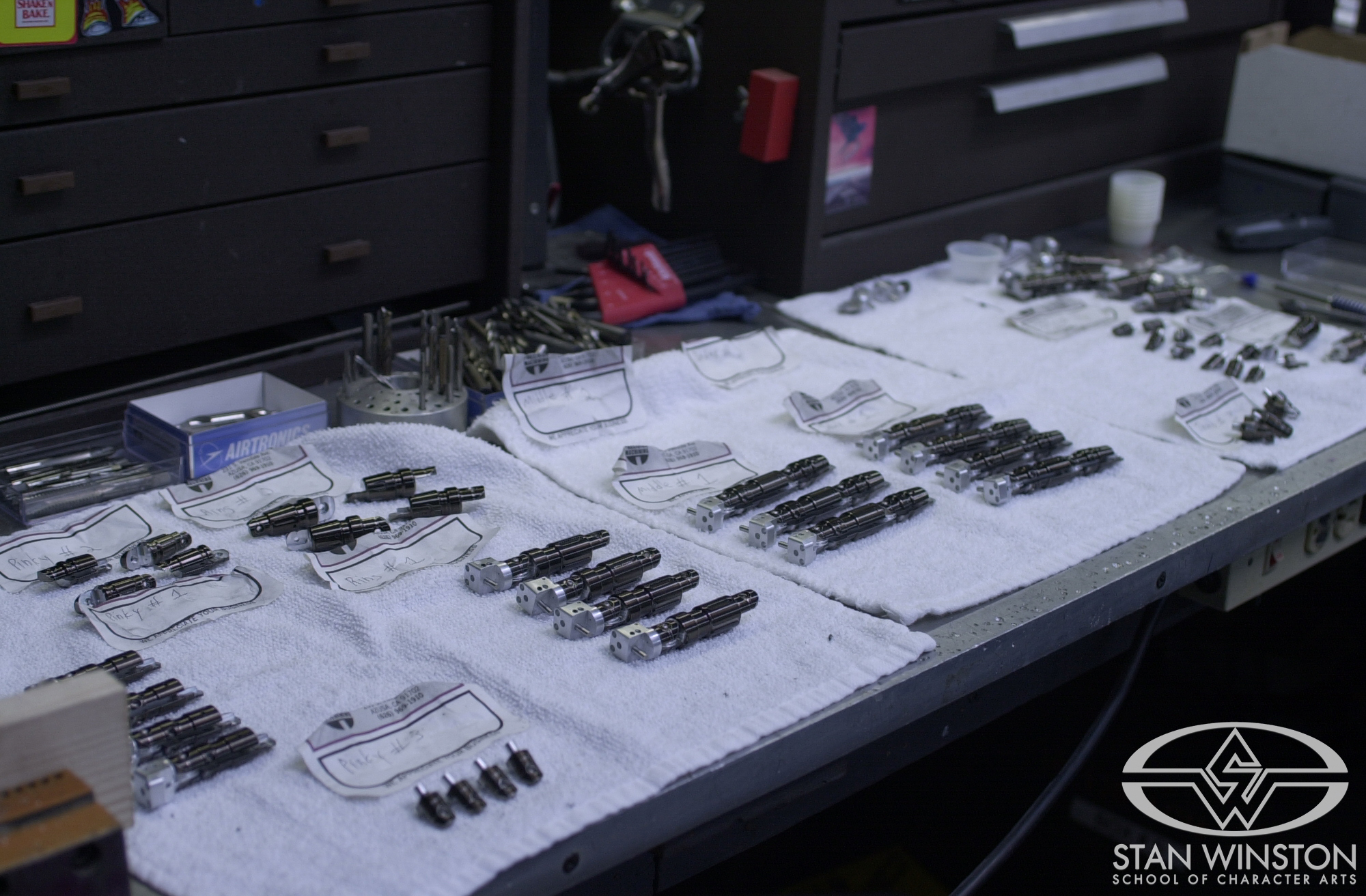 (An assortment of black chrome T-X endoskeleton finger joints, ready for assembly.)
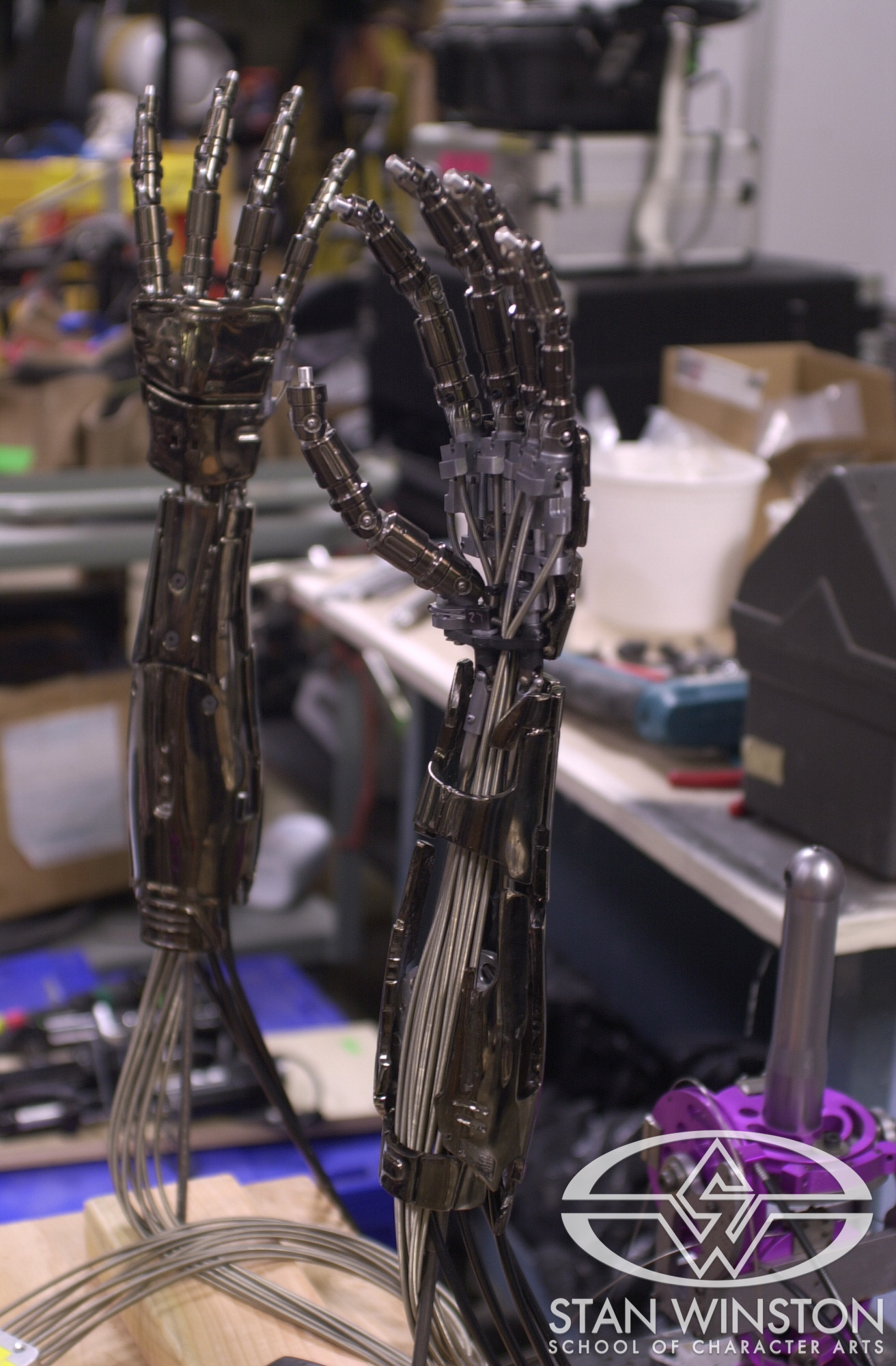 (The work-in-progress T-X mechanical hands.)
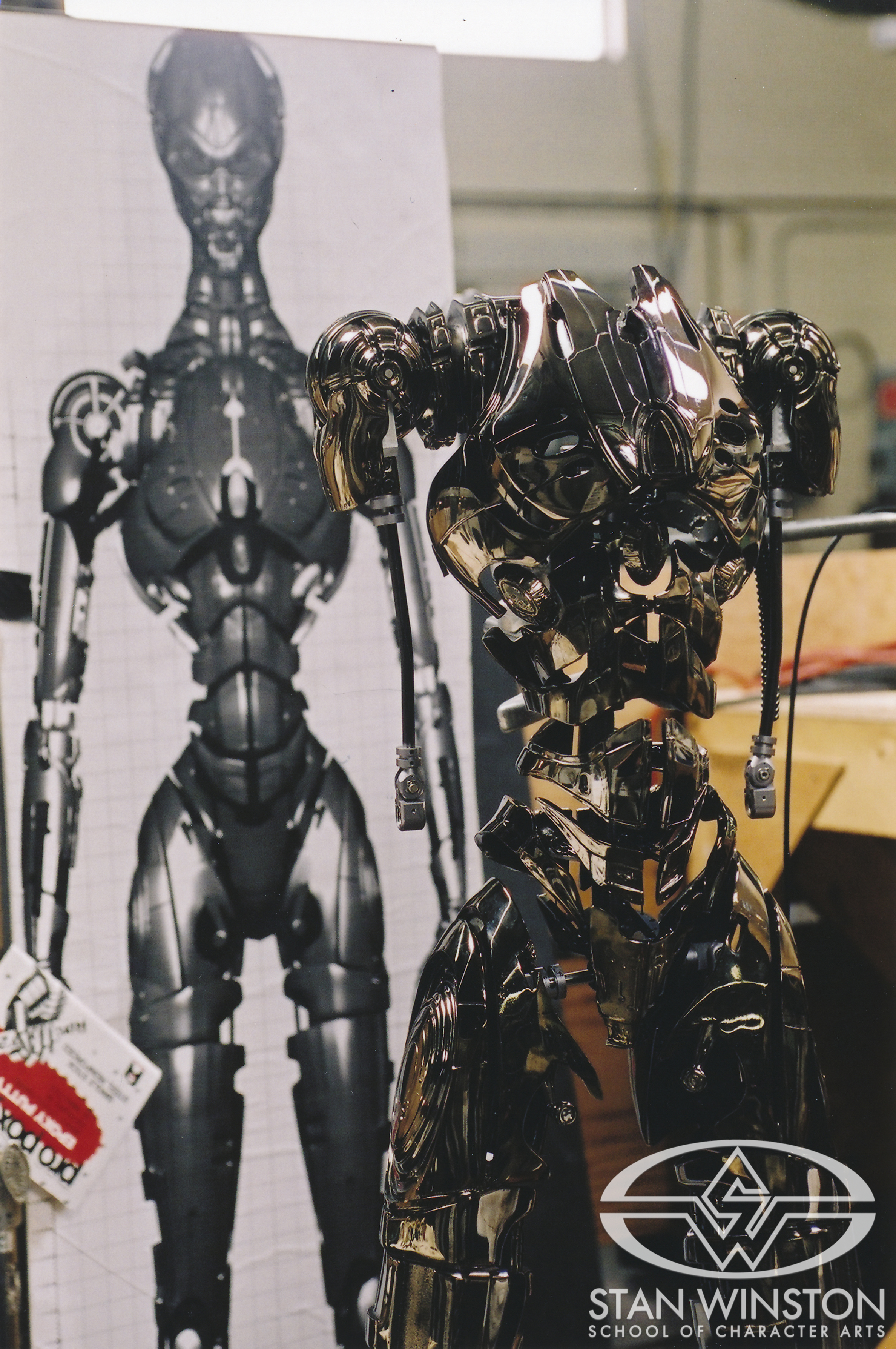 (A T-X endoskeleton being assembled at SWS.)
The final T-X endoskeleton featured running lights — blue, as opposed to the Terminator's red — incorporated into the form by model shop lead Dave Merritt. "He used super-bright LEDs blowing through fiber optics and other materials to create a glow rather than a hot light source," noted mechanical supervisor J. Alan Scott. Key electronics technicians Dave Lowe and Don Smull built custom, programmable circuit boards that could control the brightness, speed, and pulsing of the lights, depending on the character's action. Lowe and Smull also built a separate circuit board that controlled the character's eyes — made from bright blue LEDs surrounding a white light — to make them more or less intense.2
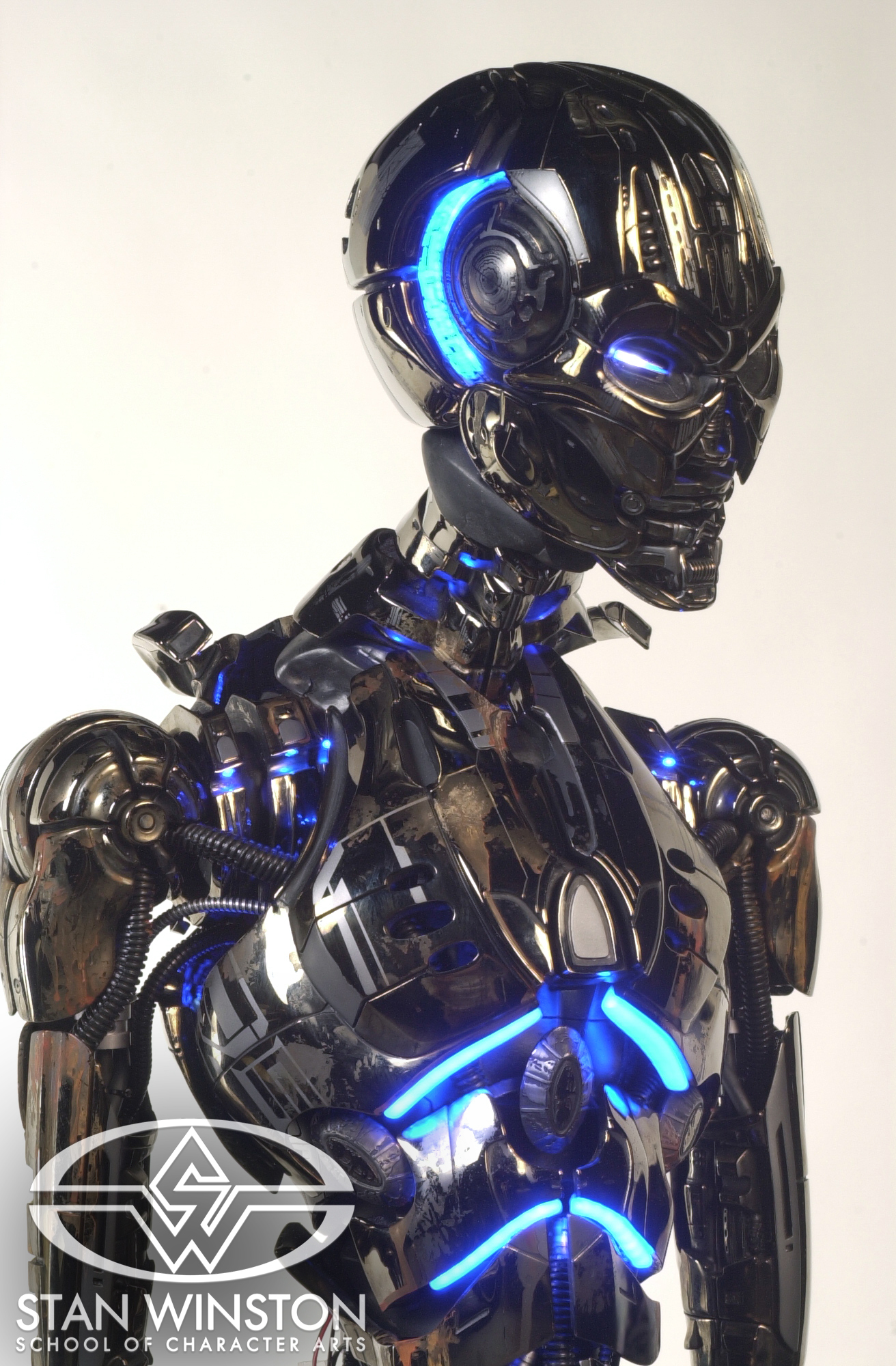 (The completed T-X endoskeleton with its running blue LED & fiber optic lights at Stan Winston Studio.)
Weapon Selections of the T-X in Terminator 3: Rise of the Machines
Stan Winston Studio designed and built several deadly accessories for the Terminatrix — a finger drill, a buzz saw, and a plasma gun that becomes a flame-thrower — all of which were somewhat functional. "They all worked," affirmed Rosengrant. "The buzz saw could turn; the finger drill had a lighting package and a spinning mechanism; and the plasma gun had a lighting package that simulated it charging up."1
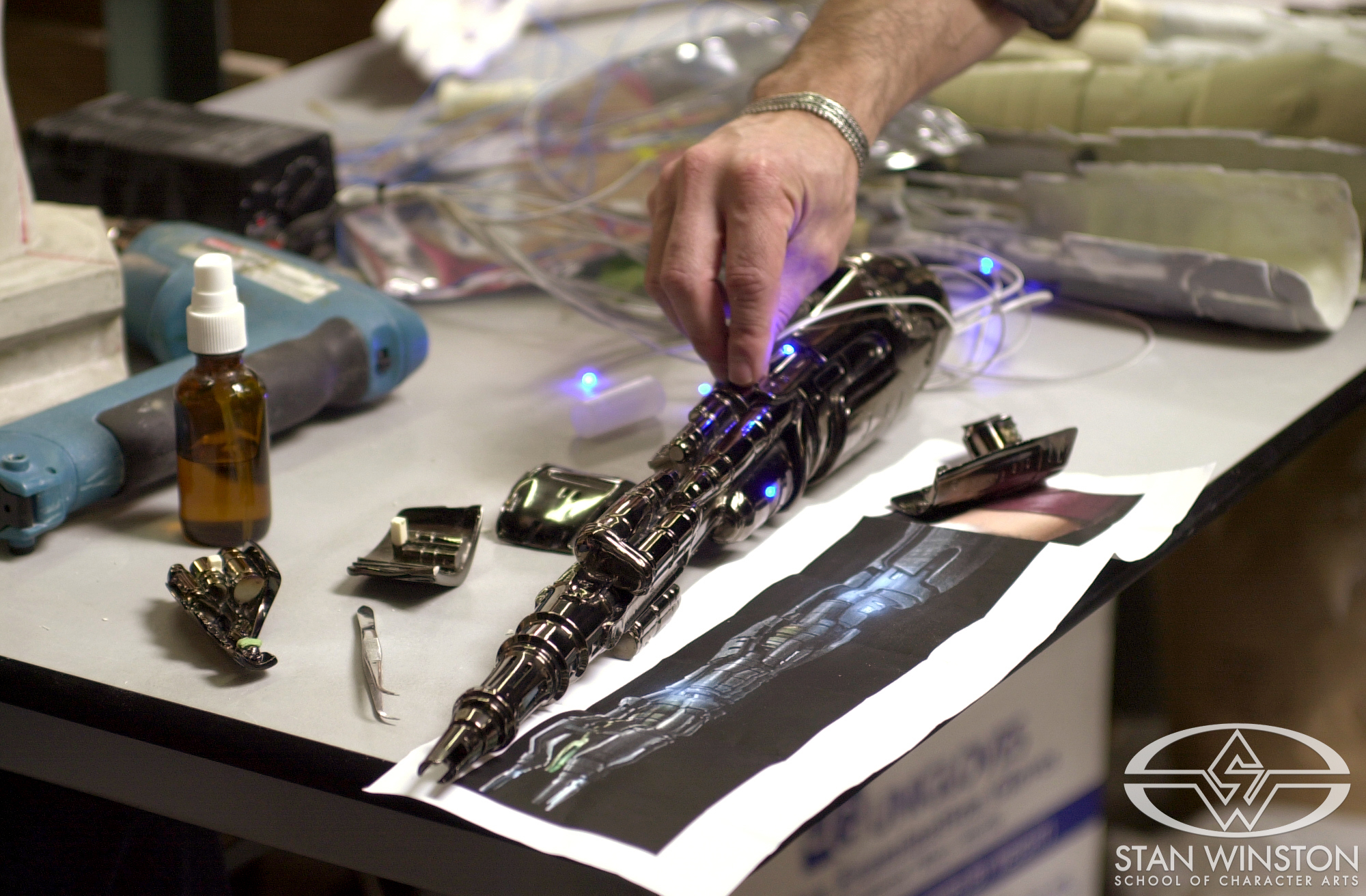 (Assembly of the plasma gun's blue LED & fiber optics lighting package at SWS.)
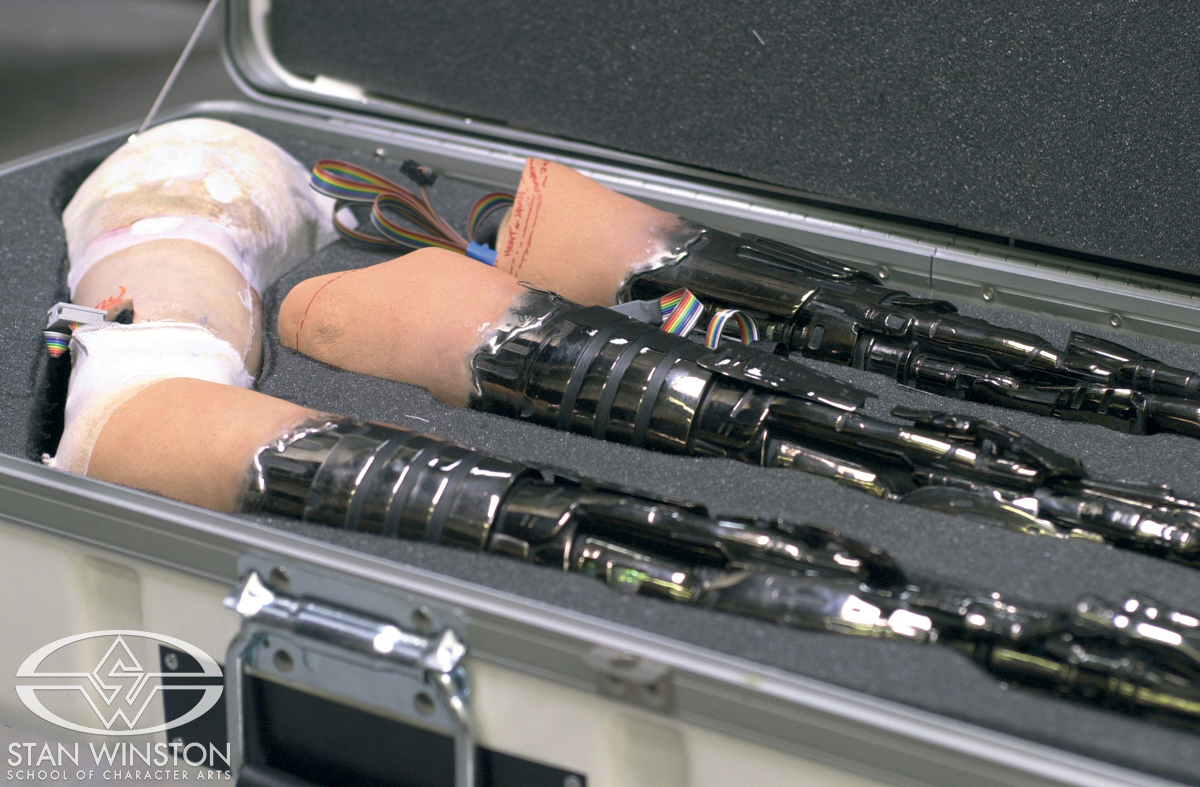 (A foam-lined SWS transportation case displays just a few of the many prosthetic weapon arms made for the T-X.)
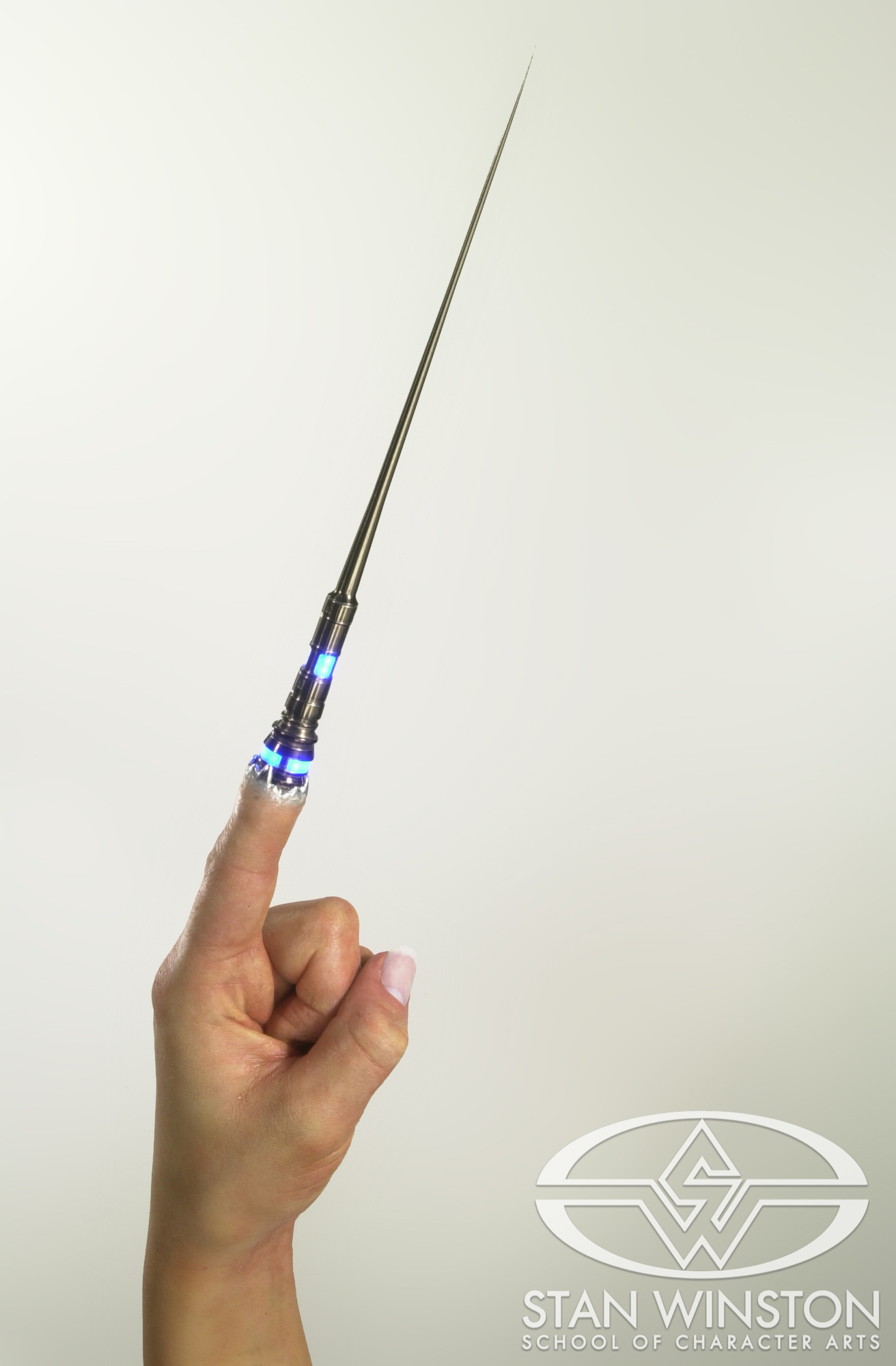 (One of the finger drills that SWS made for Kristanna Loken's character.)
The Stan Winston Studio crew fit the physical appliances to custom prosthetics fashioned from lifecasts of Kristanna Loken's arms and hands. "One version was a corset harness with a phony arm. We built a special coat so she could put her real arm behind her, and a puppet version of the gun arm could be shot from any angle."2
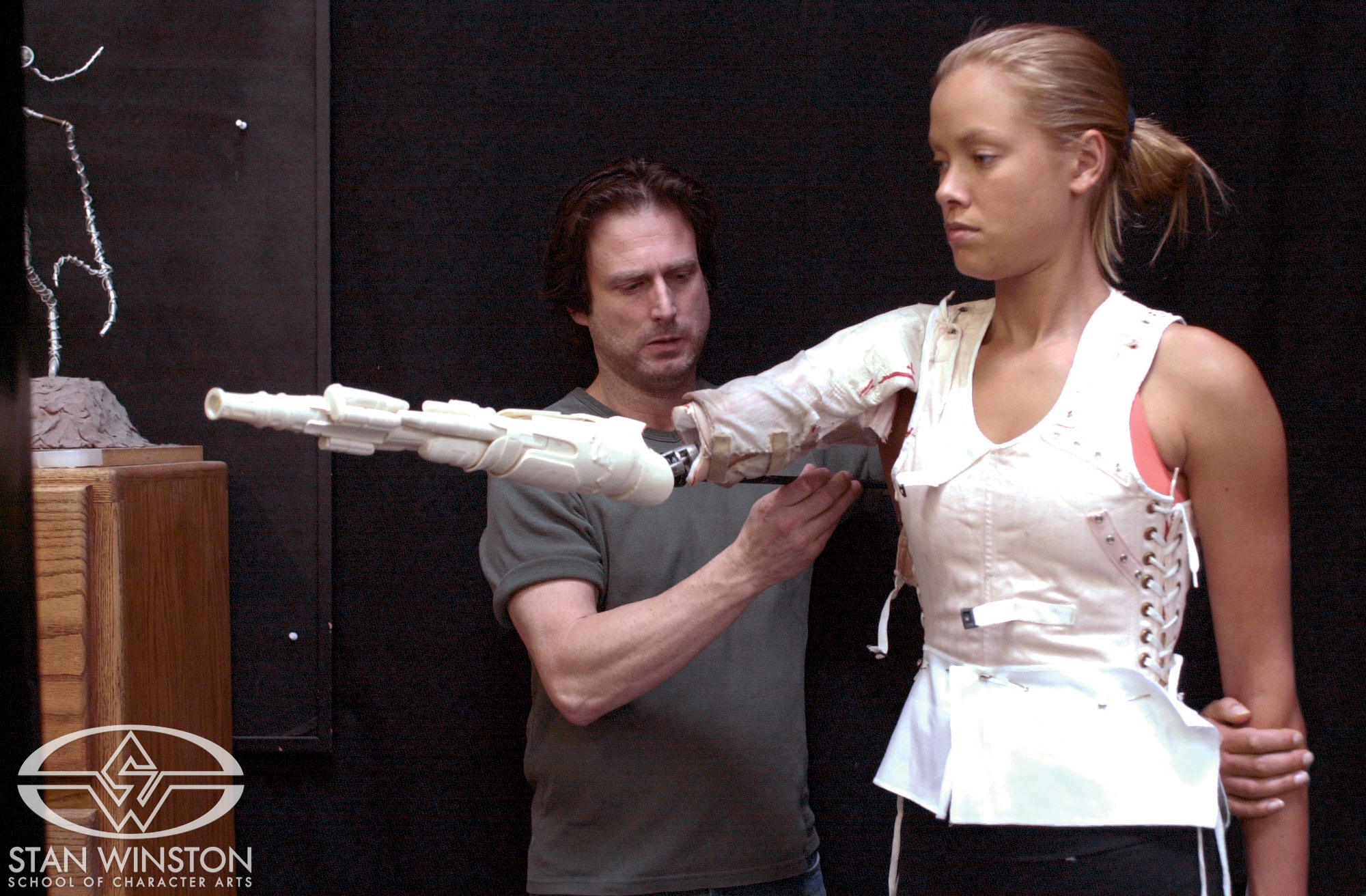 (John Rosengrant assists Kristanna Loken during a fitting of the plasma gun arm prosthetic at SWS.)
SWS created two prosthetic arms for the plasma gun, one for viewing from the left and one for viewing from the right. "When her arm morphed into the plasma gun, it got thinner. So we had her wear a black glove, and if the black glove didn't show at a particular angle, we had an in-camera shot, and it was done. If it did show, those shots were finished digitally at ILM. There are moments when the plasma gun is ours, and there are moments when it's CG, but as it transforms, it's always digital."2
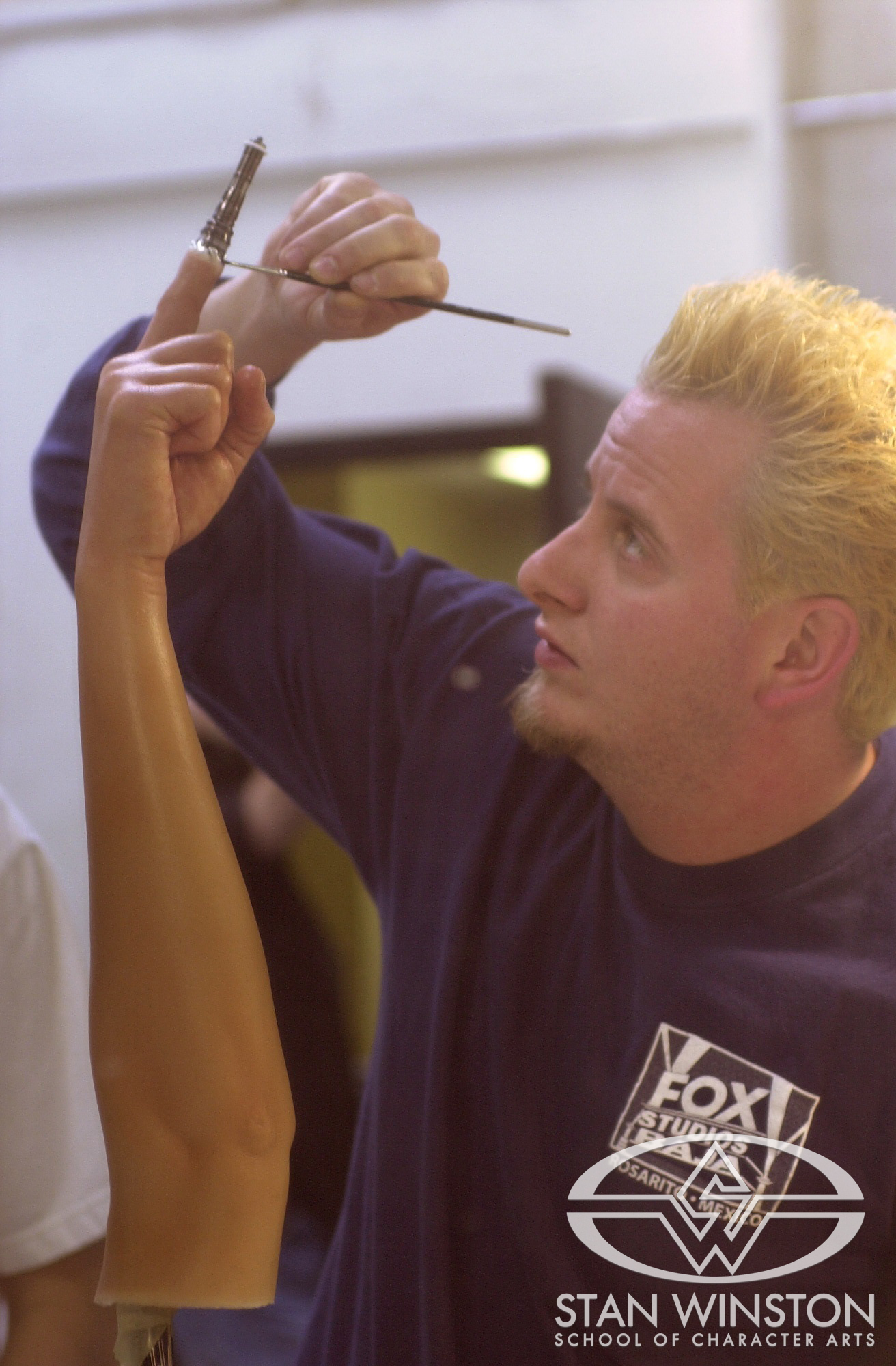 (Scott Stoddard detail paints one of the "finger drill" prosthetic arms.)
The T-X was articulated through rod puppetry, cable control, and radio-controlled electronics, though the practical figure ended up in very few shots, since in the final cut, most shots of the T-X endoskeleton were achieved using a digital model created by ILM.1,2
 (Testing a battle-damaged version of the animatronic T-X puppet at Stan Winston Studio.)
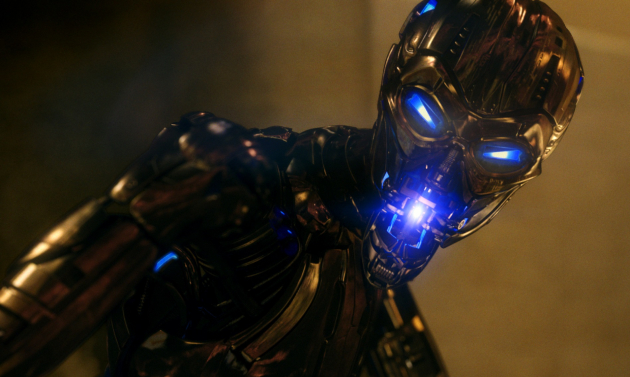 (The T-X endoskeleton battles the T-850 in the finale of Terminator 3: Rise of the Machines. Image source: Warner Bros. Pictures.)
- Blog assembled by Adrienn Lingurár with selections from:
1. The Winston Effect: The Art and History of Stan Winston Studio by Jody Duncan
2. CINEFEX #95: Winds of War by Barbara Robertson
Courses with the Creators of Terminator 3: Rise of the Machines
- Hybrid Characters: Blending Practical & Digital FX with John Rosengrant
- Special Effects Sequence Design with Shane Mahan
- Hybrid Character Design: Practical To Digital with Christopher Swift
- Animatronics Design Basics with Richard Landon
- Cable Mechanism Basics: Tentacles with Richard Landon
- Portrait Illustration Part 1: Pencil Drawing Techniques with Terry Wolfinger
- Portrait Illustration Part 2: Painting With Photoshop with Terry Wolfinger
- Maquette Painting Techniques with Trevor Hensley
- Making Creature Eyes with John Cherevka
- How To Make Eyes: Puppets, Masks & Makeups with John Cherevka
- Advanced Creature Teeth: Prosthetic Dental Appliances Part 1 with John Cherevka
- FX Corset Harness Fabrication with Amy Whetsel
- Creature Costume Basics with Amy Whetsel & Dawn Dininger
- How To Make A Stone Mold with Gary Yee
- How To Make A Monster Puppet - Rods & Cables with David Monzingo
- Makeup Blood FX - Blow Your Brains Out with David Monzingo
- Creature Screenwriting: How To Write Memorable Monsters with Juliet Snowden & Stiles White