

Jump To Section
- Shaking Off the ‘Monster Guy’ Label
- The Challenge of Edward Scissorhands' Design
- Designing Edward Scissorhands' Scissor Hands
- Creating Edward's Scissor Hands and Makeup
- Working with Tim Burton
Shaking Off the ‘Monster Guy’ Label
Despite his hand in creating a long run of movie creatures in the 1980s — the monster for Leviathan, the alien queen, the Predators for Predator and its sequel — Stan Winston never thought of himself as a monster-maker. Rather, he considered himself a creator of characters for the movies, and those characters could be human, alien, supernatural, animal, monster — whatever writers and filmmakers could conceive. In an attempt to prevent being typecast as the ‘monster guy,’ Winston eagerly accepted an entirely different assignment for director Tim Burton’s Edward Scissorhands (1990), which starred Johnny Depp as the lonely creation of a mad inventor (Vincent Price) who dies before replacing his creature’s temporary scissor hands with human ones.
 (Johnny Depp during a makeup test for Tim Burton's Edward Scissorhands as Stan Winston takes reference photos.)
The crew was also grateful for the change of pace the project offered. “I’d really enjoyed Predator 2,” Shane Mahan said, “but it was a very violent, shoot-em-up kind of thing. And then Edward comes along, and it is like a gothic, bittersweet fairy tale. I instantly loved it. We all loved it and were all inspired by it. It was such a change of pace from what we’d been used to doing. You can only rip the spine out of a guy’s back so many times, you know? On top of loving the script, it was our first time working with Tim, and I was already a big fan of his from Pee-wee’s Big Adventure [1985]. The fact that Vincent Price was going to be in the movie put it right over the moon for us. It was a great moment to be standing on a soundstage with an icon of the horror film genre.”
 (Johnny Depp as Edward Scissorhands during a test fitting at Stan Winston Studio.)
The Challenge of Edward Scissorhands' Design
Inspired by a drawing Tim Burton had done as a teenager, and in every way informed by the director’s unique imagination, Edward Scissorhands was an entirely new kind of challenge for Stan Winston, whose work, up to that point, had been securely grounded in reality.
 (L: Tim Burton’s concept sketch of Edward Scissorhands. R: Stan Winston’s initial concept design for Edward.)
“I’d always gone to great pains to make sure anatomies were accurate and grounded in scientific research,” Winston said. “Even something really fantastic, like the Predator, had been based on nature, with coloration taken from reptiles and fish. I was accustomed to using reality as a way to ground the designs of our characters. But with Edward Scissorhands, I had no reality to use as a base. There was nothing real about this. He has hands that are scissors? What? That was difficult for me to envision at first, but it was a great opportunity to break away from what is real. I had to serve Tim’s vision. If I were serving only my vision, because of the type of person I am, I would have said: ‘Well, this whole story doesn’t make sense! This is a guy who is being built by a Frankenstein kind of scientist, and he’s not finished, and so he has scissors for hands? Ridiculous!’ But that was Tim Burton’s vision, and I had to get in touch with that. I had to take the straps off and let go of my insistence that things make sense. ‘Okay, it doesn’t make sense, but his hands are scissors. Let’s make that happen.’ It was a wonderful thing, as an artist, to break my own set of rules and free myself of my preconceived notions of what is right and wrong. I let go of Stan Winston as an artist and got in touch with Tim Burton as an artist. And by doing so, my name was connected to another of the most iconic characters in motion picture history.”
 (Mark 'Crash' McCreery's Edward design, which became the springboard for costume designer Colleen Atwood’s costume for the character.)
Designing Edward Scissorhands' Scissor Hands
Stan Winston Studio’s assignment was to design Edward in his totality — the theatrical makeup for his face, as suggested in Burton’s drawing, and his costume — and to design and build his scissor hands. Winston drew a series of sketches of the character, based on Burton’s original cartoon figure, while setting his key artists to the task of designing the scissor hands.
 (Johnny Depp as Edward in the final costume and makeup.)
“We came up with reams of designs for those hands,” Winston recalled, “trying to figure out what they would look like. I spent a lot of time looking at my hands, trying to figure out how fingers could be translated to scissor blades. Normally, when you make a scissor motion, you do it sideways, with your hand and first two fingers parallel to the floor. But as I kept looking at my fingers, I realized that to make the blades move more freely, they would have to make that scissor motion, pointing upward, perpendicular to the floor. That was a much more natural motion for fingers, and would be a more organic movement for the blades. Like so many other things, this idea came to me in the middle of the night, lying in bed and thinking about it and moving my fingers in front of my face. So we started designing based on what a hand could easily do. I had a whole bunch of guys just drawing scissor hands.”
 (Various concepts of the scissor hands by Stan Winston Studio artists.)
Winston’s primary brief to his artists was that the design and its implementation be something that would enable the actor to perform freely. “We wanted to be an asset to Johnny Depp in his creation of the character,” Winston said, “not a hindrance. I didn’t want him to be uncomfortable in dealing with these scissor hands, and that is what ultimately drove the design.”
 (One of the final concept artworks for Edward Scissorhands' scissor hand.)
The artists went back to Burton’s original sketch for guidance, but found none there. “The hands in Tim’s sketches were just long, thin wisps of pen strokes,” Shane Mahan recalled. “They didn’t have any details. So a bunch of us started sketching the hands. Based on Tim’s drawings, which had a kind of antiquated look, we all felt that the hands should have the sense of an old-fashioned, filigreed, Victorian can opener.”
 (Concept artwork of the approved scissor hand.)
The artists found further inspiration in a Civil War-era catalogue featuring nineteenth-century prosthetics. “It was a catalogue that showed how they would strap prosthetic arms to people who had lost limbs in the war, operated via springs and various mechanical devices. We also searched around for every kind of pruning shear and scissor ever made, and made each finger a different type of shear. The thumbs were like small rose pruning shears, and the fingers were long blades.”
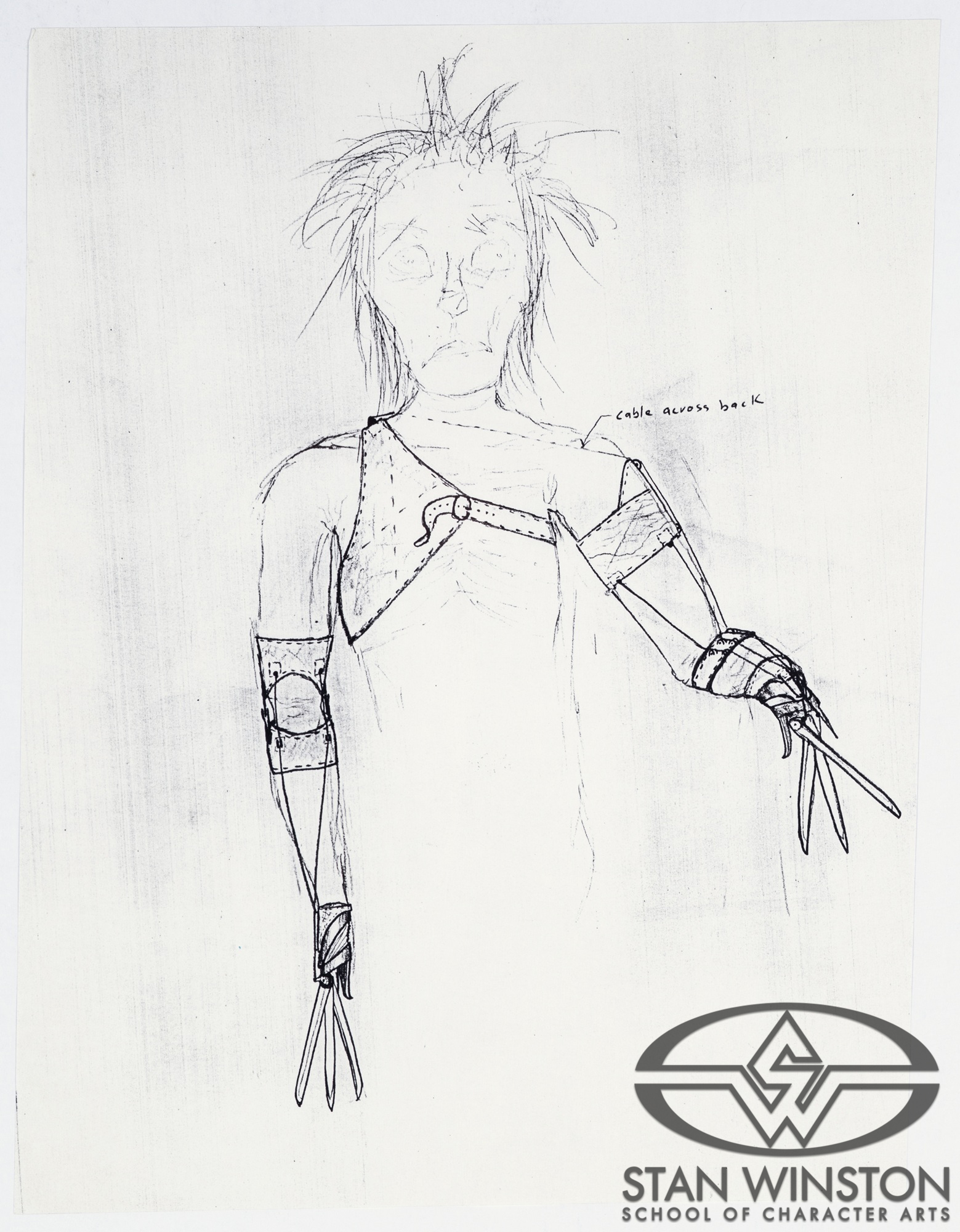 (An early sketch of the harness with scissor hands.)
When Burton returned to the studio to review the scissor hand designs, he was surprised by how literally Winston and his artists had translated his idea. “Tim looked at our drawings and said, ‘Wow, he’s actually got scissors for hands!’” Mahan said. “And we were like, ‘Yeeaahh… isn’t that what you wanted?’ And he said: ‘I didn’t think he’d actually have scissors for fingers. I thought they’d just be long, sharp pieces of metal that weren’t finished — but this is much better!’”
 (One of the final concept artworks for Edward Scissorhands' scissor hand.)
Creating Edward's Scissor Hands and Makeup
Upon design approval, Shane Mahan sculpted one of the scissor hands, while John Rosengrant sculpted the other.
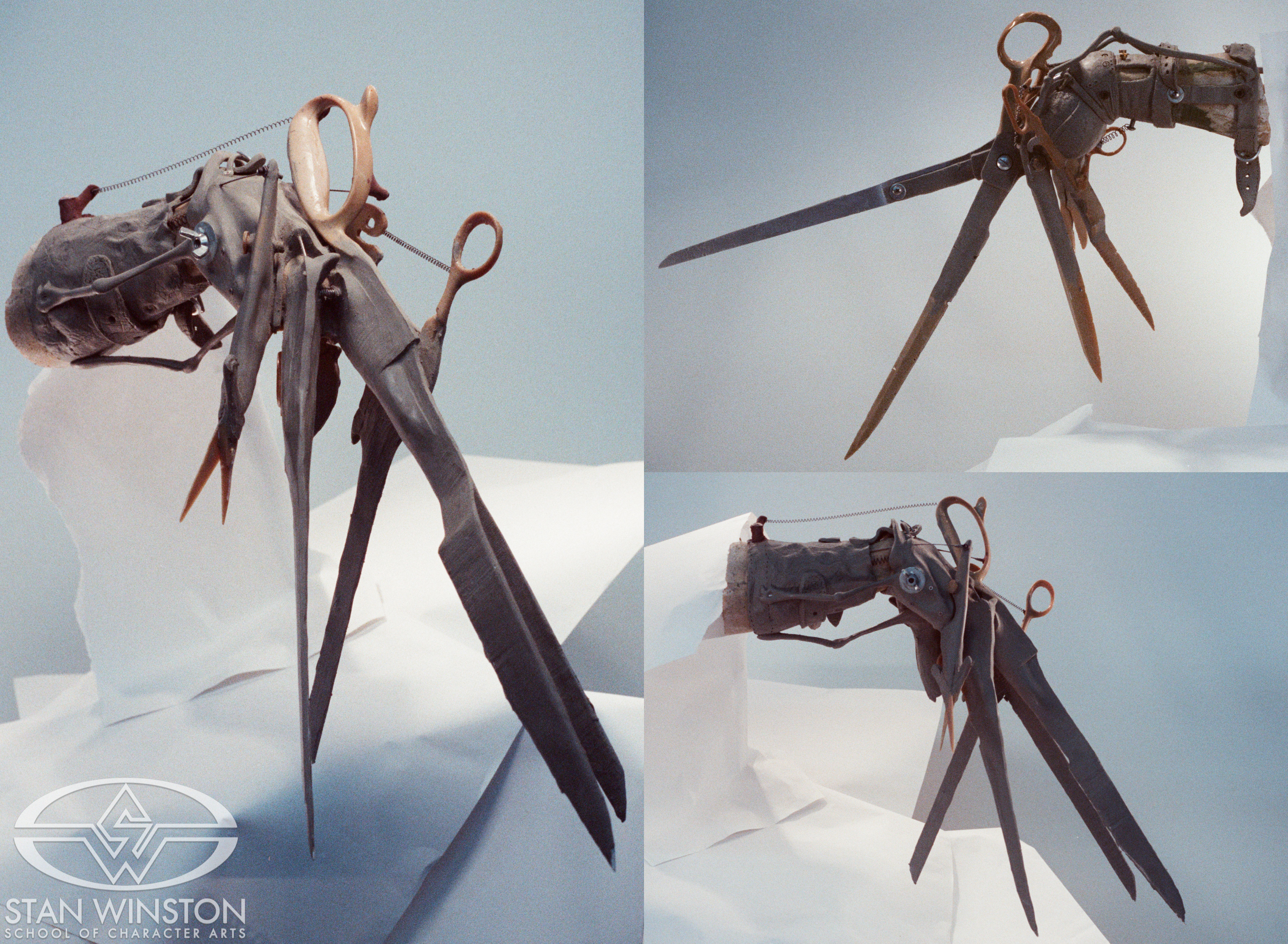 (The sculptures of Edward’s left and right scissor hands by Shane Mahan and John Rosengrant.)
 (The finished prototype style guide of Edward’s right and left gloved hands, designed, sculpted, and painted by Shane Mahan and John Rosengrant.)
The studio then constructed multiple sets over a cast of Johnny Depp’s hands, to ensure they would fit him perfectly. Lightweight resin blades vacuum-metalized to give them the appearance of metal were affixed to leather gloves that Depp could slip on easily.
 (Andy Schoneberg and Dave Grasso work on mass-producing the many sets of Edward’s scissor hands required for the show.)
 (A set of hands being test-fitted prior to plating and finish work.)
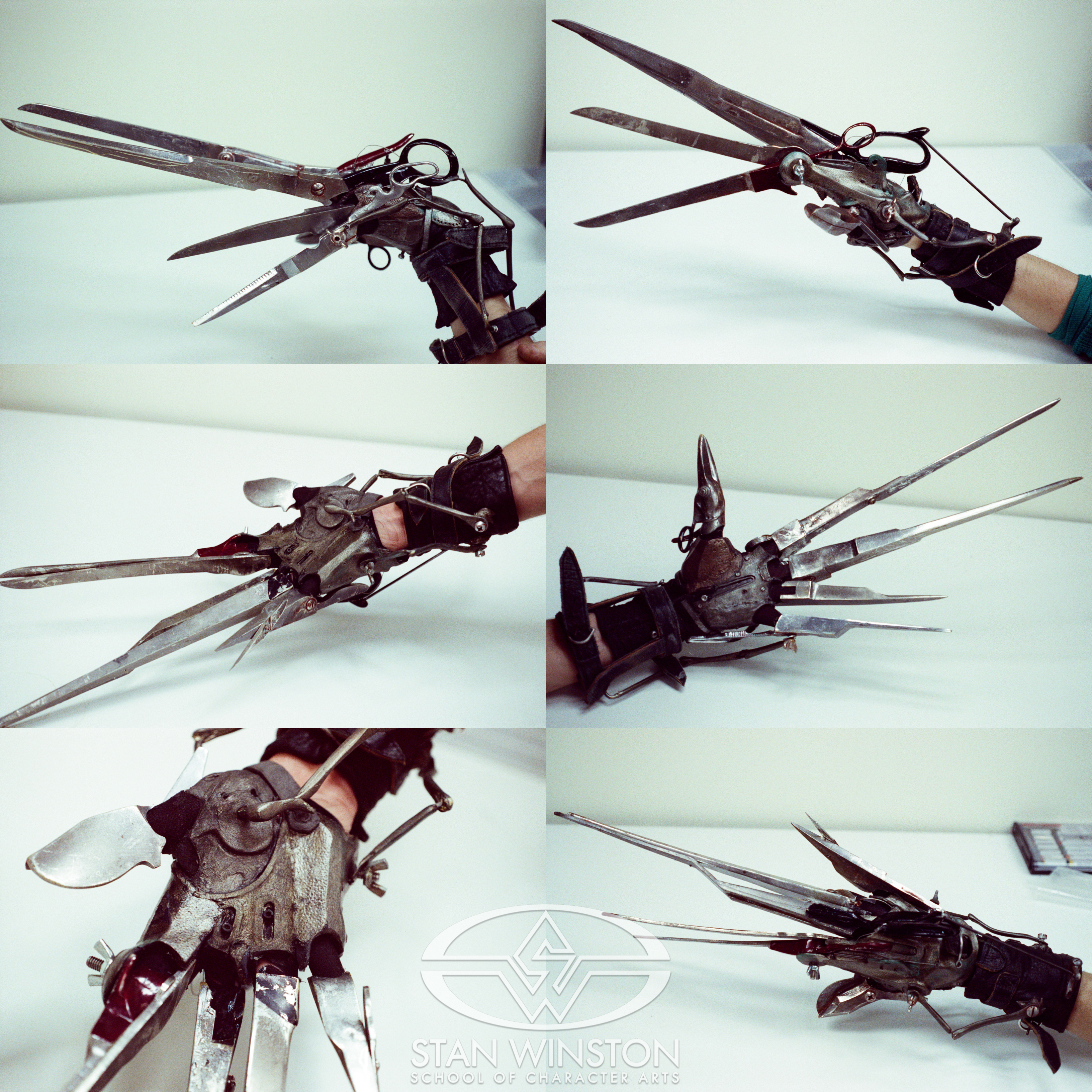 (Testing various scissor hands at Stan Winston Studio.)
“On top of that,” said Winston, “we created some insert scissor hands that could actually cut. But ninety-nine percent of what you see in the movie — Edward cutting hair or trimming bushes — was just Johnny Depp making flurried movements with these gloved hands, and the special effects crew blowing hair or leaves around to create the illusion that he was cutting.”
 (Edward Scissorhands (Johnny Depp) and Peg (Dianne Wiest). Image courtesy of Twentieth Century Fox and Tim Burton Productions.)
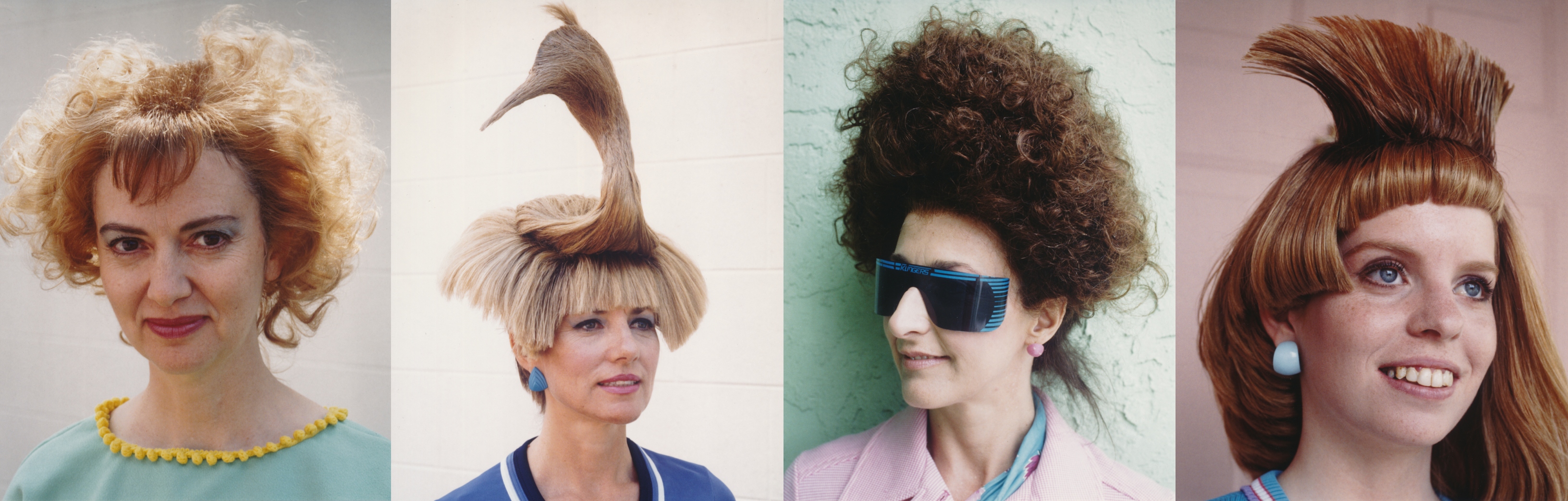 (Various hairstyles used in Edward Scissorhands. Photos by Zade Rosenthal. Images courtesy of Twentieth Century Fox and Tim Burton Productions.)
In addition to the scissor hands, Stan Winston Studio artists designed Edward’s makeup and his costume, with Mark 'Crash' McCreery doing the final rendering of the character.
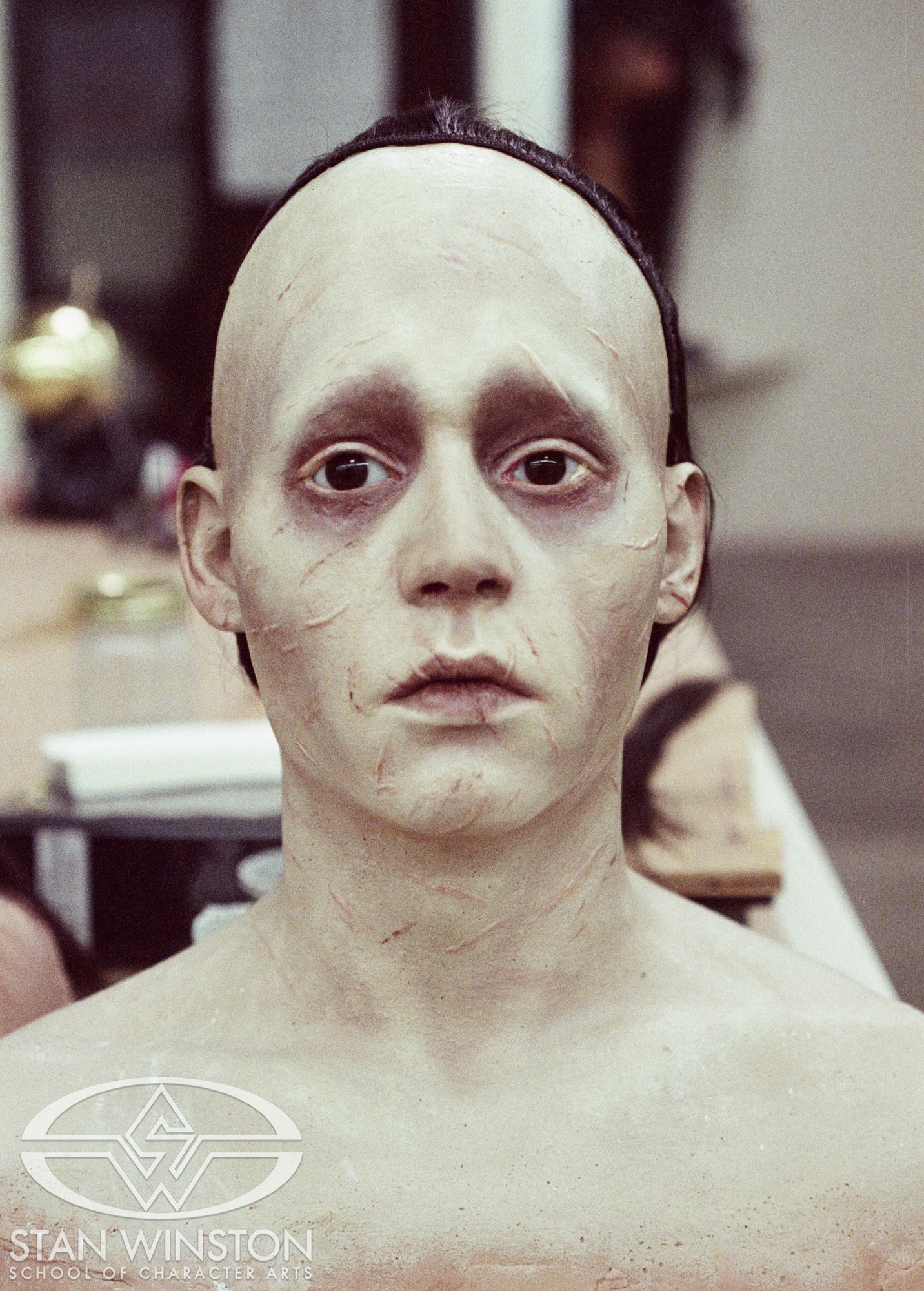 (Study of Edward with makeup in place, painted by John Rosengrant.)
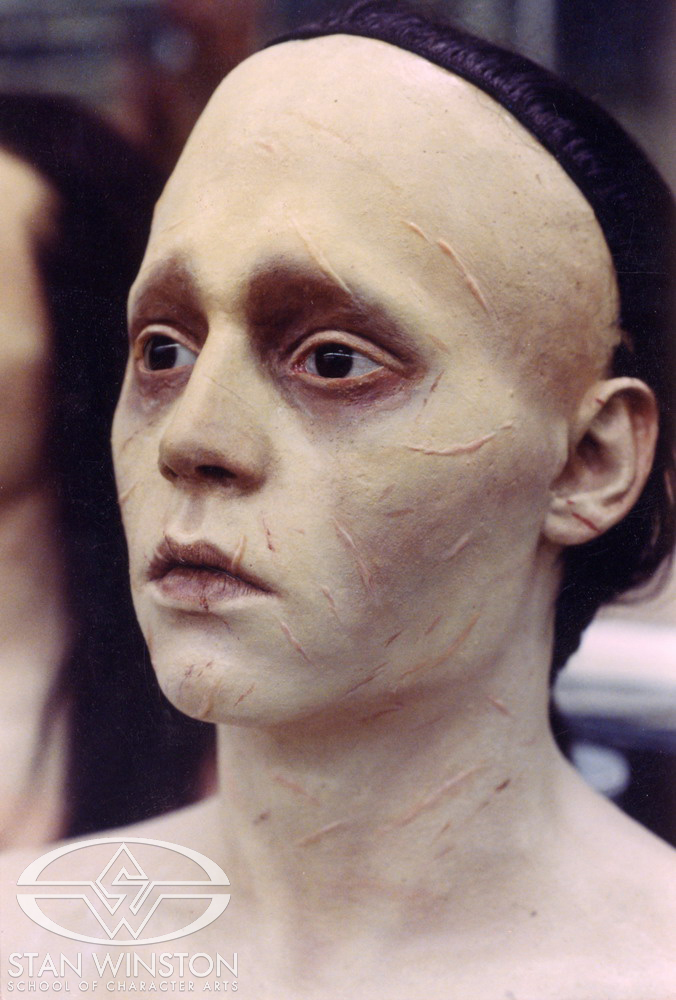 (Side view of Edward with makeup in place, painted by John Rosengrant.)
Edward’s makeup — which would be applied on the set by makeup artist Ve Neill — included a white face and very dark eyes, with nicks and cuts presumably inflicted by his scissor hands. The makeup also featured a foam rubber piece Shane Mahan had sculpted as a means to cover Depp’s eyebrows.
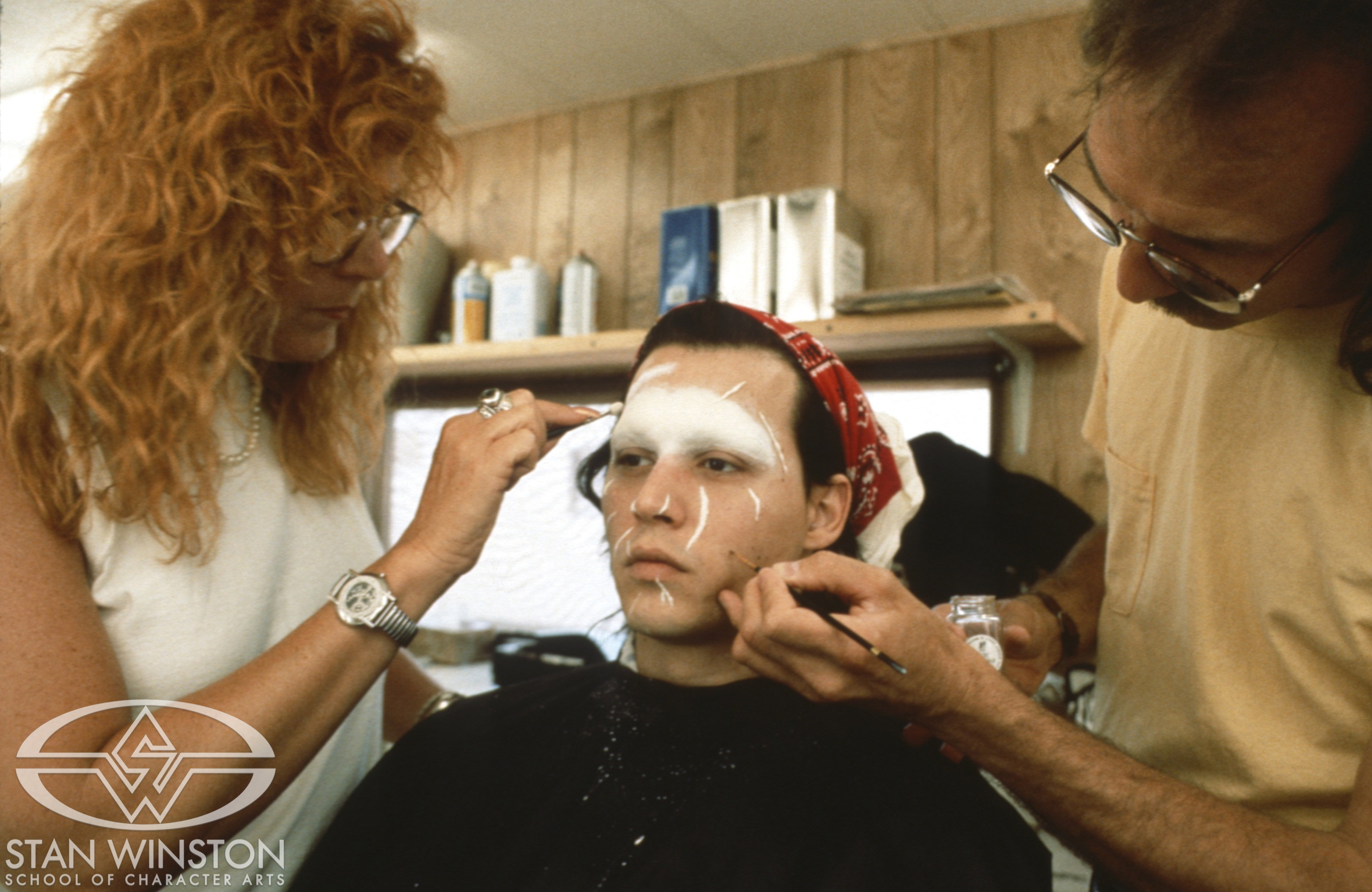 (Makeup artists Ve Neill and Matthew W. Mungle apply a brow piece — sculpted by Shane Mahan — and scars to Depp on set.)
“If you remove a person’s eyebrows,” Mahan said, “it makes them look very odd, and you’re not quite sure why. Also, the brow piece had some scars in it, and it gave a sympathetic tilt to his eyes.”
 (Johnny Depp in an early test makeup.)
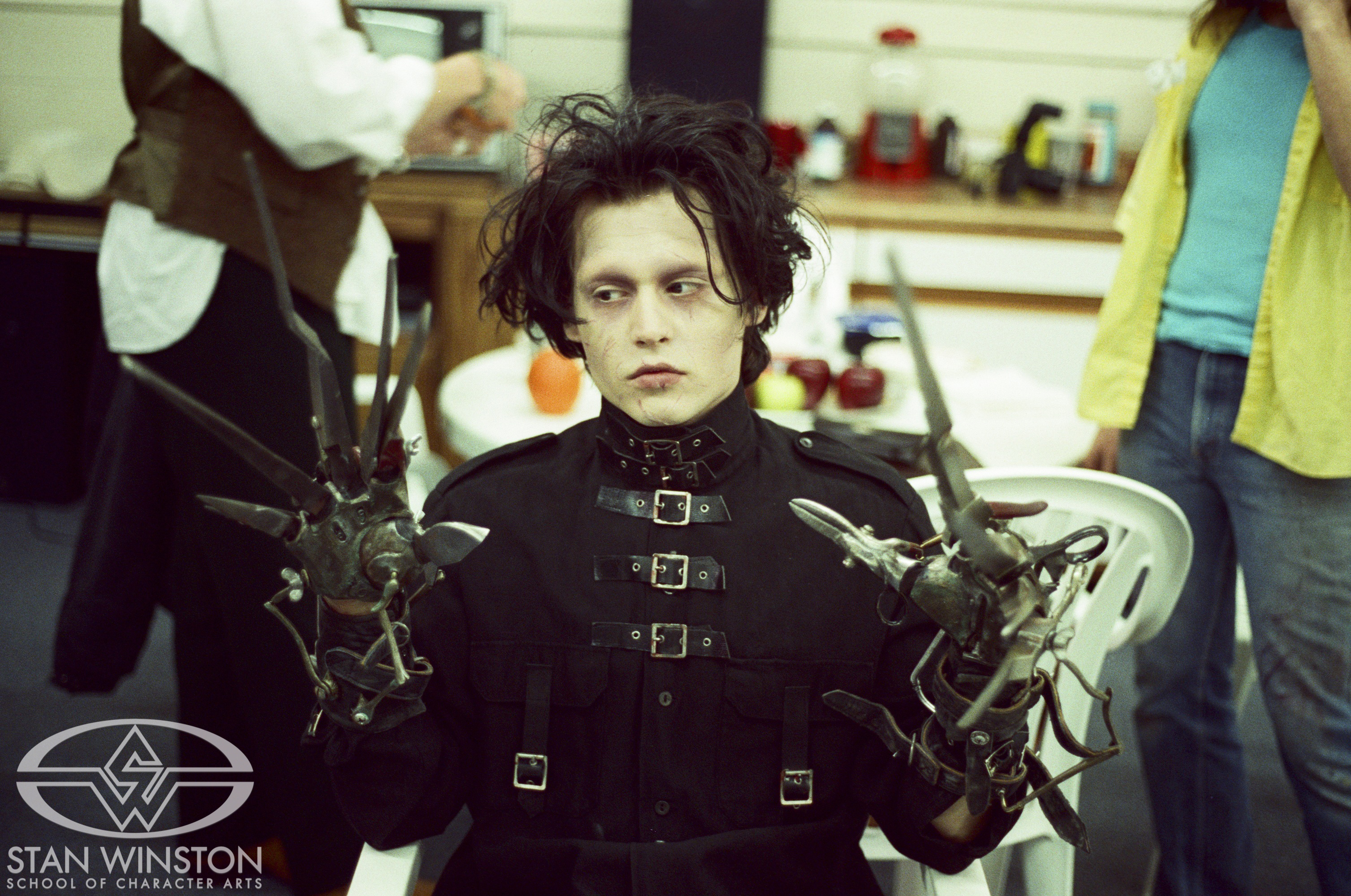 (Johnny Depp closer to what would become the final makeup look.)
Working with Tim Burton
Stan Winston and Ve Neill were nominated for an Academy Award for Edward Scissorhands. But the bigger reward for Winston and his crew was working with the visionary and singular Tim Burton. “Tim not only has incredible artistic vision,” said John Rosengrant, “he has a very straightforward, organized way of working. Tim doesn’t change his mind all the time. On Edward, we worked out with him beforehand what he wanted and how that would work; and when we got to the set, that’s what we did. That may not sound like a big deal — but it is. Tim did exactly what he said he was going to do, and that was great for us.”
 (Official photoshoot of Johnny Depp as Edward Scissorhands. Image courtesy of Twentieth Century Fox and Tim Burton Productions.)
“Working with Tim was really one of the joys of my career,” Winston affirmed. “I’ve had the good fortune of working with directors whose imaginations went beyond mine, and that is what excites me. I love working with people who can see something I didn’t see, and Tim is a perfect example of that. In his sets, his characters, his stories, he is creating his own world, not re-creating the real world — and it was so freeing for me to be a part of that, to serve that theatrical vision. Even though Edward Scissorhands involved only makeup and simple gloved hands, he is as iconic a figure as the Terminator endoskeleton.”
- Blog is excerpted from The Winston Effect: The Art and History of Stan Winston Studio by Jody Duncan
More Tim Burton movies involving Stan Winston Studio:
- Batman Returns - Creating the Penguin
- Batman Returns - Creating the Penguin's Army of Penguins
- Big Fish: Behind the Scenes at Stan Winston Studio
Courses with the creators of Edward Scissorhands (1990):
- Special Effects Sequence Design with Shane Mahan
- Hybrid Characters: Blending Practical & Digital FX with John Rosengrant
- How to Sculpt a Character Makeup with Bruce Spaulding Fuller
- Character Makeup - Multi-Piece Prosthetic Application with Bruce Spaulding Fuller
- Preview Painting Prosthetic Makeup Appliances - Foam Latex & Silicone with Bruce Spaulding Fuller
- Terminator Makeup FX Part 1: Cast, Rig & Prepaint with Steve LaPorte
- Terminator Makeup FX Part 2: Prep, Apply & Pain with Steve LaPorte
- Remote Makeup Application Part 1: Prosthetic & Kit Preparation with Andy Schoneberg
- Mastering Effects Disasters - Explode A Head with Andy Schoneberg
- Building Miniatures: Small-Scale Model Making Series with Ian Hunter
- How to Build an Animatronic Head Series with Craig Caton-Largent
- Animation for Animatronics Series with Craig Caton-Largent