
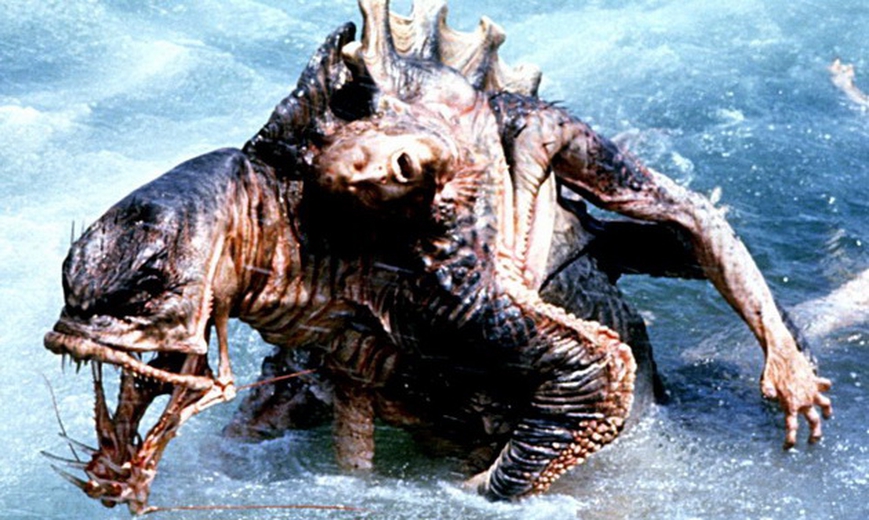
Behind the Special Effects in Leviathan (1989)
1989 was an ocean-obsessed year in Hollywood, with several films set in watery environments. Included among them were Deep Star Six, directed and produced by Sean S. Cunningham (Friday the 13th), Roger Corman's Lords of the Deep, James Cameron's epicThe Abyss, and Leviathan, a 24 million dollar monster movie, shot in Italy, and directed by George P. Cosmatos (Rambo: First Blood Part II).
Leviathan, featuring creature effects by Stan Winston Studio, follows an underwater mining crew who discover a sunken Soviet ship called "Leviathan." While investigating the wreck, they unwittingly unleash a gene-mutating virus that absorbs its victims into a part human, part marine-life monster.
Jump To Section
- Making a Deep Sea Monster
- Designing a Unique Creature
- Creating “The Thing” Underwater
- Making Dry Suits for the Leviathan Cast
- Filming Leviathan
 (The SWS Leviathan creature design maquette, sculpted and painted by John Rosengrant.)
Making a Deep Sea Monster
To create the look of the creature, the Stan Winston Studio design team drew inspiration from marine wildlife and medical books. Given the monster's ability to "assimilate" its victims, the SWS artists zeroed in on a concept that combined human body parts with the anatomy of various types of deep-sea marine life.
 (Leviathan conceptual illustration. Drawn by Shannon Shea (body) and Tom Woodruff, Jr. (head).)
"The Leviathan design," said Stan Winston, "essentially blends fish-like creatures with humanoid elements. We did a lot of anatomical research. Every creature effect starts from a realistic element, otherwise it doesn't look right. But we're using marine life and human anatomy in a way that you wouldn't expect."
 (Director George P. Cosmatos discusses the creation of the monster with creature creator Stan Winston.)
Designing a Unique Creature
After Winston and director George P. Cosmatos selected the final creature design, the SWS team began to conceive the creature in three dimensions, first as a small-scale design maquette, and then as a full-scale sculpt. "It was really kind of a beautiful sculpture, because of all the different weird creatures combined in it," said Leviathan FX team member, Shane Mahan. The unique creature would be brought to life on screen by SWS crew member and suit performer Tom Woodruff, Jr. inside the creature suit, along with additional puppeteered elements.
 (SWS artists Grant Arndt and Andy Schoneberg work on the full-scale Leviathan sculpture.)
 (Stan Winston checks the progress on the full-scale creature sculpt.)
 (John Rosengrant touches up the animatronic Leviathan head.)
 (Tom Woodruff, Jr. and Shane Mahan paint the "Sixpack-Bowman" mutation.)
 (Freshly painted Leviathan creature suit parts at Stan Winston Studio.)
Creating “The Thing” Underwater
“Leviathan was kind of The Thing underwater," said Mahan, who worked as lead creature effects artist and SWS on-set technician. "The deep-sea mining crew members begin to mutate and kill one another, and each body is absorbed into a conglomeration creature that has three or four different bodies combined with all of these sea creature elements.”
 (Monster maker Shane Mahan paints the mutated face of actor Michael Carmine onto the creature.)
After building the creature and the dive suits, a small Stan Winston Studio team followed the production to Italy for four months of filming at Cinecitta Studios in Rome. The famous studio, where director Federico Fellini made films like La Dolce Vita (1960) and Casanova (1976), was especially meaningful for Mahan, a longtime Fellini fan. "The whole time we were at Cinecitta," remembered Mahan, "I'd be out in their junkyard in the back, looking for old Fellini props. All of these massive props from Fellini films were just laying around, giant elephants carved out of foam, which I think were from Intervista (1987). We had a blast going through those old props at Cinecitta."
 (Tom Woodruff, Jr. performs as the creature on the set.)
Making Dry Suits for the Leviathan Cast
 (Stan Winston's team preps the actors inside the dive suits for filming.)
In addition to the amazing creature effects, Stan Winston Studio also built the deep dive suits, designed by conceptual artist Stephen Burg (Terminator 2: Judgment Day). The studio made a dive suit for each of the lead actors, Peter Weller, Amanda Pays, Ernie Hudson and Daniel Stern.
 (Mike Trcic, Jeff Kennemore, Andy Schoneberg, Shane Mahan, and Tom Woodruff, Jr. work on the dive suit in clay at the Stan Winston Studio.)
“We were commissioned to build the old-style mechanical underwater dive suits that the crew wears to explore the sunken ship," said Mahan. "We made one custom suit that could be retro-fit to every actor. The suits were white fiberglass shells with joints. They weren't as light as the actors probably would have liked, but they were as light as we could make them, considering how big and bulky they were. They had bellows at the bottom of the feet, so when a character stepped down, they would squirt air to make the dust on the ground poof out. Shot at forty-eight frames per second, it looked like it was slow-motion and underwater.”
 (Stan Winston sands a fiberglass dive suit torso in preparation for painting.)
 (Tom Woodruff, Jr. inspects a camera-ready dive suit on the Leviathan set.)
 (Stephen Burg's conceptual design for the dive suits.)
Filming Leviathan
The creature effects team encountered some language differences during the making of Aliens (1986) in England, but the challenges were much bigger in Italy. "I always keep a log of everything we order on shows, just in case accounting comes back later and asks about it," noted lead creature effects mechanic and on-set technician Richard Landon. "In my log from that show, you can tell that there were some real language issues, because a lot of times, instead of words, I drew pictures of nuts or bolts or that kind of thing. I would quite often have to draw a picture just to make it clear what I was talking about."
 (Stan Winston and John Rosengrant prep Tom Woodruff, Jr. inside the monster suit in the water tank set.)
There were cultural differences too, such as the Italian's crew tendency to drink large amounts of red wine at lunch. "They'd say, 'Here, have some wine!' remembered Mahan, "and we'd say, 'Uh, thanks, but we're not allowed to drink while we're working.' Of course, every once in a while, we'd sneak a little, but nothing like the way those guys were drinking it down.”
 (Leviathan, drunk or not, you gotta perform inside that monster suit.)
Scenes that could not be filmed dry-for wet at the soundstages of Cinecitta were shot either in big water tanks or at sea in Malta. Winston had his main creature effects team trained and certified as scuba divers prior to filming in order to support the required water scenes in the movie and to ensure their safety and proficiency in the water. "Tom Woodruff, Jr. would be in the suit underwater and the rest of us would act as safety divers so we could get Tom out of the suit quickly if something happened," noted John Rosengrant.
 (Stan Winston with his monster-making team, including Shannon Shea, Alec Gillis, John Rosengrant, and Tom Woodruff, Jr., in the Malta water tank set, prepping the Leviathan creature for filming.)
Once, during the underwater photography, Rosengrant and other members of the SWS on-set crew were underwater for so long and at such depth, that they were unaware of a violent storm that had come in, threatening to rip the topside boat from its anchor and smash it against nearby rocks. "We had no idea all of this was going on, until we came to the surface and saw all this commotion," recalled Rosengrant. "We all go out of the water and helped to push the boat away from the rocks and hold it steady in this storm."
 (Leviathan's monster head, sculpted and painted by John Rosengrant.)
More often though, the Leviathan experience was an adventure and a joy for Winston and his monster-making team. Not only did they get to live in Rome for four months during filming, and even learn scuba diving, a recreational activity many of them continue to pursue to this day, but they also got to work with a director who was unusually generous with inviting their input. In addition to producing the creature effects, Cosmatos trusted Winston to direct the second unit action sequences. "George Cosmatos always let us take the lead in how to shoot the creature," noted Landon. "He was such a big-hearted person, he would throw up his hands, and say 'I don't know what I'm doing.' He'd just admit it and let us do what we knew how to do. We know what our characters can do and we know the best way to use them. We're thinking about what our characters are going to have to do on the set the entire time we're building them. So we are goldmines of information and knowledge. Some directors recognize that, and really rely on us."
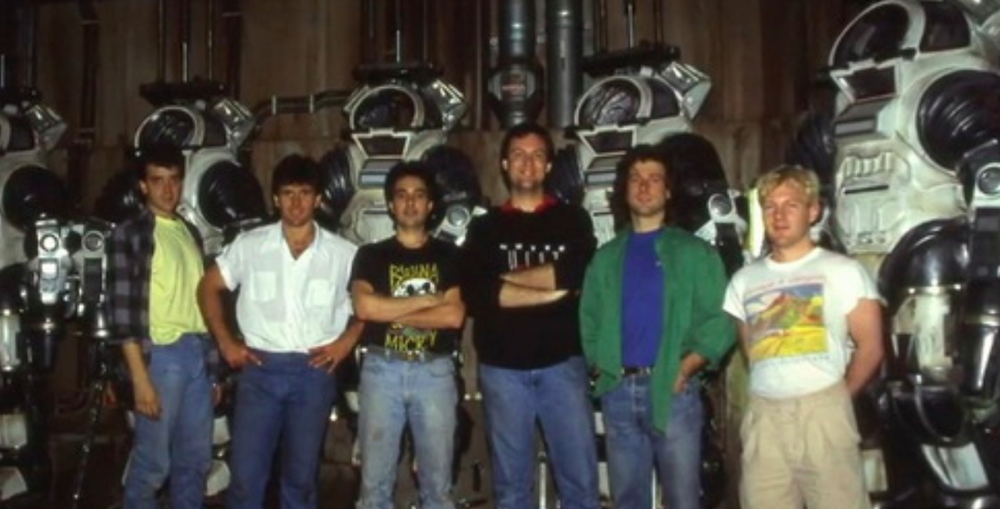 (Leviathan's on-set Stan Winston Studio team, Tom Woodruff, Jr., Alec Gillis, Shannon Shea, Richard Landon, John Rosengrant, and Shane Mahan, with the deep dive suits from the movie.)
- Blog assembled by Dimitar Dimitrov with selections from The Winston Effect: The Art and History of Stan Winston Studio by Jody Duncan

Courses with the Creators of Leviathan
- Directing Creatures with Alec Gillis
- Make A Monster Suit - Part 1: Creature Sculpting with Alec Gillis
- Animatronics Design Basics with Richard Landon
- Special Effects Sequence Design with Shane Mahan
- Garage Monsters - How To Make Creature FX On A Budget with Shannon Shea
- The Business of Making Monsters with Shannon Shea
- Hybrid Characters: Blending Practical & Digital FX with John Rosengrant
- Monster Suit Performance with Tom Woodruff Jr.
- Character Design Techniques with Tom Woodruff Jr.
- Make a Monster - Plastic Bag Technology with Steve Johnson
- Animation For Animatronics: Intro To Pololu, Maya & AnimServo Software with Craig Caton-Largent
- How To Build An Animatronic Head - Creating The Mechanical Underskull with Craig Caton-Largent
- Mastering Effects Disasters - Explode A Head with Andy Schoneberg
- Remote Makeup Application Part 1: Prosthetic & Kit Preparation with Andy Schoneberg