
Building a Penguin Army for Batman Returns (1992)
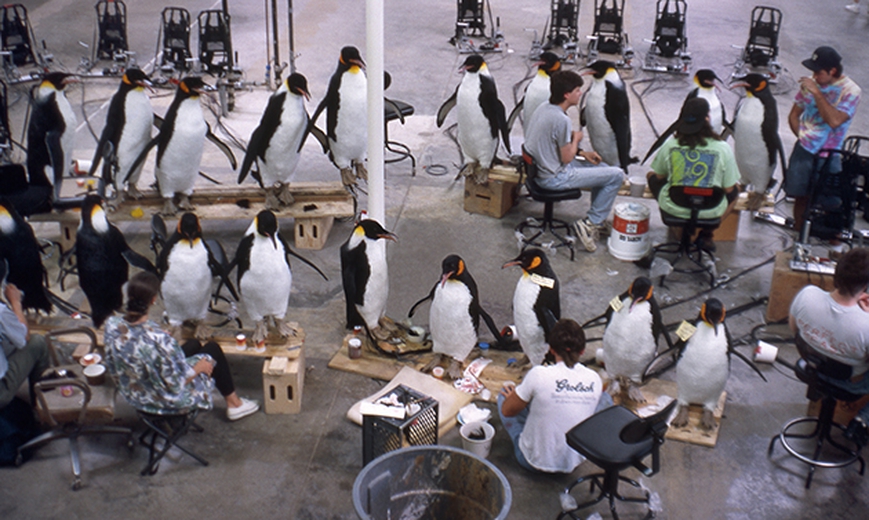
For Tim Burton's Batman Returns, Stan Winston Studio designed and built thirty full-body mechanical penguin puppets — ten each of three different penguin species — and six mechanical heads and suits, all of which were interspersed with live penguins to create the Penguin’s army.
Jump To Section
- The Process of Creating Penguin Animatronics
- Engineering Batman Returns’ Mechanical Penguins
- Stan Winston Studio Embraces Computer Design
WATCH PENGUIN SUIT TEST
The Process of Creating Penguin Animatronics
“Our mechanical puppets were slightly larger than real penguins,” explained Stan Winston Studio Batman Returns team member Chris Swift, who sculpted the suit-and-head version. "There were 3 sizes of penguin puppets for the film;" added fellow team member Andy Schoneberg, "18-inch black-footed, 32-inch king, and 36-inch emperor penguins."
"Then we had even larger versions," said Swift, "which were little people in suits, with mechanical heads. The heads and the flapping wings were puppeteered, but the walking was done by the little people in the suits.”
 (A Mark "Crash" McCreery design for a member of the penguin army featured a flamethrower weapon - which later evolved into a rocket launcher - and a fanciful costume.)
 (The finished Penguin sculptures prior to the mold-making process.)
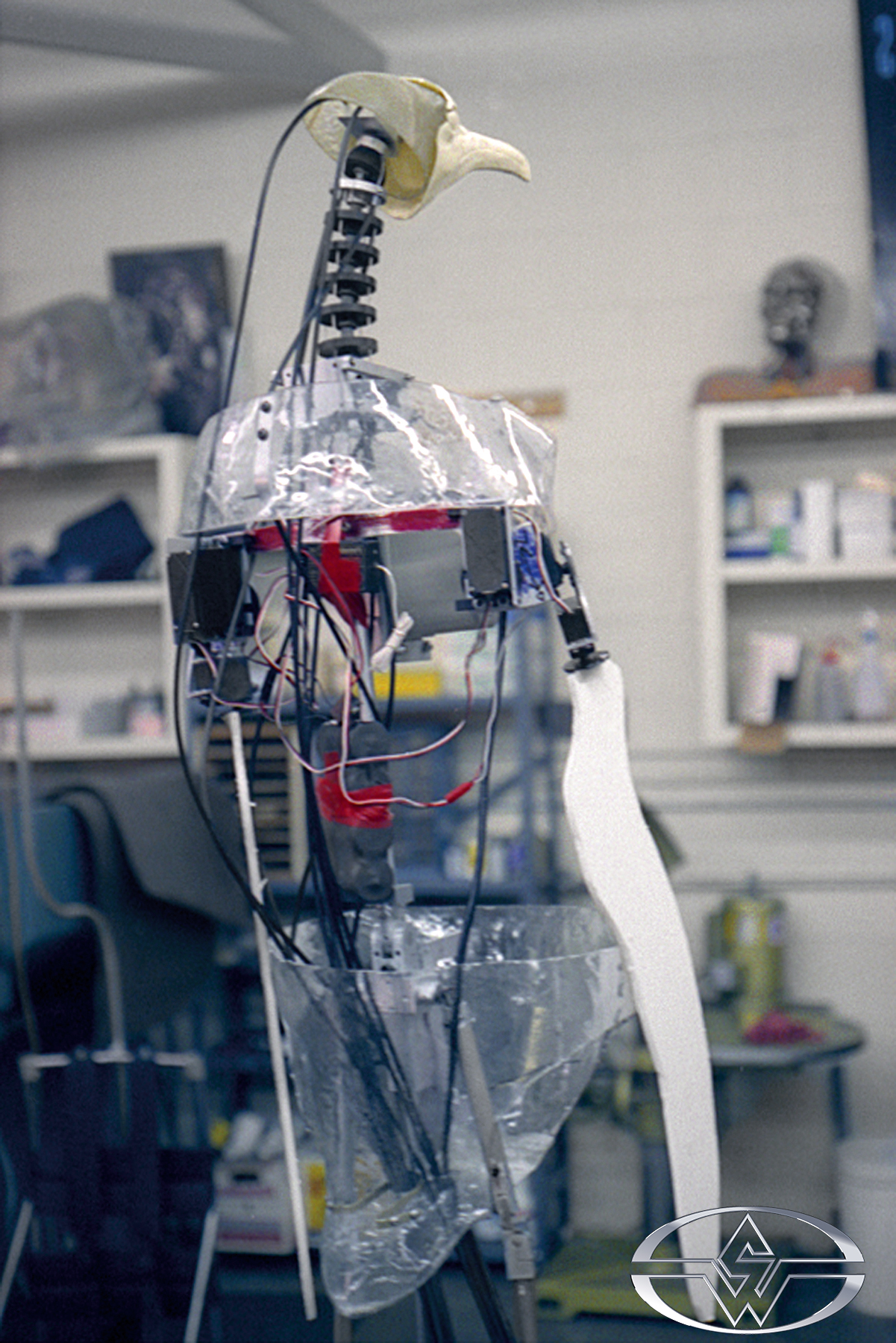 (The internal mechanism for one of the penguin animatronic puppets.)
Engineering Batman Returns’ Mechanical Penguins
Stan Winston Studio mechanical effects designers Richard Landon and Craig Caton-Largent oversaw the engineering of the cable-operated and radio-controlled mechanical penguins, with Alan Scott assisting. Each of the thirty penguin puppets required nearly 200 mechanical parts to achieve head and neck movement, plus movement of the eyes, beaks, and wings.
 (Little people performed inside the full-size penguin suits, controlling gross body and head movement, while external puppeteers operated the wings, eyes, and beaks via RC Control.)
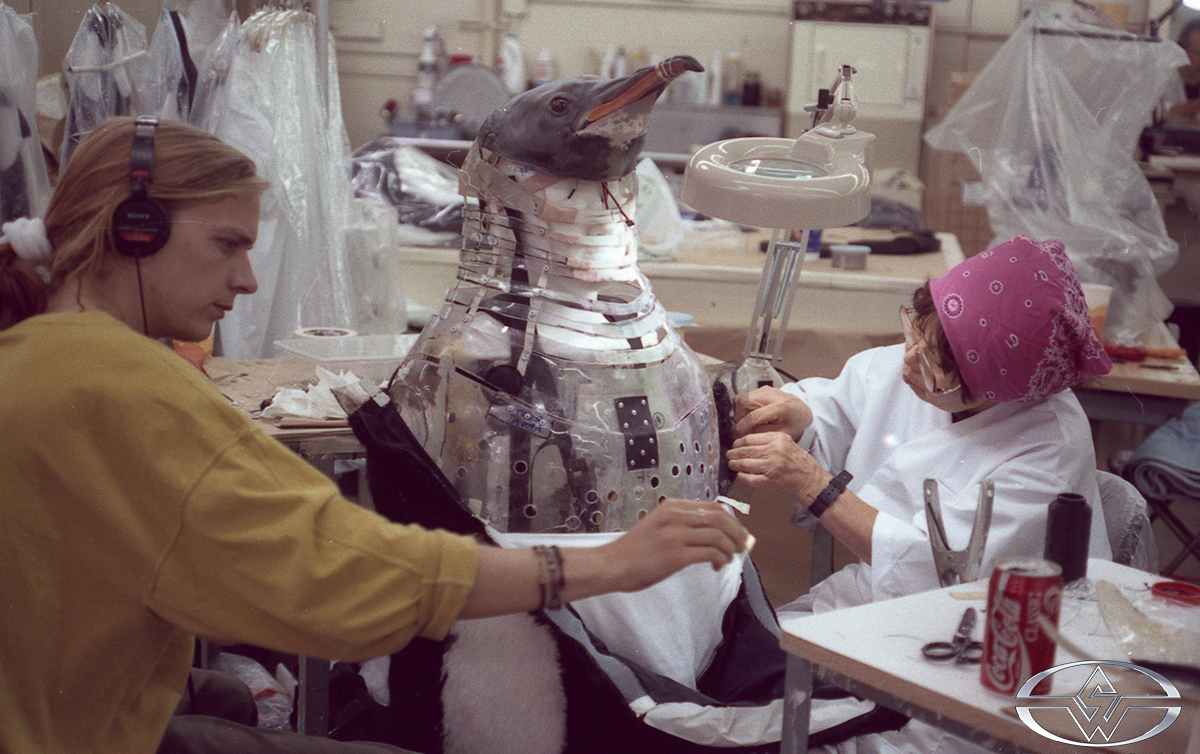 (SWS artists Len Burge and Michiko Tagawa attach the outer fur to a penguin suit.)
Stan Winston Studio Embraces Computer Design
For one of the first times in Stan Winston Studio’s history, the Penguin army's mechanical parts were designed entirely on a computer using CAD (computer-aided design) technology. “This was one of our earliest experiences with computer design,” Alan Scott noted, “which was in its infancy at the time. We had just acquired our first Macintosh computer for that purpose. It was set way in the back of the shop; but it was the really cool thing, and we’d all take turns on it. Now, of course, we’ve all got laptops at our workstations.”
 (SWS team members Karen Mason and Richard Landon work out the kinks during a Penguin suit test.)
 (Stan Winston Studio crew members perform touch-ups on the penguin animatronics prior to a rehearsal.)
 (SWS artist Mark Jurinko applies flocking material to simulate penguin feathers.)
 (The Penguin, played by Danny DeVito, as he appears on-screen in Batman Returns with his penguin army.)
-Jody Duncan
Excerpted from "The Winston Effect: The Art & History of Stan Winston Studio"
Courses with the Creators of Batman Returns
- Special Effects Sequence Design with Shane Mahan
- Hybrid Characters: Blending Practical & Digital FX with John Rosengrant
- Hybrid Character Design: Practical To Digital with Christopher Swift
- The Business Of Making Monsters - Part 1 with Shannon Shea
- Garage Monsters - How To Make Creature FX On A Budget with Shannon Shea
- Oversized Eyes Part 2: Molding & Casting with Rob Hinderstein
- Oversized Eyes Part 3: Paint Layering & Finishing with Rob Hinderstein
- Animatronics Design Basics with Richard Landon
- Cable Mechanism Basics - Tentacles with Richard Landon
- Robot Brains - Animatronic Character Servo Control with Rick Galinson
- Metallic Painting Techniques - Robot Finishes (Terminator) with Rob Ramsdell
- Mastering Effects Disasters - Explode A Head with Andy Schoneberg
- Remote Makeup Application Part 1: Prosthetic & Kit Preparation with Andy Schoneberg
- Animation For Animatronics: Intro To Pololu, Maya & AnimServo Software with Craig Caton-Largent
- How To Build An Animatronic Head - Creating The Mechanical Underskull with Craig Caton-Largent