
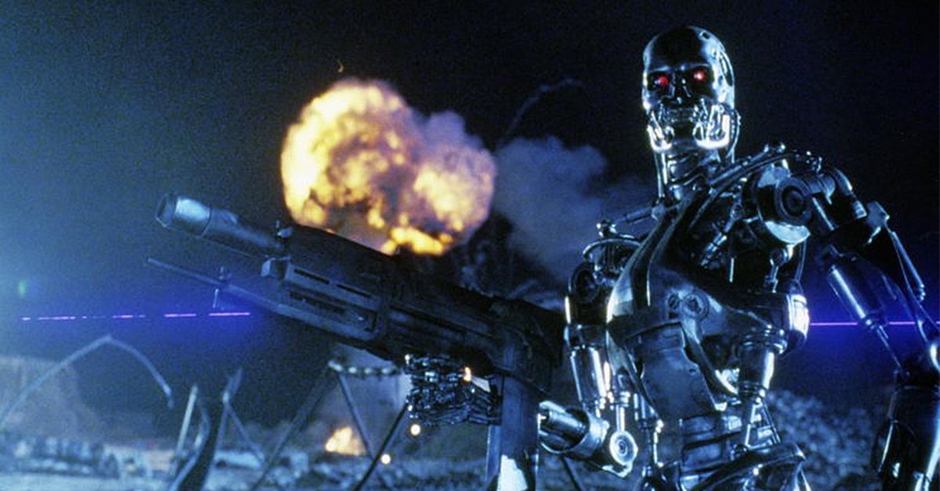
New Terminator. New Robots.
While Terminator 2: Judgement Day is best known for introducing the iconic liquid metal T-1000 to the Terminator franchise (Hollywood's first ever practical/digital "hybrid" character), James Cameron and Stan Winston were determined to improve upon the familiar T-800 as well. While designs were underway for the T-1000 effects, Stan Winston’s crew used molds from the original Terminator endoskeleton to build four new robots. Two of the full-size T-800s were non-articulated versions, and two were much more sophisticated ‘hero’ robots that could perform gross body movement, plus head and facial movement. “We really advanced our technology for the Terminator endoskeleton,” said Stan Winston. “This time, we had a full-standing, completely animatronic robot.”
Jump To Section
- Using a Chroming Process for Endoskeletons
- Making Lighter, More Durable Full-body Puppets
- Behind the Iconic Skull-crush Shot in Terminator 2
- A Massive Team Effort From Puppeteers
- Creating Illusion
- Making Extra Skulls
- “It's Perfect!”
 (Stan Winston adjusts the full-size T-800 animatronic puppet on the set of T2: Judgement Day.)
 (The full-size 'hero' T-800 puppet on TERMINATOR 2: Judgement Day's "Future War" set.)
Using a Chroming Process for Endoskeletons
Other improvements included a more authentic chrome finish. “The first Terminator robot was made of a plastic material,” said 25-year SWS supervisor & Co-Founder of Legacy Effects, Shane Mahan, “like a lens cap that might have the look of chrome, but is really plastic. We’d run the robot pieces through an electrostatic process to apply a metallic finish; but, in shooting the first Terminator, we’d found that it chipped very easily. That was a heavy action film — as this one would be — and we were constantly bashing that thing through walls. So, by the end of shooting Terminator, the endoskeleton puppets were literally patched together with paint and tin foil. There were little patches all over them to hide where the metallic finish had flaked off. By the time we got to Terminator 2, we used an actual chroming process for making the endoskeleton. It was a heavier material, but it made the endoskeleton puppets more durable, and the metallic luster was much more authentic looking. It made a huge difference.”
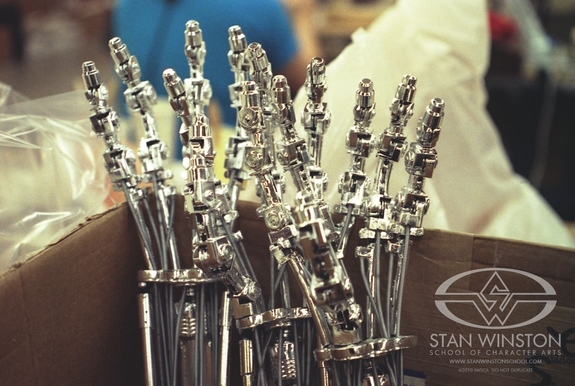 (Freshly "metalized" Terminator hands await assembly at Stan Winston Studio.)
 (The new T-800s assemble in Stan Winston Studio, unaware that they're being watched by the cast of Monster Squad to the left.)
Making Lighter, More Durable Full-body Puppets
Although the chrome was a heavier material, the endoskeleton puppets created for Terminator 2 were lighter overall, because the more durable exterior structure obviated the need for solid steel supports internally. As a result, the full-body puppet weighed half the 100 pounds of the original. “The advance of materials and engineering allowed us to make something that was both lighter and more durable,” Mahan said. “We didn’t have to put steel and solid epoxy inside these things. Everything was laid up with more consideration for the weight. They still had enough weight to feel authentic; but they were more operational.” The weight of the endoskeleton puppets was of particular concern to Mahan and 25-year SWS supervisor and Co-Founder of Legacy Effects, John Rosengrant, both of whom would strap head-and-torso configurations of the puppets onto their backs to make them ambulatory in mid-range-shots.
 (The 'hero' skull-crushing T-800 puppet comes together in the SWS mechanical shop.)
 (One of the new T-800's strikes a less-than-menacing pose on the workshop floor at SWS.)
 (Cameras roll on the "Future War" set of T2: Judgment Day.)
Behind the Iconic Skull-crush Shot in Terminator 2
Terminator 2 opens with the future war sequence, and the classic shot of an endoskeleton’s foot crushing a child’s skull. “That is one of the shots you always see from this movie,” said Winston. “The skull is crushed, the camera moves up to the endokeleton’s head, with its glowing eyes, and its head turning this way and that, looking for its next victim. That was a full- blown animatronic robot! And it was a big advancement over what we had done for the first Terminator.”
 (Red eyes of death. The 'hero' SWS T-800 puppet seeks out human Resistance fighters.)
A Massive Team Effort From Puppeteers
A team of twelve puppeteers standing off-camera operated a series of cable, rod and radio controls to create the endoskeleton performance in the opening shot — some on the crushing leg, some on a waist twist mechanism, some on the neck, some operating a hydraulic bicep action, and others on the various head and eye movements. “This tracking shot moves up to the child’s skull buried in the dirt,” explained Mahan, “and then the foot smashes down on top of it, and the camera pulls back to reveal the whole endoskeleton."
 (Everything comes together - puppet, explosions, lights - to create film history.)
 (Stan Winston preps for another take to get it just right.)
 (Shane Mahan stays just out of frame as he puppeteers on the set of Terminator 2.)
Creating Illusion
Mahan continued, "So the illusion is that this endoskeleton has walked up and stepped on this skull. How it worked, though, was that the endoskeleton’s left leg was planted on the set, and its right leg was smashed down on the skull with a rod that was connected to the calf, which would then trigger-release so that the guy operating it could grab the rod and get out of shot before the camera moved up. It was a five or six-foot rod, so the puppeteer was pretty well out of frame anyway. He could just hoist it up, smash the leg down, pull it out, and step back out of the shot as the camera moved up.”
 (One of the twenty-eight crushable, brittle wax child skulls created by SWS for the shot.)
Making Extra Skulls
Shane Mahan and the crew had fashioned twenty-eight crushable, brittle wax child skulls for the shot, which they brought to the Terminator 2 set. “I thought twenty-eight skulls was overkill,” Mahan commented. “I thought that would be way more than enough. But we did take after take of that shot, and each time, some little thing would go wrong. It was very complicated, because there was a lot of stuff that all had to work together. There were explosions going off in the distance that had to time out just right. Plus, just getting the look of the leg crashing down on the skull, how it shattered, how the camera pulled up, how the endoskeleton looked when it pulled up, getting the rod out in time — all of that had to be coordinated. So here we were, out in some old steel yard in Fontana, shooting this huge scene at three o’clock in the morning, and I’m running out of skulls. We’re using them up in take after take, and I’m just praying that we get the shot before we run out of skulls. By take fifteen, I was thinking, ‘Okay, well, we’ve used a lot, but we’re going to get this shot in the next take or two.’ By take twenty, I was thinking: ‘God Almighty! I’ve only got eight left! What am I going to do if we run out?’ Of course, I didn’t mention to anybody that we were running out of skulls. I was just sweating it out secretly, wondering how I was going to break the news to Jim. Any other director, ten skulls would have been plenty. But with Jim, you make a lot more of everything — and it still isn’t enough. We had two skulls left in the box when we finally got it. I was so thankful.”
 (The iconic skull crush moment. T2's theme stated.)
“It's Perfect!”
“Jim still wasn’t really happy, though,” SWS "Lifer" & Legacy Effects mechanical designer Richard Landon recalled. “He just said, ‘Well, I guess that’s the best I’m going to get,’ and he moved on. And we were so disheartened, thinking we’d failed him, and hoping against hope that he got something he could use. But then, when we came in the next day, Jim called John, Shane, and me into his trailer, and he popped in a videotape of the shot from the night before, and he was all excited. ‘Watch this! It’s perfect!’ And it was like the fourth or fifth take! That’s the take that is in the movie.”
-Jody Duncan
Excerpted from The Winston Effect: The Art and History of Stan Winston Studio
Courses with the Creators of Terminator 2
- Special Effects Sequence Design with Shane Mahan
- Animatronics Design Basics with Richard Landon
- Hybrid Characters: Blending Practical & Digital FX with John Rosengrant
- Hybrid Character Design: Practical To Digital with Christopher Swift
- Animation For Animatronics: Intro To Pololu, Maya & AnimServo Software with Craig Caton-Largent
- How To Build An Animatronic Head - Creating The Mechanical Underskull with Craig Caton-Largent
- Garage Monsters - How To Make Creature FX On A Budget with Shannon Shea
- The Business of Making Monsters with Shannon Shea
- Mastering Effects Disasters - Explode A Head with Andy Schoneberg
- Remote Makeup Application Part 1: Prosthetic & Kit Preparation with Andy Schoneberg
- How To Sculpt A Character Makeup with Bruce Spaulding Fuller
- Character Makeup - Multi-Piece Prosthetic Application with Bruce Spaulding Fuller