
The Making of Big Fish
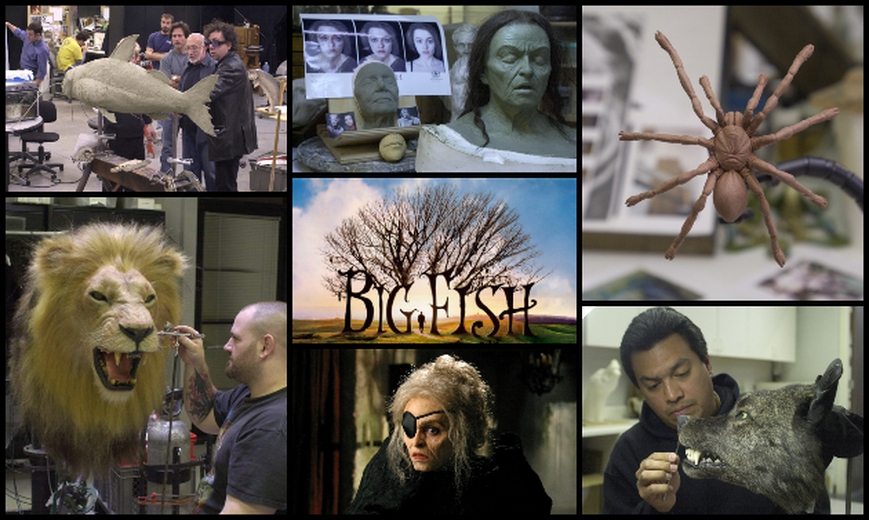
While working on Terminator 3 and Wrong Turn, Stan Winston Studio also provided practical effects and makeups for Tim Burton’s Big Fish (2003). The movie concerns an aging raconteur of fanciful tales, Ed Bloom--portrayed by Albert Finney in present-day sequences, and by Ewan McGregor in flashbacks--and his strained relationship with his grown son, Will (Billy Crudup).
Jump To Section
- Building the Big Fish
- Moving the Big Fish
- Creating the Circus Lion
- Using an Animatronic Wolf Puppet for Danny DeVito’s Transformation as Amos Calloway
- Makeup for Helena Bonham Carter’s “Swamp Witch”
- Custom Building the Big Fish Town, Spectre
- The Magic Behind the Conjoined Twins, Ping and Jing
- Working with Tim Burton on Big Fish
Stan Winston Studio created a variety of makeup effects and puppets on Big Fish. J. Alan Scott and Lindsay MacGowan were the effects supervisors. Shane Mahan and John Rosengrant were the key artists. Aaron Sims was responsible for designing the Swamp Witch makeup.
 (Ewan McGregor has a close encounter with the animatronic wolf.)
Building the Big Fish
Joey Orosco sculpted the titular big fish--a gigantic catfish Ed claims to have encountered in his youth--under the guidance of Shane Mahan and Tim Burton. “I remember that Tim wanted the whiskers on the catfish to be curly,” said Orosco, “which was such a ‘Tim Burton’ touch.”

 (Different concept artworks for the big fish in Big Fish)
“The fish design wasn’t based on a real fish at all,” Shane Mahan added. “Tim wanted it to be the memory of a big fish, so it had to be more stylized, even more beautiful than a real fish. Real 500-pound catfish are monstrous, hideous-looking creatures. Tim wanted this to be a beautiful, fantasy fish.” The final fish puppet had cable-controlled gill, tail and mouth movement, and was operated by puppeteers stationed on a flatboat.
 (The work-in-progress, five-foot-long Big Fish sculpture at the Stan Winston Studio.)
Moving the Big Fish
A Winston crew that included Shane Mahan, Lindsay Macgowan, Richard Landon, and Matt Heimlich transported the puppet to the river in Alabama where Burton planned to shoot a closing scene in which the fish swims around Billy Crudup’s character.
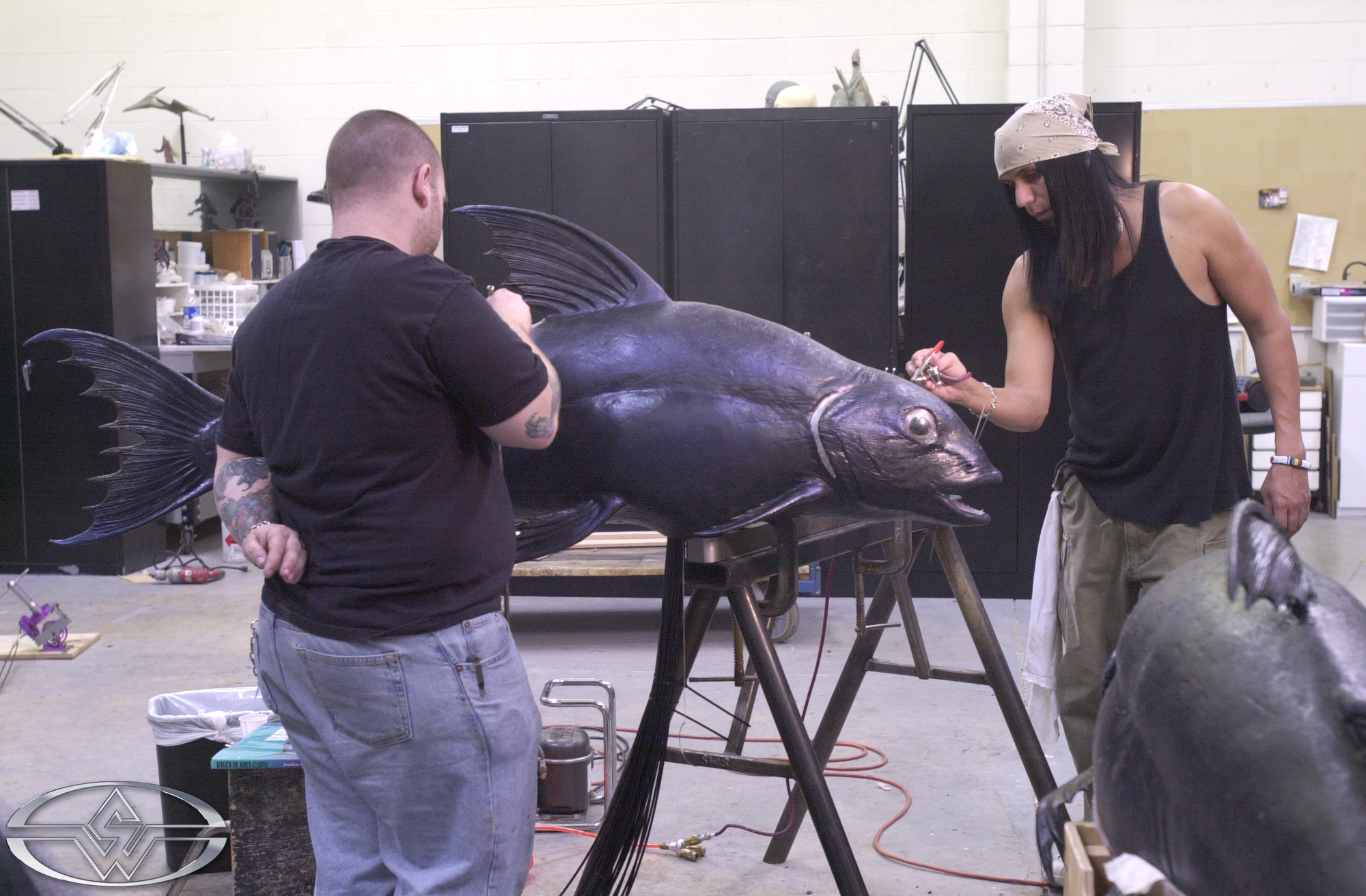 (John Cherevka and Joey Orosco paint the animatronic Big Fish at the Stan Winston Studio.)
To move the fish through the water, the crew mounted it to a track that had been laid in the river, which wound through a rural cotton field. “It was very challenging to mount this five-foot-long, heavy puppet on a track in a real river,” recalled Mahan. “Tim wanted to shoot it at seven o’clock in the morning - that’s when Billy Crudup was going to be out there, standing in that river. That meant that we had to be out there at about three o’clock in the morning to set it up and make sure everything was ready by seven."
 (Billy Crudup lets the Big Fish swim away.)
"We had to get into dry suits and scuba gear, then hoist the puppet into the water and set it on the track, take all the stops out, make sure the tail and rudder were working. We were setting all of this up in the water, in the middle of the night, in the winter, freezing cold, working in the dark. And the old farmer who owned the cotton field came out, and said to us, ‘Now, you boys be careful and mind that alligator.’ And we’re thinking: ‘Great. There’s an alligator, too!’”
Creating the Circus Lion
One circus sequence shows young Ed sticking his head into the mouth of a lion. For this sequence, the Winston crew built a lion head that matched the real animal filmed for the scene. Lindsay Macgowan and Alan Scott traveled to Florida, where that lion was performing in a real circus, to take reference photographs.
 (The lion animatronics without its skin and fur.)
The crew then set about building the lion head, beginning with the roaring lion head that Joey Orosco had sculpted for The Ghost and the Darkness. “We had the mold from Ghost and the Darkness,” explained Macgowan, “and we took a casting from that. Then John Rosengrant resculpted that and we remade the whole thing. When we got to the set, we put our lion up to the real lion that was there, matching the colors as closely as we could.”
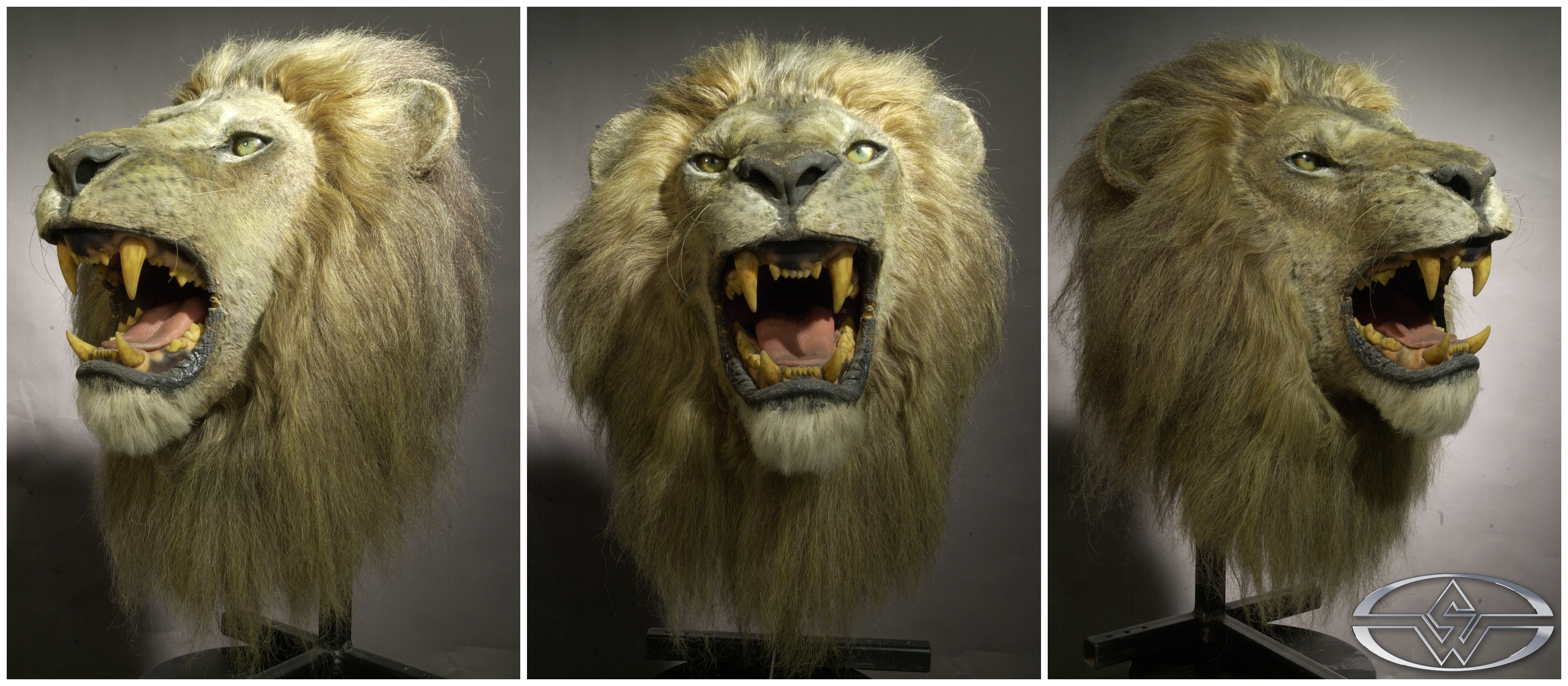 (Life-like lion head made for Big Fish by the Stan Winston Studio.)
Using an Animatronic Wolf Puppet for Danny DeVito’s Transformation as Amos Calloway
For scenes where Danny DeVito's character becomes a wolf, the crew also made an animatronic wolf puppet.
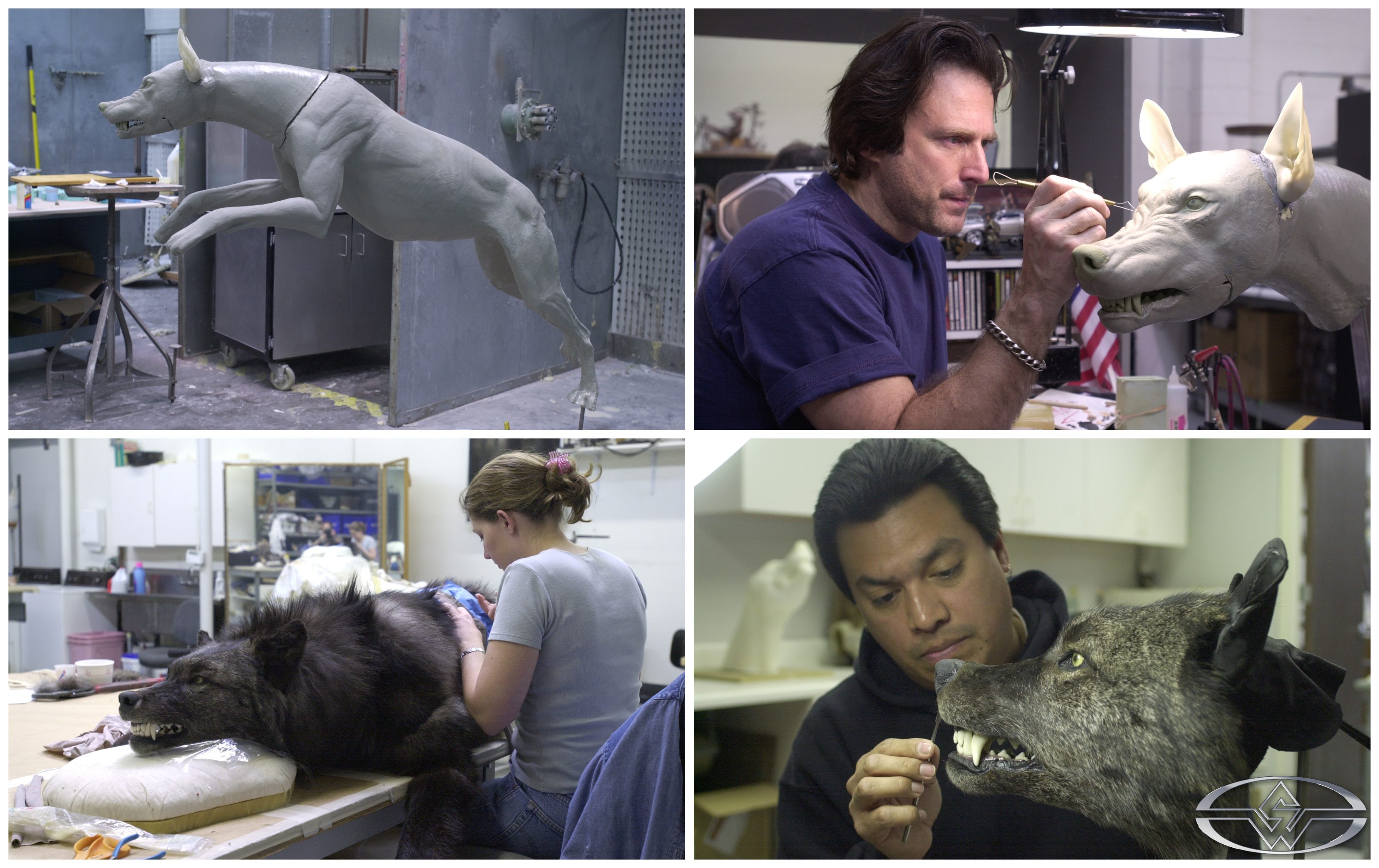 (The wolf-making process (from the top right to the bottom left): wolf sculpture; John Rosengrant detailing the wolf head; pulling up fur to the wolf puppet; Michael Ornelaz grooms the muzzle of the animatronic wolf puppet.)
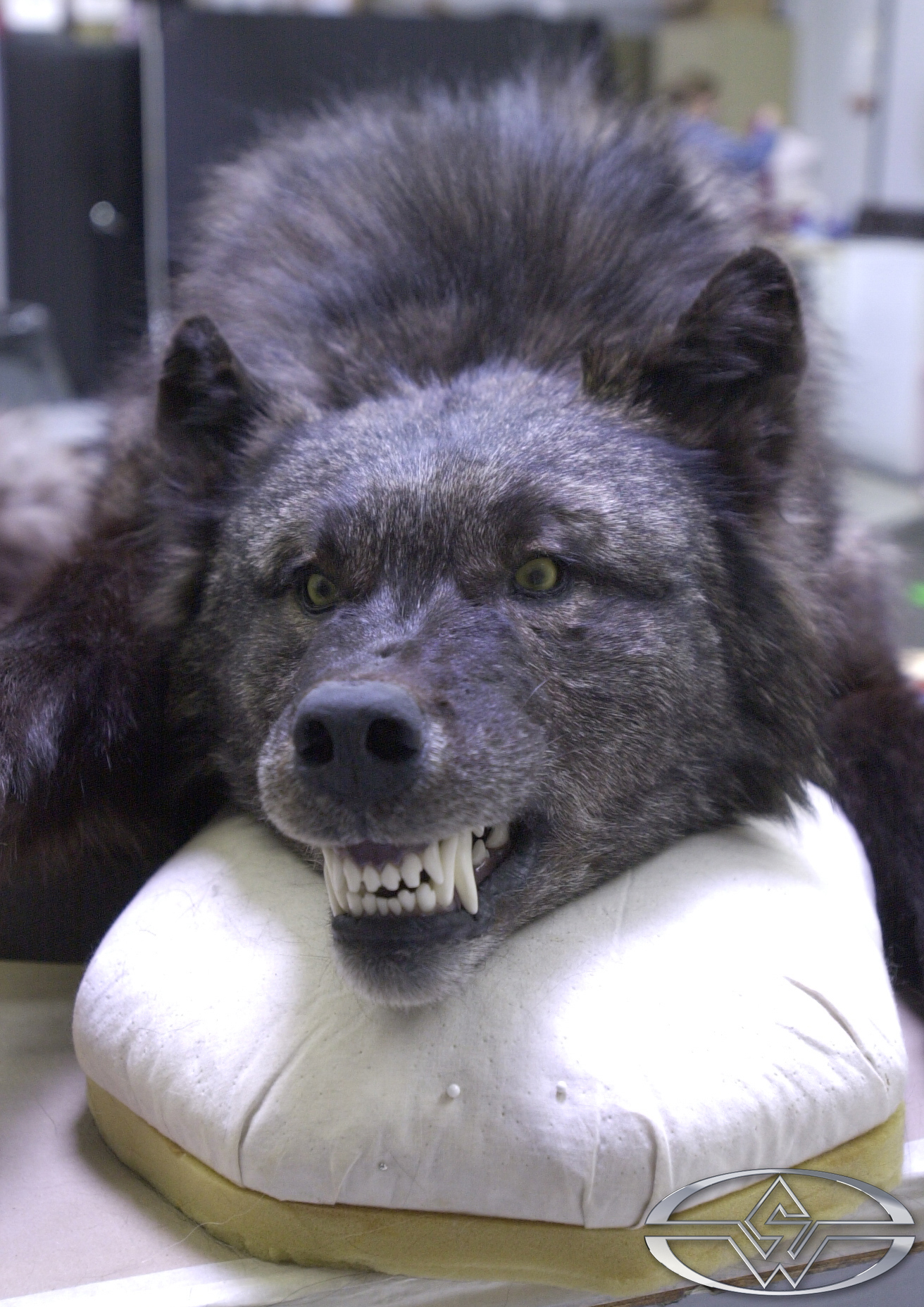 (The wolf puppet at the Stan Winston Studio nearly ready for camera.)
Danny DeVito had previously worked with the Stan Winston crew on Batman Returns. “When we were working with Danny,” Shane Mahan said, “he told us that when he’d done the voice-over sessions for Batman Returns [for the Penguin], it was much harder for him to find the character without the makeup on. So he actually went to the trouble of having the makeup put on him for the voice-over work, just to help him get into the character. That was a big compliment to us.”
Makeup for Helena Bonham Carter’s “Swamp Witch”
Helena Bonham Carter played two characters in the movie: The Swamp Witch, who's clairvoyant glass eye shows everyone their own death, and Jenny, who appears both young and middle-aged. Based on Aaron Sims' design Joey Orosco sculpted the witch head and Richie Alonzo sculpted the witch makeup. The makeup application took about five hours.
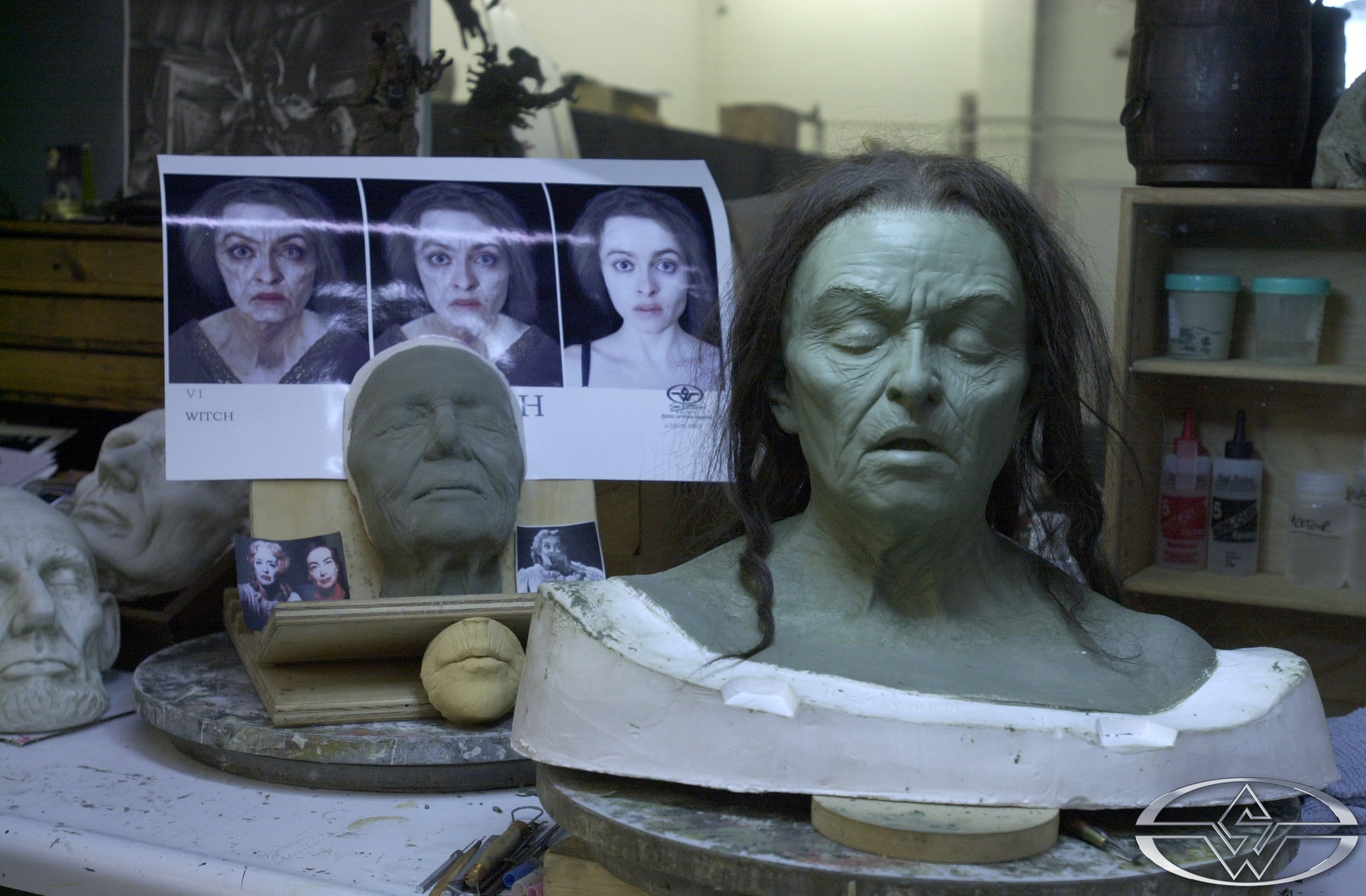 (The Swamp Witch sculpted by Joey Orosco at the Stan Winston Studio.)
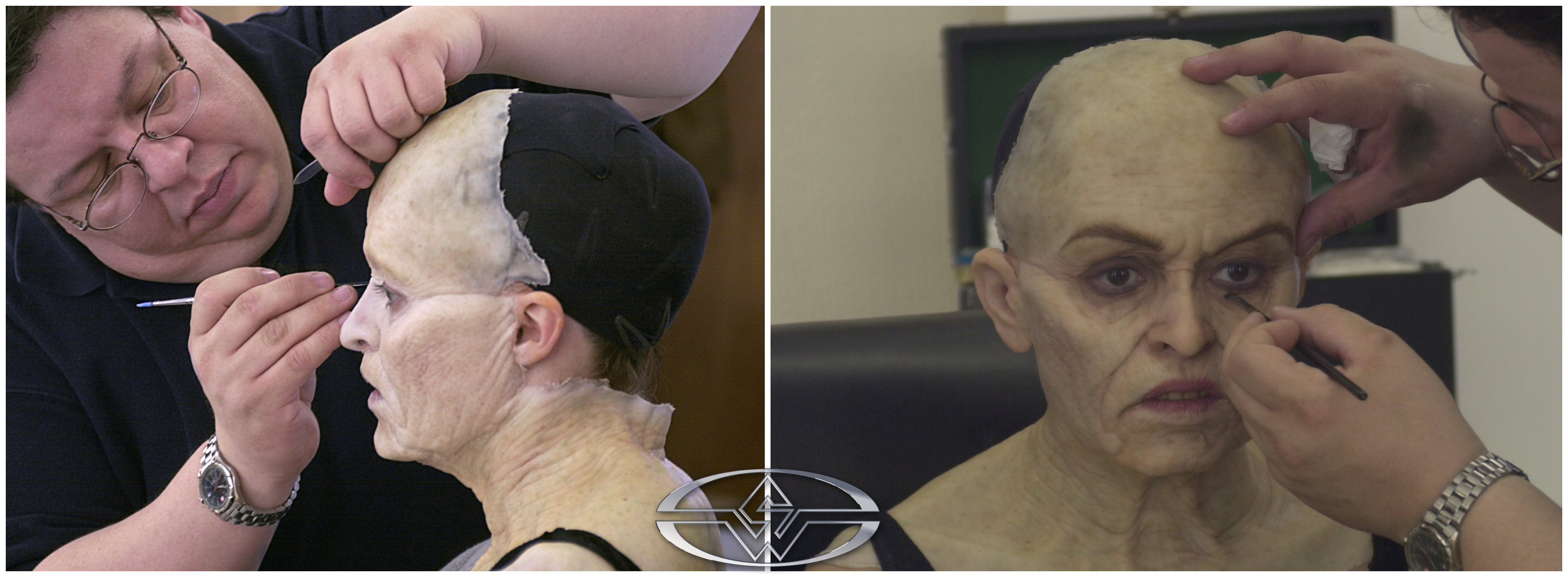 (Richie Alonzo sculpted the witch makeup from Aaron Sims’ design; seen above applying the makeup to Helena Bonham Carter.)
 (Helena Bonham Carter as the Swamp Witch on the set of Big Fish.)
Custom Building the Big Fish Town, Spectre
In the movie, Edward Bloom (Ewan McGregor) walks through a dark forest, has his hat stolen by a crow, gets pinched by wasps and then attacked by jumping spiders before arriving at a small town, called Spectre. The entire town was custom built for Big Fish at Jackson Lake Island in Alabama.
 (The circular portal of old trees, built from styrofoam, remains at Jackson Lake Island to this day.)
The trees were created by Stan Winston Studio, forming a wire mesh around a steel skeleton and then blowing styrofoam into the mesh. They were then sculpted, sealed, and painted to look appear realistic.
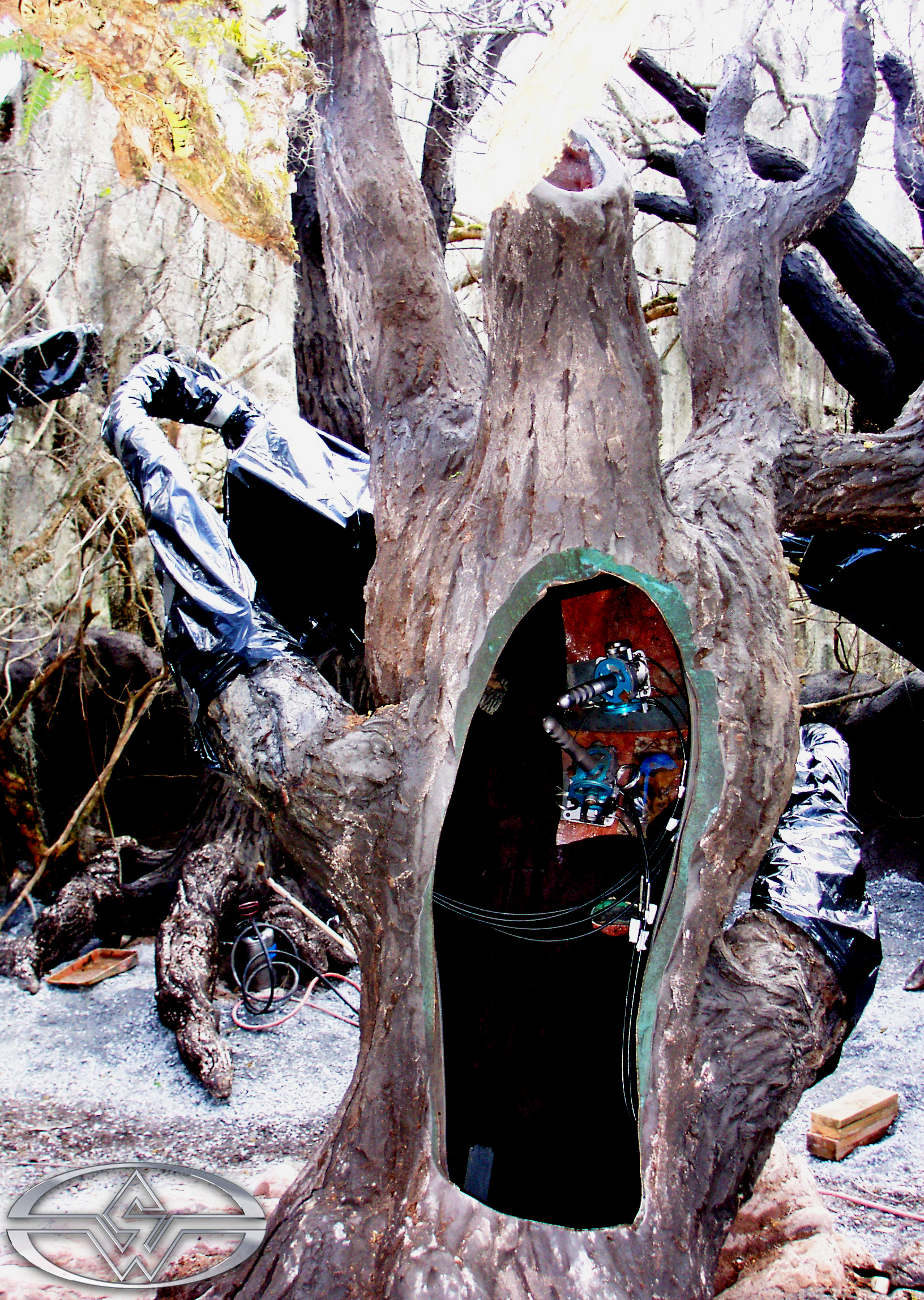 (Some of the trees had embedded animatronics for moving branches.)
In the scene where spiders jump on Bloom (McGregor), most of the attacking spiders were cable- and servo-controlled puppets, though some of them were applied directly to the costume.
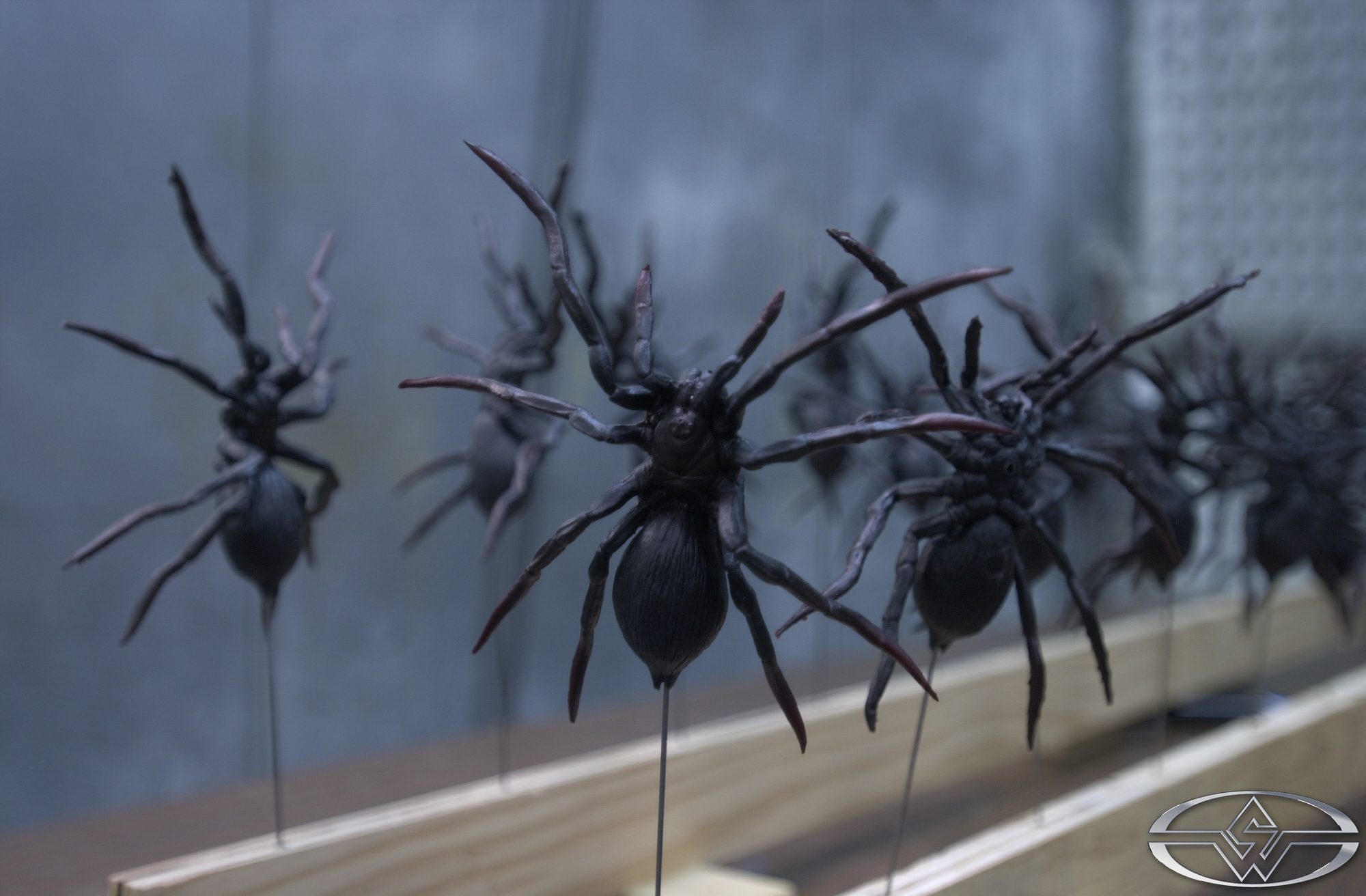 (Some of the spiders drying in the paint booth at the Stan Winston Studio.)
The Magic Behind the Conjoined Twins, Ping and Jing
Ada and Arlene Tai (Ping and Jing) are twins, but they are not conjoined. For their role as conjoined twins, they were attached at the hip and waist with a metal corset-like contraption to fit into the custom dress made for their stage performance. When their lower half needed to appear on camera, their extra legs were digitally removed.
 (Ada and Arlene Tai (Ping and Jing) at the Stan Winston Studio.)
 (Various 'Hero Hands' with a kit made for the scenes where Ed Bloom is working as a travel agent.)
Working with Tim Burton on Big Fish
Big Fish represented Stan Winston Studio’s third outing with Tim Burton; and, once again, the experience was a rewarding one. “It is always great to work with Tim Burton,” said Shane Mahan. “He’s a regular guy. He shows up by himself on a Sunday morning, comes to the trailer, and has a cup of coffee. The perception of Tim is that he is this kooky, artsy guy. He is a brilliant artist, of course; but he’s also very thoughtful and structured and organized. And the tone on his movie sets is very conducive to good work. There’s no yelling or belittling. On a Tim Burton set, you always feel as if you are a part of something wonderful and special.”
 (Stan Winston and Tim Burton check out the Big Fish sculpture at the Stan Winston Studio.)
- Blog assembled by Adrienn Lingurár with selections from The Winston Effect: The Art and History of Stan Winston Studio by Jody Duncan
Do you want to try our school? Online Courses with Hollywood's Master FX Artists: FREE 7-Day Trial.
Courses with the Creators of Big Fish
- Special Effects Sequence Design with Shane Mahan
- Hybrid Characters: Blending Practical & Digital FX with John Rosengrant
- Cable Mechanism Basics - Tentacles with Richard Landon
- How To Create A Basic Hand Mechanism - MINI-TUTORIAL with Richard Landon
- Making Creature Eyes with John Cherevka
- How To Make Eyes: Puppets, Masks & Makeups with John Cherevka
- Advanced Creature Teeth: Prosthetic Dental Appliances - Part 1 with John Cherevka
- Hairy Creatures Series - Introduction To Hair Knotting with Michael Ornelaz