
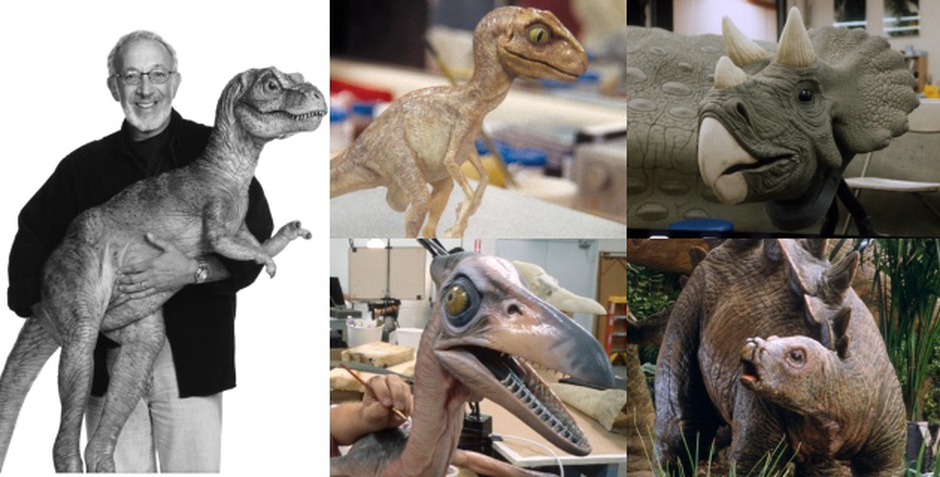
Universal Pictures’ marketing department touted Jurassic Park as ‘an adventure sixty-five million years in the making.’ For Stan Winston Studio, making the first Jurassic Park took three years — a blink of an eye in paleontological terms, but in the realm of filmmaking, a very long journey, indeed.
That journey began with a novel by best-selling author Michael Crichton, about a wealthy industrialist, John Hammond, who finds a way to clone dinosaurs, and builds a lavish theme park on an island near Costa Rica for their display. As a team of scientists commissioned to sign off on the park’s safety tours the nearly completed ‘Jurassic Park’, along with Hammond’s grandchildren, security systems break down, leaving the stranded group to fight for survival against prehistoric predators.
Jump To Section
- Designing Extinct Animals for Jurassic Park (1993)
- Sculpting Dinosaurs for 15 Minutes of Fame
- Behind the Scenes of the Hatching Baby Raptor
- The Infants of The Lost World: Jurassic Park
- "Claire", the Baby Stegosaurus
- Reusing the Baby Triceratops from Jurassic Park
- Introducing a New Star: The Baby T-rex
- The Baby Pteranodons of Jurassic Park III
Designing Extinct Animals for Jurassic Park (1993)
Jurassic Park had yet to be published when film studios began a bidding war for the movie rights. The victors of that war were Universal Pictures, director Steven Spielberg, and his Amblin Entertainment production company. Aware of the monumental challenges involved in bringing Jurassic Park to the screen, Spielberg and producers Kathleen Kennedy and Gerald R. Molen allowed three years to get the film from script to screen, the first two of which were devoted largely to designing and realizing the story’s seven dinosaur species.
 (Original poster of Jurassic Park (1993). Image Courtesy of Universal Pictures and Universal Studios.)
Stan Winston’s role in Jurassic Park began before he was officially awarded the job. “Steven knew he was going to do the movie,” said Winston, “and he knew what dinosaurs he wanted in the movie. So we started designing dinosaurs, even though we weren’t officially on the film. We designed dinosaurs for a full year before we actually started working on the movie.”
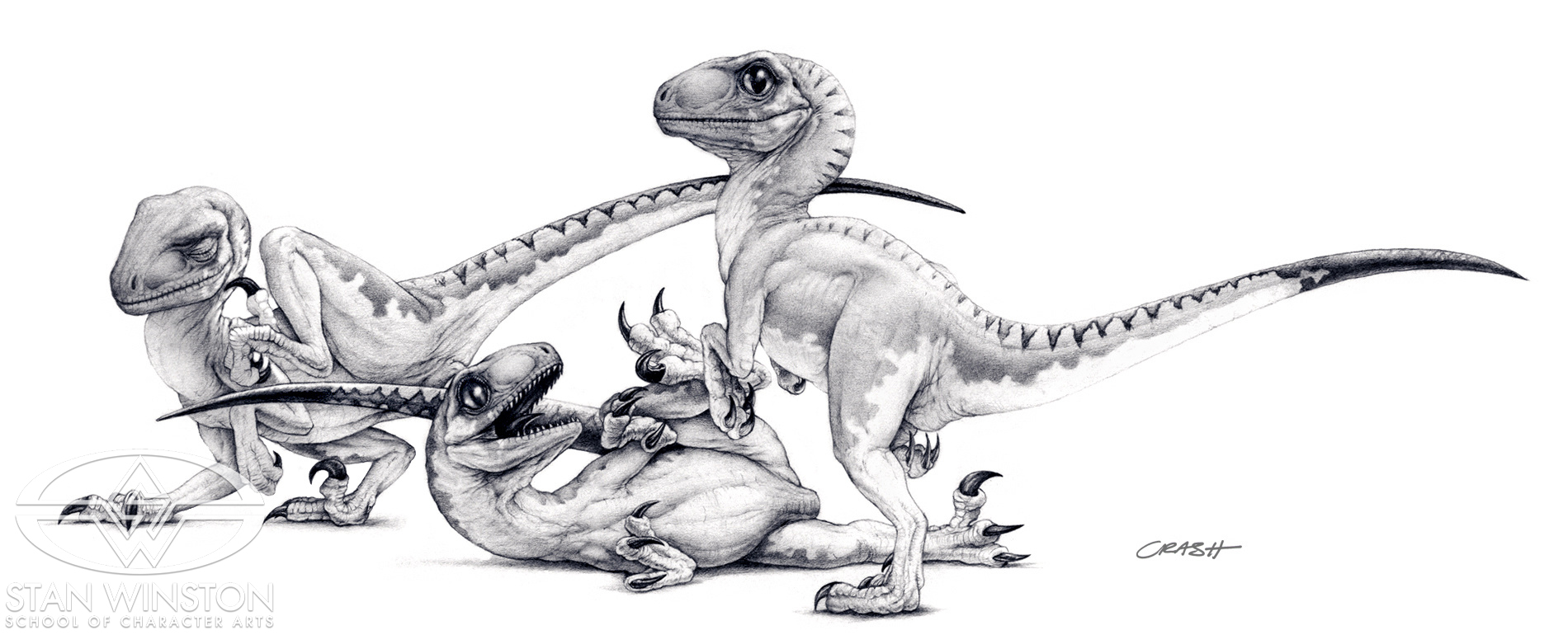 (Baby Raptor concept artworks made by Mark 'Crash' McCreery for Jurassic Park.)
Winston engaged Mark 'Crash' McCreery to draw various dinosaurs in a series of dynamic poses, insisting that those dinosaur designs be as scientifically accurate as possible, reflecting current paleontological theory. “We wanted these dinosaurs to be authentic, so we did our research. We studied books. We talked to paleontologists. It is all theory, of course, because no one has ever seen one of these animals; but we were as true to those scientific theories as we could be in designing the dinosaurs.”
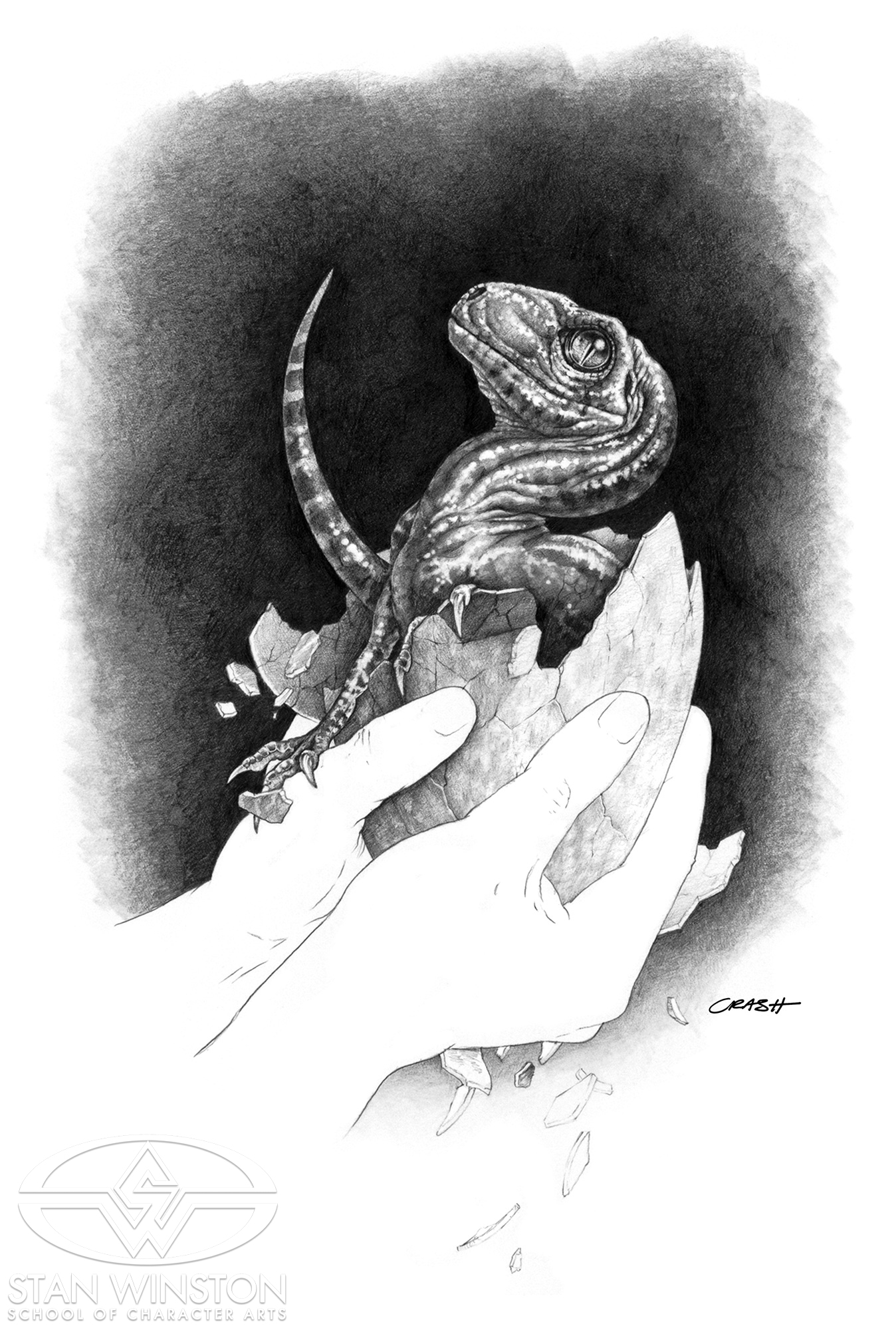 (Mark 'Crash' McCreery’s rendering of a ‘hatchling’.)
Sculpting Dinosaurs for 15 Minutes of Fame
Jurassic Park contained only fifteen minutes of dinosaur footage. Out of those fifteen minutes, nine featured Stan Winston Studio’s practical dinosaurs, and six featured computer animated versions. The studio would design all of the film’s dinosaurs — even those realized only through computer graphics, such as the Gallimimus — and would build six as live-action characters: the T-rex, Velociraptors, a Dilophosaur (nicknamed the ‘spitter’), an ailing Triceratops, a Brachiosaur and a Velociraptor hatchling.
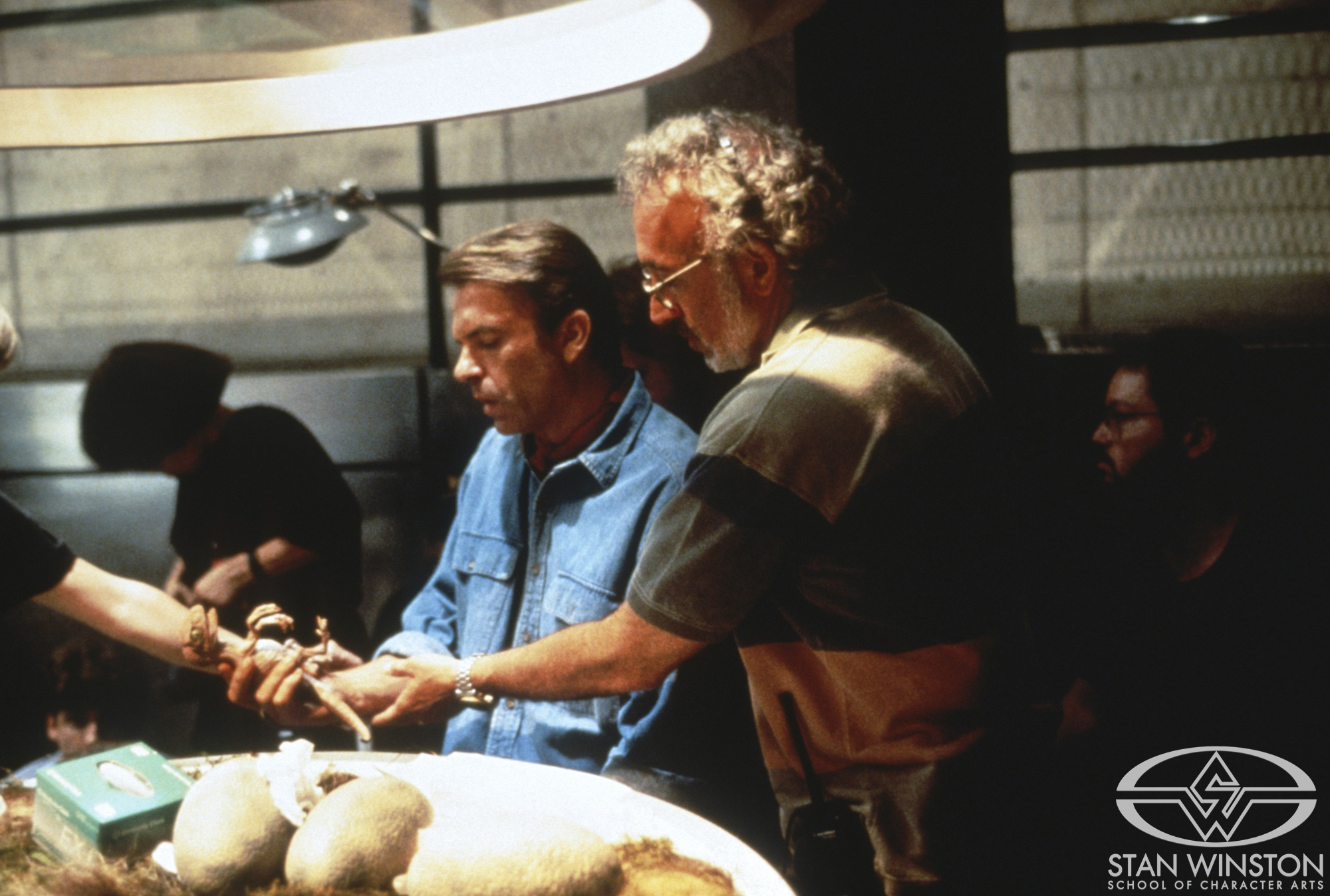 (Stan Winston presenting one of the baby Raptor puppets to Sam Neill.)
Extrapolating from McCreery’s original dinosaur renderings, the studio’s top sculptors created scaled maquettes of each species. These sculpts served as the basis for both the full-size live-action characters and ILM’s computer models.
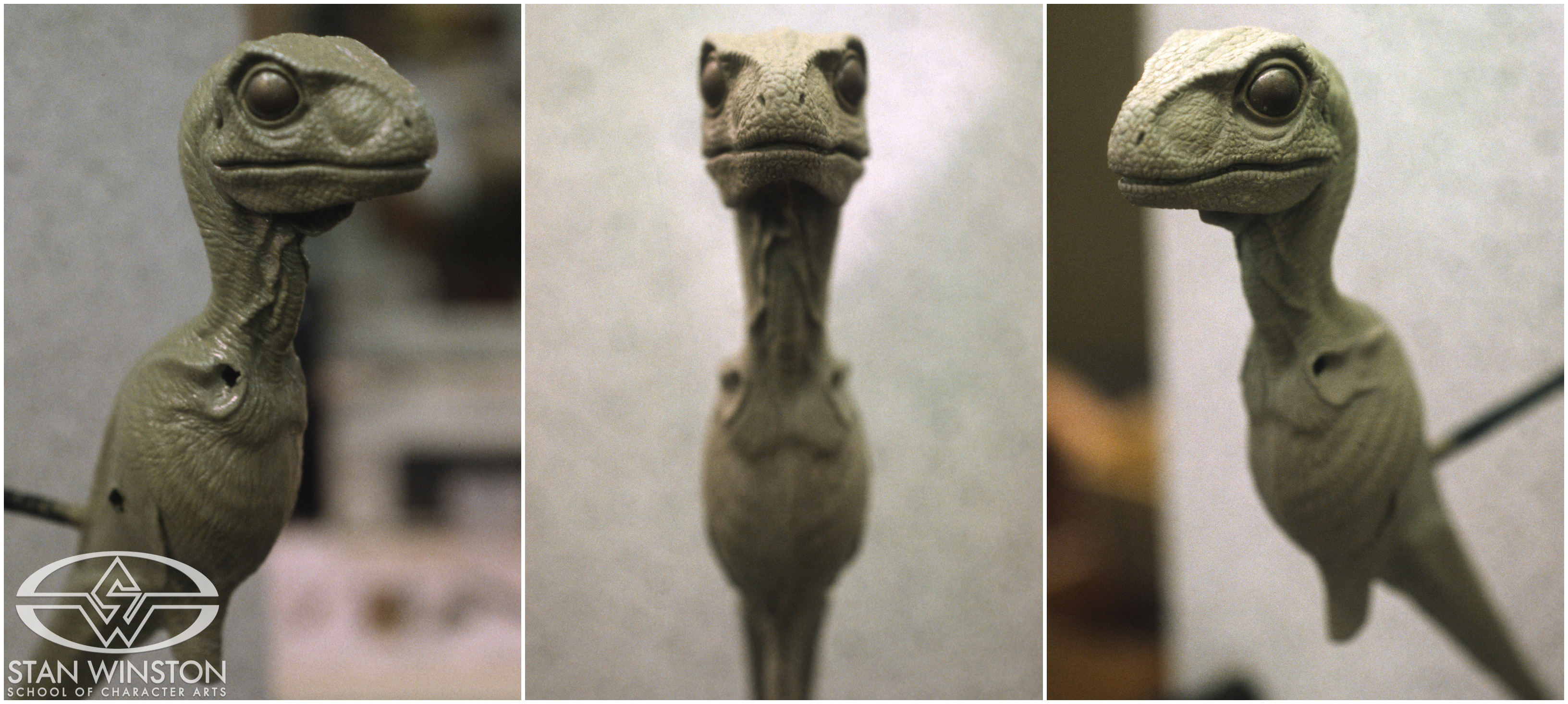 (Front and 3/4 facing views of Greg Figiel’s baby Raptor sculpt with limbs removed, ready for molding.)
The level of detail in these maquettes was eye-opening to some of the newly hired artists at the studio. “Before seeing these maquettes, I had no idea that you could take a sculpt to that level,” said Rob Ramsdell, now a veteran studio artist, first hired for Jurassic Park. “I had a fine art background, and in the fine art world, sculptures are never finished to that degree. You look at a Rodin as a finished piece, but it still has tool marks and things like that. A fine art sculpture is just blocking in a character, compared to a sculpture you do for a special effects character. These maquettes had to be highly detailed because they were going to become something that looked like a real-life creature. Ultimately, the level of reality of these characters is what was so groundbreaking about Jurassic Park.”
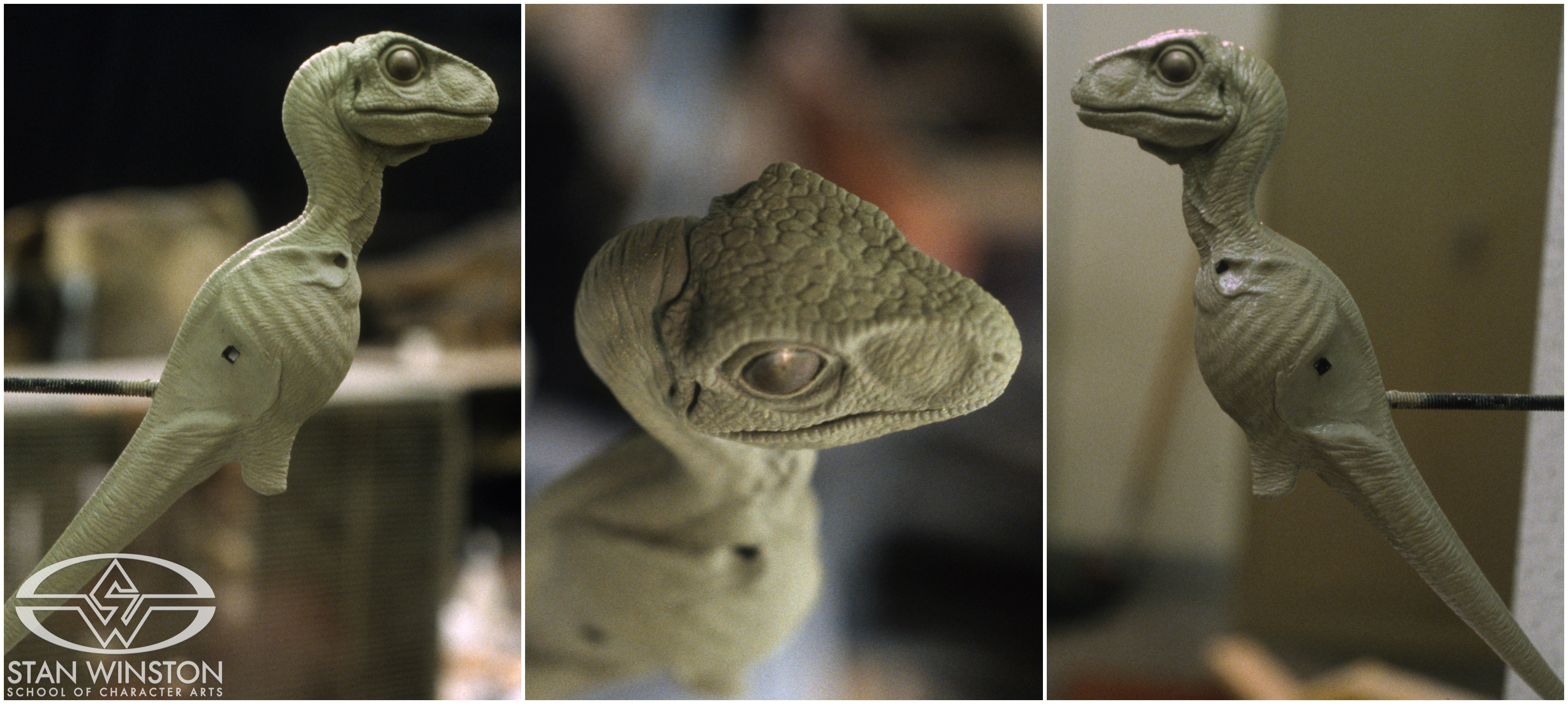
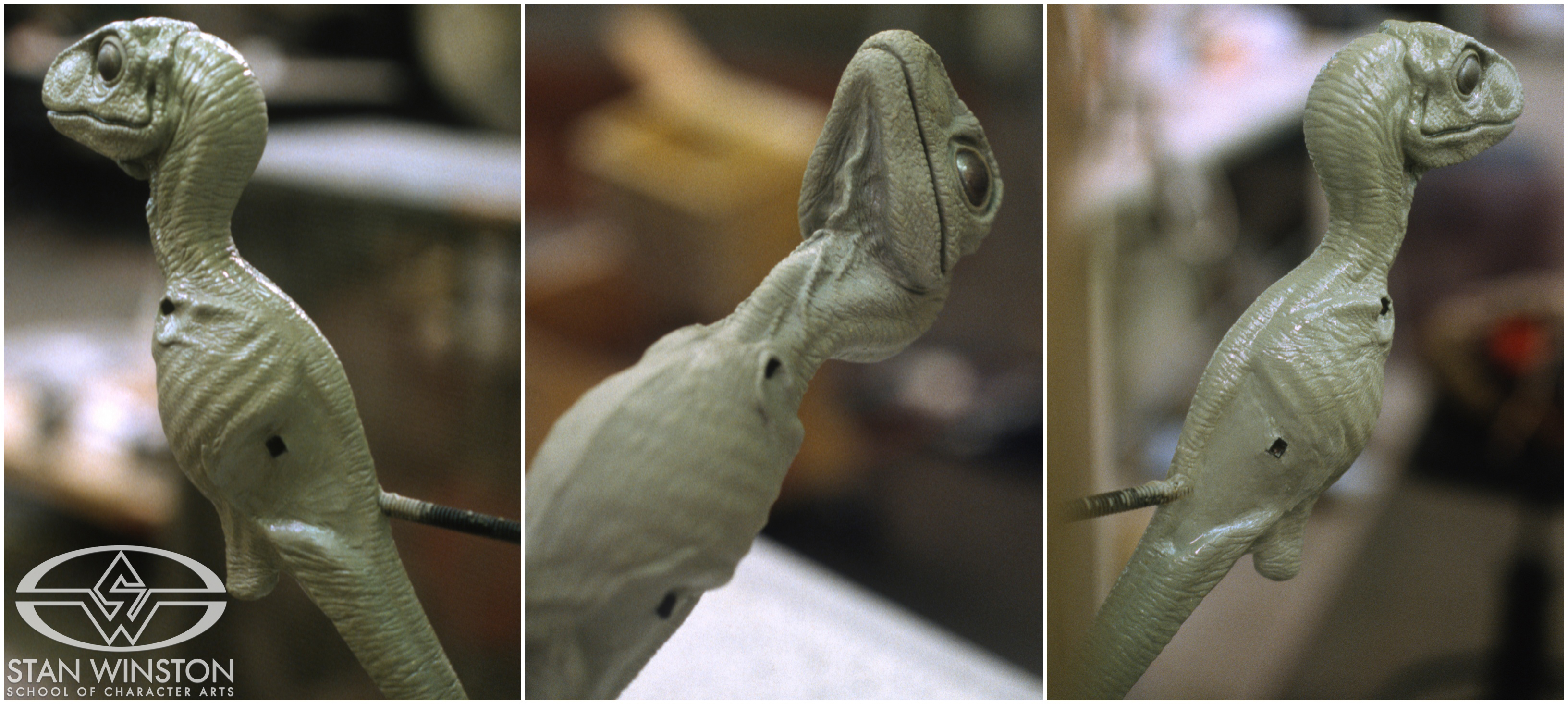 (Profile, 3/4 rear and top/bottom views of Greg Figiel’s baby Raptor sculpt with limbs removed, ready for molding.)
Art, as always, took precedence over technology when creating these dinosaurs. "That ‘art is first’ philosophy is what makes the work that comes out of Stan Winston Studio stand apart,” Alan Scott elaborated. “We design the very best character first, and then we decide how we are going to make it move. Once Stan has signed off on a design, we have to find a way to make that design work."
Behind the Scenes of the Hatching Baby Raptor
Stan Winston Winston’s studio built a newborn Raptor for a scene where the visiting scientists witness a Raptor hatchling emerging from an egg.
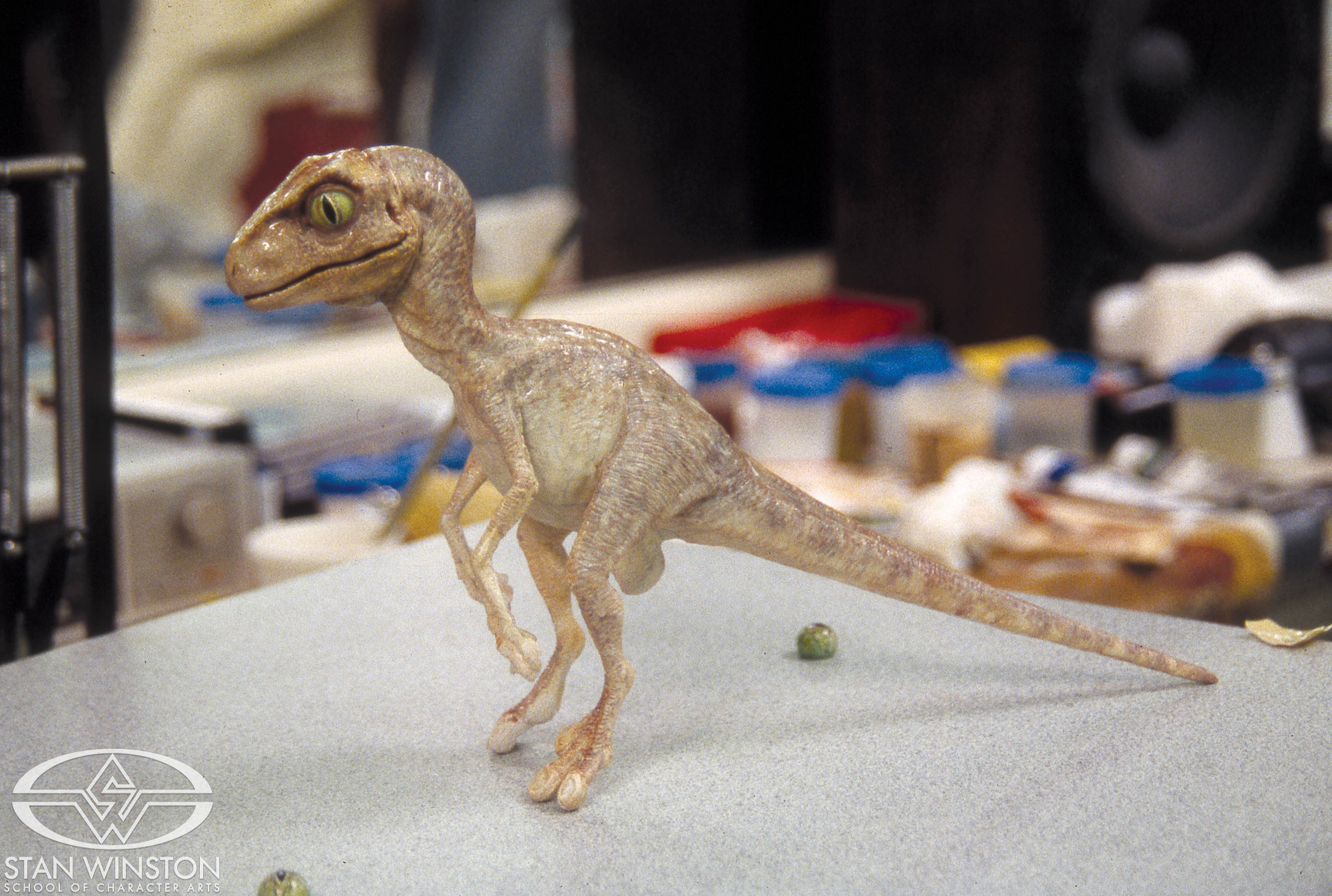 (Baby Velociraptor puppet at Stan Winston Studio.)
Mechanisms that the studio designed included one to move the tiny rib cage in and out, simulating breathing, and cables to produce arm and leg movement. A single rod inserted into the bottom of the puppet enabled puppeteers to create gross body moves. Up to seven puppeteers, stationed below the lab set, brought the Raptor hatchling to life, pushing it up through a prescored wax egg as the actors looked on in amazement. “The actors hadn’t seen the Raptor hatchling in action before we shot that scene,” Richard Landon said, “so their reactions to it were all very genuine.”
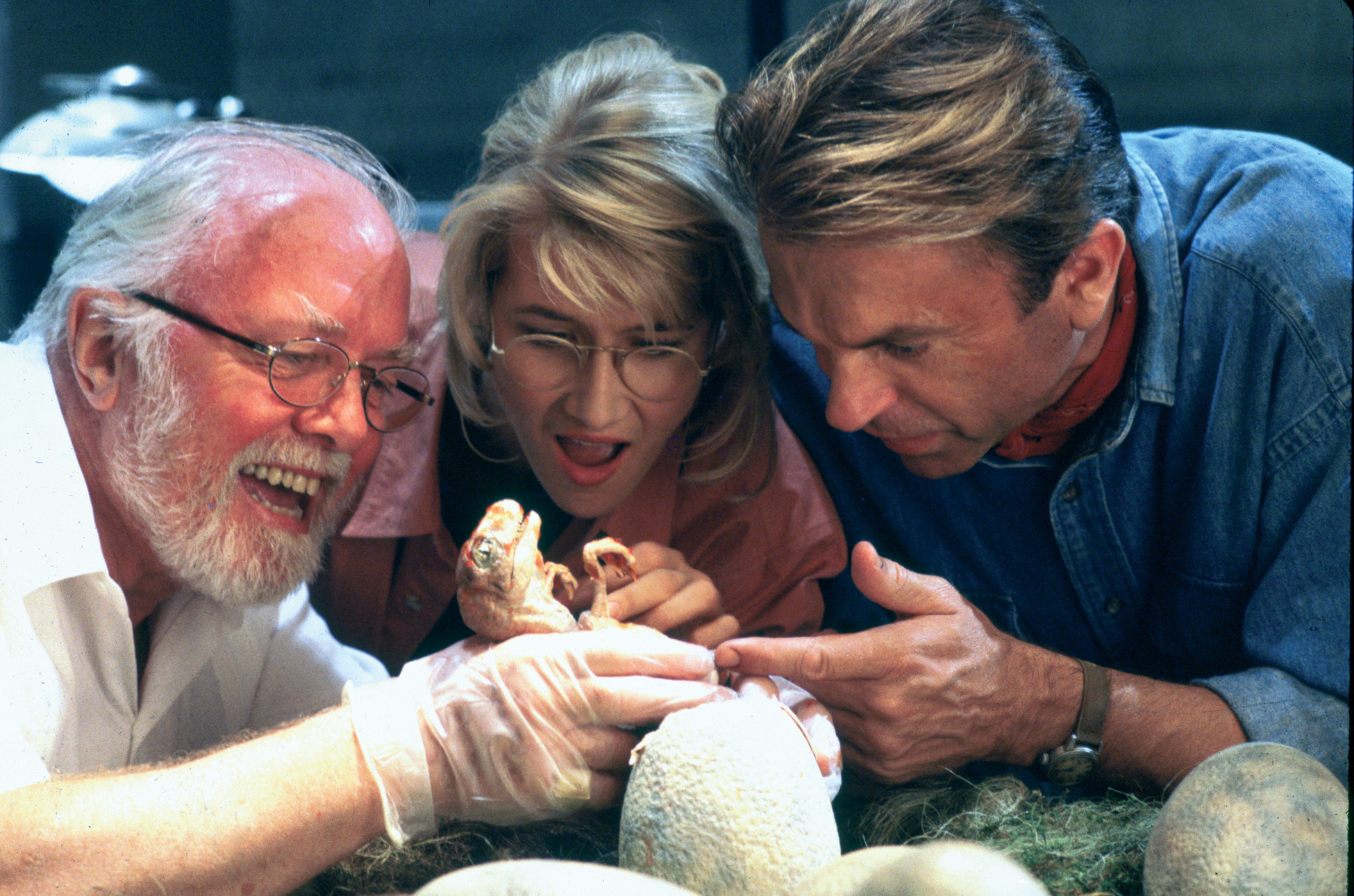 (John Hammond and Doctors Ellie Sattler and Alan Grant — portrayed by Sir Richard Attenborough, Laura Dern, and Sam Neill, respectively — witness the hatching of a baby Raptor, a tiny puppet, operated by puppeteers stationed below the laboratory set. Image Courtesy of Universal Pictures and Universal Studios.)
The Infants of The Lost World: Jurassic Park
Considering Jurassic Park’s box office performance as one of the highest-grossing movies of all time, it was no surprise when its sequel, The Lost World: Jurassic Park, was announced for a 1997 release. The storyline involved a scheme by the InGen bioengineering company to send a team of hunters to a second Costa Rican island, wrangle the surviving dinosaurs there, and transport them to a Jurassic Park-San Diego theme park.
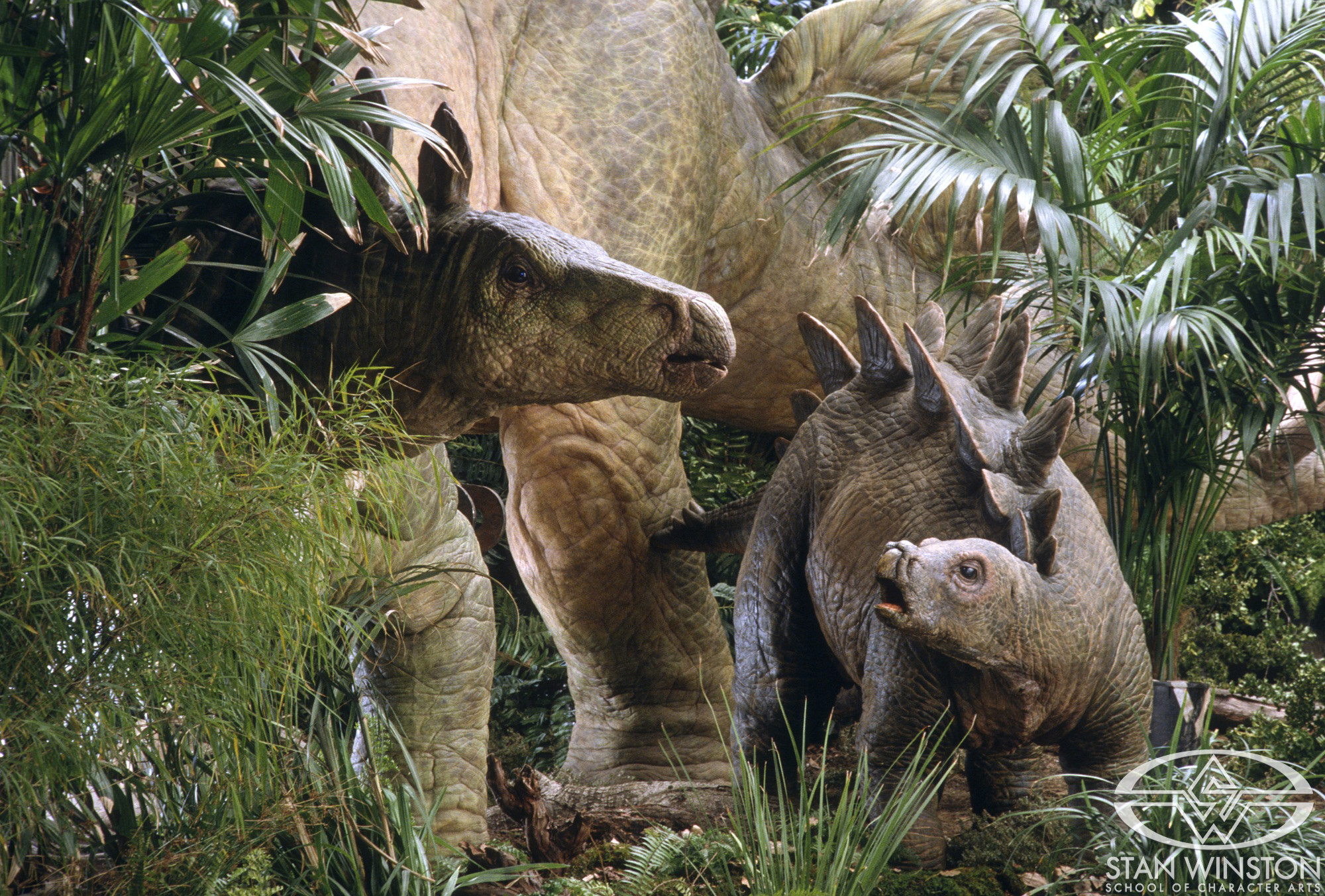 (Promo image of the adult and the baby Stegosaurus from The Lost World: Jurassic Park.)
Jurassic Park (1993) had featured seven dinosaur species; The Lost World would boast thirteen. Of those, seven were entirely new species designed by Stan Winston Studio. Six of those new designs — the chicken-sized Compsognathus, an adult and baby Stegosaurus, a goat-like Pachycephalosaurus, a Pteranodon, and a baby T-rex — would be fully-functional animatronic creations, while the seventh, a Mamenchisaurus, would be realized only in CG. Besides these new species, there would be a baby Triceratops for this sequel, and the returning T-rex and Velociraptors.
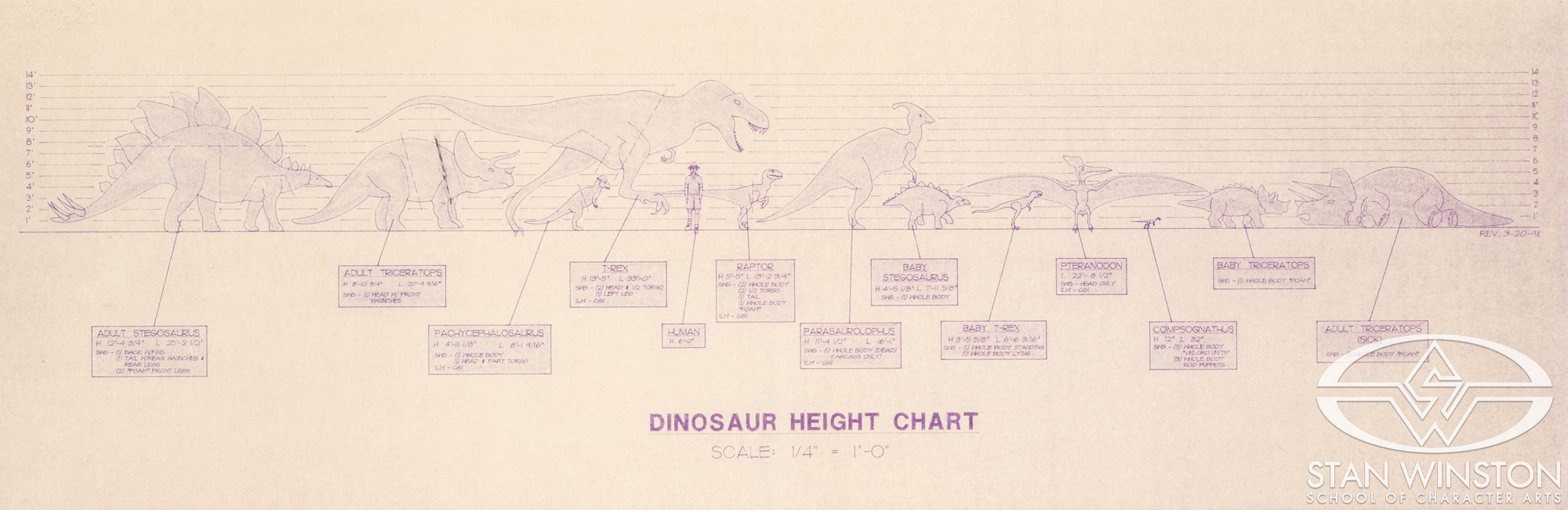 (Original dinosaur height chart (Scale: 1/4" = I'-O") made for The Lost World: Jurassic Park, showcasing a size of a human (6'-O") compared to the size of an adult Stegosaurus, an adult Triceratops, a Pachycephalosaurus, a T-rex, a Raptor, a Parasaurolophus, a baby Stegosaurus, a baby T-Rex, a Pteranodon, a Compsognathus, a baby Triceratops and an adult (sick) Triceratops.)
"Claire", the Baby Stegosaurus
While the only live-action dinosaur in Jurassic Park (1993) scheduled to be shot in Hawaii was the sick Triceratops, in The Lost World, more dinosaurs were transported to the Eureka locations. One of those was the baby Stegosaurus — sculpted and painted by Dave Grasso and mechanized by Bob Mano.
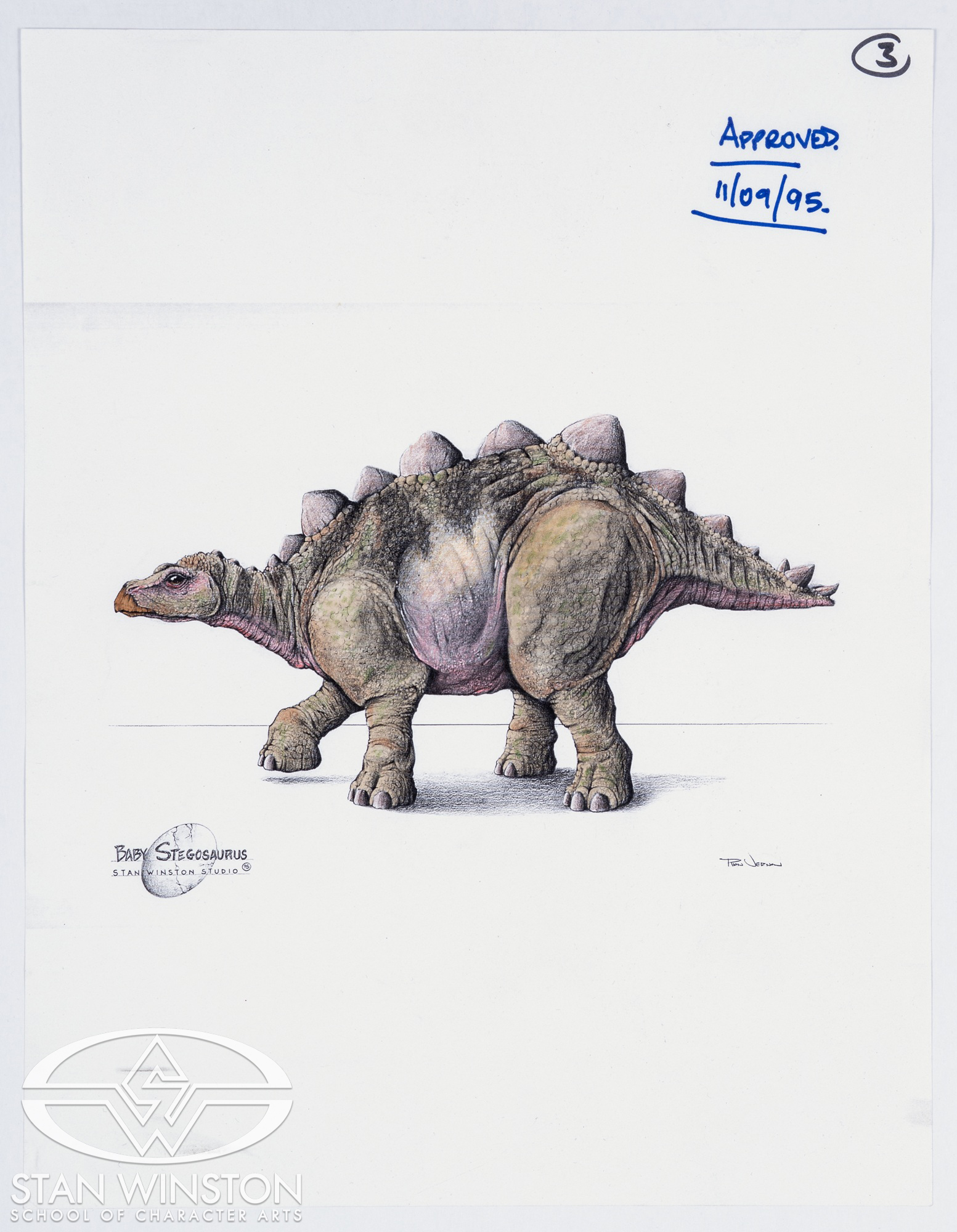 (One of Rion Vernon's concept artworks made for the infant Stegosaurus.)
Like the other large dinosaurs in the movie, the baby Stegosaurus was hydraulically controlled through a telemetry device for gross body movements, as well as head, neck, and jaw articulation.
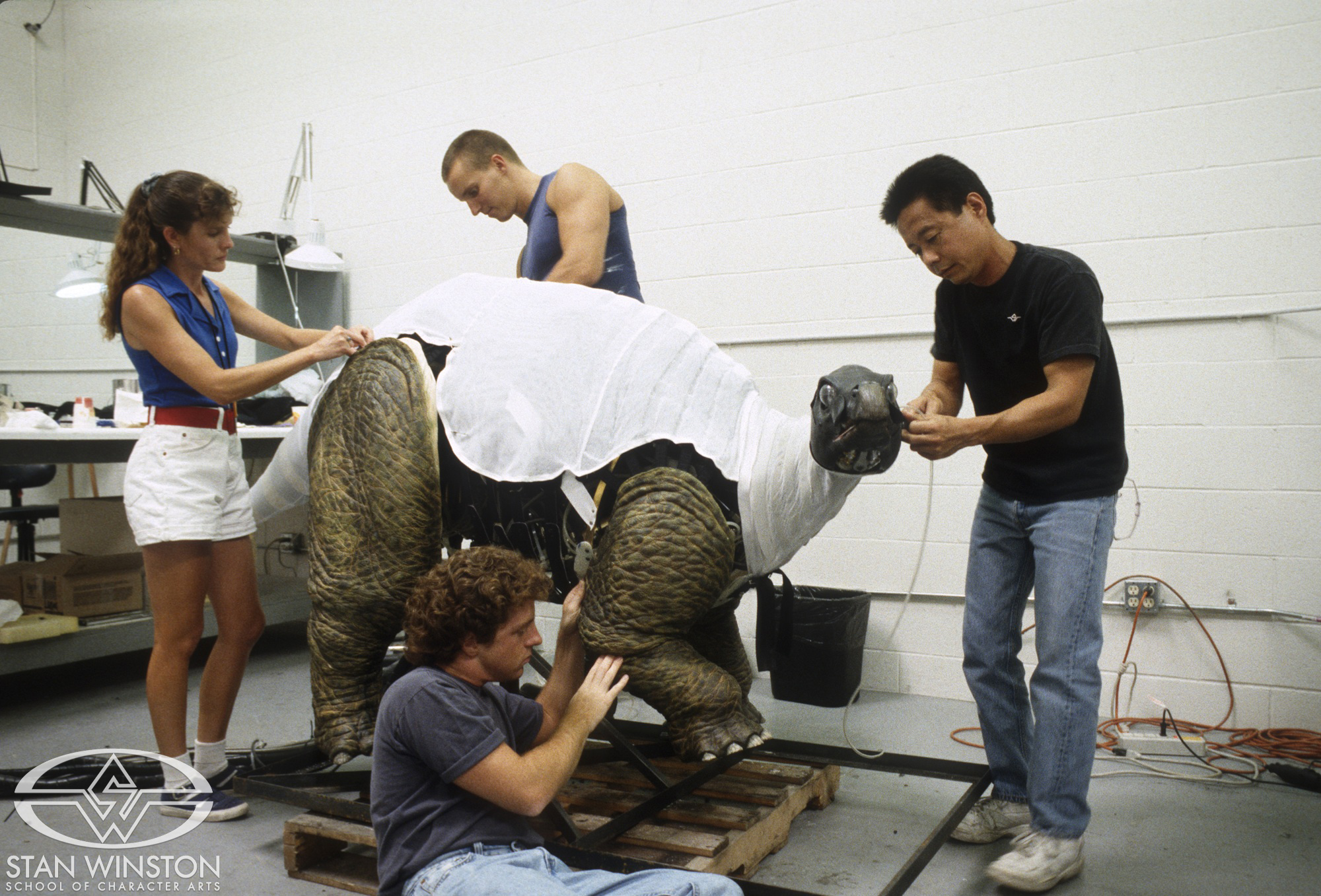 (From L to R: Judy Bowerman, Christian Lau, David Grasso, and Bob Mano covering the baby stego animatronics before attaching its skin.)
Smaller functions of the eyes, nostrils, and tongue were radio-controlled.
VIDEO CLIP -- Testing the baby Stegosaurus animatronic at Stan Winston Studio for The Lost World: Jurassic Park:
"Oooh, ahhh, that's how it always starts. Then later there's running and screaming." The animatronic baby Stegosaurus at Stan Winston Studio for The Lost World: Jurassic Park. @amblin #animatronic #stegosaurus #jurassicjune #jurassicpark #stanwinstonstudio #dinosaur #stevenspielberg
Posted by Stan Winston School of Character Arts on Friday, June 18, 2021
The completed baby Stegosaurus measured approximately 4.5 feet tall and 7 feet long, and weighed around 400 pounds. Six Winston puppeteers created the performance for the scene where Sarah interacts with the baby dinosaur.
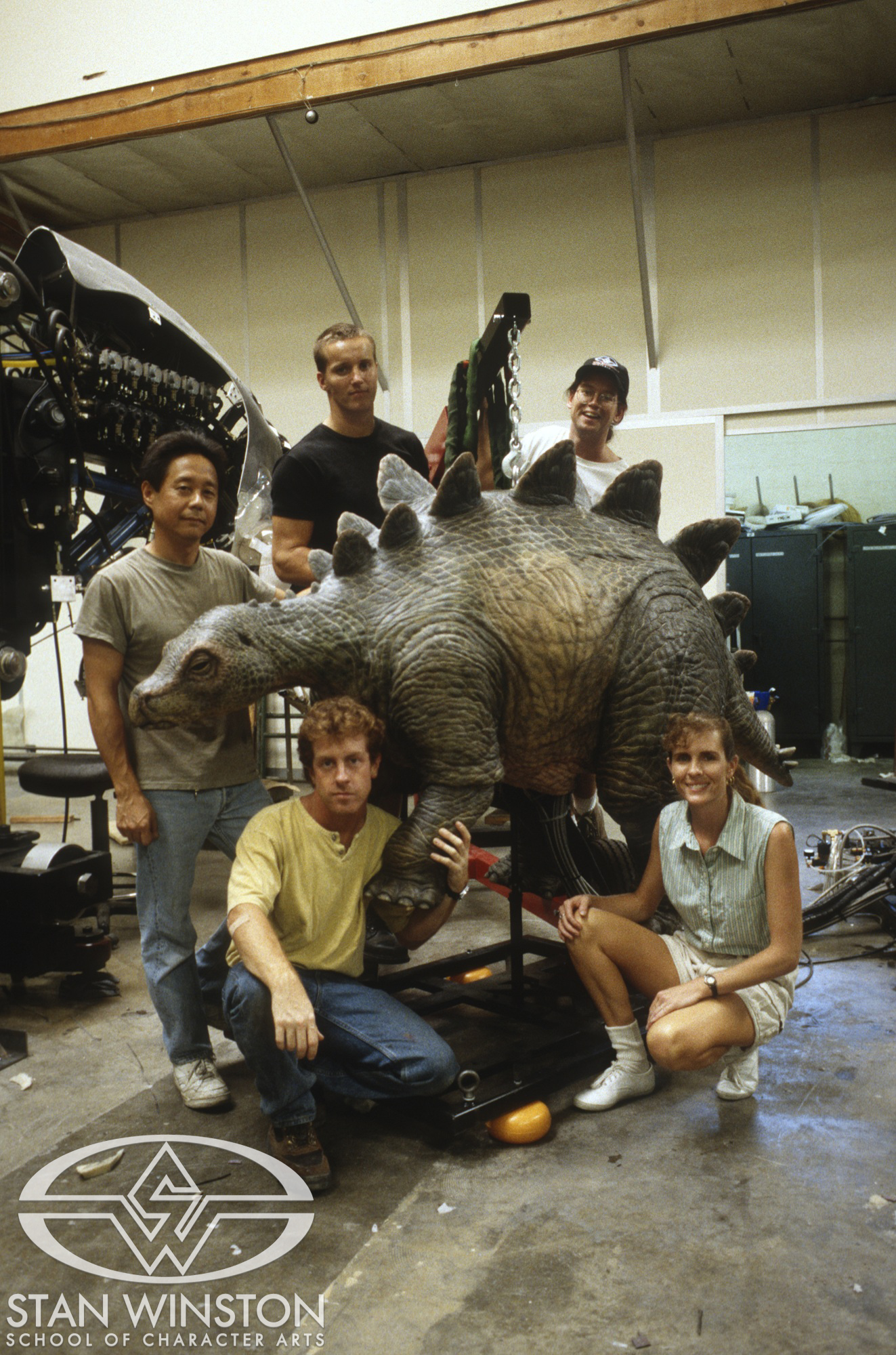 (Baby Stegosaurus crew with the final infant stego animatronic puppet at Stan Winston Studio.)
Reusing the Baby Triceratops from Jurassic Park
Eight Winston dinosaurs are featured in a scene in which Sarah and Nick Van Owen, the field documentarian portrayed by Vince Vaughn, sneak into the hunters’ camp to release caged dinosaurs. A baby Triceratops that had been cut from Jurassic Park was among the caged animals.
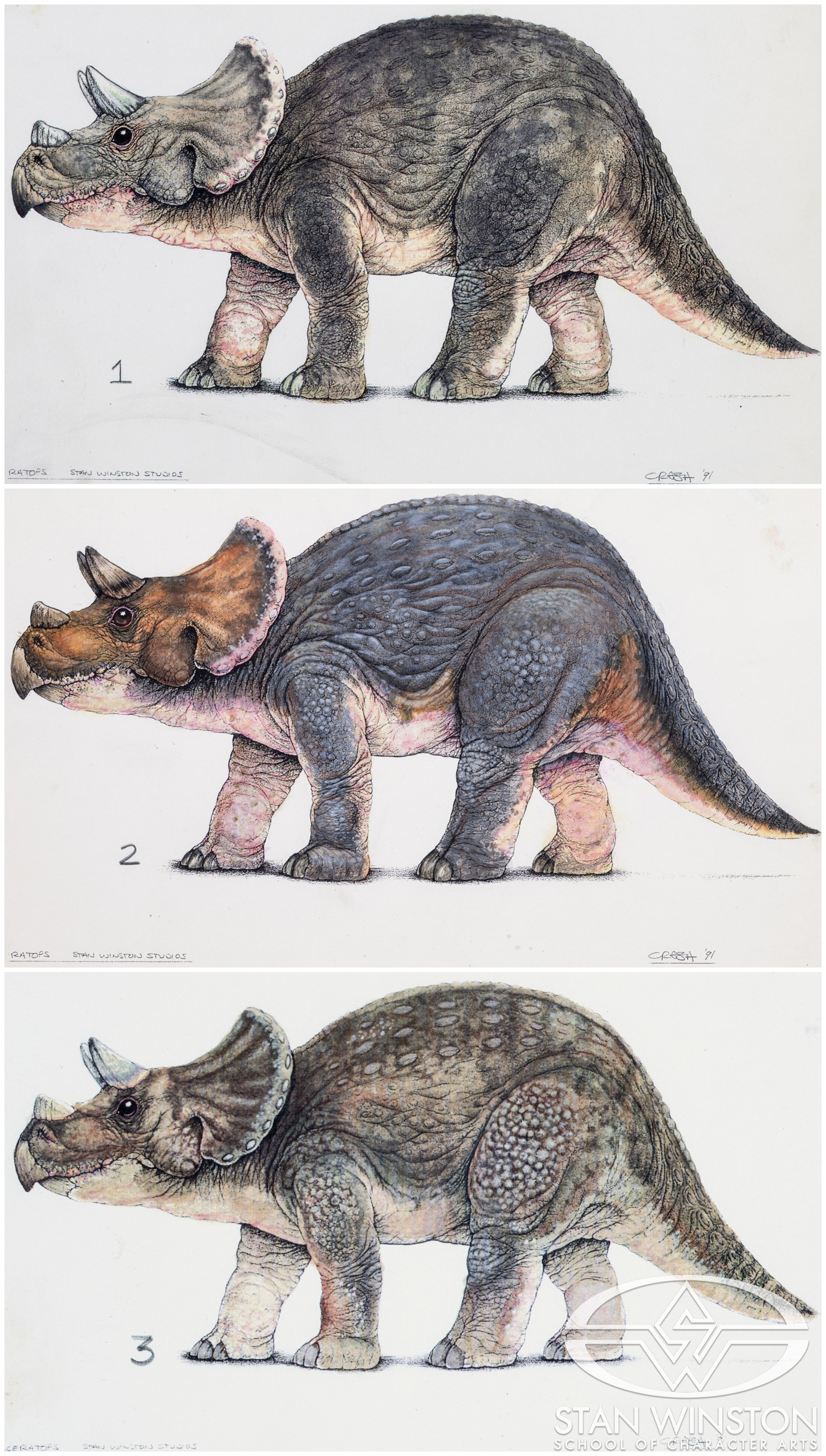 (Baby Triceratops concept artworks from 1991 made by Mark 'Crash' McCreery for Jurassic Park (1993).)
 (Original baby Triceratops head sculpture by Shannon Shea made for Jurassic Park (1993).)
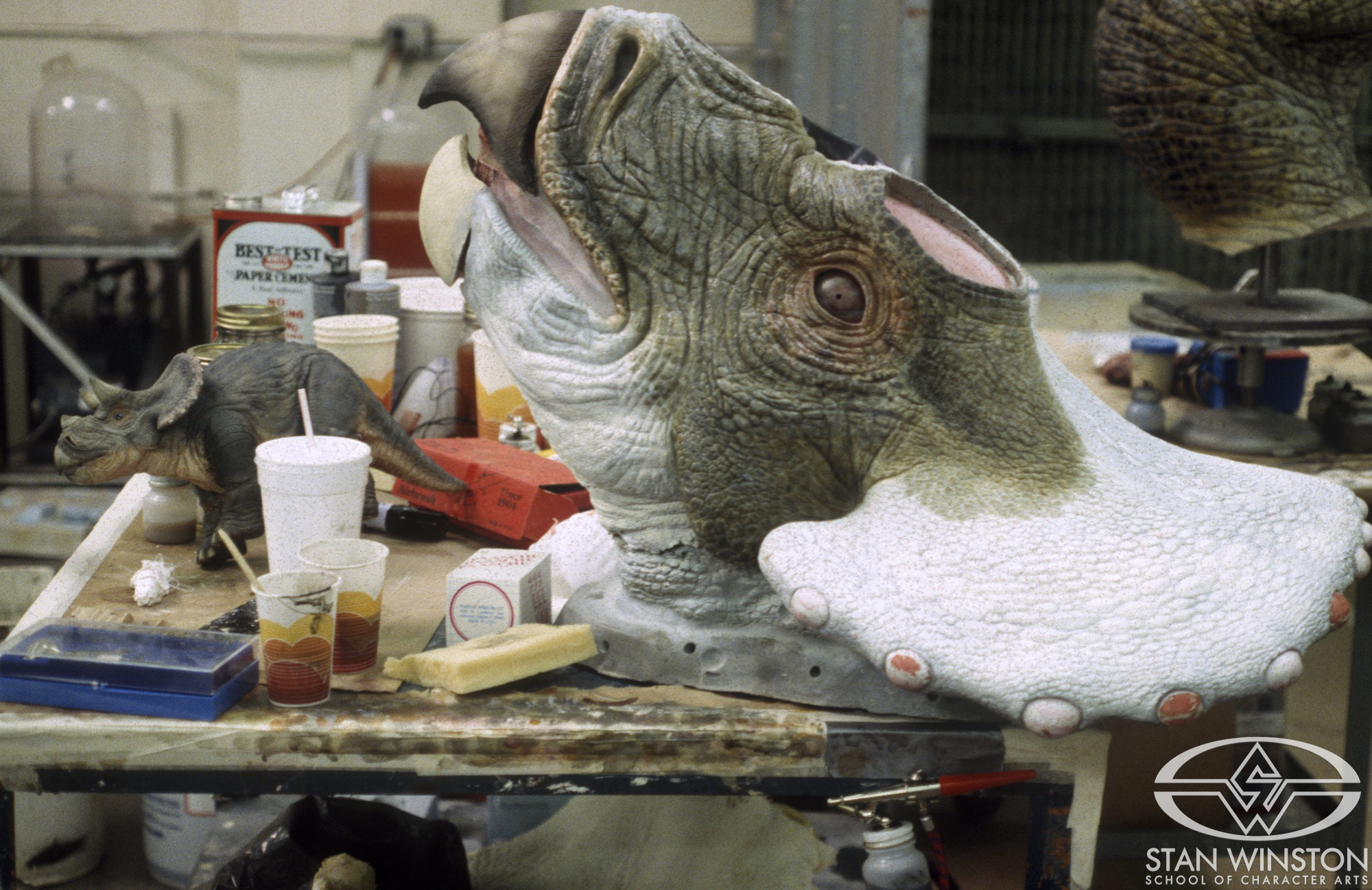 (The original baby Triceratops head painting process in-progress for Jurassic Park.)
Although the crew retained the original radio-controlled head, the animatronic body was refurbished as a foam latex Triceratops suit, worn by Lindsay MacGowan in the scene.
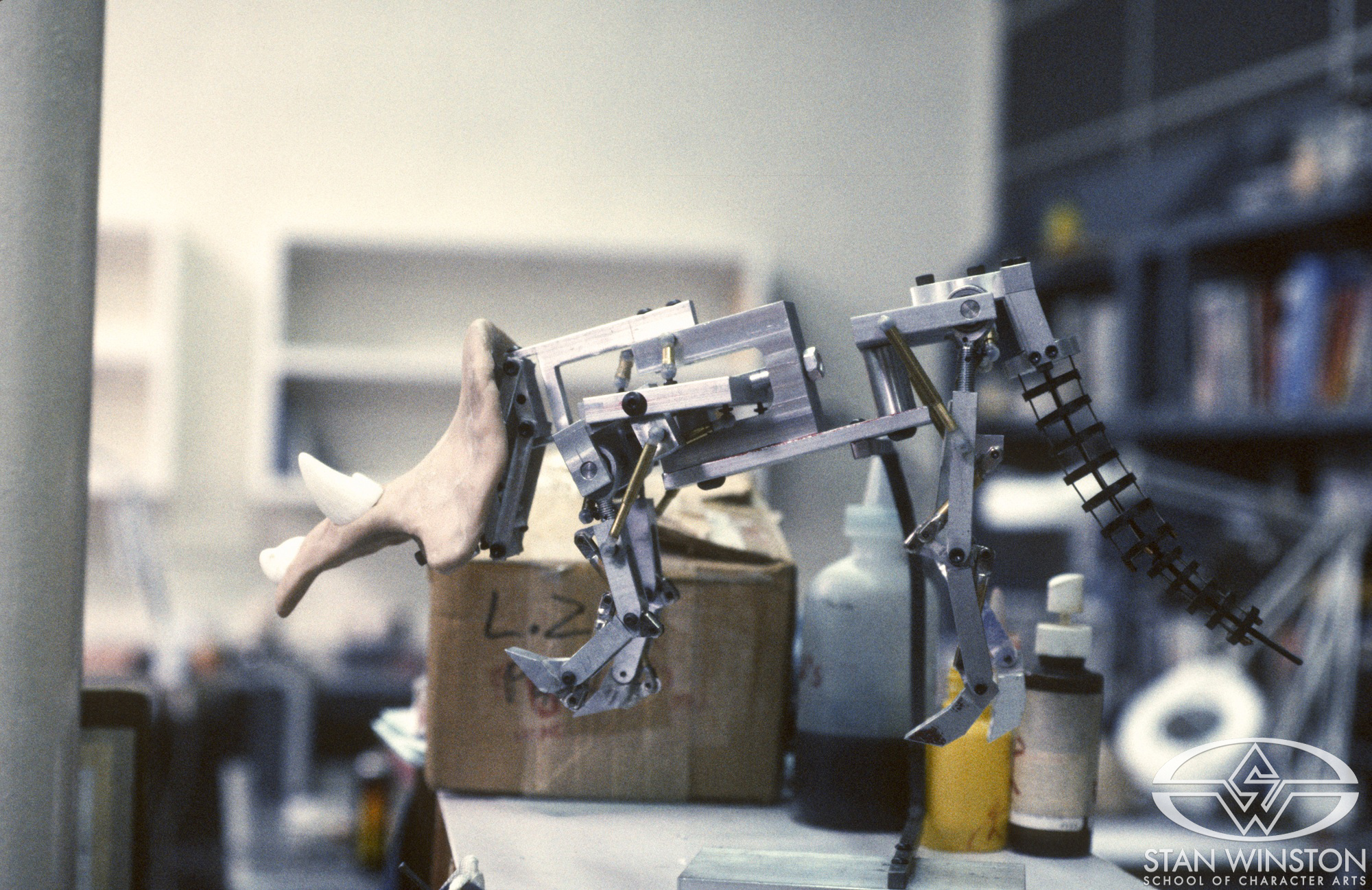 (Original small-scale infant Triceratops miniature structure conceptualizing its animatronics for Jurassic Park (1993).)
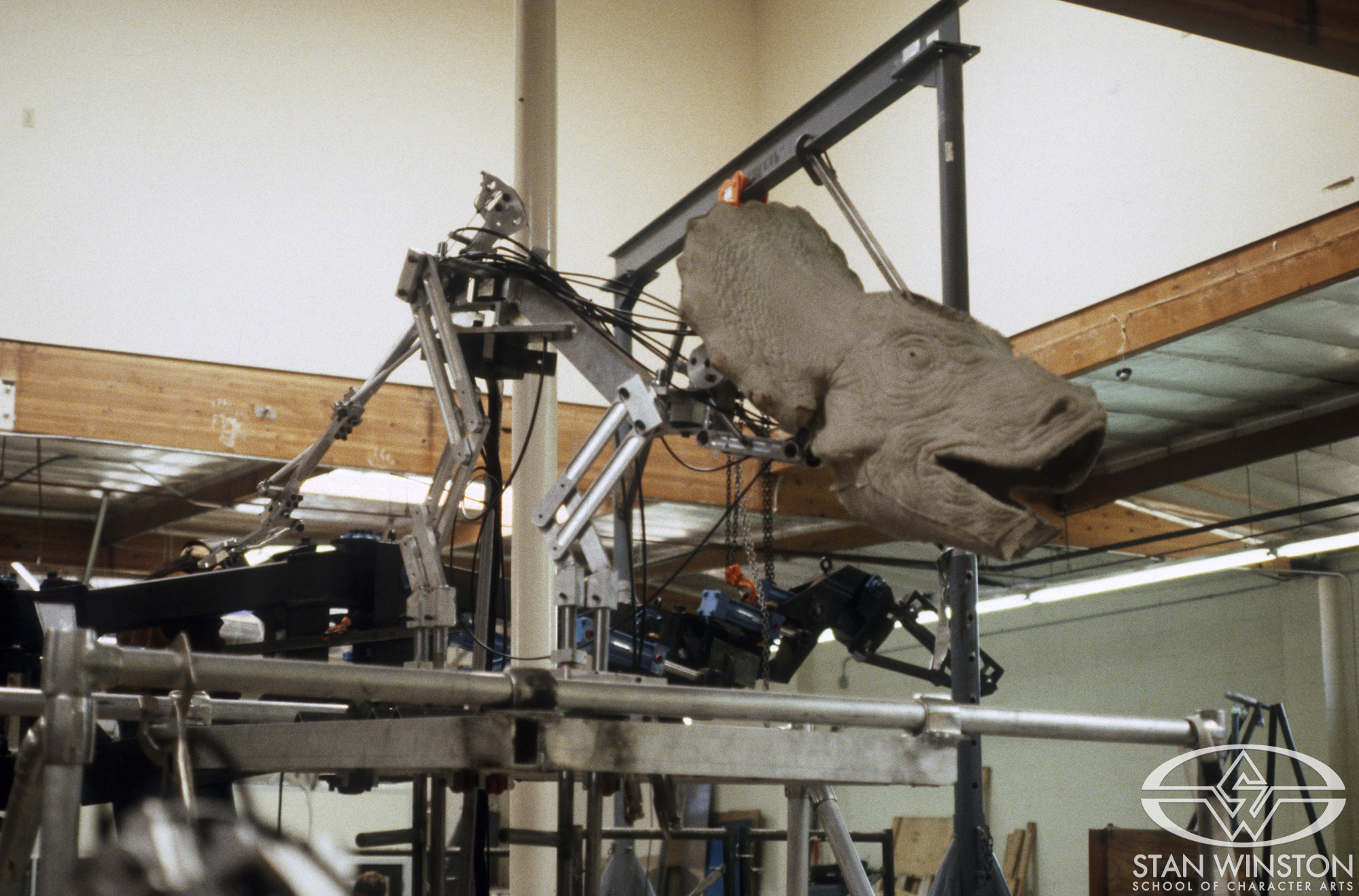 (The original life-size baby Triceratops animatronics understructure in-progress.)
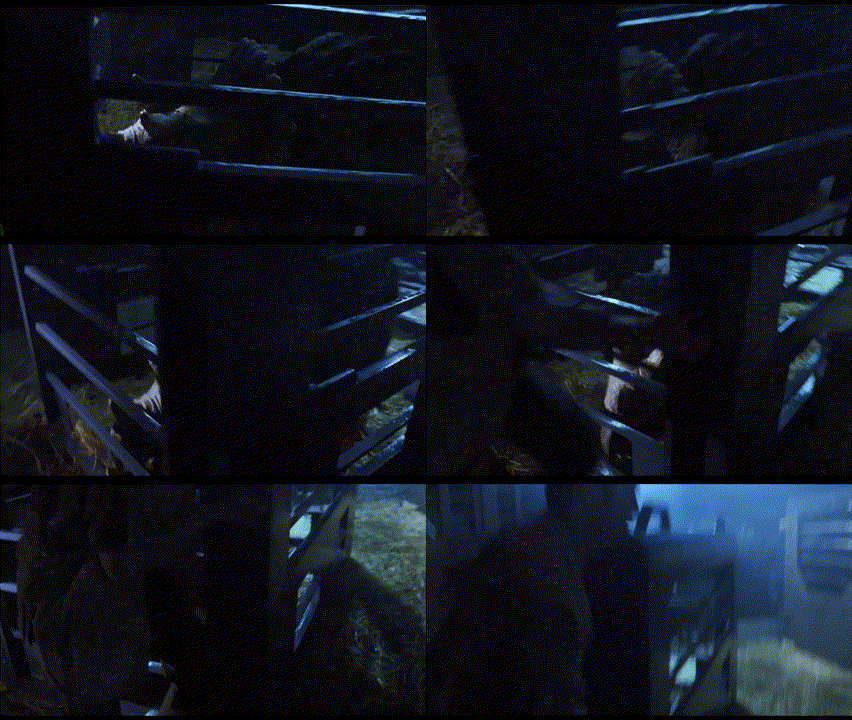 (Baby Triceratops as it appeared in The Lost World: Jurassic Park. Image Courtesy of Universal Pictures and Universal Studios.)
Introducing a New Star: The Baby T-rex
One of the most prominently featured dinosaurs in the film was the baby T-rex, which was designed by Joey Orosco and sculpted in a maquette by Bill Basso. “The big question when we started doing this character,” said Orosco, “was how cute we should make it. We went back and forth about how short or long the snout should be. The size of the eyes was another issue. The bigger the eyes were, the more appealing they looked, but if they got too big, it looked silly. It had to look like a cute baby, but it also had to look like something that would grow into an adult T-rex.”
VIDEO CLIP -- Joey Orosco and Bill Basso paint various T-rexes at Stan Winston Studio for the The Lost World: Jurassic Park:
Richard Landon and Matt Heimlich mechanized the baby T-rex in three different configurations. One was a battery-powered, self-contained unit for close to medium shots of the baby being carried by the actors. The second was a self-contained puppet with only limited functions of the head and tail for more distant shots. A third puppet was a cable- and hydraulic-powered version, used for shots that required more power.
VIDEO CLIP -- Testing WIP animatronic baby T-rex for the The Lost World: Jurassic Park at Stan Winston Studio:
“The self-contained, battery-operated baby T-rex was the one that was used the most in the film,” noted Landon. “Jeff Goldblum was running around with that in his arms for most of the film. That was another situation where we were told our character wouldn’t be in the rain. Have you seen The Lost World? It’s raining all the time!”
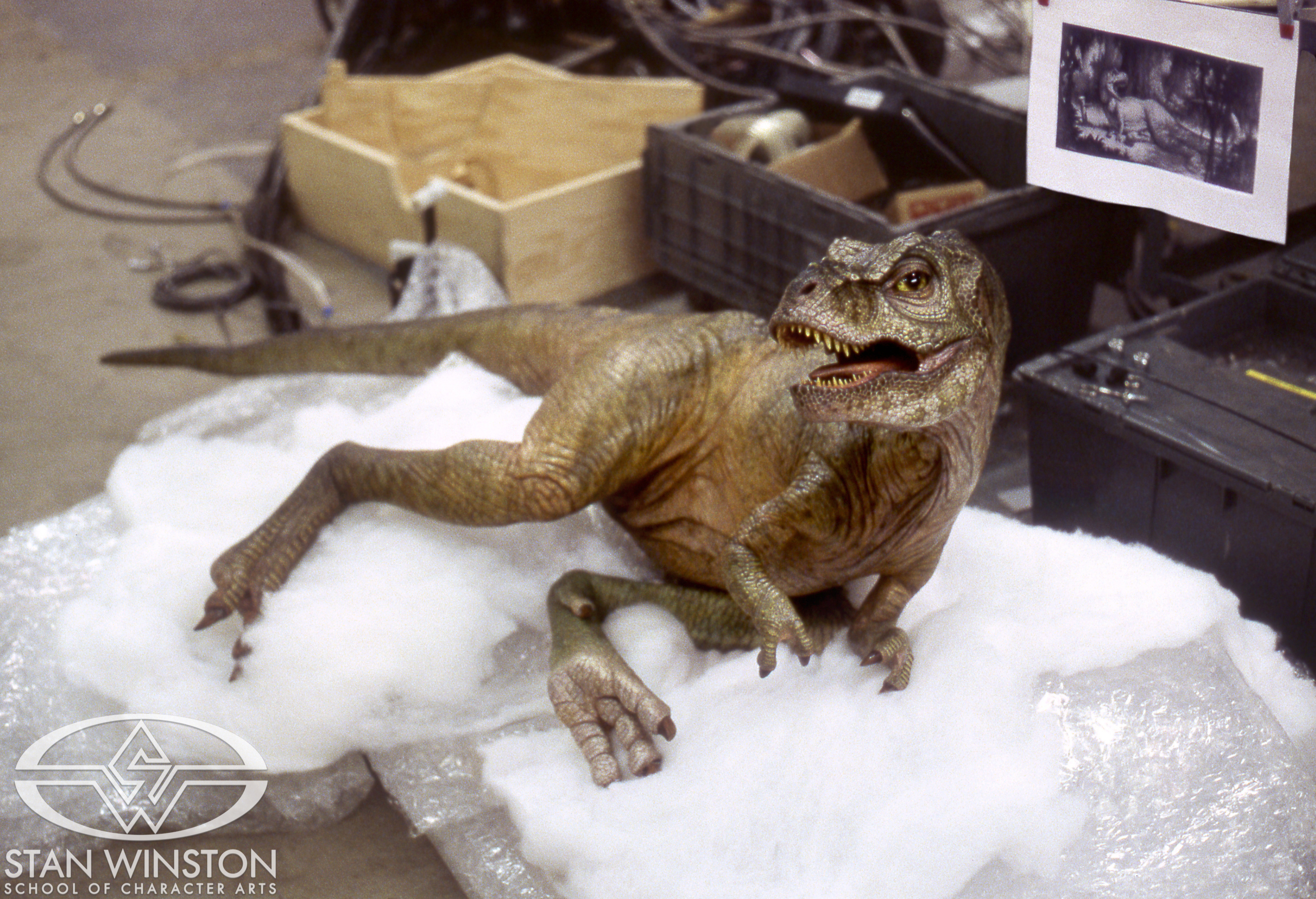 (The final baby T-rex, one of the featured characters in The Lost World: Jurassic Park (1997).)
Trevor Hensley, a relatively new hire, was assigned the on-set task of holding an umbrella over the baby T-rex between takes to keep as much water off of it as possible. The newcomer did not fully understand the assignment at first. “In between scenes, or even when a scene was still shooting, they handed the baby T-rex to me out of frame,” Hensley recalled. “They also handed me an umbrella, and being the stupid, ignorant person that I was at the time, I held the umbrella over myself instead of over the baby T-rex! I just let the baby T-rex hang out there in the rain. As the scene was going on, Stan was across the set, looking at me, and gesturing to the baby T-rex. I thought he was asking, ‘Is everything okay?’ So I gave him a big smile and a thumbs-up — and meanwhile, the baby T-rex is being drenched in the rain! Crash, who was standing near me, figured out what was going on, came over, and shoved the umbrella over the baby T-rex. He whispered, ‘You have to keep it dry!’ I felt so stupid. I shot back, ‘How the hell should I know that?’ And, of course, Stan heard all of this on his headset. It was a miracle that I didn’t get fired right then and there. Stan walked over later, and said, ‘You know, the umbrella’s not for you, it’s for the dinosaur.’ He was very nice about it, but I felt like an idiot.”
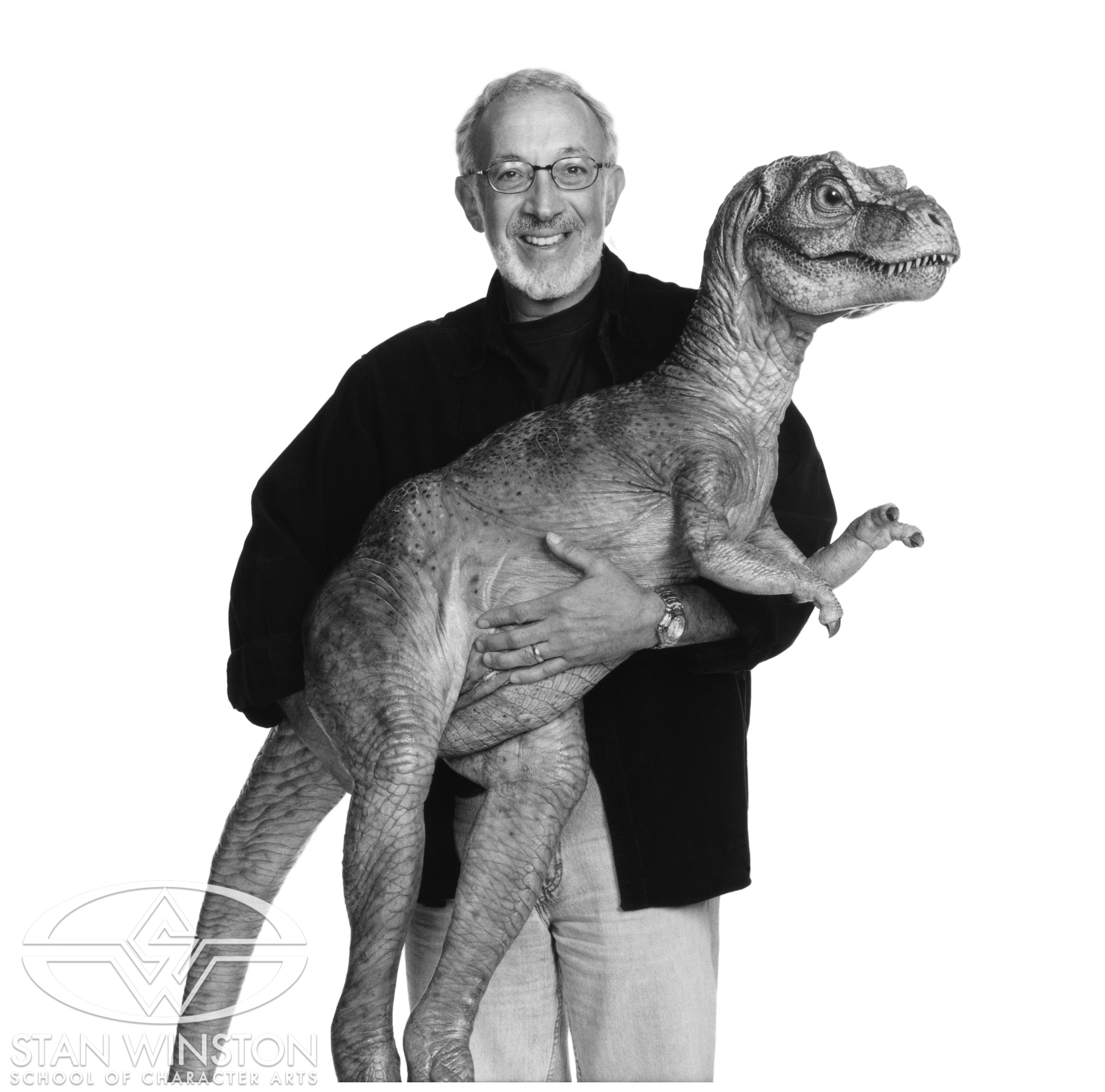 (Promo image of Stan Winston with the baby T-rex.)
The Baby Pteranodons of Jurassic Park III
In Jurassic Park III, Paul and Amanda Kirby (William H. Macy and Téa Leoni) are a couple whose son, Erik, has gone missing in a parasailing accident near the Costa Rican island of Isla Sorna. The concerned parents trick Dr. Alan Grant (Sam Neill) into guiding them on a search of the island, still teeming with dinosaur life. Just as they had for The Lost World, Stan Winston’s artists designed and built new dinosaurs for the film, and also revamped some of those that had been featured in the previous installments.
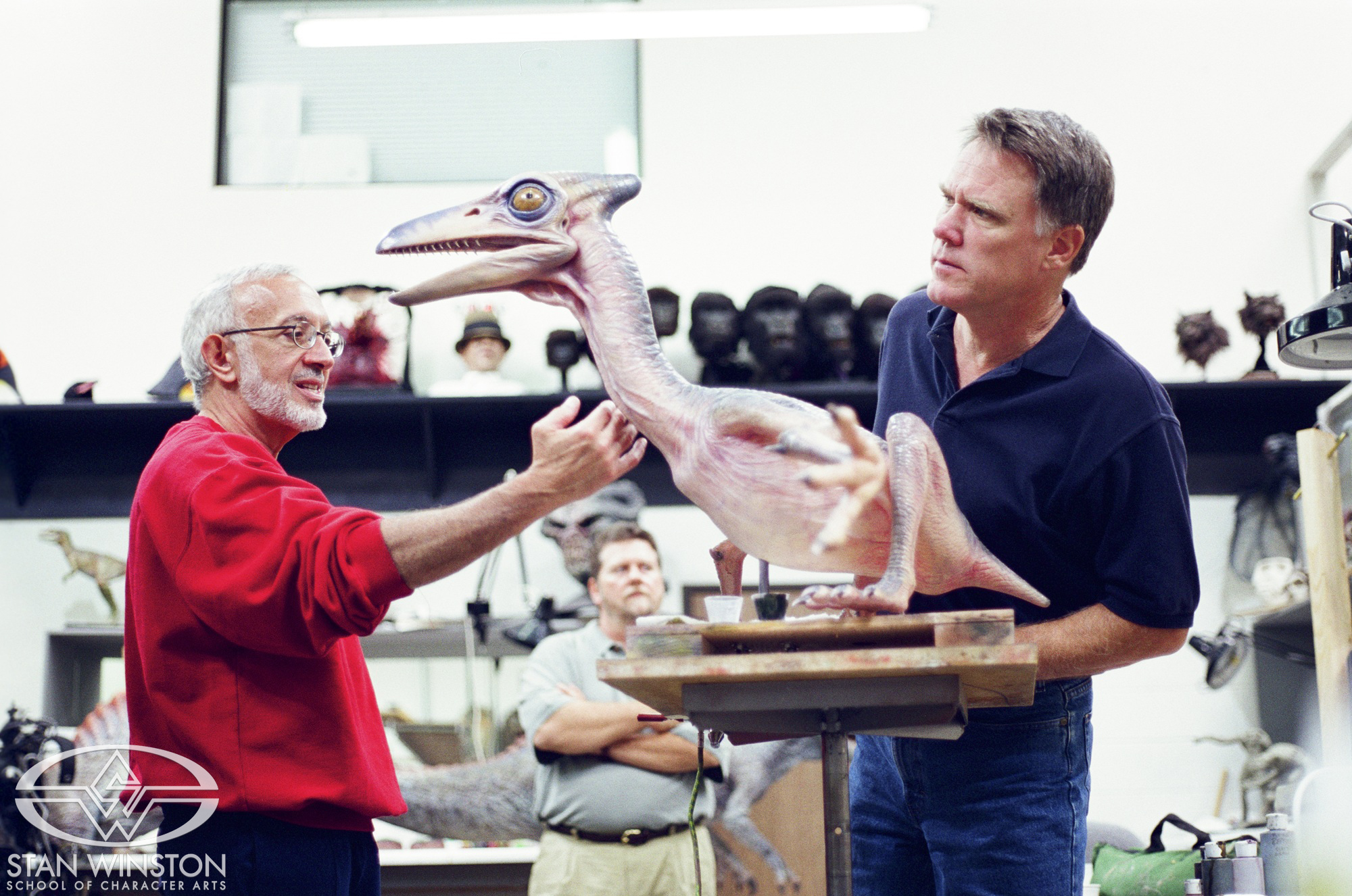 (Stan Winston introduces one of the baby Pteranodon puppets to director Joe Johnston.)
Among the new dinosaurs introduced in Jurassic Park III was the flying Pteranodon. Pteranodons had been included in the original script for The Lost World, in an attack on a helicopter that was to be that film’s climax. But when Spielberg conceived a new ending that had the T-rex terrorizing the streets of San Diego, the Pteranodons had been dropped. Both adult and baby Pteranodons would later be featured in Jurassic Park III, in a sequence within an expansive aviary.
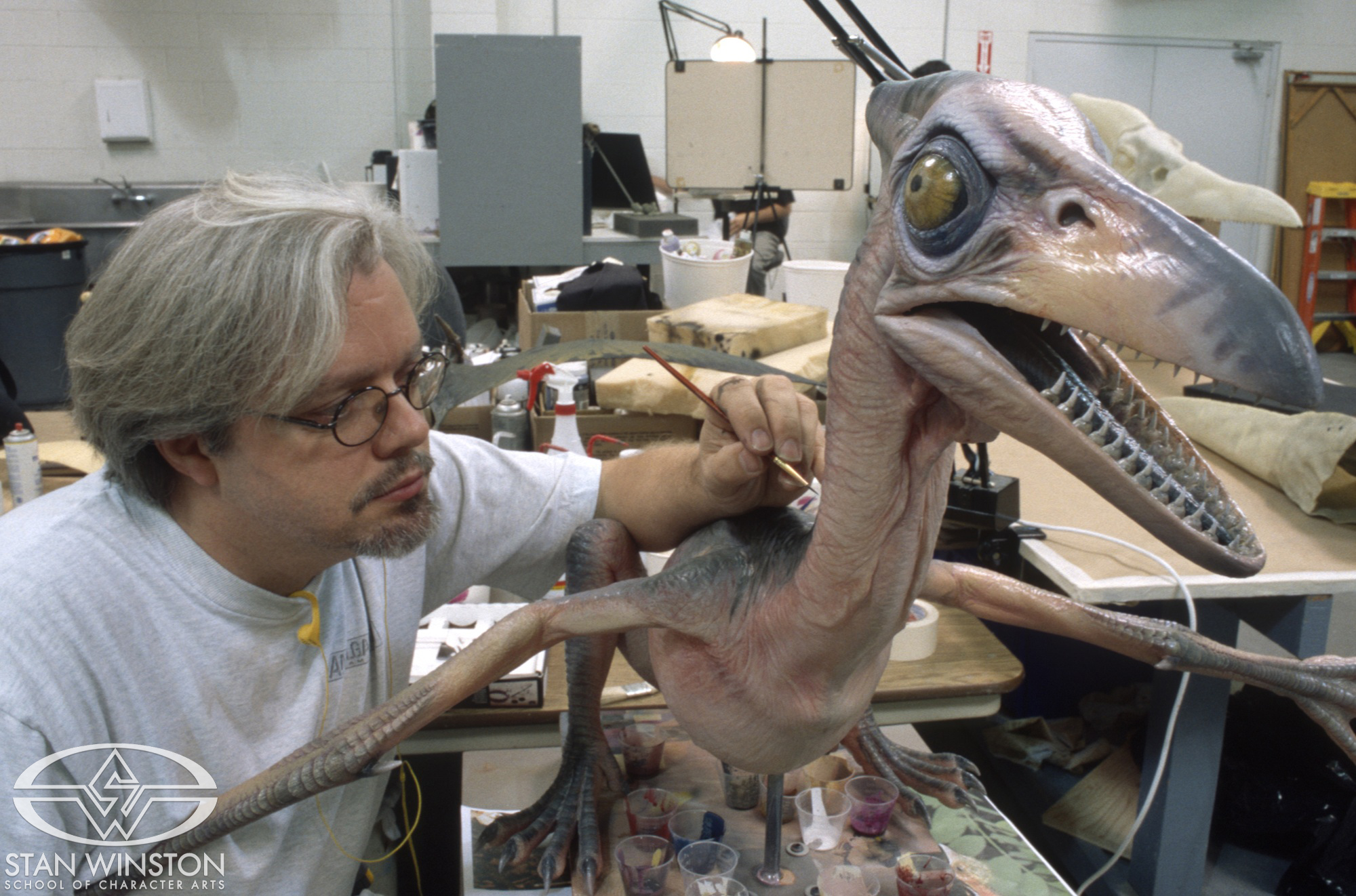 (Andy Schoneberg paints one of the baby Pteranodons at Stan Winston Studio.)
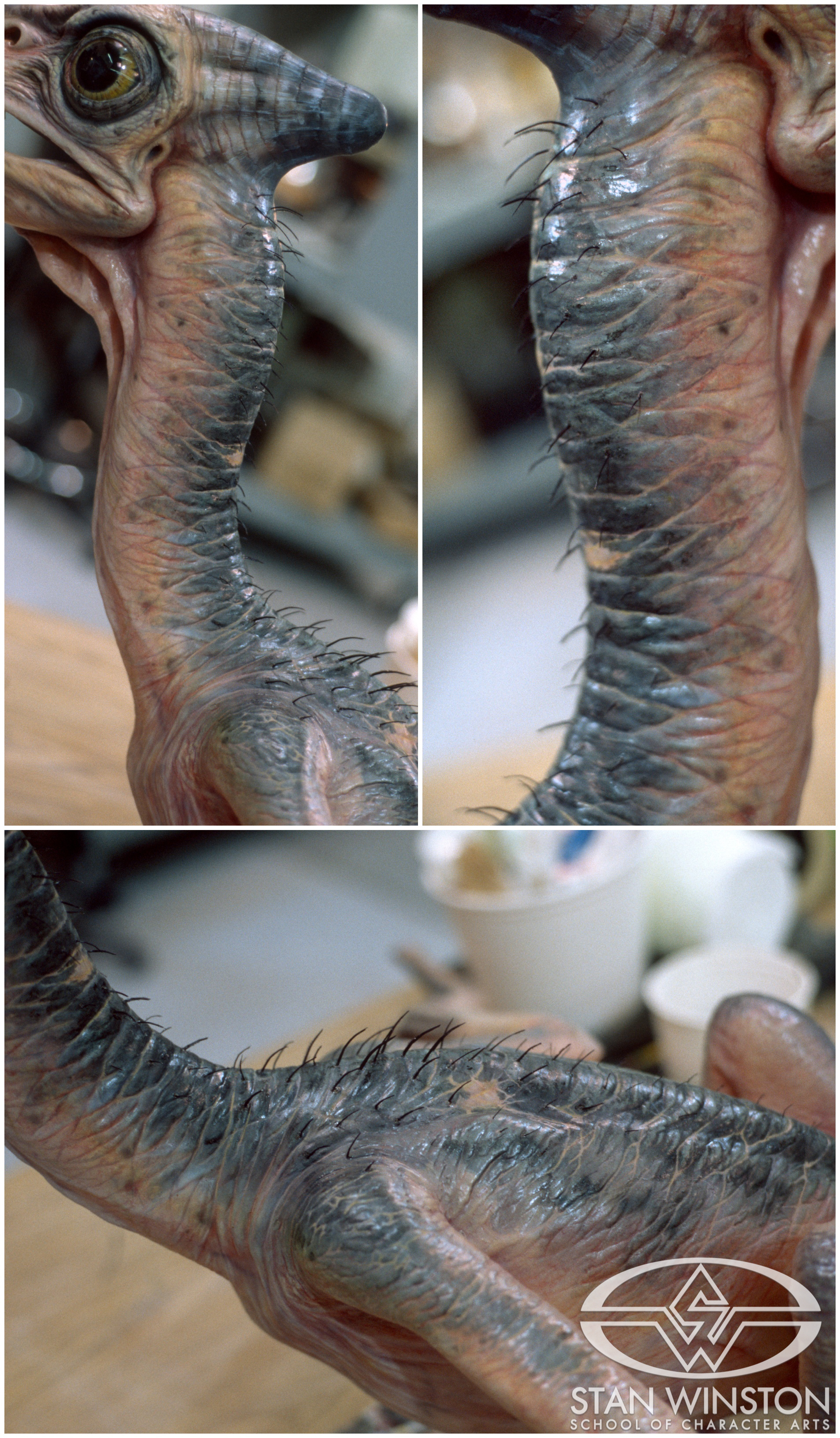 (Close-up views of the baby Pteranodon's neck and back.)
Winston’s crew built baby Pteranodon puppets under the supervision of Greg Figiel. The babies were featured in a scene in which Erik Kirby (Trevor Morgan) is abducted by an adult Pteranodon and deposited into a nest of hatchlings.
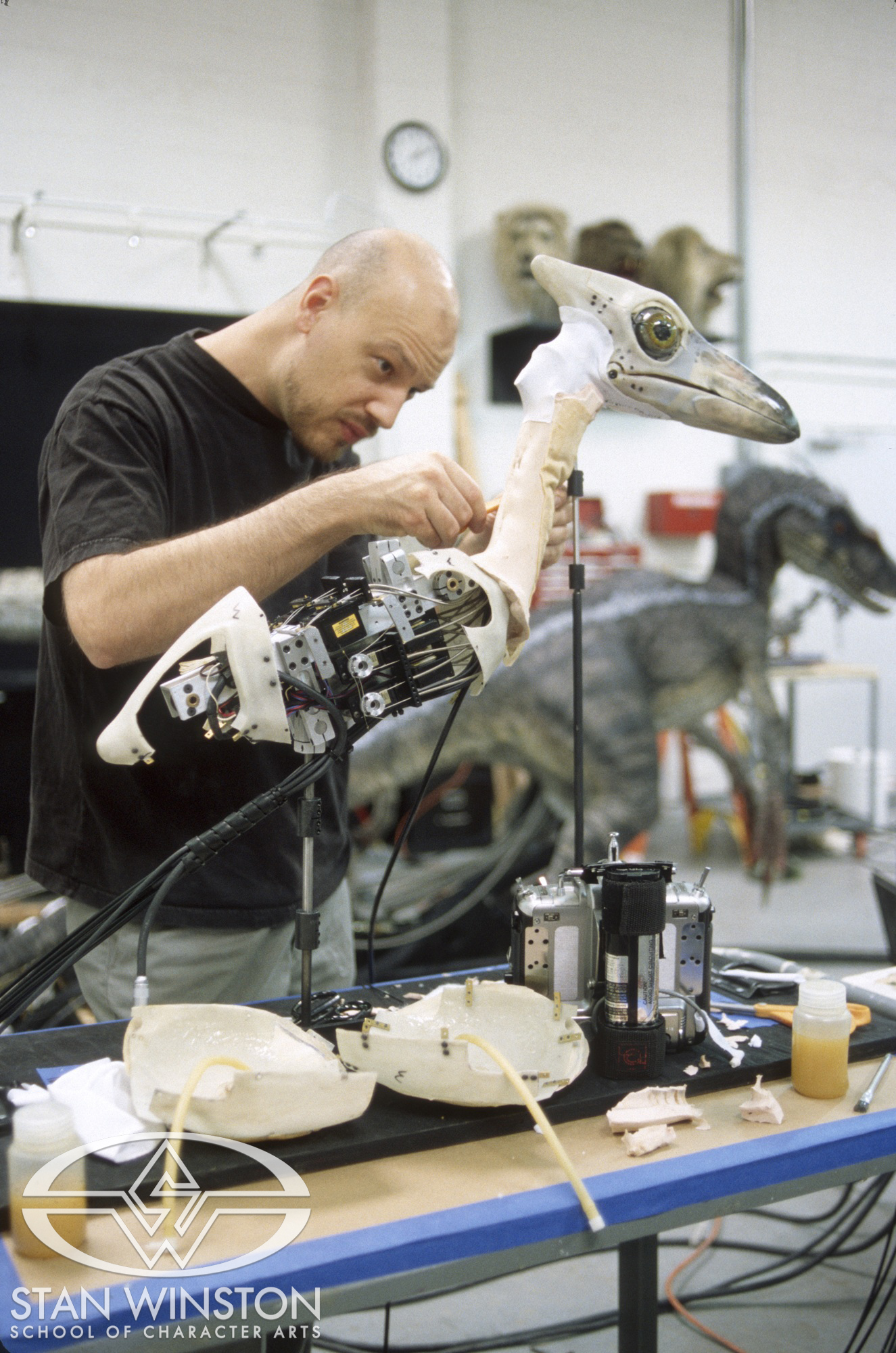 (Greg Figiel works on an animatronic baby Pteranodon at Stan Winston Studio.)
Winston’s five cable- and rod-actuated baby Pteranodons were seen in the foreground of shots, while ILM’s computer-animated characters were seen flying and leaping around in the background. “There were some neat shots of the baby Pteranodons pecking at the boy,” said John Rosengrant. “It was all real and interactive. That was a case where some of the best stuff we got was accidental, as so often happens when you are puppeteering a live character. One of the puppeteers grabbed at the kid’s clothing and accidentally pulled his coat off — and it looked very natural and real.”
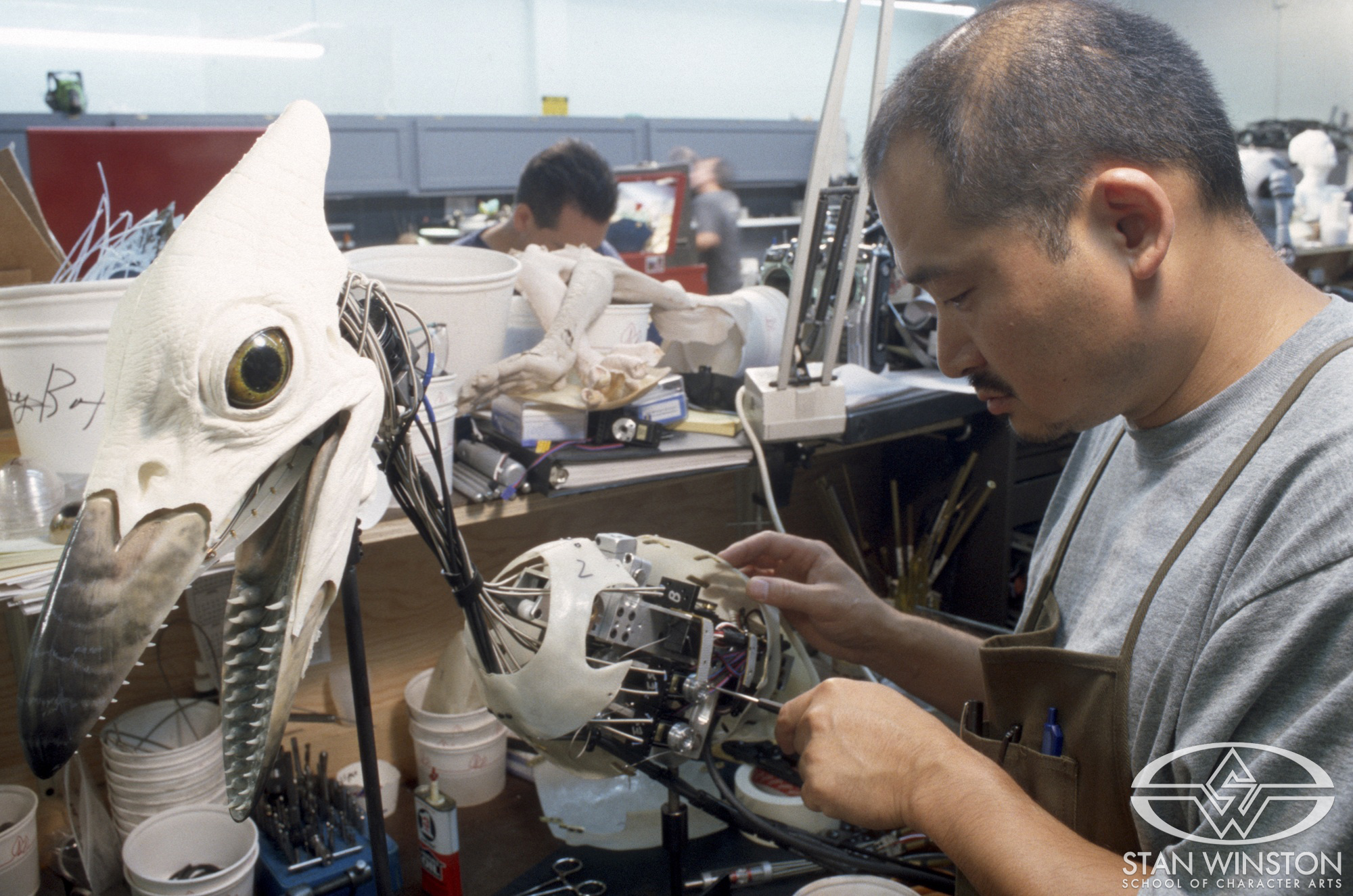 (Hiroshi 'Kan' Ikeuchi works on the baby Pteranodon animatronics at Stan Winston Studio.)
“It’s a great thing when you are puppeteering a character and something wonderful happens by accident,” said Richard Landon. “When puppeteers are goofing around and playing with a puppet, that’s always when it comes to life. The atmosphere is relaxed, and suddenly the performance becomes much more real and exciting. Stan has reminded us of that many times. He’ll say: ‘Relax! Don’t think about it so much! Goof off!’ And that always makes the performance better.”
The performance of the baby Pteranodons was especially impressive considering the conditions in which the puppeteers worked. Nine puppeteers were crowded into a pit about the size of a small bathroom, underneath an elevated nest set, working rods through slots to articulate the puppet's legs and wings. “Imagine nine guys sweating in a pit,” said Paul Mejias, one of the baby Pteranodon puppeteers, “dirt falling on their faces, in their mouths and on the monitors, elbows and arms and legs everywhere! Not surprisingly, the puppeteering wasn’t looking so good at first, and Stan started yelling at us over the intercom system. It was such a preposterous situation, I just started laughing — which, of course, made Stan even more mad. I remember that he lined us all up during a break and read us the riot act. And, after that, we somehow got it together and got the shots.”
- Blog is excerpted from The Winston Effect: The Art and History of Stan Winston Studio by Jody Duncan
Read More Jurassic Park Behind-The-Scenes Stories HERE:
Behind the scenes of Jurassic Park (1993):
- The History of the Dinosaur Eyes of Jurassic Park
- Jurassic Park's T-Rex - Sculpting a Full-Size Dinosaur
- Jurassic Park T-Rex - Building an Animatronic Dinosaur
- Jurassic Park T-Rex Skinning: An Animatronic Dinosaur
- Jurassic Park's Animatronic T-Rex Comes To Life
- Jurassic Park's T-Rex: One man's survival story
- Jurassic Park - The Evolution of a Raptor Suit with John Rosengrant
- Roaring into Action: Behind the Scenes of Jurassic Park's Raptors in the Kitchen
- Jurassic Park's Spitter - Building the animatronic Dilophosaurus dinosaur puppet
- Jurassic Park's Spitter attacks Nedry
- Jurassic Park's Brachiosaurus - Animatronic Puppet Rehearsal
- Jurassic Park Triceratops - Puppeteering an Animatronic Dinosaur
Behind the scenes of The Lost World: Jurassic Park (1997):
- The Lost World: Jurassic Park's T-Rexes
- What are Spinosaurs Made of?
- The Lost World: Jurassic Park - Raptor Running Test
- The Adult and Baby Stegosaurus of The Lost World: Jurassic Park (1997)
- The Lost World: Jurassic Park - Compy Dinosaur Attack
- The Lost World: Jurassic Park | Compy Test | Stan Winston Studio Behind-the-Scenes
Behind the scenes of Jurassic Park III (2001):