
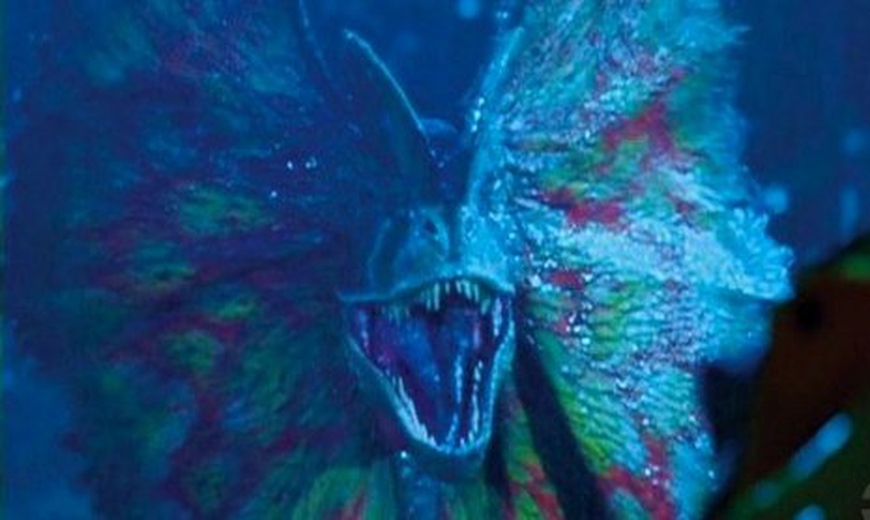
Jurassic Park's Spitter Attacks
One of the main dinosaur attack sequences in Steven Spielberg's Jurassic Park was the one in which computer programmer Dennis Nedry (Wayne Knight), attempting to deliver dinosaur embryos to a waiting ship, veers off the main road and stalls his vehicle in the mud. There, he encounters a seemingly benign Dilophosaurus, or ‘spitter’.
Jump To Section
- Designing Jurassic Park’s Most Fictionalized Dinosaur
- Creating the Spitter Puppet
- Making the Dilophosaurus Move
- Challenges Puppeteering the Dilophosaurus
- Nearly Drowning for Art
- Creating an Iconic Scene in Jurassic Park
 (Jurassic Park's seemingly harmless Dilophosaurus surprises Nedry (Wayne Knight).)
Designing Jurassic Park’s Most Fictionalized Dinosaur
The spitter was the most fictionalized of all of Jurassic Park’s dinosaurs. Whereas a real Dilophosaurus stood approximately ten feet tall and was non-poisonous, the movie’s Dilophosaurus was a much smaller animal with a vibrating cowl and the ability to spit toxic venom.
 (Mark “Crash” McCreery's pencil rendering of the Dilophosaurus in profile and scaled down to a new, less threatening size.)
 (A 3/4 rendering of the Spitter by Stan Winston Studio concept artist Mark "Crash" McCreery.)
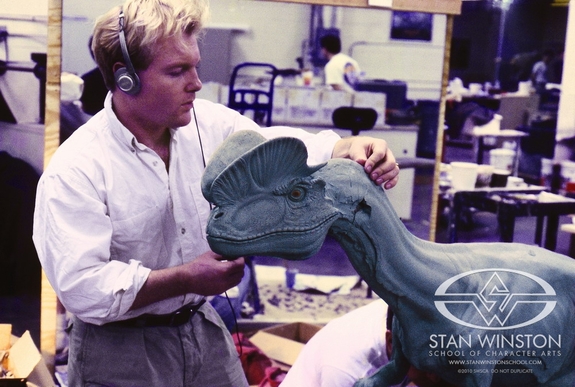 (Shane Mahan sculpts the full-size Dilophosaurus based on approved designs and maquettes.)
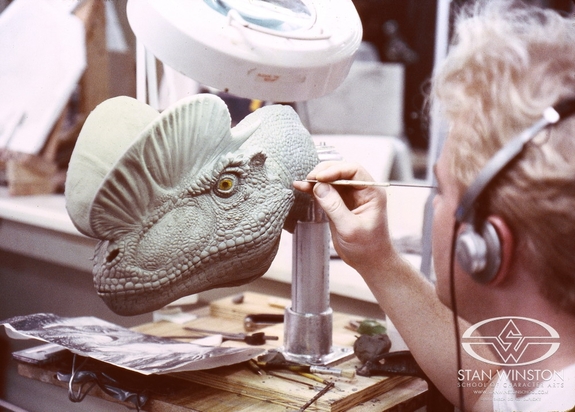 (Shane Mahan details the Spitter sculpture at Stan Winston Studio.)
 (Among many versions, this was the final color scheme selection for the Dilophosaur, aka Spitter.)
Creating the Spitter Puppet
Stan Winston's live-action dinosaur crew realized the Dilophosaurus as one cable-operated puppet with three interchangeable heads, each of which performed a specific function. The first head featured the cowl in its lowered position; the second was mechanized to make the cowl flare open; and the third had a vibrating, open cowl, and could execute the spitting action.
 (Shane Mahan details the final Dilophosaurus puppet and interchangeable heads.)
Making the Dilophosaurus Move
Stan Winston Studio had also built a lower-body cable-actuated walking rig for shots of the spitter, framed from the hips down, advancing on Nedry. The rig was suspended from the stage catwalks on bungee cords so that it could be bounced into frame as if the creature was leaping. “This was the one character that wasn’t going to have any digital help for walking shots,” said 25-year SWS supervisor and co-founder of Legacy Effects, Shane Mahan, “so we had to do as much as we could, physically.”
 (The Dilophosaurus "cowl-opening" puppet head. Notice the cowl flattened against the Diloposaur's neck just before the "opening" effect.)
Challenges Puppeteering the Dilophosaurus
For some Dilophosaurus shots, a crane supported the bulk of the body from above while Mahan, stationed below the set, moved the legs via attached rods. Like so many in the film, the entire spitter scene was set in a drenching rainfall, which complicated the below-set puppeteering considerably. “This set was built on a raised soundstage that had a water tank underneath,” said Mahan, “so that all the water, supposedly, would just drain into the tank. But the drainage system wasn’t functioning all that well, so our puppeteering area down below quickly filled up with water. We built a one-foot riser to stand on, just to keep some of the water off of me; but the water rose way above that — and it kept rising.”
 (The Stan Winston Studio Dilophosaurus vibrates its frill at Nedry just before blinding him with a shot of venomous spit.)
Nearly Drowning for Art
The rising water wasn’t just a physical discomfort. The roaring sound it made as it poured into the puppeteering area made it impossible for Mahan to hear directions or cues through his headset. “They were screaming at me from up above, but I couldn’t hear ‘cut’ or ‘roll’ or anything. In order to figure out what to do, I had to rely totally on a video monitor we’d set up on a stack of Snapple boxes. But as the day progressed, and the water level kept rising, the video monitor just floated away! So now, I couldn’t hear anything, and I couldn’t see anything. I was just trapped under there, with this freezing water rising up to my chest, trying to puppeteer this spitter. It was a ridiculous, impossible situation; but everybody up top was just getting frustrated with me. This was toward the end of the shoot, and nobody had much patience left.”
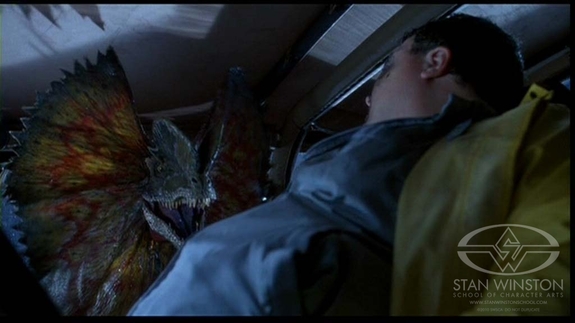 (Nedry's final moment before the Spitter attacks.)
Creating an Iconic Scene in Jurassic Park
Needless to say, Shane Mahan didn't drown and Steven Spielberg got what he needed on set to create Jurassic Park's memorable Spitter scene. The Stan Winston Studio crew had come through again, delivering full-size dinosaur puppets that could act and that would, in combination with ILM's digital dinosaurs, change the course of monster movie history.
-Jody Duncan
Excerpted from THE WINSTON EFFECT: THE ART & HISTORY OF STAN WINSTON STUDIO
Courses with the Creators of Jurassic Park
- Robot Brains - Animatronic Character Servo Control with Rick Galinson
- Hybrid Characters: Blending Practical & Digital FX with John Rosengrant
- Hybrid Character Design: Practical To Digital with Christopher Swift
- Special Effects Sequence Design with Shane Mahan
- Oversized Eyes Part 2: Molding & Casting with Rob Hinderstein
- Oversized Eyes Part 3: Paint Layering & Finishing with Rob Hinderstein
- Animatronics Design Basics with Richard Landon
- Cable Mechanism Basics - Tentacles with Richard Landon
- Animation For Animatronics Part 1: Intro To Pololu, Maya & AnimServo with Craig Caton-Largent
- How To Build An Animatronic Head Part 1 - Creating Mechanical Underskull with Craig Caton-Largent
- Mastering Effects Disasters - Explode A Head with Andy Schoneberg
- Remote Makeup Application Part 1: Prosthetic & Kit Preparation with Andy Schoneberg
- Garage Monsters - How To Make Creature FX On A Budget with Shannon Shea
- The Business Of Making Monsters - Part 1 with Shannon Shea
- Metallic Painting Techniques - Robot Finishes (Terminator) with Rob Ramsdell