
Skinning an Animatronic T-Rex
Beyond the groundbreaking design, sculpture, mold-making, and mechanical steps required to create Jurassic Park's full-size animatronic T-Rex, Stan Winston's team had to contend with finally SKINNING the mechanical beast - a huge challenge in and of itself. Watch this 2 Part Exclusive Behind-the-Scenes footage from the Stan Winston Studio Archive.
WATCH PART 1
WATCH PART 2
Narrated by Alan Scott and Lindsay MacGowan
SWS JP Dinosaur Team Members & Co-Founders of Legacy Effects
Jump To Section
- Developing an Innovative Mechanical Core
- Fixing Gaps and Patching Skin on the T-Rex
- Using Elastic for the T-Rex’s Mouth
- Creating a Thick-skinned T-Rex
Developing an Innovative Mechanical Core
First of all, due to the sheer size of the character, the SWS team had to adopt an innovative approach to creating the mechanical core. Alan Scott recalled developing the core structure for the necks and tails on the T-Rex and the Velociraptors, "When we were developing the core technology on this, everyone had traditionally been using rings to try and create cores that moved sequentially, and we realized that it was going to be hard to organize all those and make them all work. While I was working on the Raptors, I came up with this idea of just cutting [the cores] in a continuous spiral so that it could expand and contract but never lose its shape."
 (Marilyn Dozer-Chaney works on a foam fabricated raptor suit prototype. Note the traditional approach to the neck core, with separate rings attached by elastic.)
 (The mechanical version of the Velociraptor and its spiral-cut neck core.)
"It wouldn’t just fall apart with 40 different rings on it. They would all stay integrated," pointed out Scott. "So the tail and the neck for both the Raptors and the T-Rex were done as a spiral and then reinforced so that they didn’t become too weak, but that way, we could keep the shape and the look of everything very continuously."
 (Tim Nordella and Mike Trcic work on the T-Rex. The spiral-cut core helped the skin hold its shape while still allowing freedom of movement.)
Fixing Gaps and Patching Skin on the T-Rex
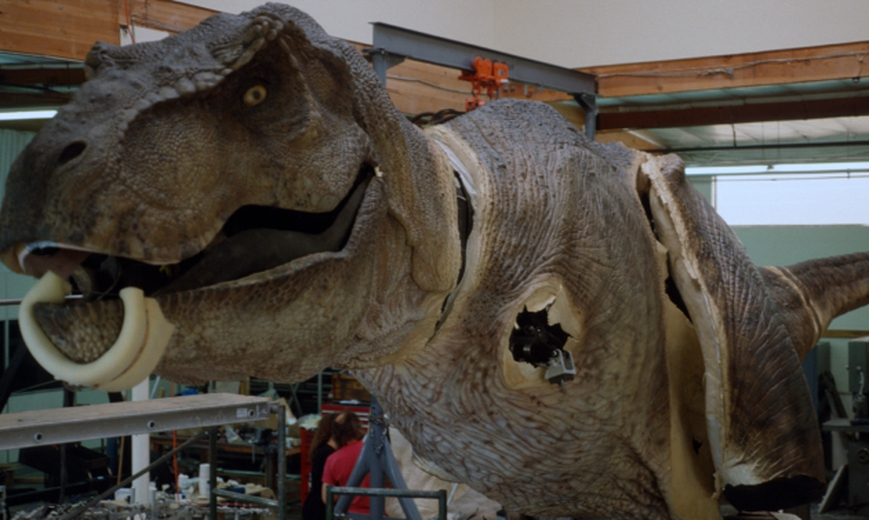
The T-Rex team also had to get creative when it came to making all the sections of foam latex skin come together when they didn't always fit perfectly. MacGowan recalled the shrinkage issues, "You can see there, on the tail, and it happened on the neck area too... foam actually shrinks quite a lot."
 (The animatronic "skeleton" of the T-Rex being "skinned" at Stan Winston Studio.)
 (Tony McCray, Paul Mejias, and Mike Trcic add skin to the T-Rex's mechanical neck and head.)
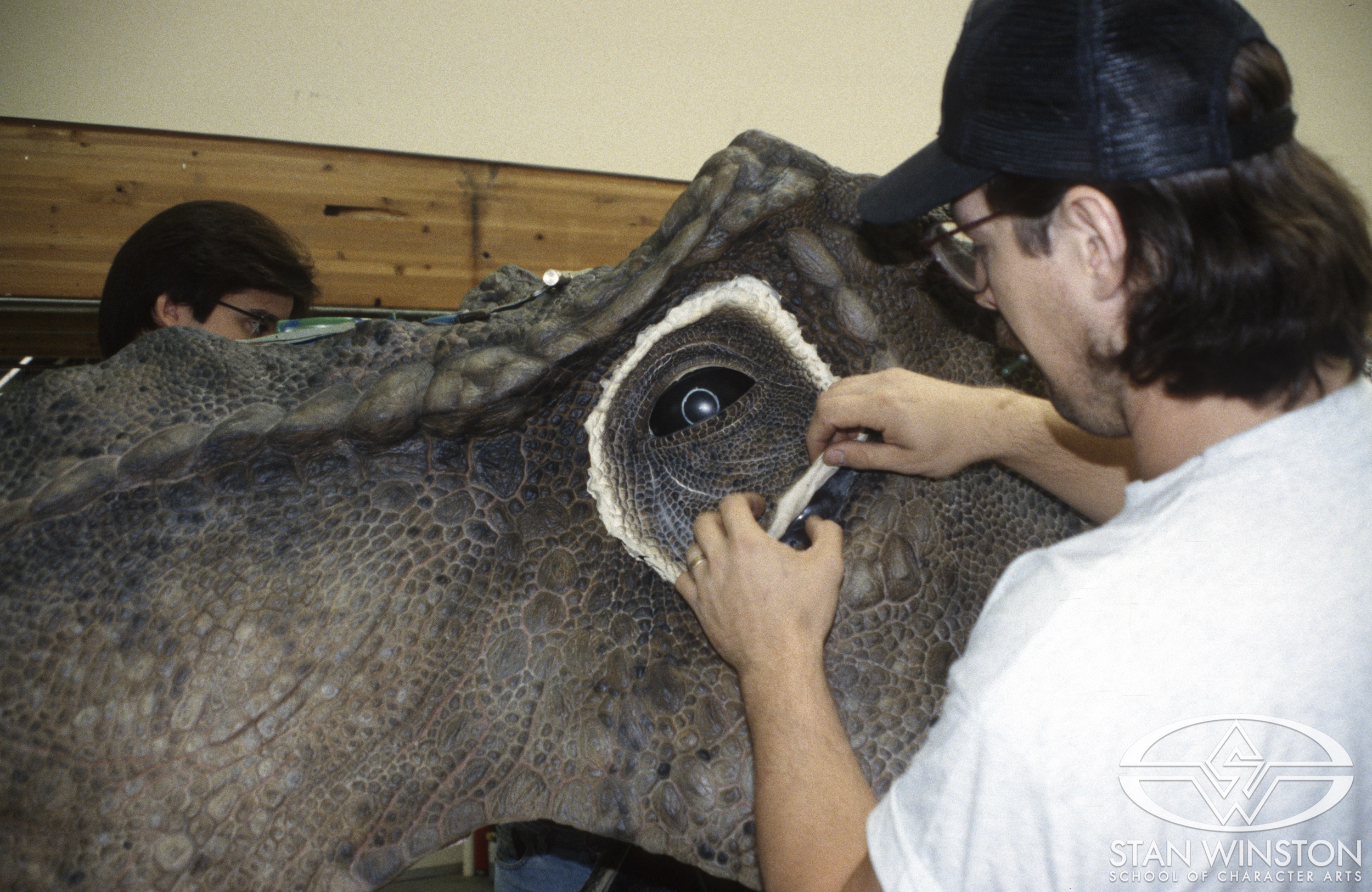 (Paul Mejias and Mike Trcic glue sections of skin over the T-Rex's radio-controlled eyes.)
 (The T-Rex skinning process underway at SWS. In the foreground: the T-Rex control systems, including the telemetry device that puppeteers would use to perform the T-Rex in real-time on set.)
"[The T-Rex skin] shrank quite considerably, and we’d have to put like two or three-foot sections of skin back in - basically re-sculpting areas with these patches," said MacGowan, in a nod of appreciation to the expert fabrication team who worked on the project at Stan Winston Studio.
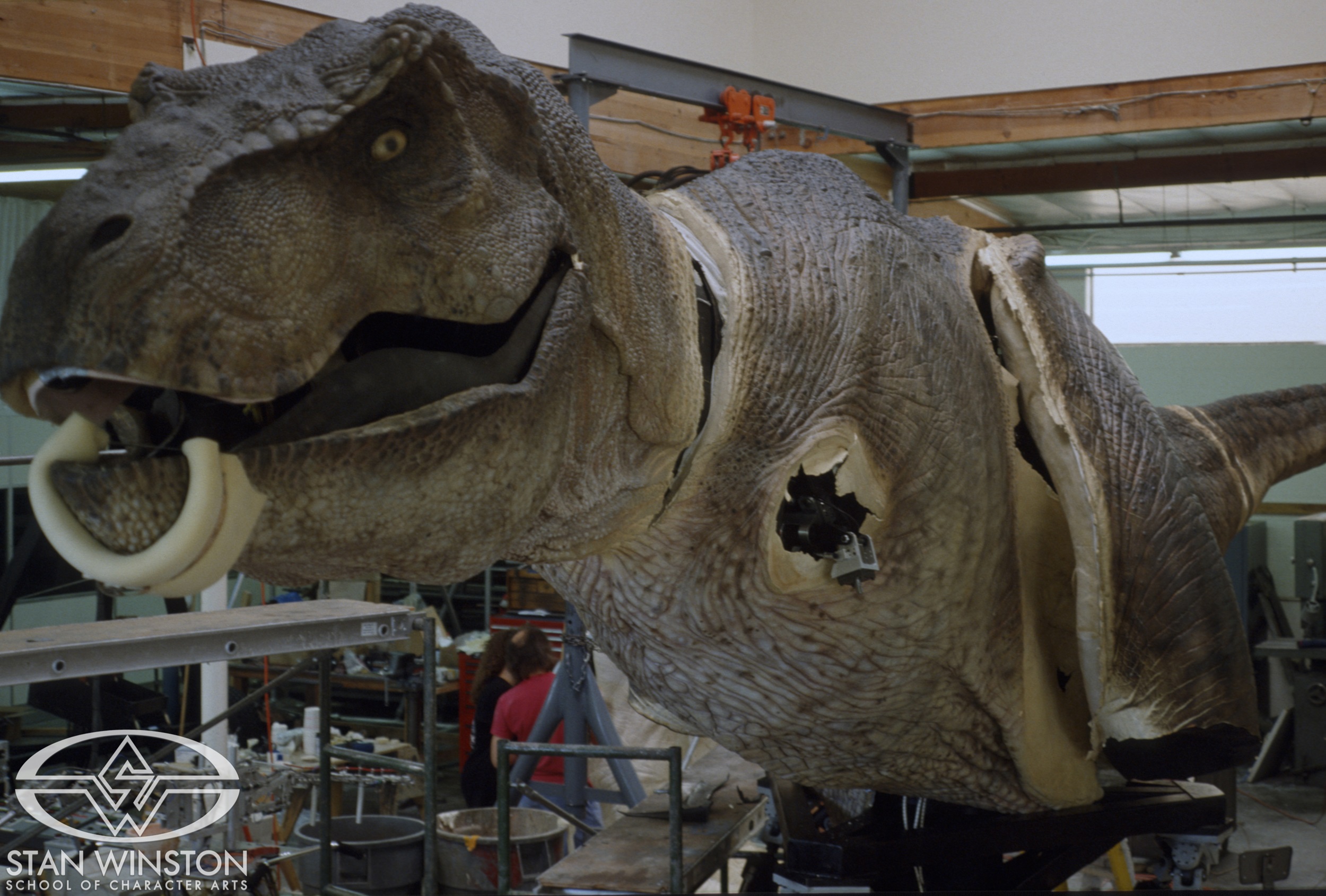 (The T-Rex head and body skin on the mechanical skeleton, before the sections of skin are glued together and patched.)
Alan Scott emphasized the high-stakes game the SWS crew was playing in bringing the T-Rex to life, "Everything was so big. You couldn’t risk running [the latex skins] three and four times. It was gallons and gallons and gallons of foam, so you only had one or two shots at it. But it’s a testament to the artistry too," marveled Scott, "to take this amazing sculpture and then cut 3 one-foot sections out of the middle of it and then have to re-fabricate it out of foam latex and patch it back in and make the lines work and the wrinkles work, make everything flow again even though you’ve cut a big piece out."
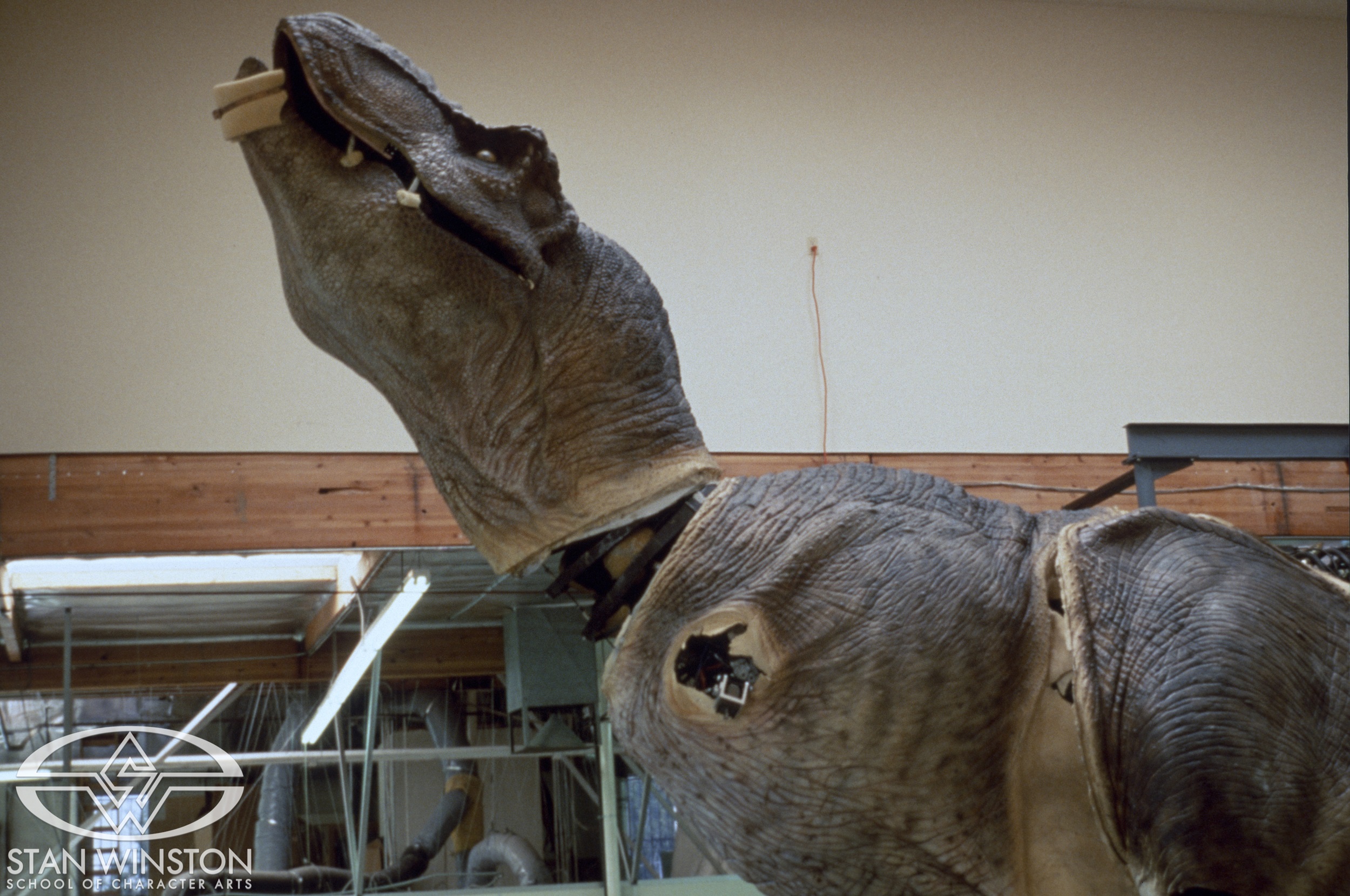 (SWS crew test the T-Rex head movement during the skinning process.)
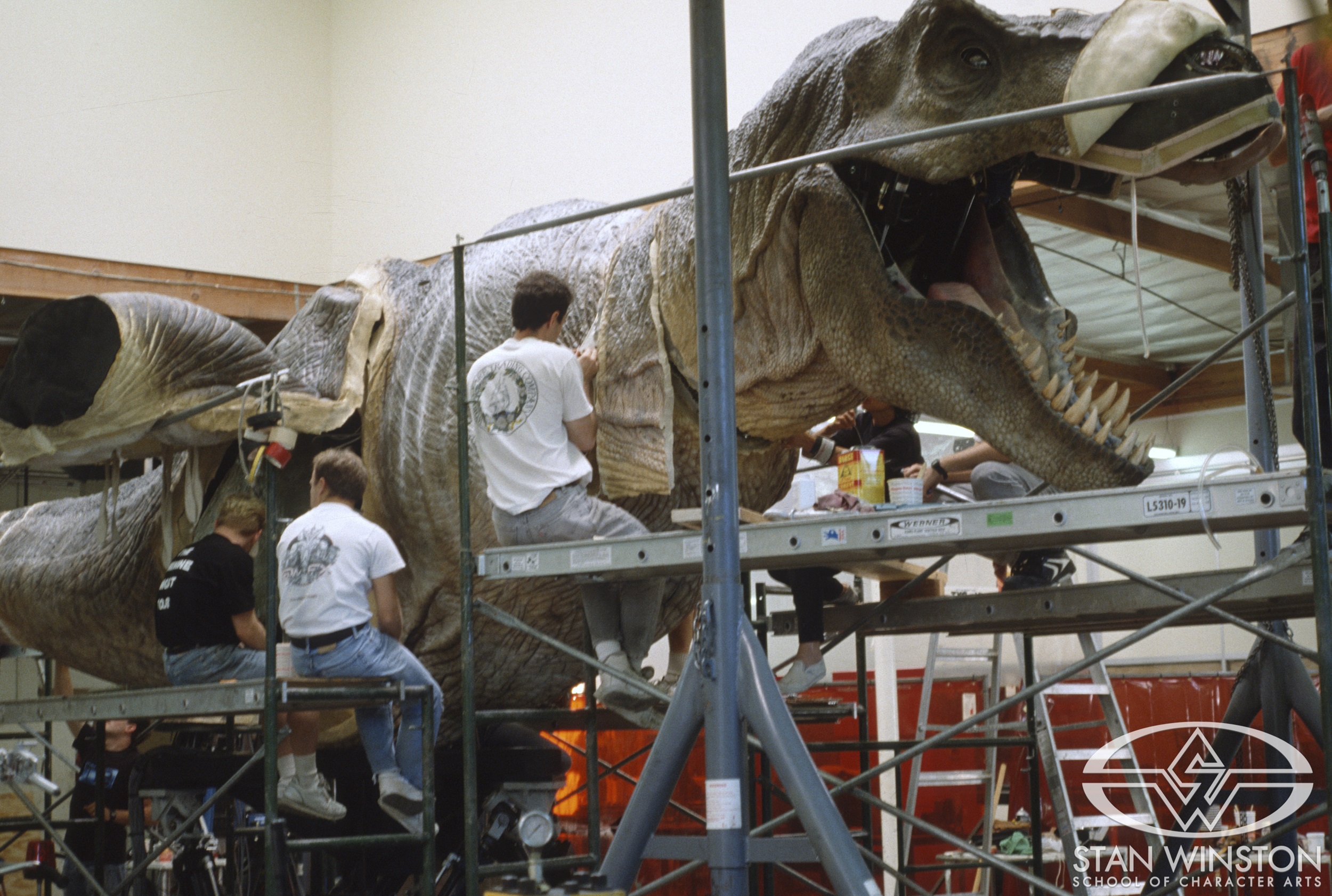 (SWS crew add new sections of skin to fill the gaps caused by the foam latex shrinkage.)
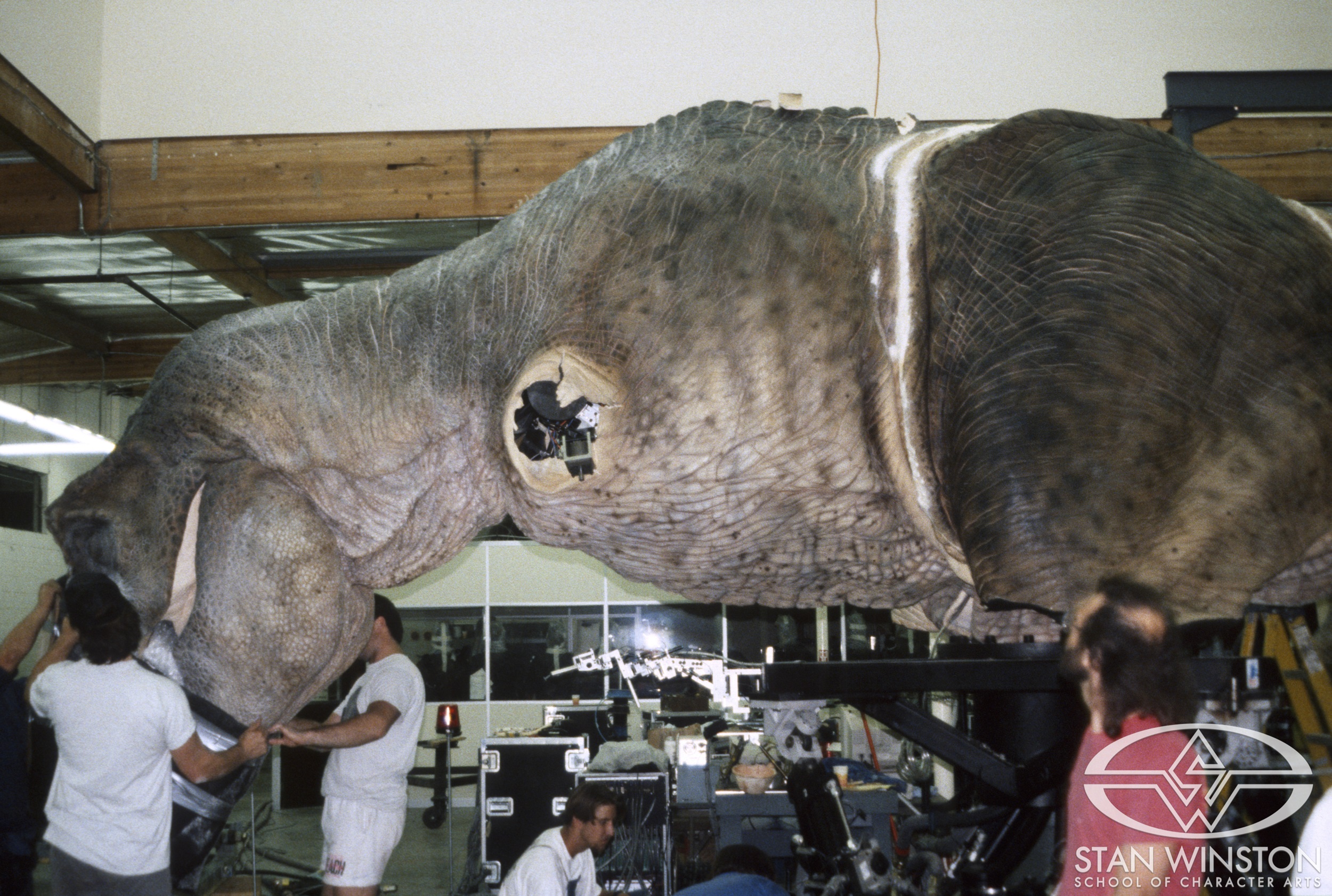 (The SWS crew prepares for a T-Rex movement test to see how the patched skin will perform. Notice the patched neck section; the seams are invisible!)
's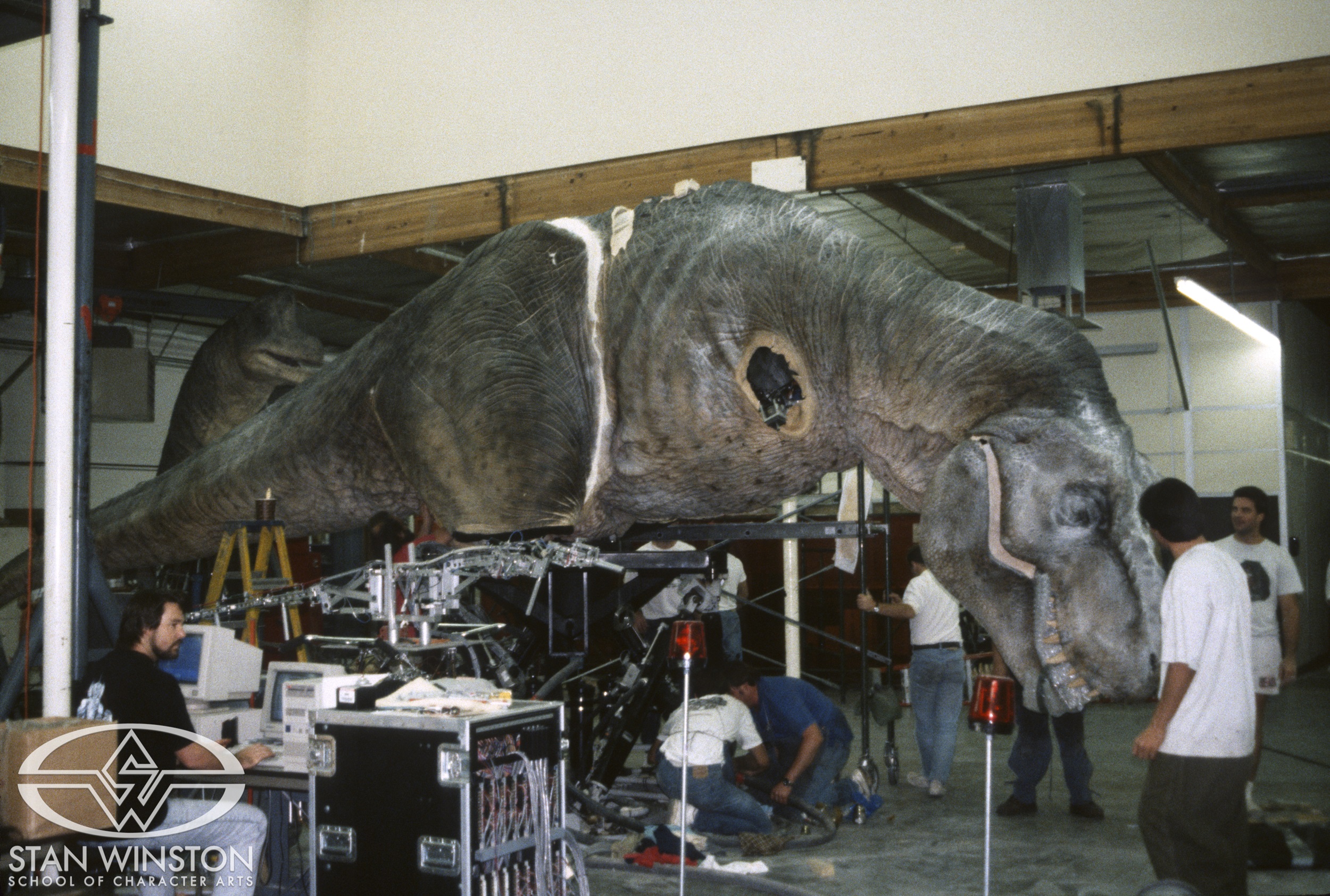 (Another view of the T-Rex being prepared for the skin movement test.)
Using Elastic for the T-Rex’s Mouth
On top of the issues posed by the shrinking foam latex skin, there was another problem to solve, according to Scott, "The corner of the mouth was tricky because [when the T-Rex] closed her mouth, you didn’t want to have [the membrane] bunching out... so they were very inventive with the elastic inside of it so that it would want to collapse and then move to the inside of the mouth instead of the outside of the mouth."
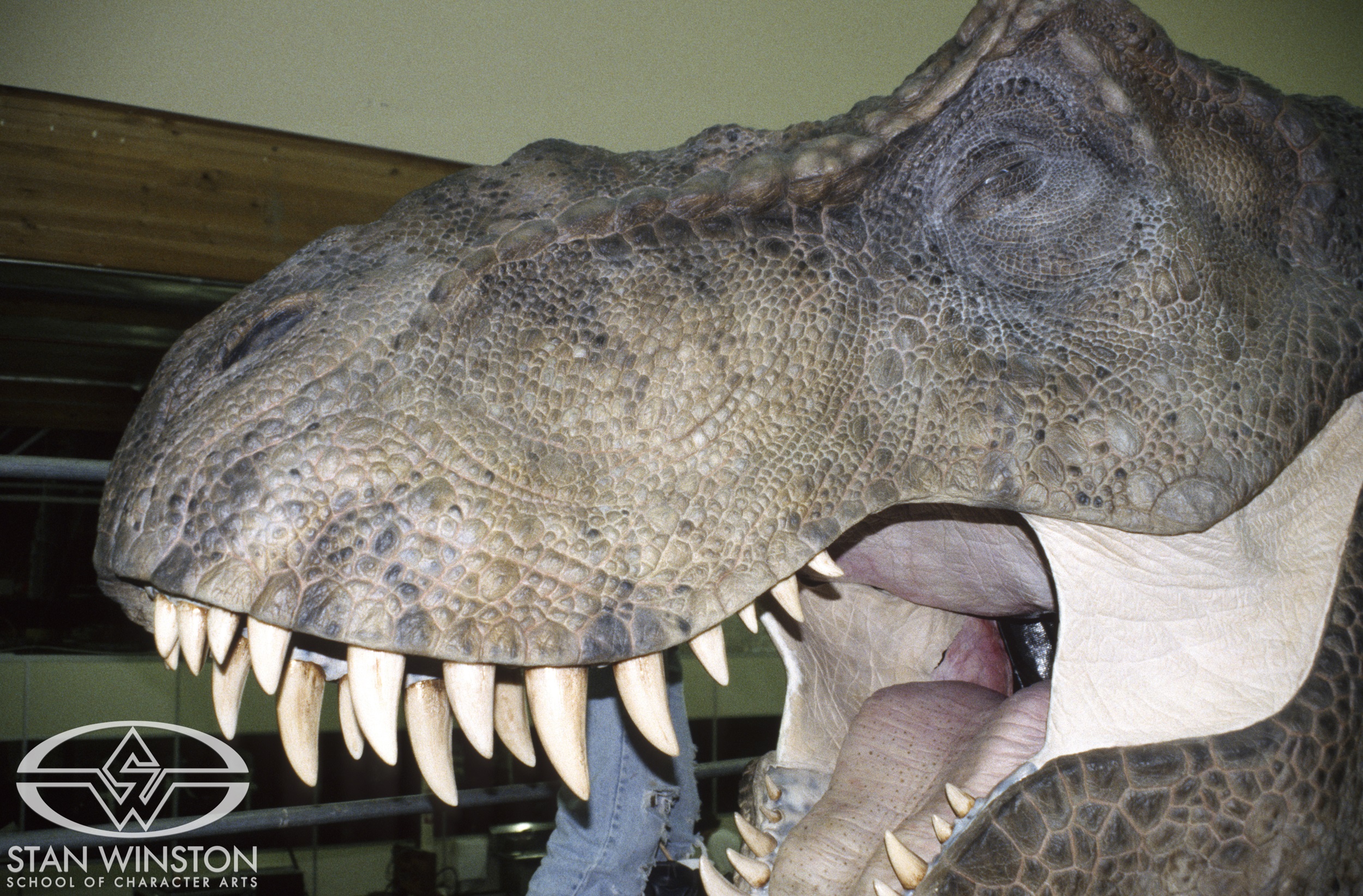 (SWS crew at work applying the membrane to the corner of the T-Rex's mouth.)
Creating a Thick-skinned T-Rex
"The skins were tremendously heavy, two inches thick in a lot of places, because we wanted to make sure that they didn’t give away the mechanisms inside," revealed Scott, "and that’s kind of the wonder of the fabrication and the coring of it because inside you’ve got hard mechanical moves. On the outside, it needed to have smooth, organic, and realistic movement, so a thicker skin always helps with that, but as we learned later on, a thicker skin takes on more water. So, finding the perfect amount of tension and stress on the skin that wouldn’t tear itself apart but would still look organic was tricky on something of this scale."
 (A shot of the T-Rex leaving Stan Winston Studio in the dead of night to be transported to Warner Bros. Studio's Stage 16.)
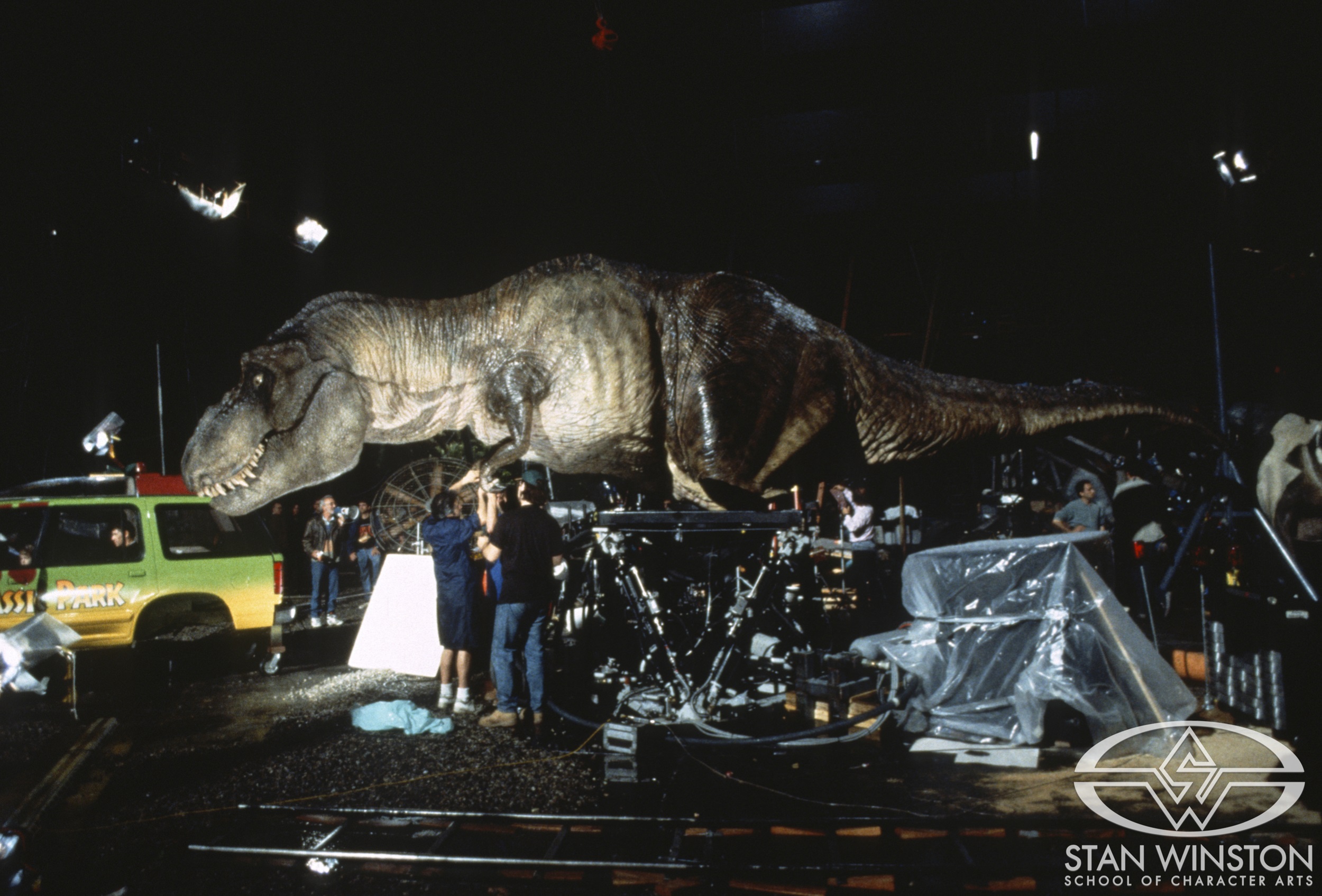 (The fully-skinned and completed T-Rex makes her debut on the set of Jurassic Park.)
Courses with the Creators of Jurassic Park
- Hybrid Characters: Blending Practical & Digital FX with John Rosengrant
- Hybrid Character Design: Practical To Digital with Christopher Swift
- Special Effects Sequence Design with Shane Mahan
- Oversized Eyes Part 2: Molding & Casting with Rob Hinderstein
- Oversized Eyes Part 3: Paint Layering & Finishing with Rob Hinderstein
- Animatronics Design Basics with Richard Landon
- Cable Mechanism Basics - Tentacles with Richard Landon
- Animation For Animatronics Part 1: Intro To Pololu, Maya & AnimServo with Craig Caton-Largent
- How To Build An Animatronic Head Part 1 - Creating Mechanical Underskull with Craig Caton-Largent
- Mastering Effects Disasters - Explode A Head with Andy Schoneberg
- Remote Makeup Application Part 1: Prosthetic & Kit Preparation with Andy Schoneberg
- Garage Monsters - How To Make Creature FX On A Budget with Shannon Shea
- The Business Of Making Monsters - Part 1 with Shannon Shea
More Jurassic Park behind-the-scenes from Stan Winston School
- JURASSIC PARK T-REX - Sculpting a Full-Size Dinosaur
- JURASSIC PARK T-REX - Building an Animatronic Dinosaur
- JURASSIC PARK - Animatronic T-Rex Rehearsal - On Set with Stan Winston
- JURASSIC PARK - The Evolution of a Raptor Suit with John Rosengrant
- JURASSIC PARK Spitter - Building the Animatronic Dilophosaurus Dinosaur Puppet
- JURASSIC PARK Brachiosaurus - Animatronic Puppet Chewing Test