

Creating the Baby and Mother Stegosaurus for The Lost World: Jurassic Park
The Lost World: Jurassic Park featured thirteen dinosaur species; of those, seven were entirely new species designed by Stan Winston Studio. Six of those new designs would be fully functional animatronic creations, including an adult and baby Stegosaurus.
Jump To Section
- Computer-Milling a Dinosaur
- Operating the Adult Stegosaurus in Jurassic Park
- Behind the Scenes of the Baby Stegosaurus
 (Mechanical structures of animatronic dinosaurs at Stan Winston Studio (from left to right) the adult and baby Stegosaurus, a baby and an adult T-rex, one of the Velociraptors, and a Pachycephalosaurus.)
Computer-Milling a Dinosaur
The adult Stegosaurus represented a major shift in technique for building large-scale creatures at the studio. For the first time, studio artists used computer-milled foam pieces as the basis of their characters rather than sculpting the full-scale dinosaur in clay.
 (Mark 'Crash' McCreery’s pencil rendering of the adult Stegosaurus.)
The process involved doing a cyber scan of the Stegosaurus maquette and then feeding that scan data into a computer. When the proper scale was determined, a computerized mill cut out full-size body parts in foam, which were then assembled.
 (The adult Stegosaurus' clay maquette at Stan Winston Studio.)
 (Jim Charmatz and Mark Maitre paint maquettes of the adult Stegosaurus.)
“This was a much faster, easier technique than what we’d done before,” noted John Rosengrant. “For Jurassic Park, we’d had to sculpt the T-rex completely from scratch, very much like it would have been done 100 years ago; and so, it was never completely accurate. By cyber-scanning the maquette and getting these blown-up foam pieces from the computer-run mill, we were getting something that was an exact mathematical replica of the sculpted maquette.”
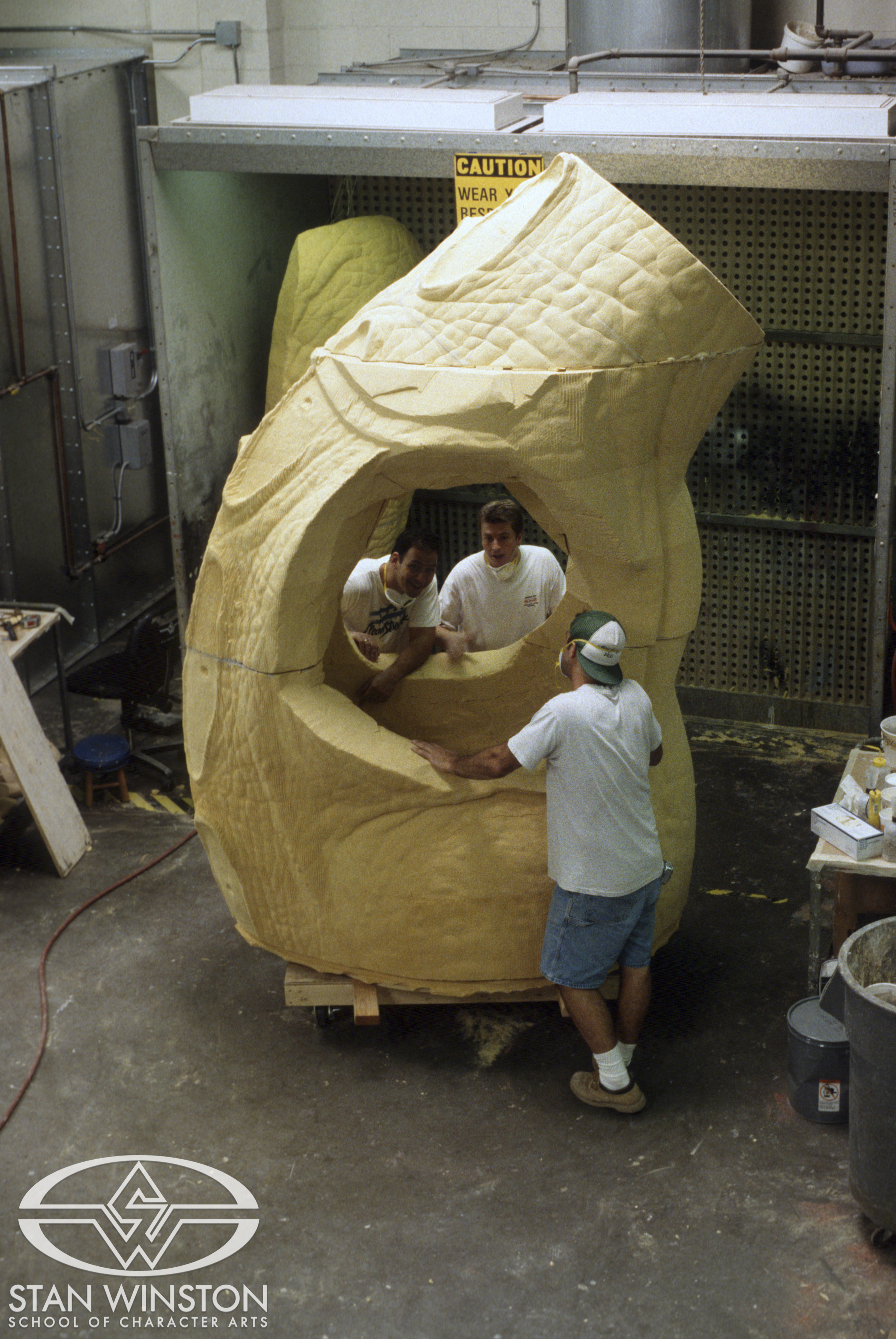 (Jim Charmatz, Mark Maitre, and Rob Ramsdell next to the adult Stegosaurus' computer-milled full-sized foam body.)
“This method gave us a lot more control over the final form,” added Chris Swift, “because we could do all the designing and tweaking in the computer before we even got it carved out — as opposed to tweaking it by hand over the course of weeks as you sculpt this huge thing out of clay. All of the foam pieces were exact replicas of what was done on the computer. We still had to put them together like a big puzzle, but each of the pieces exactly correlated to that part of the creature in the computer design.”
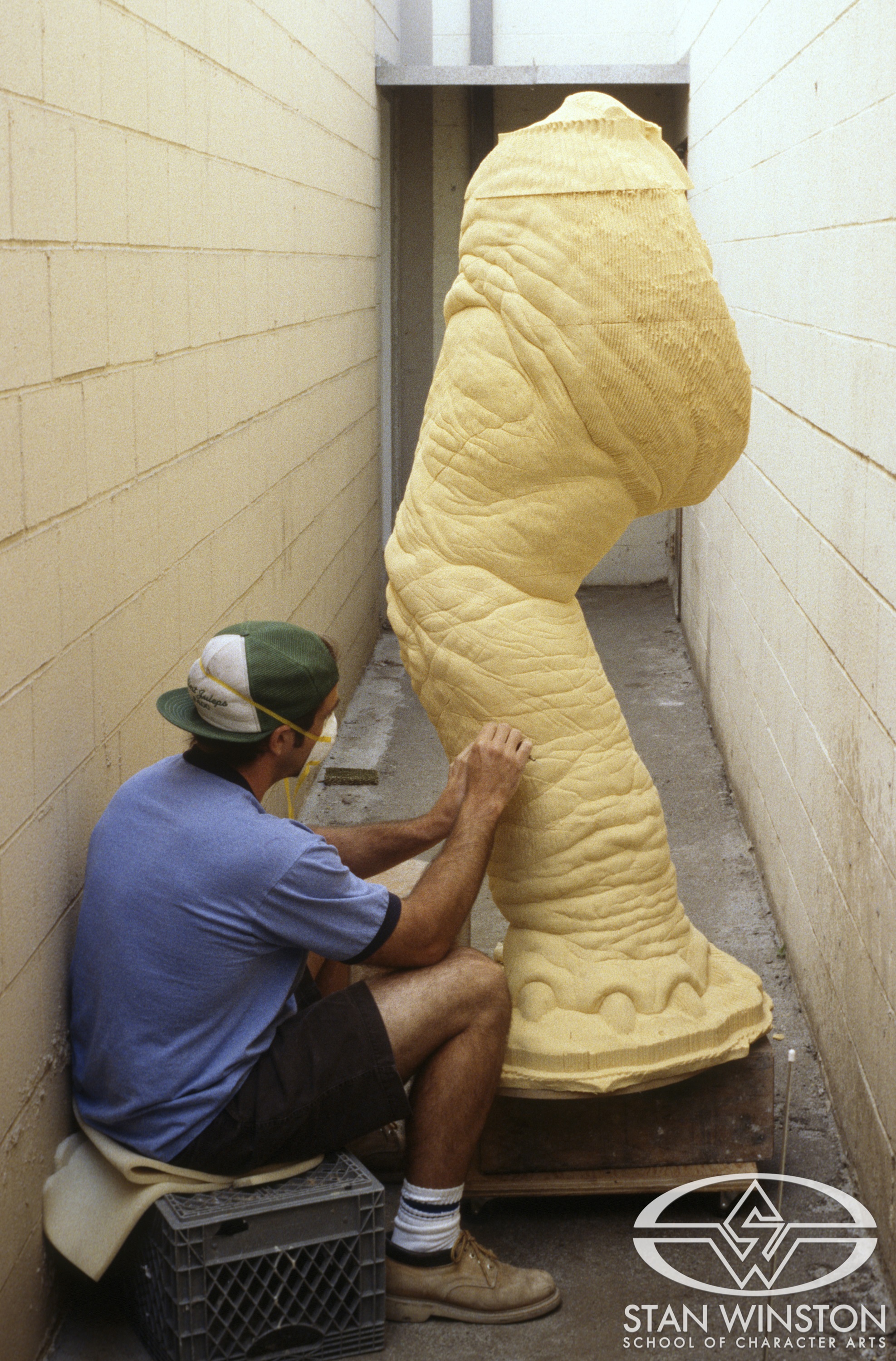 (Rob Ramsdell cleans out and carves details of one of the computer-milled foam legs of the adult Stegosaurus.)
 (Jim Charmatz, Ian Stevenson, and Mark Maitre carry the foam leg of the adult Stegosaurus.)
 (The assembled bottom half of the full-sized Stegosaurus' foam body.)
Although exact in form and proportion, the foam pieces lacked detail, requiring studio sculptors to go in and carve that detail into them after they were assembled. Rob Ramsdell and Paul Mejias were assigned the job of detailing the first adult Stegosaurus foam sculpture. “We had no idea what tools to use on this foam,” said Ramsdell, “because we’d always worked in clay. We just grabbed some loop tools and started experimenting with this stuff. There was a tendency with the foam to get hard edges, like a wood carving, so we had to learn how to avoid that. Also, we could do subtraction on it, but we couldn’t add anything like we could in clay, so we had to be careful. There was a lot to learn. But once we started figuring it out, it was great. It was very fast because so much of the final form was already there to start with. It had taken months to sculpt the T-rex, but we had the adult Stegosaurus all ready to go in a couple of weeks.”
 (Detail showing the molding process of the adult Stegosaurus' head.)
 (Mark Maitre details clay surface of the adult Stegosaurus head.)
The lighter weight of the foam pieces was another advantage. “There had been a lot of problems with the T-rex sculpture due to the weight of the clay. But with the foam, we could have a ten-foot dinosaur leg in front of us, and a couple of guys could pick it up and move it across the room, no problem.”
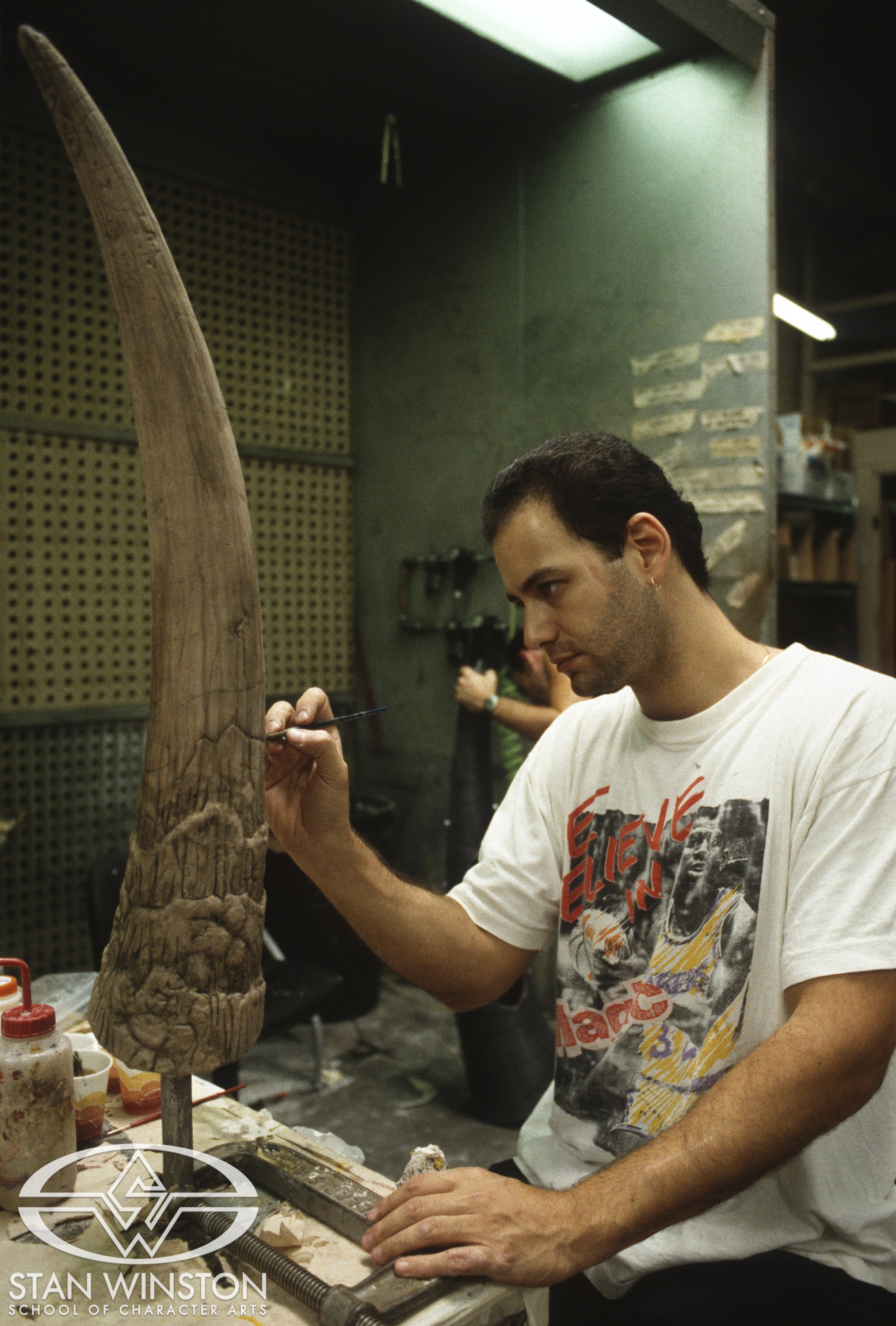 (Jim Charmatz details one of the Stegosaurus full-size tale spikes at Stan Winston Studio.)
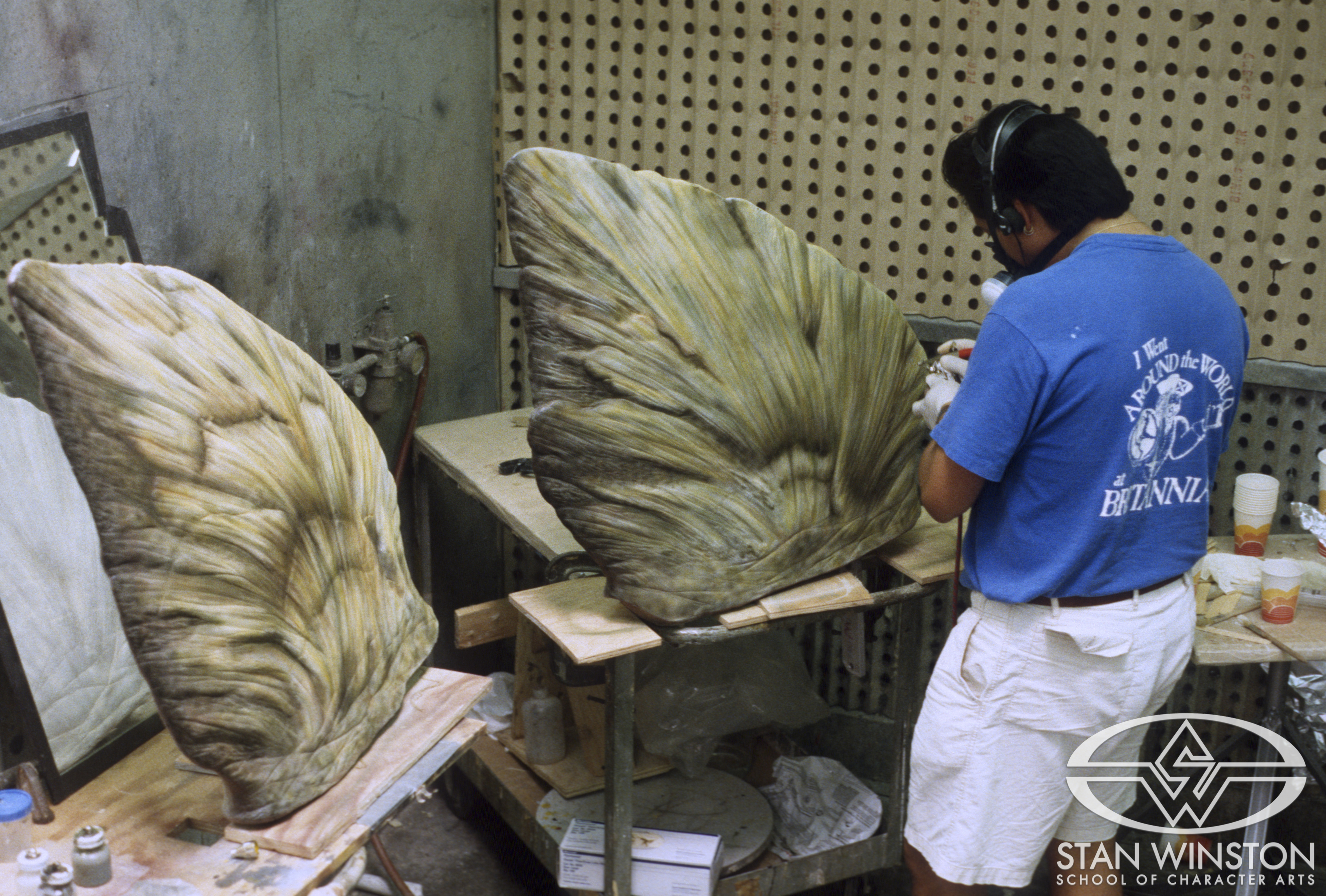 (Michael Ornelaz airbrushes the adult Stegosaurus' back plates.)
Operating the Adult Stegosaurus in Jurassic Park
The final adult Stegosaurus stood sixteen feet tall and measured twenty-six feet from nose to tail — at that time it was the second largest character ever built by Stan Winston Studio.
 (Mark Maitre paints the head of the full-sized adult Stegosaurus at Stan Winston Studio.)
To cut down on costs and weight, the crew had built the Stego’s head and neck, and from its rump section to the tip of its tail, leaving a gap in the middle. The plan was for Steven Spielberg to frame his shots so that either the Stego’s head or its backside would be in the frame — never the whole animal, head to tail.
 (The mechanical head and neck understructure of the adult Stegosaurus.)
Hydraulics and a computer-linked telemetry device controlled the head, neck, and tail, while radio controllers operated facial articulation. The sixteen plates along the Stegosaurus' spine were individually rigged with hydraulic cylinders, run off a mixing board with slider controls.
 (Ian Stevenson works on the animatronic Stegosaurus head.)
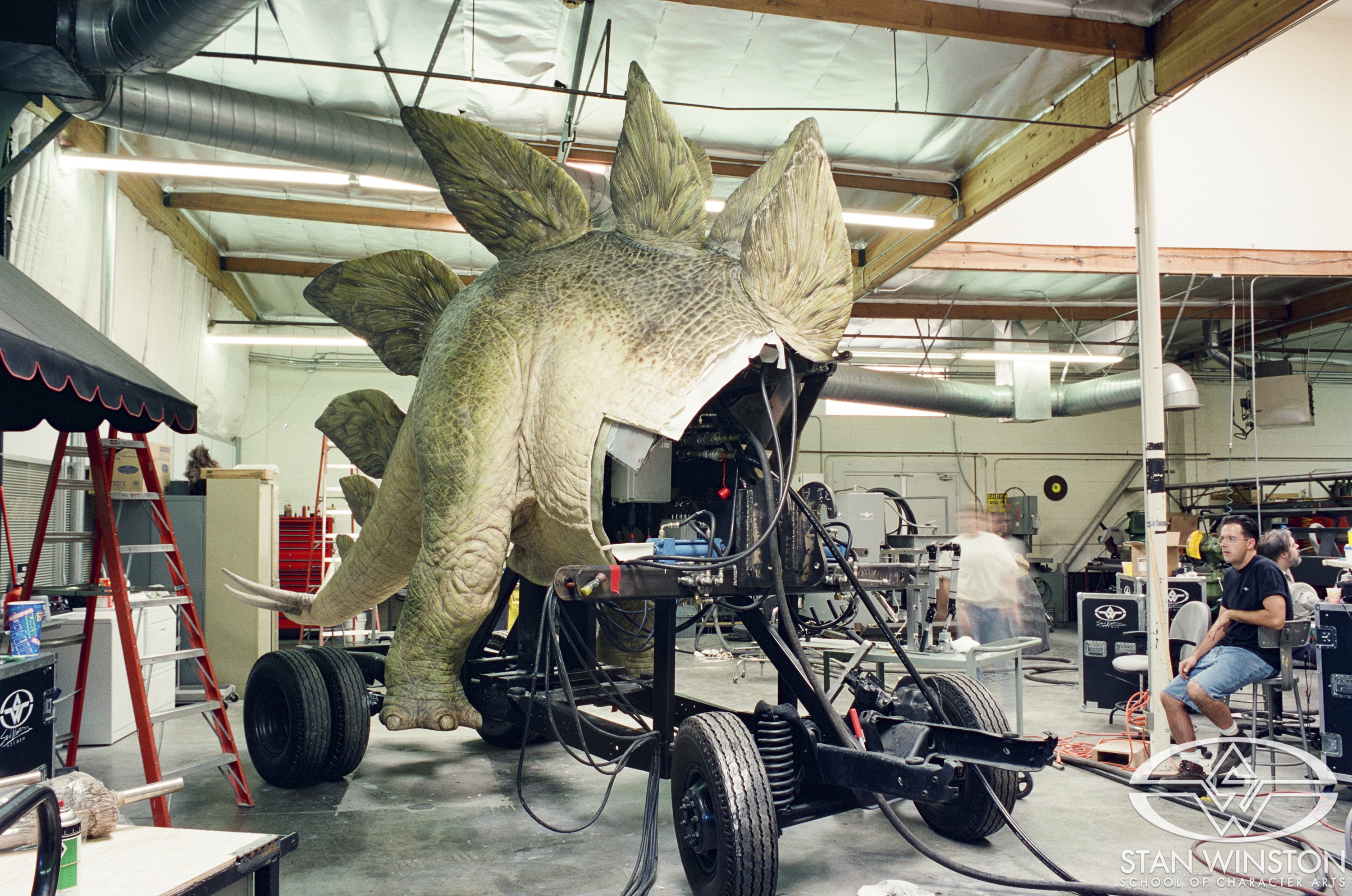 (Kirk Skodis and Emery Brown work on the animatronic back half of the adult Stegosaurus at Stan Winston Studio.)
The adult Stegosaurus was set up on the filming site in the redwood forest, but because of schedule changes, it was never filmed there. Instead, Spielberg moved it to later in the schedule, to be filmed by the second unit on stage at Universal, with Stan Winston and stunt coordinator Gary Hyams directing.
 (The Stegosaurus crew of artists, mechanics, and technicians pose in front of the backside of the final animatronic Stegosaurus puppet.)
“We had it all set up on location to whip its tail at Julianne Moore and then swing around and look at her,” said Shane Mahan, “but they never shot it. It was a shame because that had been a huge setup for us.”
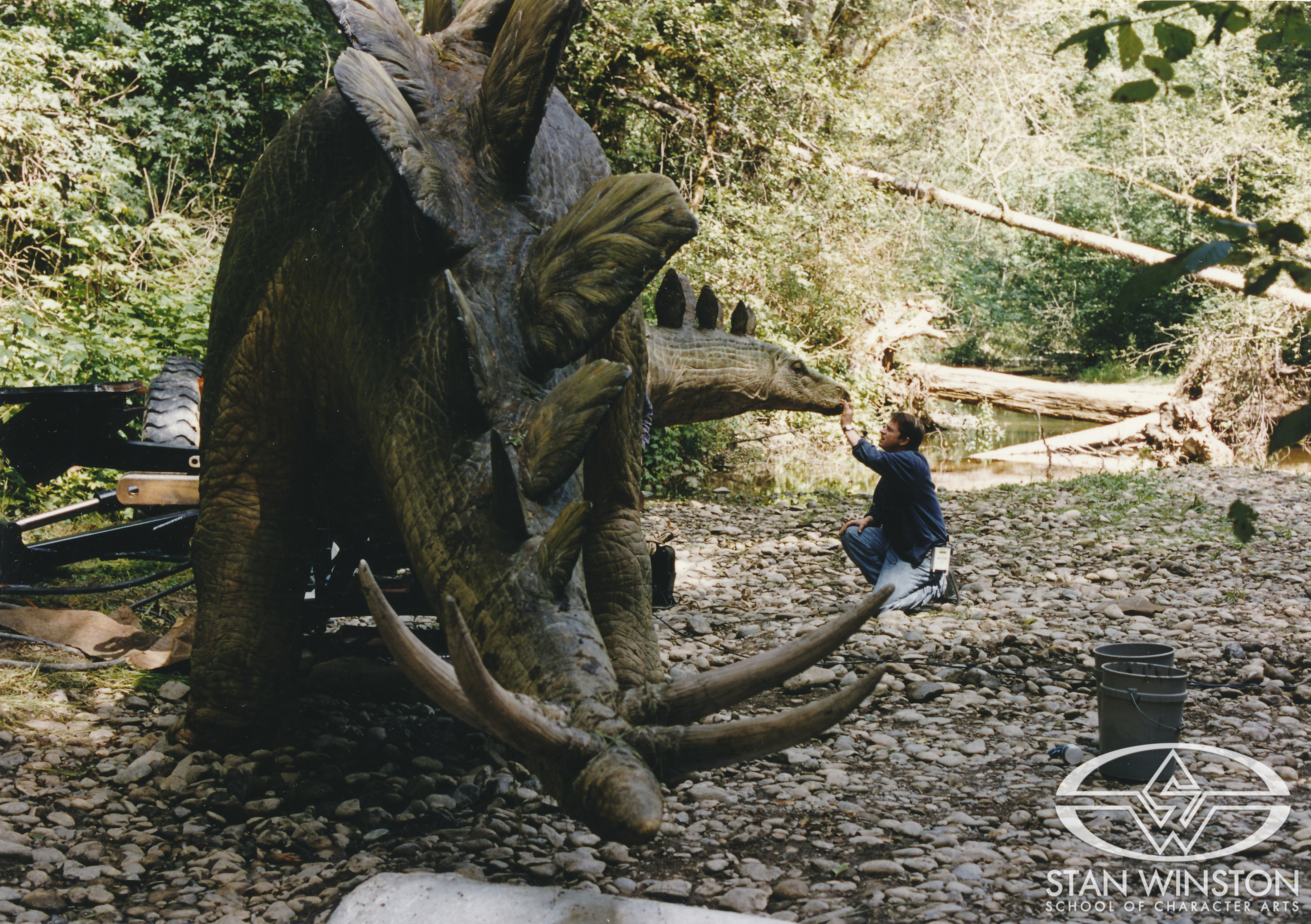 (The animatronic adult Stegosaurus on location with Mark Maitre.)
Behind the Scenes of the Baby Stegosaurus
However, the baby Stegosaurus—sculpted and painted by Dave Grasso and mechanized by Bob Mano —did get its moment to be filmed on location.
 (A baby Stegosaurus design by SWS artist Rion Vernon.)
 (Dave Grasso paints the baby Stegosaurus maquette.)
 (Sculpting the baby Stegosaurus at Stan Winston Studio.)
Like the other large dinosaurs, the baby Stegosaurus was hydraulically controlled through a telemetry device for gross body movements and head, neck, and jaw articulation.
 (Bob Mano works on the hydraulic section of the baby Stegosaurus.)
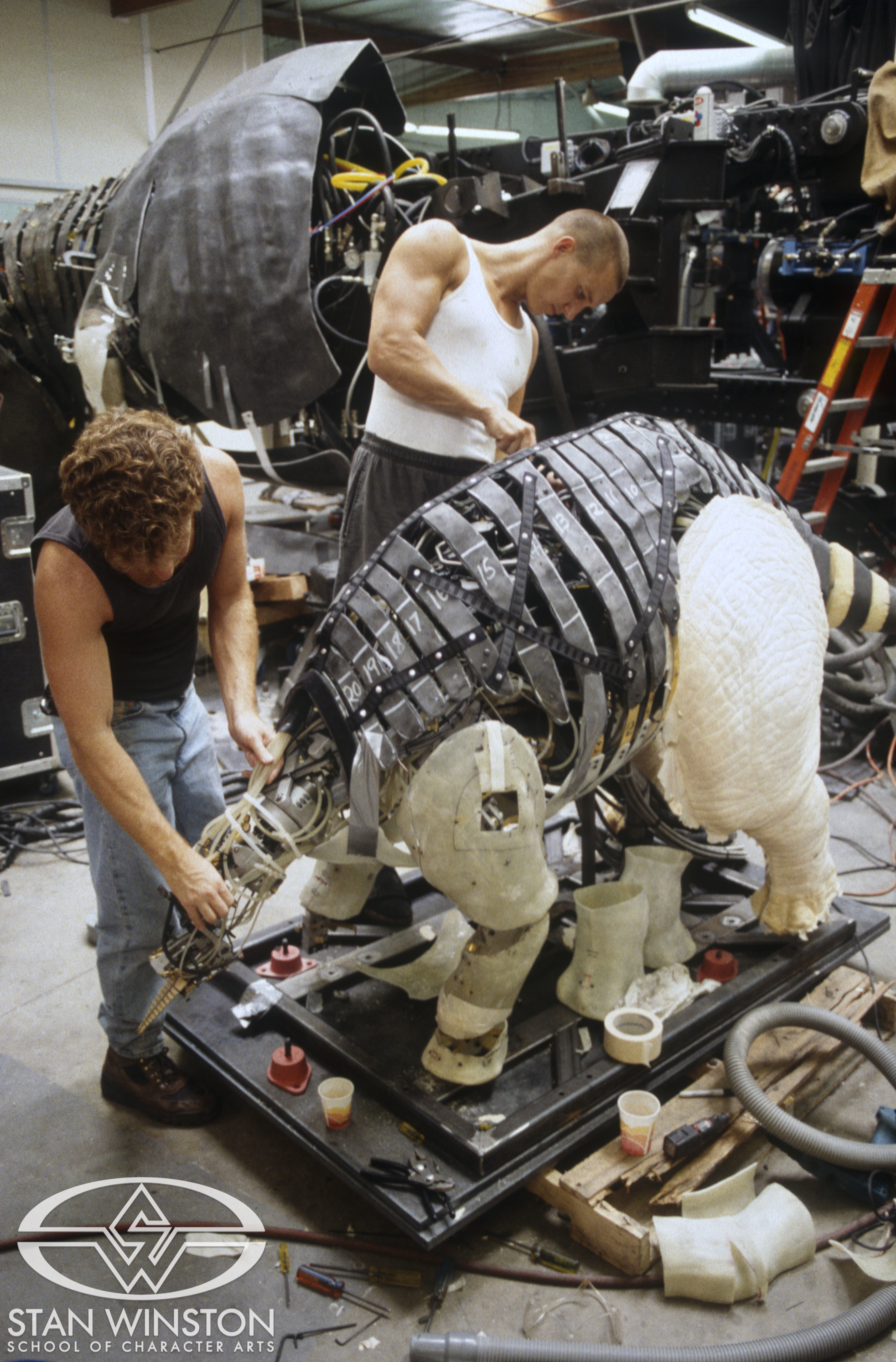 (Dave Grasso and Christian Lau prep the mechanical understructure of the baby Stegosaurus for skinning at Stan Winston Studio.)
VIDEO CLIP -- Testing the animatronic baby Stegosaurus at Stan Winston Studio for The Lost World: Jurassic Park:
"Oooh, ahhh, that's how it always starts. Then later there's running and screaming." The animatronic baby Stegosaurus at Stan Winston Studio for The Lost World: Jurassic Park. @amblin #animatronic #stegosaurus #jurassicjune #jurassicpark #stanwinstonstudio #dinosaur #stevenspielberg
Posted by Stan Winston School of Character Arts on Friday, June 18, 2021
Smaller functions, such as the eyes, nostrils, and tongue, were radio-controlled.
 (Dave Grasso completes the skin glue down on the nearly finished animatronic baby Stegosaurus at Stan Winston Studio.)
The completed baby Stegosaurus measured four-and-a-half feet tall, seven feet long, and weighed 400 pounds.
 (Dave Grasso does final touchups on the animatronic baby Stegosaurus on location.)
- Blog assembled by Adrienn Lingurár with selections from The Winston Effect: The Art and History of Stan Winston Studio by Jody Duncan
To Create Your Own Dinosaurs, Check Out These Courses
- How To Sculpt A Dinosaur Part 1 - Armature Building & Sculpting Primary Forms with Chris Darga
- How To Sculpt A Dinosaur Part 2 - Secondary Forms & Finishing Techniques with Chris Darga
- How To Make A Dinosaur - Part One: Design, Foam Carving & Fabrication with Ted Haines
- How To Make A Dinosaur – Part Two: Carving Teeth, Adding Detail & Texture with Ted Haines
- How To Make A Dinosaur - Part Three: Painting & Finishing with Ted Haines
- Oversized Eyes Part 1: Digital Sculpting & 3D Printing with Sam Polin
- Oversized Eyes Part 2: Molding & Casting with Rob Hinderstein
- Oversized Eyes Part 3: Paint Layering & Finishing with Rob Hinderstein
Courses with the Creators of The Lost World: Jurassic Park
- Special Effects Sequence Design with Shane Mahan
- Hybrid Characters: Blending Practical & Digital FX with John Rosengrant
- Maquette Painting Techniques with Trevor L. Hensley
- How To Sculpt A Character Makeup with Bruce Spaulding Fuller
- Character Makeup - Multi-Piece Prosthetic Application with Bruce Spaulding Fuller
- Animatronics Design Basics with Richard Landon
- Cable Mechanism Basics - Tentacles with Richard Landon
- How to Make a Monster Puppet - Rods & Cables with David Monzingo
- Makeup Blood FX - Blow Your Brains Out with David Monzingo
- Hybrid Character Design: Practical To Digital with Christopher Swift
- Portrait Illustration Part 1: Pencil Drawing Techniques with Terry Wolfinger
- Portrait Illustration Part 2: Painting with Photoshop with Terry Wolfinger
- Introduction to Hair Knotting with Michael Ornelaz