
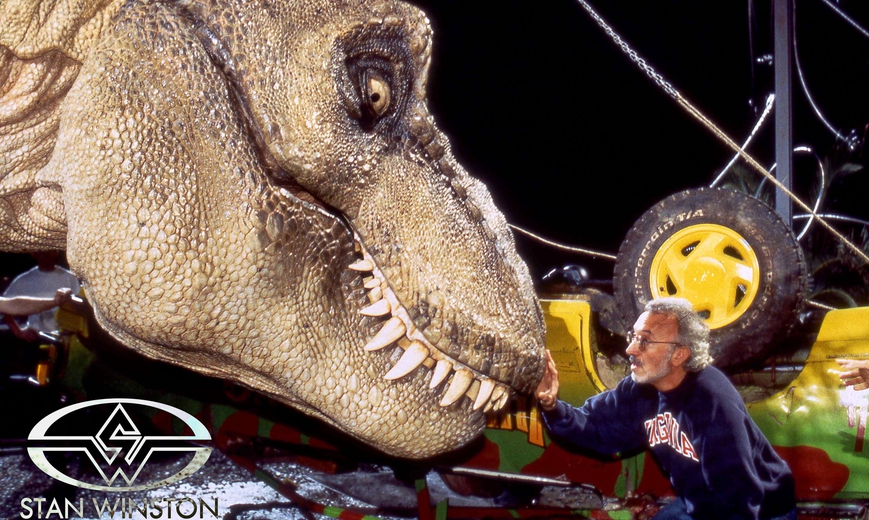
Shooting the T-Rex Scenes for Jurassic Park
The last three weeks of principal photography on Jurassic Park were devoted exclusively to shooting the T-rex scenes on the largest sound- stage at Warner Bros. Studio. Prior to filming, the T-rex rig had been transported to Warner Bros. without its outer skin attached so that Winston’s crew could test the hydraulics on stage before enclosing the mechanical armature in foam rubber. After all the hydraulics were tested and hooked up, a crew stayed late one night to glue the foam rubber skin onto the construct.
Jump To Section
- Pulling and Fitting the T-Rex Skin
- Alan Scott, the World's Bravest FX Guy
- A Near Death by T-Rex
- Working With a Huge Animatronic T-Rex
- The Biggest Mechanical Actor in Film History
 (Stan Winston and crew with the fully-assembled T-Rex at Warner Bros. Studios.)
 (Evan Brainard, Stan Winston & Alan Scott work on the full-sized T-Rex puppet, before the skin has been attached.)
Pulling and Fitting the T-Rex Skin
“We had to actually pull the skin on, glue it down from the inside, and sew it all up once we were there,” said Alan Scott. “The skins were so long, you could only reach in a couple of feet from either end; and so, there was this whole section in the middle that you could only glue down by crawling into the armature. It had to be done in the sculpted position, too. The T-rex had to be powered up and held in that pose.”
 (Stan Winston Studio crewmembers Mike Trcic, Alan Scott & Lindsay Macgowan fit the T-Rex's foam rubber skin onto the mechanical understructure.)
Alan Scott, the World's Bravest FX Guy
Scott volunteered for the job, climbing inside the rig with a bucket of glue and a brush. “If the power was shut off for some reason,” said Scott, “the head would move from its powered-up position to its powered-down position — and all of the hydraulic cylinders and sheets of metal inside would move. So, as I was crawling inside this thing, I said to the guy on the controls: ‘Don’t shut it down, and make sure nobody trips on this cord. I’m going to be inside, and if this thing moves, with all those hydraulics inside, I’m dead.’”
 (Before gluing the skin in place, the Stan Winston live-action dinosaur crew put the T-Rex through extensive mechanical testing to make sure everything was working just right.)
A Near Death by T-Rex
Scott was well inside the interior of the rig, slapping glue onto the underside of the skin when, as Murphy’s Law would have it, the power went out in the entire studio. “Suddenly, I could hear the hydraulics stop and the power start going down. And I could hear a muffled shout from outside, ‘There’s someone inside the T-rex!’ All I could think of were these big hydraulic cylinders and giant metal sheets shearing across each other, with me in the middle of it all. I pulled my hands and legs in as tightly to my chest as I could, and just stayed like that, hoping no part of my body would get caught in all that moving metal. It wasn’t until it came to a complete rest that I realized I wasn’t going to get hurt. The head dropped down until the nose was a couple of feet from the ground, and three or four guys pried open the jaw and pulled me out.”
 (Mike Trcic and Tim Nordella at work on the giant animatronic T-Rex puppet.)
Working With a Huge Animatronic T-Rex
The power and potential danger of the T-rex was never far from Winston’s — or any crewmember’s — mind, as they had all witnessed it up close and personal during trial runs at the studio. “Whenever we saw it glitch even a little bit, it was scary,” Scott said. “When we were testing it in the shop, because of the relatively small space there, we’d be standing right next to it as this wall of flesh and machinery came roaring toward us. It was very unsettling.”
 (SWS crewmembers pose with the massive T-Rex robot.)
The Biggest Mechanical Actor in Film History
Despite the danger, Stan Winston Studio had accomplished an incredible feat, building the biggest, most director-friendly mechanical actor of all time. That achievement was just one of many realized for Jurassic Park, easily the most exciting project of Winston’s career to that point.
 (Stan Winston confers with one of his proudest (and deadliest) creations: the T-Rex from Jurassic Park.)
“We had more fun creating dinosaurs for Jurassic Park than we’d ever had before,” Winston said. “I think that fun mirrored the fun that John Hammond, the character in the movie, was having in creating his dinosaurs. In the story, he was creating something that had never been done before, and so were we. He wanted to entertain the world by letting them see real dinosaurs for the first time, and so did we."
-Jody Duncan
Excerpt from "The Winston Effect: The Art and History of Stan Winston Studio"
Courses with the Creators of Jurassic Park
- Robot Brains - Animatronic Character Servo Control with Rick Galinson
- Hybrid Characters: Blending Practical & Digital FX with John Rosengrant
- Hybrid Character Design: Practical To Digital with Christopher Swift
- Special Effects Sequence Design with Shane Mahan
- Oversized Eyes Part 2: Molding & Casting with Rob Hinderstein
- Oversized Eyes Part 3: Paint Layering & Finishing with Rob Hinderstein
- Animatronics Design Basics with Richard Landon
- Cable Mechanism Basics - Tentacles with Richard Landon
- Animation For Animatronics Part 1: Intro To Pololu, Maya & AnimServo with Craig Caton-Largent
- How To Build An Animatronic Head Part 1 - Creating Mechanical Underskull with Craig Caton-Largent
- Mastering Effects Disasters - Explode A Head with Andy Schoneberg
- Remote Makeup Application Part 1: Prosthetic & Kit Preparation with Andy Schoneberg
- Garage Monsters - How To Make Creature FX On A Budget with Shannon Shea
- The Business Of Making Monsters - Part 1 with Shannon Shea
- Metallic Painting Techniques - Robot Finishes (Terminator) with Rob Ramsdell