
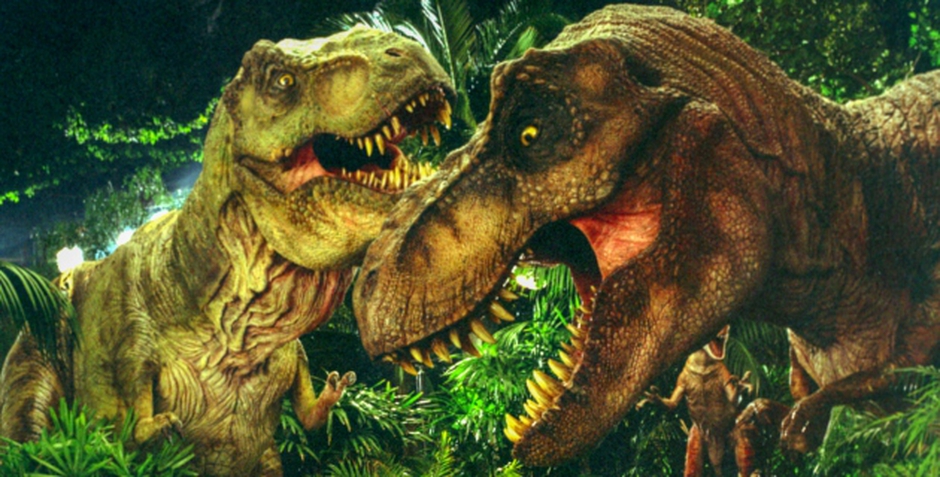
When Steven Spielberg decided to return to Isla Sorna for the 1997 sequel, the directive was clear: everything had to be bigger, more complex, and significantly more terrifying. For Stan Winston Studio, this didn't just mean upgrading the existing technology—it meant fabricating an entirely new apex predator to share the screen with the original queen of Jurassic Park.
In this behind-the-scenes excerpt from Jurassic Party Part 2: The Lost World Dinosaur Crew Reunion, key members of the original crew, including John Rosengrant, J. Alan Scott, Richard Landon, and Mark 'Crash' McCreery, talk about bringing another life-size Tyrannosaurus Rex to the screen for The Lost World: Jurassic Park.
To watch The Lost World: Jurassic Park - Behind The Male T-Rex video from Jurassic Party Part 2, click the player above!
Jump To Section
- Designing the Male T-Rex, aka "Tyrannosaur Buck," for The Lost World: Jurassic Park
- Why the Male T-Rex Lost Its Tail
- The Logistics of Two Life-Size Tyrannosaurus Rex
- Preparing the Double T-Rex Attack
- Testing the Hydraulic Skeleton of the Male T-Rex with a Stuntman
Designing the Male T-Rex, aka "Tyrannosaur Buck," for The Lost World: Jurassic Park
For the first movie, Stan Winston Studio built a single, iconic female T-Rex. For the sequel, the script called for a mated pair. This required the studio to evaluate how to efficiently scale up its assets. The foundational framework was already resting in the shop, but it needed massive modifications to become a completely separate character.
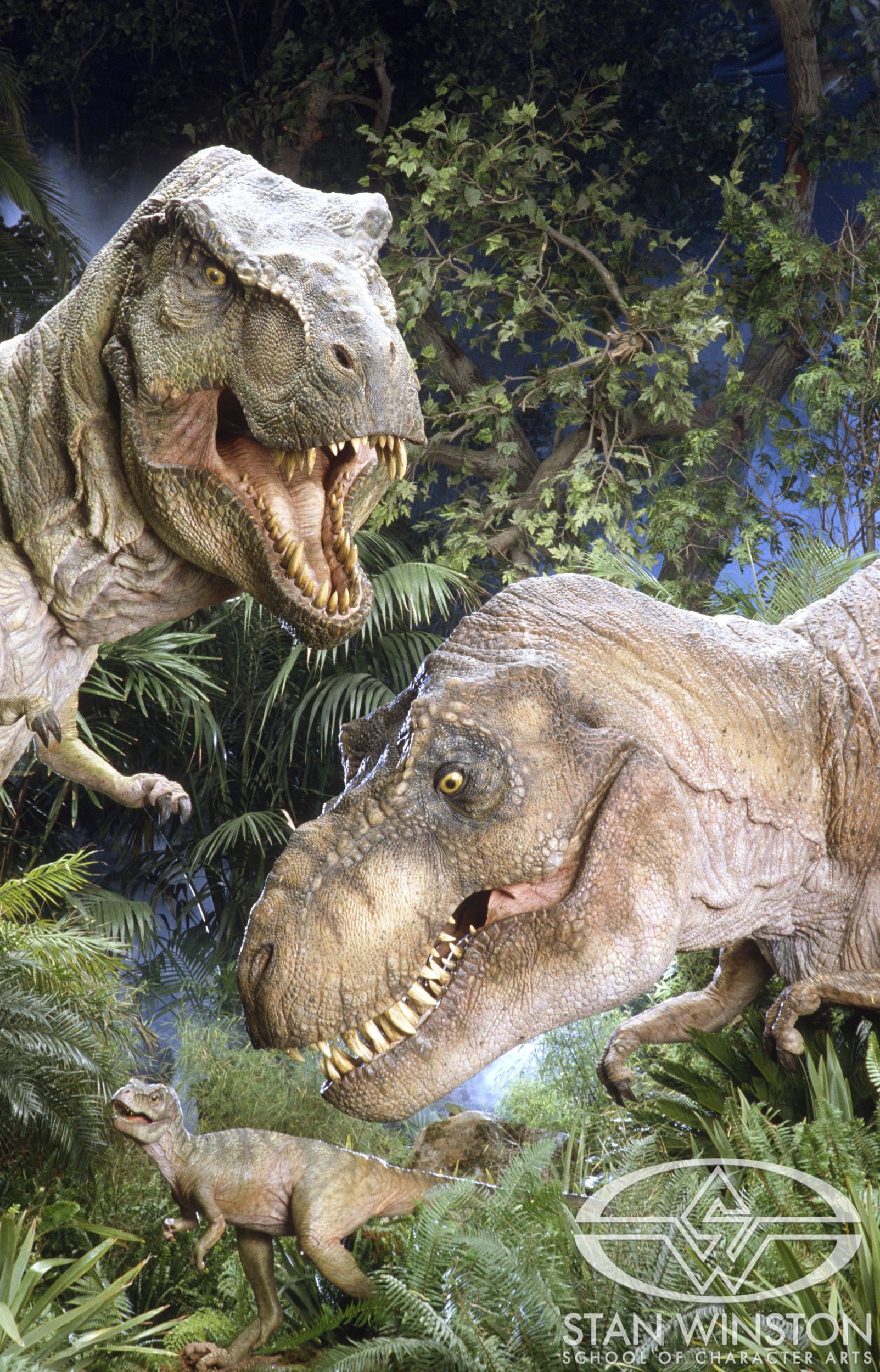 (The T-Rex family of The Lost World: Jurassic Park.)
Instead of starting from scratch, SWS reused the original female from Jurassic Park and got to work designing her mate, "with new skins...a new paint scheme; and then we added some appliances to kind of change up his look from hers," said creature effects supervisor, John Rosengrant.
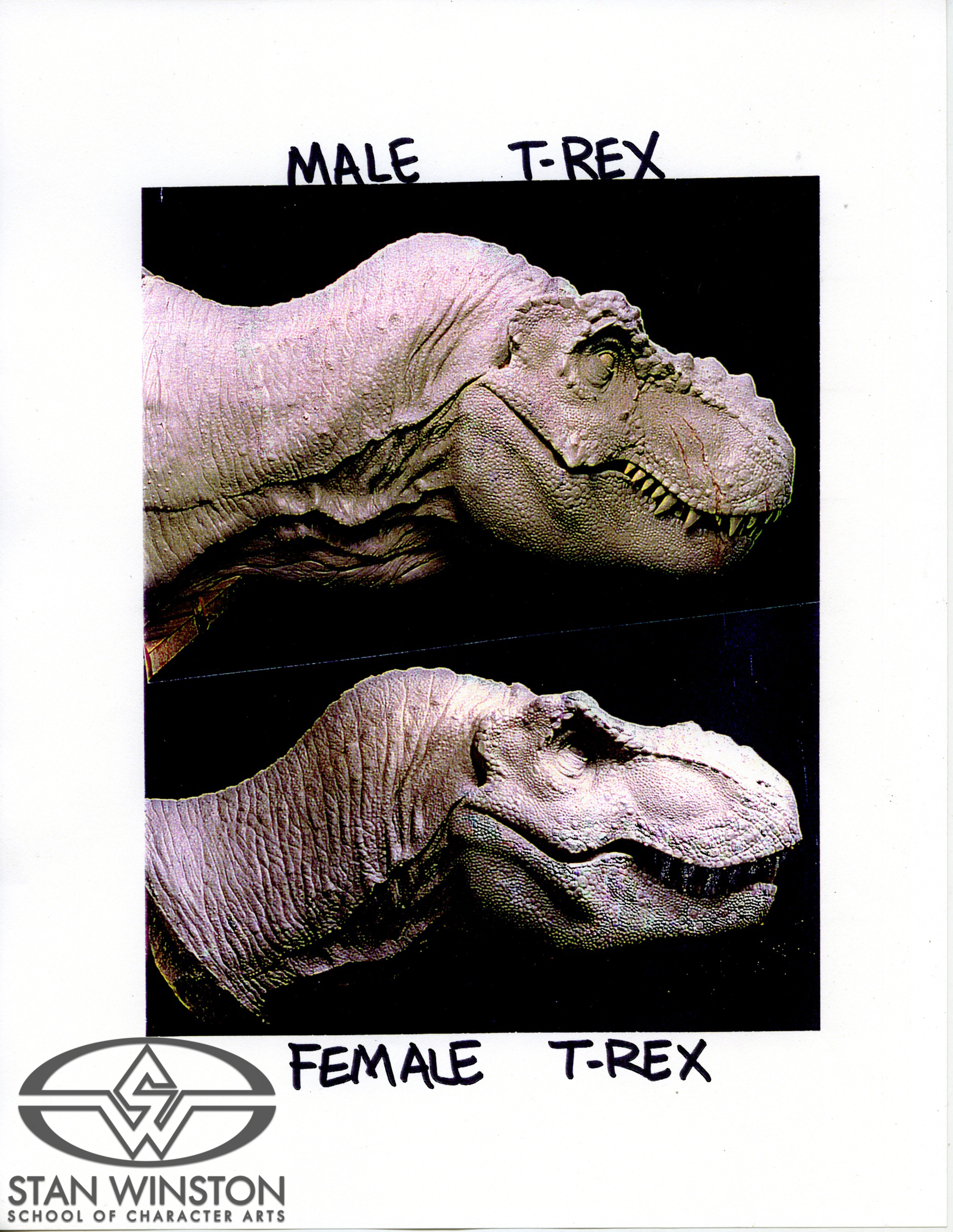 (Side views of the male and female T-Rex models built by Stan Winston Studio, showcasing the differences between the two dinosaurs.)
To differentiate the two, concept artist Mark 'Crash' McCreery took inspiration from nature. "I think there might have been a quick sketch," McCreery recalled. "In nature, most of the time, the male is more colorful or has a little more ornamentation. So we were taking cues off of that."
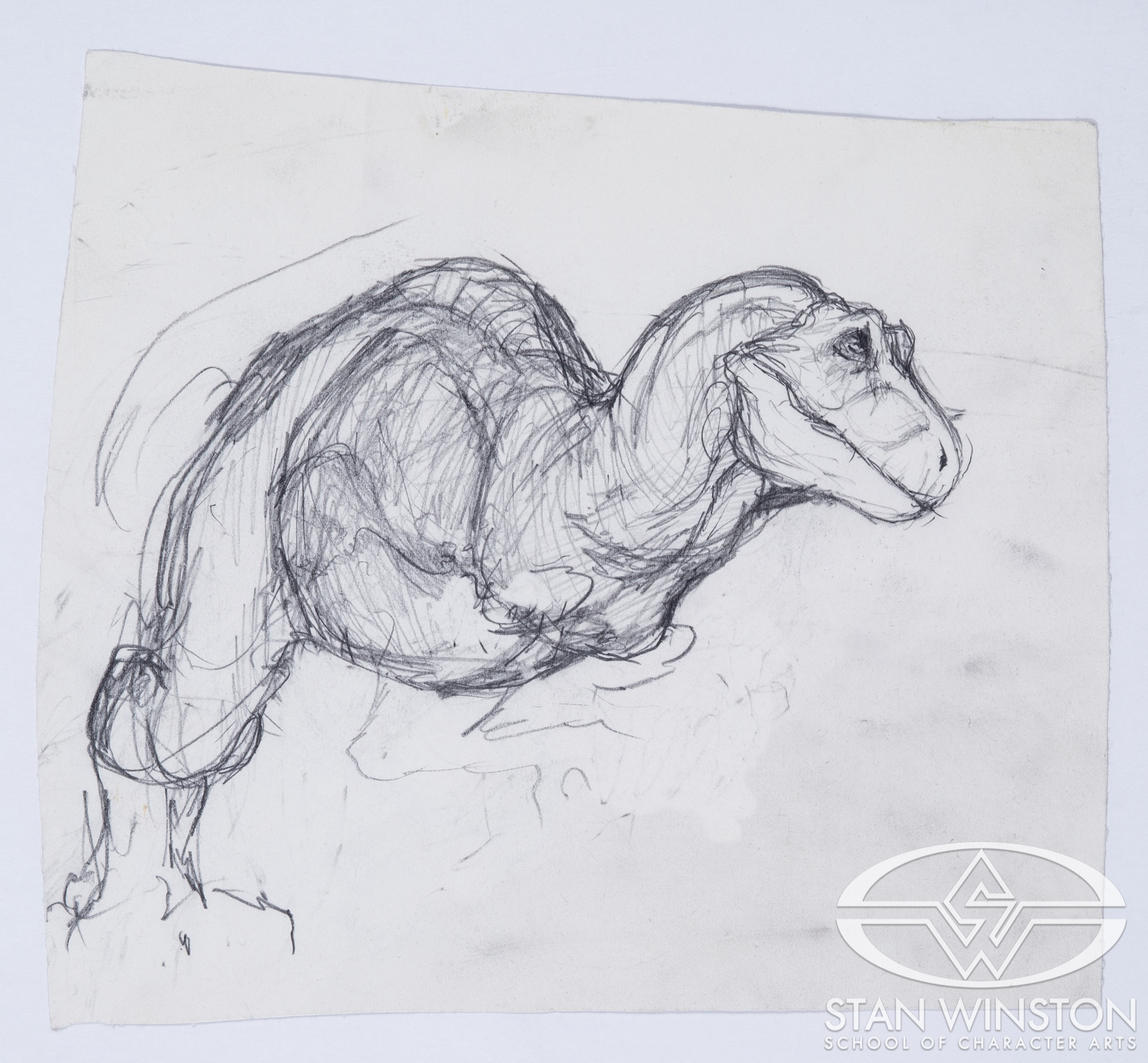 (Sketch of the male T-Rex by Mark 'Crash' McCreery.)
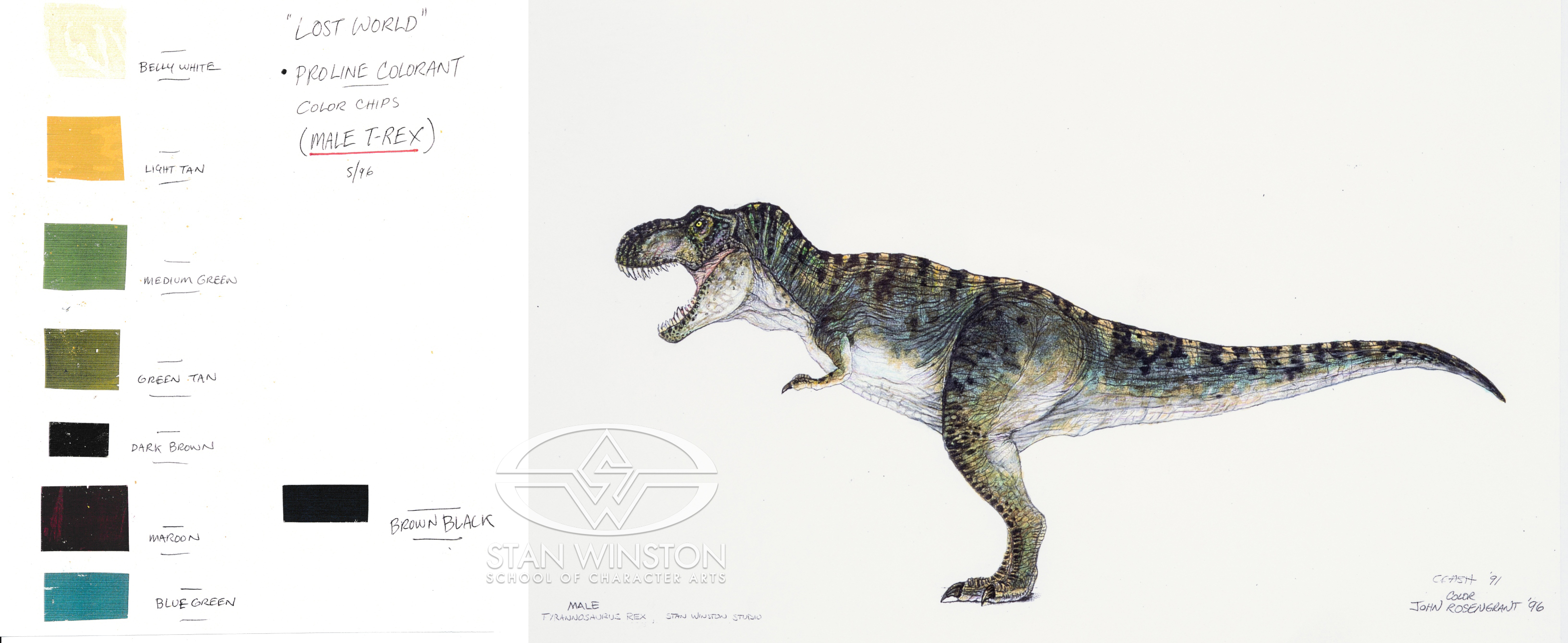 (Male T-Rex concept based on Mark 'Crash' McCreery's original artwork and the related color palette by John Rosengrant.)
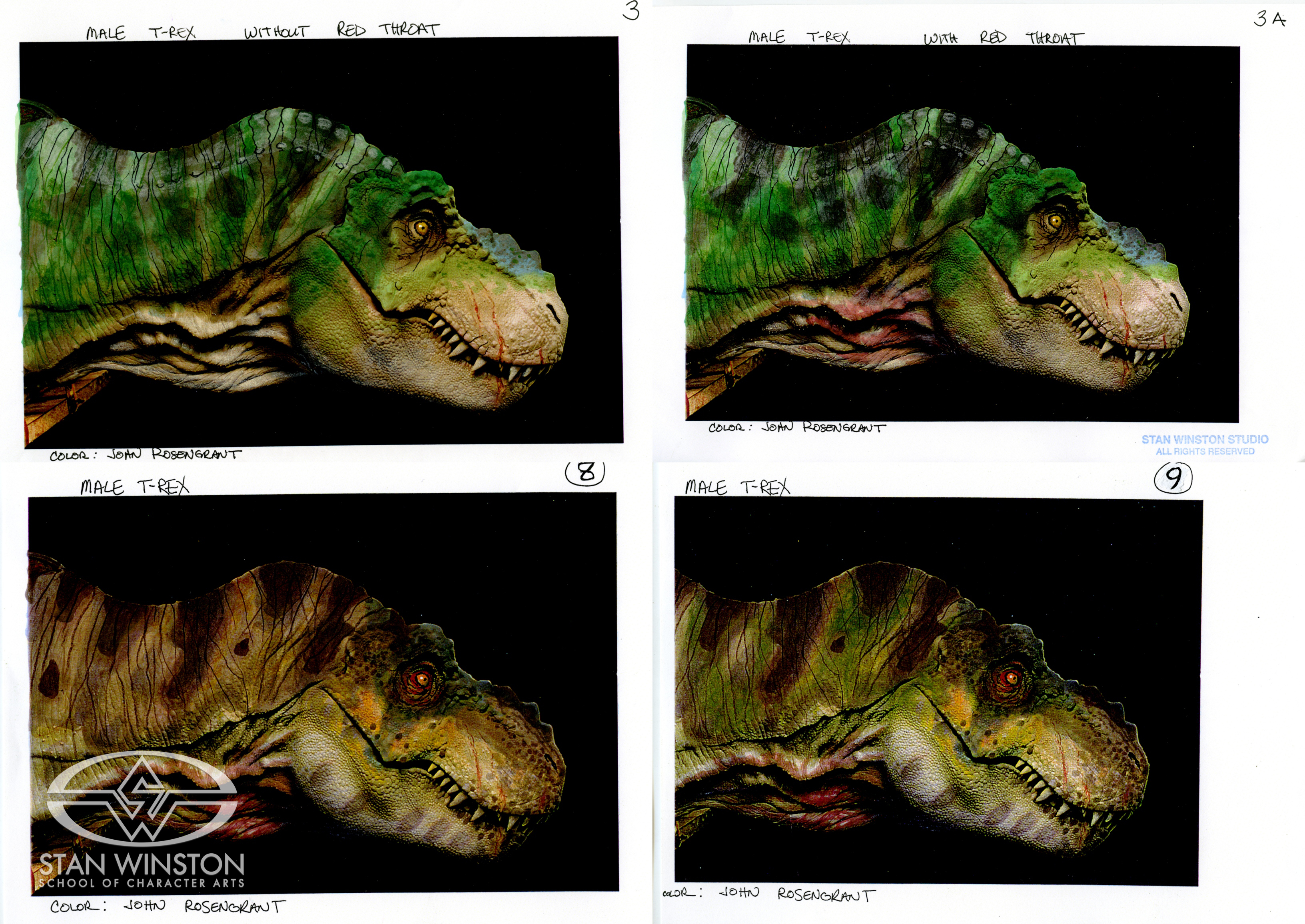 (Color variations for the male T-Rex by John Rosengrant.)
Rosengrant devised a green-tone color scheme and made structural changes to a fifth-scale maquette, giving the male T-Rex a more pronounced, rugged brow and a throat wattle.
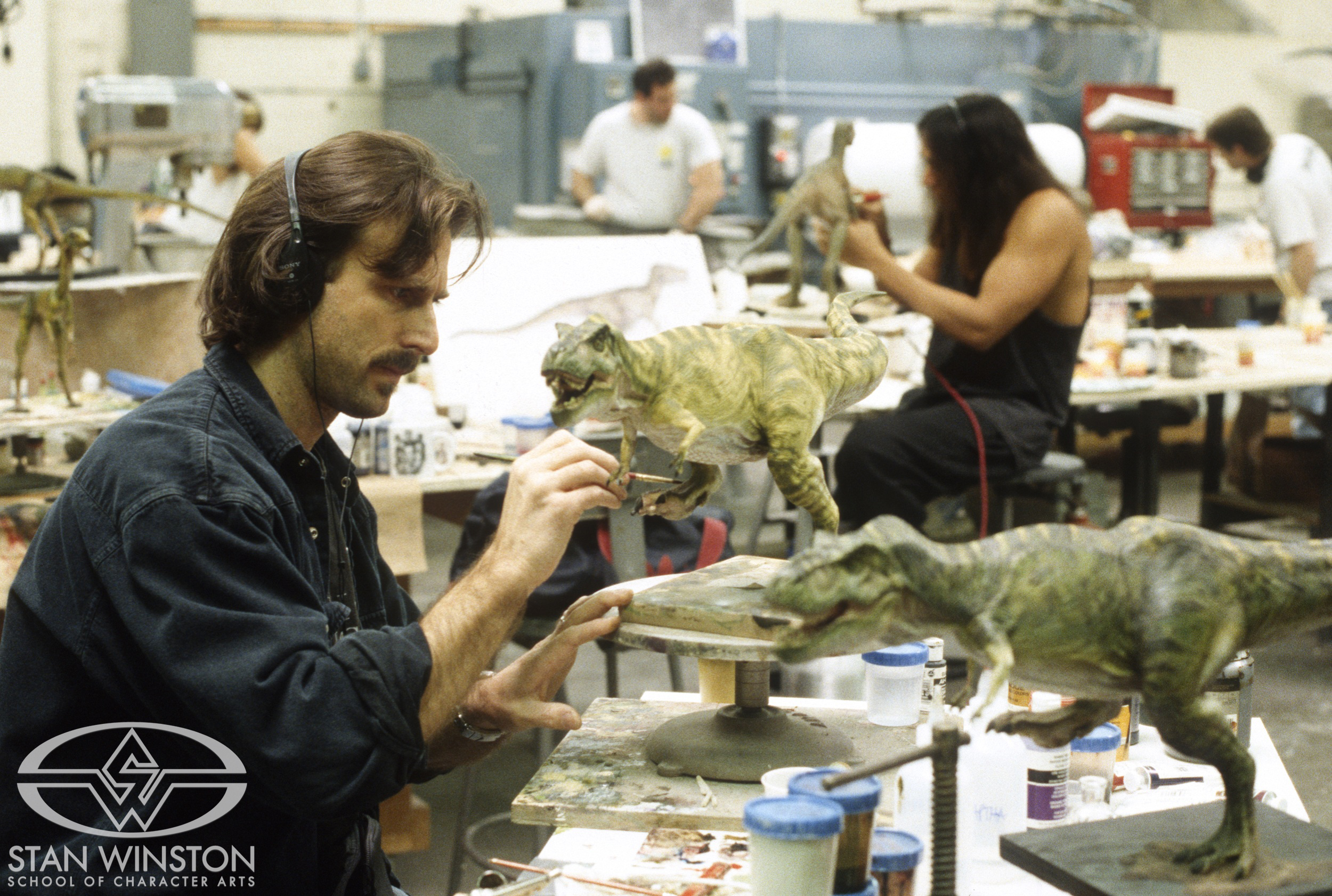 (John Rosengrant paints one of the 1/5th scale male T-Rex maquettes at Stan Winston Studio.)
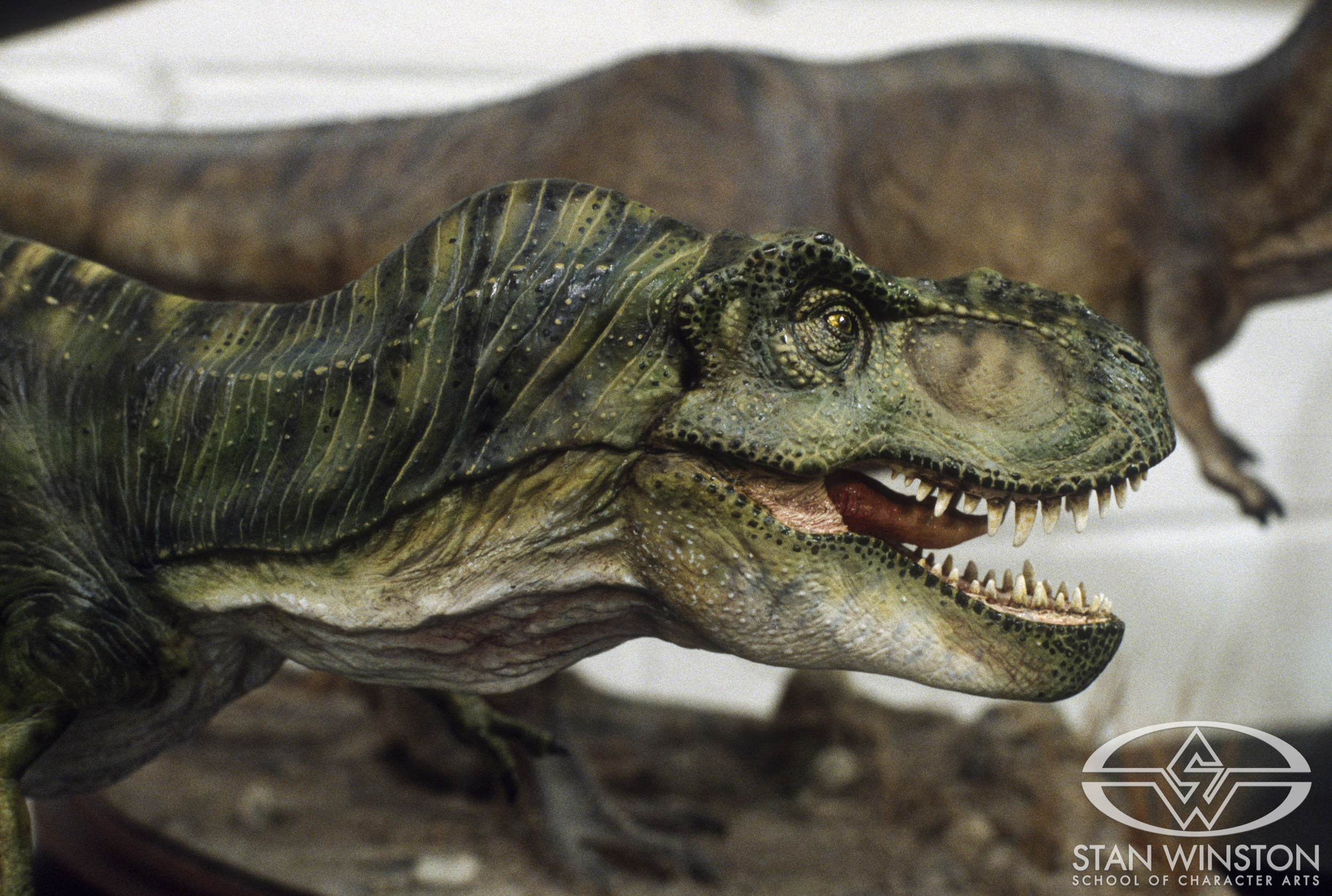 (The finished 1/5th scale male T-Rex maquette.)
Why the Male T-Rex Lost Its Tail
After analyzing what worked on screen in 1993, SWS adjusted its engineering strategy for the sequel. "I did a sculpt on the fifth scale... it was distinctive, but it was a different philosophy...we figured out from the first movie that we didn't really use the tail...when they were showing the Rex from nose to tail, it was the CG one," noted Rosengrant. "So, once again, things were being tailored now...who's going to do what and what's the purpose of it and why we need it."
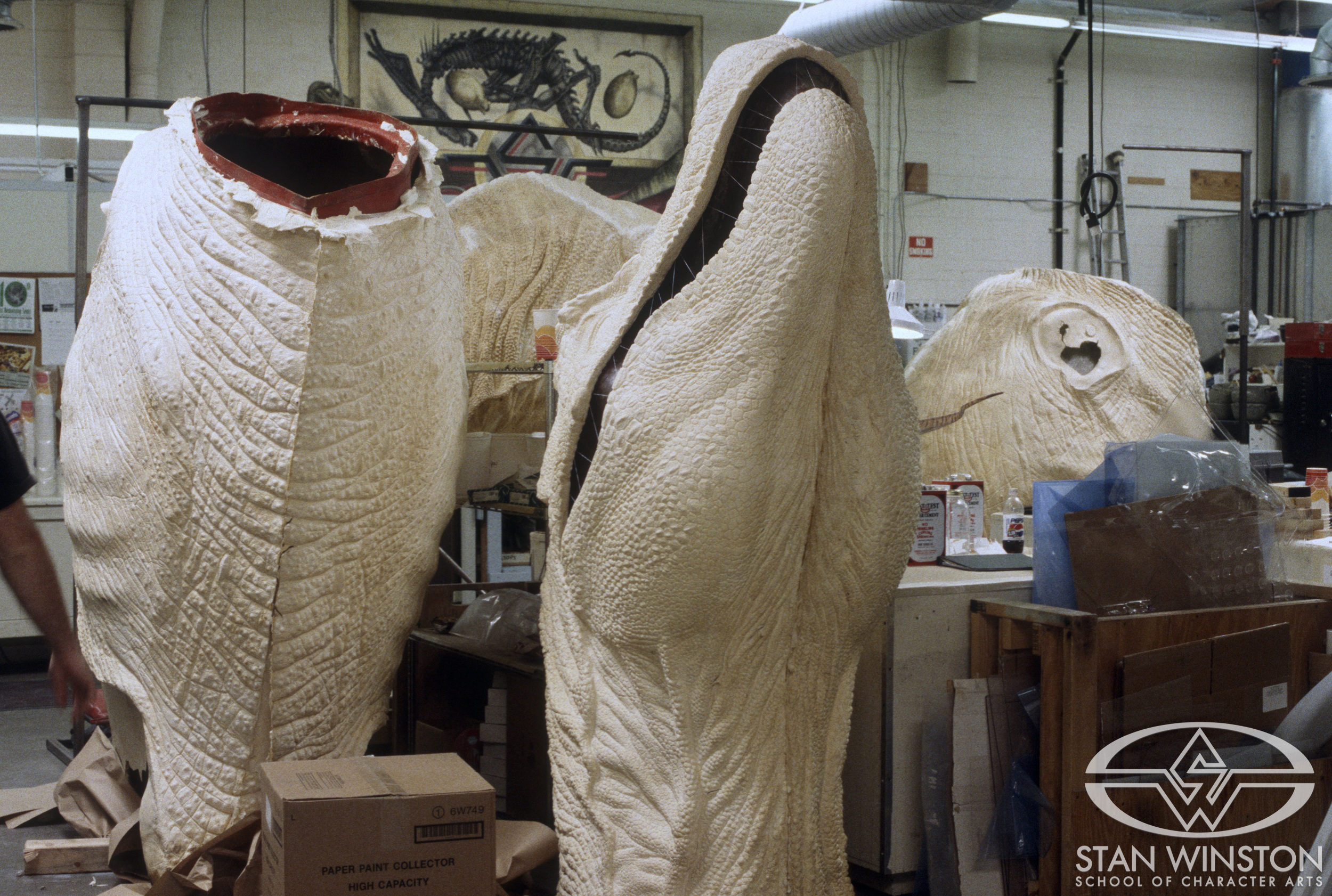 (Various male T-Rex foam body parts at Stan Winston Studio.)
Because SWS knew the practical animatronics wouldn't be used for full-body wide shots, they didn't build a tail for the physical animatronics; instead, the crew redirected their engineering power toward what truly mattered: making the massive body move convincingly through space.
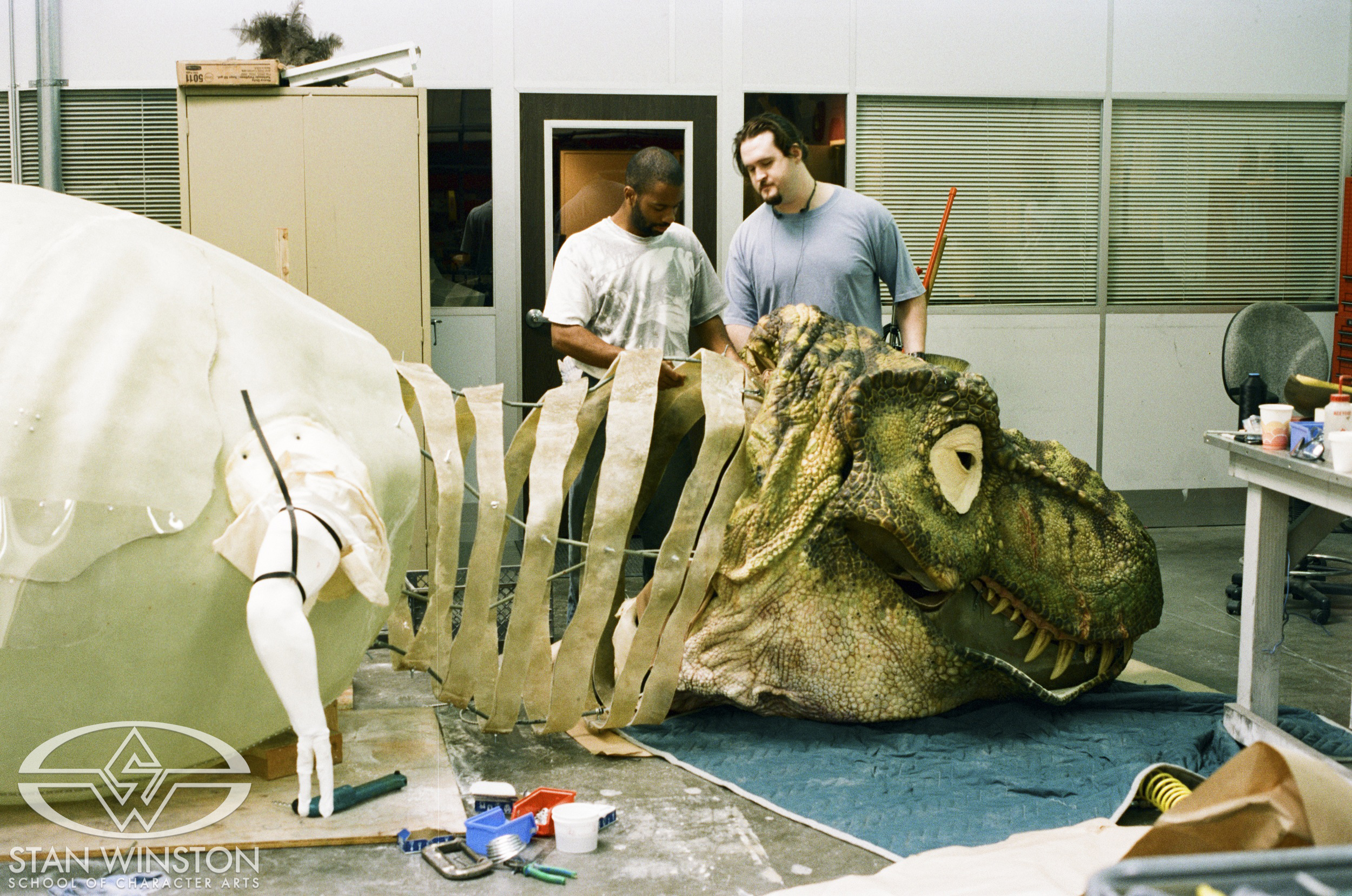 (Lance Gilmer and Trevor Hensley test-fitting the male T-Rex head's foam latex skin.)
The Logistics of Two Life-Size Tyrannosaurus Rex
Bringing two multi-ton animatronics onto the set was what Rosengrant called "tough sledding." And to match Industrial Light & Magic's (ILM) CG dinosaurs, the practical versions couldn't remain static; they needed to appear to be actively taking steps and shifting their massive weight. "Puppeteering those, we had two crews, and it was Michael Lantieri... and his team [who] worked hand in hand with us on the physical effects side of this," added Rosengrant.
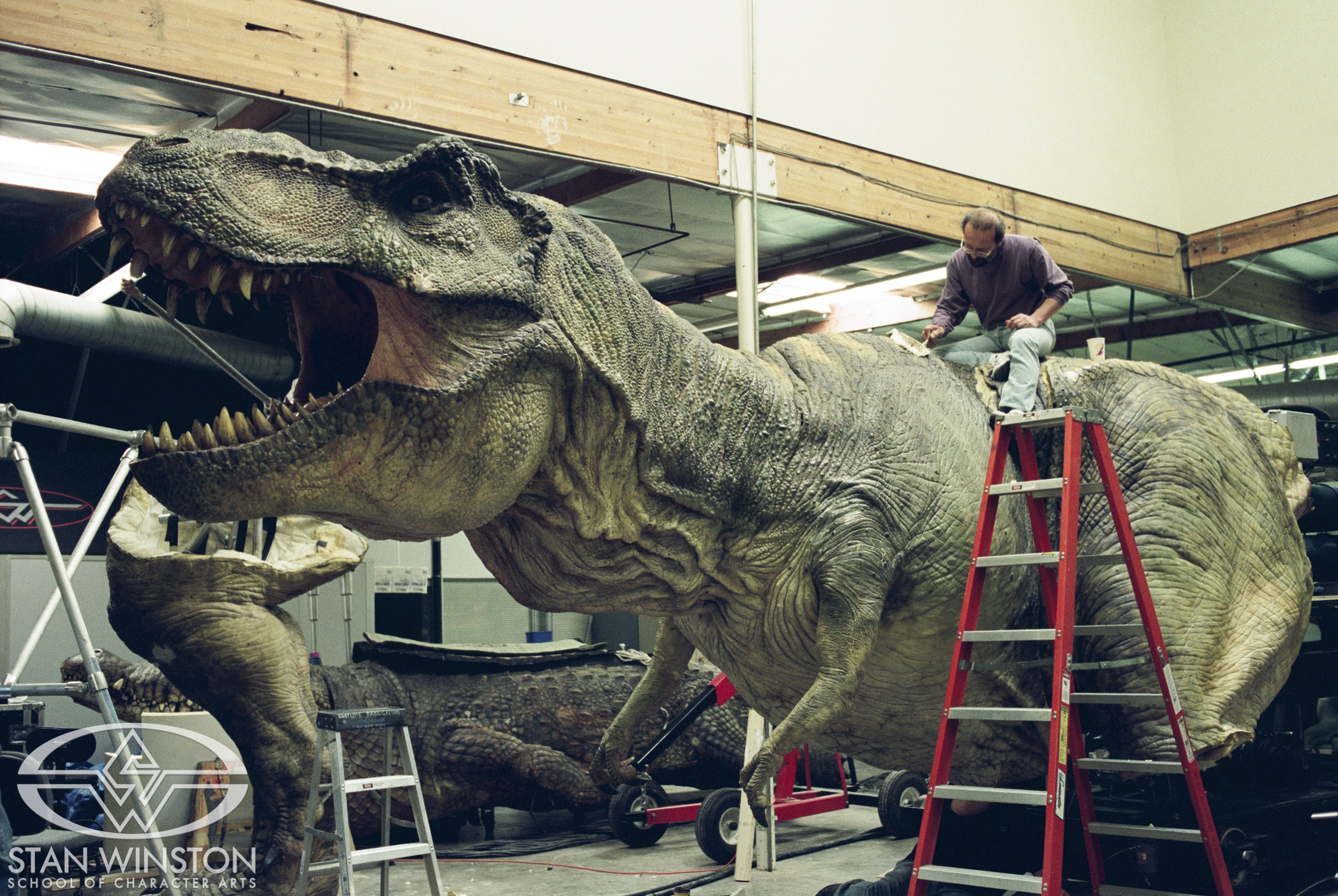 (Joe Reader works on the foam latex skin on the life-size male T-Rex's animatronics.)
To achieve this, Michael Lantieri and his team laid down heavy-duty railroad tracks. The T-Rexes were mounted on top of massive, custom-welded carts that traveled along these tracks. "They laid in this serious railroad track that these Rexes would go on top of, on these amazing big carts that were welded together...because what we found in the first movie is, you needed that sense of motion. You needed these things to be moving...and that was what you were seeing in the CG," noted Rosengrant.
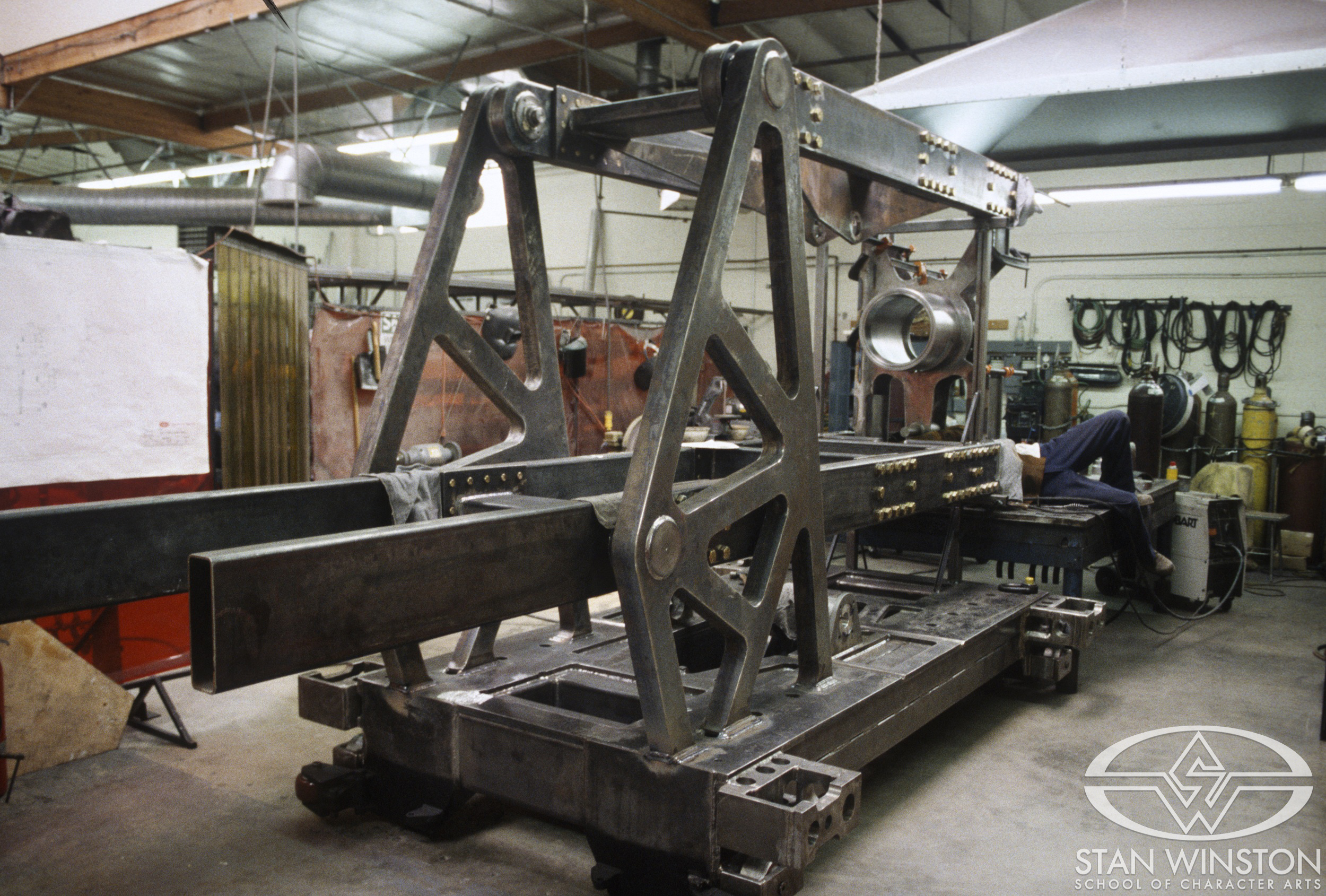 (Work-in-progress on one of the custom-welded carts at Stan Winston Studio.)
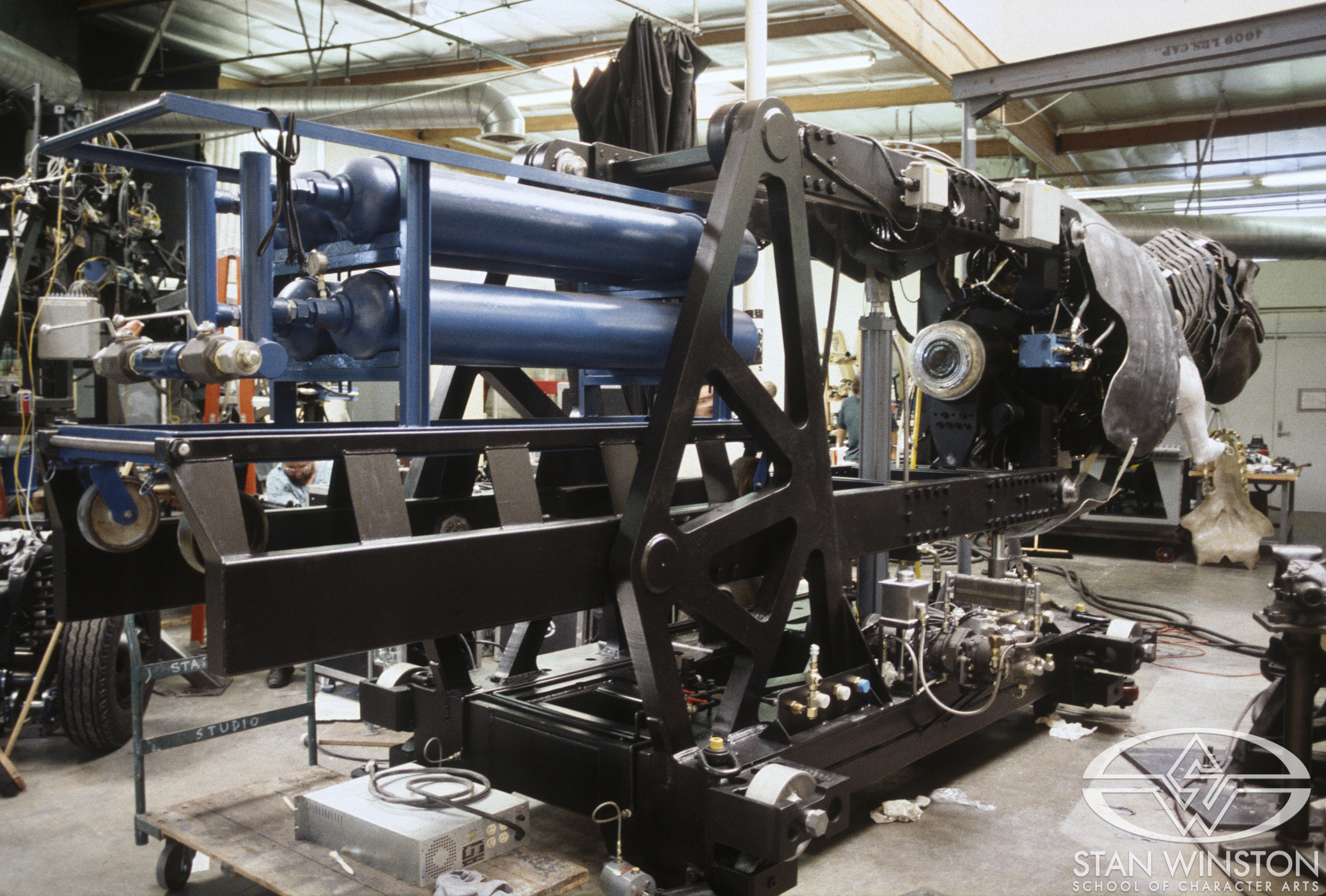 (Work-in-progress placing the male T-Rex onto the custom-welded cart.)
Hydraulics supervisor Tim Nordella spearheaded the engineering feat. Because the heads and necks moved with such violent force, the carts behind them had to be engineered to be incredibly heavy to serve as counterweights.
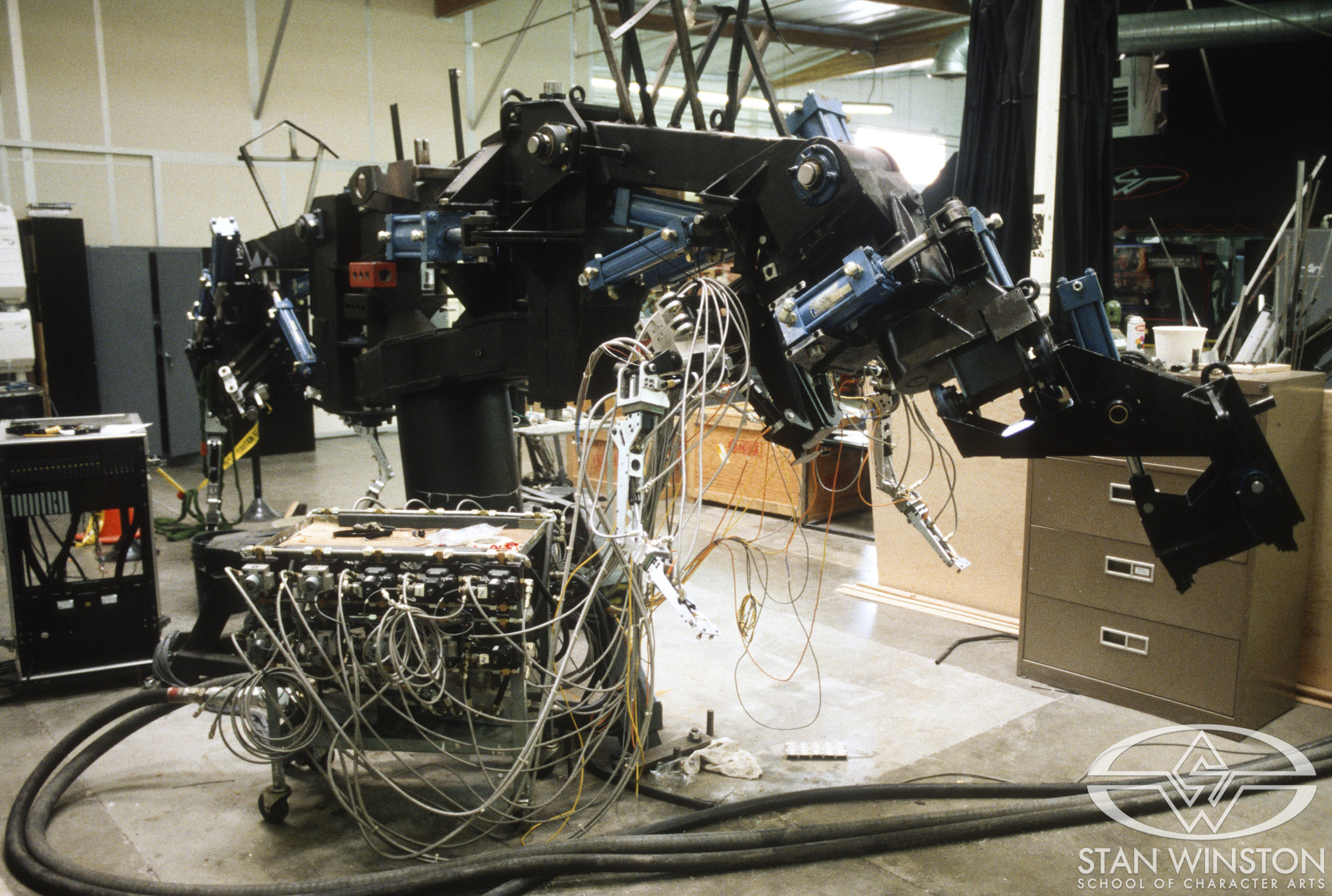 (The hydraulic base of the male T-Rex at Stan Winston Studio.)
"Designing not only the character but figuring out the cart that was behind it that had to be bigger and heavier than the head and neck to support all that movement, and then to put that on basically like a railroad track...and then move that," noted J. Alan Scott. "There were hydraulic motors and hydraulic cylinders that were moving the entire structure... accumulators and air tanks to give it as much power as possible...all orchestrated by Tim Nordella."
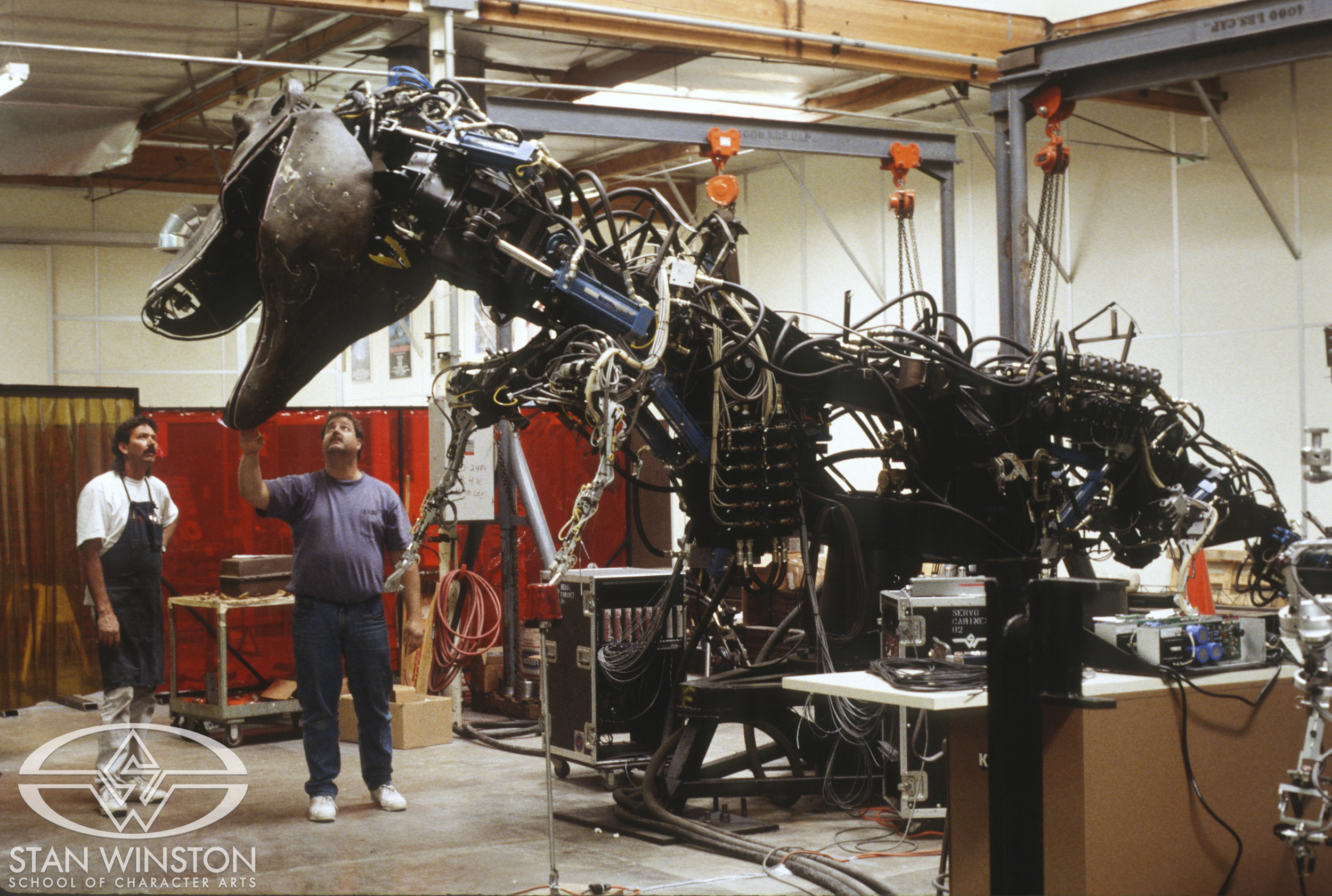 (Tim Nordella and another artist oversee the male T-Rex's head and neck mechanism at Stan Winston Studio.)
Scott continued, "And the opportunity to learn from what we had accomplished on the first one and improve on it...you rarely get that opportunity to really learn from your successes and failures and then take it to another level. And that's what the raptors and the T-Rexes gave us."
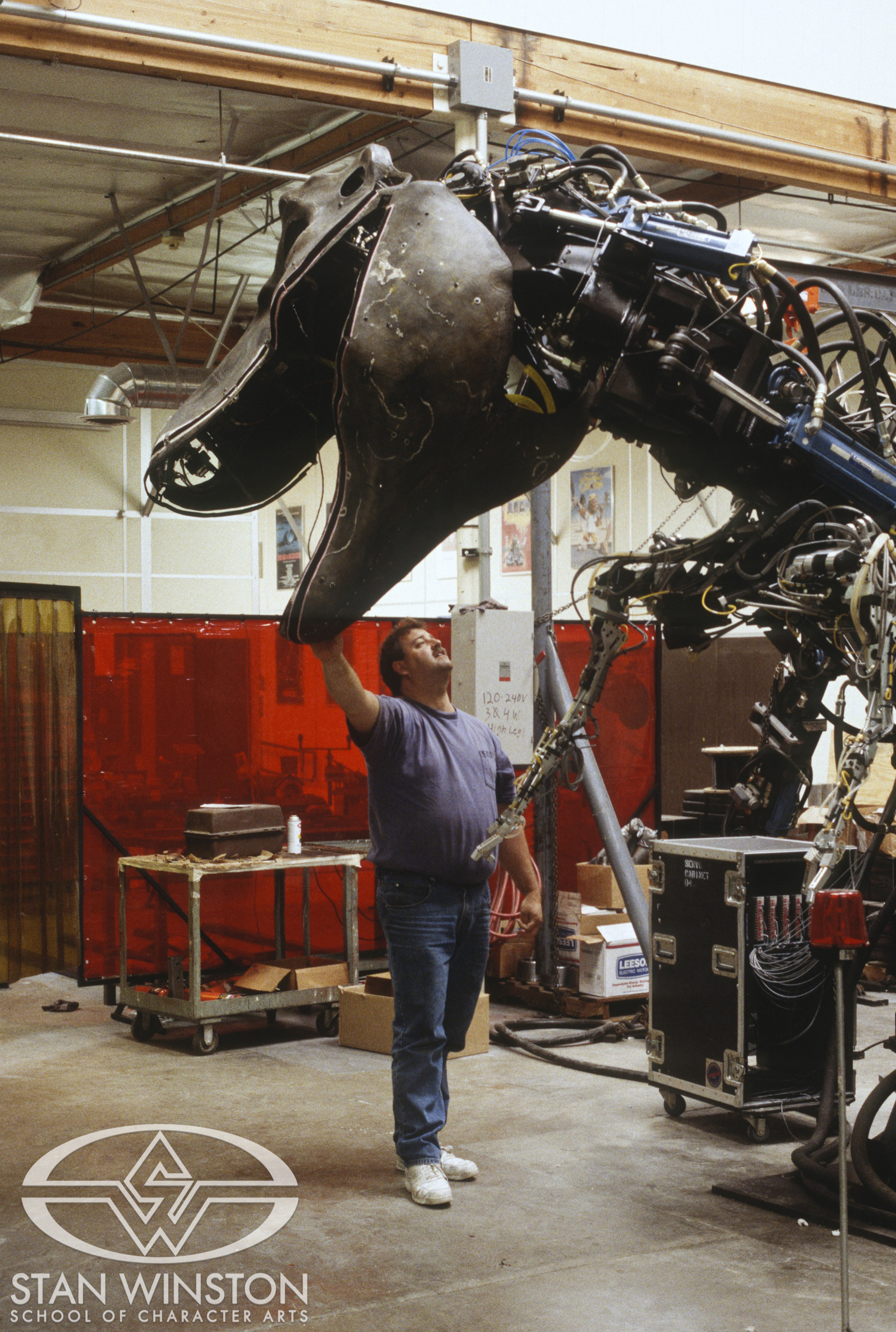 (Tim Nordella checks the animatronics of the male T-Rex at Stan Winston Studio.)
Preparing the Double T-Rex Attack
Because these massive railroad tracks were completely permanent once installed on the set, there was zero room for placement error. Mechanical designer Richard Landon and the team built functional, 1/16th scale mechanical mockups. "We built [1/16]-scale miniature maquettes of the mechanics, which we had never done before," noted Richard Landon. "And that became more important on Jurassic Park 2 because they built the train tracks in miniature with the two heads in miniature, so they could put them on a miniature version of the set and pre-rehearse the scene."
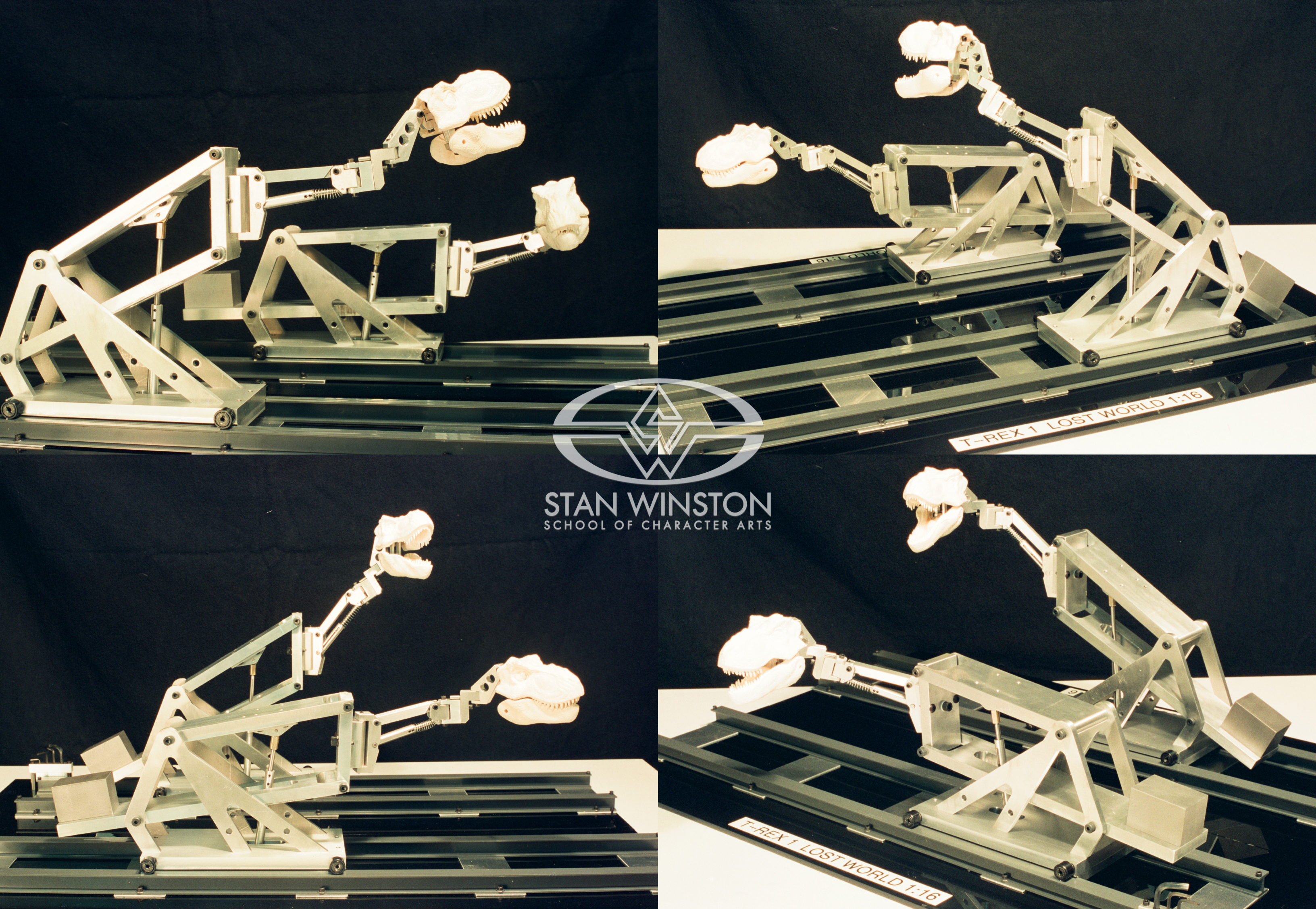 (1/16-scale mechanical mockups of the T-Rexes at Stan Winston Studio.)
This solution allowed Steven Spielberg and the crew to perfectly choreograph the camera angles and know exactly where the tracks needed to be bolted down before the full-scale dinosaurs ever arrived on set. "You didn't have the luxury of a whole CG environment that you could, like, move the camera anywhere," added Scott. "They used those miniatures...to stage shots and figure out where it needed to get planted on the set because once you had put a railroad track there, it's not going anywhere else, and you can't just have the head ten feet over. It had to be very, you know, well thought out and choreographed."
Video below: Todd Marks' archive footage compilation of shooting one of the choreographed double T-Rex attacks in the rain on the set of The Lost World: Jurassic Park
Testing the Hydraulic Skeleton of the Male T-Rex with a Stuntman
All this preparation resulted in one of the most suspenseful sequence shots in creature-feature history, the spectacular trailer attack. Learning from the first movie (where the T-Rex skin would absorb water, get heavy, and start shaking), the team applied a specialized silicone sealant to the skin. It wasn't foolproof, but it kept the animatronics operational.
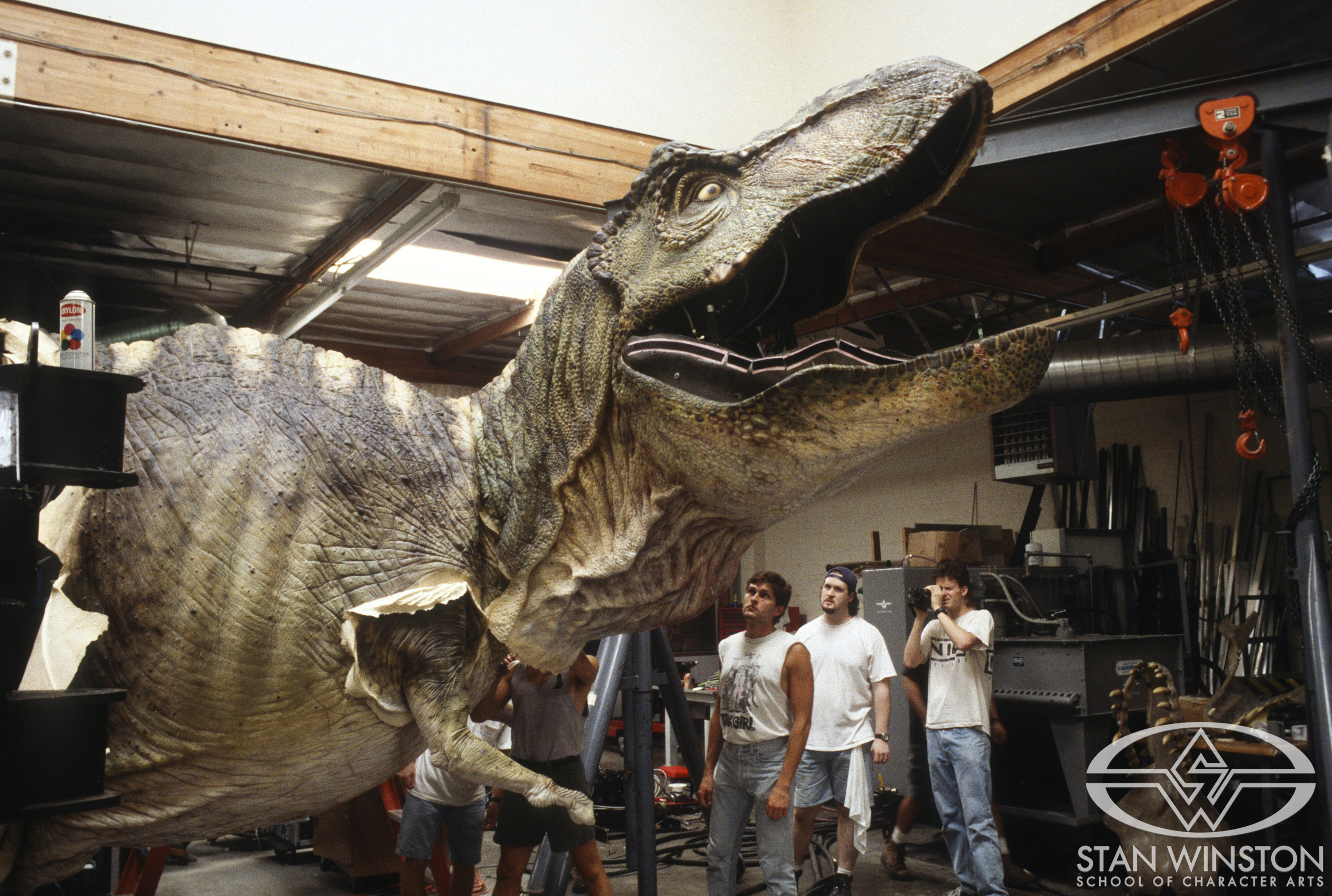 (Checking the male T-Rex skin during the animatronics movement.)
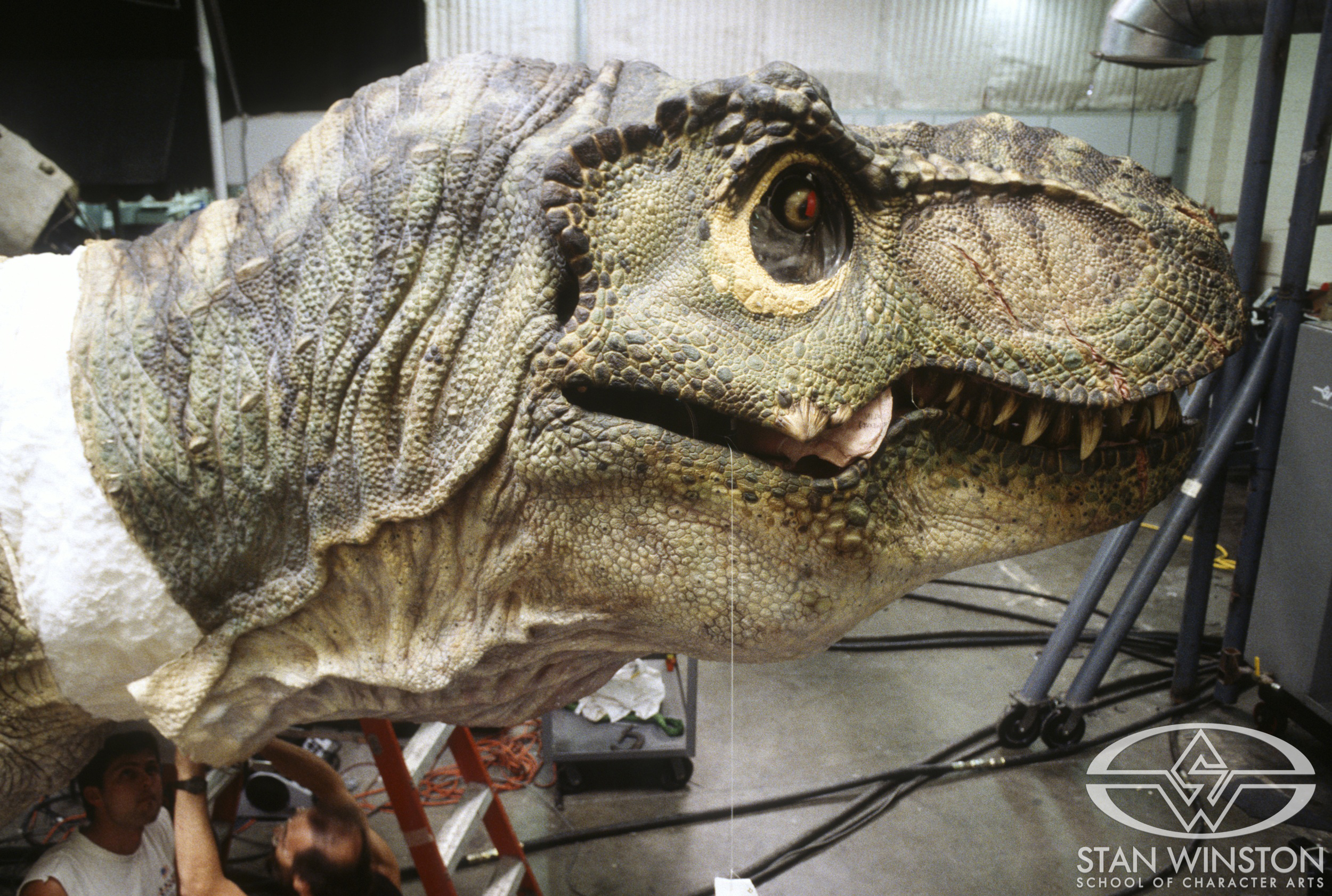 (Work-in-progress as the male T-Rex skin is attached at Stan Winston Studio.)
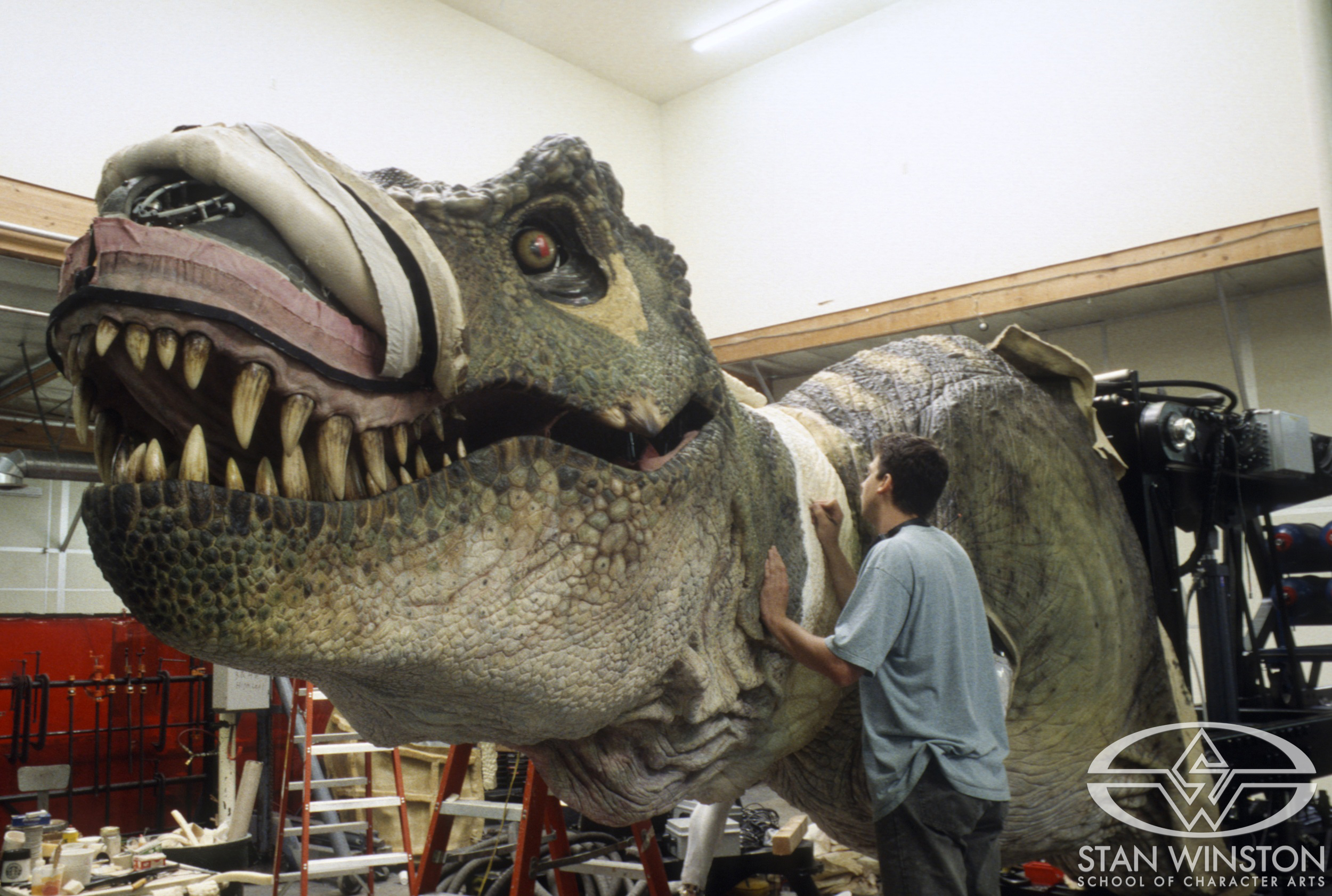 (Eric Ostroff works on the male T-Rex skin covering the life-size animatronics.)
But the real tension came when John Rosengrant, operating the Rex telemetry controller, had to puppeteer the male T-Rex grabbing a stuntman right out of a jeep. "[It] was pretty scary to do," noted Rosengrant. "I was the guy puppeteering this. Terrifying. And working with this stunt guy that we had to pick him out of a jeep, pick him up in his mouth, and swing him around. And he was one brave dude."
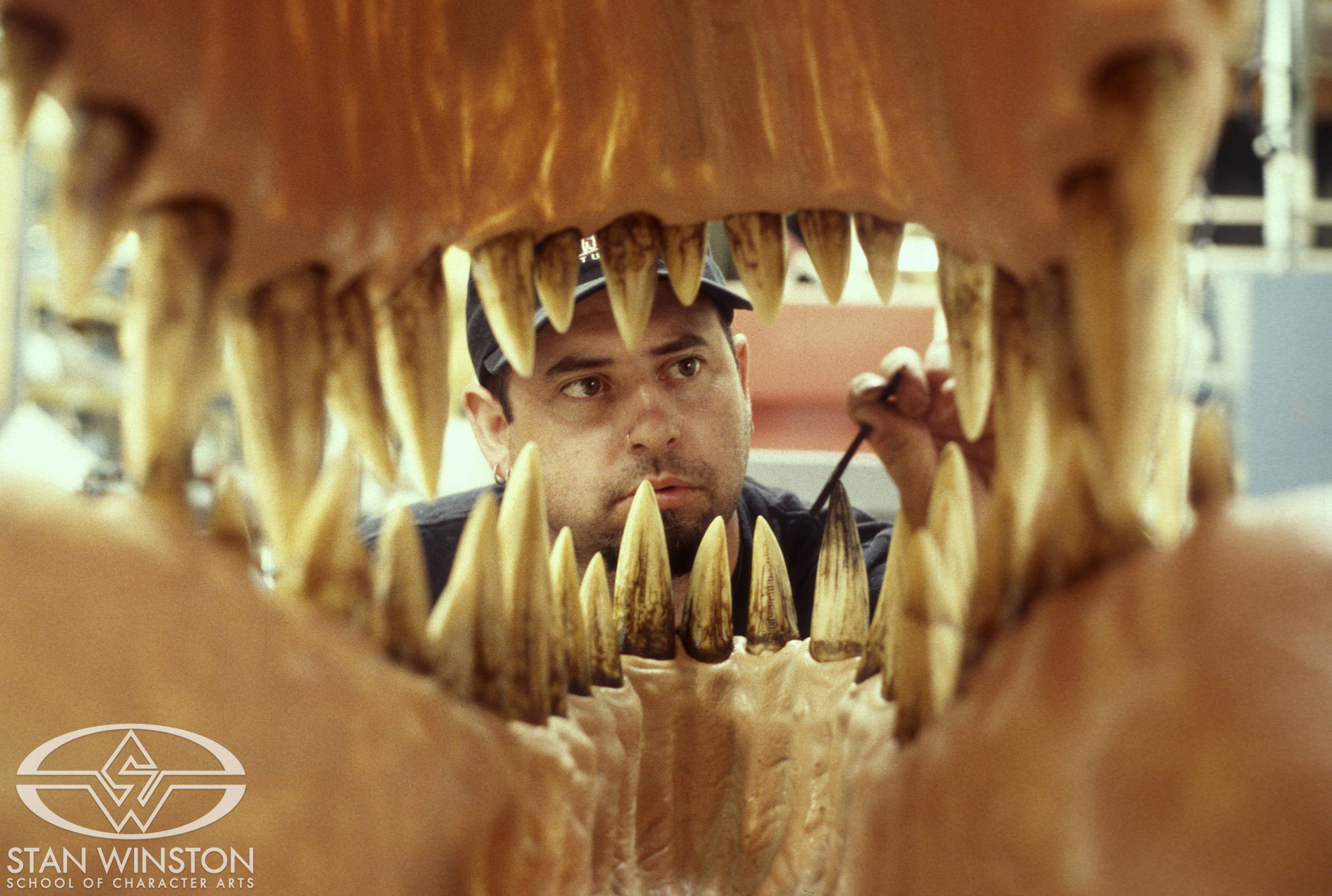 (Tim Gore paints the life-size T-Rex teeth at Stan Winston Studio.)
Operating the telemetry controller for a massive machine capable of crushing bones meant absolute precision. "That day was a pretty high-pressure day," Rosengrant shared. "If you miscalculated...grabbing the stunt guy and picking him up... it was very dangerous. That was the most stressful day I've ever had on a movie set in my life."
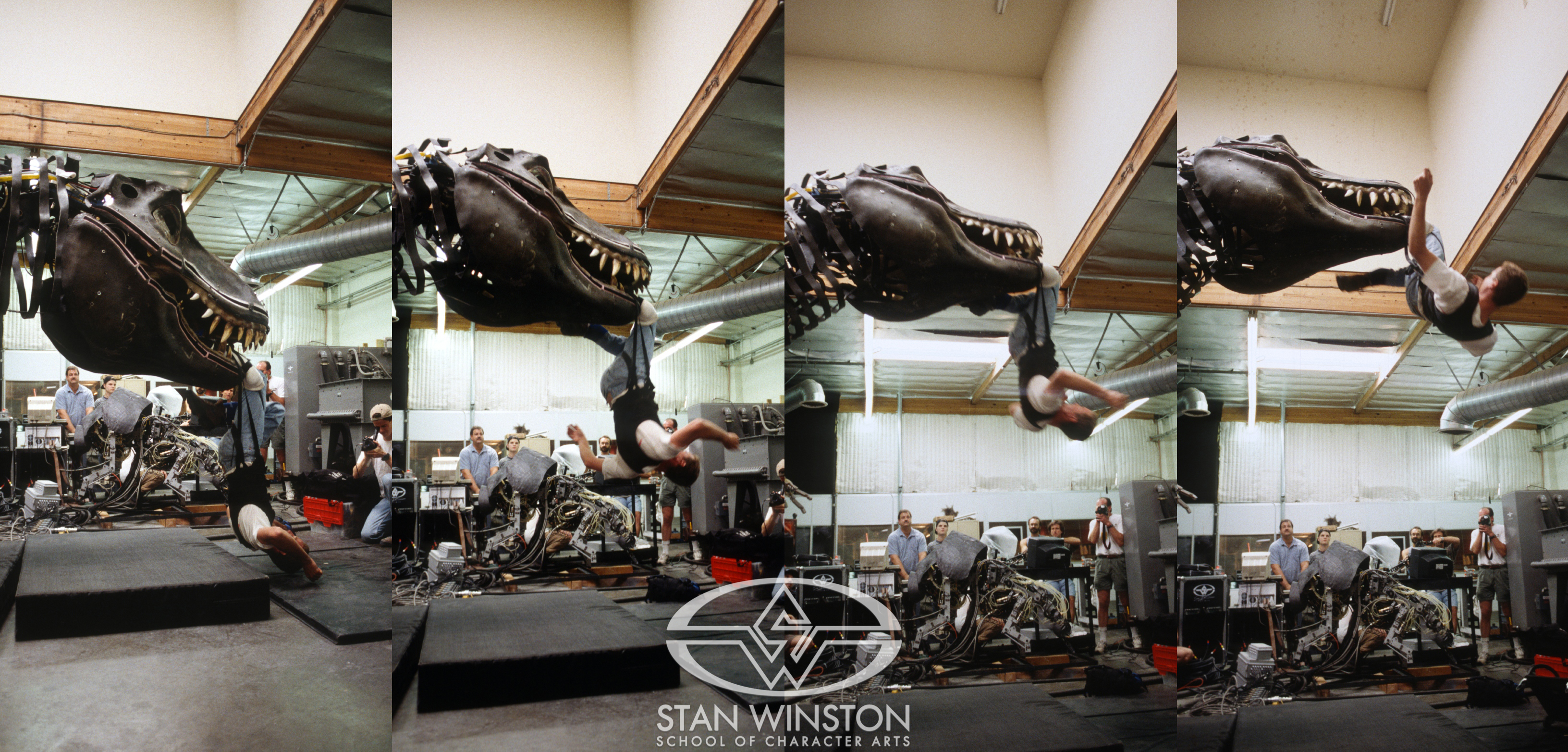 (One of the life-size male T-Rex animatronics tests with a professional stuntman.)
To ensure he didn't accidentally "pile drive" the stuntman into the jeep, Rosengrant had to memorize physical markers in the air to know exactly where his safety limits were.
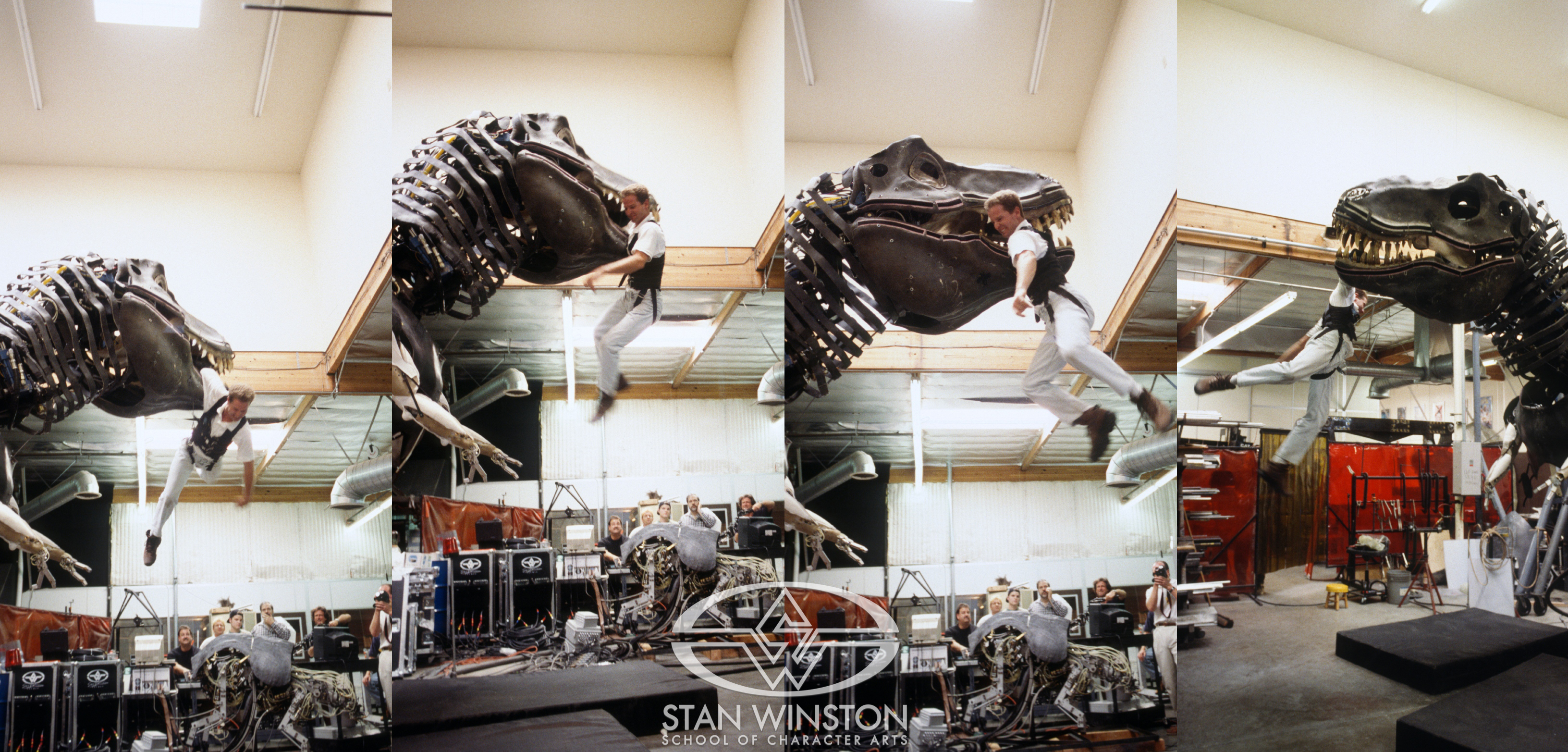 (Another male T-Rex test with a professional stuntman.)
As for the stuntman who volunteered to be clamped inside the jaws of a multi-ton hydraulic predator, when Rosengrant asked him what it was like to be inside the T-Rex's mouth, the stuntman just smiled and said:
"Buddy, it's like living the dream."
Video below: The FULL Jurassic Party Part 2: The Lost World Dinosaur Crew Reunion
Courses with the Creators of The Lost World: Jurassic Park
- Special Effects Sequence Design with Shane Mahan
- Hybrid Characters: Blending Practical & Digital FX with John Rosengrant
- How to Paint Realistic Silicone Skin - Silicone Painting Techniques with Tim Gore
- How to Make Horror Props: Casting, Painting, and Finishing with Tim Gore
- Metallic Painting Techniques - Robot Finishes with Rob Ramsdell
- Maquette Painting Techniques with Trevor L. Hensley
- How To Sculpt A Character Makeup with Bruce Spaulding Fuller
- Character Makeup - Multi-Piece Prosthetic Application with Bruce Spaulding Fuller
- Animatronics Design Basics with Richard Landon
- Cable Mechanism Basics - Tentacles with Richard Landon
- How to Make a Monster Puppet - Rods & Cables with David Monzingo
- Makeup Blood FX - Blow Your Brains Out with David Monzingo
- Hybrid Character Design: Practical To Digital with Christopher Swift
- Portrait Illustration Part 1: Pencil Drawing Techniques with Terry Wolfinger
- Portrait Illustration Part 2: Painting with Photoshop with Terry Wolfinger
- How to Make a Stone Mold with Gary Yee
- Introduction to Hair Knotting with Michael Ornelaz
To Create Your Own Dinosaurs, Check Out These Courses:
- How To Sculpt A Dinosaur Part 1 - Armature Building & Sculpting Primary Forms with Chris Darga
- How To Sculpt A Dinosaur Part 2 - Secondary Forms & Finishing Techniques with Chris Darga
- How To Make A Dinosaur - Part One: Design, Foam Carving & Fabrication with Ted Haines
- How To Make A Dinosaur – Part Two: Carving Teeth, Adding Detail & Texture with Ted Haines
- How To Make A Dinosaur - Part Three: Painting & Finishing with Ted Haines
- Oversized Eyes Part 1: Digital Sculpting & 3D Printing with Sam Polin
- Oversized Eyes Part 2: Molding & Casting with Rob Hinderstein
- Oversized Eyes Part 3: Paint Layering & Finishing with Rob Hinderstein