
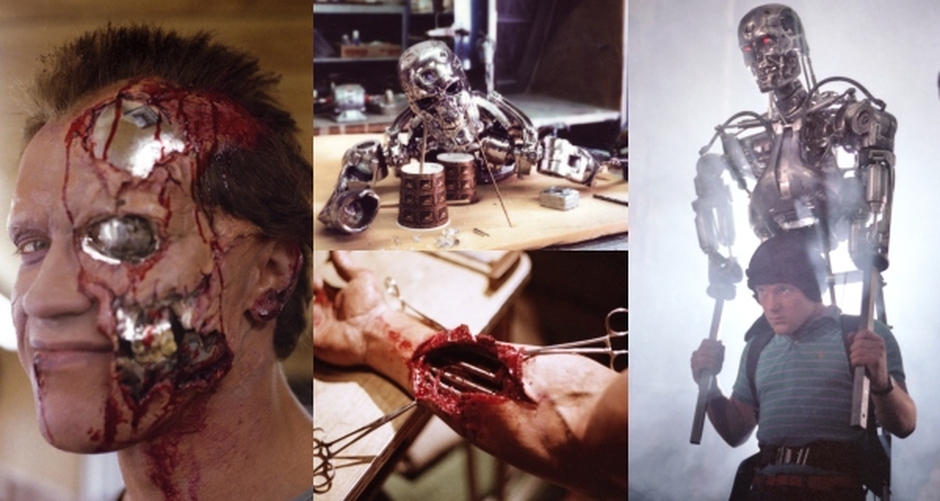
Stan Winston was not the first person James Cameron approached for The Terminator, a gripping story about a cyborg assassin who travels back in time to kill the would-be mother of a future resistance leader. Although the film’s third act prominently features the robotic endoskeleton beneath the cyborg’s human exterior, Cameron—who had worked as an art director and special effects supervisor on low-budget films for Roger Corman’s New World Pictures—had not even considered shooting a full-size robot for the endoskeleton scenes. Instead, he planned to achieve all endoskeleton shots through stop-motion animation, moving a miniature Terminator puppet incrementally, frame by frame. As Cameron saw it at the time, the film’s makeup effects team would be responsible for building and applying prosthetics to the Terminator actor, suggesting the metallic form beneath the cyborg’s deteriorating fleshy exterior, and for engineering articulated props.
Jump To Section
- How Dick Smith Led James Cameron to Stan Winston
- Assembling Stan Winston Studio’s Core Team for The Terminator
- The Role Swap That Made Arnold Schwarzenegger History
- Planning to Build a Full-scale Terminator Robot
- Building a Full-Size Endoskeleton
- Making the Backpack Rig Terminator
- How The Terminator Crew Blew Up the Stunt Endoskeleton
- The Head Behind the Hydraulic Press Scene
- Replicating Schwarzenegger’s Head for the Eye-surgery Scene
- Using Terminator Makeup FX
- The In-Camera Trick Behind the Arm Surgery Scene
- Second Unit Directing The Terminator
- The Terminator FX Breakthrough That Launched Stan Winston’s Legacy
How Dick Smith Led James Cameron to Stan Winston
With those effects in mind, James Cameron approached Dick Smith six months prior to the movie’s principal photography schedule, traveling to Smith’s Larchmont, New York, home to solicit his involvement in the project. “He brought some pictures of his concepts,” Smith recalled, “and they were wonderful, because he is a very good artist. We discussed the film, and I thought it sounded very exciting. But it was also an enormous undertaking, technically. So, when Cameron outlined this whole thing, I told him that I didn’t think it was really my cup of tea. I said, ‘I don’t have the kind of shop that you need to do this, and there are very few people in this area that I could hire to help me with the technical demands of this production.’ I didn’t say a definite ‘no,’ but I let him know that I didn’t think I was the right guy for it. I suggested that he talk to Stan Winston instead.”
Acting on Smith’s recommendation, which had been reiterated by Rob Bottin, Cameron met with Stan Winston, unaware that this meeting was to be the beginning of a remarkably successful filmmaking collaboration and a lifelong friendship.
Assembling Stan Winston Studio’s Core Team for The Terminator
By signing on to The Terminator, Winston committed to significantly expanding his Stan Winston Studio staff, which at that time numbered only five. Within a few months, Winston had hired a crew of twenty, including artists Shane Mahan, John Rosengrant and Tom Woodruff Jr., and a young mechanical wizard named Richard Landon. This gathering of artists and technicians worked out of Winston’s first real studio, a single unit in an industrial complex in Northridge.
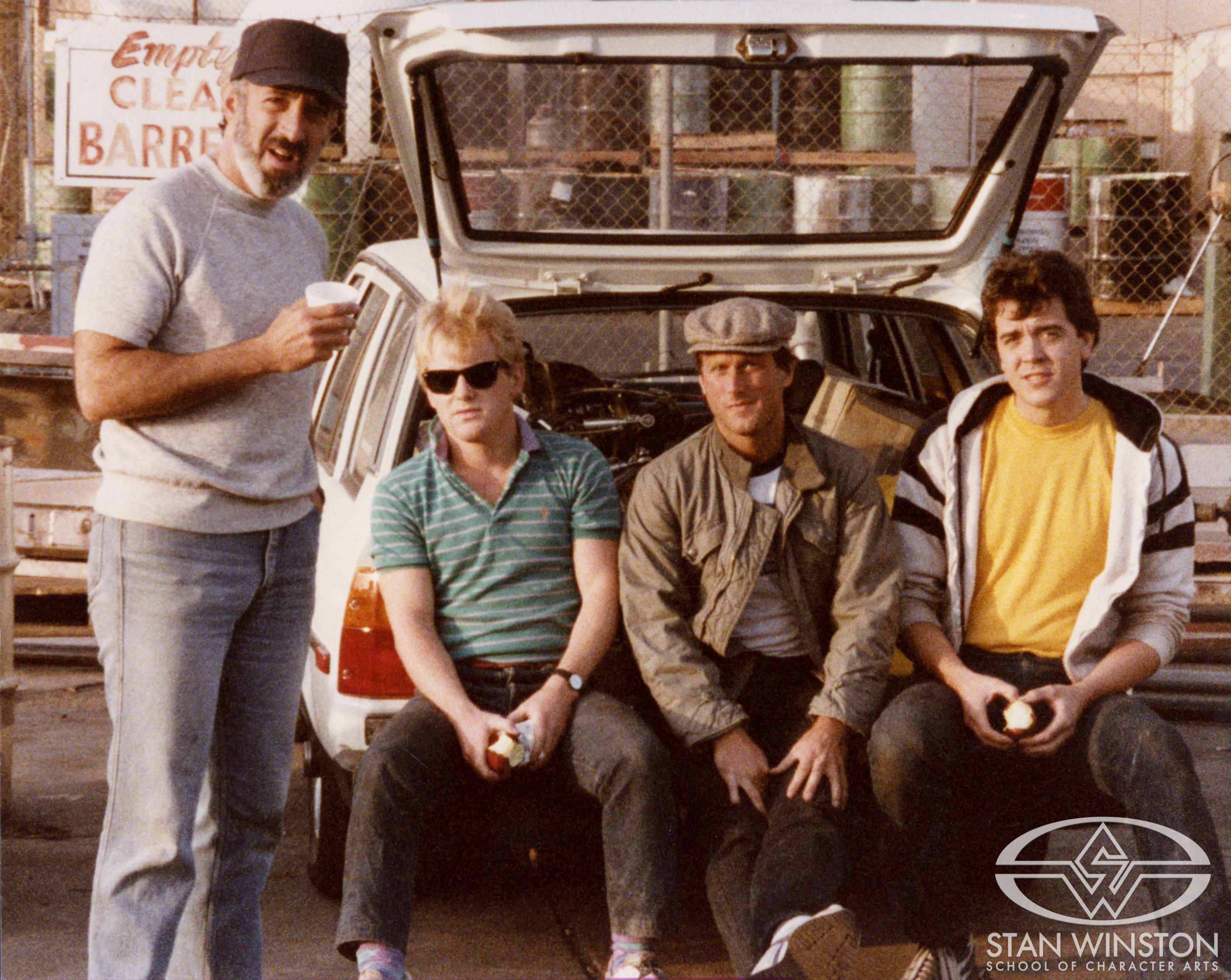 (Stan Winston, Shane Mahan, John Rosengrant and Tom Woodruff Jr.)
Anticipation and excitement permeated the clean air of the Stan Winston Studio as the crew prepared to begin work on The Terminator. Though it was a low-budget production, helmed by an unknown director, everyone on the crew recognized its potential as a breakout film. “Stan let us all read the script,” recalled John Rosengrant. “I had never read a script before in my life, so I had nothing to compare it to. But even as inexperienced as I was, I remember thinking that it was a really great story. We all had very high hopes for it.” The enthusiastic crew found itself all revved up with nowhere to go when, suddenly, financing for The Terminator fell through, resulting in a six-month postponement to the start of principal photography. Unwilling to lose his newly hired artists and technicians in the interim, Winston kept them busy working on a nine-episode television series called Manimal (1983), which required man-to-animal transformations, and on Wish Man (1983), a television pilot that was never picked up.
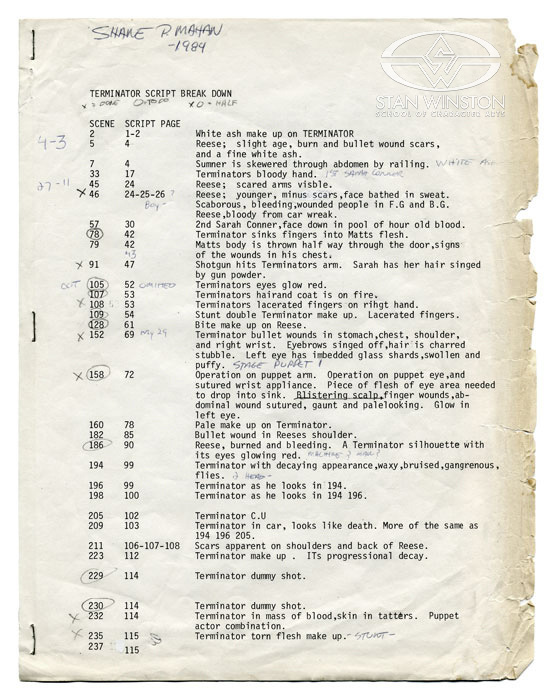 (Shane Mahan's The Terminator script breakdown.)
When production for The Terminator resumed in December 1983, Cameron began meeting regularly with the Stan Winston Studio team, driving to the Northridge shop and bringing a series of concept illustrations he had sketched himself.
The Role Swap That Made Arnold Schwarzenegger History
Cameron’s drawings included concepts of the Terminator with areas of its metal understructure exposed, rendered over a likeness of actor Lance Henriksen, an early contender for the role. Arnold Schwarzenegger — a former world champion bodybuilder who had earned the film industry’s attention with his performance as the title character in Conan the Barbarian (1982) — had auditioned for the role of Kyle Reese, the resistance fighter sent back in time to stop the assassin; but when he expressed a preference for the Terminator character, Cameron shuffled the roles, ultimately casting Michael Biehn as Reese and Lance Henriksen as a police detective. Linda Hamilton would play Sarah Connor, the Terminator’s primary target.
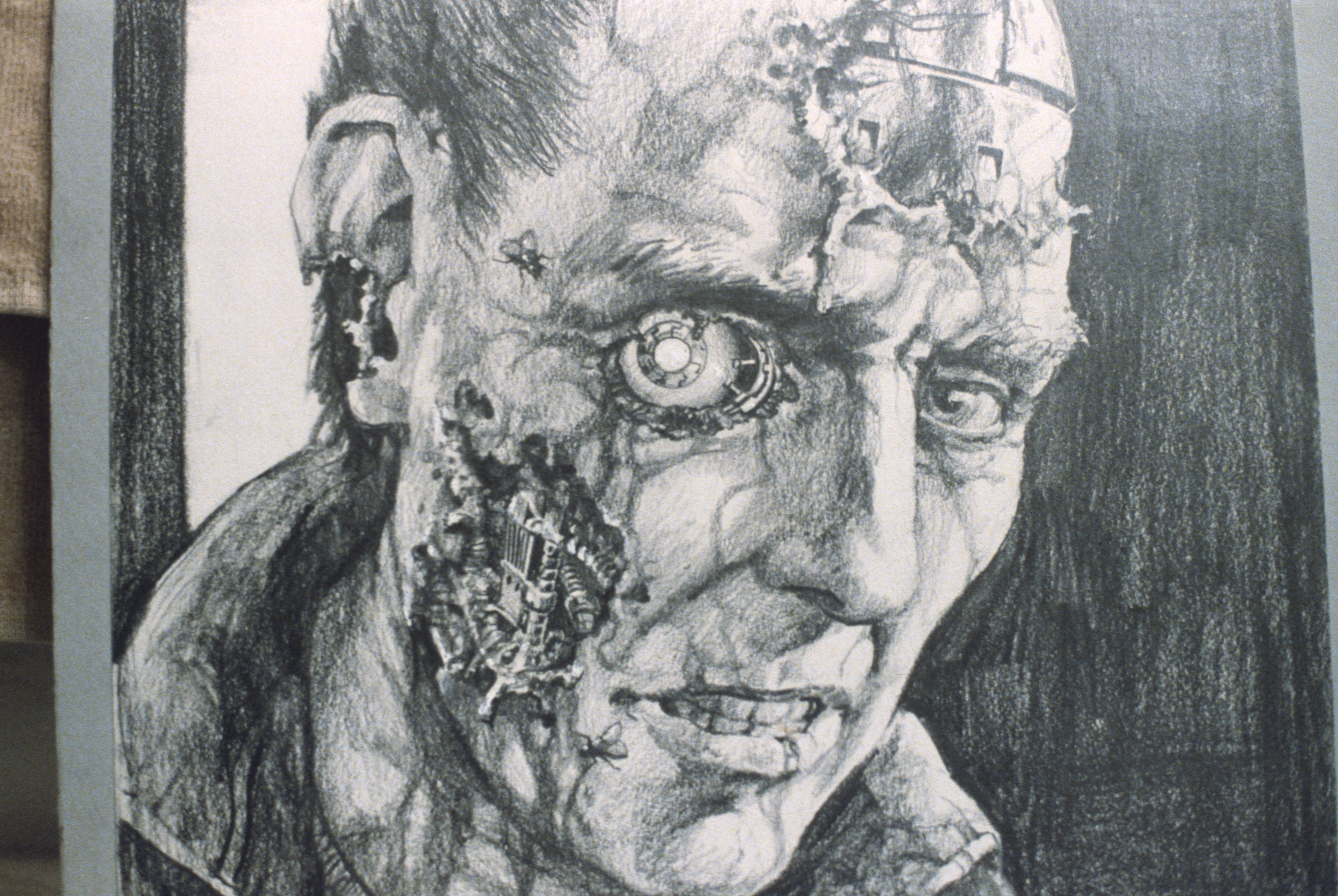 (James Cameron's sketch of Lance Henriksen as the Terminator. Image courtesy of Hemdale Film, Pacific Western Productions, Euro Film Funding, and Cinema '84.)
Planning to Build a Full-scale Terminator Robot
Cameron also illustrated the Terminator's robotic look after its flesh is stripped off, exposing its metallic endoskeleton. That version of the character first appears near the end of the film, emerging from the flames of a truck explosion—an image Cameron had seen in a dream and that became the film's seminal vision. In planning his production, Cameron relegated that shot and all other ambulatory endoskeleton shots to stop-motion animation, mainly because no one had yet built a full-scale, animatronic, articulated, live-action robot for the movies.
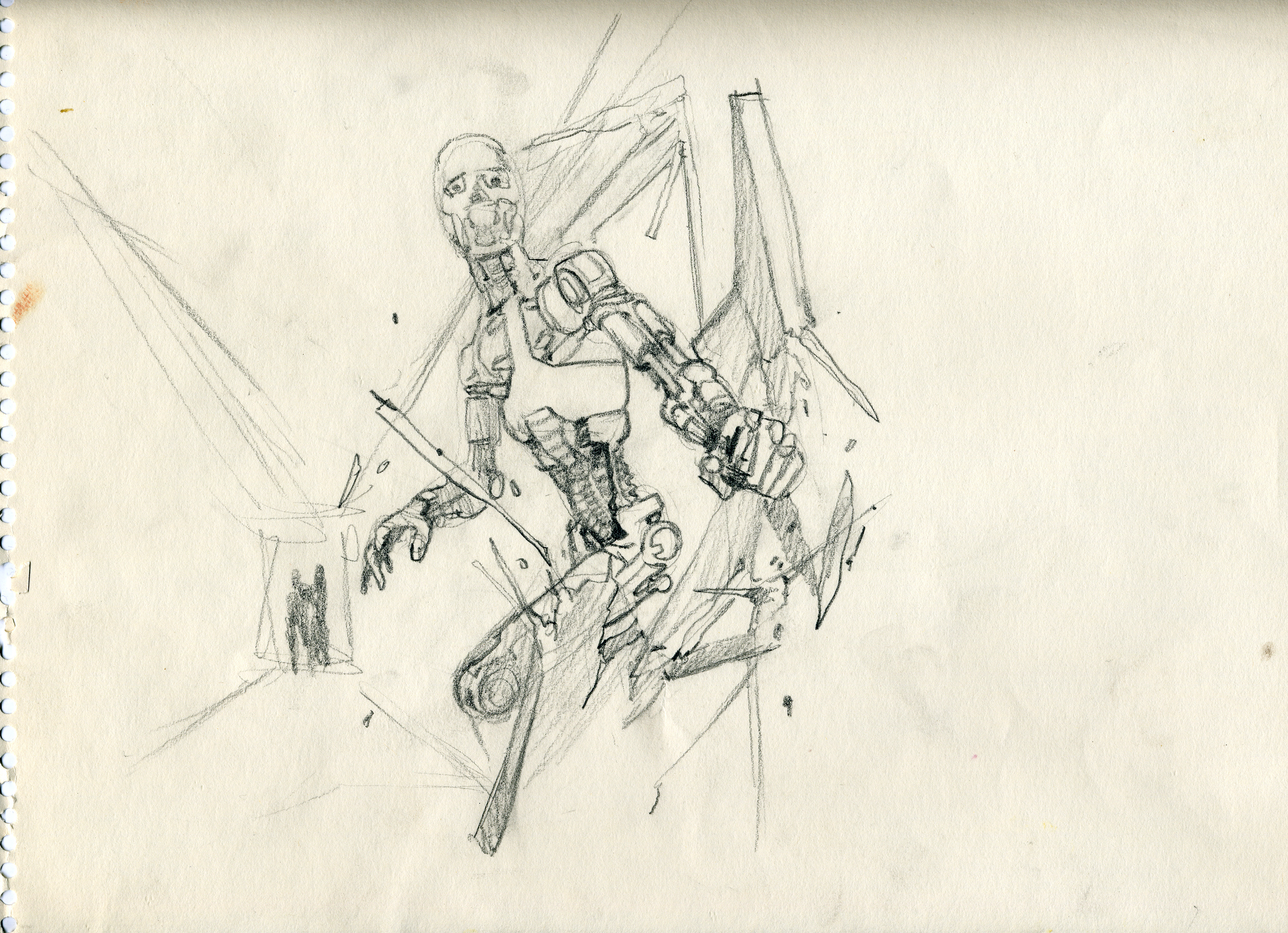 (James Cameron’s preliminary sketch for the Terminator endoskeleton. Image courtesy of Hemdale Film, Pacific Western Productions, Euro Film Funding, and Cinema '84.)
Stan Winston wanted to be the first. “I was really into the puppet thing by then, and so I wanted to build this endoskeleton as a full-scale puppet. I told Jim that I’d been developing puppeteering techniques, using rods, radio control, and Jim Henson’s methodologies, and I talked him into letting us build a full-size endoskeleton, which would allow him to get many of his shots live, in camera. Jim was willing to take that leap of faith.”
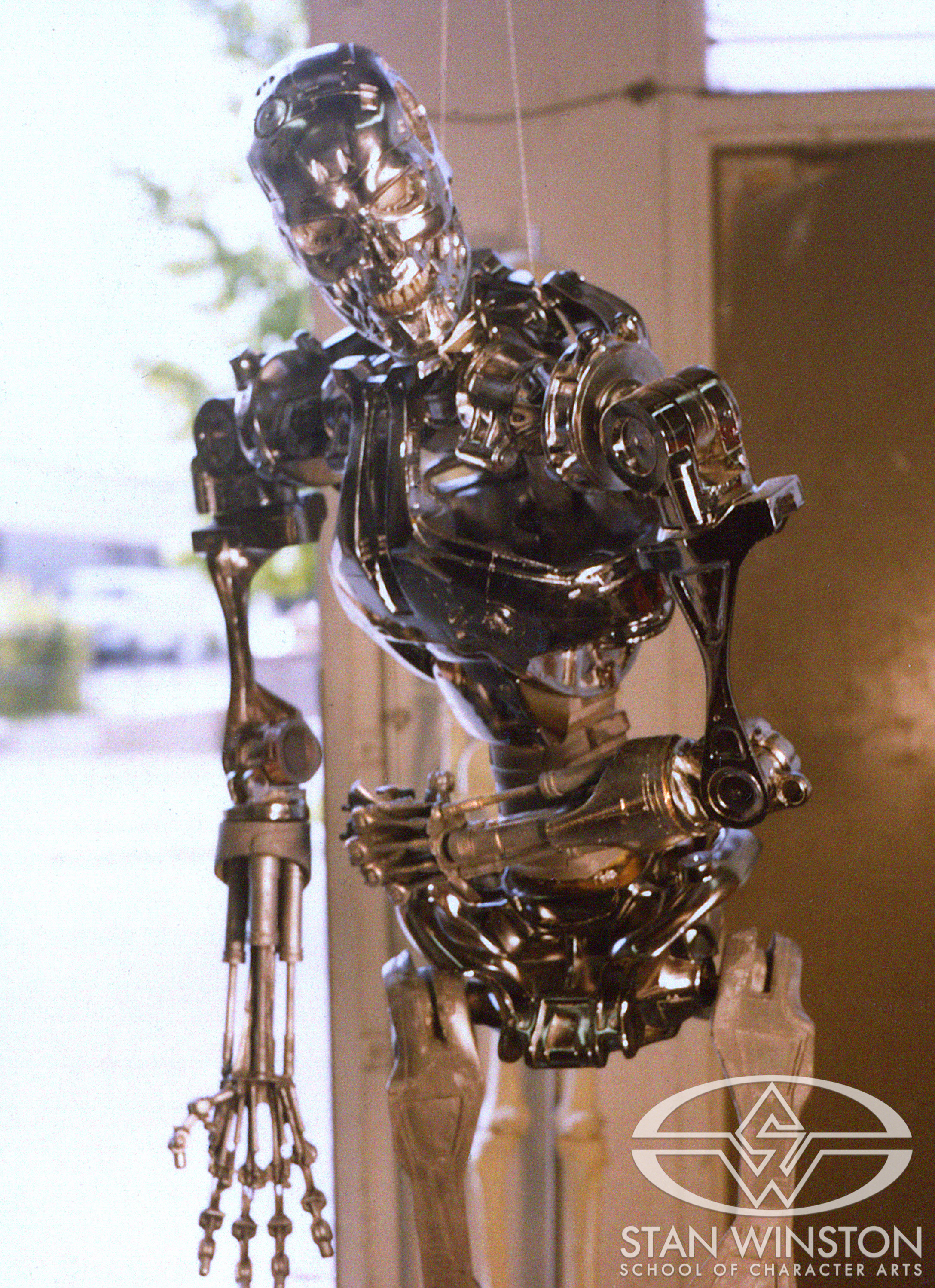 (Work-in-progress Terminator endoskeleton at Stan Winston Studio.)
The endoskeleton would be the show's biggest challenge for Stan Winston Studio, so its design and construction took top priority. “We started chipping away at the design of the endoskeleton right away,” Shane Mahan recalled. “I remember Stan and Jim going off to an auto parts graveyard to take photographs of interesting pieces of machinery for reference.”
Building a Full-Size Endoskeleton
With those photographs and Cameron’s drawings as guides, Shane Mahan, Tom Woodruff Jr. and Brian Wade began sculpting clay head mockups for the endoskeleton, starting with a lifecast of Arnold Schwarzenegger. “We took Arnold’s lifecast,” explained Mahan, “set his eyes and teeth where they should be, and then produced solid clay versions of Arnold from that lifecast. Then we carved that down to get the endoskeleton skull. So, the head of the endoskeleton wasn’t a cheat. That skull actually fit and conformed to Schwarzenegger’s real head. It was an accurate re-creation of Arnold’s skull, with its distinctive square jaw and shape.”
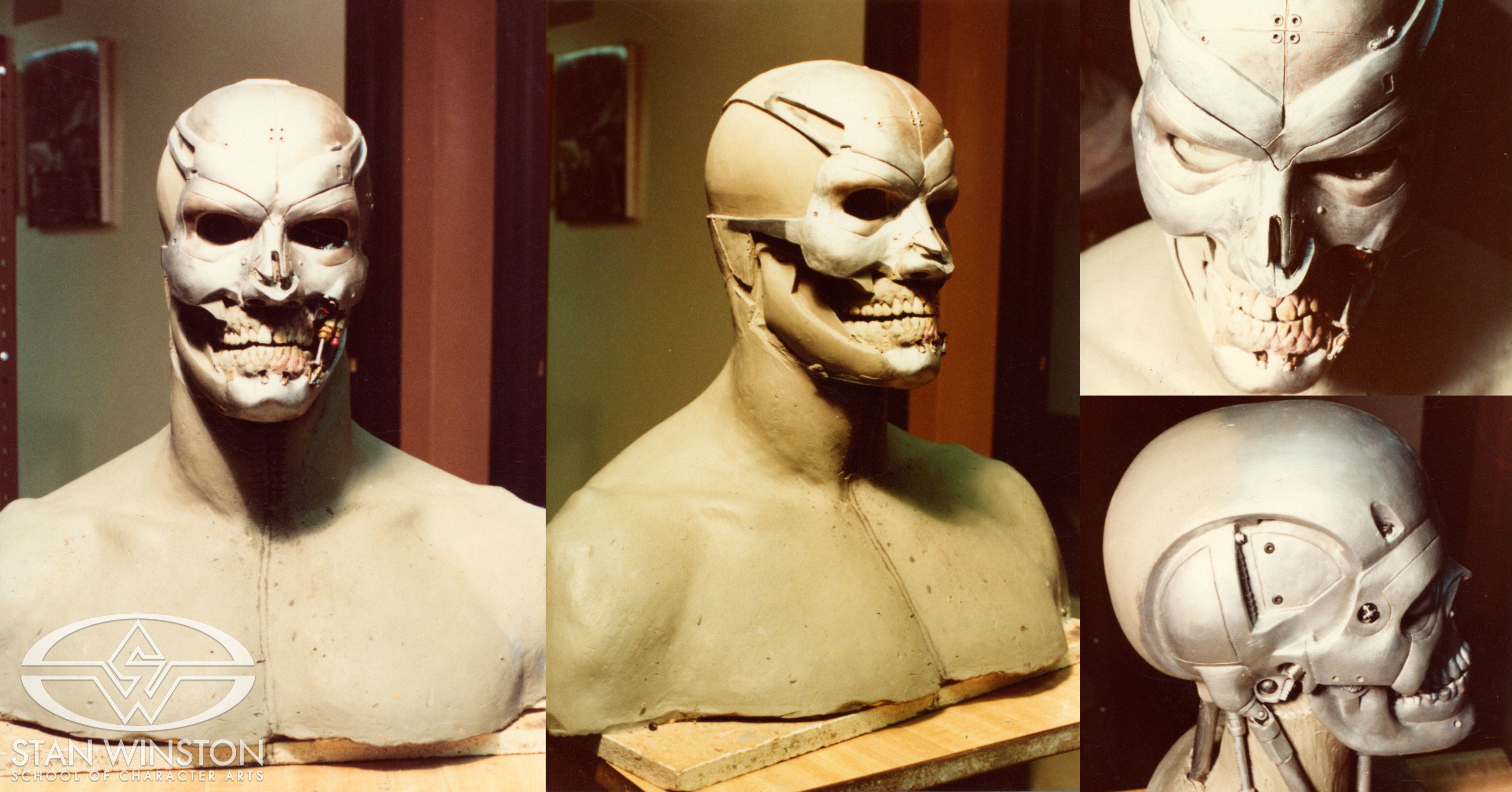 (Work-in-progress of Brian Wade’s clay concept study of the Terminator.)
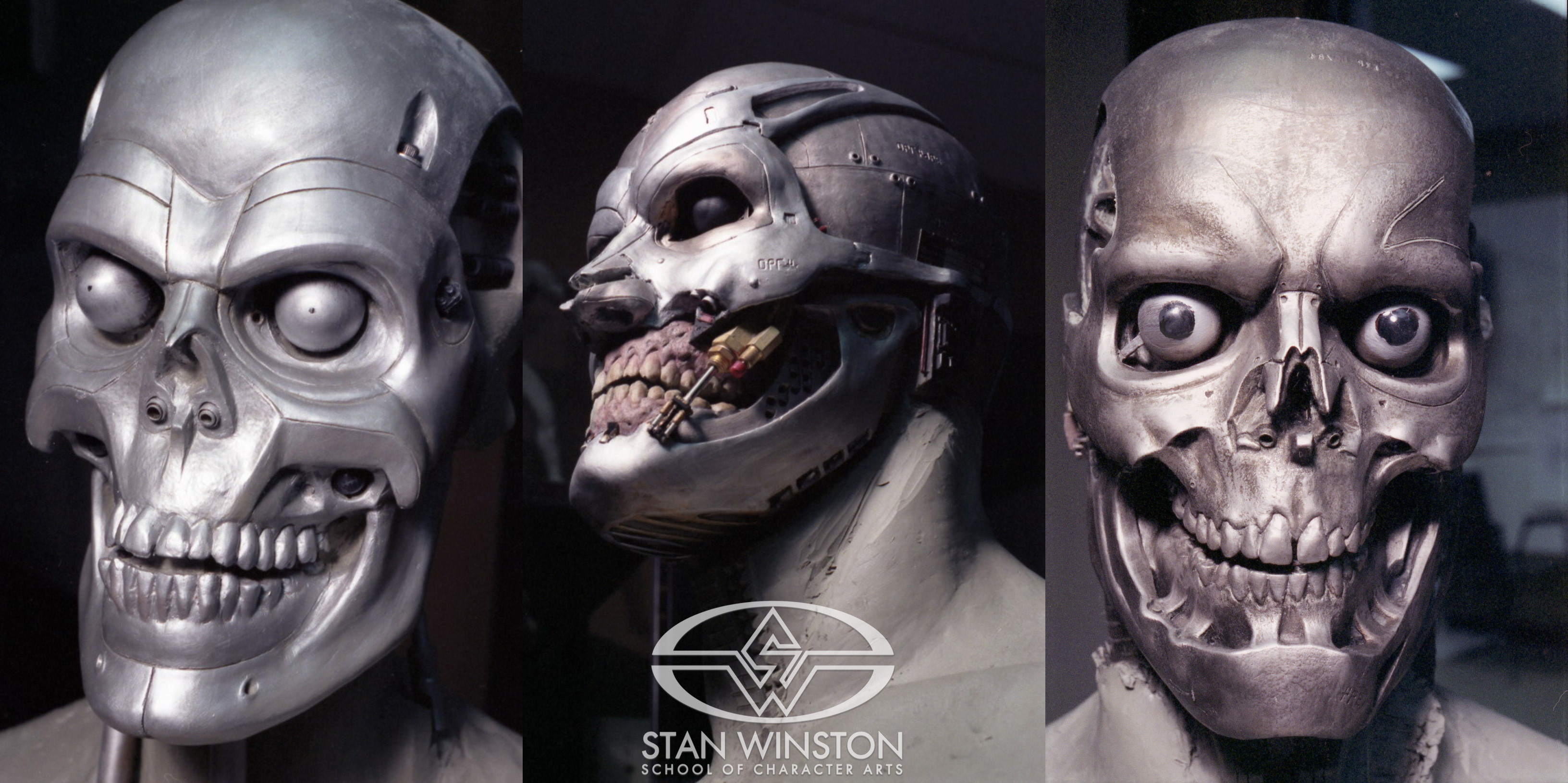 (Tom Woodruff Jr., Brian Wade, and Shane Mahan's versions of the Terminator. James Cameron selected elements from all three concepts and incorporated them into the final Terminator endoskeleton design.)
Cameron and Winston chose Mahan’s sculpture as their favorite among the endoskeleton heads, and assigned him the task of sculpting the actual skull, while other artists sculpted the robot’s various body parts in clay.
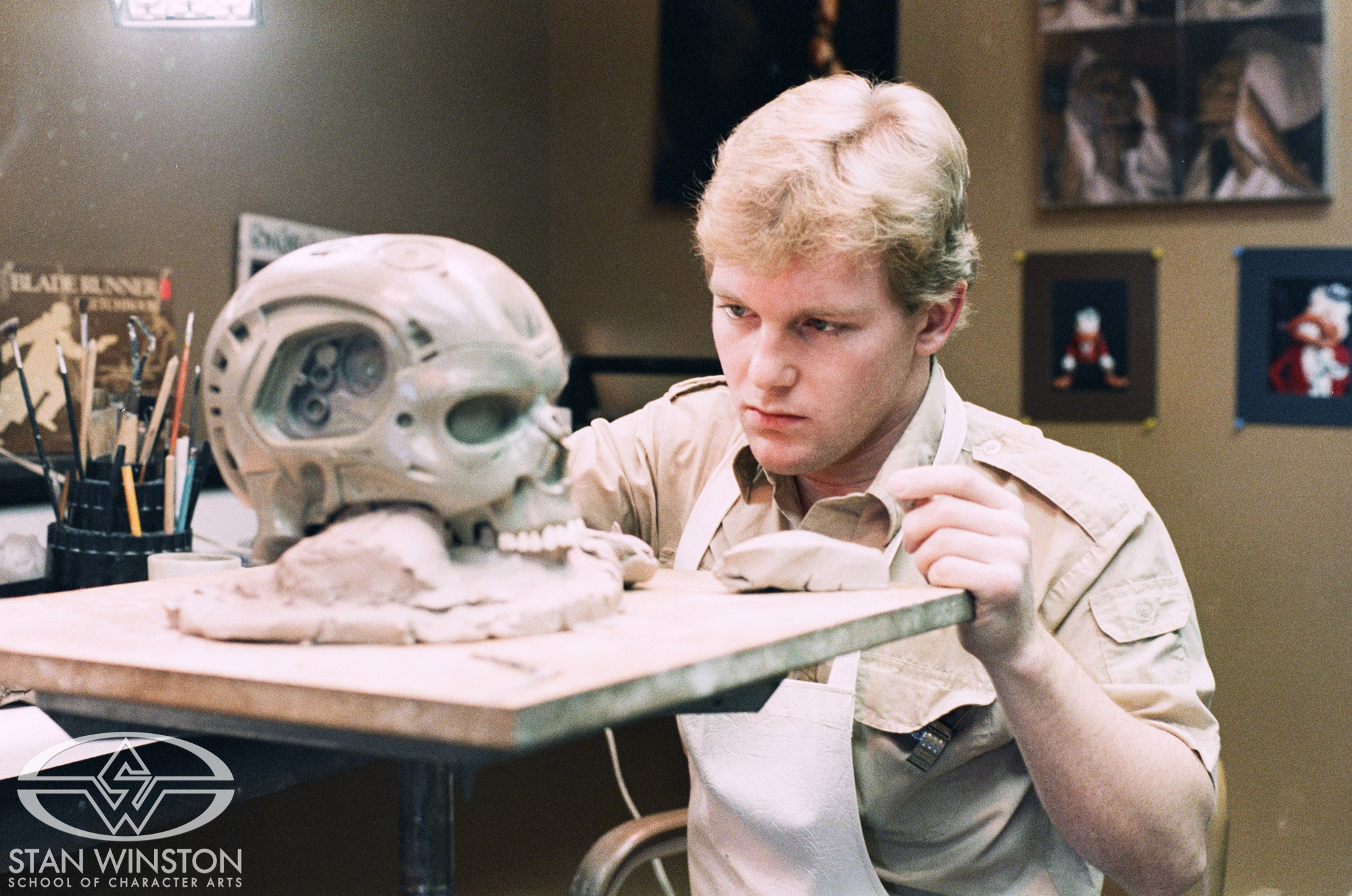 (Shane Mahan lays up the final Terminator head sculpt for molding.)
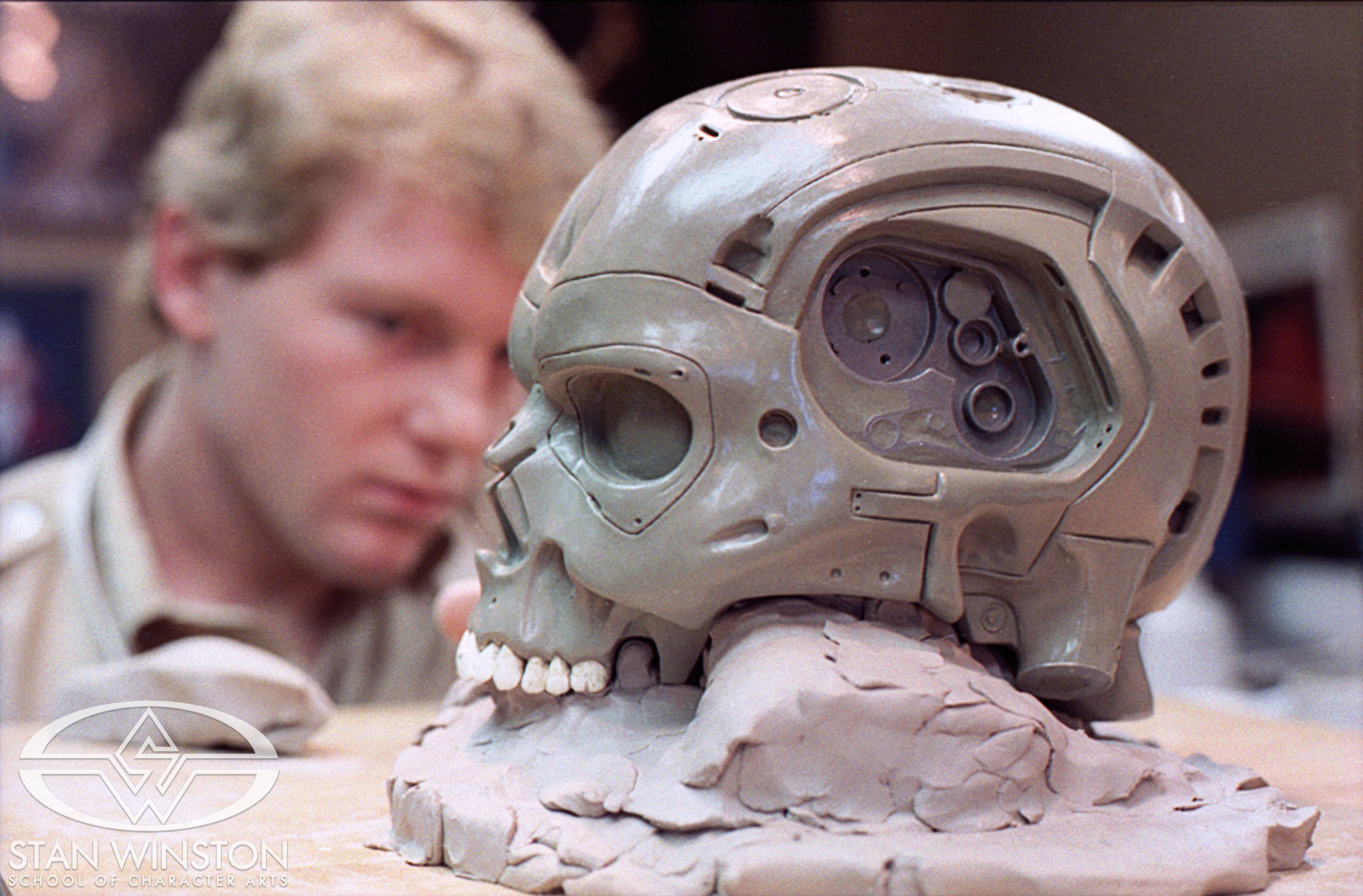 (Side view of the Terminator head sculpt before molding.)
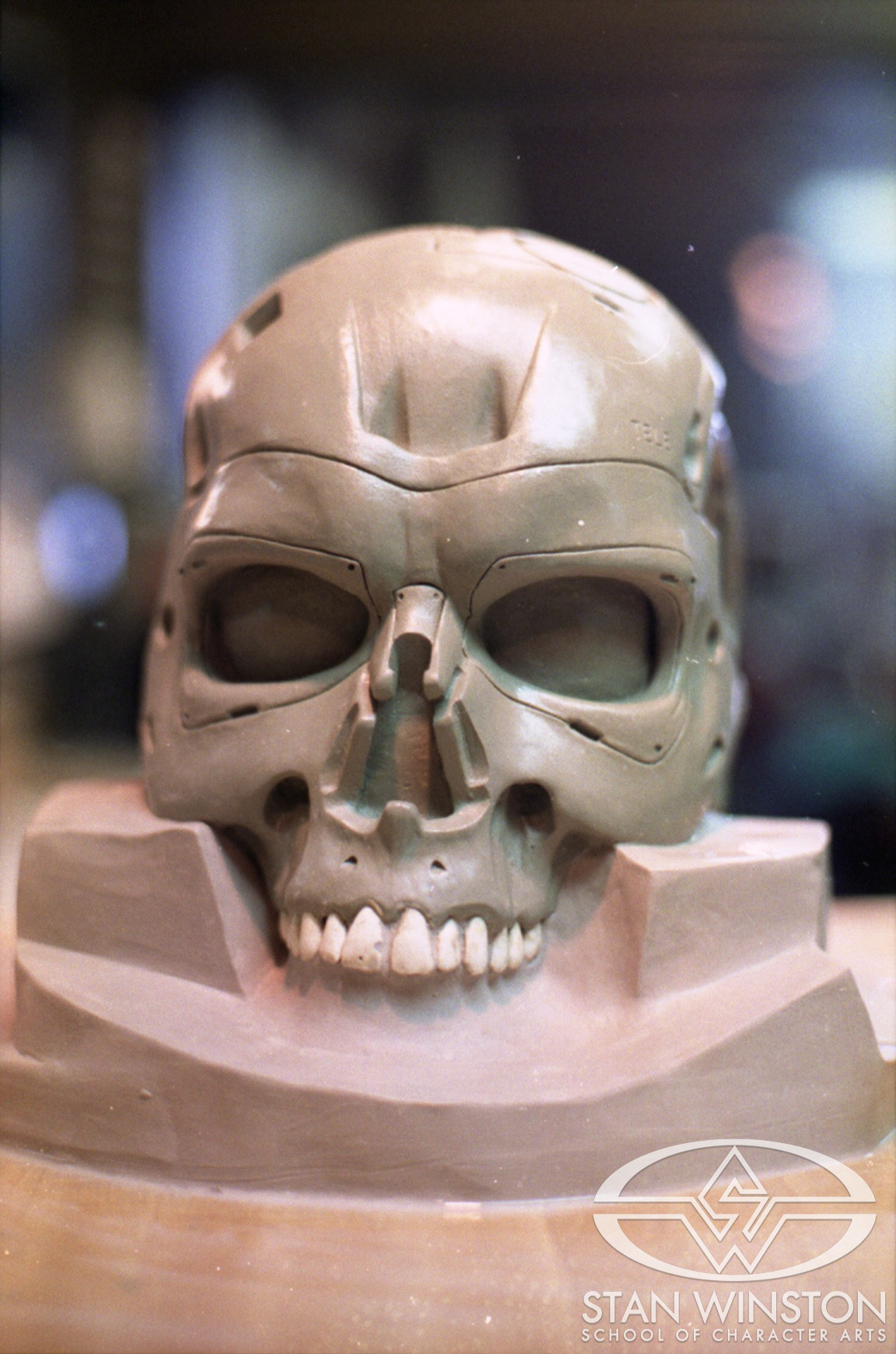 (Close-up of the Terminator head sculpt before molding.)
After making urethane molds from those sculpted forms, the crew made epoxy and fiberglass parts, embedded with steel supports. To give them the appearance of metal, the pieces were vacumetalized — an electromagnetic process that adheres metallic particles to an object — then assembled into the final robot form. Made of solid epoxy, fiberglass, and steel, the final full-body puppet weighed 100 pounds.
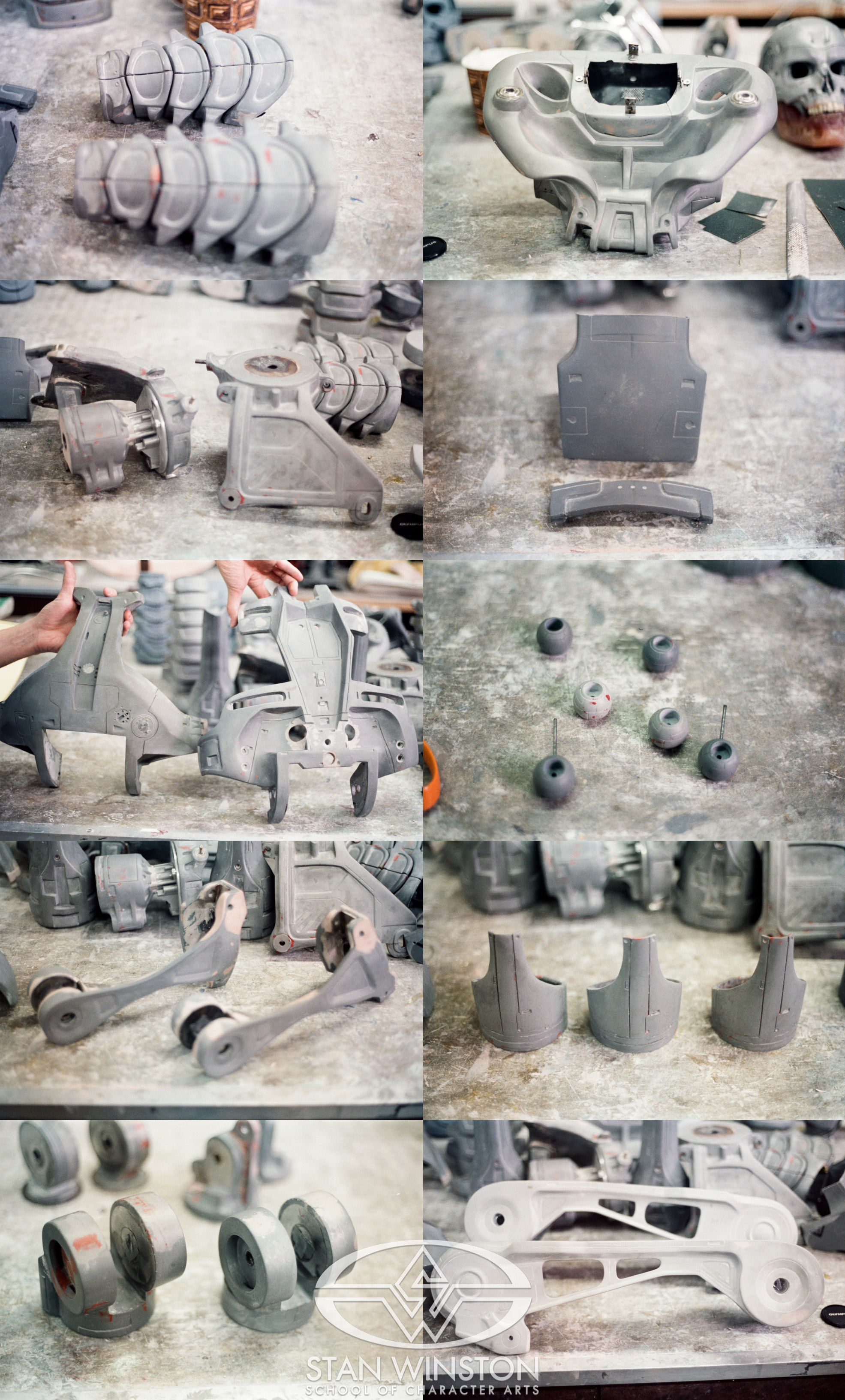 (Epoxy Terminator parts before assembly at Stan Winston Studio.)
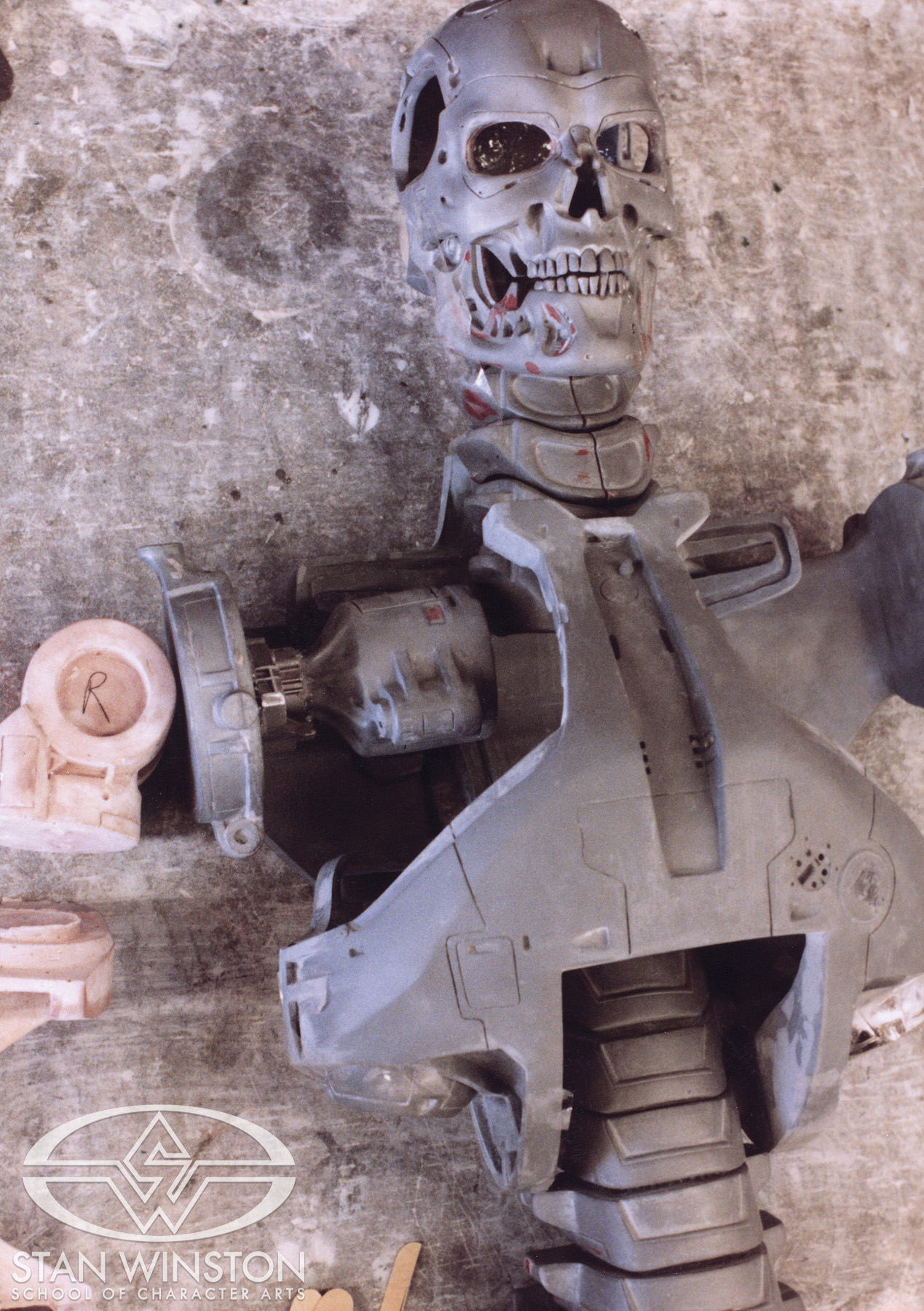 (Epoxy Terminator castings assembled for a test fitting.)
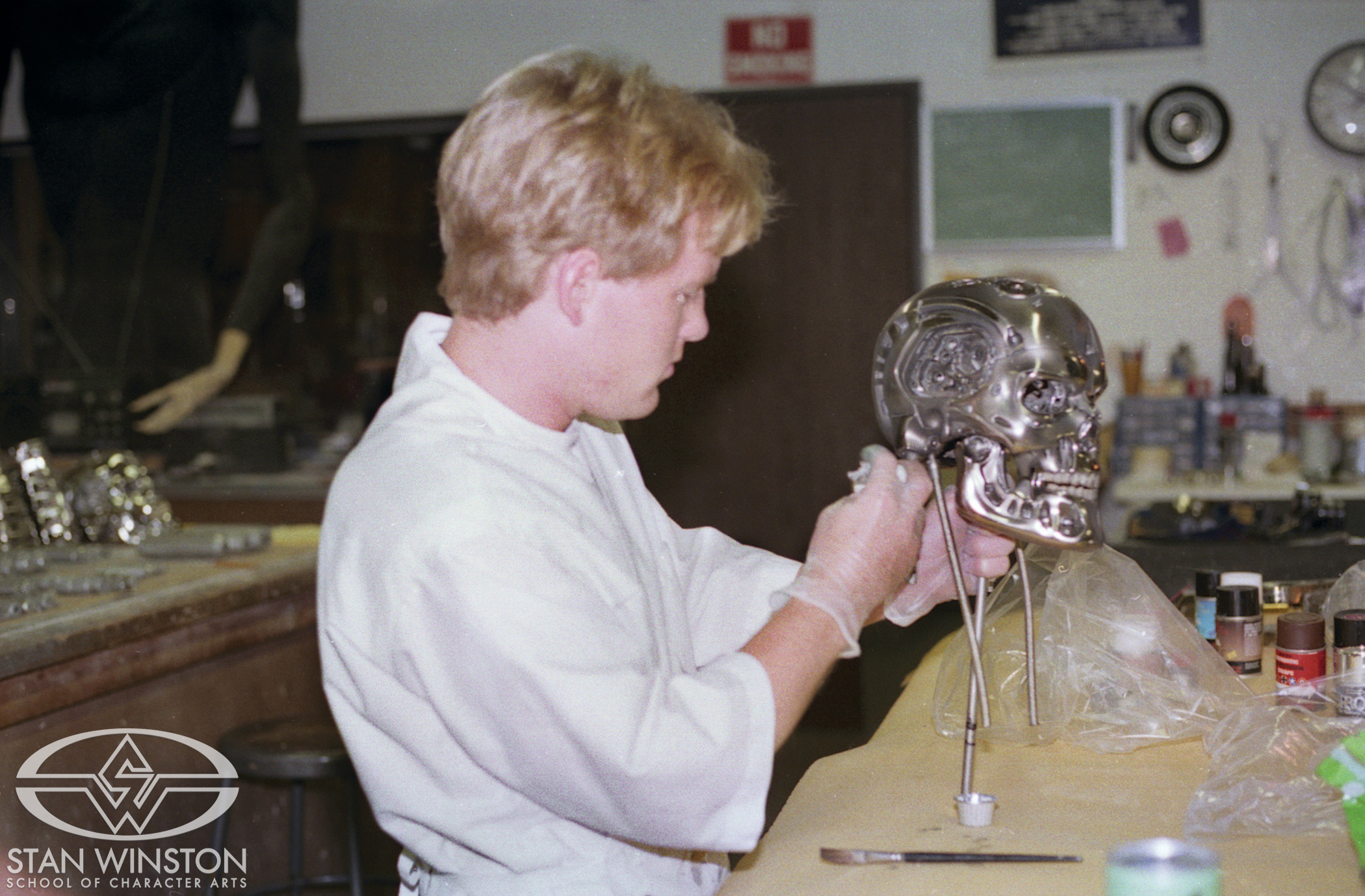 (Shane Mahan adds paint details to the Terminator skull.)
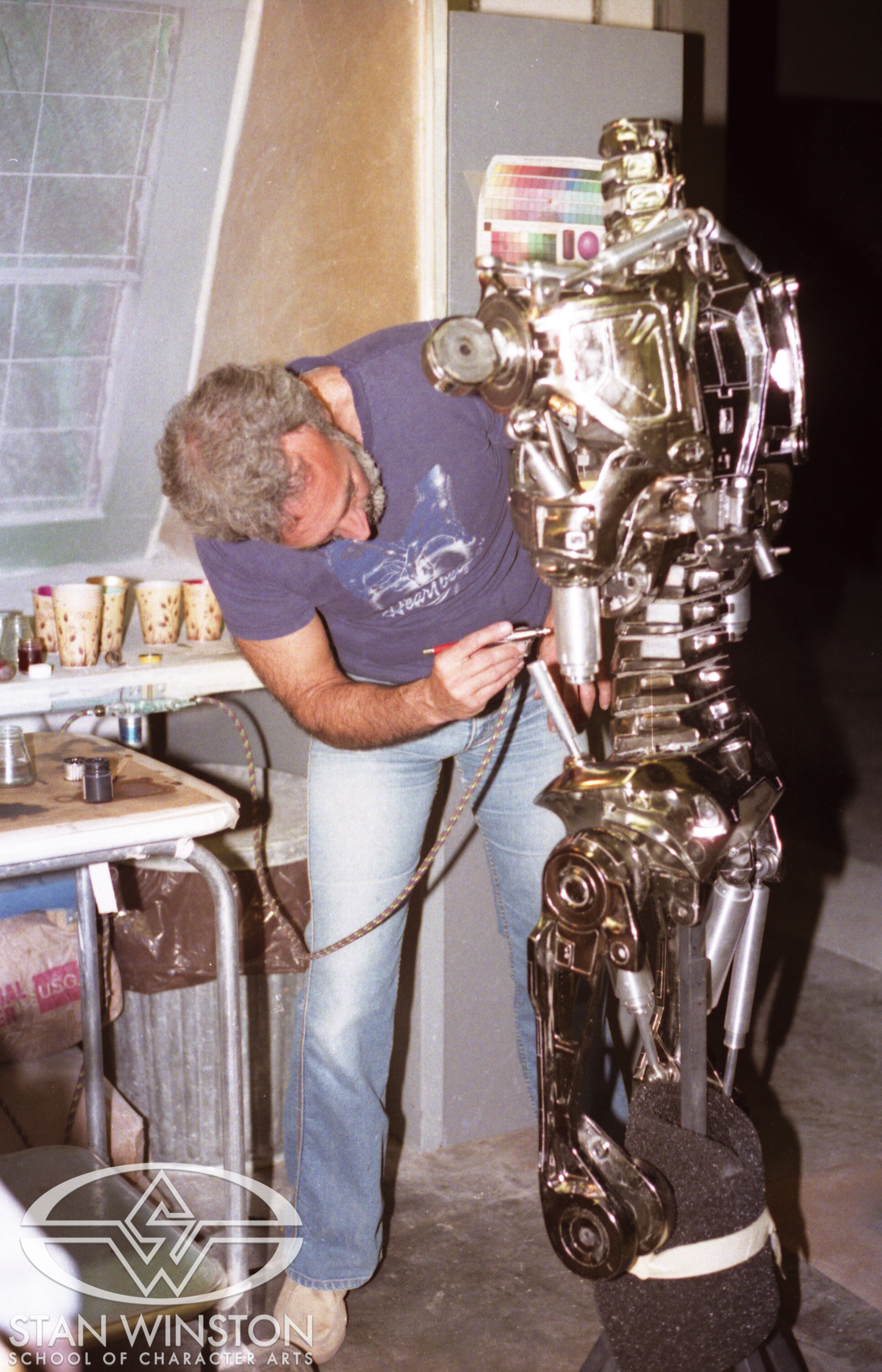 (Stan Winston airbrushes a Terminator endoskeleton.)
Because wide full-body shots of the endoskeleton walking would still be achieved through stop-motion animation of a two-foot-tall puppet, Winston’s full-body, full-size endoskeleton would be used only for non-ambulatory shots, and thus had movement that was limited to the head and eyes, articulated through mechanisms designed and built by Sonny Burman and his partner, Bob Williams. For insert closeups of the robot’s lower half, puppeteers operated the legs manually, one per limb, moving attached rods.
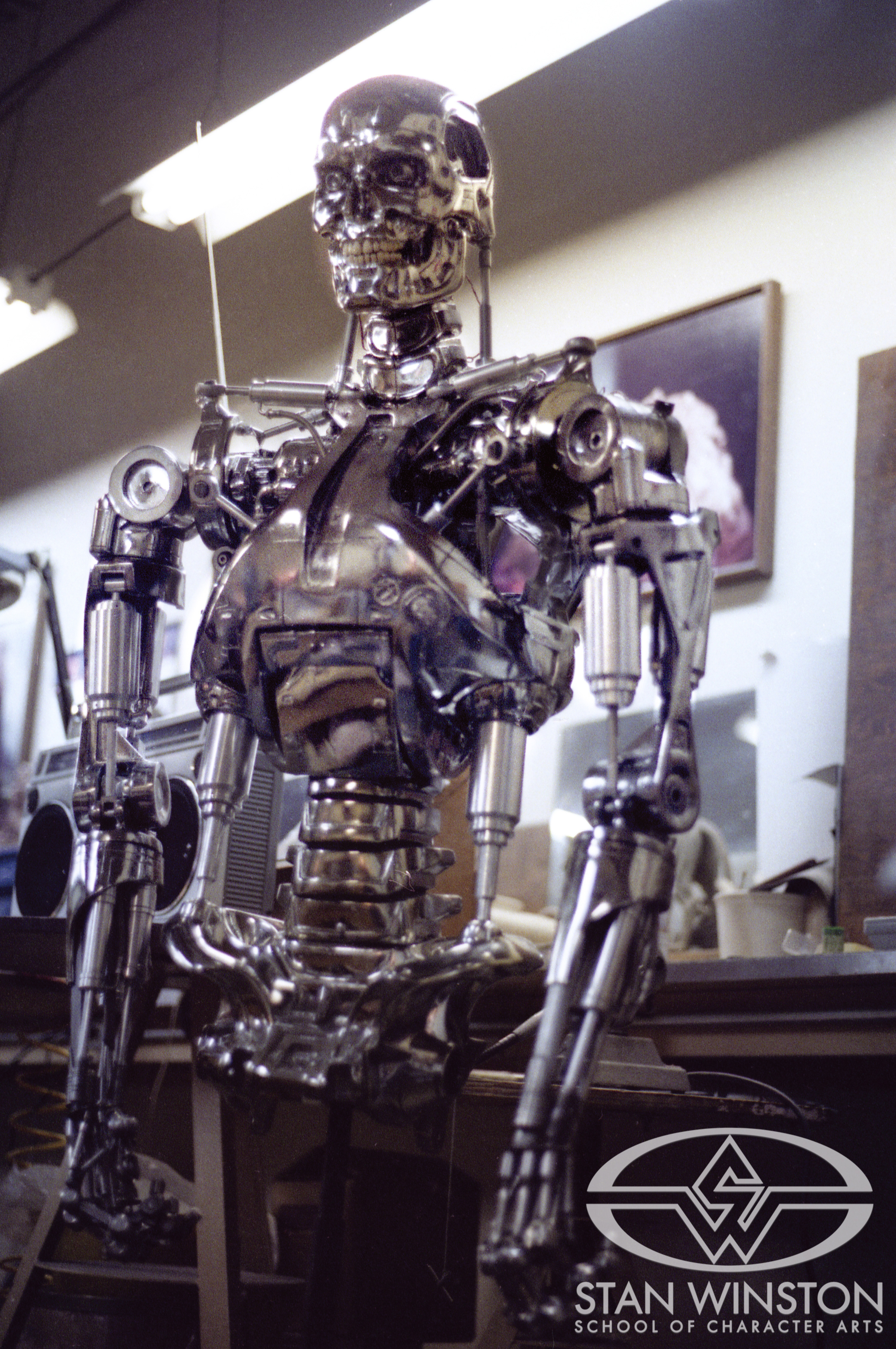 (Work-in-progress Terminator endoskeleton at Stan Winston Studio.)
Making the Backpack Rig Terminator
For mid-range and close-up shots of the endoskeleton moving through the frame, Stan Winston Studio built a head-and-torso half-puppet that could be worn on the back of an operator. “This was the same technique I’d seen used in Dark Crystal,” Winston explained. “A puppet would be carried on the shoulders of a puppeteer as a way of making it look as if it was walking across the stage. And because of the way the puppet was built and mounted to the puppeteer’s shoulders, every body motion that the puppeteer made would be translated up to the puppet. We did the same thing for the Terminator, mounting a half-body puppet onto the shoulders of a puppeteer to give us a mobile endoskeleton.”
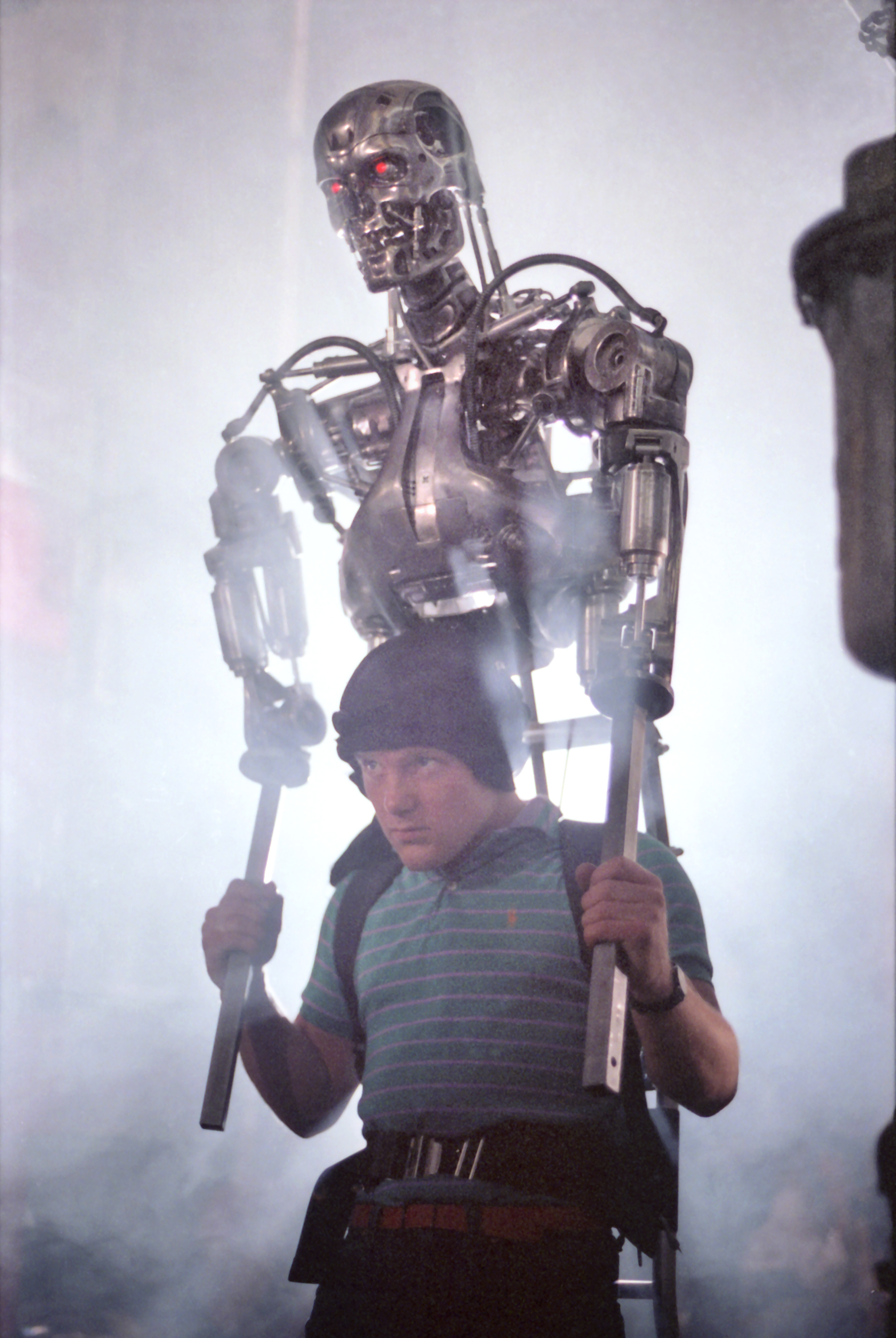 (Shane Mahan wearing the detached torso and head on a backpack rig on the set of The Terminator. Image courtesy of Hemdale Film, Pacific Western Productions, Euro Film Funding, and Cinema '84.)
Shane Mahan was tagged for the puppeteering job. “They needed somebody who was short,” Mahan commented, “otherwise, the endoskeleton would have been eight feet tall by the time they put this head and torso on the puppeteer’s back. I was the shortest guy on the crew, but I was also stocky enough to carry this eighty-five-pound puppet on my back. It was extremely heavy, partly because the materials available back then were limited, and partly because we weren’t that savvy yet about how to build these things. Plus, the endoskeleton was going to take a real beating during the shoot, being bashed into doors and all kinds of things, so it had to be really tough and durable.”
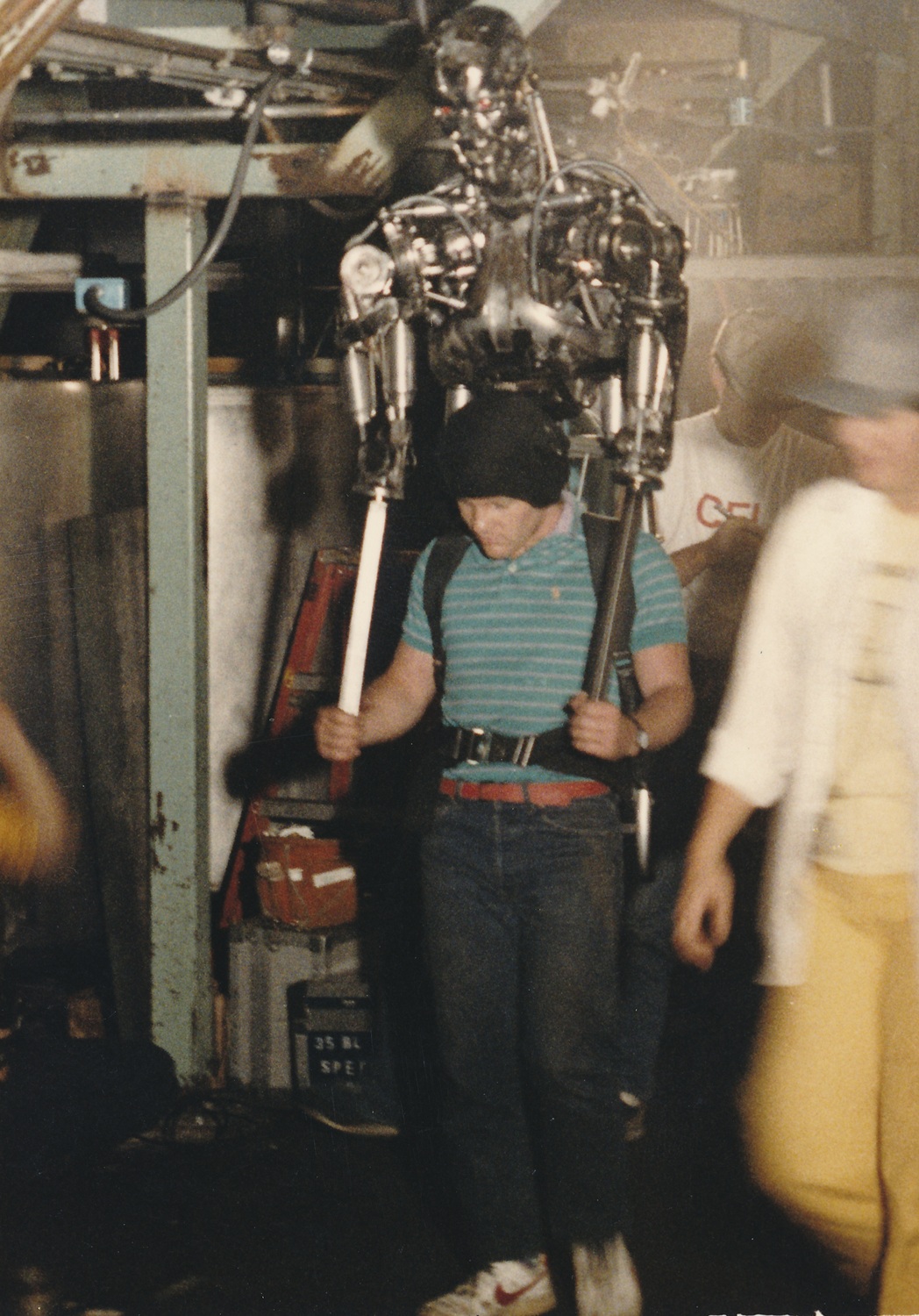 (Shane Mahan prepares for shooting the scene where the Terminator chases Sarah Connor and Kyle Reese through the factory. Image courtesy of Hemdale Film, Pacific Western Productions, Euro Film Funding, and Cinema '84.)
The crew devised a special rig to mount the half-puppet to Mahan’s back and translate his body movement upward. Working out body language with Winston and Schwarzenegger, Mahan walked with a distinctive limping gait, which created a similar cadence and posture in the torso and head of the Terminator robot.
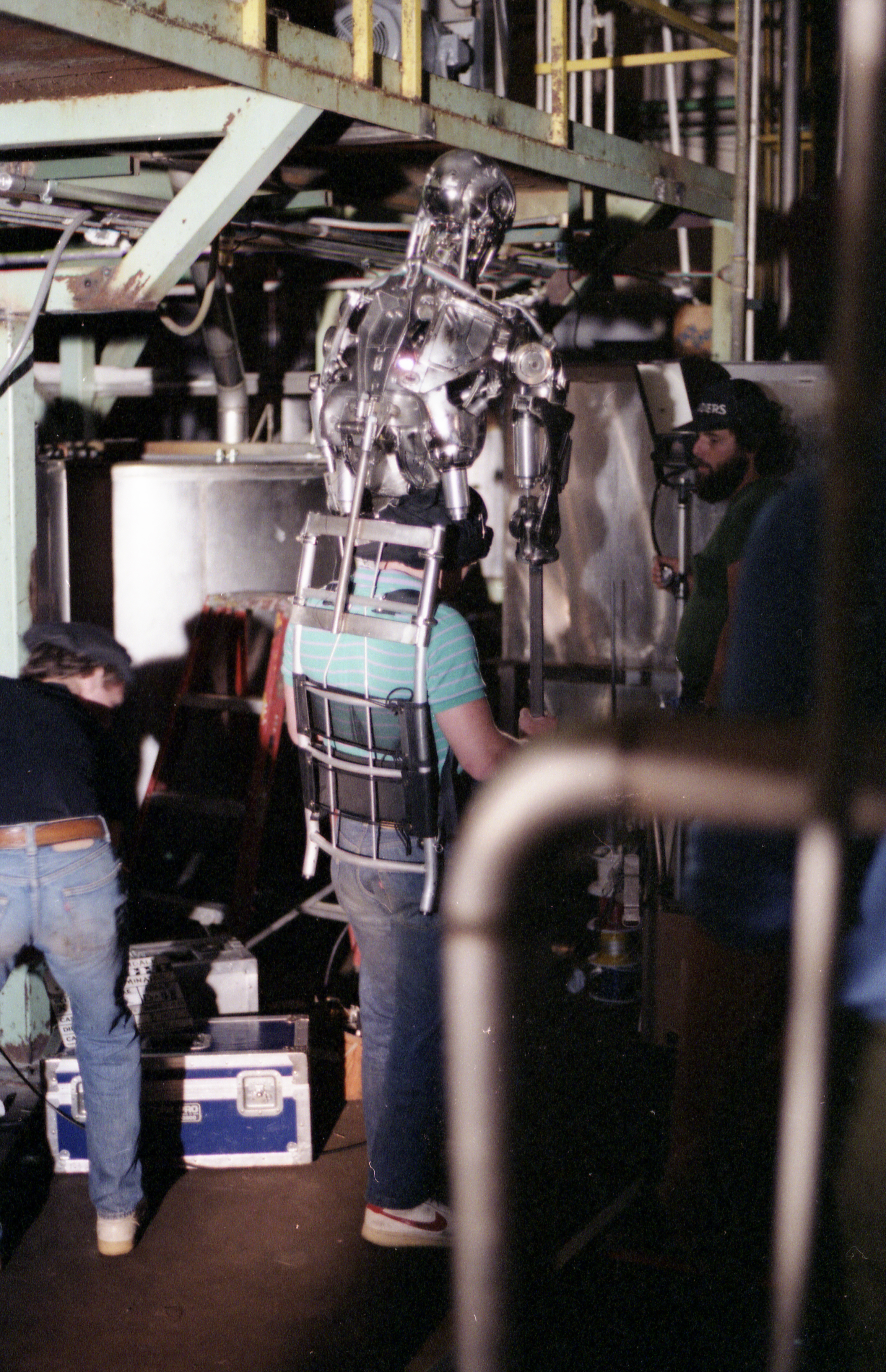 (The backpack rig from behind, worn by Shane Mahan. Image courtesy of Hemdale Film, Pacific Western Productions, Euro Film Funding, and Cinema '84.)
“You really see it when the Terminator is run over by the truck,” Winston said. “He rises up from underneath the truck, and he has this kind of mummy limp, dragging one foot behind him. Shane would do that same walk, and that limp and body language translated to the puppet.”
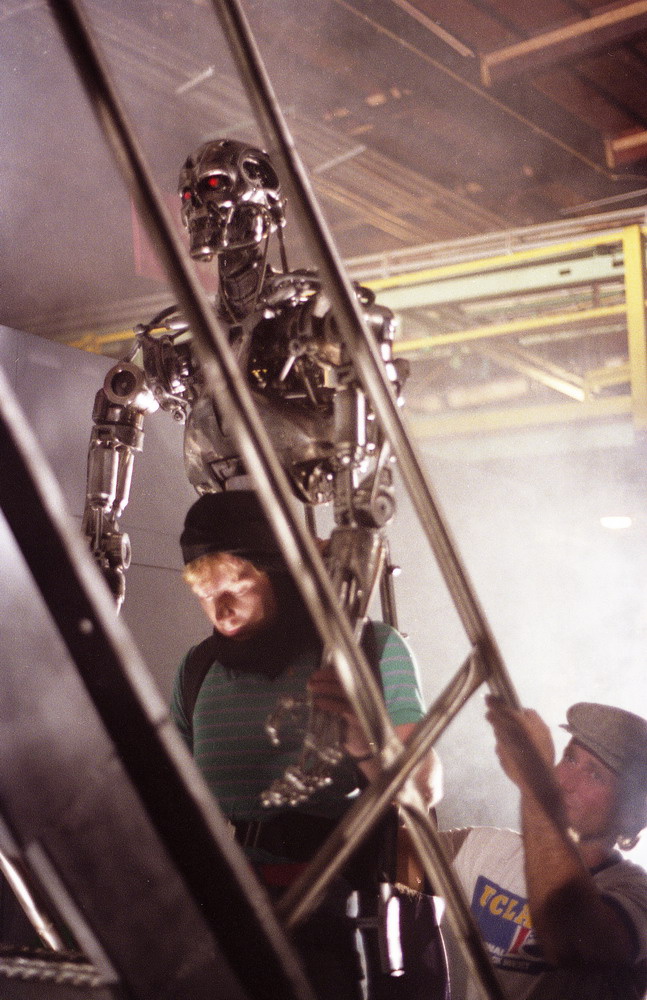 (Shane Mahan, wearing the backpack rig on set of The Terminator. Image courtesy of Hemdale Film, Pacific Western Productions, Euro Film Funding, and Cinema '84.)
Rods were also attached to the puppet’s elbows, enabling Mahan to articulate the arms. Head movement was operated by way of radio control in wider shots. For close-ups, a puppeteer would often insert his hand into the head cavity and manually articulate the head to turn. In addition to full-body and half-body endoskeletons, Stan Winston Studio built a variety of robot heads and arms for insert shots, as well as stunt versions.
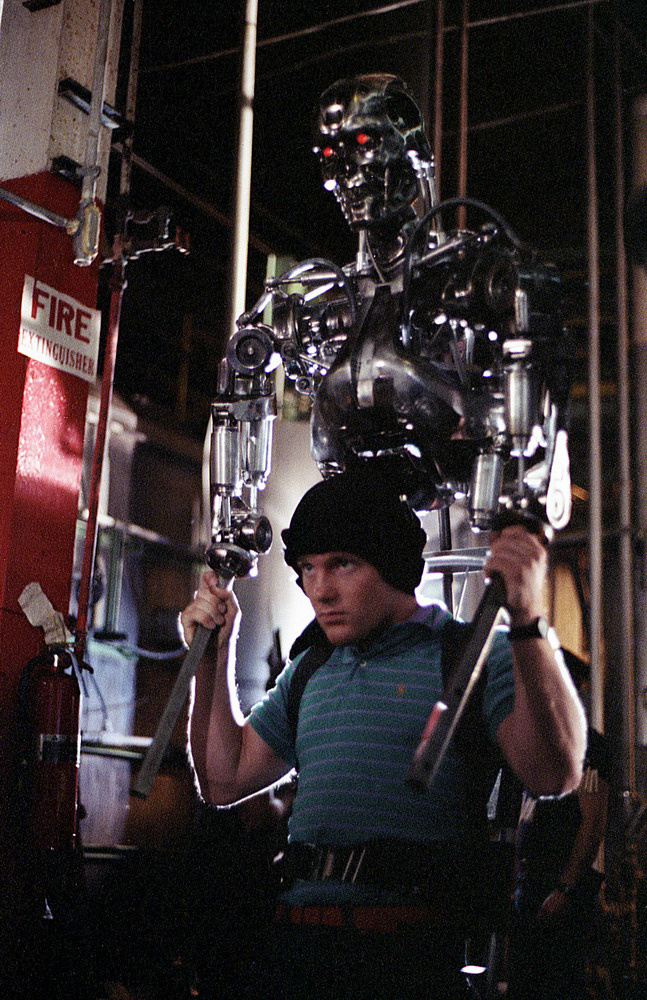 (Shane Mahan puppeteering the Terminator endoskeleton via the attached rods to move the arms and shoulders. Off-camera puppeteers radio-controlling the endoskeleton puppet’s head and eyes. Image courtesy of Hemdale Film, Pacific Western Productions, Euro Film Funding, and Cinema '84.)
How The Terminator Crew Blew Up the Stunt Endoskeleton
For shots of the Terminator robot being severed in half in an explosion when Reese inserts a pipe bomb into its torso area, Richard Landon built a lighter-weight stunt endoskeleton. “I built that stunt puppet by myself, in the shop, while the other guys were on the set. Stan’s reaction to that puppet was one of the first real pats on the back I got from him. I showed him a picture of it, and he thought it was the hero puppet. He couldn’t tell the difference.”
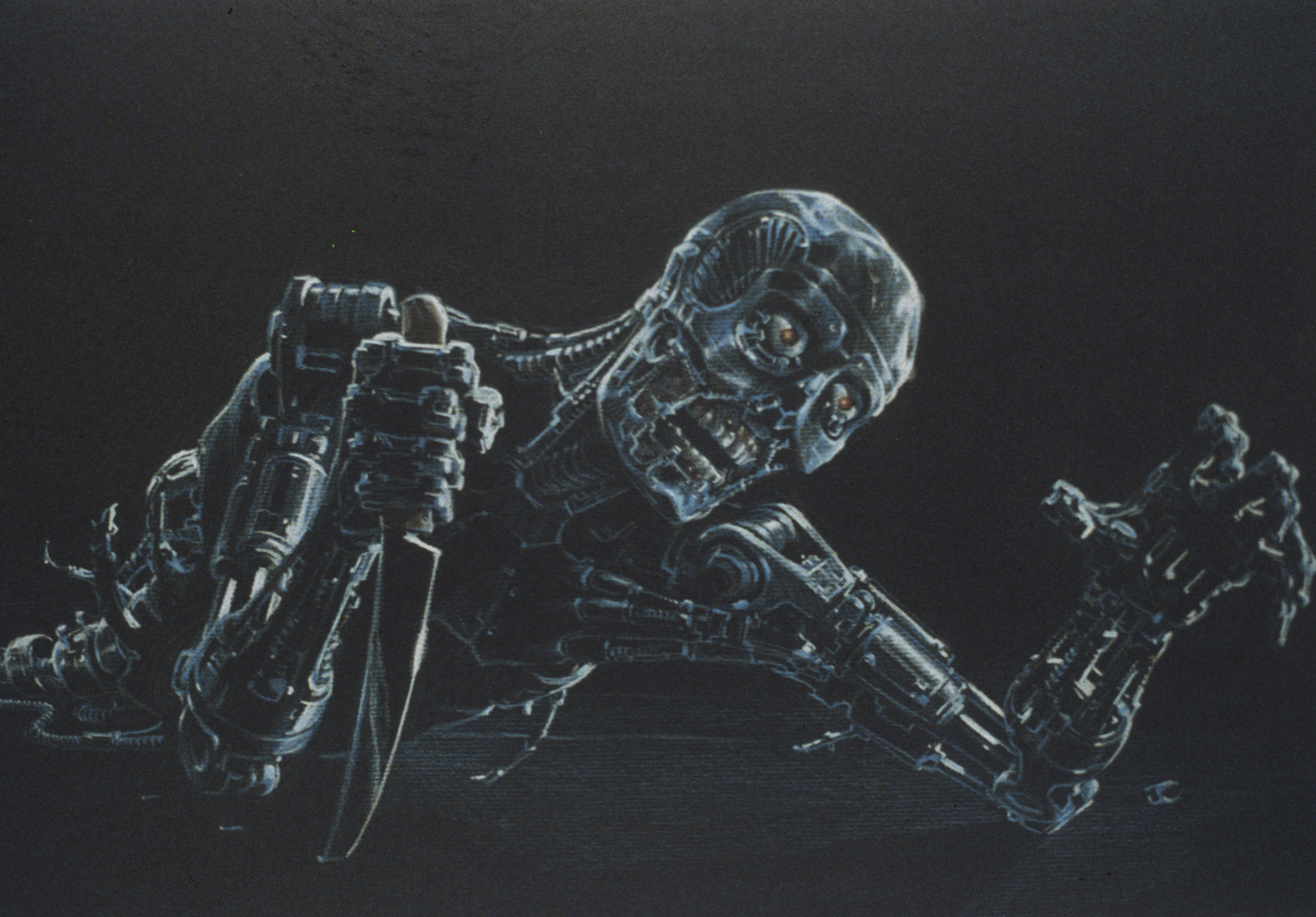 (James Cameron's concept of the head-and-arm Terminator. Image courtesy of Hemdale Film, Pacific Western Productions, Euro Film Funding, and Cinema '84.)
Landon accompanied his stunt puppet to an insert stage where a pyrotechnics crew rigged the endoskeleton explosion. To achieve the specific effect Cameron wanted—which was to see the top half of the endoskeleton separate from the bottom half—Landon attached two cables to the stunt puppet's shoulders so he and another crewmember could lift the top half off when the explosion occurred. “When they were ready to go,” recalled Landon, “we all hid behind some kind of cover because that epoxy puppet was going to send shrapnel all over the room when it blew up. The pyrotechnics guy counted down, ‘Three, two, one,’ the explosion went off, the other guy and I yanked on these two cables — but they just went slack in our hands. There was nothing connected to them anymore, because the stunt endoskeleton had disintegrated! The guy who wired the robot to explode had put twenty feet of primer cord through the legs, which is roughly equivalent to about forty M-80s. They had wanted to make sure the puppet would blow up — and boy did it. In the dailies the next day, it was clear that the robot had disintegrated. In fact, you can see it in the final film, if you watch carefully. So, in reality, the movie should have been over at that point. The Terminator was blown to pieces. Kyle wins.” A quick cut from the explosion to an endoskeleton head and arm crawling forward rendered the mistake unnoticeable to all but the most observant viewers.
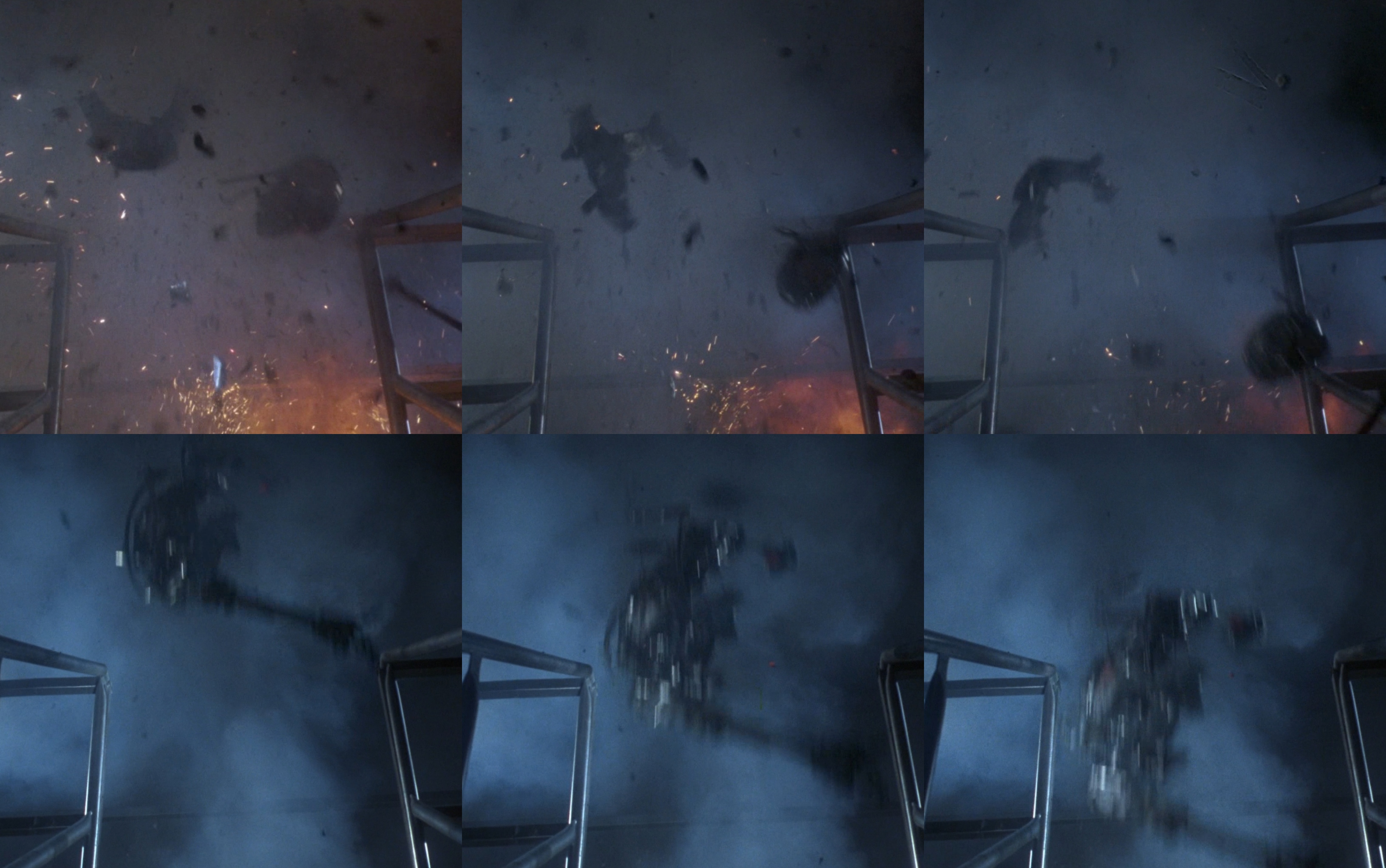 (The blown-up stunt Terminator as it appears in the movie. Image courtesy of Hemdale Film, Pacific Western Productions, Euro Film Funding, and Cinema '84.)
That head-and-arm Terminator is featured in shots inside the factory where Sarah has taken cover. To propel the puppet forward as it crawls toward the young woman, Winston puppeteers positioned themselves beneath the grated floor of the factory set, then operated rods that were connected to the puppet and threaded through the grating slots. Earlier shots of its slamming into the factory door were achieved by fitting the puppet with a battering ram and mounting it to a trolley that was rolled full-force into the set door — over and over again, until Cameron got a take he liked.
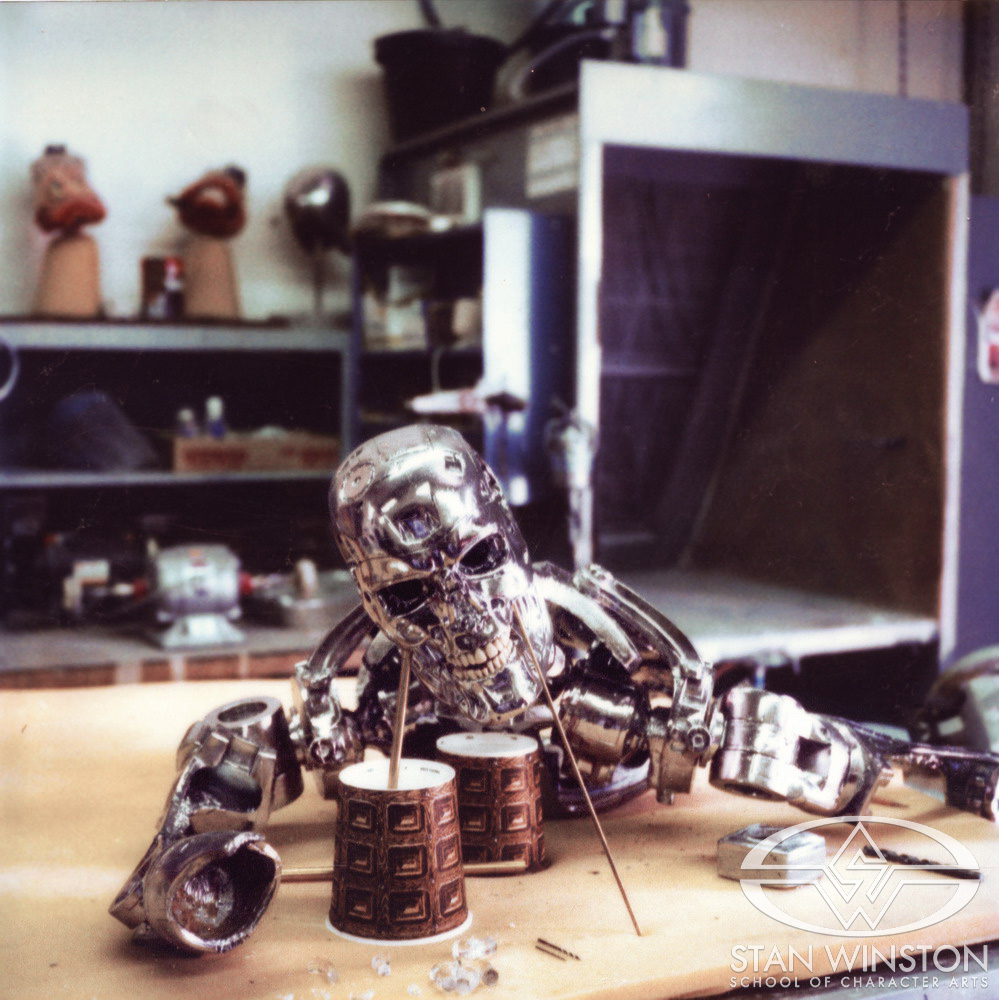 (Work-in-progress head-and-arm Terminator puppet at Stan Winston Studio.)
The Head Behind the Hydraulic Press Scene
The studio built a flexible polyurethane endoskeleton skull for a final scene in which Sarah crushes it in a steel press. During filming, when the skull would not flatten sufficiently to satisfy Cameron, John Rosengrant created a new endoskeleton head, right on the spot. “I took one of the chrome-plated resin skulls we had for the other endoskeleton puppets,” Rosengrant said, “and I covered it with very thin sheet lead. I carved into that lead to create an eye and part of the face, and then painted it — and that’s what we used. That’s the final endoskeleton head you see being smashed in the press in the movie. I had less than an hour to do this, but I liked that. I’ve always found that I like the situations where everyone is desperate, and you have to wing it, those situations where all your plans go out the window, and you have to think of something quick.”
Replicating Schwarzenegger’s Head for the Eye-surgery Scene
In addition to the endoskeleton puppets, Winston and his crew built full-scale mechanical replicas of Arnold Schwarzenegger’s head, required for shots of the Terminator performing self-surgery on a damaged eye.
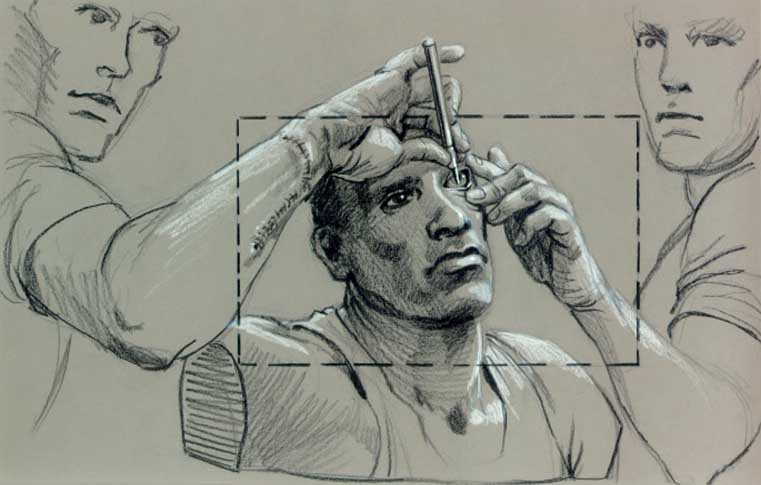 (James Cameron's concept for the eye-surgery scene. Image courtesy of Hemdale Film, Pacific Western Productions, Euro Film Funding, and Cinema '84.)
“With these puppets,” said Winston, “we were going much further than just creating actor dummies. We were creating replicas of an actor that would be scrutinized by the camera, so they had to be absolutely realistic-looking. It had been done before this, but usually as a throwaway effect, something seen only in very quick cuts. It wasn’t something featured for a long time in a scene, not something with eye and head movement. We were pushing the envelope again, taking the art of prop dummy-making and crossing it with animatronics and radio control. By pushing that envelope and crossing those techniques, we created lifelike, animatronic puppets that replicated an actor.”
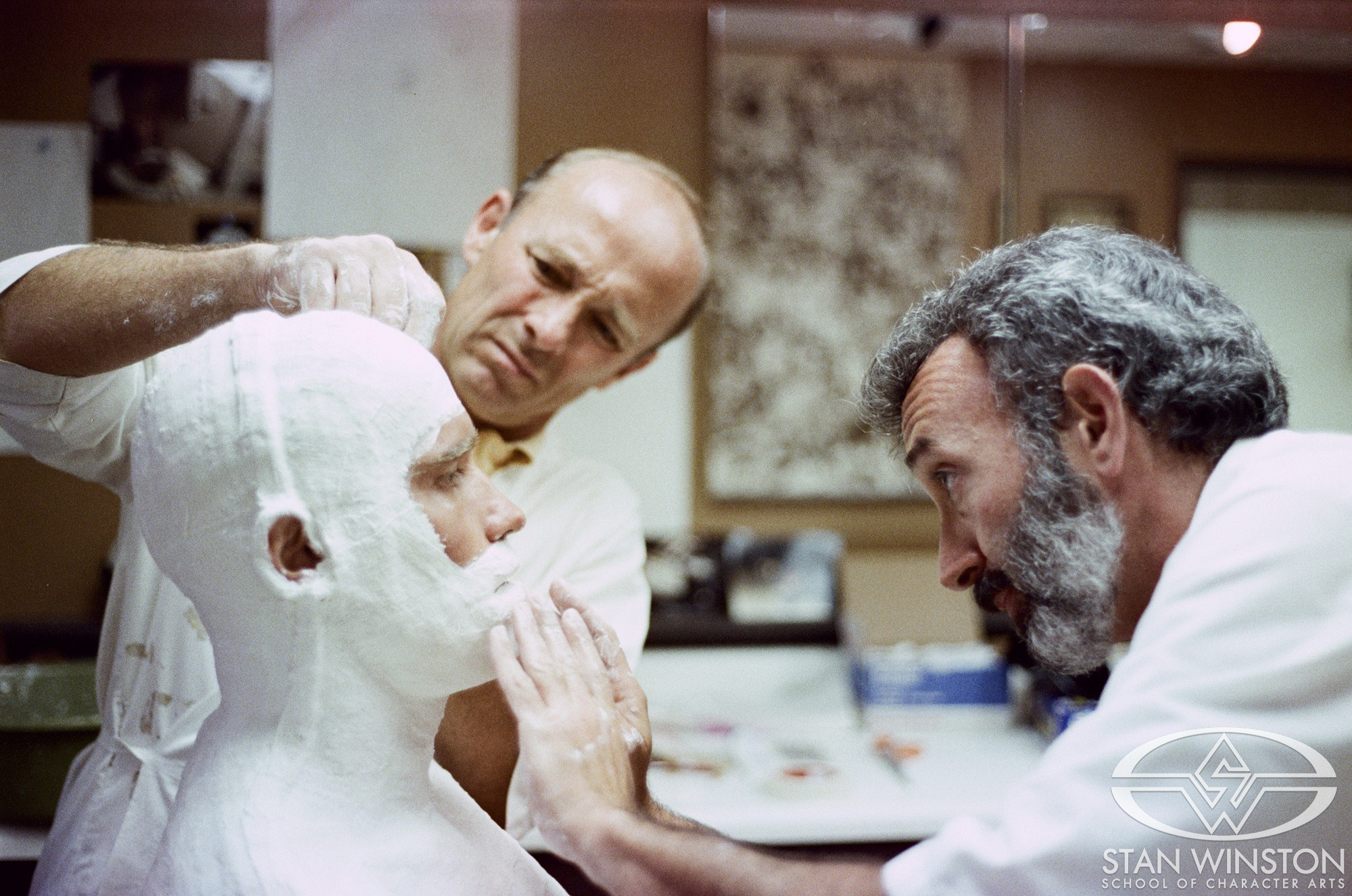 (Ellis Burman Jr. and Stan Winston life-casting Arnold Schwarzenegger.)
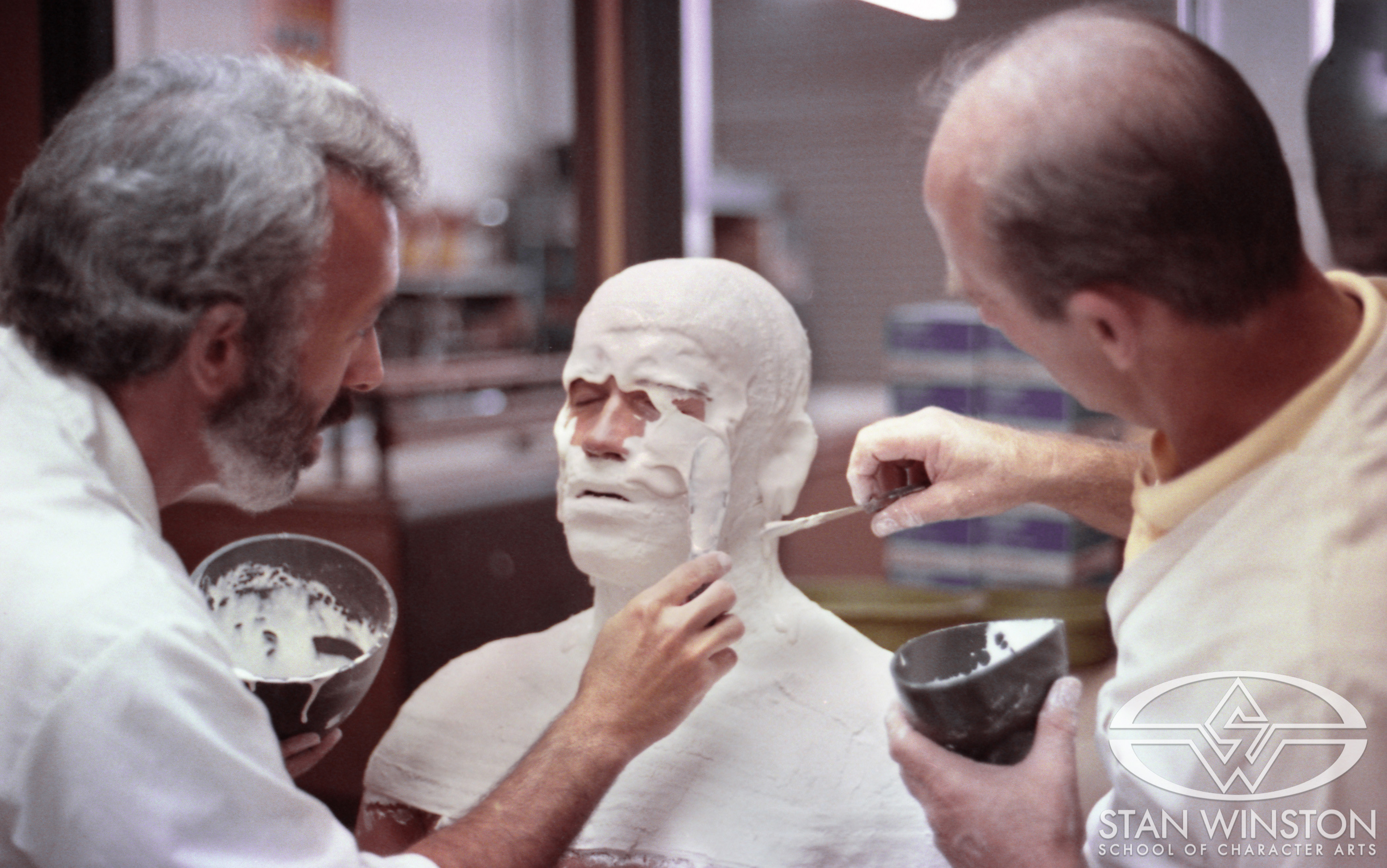 (Work-in-progress of life-casting Arnold Schwarzenegger at Stan Winston Studio.)
To create the best replica, Winston first took a lifecast of Schwarzenegger, duplicated it in clay, and then sculpted back in all of the nuance and character of the face that had been lost in the lifecast, referencing photographs of the actor taken from every angle. “Normally,” Winston explained, “if someone wanted to create a dummy of an actor, they would take a lifecast, pull out a positive of that, and then carve in the eyes and so forth. But if you want an exact replica of an actor, you can’t do a straight lifecast, because of the distortion that occurs in the casting process. The material tends to pull down the face and create a kind of ‘death mask’ look. I wanted to push the art of making dummies, and make these puppets perfect replicas of Arnold. So, using photographs, we resculpted the life mask to take whatever distortion there was out of it, and to make it a more perfect replication of Arnold.”
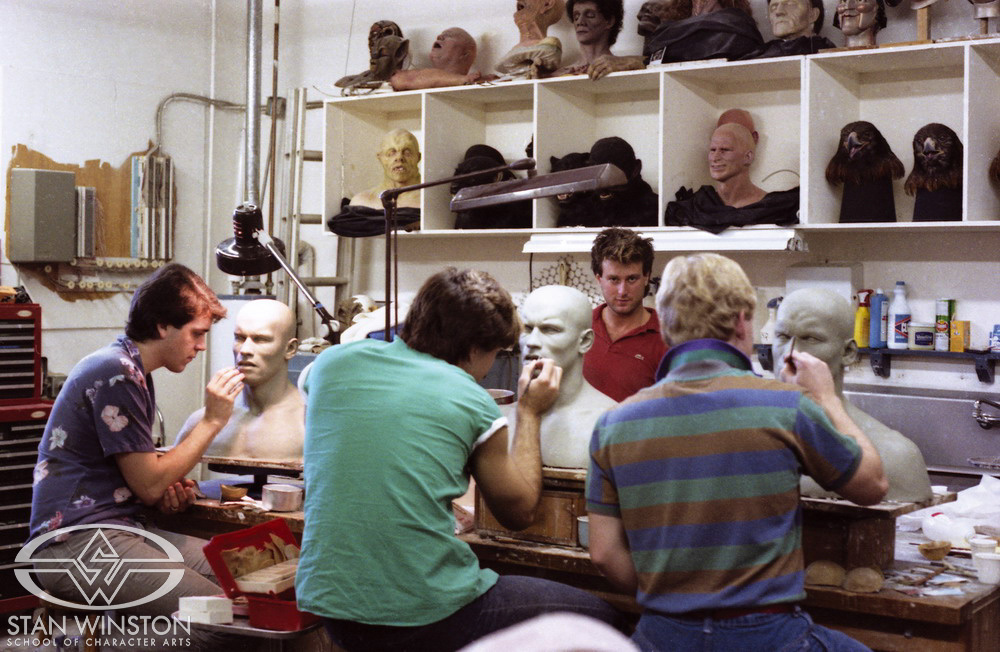 (Tom Woodruff Jr., Brian Wade, Shane Mahan, and John Rosengrant work on Schwarzenegger clay sculptures.)
After creating clay duplicates of the original sculpture, the crew resculpted those to conform to the configuration of the two puppets, as they would appear in each specific shot of the eye surgery scene. One was sculpted as if the Terminator was stretching open the skin around the eye, while the second was sculpted with the entire eye section cut away. “The reason we had to sculpt that open-eye look in the first one was that we couldn’t just stretch open the foam rubber skin of a puppet in a neutral position,” Winston said. “It would never have looked like real skin stretching. So that ‘movement’ was actually sculpted into that particular puppet head. It also had a gelatin eye, which is what the Terminator cuts into with the X-Acto knife in the scene.”
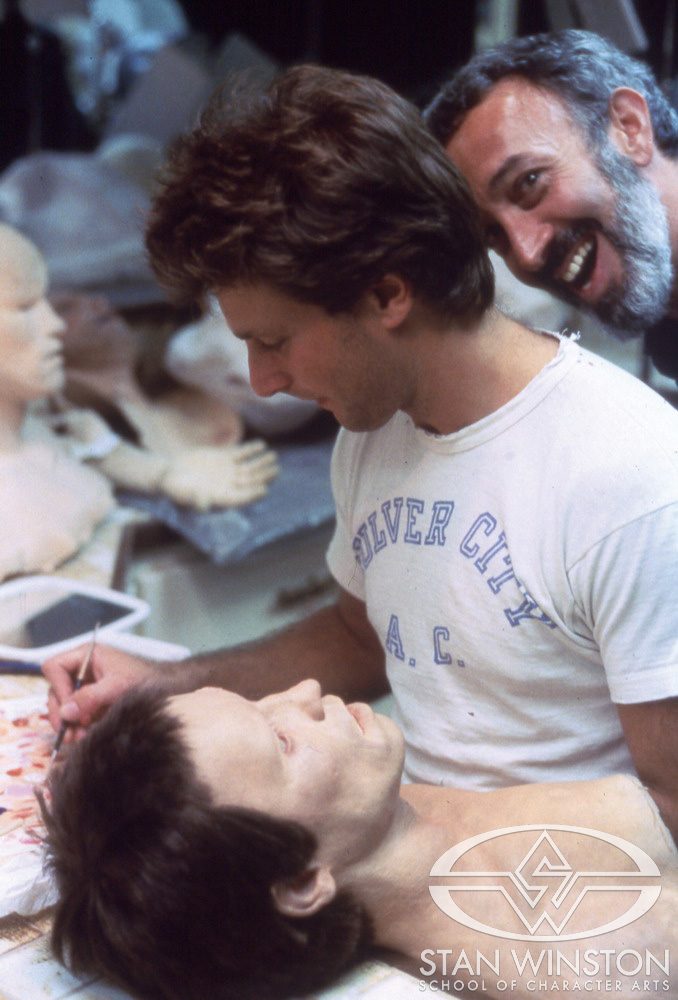 (Stan Winston photo-bombing John Rosengrant while he paints one of the Schwarzenegger heads, featuring hair that had not yet been cut or dressed to match the actor.)
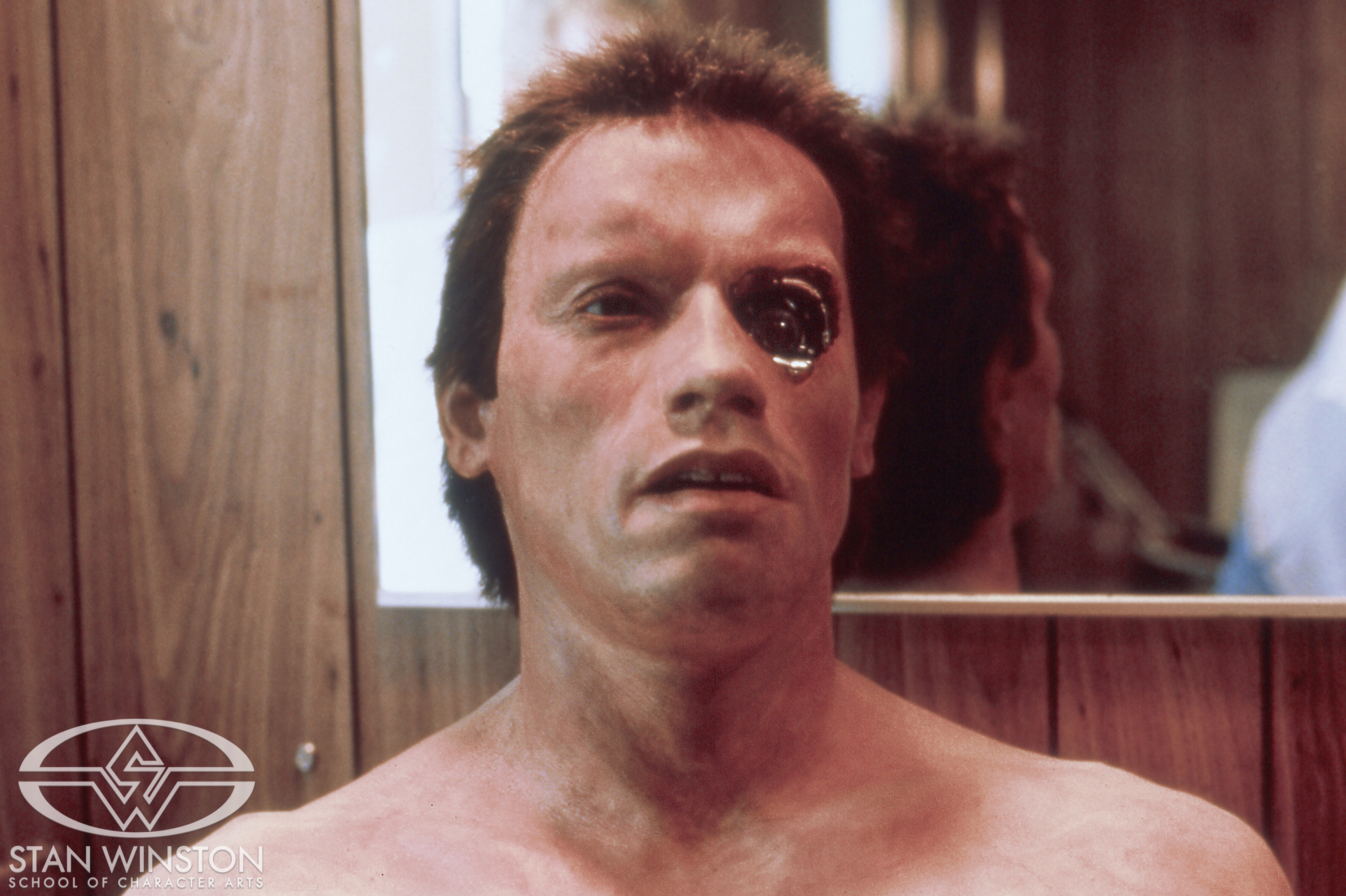 (The final puppet head after paint and hair work.)
When the eye-surgery scene was shot, Schwarzenegger held the X-Acto knife standing to one side of the puppet, out of frame. On the other side, another performer with hands as large as Schwarzenegger’s positioned his fingers on the puppet head, as if propping open the damaged eye. After Schwarzenegger sliced into the gelatin eye, the scene cut to the second puppet head, which featured the excised eye area. Both puppet heads were cable-operated to instill life and movement into them. A final shot closed in on a larger-than-life mechanical insert eye built by the Winston team.
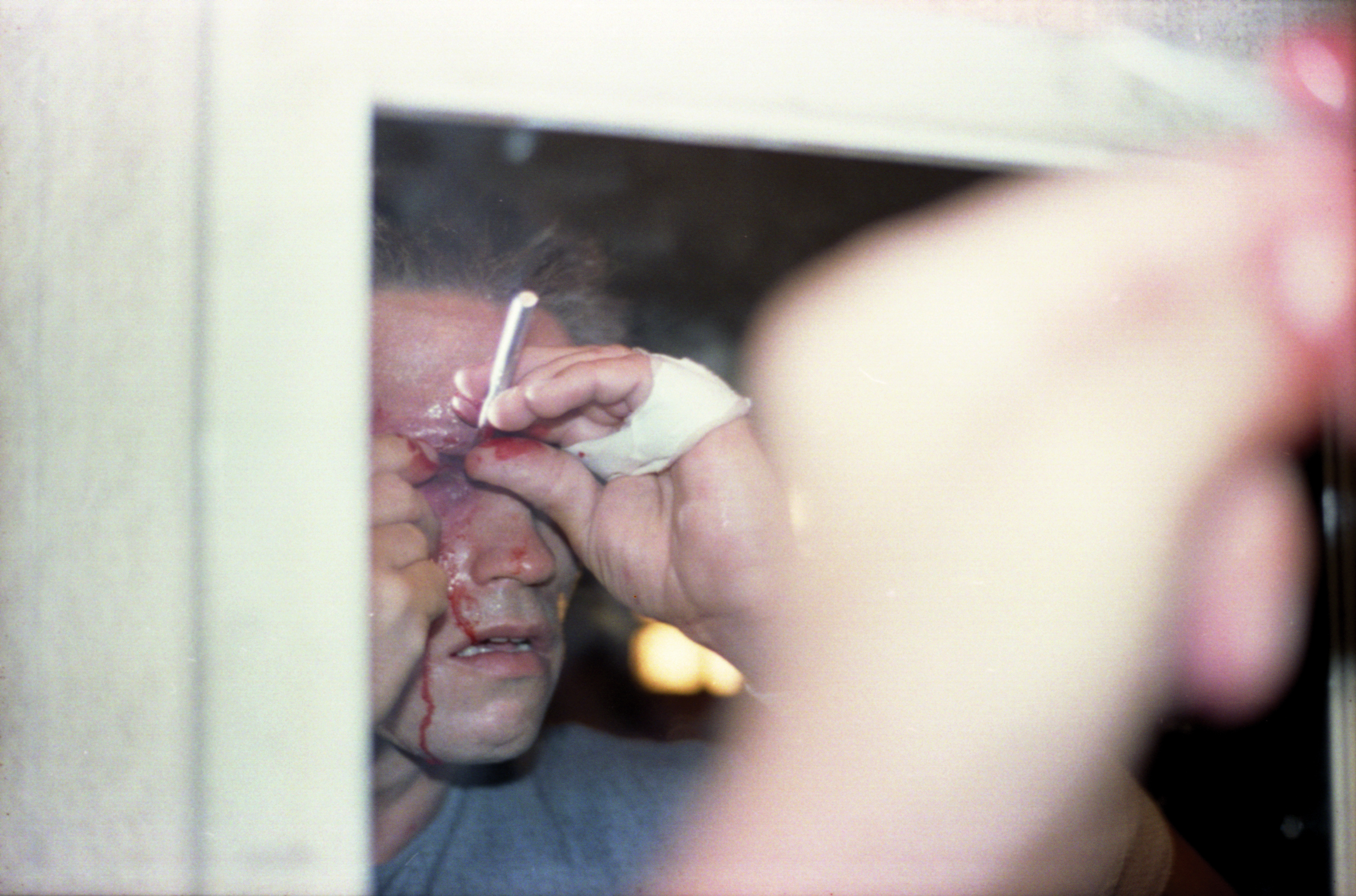 (On set of Arnold Schwarzenegger practicing the eye-surgery scene. Image courtesy of Hemdale Film, Pacific Western Productions, Euro Film Funding, and Cinema '84.)
Using Terminator Makeup FX
A third puppet head was built for later scenes in which much of the cyborg’s chrome understructure is exposed. That head featured a chrome plate at the forehead, a mechanical eye, and a section of metallic jaw revealed through the Terminator’s injured cheek.
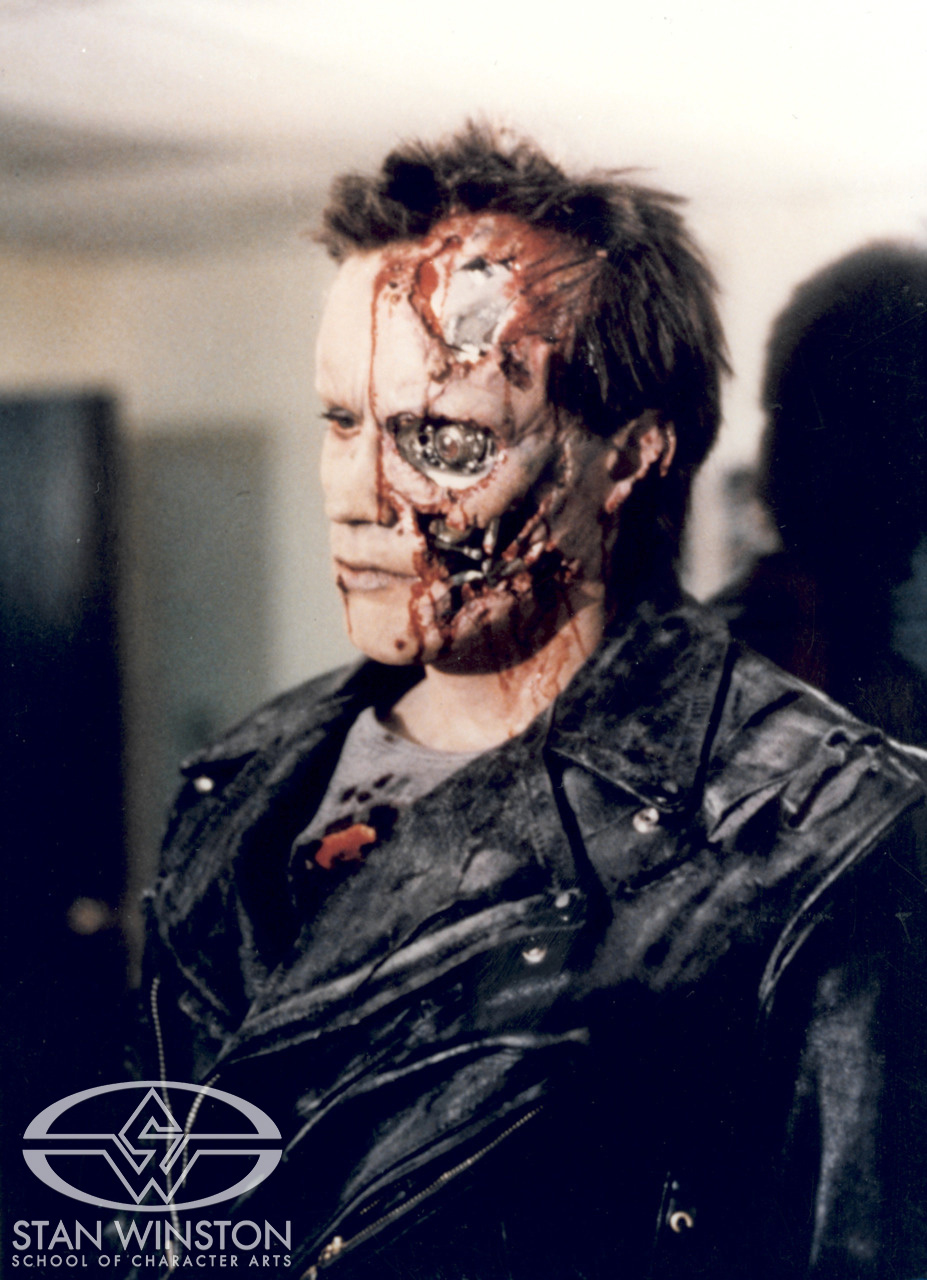 (The third Terminator puppet, with its exposed chrome understructure.)
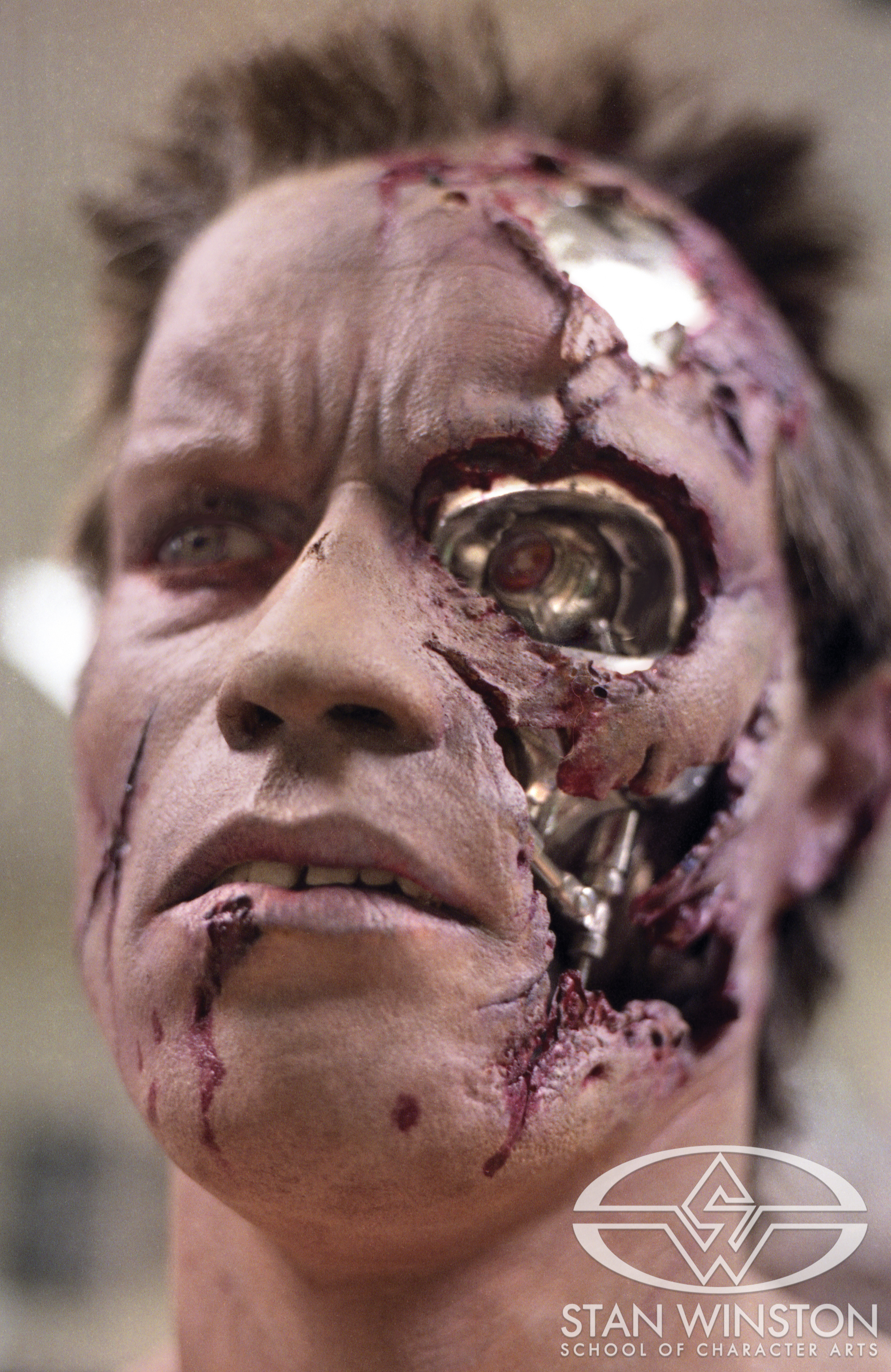 (The deteriorated section on the third puppet that was used for the scene where the Terminator chases Sarah Connor and Kyle Reese in a tanker truck.)
Winston duplicated this advanced-stage damage in a makeup that was applied to Schwarzenegger, consisting of vacumetalized plastic pieces and foam rubber prosthetics. “This was pioneering stuff that Stan was doing,” John Rosengrant remarked. “Nobody had ever done a makeup to create the look of a metal skull showing through on an actor.”
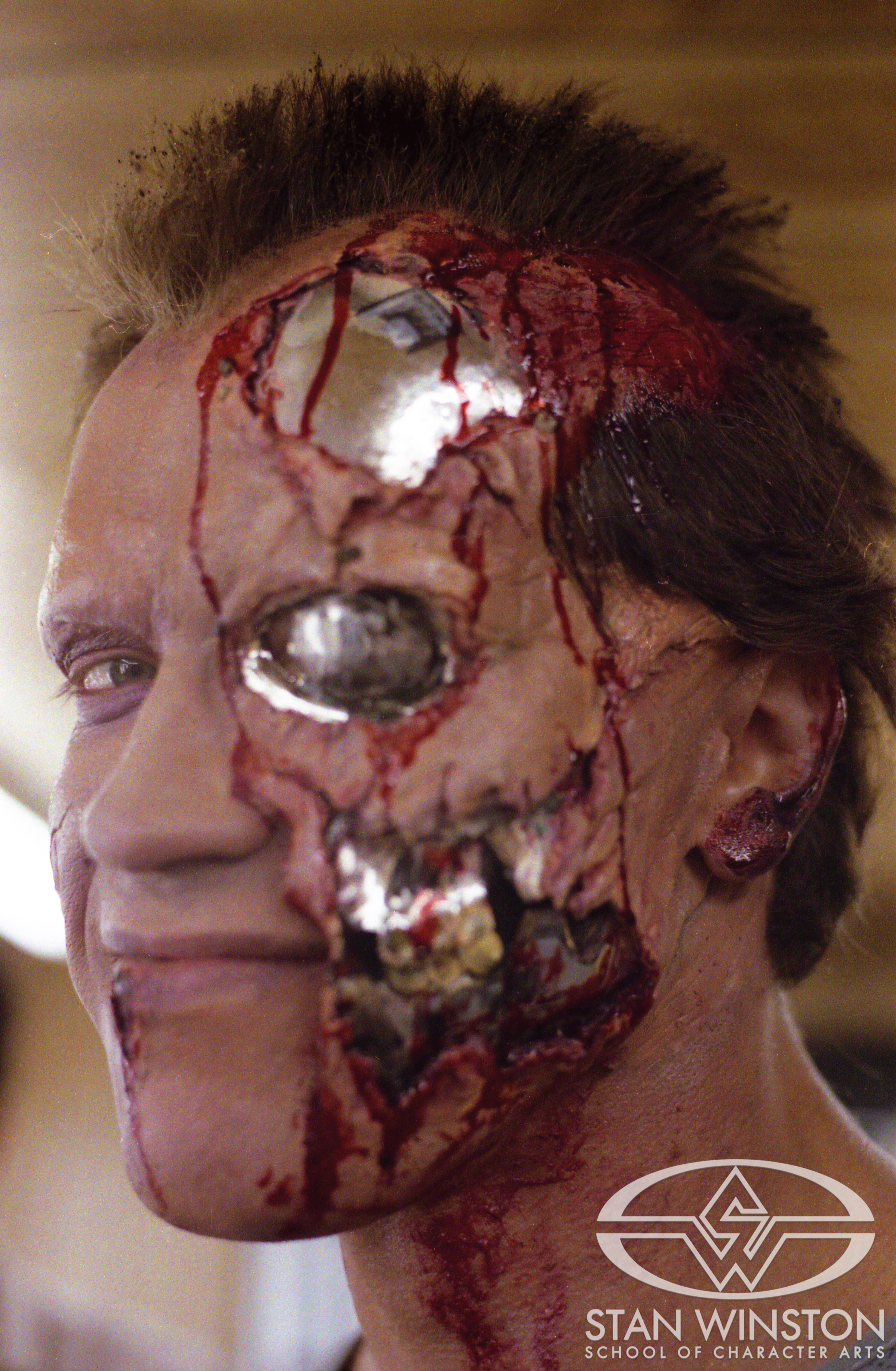 (Arnold Schwarzenegger wearing the deterioration makeup.)
The In-Camera Trick Behind the Arm Surgery Scene
Stan Winston Studio also replicated Schwarzenegger’s arm for a scene in which the cyborg cuts into his limb, exposing the underlying endoskeleton.
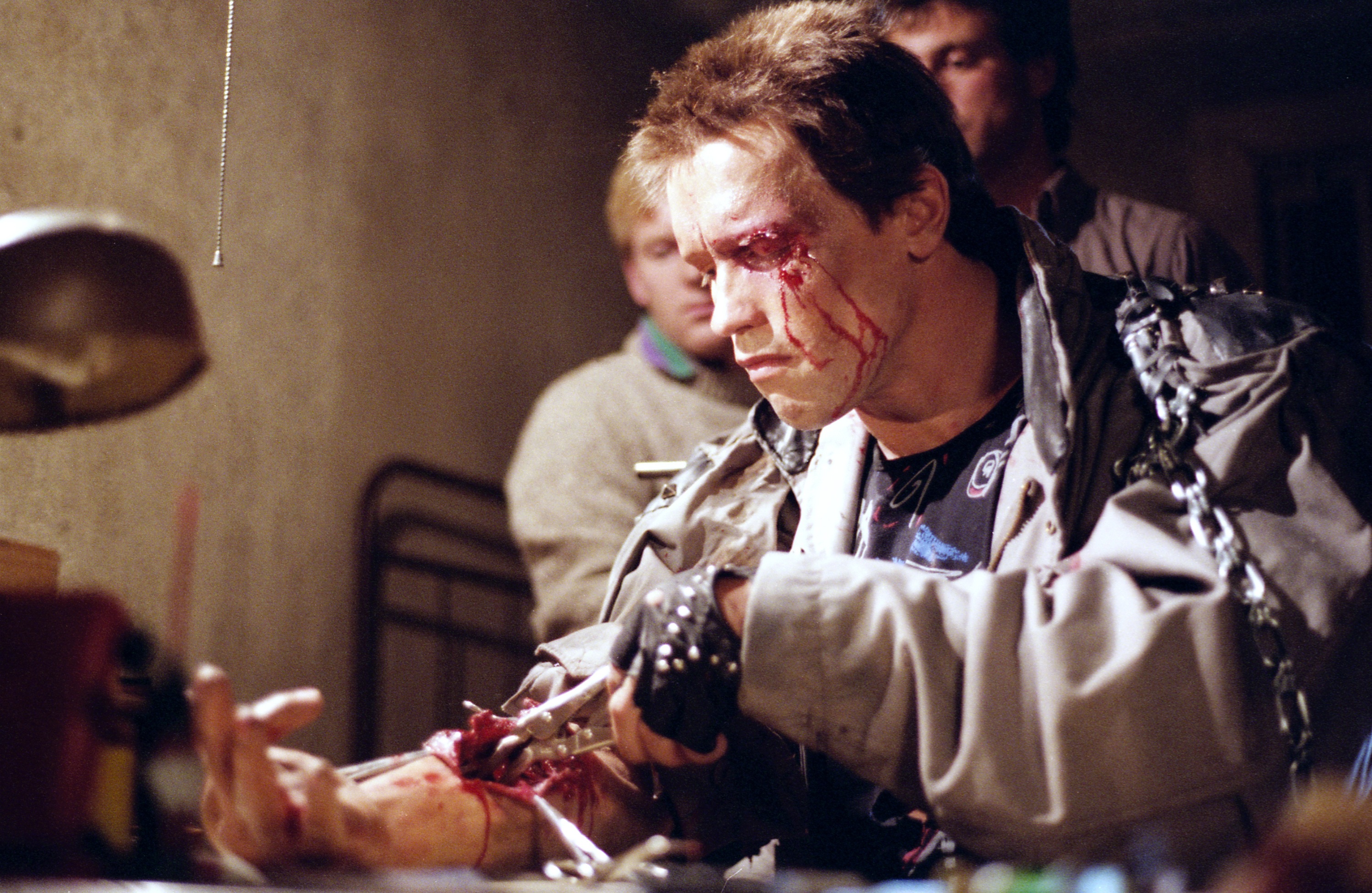 (Shane Mahan and John Rosengrant overseeing Arnold Schwarzenegger practicing the arm surgery on the puppet arm. Image courtesy of Hemdale Film, Pacific Western Productions, Euro Film Funding, and Cinema '84.)
Winston’s crew first cast Schwarzenegger’s hand and arm in the appropriate position. From that, they made a urethane arm with a hollow core that—due to Schwarzenegger’s size—was large enough for a petite woman to wear like a glove. “I think it was Stan’s and Jim’s idea to put the girl’s arm inside Arnold’s fake arm for this scene,” said Shane Mahan. “This was a low-budget movie, without a lot of money for mechanical things or visual effects. So we had to devise a lot of simple, but ingenious in-camera tricks — and this was one of them.”
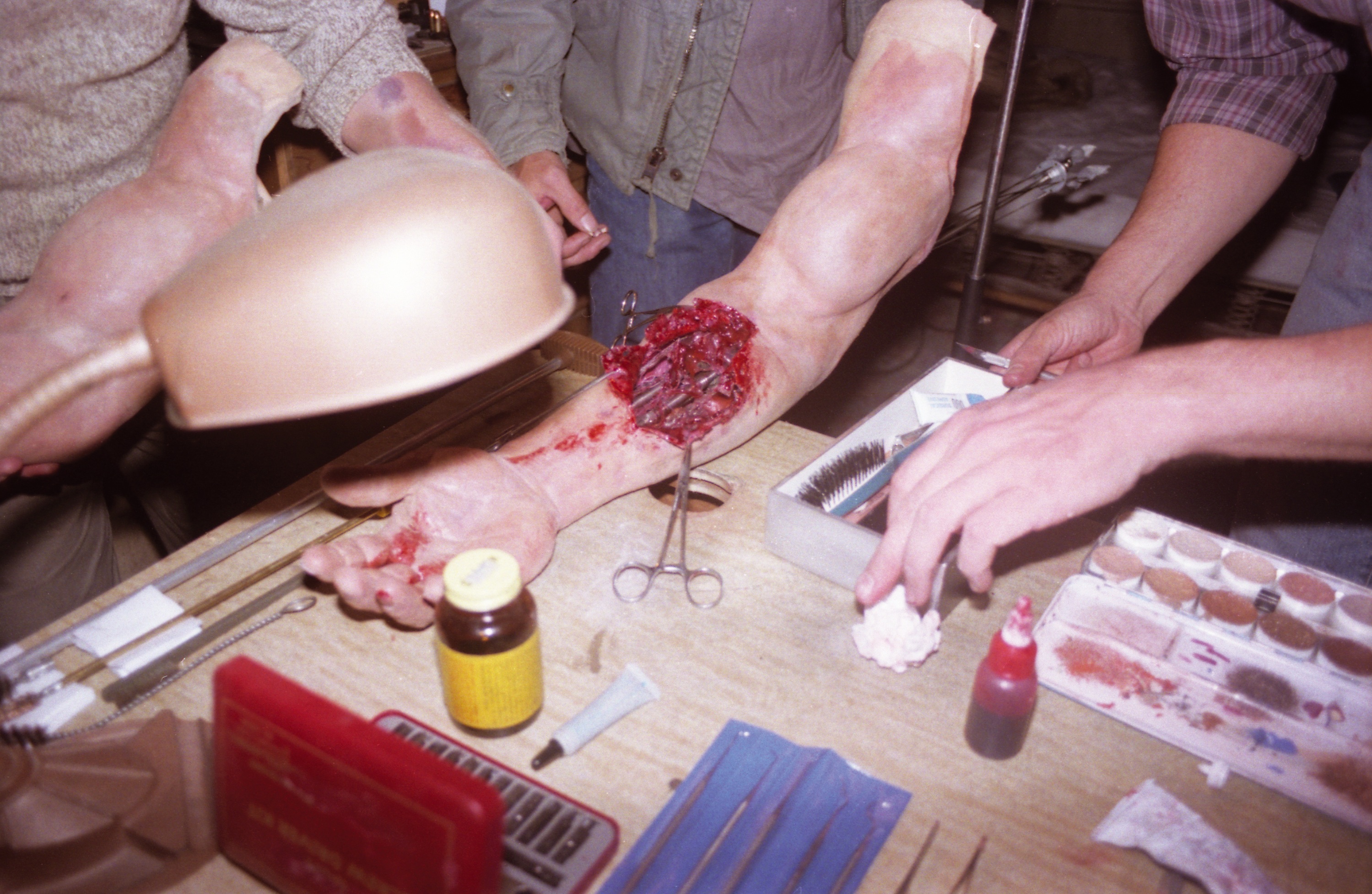 (Stan Winston's crew prepare the dummy arm for the arm surgery scene. Image courtesy of Hemdale Film, Pacific Western Productions, Euro Film Funding, and Cinema '84.)
The exterior of the arm was dressed with shredded pieces of meat, plus veins and tissue made from Hot-Melt glue, to give it the look of torn flesh.
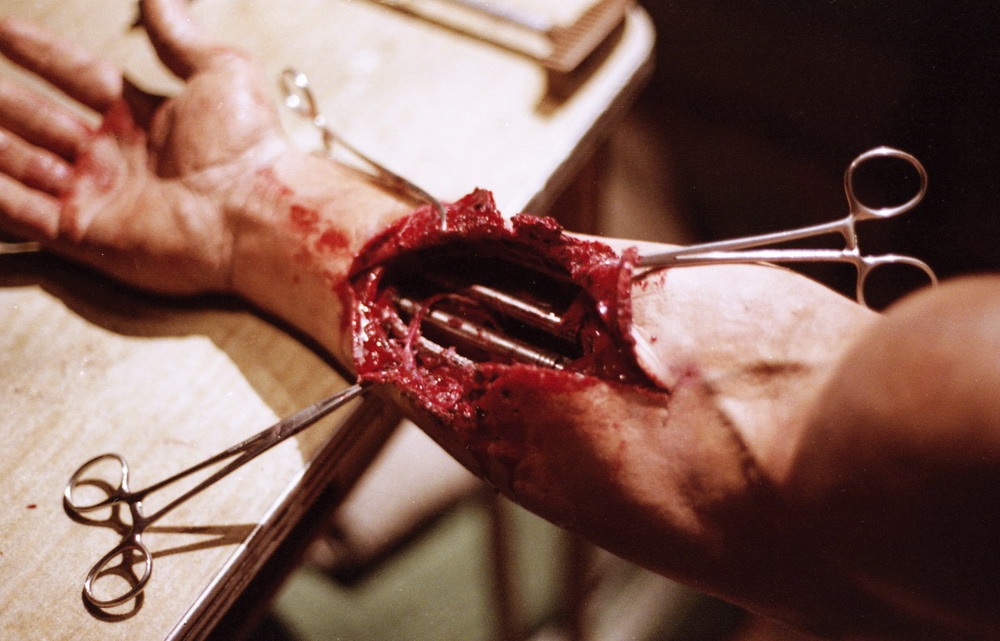 (The prosthetic arm, made from a cast of Arnold Schwarzenegger’s arm, with the interior hollowed out to fit puppeteered mechanisms inside. Image courtesy of Hemdale Film, Pacific Western Productions, Euro Film Funding, and Cinema '84.)
During filming, the woman contorted her body to extend her gloved arm through a hole in a table and assume the right position. “She hid under the table where the Terminator is operating on his arm,” said Mahan, “poked her arm up there, and moved it around to give the fake arm some life. It was genius. I learned from Jim and Stan that if you can do something in camera, in a way that is simple and inexpensive but still fools the audience, do it. The simplest things are sometimes the most effective.”
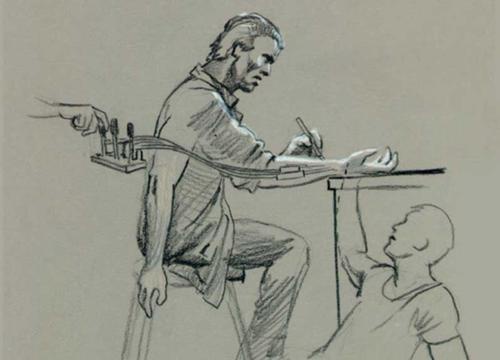 (James Cameron's concept for puppeteering the hand in the arm surgery scene. Image courtesy of Hemdale Film, Pacific Western Productions, Euro Film Funding, and Cinema '84.)
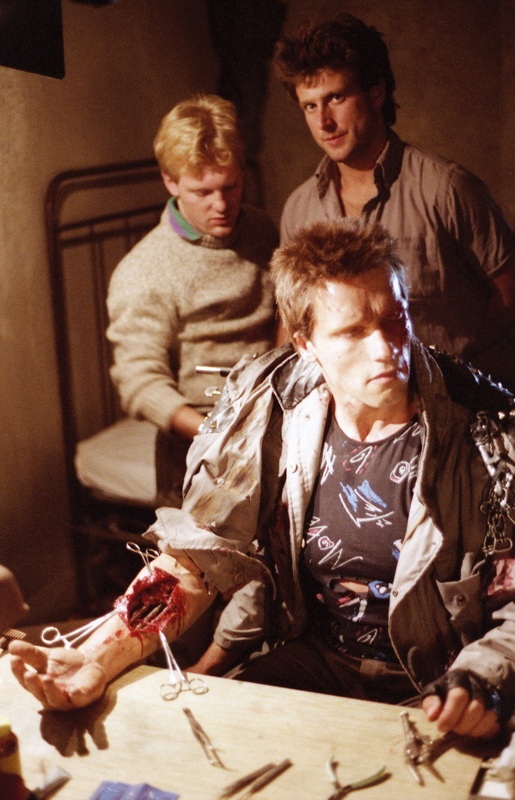 (Shane Mahan and John Rosengrant on set with Arnold Schwarzenegger ready for shooting the arm surgery scene. Image courtesy of Hemdale Film, Pacific Western Productions, Euro Film Funding, and Cinema '84.)
Second Unit Directing The Terminator
The team used combinations of puppets, mechanical devices, and prosthetic makeup appliances on the sets and Los Angeles-area locations every shooting day for months.
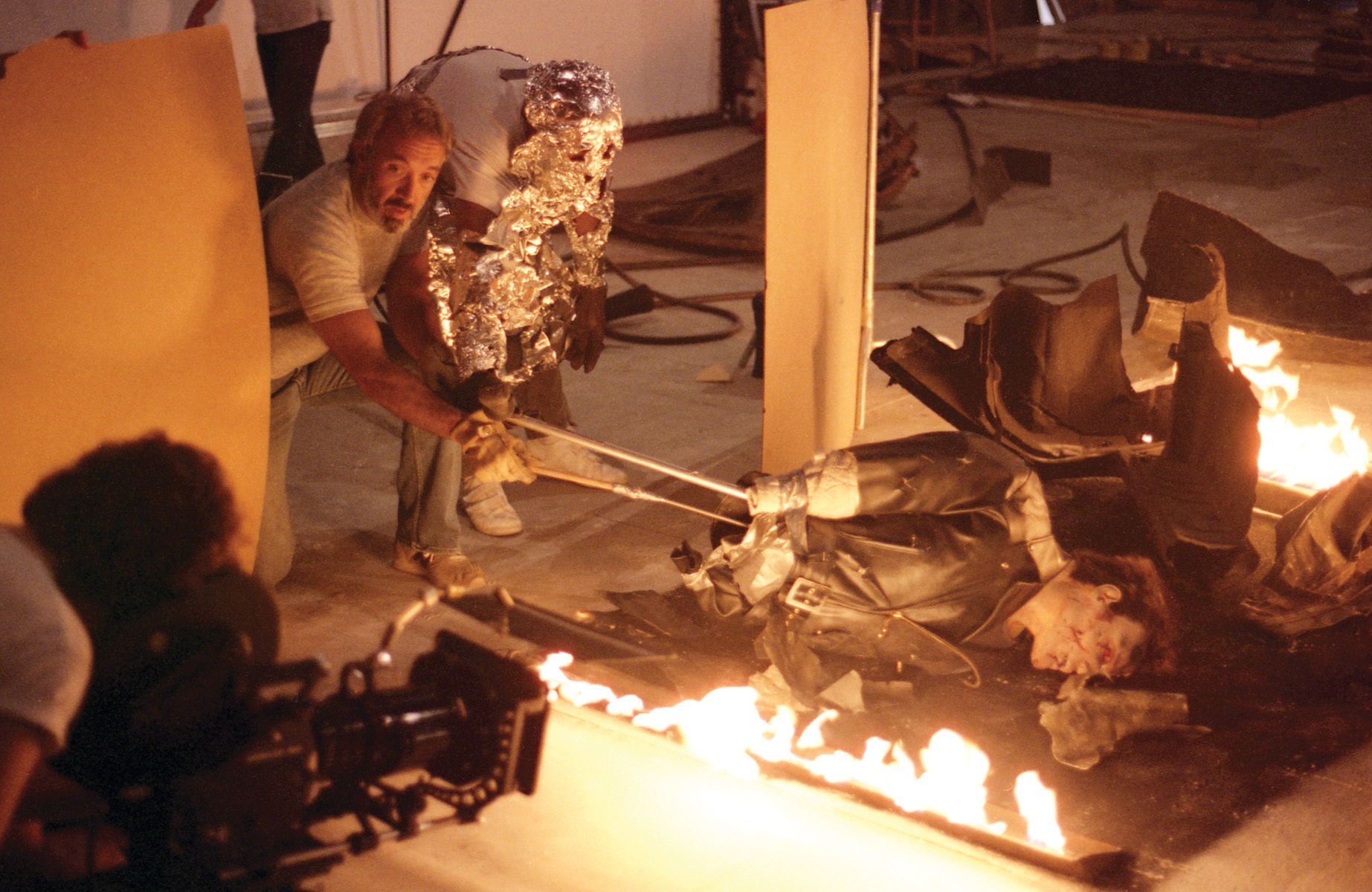 (Stan Winston and John Rosengrant — with aluminum foil heat protection — operate a Terminator puppet used specifically for a shot of the cyborg’s flesh burning away in the tanker truck fire. The foam rubber exterior burned away in the real flames, while the plaster underskull representing the endoskeleton remained intact. Image courtesy of Hemdale Film, Pacific Western Productions, Euro Film Funding, and Cinema '84.)
Throughout the shoot, Winston served as second unit director, a position he would hold on several future Cameron projects. “I was so involved in directing the performance of the endoskeleton puppet,” Winston said, “it just naturally evolved into my doing the second unit direction on all of the endoskeleton scenes. Jim asked me if I would shoot that second unit creature stuff; and then there was another second unit director who did all of the other stunt and action scenes. I only directed shots featuring the Terminator robot.”
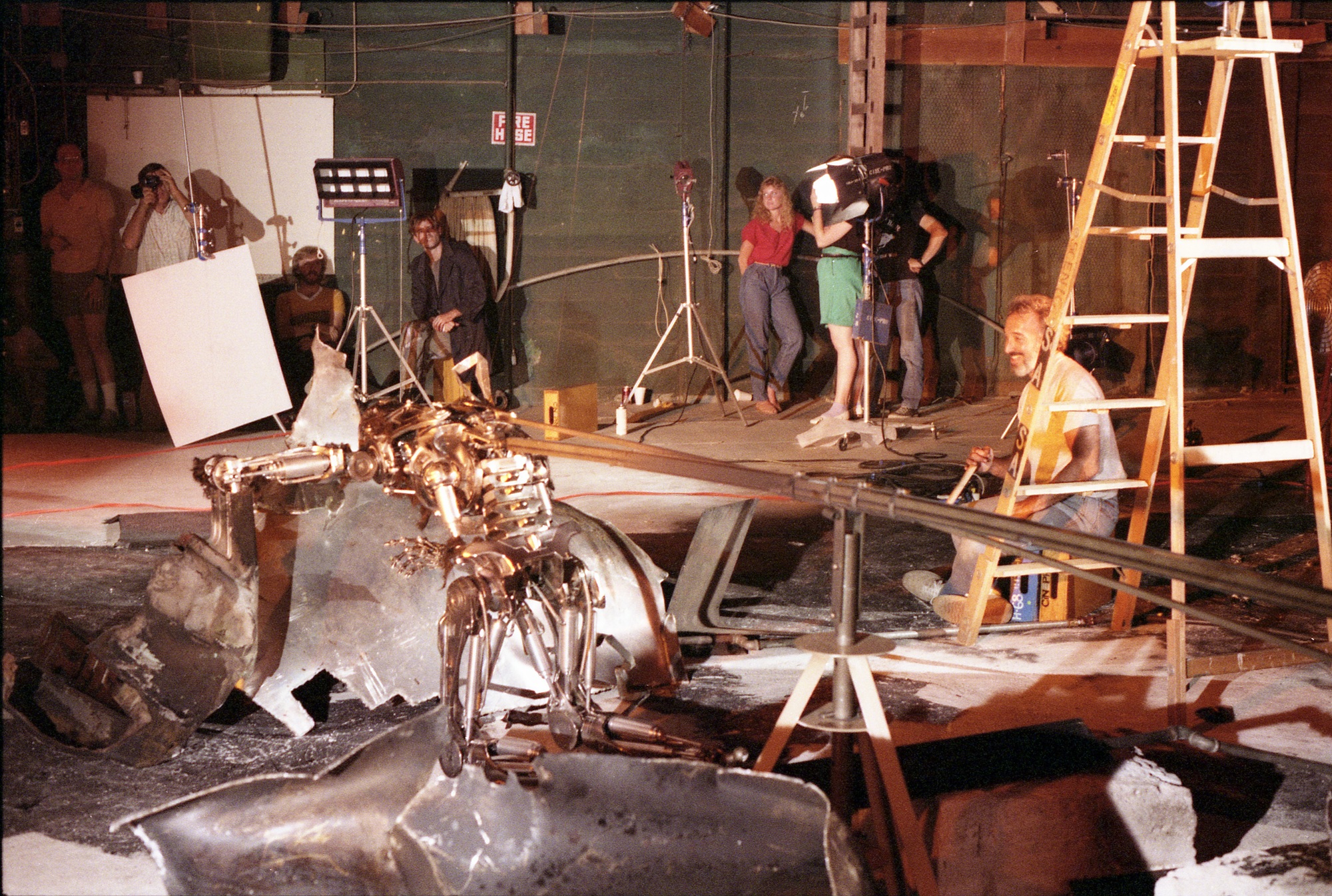 (Jim Cameron (seated, center) and Michael Biehn (right) watch as Stan Winston and his crew prepare to rehearse a shot of the endoskeleton rising from the soon-to-be flaming debris of the exploded tanker truck. Image courtesy of Hemdale Film, Pacific Western Productions, Euro Film Funding, and Cinema '84.)
The Terminator FX Breakthrough That Launched Stan Winston’s Legacy
“We all felt a sense of energy, of stimulation, of being a part of something special,” noted Shane Mahan. “And because of that, we all worked our butts off on this show. Everybody involved had something to prove. I did. John Rosengrant did. Tom Woodruff and the rest of the crew did. Stan did. Jim Cameron did. Even Arnold Schwarzenegger did. Because we all had something to prove, we gave this show everything we had.”
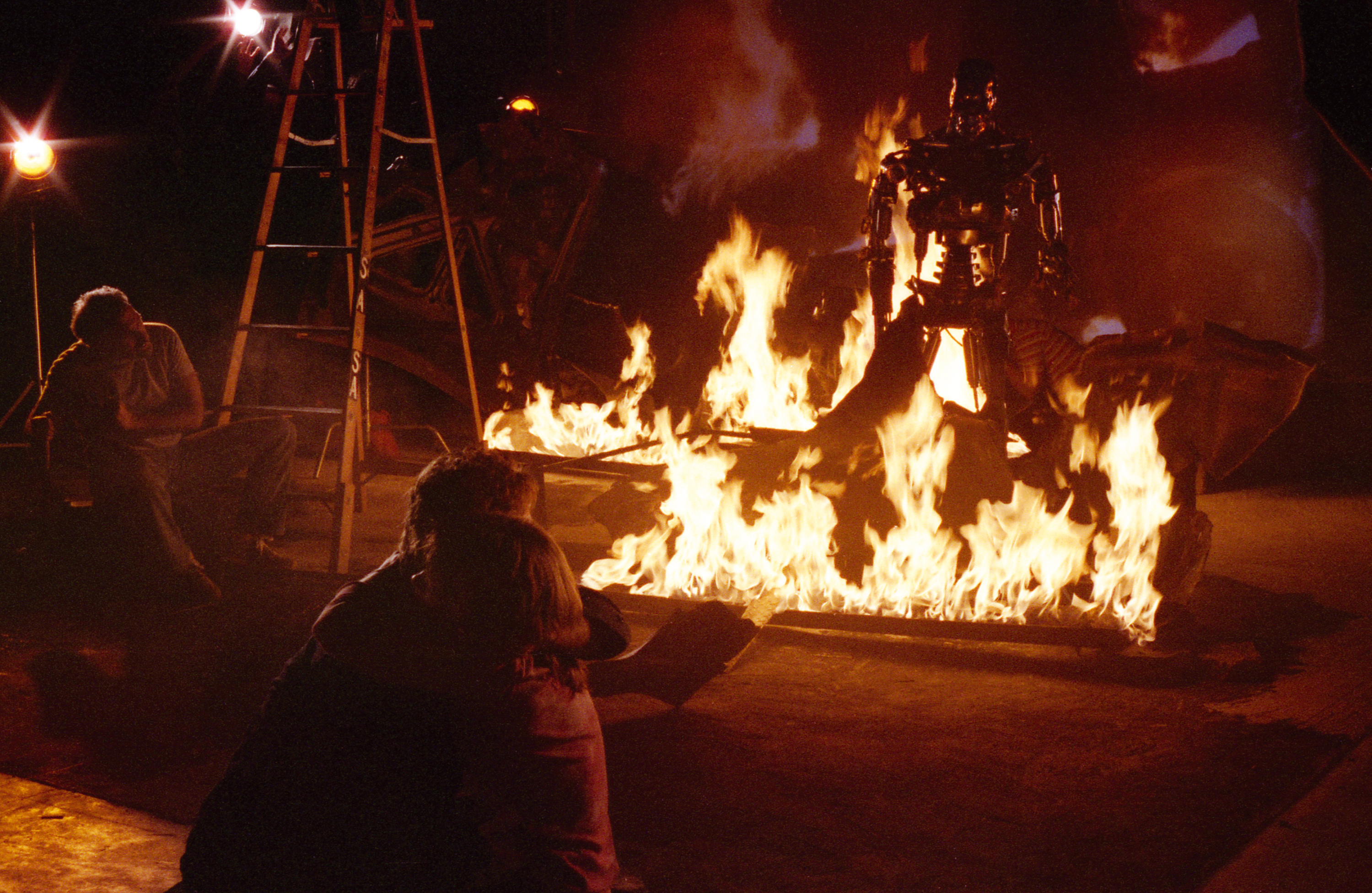 (Stan Winston overseeing the shot of the endoskeleton rising from the flaming debris of the exploded tanker truck. Image courtesy of Hemdale Film, Pacific Western Productions, Euro Film Funding, and Cinema '84.)
That commitment and hard work paid off when The Terminator, which had been made for only $6.5 million, became a box-office blockbuster and a critical success. The Terminator phenomenon launched the careers of James Cameron and Arnold Schwarzenegger, and — just as Dick Smith had predicted — it made a name for Stan Winston. “The Terminator gave me a much higher profile in the business,” Winston commented. “I’d had a semi-high profile as a makeup artist prior to it; but Terminator expanded my profile from only a makeup artist to someone who did character and creature effects. ‘Makeup effects’, which had been my credit on a lot of shows up until then, no longer really covered what we did. Terminator opened the eyes of the industry to new ways to create characters for motion pictures. By combining animatronics technology with traditional artistry, we created one of the most iconic characters in motion picture history. But it didn’t just suddenly happen. It was a logical extension of what had gone before. The dog-thing puppet we did for The Thing led to the Mr. Dark puppet for Something Wicked This Way Comes, which led to our work on The Entity, which evolved into the puppets we built for The Terminator.”
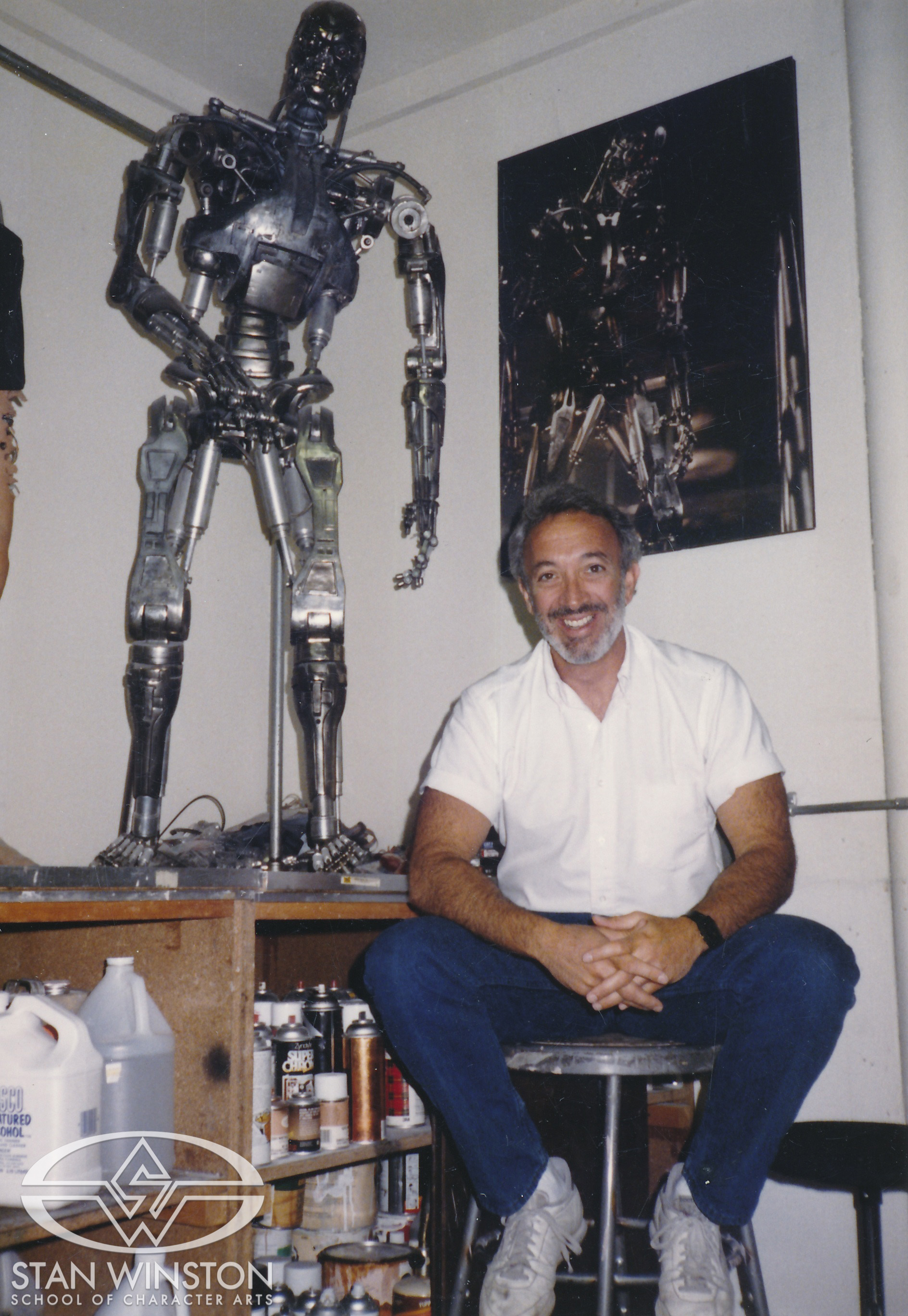 (Stan Winston with a Terminator puppet at Stan Winston Studio.)
If the new methodologies developed for The Terminator piggybacked on those of the past, they would reverberate into the future, as well. “There never would have been an alien queen in Aliens [1986] if there hadn’t been a Terminator,” Winston concluded. “And there would never have been a Jurassic Park [1993] if there hadn’t been an alien queen, because no one would have even considered that you could build live-action dinosaurs. In fact, it may sound silly, but I’m not sure any of it would have happened if not for Heartbeeps. If not for Heartbeeps, I would not have been hired to do Mr. Roboto. If not for Mr. Roboto, I would not have been perceived as the ‘robot guy’, and Jim Cameron would not have come to me for Terminator. And if Jim Cameron hadn’t come to me for Terminator, everything would have been different.”
- Blog excerpted from The Winston Effect: The Art and History of Stan Winston Studio by Jody Duncan
Courses with the creators of The Terminator (1984):
- Special Effects Sequence Design with Shane Mahan
- Hybrid Characters: Blending Practical & Digital FX with John Rosengrant
- Character Design Techniques: Sketching, Photoshop, Sculpting & Prosthetic Makeup Testing with Tom Woodruff Jr.
- Monster Suit Performance with Tom Woodruff Jr.
- Animatronics Design Basics with Richard Landon
- Cable Mechanism Basics - Tentacles with Richard Landon
Terminator-related courses:
- Terminator Makeup FX Part 1: Cast, Rig & Prepaint with Steve LaPorte
- Terminator Makeup FX Part 2: Prep, Apply & Paint with Steve LaPorte
- Metallic Painting Techniques - Robot Finishes
- Creature Screenwriting: How to Write Memorable Monsters with Juliet Snowden & Stiles White
- Portrait Illustration Part 1: Pencil Drawing Techniques with Terry Wolfinger
- Portrait Illustration Part 2: Painting with Photoshop with Terry Wolfinger
- Stop Motion Character Performance with Mark Sawicki
- 3-Axis Robotic Mechanisms: Animatronic Necks & Torsos - Part 1 with Jim Kundig
- 3-Axis Robotic Mechanisms: Animatronic Necks & Torsos - Part 2 with Jim Kundig