
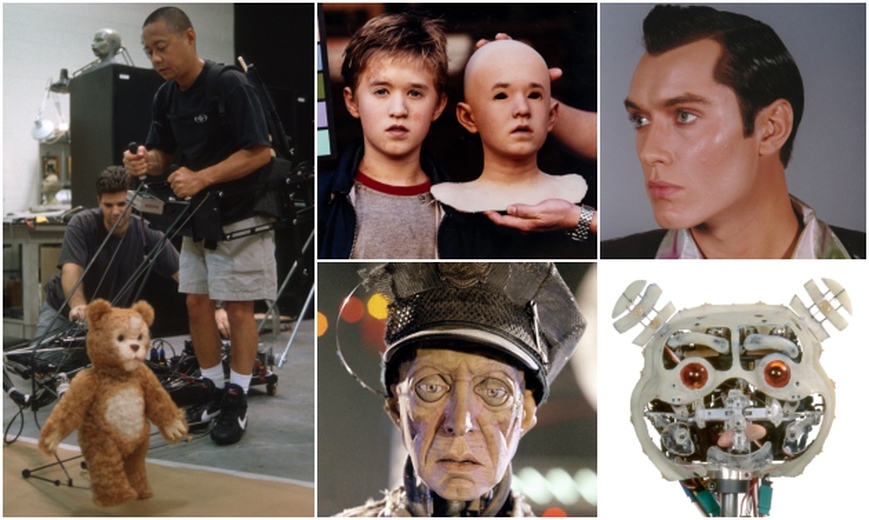
From Stanley Kubrick to Steven Spielberg: The Story of A.I. Artificial Intelligence
Legendary filmmaker Stanley Kubrick — the man who brought the world Dr. Strangelove (1964), 2001: A Space Odyssey (1968), and A Clockwork Orange (1971), among other lauded films — spent decades developing A.I. Artificial Intelligence, a proposed film adaptation of Brian Aldiss' 1969 short story, Supertoys Last All Summer Long, about a robot child who longs to be a real boy. After completing an exhausting two-year shoot for Eyes Wide Shut (1999), starring Tom Cruise and Nicole Kidman, Kubrick had intended to turn his full attention back to A.I. and finally bring the ambitious story to the screen. But just four months before the release of Eyes Wide Shut, Kubrick died quietly in his sleep at home in England. Steven Spielberg, a lifelong fan of Kubrick's, paid homage to the director in the way best suited to his talents — he took the reins of the A.I. project and directed the film himself.
 (Steven Spielberg reacts to a mechanical demonstration of the Teddy supertoy by SWS mechanical designer Matt Heimlich, as Stan Winston looks on.)
Jump to Section
- Crafting 'David,' the Android Boy
- Building the Mecha Characters
- Mixing Drawings with 3D Computer Design
- Creating Teddy, the Animatronic Supertoy
- Puppeteering Teddy
- The Challenge of Secrecy
- Mastering Teddy's Movements
- Jude Law's Gigolo Joe Makeup
- Stan Winston's Cameo as a Mecha
- Operating the "Flesh Fair" Robots
- Academy Award Nomination
Crafting 'David,' the Android Boy
Spielberg was given access to concept illustrations that the late director had commissioned, but he put his distinctive stamp on the film, finding his own solutions to creative issues that had stymied Kubrick for years.
 (Color palette testing with Haley Joel Osment and one of the David puppets for A.I. Artificial Intelligence.)
The most central of those issues was the problem of how to realize 'David,' the android boy. Whereas Kubrick had invested considerable resources into exploring the creation of a real David robot, Spielberg simplified the approach by casting a child actor, Haley Joel Osment, in the role. Stan Winston Studio and Ve Neill designed a subtle robot makeup for Osment, shaving the peach fuzz from his face and body to create a doll-like sheen and implanting an oral device to give him a too perfect gum line. Osment further sold the illusion through his performance, adhering to a number of 'robot' acting rules, such as not blinking during his takes.
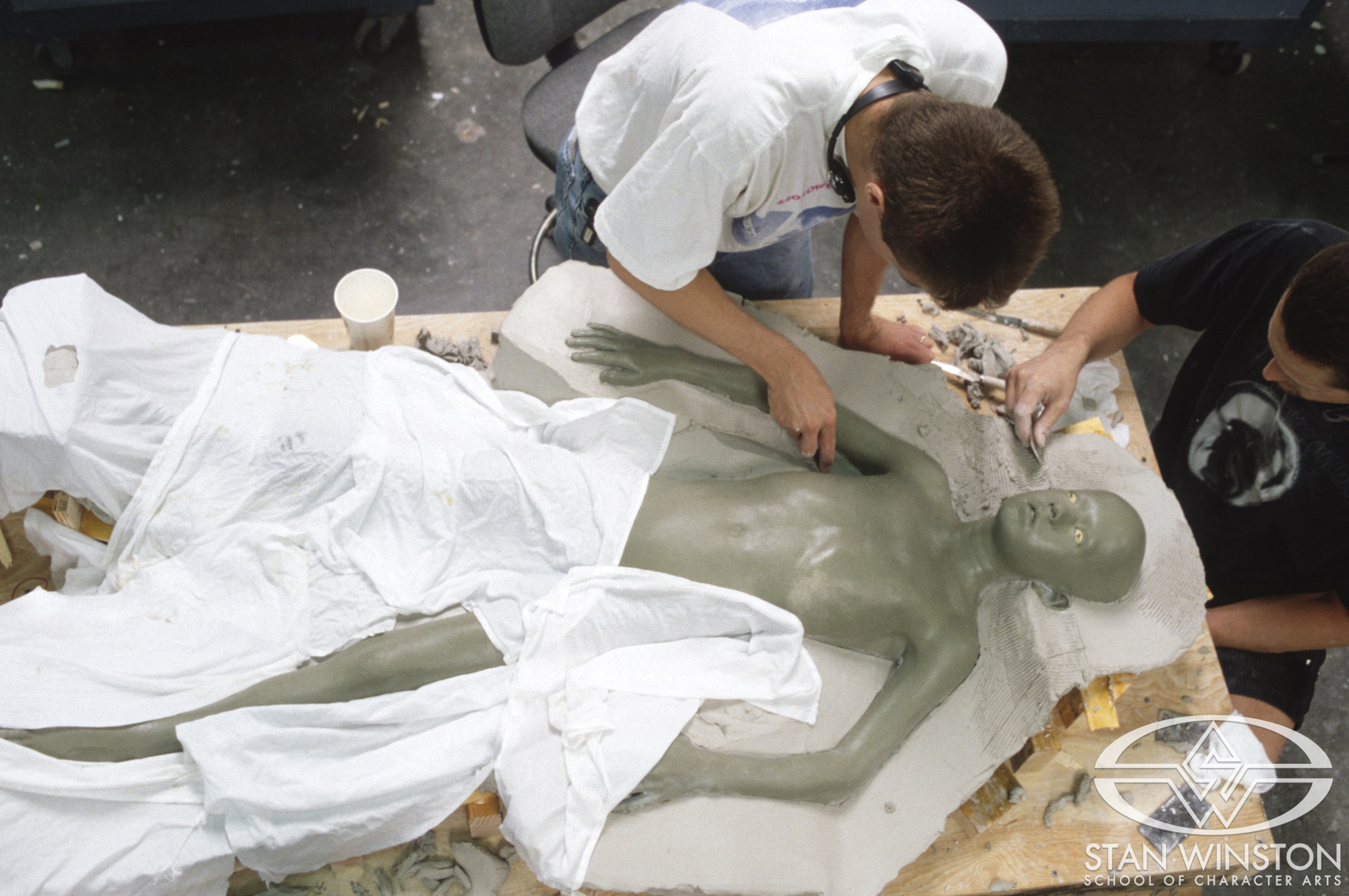 (Laying up the clay wall for a mold of a head-to-toe sculpture of Haley Joel Osment at Stan Winston Studio.)
Stan Winston recognized the simplicity and expediency of realizing David through a live actor's performance; however, during A.I.'s development, he made a strong case for augmenting that performance with a David robot. "It was never about taking away from Haley Joel's performance," explained Winston. "It was just about adding a layer of complexity to that performance with a robot that was a perfect replica of him. A real robot could do robotic things that an actor couldn't do — little robotic glitches that would convince the audience that this was a robot, not a boy. I think there would have been some fun for the audience in trying to figure out when it was the real Haley Joel Osment and when it was the robot. And, of course, some of it was self-serving. I really wanted to take up the challenge of building a robot boy. I thought it was something we could do at that point."
 ("It's okay, Mommy. It doesn't hurt!" Stan Winston visited Haley Joel Osment while he was testing effects and practicing the post-dinner repair scene.)
For a scene in which the boy finds a factory full of 'Davids,' all in various stages of construction, Winston's crew made background David dummies out of urethane and foreground versions out of silicone. A cable-controlled puppet was used briefly in a scene in which David comes face to face with one of his mechanical clones. An underwater view of David after he has fallen into the ocean from a high-rise used a Winston-made loose-jointed silicone puppet, shot in a tank.
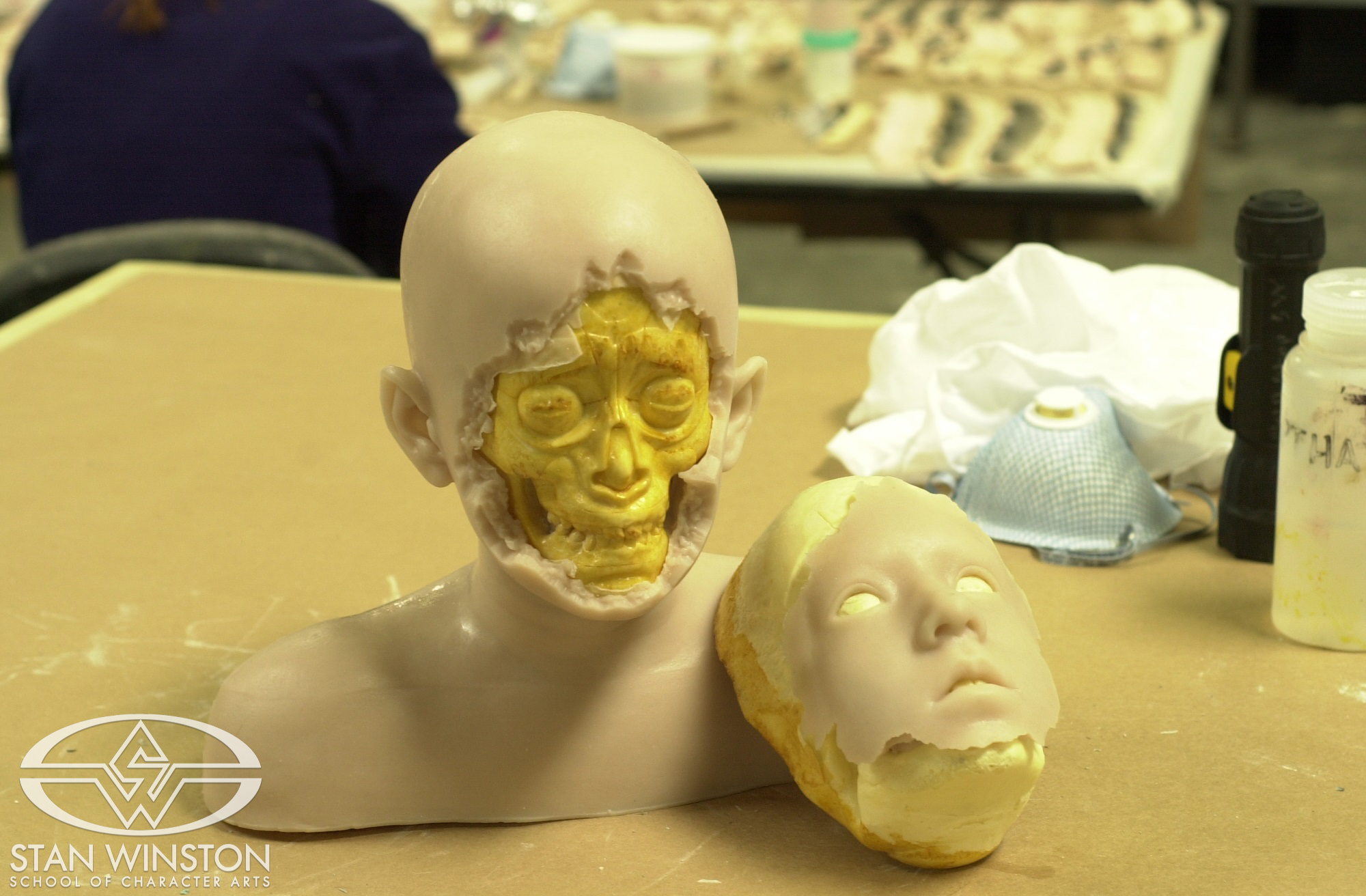 (One of the David busts with its removable face, which was created for David's breakdown scene in the Cybertronics building.)
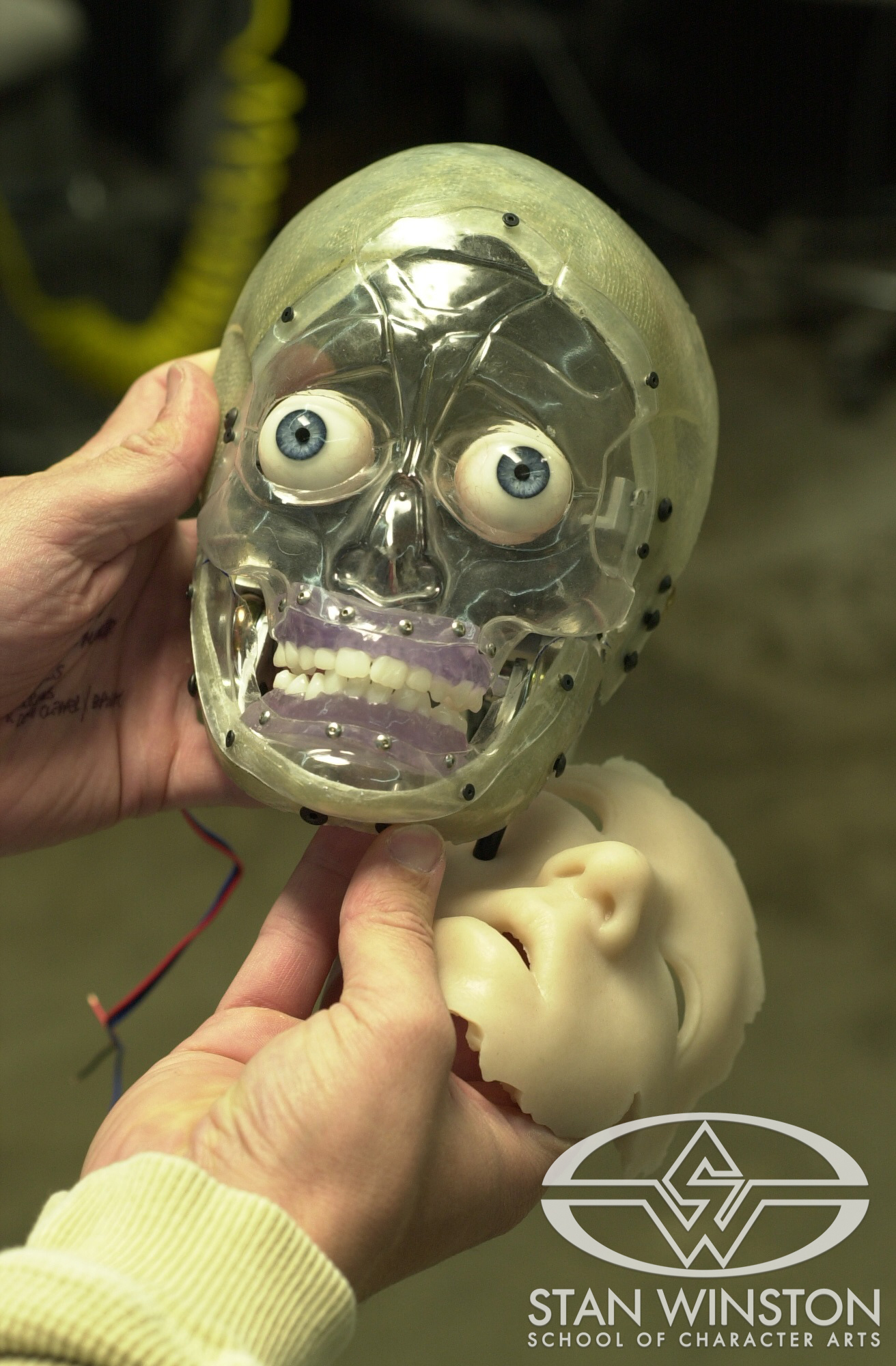 (The work-in-progress understructure of David's head, which was created for the same breakdown scene in A.I.)
Building the Mecha Characters
Although Winston and his crew were not ultimately afforded the chance to build the world's first fully functioning animatronic boy for the film, A.I. did require them to create robots — dozens of them, in fact. These robots called 'mechas' in the story, ranged from the utilitarian type — such as gardeners, security guards, and other blue-collar workers — to Gigolo Joe (Jude Law), a true 'love machine,' and Teddy, a robotic teddy bear who serves as David's sidekick.
 (Concept art of various mechas, including Gigolo Joe, by Stan Winston Studio concept artist Mark "Crash" McCreery for A.I. Artificial Intelligence.)
Stan Winston had more experience building robots than any other creature effects artist in the world — but the robots of A.I. would be unlike anything Winston, or anybody else, had ever created. "It was important to Steven that the robots in A.I. have absolutely nothing to do with the Terminator or any of the robots we'd done previously," Winston remarked. "Rather than beginning to show the metal underneath in the mechas, for example, as we'd done with Arnold's character in The Terminator, Steven wanted the robot faces to be intact but to expose the entire head so that you'd see the robot underneath. In one of the most memorable scenes in the movie, a nanny robot walks up and turns, and you see right through her head. That was unlike anything you'd seen before, and we were able to do it by using all of the available technologies. We did part of it live-action, creating an actual robot of that character; we created makeup for part of it and used CG for part of it. We combined technologies to make all of the robot characters in A.I. happen."
 (Rick Galinson works on one of the nanny robots in the Stan Winston Studio.)
Mixing Drawings with 3D Computer Design
An extended design phase preceded the building of the mecha characters, with Mark 'Crash' McCreery rendering drawings and concept artist Aaron Sims — who was new to Stan Winston Studio — designing on the computer. An artist who had worked for years in traditional mediums, Sims was just beginning to explore digital technologies and how they might be applied to visual effects, and Winston had provided him with the necessary digital tools to do so. With A.I. — and with Winston's blessing — Sims began to apply computer technology to character design, as well. "Since we had the computers and the software there," Sims said, "Stan thought we might as well use it. He thought that digital would be particularly well suited to designing robots, just because of their mechanical nature."
 (Different computer-designed robot characters by Aaron Sims.)
Sims' first computer-designed character was the futuristic mecha that appears at the film's end. "I started building a model on the computer, and within a day, I had created that entire robot. That first design wasn't exactly the one that Steven finally approved — we went through many concepts to get to a point where he was pleased with the design — but it was a very good start. From there, I did some quick animations to show the character from all angles — and that's what really sold Steven on the design." Sims' computer files were sent directly to Industrial Light & Magic, where the model was rebuilt in the computer and animated for future mecha shots.
 (Based on Aaron Sims' design and using photographs of Stan Winston as inspiration, David Grasso sculpts a mecha head.)
Winston had been extremely impressed with Sims' final 3D computer model and the speed with which he'd been able to produce it. "At that point, Stan put me off in my own room and let me loose to design a bunch of robots on the computer," Sims said. "The process got even quicker as I got going because I was able to build up a library of robot parts. I could grab different elements from this library for each robot and bang together something new. It was an interesting experiment that opened up a whole new way of working for me." Sims would go on to design approximately 100 mecha characters as three-dimensional computer models.
Creating Teddy, the Animatronic Supertoy
Surprisingly, of all the robots designed for A.I., the most difficult to conceptualize was Teddy, the 'supertoy' that would be a featured player in the film. "Designing Teddy was a huge job," said Winston. "When we started researching, we found that thousands of teddy bear designs had been done through the years. It turned out to be a real chore to design a new teddy bear that captured all of the best qualities of those previous teddy bears and yet didn't look exactly like any of them. We had to find a concept for the ultimate teddy bear."
 (Different hand-drawn studies and concept artworks for Teddy, the animatronic bear.)
"You'd think that a teddy bear would be the easiest thing in the world to design," added project lead Lindsay MacGowan, "but it wasn't. Teddy had to be absolutely unique. He had to be traditional but not too traditional. He had to be specific to this story. It was really tough. We had to go through a very long design period before we ever started building Teddy."
 (The skeleton framework of Teddy at the Stan Winston Studio.)
Working with MacGowan, Mark 'Crash' McCreery developed the Teddy design in a series of drawings. With only five months left by the time final designs were approved — for Teddy and the other robot characters — Winston hired his largest crew ever to complete the robot construction project. At the height of production, Stan Winston Studio boasted 140 artists and technicians. Building Teddy, a more sophisticated and complex animatronic than any of the dinosaurs in Jurassic Park, required increased manpower, plus the ingenuity and talent of many artists and technicians. "We'd given our Velociraptor thirty-four points of motion," explained Winston, "and our T-rex, forty points of motion. But Teddy had fifty points of motion, all in a little character that was less than three feet tall. He had to act, he had to talk, and he had to deliver a varied and convincing performance. We had to create the ultimate robotic teddy bear — which was the biggest, most difficult job we'd ever taken on."
 (Teddy's animatronic body as a work-in-progress.)
 (Teddy’s sophisticated internal mechanics, which included 30 servos, enabled the SWS crew to create one of the most complex and expressive puppet performances in film history.)
Because no one 'Teddy' could perform all of the character's actions, Winston's crew built a series of Teddy puppets using every available technology. "We used cable control, pneumatics, radio control," said Winston. "We also developed a new type of telemetry device, which enabled us to transfer the arm movements of a puppeteer to Teddy's arms. We used everything from the most low-tech puppetry to the most high-tech robotics to create the illusion of this little robot character."
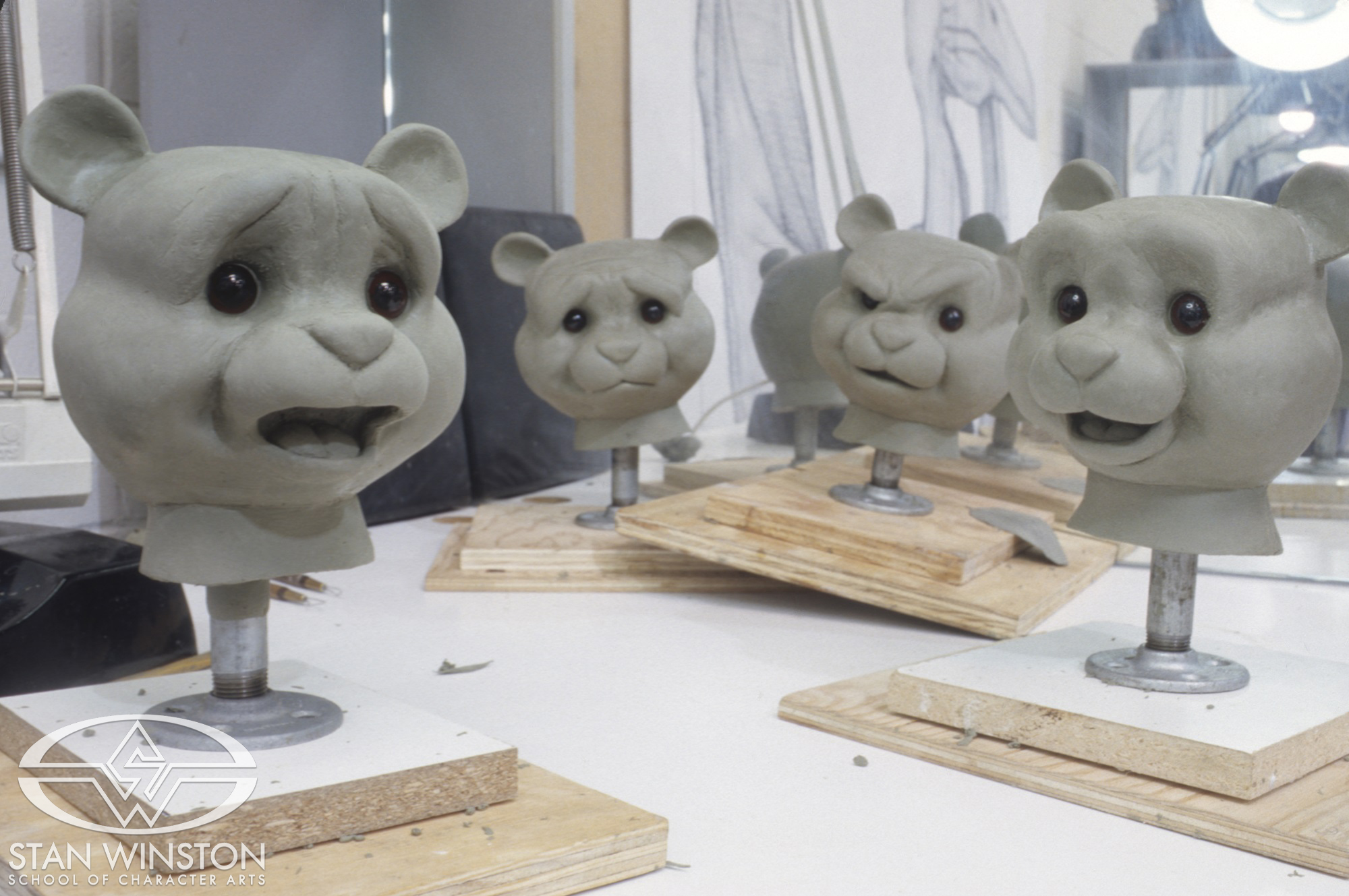 (Teddy expression heads, sculpted by Mark Maitre.)
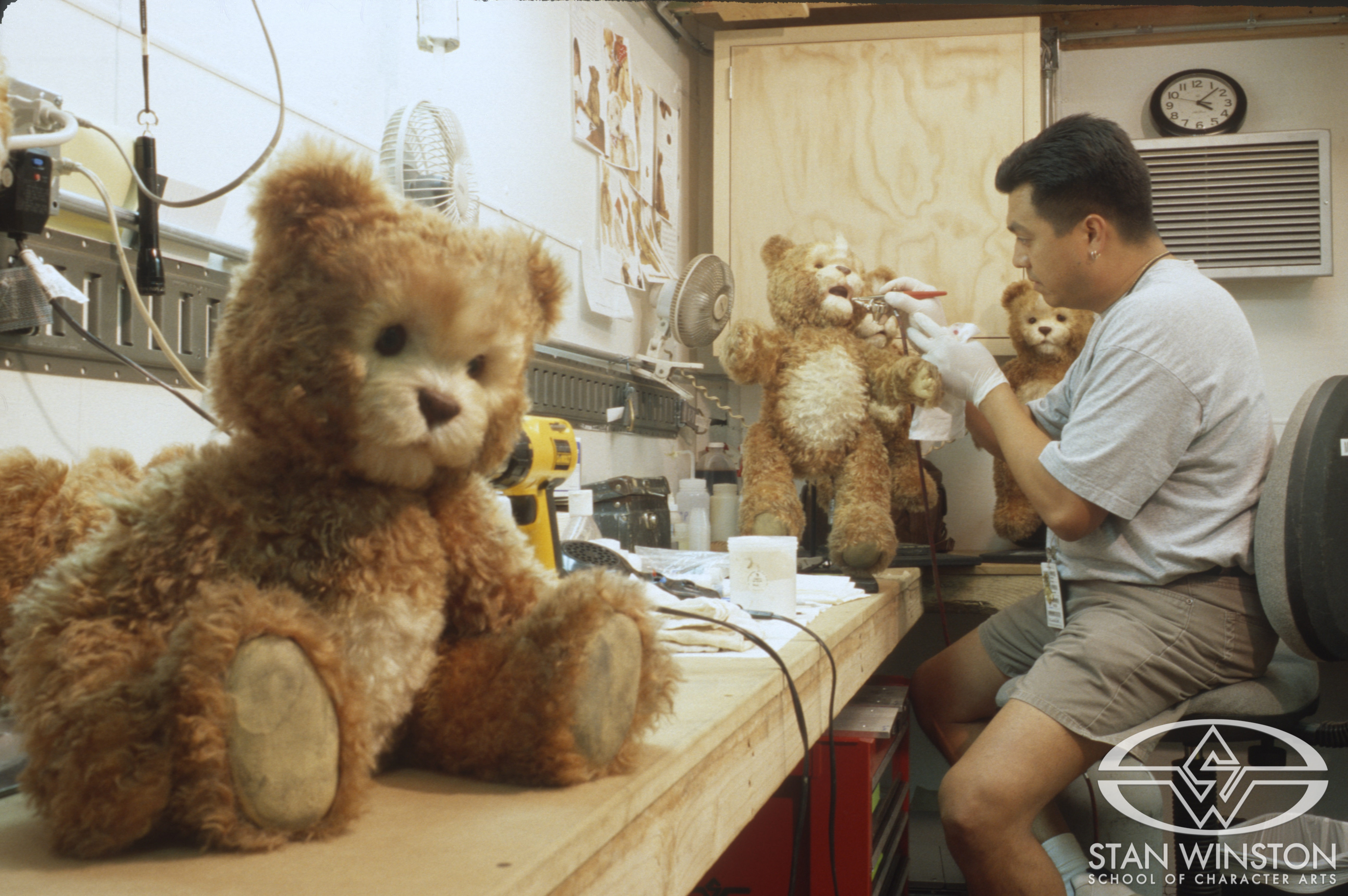 (SWS Artist Michael Ornelaz airbrushes one of the Teddy puppets.)
Puppeteering Teddy
The crew was testing the telemetry-controlled Teddy puppet one day when Stan Winston and Steven Spielberg walked through the shop's mechanical department. "We were playing with Teddy," recalled Matt Heimlich, who engineered the puppet, "having him take a pen out of someone's hand, all kinds of things. And when Stan and Steven walked through and saw what we were doing, they both went nuts! They started laughing, both of them as excited as little kids. I even had Teddy grab Steven's finger, which was a great moment. Up until then, I don't know if Steven really believed we'd be able to give him a teddy bear that could do everything he wanted. But then he came in and saw this test and became really happy and excited."
Watch Steven Spielberg's first reaction when Stan Winston presented him A.I.'s animatronic Teddy head for the first time:
"HOLY SH*T, THAT'S GREAT""HOLY SH*T, THAT'S GREAT" - Steven Spielberg's first reaction when Stan Winston showed him A.I.'s animatronic Teddy head for the first time. We love his simple and honest reaction! Oh, and A.I. Artificial Intelligence premiered 20 years ago in New York City, New York.
Posted by Stan Winston School of Character Arts on Saturday, June 26, 2021
Heimlich and the other members of the Teddy crew were gratified — and greatly relieved — to see Spielberg's reaction to the robot. Secrecy on the project was so tight that Winston, project leads Lindsay MacGowan and Alan Scott, and designer Mark 'Crash' McCreery were the only people on the crew allowed to read the script — and thus, they alone really knew what Teddy's character was and what he would be expected to do. "I understood the security issues they had," MacGowan commented, "but it was tough on everybody — not just us, but every department on the film. Only a few key people in key departments got to read the script. And even those of us who got to read it didn't get to keep it so we could refer back to it. We had to go into a room, read the script, make little notes — and that was it. And then, even though we'd read the script, we weren't allowed to discuss it with anybody else. We couldn't even tell the people who were building Teddy anything about him!"
The Challenge of Secrecy
Jurassic Park, too, had been a top-secret project, but, in that case, the animatronic dinosaurs had been called upon to perform basic animalistic behaviors. Teddy, in contrast, had to deliver a nuanced performance and exhibit a real personality. "Almost every Teddy shot was a one-off gag," MacGowan explained, "so there was a much greater range of actions this one character had to do. It was very difficult to design and build that character without knowing what those gags would be."
 (Glenn Derry and Matt Heimlich test the animatronic Teddy body movements at Stan Winston Studio.)
Secrecy remained an issue even after the Winston crew joined the Oregon production. To prevent story leaks, the puppeteering crews were given the next day's Teddy scenes only at the end of that day's shoot. Even then, they were given 'sides' — partial scripts featuring only Teddy's lines — rather than entire scenes. With only these tiny bits of script to go by, the crew was left to guess the context of Teddy's dialogue and actions. "Since we didn't get the next day's dialogue and scenes until we'd finished shooting for the day," recalled Richard Landon, "we would have to stay well into the night and early morning to rehearse everything we would shoot the next day."
 (Mechanical designer Bob Mano rehearses with the animatronic Teddy puppet created for A.I. Artificial Intelligence.)
"It was brutal," Matt Heimlich elaborated. "The Teddy crew would stay three, four, eight hours, rehearsing and testing and setting up for the next day based on the scenes we'd be given. But then, many times, that would change the next morning! So everything we'd rehearsed for hours the night before would be out the window."
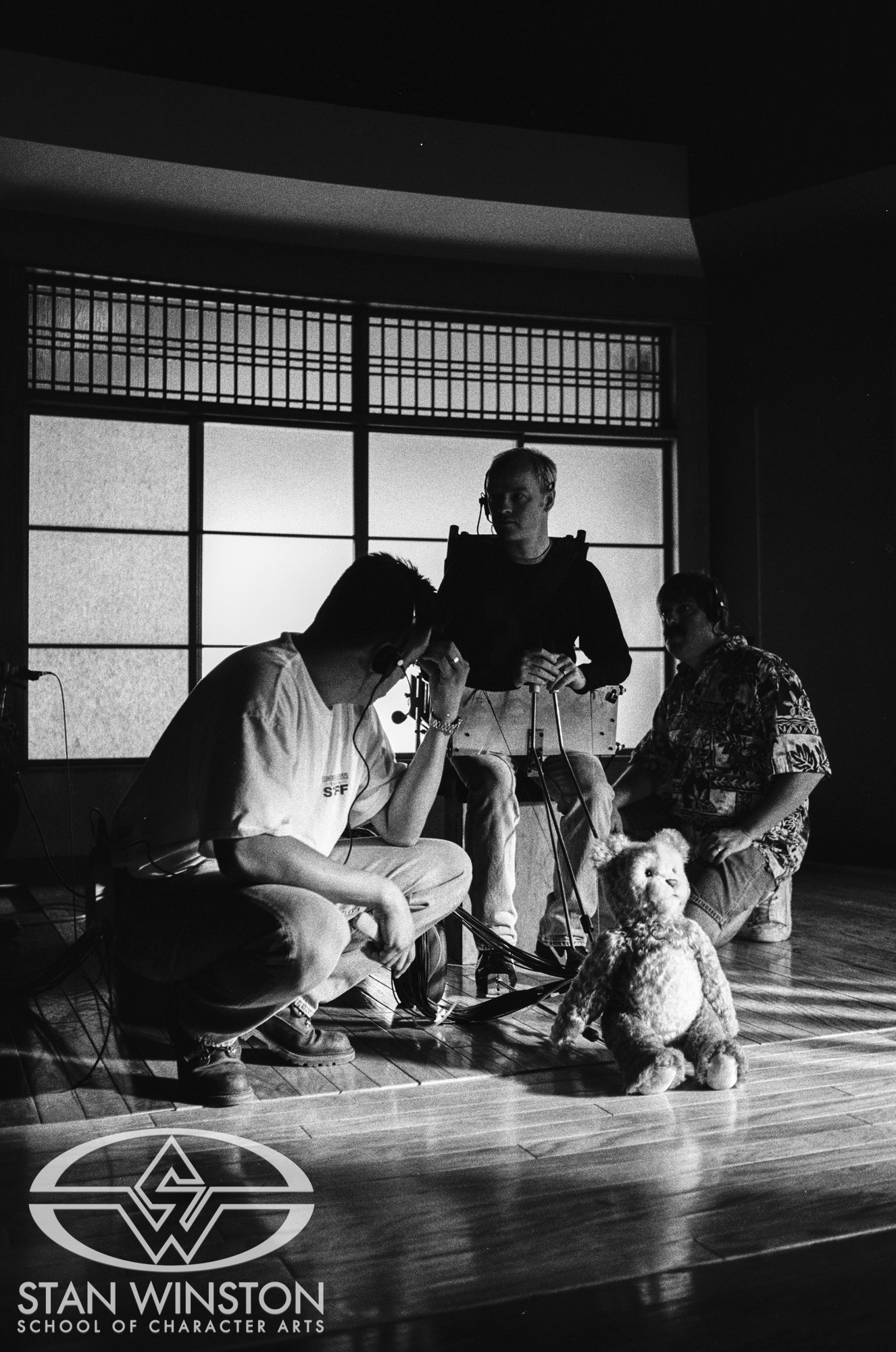 (Michael Ornelaz, Lindsay MacGowan, and Eric Fiedler practicing Teddy walking on set.)
In some cases, the puppeteers' late-night tests and rehearsals prompted last-minute changes in Teddy's scenes. "Sometimes, we'd capture something really interesting when we were just playing with Teddy or experimenting with an idea. So we'd videotape that, show it to Steven the next day, and often, Steven would like it so much, he'd say, 'That isn't what we planned on, but that's what we're going to shoot.' He was open to new ideas. When he saw something that was better than what he'd planned, he was willing to go with it."
Mastering Teddy's Movements
Production shot with Teddy, off and on, for three months. In that time, as the puppeteers gained mastery of the character, they were able to make Teddy do any number of surprising things — such as walk down a flight of stairs and slide across a floor. "We got him to do all kinds of stuff," said MacGowan, "but a lot of that isn't in the movie, just because there was only so much 'Teddy' stuff Steven could fit into the film. One of my favorite things that did make it into the movie was a shot of Teddy hopping out of a box during the Flesh Fair scene. That was one of those cases where we'd been playing with it and figured out how to do this, and when we showed it to Steven, he said: 'Wow, that's better than what I was thinking of! Let's do that!'"
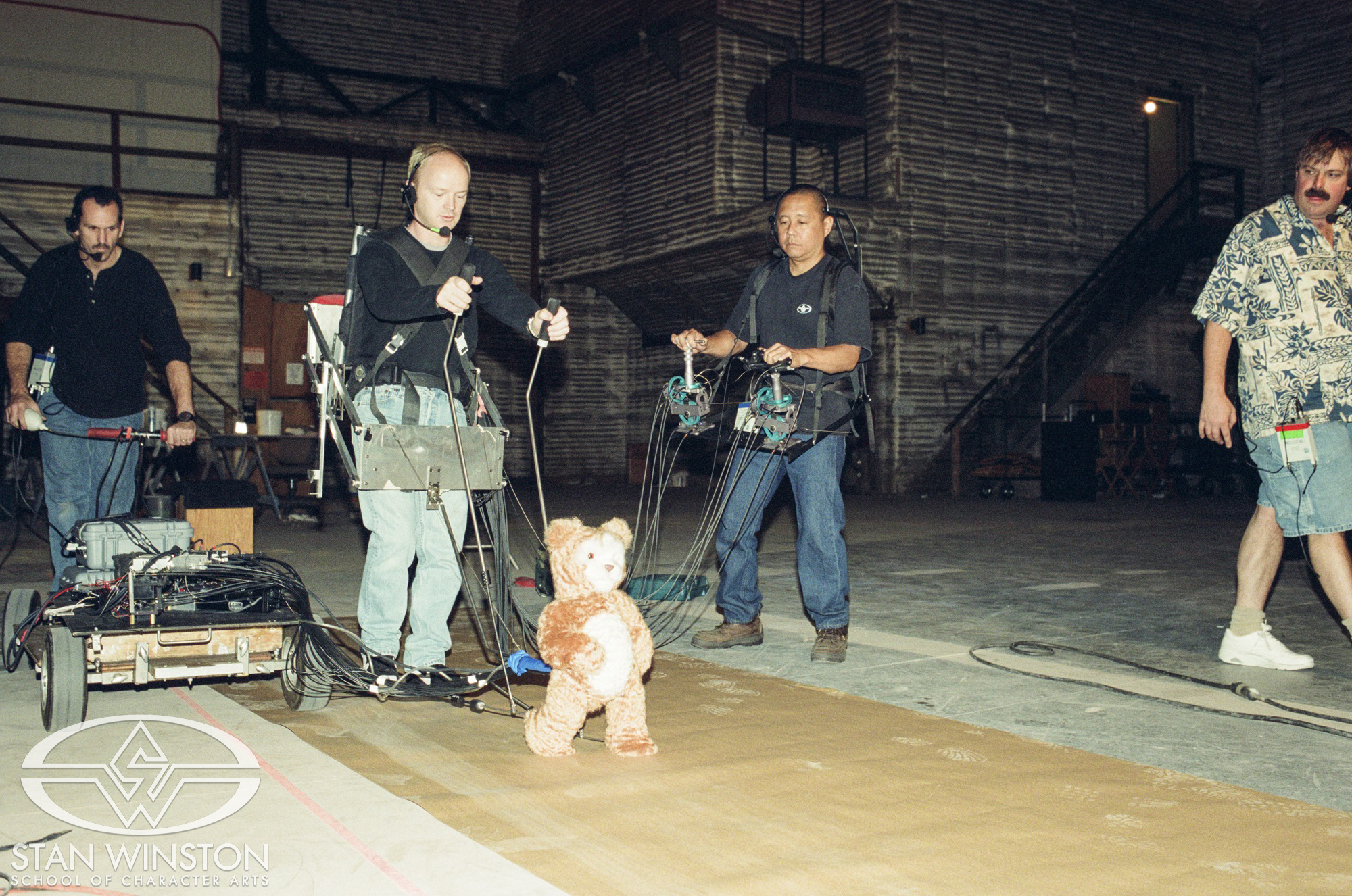 (Alan Scott, Lindsay MacGowan, Bob Mano and Eric Fiedler rehearse with Teddy in between shots.)
Another intricate bit of Teddy puppeteering in the film is a shot of the character sewing. "That was tricky," said MacGowan. "It was a really cramped, hot set, and Steven was standing right behind me as I remote-controlled Teddy's head. Meanwhile, Matt Heimlich was in the telemetry suit, puppeteering the arms to create this sewing motion. I remember looking over at Matt and seeing sweat just pouring off of him. We were both soaking wet because it was so hot in there, and we were concentrating so hard on puppeteering Teddy for this scene. It was nerve-wracking."
Watch a sneak peek of the many Teddy puppets and their interchangeable heads while Michael Ornelaz gives final touches before filming A.I. Artificial Intelligence:
Inside the Stan Winston Studio set trailer SWS Hair Dept. Supervisor & SWSCA Teacher Michael Ornelaz gives final touches to the many Teddy puppets before filming for #StevenSpielberg’s A.I. Artificial Intelligence. “We’d given our Velociraptor thirty-four points of motion and our T-rex, forty points of motion. But Teddy had fifty points of motion, all in a little character that was less than three feet tall. He had to act, he had to talk, and he had to deliver a varied and convincing performance. We had to create the ultimate robotic teddy bear — and that was the biggest, most difficult job we’d ever taken on.” - Stan Winston
Posted by Stan Winston School of Character Arts on Monday, March 25, 2019
Winston directed Teddy's performance throughout the shoot, communicating Spielberg's comments to the puppeteers and unifying all the disparate minds at the controls to create an organic performance. "Stan was on set every day," MacGowan said. "He was our acting coach and our guide. Teddy's performance would never have been as good or as interesting without him there. Teddy really was Stan. That was Stan's personality that came through in that character."
Watch how Stan Winston Studio puppeteers follow Stan Winston's direction in this animatronic "Teddy" puppet test footage from A.I. Artificial Intelligence:
The team's hard work was well rewarded when many critics and audience members cited Teddy's performance as one of the most enjoyable aspects of the film. "A lot of people praised Teddy and said that he was the best part of the movie," Heimlich said. "That was a great thing for us to hear — but, of course, it didn't help us when we were on the set, nervous, with sweat pouring off of us!"
Jude Law's Gigolo Joe Makeup
The studio realized the other robots in A.I. through combinations of rod puppetry, animatronics, prosthetic makeups, and digital effects, working off of the rendered and computer-designed mecha concepts provided by Mark 'Crash' McCreery and Aaron Sims. "It was difficult to get a handle on what these robots were going to be," said McCreery. "With Teddy, we at least had some idea of what it needed to be — it was a teddy bear. We had that idea to hold onto. But what the mechas were and how they would interact in this society was very difficult to figure out. Should they look human? Should they look synthetic so that they are not confused with the human characters? We went through many different phases; by the time we were done, we'd come up with some pretty cool stuff."
 (Jude Law as Gigolo Joe conceived and made in sculpture form by Stan Winston Studio for A.I.)
For Gigolo Joe, the studio created a prosthetic makeup that was developed through a series of tests on Jude Law. "The idea was to give him a makeup that would make him look more perfect," said MacGowan. "That was the hardest thing because Jude Law is so good-looking to begin with. It's easy to make somebody look bad. But to make somebody who is already very good-looking look better is a tough job."
 (Joel Harlow and Ve Neill apply a Gigolo Joe test makeup on Jude Law.)
In early tests, MacGowan and his team experimented with using a gel-filled silicone appliance to give Law a more chiseled jawline. "We'd wanted to use gel-filled silicone for its natural translucency and movement. I also thought it would work well with the synthetic look we were trying to achieve with him. But, even though we tested the gel-filled silicone, we didn't use it. We weren't quite able to nail it for that show — although, later, we did. We went with a foam latex appliance for A.I., and it looked great."
 (On-set color palette testing of Jude Law in the Gigolo Joe makeup.)
Ve Neill and Joel Harlow applied Law's makeup on the set, affixing the foam latex jawline appliance, then airbrushing paint on his face to give him a flawless, doll-like complexion. A rigid hairstyle hardened with gel completed the look. Winston and his crew also built a prosthetic arm for a shot of Joe staring into a lighted vanity mirror in his palm and an animatronic hand for a scene in which the character's mechanical wrist is exposed.
Stan Winston's Cameo as a Mecha
David meets Joe after his 'orga' (organic) mother has abandoned him in the woods. There, the two witness a garbage truck dumping mecha parts in the forest. The parts were actually Stan Winston Studio reject designs that prop master Jerry Moss mass-produced from Winston's molds. Damaged mecha outcasts rummage through the pile, looking for replacement parts. The studio designed twelve key mecha characters for the scene — including a security guard mecha that was built from a lifecast of Stan Winston — each mecha was realized as either a mechanical puppet or an appliance makeup worn by a performer.
 (The guard mecha puppet that was based on Stan Winston.)
Operating the "Flesh Fair" Robots
The studio built additional mechas for a scene at the Flesh Fair, where David is thrown into a holding pen with obsolete worker robots. These included Gardener, Comedian — sculpted in the image of Chris Rock — Road Worker, Crash Test Dummy, and TV Face. While some of the Flesh Fair mechas were performers in prosthetic makeups, twenty were fully mechanical Winston puppets.
 (David Grasso airbrushing the Comedian's heads. The Comedian robot's likeness was based on the facial characteristics of Chris Rock, who also voiced the character.)
Throughout the two-week Flesh Fair shoot, up to fifty puppeteers were operating the mechanical puppets from below the holding pen set. "There were guys up top with radio controllers, doing the facial movement on the robots," recalled Richard Landon, "and then there were all these puppeteers down below doing gross body movements. It was absolute chaos down there — fifty puppeteers, rods, cables, video monitors, levers, everybody getting in each other's way. Luckily, I only had to go down there a couple of times."
 (Internal mechanisms of the practical TV Face robot, featured in the film’s Flesh Fair sequence.)
The topside crew manning the radio controls had its own problems, such as signal interference due to the steel cage surrounding the puppets. "The cage totally grounded the signal," Landon explained. "The signal would only work if the puppeteers got really close to the puppets. So, there are shots in that scene where the puppeteers are on-camera, literally hiding behind rocks and set pieces. That was the only way we could get a reliable and strong signal."
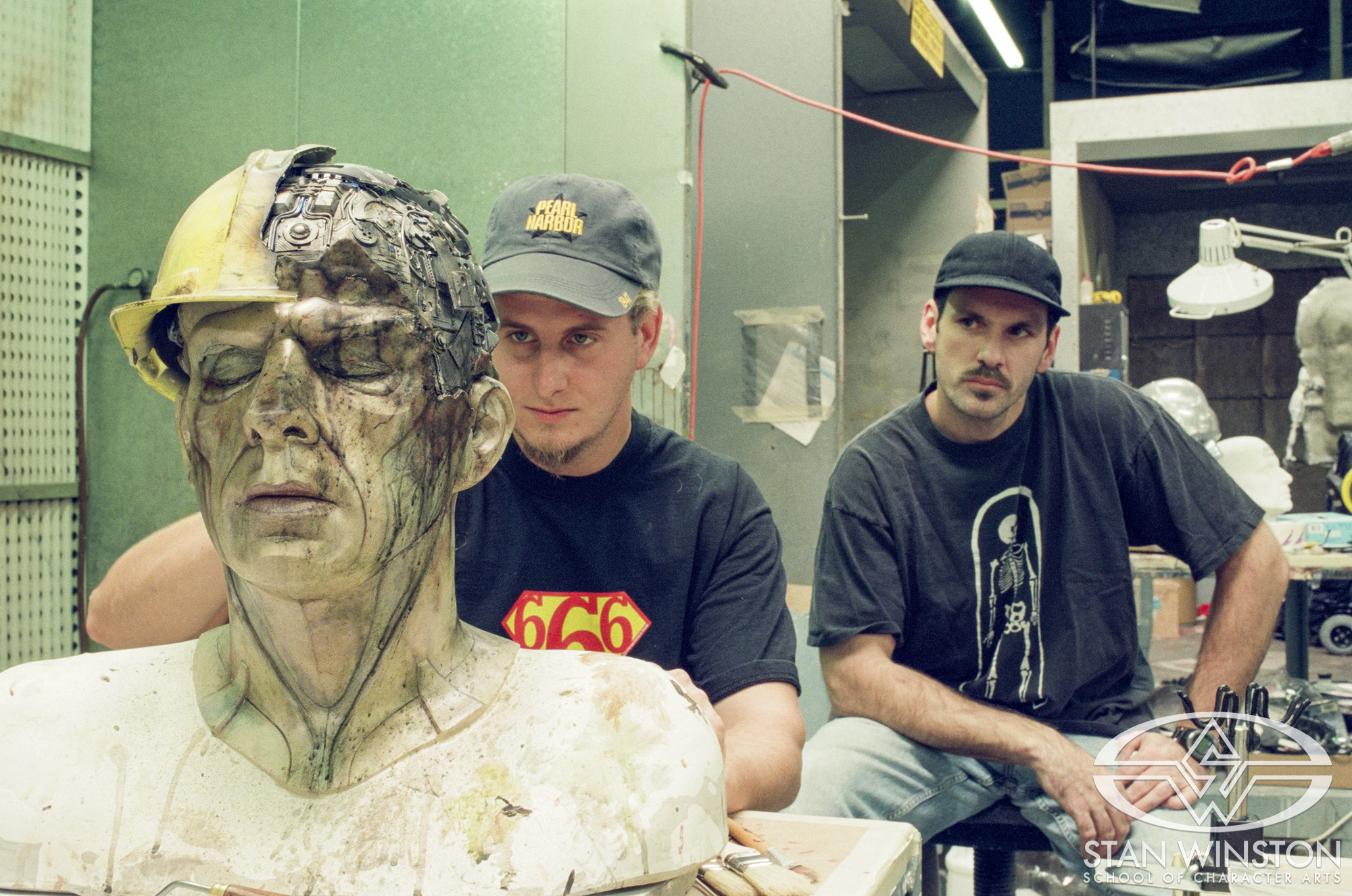 (Alan Scott and Scott Stoddard work on one of the Road Worker Mechas.)
Adding to the complexity of the Flesh Fair puppeteering setup was a new lip-sync control system the studio had developed that enabled one of the puppets to speak a line of dialogue.
 (Aaron Sims and Eric Fiedler work on the Guard mechas.)
The lip-sync system had performed without incident in all of its test runs and rehearsals on the set, but every time the cameras rolled, it failed to work. "It was so frustrating," Paul Mejias recalled, "because when the cameras stopped rolling, it would start working again! Steven made everybody turn off their beepers, walkie-talkies, and cell phones — everything was turned off, just in case that interfered with the signal — but it still wouldn't work when the cameras rolled. We were under all this pressure to get the shot, and we couldn't get this damn robot to deliver one line of dialogue. Stan usually stays cool, but this was one time when he got really tense. I remember at one point, he said to us over the intercom: 'I don't know how you guys are holding up, but I'm about to crack.' Finally, we just disconnected the lip-sync system, plugged into the robots directly, and faked the lip-sync on the fly."
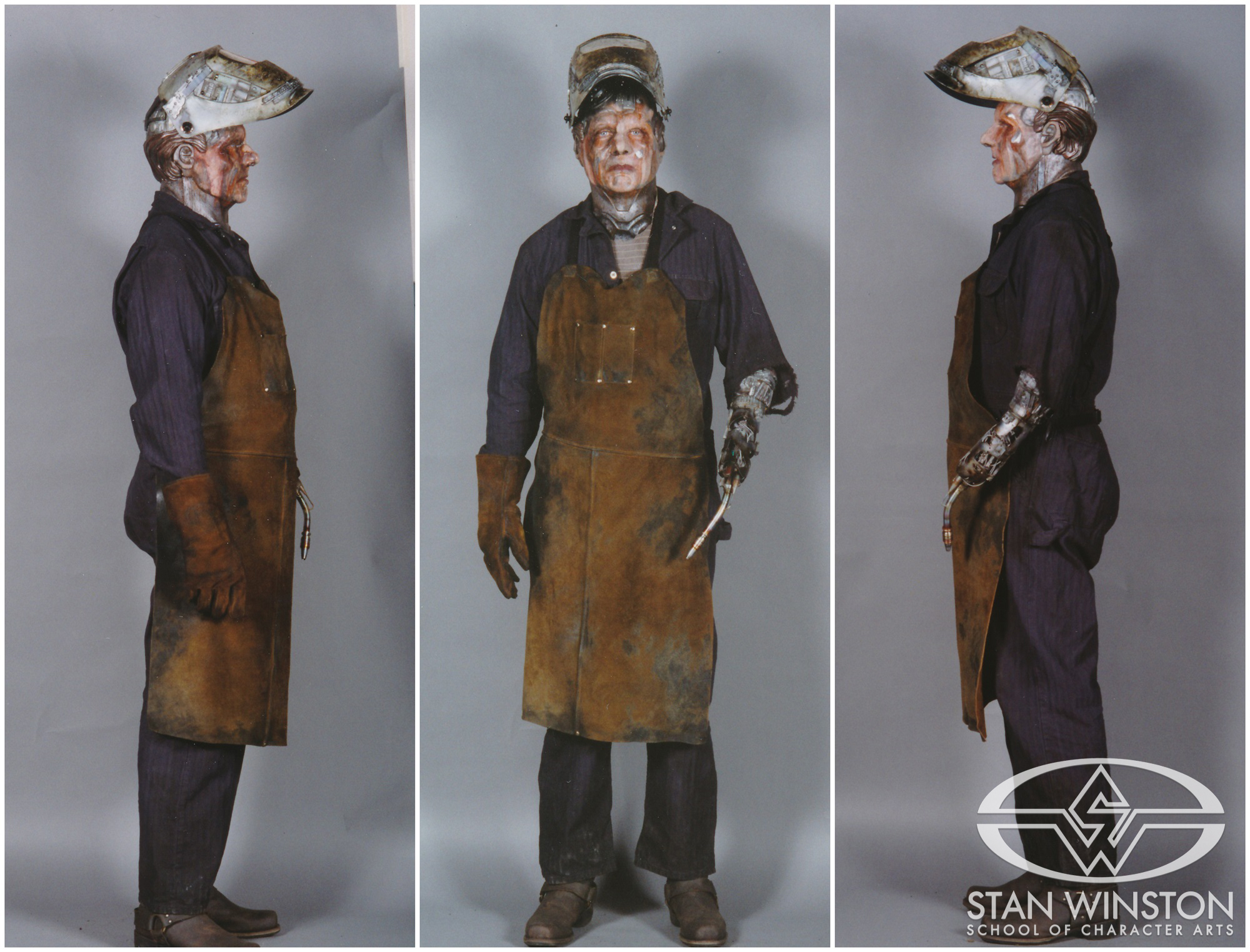 (R. David Smith poses as a Welder mecha at the Stan Winston Studio.)
Academy Award Nomination
Stan Winston received a VFX Academy Award nomination for A.I., a recognition of the incredible scope of the show's character effects. "A.I. was a tough, tough show," concluded Lindsay MacGowan. "Part of me enjoyed it tremendously, and part of me felt like it was the most difficult thing I'd ever done. It was a year-long project for me, and throughout that time, I averaged eighty- to 100-hour weeks. But I'm incredibly proud of the work we did on A.I. There was a great deal of innovation on that show."
- Blog assembled by Adrienn Lingurár with selections from The Winston Effect: The Art and History of Stan Winston Studio by Jody Duncan
Courses with the Creators of AI: Artificial Intelligence
- Special Effects Sequence Design with Shane Mahan
- Hybrid Character Design: Practical To Digital with Christopher Swift
- Animatronics Design Basics with Richard Landon
- Cable Mechanism Basics - Tentacles with Richard Landon
- Robot Brains - Animatronic Character Servo Control with Rick Galinson
- How To Draw Monsters - Drawing Stan Winston Creatures with Tim Martin
- How To Sculpt With WED Clay with Tim Martin
- Styrofoam Prop Making with Tim Martin
- Making Creature Eyes with John Cherevka
- Advanced Creature Teeth: Prosthetic Dental Appliances with John Cherevka
- How To Lifecast: Head, Hands & Teeth with Mark Viniello
- Silicone Sculpting & Patching Part 1: How To Seam & Patch A Silicone Mask with Chris Grossnickle
- Silicone Sculpting & Patching Part 2: How To Patch A Prop Body with Chris Grossnickle
- Silicone Sculpting & Patching Part 3: How To Seam & Patch A Silicone Makeup with Chris Grossnickle
- Articulated Mask Making On A Budget 1: Lifecasting, Sculpting & Teeth with Patrick Magee
- Articulated Mask Making On A Budget 2: Fabricating Flesh, Painting & Hair Work with Patrick Magee
- Art of the Fat Suit with Dawn Dininger
- Creature Costume Basics with Dawn Dininger & Amy Whetsel
- Beauty & Age Makeup - From Script To Screen with Bill Corso
- Zombie Makeup - Appliances, Airbrushing, Lenses & Teeth with Bill Corso
- Out Of The Kit Makeup Effects with Joel Harlow
- Creature Makeup - Multi-Piece Silicone Prosthetic Application with Joel Harlow
- How To Make A Monster Puppet - Rods & Cables with David Monzingo
- Makeup Blood FX - Blow Your Brains Out with David Monzingo
- Introduction to Hair Knotting with Michael Ornelaz