

Behind the Scenes of Interview with the Vampire (1994)
After Jurassic Park, there would rarely be a time when Stan Winston Studio wasn’t juggling multiple projects. One of those projects was Interview with the Vampire (1994), Neil Jordan’s film version of Anne Rice’s hugely popular novel, the first in her Vampire Chronicles series. Interview with the Vampire tells the story of an eighteenth-century plantation owner, Louis de Pointe du Lac, who, in contemporary times, grants an interview to a journalist, recounting his transformation at the hands of the vampire Lestat.
To watch the complete video, click the player above!
As popular as the book had been upon its publication in 1976, the complexity of its narrative, which spanned many decades, and its host of vampire characters had proved insurmountable obstacles to its film adaptation for nearly twenty years. The appropriate creative forces required to make the film a reality finally joined together when Jordan brought on Digital Domain to execute visual effects shots and Stan Winston Studio to create vampire makeups and effects.
Jump To Section
- The First Installment of The Vampire Chronicles
- Concepting Louis, Brad Pitt's Character
- Searching for the Perfect 'Lestat'
- Tom Cruise as Lestat de Lioncourt
- Achieving the Vampires' Translucent Skin
- Making Fangs and Eyes
- The Makeup After the Swamp Incident
- Lestat Bites the Rat
- Behind the Neck-Cutting Scene
The First Installment of The Vampire Chronicles
It was John Rosengrant and Shane Mahan, both huge fans of Rice’s book, who initially brought the project to Stan Winston’s attention. “Shane and I were very gung-ho about this show,” Rosengrant said. “Not only were we big fans of the book, but we saw this as an opportunity to do a serious horror movie in the tradition of Hammer Films. It was also a chance for us to do something completely different than Jurassic Park. We didn’t want to get typecast as the studio that only did big animatronics.”
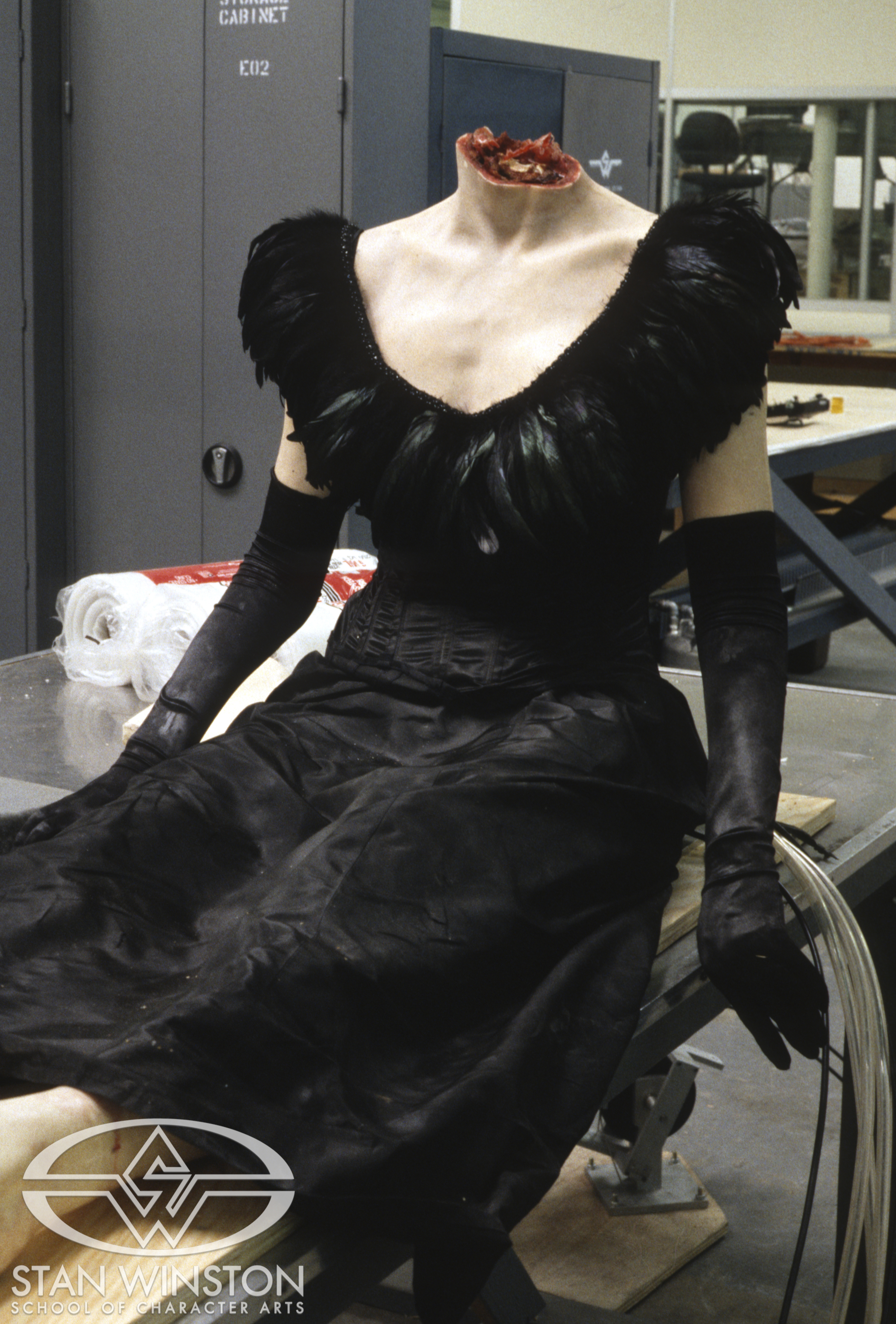 (Some scenes in Interview with the Vampire required mechanized puppets, including this one of Estelle's headless body.)
 (A technician at Stan Winston Studio clothes another mechanized puppet, a half-cut version of Santiago, the vampire played by Stephen Rea.)
 (The vampire Santiago's animatronic head as a work-in-progress.)
 (Richard Landon and Stan Winston preparing Estelle's mechanical vampire puppet on set.)
“Interview with the Vampire was a perfect example of how quickly you get typecast in this business,” Stan Winston said. “When John and Shane came to me and said they heard that Neil Jordan was going to do Interview with the Vampire, I was interested. I hadn’t read the book yet, but I was a big fan of Neil Jordan as a director. So I called him, asking him to have a meeting with me regarding the film. And he was shocked to hear from me because, to his mind, I was the ‘dinosaur guy.’ He would never have thought of this studio for the makeup effects for Interview with the Vampire. I literally had to sell this studio and myself to him. I had to convince him that we did makeups, that I’d started doing makeups. Because I’d done dinosaurs, I had to fight to get that job.”
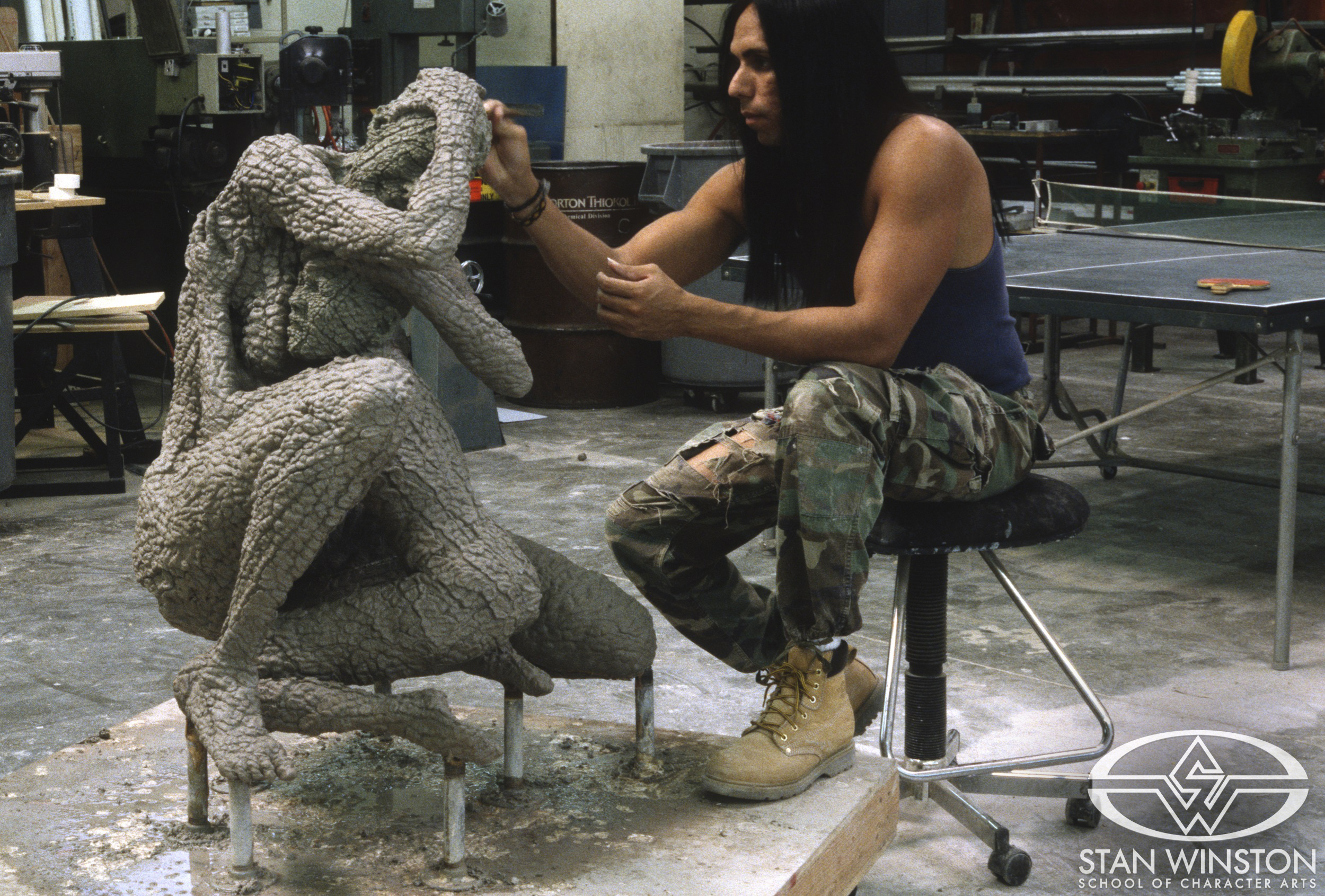 (Joey Orosco sculpts the ashen form of vampires Claudia, played by Kirsten Dunst, and Madeleine, portrayed by Domiziana Giordano, clutching each other before disintegrating upon exposure to the sun.)
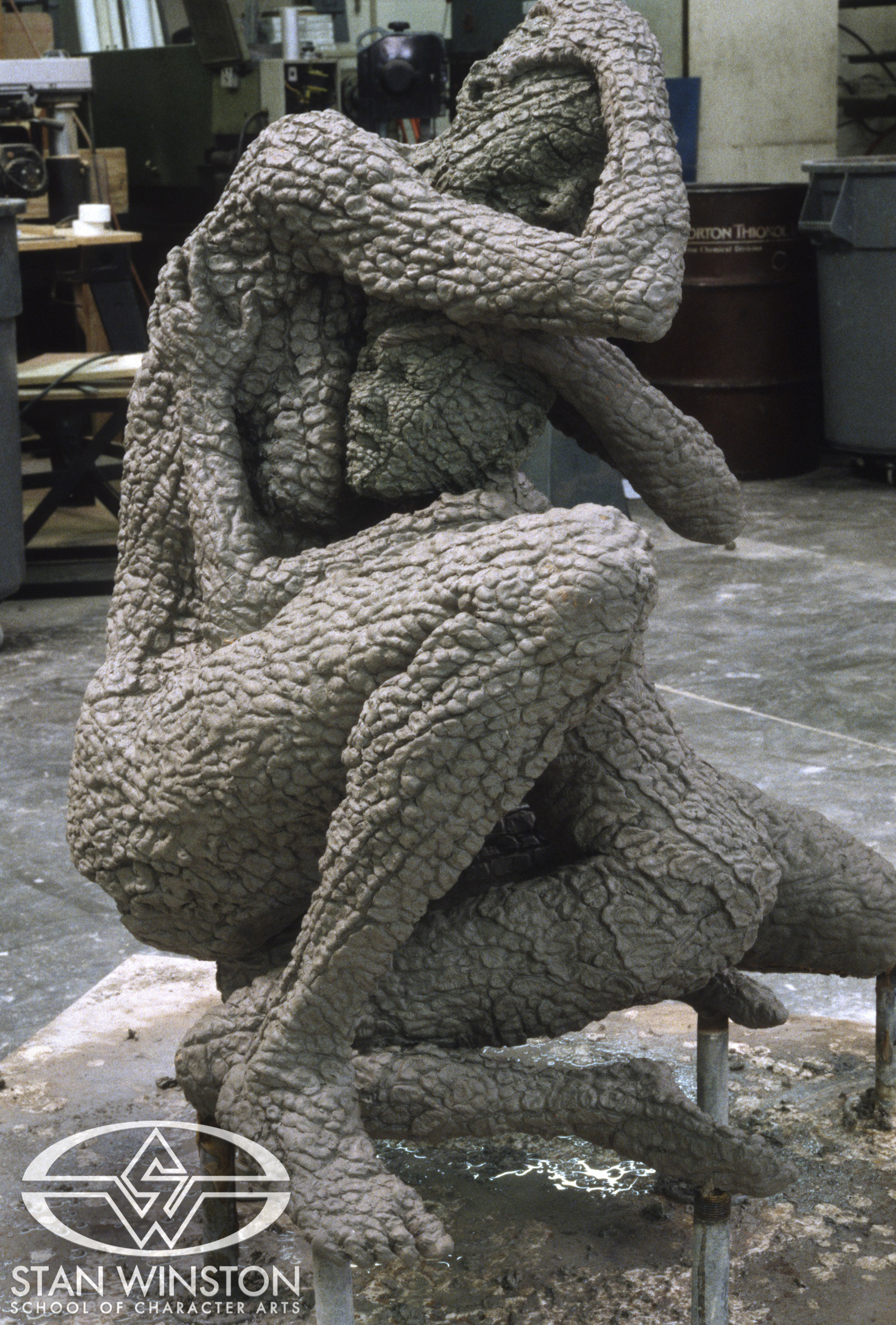 (The ashen sculpture of Claudia and Madeleine as a work-in-progress.)
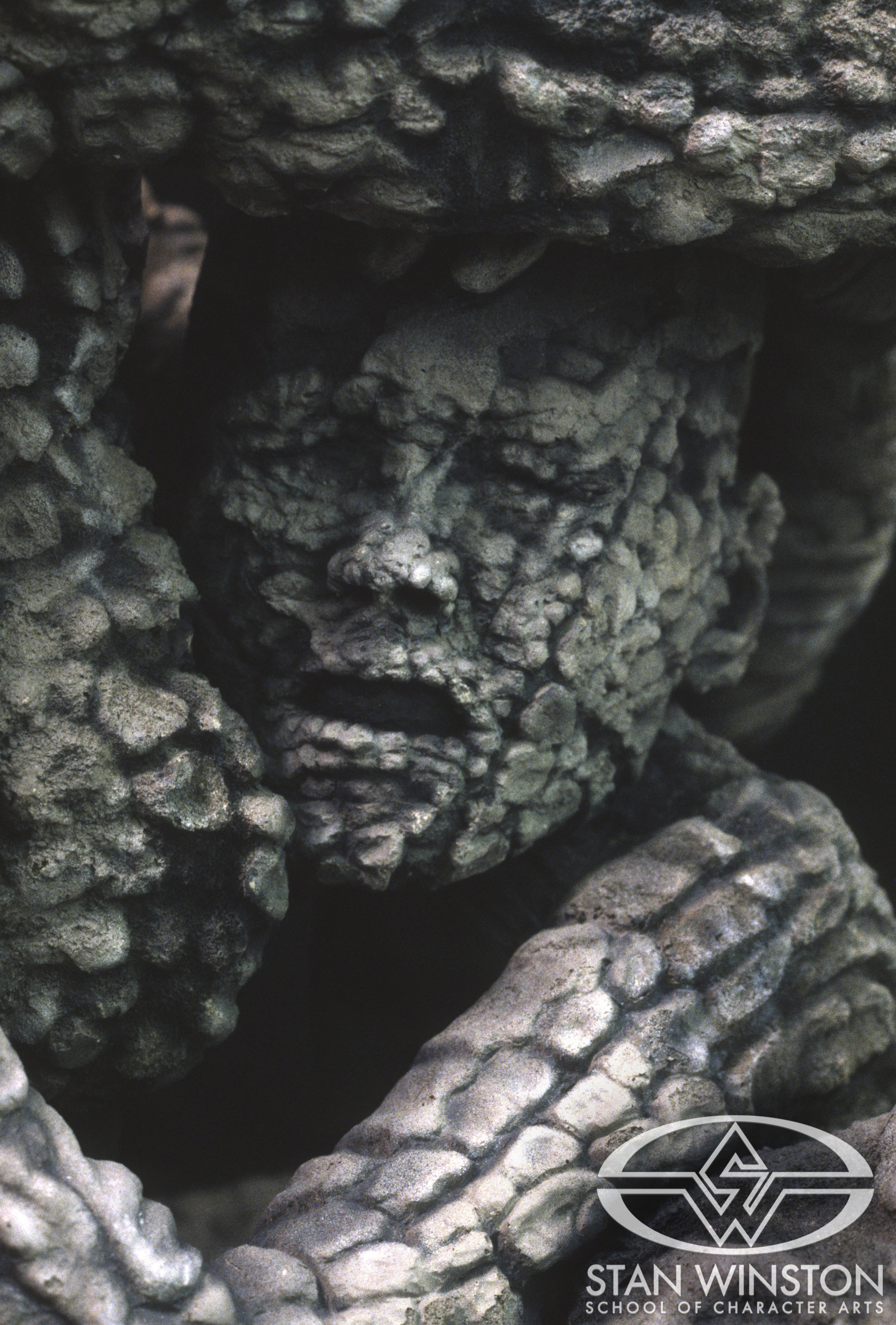 (Close-up of Claudia's form in the sculpture.)
Concepting Louis, Brad Pitt's Character
Back at the studio, John Rosengrant, Shane Mahan, Mark 'Crash' McCreery, and artist Miles Teves were drawing vampire concepts over photographs of actors being considered for the lead roles. McCreery concentrated his efforts on concepts for Louis, incorporating the facial features of Brad Pitt, who had been cast as the character. “At that time,” said McCreery, “Brad Pitt was best known for his small part in Thelma and Louise [1991], so this was really a very different role for him. I remember him coming into the studio and being so into the project. He even posed for pictures for me to work off of, which we rarely get an opportunity to do. I did three or four drawings on Brad Pitt to figure out what the teeth would look like, how the veins would look, how much pallor there would be in the face — all of those things.”
 (Mark 'Crash' McCreery’s drawing of Brad Pitt as Louis in Neil Jordan’s Interview with the Vampire.)
Searching For the Perfect "Lestat"
Miles Teves concentrated on concepts for Lestat, a crucial role that remained uncast for a long time. A seemingly endless series of names was thrown into the hat as possible contenders, only to be rejected. “The craziest one was Al Pacino,” Shane Mahan said. “I remember Neil Jordan coming into the shop one day and asking, ‘What do you boys think of Al Pacino?’ And we said, ‘For what?’ ‘For Lestat.’ We couldn’t believe it. He was too old for the part, for one thing. In the book, Lestat was a twenty-four-year-old French guy! But, apparently, Al Pacino really wanted to do it, and so we did drawings of Al Pacino as Lestat.”
 (Miles Teves's portrait of Al Pacino as the vampire Lestat. The actor was briefly considered for the role.)
“Every week, we’d get a new name,” said McCreery, “and Miles and I would go back and do another drawing of Lestat, sketching it over that new actor’s face. One week, it was Jeremy Irons. The next week, it was Daniel Day-Lewis. The next week, it was Val Kilmer. Finally, it was announced that Tom Cruise was going to be Lestat — and everyone at the studio really got behind that idea.”
Tom Cruise as Lestat de Lioncourt
There was a loud and angry outcry from fans of the novel when Tom Cruise’s casting was announced. “I didn’t really understand that backlash,” Shane Mahan said. “I think people may have just been responding to the fact that Tom had dark hair and dark eyes, and Lestat was described as very pale, with blond hair and blue eyes. Physically, he didn’t seem to fit the part, which threw people off.”
 (Miles Teves depicted Tom Cruise as Lestat in all the character’s various forms, including sick and wasting away, burned and scarred in a fire, and, finally, as he appears when he arises from a swampy grave.)
Initially, however, Cruise resisted the idea of being transformed into a blue-eyed blonde for the role, convinced that Lestat would lose none of his power and appeal if he were to play him with his natural dark hair and eyes. The artists at the studio disagreed and convinced the actor to let them do a test makeup with blond wigs and blue contact lenses. “Tom was really putting himself out there in doing this part and making himself look so different,” John Rosengrant said. “There were a lot of people lining up to see the movie fail and, especially, to see Tom fail. There was a lot riding on this makeup being successful and looking right, and so we all worked together and focused on every detail to make this makeup as believable as possible.”
 (Tom Cruise with Stan Winston and SWS crew members Bill Basso, John Rosengrant, Mark Jurinko, Shane Mahan and David Grasso at Stan Winston Studio.)
For the final look, the studio dyed Cruise’s eyebrows and hairline blond and then fitted him with a luxuriant blond wig created by Renate Leuschner. “With the wig and the character makeup and blue contact lenses, Tom really looked like Lestat,” Shane Mahan said. “He liked how it looked, too. I think our makeup really helped the fans to accept Tom as Lestat.”
 (A test shot of Tom Cruise as Lestat with blond hair, blue contact lenses, and paper-thin acrylic fangs.)
Achieving the Vampires' Translucent Skin
The makeups designed for all the vampire characters were subtle, serving Jordan’s view of the film as a character study rather than a horror effects spectacular. One of the key elements of the makeup designs was the vampire’s translucent skin. With John Rosengrant acting as vampire test subject, Stan Winston and his crew explored using metallic substances to achieve the porcelain sheen Rice described in her book, as well as stark white makeups; but the metallic powders didn’t read on film, and the white makeups were too garish for the film’s realistic tone. A fair pancake makeup was ultimately used to create the appropriate pallor.
 (John Rosengrant as Lestat, wearing a network of blue lines painted directly onto his face following his natural vein patterns.)
The vampires’ translucent flesh would reveal bluish veins beneath the surface. The studio tested foam rubber vein prosthetics to create a three-dimensional vein effect on the skin, but the approach was judged too labor-intensive for a film that would feature vampires in nearly every shot. The final solution was to use tattoo ink to paint a network of blue lines directly onto the actors’ faces, following their natural vein patterns, which were made more discernible during application by having the actors lie on a tilted slant board, heads-down.
 ( Some scenes required pulsating veins on living characters, which was achieved by using bladder effects in neck and chest prosthetic appliances.)
Making Fangs and Eyes
The studio also produced needle-sharp acrylic veneers that fit tightly against the actors’ gums and covered their upper front teeth. The veneers were made as thin as possible so as not to impede the actors’ speech, but the paper-thin acrylic broke easily, requiring the studio to produce many sets for each vampire character in two different lengths — a shorter, more subtle set for dialogue scenes, and a longer set for more horrific scenes.
 (Brad Pitt wearing a set of vampire teeth at Stan Winston Studio.)
Contact lenses were most often used to intensify actors' eye color rather than give them a monstrous look—although some were colored black or gold to create an animalistic appearance for specific sequences. As a final touch, all of the vampire characters wore long acrylic fingernails.
 (John Rosengrant tests the black contact lenses at Stan Winston Studio.)
The Makeup After the Swamp Incident
Later scenes required less subtle makeups. John Rosengrant created a disfigured Lestat makeup for shots of the character after he returns from a swamp, and Shane Mahan designed his final aged and decayed look as he appears in modern-day New Orleans. Mahan’s initial design was quite severe and involved a number of appliances. When Cruise expressed concern over wearing heavy prosthetic makeup for his final scenes, Mahan simplified it to include only cheekbone appliances and a brow piece.
 (Bill Basso details one of the Lestat decayed clay sculptures at Stan Winston Studio.)
 (Different Lestat makeups in different stages.)
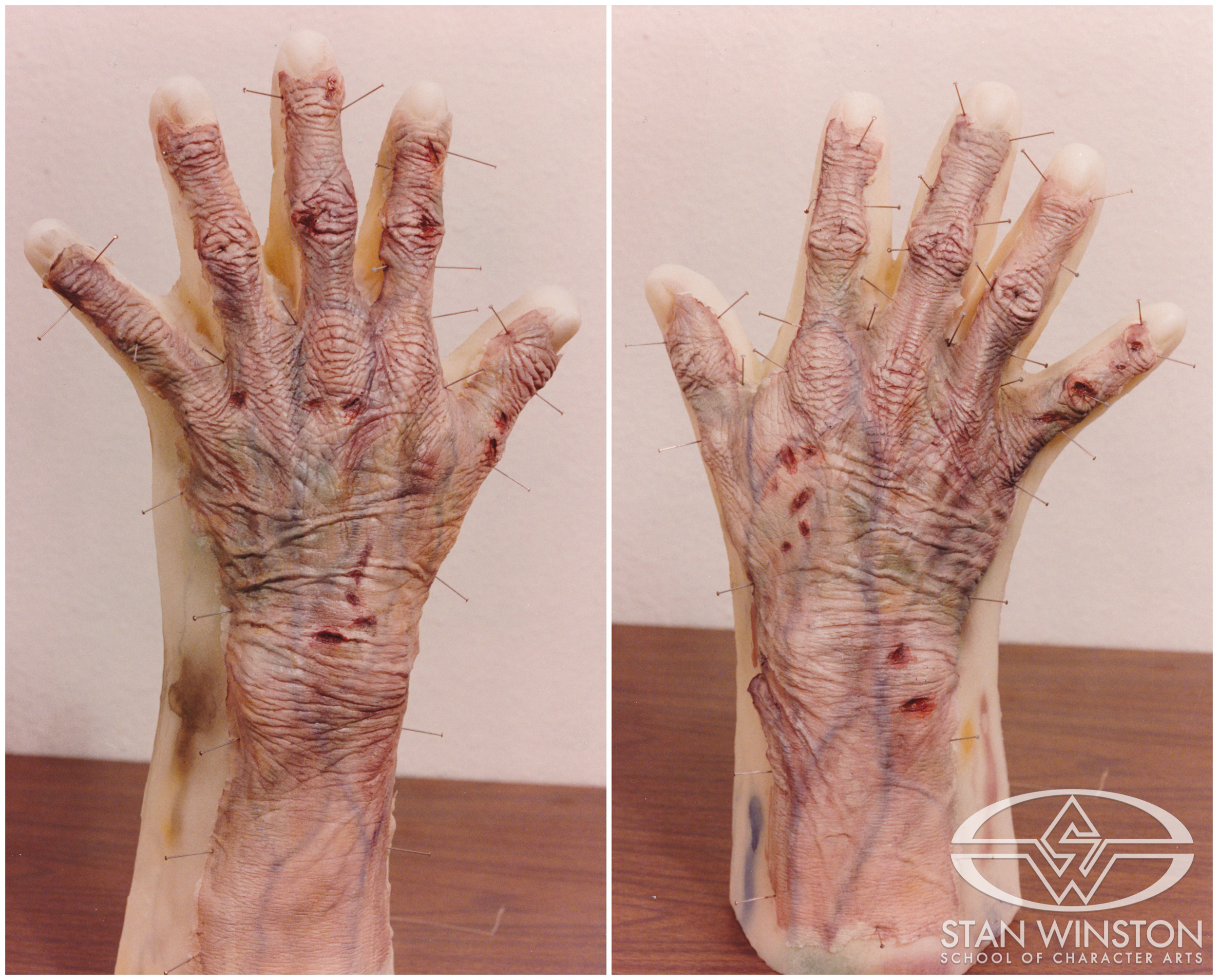 (The Lestat decayed hand prosthetics.)
Although Cruise had those notes on the final makeup, overall, he was an unusually cooperative and collaborative partner with the Stan Winston Studio artists in creating his character for Interview with the Vampire. “There are actors who really embrace the makeup process,” said Mahan, “and there are those who want nothing to do with it. I think some actors are afraid they’re going to look foolish, which is understandable. But an actor’s attitude toward the makeup can either make our work great or make it terrible. Tom was very good, very professional about the makeup.”
 (John Rosengrant poses with two different prosthetic Lestat makeups in Stan Winston Studio's parking lot.)
Lestat Bites the Rat
In a key scene, Lestat reaches to the floor and picks up a live rat, bites its neck, and drains its blood into a wine glass for Louis. A live, trained rat was used for the shots of the rat on the floor. But when Tom Cruise, as Lestat, picks up the rat, the creature effects designers at Stan Winston Studio created a moving rat puppet that could be controlled via cable so it appeared to be wiggling.
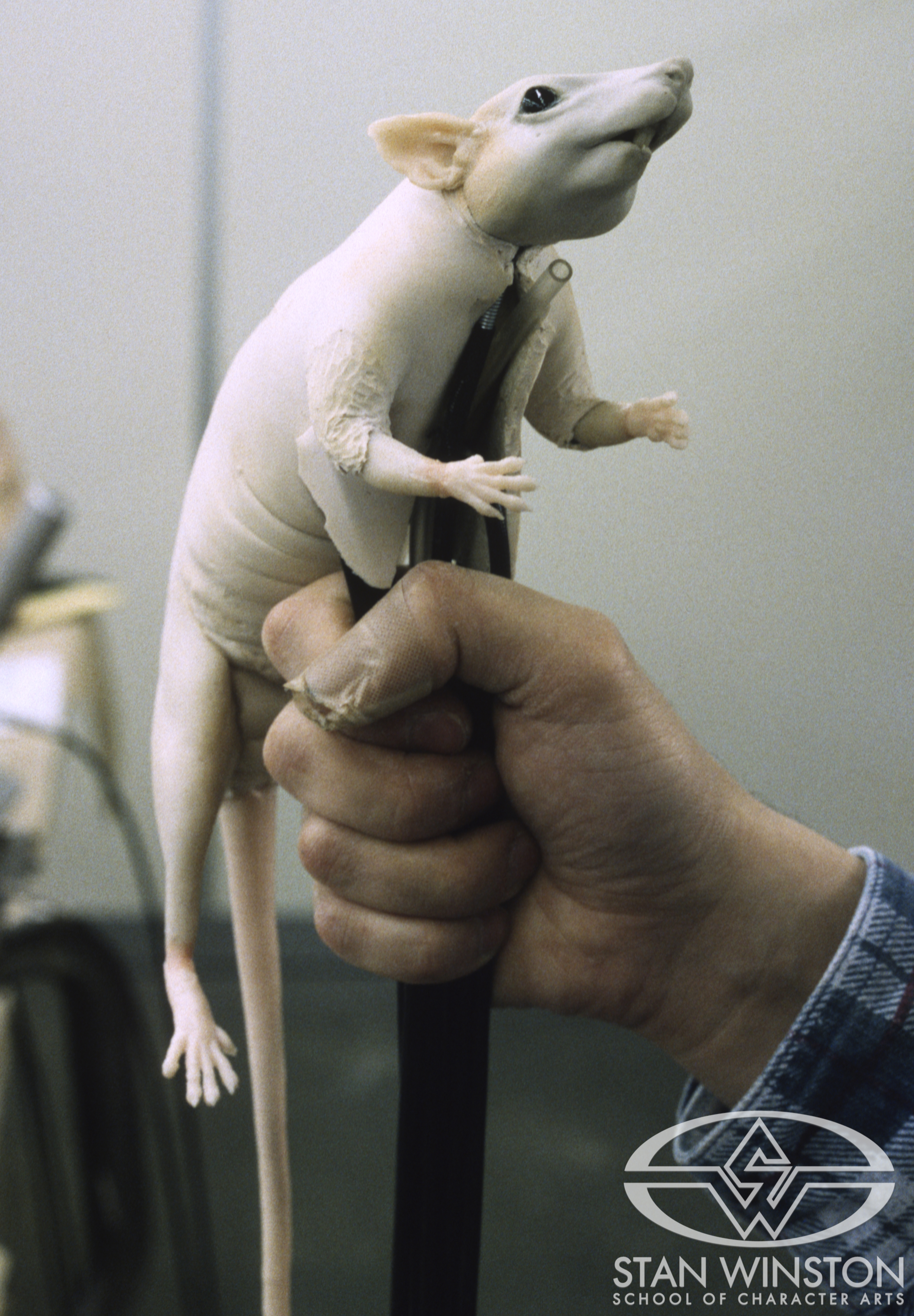 (The assembled cable-controlled rat before getting its fur.)
 (Lindsay Macgowan works on the rat's fur at Stan Winston Studio.)
The effect was achieved by taking advantage of the eighteenth-century billowy shirt that Cruise wore as Lestat to run the operating cables (similar to bicycle cables) and a thin, blood-delivery tube along the actor's inner arm. As Lestat seems to grab the rat and raise it to his mouth, puppeteers use the cables to make the rat appear to struggle and the blood tube to spray a bit of non-toxic fake blood around his mouth.
Watch John Rosengrant (standing in for Tom Cruise) testing the rat-biting effect at Stan Winston Studio:
Behind the Neck-Cutting Scene
In addition to the vampire makeups — which were applied on set by makeup artist Michele Burke, an Oscar-winner for Quest for Fire (1981) and Bram Stoker’s Dracula (1992) — Winston and his crew created a series of puppets for a sequence in which Lestat, after having his throat cut by Claudia (Kirsten Dunst), transforms from beautiful golden-boy to a desiccated shell.
 (The Lestat transformation heads at Stan Winston Studio.)
Extrapolating from a similar effect he had created for the Mr. Dark character in Something Wicked This Way Comes, Winston accomplished the transformation live with only a little help from the digital effects team. “It starts with Tom Cruise,” said Winston, “and by the end, he is this sunken-in corpse. And it all happens in one shot, right in front of your eyes, through a combination of live-action animatronics and digital effects.”
Watch test footage of mechanical effects designer Richard Landon (standing in for Kirsten Dunst) "slashing" Shane Mahan's throat (standing in for Tom Cruise). Gallons of blood later, the Stan Winston Studio crew had proven the throat slash effect would work on set.
The Winston crew first videotaped Cruise performing the transformation scene and then used that as a reference in building and mechanizing Lestat head and body puppets. The body was puppeteered from underneath a table, with miniature hydraulic systems creating a crawling motion. The puppet’s head, neck, arm, and fingers were also hydraulically controlled.
 (Mechanical under-skulls built by Alan Scott for a series of transformation heads used in Lestat’s death sequence.)
 (Lestat's exposed mechanical body rig.)
To create a shriveling effect, air was released from an inflated airbag configured in the shape of Cruise’s body and sewn around a skeletal form. Miles Teves sculpted Lestat’s facial disintegration in four stages, working over a lifecast of Cruise, and then, studio artists and engineers created four animatronic heads from those sculpts. The stage-one head was a perfect replica of Cruise to ensure that the cut from the actor to the puppet would be undetected. For the stage-two through stage-four heads, Winston and his artists referenced photographs of concentration camp survivors and AIDS victims.
 (The four stages of Lestat’s death transformation. The invisible in-camera effect required only minimal digital manipulation to blend from one head to the next in the final sequence.)
The animatronic heads were mounted, in succession, onto the animatronic body puppet, then shot in fourteen separate motion control passes. Digital Domain then blended those motion control passes through a digital morph to create a twelve-second cut that appeared continuous and seamless. “Instead of just doing a dissolve from one stage of decay to the next,” said Winston, “Digital Domain morphed between those stages to create an invisible and beautiful transformation. I believe it is still the most invisible transformation ever done on film. To this day, audiences don’t realize that what they are watching is an effect. They just see a person dying before their eyes.”
 (The stage-four head of Lestat on the mechanical body rig at Stan Winston Studio.)
- Blog assembled by Adrienn Lingurár with selections from The Winston Effect: The Art and History of Stan Winston Studio by Jody Duncan
Courses with the Creators of Interview with the Vampire
- Hybrid Characters: Blending Practical & Digital FX with John Rosengrant
- Special Effects Sequence Design with Shane Mahan
- Cable Mechanism Basics - Tentacles with Richard Landon
- Animatronics Design Basics with Richard Landon
- Hybrid Character Design: Practical to Digital with Christopher Swift
- Makeup Blood FX - Blow Your Brains Out with David Monzingo
- How to Make a Monster Puppet - Rods & Cables with David Monzingo
- Creature Screenwriting: How to Write Memorable Monsters with Stiles White and Juliet Snowden
To create the makeup effects seen in Interview with the Vampire, use the following courses:
- How to Lifecast: Head, Hands & Teeth
- How to Make Fake Teeth
- How to Sculpt a Character Makeup
- Character Makeup - Sculpture Breakdown & Mold Making - Part One
- Character Makeup - Sculpture Breakdown & Mold Making - Part Two
- Character Makeup - Multi-Piece Prosthetic Application
- A to Z Tabletop Prosthetics Part 1: Sculpt & Mold a Wound
- A to Z Tabletop Prosthetics Part 2: Demold, Cast, Apply & Paint
- How to Make Prosthetic Transfers - Makeup Effects Innovation
- Dead Body Makeup: Creating Realistic Corpse Makeups
- Blood, Gore and Makeup Effects Part 1 - Cuts, Wounds, Props
- Blood FX: Rig, Apply & Shoot
- Blood Makeup Effects - The Throat Slash
- Transformation Makeup - Bladder FX Part 1: Design, Create & Test
- Transformation Makeup - Bladder FX Part 2: Apply, Paint & Shoot