
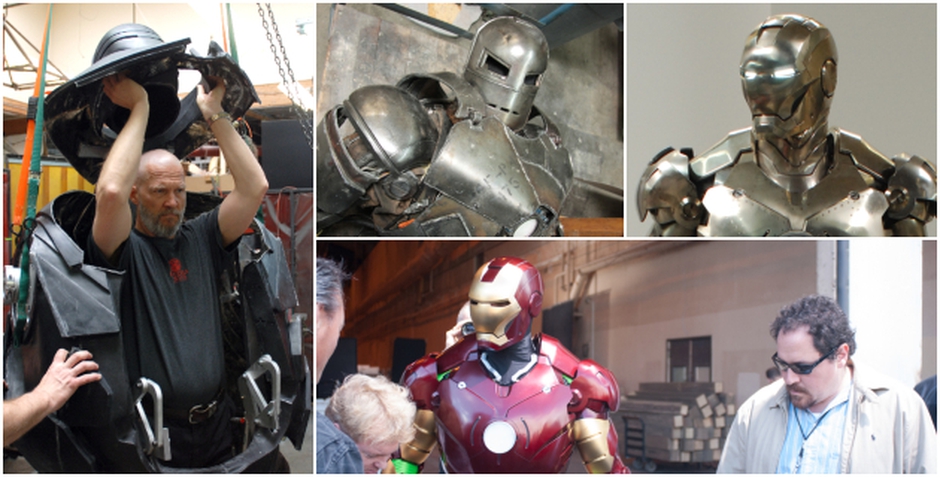
The Origin of Iron Man
Primary source: CINEFEX #114: The Man in the Iron Man Mask by Jody Duncan.
Although Iron Man never achieved the same level of mainstream popularity as Spider-Man or other Marvel icons, the character still earned a dedicated following and deep respect from comic book enthusiasts. First appearing in 1963 in a tale written by Stan Lee and drawn by Don Heck, Tony Stark is depicted as an inventive genius in weaponry, a wealthy playboy, and a chronic drinker. During the Vietnam War, Stark is wounded and taken captive. His captors demand he build a bomb from available materials, but instead, he constructs a suit of armor with miniature transistor technology that shields his heart, which is at risk due to shrapnel lodged inside. This armored suit allows him to break free. Upon returning home, Stark is forever altered. As Iron Man, he vows to protect the innocent and fight against the misuse of his own weapons when they end up in the wrong hands.
Jump To Section
- Behind the Scenes of Iron Man (2008)
- Making the Practical Tony Stark Armors
- Building the Mark I, Mark II, and Mark III Suits
- Creating Obadiah Stane's Iron Monger
- Proof that Tony Stark Has a Heart
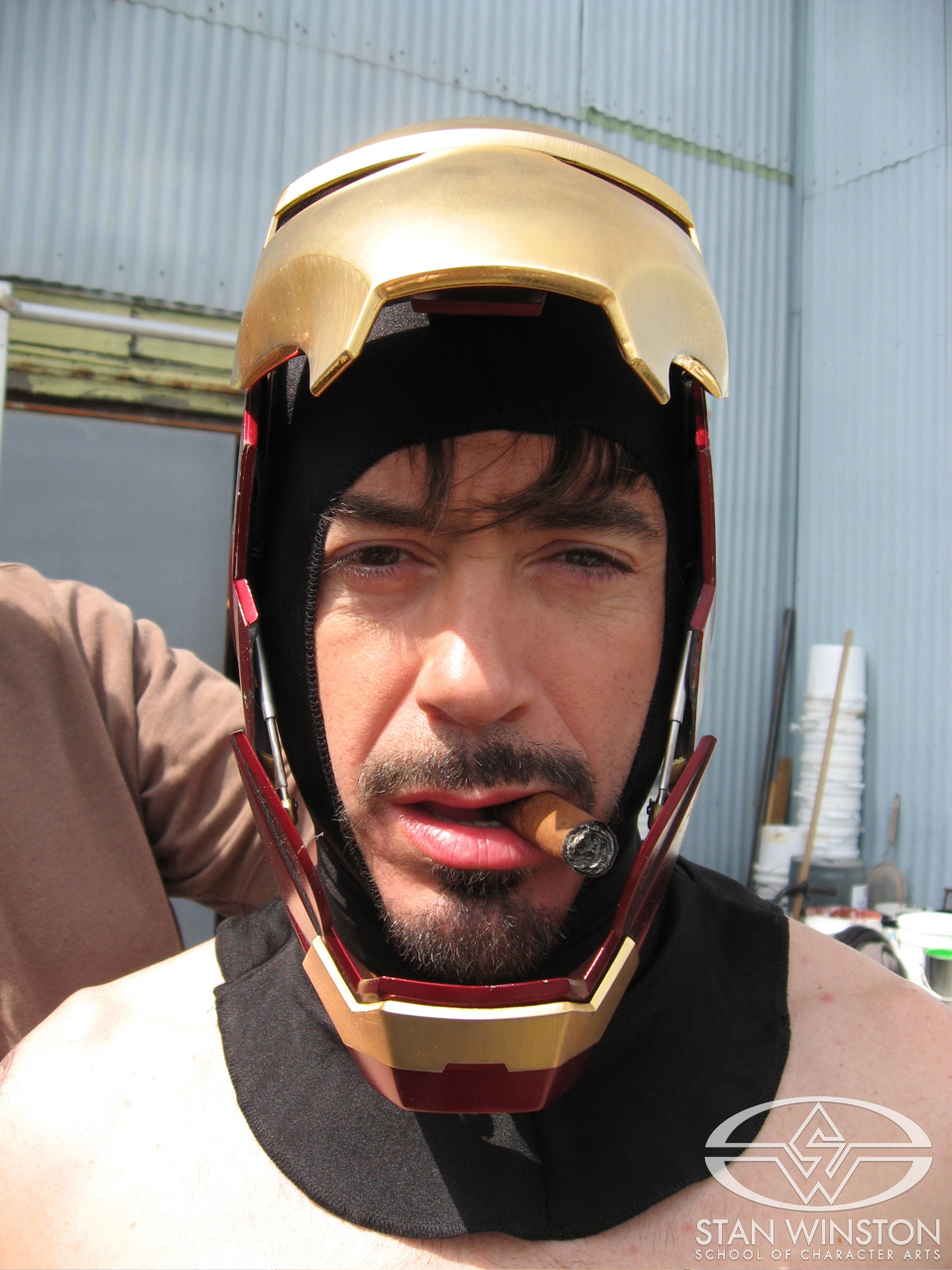 (Image of Robert Downey Jr. testing one of the classic red and gold Mark III helmets at Stan Winston Studio for Iron Man.)
Behind the Scenes of Iron Man (2008)
Iron Man spent several years in development hell, bouncing between studios and directors without significant progress. When Marvel regained the rights to the character, executive Avi Arad approached Jon Favreau to develop the project anew from the ground up. "It was nice to develop it with Marvel," Favreau shared, "because they have a different view towards the source material than the studios do. Studios tend to see source material only for how it can benefit them. They tend not to stay true to it or be protective of it. But these properties are Marvel's bread and butter, so they don't want to do anything to diminish them. A studio would say: 'Who cares? Let's just get it on the screen.' But Marvel wanted to do it right."
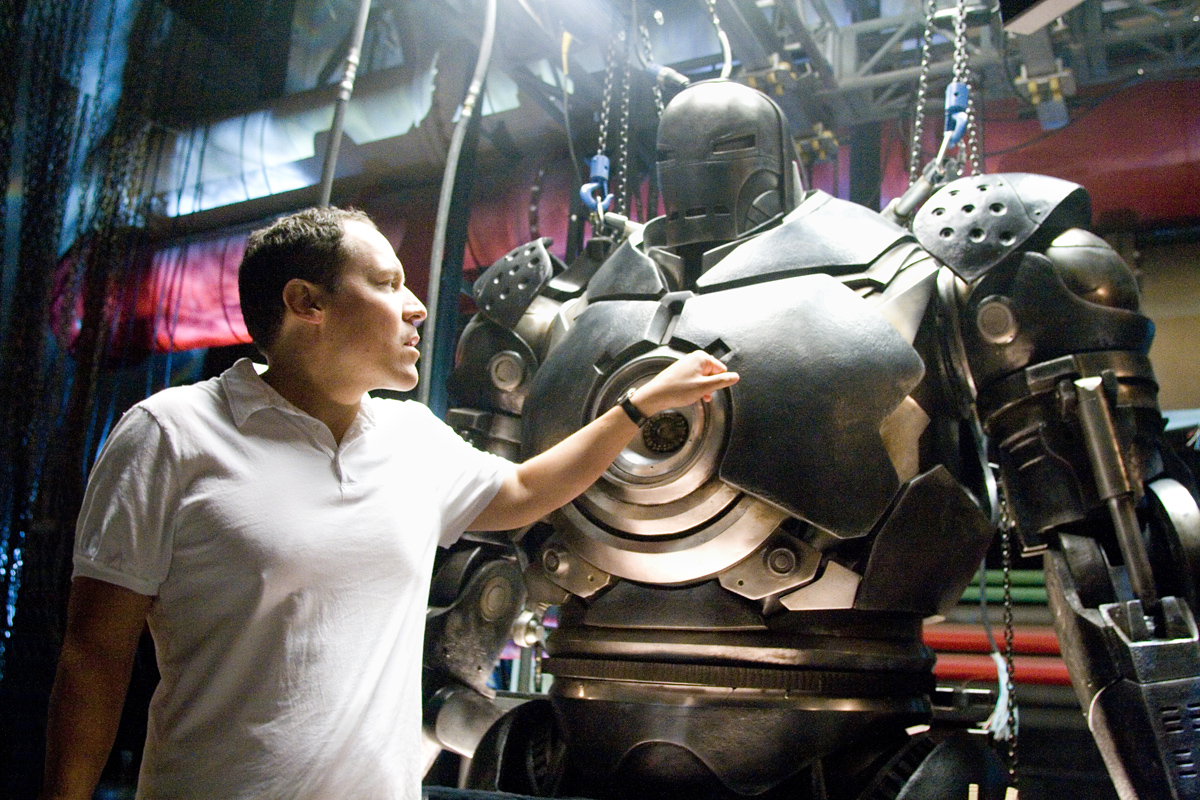 (On-set image of Jon Favreau checking Obadiah Stane's Iron Monger built by Stan Winston Studio. Image courtesy of Paramount Pictures, Marvel Entertainment, and Marvel Studios.)
Favreau collaborated with screenwriters Mark Fergus, Hawk Ostby, Art Marcum, and Matt Holloway to update the original comic's storyline, shifting the action from the Vietnam War era to the present day. The writers reimagined key elements, swapping the comic's 'miniaturized transistors' with cutting-edge 'repulsor technology' and 'arc reactors.' "The technology changed a lot," Favreau remarked. "It had to. The original Iron Man suit in the comics had roller skates that popped out! We had to come up with technology that would play with a much more discerning audience — without violating the expectations of people who grew up loving Iron Man."
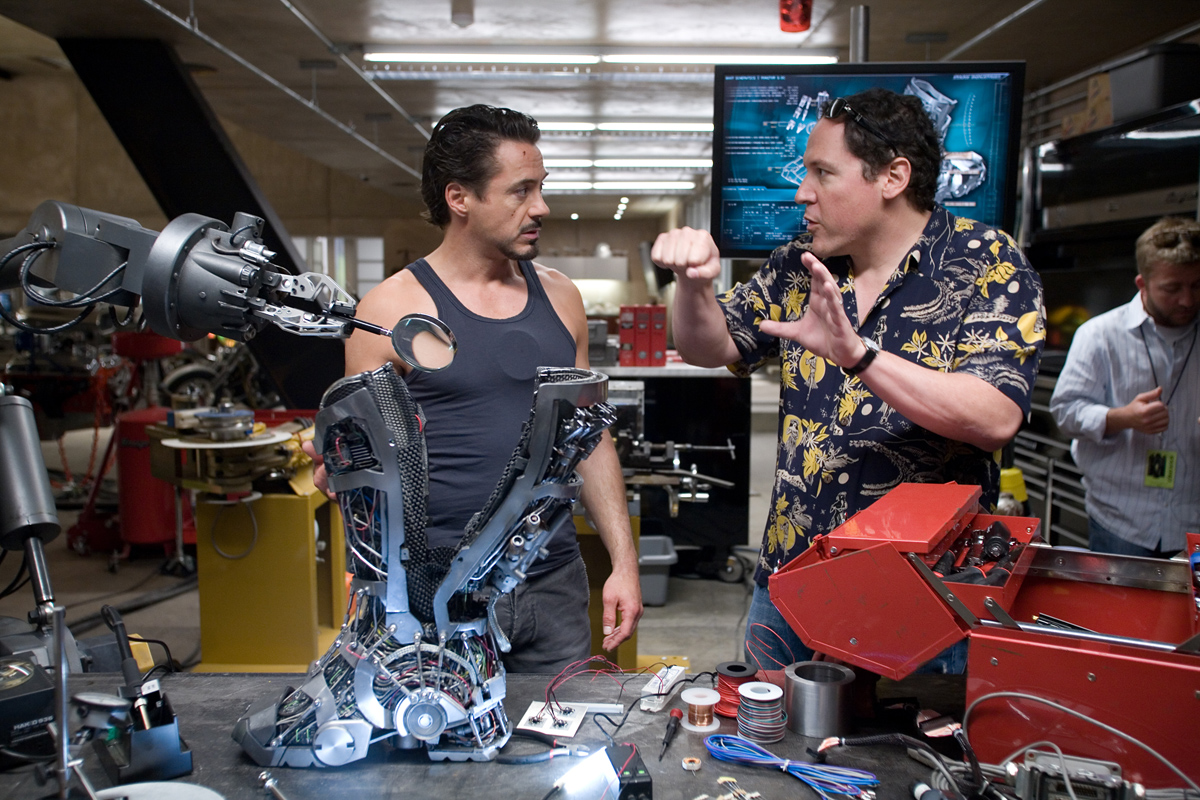 (On-set image of Jon Favreau directing Robert Downey Jr. for a scene that involves practical accessories, including a flight boot built by Stan Winston Studio. Image courtesy of Paramount Pictures, Marvel Entertainment, and Marvel Studios.)
Favreau, who has long criticized the excessive use of CGI in films and prefers using traditional, practical effects whenever possible, recognized that, given the character's physicality and powers, a substantial portion of Iron Man's scenes would require computer-generated imagery. Nevertheless, the director emphasized the necessity of incorporating real Iron Man suits on set, worn by either Robert Downey Jr. or stunt performers. These practical suits enabled Favreau to capture authentic, in-camera shots, minimizing the dependence on CGI and providing essential lighting reference for the visual effects teams working on the digital components.
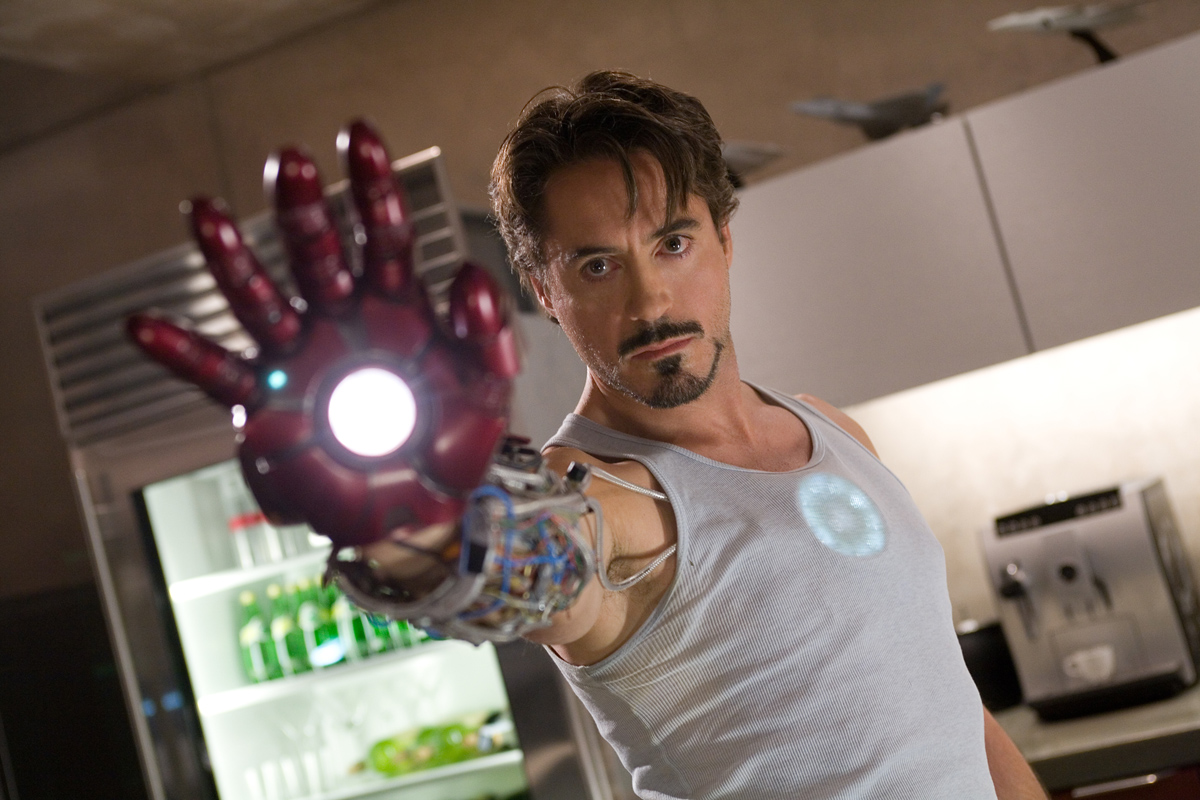 (Image of Robert Downey Jr. wearing one of the Stan Winston Studio-built mechanical arm props on the set of Iron Man. Image courtesy of Paramount Pictures, Marvel Entertainment, and Marvel Studios.)
Making the Practical Tony Stark Armors
Stan Winston Studio was tasked with creating the Iron Man suits, with SWS supervisor Shane Mahan overseeing the project. "Shane, Victoria, and I went through the storyboards and figured out what we could do practically and what we would do in CG," recalled visual effects production supervisor John Nelson. "There were obvious places that were going to be CG, obvious places that were going to be practical — and then there were shots that could go either way. We just went in with the attitude that we would get as much as we could with the practical suits, and we ended up with some very nice practical shots in the movie."
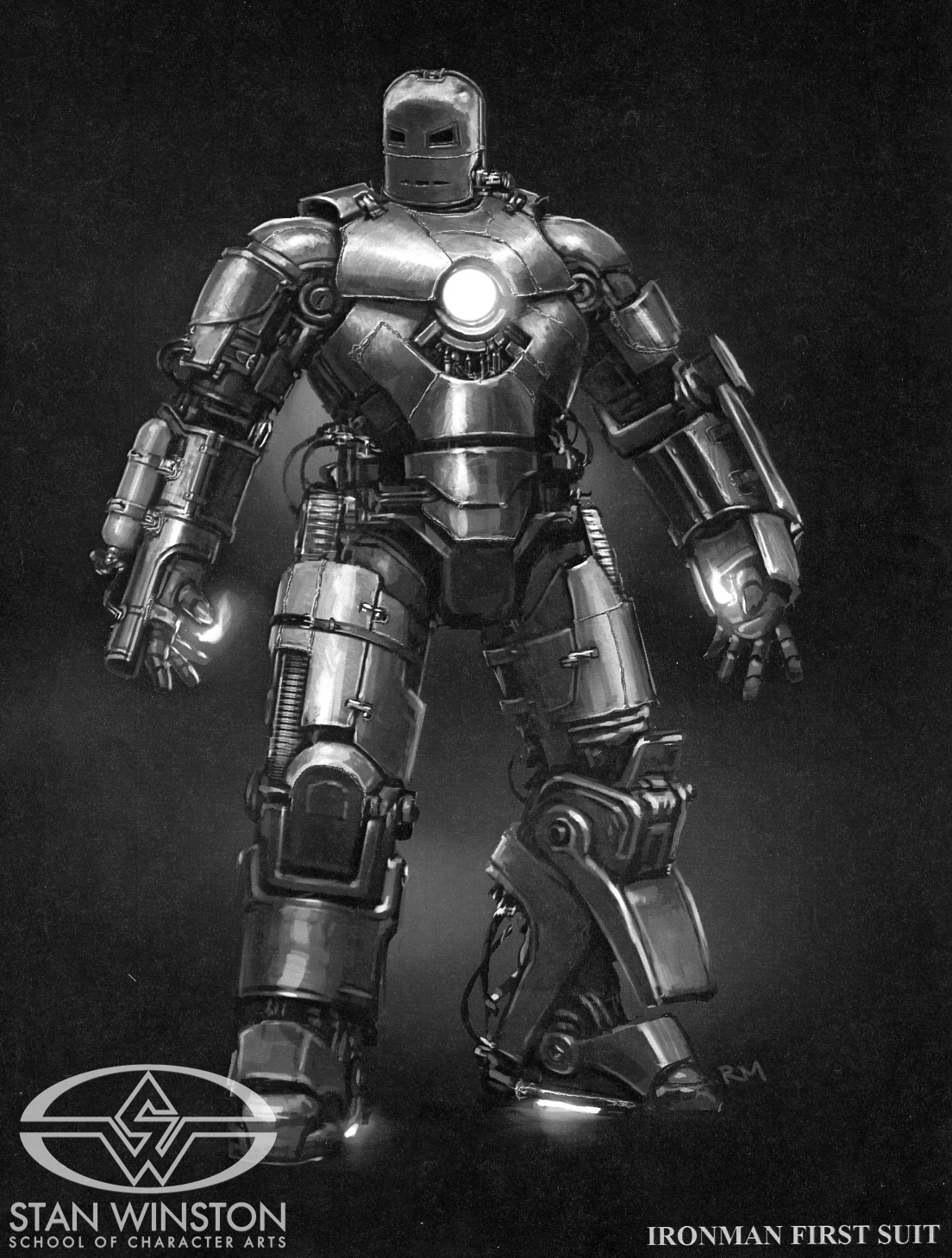 (Concept art by Ryan Meinerding for Iron Man's Mark I "cave escape" suit.)
The film features three versions of the ron Man suit: the 'Mark I,' built by Stark during his captivity; the silver 'Mark II,' created when he returns to his home lab; and the red-and-gold 'Mark III,' representing the peak of Iron Man's technological evolution. Much of the pre-production phase was dedicated to designing these suits, with Marvel concept artists Phil Saunders and Ryan Meinerding drawing heavily from the depiction of Iron Man in the recent Extremis comic book series by Marvel artist Adi Granov.
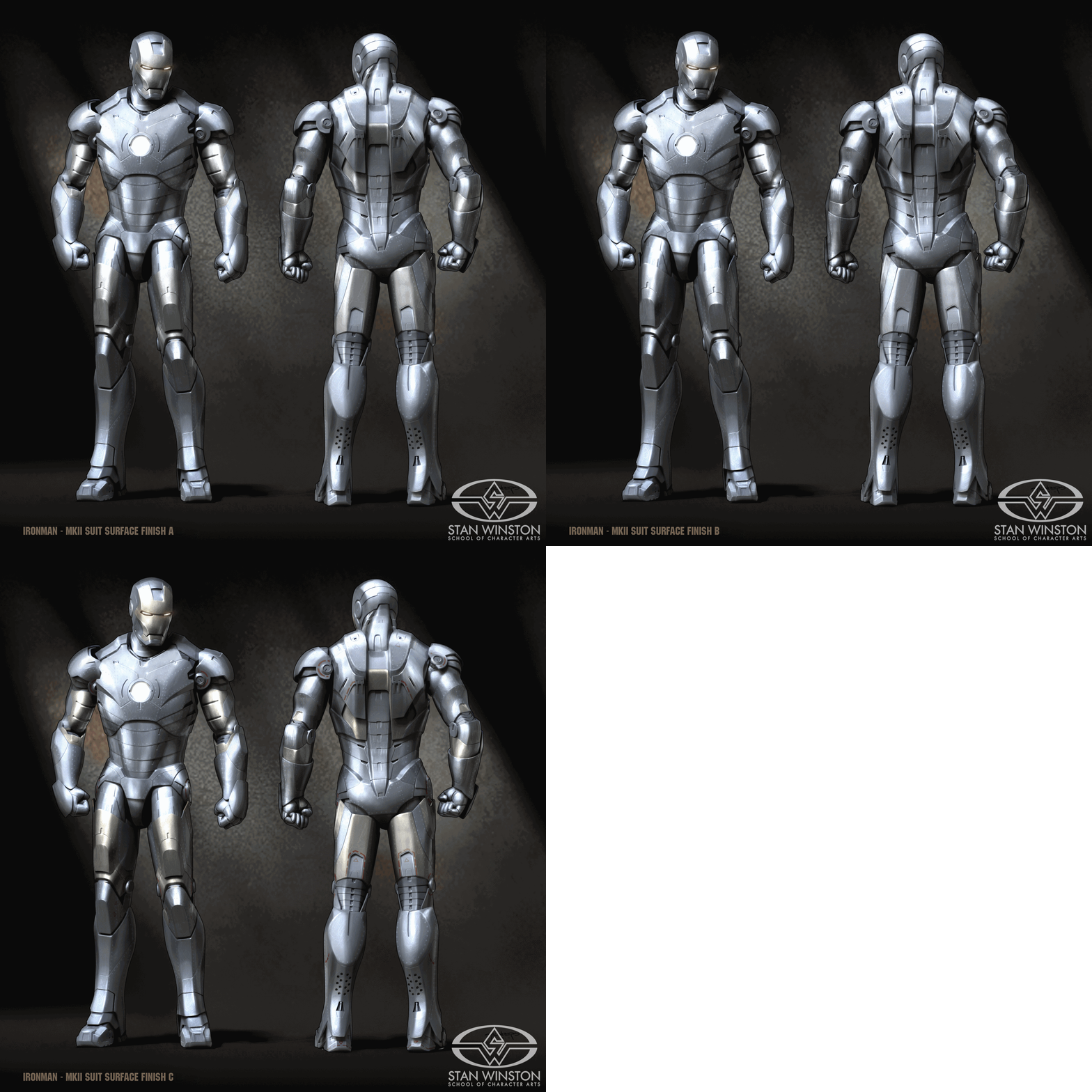 (Different color concepts for the Iron Man Mark II suit.)
Stan Winston Studio's team was responsible for bringing these 2D designs to life in a practical, real-world context. "Up to that point," Shane Mahan explained, "there were designs for separate elements of the suit — this back, these feet, that chest, that head. We had to massage all of those different pieces into a whole that made sense. Also, all of the illustrations up to that point were comic-book-style illustrations. They looked fantastic, but they wouldn't necessarily work in the real world. We still wanted to pay tribute to the comics, but while doing that, our designers had to make the suit function to make sure that the joints worked and that pieces wouldn't crash into one another."
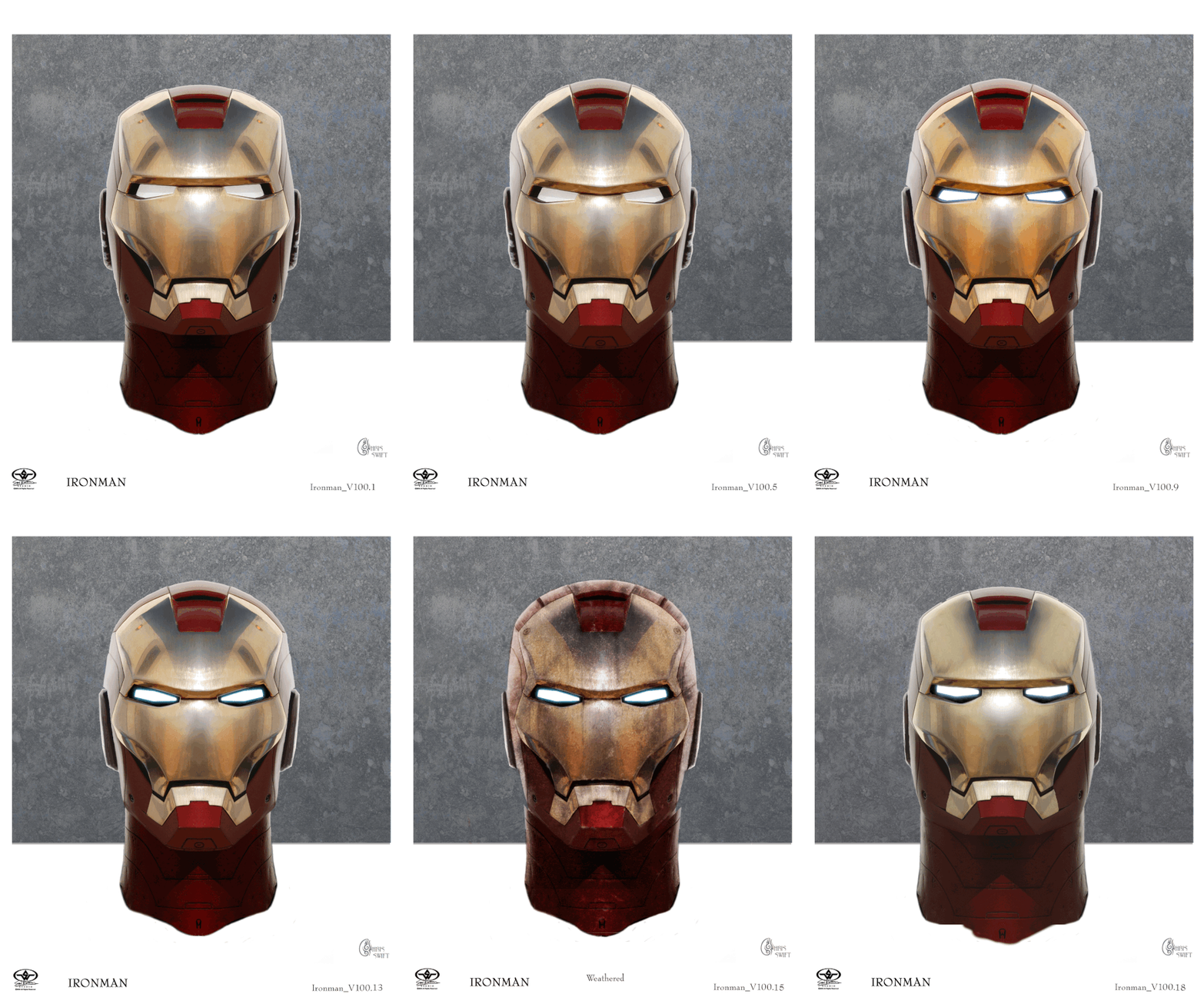 (Variations on the Iron Man Mark III helmet design by Christopher Swift.)
To ensure the suit pieces would move properly, SWS digital artists first sculpted them in the computer to run virtual motion tests. "That allowed us to see what parts of the suit were going to crash," Mahan said. "It told us how much rotation we were going to get in the elbows and other areas. It also helped us to figure out the ideal proportions for the suit. Jon Favreau felt that Iron Man should be six-foot-five because, at that height, the suit looked really dynamic."
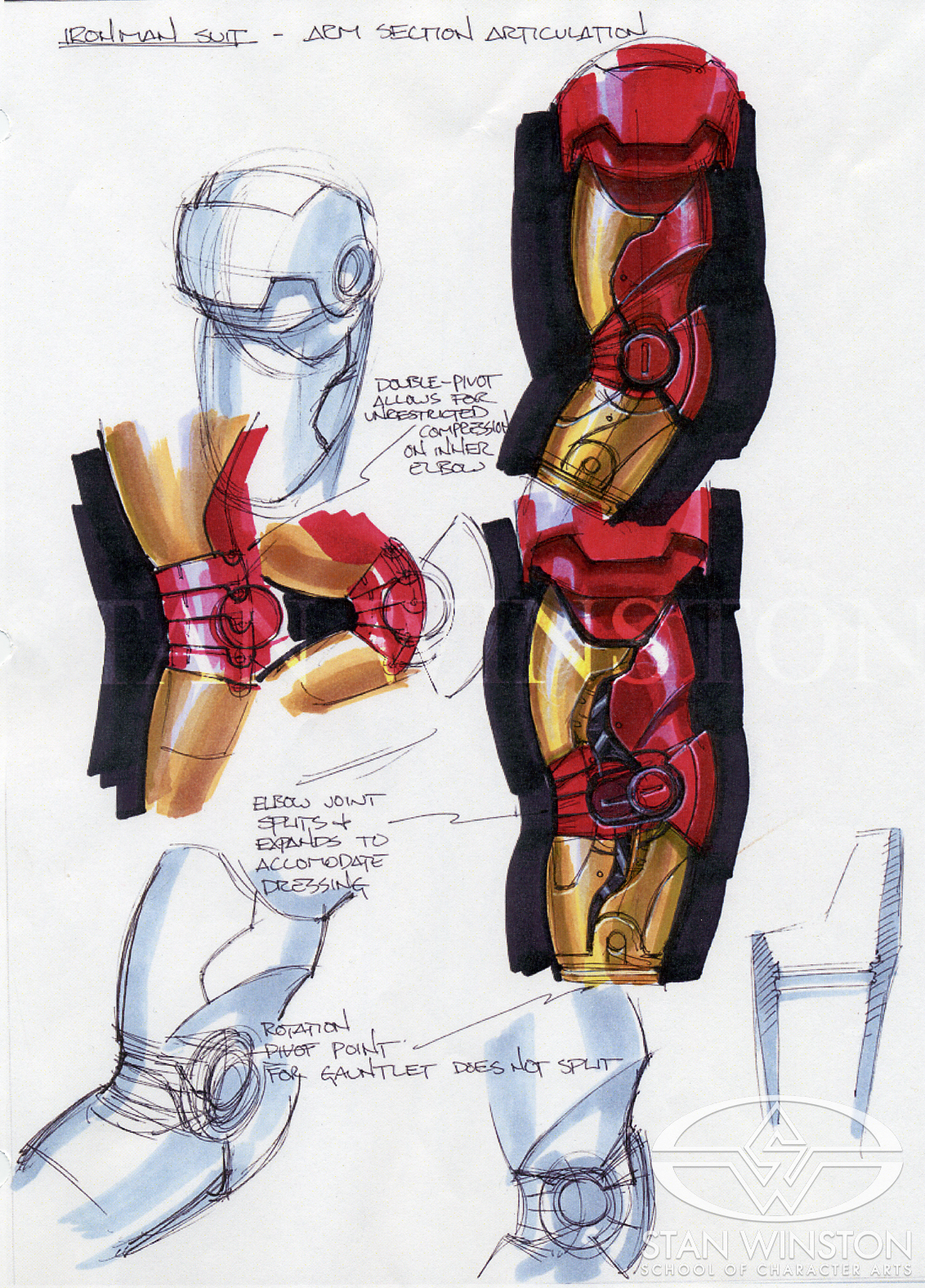 (One of the early articulation representations of the Mark III suit's arm section.)
Once Robert Downey Jr. signed on to play Tony Stark, the suits needed to be modified to accommodate him. "This wasn't done in the traditional manner, where you've got Christian Bale as Batman, so you do a body cast of Christian Bale, and you sculpt the suit on top of that, and you know the actor will fit in there," Mahan explained. "This time, we had to design the suit first and then figure out how to get Robert Downey Jr. to fit inside. Of course, Robert isn't six-foot-five, but the idea was that we would put him in the suit from the thighs up, with the additional height in the lower legs."
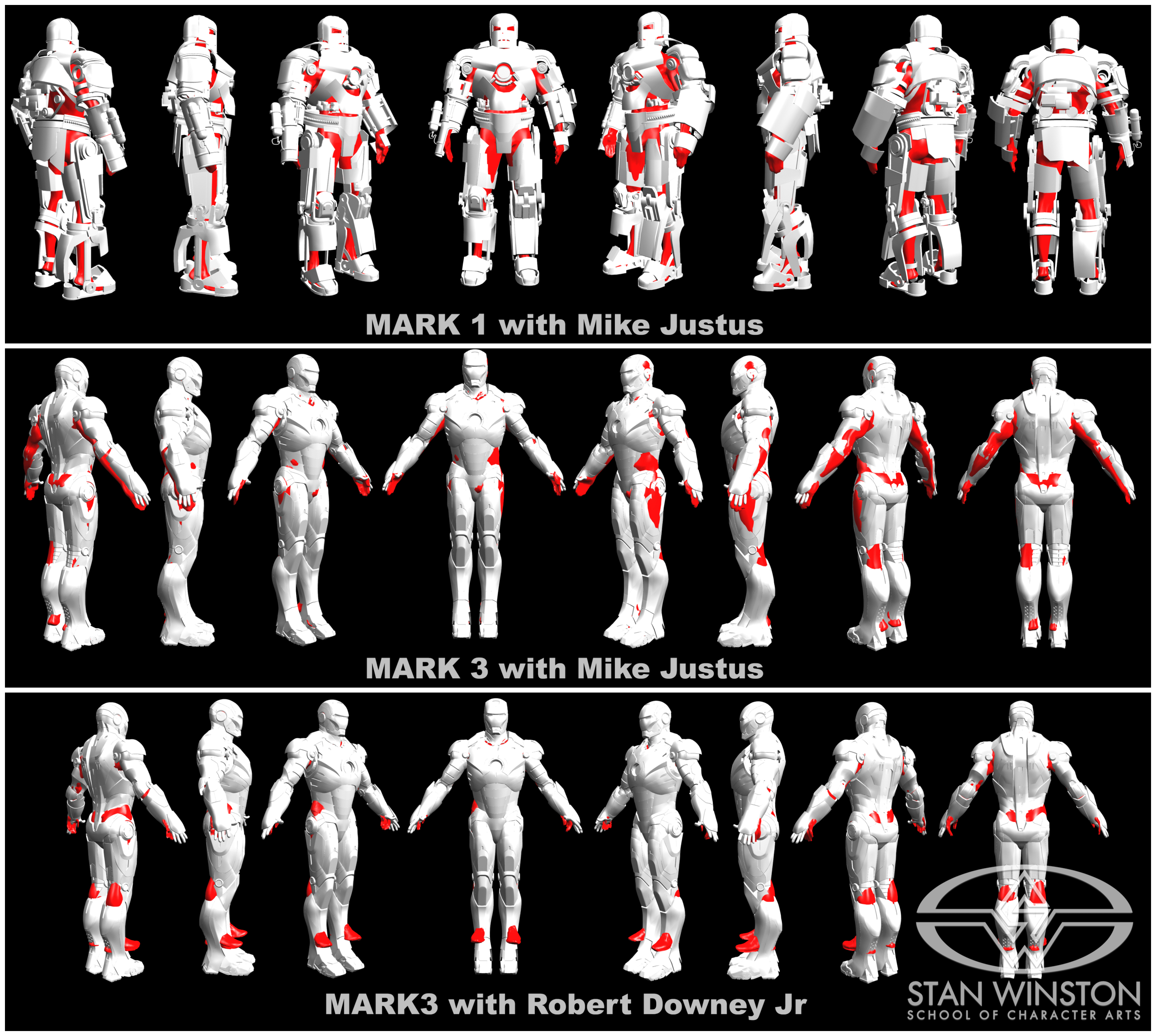 (Iron Man Mark I and Mark III suit interpretations for stunt double Mike Justus and Mark III for Robert Downey Jr.)
Building the Mark I, Mark II, and Mark III Suits
After Marvel and Favreau signed off on the SWS designs, Shane Mahan and the Stan Winston Studio crew began building the Iron Man suits: two complete Mark I suits, along with additional parts, one Mark II, and two fully functional Mark IIIs. "The challenge was that these were all hard, exoskeleton suits," Mahan noted. "It wasn't like a Batman suit made out of soft rubbers or Spider-Man's flexible, action-friendly suit. This was like building a fighter jet."
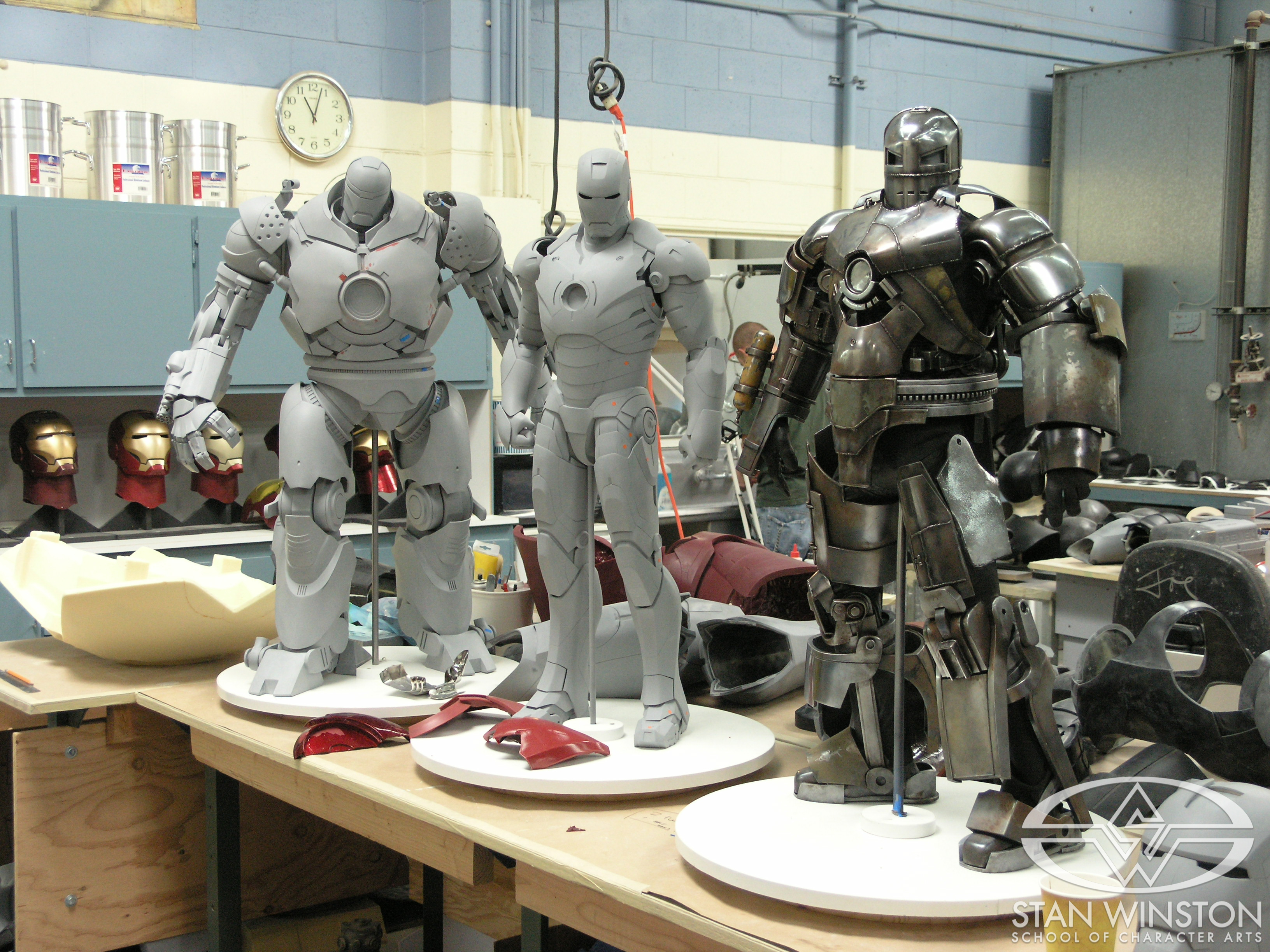 (Work-in-progress image of the miniature Iron Monger, Mark III and Mark I at Stan Winston Studio.)
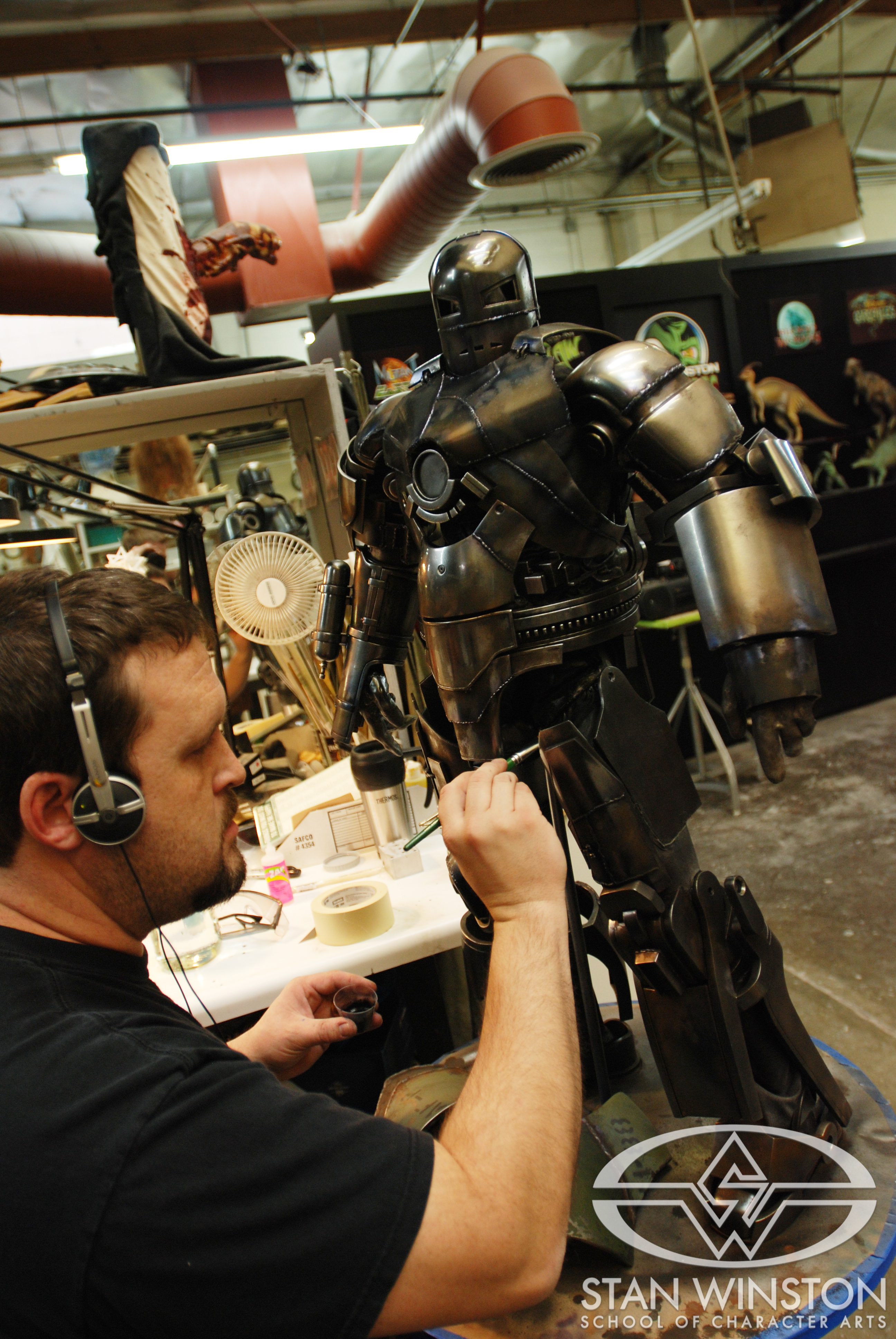 (Trevor Hensley paints the Mark I "cave escape" miniature.)
The SWS team crafted rigid shells using composite epoxy, fiberglass, and metal. For areas that required more range of motion—such as the neck, elbows, and torso—they used flexible urethanes painted to resemble metal.
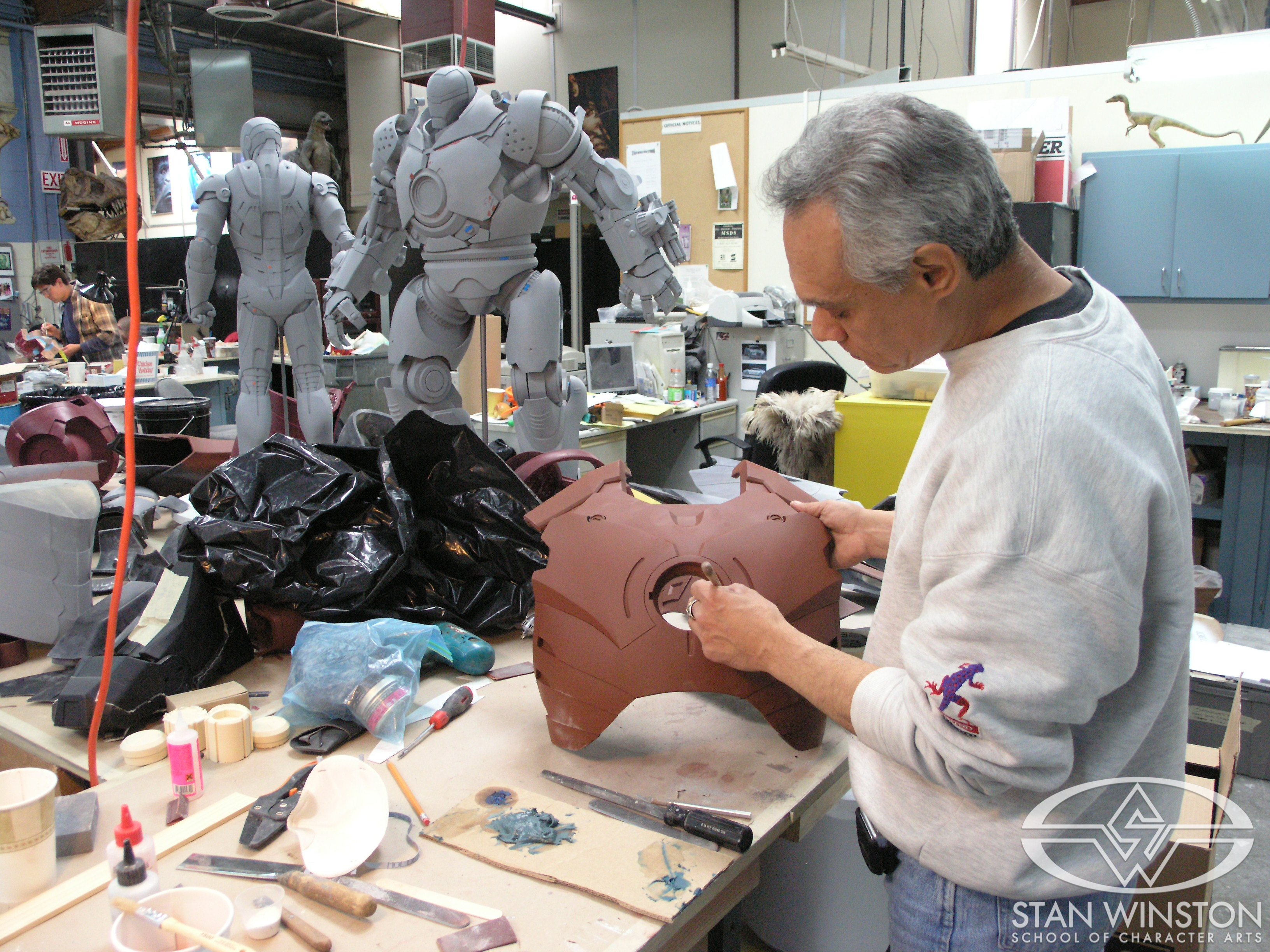 (Edward Lawton details one of the Mark IIIs chest sections at Stan Winston Studio.)
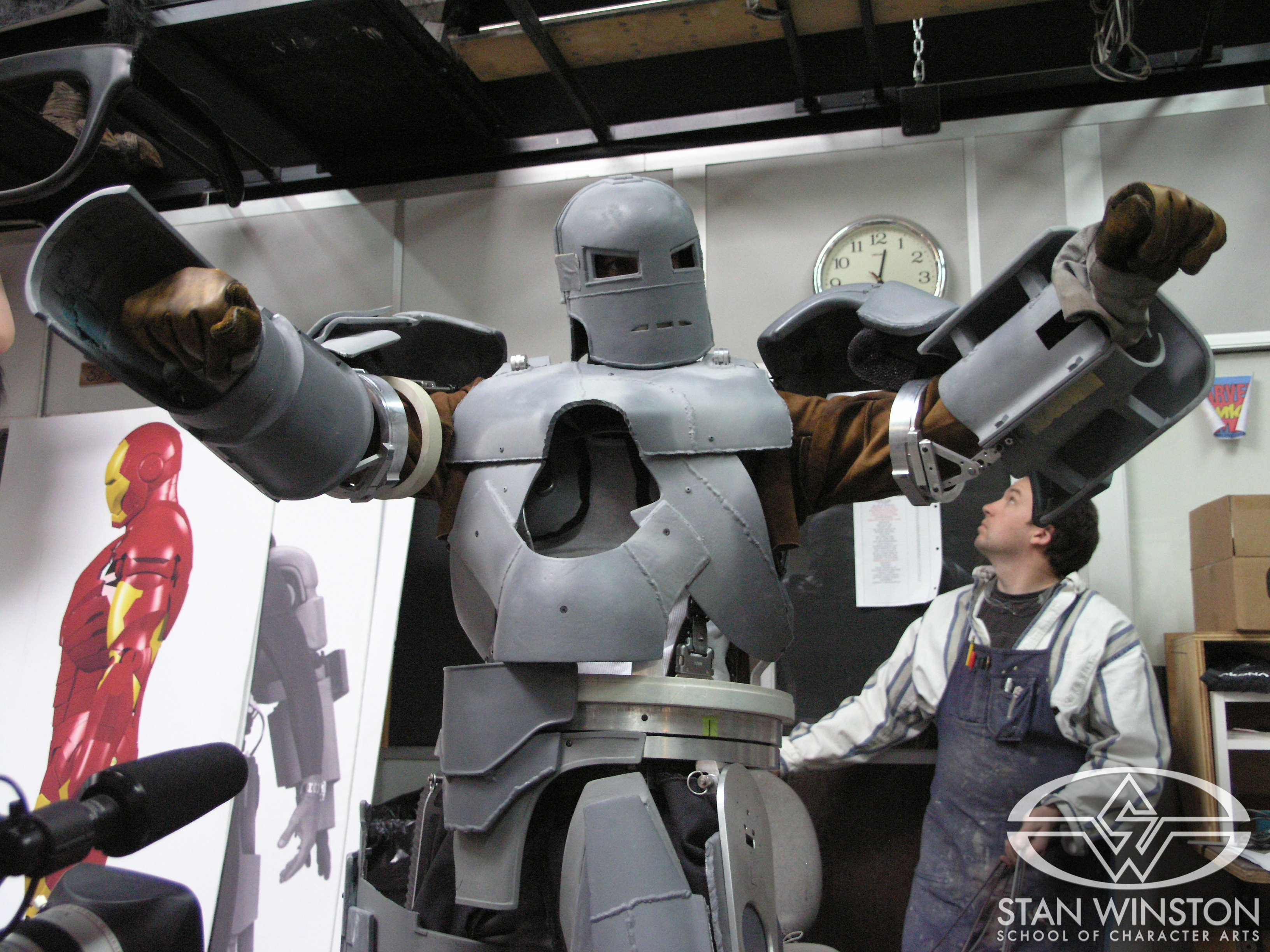 (Testing the WIP Mark I "cave escape" suit.)
Initially, the production team had considered integrating greenscreen material into the more flexible parts of the suit, planning to add digital elements in post-production. Stan Winston Studio R&D'd this approach and made some headway, but it soon became apparent that this method—relying heavily on CGI for nearly every scene—would be prohibitively expensive.
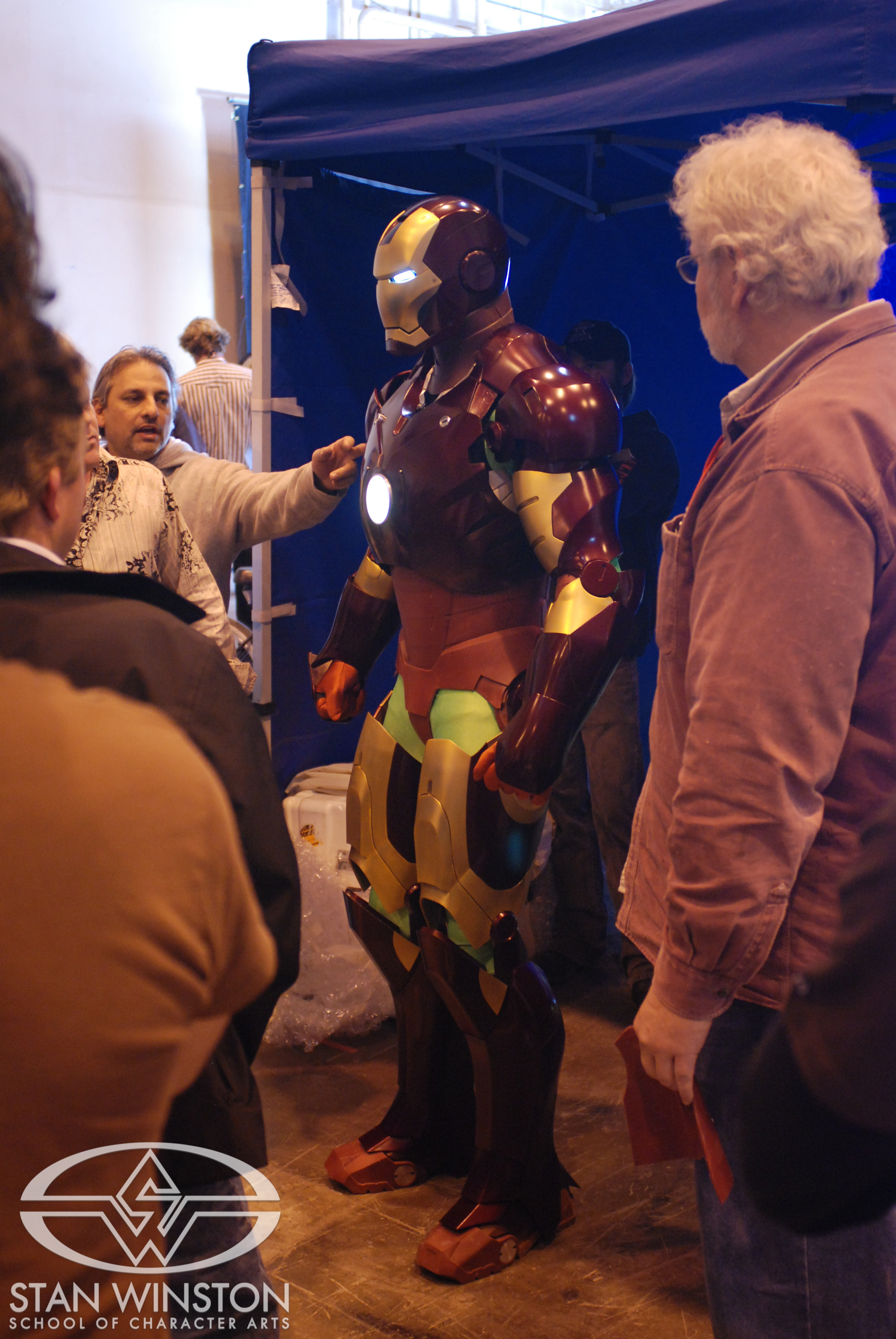 (Image of a stunt double wearing a Mark III suit at a reveal with a green undergarment for areas that would require CG work.)
Finding a urethane and paint combination that could mimic metal proved to be a lengthy and challenging task. "We finally found a company in Switzerland that could create custom mixes and bake out pieces with durable urethane paints," Mahan explained. "That solved the problem, and we were able to fill in the elbow, knee, neck, and abdomen areas with semi-flexible material that allowed him to twist and bend without a lot of funny buckling and wrinkling."
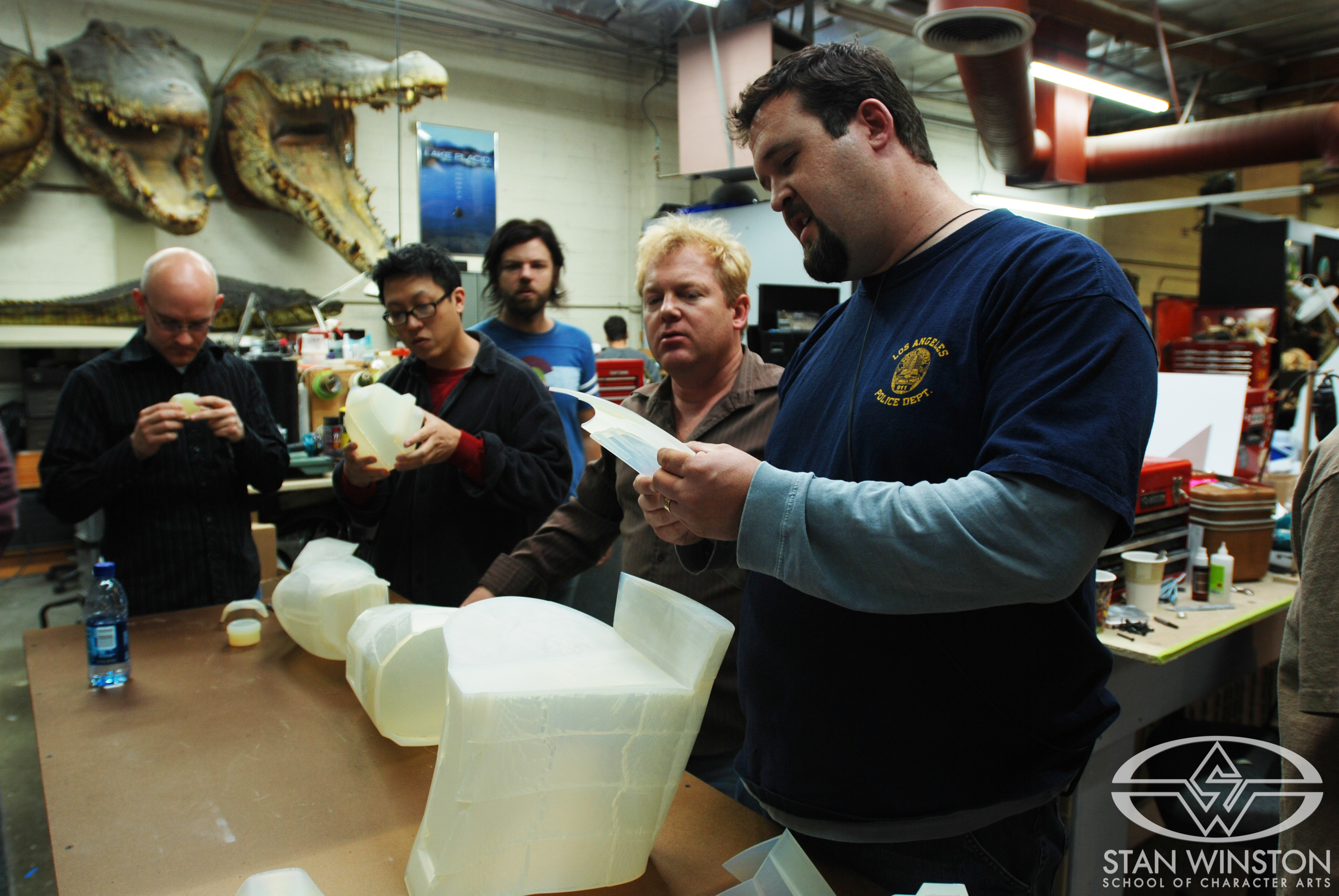 (Paul Waggoner, Eddie Yang, Nathan Fritzges, Shane Mahan, and Trevor Hensley check the Iron Man suit parts at Stan Winston Studio.)
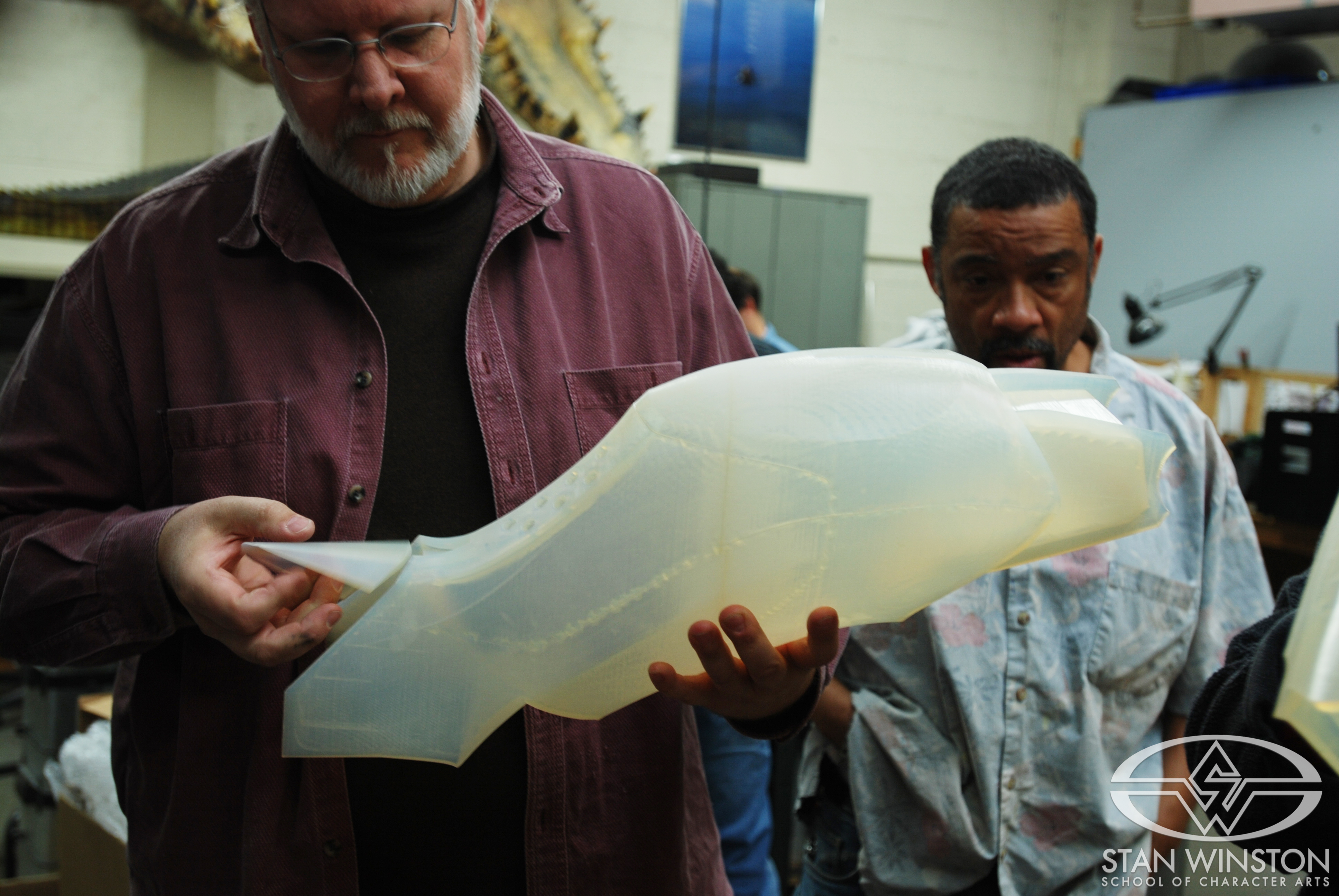 (David Merritt and Keith Marbory inspect the raw calf section.)
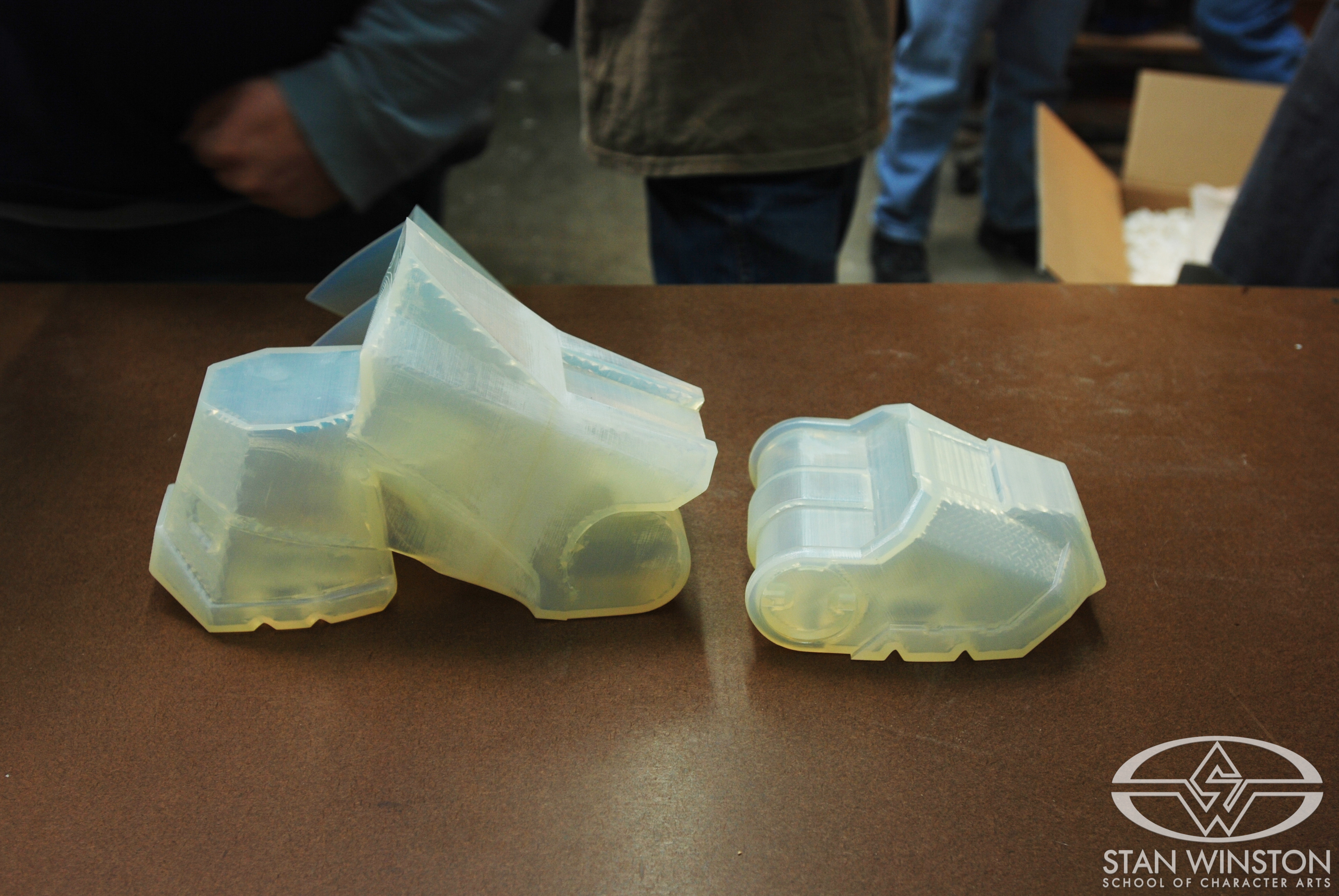 (A shot of the raw foot section.)
Painting the suits, particularly the Mark III, involved extensive trial and error. The Winston team, along with production, conducted three separate screen tests using 15 different shades of red and gold before settling on two complementary tones.
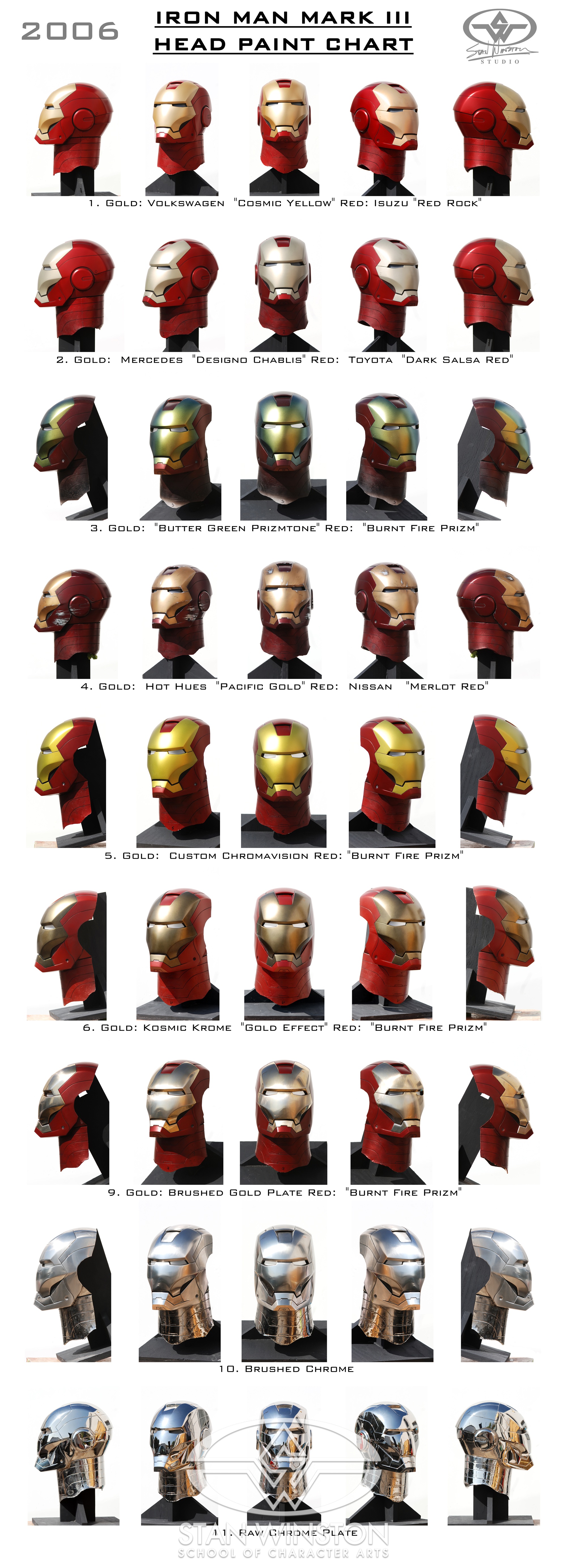 (Iron Man Mark III head paint chart, listing 11 various color schemes.)
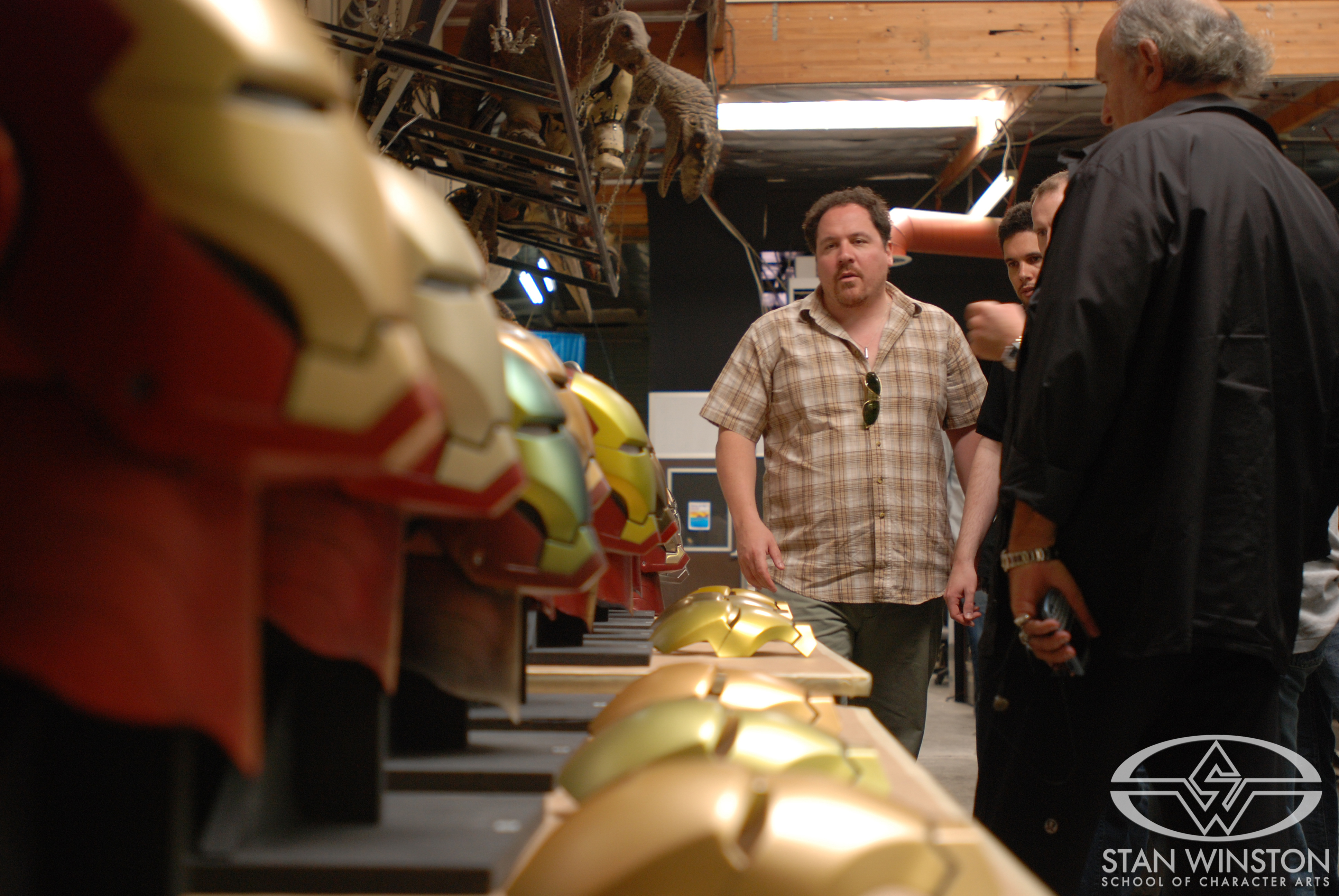 (Jon Favreau takes a look at a collection of Mark III heads with different paint schemes at Stan Winston Studio.)
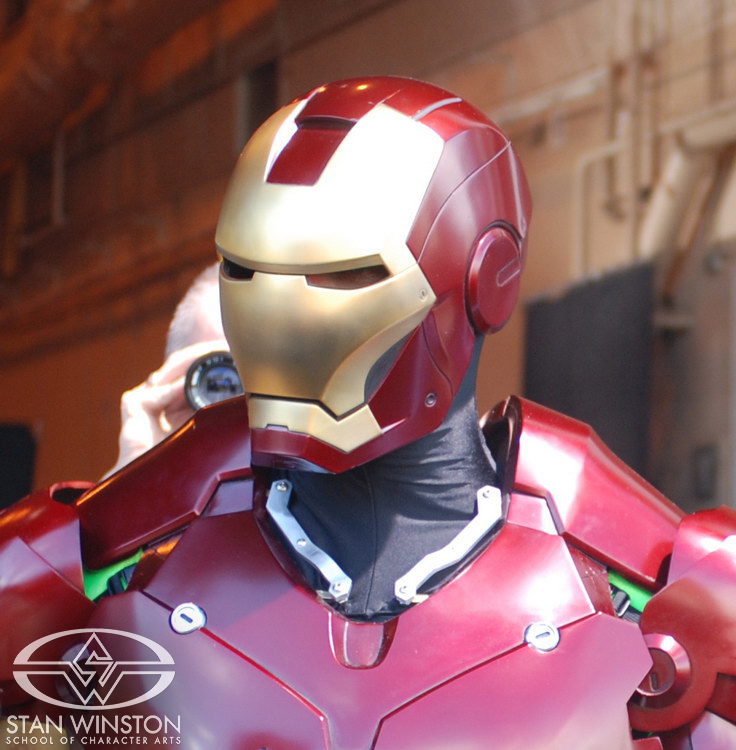 (A stunt double tests the Mark III suit at Stan Winston Studio.)
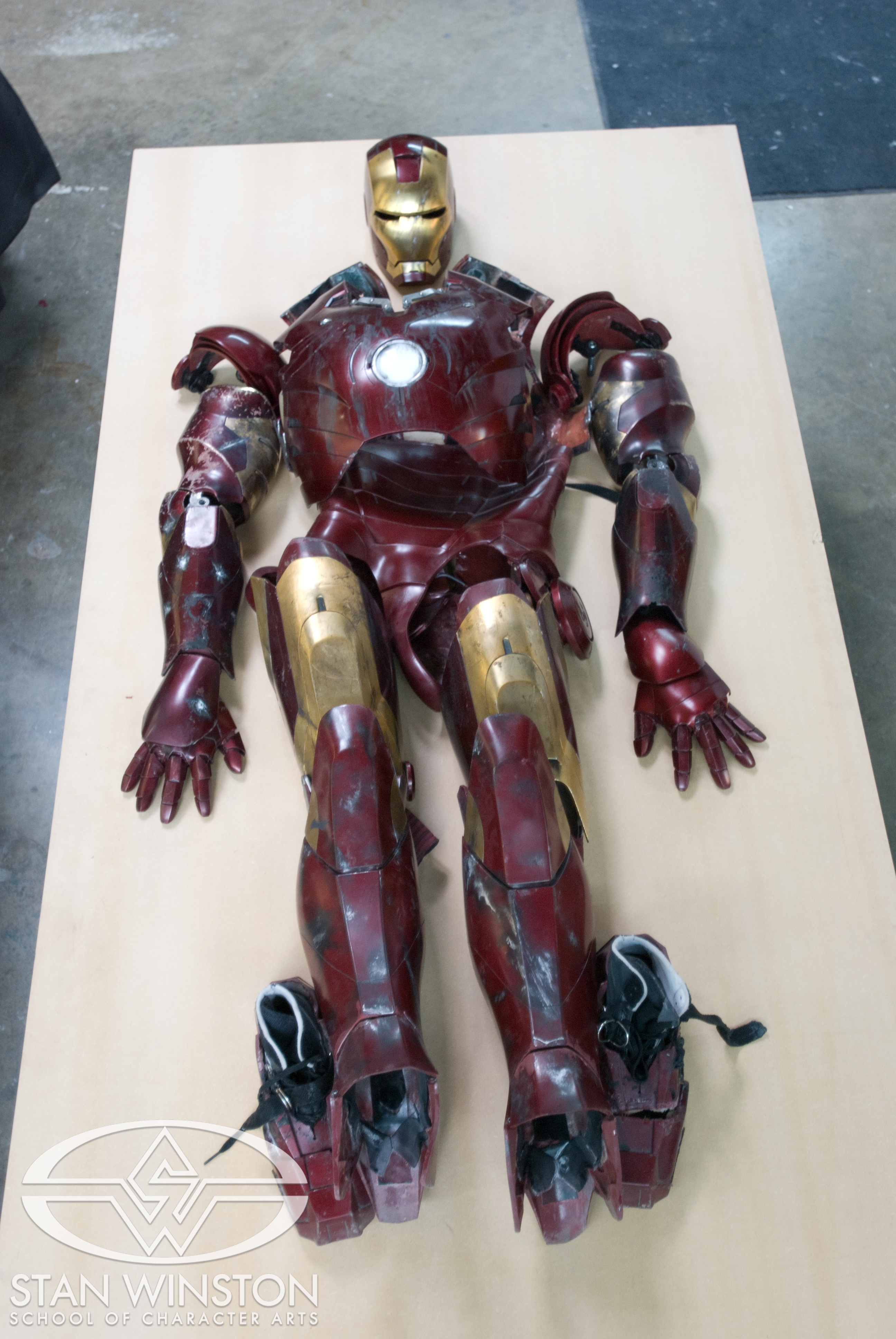 (One of the battle-damaged Mark III suits at Stan Winston Studio.)
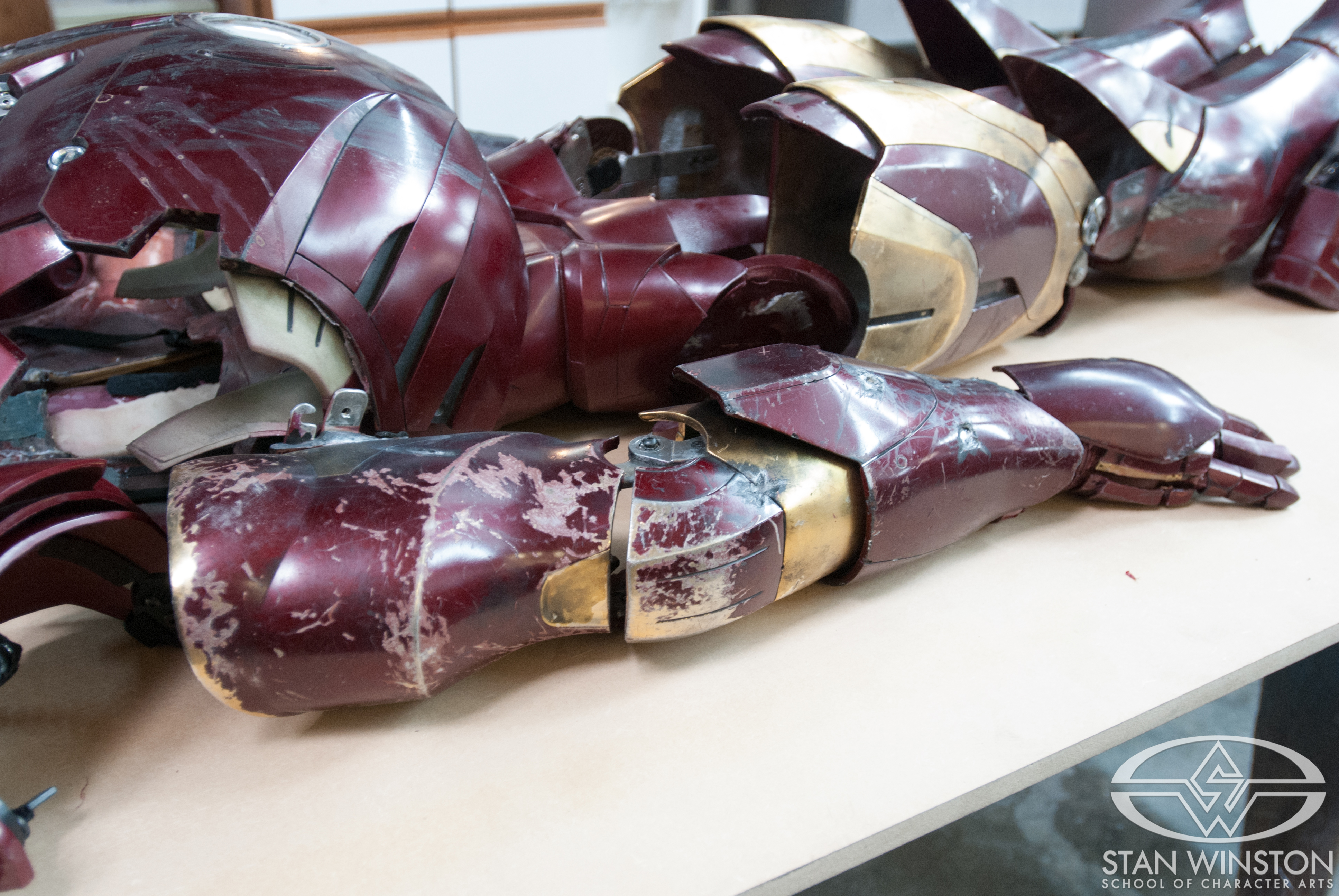 (Close-up image of a battle-damaged Mark III suit at Stan Winston Studio.)
The final Mark II and III suits were constructed from about 70 individual pieces, while the Mark I suit contained over 100 components designed to hide seams and fastenings from the camera. The suits' weights varied, with the Mark I tipping the scales at a full 90 pounds while the sleeker Mark III weighed around 40 pounds.
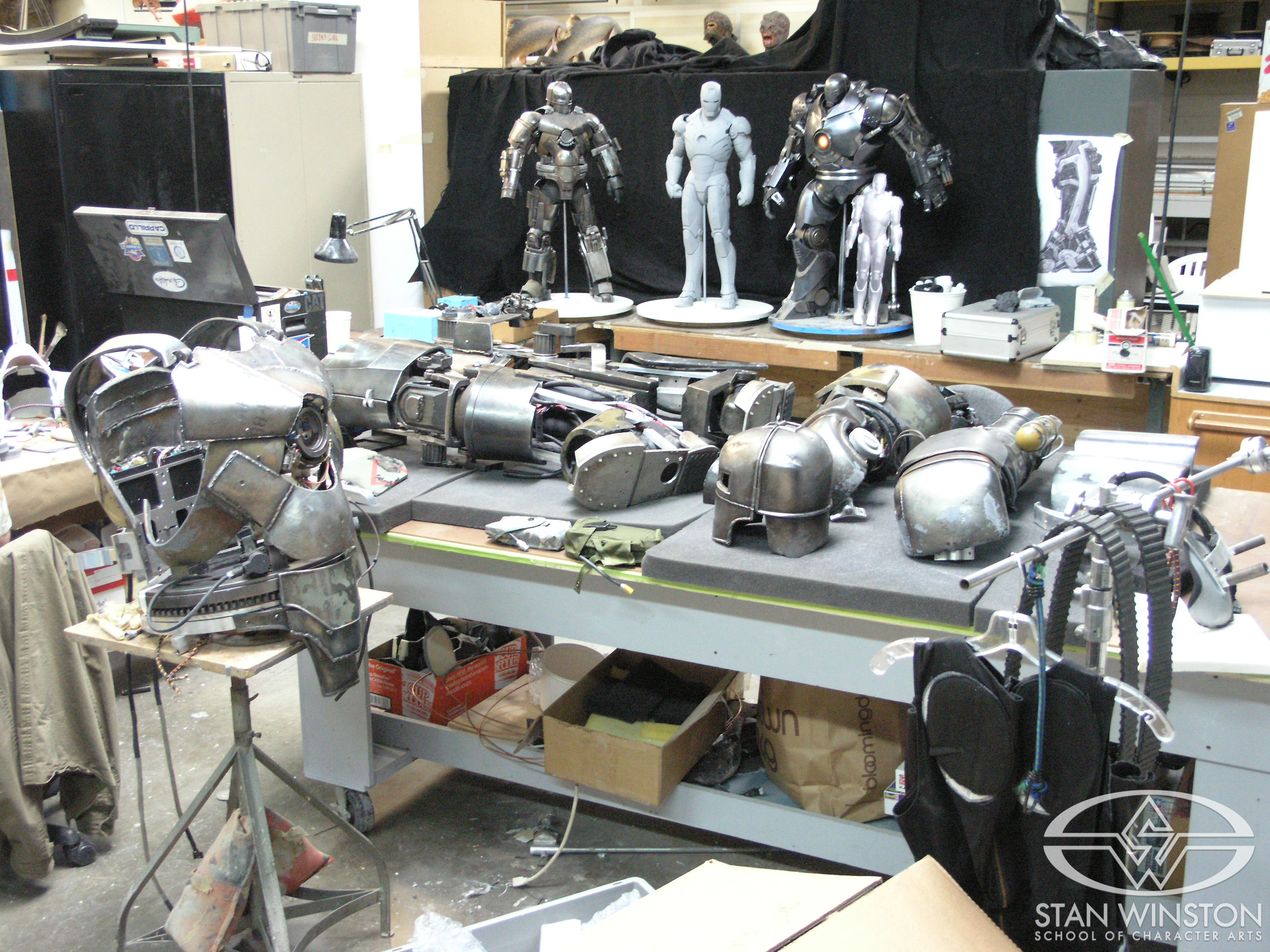 (The Mark I "cave escape" suit is ready to be assembled.)
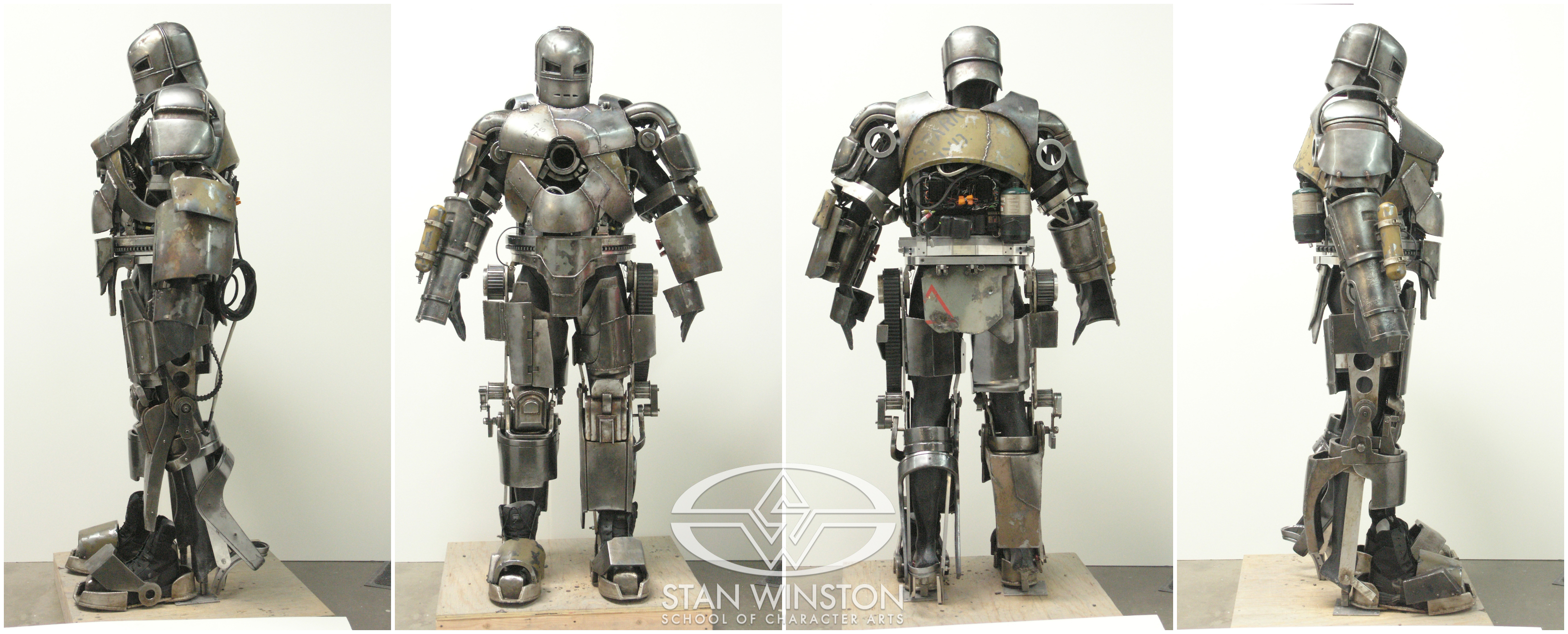 (The completed Iron Man Mark I suit, built with more than 100 parts, ready for on-set usage.)
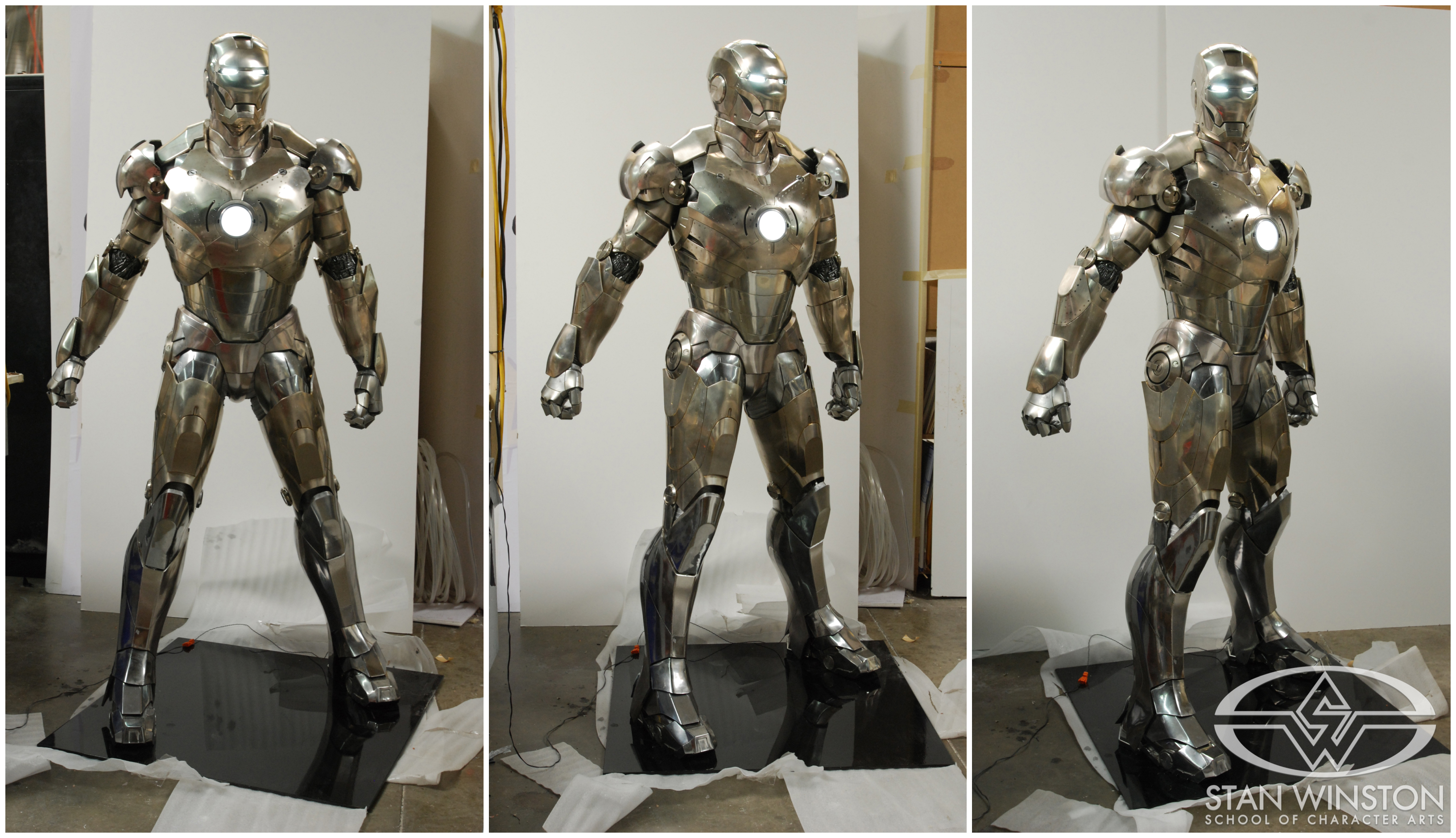 (The finished Iron Man Mark II suit at Stan Winston Studio.)
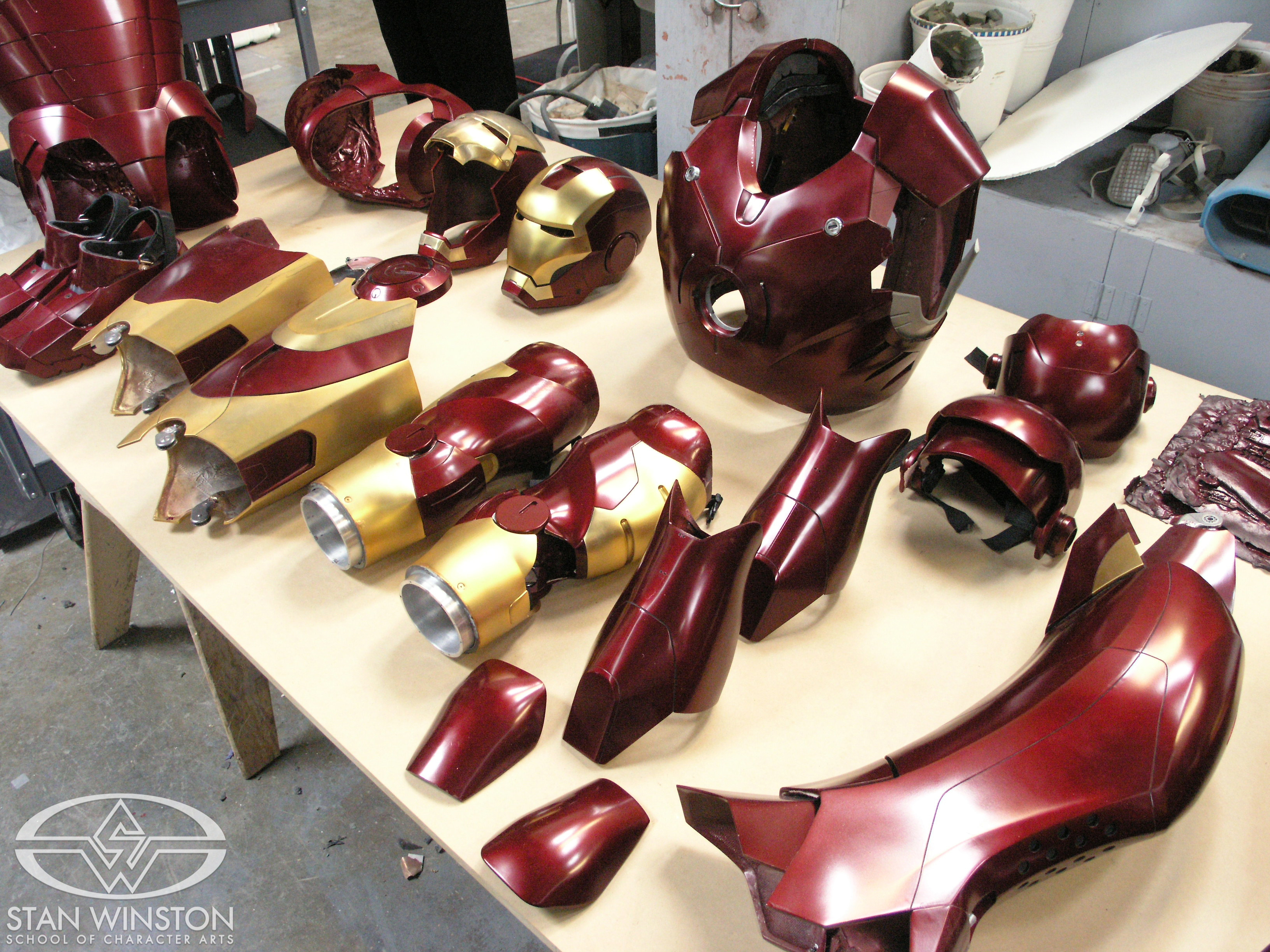 (The Iron Man Mark III suit prior to assembly.)
Additionally, Stan Winston Studio created several urethane stunt suits to allow the filmmakers to capture a broader range of physical actions that would have been difficult with the heavier, more restrictive hero suits.
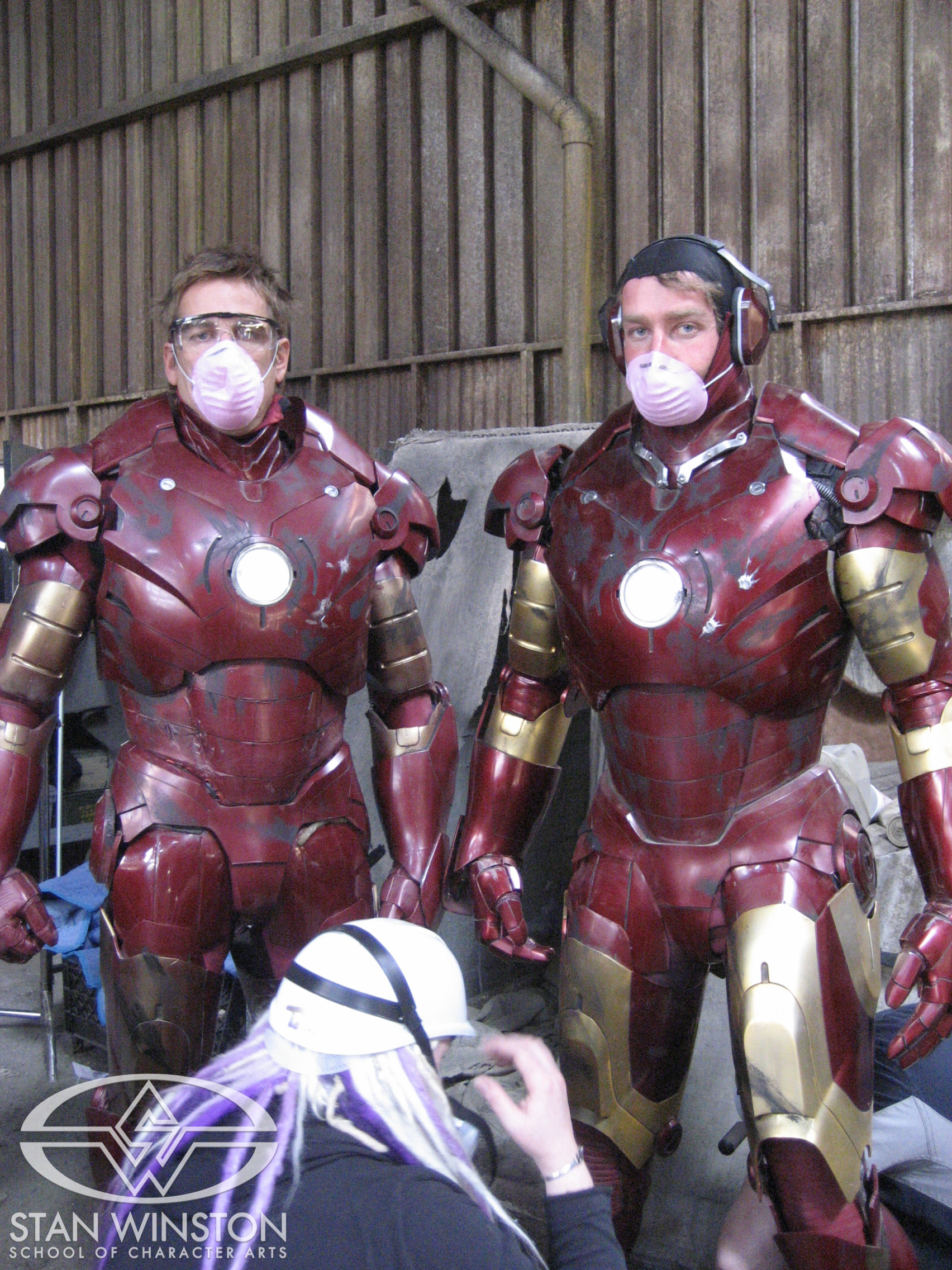 (On-set image of stunt doubles wearing battle-damaged Mark III suits.)
Creating Obadiah Stane's Iron Monger
Stan Winston Studio was also responsible for constructing a suit for Iron Monger, the film's primary antagonist. Ryan Meinerding developed the initial concepts for the character, but Mahan and his team had to adapt these 2D designs for practical, real-world functionality.
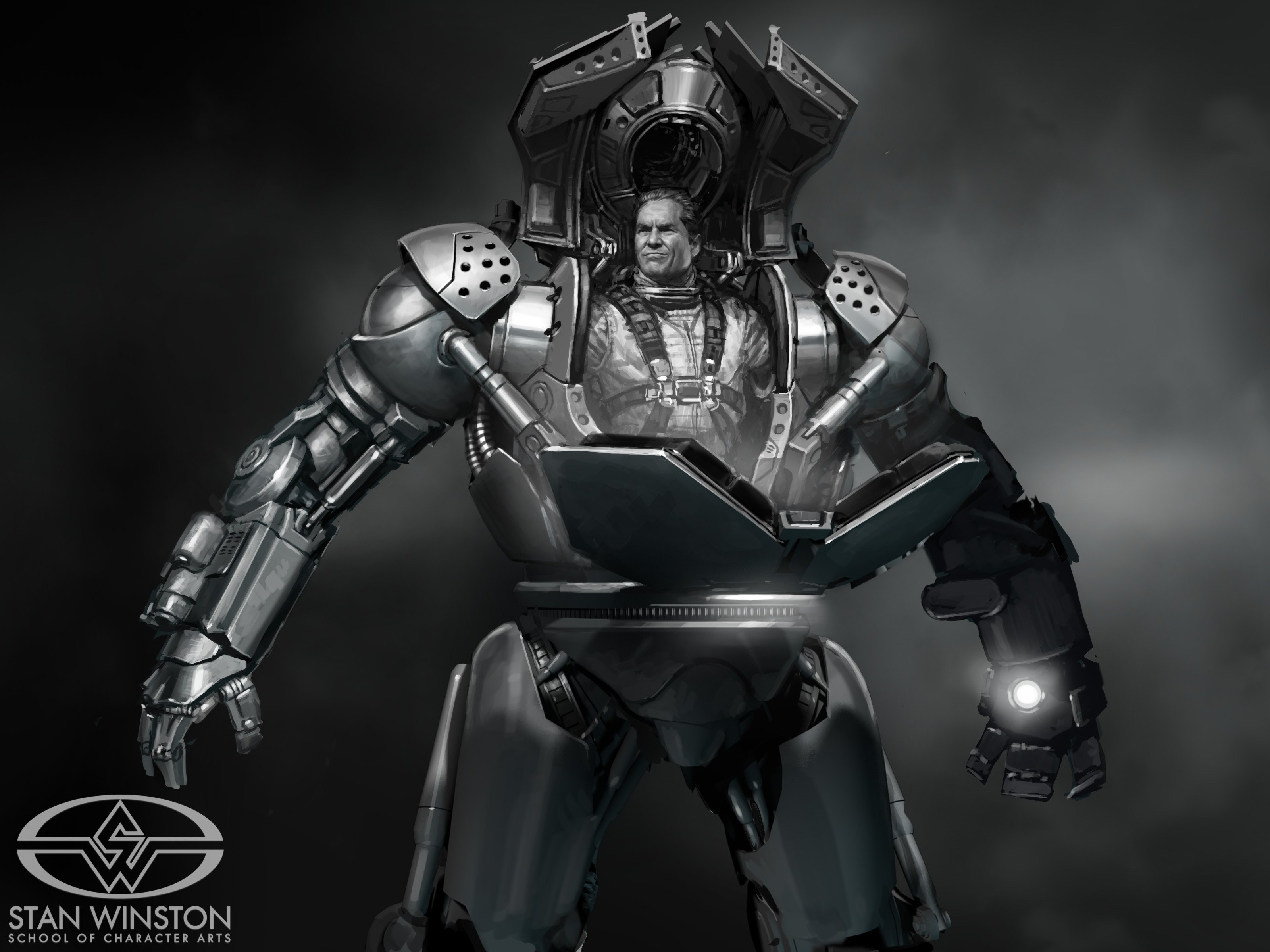 (Concept artwork for Jeff Bridges' character Obadiah Stane in the Iron Monger suit.)
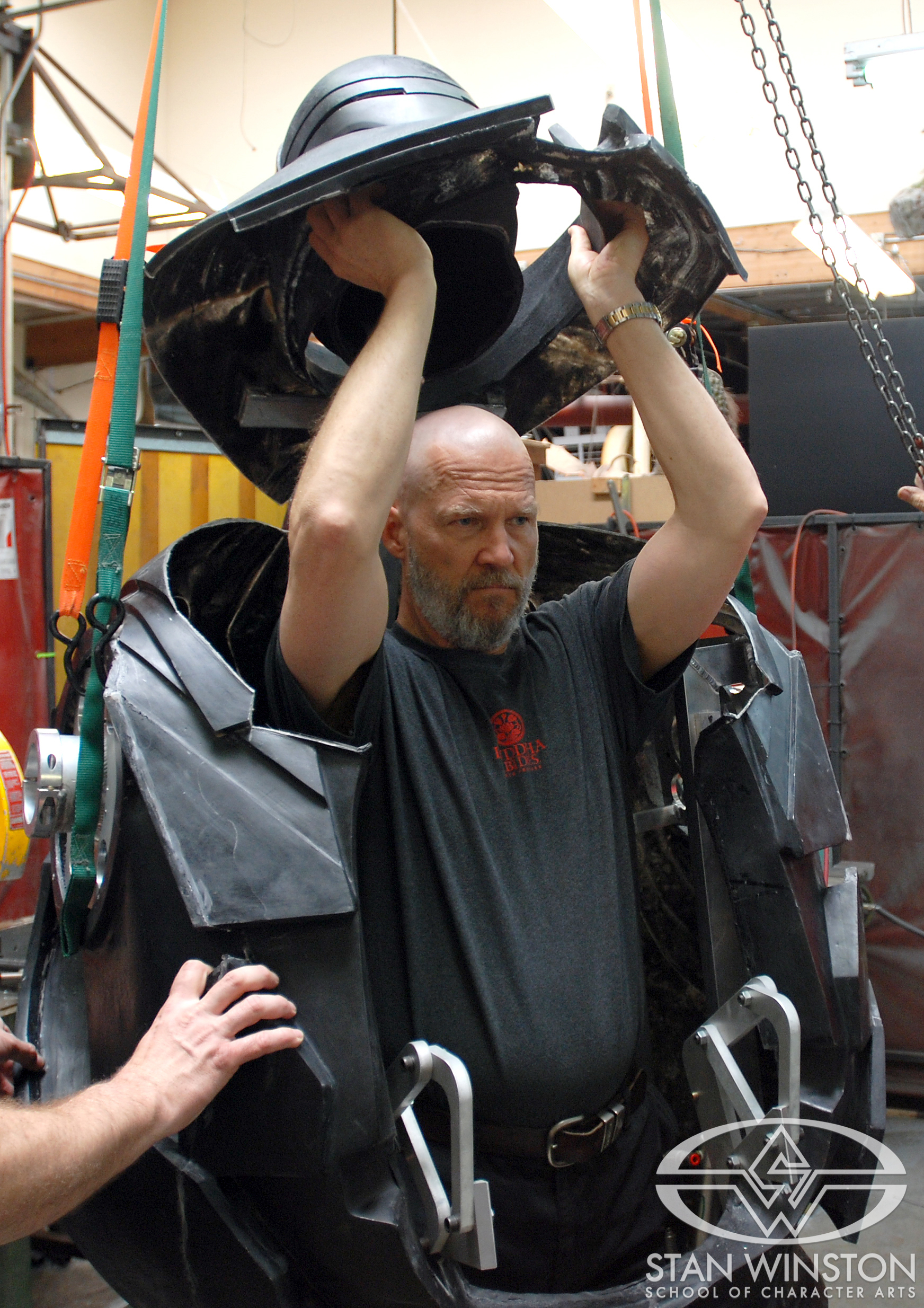 (Jeff Bridges tests the upper section of the Iron Monger suit.)
Initially, the Iron Monger suit was meant to be a lighting stand-in. However, the SWS team modified it to include movable joints and swiveling hips, turning it into a puppet for use on set. "I knew that once we got on set, having an Iron Monger puppet would help them," said Mahan. "Even if it only allowed them to get one or two shots, that was still two shots they didn't have to worry about after the fact. My intention was to help John Nelson in any way possible."
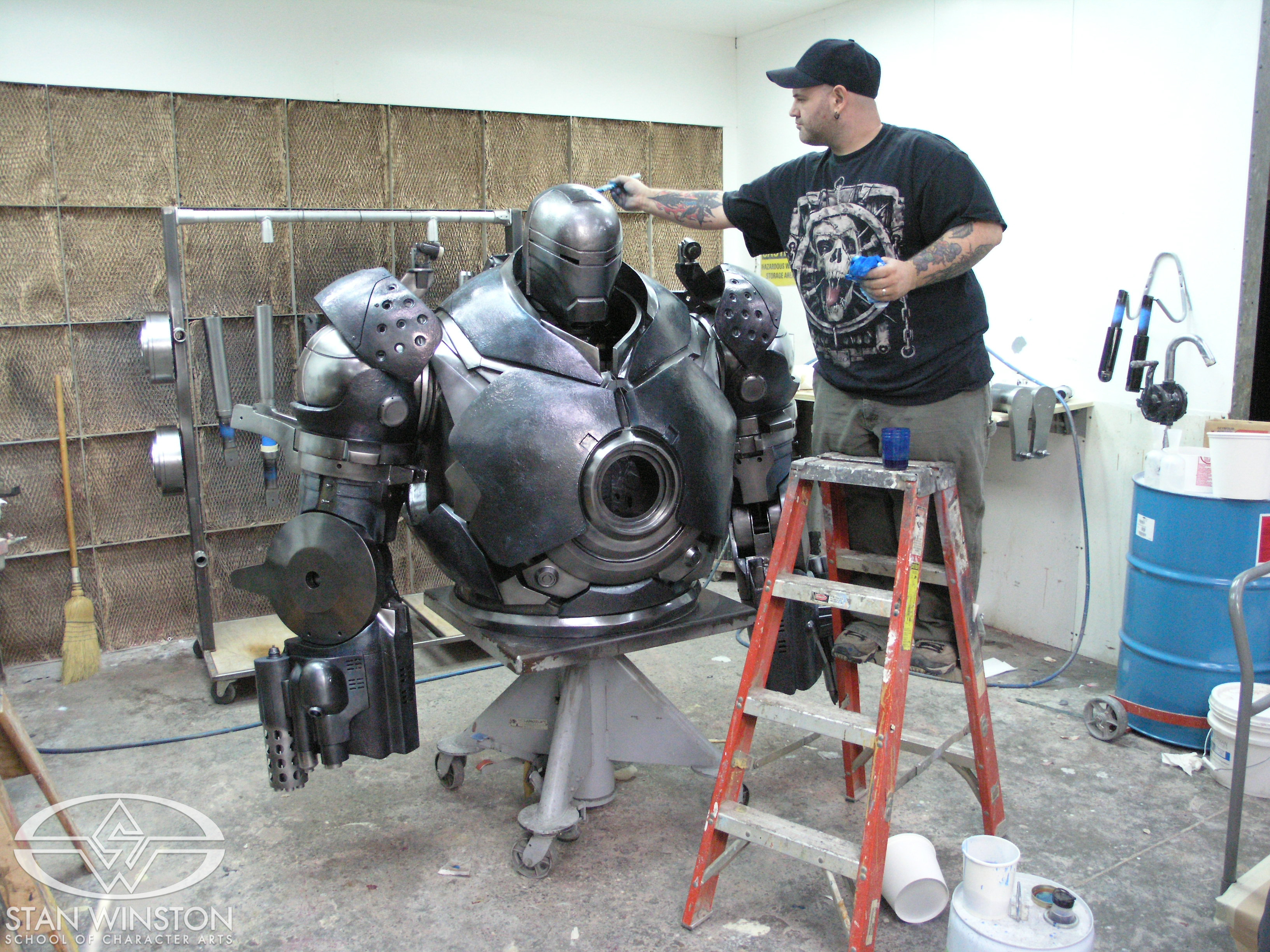 (John Cherevka paints the Iron Monger at Stan Winston Studio.)
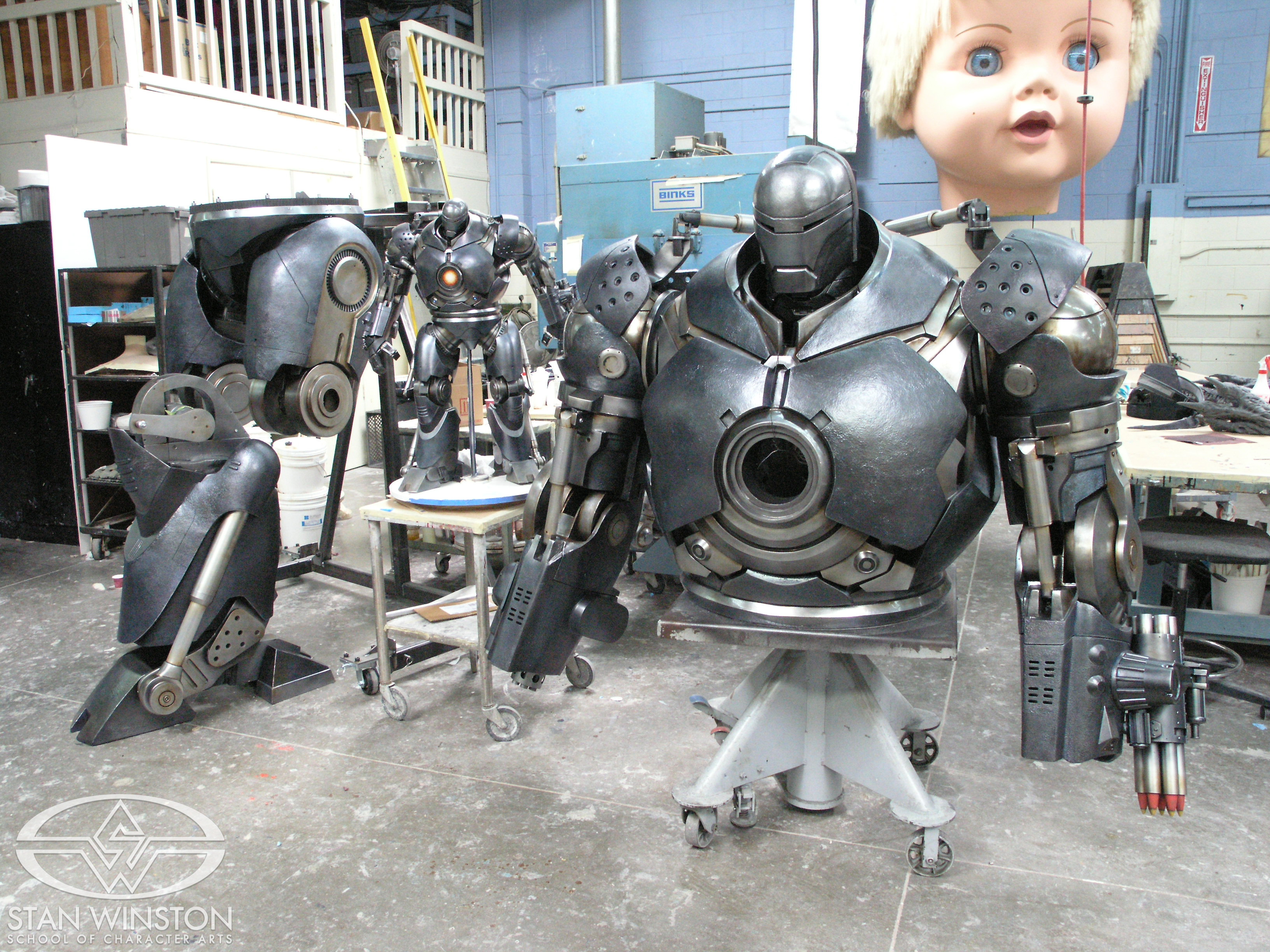 (Obadiah Stane's Iron Monger, painted and ready for assembly at Stan Winston Studio.)
The Winston team devised a wheeled gimbal rig to support and maneuver the upper portion of the Iron Monger suit, making it easier to use on set. Dan Sudick's special effects team assembled the rig according to the SWS design. The rig was either digitally removed in post-production or carefully positioned outside the frame.
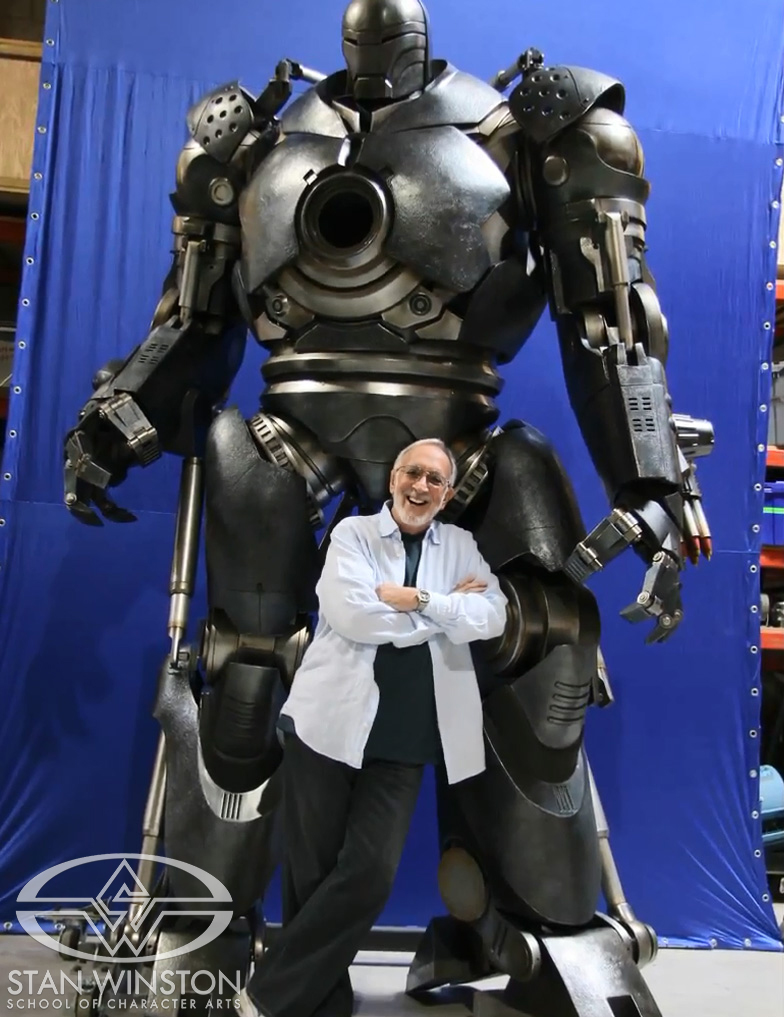 (Stan Winston with the Iron Monger at Stan Winston Studio.)
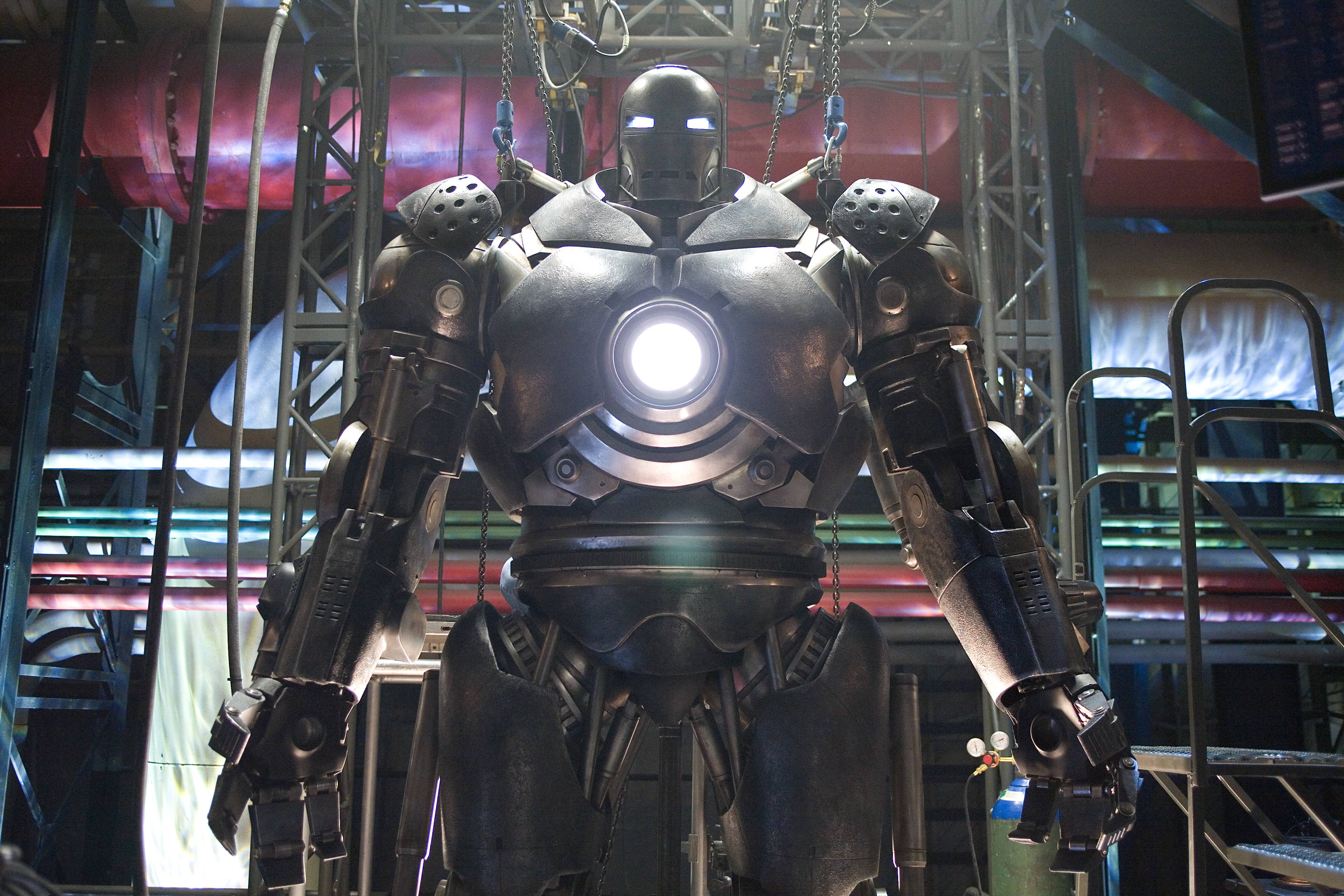 (On-set image of the Iron Monger with the final version of its head. Image courtesy of Paramount Pictures, Marvel Entertainment, and Marvel Studios.)
Proof that Tony Stark Has a Heart
In addition to the full Iron Man and Iron Monger suits, Stan Winston Studio also built a range of mechanical props, including Iron Man's flight boots, arm thrusters, and hand controls.
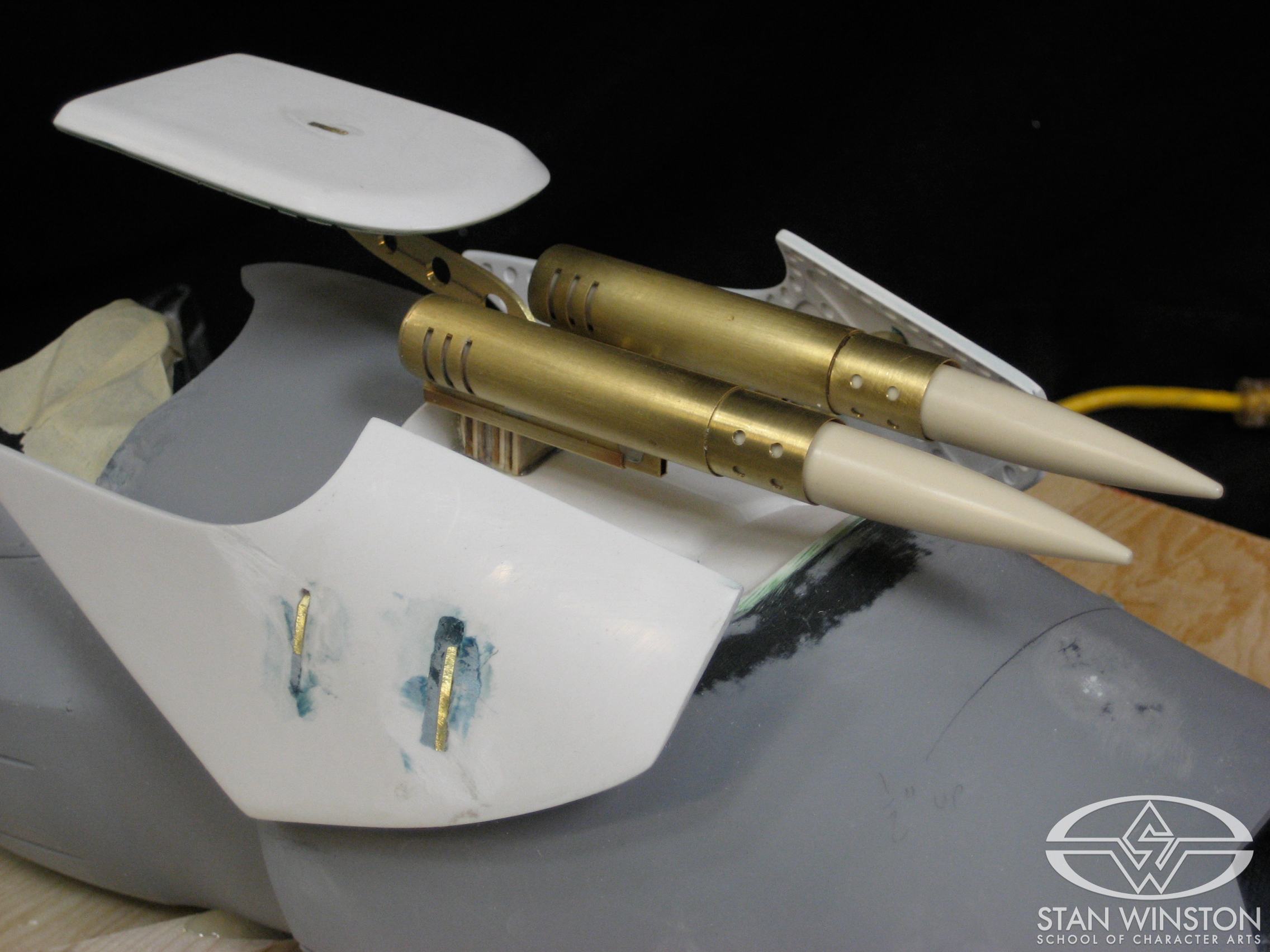 (WIP image of a rocket launcher.)
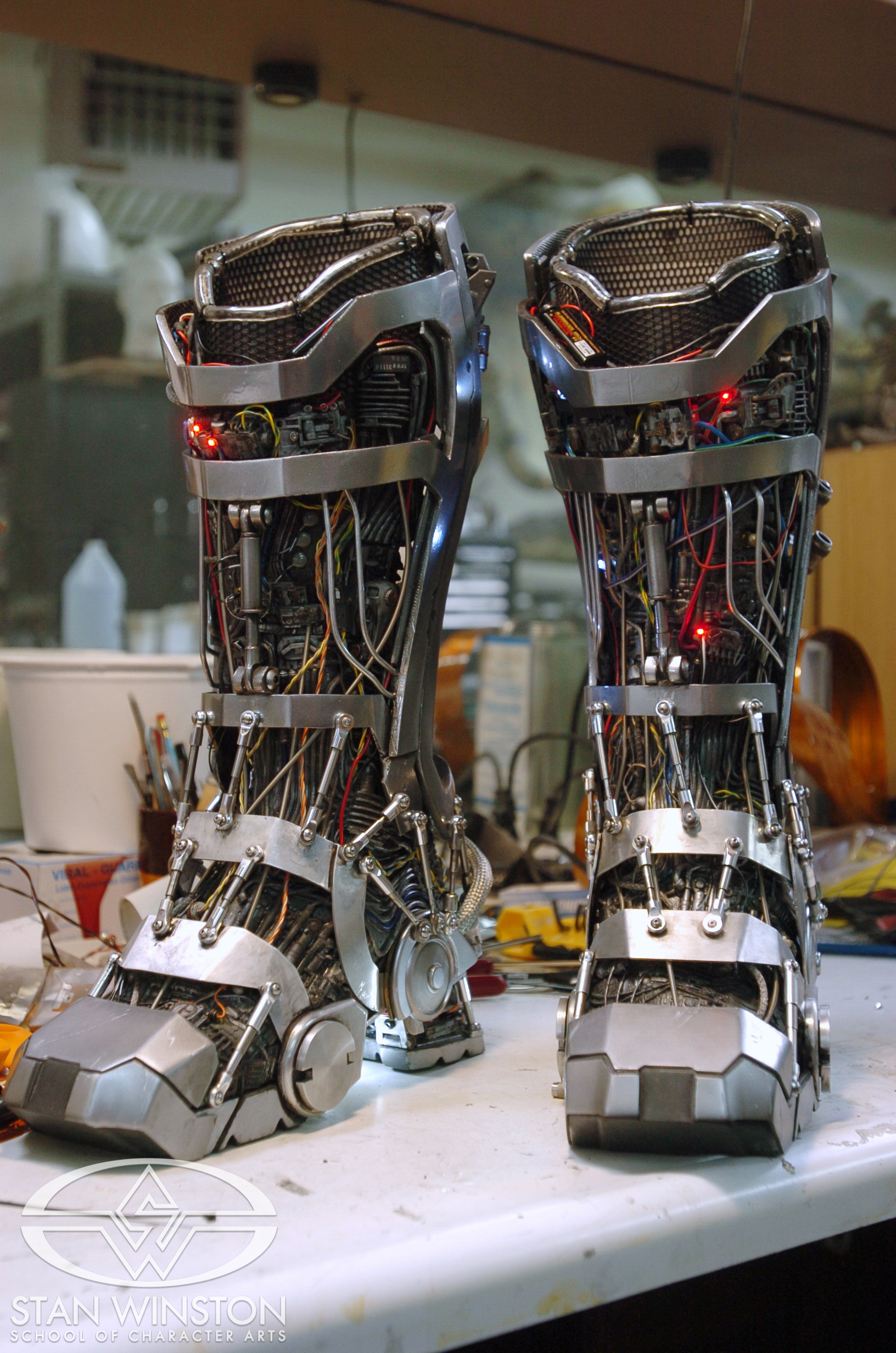 (A close-up image of Iron Man's flight boots at Stan Winston Studio.)
For a scene where Pepper Potts (Gwyneth Paltrow), Stark's assistant, performs repairs on the technology that powers his heart, the team crafted a copy of Robert Downey Jr.'s torso for a classic 'slant-board' illusion. "We did lifecasts of Robert in various poses," Mahan explained, "as well as scans, and then we built this chest with a deep cavity where the heart would be. It was made of silicone, and it had breathing bladders and punched hair. It turned out really well."
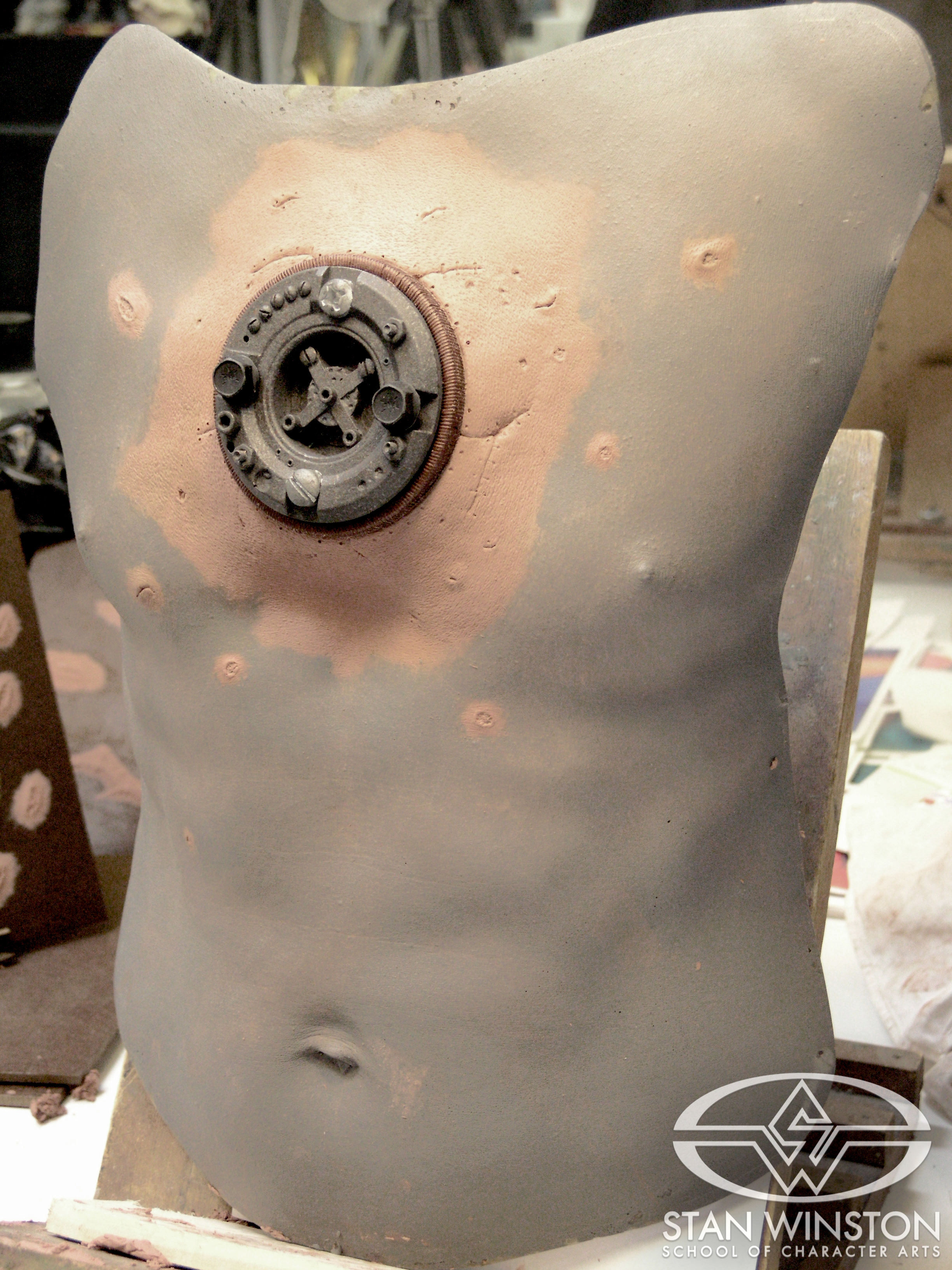 (Work-in-progress image of Tony Stark's "mechanically-assisted heart," the Arc Reactor.)
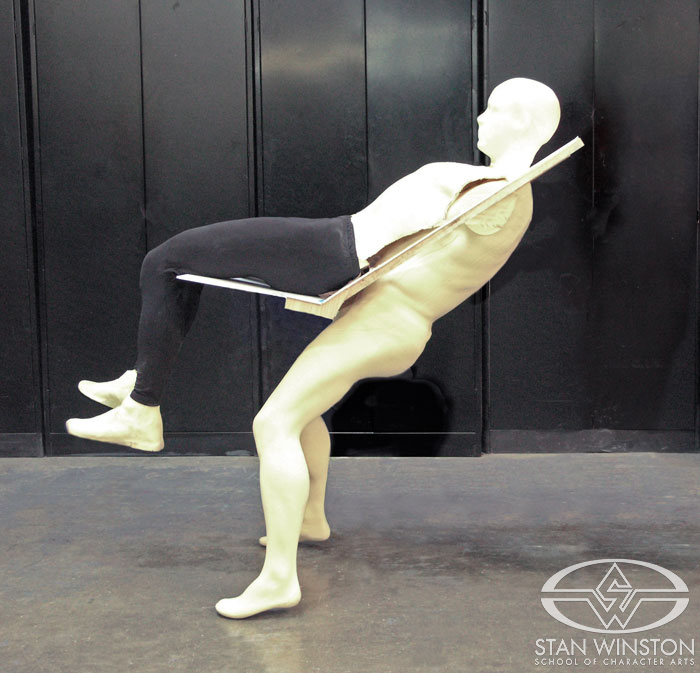 (The classic slant board trick, which was used in Iron Man for the Arc Reactor switching scene.)
By the time principal photography began in February 2007, the Winston crew had arrived on set with all their practical suits and props. The production took place on stages at Playa Vista, which, fittingly, had once served as an aviation plant owned by none other than Stan Lee and Jack Kirby's inspiration for Tony Stark, aerospace engineer and business magnate Howard Hughes.
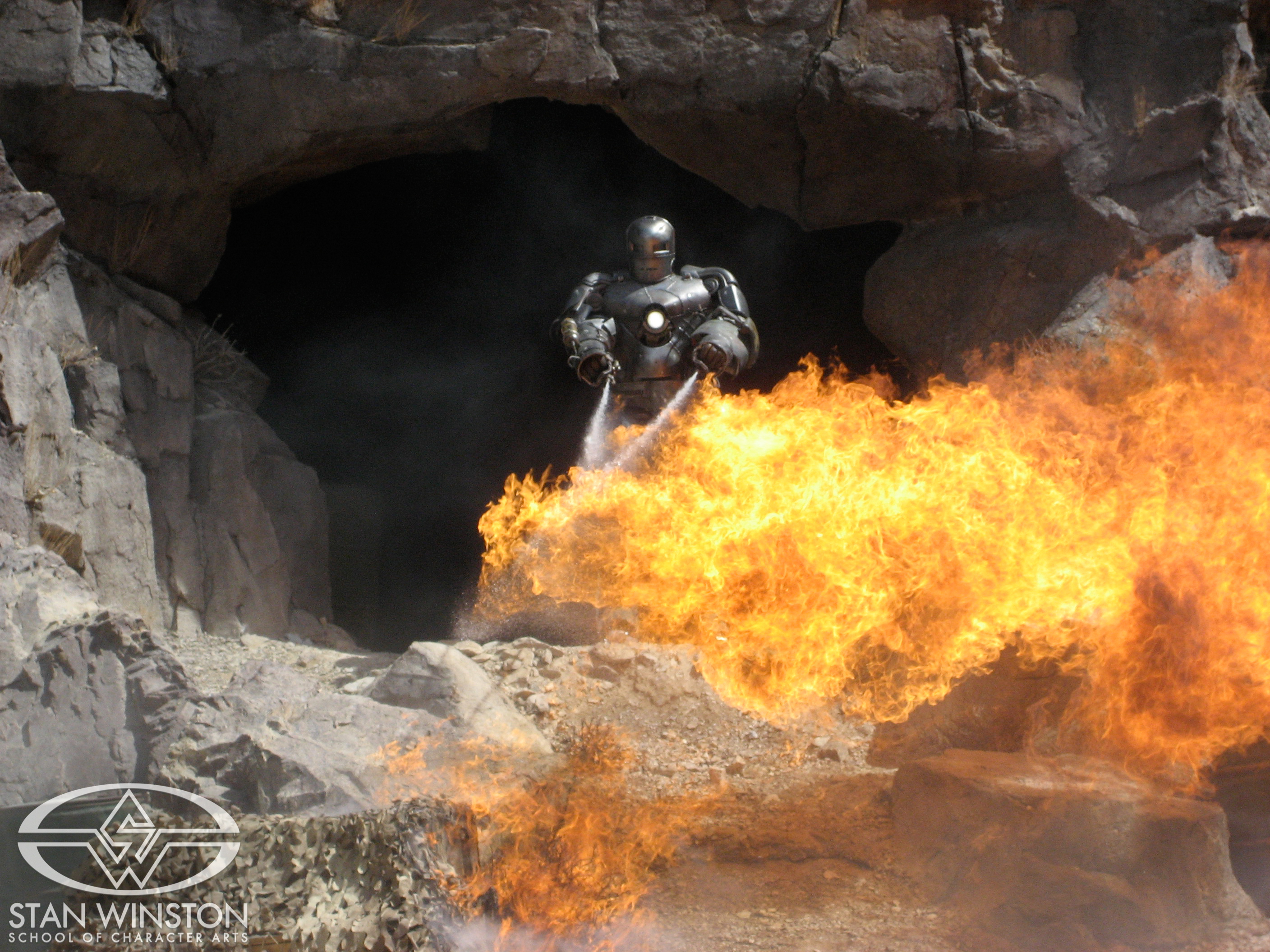 (The Mark I "cave escape" suit in action with its built-in flamethrowers.)
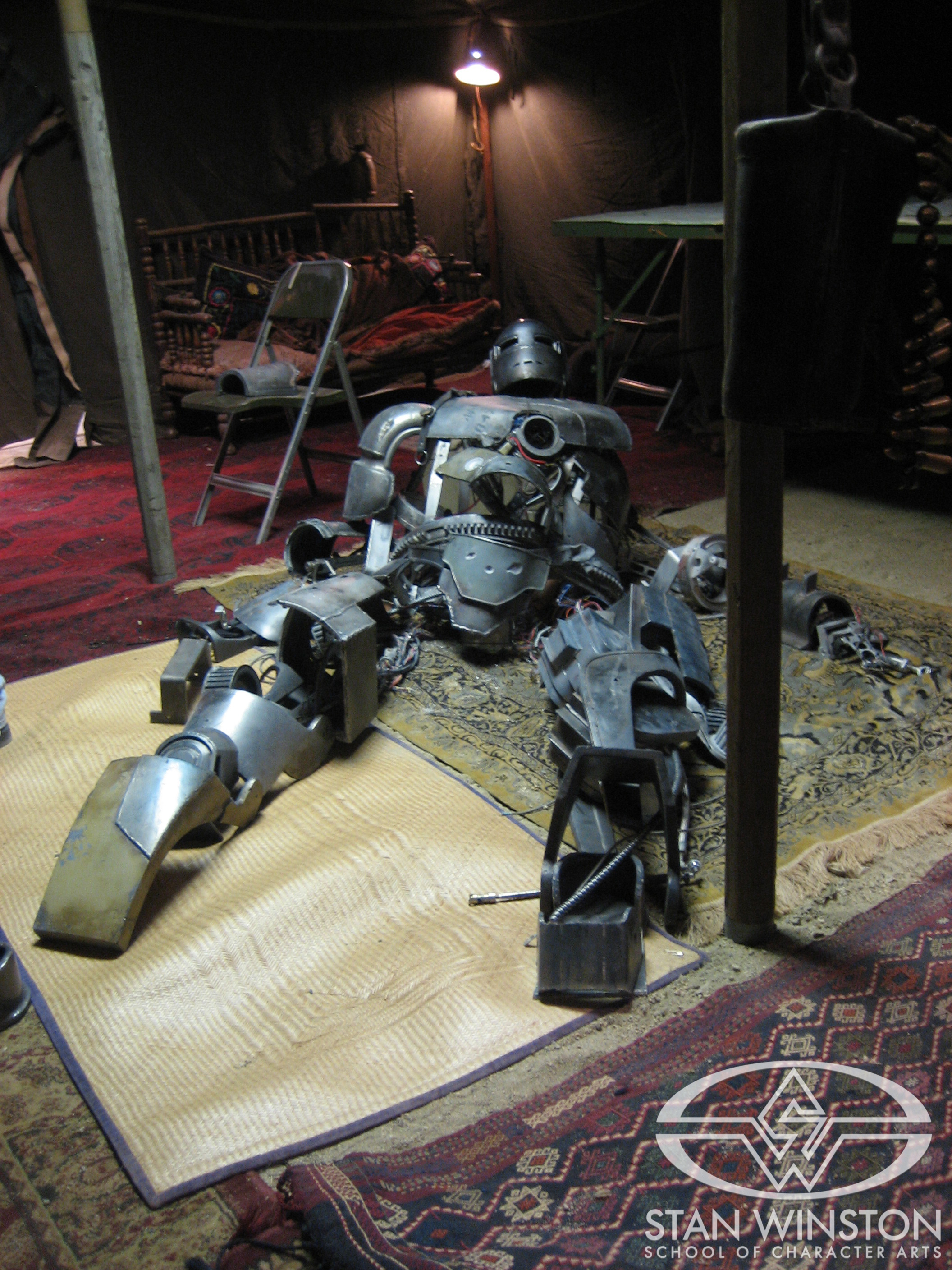 (On-set image of the Mark I "cave escape" suit.)
Filming continued at many locations throughout the Los Angeles area before moving to the desert and mountainous areas near Lone Pine, California. Meanwhile, the second unit worked alongside the first under the supervision of visual effects supervisor Wes Sewell. Sewell was responsible for managing the effects shots on the second unit's stages and locations. While filming wrapped in June 2007, the effects team continued capturing motion-capture footage of stunt performers for Iron Man sequences well into post-production.
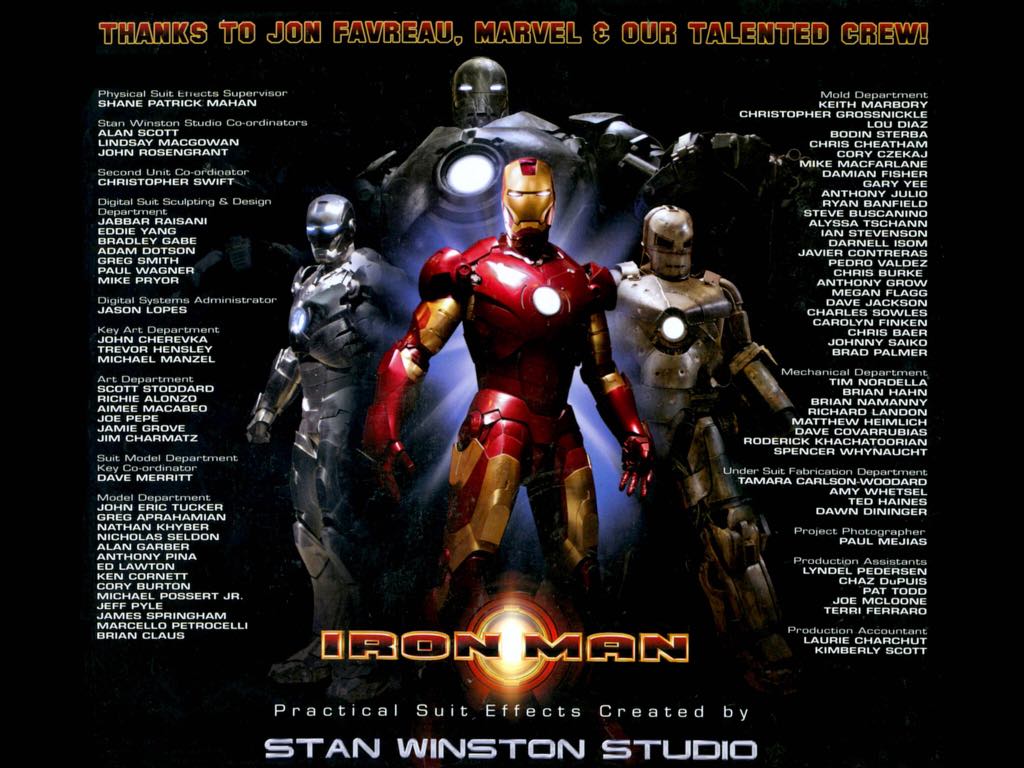 (Stan Winston Studio's practical suit effects crew list for Iron Man 2008. Image courtesy Stan Winston Studio and Cinefex.)
- Primary source: CINEFEX #114: The Man in the Iron Man Mask by Jody Duncan
Courses with the Creators of Iron Man (2008)
- Special Effects Sequence Design with Shane Mahan
- Production Design: The Process Of Creating A World For Film with Jabbar Raisani & Eddie Yang
- Hybrid Characters: Blending Practical & Digital FX with John Rosengrant
- Hybrid Character Design: Practical To Digital with Christopher Swift
- Making a Stone Mold with Gary Yee
- Maquette Painting Techniques with Trevor L. Hensley
- Making Creature Eyes with John Cherevka
- Advanced Creature Teeth: Prosthetic Dental Appliances with John Cherevka
- Character Makeup - Running Foam Appliances with Cory Czekaj
- Lab Work for Animatronic Characters Part 1: Making a Mechanical Core with Cory Czekaj
- Animatronics Design Basics with Richard Landon
- Cable Mechanism Basics - Tentacles with Richard Landon
- Character Hairwork: Hair Laying for Prosthetic Makeup with Aimee Macabeo