
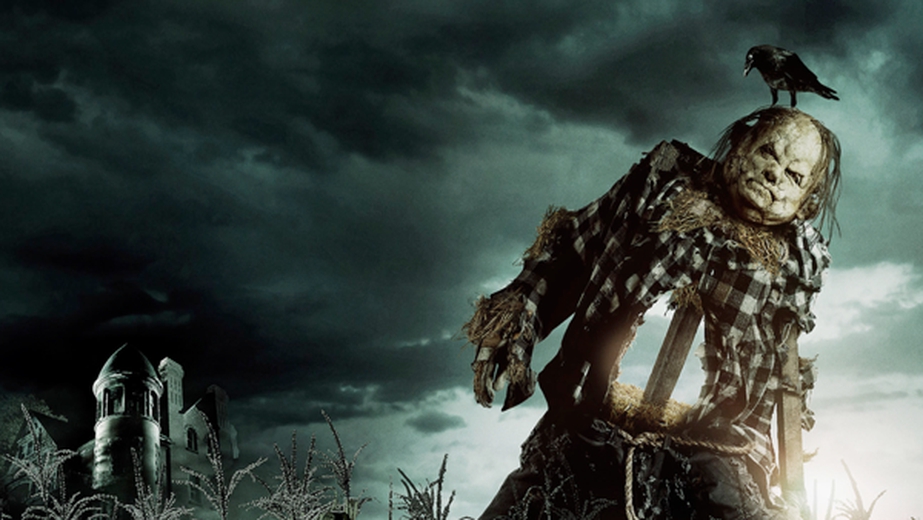
By Lexi Stewart
There's nothing kids love more than scary stories. A good story stays with you, gives you nightmares, and makes your skin crawl. The '70s paved the way for a boom in the horror genre during the '80s, which brought about some pretty iconic films and books for the younger generation. Counted among them was Alvin Schwartz's Scary Stories to Tell in the Dark, which terrified an entire generation of fans, both young and old.
Scary Stories to Tell in the Dark was a collection of short horror stories written by Alvin Schwartz and illustrated by Stephen Gammell from 1981 to 1991. Despite some controversy, the series became a quintessential classic for kids craving an uncensored look into the world of the macabre.
Jump To Section
- Behind the Scenes of Scary Stories to Tell in the Dark
- Making Harold the Scarecrow
- Bringing the Pale Lady to Life
- The Magic Behind the Toeless Corpse
- Creating the Jangly Man
- The Dream Team
- The Future of Spectral Motion
 (Stephen Gammel's terrifying original illustration of the Toeless Corpse from the Alvin Schwartz short story "The Big Toe." Image source Scary Stories to Tell in the Dark book series.)
Behind the Scenes of Scary Stories to Tell in the Dark
In 2013, CBS Films acquired the rights to the book series. Five years later it was announced that Guillermo del Toro would co-write and produce the film adaptation. Del Toro decided to create a joint narrative that incorporated some of the more prominent monsters, and he wasn't going to shy away from the horrifying source material. He wanted to create a film for younger viewers that 'The Hollywood Reporter' now describes as '...arguably essential to fostering the next generation of horror fans.'
With André Øvredal directing, Del Toro needed a true monster enthusiast to reconstruct Gammel's designs in real life. He recruited frequent collaborator, special makeup effects artist Mike Elizalde co-owner and creative director of Spectral Motion, known for Hellboy, X-Men and Stranger Things, etc. With the caliber of the filmmaking team and knowing they would be staying true to the nightmare illustrations he and his children remembered from the books, Elizalde together with his wife, Spectral Motion co-owner Mary Elizalde, did not hesitate to jump on board.
 (Guillermo del Toro reviews The Jangly Man sculpture with, from left: Brian Wade, Mike Hill, Mike Elizalde, and Claire Flewin. Image courtesy Spectral Motion.)
"This is a series of books that I remember as terrifying. Just the imagery alone. If you didn't read the stories and you only saw the images by Stephen Gammel, they were burned into your subconscious forever because they're so frightening," said Elizalde. "They have a primal kind of quality that reaches into your soul and says, 'there's something very wrong going on here,' and you can't unsee it."
Guillermo and André approached Spectral Motion with a list of four main monsters, one of which was not from the original series. Elizalde split the builds up into two teams, led by two veteran monster artists, Norman Cabrera and Mike Hill. "It was a dream team," said Elizalde, "and it was a dream project."
 (Key Artist Norman Cabrera sculpts the head of The Toeless Corpse with Stephen Gammel's original book illustration for reference. Image courtesy Spectral Motion.)
The four monsters were Harold the Scarecrow, The Pale Lady, The Toeless Corpse, and The Jangly Man. "All of them were going to be actors in a rig, either prosthetics or a creature suit. That was an incredible challenge for us, but the easy part of it was that most of the design work was done," said Elizalde, referring to Stephen Gammel's original illustrations.
 (Key Artist Mike Hill paints the Jangly Man suit. Image courtesy Spectral Motion.)
Norman Cabrera led the teams for Harold the Scarecrow and The Toeless Corpse, while Mike Hill took the helm for The Pale Lady and The Jangly Man. With a fantastic team in place, Elizalde felt reassured tackling the challenge of taking the original illustrations and creating something tangible that could be worn by a human being. "We had to work quickly, efficiently, and nail it. That's how it evolved."
Making Harold the Scarecrow
 (Harold the Scarecrow keeps the crows away on the set of Scary Stories to Tell in the Dark. Image courtesy Spectral Motion.)
Elizalde, Cabrera and the rest of the creative team decided that Harold would be a construct of different elements (e.g. rotting pumpkin for a belly, wooden framework for a skeleton). Cabrera suggested that Harold's head could be an old rubber mask from a novelty store that had rotted in the sun. Elizalde loved the idea. It gave Harold "human qualities and characteristics" while still being completely terrifying.
 (Harold the Scarecrow gets even scarier at night. Image courtesy Spectral Motion/Lionsgate.)
"We didn't want Harold's body to look like human anatomy," said Elizalde. "We wanted it to feel like pieces of wood and rope and wire and straw." Elizalde brought on fabricator Bruce Mitchell to work out how his joints moved. Mitchell "made artificial limbs out of foam. It looked beautiful. It looked like old rotting wood."
 (A closer look at Harold the Scarecrow's many layers. Image courtesy Spectral Motion.)
Spectral Motion's attention to detail resulted in the suit working perfectly with performer Mark Steger's movements. "We structured it onto the performer's body in such a way that when Mark moved, those pieces moved differently than he did," recalled Elizalde. "It had a very eerie, creepy, and disjointed kind of feel that was very effective."
 (Tim Huizing molds Harold the Scarecrow's rubber mask head. Image courtesy Spectral Motion.)
Bringing the Pale Lady to Life
 (Initial concept design for The Pale Lady based on Stephen Gammell's illustrations. Image courtesy Spectral Motion.)
The Pale Lady character presented a few challenges as well, but it was a fun build for the team overall. This suit would also be worn by Mark Steger, a veteran monster suit actor known for bringing many characters to life with Spectral Motion in the past, including the Demogorgon from the first season of Stranger Things.
 (Veteran suit performer Mark Steger would portray The Pale Lady as well as Harold the Scarecrow. Image source David Studarus for Variety.)
 (Ian Cromer and Mike Hill sculpt the body and head of The Pale Lady. Image courtesy Spectral Motion.)
 (The painted foam latex face of The Pale Lady. Image courtesy Spectral Motion.)
Elizalde explained one of the performance problems created by the character design, "there was the issue of where the eyes were. They're too far apart for a human. So we had to create little peepholes for Mark to be able to see where he was going."
 (Ian Cromer and Mike Hill pose with the finished Pale Lady. Image courtesy Spectral Motion.)
There was also a lot of discussion about how to execute The Pale Lady's outfit, which resulted in an unsettling solution. "We decided that we don't know what it is. We don't know if it's skin or if it's nightgown fabric that's fused on, which makes it even creepier," explained Elizalde. "In the paint job, there are these stains that have dried, and it's terrifying. You don't want to get near this thing!"
The Magic Behind the Toeless Corpse
 (The Toeless Corpse comes to life in this painted test bust. Image courtesy Spectral Motion.)
The constant challenge for the team usually involved having to turn Stephen Gammel's loose two-dimensional illustrations into functional three-dimensional characters. The Toeless Corpse offered another chance for Spectral Motion to work their magic.
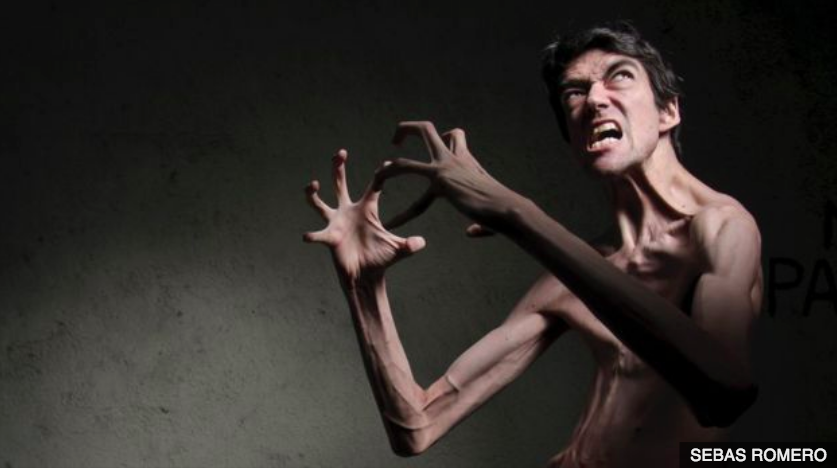 (The Toeless Corpse performer Javier Botet. Image copyright Sebas Romero.)
Elizalde looked forward to transforming talented suit performer Javier Botet into The Toeless Corpse. "Anytime you get to work with Javier, it's such a treat. He's an incredible human being who can do amazing things with his body and has exceeded the dimensions of a human so much that it's eerie. It was an exciting experience because we had not only a terrifying character but the perfect actor, and then Norman Cabrera to put his signature on it."
 (A 3/4 view of The Toeless Corpse painted test bust. Image courtesy Spectral Motion.)
To become the part, Javier Botet's body was painted, followed by a costume over the top. Foam latex prosthetic appliances were then applied to his face and gloves were glued on at the wrists. Elizalde was adamant about using foam instead of materials like silicone. "Foam latex is still a very viable medium. I know that silicone has become the industry standard, and it's a great material that has qualities foam doesn't have. But for a heavily stylized character like this, foam worked out well."
 (Norman Cabrera works out The Toeless Corpse's color palette. Image courtesy Spectral Motion.)
Regarding the continued viability of foam latex, many FX artists would agree with Elizalde. Increased demand for practical effects in recent times has seen a lot of workshops go back to using foam latex for its breathability and elasticity.
"I love the characteristics of foam," Elizalde continued. "It's a very pliable and lightweight material. It has great memory elasticity, and I think it breathes a little bit better than silicone does. If formulated correctly, it's incredibly supple, flexible, and lifelike. Even subtle facial expressions read on the surface. It's a material where you can scientifically control its density. So if you need it to be tougher, you can make it more robust. It's highly controllable."
 (Javier Botet as The Toeless Corpse in Scary Stories to Tell in the Dark. Image source Lionsgate.)
Creating the Jangly Man
 (The head of The Jangly Man. Image courtesy Spectral Motion.)
The Jangly Man character, supervised at Spectral Motion by Mike Hill, was the one character that didn't come from the original illustrations. Guillermo del Toro and André Øvredal put together a team of artists who initially illustrated a concept for the Spectral team to reference.
 (The Jangly Man bodysuit made to fit Troy James. Image courtesy Spectral Motion.)
The practical suit would end up being "an amalgam of a lot of different cues that we referenced from the artwork" said Elizalde, whose team enjoyed having a little more creative freedom on this new character. With The Jangly Man's design in place, all they needed was the right performer.
 (Suit performer Troy James in The Jangly Man makeup and body suit. Image courtesy Spectral Motion.)
 (Left to right: Ian Cromer, Mike Hill, and Brian Wade refine The Jangly Man suit sculpture. Image courtesy Spectral Motion.)
We felt it had to be contortionist Troy James. "He's the only guy who can do what he can do with his body," Elizalde explained. "It's just crazy, crazy things. Incredibly limber is an understatement. I mean, the guy can turn himself into a puddle right before your eyes."
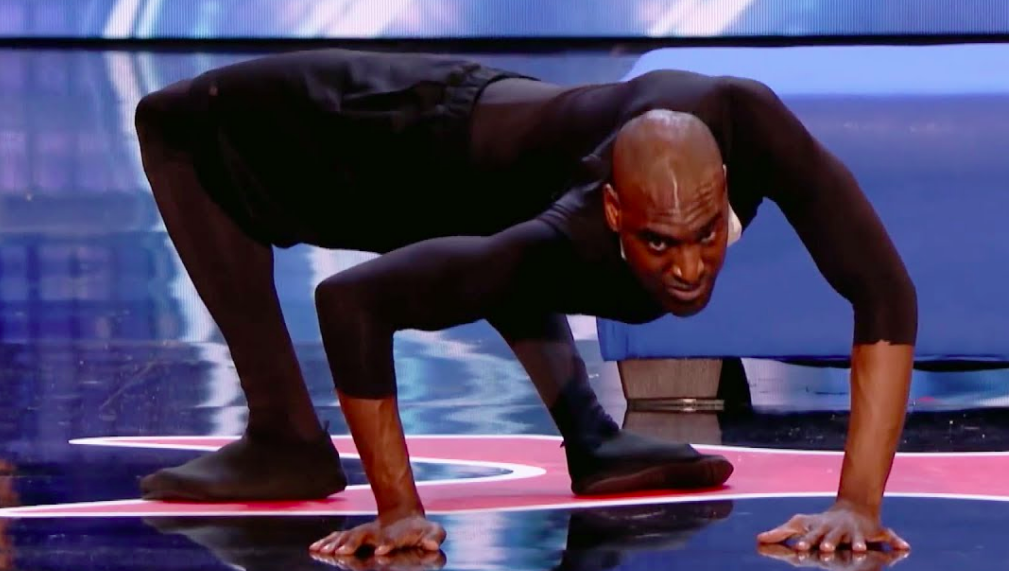 (The Jangly Man suit performer Troy James shows off his contortionist skills on America's Got Talent. Image source NBC.)
 (Troy James as The Jangly Man during a full-body makeup test. Image courtesy Spectral Motion.)
The Dream Team
Aside from his fantastic in-house 'dream team' at Spectral Motion, Mike also credits the success of the project to his long-standing relationship with Guillermo del Toro. "What I always love about Guillermo is that he enjoys giving the artists license and a sense of ownership in what they're creating. I love the level of respect that he has for the people who are in the trenches building this stuff and crafting it with their hands. He's very passionate, but he also approaches the creative process from a very methodical, very technical and artistically oriented perspective."
 (Left to right: Chad Washam, Brian Wade, and Guillermo del Toro discuss the progress of The Jangly Man sculpture. Image courtesy Spectral Motion.)
Elizalde also gives kudos to the director for providing the best environment possible for such an ambitious film. "André Øvredal is very methodical and logical. I love working with guys like that because there's little emotion, except when it's translated onto the screen. I don't like drama on set. I don't like dramatic people. I don't like directors who scream. None of that stuff is productive. To have the privilege of working with somebody so level-headed like André is awesome.' Overall, Elizalde felt that the entire project was an absolute dream job.
The Future of Spectral Motion
The so-called decline of practical effects is a myth to Mike Elizalde, and with so many great practical characters coming to our screens lately, the rest of the world is starting to believe him. "In my entire career, I've experienced that there's always a demand for practical effects. Somebody always walks through our door and says, 'I want to do as much of this practically as possible. I need my actors to react to something that's there."
He is confident about the future of Spectral Motion, which is currently filled to the brim with practical effects builds while also advancing into other areas such as robotics and AI. It's an exciting time for the effects industry and perhaps the rest of us as well. It seems the craft of practical monster-making is still alive, now more than ever. "It's an essential part of filmmaking," said Elizalde, "and I believe it always will be."
SCARY STORIES TO TELL IN THE DARK
Special Make-Up Effects by SPECTRAL MOTION, INC.
Spectral Motion Supervisors
- Mike Elizalde
- Mary Elizalde
Project Supervisor
-
Kevin McTurk
Shop Coordinators
- Mark Viniello
- Tim Huizing
Key Artists
- Norman Cabrera
- Mike Hill
Art Department
- Ian Cromer
- Brian Wade
- Chad Washam
- Mauricio Ruiz
- Christopher Garnaas
- Tim Gore
Mold Department
- Bryan Blair
- Darin Bouyssou
- Grace Choo
- Jon Fedele
- Rachel Gervig
- Brian Goehring
- John Holfmann
- Christopher Hernandez
- Kyle Marzigliano
- Drew Talbot
- Lillian Vince
- Eden Elizalde
Seaming Department
- Brie Ford
- Tim Leach
Hair Department
- Lynne Watson
- Megan Many
Fabrication Department
- Claire Flewin
- Bruce Mitchell
- Ajax Hulce
- Junko Komori
Spectral Motion Administration
- Maria Kruse
- John Moya
- David Diaz
Courses with the Creators of Scary Stories to Tell in the Dark
- How To Lifecast: Head, Hands & Teeth with Mark Viniello
- How to Sculpt a Mask: Sculpting Monsters in Clay Part 1 with Norman Cabrera
- How to Sculpt a Mask: Sculpting Monsters in Clay Part 2 with Norman Cabrera
- How to Sculpt a Mask: Sculpting Monsters in Clay Part 3 with Norman Cabrera
- How to Make Horror Props - Casting, Painting & Finishing with Tim Gore
- Hyper-Realistic Silicone Painting with Tim Gore
- Latex Mask Painting Techniques with Tim Gore and Casey Love
- How To Make A Mask - Part One: Sculpting And Carving with Bruce D. Mitchell
- How To Make A Mask - Part Two: Painting And Leather Work with Bruce D. Mitchell
- How To Make A Mask - Part Three: Sculpting Goggles & Mouthpiece with Bruce D. Mitchell
- How To Make A Mask - Part Four: Detail Sculpting & Adding Magnets with Bruce D. Mitchell
- How To Make A Mask - Part Five: Leatherwork, Painting, And Finishing with Bruce D. Mitchell