

Paulie is a charming 1998 American adventure comedy-drama film directed by John Roberts. The film follows the adventurous journey of the eponymous Paulie, a talking parrot who can communicate with humans. He’s been given as a gift to a little girl named Marie, who struggles with a stutter. Paulie helps her learn to speak clearly—but her father, convinced she’s confusing make-believe with reality, takes Paulie away. From there, the plucky bird embarks on a whirlwind series of adventures, crossing paths with a pawn shop owner, a lonely widow, a Mexican American troubadour, and a small-time thief—until fate finally lands him at the research institute.
Jump To Section
 (The final blue-crowned Paulie puppet built by Stan Winston Studio for John Roberts' Paulie (1998).)
Creating an Animatronic Bird for Paulie (1998)
Bringing Paulie's character to life was similar to the Mouse Hunt assignment in that it required the Stan Winston Studio to mechanize a relatively small bird puppet and then deliver a comedic performance with the puppet.
 (Eric Ostroff working on Paulie's mold.)
In most of the film’s shots, one of fourteen trained blue-crowned conure parrots portrayed Paulie, who was later voiced by comedian Jay Mohr.
 (Some of the trained blue-crowned conures that served as reference for the animatronic Paulie.)
The Winston animatronic parrot was commissioned for expressive facial closeups, talking shots, and for stunts judged too dangerous to be performed by the real birds.
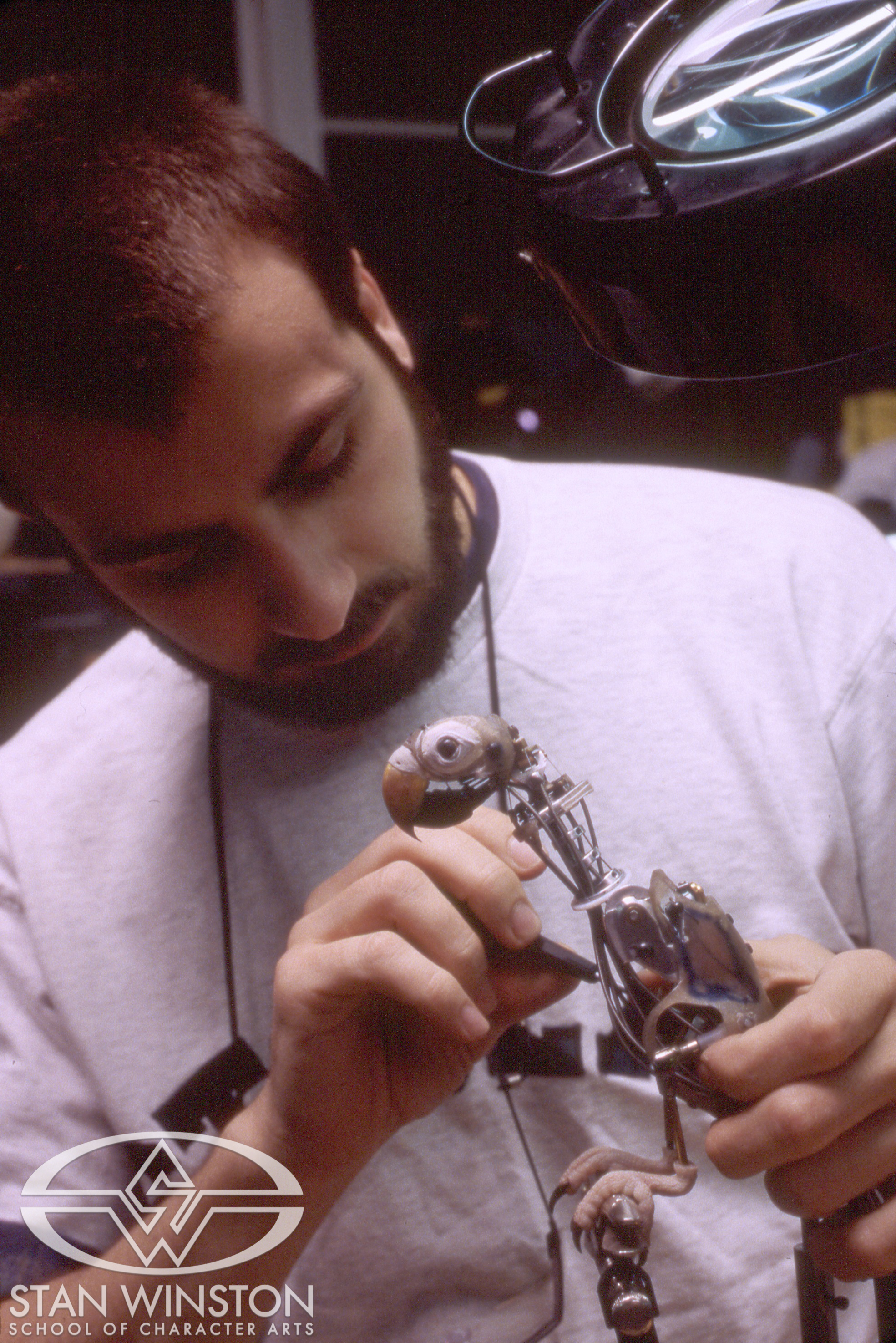 (Matt Heimlich calibrates Paulie's animatronic structure.)
 (The bird animatronics without feathers.)
 (Stan Winston face-to-face with the bird animatronic.)
Showrunner Lindsay Macgowan built the Paulie animatronic with Matt Heimlich, who mechanized it, and Trevor Hensley, who did the fabrication and painting.
VIDEO CLIP -- Animatronic Paulie puppet movement test at Stan Winston Studio.
Paulie: Behind the ScenesPaulie: animatronic puppet movement test, created by Stan Winston Studio for the 1998 comedy film.
Posted by Stan Winston School of Character Arts on Sunday, April 5, 2020
The Capabilities of the Mechanical Paulie
The final puppet was fully articulated and capable of performing a wide range of movements.
 (The mechanical Paulie head before and after feathering.)
“It had full head and neck movement,” said Heimlich. “It could twist its head all the way to the back, nearly 360 degrees, and it could tuck its head under its wing. Its whole body could bob up and down. It also had rod-puppeted wings and a bladder in its chest to fluff out its feathers. This puppet could do a lot of stuff.”
 (Trevor Hensley paints the mechanized Paulie puppet at Stan Winston Studio.)
 (Lindsay Macgowan painting the beak of a Paulie puppet.)
Unfortunately, few of the puppet’s capabilities were ever even filmed on set. Uncertain of how it would cut with the real bird, the Winston crew was asked to manipulate the bird’s beak as if speaking, but to keep the body static and fixed — unlike the real birds, which were in relatively constant motion.
 (Trevor Hensley and Lindsay Macgowan oversee the animatronic Paulie puppet before finishing touches.)
“The result, of course, was that the puppet didn’t match the live birds at all, in terms of behavior,” Heimlich said. “It looked like a puppet, which was too bad. It’s a cute movie, and we were okay with it, but we could have done much better work. When you build a puppet that can do so many things, it is frustrating and disappointing not to be able to let it do its stuff.”
 (SWS crew members Lindsay Macgowan, Eric Ostroff, Trevor Hensley, Matt Heimlich, and Patric Rummans with the animatronic Paulie puppet at Stan Winston Studio.)
- Blog is excerpted from The Winston Effect: The Art and History of Stan Winston Studio by Jody Duncan
Courses with the creators of Paulie (1998):
- Maquette Painting Techniques with Trevor L. Hensley
- Hybrid Characters: Blending Practical & Digital FX with John Rosengrant
- Creature Screenwriting: How to Write Memorable Monsters with Juliet Snowden & Stiles White
To create your own animatronic puppet, check out our Learning Pathways: