

Creating the Animatronic Animals for Mouse Hunt
Having just completed work on The Lost World: Jurassic Park, Stan Winston and his crew found themselves working at the other end of the creature size spectrum for director Gore Verbinski's 1997 film, Mouse Hunt. Described as 'Home Alone with a Mouse,' the film involves a fiendishly clever mouse that resists eviction from a house by two ill-meaning heirs, played by Nathan Lane and Lee Evans.
Jump To Section
- Creating an Oversized Animatronic Mouse for Mouse Hunt
- The Challenges of Building an Oversized Mouse Puppet
- Puppeteering the Giant Mouse for Mouse Hunt
- Building Catzilla, the Mechanized Terror-Cat
- A Comic Game of Cat and Mouse
Creating an Oversized Animatronic Mouse for Mouse Hunt
Although real mice would be intercut with CG versions — created by visual effects house Rhythm & Hues — many shots of the film's leading rodent were achieved with an oversized animatronic mouse puppet built by Stan Winston Studio.1
 (One of the real mice used as a reference for the animatronic mouse for Mouse Hunt.)
"The main reason they needed a mouse puppet," explained effects supervisor Shane Mahan, "was to get certain facial expressions they couldn't get out of a real mouse. They needed facial expressions that were just a bit more human and intelligent than what a real mouse could do."1
 (Shane Mahan looks on as Jim Charmatz and Stan Winston compare the fur of a real mouse to that of the puppet.)
Closeups of the mouse involving human-like expressiveness and gestures would be the domain of Stan Winston Studio. Fresh from building T-rexes and raptors, the Winston team began work on an animatronic mouse — a seemingly simple task that quickly proved otherwise. "Nothing went quite as expected," said Stan Winston. "When we were doing dinosaurs, we had a fair amount of artistic license because no one has ever actually seen a dinosaur. But in this case, everyone knows what a mouse looks like, so we found ourselves dealing with a far more exacting standard of realism."2
 (Paul Mejias works on the mouse's fur at Stan Winston Studio.)
Besides holding up to close scrutiny, the fake mouse also had to intercut seamlessly with shots of the real mice. "Getting the lighting and depth of field, the width of the whiskers, and the subtleties of the hair on our puppet to work at a magnified level that precisely matched the real animals was no simple matter," stated Mahan. "The production was using maybe sixty different trained mice, each with slight color variations. We had to come to a common ground for our animatronic and determine what differences we could get away with. As it was, we returned to the drawing board several times on the skin and hair to get the fur density and color just right. After that, we depended on cinematography and lighting to help make it all work."2
The Challenges of Building an Oversized Mouse Puppet
To accommodate an array of intricate internal mechanisms, the puppet was built oversized — four-and-a-half times larger than life. But even scaled up, the challenges were considerable.1
 (Paul Mejias' mouse sculpture at Stan Winston Studio.)
Having analyzed mountains of reference material, the Winston team used soft foam to construct the mouse body. "A mouse is a very squishy little animal," said Mahan. "It's always compressing or inflating. It can go under little cracks in doors because it's so flexible. So we thought we'd make him light and floppy-looking rather than have too many hard skeletal structures inside. That way, we could flatten him down or puff him up."2
 (Limb and head details of the mouse sculpture.)
From a sculpture by Paul Mejias, the body was fabricated by Lynette Eklund with small metal legs that were then attached and covered in silicone skin.2
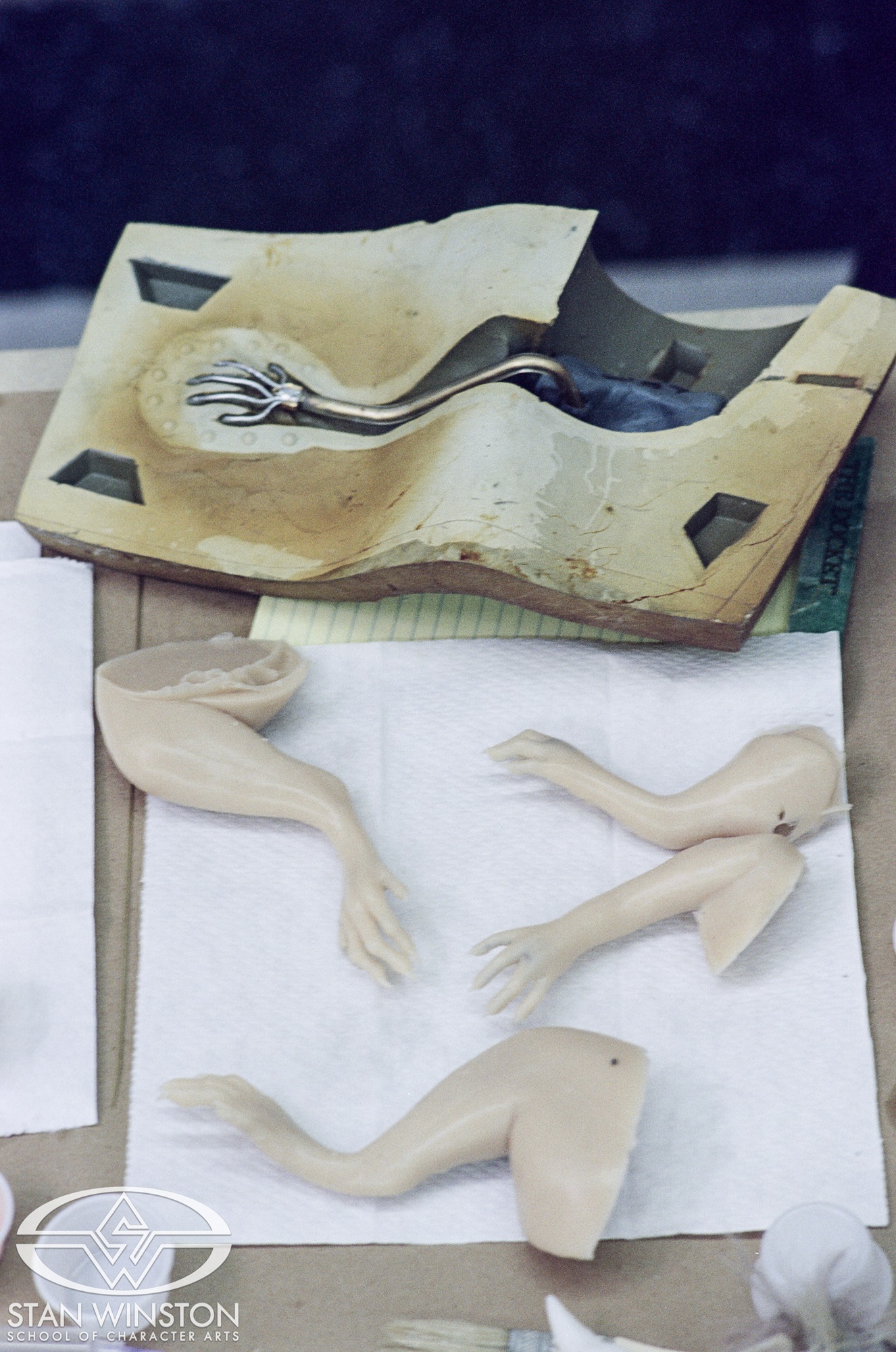 (Tiny mouse limbs castings before assembling.)
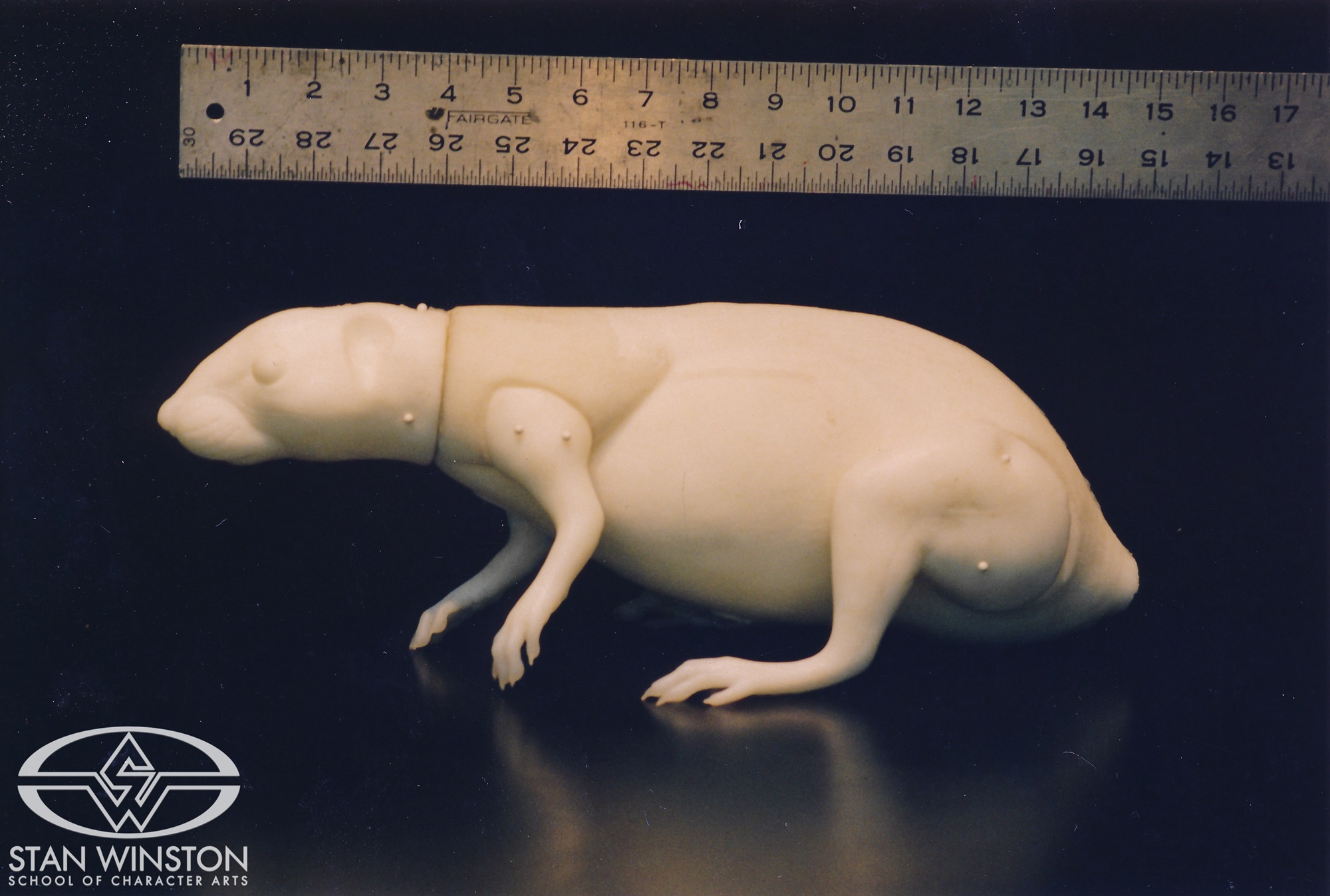 (A test shot of the assembled mouse head, body, and limbs at Stan Winston Studio.)
Mechanics, designed and built by Christian Colquhoun and Al Sousa, included those required for remote-controlled facial articulation, cable-controlled head and neck movement, and telemetry-controlled mechanical arms. Internal bladders simulated breathing movement, and an opening in the soft body enabled puppeteers to reach a hand inside and create torso movements. Hair for the animal's dense pelt was hand-tied by Stuart Artingstall, Ursula Ward, and Eklund.2
 (Jon Dawe fine-tunes the mouse's underskull.)
 (Chris Colquhoun works on the delicate interior mechanics of the animatronic mouse.)
"One of the problems with doing an oversized mouse was getting scaled fur that looked right," Mahan recalled. "It took a while before we found something that looked good."2
 (Different fur tests on Paul Mejias' mouse sculpture.)
In fact, during the first screen test with the puppet, the crews found that the fur, which had looked acceptable in person and in normal light, lacked sheen and vibrancy under the stage lights and on film. The crew refined the fur in time for a second screen test, using a painting technique devised by Stan Winston Studio artist Jim Charmatz. "We had tried several different techniques in hair weaving to match the real animal's fur," said Charmatz, "including using single-color hair and mixing different colors to create the appearance of a new color. But nothing was working in our film tests. I came up with the idea of starting with neutral-colored fur and then painting it using transparent paints. I did several tests on tufts of fur, and it worked great."2
 (Fur comparison of a real mouse and the animatronic.)
Puppeteering the Giant Mouse for Mouse Hunt
Six members of the Winston crew puppeteered the animatronic mouse on special scaled-up sets erected by the production at Raleigh Studios. "We had to create a believable performance that conveyed recognizable human emotions," commented Winston, "which is hard to do because a mouse's anatomy is so different from ours. And since mice are not normally very animated creatures, we had to find ways to make it so."2
 (The animatronic mouse with its radio and telemetry-control system at Stan Winston Studio.)
Before filming, puppeteers rehearsed extensively on a stage set up at Stan Winston Studio. "We wanted to make sure that each puppeteer could work off of the rhythm of the next person and be able to make specific moves or just ad-lib if necessary," explained Mahan. "Our team got quite proficient at keeping the performance alive and interactive."2
 (A close-up image of the animatronic mouse made for Mouse Hunt.)
The puppet could accommodate a range of subtle and not-so-subtle expressions, although Verbinski frequently opted for the subtler approach as shooting progressed. "We'd do a lot of funny, cute pauses punctuated by reactions from the mouse. But then Gore would say: 'Let's not go so human. Let's pull it back a bit, make it more mouselike.' He didn't want the character to be completely cartoony. He wanted to keep it right on the cusp — it was funnier that way."2
 (Shane Mahan prepares the mouse for a test shot at Stan Winston Studio.)
Building Catzilla, the Mechanized Terror-Cat
The Winston team also built a mechanical cat for a dozen or so stationary full-body shots and closeups of a feisty feline named Catzilla, recruited by the brothers in the film to solve their vermin problem.2
 (The real cat who played Catzilla in wide shots for Mouse Hunt visits Stan Winston Studio.)
Catzilla in the wide shots was played in the film by an actual live cat. The cat-actor visited Stan Winston Studio several times, not only for reference, but also so the artists could photograph it and the animatronic performers could observe its behavior in order to build the animatronic version with as much expression as possible.2
Opting for a distinctly cartoonish approach, SWS artists worked from approved concept art by Mark 'Crash' McCreery.2
 (A headshot of the sculpture Paul Mejias and Scott Stoddard made for the character, Catzilla.)
Unlike the mouse scenes, they were not hampered by the need to match a live animal counterpart precisely. "The only time a real cat was substituted was in instances where it's running across the floor," said mechanical designer Richard Landon, "and those were either long shots or filmed over the shoulder." With a license to play up the comic aspects of the character, SWS artists had fun with the development process. "Originally, we were going for an escaped-lab-experiment look, but we ended up toning that down because it looked too sorrowful and pathetic. Instead, we went for the ultimate monster alley cat — basically just a real bruiser."2
 (Side-view of the Catzilla sculpture at Stan Winston Studio.)
Built at 150 percent scale from sculptures by Paul Mejias and Scott Stoddard, the mechanical cat had interchangeable heads — including one with a neutral expression and another that was angry and open-mouthed.2
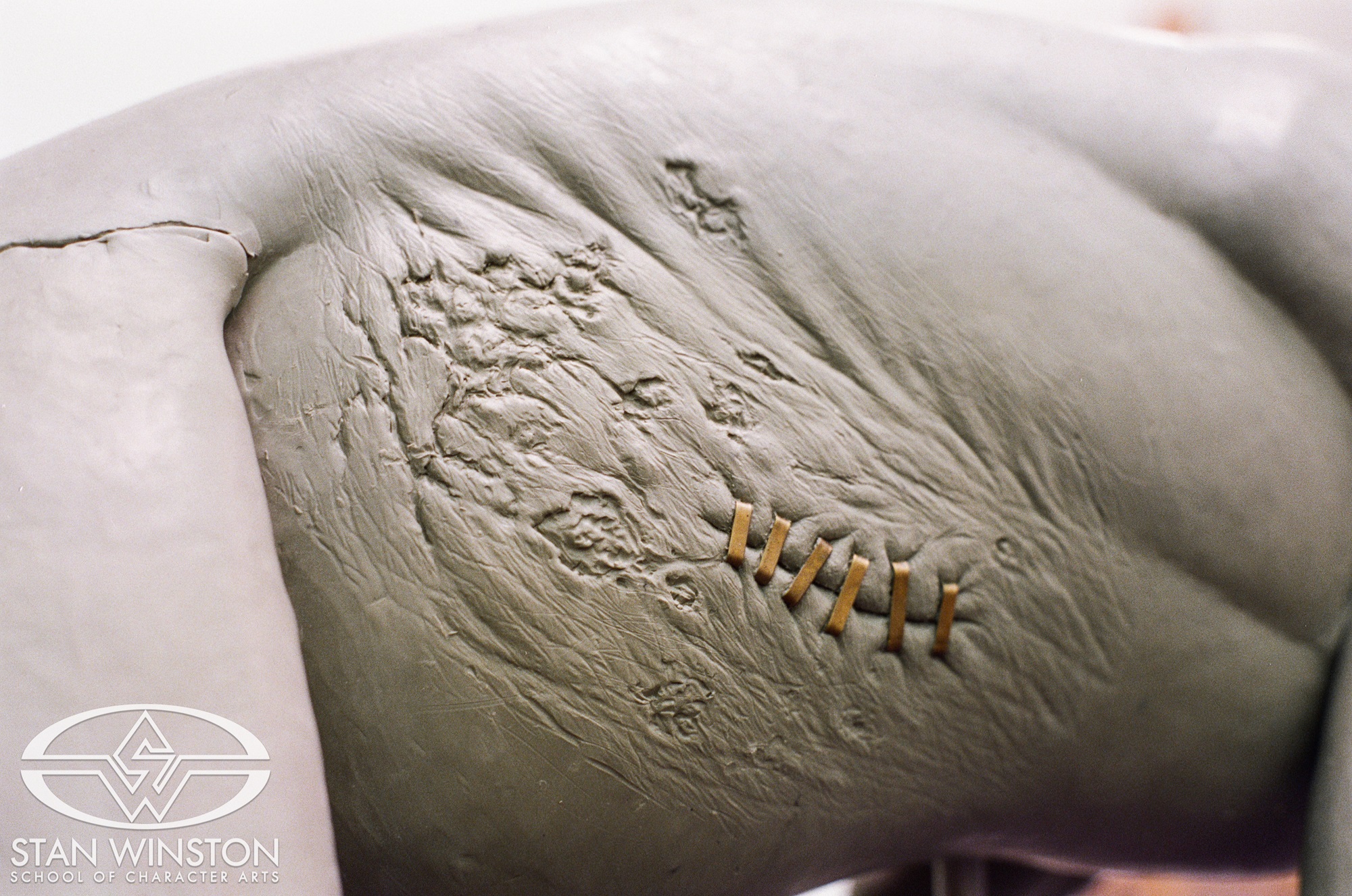 (A close-up image of Catzilla's injury.)
Mechanisms built by Richard Landon, Matt Heimlich, and Chris Colquhoun included posable front and rear limbs and a fully articulated face, head, neck, shoulders, and body. "A lot of the mechanical design was based on the work we'd developed for [The Lost World: Jurassic Park]," stated Landon. "We had a brand-new control system for the radio-controlled functions. It was puppeteered just like we did the dinosaurs, with a telemetry controller that matched all the internal construction inside the puppet externally. Puppeteers moved the external device, and the computer and radio controls would translate that signal to our animatronic."2
 (Richard Landon works on Catzilla's head mechanism at Stan Winston Studio.)
 (One of the interchangeable animatronic heads at the Studio.)
 (Various eyeballs were created for Mouse Hunt's iconic character, Catzilla.)
A Comic Game of Cat and Mouse
The mouse and cat performances not only had to be realistic and match the behavior of their real-life animal counterparts, but they also had to be comedic in nature, that is to say, funny! This was no small task, as illustrated in the old story of the actor who, on his deathbed, declared that 'dying is easy… comedy is hard.' If one had to be a bit of an actor to puppeteer the usual 'must eat, must destroy' characters that came out of the studio, one had to be a bit of a comedian to create convincing portrayals of a mischievous mouse and his feline foil.1
 (Lynette Eklund puppeteers Catzilla's legs for a test shot at Stan Winston Studio.)
 (Shane Mahan and Jim Charmatz color-correct Catzilla's fur.)
Fortunately, Stan Winston Studio had its share of in-house comedians. "In a way," said Shane Mahan, "doing Mouse Hunt was like doing a Laurel and Hardy-style comedy, which was so much fun for us. It was a really nice departure from the stuff we normally do. I loved everything about doing Mouse Hunt. And watching the film now, I think the puppet holds up really well. That mouse has some beautiful little expressions."1
 (A shot of Catzilla rehearsing one of the Mouse Hunt scenes at Stan Winston Studio.)
After filming, the primary trained mouse used in the film went home with Paul Mejias and lived with him as a pet for two years. When the mouse died, Mejias and other members of the Mouse Hunt crew buried him in a patch of grass in front of the studio. "His little grave is still out there," said Mahan.1
- Blog assembled by Adrienn Lingurár with selections from:
1. The Winston Effect: The Art and History of Stan Winston Studio by Jody Duncan
2. CINEFEX #73: Mouse Hunt of Mice and Men by Estelle Shay
Courses with the Creators of Mouse Hunt
- Special Effects Sequence Design with Shane Mahan
- Introduction to Hair Knotting with Michael Ornelaz
- Animatronics Design Basics with Richard Landon
- Cable Mechanism Basics - Tentacles with Richard Landon
- Hybrid Characters: Blending Practical & Digital FX with John Rosengrant
- Creature Screenwriting: How To Write Memorable Monsters with Juliet Snowden & Stiles White
- How To Make An Eye Mechanism - Design, 3D Printing & Assembly with David Covarrubias
- Animatronic Control Systems - Arduino Programming Basics Part 1 with David Covarrubias