

The Making of Lake Placid’s 30-Foot Animatronic Crocodile
Lake Placid is a Steve Miner film about the search for a man-eating, thirty-foot crocodile in a lake in Maine.
Jump To Section
- Designing a Massive Underwater Puppet
- Creating a Fully Functional Animatronic for Water
- Testing the Full-size Crocodile Puppet in Water
WATCH THE CROCODILE COME TO LIFE
Designing a Massive Underwater Puppet
Stan Winston and his crew realized Lake Placid’s crocodile as a full-size animatronic puppet — complete with moving head and tail and snapping jaws — that would function underwater.
 (Stan Winston and film director Steve Miner discuss the design for the crocodile maquette which will serve as the guideline for the full-size build.)
 (SWS artist Bill Basso airbrushes final layers of color on the crocodile reference maquette.)
 (SWS artist Nick Marra carves fine details into the full-size milled foam crocodile head.)
 (SWS mold technicians, wearing full-body clean air suits to protect themselves from the toxic chemicals, apply a surface coat of water-resistant urethane to the inside of the crocodile mold.)
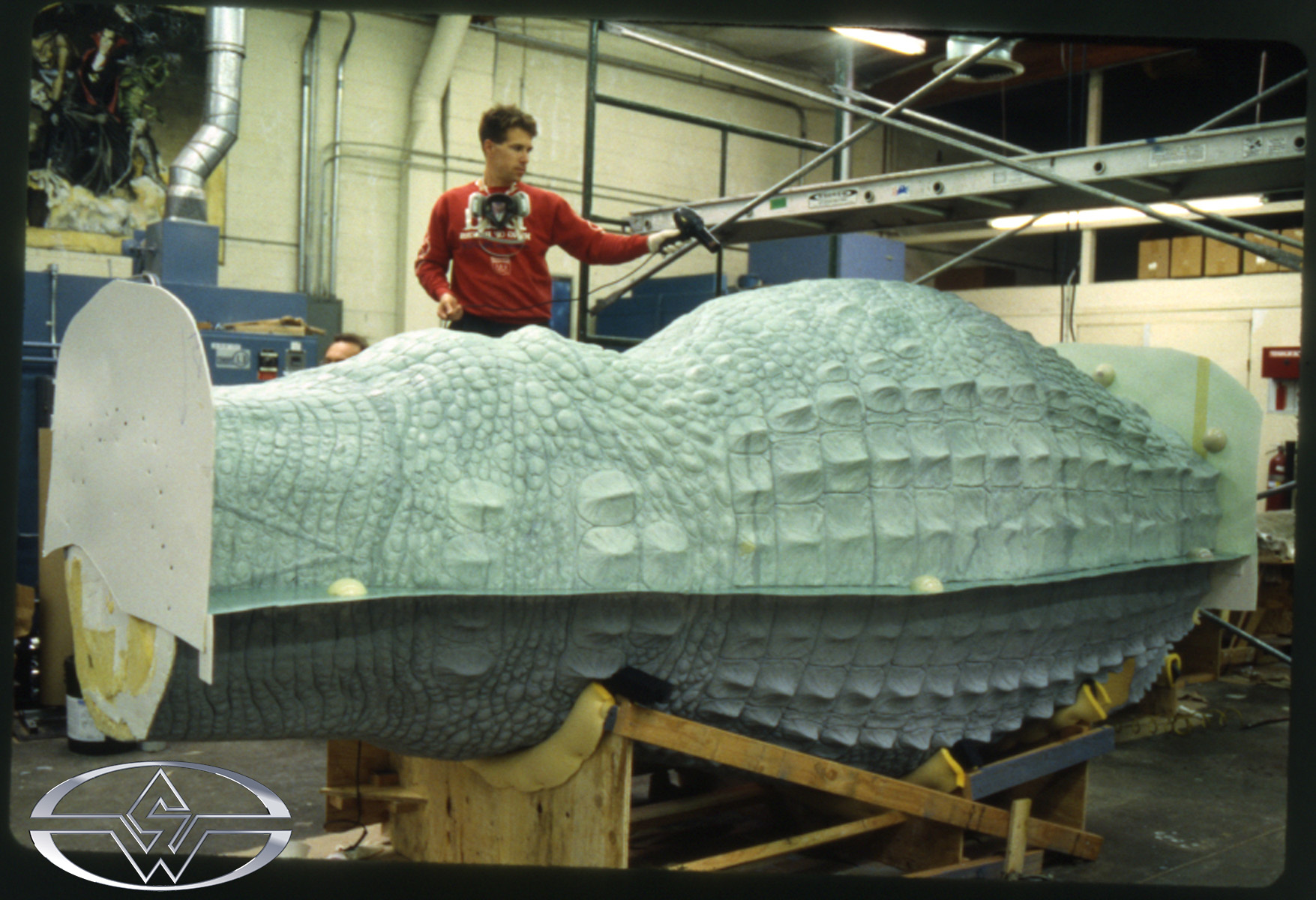 (SWS team member Mike Harper preps the full-size foam crocodile for molding.)
Creating a Fully Functional Animatronic for Water
The crocodile was mechanized through hydraulics, which, as had been learned on previous projects, worked fairly well in a water environment, as long as they were protected in waterproof housings and surrounded by a water-resistant skin.
 (SWS lead mechanic Richard Landon welds the mounting system for the animatronic crocodile head.)
 (SWS mechanic Jeff Edwards makes adjustments inside the crocodile's 30-foot long fiberglass body before the skin is applied.)
 (SWS artist Ian Stevenson troubleshoots with SWS hydraulics expert Lloyd Ball as the skin is applied to the full-size animatronic crocodile.)
 (SWS artist Mike Ornelaz painstakingly attaches the water-resistant skin to the crocodile's fiberglass underbody.)
 (SWS artists Rob Ramsdell, Rob Phillips, and Mike Ornelaz complete the paint job on the full-size crocodile puppet.)
Testing the Full-size Crocodile Puppet in Water
To test the crocodile puppet’s efficacy in water, the SWS crew took it up to Castaic Lake, in the Los Angeles National Forest, prior to painting it, and dropped it in. “That thing actually swam,” Landon remarked. “Its head left/right and tail left/right functionalities were enough to make it propel itself through the water.” To gain greater swimming speed during filming, the crocodile was most often attached to a wire and pulled through the water by boat.
 (SWS crewmembers prepare to lower the crocodile puppet into the water.)
 (The 30-foot full-size animatronic crocodile prepares for a swim in Castaic Lake in Los Angeles, CA.)
“We went into this show with the full knowledge that water always wins,” said Richard Landon, who led the mechanical crocodile design team. “That has become my personal motto: Water Always Wins. Water will always break something. Water is the universal solvent. Superglue breaks down in it. Urethane breaks down in it. Paint breaks down in it. Water is a nightmare — and we were in it for a full six months on this show.”
- Jody Duncan
Excerpted from "The Winston Effect: The Art & History of Stan Winston Studio"
Courses with the creators of Lake Placid's Crocodile
- Animatronics Design Basics with Richard Landon
- Cable Mechanism Basics - Tentacles with Richard Landon
- How To Create A Basic Hand Mechanism - MINI-TUTORIAL with Richard Landon
- Metallic Painting Techniques - Robot Finishes with Rob Ramsdell
- Hairy Creatures Series - Introduction To Hair Knotting with Michael Ornelaz
- Creature Screenwriting: How To Write Memorable Monsters with Juliet Snowden & Stiles White
- Animatronic Control Systems - Arduino Programming Basics - Part 1 with David Covarrubias
- How To Make An Eye Mechanism - Design, 3D Printing & Assembly with David Covarrubias
- Maquette Painting Techniques with Trevor L. Hensley
- How To Make A Monster Puppet - Rods & Cables with David Monzingo
- Makeup Blood FX - Blow Your Brains Out with David Monzingo