
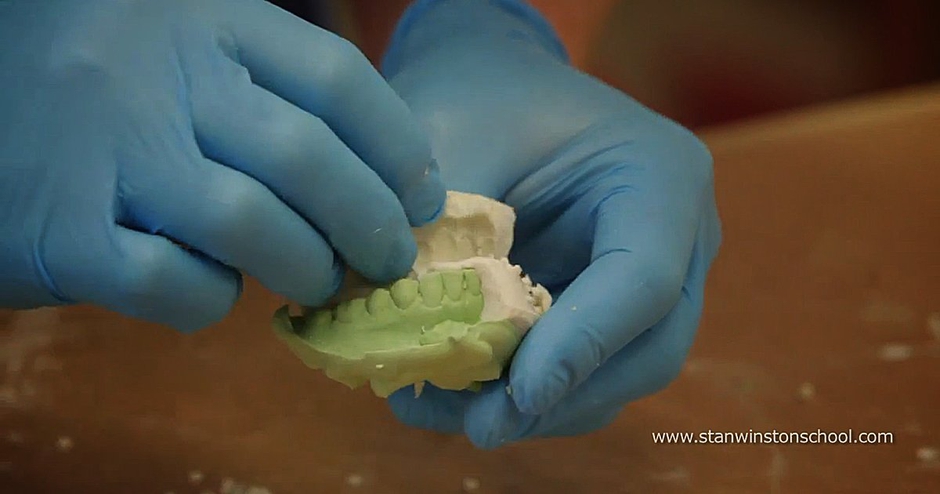
Mini-Lesson excerpted from Mark Viniello's full lesson, How To Life-Cast - Head, Hands, Teeth. To view the FULL LESSON, click HERE.
Jump To Section
- The Makeup Effects Artist's Job
- Keeping Your Actor Comfortable During Dental Casting
- Alginate vs. Dental Silicone
- Getting the Best Fit for Prosthetic Dentures
- Gathering Information Before Creating a Dental Impression
- Capturing the Dental Impression
- Pouring the Plaster Positive
- Preserving The Gumline
- Demolding the Teeth
The Makeup Effects Artist's Job
A makeup effects artist's job is to enhance an actor's performance. No matter what you create for your actor to wear, be it a wig, prosthetic nose, costume or fake teeth, it must fit well or the performance will suffer. An understanding of proper life-casting technique is essential for any artist who wants to help actors create unforgettable characters.
In this free mini-lesson, makeup effects master Mark Viniello demonstrates the dental casting process; from taking impressions with alginate to creating the stone positive, Viniello shows you the right way to cast teeth.
 (Bruce Spaulding Fuller's "Hag" design for which today's mini-lesson provided the necessary base to sculpt and cast prosthetic dentures (aka fake teeth).)
Keeping Your Actor Comfortable During Dental Casting
The first step in casting teeth is to choose a dental tray that will comfortably fit inside your actor’s mouth. Dental supply houses offer a range of sizes to accommodate almost any mouth you’ll encounter, so it’s important to have several different trays in your kit for every dental casting session.
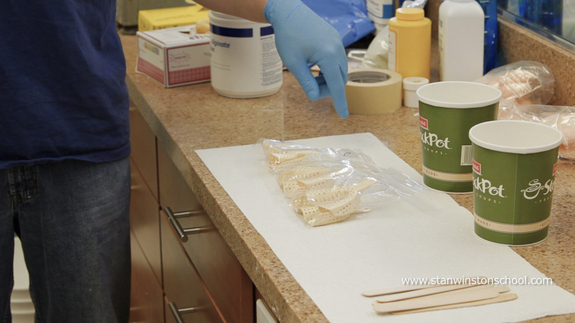 (Dental trays come in a variety of sizes. Using one that properly fits your actor's mouth will ensure comfort and a better impression.)
Alginate vs. Dental Silicone
Mark Viniello chooses alginate over dental silicone to take the impression of fellow makeup effects artist Cynthia Garza's teeth. Although alginate is single-use only, it's far cheaper than dental silicone, making it more affordable for most new makeup artists and hobbyists.
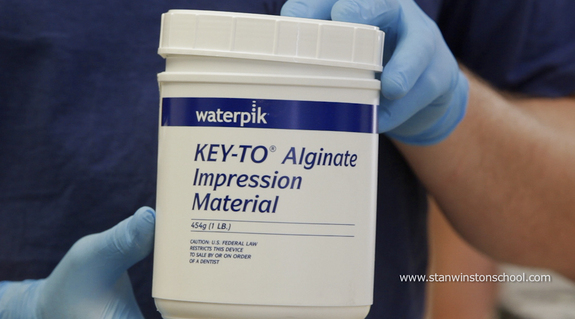 (Dental alginate is a faster setting and cheaper alternative to dental silicone. However, unlike silicone, alginate is a single-use material as it shrinks substantially when it dries.)
Getting the Best Fit for Prosthetic Dentures
The better the casting, the better the final fit of the prosthetic dentures so “the important part about doing dental casts is to make sure you have as much information as you can to create the dentures,” stresses Viniello.
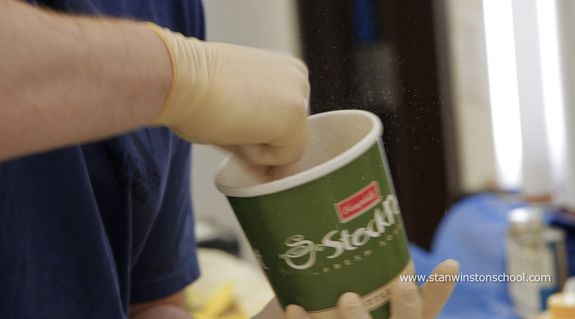 (Getting the right consistency is critical. Too little water and the alginate won't flow, too much and it won't set correctly.)
Gathering Information Before Creating a Dental Impression
One of the basic questions you must first ask your actor is whether or not they have any type of veneers or bonding. “It’s always important to know if there is real dental work in there,” advises Viniello. “Make sure there is nothing that can be affected by the impression material.”
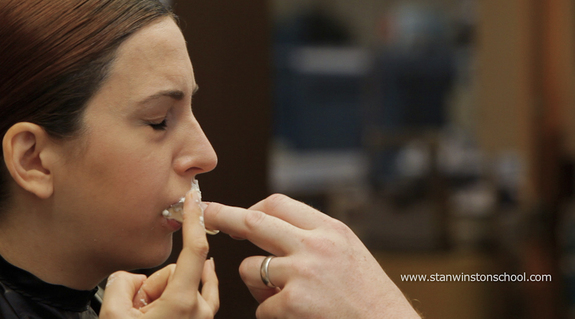 (To avoid having thin spots in your stone-positive, be sure to correctly center the dental tray before the alginate sets.)
Capturing the Dental Impression
Makeup Effects artist and SWSCA instructor Cynthia Garza sits patiently as Viniello mixes the dental alginate, fills the dental tray, and then takes the impression of her teeth. Once the alginate sets, he instructs her to “give it a little twist” to break the suction and make removing the dental tray easier. He then repeats the process to take an impression of her lower teeth as well.
 (With the alginate set up, it's time to pour in dental stone to make the positive.)
Pouring the Plaster Positive
“We are going to pour a type of a dental stone. It’s called Die-Keen®,” explains Viniello. “It’s a very hard, very accurate plaster.” Once he's mixed the Die-Keen® with water, he carefully pours it into the alginate molds of Cynthia’s teeth, paying special attention to the lowers. “I’m taking a brush right now and I‘m actually poking the Die-Keen® in. Especially in the front lowers, I mean those are very thin and you want to make sure you get as much detail, or you get all the detail for when we put these two together. You want to ensure that you have a good bite.”
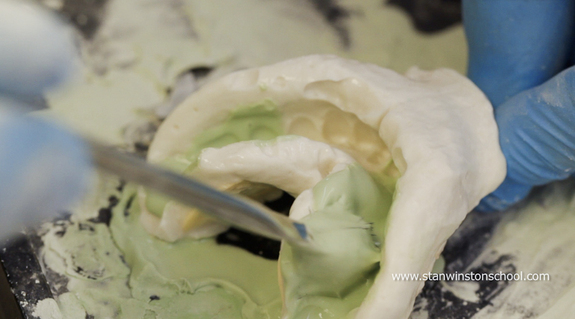 (Mark Viniello uses a brush to poke the Die-Keen® into all the nooks and crannies in the alginate. The more information captured, the better.)
Preserving The Gumline
Since the final denture prosthetics will completely cover Cynthia’s gumline with an artificial gumline, it’s important to “have a good build-up on these, because these will get sunk in a base and you want to make sure you have enough material that you are not going to lose any gumline or any of the teeth," says Viniello. "So you want to build it up a little bit higher, and again, you can always carve down."
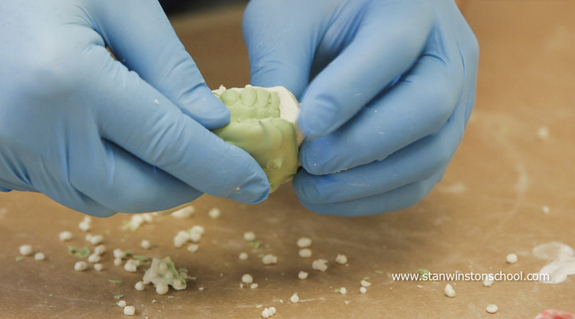 (Take care not to damage the plaster positive when peeling away the alginate. A broken casting is a useless casting.)
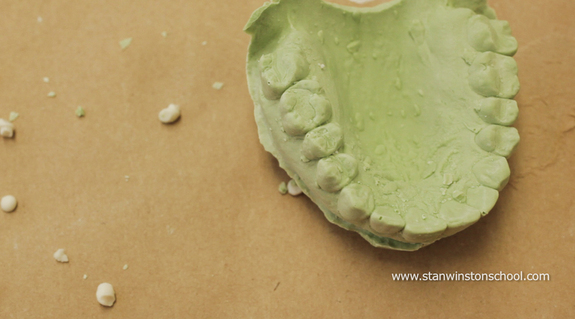 (The Die-Keen® dental stone casting of Cynthia Garza's teeth. The final step is to clean it up and create a stone base.)
Demolding the Teeth
With the Die-Keen® set, it's time to remove the stone positive from the alginate impression of Cynthia’s teeth. With all the precaution and care that led up to this moment, it’s important not to rush to see the results. “You don’t want to do anything that is going to pry or put any stress on the casting because it’s very easy, especially with the lowers, to bust the teeth off," cautions Viniello. He then carefully peels away the alginate to reveal a beautiful set of teeth inside, perfect replications of Cynthia’s teeth that will provide an accurate sculpting base for the “Hag” dental prosthetics that she’ll eventually be wearing.
-Matt Winston
To VIEW the entire lesson, click HERE: How to Life-Cast-Head, Hands, Teeth
To VIEW Cynthia Garza's continuing lesson on TEETH, click HERE: How to Make Fake Teeth