
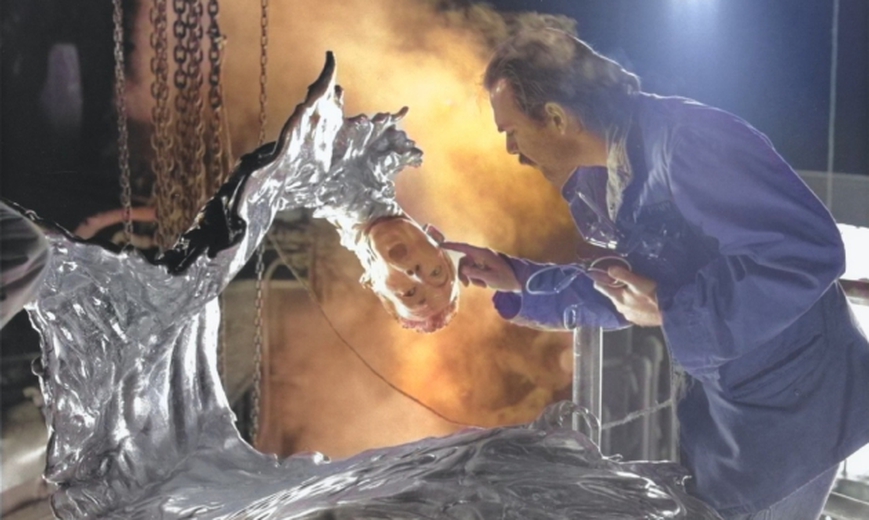
Creating the T-1000, a Liquid Metal Villain
Although Stan Winston Studio vastly improved upon the techniques used to create the T-800 endoskeleton effects in Terminator 2: Judgment Day, they would be breaking all new ground with the unprecedented T-1000 liquid metal effects.
Jump To Section
- The Magic Behind the “Donut Head” Effect
- Explaining the “Splash Head” Effect
- Breaking Down the “Cleave Man” Effect
- Achieving the “Pretzel Man” Effect
- Making the Bullet Effects
- Designing the T-1000’s Blades
- The Making of the Liquid-Frozen T-1000
- The SFX Challenges and Successes With Terminator 2
“The endoskeletons, which had been the big deal on Terminator, were the least of our problems on Terminator 2,” said 25-year SWS supervisor and Co-Founder of Legacy Effects, John Rosengrant. “By far, the most challenging things we did for Terminator 2 were these physical effects involving the T-1000 character. We did a lot of in-camera magic tricks for that - splitting open bodies, finger blades, heads blowing open, bullet-hit wounds. Every day, there was something new and challenging to do.”
To watch the complete video, click the player above!
The Magic Behind the “Donut Head” Effect
The steel mill finale featured some of the more complex liquid-metal-man gags created by Stan Winston’s team. In one, Sarah Connor (Linda Hamilton) shoots the T-1000 (Robert Patrick) at point-blank range, creating a giant hole in the character’s head.
 (Mike Trcic’s design of the T-1000 ‘donut head’ based on the likeness of Billy Idol, an early candidate for the role.)
 (Mike Trcic works on the T-1000 'donut head' sculpture.)
Dubbed ‘donut head’ by the crew, the effect was achieved with a mechanical head-and-shoulders puppet that had some radio-controlled eye and jaw movement, as well as some cable-actuated closing-up movement, much like the mechanism in ‘splash head,’ suggesting the hole is beginning to close.
 (The final 'donut head' puppet, sculpted by Mike Trcic.)
“Nobody realized that was a puppet,” Stan Winston commented. “Everybody assumed that was really Robert Patrick and that the hole in his head was done with CG. But that was a puppet that we built. It turns around and looks right at the camera.”
Explaining the “Splash Head” Effect
When John Connor (Edward Furlong) and the Terminator break out Sarah Connor from the state hospital, the T-1000’s head is split apart by the Terminator’s point-blank gunfire.
 (Mark 'Crash' McCreery’s design for the T-1000 shotgun-to-the-head effect, dubbed ‘splash head.’)
Stan Winston Studio built two articulated puppets for what was dubbed the ‘splash head’ effect. The first was employed for the shot of the head initially springing open, viewed from behind the T-1000. Studio artists sculpted Robert Patrick in clay, then split that clay sculpture down the middle and pulled it open, sculpting a ‘splash’ area into the middle of it.
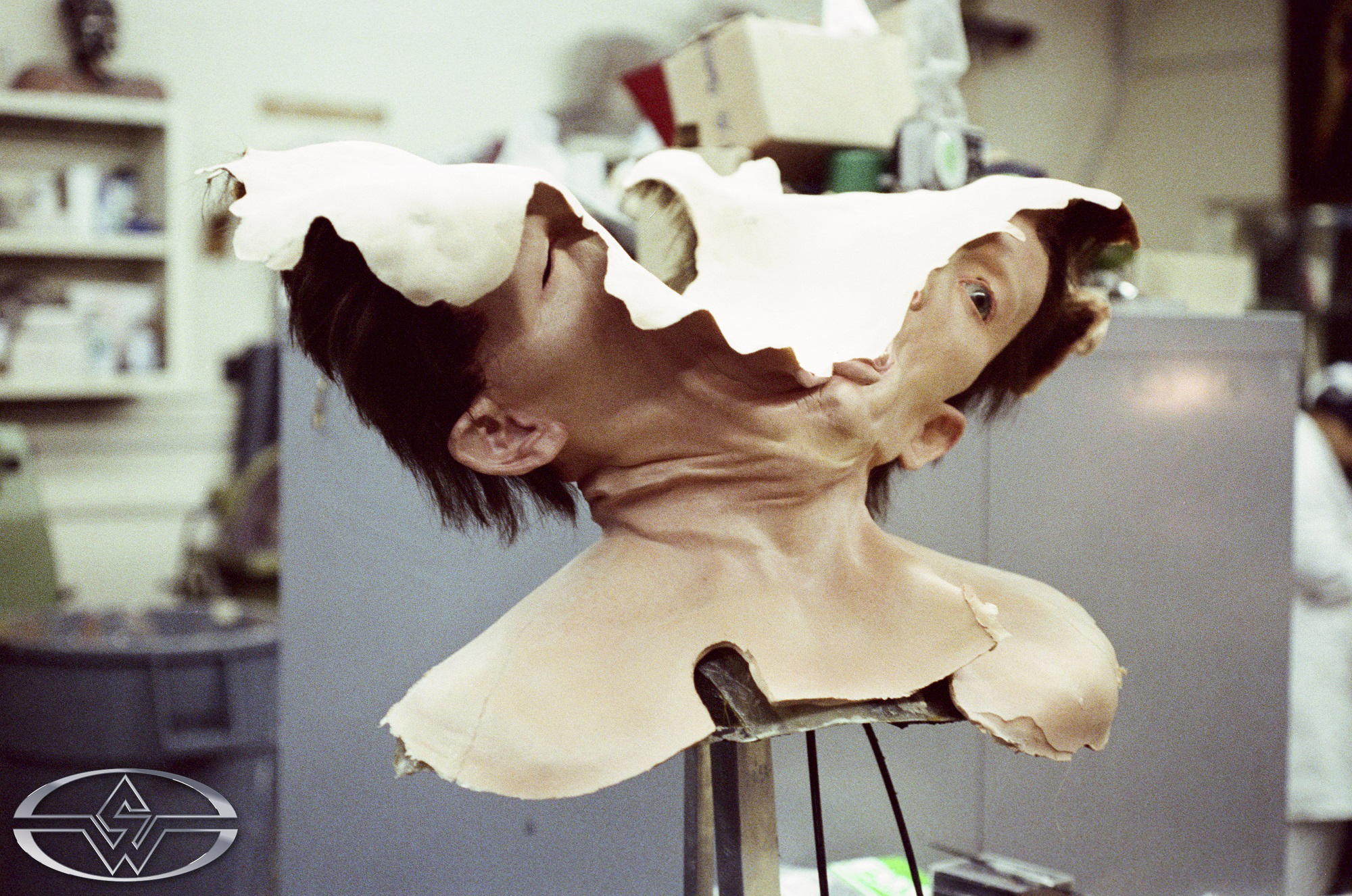 (One of the T-1000 puppets SWS crew built for the T-1000 ‘splash head’ effect.)
The foam rubber puppet was then made from molds of that sculpture. The puppet had a hinged fiberglass core that would spring open with the pulling of a single pin.
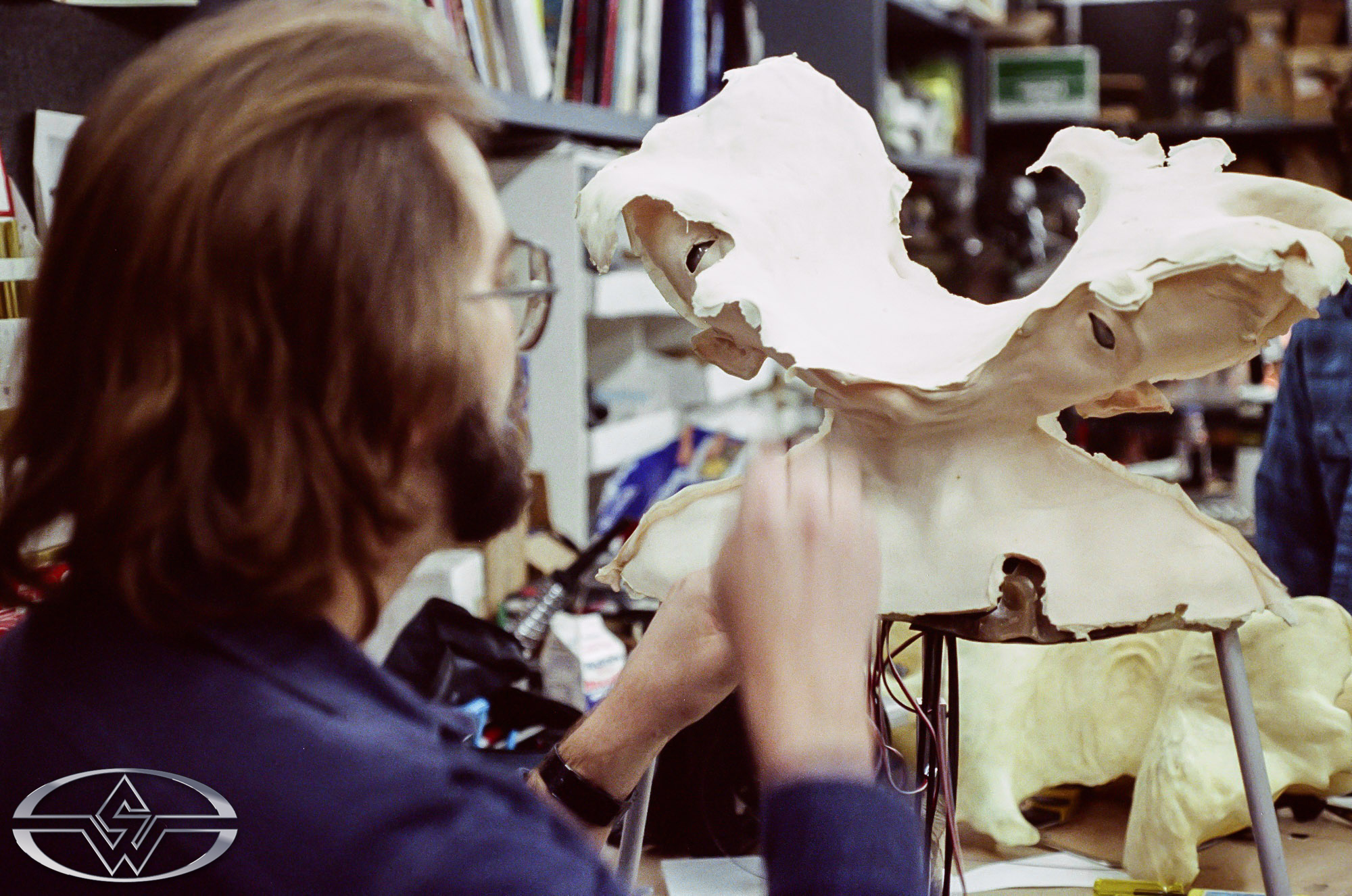 (Craig Caton-Largent works on one of the foam rubber T-1000 puppets.)
The following shot, a frontal view of the ‘splash head,’ required a more detailed puppet that featured eye mechanisms working independently on either side of the T-1000’s split face. Pulley mechanisms pulled the sides of the head toward the middle to suggest the beginning of the healing effect, which was finished off with ILM’s computer graphics.
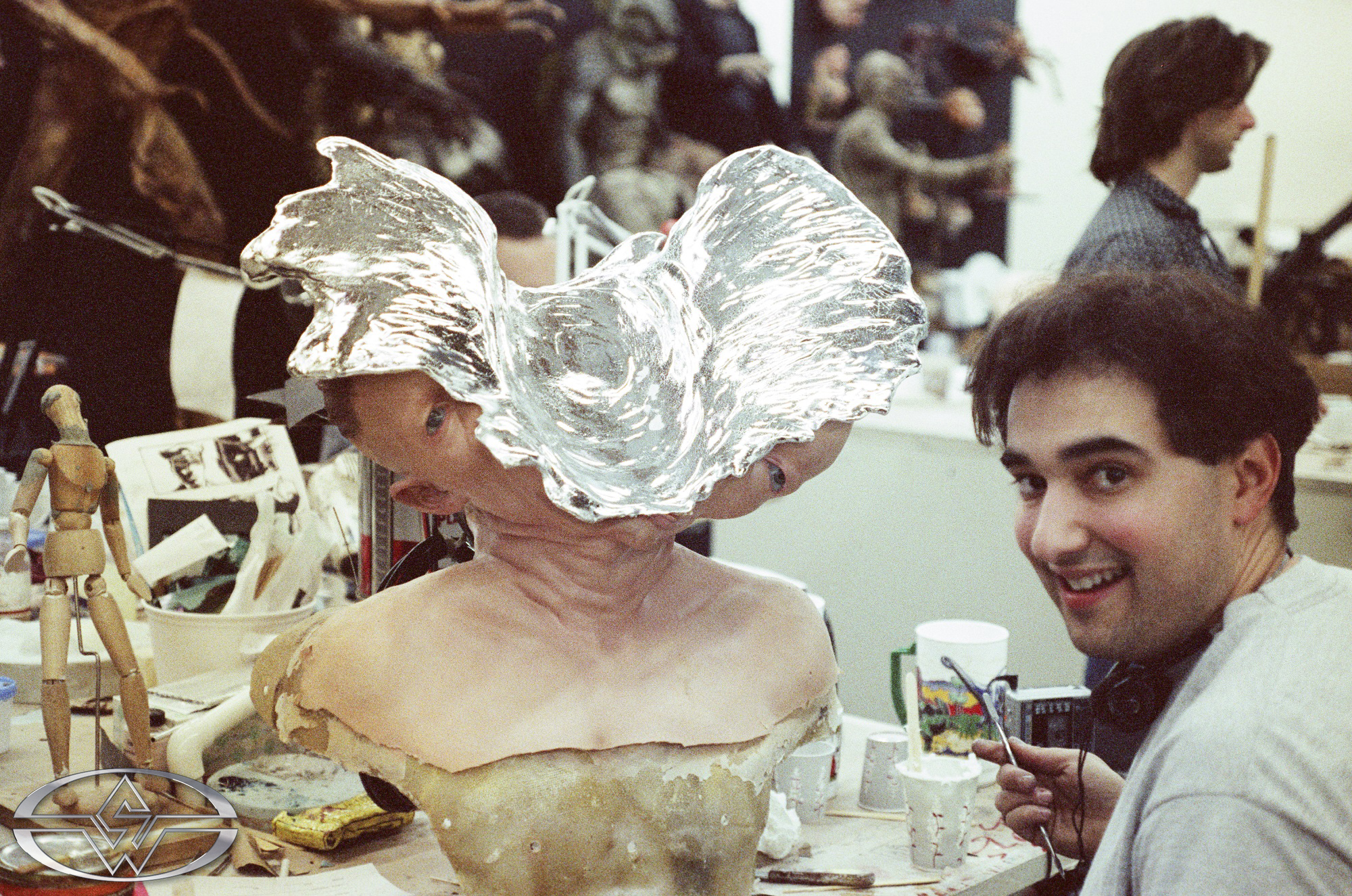 (Shannon Shea works on the wearable cable and radio-controlled partial puppet piece for 'splash head.')
Created from a lifecast of Robert Patrick, the puppet head was made of foam rubber with a vacumetalized inner portion coated with Krylon Crystal Clear, suggesting the look of liquid metal.
A final ‘splash head’ makeup appliance was worn by Patrick’s double for shots of the T-1000 stumbling backward as his head wound continues to heal.
 (The wearable ‘splash head’ on the set of Terminator 2.)
Breaking Down the “Cleave Man” Effect
Terminator 2's steel mill finale featured some of the more complex liquid-metal-man gags created by Stan Winston’s team, including the ‘cleave man’ suit worn by Robert Patrick for shots of the T-1000 after the Terminator has sliced through his body with a steel rod.
 (A Shane Mahan concept for the ‘cleave body’ of the T-1000. Billy Idol’s likeness was used again for this early design.)
Originally, Winston had assumed that he would have to build an entire puppet for the effect; but when James Cameron suggested that he would be willing to shoot it from a locked-off camera angle - rather than having the camera move around the T-1000 - Winston realized that a more simple approach would work.
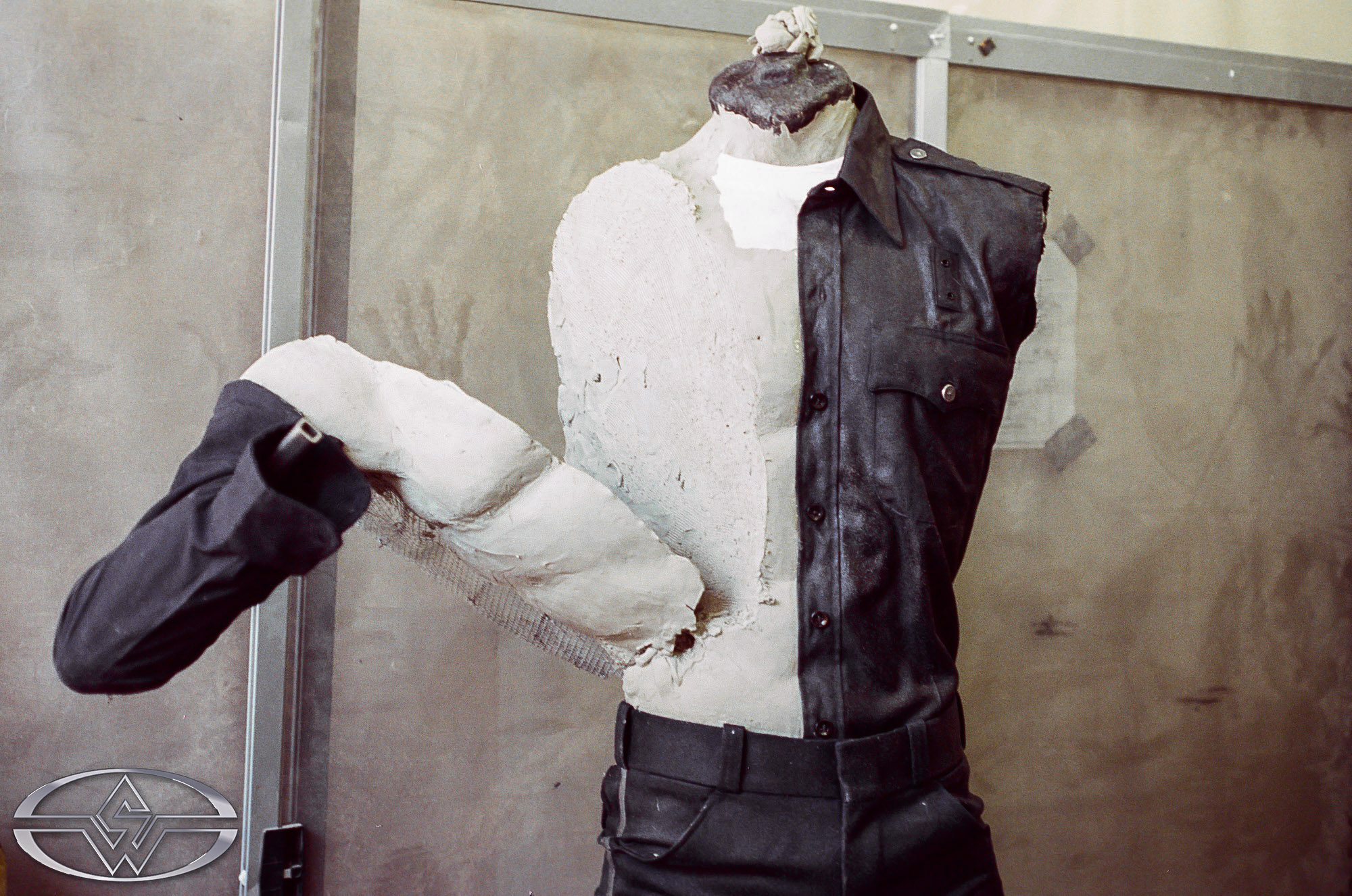 (The 'cleave man effect' featured a resin-impregnated police uniform with a clay "splash.")
Christopher Swift sculpted a foam rubber body appliance that was vacumetalized in the center liquid metal splash area. That appliance was then pressed firmly against Robert Patrick’s body to simulate his right shoulder and side while the actor bent his real shoulder and side backward.
From one specific camera angle, Robert Patrick appeared to be standing in a normal position. When Arnold Schwarzenegger brought the steel rod down through the split line between Patrick’s body and the appliance, the device sprang open.
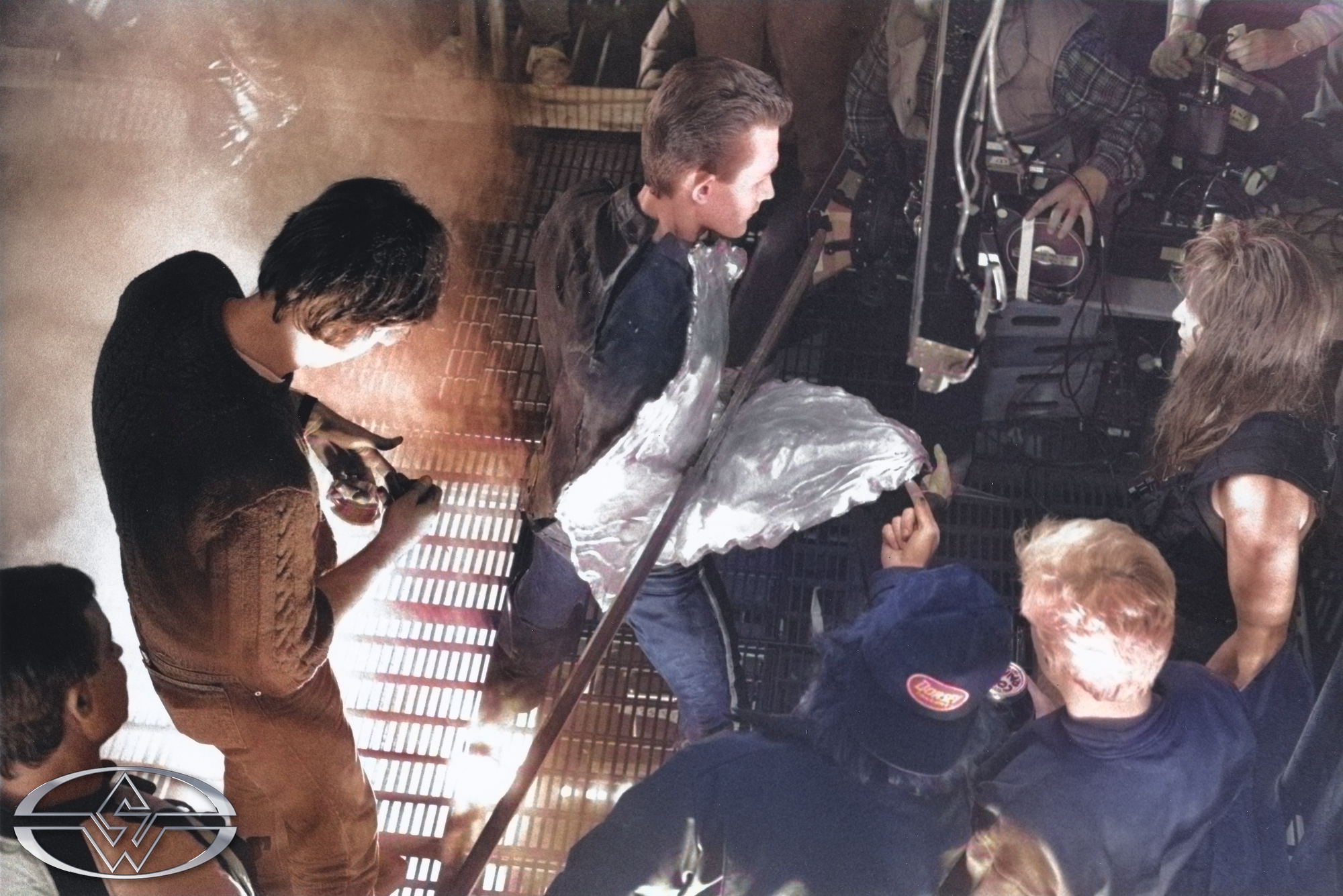 (On-set photo of the 'cleave man' suit in action. The effect was created by filming Robert Patrick wearing a partial suit from one specific camera angle.)
Achieving the “Pretzel Man” Effect
Stan Winston’s crew built three final T-1000 puppets for the ‘pretzel man’ effect, which has the character blowing open after the Terminator has launched a grenade into his midsection.
 (Mark 'Crash' McCreery’s concept design for pretzel man.)
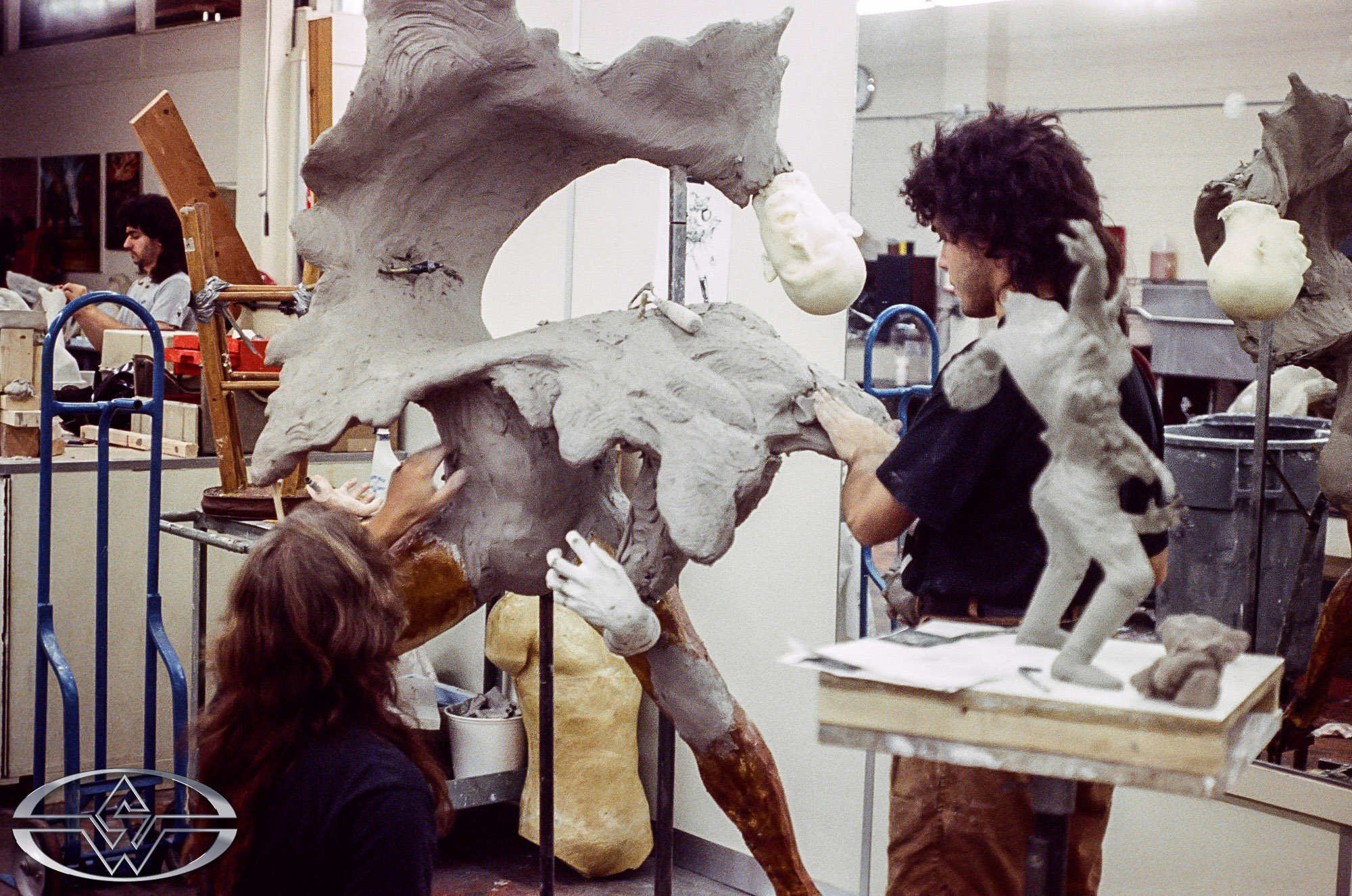 (Andy Schoneberg and Christopher Swift work on the life-size ‘pretzel man’ sculpture, based on the 'pretzel man' maquette.)
The first 'pretzel man' puppet was a spring-loaded replica of Robert Patrick in a splayed-open position, which could be closed up through cables, then released to create the initial exploding action while a pneumatic ram drove the head upward.
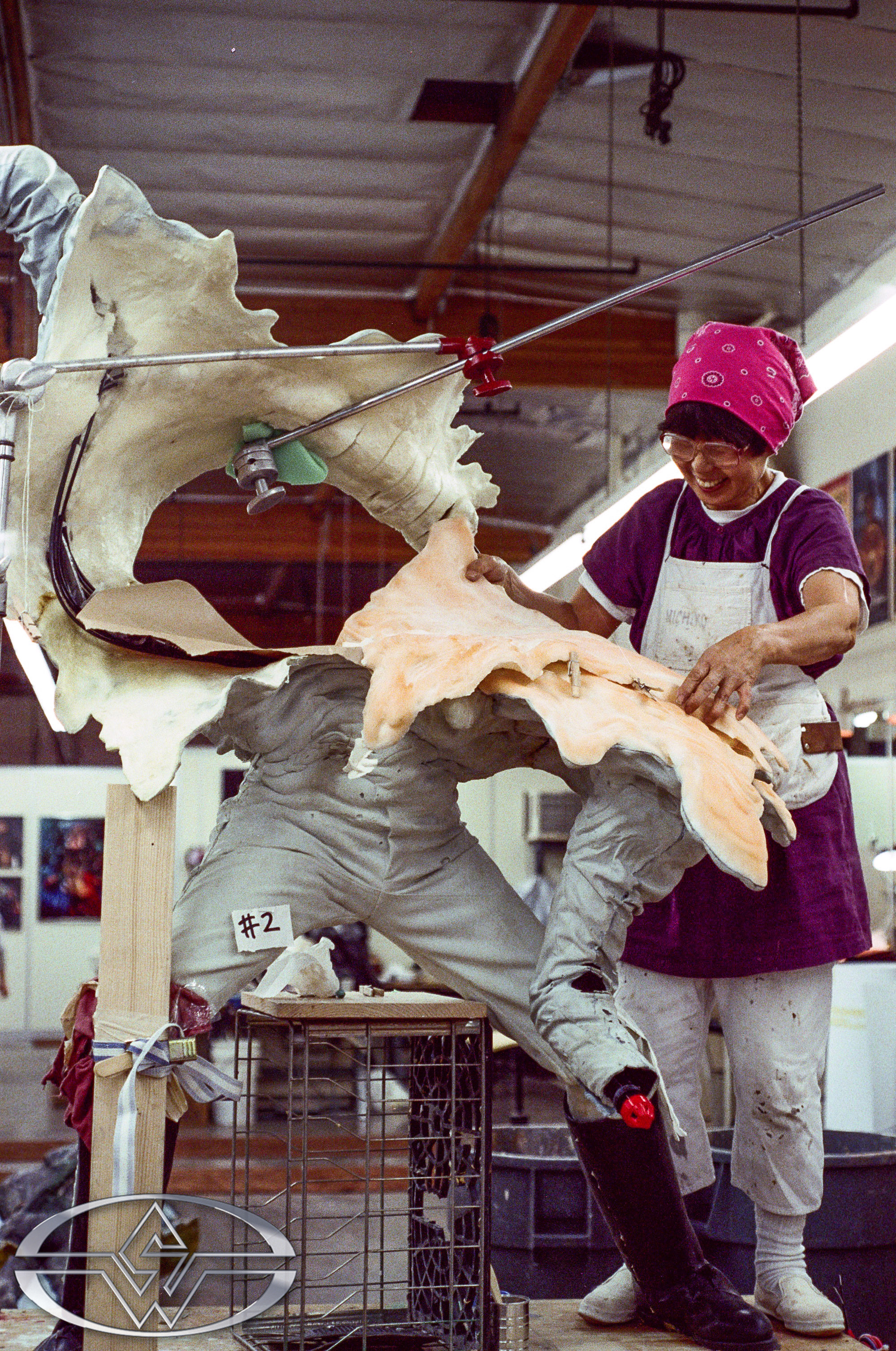 (Michiko Tagawa works on the spring-loaded 'pretzel man' puppet.)
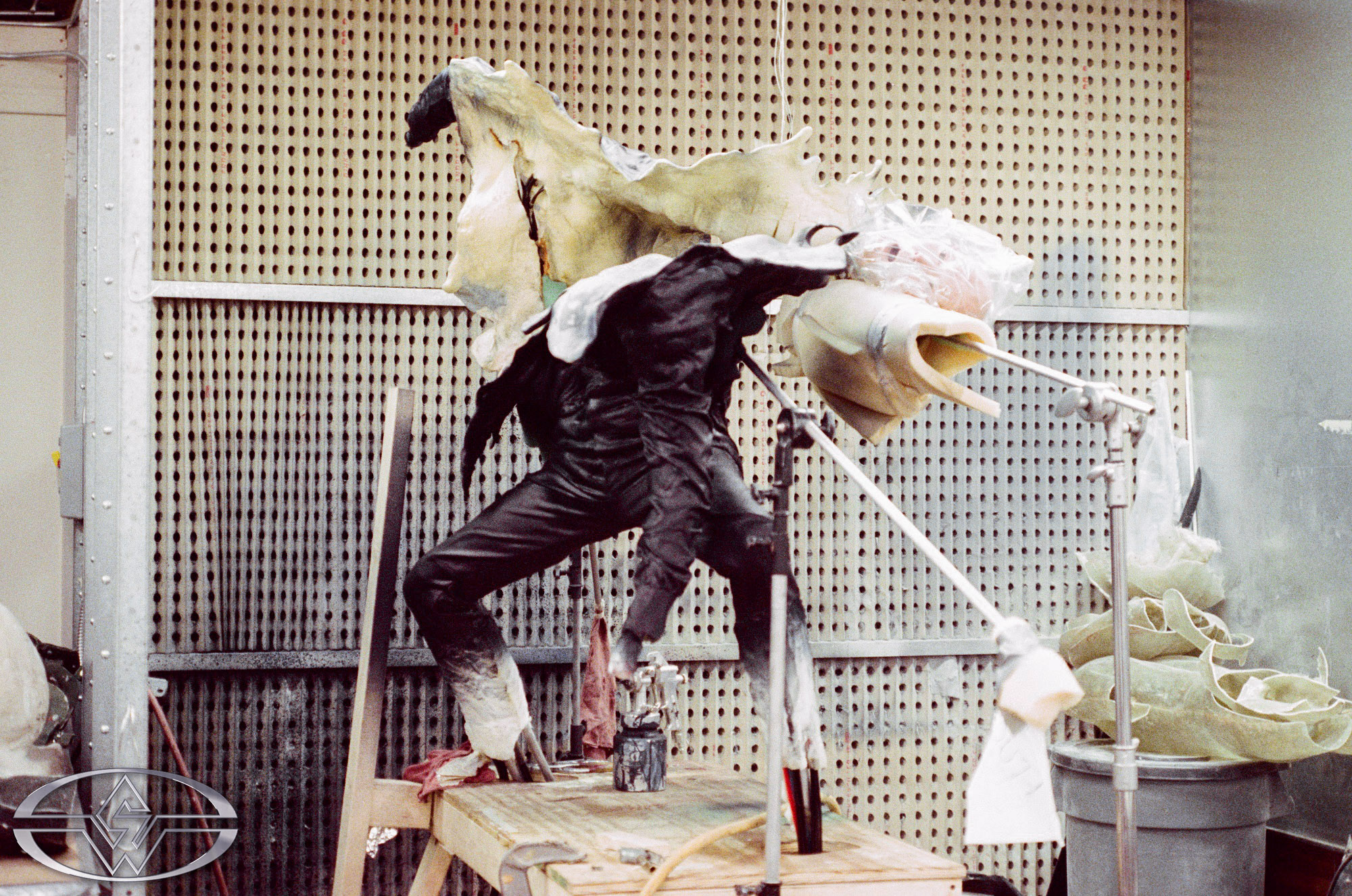 (The spring-loaded ‘pretzel man’ puppet during painting.)
A stage two 'pretzel man' puppet was built for shots of the cleaved T-1000 stumbling toward a pit of molten steel. The puppet was mounted onto gimbals at the ankles to create a teetering motion, while other body movements were achieved through rods, puppeteered by crewmembers stationed below the set. Jaw and eye movement in the head were radio-controlled while spinning head action was cable-controlled.
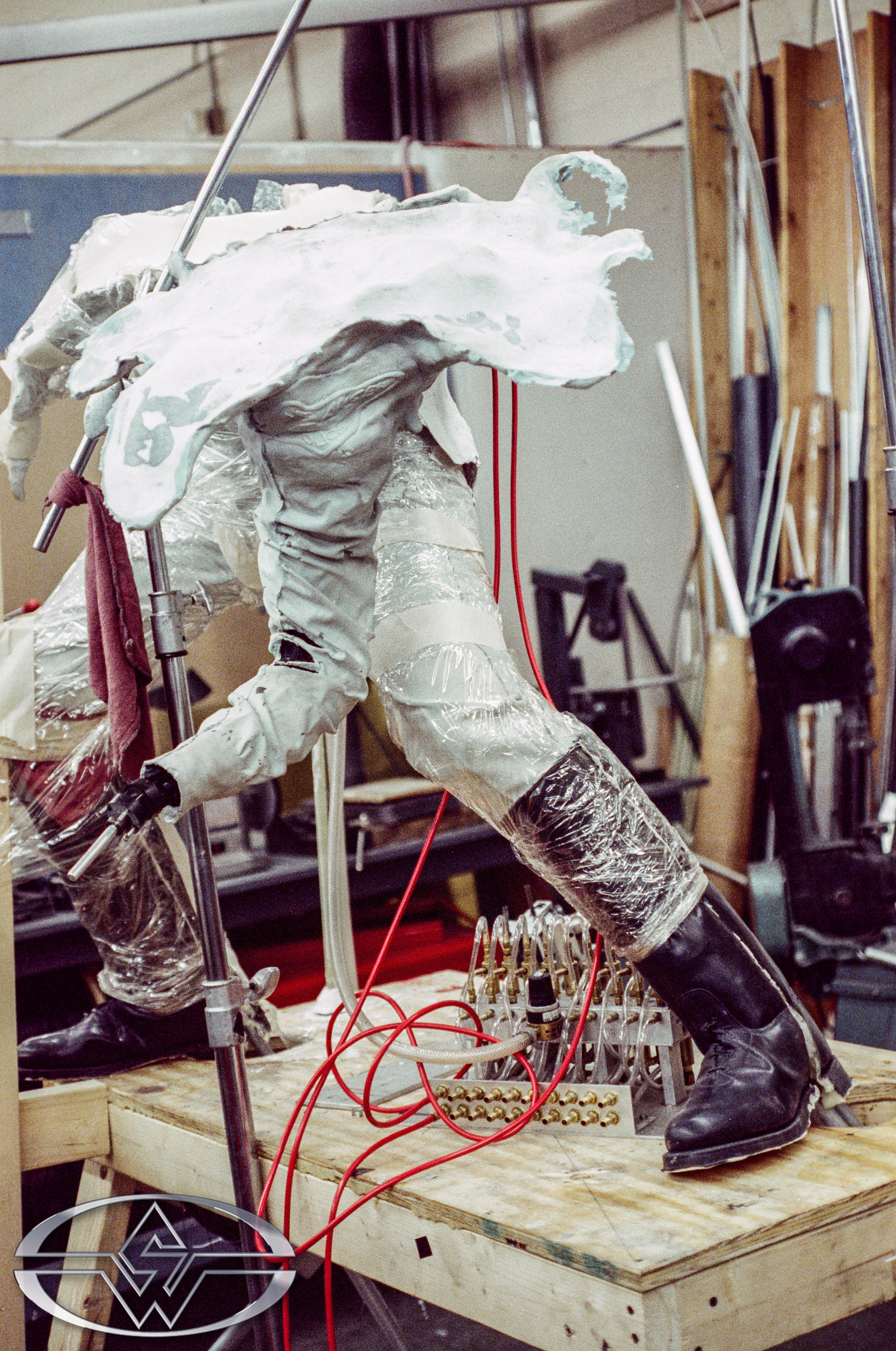 (A work-in-progress image of the stage two 'pretzel man' puppet.)
A third non-articulated 'pretzel man' puppet had a thirty-five-pound weight in its back to aid its fall into the molten steel, which was actually an underlit gelatinous concoction created by the special effects team.
 (Evan Brainard touches up the third, non-articulated 'pretzel man' puppet on the set of Terminator 2.)
Making the Bullet Effects
Among the T-1000 effects were appliances that would suggest the splash impact of bullet hits on the liquid metal man, first seen in an early sequence at a shopping mall, where the original Terminator fires on the T-1000.
 (Greg Figiel works on the bullet-hit T-1000 head sculpture for the tanker truck scene.)
To research the look, Stan Winston and his crew spent weeks shooting pellets into the mud, studying the patterns made by the impact, then duplicating them in sculpted form and producing appliances. Vacumetalizing slip rubber latex material, backed with soft foam rubber or polyfoam, achieved the chrome look.
 (Bullet-hit devices were attached to pre-scored police uniform shirts worn by T-1000 actor Robert Patrick and his stunt doubles.)
The splash appliances were sculpted and produced in a variety of patterns and sizes, and were fitted with an irising, petal-like spring-loaded mechanism that would open the bullet wounds on cue.
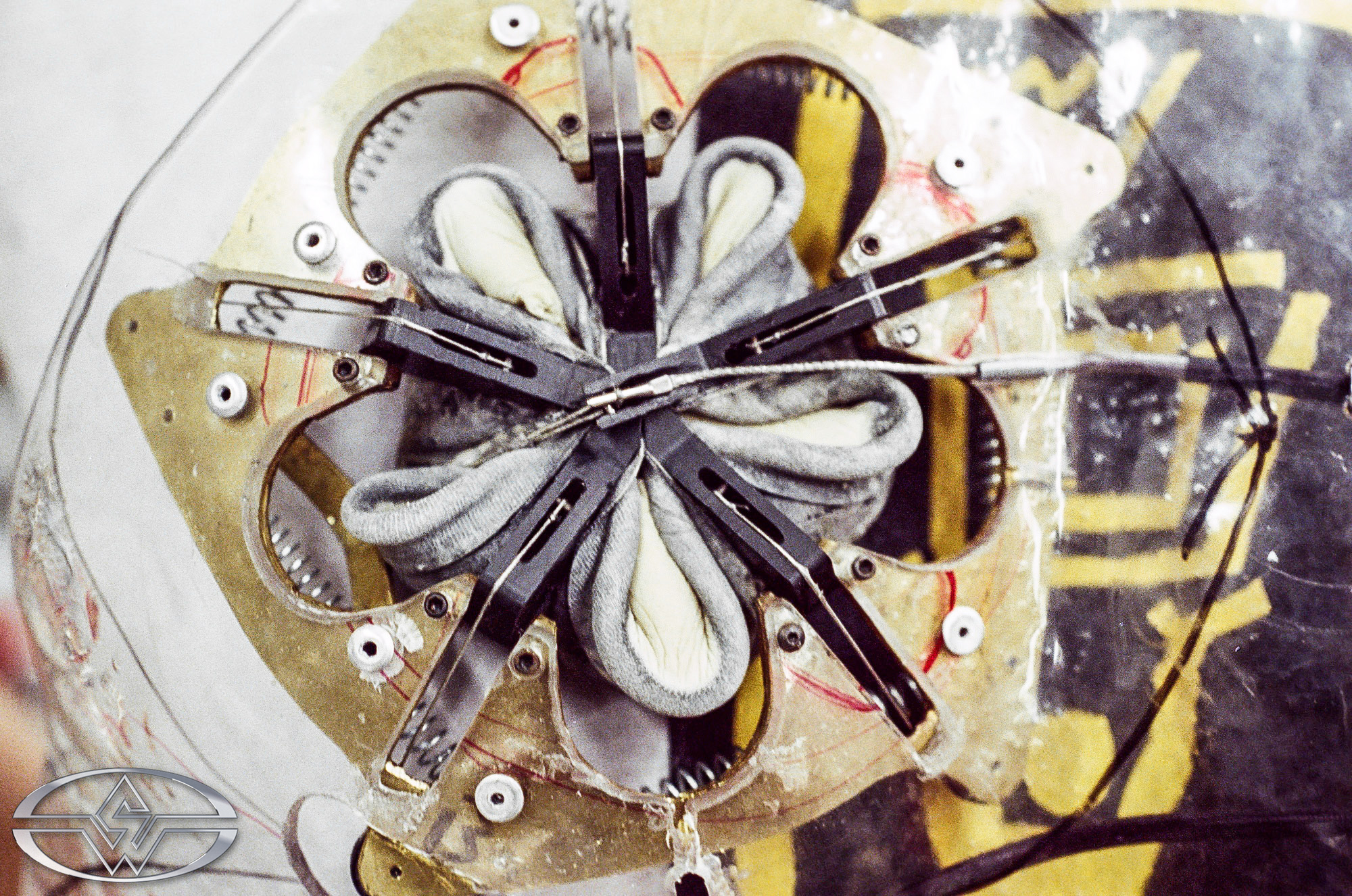 (One of the various spring-loaded mechanisms for exploding T-1000 bullet hits.)
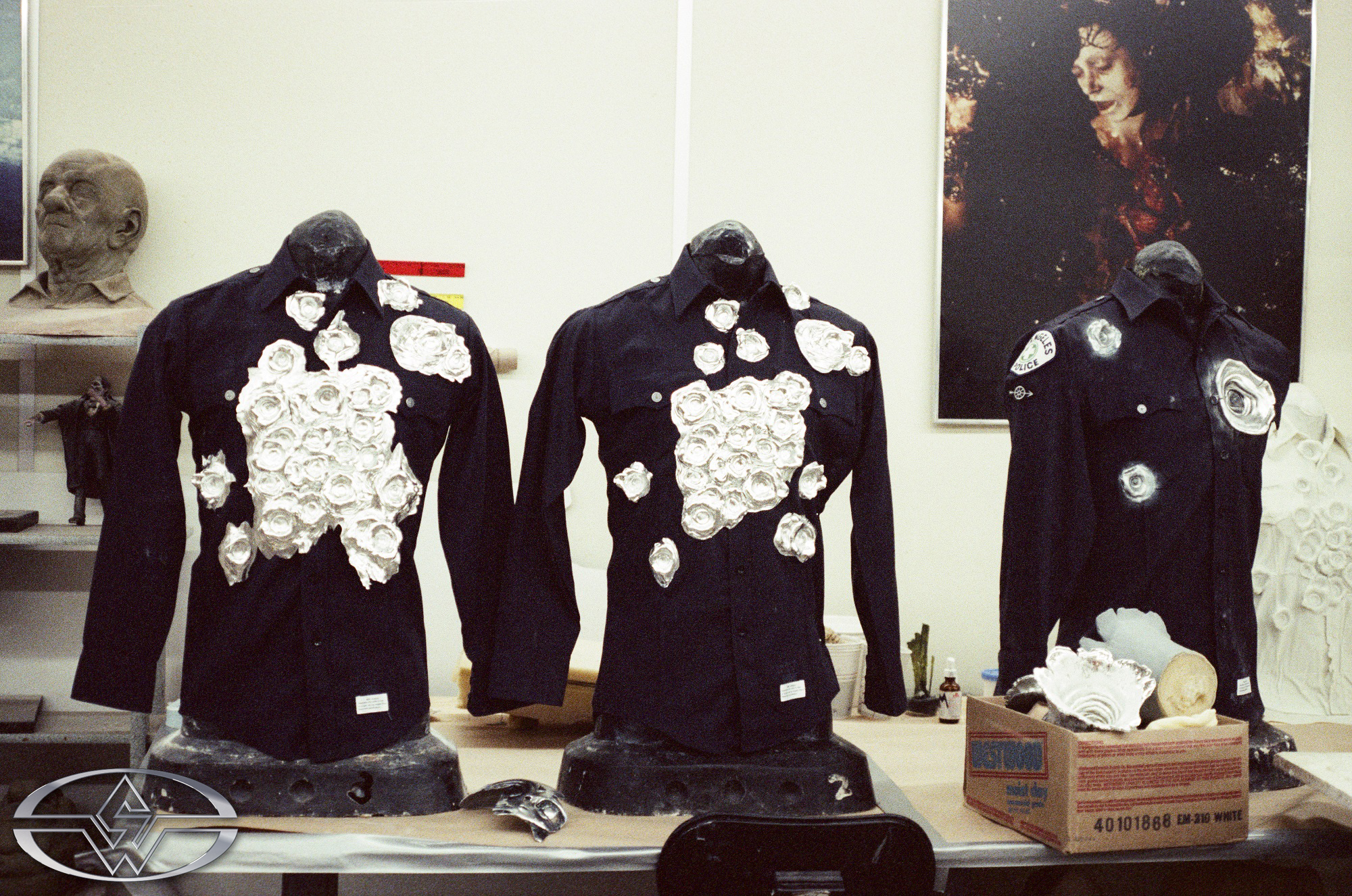 (Some of the uniforms with different bullet-hit patches.)
This flowering mechanism was attached to a fiberglass chest plate worn by Robert Patrick under a prescored costume and was actuated by a single radio-controlled cable pin release. The pin’s release would open the petals, replacing that area of the costume with the chromed bullet splash.
 (Robert Patrick wears a chest piece fitted with the appliances.)
Designing the T-1000’s Blades
With John and his Terminator protector on the run, the action moves to the home of the boy’s foster parents, where the T-1000 kills his foster mother, Janelle (Jenette Goldstein), and takes her form. Later in the film, the T-1000 morphs into a security guard at a state mental hospital, then uses his finger spike to kill the original guard.
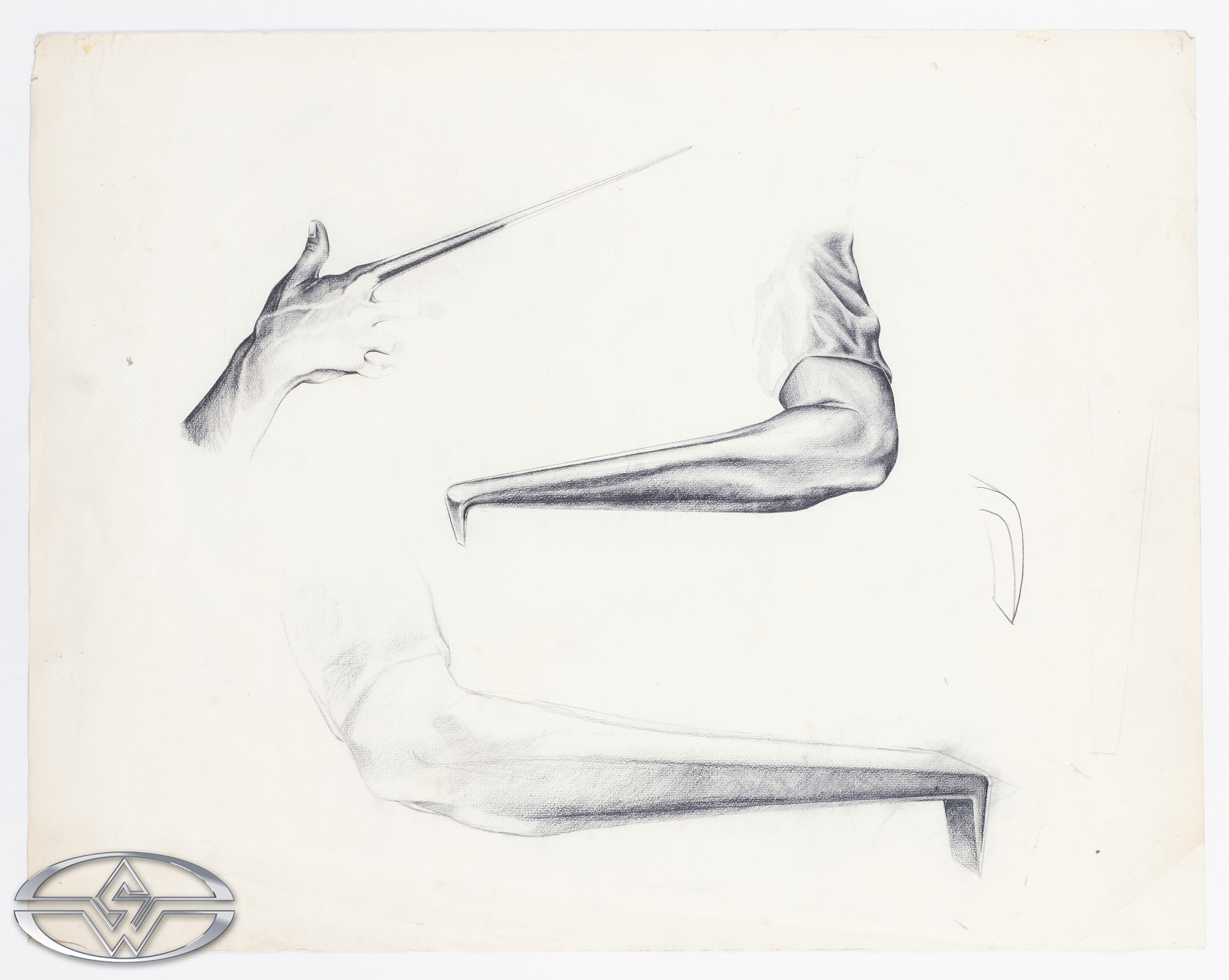 (Ian Stevenson’s designs for the T-1000 hook arms and spike finger.)
Stan Winston Studio sculpted and produced a tapered blade arm, attached by a strap to Goldstein's shoulder, for a shot of the woman driving the blade through the head of her husband, Todd (Xander Berkeley).
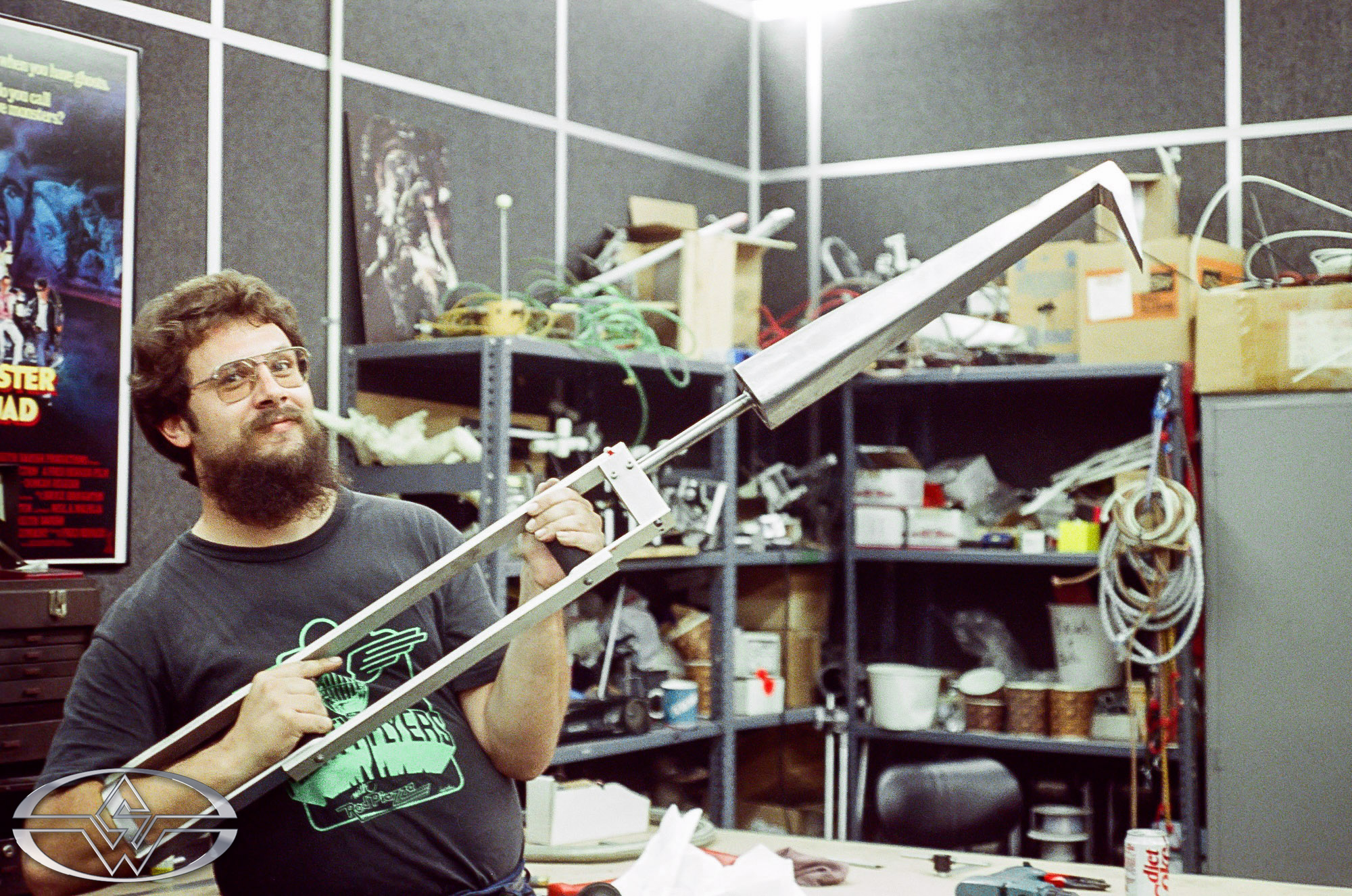 (Mark Goldberg with one of the hook arms created for Terminator 2.)
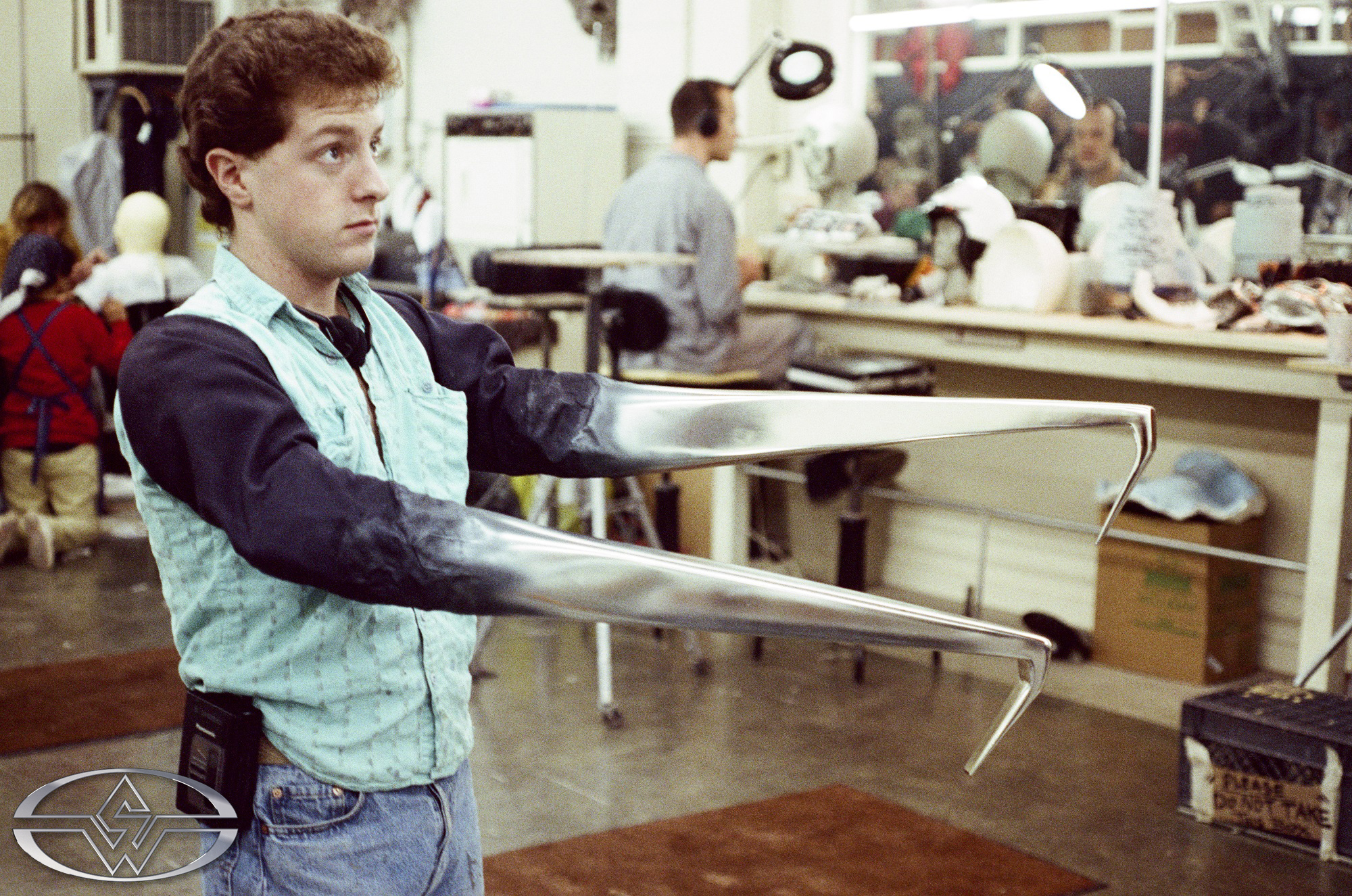 (David Grasso tests two of the hook arms.)
As the T-1000’s weapon of choice, blades built for the show would number in the hundreds. Although seemingly simple, the blades posed continual challenges to Stan Winston Studio artists and technicians since the vacumetalizing process revealed even the most minute flaws in their form. The Janelle blade arm, for example, which was made of fiberglass and ABS plastic, had to be made and remade multiple times before the crew produced a perfect specimen.
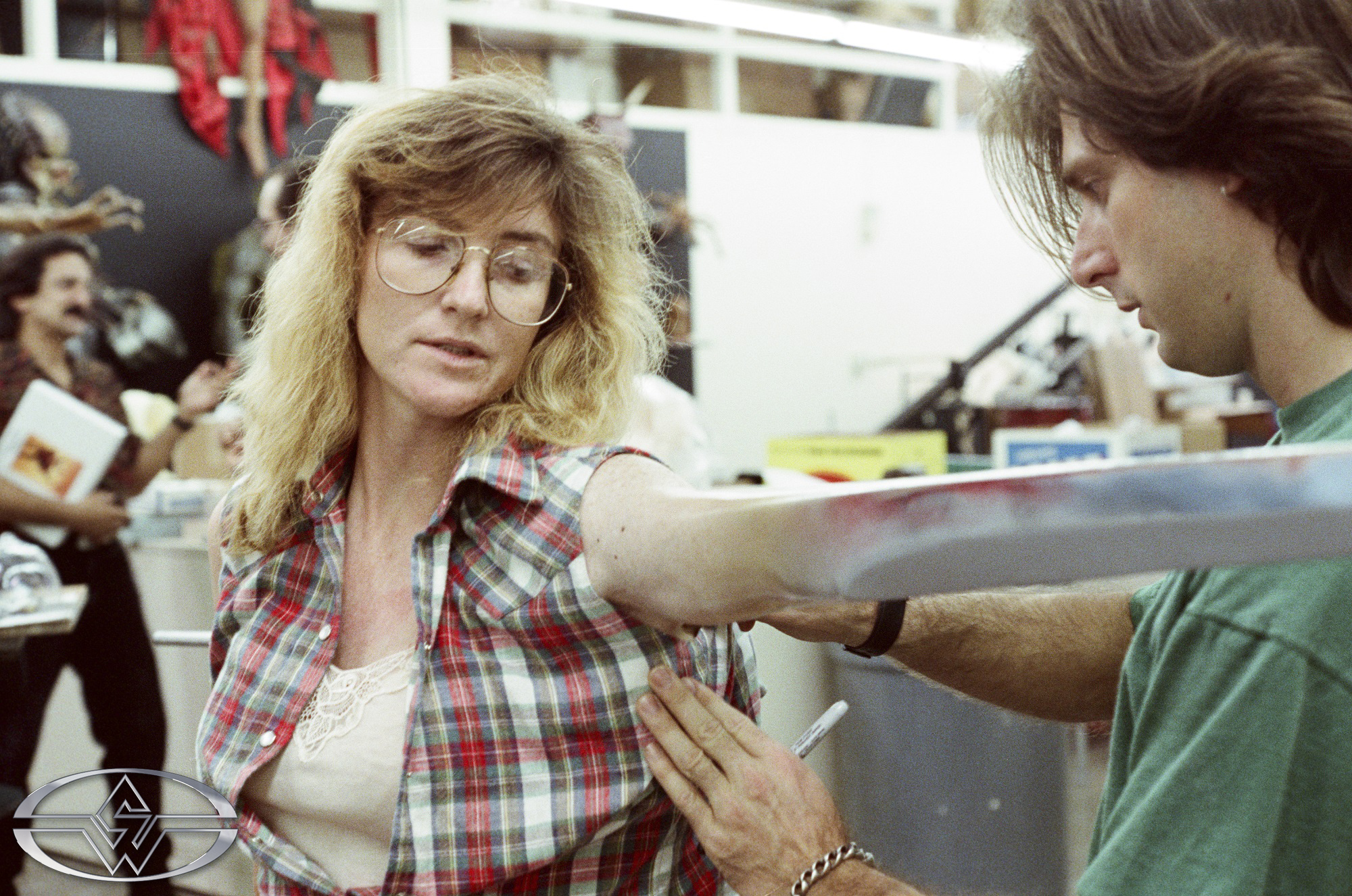 (John Rosengrant applies the 'Janelle blade' to Karen Mason for testing.)
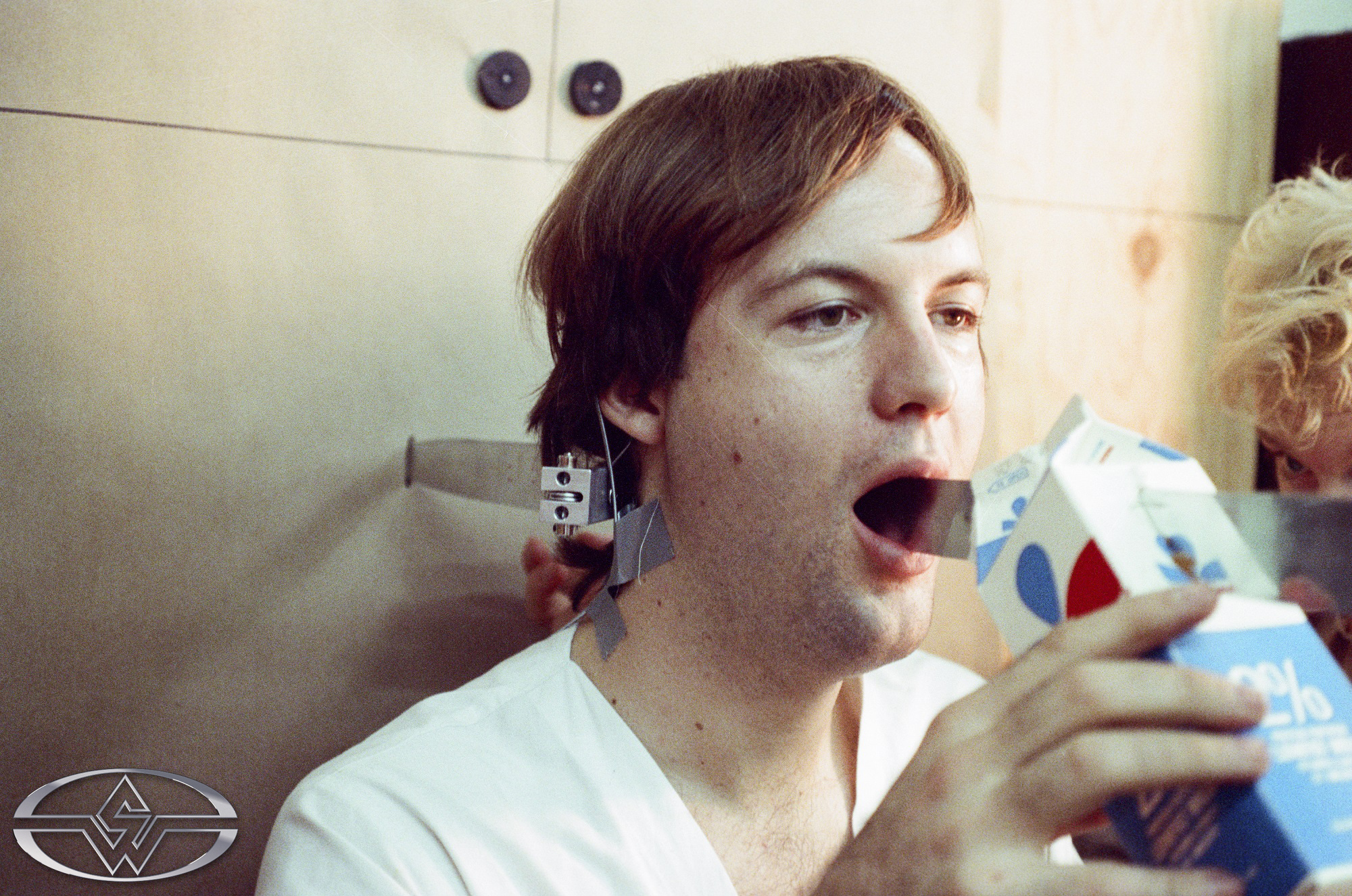 (Richard Landon and Shane Mahan test the 'Janelle blade' effect in the Stan Winston Studio.)
Thinner urethane blades were employed for shots of the T-1000 inserting a stiletto into the eye of the hospital security guard.
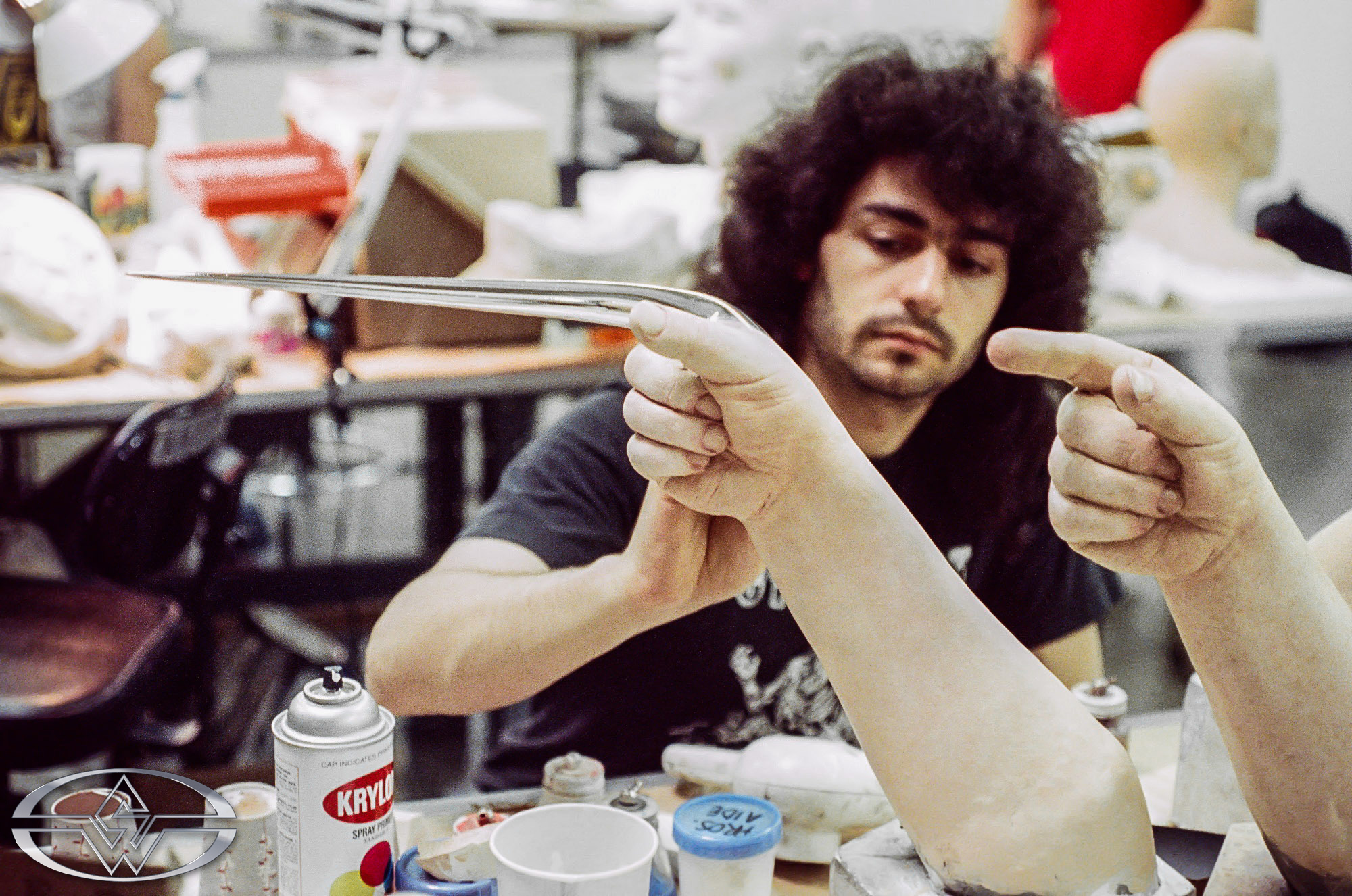 (Mike Spatola works on the 'spike fingers.')
“For the blade going into the eye,” said Richard Landon, “we’d built three hand-and-blade rigid props that would fit on the actor’s hand - one with a finger that tapered into a short blade, one with a finger tapering into a medium length blade, and a third finger tapering into a long blade. We were going to shoot it almost like a stop-motion animation replacement effect. We’d shoot the short blade, then replace it with the longer blade, shoot that, and so on. ILM would then do a morph between each blade, and by the time it was all put together, it would look like the blade was growing on screen.”
 (On-set image of Linda Hamilton, Robert Patrick, and John Rosengrant watching James Cameron, who wears one of the 'spike fingers' to illustrate its use in the upcoming scene.)
The Making of the Liquid-Frozen T-1000
The finale of Terminator 2 is set at a steel mill, where a tanker truck transporting a load of liquid nitrogen crashes. Within the steel mill, liquid nitrogen leaking from the crashed tanker surrounds the T-1000, causing him to freeze.
Stan Winston Studio adhered shredded Christmas tree tinsel to Robert Patrick’s body with adhesive, then sprayed it with fake snow to create a frosted look. The crew repeated the treatment in sections, starting at Patrick’s feet and ending at his head. Over the course of five nights, James Cameron shot each subsequent stage separately; and when the film ran, it created the illusion of frost moving up the character’s body.

(The casting and the sculpture of the frozen-solid T-1000.)
The freezing T-1000 continues to move forward, his frozen limbs shattering into pieces. To create the illusion of the T-1000’s legs breaking apart, double-amputee Larry Johnson wore special urethane boots that were cut into jigsaw puzzle segments, all held together by a cable device. As Johnson stepped forward, the cable device was activated, which broke up the boot into shards.
A jacket with a cable-controlled false arm in it, worn by Robert Patrick, was built to capture shots of a frozen hand breaking off at the wrist when he falls. The fake arm was lined up to a fake hand mounted on the set floor. As Patrick rose and pulled his arm away, a cable-actuated mechanism made the floor-mounted hand collapse into pieces.
The parts fit together like a puzzle.
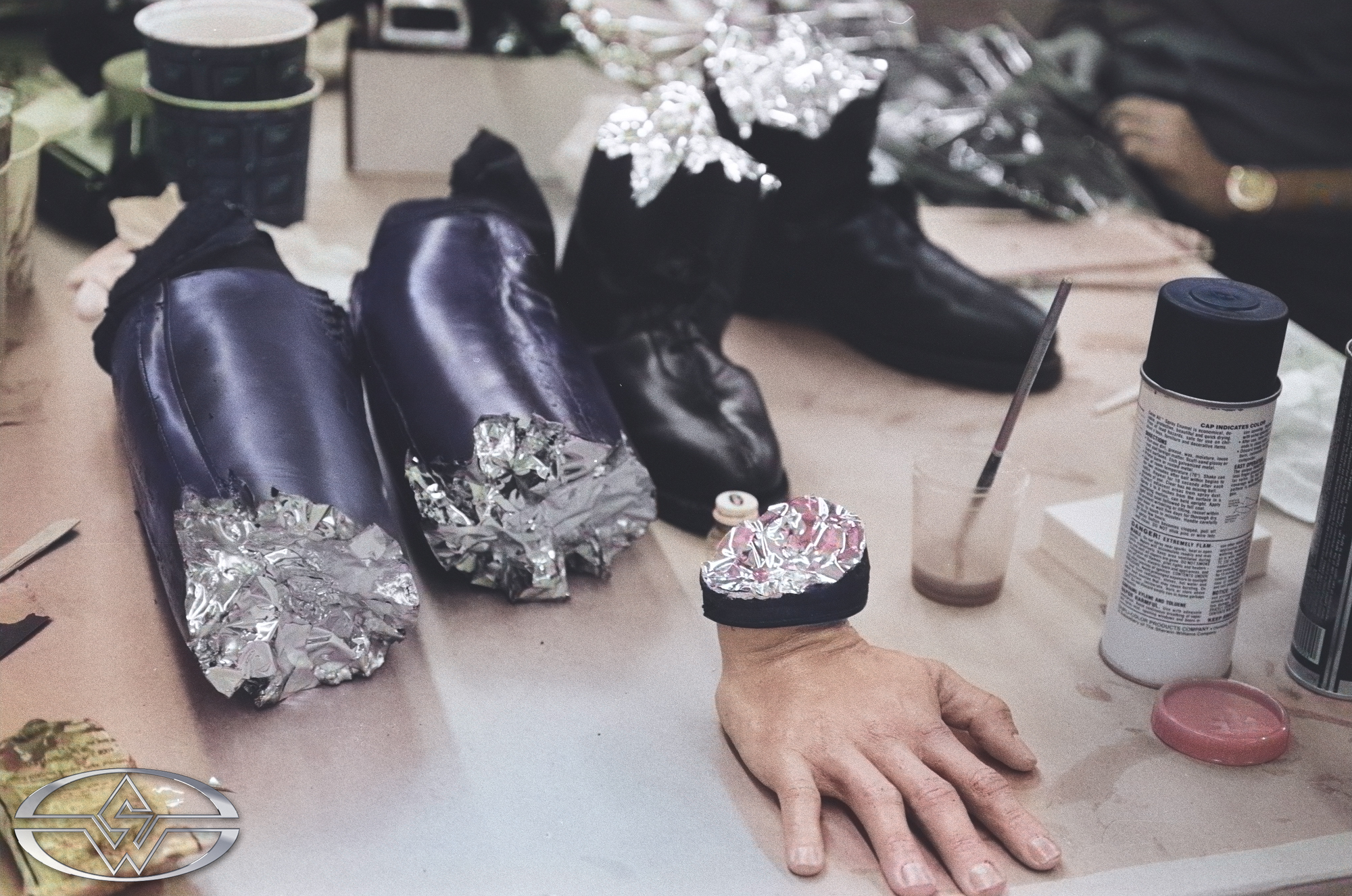 (Breakaway prosthetic pieces used for the scene where the T-1000 freezes, then breaks apart as he attempts to move.)
Stan Winston Studio built a Patrick dummy for final shots of the T-1000 frozen solid, then shattering from Terminator gunfire. Winston’s crew filled the dummy with metallic flakes and vacumetalized urethane foam shards. The special effects team blew the form apart with a primer cord. Air mortar cannons aimed straight down at the sculpture caused the shards to collapse onto the floor with the primer cord blast rather than fly outward, as per Cameron’s request.
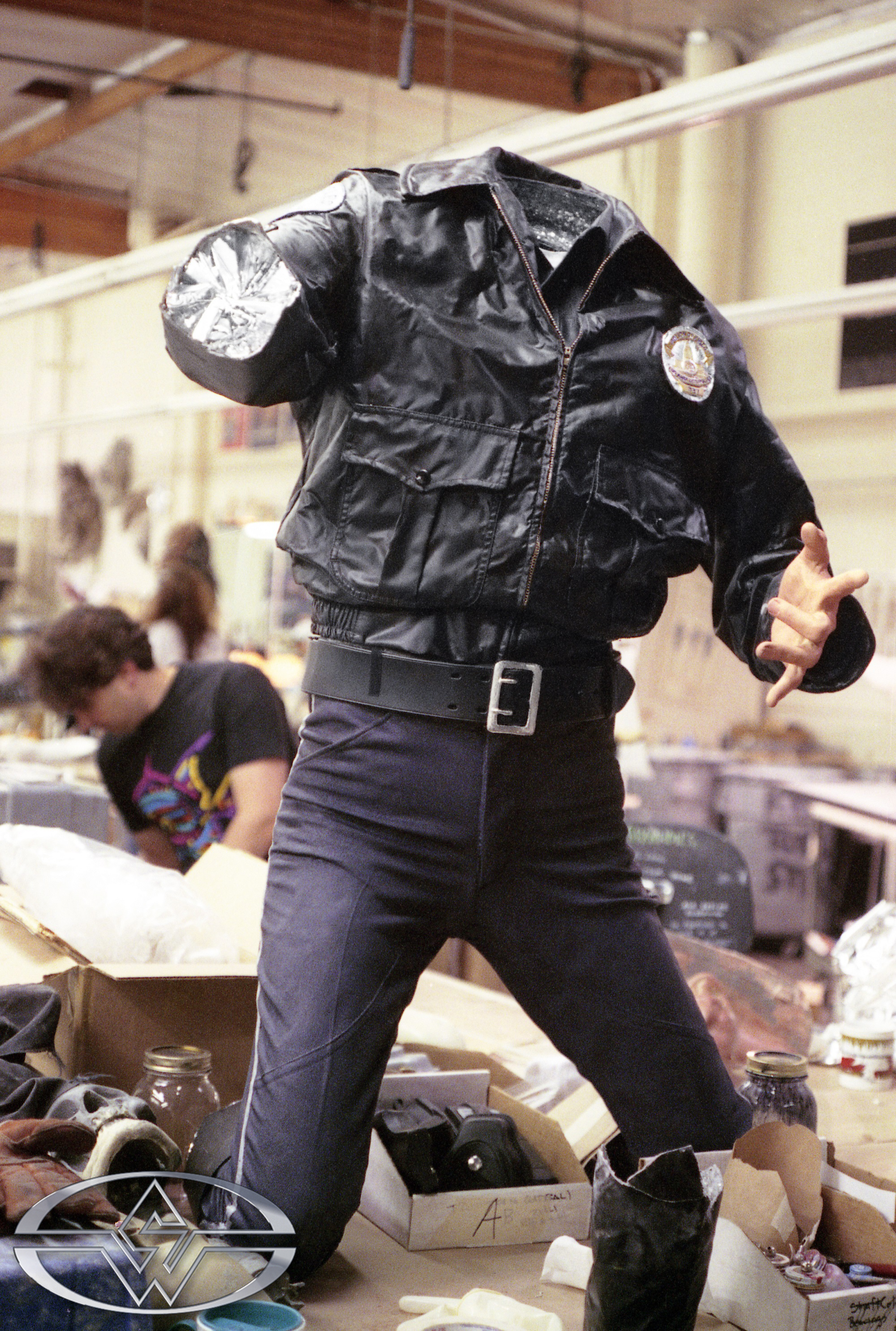 (The final painted frozen body. Made of ultra-thin, prescored fiberglass and rigged with primer cord, the body was blown apart as slow-motion cameras captured the shattering effect.)
The SFX Challenges and Successes With Terminator 2
Made on an incredibly tight schedule and featuring hundreds of character effects, Terminator 2: Judgment Day would go down in the Stan Winston Studio record books as one of its most difficult projects ever. “Terminator 2 was all-encompassing and often overwhelming,” John Rosengrant noted. “There were so many gags, so many effects; it felt like we were always playing catch-up. There were lots of puzzles to solve and very little time to solve them. There was never a moment to just stop and enjoy the process. Because of the number of effects, the variety of effects, the lack of time, and the intensity, Terminator 2 was the most difficult show I’ve ever worked on.”
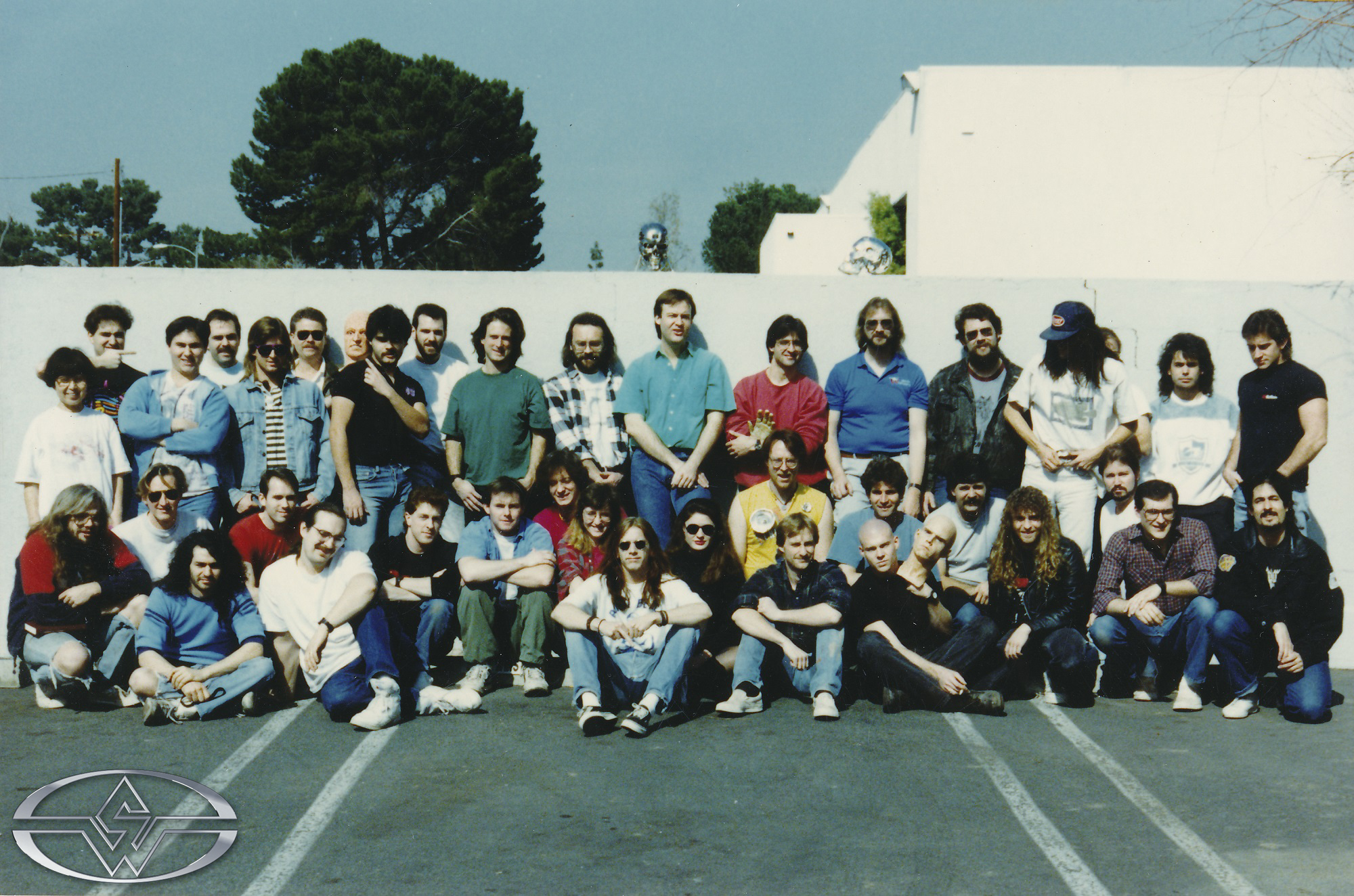 (Team photo of the Terminator 2 crew.)
Looking back on the experience, Stan Winston, too, recalls the challenges of the show. But he also takes satisfaction in the quality and number of effects he and his studio were able to achieve live, in-camera. “Everybody who looks at Terminator 2 now thinks that it was all done with CG - and that’s fine with me, as long as they watch the movie and enjoy it. But nearly all of those liquid-metal-man shots were done using our puppets. We created 300 separate effects for Terminator 2. It was the biggest show we’d ever done up to that time.”
Dinosaur-sized, in fact.
- Blog assembled by Adrienn Lingurár with selections from The Winston Effect: The Art and History of Stan Winston Studio by Jody Duncan
Courses with the Creators of Terminator 2
- Special Effects Sequence Design with Shane Mahan
- Animatronics Design Basics with Richard Landon
- Hybrid Characters: Blending Practical & Digital FX with John Rosengrant
- Hybrid Character Design: Practical To Digital with Christopher Swift
- Animation For Animatronics: Intro To Pololu, Maya & AnimServo Software with Craig Caton-Largent
- How To Build An Animatronic Head - Creating The Mechanical Underskull with Craig Caton-Largent
- Garage Monsters - How To Make Creature FX On A Budget with Shannon Shea
- The Business of Making Monsters with Shannon Shea
- Mastering Effects Disasters - Explode A Head with Andy Schoneberg
- Remote Makeup Application Part 1: Prosthetic & Kit Preparation with Andy Schoneberg
- How To Sculpt A Character Makeup with Bruce Spaulding Fuller
- Character Makeup - Multi-Piece Prosthetic Application with Bruce Spaulding Fuller