

By Lexi Stewart
How do you reinvent an icon? For over 30 years, The Terminator films have cemented themselves into film history as one of the most successful sci-fi action franchises of all time, generating over $3 billion in revenue. When news of another film arose, fans on the internet were hesitant at first to get on board. But when James Cameron, Arnold Schwarzenegger, and Linda Hamilton all signed up to return, reluctance turned to anticipation. James Cameron revealed that the story he'd effectively left off in Terminator 2: Judgment Day was open for continuation, and now was the time to start the machine up again.
Jump To Section
- Combining Old and New Looks for the T-800
- Creating an Updated Cyborg for Terminator: Dark Fate (2019)
- The Makeup Effects for Grace, the Human Terminator
- Carrying on Stan Winston’s Legacy with Terminator: Dark Fate
- Terminator: Dark Fate Makeup Effects Crew
 (Poster art for Terminator: Dark Fate)
Terminator: Dark Fate ignores the most recent sequels and starts off back in 1998, following the events of Judgment Day. The story soon jumps 20 years into the future to introduce a cast of new characters alongside the original duo (Sarah Connor and T-800). Tim Miller of Deadpool fame was brought on to direct, and he made sure to bring his Deadpool makeup designer Bill Corso.
Corso was hesitant at first and took some convincing. "Tim said, 'the whole Deadpool gang is doing it. It's going to be a lot of fun. James Cameron is back. He's producing, he's writing, he's going to be really involved, and it's going to be a very different scenario. Linda Hamilton's coming back as Sarah Connor, and we're literally starting off after T2.'" Hearing those words sealed the deal for Corso.
 (Geoff Redknap and Bill Corso apply T-800 prosthetics to Arnold Schwarzenegger. Image courtesy of Bill Corso)
Of course, the practical effects and prosthetics wouldn't be complete without involving the talented team at Legacy Effects, who have contributed special makeup effects to every Terminator film since Stan Winston's passing in 2008. Legacy Effects co-owner and former Stan Winston Studio supervisor John Rosengrant, who has worked on every Terminator film since the original, was eager for the team to return and continue the legacy. Bill Corso looked forward to working alongside them. "It was very important to me to have John and the guys involved because there is a real legacy there. They know that I was trying to do it right, and I felt comfortable having them work with me on it."
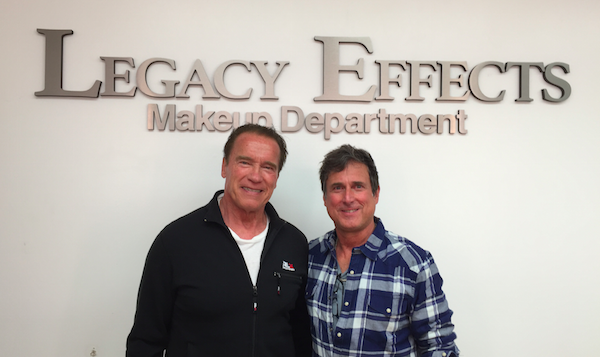 (Arnold Schwarzenegger & John Rosengrant reunite at Legacy Effects. Image courtesy of Legacy Effects)
Combining Old and New Looks for the T-800
The filmmakers decided that the T-800 would retain a similar look to what had been seen in the past. "I think they wanted to stay traditional and retain humanity to him but also not make him ugly or monstrous," John Rosengrant explained, "There's a heroic feeling to the T-800, starting from T2. The minute that goes away, it goes to zombie land. So that heroic look was to be maintained."
However, Rosengrant agreed with Corso, who also wanted to bring something new to the character. "Bill executed the work and gave concepts to the director and Arnold as to where he wanted to take this. He wanted to present a slightly different looking Arnold than what we've seen in the past, and rightly so."
One of the most interesting variables that became apparent from the start was that the T-800 would have aged after the 22-year time jump. Rosengrant had worries initially but loved that the writers had accounted for it this time around. "Back on T3, we were trying to disguise this stuff, you know? If there was a wrinkle, we'd put a wound there. It's just great that they wrote the story for Arnold's age this time around. I think he looks terrific. They embrace aging, which is excellent. It's living tissue on an endoskeleton, so it made sense. That was honestly one of my biggest worries going into the job, but it really works."
 (T-800 Stage 2 Makeup Design. Image courtesy of Bill Corso)
Corso recalls, "My idea was, let's keep all the appliance work on Arnold paper-thin, so it really is just like ripped-up skin that we would see deep into. But he's an older guy now, and it's living tissue over an endoskeleton which has aged naturally for 30-40 years," said Corso. As an older Terminator, it was also decided that the T-800 would bleed much less freely, as his blood would have grown darker and thicker over time.
To create the endoskeleton elements visible under T-800's flesh, "ILM was very heavily involved, and [VFX supervisor] Eric Barba was very open and excited to allow me to collaborate on the looks of anything makeup and cosmetic related," said Corso. "There's a lot of depth to the makeups, which is really exciting to me, and hopefully, the result is the perfect marriage of practical makeup and CG."
 (T-800 Stage 2 Ver. 1 Makeup Design. Images courtesy of Bill Corso)
Creating an Updated Cyborg for Terminator: Dark Fate (2019)
After receiving Corso's approved designs, the team at Legacy Effects had Arnold Schwarzenegger come into the workshop for an updated digital scan, which would give a better foundation to start sculpting on. "Old school lifecasts still give you that texture," explains Rosengrant. "What the scan gives you is a form to sculpt on that is accurate to the actor. Nothing has been pulled or pushed from the lifecasting process."
Corso was determined to get his hands dirty with Legacy during the prosthetic build process. "I'm not one of these guys who comes up with an idea or designs a look and just hands it over, I like to be hands-on. So I asked John if he would be all right with me blocking out some of the sculptures. I'd shown him all the designs which were based on old Stan Winston Studio concepts. He was great. They set me up with a table at Legacy Effects, and they brought a scanned lifecast for me to start on."
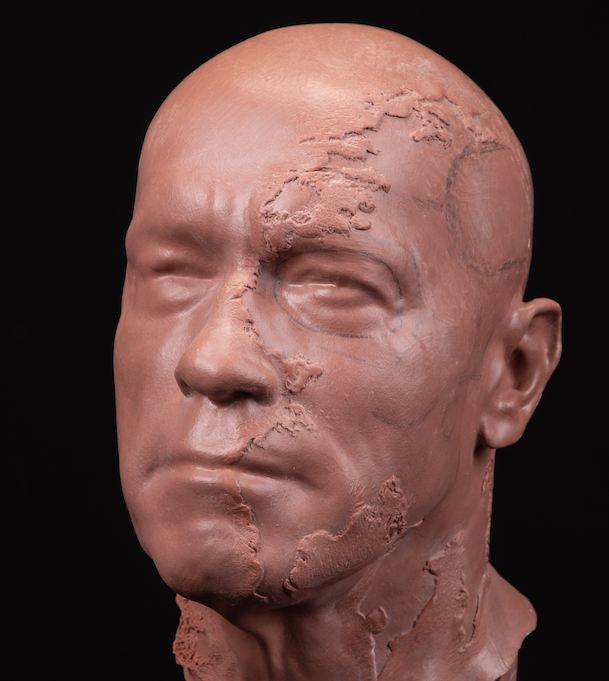 (Bill Corso's roughed-out sculpture on a 3d printed scan of Arnold Schwarzenegger. Image courtesy of Legacy Effects)
Corso began blocking out the sculpture on the form printed from the scan. He said, "We sculpted the appliances on the scan because it had a better representation of what his face would sit like normally. Then we just used the lifecast for texture reference. The really nice thing about Legacy Effects is that they really have taken the art of makeup effects to the ultimate level." Key sculptor Mario Torres finished the roughed-out sculpt with extreme attention to final details and finesse. Both Rosengrant and Corso spoke highly of Torres' work on the project.
 (Key sculptor Mario Torres details torn T-800 flesh. Image courtesy of Legacy Effects)
 (T-800 Stage 2 appliances. Image courtesy of Legacy Effects)
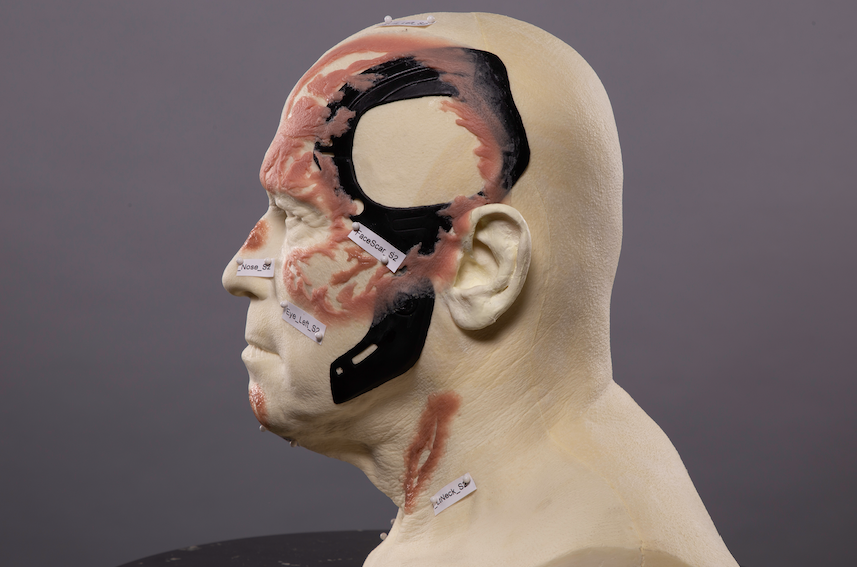 (T-800 Stage 2 appliances. Image courtesy of Legacy Effects)
The artists and technicians at Legacy incorporated a variety of materials for the actual manufacturing of the prosthetics. Rosengrant elaborates, "We used prosthetic transfers when we could because they're fast, easy to apply, and very thin. They're pretty bomb-proof, and they go on in a hurry. Anything that had a bigger buildup on it was plasticized gel-filled silicone appliances so that they would move really nicely."
 (Mold maker Gary Yee molds one of the Arnold heads. Image courtesy of Legacy Effects)
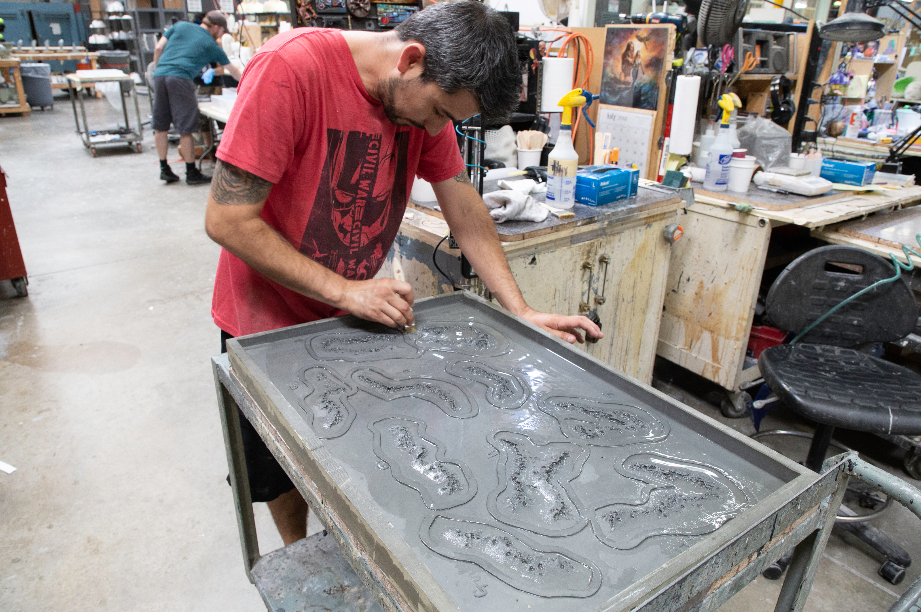 (Mold maker Tony Contreras preps appliance sculptures for molding. Image courtesy of Legacy Effects)
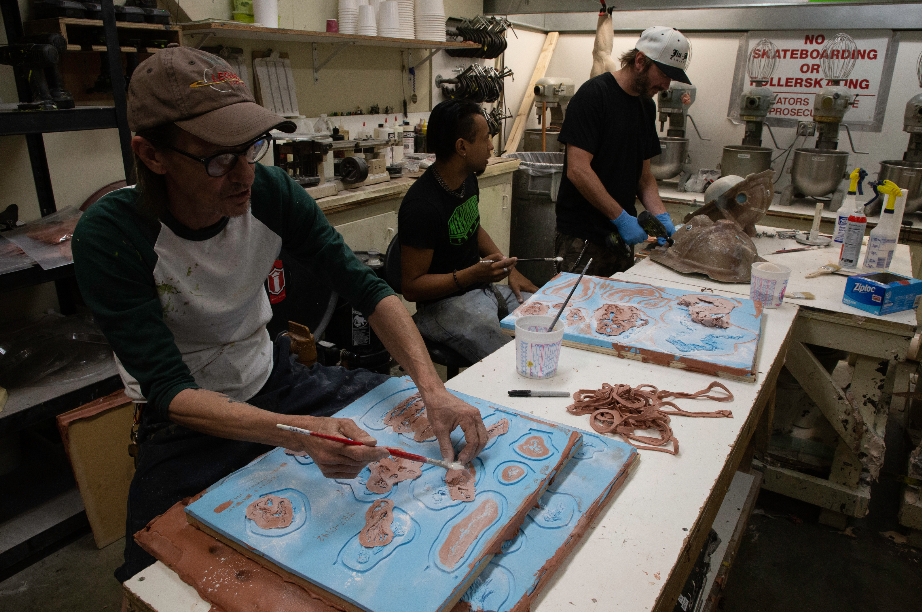 (Walt Phelan, Kenneth Calhoun, and Cory Czekaj clean out appliance molds in preparation for casting. Image courtesy of Legacy Effects)
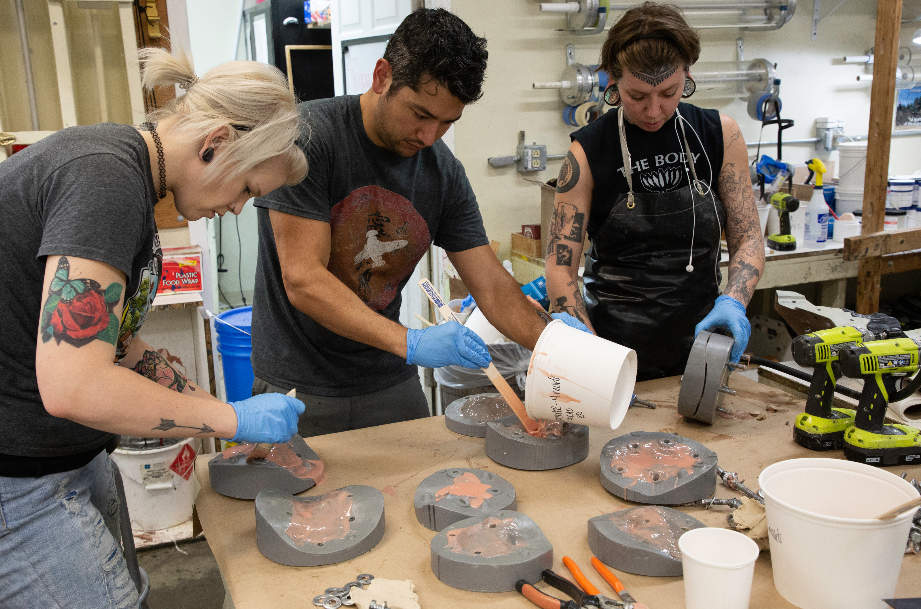 (Taylor Schulte, Cary Lee, and Jo Holland run silicone T-800 appliances. Image courtesy of Legacy Effects)
Corso is also partial to foam latex, a near-ubiquitous staple for a practical FX film. "There was a lot of foam latex." Corso admitted. "All the body pieces were foam latex. I'm a big fan of foam latex, and when it works, it's fantastic. Sometimes I'll take foam over silicone many days of the week because it's tried and true, and it always works. But we used a little bit of everything, which was great."
 (Makeup Assistant/PA Fanni Hudak touches up the prosthetics on a body suit worn by Schwarzenegger's stunt double Danko Jordanov. Image courtesy of Bill Corso)
To allow for the more significant injuries and wounds, Legacy created grey suits for Schwarzenegger and his doubles, which could have prosthetics applied to them. The grey would then be digitally removed, much like a green screen effect. Rosengrant made sure the kits were well-stocked for the on-set team. "There were grey suits that we made with a whole assortment of prosthetic appliances that we could glue onto them. Bill ended up handling the suits while we made all the prosthetics. We made like a grab bag kit of many different things because no one was quite sure as to what they would want on the day."
In addition, to help disguise Arnold's stunt doubles in some of the more involved action sequences, Legacy Effects created ultra-lifelike silicone likeness masks of Schwarzenegger.
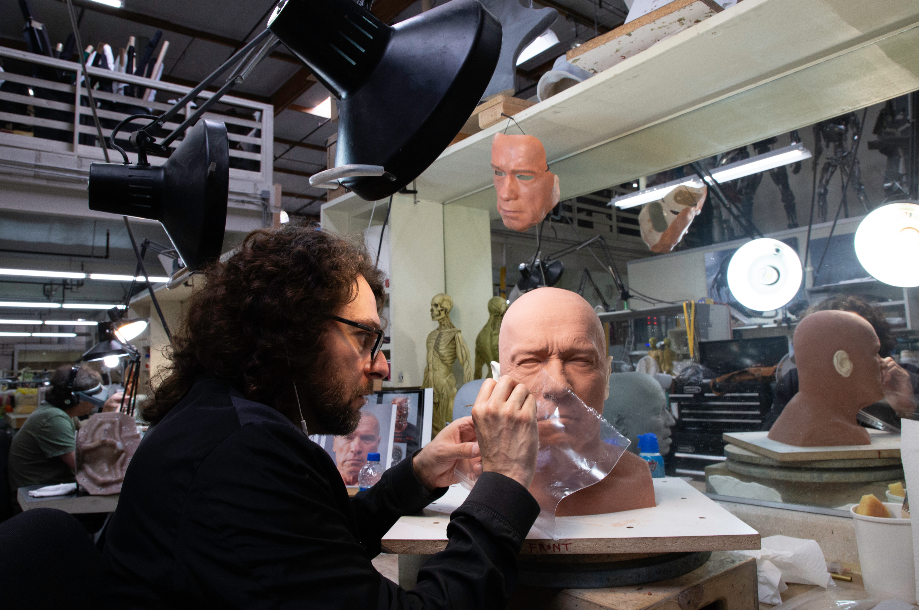 (Key sculptor Mario Torres sculpts an Arnold likeness mask to be worn by stunt performers. Image courtesy of Legacy Effects)
 (Schwarzenegger with his T-800 friend, one of the incredibly lifelike masks created by Legacy Effects for stunts and body doubling. Image courtesy of Bill Corso)
 (Geoff Redknap and Bill Corso transform Arnold Schwarzenegger into battle-damaged "Carl" the T-800. Image courtesy of Bill Corso)
The Makeup Effects for Grace, the Human Terminator
 (Mackenzie Davis' 'Grace', and augmented human from the future. Image: 20th Century Fox)
Terminator: Dark Fate introduces new faces, including Mackenzie Davis' 'Grace,' a resistance soldier from the future who's been converted into a cyborg after sustaining fatal injuries in battle. Corso designed the look for a character that is part machine, part human. "Her entire body has been opened up, and her bones and insides have been replaced. She can operate at a very high capacity, but only for short periods." Amazingly, Grace's function was based on real-world science. "What was fascinating was that Tim Miller issued me a 40-page document of real scientific research and technology that the character was based on. In our world, some of this is real stuff that they are looking to do," Corso explained.
The character self-heals when injured, so he knew Grace would go through the film in states of damage and healing. This element paved the direction for the design but also brought up potential challenges. "We wanted to create a latticework of scarring all over her body, but we knew it would become a logistical problem for the makeup artist. It's like, we have an actress that we're going to have to do this to every day!"
 (Early scar and wound design concepts on Mackenzie Davis' 'Grace', an augmented human from the future. Image courtesy of Bill Corso)
The initial tests explored traditional raised scars, but Miller wanted a more elegant solution. Corso elaborates, "It was very Frankenstein-y, and Tim didn't really like that. He thought it was too scary."
Ultimately, Corso was inspired by a small scar he found on his assistant's arm, "I experimented with tons of different materials, but that was the look we went with. Mackenzie Davis has this entire latticework painted on her every day. Monica Hubert, an amazing makeup artist with finesse who worked with me on Deadpool, was in charge of that makeup, which wasn't easy."
 (Detail shots of Mackenzie Davis' latticework of scarring and bruise makeup. Images courtesy of Bill Corso)
The makeup process was time-consuming, extremely detailed, and consisted of many steps. "To start, we basically pinstriped the whole body with a latex frisking. The whole design was painted very thin, with spatulas." Davis had a spray tan applied over the latex to bring her skin tone up to a warmer level as she was naturally so pale. Corso continued, "The frisking would be peeled off after this, which would leave perfectly white razor-thin lines. On top of that, we used a mix of matte Pros-Aide with pink flocking in it, and ran a little bead of that down the white lines to make it translucent and textural."
Once everything was dry, the scars were painted over with Bluebird matte sealer. Using a thin brush, the sealer would overlap the scar on either side, creating a fantastic effect. "It would create a slight drop shadow because of the tan and also map out the Pros-Aide. When she moved her arm and everything, you'd get this beautiful little pucker just like on a real scar. It looked very cool, especially up close. That was her normal daily routine. She would go through two and a half hours of getting these scars put on her. They had it down to a science."
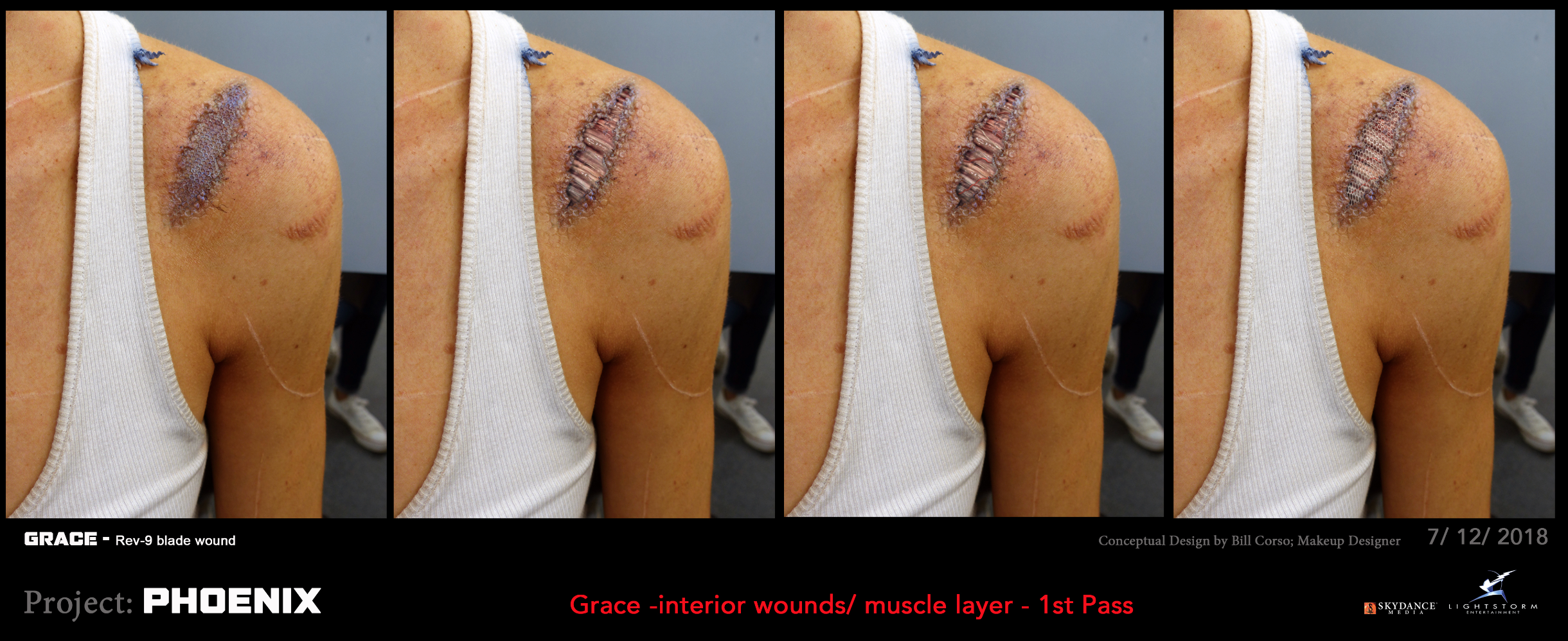 (Design concepts for Grace's exposed wounds. Images courtesy of Bill Corso)
For Grace's injuries and bigger prosthetics, Corso went to David Martí and DDT SFX while they were shooting in Spain. "We started shooting the movie in Spain, and I love those guys, and I've always wanted to work with them on something. So I brought them in to handle all of her stuff. They helped create the prosthetics for her."
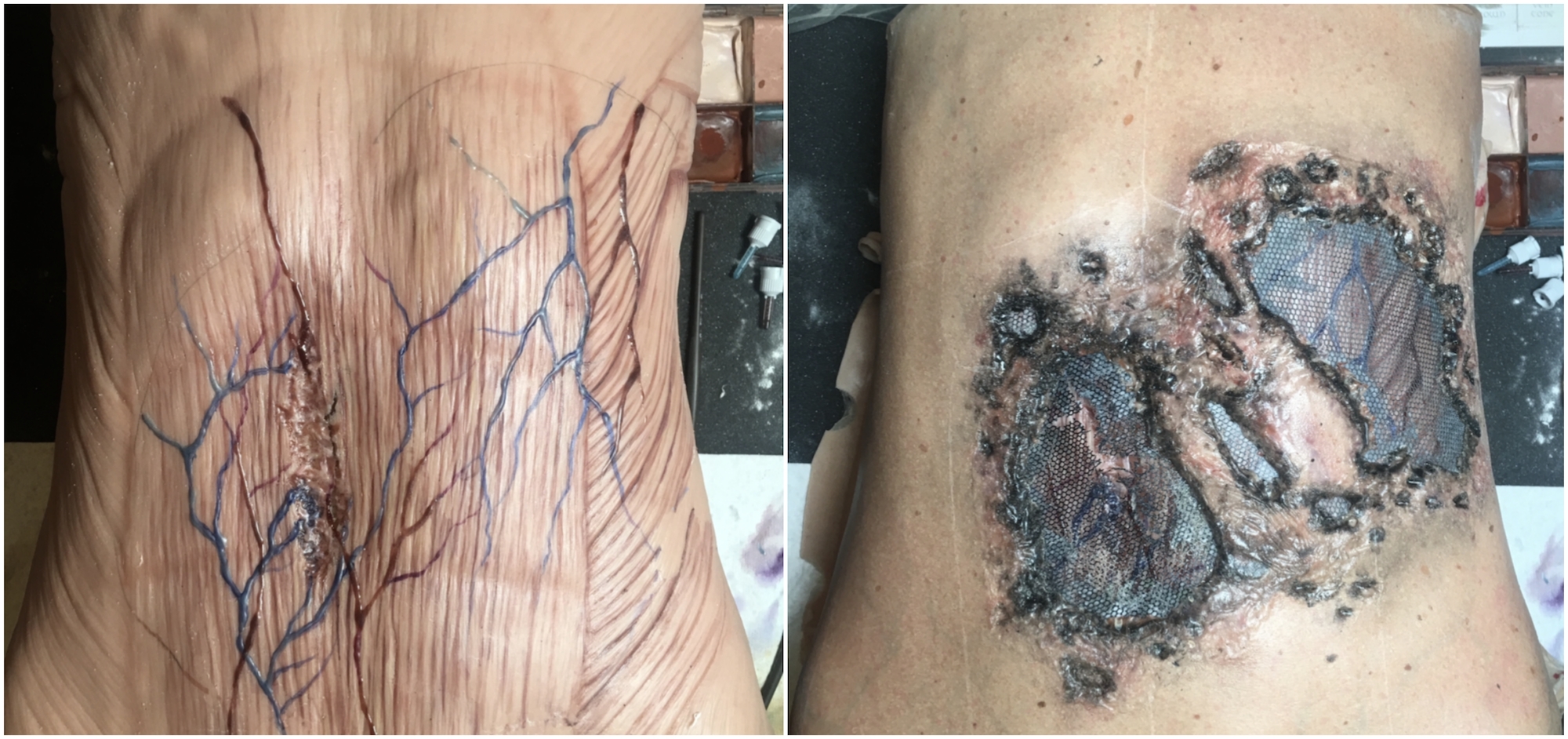 ('Grace' battle damaged torso prosthetics created by DDT SFX. Image courtesy of Bill Corso)
 (Some of the 'Grace' battle damage prosthetics created by DDT SFX. Image courtesy of Bill Corso)
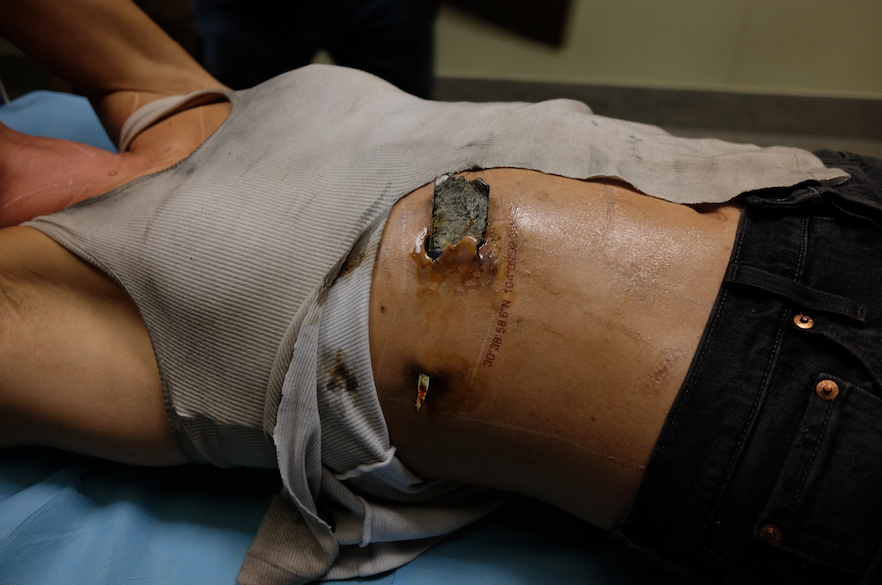 (Another 'Grace' injury prosthetic built for Bill Corso by DDT SFX. Image courtesy of Bill Corso)
Carrying on Stan Winston’s Legacy with Terminator: Dark Fate
 (Stan Winston on the set of Terminator 2: Judgment Day. Image: Stan Winston School of Character Arts)
John Rosengrant was happy to get the call from Bill Corso to join the Terminator: Dark Fate team. "I'm very proud. I would've been a little crestfallen if somehow we got nudged out of this one. We've become part of the legacy created by Stan and carried on by all of us. I'm thrilled, and I've always been very proud of the fact that I've worked on all of the films. It's such a historic, iconic character, and we want to help keep that alive."
For his part, makeup designer Bill Corso hopes the film inspires new generations to get excited about the Terminator again and ensures that it's fresh but also nostalgic. "This film is trying to take the original characters we all love so much and continue their story on for a new generation of movie watchers. I'm a fan, just like Tim Miller, and all of us want to see these movies done well or not at all! We all do our best. Hopefully, with the respect and love of the other films, you can bring something to it that gets people excited again and brings it to a new generation."
Terminator: Dark Fate Makeup Effects Crew
MAKEUP DEPARTMENT
Bill Corso - Makeup Designer & Department Head
Dennis Liddiard - Makeup Artist (Linda Hamilton & Gabriel Luna)
Monica Huppert - Makeup Artist (Mackenzie Davis)
Rita Horvath - Makeup Artist & Prosthetics
(in alphabetical order)
Montse Damas
Anna Daniel
Anna Dalmau Forcano
Szilvia Homolya
Judit Hornyák
Fanni Hudák
Beata Javorszki
Geoff Redknap
Susanna Sanchez-Nunez
Michelle Vittone
Cristina Patterson - Lenses
Brian Sipe - Additional Photography Unit
SPECIAL T-800 PROSTHETIC MAKEUP BY LEGACY EFFECTS
John Rosengrant - Supervisor
(in alphabetical order)
Blair Berens
Kenneth Calhoun
Tamara Carlson
Marilyn Chaney
Jim Charmatz
Cory Czekaj
Jeff Deist
Damien Fisher
Nate Fritzges
Nyssa Grazda
Jo Holland
Regina Jiganti
Cary Lee
Lindsay Macgowan
Shane Mahan
Walt Phelan
Stephanie Riekena
Taylor Schulte
J. Alan Scott
Jaimie Siska
Mario Torres
Gary Yee
'GRACE' MAKEUP EFFECTS BY DDT EFECTOS ESPECIALES
David Martí, Montsé Ribe - Supervisors
(in alphabetical order)
Natalia Aguilar
Xavier Bastida
Paula Comesaña
Cristina Malillos
Jose Manuel Meneses
HAIR DEPT
Michael White (Department Head)
Francesco Alberico
Joanne Best
Larry Waggoner
Kornél Hídas
Courses with the Creators of Terminator: Dark Fate
- Beauty & Age Makeup - From Script to Screen with Bill Corso
- Zombie Makeup - Appliances, Airbrushing, Lenses & Teeth with Bill Corso
- Hybrid Characters: Blending Practical & Digital FX with John Rosengrant
- Special Effects Sequence Design with Shane Mahan
- Encapsulated Pros-Aide Prosthetics: Sculpting, Molding & Casting with Kenneth Calhoun
- Encapsulated Pros-Aide Prosthetics: Demolding, Application & Beauty Makeup with Kenneth Calhoun
- Character Makeup - How To Run Foam Prosthetic Appliances with Cory Czekaj
- Lab Work for Animatronic Characters Part 1: Making a Mechanical Core with Cory Czekaj
- How To Make A Stone Mold with Gary Yee