
By Michael Martin
Jump To Section
- Making Lost in Space’s New Robot
- The Design Process
- Bringing in Shannon Shea
- Building the Robot
- Adding Details With Scales
- Like Sketching in Three Dimensions
- Constructing a Faceless Robot
- Moving a Robot’s Arms
- Twitter Deems the Bot “Sexy”
- Sharing an Amazing Experience
- Using (Mostly) Practical and Digital Effects
- Listen to the Audio Interviews with Mike Elizalde & Shannon Shea
Making Lost in Space’s New Robot
"Danger, Will Robinson!” That robotic phrase would be repeated over and over during Lost in Space’s 83 episode run. The original Lost in Space series from the 1960’s was a fun, if campy, technicolor romp across the stars with the space family Robinson. It had a great theme composed by a young John Williams, teenagers in shiny Mylar space suits, and a talking robot.
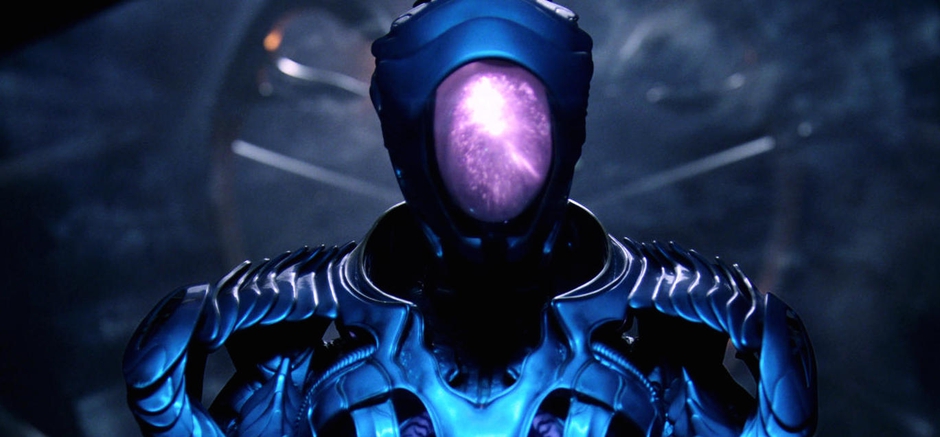
When the producers of the new Netflix series decided to re-imagine the old program for today’s audiences, they would change many things. There would be a new twist with Dr. Smith (here played by Parker Posey). And no longer would the family’s robot sidekick be a stiff, stumbling thing with flailing arms and a head filled with flashing lights. This 21st-century robot reboot would be a metallic blue, multi-limbed alien/mecha hybrid…that wears its emotions on its domed convex face. To do this, the producers sought out effects studio Spectral Motion (Hellboy 1 & 2, X-Men:The Last Stand, Attack The Block).
 (Parker Posey as Doctor Smith, Brian 'CreatureBoy' Steele in the Spectral Motion robot suit, and Maxwell Jenkins as Will Robinson. Image courtesy Netflix.)
Founded by Oscar-nominated creature creator Mike Elizalde in 1993, Spectral Motion has long been known for creating some of cinema's most interesting characters. From the titular ‘Hellboy’ and ‘Hellboy 2’s Mr. Wink to Michael Keaton’s ‘Birdman’ and the wise-cracking alien from Paul, the company has built a reputation for eye-catching characters with stunning detail.
 (Spectral Motion owner Mike Elizalde and Lost in Space director Neil Marshall pose with the foam fabricated test suit. Image courtesy Spectral Motion.)
The Design Process
Speaking with SWSCA, Mike Elizalde would reveal that the Lost in Space robot was originally supposed to be non-anthropomorphic. The production team said, “We want it to be interesting and different because it's alien technology. It's coming from somewhere else.” So the Spectral Motion team turned out designs for two weeks. But in the end, the production opted to go with an earlier, more anthropomorphic robot concept designed by Aaron Sims Creative.
 (A series of Lost in Space robot design concepts by Aaron Sims Creative.)
Bringing in Shannon Shea
To lead Spectral Motion's Lost in Space robot build team, Mike would call upon veteran Creature FX supervisor Shannon Shea (Predators, Jurassic Park). With a 30-year resume supervising FX shops, spanning from Stan Winston Studio to KNB to Rick Baker’s Cinovation Studios, this would be the first time Mr. Shea would be working with the gang at Spectral Motion.
 (Lost in Space robot build supervisor Shannon Shea and fabricator Frederick Fraleigh with the body sculpture of the robot. Image courtesy Spectral Motion.)
Initially, the Spectral Motion team would fabricate a 'proof of concept' suit out of foam based on the designs from Aaron Sims Creative.
 (Spectral Motion fabricator Frederick Fraleigh working on the foam 'proof of concept' suit. Image courtesy Spectral Motion.)
Shannon remembers Mike telling him to look at the design with fresh eyes. “So I walked in there without having seen anything, and I saw what they were doing it. I went, 'Yeah, this works. It works really well.'” Shannon says that all they had to do was adjust some of the proportions on that initial concept.
Building the Robot
The suit that would become the new Lost in Space robot would be constructed primarily around a foam latex body suit with fiberglass armor pieces over it. Inside the suit would be veteran suit performer Brian Steele aka CreatureBoy (Hellboy II: The Golden Army, Terminator Salvation, Predators).
 (Spectral Motion's robot suit on set, performed by Brian Steele, with glowing dome, overlapping shells, and actor-driven arm extensions. Image courtesy Netflix.)
The original thought was to utilize 3D printing but the price and the turnaround time negated that direction. So it would fall to sculptors Don Lanning (The Avengers, Star Trek: Beyond), Chad Washam (Aquaman, A Nightmare on Elm Street), and Miles Teves (Stranger Things, Pirates of the Caribbean: On Stranger Tides) to sculpt the robot suit in clay. Shannon was amazed, “…they just banged the suit out pretty quickly.”
 (Sculptor Chad Washam works on the robot torso. Image courtesy Spectral Motion.)
Adding Details With Scales
A lot was done with the design to try and hide the fact that the robot was simply a man in a suit. In part, this was done by adding green fabric to certain portions of the suit, so that digital artists could create areas where you could see right through it. Another element that hid the human form was the suit's elaborate overlapping layers. To achieve the layered effect, the robot would be covered with approximately 750 blue and gold ‘scales.’ To quote Shannon, “…keeping track of all these pieces was insane.” The ‘scales’ would overlap and move over the top of one another. Once the ‘scales’ were cast, cut out, and sanded, they would be painted a metallic blue, with a copper color around the edges.
 (Spectral Motion artists Bruce D. Mitchell, Brie Ford, and Neil Winn detail portions of the Lost in Space robot suit. Images courtesy of Spectral Motion.)
Like Sketching in Three Dimensions
There were a number of conversations about what the robot’s head was going to look like. Finally, the Lost in Space team came to Spectral Motion so they could give notes to sculptor Don Lanning in real time. In a sense, it was like creating a police sketch in three dimensions. While ideas were pitched, Don would make the changes right there in the clay, “and they finally got it whittled down to a point where they were all happy,” remembered Shannon Shea.
 (Don Lanning sculpting the Lost in Space robot head in WED clay. Image courtesy Spectral Motion.)
Constructing a Faceless Robot
One of the most memorable aspects of the robot was its face…or lack thereof. Instead of recognizable eyes and mouth, a dome that could reflect the robot’s ‘emotions’ was used to represent the robot’s face. Red tones were used when it was angry, and pastel colors were used when it was calm.
 (Spectral Motion FX mechanic Lars Jangaard works on the robot head. Images courtesy Spectral Motion.)
Behind the dome, a tiny rear screen projector would broadcast images that were provided by the production team and operated remotely. On some occasions, the projected imagery would be replaced by CG, either due to the original projections being washed out by the sun or creative changes. But Mike Elizalde noted that “…by and large, what you’re seeing is the actual projection onto the surface.”
 (Spectral Motion artists Claire Flewin, Bruce D. Mitchell, and Michael Passaretti assemble the robot suit. Images courtesy Spectral Motion.)
Moving a Robot’s Arms
Elaborate animatronic arms that would have required off-screen puppeteers and back-mounted servos and batteries were constructed. Eleventh-hour changes, however, would mean that suit performer Brian Steele would end up operating the robot's appendages with his own arms, hands, and fingers via self-contained cable-actuated mechanisms.
 (Claire Flewin, Bruce D. Mitchell, Michael Passaretti, and Nicholas Baumann suit up Lost in Space robot performer Brian Steele. Images courtesy Spectral Motion.)
The artists at Spectral Motion would have three months to build two robot suits. During the shoot in Canada, the suits would be maintained on set by Canadian FX company Amazing Ape.
Twitter Deems the Bot “Sexy”
The Lost in Space robot has been a huge hit with fans of the show. The Twitter-verse exploded with discussions about how sexy the alien robot was. Much of that admiration deservedly belongs to the initial design by Aaron Sims Creative, the incredible build by the artists at Spectral Motion, and the nuanced performance by Brian Steele.
Sharing an Amazing Experience
As for working with Spectral Motion, robot build supervisor Shannon Shea could not have enough kind things to say about the studio. “I really was impressed because I had never worked at Spectral Motion before…this was a team, this was a well-oiled machine that I walked into, and they trusted me, and in turn, I trusted them. And at the end of it, we were all very proud of what we had done.” Shannon would conclude, “It was an amazing experience.”
Using (Mostly) Practical and Digital Effects
Mike Elizalde states that digital technology is a useful tool, but he also feels that practical effects can provide a believable on set interaction with the actors. All one needs to do is look at the young Will Robinson (Maxwell Jenkins) and how he interacts with the robot. “…one thing that we learned on Stranger Things is that the kids really, really react to the monster…they love seeing it in person.”
 (Will Robinson, played by Maxwell Jenkins, and the robot, played by Brian Steele, in a touching scene from Lost in Space. Image courtesy Netflix.)
Elizalde estimates that approximately 85% of the robot in season one of Lost in Space was practical with the rest being handled digitally. “It's so exciting that there's so much of our robot in the series.” He says executive producer and episode director Neil Marshall (The Descent, Dog Soldiers) was very keen on doing as much practical work as possible. Does this mean that productions are turning back toward a more practical approach to effects work? Mike thinks so. “I can't tell you how many times we take meetings with directors where the first thing they say to us is we want to do this as practical as we can…and use digital as an enhancement…” And, he says “… that's really encouraging, you know, that's really exciting for us.”
 (Neil Marshall with the Lost in Space robot. Image courtesy Spectral Motion.)
Listen to the Audio Interviews with Mike Elizalde & Shannon Shea