

Building the Hyper-Realistic Shaggy Dog
March 2006 saw the release of The Shaggy Dog — a Disney production directed by Brian Robbins — which updated the story of the original The Shaggy Dog, released in 1959. In the new version, Tim Allen portrays a work-consumed father and husband who begins to experience frequent transformations into a shaggy canine named Shaggy after he is bitten by a dog whose DNA has been altered.
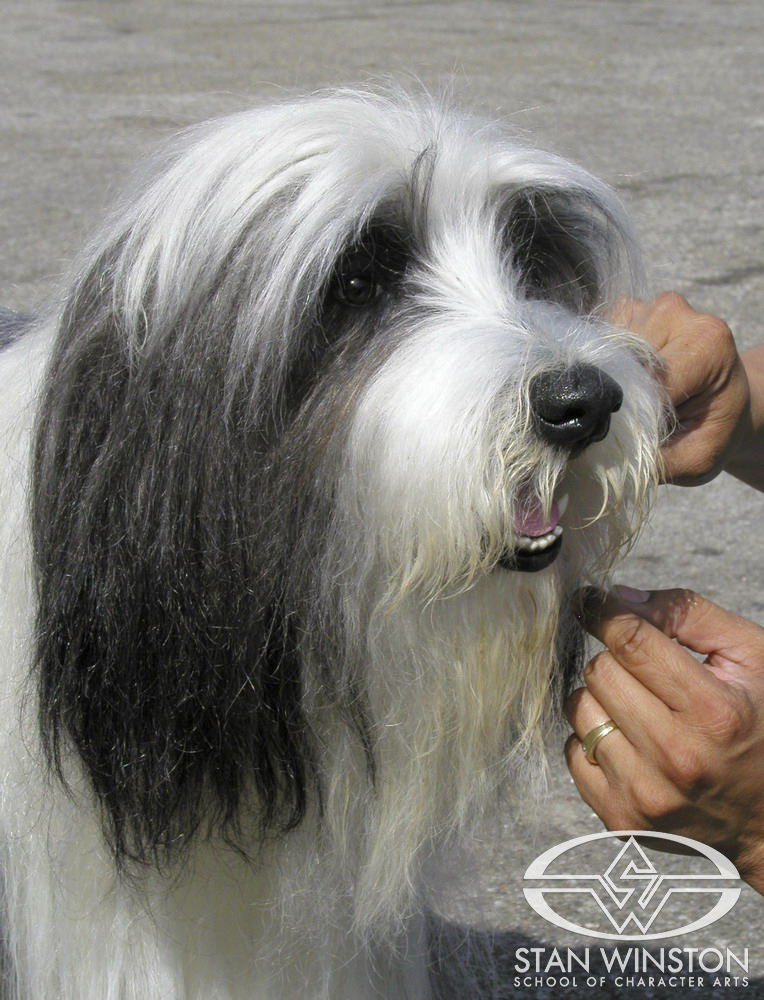
Stan Winston Studio's Paul Mejias led the assignment, building a puppet version of the shaggy dog for shots that the filmmakers might not be able to get with the real bearded collie (a dog named Cole). "Our dog had to cut closeup to closeup with the real dog," said Mejias, "so it had to match exactly. It was important because there is nothing worse than shots in movies where they suddenly cut to a puppet, and it's just dead and lifeless."1
Jump To Section
Creating The Shaggy Dog Animatronics
Dog trainers Mark Forbes and Ray Beal brought Cole into the Stan Winston Studio at least twice a week for about five months. On these visits, the crew took tons of photographs of Cole, photographing him from every conceivable angle, including the inside of his mouth. "We also measured him everywhere," added Mejias. "The trainer even let us make a lifecast of Cole's nose and an alginate impression of his front teeth! And the dog was just as calm and happy as he could be throughout that procedure. That was the sweetest dog in the world."1
 (Cole, the real actor dog with the Shaggy Dog puppet. Can you tell which one is real?)

 (The head sculpture by Paul Mejias based on Cole the collie for The Shaggy Dog. The front teeth and canines are castings from Cole's actual teeth.)
The Stan Winston Studio team built the dog from the tip of his nose to the end of his tail, mechanizing it to perform nose, lip, tongue, and tail movement, as well as panting, eye blinks, and independent eye movement. The puppet's legs were rod-controlled.1
Tamara Carlson-Woodard, assisted by Kristen Willet, supervised the fabrication of all the muscles for the Hero and Stunt versions of the puppet. They made access to the internal animatronics quick and repeatable for repairs and rigging.2
 (A look at the Shaggy Dog's fabricated body structure without the hair suit.)
 (Comparing Cole's teeth to the puppet's teeth. Frequent Cole vs. puppet comparisons like this were done throughout the entire puppet build.)
 (FX mechanic Seth Hays and fabricator Tamara Woodard-Carlson assemble the nearly complete Hero animatronic puppet.)
Distinctive Doggy Detailing
John Cherevka crafted and meticulously painted the eyes to replicate Cole's distinct eye characteristics perfectly. Jim Charmatz painted the lips and eye area to match the spotted patterns under the fur on Cole's face, while Chris Gallaher fabricated and painted the gums and teeth.2
 (Tamara Woodard-Carlson works out the chest and neck snaps.)
 (A shot of the test glued hero skin before the tongue installation.)
Led by animatronics designer Evan Brainard, the puppet was loaded with performance functions from independent eye blinks so that he could wink each eye individually to automatic tongue panting that would slow down and then stop as the mouth closed. Additional movements were 3-axis ear movement, full neck motion, upper and lower lip articulation, and breathing bladders.2
 (Evan Brainard works on the Shaggy Dog animatronics at Stan Winston Studio.)
 (A closeup view of the nearly completed head animatronics.)
SWS mechanic Spencer Whynaucht fabricated and welded together a puppet-mover to provide mobility on set. The puppet could be mounted from several different places depending on where the camera would be in relation to it. A mounting plate was also made to allow a sitting pose without visible support; the plate rested flat on the ground and was hidden under Shaggy's long body hair.2
 (The Hero animatronic Shaggy mounted onto the 'puppet-mover' rig.)
Although it had limited use on The Shaggy Dog, Spencer Whynaucht's puppet-mover would prove to be very useful on subsequent projects at Stan Winston Studio.2
Dog Actor Becomes the Movie Star
For scenes of Dave (Tim Allen) in full Shaggy mode, the production ended up relying heavily on the talents of Cole.3
 (Mike Ornelaz secures and grooms the hair pieces he and Kathy Kane-Macgowan tied for the animatronic dog puppet.)
In fact, Cole's stellar performance on set rendered the Stan Winston animatronic all but unnecessary. "We went into the show expecting to get maybe half the performances we needed from the trained dog, and we got more like 90 percent," noted Mejias.3
 (Kathy Kane-Macgowan works on the stunt version of Shaggy.)
VFX Supervisor Stephen Rosenbaum worked closely with trainer Mark Forbes to plan shots in order to get as much as they could in-camera. "Cole was just phenomenal. We'd have a shot, for example, where the dog needed to go from the living room to the kitchen, stick his head into a backpack and pull out a book, then sit and look at the camera, and you'd think, 'There's no way Mark is going to get that in one shot.' But then he'd say, 'Okay, give me about half an hour.' And a half hour later, the dog was doing it," noted Rosenbaum.3
Ultimately, the Shaggy animatronic accounted for less than ten seconds' worth of screen time.3
 ( Shaggy's travel cart with the dog puppet and its controls.)
The hero Shaggy dog puppet was transported around the set and at locations on a red flatbed wagon. A black box contained all the larger Maxon motors that controlled things like the neck and shoulders. In a round black bag, the crew stored coiled fiber optic cable that connected the puppet to the Overdrive Control System engineered by Steve Rosenblum and his team. Electronics specialist and puppeteer Rodrick Khachatoorian worked closely with Rosenblum on the control interface and performance programming for the puppet.2
 (Mike Ornelaz applies his special solution around the mouth of the stunt puppet.)
To complete the lifelike illusion, Mike Ornelaz devised a solution of tan-colored Fuller's Earth mixed with isopropyl alcohol to achieve the "tobacco stain" color that bearded collies tend to get around their mouths from saliva. Ornelaz's formula washed off easily for scenes where Shaggy had to appear clean.2
- Blog assembled by Adrienn Lingurár with selections from:
1. The Winston Effect: The Art and History of Stan Winston Studio by Jody Duncan
2. The Shaggy Dog Scrapbook by Paul Mejias
3. CINEFEX #105: Stephen Rosenbaum on The Shaggy Dog by Estelle Shay
Courses with the Creators of The Shaggy Dog
- Making Creature Eyes with John Cherevka
- Advanced Creature Teeth: Prosthetic Dental Appliances with John Cherevka
- Character Makeup - Running Foam Appliances with Cory Czekaj
- Character Makeup - How to Run Silicone Appliances with Cory Czekaj
- Lab Work for Animatronic Characters: Making a Mechanical Core with Cory Czekaj
- Introduction to Hair Knotting with Mike Ornelaz
- Creature Costume Basics with Dawn Dininger & Amy Whetsel
- FX Corset Harness Fabrication with Amy Whetsel
- Making a Stone Mold with Gary Yee
To create your own animatronic puppet, check out these Pathways: