

Building the Stan Winston Creatures Website

In 1998, Stan Winston Studio was experiencing a pause in its project schedule following the success of the beloved action comedy film, Small Soldiers. Besides the work for hire that had established the studio, for a long time, Stan Winston had been creating his own intellectual properties (IP)--iconic characters and creatures. Suddenly, he had the team and they had the time to bring these characters to life, as actual figures. Stan envisioned collectibles, comics, trading cards, all with his original creatures, characters and storylines. In the early 2000s, Flash websites were skyrocketing in popularity. The studio website had launched and was getting attention. A Stan Winston Creatures website seemed like the best way to introduce, support and promote the proposed line of toys.
Jump To Section
- Designing the Stan Winston Creatures Homepage
- A Look at Stan Winston’s Action Figures
- Conventions and Fans’ Reactions to Stan Winston Creatures
- Stan Winston Creatures Behind the Scenes Exclusive Content
- Other Pages on the Stan Winston Creatures Website
- Looking Back on the Legacy of Stan Winston Creatures
Stan Winston School of Character Arts co-founders Matt Winston and Erich Litoff chatted with three of the original website’s creators, character designer/digital artist Jim Charmatz, screenwriter/director Stiles White and character designer/illustrator Terry Wolfinger, about the vision for the special creature website and the time, effort and creativity it took to construct it.
Prepare for creatures — and web designs — like you've never seen before. Not to mention, tons of exclusive content. Watch the complete video by clicking the player above!
Designing the Stan Winston Creatures Homepage
 (The official Stan Winston Creatures homepage.)
The Stan Winston Creatures website showcased everything Stan wanted to put on display: the action figures, comics connected to the figures, as well a trailer of his monumental character, Trakk, a time-traveling monster hunting hero meant to launch the multiple world-building projects Stan had in mind.
“It was beyond just the action figures,” Winston says. “It was the graphic novel, the comic books, all of this really original IP that Stan was developing with the help of you guys and the rest of the folks at the studio.”
With White writing the web copy, Wolfinger creating dazzling design elements and Charmatz behind the stellar web design, the trio constantly came up with clever ideas and intentionally incorporated a lot of the same elements as the studio website.
“We wanted it to feel cohesive with the studio site as well,” Wolfinger says. “This was the offshoot but still felt like it was part of the same world.”
A Look at Stan Winston’s Action Figures
 (The Stan Winston Creatures splash page for figures.)
Upon clicking on 'The Figures' section of the website, fans could learn all there was to know about Stan Winston Creatures' current releases and even get a sneak peek into future toy lines. With a simple hover over a button, they could see each series in order of their release: Creature Features, Realm of the Claw, Mutant Earth, Extreme Gargoyles and Blood Wolves, as well as Robot Revolt and The Four Horsemen of the Apocalypse.
“The origins of a lot of the action figures was when Stan was producing the Creature Feature films. They were these original films that were remakes of the ‘60s drive-in movies,” White says.
At this time, Stan was producing modern versions with new filmmakers and actors. One of the ideas he wanted to do, White says, was to make more model kit figures of the creatures from those movies.
“That got the wheels turning of continuing that and branching out into original action figures,” he says. “A lot of them were based on concept designs that Stan and the artists had come up with in the studio for feature films that had never been produced.”
Since the studio had created dozens of pint-sized, personality-packed characters on Small Soldiers, the move to make actual toy lines seemed to be a no-brainer. (Major Chip Hazard's iconic line, “We're not toys, we're action figures!” would apply fittingly to the entire Stan Winston toy-line output.)
 (With seven lines to choose from, fans could dive in and look at all the character figures from each series.)
The first figures created were from the Mutant Earth and Realm of the Claw characters. These worlds emerged from concept designs Stan had done in the 1970s.
For Realm of the Claw, the team created characters around the story's two main brothers, Tswana and Tare, and built a whole fantasy world around them.
Mutant Earth, profiled Trakk, a monster hunter who lived through time and encountered various mythical creatures and characters throughout his journey.
Other stories included werewolves, gargoyles and different monster worlds Stan wanted to explore. The comics that emerged from these story concepts were based on his original sketches from many years prior. And the characters they described became the basis for new designs in the toy lines.
 (The Creature Features toy line was promoted to tie in the films made for HBO and Cinemax in 2001.)
When visitors first landed on the Creature Features figures page, they were welcomed by a pair of frightening eyes in an equally spooky hallway. Wolfinger created the artwork for the page, using the eyeballs from Charmatz' Stan Winston Creatures logo. Wolfinger came up with ideas on how to load the clickable frames and tie it into the series' theme. Additionally, the team wrote fun mythologies for the characters to provide more background.
Creature Features was the first toy line series released and it presented its unique learning curves. “This was the very first run at a test drive of figuring out how to do action figures and how to do the toy production to really get them to look great with the paint jobs,” White says.
He recalls how the team would get test runs that would come into the studio and would attempt to replicate the paint jobs of the original maquettes. Each artist who sculpted the figures also built incredible complementary background sets to place them in.
 (The Realm of the Claw figures were styled and photographed on background sets also made by the artists.)
At this time, the first digital cameras were coming out. The composite shots featured on the website, when you click on the characters, would showcase the figures against atmospheric backgrounds made from miniatures and models.
“There was a learning curve to all of this, as well as with some of the new tools that were available to us,” White says.
 (The Mutant Earth series included custom art for everything from figures and sets to trading cards and merchandise packaging.)
As you look at the figure photos, it's hard to believe they're not still frames from films. Christopher Swift, helped achieve the striking photos placing the figures and backgrounds for the photography, by photographer Chuck Zlotnick. Together, the duo created picturesque backgrounds. Charmatz and Wolfinger added the logo designs and other graphics, enhancing the backgrounds and photos.
Multiple team members were involved achieving both in-camera and photoshop-enhanced imagery to elevate every aspect of the storytelling down to the packaging and accessories that came with the figures.
“It was a big team effort just trying to get the coolest of the cool,” Charmatz says.
 (Extreme Gargoyles was another world in the series with the individual artists empowered to come up with their own character names, backstories, personalities and design elements.)
Making the toy lines required the artists to become storytellers putting character first. Creating the characters was a full-time job for all involved. Along with making the figures, artists gave life to the characters with names, backstories and color schemes. The goal was for each artist to give a sense of who the character was and discover their own unique tone. The themed backgrounds helped create a distinctive atmosphere to support the individual figures.
“We wanted it to feel like even within any grouping of action figures, whether it was Mutant Earth or Extreme Gargoyles, that there were good guys, bad guys, rivalries ...” Stiles says. “We were just trying to come up with as much content, ideas and story as possible that we could fit on the back of the packaging in the trading cards and stuff to put on here on the website.”
The story elements emerging from the character design would be shared with comic book writers they were working with. What emerged were natural storylines that led to outlines and eventually the comic books for the series.
This, Winston says, was Stan's backdoor method to hopefully get movies made of his original ideas and characters.
“Of course, getting a studio to spend $100 million on an unproven IP is very difficult. But to get a comic book made? A fraction of the cost of getting a movie made. To get a toy figure made, the same,” Winston says. “I think that's another reason these things are so fleshed out and you guys put so much effort into making them look almost filmic in their presentation is because these, eventually, would become a great way to pitch movies. That was the long game Stan had in mind.”
Conventions and Fans' Reactions to Stan Winston Creatures
 (Blood Wolves imagined a world of hybrid man-wolf creatures in a fantasy world of heroes and villains.)
The group recalls participating in a big showing at the San Diego Comic Con where they had a display set up with a diorama of all the characters in the series. They had several of the set elements. They also made Trakk posters.
“Stan hung out in the booth for almost the whole time — for hours — and then we'd go do panels,” White says. “Thousands and thousands of people came through that booth over those four days that we were there at Comic Con.”
White recalls also being at the Wizard World Convention in Chicago:
“Unlike San Diego where a lot of celebrities and people could drive down from LA, getting to Chicago was more of a an effort and not everyone would come out. I remember it was a really big deal that Stan had come out for it. A lot of people were excited to see Stan and have him sign Jurassic Park DVD sleeves and posters that we had printed up. Before you could do things like this, a live Q&A on Zoom, you had to go do these things in person. So, Chicago and San Diego were definitely two amazing live events that we got to be part of.”
 (Robot Revolt was a planned future project that did not make it to production.)
When people saw the toy lines they went wild. They were taking photos constantly and asking questions, inspired by the imagery of the figures. White remembers. “It was a big reaction because it was what Stan wanted to do from the get-go.”
Though the studio had previously created limited edition 1:1 scale versions of Small Soldiers' Chip and Archer, these original pieces were costly. A true consumer toy had to be more affordable, but the challenge came in preserving the artistry at a lower price point.
Once Stan saw comic book creator Todd McFarlane raising the bar of toys with McFarlane Toys, he knew it was possible to bring that level of artistry to a more affordable toy figure.
For fans who yearned to have a piece that came from the studio, the toy line was the perfect way for them to get their hands on an action figure.
 (The Four Horsemen of the Apocalypse was another planned project that sadly didn't make it past the conceptual stage.)
Litoff says, “This was cutting edge going from a toy to a CD-ROM to a website; having a full circle of the story, sometimes comics, sometimes trading cards. The whole thing was very innovative ... It was remarkable to watch what all you guys were doing. You're making creatures over here, but here's an entire new function in business." And Stan loved seeing the immediate reaction to the characters by the public. Lifoff, continues, ",,, that one thing always stood out — those conventions. He just stayed till the end every time and shook every last hand.”
Stan Winston Creatures Behind the Scenes Exclusive Content
 (Paid content in the early 2000s: toys came with a secret code for exclusive web content access.)
Behind-the-scenes content could be found on the Creature Features CD-ROMs. However, once the team got to the web content up for Realm of the Claw, Mutant Earth and Extreme Gargoyles, they put it behind a paywall. At first, the only way fans could access the exclusive content was by buying the action figure box, opening the box and finding the code featured on the trading cards.
But the cumbersome process was holding back considerable public interest in the characters. Once Blood Wolves came along, the team decided to open up all the behind-the-scenes pages for free.
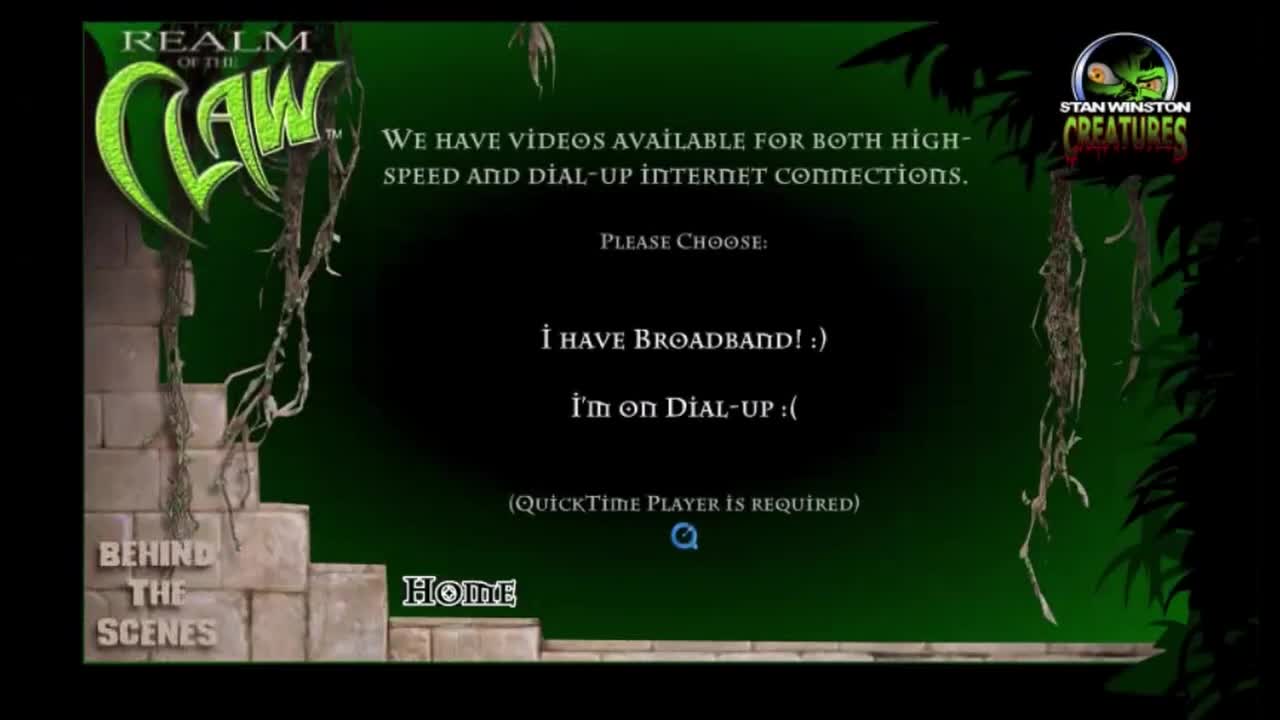 (Good web design could accomodate for either the painfully slow dial-up speeds or, less compressed renders for those lucky enough to have broadband service.)
Wolfinger and Charmatz worked diligently to create content for each of the series' pages. With Wolfinger responsible for the backgrounds and Charmatz designing the pages, visitors to the site could feel as though they were teleporting into each brand new world.
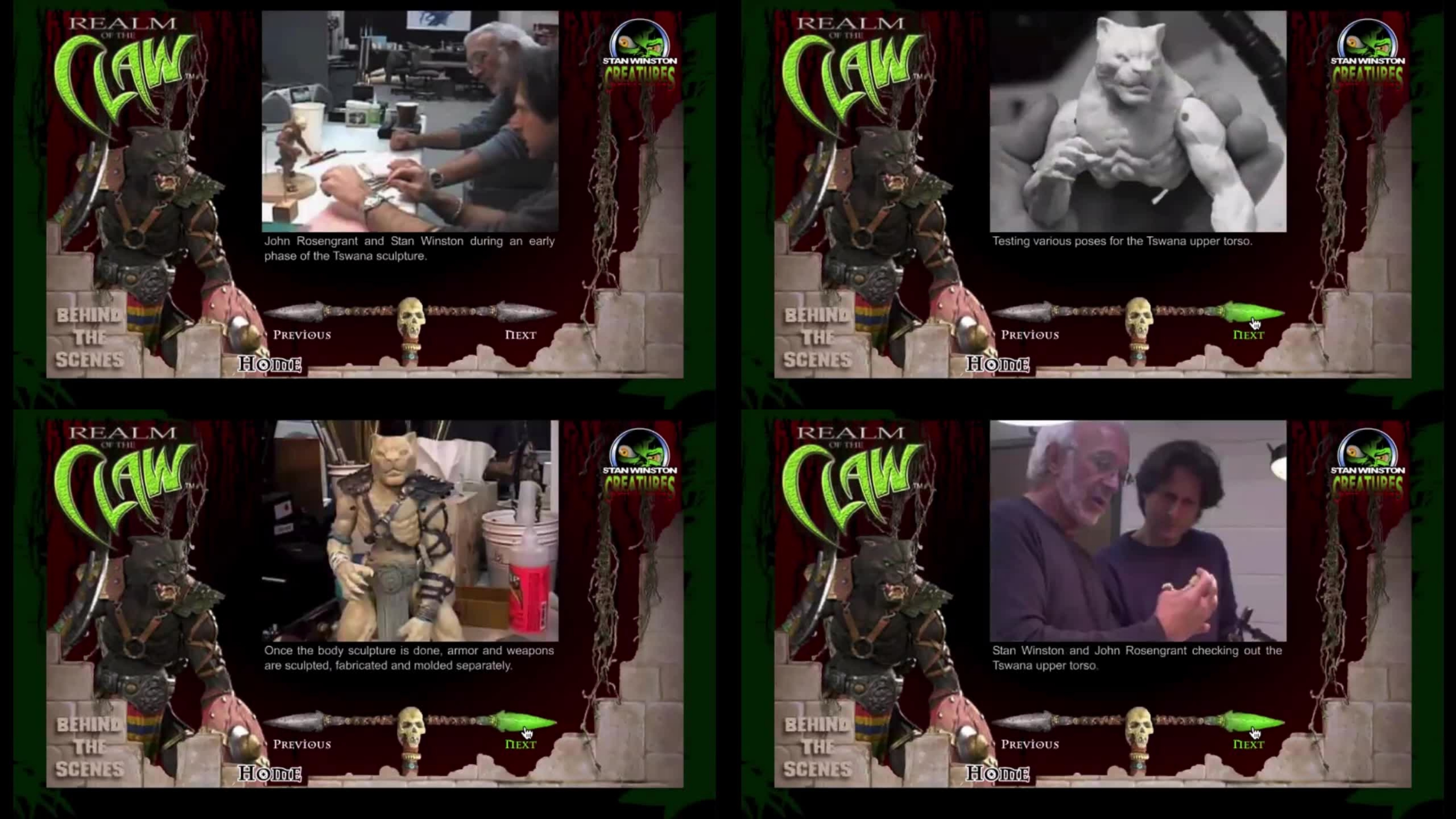 (Behind the scenes content captured the process of how an idea was executed from start to finish.)
For Realm of the Claw, Charmatz stylized a yin yang design element made by Mark 'Crash' McCreery to represent the good and the bad cat-creatures in the line, Tswana and Tare. As users would navigate through the site, each click revealed more imagery and information about the world.
 (Fans could learn more about the artist behind their favorite characters and even view the figures in 3D!)
Fans wanted to have a complete look into how the magic happened at the studio. The photos and details included on the website gave them insights about the artists, the original characters and how the figures were made.
There was a 3D viewing feature on the site, not easy given the limitations of the technology at the time. Equally impressive, the figures weren't retouched digitally. The figures depicted on the site looked the same as the toys in the package. Even the stands used in the photos were the actual stands that came in the packaging with the character.
“Because of the work that the studio had done on Small Soldiers, that was very informative of how we wanted them to be really cool action figures that you could create all kinds of interesting poses. So, joints and all those points of articulation were figured out and part of the design,” White says. “To make it look more elegant, the artists would figure out the armor, cool weaponry and things like that. That could blend into some of the points of articulation and give it not such a clunky feel. There was just a ton of work being done on every stage of the creation of these.”
In some ways, the studio at that time became essentially a toy shop, with everyone involved in the process.
Wolfinger recalls that the contract for Terminator 3: Rise of the Machines came in while they were responsible for toy packaging and website duties. “I remember Jim and I put in a lot of late nights trying to get the Arnold makeups done and still get the packaging off to the printer,” he says with a laugh.
The SWS artists were designing every aspect of the packaging: from the blister card art to the barcode layout and hang tag placement.
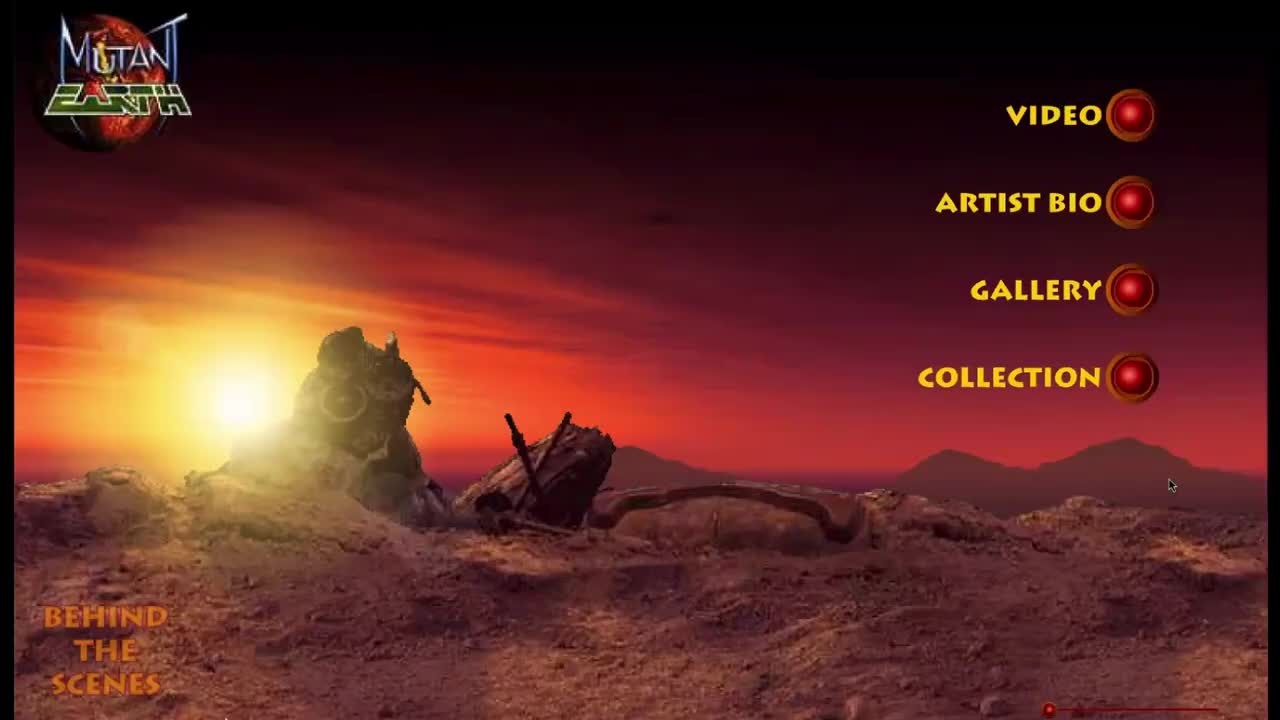 (The main page for Mutant Earth looks like how one might imagine a post-apocalyptic world.)
Each series page used the same creative approach but with different themes to create a vastly different world. For example, while Realm of the Claw used foliage and brick walls to represent a jungle world, Charmatz used backgrounds that were created for the Trakk video trailer for the Mutant Earth page and created sky backgrounds with 3D effects and Flash. No matter the series, he wanted to create neat effects to capture the audience's attention.
Charmatz learned a lot about Flash working on the Stan Winston Creatures website. “You get creative, just like anything at Stan's, we were always pushing the envelope to try and find the newest, coolest thing that we could do.”
 (A look at the detail of the toy figures offered from the Mutant Earth series.)
White wrote all the text for the website, in some cases coming up with character names, captions, or introductions. And if a page needed text, he would come up with the copy.
“If you're any kind of writer and you're looking at these characters, you do start to daydream of what they would look like,” White says. “Everything was so visual with the backdrops, photos and imagery that the digital departments were coming up with. You definitely could envision the film of good guys, bad guys, post-apocalyptic wasteland.”
 (The wintery atmospheric main page for the Blood Wolves toy line.)
Since Blood Wolves, is about hunting werewolves during the Middle Ages, the team made sure to include a castle in the page's background and reused Wolfinger's logo elements that were also featured on some of the trading cards. “Because we were doing them in series, you would build off the learning curve of what you had done on the previous one,” White says. “So, even though you had some new techniques and some new methodology, you knew what you had done before, but visually, you knew you needed to change it up.”
The team became more ambitious with the launch of each successive toy line site, searching for new ways to keep the content fresh and exciting for fans.
 (The "collection" screen of the Blood Wolves web page.)
Blood Wolves ended up being the last toy line that would be sold. For the collection screen webpage, Charmatz made each character icon clickable so you could uncover content about each figure--Wulv, Medieval Trakk, Lycon and Vereticus. To display the characters, the team built a highly-detailed stairway inside the castle and animated the fire on the walls.
Concept artist Simon Bisley's designs inspired many of the figures in the Stan Winston Creatures' lines including the ones for Blood Wolves. The team came up with the character names pulling from werewolf-related etymology. “Lycon” came from “lycanthropy,” the word for someone becoming a werewolf. Since it was during the medieval times, the team also added an accent mark to "Wülv" to give it some foreign flair.
 (The Blood Wolves character pages illustrated each different character design.)
The artists at Stan Winston Creatures were tapping into the current trends. Trading cards, action figures, behind-the-scenes content and highly-detailed websites were gaining popularity, White recalls. The Stan Winston Creatures website was truly a great place for monster maniacs and toy enthusiasts to visit and immerse themselves in all this next level content.
 (The Collection product page showed the actual product packaging.)
“With Stan, we were all trying to pack in as much as possible. We wanted the action figure to be a really cool value; and beyond just the figure, like the photography and art, something that you could collect,” White says. “The idea was if there were multiple lines of action figures and trading cards, it would be a whole set that you'd eventually have if you got them all.” White wrote the copy with the information about the toy line and character backgrounds that appeared on the packaging. The front packaging featured a preview of the trading cards.
Since this was all before social media, the website had a Stan Winston Creatures message board where fans could gather and talk about the lines. It was also a great way for the team to share announcements, release dates and teaser images for upcoming projects. And the message board served as a way to get feedback from fans in real time.
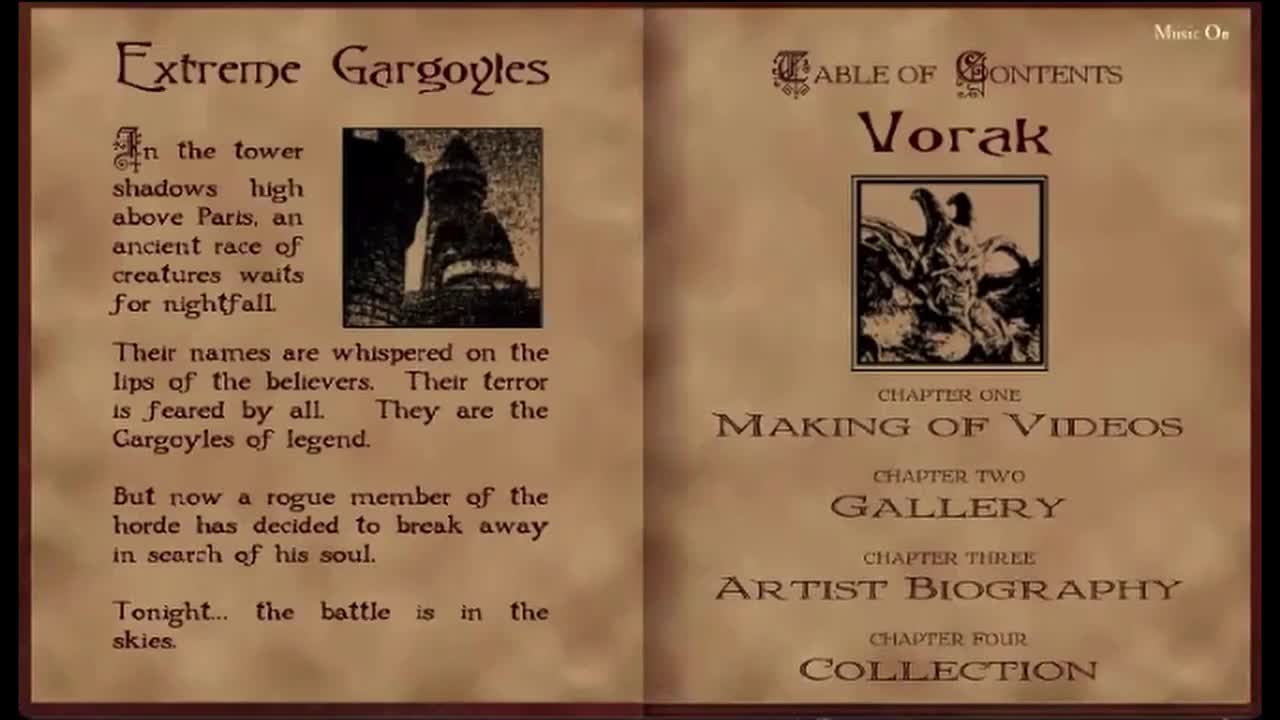 (Wolfinger did the artwork for the Extreme Gargoyles page which Charmatz rendered in 3D.)
For the Extreme Gargoyles line, Wolfinger's artwork was meant to seem like an ancient tome. Charmatz animated the pages to seem like they were turning when you clicked them.
The Gargoyle characters, Vorak, Raze, Elias, Lucian and Zephyr, each had a different design with Simon Bisley doing many of the sketches.
In the 'Making of Videos,' users could watch videos and learn about each character's concept design, the process of sculpt-to-finish of the character as well as its sets and packaging. Here, the artists were recognized and interviewed about their work.
 (Small touches to the webpages might include music cues or having a gargoyle fly in the background.)
“We just had so much fun doing different things with these toy lines,” Charmatz says.
Other Pages on the Stan Winston Creatures Website
 (The 'Comics' section of the Stan Winston Creatures website with Trakk and Realm of the Claw.)
The other sections of the creatures website were equally jam-packed with compelling creature content. Users could check out comic book previews, news coverage of Stan Winston Creatures, forum messages, figures available for purchase and the website's FAQ.
 (A question on the website's FAQ page. Stan Winston Creatures was always about originals!)
Registering for Stan Winston Creatures allowed people to get access to exclusive contests, giveaways and member newsletters. They could also sign up to share feedback with the Stan Winston Creatures team.
Another perk of the website? Custom screen images to set as your new desktop wallpaper!
 (Some dowloadable desktop images included never-before-seen images of the horror-themed series, Dark World. And a conceptual logo Charmatz created that reads 'Stan Winston Toys.')
Stan Winston Creatures had concepts for 12 series that each explored a different world and theme of characters and creatures; four of these did end up being produced. There were prototypes and some elements created for others, including Aliens and Dark World. And although some series didn't make it past the maquette stage, according th Charmatz, the web artists made all the setups for them ready to go active with the possibility of what would come.
 (The teaser trailer for Trakk in Mutant Earth.)
“[The website] was just very ahead of its time. Everything was always just cutting edge, trying new things, and it was welcomed. It was such a great spirit,” Litoff says. “Not sure if you guys felt that when you were there going through it, but for us on the outside looking at it, it's remarkable to be able to have this much fun trying things out.”
Looking Back on the Legacy of Stan Winston Creatures
 (An earlier iteration of the website frontpage teasing at the toy content that would later come.)
The decision to make Stan Winston Creatures stemmed from the difficulty in producing original feature film content. Stan's frustration led him to put his IP out in a way that he could control and release on his own terms. The creation of the website and the many fantasy worlds it showcased, gave the artists at the studio the chance to push the series' toys to the public with the hopes of movies being made later.
And while the entire series didn't materialize, and the hoped-for movies were never made, the amount of work, passion and creativity from the artists undoubtedly fueled the journey of expanding on what was possible.
“There's so much work done on this. It's kind of fun to go through this and especially to get the feedback of Stiles and Terry because there's so many things that we went through that I don't even remember, and they brought up some really fun things,” Charmatz says. “Everything we did for Stan was an honor for me. This was especially because during that time, movies and commercials were kind of slow, which enabled us to put an awful lot of time and effort into creating all this great stuff.”
 (Artwork for a few of the trading card fronts.)
Stiles reminisces about a time when he, Charmatz and Wolfinger were in San Diego with Stan. They had displays and posters, theTrakk teaser played on a big flat screen TV behind them, and thousands of fans came through the booth to meet Stan and ask about the action figures:
“When you're in the studio and you're putting all this stuff together, you're behind the scenes and kind of doing it all in secret in the studio ... but to be able to take the show on the road and have Stan there and interact with the fans ... those four days of being there from the moment the show opened to when it closed and meeting all those people. That, to me, was when all the work that we'd been doing, we were able to present it to the people who wanted to see it and who were interested. That was a great experience. We were all there together doing it.”
Wolfinger shares, “It was an amazing experience, especially as far as just being in the studio space where it was all happening was just so inspiring as an artist. To see it all come together in San Diego, like Stiles said, and yes, Stan signed every poster, like we ran out of posters. You could just feel the energy. The people got excited to see him. I just had a smile on my face the whole time. It was a ton of work putting it all together, but it never felt like it because you'd take a little break from what you were doing. I would walk around and check out what the sculptors were doing and seeing what Trevor [Hensley] and Joey [Orosco] were putting together with their figures. The whole experience was just great, and I'm glad I was part of it.”