

The Magic Behind the Interactive 2001 Stan Winston Studio Website
By Yvonne Villasenor
When you think back on the early days of the World Wide Web, you probably have a certain image in mind of what websites looked like — most were simple and no-frills, some were flashy and bold.
In the early 2000s, it was hard to come by websites that were visually engaging, informative and, above all, fun! Before the days of WordPress, Squarespace and Wix, web developers had to do a lot of the heavy lifting themselves by putting their Photoshop, Flash and HTML skills to the test.

Stan Winston School of Character Arts co-founders Matt Winston and Erich Litoff caught up with three of the original website’s creators, character designer/digital artist Jim Charmatz, screenwriter/director Stiles White and character designer/illustrator Terry Wolfinger, to discuss the magic behind bringing it to life.
Jump To Section
- Landing on the Stan Winston Studio Website’s Homepage
- Stan Winston Studio Filmography
- Giving Stan Winston Studio Fans a Sneak Peek Into Behind-the-scenes Content
- Using Special Web Effects for the SWS Website
- Giving a Virtual Tour of the Stan Winston Studios Special Effects Process
- Breaking Down the Timeline of Stan Winston’s SFX Journey
The result of their collaboration was a captivating design, excellent user interface and engaging web copy for every SFX fan to enjoy — a truly rare combination in 2001.
So, grab your favorite pair of sneakers and prepare to take a walk down memory lane. Watch the complete video by clicking the player above!
Landing on the Stan Winston Studio Website’s Homepage
 (One of the various Stan Winston Studio homepages — Roberta says hello!)
Ah, the homepage. It’s the first page everyone sees when they visit your website, so it ought to be ready to take you on an adventure, no matter which link you decide to click.
And guess what? Stan Winston Studio's homepage did just that!
Charmatz and Wolfinger collaborated on the website’s exciting and elaborate design, while White tackled writing its compelling and descriptive web copy. Combined, they made sure you were just as thrilled to learn about the very films you loved as you were to watch them.
As you landed on Stan Winston Studio’s homepage, you were greeted by some of the studio’s most famous characters, like the T-800, Edward Scissorhands and Roberta the T-Rex from Jurassic Park. Thanks to its numerous homescreen variations, visitors could see a new character every time they refreshed the page.
The website showed a whole new level of interaction that had yet to be explored at the time. For example, an interactive robot arm emerged as you clicked on different sections of the website. (I mean, really, where else in those days were you going to see something like that?)
Wolfinger shared that they wanted to do something “fun and different” with their approach.
“Instead of just clicking a button, we wanted to have it feel as interactive as we could,” he said. “We came up with the idea of this hydraulic hand that actually does the work for you after you've selected the button.”
With Flash websites being the new craze in those days, the team created a highly animated website that was well ahead of its time with cutting-edge elements.
Stan Winston Studio Filmography
 (Even if you weren't alive in the 80's and 90's, it's likely you've come across Stan Winston Studio's work at least once.)
The ‘Filmography’ section displayed every film, television show, commercial and music video the studio’s work was featured in. (Yes, every single one!) And while the team could’ve just listed each film in plain, ordinary text, they decided to take it up a notch. Together, they compiled a comprehensive list of logos to show everything from W.C. Fields and Me (1976) to Avatar (2009) in a distinctive way.
“One of the things when we were putting this together is we felt like it would have been easy to just have a list of all the films, but this was cool because we, again, thinking of the times when this website was created, getting all the actual film logos, proper colors and the looks and everything and having them be part of the scroll here — it just made it a lot more fun,” White said. “As you scroll through, you see how distinct and different all these film titles and logos are. That kind of became part of the iconography of how you felt about the film, Predator, Aliens…All these are so distinctive, so it was fun to see them on here.”
Giving Stan Winston Studio Fans a Sneak Peek Into Behind-the-scenes Content
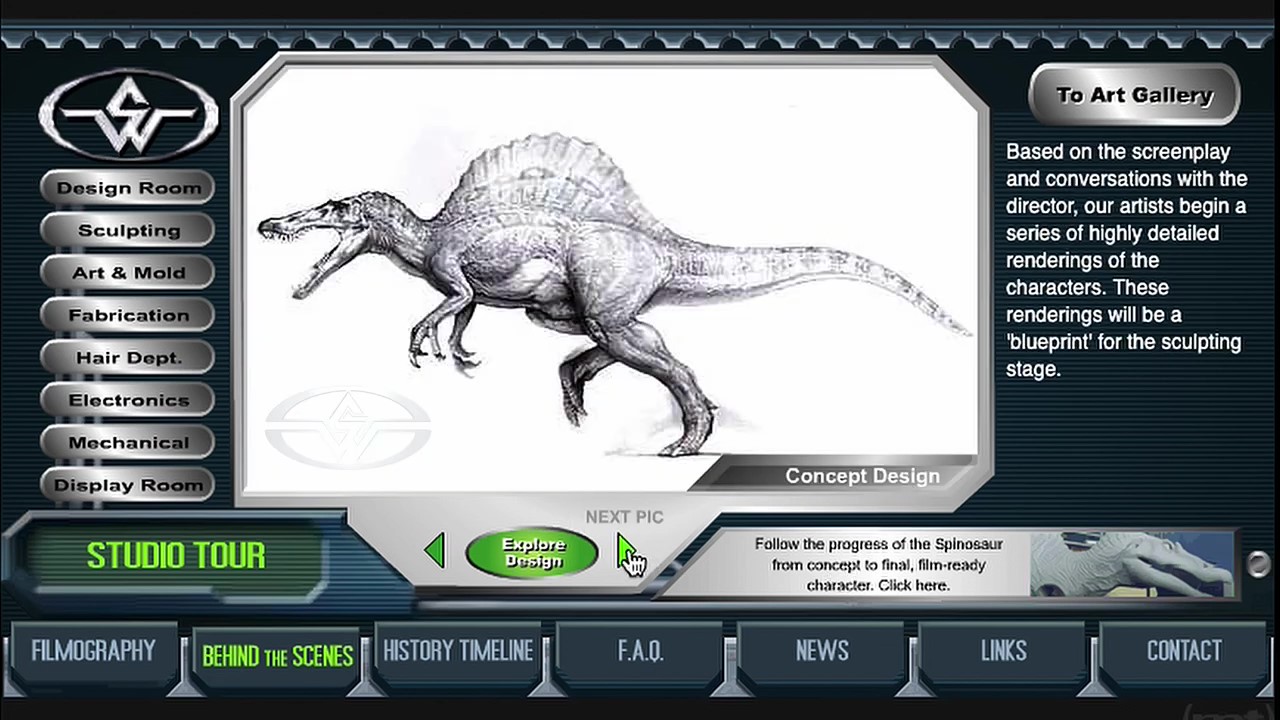 (The SWS website showed visitors just what it took to get the Spinosaur, their largest and heaviest animatronic, film-ready.)
As White related, following the success of Jurassic Park, there was an interest in what was happening at the studio and the behind-the-scenes of how the dinosaurs were made. There was, naturally, a lot of mystique that surrounded Stan Winston Studio.
‘How did they make that?’
‘Who works on this kind of stuff?’
‘What is the process like?'
“[Prior to this] we didn’t have a website. There was no presence of Stan Winston Studio on the web at all,” White said. “We wanted to create something and make it an interactive and fun experience — not a boring, just plain old site like you used to see. So, we put our minds together and our creativity and did our best.”
The website gave fans a sneak peek into how everything was made for the first time ever.
“Audiences had really never seen live action creatures done on a scale like that [for Jurassic Park] before,” White continued. “...This was really an opportunity for everything else so that it could have a home, to show all the departments and multiple photos of how things were getting done. This was just really a huge archive to be able to put everything on there that we wanted to and express the kind of work the studio was doing.”
Using Special Web Effects for the SWS Website
Charmatz and Wolfinger worked on the art for the website and had help from Flash designer Quinn Supplee, who helped with the heavy duty flash scripting. According to Charmatz and Wolfinger, Supplee enhanced their creative ideas.
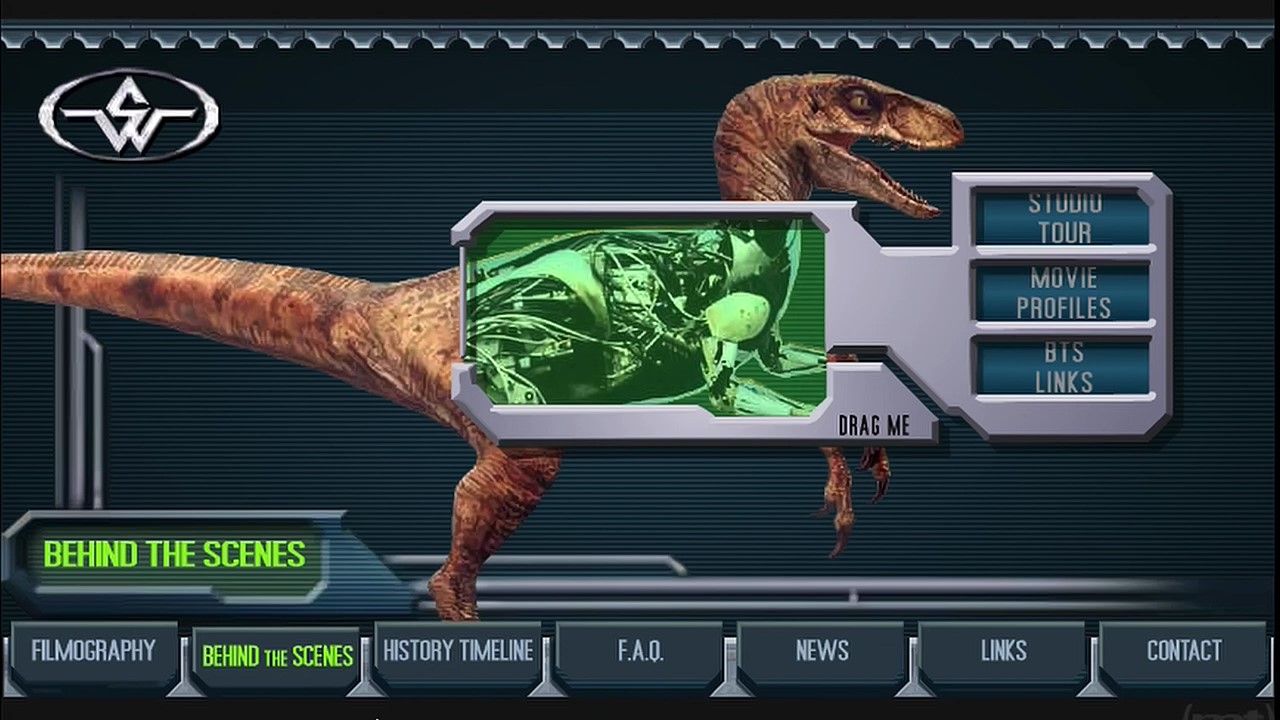 (This effect from Wolfinger and Supplee is absolute dino-mite.)
One of those ideas was the x-ray raptor feature. Supplee gave the duo the scripting to be able to move the screen around and see the raptor as is as well as its mechanical skeleton.
“For the actual effect, we basically shot stills of the actual raptors with the skins on,” Wolfinger said. “Luckily, we had some that had not yet been skinned that we took photos in the same angles and then composited them in Photoshop so they lined up perfectly and created a mask in the shape of this x-ray screen so that as you drag it around, [you] reveal what was underneath.”
Giving a Virtual Tour of the Stan Winston Studios Special Effects Process
 (Your favorite SWS character was first brainstormed here!)
Another fascinating feature on the website was the virtual tour you could take of the studio. You could get an idea of exactly how something was made, the chronological order in which it was made and every department it went through.
 (A look into the initial steps of bringing a character to life: sculpting, art and mold, fabrication and hair.)
Every crew member was a special effects magician. The website’s images show decades in the studio’s history, spanning from the ’80s to the early ‘00s.
“We had so many people at different times working on so many things. Everybody was so talented, from the designers to the mechanical designers, to the mold makers, to the painters and sculptors,” Charmatz said. “Everybody in their own right was so talented, and that’s why I think we were able to put out such great work.”
 (The final steps for projects nearing completion.)
The studio, while not open to the public, was captured on the website so it was the perfect way to invite the fans in. Visitors could see everything from where Stan Winston was making an appearance and the latest news to the works in progress and all the love that went into each from start to finish.
 (This 360° panoramic photo was comprised of hundreds of photos taken at multiple levels and stitched together in Photoshop.)
“We knew people who were coming here wanted to see everything. They wanted to see all the details and all the making-of’s — not just sort of the superficial experience of maybe seeing the movie and seeing that it was a cool creature,” White said. “It's why in all these images you're seeing so many different projects, films and types of characters represented — everyone's got their own favorite, so we wanted to make sure that if Aliens was your favorite, or Predator, Edward Scissorhands, Interview with the Vampire, everything was here. There was something for everybody.”
The team thought about what they would want to see as a visitor and applied that to how they built the website.
 (Fans of Aliens and Predator could learn more about their favorite films and see behind-the-scenes photos through the website's movie profiles.)
“There was nothing else out there like this. Any other websites that had to do with entertainment or studios were pretty stripped down and simple,” Charmatz said. “We’re fanboys too. We wanted to see the best of the best.”
Breaking Down the Timeline of Stan Winston’s SFX Journey
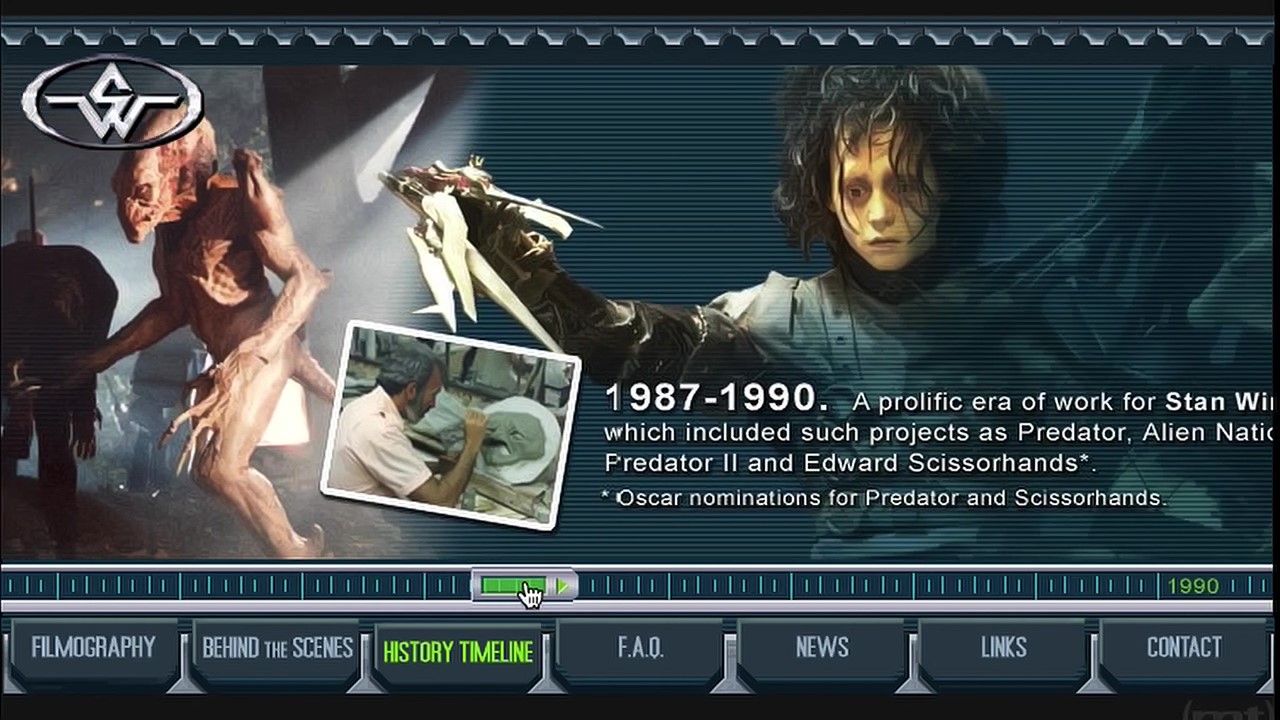 (The full-length timeline, which was one long Photoshop image, captured Stan's SFX journey.)
The “History Timeline” section of the website gave fans an outstanding overview of Stan Winston’s work and success accomplished over the years.
“What was also cool about this particular history timeline is: if you were a fan and you were starting at the beginning, you could really see the trajectory and the journey of just one person’s career and how one project, working for a certain director, a certain new technique that was created…” White said. “In a lot of ways, the Heartbeeps makeup for Andy Kauffman and Bernadette Peters led to The Terminator. All these things are building on top of each other, and this was just a really cool way to visualize that as a journey of what a career could look like in the film business.”
Inspired creators of all ages in pursuit of their dreams who wondered how they could send their portfolios in hopes of working at the studio could learn everything they needed to know with the website’s FAQ page.
“The website was finally a way that we could just say it all and show it all,” White said.
Web building, filmmaking, and special effects have certainly evolved over the last 20 years. What remains unchanged and everlasting is the influence Stan Winston and the special effects artists at Stan Winston Studio have made on the industry.
Courses with the Creators of the Stan Winston Studio Website
- Creature Screenwriting: How To Write Memorable Monsters with Juliet Snowden & Stiles White
- Portrait Illustration Part 1: Pencil Drawing Techniques with Terry Wolfinger
- Portrait Illustration Part 2: Painting With Photoshop with Terry Wolfinger
Do you want to try our school? Online Courses with Hollywood's Master FX Artists: FREE 7-Day Trial.