
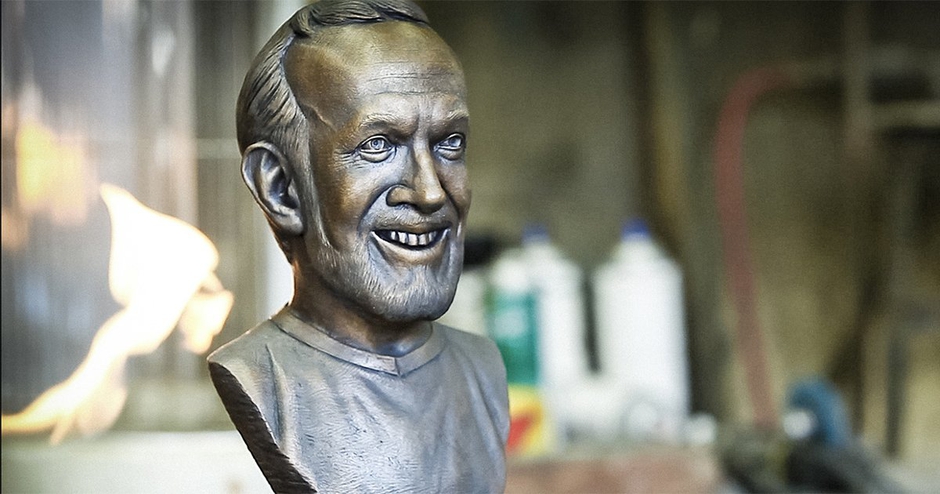
Transforming the Stan Winston Sculpture From Clay to Bronze
SWSCA instructor and fine art sculptor Davis Fandino took us inside the American Fine Arts Foundry for a guided tour of the lost wax bronzing process. Along with AFAF's owner, Brett Barney, Fandino explained, step-by-step, how the artisans of AFA Foundry transformed Fandino's clay sculpture of Stan Winston from impermanent work of art to a bronze bust that will last for generations.
Jump To Section
- The Unsung Heroes of Fine Art
- A Ten Step Process
- Molding the Sculpture
- Creating the Wax Positive
- Wax Chase
- Gating the Wax Positive
- The Shelling Process
- Burnout
- Casting the Bronze
- Demolding the Bronze
- Metal Chase
- The Patina Process
- Paying Homage to a Master
To WATCH THE VIDEO, simply click on the video player above.
To check out Fandino's PORTRAIT SCULPTURE lesson, featuring the creation of his Stan Winston bust, CLICK HERE.
The Unsung Heroes of Fine Art
Why learn the bronzing process? What does this have to do with special effects and monsters? Fandino addressed these questions right at the start, saying, “There are a lot of artists, like myself, who live in both worlds, a special effects world and a fine arts world. This will really resonate with people who do special effects because they are the craftsmen behind the scenes, and they don’t get the glory or the credit that they often deserve. The fine art world is exactly the same way. It’s the artist who gets to stand next to the piece at the gallery, but there’s a whole army of people behind them. They are unsung heroes just like special effects artists.”
A Ten Step Process
AFA Foundry’s owner, Brett Barney, laid out the plan for our Foundry tour. "What we are going to show you today are the ten steps that occur in the lost wax foundry process. Hopefully, through all of it, you will get a good perspective on how much work it actually takes from trained artisans in each of their specialties, in each of their departments, to realize the sculpture that you’ve put all your heart and soul into and bring it all the way through to the final product. Our goal is not to be the weakest link in your process but at least on par with the original artists themselves. So hopefully, that comes through in the final piece.”
Molding the Sculpture
Our tour began in earnest as Barney and Fandino led us from the foundry showroom back into the workshop area. Barney explained step one of the lost wax process. “Typically, what we receive here at the foundry is an original sculpture. It is made either in clay, wax, wood,or any material—it could be stone—that an artist likes to work in. Our first job is to mold that original piece of artwork.”
Creating the Wax Positive
Once the mold has been made, it’s time to make the wax positive, a hollow wax casting of the original sculpture -- like making a chocolate Easter bunny. Hollow bronzes are preferable to solid bronzes for several reasons. “One, it’d be very costly, but two, you have a lot of casting defects that can occur when you’re managing heat. So we strive for a casting wall of about three-sixteenths of an inch thick,” said Barney.
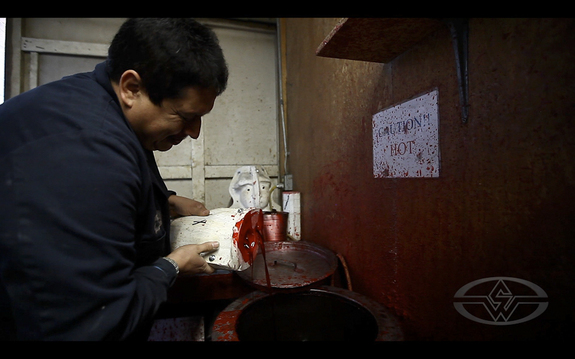 (AFAF's 'Big Danny' pours wax into a silicone mold to cast all the detail from Fandino's original clay bust of Stan Winston.)
Wax Chase
“Whenever you pour a wax, there has to be parting lines on the mold. So we have to remove any of the seam lines that have occurred,” explained Barney. “And it’s not only seams that need to be removed. If any air bubbles end up in the wax, anything like that, we go back, and we call it perfecting the wax.”
Fandino underscored another parallel between foundry and special effects work. "In the special effects industry, the terms for these processes are 'seaming' and 'patching.' The fabrication department will take a piece; in your case, it's wax; in our case, it would be resin, fiberglass, foam latex, urethane, or silicone, and the seams would be cleaned up and bubbles filled in a very similar way."
Gating the Wax Positive
After the hollow wax casting has been cleaned up thoroughly during the wax chase process, it’s time to prepare for the second molding process by ‘gating’ the wax. “We have to engineer how the piece is going to get cast and how the metal is going to flow into the shell throughout the piece when we pour the bronze,” said Barney. “We design the channels for the flow of the bronze in and the escaping of the air out of the temporary mold that's going to be used for casting the bronze."
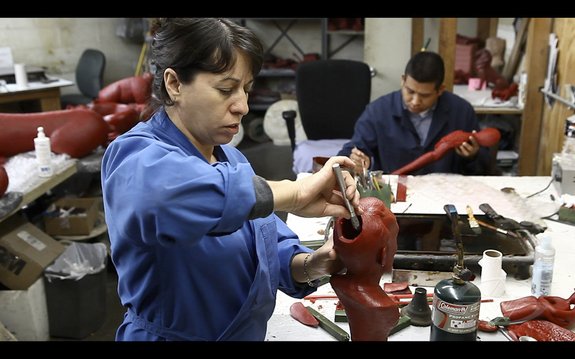 (AFAF's Herminia 'chases' the details and imperfections in the wax. She then cuts vents and adds wax rods, which will later create paths for the bronze to flow through, a process known as 'gating.')
The Shelling Process
The gated wax casting then heads to the ‘shelling’ room, where it will be coated with layers of sand and slurry to create a new ceramic mold that molten bronze can eventually be poured into to create the final casting. It’s a time-consuming step that Barney compared to watching paint dry. “It’s a multiday process because we have to dip the piece in a slurry solution, which makes the piece wet. Then, we apply a coat of a special type of sand to it and wait for it to completely dry. We then must repeat that process about eight times to create the proper thickness for the shell.”
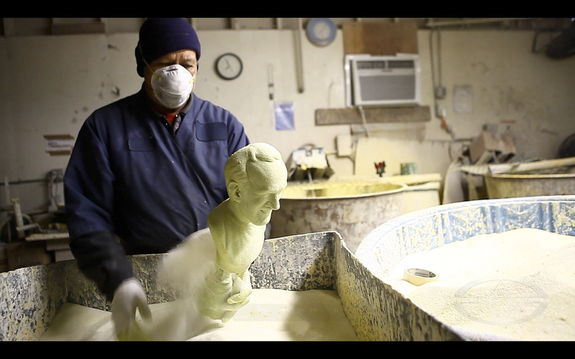 (AFAF's Enrique sifts a fine sand coat onto the hollow wax casting after it has been dipped in a slurry.)
Burnout
Once the eight layers of sand and slurry have dried, it’s time for the burnout phase. “We cut off the bottom of the ceramic, we turn it over, and we heat it,” explained Barney. “As the shell is brought up to temperature, a couple hundred degrees, all that wax then just melts right back out. That wax is captured and then recycled back to our suppliers.” The ceramic shell is then reheated up to 1500 degrees, at which point the silicone-based sand ‘vitrifies’ into a glass-like ceramic material with the strength to withstand the heat and pressure of the molten bronze that will be poured inside.
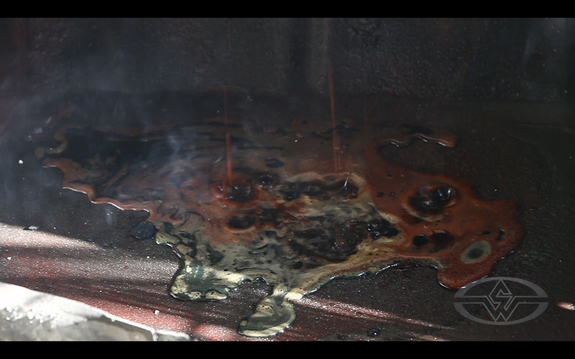 (They don't call it “Lost Wax” for nothing. Enrique holds fire to the shell until all the wax is burnt out.)
Casting the Bronze
The day after the vitrification of the ceramic shell, it’s finally time to pour the bronze. “We will bring it back up to casting temperature (1500 degrees) while at the same time, we’re bringing the bronze up to temperature, which is approximately 2000 degrees,” said Barney. This pre-heating process is all to avoid a ‘cold stop’, where the bronze cools to the point that it can no longer flow evenly throughout the shell. “You want to get a good even pour through the entire shell so that you get a great casting.”
We watched as the foundry crew, wearing fire-proof suits, mask,s and gloves, pulled the shells out of the oven, lined them up for the pour sequence, and then poured the molten bronze into the hot shells as quickly and accurately as possible.
Fandino again pointed out the parallels between the fine arts and special effects worlds. “When we’re pouring foam latex, it’s a big hurry. It’s the same thing as pouring bronze, but the latex isn’t cooling; it’s jelling. As it jells, the flow decreases,” said Fandino. “So we’re seeing all the one-to-one corollaries. If you’re a special effects artist, everything you learn in the special effects world can be applied to the fine arts world and vice versa. People can jump worlds, which is what this is all about.”
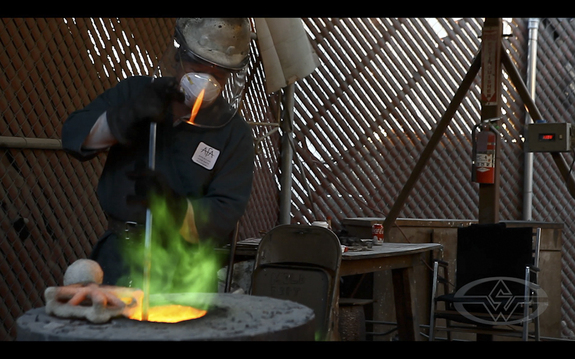 (Before the pour, the crew removes the slag from the surface of the molten bronze.)
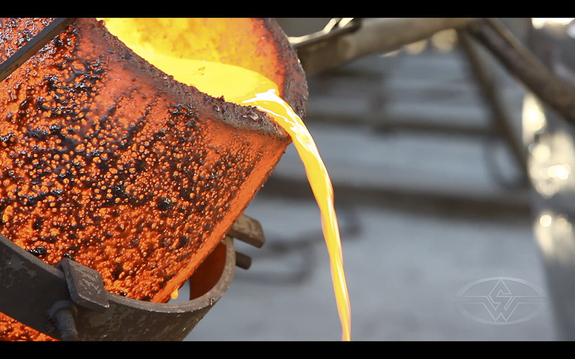 (Molten bronze flows out of the crucible at 2,000 degrees.)
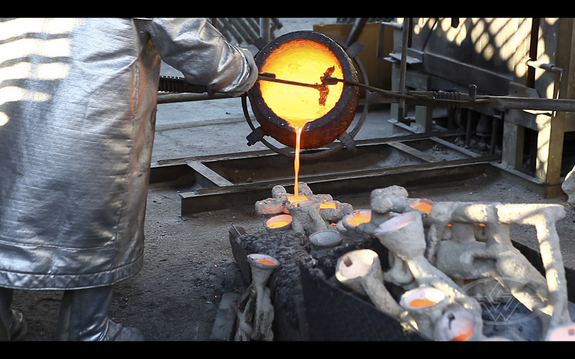 (The team is awake EARLY on pour days, and their movements are choreographed like a ballet.)
Demolding the Bronze
As the molten bronze cooled inside, the pressure from the shrinking and cooling began to crack the brittle ceramic shell. Whatever didn’t naturally break off was carefully hammered away, and then the piece was blasted with glass beads to remove any remaining ceramic material.
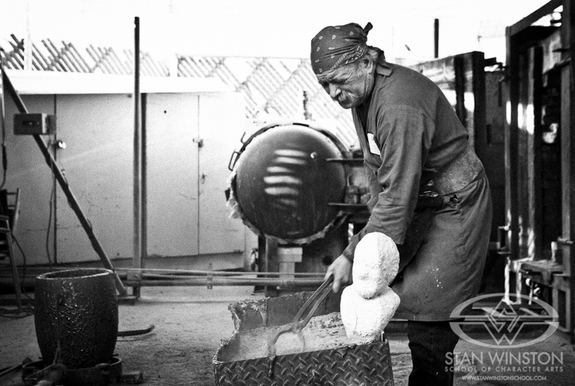 (AFAF's Enrique places the shell, now filled with cooling bronze, into the sand for further cooling.)
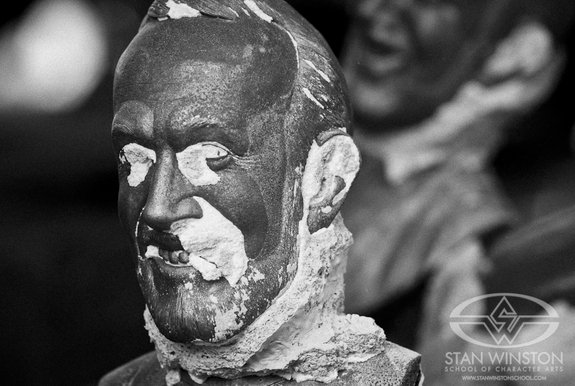 (Whatever ceramic doesn't slough off of the bronze from the cooling process will be hammered away.)
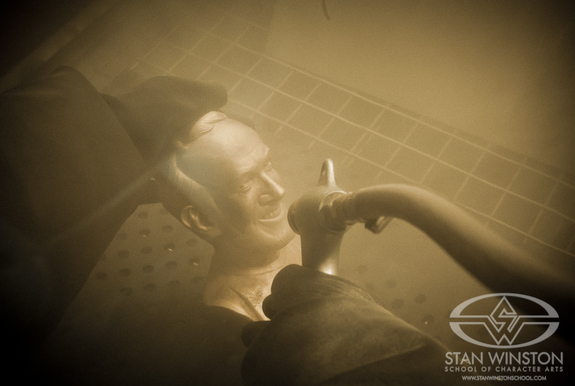 (AFAF's Little Danny takes a sandblaster to the bronze to create a clean, impurity-free surface.)
Metal Chase
If the piece had to be segmented for mold making or just to manage the casting process, all parts are reassembled during the ‘metal chase’ process, during which the casting is returned to the same level of texture and assembly as the original art piece. Welds and any imperfections caused by the casting process are eliminated. Barney brings it all back to pleasing the artist, who has to be able to look at the bronze and say “That’s it.” Fandino brought up another similarity between the ‘metal chase’ process and the special effects world, “There are crews of hundreds of people, and their pride comes from almost being invisible, and the more invisible they are, the better they did their job.”
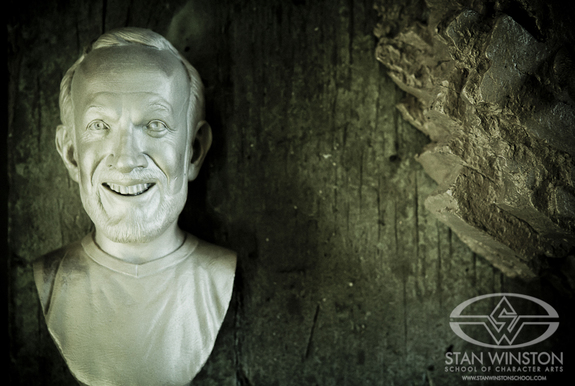 (The cleaned bronze bust of Stan Winston awaits the next step: Metal Chase.)
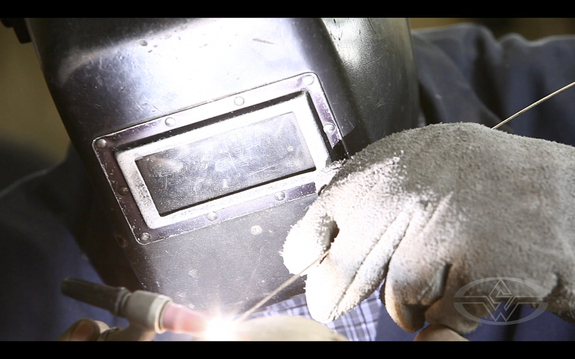 (AFAF's Servando tack welds the bust back together. The weld seams will then be removed.)
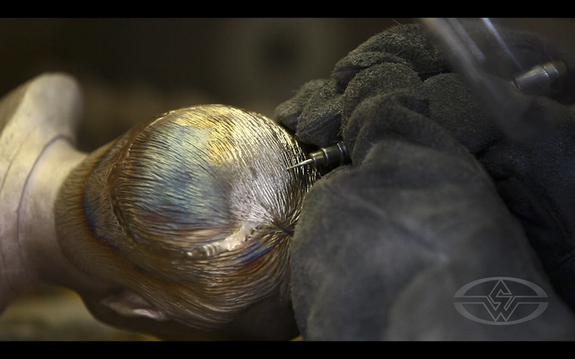 (AFAF's Servando 'chases' the metal, restoring hair detail to a welded section of the bust.)
The Patina Process
Once metal chase has been completed to the original artist’s satisfaction, the piece heads for the patina department, where artisans, in close consultation with the artist, add color to the raw bronze.
But unlike with special effects, where color is typically added with tint and paint, the patina process is “a heat process,” said Barney. “We’re actually changing the molecular structure of the surface of the bronze. Heat is the catalyst that drives the oxidation of the salts and acids used to create different color effects. The patina artist, or ‘patineur,’ has to have a good understanding of the solution strength for those materials, the heat that’s required to get different effects, the layering that might have to happen in order to drive different colors or different kinds of shadings or luminosity through the patina.”
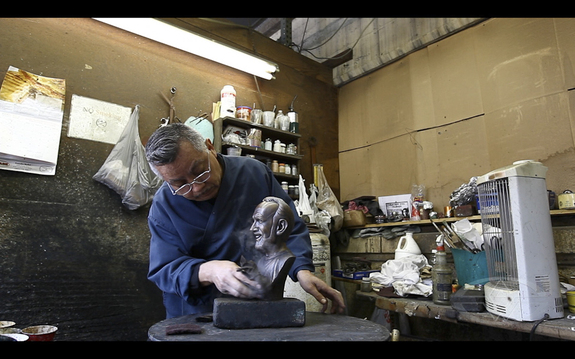 (For over 20 years, Joaquin Quintero has been one of the head Patina Artists at the Foundry.)
Paying Homage to a Master
When our tour wrapped up, Fandino took a moment to share his reaction to it all. “This is actually the first piece I’m having cast in bronze of my own, and it’s been really amazing to watch this happen. It’s also been great for the students of SWSCA to see how many of these skills apply to both special effects and fine arts work. Artwork is artwork, and the craft is always the craft. Creating three-dimensional objects by hand, all of the processes are similar, with just slight variations depending on where you’re applying them. This whole process for me has been really exciting, and I’m really honored to be able to sculpt a bust of Stan for the school, for his family; then, to top it all off, to use the same foundry that he used. There’s something really great about that, it really brings it all together for me and for everybody, I’m sure. Thank you so much for your help in that.”
-Matt Winston
To WATCH THE VIDEO, simply click on the video player at the top of the page.
And to check out Davis Fandino's How to Sculpt a Portrait lesson, featuring the creation of his Stan Winston bust, CLICK HERE.