

The year 1996 was a busy one for the special effects team at Stan Winston Studio. The studio got the task of creating the animatronic animal replicas for The Ghost and the Darkness. The film marked the second collaboration between Stan Winston and director Stephen Hopkins (A Nightmare on Elm Street 5 The Dream Child, Predator 2, Lost in Space), and the sixth with producer Gale Anne Hurd (The Terminator, Aliens, The Relic). The action-adventure film tells the story of man-eating lions, called "the Ghost" and "the Darkness," who wipe out a railroad construction crew in East Africa.
Jump To Section
- The Making of Tsavo Lions “The Ghost” and “The Darkness”
- Taking Inspiration from a Real Lion to Create Sculptures for The Ghost and the Darkness
- Building Mechanical Lions for Stephen Hopkins’ 1996 Adventure Film
- The Challenge of Filming The Ghost and the Darkness on Location
Behind-the-scenes of The Ghost and the DarknesNEW behind-the-scenes blog! bit.ly/GhostDarkBtsFB The year 1996 was a busy one for the special effects team at Stan Winston Studio. The studio got the task of creating the animatronic animal replicas for The Ghost and the Darkness. The film marked the second collaboration between Stan Winston and director Stephen Hopkins and the sixth with producer Gale Anne Hurd.
Posted by Stan Winston School of Character Arts on Monday, October 11, 2021
(John Rosengrant and Joey Orosco sculpt the form that was used as the basis of the lion puppets.)
The Making of Tsavo Lions “The Ghost” and “The Darkness”
The project was led by animatronic effects supervisor John Rosengrant, senior effects artist Joey Orosco, and animatronics design supervisor Richard Landon with hydraulics expert Tim Nordella, and the entire team of artists and technicians at Stan Winston Studio also contributed their skills. Rosengrant and Orosco sculpted a full-size lion in clay, which served as the basis for all of the animatronic lion rigs the studio would build for the show. And to give the lions an almost mythological appearance, the Stan Winston Studio crew made their sculpture ten percent larger than an average lion.
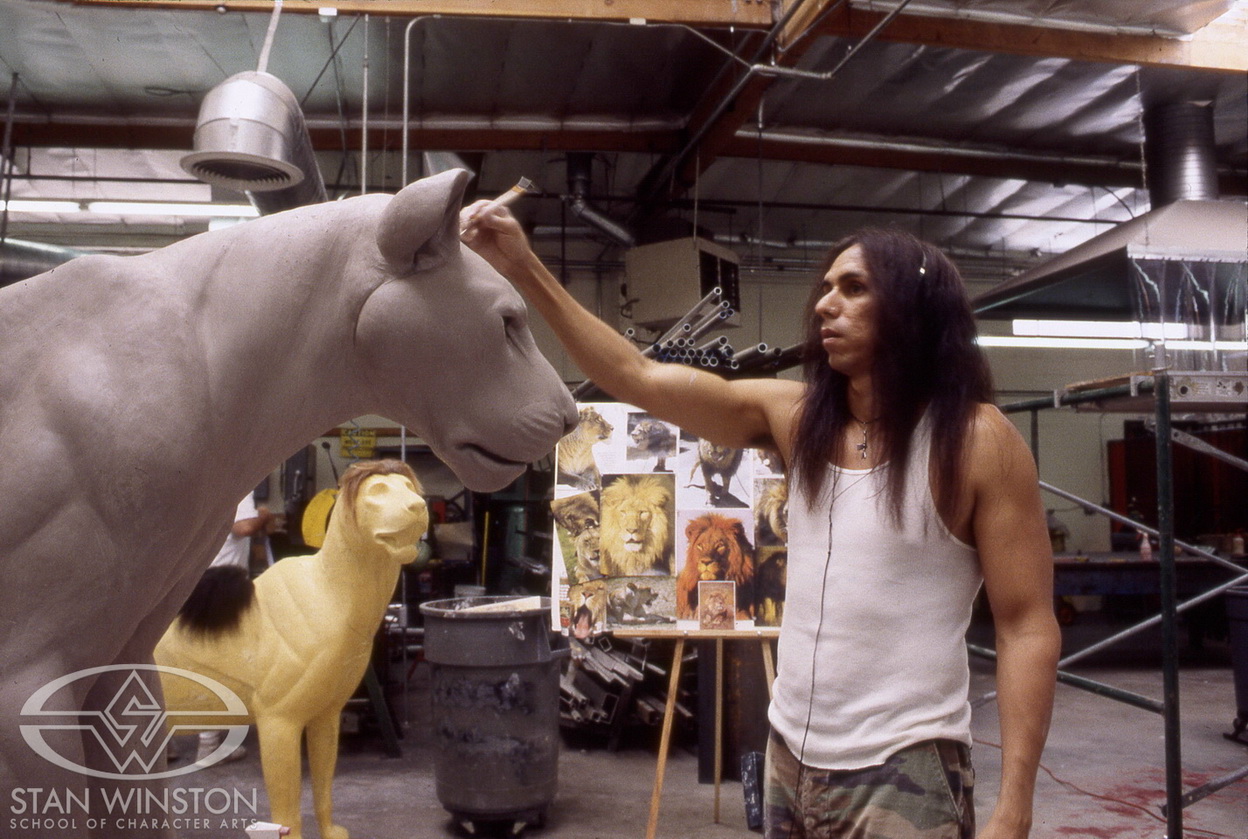 (Key artist Joey Orosco sculpts the lion body in clay.)
"The underlying idea of the story was the question of whether the lion attacks were Africa herself rising to rebel against the building of this railroad, or just attacks by rogue lions. There was that mythological aspect to the story, and so these lions needed to look like more than normal animals." Rosengrant explained.
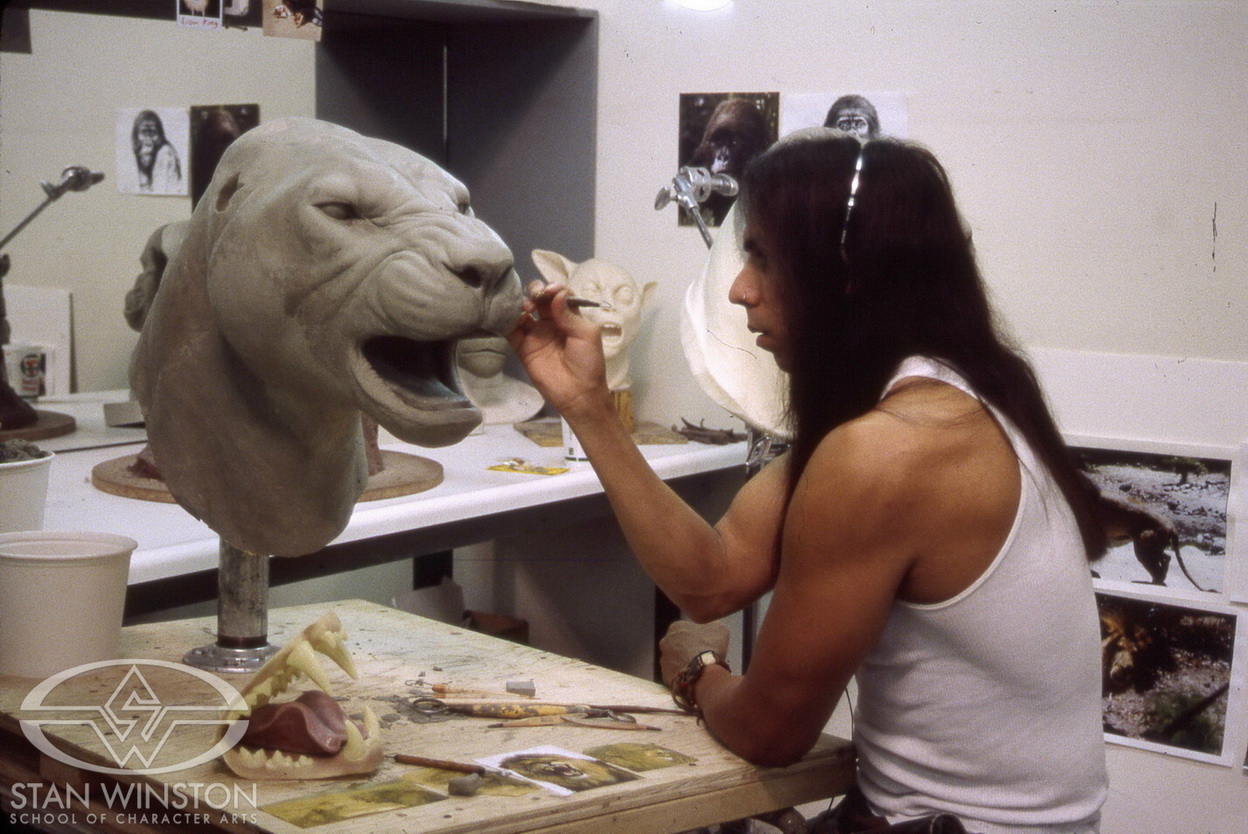 (Joey Orosco adds facial details to the lion's head clay sculpture.)
Taking Inspiration from a Real Lion to Create Sculptures for The Ghost and the Darkness
For the film, Rosengrant and Orosco based the oversized sculpture's features and proportions on photographs and measurements of Sudan, the main performing lion originally cast to portray both the Ghost and the Darkness. From that first sculpture, the crew built two hydraulic lion puppets. Each mechanical puppet had a full range of motion on the front end, with hydraulically powered head and torso movement, plus radio-controlled facial features and rod-puppeteered front legs and paws. Yak hair and mohair were punched and hand-tied into the silicone skin on the faces and manes, while dense-weave fur was used for the bodies. Orosco did the final paint jobs on the animatronic lions, coloring one lighter, for the Ghost, and one darker, to portray the Darkness.
 (FX technician Lindsay MacGowan fits a fiberglass ribcage over mechanics for one of the lion puppets the studio built for the film.)
Building Mechanical Lions for Stephen Hopkins’ 1996 Adventure Film
In addition to the full-body lion puppets, the Stan Winston Studio crew built a separate roaring head for each of the hero bodies. The crew also built two close-up heads mounted to a harness worn by Rosengrant for shots in which the bodies were not in the frame. Insert lion paws, and full-body props for shots showing a dead animal completed the assignment. When the studio crew arrived in South Africa for filming, they were stunned to learn that director Stephen Hopkins had replaced Sudan with a different, much larger live lion. Suddenly, the animatronic lion rigs, so meticulously matched to Sudan, bore no resemblance to the main lion who would be filmed in the movie. "Sudan had a very distinctive face which wasn't at all like that of the new lion they were shooting. But, when I saw him, I understood the decision to switch to this new lion. Sudan was rather small, only 350 pounds, whereas this lion was a huge 475 pounds. But swapping lion-actors meant that, even with the ten percent enlargement we'd done on the sculpture, our lion still wasn't big enough to match. The coloration was very different, too." said Rosengrant.
 (FX technician Joe Reader fits the skin onto one of the hydraulic lion puppet rigs. In the background is FX Mechanic Bob Mano.)
To create a better match, John Rosengrant did some quick cosmetic alterations on the animatronic lions, changing their markings and color patterns. Initially, he also considered improving the match by using powders to change the coloration of the real lion. Joey Orosco said, "I remember John standing next to me with these colored powders as one of the trainers brought out this really scary-looking lion and walked toward us. I asked John, 'Uh, what are you thinking of doing?' John said he wanted me to put some of these powders on the lion so that the hair would match the puppets. I said: 'No way! I'm not going to do that!' So John went over and put a bit of these colored powders on the lion himself. I don't think he was feeling too good about it, though, because that was the last time he ever did it."
Although that was the last time Rosengrant got that close to a lion, he and other crew members worked in proximity to the animals every day of the two-month shoot. "Being around those lions, seeing the power of them up close, was an amazing experience." John recalled, "I remember the trainers would skewer an entire fryer chicken and hold that up to get the lions to walk in a certain direction, and the lions would swipe at that chicken with a paw and swallow it whole. It would be gone, just like that. The trainers could walk around with some of them on leashes because they had been hand-fed and trained. And they would leave us alone because we stood tall, which, to them, meant we were bigger. A lion sizes up everything by height to determine what is prey, which is why children and small women can’t be around them."
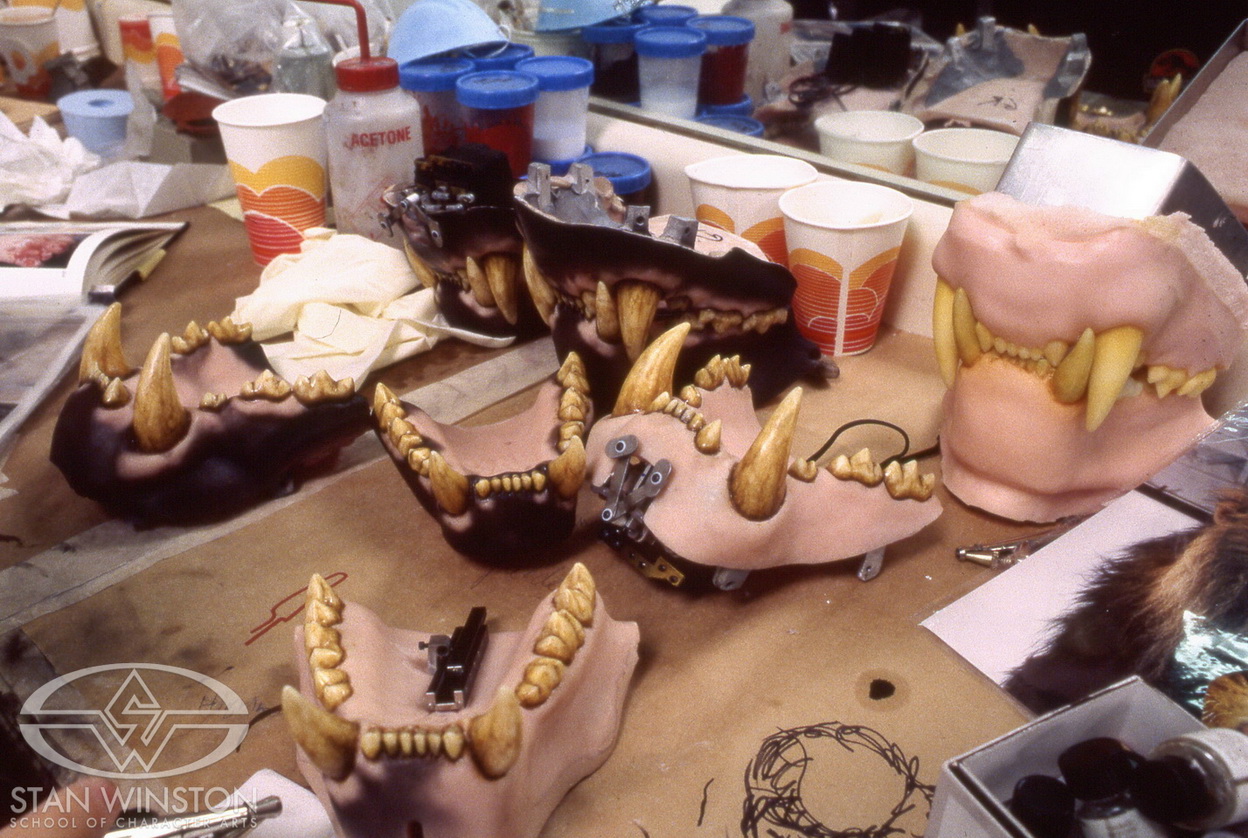 (The jaws of the animatronic lion puppets during fabrication at Stan Winston Studio.)
On more than one occasion, a lion broke free of its leash, or its cage, prompting crew members to retreat to a safe distance. "I was there one time when a lion got loose," said Rosengrant, "and I watched it snap at its trainer, then jump from the ground to the top of its cage at the back of a truck — twelve to fifteen feet, straight up in the air, just like a housecat. And that was one of the tame ones! I got on the camera truck with some other people, and we drove off away until they corralled that animal. There were also a couple of circus lions, and when one of those got loose, you ran for the hills because they weren't tame at all. They had a much meaner, more aggressive demeanor." Fun!
 (Stan Winston Studio hair technician Ursula Ward punches fur into the skin of a lion puppet.)
The Challenge of Filming The Ghost and the Darkness on Location
The crew had confrontations with other wildlife on the game preserve as well, especially at night when searching for a bathroom with a flashlight in hand; they'd suddenly find themselves in the path of a running gazelle or wildebeest. Dangers lurked even at the hotel where the crew was staying. "I found myself within two feet of a cobra one day." recalled Rosengrant, "I was walking from the pool, wearing only swimming trunks and flip-flops in a pretty vulnerable state, and suddenly this thing rose, and its hood opened. I froze. I remember thinking: 'I might actually die here in Africa, at this hotel.' I had no idea what you're supposed to do when a cobra confronts you, but I guess I did the right thing by freezing because the cobra relaxed and slithered away. I just slowly turned and walked back the way I came."
 (Stan Winston Studio lead FX artist Joey Orosco airbrushes the animatronic lion puppet head at the art department.)
The crew also battled the elements in South Africa, where temperatures routinely rose to well above 100 degrees. Thunderstorms hit frequently and suddenly, threatening to flood the savanna where the crew was shooting. More than once, the film crew had to pack up in a hurry, then gun the engines of their trucks, driving up muddy, slippery slopes to escape before the flood waters rose. "It would get so hot, there were times when we had to put blankets and ice over the electronics packages because they were overheating and malfunctioning." said Richard Landon who was on the mechanical and puppeteering crews.
 (Stan Winston Studio Art Department: John Rosengrant, Jim Charmatz, Joey Orosco & Jon Neill at work, airbrushing various lion puppets at the studio.)
"The Ghost and the Darkness is another one of those shows where a lot of it didn't seem like fun when we were going through it," said Rosengrant, "but looking back on it is like looking back on a great adventure. I was fascinated by the place and by the animals. And we really contributed something to that show. There were shots they wouldn't have been able to get any other way, except by using the lions we'd created at the studio."
 (The final "Darkness" puppet on its platform.)
STAN WINSTON STUDIO: Animatronic Effects Team
John Rosengrant – effects supervisor
Richard Landon (mechanical) & Tim Nordella (hydraulics) – animatronic effects design and supervision
Joey Orosco – lead key artist
Glenn Derry – key electronics technician
Stuart Artingstall – hair department supervisor
Karen Mason – fabrication department supervisor
Emery Brown – electronics department supervisor
Michael Ornelaz – on-set hair technician
Hair Department:
Ursula Ward, Sylvia Nava, Robert Maverick, Kathleen Kane – MacGowan, Lynne Watson, Christine Stahl
Key Artists:
Richie Alonzo, Bill Basso, Jim Charmatz, Richard Davison, Mark Jurinko, Nick Marra, Jason Matthews
Art Department:
Jason Barnett, John Calpin, Jacqueline Perreault – Gonzalez, Kevin McTurk, Jon Neill, Chris Robbins
Key Technicians:
Joe Reader, Barry Crane, Lindsay MacGowan
Mold Department:
Darin Bouyssou, Mike Harper, Keith Marbory, David Perteet, Gary Yee
Mechanical Department:
Jon Dawe, Matt Heimlich, Marc Irvin, Robert Mano, Kyle Martin, Brian Namanny, Paul Romer
Electronics Department:
Roderick Khachatoorian, Ronald Presser
Fabrication Department:
Gilianna Bonfietti, Judy Bowerman, Tamara Carlson, Jodi Dickson, Nathalie Fratti – Rapoport
South Africa Animatronic Effects Assistants:
Graham Press, Richard Preston, Gerard Barnardo
BTS Blog assembled by Dimitar Dimitrov with selections from The Winston Effect: The Art and History of Stan Winston Studio by Jody Duncan
Courses with the Creators of The Ghost and the Darkness
- Hybrid Characters: Blending Practical & Digital FX with John Rosengrant
- Animatronics Design Basics with Richard Landon
- Cable Mechanism Basics - Tentacles with Richard Landon
- How To Make A Stone Mold with Gary Yee
- Hairy Creatures Series - Introduction To Hair Knotting with Michael Ornelaz
Do you want to try our school? Online Courses with Hollywood's Master FX Artists: FREE 7-Day Trial.