

The Breakthrough of Stop-Motion Animation in Films
When it comes to stop-motion animation, there's Ray Harryhausen, and then there's everyone else. I thought it would be fun to turn the spotlight to some stop-motion monster classics and not-so-classics, from other frame-by-frame puppeteers.
Since the early days of movies, stop-motion and dinosaurs have gone hand in hand. Willis O’Brien pioneered stop-motion effects in the silent era, bringing dinosaurs to life as early as 1915 in comedy shorts like The Dinosaur and the Missing Link and R.F.D. 10,000 B.C. A 1918 fantasy short, The Ghost of Slumber Mountain, featured more realistic stop-motion dinosaurs. These early works can be viewed on YouTube by clicking http://www.youtube.com/user/willisobrien.
Jump To Section
- The Lost World (1925) – Willis O’Brien
- King Kong (1933) – Willis O’Brien
- Stop-Motion Animation Becomes Popular in the 1950’s
- The Black Scorpion (1957) – Willis O’Brien and Pete Peterson
- Stop-Motion Critters in Fiend Without a Face (1958)
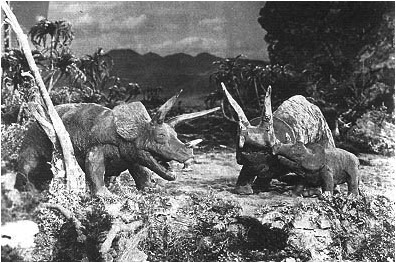 (Two triceratops from The Lost World (1925); stop-motion effects by Willis O’Brien.)
The Lost World (1925) – Willis O’Brien
In 1925 O’Brien startled movie audiences with a whole world of life-like dinosaurs in The Lost World. The movie was also the first to have a prehistoric monster loose in the streets of a modern city, an idea repeated countless times in the future. Of course, that was the theme of O’Brien’s next big movie and his crowning achievement...
 (Brontosaurus on the street from The Lost World (1925); stop-motion effects by Willis O’Brien.)
King Kong (1933) – Willis O’Brien
“The stuff for which movies were made!” shouted the trailers. For once, the publicity was absolutely true. The world that Kong inhabits could only have existed through the magic of the movies and the skills of talented effects artists and technicians like Willis O’Brien.
 (Kong battles a T-Rex in King Kong (1933) with stop-motion effects by Willis O’Brien.)
Imagine being in the audience during the movie's original release and seeing the monstrous ape battle the hissing, snapping Tyrannosaurus. You would have been witnessing things you had never seen or heard before, and never could have up until then. It was state of the art and then some in 1933. Kong thrilled millions and changed the life of a teenaged Ray Harryhausen whose mission became clear the day he first saw King Kong. Two re-makes and scores of spin-offs and imitators have followed, but the original KONG is still King and still a marvel of ingenuity, artistry and imagination.
 (Kong saves the lady from a Pterodactyl in King Kong (1933) with stop-motion effects by Willis O’Brien.)
Young viewers of today might think that it looks crude or even funny compared to the near-seamless computer effects of the mega-million dollar Peter Jackson version and other modern effects movies. But if they can look at the original with the proper perspective, they might just realize what a groundbreaking and remarkable film it was and still is and come to appreciate the genius of men like Willis O’Brien.
Stop-Motion Animation Becomes Popular in the 1950’s
There was a long dry spell in stop-motion monsters. A Willis O’Brien project called War Eagles, sadly, never took flight. Finally in 1949 Mighty Joe Young became sort of the final part of the Cooper/ Schoedsack/ O’Brien giant ape trilogy, although the animation was chiefly done by O’Brien’s new protégé (along with Pete Peterson) so it's usually thought of as a Ray Harryhausen film.
 (Harryhausen’s defining The Beast from 20,000 Fathoms (1933) with stop-motion effects by Ray Harryhausen.)
In 1953 Harryhausen's reign as king of stop-motion movie monsters began with The Beast from 20,000 Fathoms, followed quickly by a string of sci-fi films for Columbia. Probably inspired by the popularity of those films, there was a rash of other stop-motion features in the late '50s.
The Black Scorpion (1957) – Willis O’Brien and Pete Peterson
Without a doubt, the best non-Harryhausen stop-motion film of the '50s was The Black Scorpion (1957). In fact, it's one of the best of the "big bug" movies of that time along with Tarantula and Them!. Its effectiveness is due in no small part to the natural fear most people have of those wicked-looking little arachnids. I mean, pinchers, eight spider-like legs, a plated, flesh-colored body, and a whip-like tail with a barbed stinger on it? Come on!
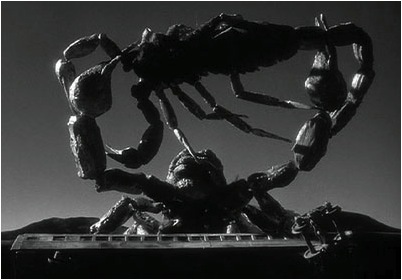 (Scorpions from The Black Scorpion (1957), stop-motion effects by Willis O’Brien and Pete Peterson.)
Like most insects, the structure of a scorpion lends itself well to stop-motion and Willis O'Brien's crew did an excellent job of making them move naturally. The actual animation was done mostly by Pete Peterson. Two scenes in particular stand out.
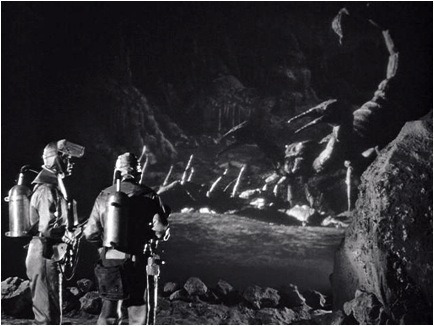 (Cavern scene from The Black Scorpion (1957), stop-motion effects by Willis O’Brien and Pete Peterson.)
One is when the heroes (and a stowaway kid) are lowered deep into the caverns that the scorpions call home. The caves have an otherworldly feel to them, a little like Kong's Skull Mountain lair. And there are guest appearances by other icky insect life, some of which are rumored to be leftover from the spider pit scene cut from King Kong.
The other big scene is when the scorpions derail a train and devour all the occupants. That's also when Big Blackie decides to let the other scorpions know who's boss in the most direct way possible - by killing them all. An annoying technique that was common to stop-motion monster films was the use of a large prop head for close-up inserts.
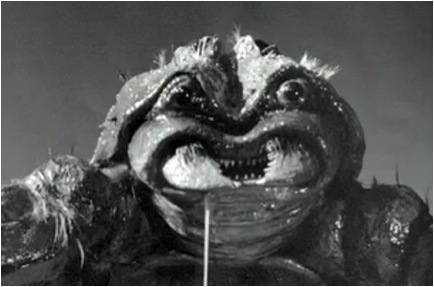 (Scorpion close-up from The Black Scorpion (1957).)
The heads usually take you out of the movie every time they pop up because of the jarring differences between them and the stop-motion models. It was true even in King Kong but it's especially bad in The Black Scorpion. The excitement of the animated action hits a speed bump every time they cut to a close-up of a much too human-looking scorpion face with drool constantly dripping from its grinning mouth. The repeated use of the prop head is the movie's biggest drawback, but still, it's a grisly gem of a giant bug movie.
Stop-Motion Critters in Fiend Without a Face (1958)
Some of the weirdest stop-motion monsters of the '50s were found in Fiend Without a Face (1958). The British film directed by Arthur Crabtree was a change of pace from dinosaurs and giant bugs, these sickening critters were slimy human brains with antennae and spinal cord tails used to crawl along like inchworms or spring onto their victim’s throats. And did I mention they gurgle and sputter when they're killed? Is this a cool movie or what? Florenz Von Nordoff directed the effects sequences while the actual stop-motion animation was done in Munich by German special effects artist K. L. Lupel.
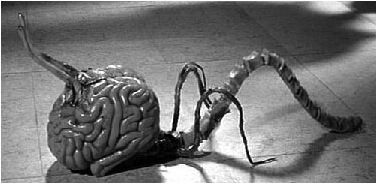 (Brain creature from Fiend Without a Face (1958), stop-motion effects by K. L. Lupel.)
The '50s were coming to a close and with them, an era of black and white, atomic age sci-fi films that now have a timeless charm. Stay tuned for PART II of “STOP MOTION MANIA” next week!
- Kerry Gammill
Excerpts from “Stop-Motion Monster Mania” by Kerry Gammill from the online magazine Monster Kid Vol. #7, reprinted with permission, all rights reserved.
Read STOP MOTION MANIA - Beyond Ray Harryhausen - Part 2 HERE: STOP MOTION MANIA - Beyond Ray Harryhausen - Part 2