
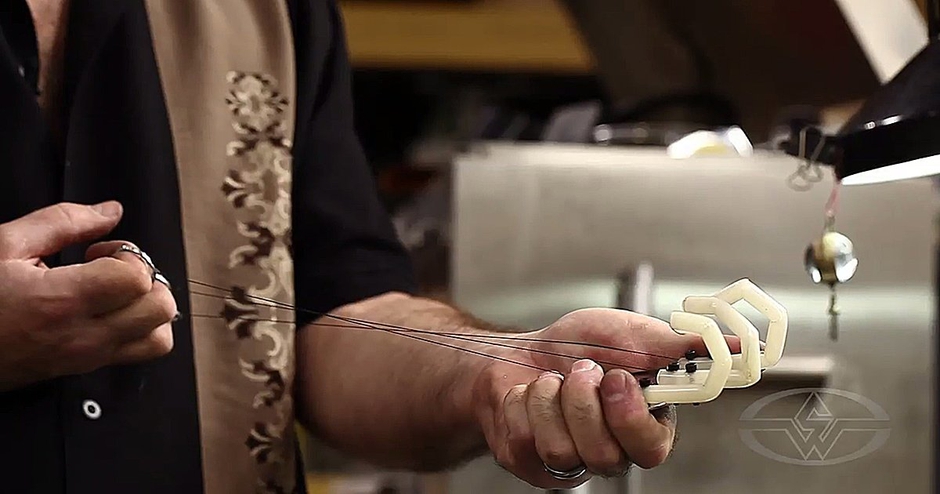
Making a Tentacle Hand with Richard Landon
In this excerpted MINI LESSON from Richard Landon's CABLE MECHANISM BASICS - TENTACLES, Richard demonstrates the simplest, One-Way Tentacle finger. And when prodded, he gangs them together to show how this simple principle can layer to become the simplest, creepy hand he can think of!
Jump To Section
- Using Nylon Tubing to Build a Finger Mechanism
- Richard Landon’s Experience with Making Finger Mechanisms
- Creating a Hand Plate Using Aluminum Plate
- Materials You’ll Find in a Mechanic's Work Station
- Putting Nylon Tubing Together to Make a Tentacle Hand
To watch the MINI-LESSON PREVIEW, click on the player above!
Watch the FULL MINI-LESSON HERE: SINGLE AXIS TENTACLE HAND MECHANISM MINI-LESSON.
Using Nylon Tubing to Build a Finger Mechanism
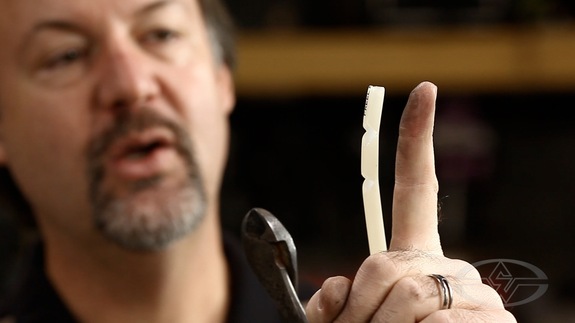 (Creature FX Mechanical Master, Richard Landon gives a MINI-LESSON on simple tentacle mechanisms.)
Richard Landon’s Experience with Making Finger Mechanisms
"It's actually really fun for me to recreate this mechanism, especially using the key rings because having worked with Stan Winston Studios for 26 years before he passed away and then continuing at Legacy Studios, I always go back to my roots, and I always go back to where I came from because it really helps to remember the history and remember where you came from. The very first mechanism that I ever showed Stan, and it is actually the mechanism that got me my first job at Stan Winston Studios, was a brass version of this exact mechanism. It wasn’t nylon fingers, it was brass fingers but it was something that I had made for David Miller for a Night of the Comet zombie. Very, very skinny finger mechanisms that bones could be placed around so that it would look like a zombie hand. And then that was covered with some fake flesh because the shot was, someone you don’t know is a zombie reaches in and grabs a girl around the throat. The girl strips the hand off the flesh, revealing the bones and he’s continuing to attack her...so my very thin mechanism, the finger mechanism that I built for Dave Miller, is what got me my first job at Stan Winston Studios as a mechanic. So this is kind of a cool moment to share with you. So now I’ve got three fingers. I’m going to go ahead and mount these down to a quick hand plate and actually make it look like sort of a monster hand. That will just take a quick second." No fair, Richard. The guy's just telling stories as he creates a GENIUS hand mechanism right before our eyes.
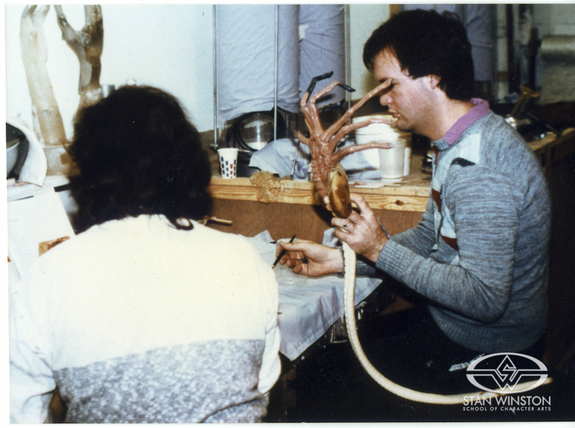 (A younger Richard Landon digs into a pet project for the movie Aliens. Did he use simple Cable Mechanisms on THAT FILM? You bet your face-hugger, he did.)
Creating a Hand Plate Using Aluminum Plate
"This is aluminum straight out of the hobby store. It’s called K&S, which is a brand-name aluminum plate. And I just cut it on the band saw. I’ve drilled, and now I’m tapping some holes and threading. So just like you can make these out of several different kinds of plastic, you can make the actual baseplate; this could be a plastic baseplate. It could be a fiberglass baseplate that you’ve come up with based on coring the inside portion of your sculpture. By threading the nylon and the aluminum, I basically created a pair of seats so that I can go ahead and lock that finger down. I’m going to do that several more times just so that we can finish creating our hand."
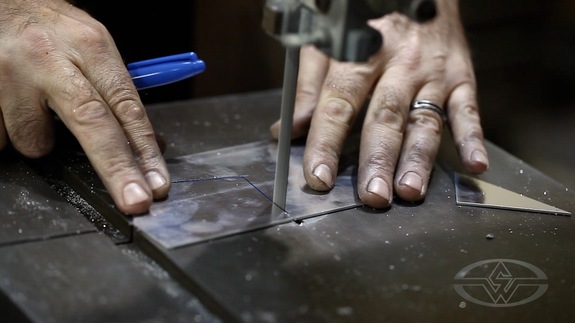 (The hand plate is a simple, roughly palm-shaped hunk of aluminum plate.)
Materials You’ll Find in a Mechanic's Work Station
"All mechanics have slightly different working techniques, but this is sort of an interesting behind-the-scenes fact. Most of us have a consumable strip of aluminum. That’s why you see all these holes drilled all over our table. A rubber mat makes it less likely that you’re going to drop and break something, and it’s also safer for working on electronics. The old shop at Stan Winston Studios...had these beautiful stainless steel tops on them. I shorted out more electronics than I care to mention. So I added a rubber mat...this is an evolutionary process. And then just the ordinary Masonite and plywood construction for the regular table top is always protected so if I peel up this rubber mat and if I ever move this consumable strip, you’ll see a nice pristine tabletop that never gets destroyed. Two fingers...", he adds, off-the-cuff, the hand is coming together without our noticing!
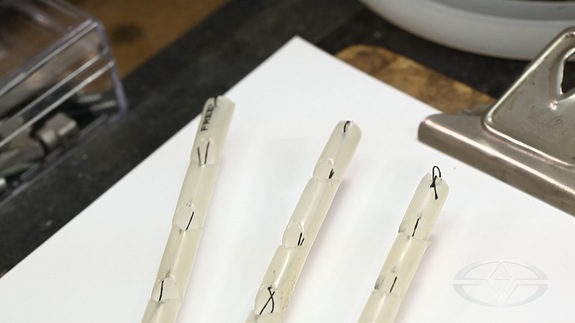 (The 3 creepy fingers are wired and ready to be puppeteered.)
Putting Nylon Tubing Together to Make a Tentacle Hand
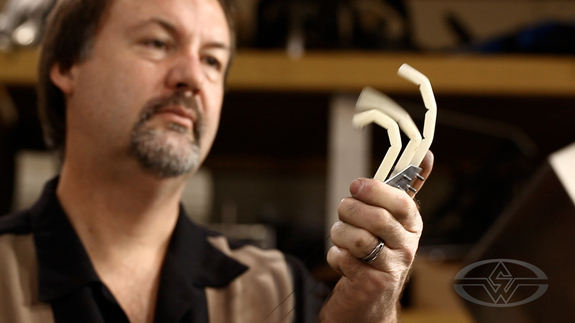 (Richard Landon moves this 'hand' like a creature might. This is the performer in him, making the motion 'real,' learning how to manipulate the puppet. Really, he's just a kid at heart.)
Watch THE TENTACLE MINI LESSON with FX Mechanical Wizard Richard Landon.
Mini-Lesson Excerpted from Richard Landon's Full Lesson CABLE MECHANISM BASICS.