

Behind the Alien Transformation Effects of Starman
Not every project was as life-altering as The Terminator in 1984. Even as Stan Winston enjoyed greater status within the film industry in the mid-1980s, he had to support his studio and his expanded crew by accepting other, less groundbreaking assignments. One was John Carpenter's Starman (1984), a film starring Jeff Bridges as an alien who takes on the appearance of a deceased house painter to secure the confidence and help of the man's widow, played by Karen Allen. In an early sequence, the alien transforms from a human baby to a grown man, an effect that was accomplished with clever angles, cuts, and in-camera practical techniques and no use of digital or optical post-production effects.
Watch the entire Starman (1984) Transformation Sequence:
Jump To Section
- Starman's Historical Significance in the Makeup Industry
- Working on the Stages of Starman's Transformation Makeup Effects
- Dick Smith's 100-Dummy Transition
Starman's Historical Significance in the Makeup Industry
Starman's historical significance within the makeup effects industry is that it was the one and only film on which giants Dick Smith, Rick Baker, and Stan Winston collaborated. John Carpenter and the producers had first approached Smith, but recognizing that the job was too big for one person, Smith had suggested that they bring on Baker and Winston, as well. "It was quite an ambitious thing," Dick Smith said. "This sequence was supposed to illustrate the creation of a human being from a molecule, virtually. So Stan, Rick, and I divided up the work."
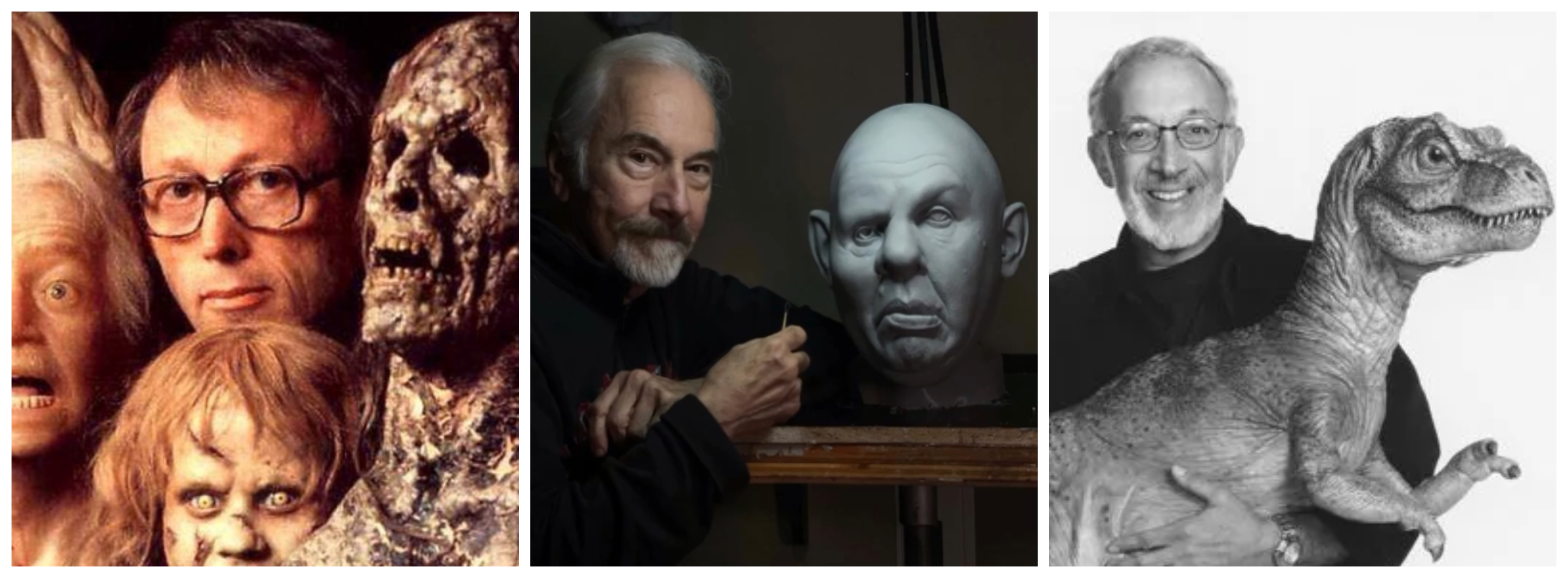 (From left to right: Dick Smith with some of his iconic works, Rick Baker with his Charles Laughton hunchback mask sculpture, and Stan Winston with the baby T-Rex from The Lost World: Jurassic Park. First two image sources: Dick Smith Makeup FX Education' and Rick Baker's Instagram.)
Working on the Stages of Starman's Transformation Makeup Effects
Rick Baker took on the first stage of the effect, building a mechanical baby puppet. Stan Winston created the middle stage, which started on a puppet with stretching limbs, then cuts to a real little boy, as if the boy was growing to adolescence.
 (Rick Baker works on Starman's mechanical baby puppet. Image source: Movie Oubliette.)
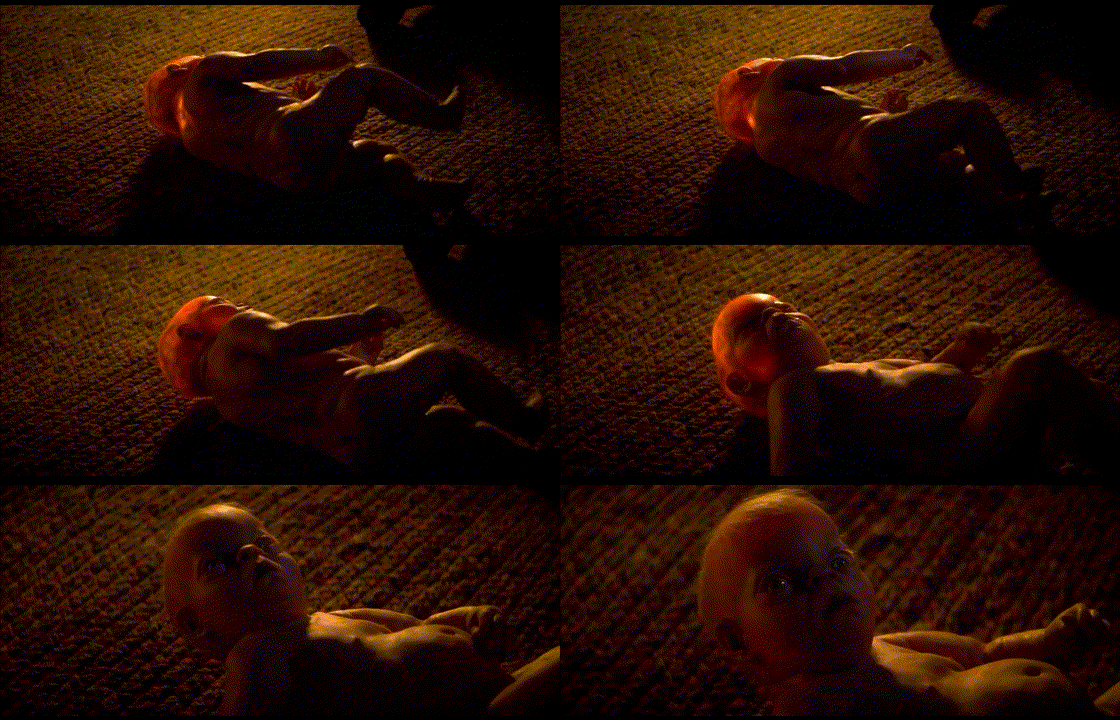 (The final mechanical baby puppet built by Rick Baker in Starman's transformation sequence. Gif courtesy of Columbia Pictures.)
The Winston puppet required the development of new materials that would hold their shape as pneumatic mechanisms underneath the skin, designed by Sonny Burman, executed the stretching action. "It was a pretty daunting effect," said John Rosengrant. "In its initial, youngest stage, it had to look like an absolutely anatomically correct little boy. But then all the bones and skin had to grow. The challenges were keeping everything intact — the outer skin, the paint on the skin, and the basic form of the limbs — as the puppet stretched. We did a lot of research into skin materials that would stretch without breaking and would hold paint. We also came up with spiraled cores — almost like Slinkys — that would stretch but still retain their shape so that the limbs wouldn't buckle and deform." Nearly a decade later, the crew would extrapolate on that spiraled-core concept to maintain the shape and integrity of dinosaur tails.
 (A close-up image of the sculpture core for the middle-stage sequence at Stan Winston Studio.)
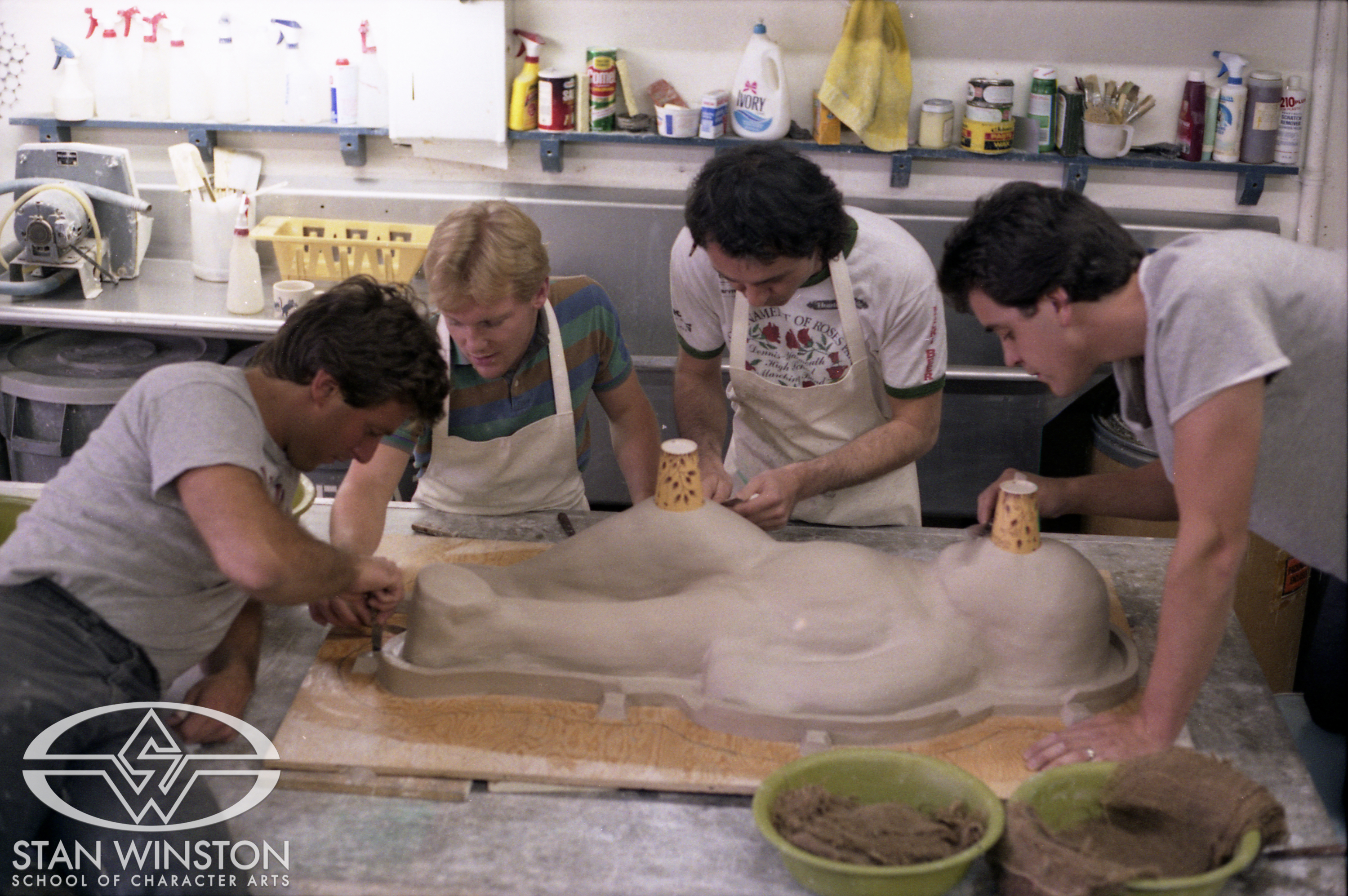 (John Rosengrant, Shane Mahan, Jack Bricker, and Tom Woodruff Jr. molding the young boy sculpture for the transformation scene.)
 (Stan Winston details the head of Starman's young boy sculpture.)
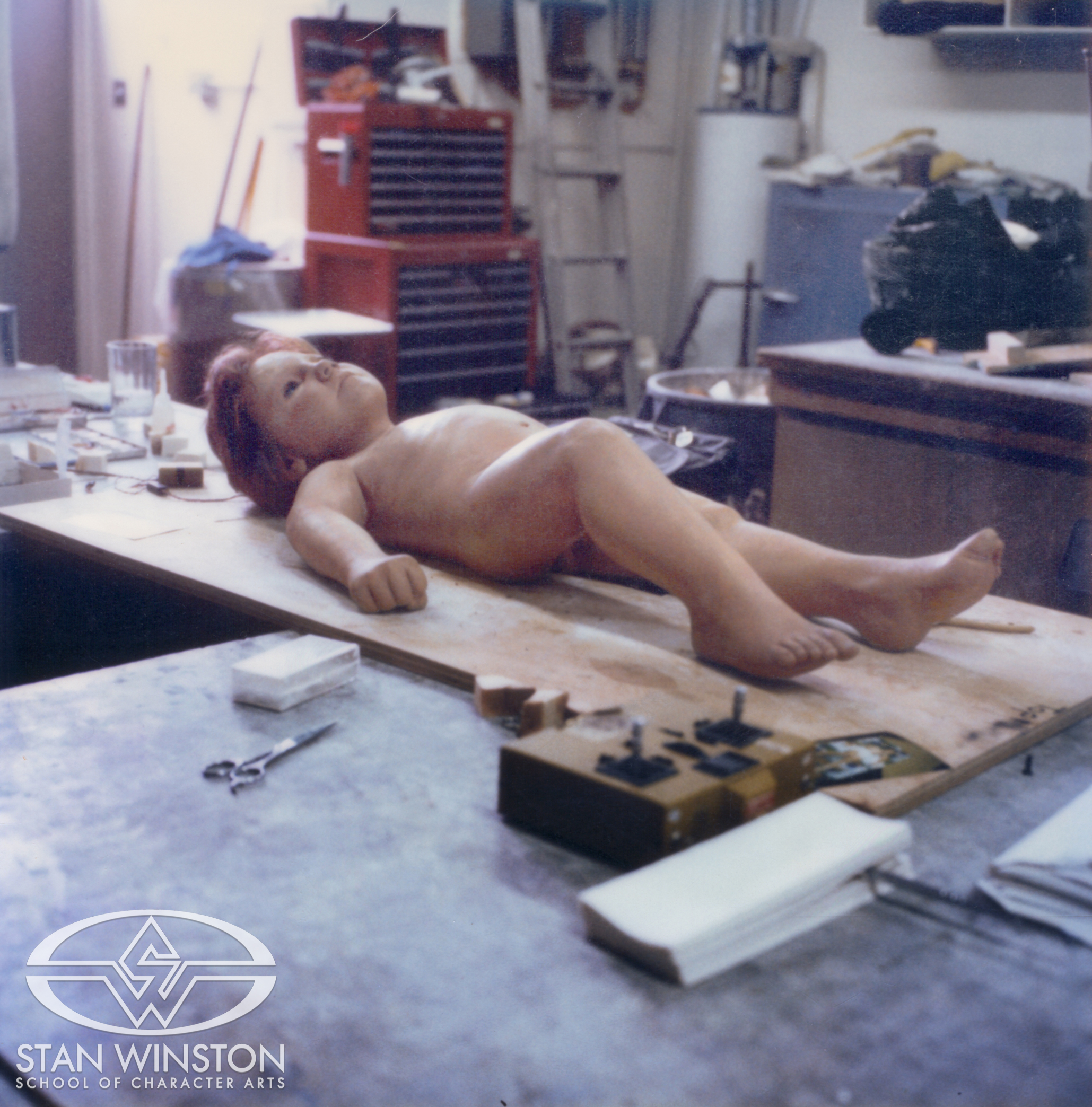 (The finished stretchable puppet at Stan Winston Studio.)
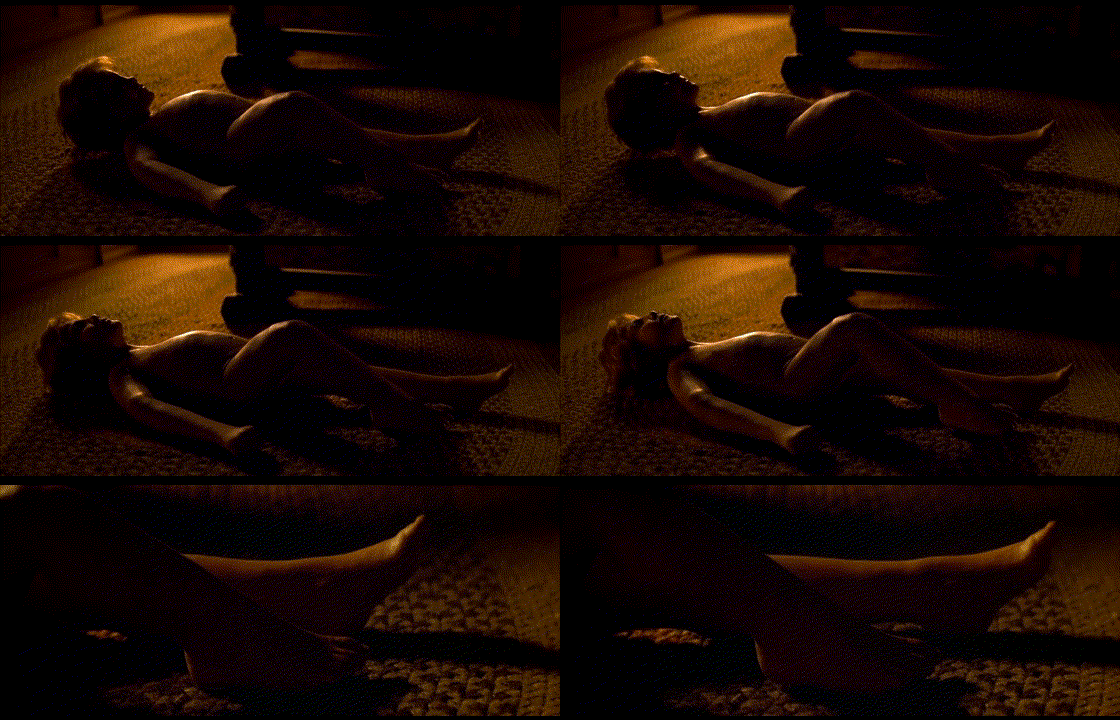 (The SWS-built stretching puppet in John Carpenter's Starman (1984). Gif courtesy of Columbia Pictures.)
Dick Smith's 100-Dummy Transition
Dick Smith picked up the transformation from there, building a series of head-and-shoulders puppets to achieve the adolescent's maturing to full manhood. "It was kind of like stop-motion animation," Smith explained, "in that they would, frame by frame, substitute one puppet with the next until it was the full-grown Jeff Bridges. To create a really smooth transition from one to the next, I made more than 100 separate dummies, each one a bit larger and older-looking than the one before it. These puppets would be filmed one at a time, and then, when it was all put together, we'd have this very organic transformation."
 (Some of the animation heads made by Dick Smith for the final transformation stage in Starman. Image source: Doug Drexler.)
Based in New York, Dick Smith used Stan Winston's shop when he was in Los Angeles to prepare for his extensive puppet build. Among the tasks Smith performed at Stan Winston Studio was the lifecasting of Jeff Bridges, which he would use to create the final stage puppet, and as guidance in creating the preceding stages.
 (Dick Smith prepares actor Jeff Bridges for a life-casting procedure before creating the puppets.)
Winston assigned John Rosengrant and Shane Mahan to assist Smith in the lifecasting procedure. "That was a very big deal to us at that point in our young, nerdy lives," Mahan said. "'We're doing a lifecast with Dick Smith — yay!' It was very exciting — but also kind of shocking. When Jeff Bridges arrived, Dick immediately said, 'I'm going to take your lifecast with your eyes open.' None of us had ever heard of such a thing. We always took lifecasts with the person's eyes closed, and then we sculpted the eyes open later. So John and I looked at each other, wondering what Dick was talking about. Jeff Bridges looked a little nervous, too. 'You're going to do what?' But Dick didn't coddle him at all. He just pulled out these big, hard contact lenses that would cover the entire eye, put deadening drops in Jeff Bridges' eyes so he wouldn't feel anything, and stuck these lenses in. Then he proceeded to do an alginate cast on his face with his eyes wide open. That astounded us! Stan was always very careful about being gentle with the actors, not causing them any undue discomfort. Not Dick. He was just, 'Keep your eyes open; here are the drops, here's the alginate; done.' And we were thinking: 'Wow, I wonder if we could have done that on Schwarzenegger? No way, man…'"
 (Work-in-progress image of lifecasting Jeff Bridges with open eye at Stan Winston Studio.)
Shane Mahan and John Rosengrant also noted Smith's meticulous, almost scientific approach to the work with interest. "Dick had a very precise way of working," said Rosengrant. "He pre-tested everything several times and was very particular about things like water temperature. Watching him work was interesting, almost like a chemist in a laboratory. At that point in my career, I'd already learned a lot from Stan about the art of this work, about sculpting, about performance. In this brief period of working with Dick Smith, I learned about precision and the importance of testing."
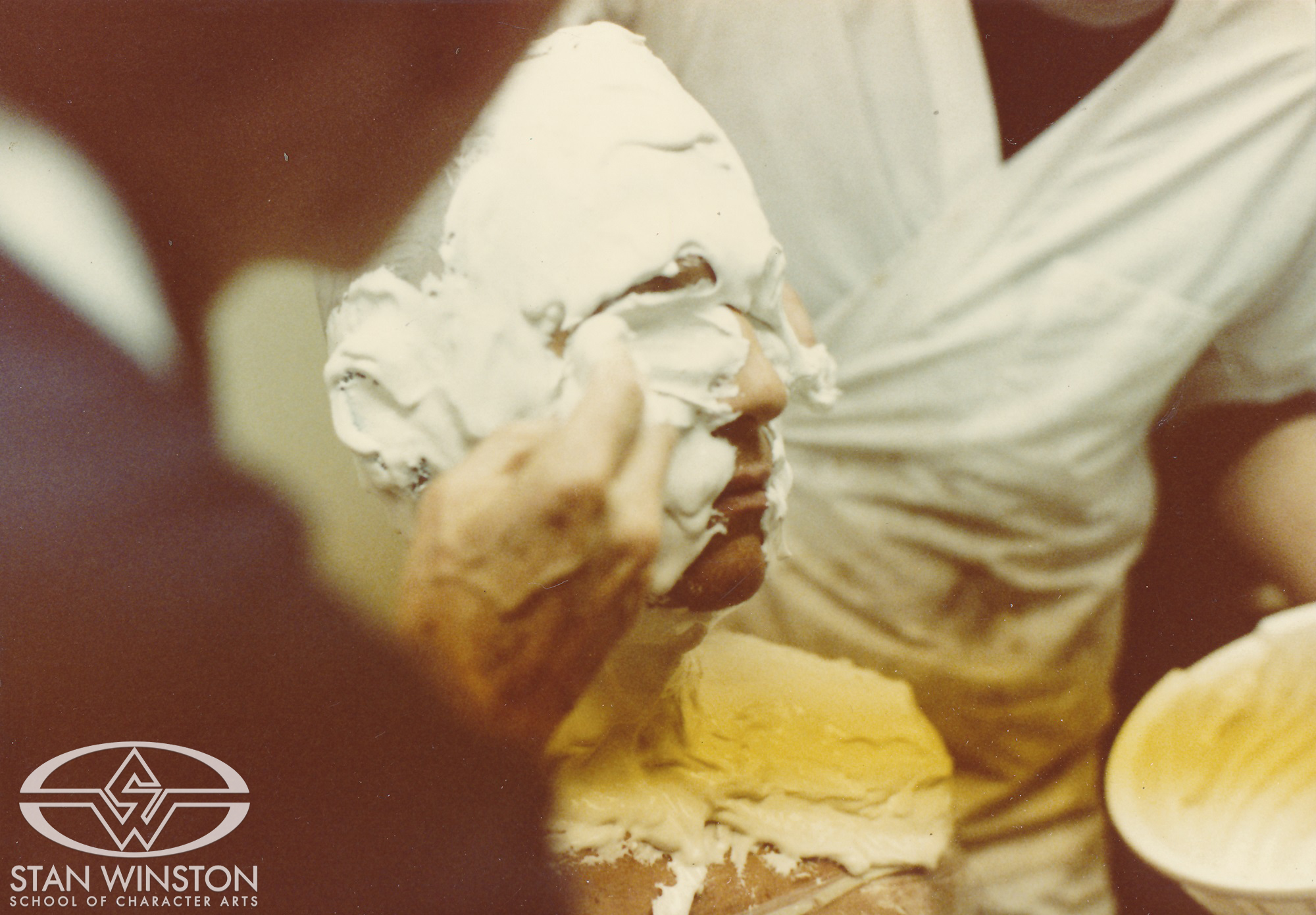 (A close-up image of the open-eye casting process.)
Given Dick Smith's attention to detail, he was dismayed to discover, when viewing the final film, that his incremental, 100-dummy transition had been edited and shortened to a rather abrupt effect. "The director was ruthless," Smith said, "and he cut out a lot of the intermediary dummies and stages — so the whole thing happened really fast, and you really couldn't tell what was going on. It was a disappointment."
 (The final version of the adolescent's maturing to full manhood transition in Starman. Gif courtesy of Columbia Pictures.)
Starman's box-office performance was underwhelming, but, like so many films, it found a devoted audience in video. A postscript to the Starman story is that it was one of two 'alien visitor' scripts that had been in development at Columbia Pictures simultaneously. Unwilling to greenlight both, the head of the studio had chosen to move forward with Starman and take a pass on the other project — E.T. the Extra-Terrestrial.
- Blog assembled by Adrienn Lingurár with selections from The Winston Effect: The Art and History of Stan Winston Studio by Jody Duncan