
Making Apes at Stan Winston Studio
The entire time Stan Winston Studio was working on Small Soldiers - and even before and after that project - Stan Winston and his crew were designing characters for a proposed remake of Planet of the Apes. As he had done previously when his intense interest in Jurassic Park led him to generate designs before being awarded that show, Winston boldly invested his studio's time and resources into developing simian concepts for Planet of the Apes, a project he was most anxious to win.1
Jump To Section
- Oliver Stone's Return of the Apes
- The Fully Servo-Driven Planet of the Apes Makeups
- The Second Planet of the Apes Makeup Test
- Actor-Driven Makeup in Galaxy Quest
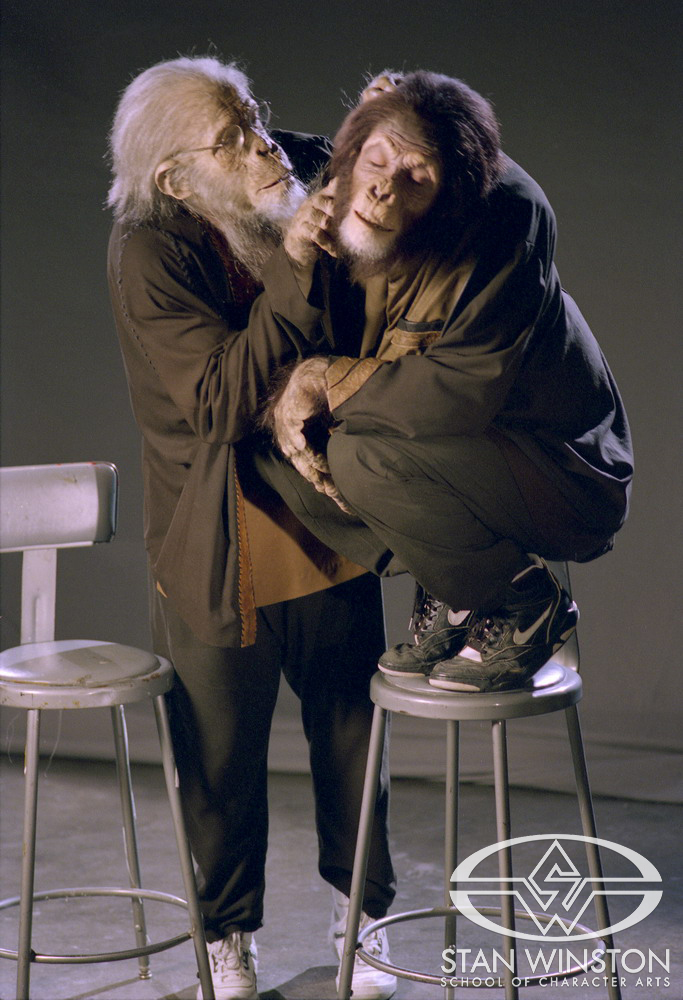 (Stan Winston, with his son, Stan Winston School co-founder Matt Winston, as test subjects wearing makeups, developed for the Planet of the Apes remake.)
Oliver Stone's Return of the Apes
The work began in the 90s when Oliver Stone - as an executive producer - developed a new Planet of the Apes movie - to be titled Return of the Apes - for 20th Century Fox. Stone hired Terry Hays to write the script, Phillip Noyce to direct, and Arnold Schwarzenegger to star. He first approached Rick Baker, who had done apes previously, to design the ape prosthetic makeups, but he later opted for Stan Winston.2
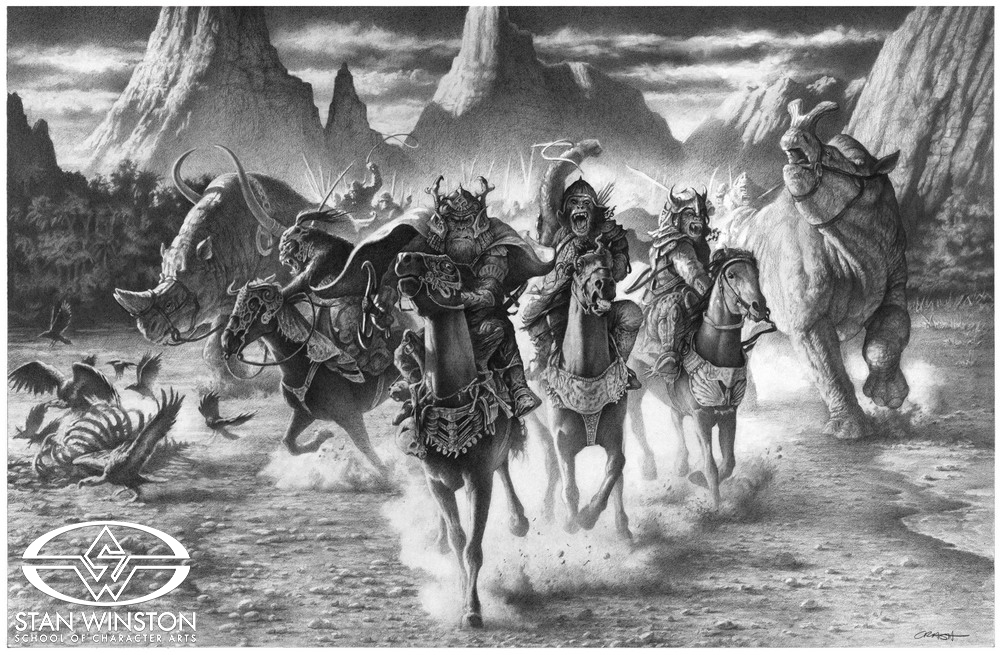 (Mark 'Crash' McCreery's depiction of a scene from a proposed Planet of the Apes remake.)
Stan Winston Studio was still working on the ape makeups and spent a lot of time on research and development work. Eventually, Sam Hamm (Batman), would write a script with Chris Columbus (Home Alone, Mrs. Doubtfire), attached to direct. Oliver Stone switched his attention to other film projects.2
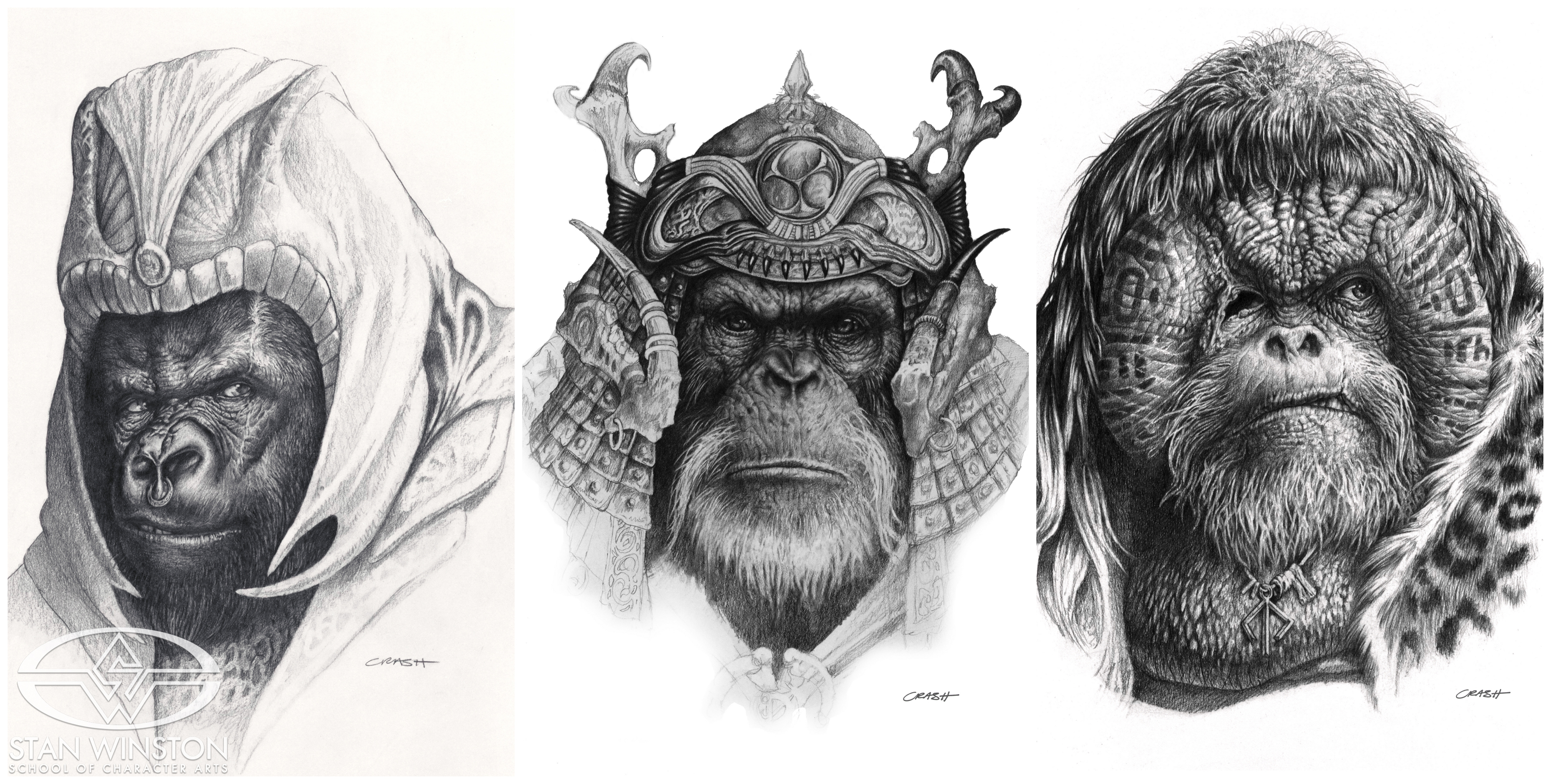 (Some of the ape characters Mark 'Crash' McCreery designed for the Planet of the Apes remake.)
The new script and direction didn't meet Fox's approval. In the following years, new screenwriters were sought, and the directing duties were offered to dozens of directors, among them Roland Emmerich, Peter Jackson, and Michael Bay. At one point, Fox executives were even having talks with James Cameron while he was filming Titanic.2
The Fully Servo-Driven Planet of the Apes Makeups
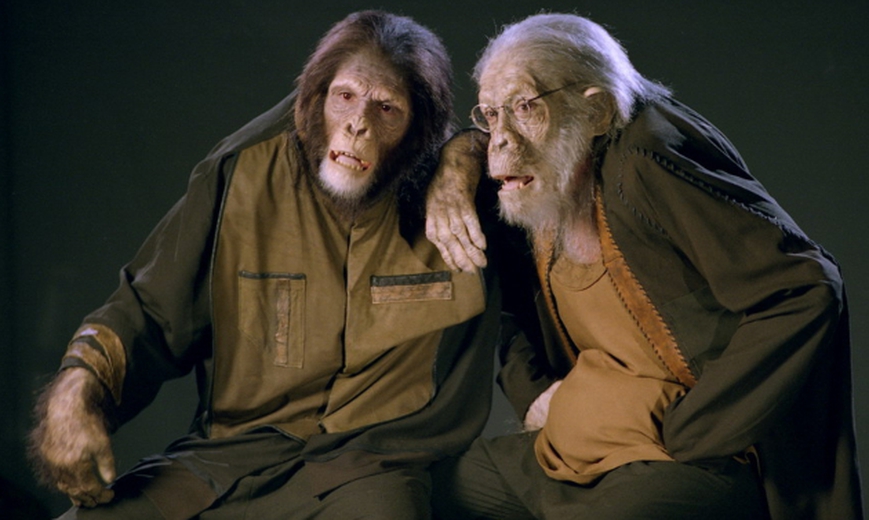
During this time, work at Stan Winston Studio continued. Some of the ape concepts made it from designs on paper to fully built makeup and mechanical appliances. Stan Winston and his son, Matt Winston, were more than willing subjects when it came time to proof the concept and test the ape makeups.1
"Stan and Matt got into these full ape heads and wardrobe - the gray ape and the young ape - and they looked fantastic," recalled Rob Ramsdell. "He and Matt were hysterically funny as these apes, running around the studio, screaming. I never saw Stan more animated than he was that day. It was as if being in that makeup completely brought back his love of acting."1
Watch a sneak peek of the first Planet of the Apes makeup test with Stan Winston:
Mechanical designer Christian Colquhoun, who helped devise the articulation for the makeups, described what you're seeing in the video above as a first-generation, fully servo-driven makeup test. "All aspects of the lips and jaw were controlled by RC."
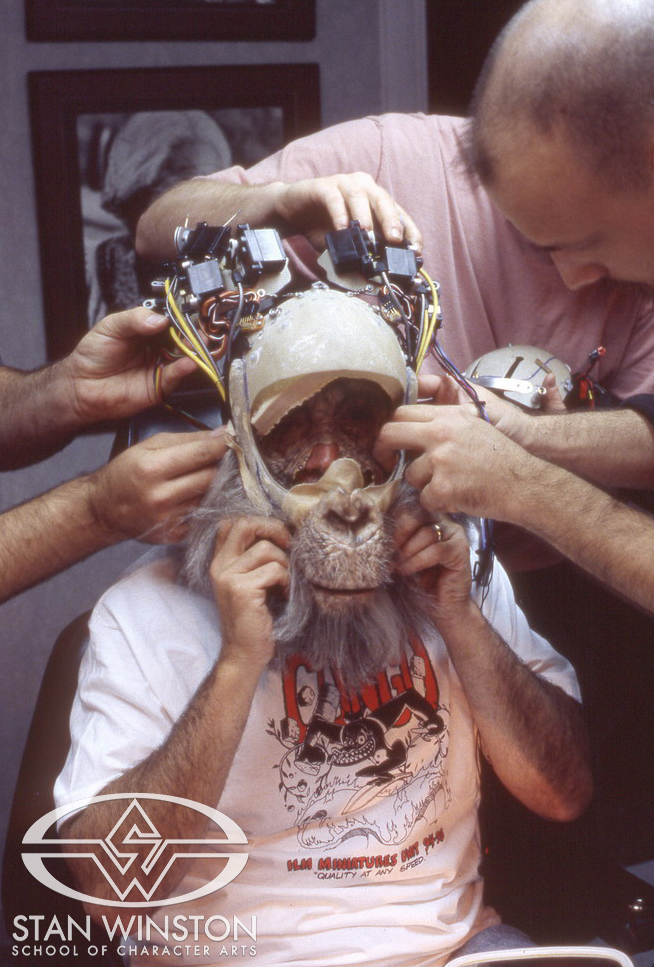 (Studio crew members applying the fully animatronic ape makeup to Stan Winston.)
According to Colquhoun, "This version could be run from a couple of standard RC units to do direct puppeteering of lips and jaw, but for the most part, it was controlled by a software program where we could use pre-recorded dialogue to sync and program those actions we wanted from the lips and jaw. Using the pre-recorded dialogue, it looked incredibly convincing and worked very well, doing exactly what we wanted it to do."
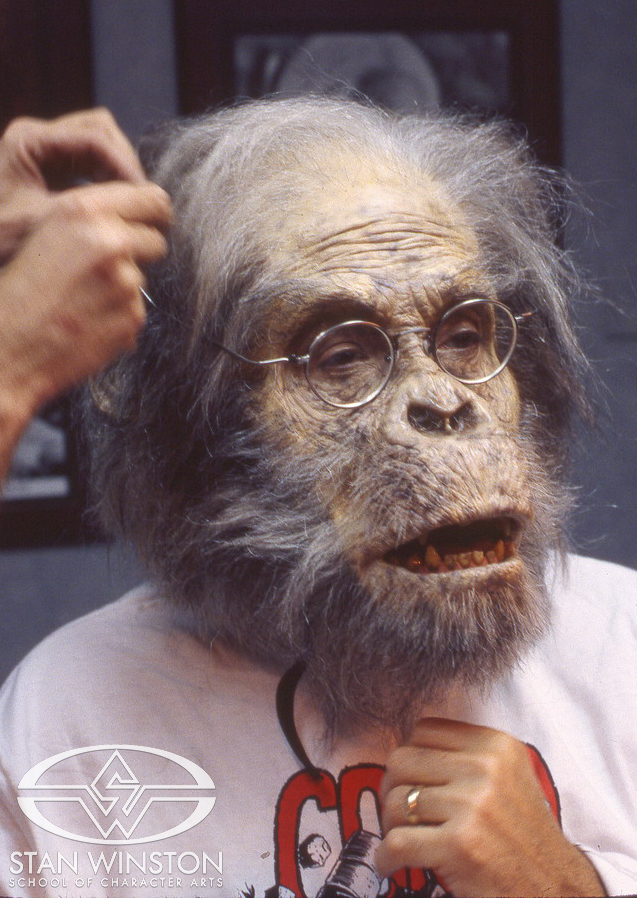 (Final touching-ups are applied on the ape makeup as worn by Stan Winston.)
"I did quite a lot of hand stitching," Colquhoun said, "and silicone patching to install the cables/springs and drive mechanism into the back/inside of the silicone skins before installing the face onto the fiberglass skull and connecting to all the servos that were on the back of the skull hidden by the hair. You cannot really tell, but there is a foam latex appliance on the forehead, around the eyes, nose, and cheeks. The silicone overlaps all of that and blends to the nose and lips of the ape's face."
 (Stan Winston performs in the test of the proposed animatronic makeup technique.)
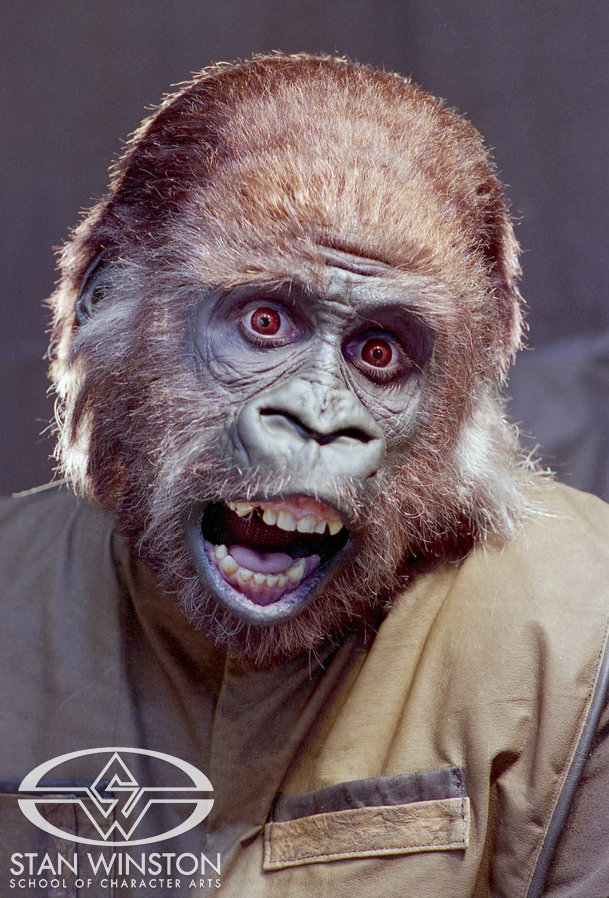 (Christian Colquhoun wears a servo-driven test makeup.)
"Second generation, we got to be substantially smaller and gave the jaw action to the actor, which was a problem that I definitely could foresee being an issue from the inception of that idea and tried to get people to reconsider," noted Colquhoun. "The synchronization of dialogue between the lips and the actor doing the jaw required the actor to perfectly match and delay speaking the dialogue to match the unavoidable latency due to data transmission/playback/servo lag, etc. The version with the actor-controlled jaw was smaller and tighter to the face but never worked very well in any of the camera tests we did because of the sync issues."
The Second Planet of the Apes Makeup Test
Chris Colombus, the director that was on board at the time, was known as an 'actor's director.' Colquhoun continued, "Once he saw what was happening, while he liked the look of the heads and design, he was fully against any pre-recorded dialogue. He desired substantially more freedom 'on the day' and liked to have improv, changes to dialogue, and was known for his nuances of directing, which would be severely curtailed if using pre-recorded dialogue, even if we could change it on the fly. It would still slow down his directing process a great deal."
Watch a sneak peek of the second Planet of the Apes makeup test with Stan and Matt Winston:
The second test employed a breakthrough makeup technique, never before achieved, in which the prosthetics were entirely actor-driven, requiring no outside manipulation. The actors - in this case, Stan Winston and his son, Matt - could talk, smile, frown, or scream, using their own facial movements to articulate the prosthetics.1
 (Stan and Matt Winston in makeup for the second ape test at Stan Winston Studio.)
"I was charged with designing and building an actor-driven makeup," added Colquhoun, "that ended up working incredibly well, but the timing didn't work to use it for Planet of the Apes." By then, Chris Columbus had been replaced by Tim Burton, and Rick Baker was brought on as 'the Ape Guy.' "But we learned so much from all of those tests," said Colquhoun, "Eventually, we used the actor-driven makeup on Galaxy Quest for the main bad guy Sarris and a few of his henchmen."
 (Stan Winston poses in the actor-driven makeup in the second ape makeup test.)
 (Matt Winston, in his young ape makeup for the second test.)
In 1999 Fox hired William Broyles Jr. to write a new script for the Burton version. Burton chose to work with Rick Baker. "I have a relationship with both of them, so that decision was hard," said Burton. "Stan worked on Edward Scissorhands, and Baker did Martin Landau's makeup [as Béla Lugosi in Ed Wood].'"2
Watch Matt Winston playing Kung-Fu ape in the actor-driven makeup at Stan Winston Studio:
When the Planet of the Apes remake was finally released in 2001, it featured ape makeups by Rick Baker's Cinovation Studio.1
Actor-Driven Makeup in Galaxy Quest
Luckily, all that research and development didn't go to waste. In Galaxy Quest (1999), for the character Sarris, the SWS mechanical department used the technology that had been developed for the Planet of the Apes project, which enabled the actor's facial expressions to be translated to an outer makeup appliance - a problem Stan Winston had been working on, in one way or another, ever since he'd built the Wookie heads for The Star Wars Holiday Special, twenty years earlier.1
Check out behind the scenes of Sarris' makeup from Galaxy Quest here:
At Stan Winston Studio, even the loss of a project was an opportunity to develop techniques that helped other projects become successes.
- Blog assembled by Adrienn Lingurár with selections from:
1. The Winston Effect: The Art and History of Stan Winston Studio by Jody Duncan
2. Focus On: 100 Most Popular American Science Fiction Films by Wikipedia contributors
Special thanks to Christian Colquhoun for additional information and commentary.