
The Making of Dead & Buried (1981)
In 1981, producer Ronald Shusett hired Stan Winston to create special effects for a bizarre horror film, Dead & Buried. In a small coastal town, after a series of gory murders committed by mobs of townspeople against visiting tourists, the corpses begin to come back to life.
Dead & Buried contains some of the most startling effects done in 1981. "I've developed some things that no one's ever seen before, and I'm very proud of the work I did," said Stan Winston. Among the highlight effects in Dan O'Bannon's story, a severed arm comes to life; a woman's face is restored from crushed bone and shredded sinew back to its normal attractive state; and there's a lot of rotting flesh. The effects in Dead & Buried are a result of combining everything Stan Winston had learned up that point.1
Jump To Section
- The Burned Head Effect in Dead & Buried
- Effects Used to Create the Needle Scene
- Using a Hand and Rod Puppet for the Severed Arm Scene
- Reconstructing Lisa Marie as the Hitchhiker in Dead & Buried
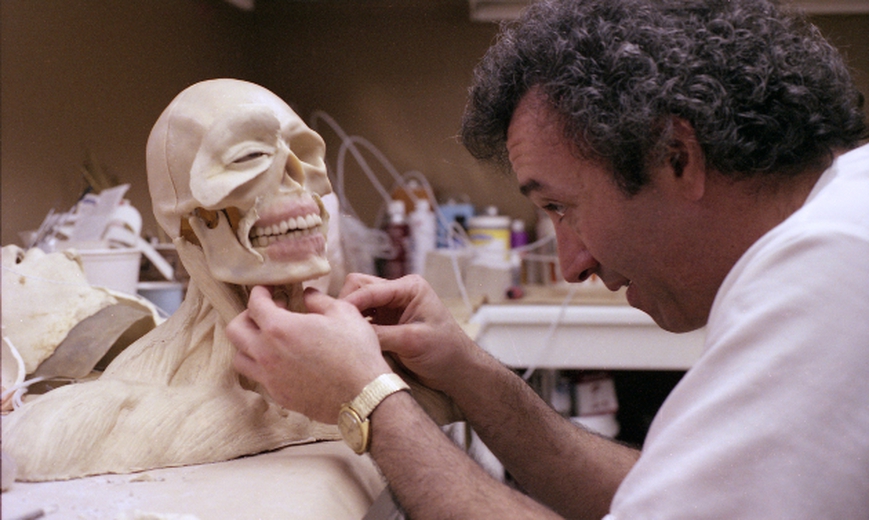
 (Stan Winston with the first of a series of lifelike heads created for the reconstruction scene of the hitchhiker played by Lisa Marie. Stan's own hands were filmed for the on-camera operation. Image copyright Stan Winston Studio.)
The Burned Head Effect in Dead & Buried
About the film, Stan said, "a lot of us were pushing to give it a little bit more style and I think director Gary Sherman really tried to - with Steven Poster who was the DP [Director of Photography] - give Dead & Buried a stylish look. I was on a shoestring, it was a low-budget movie; I know that I put a hundred and ten percent of myself into the effects."2
The first effect that really comes into play in the film is seeing Freddie (played by Christopher Allport) burning in a car upside down. The burned head in that scene was a recreation of the actor's head. Makeup effects coupled with some clever puppetry allowed the effect to be very realistic.
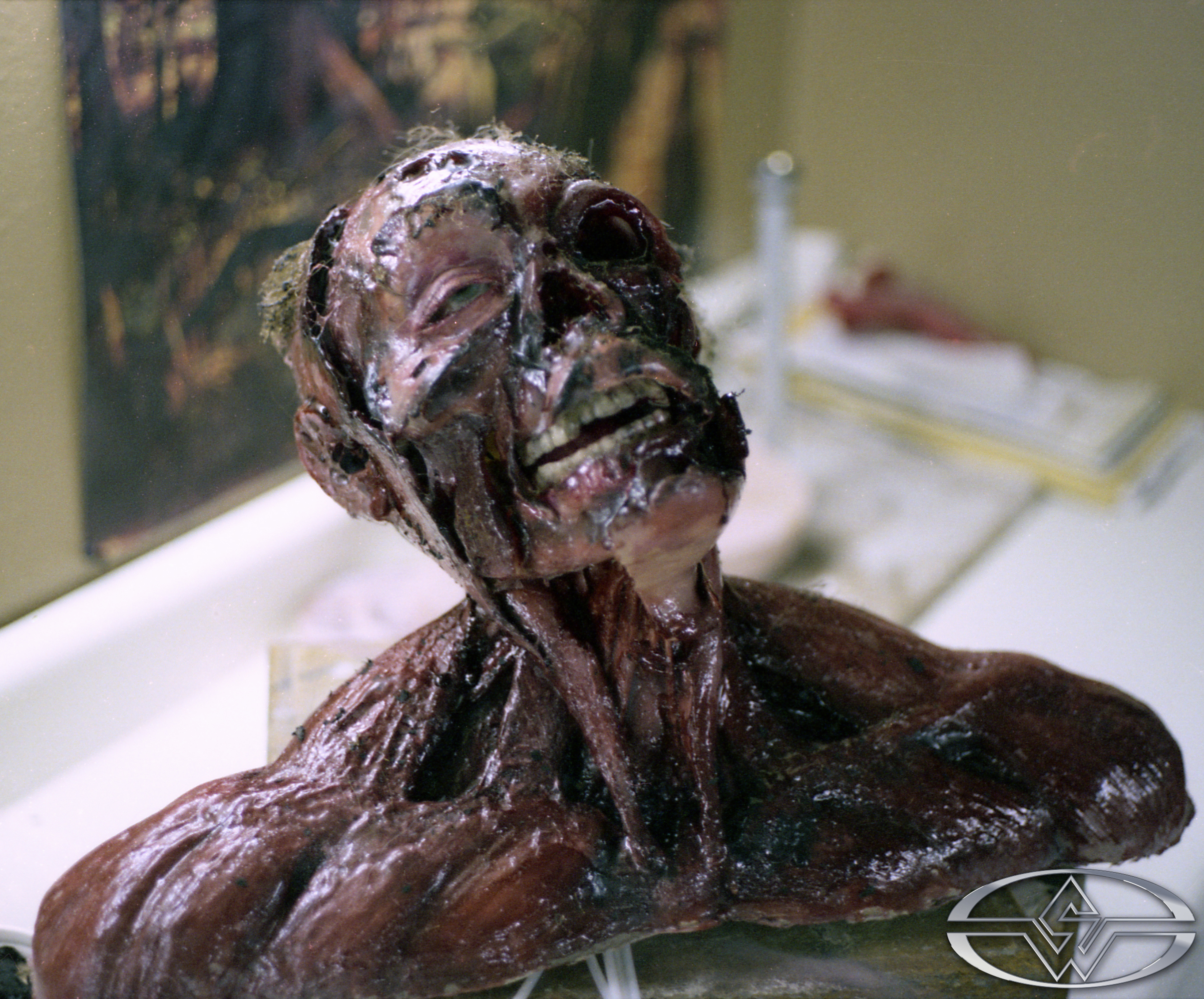 (The burned head puppet used for the upside-down car scene. Image copyright Stan Winston Studio.)
"Conceptually," said Stan, "I was getting into, at this period of time, trying to again go beyond simply what you could do with the makeup effect and to recreate actors and start using forms of puppetry to allow these effects to be that much more visceral, that much more real--actually to get into the skin rather than just to layer on top of it. And so that first effect, of course, was actually a puppet."2
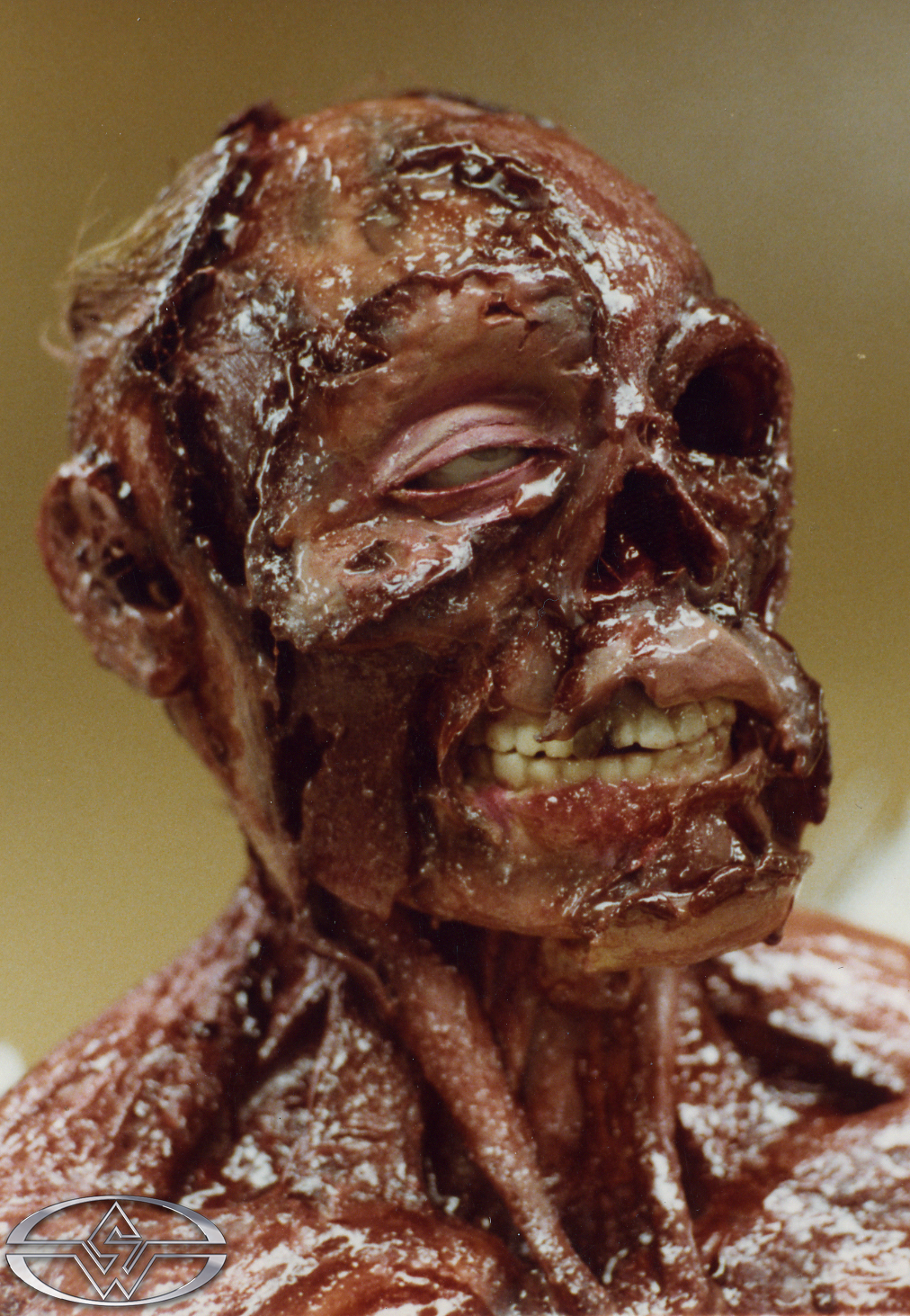 (Close-up shot of the burned head puppet. Image copyright Stan Winston Studio.)
"I remember we did a test in my studio of the burning head. We did it upside down - which is the way it was scripted and the way it ended up in the movie - and right side up. I had spent an enormous amount of energy trying to create this very realistic burned victim puppet. And after the test, for my eye, it really didn't read as organic to me upside down as it did right side up. So I remember throwing a real hissy fit on the set. On that particular day probably, I was somebody that Gary would say, 'I don't want to work with this guy anymore, he is a brat.' Yet I must say revisiting the film it still works upside down and it really showed in this movie how extensively we could use puppets."2
Effects Used to Create the Needle Scene
In another scene, Freddie is on a bed, his entire body wrapped in bandages, with only one eye visible and a small hole for his mouth. Nurse Lisa (played by Lisa Blount) comes into the hospital room and proceeds to jam a needle directly into his eye. This shot, where the needle goes into the eye, was one of the effects that Stan Winston was most proud of.
"Making the eye completely organic, took a lot of energy."2 To guarantee that the actress would poke the eye correctly each take, they filmed the shot in reverse. There was a tiny hole drilled into the center of the eye, so the shot started with the needle already embedded in this hole and the eyelid closed. On action, the actress pulled the needle out and the eyelid opened. In the movie, the audience sees the action reversed so she appears to jab the needle in perfectly, really selling that what you're seeing is real.
 (The "needle scene" from the movie Dead & Buried. Courtesy of AVCO Embassy Pictures.)
Stan went on to say, "I remember vividly how much energy I put into every lash being perfect, that the movement of the lids was perfect, that the eye movement was organic, that everything about that close-up would be completely organic so that it would hold up on the screen."2
The reason for building the full body of bandaged Freddie was to be able to move up the body, showing the shocked face with the eye and then the needle, all in one shot. Though filmed as one camera move, the director decided to cut it, where you see his view of the actress just before the needle goes into the eye. "Watching it recently," said Stan, "the effect still holds up, it's still a pretty tough one to watch having a needle jabbed into somebody's eye, and gives me a lot of pleasure to know that I've brought that kind of gruesomeness to screen."2
Using a Hand and Rod Puppet for the Severed Arm Scene
Another one of Dead & Buried's innovative effects is the severed arm on the grill of the car. The arm was a moving prosthetic, a simple hand and rod puppet made by Stan Winston, before the advent of complicated animatronics and robotics. "The puppeteer, the actress, was inside the hood of the car with her hand puppeteering the hand of the severed arm, and then there was a rod operating the back of the arm so that it had all of this life and movement."2
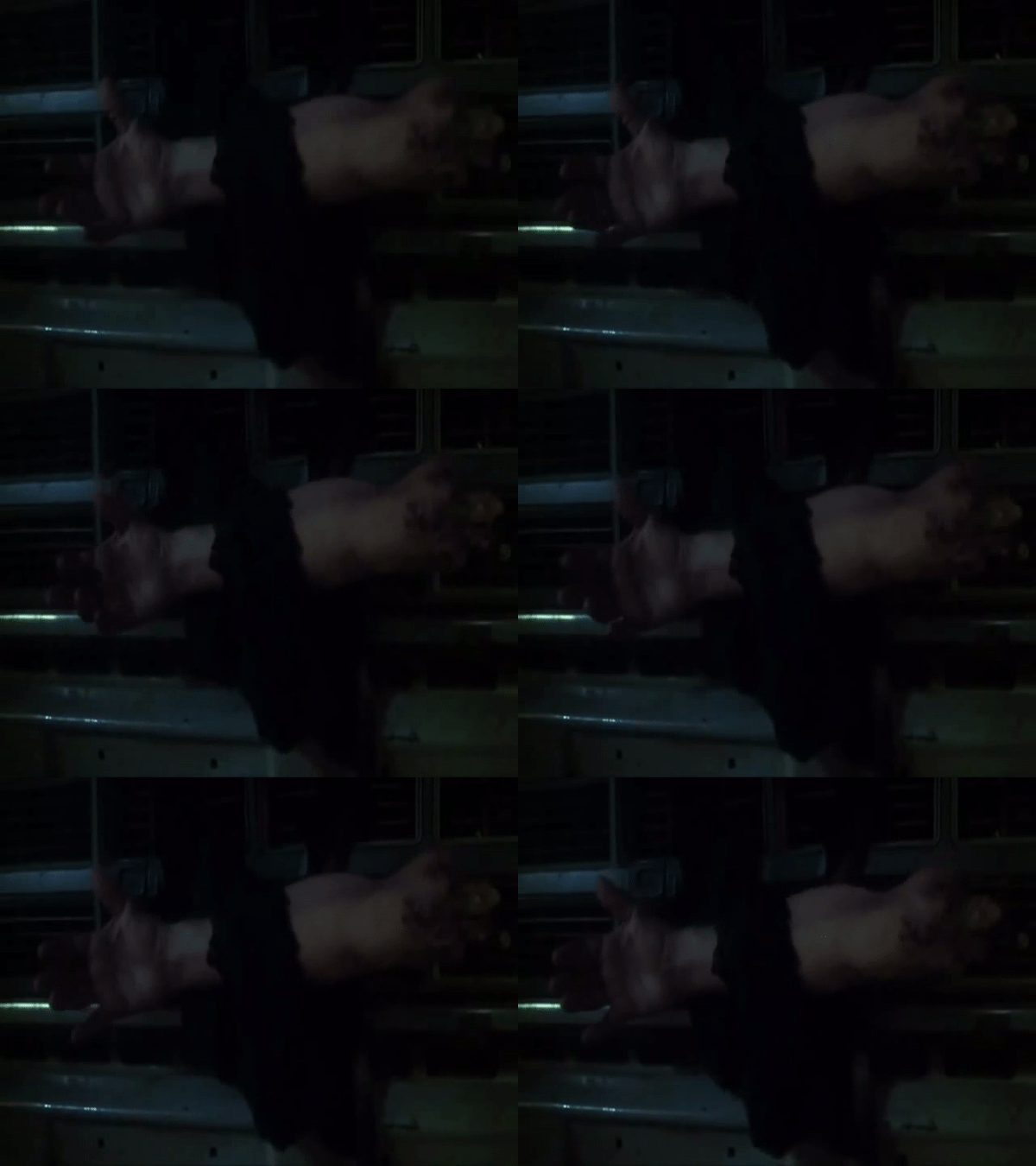 (A short "severed arm scene" from the movie Dead & Buried. Courtesy of AVCO Embassy Pictures.)
Reconstructing Lisa Marie as the Hitchhiker in Dead & Buried
"The most extensive effect in the movie for me, beyond the eye operation, was the reconstruction of the hitchhiker played by Lisa Marie," said Stan. "Once she was killed, again we did a lot of really fun in-camera tricks and slides and moves, but the first image we see of her lying on the mortician's table is this completely destroyed face. Of course, it was a puppet head recreation of her in this destroyed look."2
 (Lifecasting process of Lisa Marie by Stan Winston. Image copyright Stan Winston Studio.)
"I started with the lifecast of Lisa Marie and then I created a clay replica. Then I started literally carving away her face, section by section. Since I had the original casting of her skin, I was able to actually take a final skin and lay it over the entire puppet," Stan explained. "I'll call it a puppet because what I added, layer by layer, was the skull, the muscles, and the skin that all came back together to recreate Lisa Marie. I was able to then pull the lips back and check the teeth, pull the eyelid back and see the eye, and then pull the other eyelid back to find that the socket is still empty."2
 (Stan Winston with makeup artist Zoltan Elek checking and marking Lisa Marie's eyebrow placement on the replica, in order to create matching facial features. Image copyright Stan Winston Studio.)
Though the character of Dobbs, the surgeon, played by Jack Albertson, appears to be manipulating the face, those hands, in fact, belong to Stan Winston himself. Stan revealed, "the hands that are actually doing the operation in the film are mine. And then...we did a wonderful trick move. I pulled my hands out, and Jack Albertson brought his hands up from the shot with the gloves on and made his remark, 'What a masterpiece, completed beautiful!.'"2
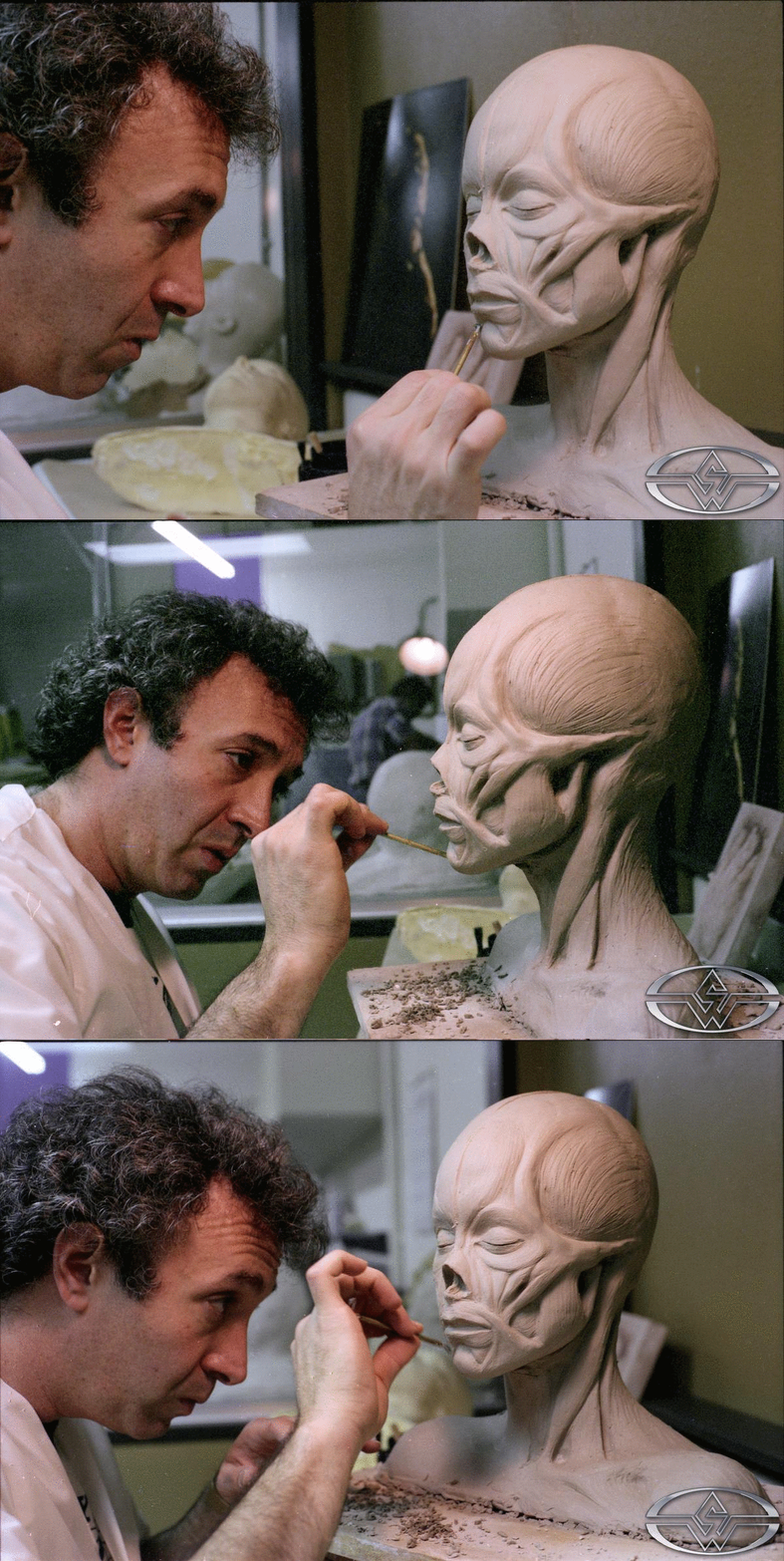 (Stan Winston details the chin muscles on the écorché sculpture of Lisa Marie. Image copyright Stan Winston Studio.)
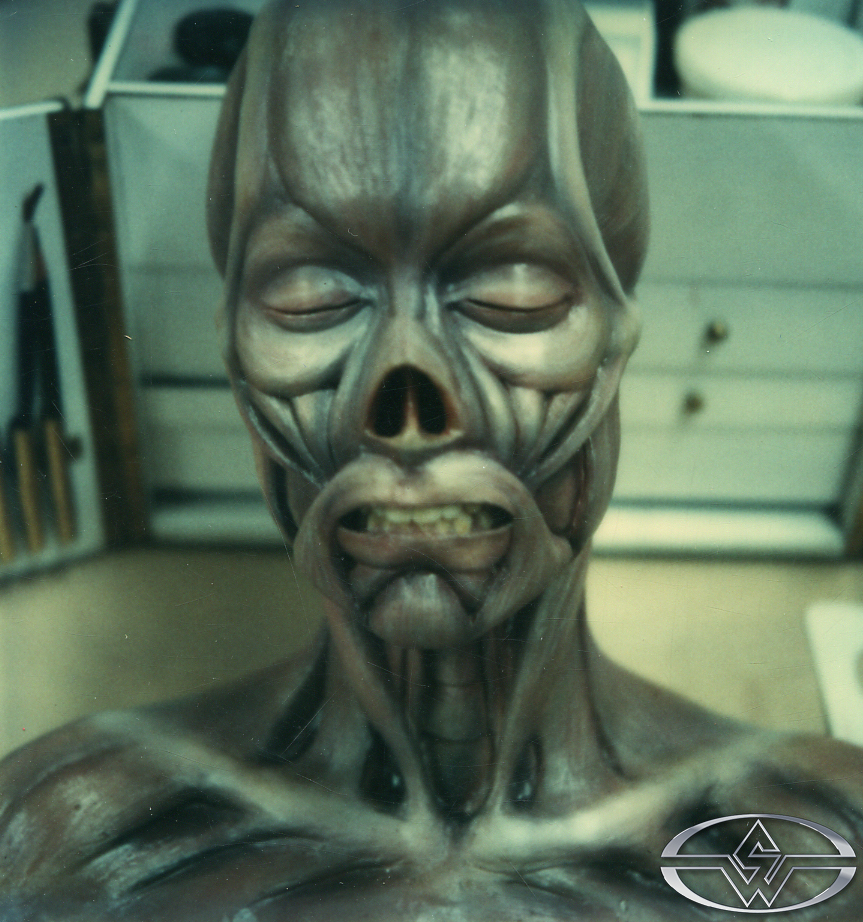 (The underlying muscle layer for the hitchhiker reconstruction scene. Image copyright Stan Winston Studio.)
Writer/producer Ronald Shusett described the impact of the reconstruction scene, "We see a woman's face being reconstructed by the mad doctor. We see an empty eye socket, and then we see him put in an eyeball. In a moment she sits up, blinks, and turns around; it's obvious, she is not a dummy, nor did she have a glass eye. The effect is startling because of the way it's been filmed, it's impossible to tell how it was done. Actually, Stan made a very elaborate dummy of the girl from a new, very fleshy material. In fact, we were often fooled when we came in the room as to whether it was a dummy under those sheets. Anyway, we used that dummy and without a dissolve, we made a switch to the real girl. For the briefest moment, the doctor lifts his elbow to get something and it covers the audience's view of the girl on the table. But they are so interested in what he is doing they don't even notice for a few seconds, they are not able to see the girl. In that period of time, we moved the dummy just out of camera range and substituted the real person. If you think this sort of thing is easy to do, I can tell you it's not: we shot that scene 17 times to get it right!"3
 (SWS Lab Technician Carl Cobery in test makeup. Image copyright Stan Winston Studio.)
Stan also discussed the undead makeup effects used at the end of the film, "In the last scene, where we see all of our dead populace with skin starting to peel off of their faces, badly in need of repair, we realize what the movie is all about. We had a lot of prosthetic makeup effects that we did that gave the illusion of skin starting to peel off, the coloring starting to come off of some hands. Seeing the blue dead look underneath the skin. This is the reveal, this is the end of the movie where we finally realize that everybody's dead and buried."2
- Blog assembled by Balázs Földesi with selections from:
1. Fangoria #14: "STAN WINSTON - A look at the long and varied career of a premiere make-up effects artist and his latest works: Dead & Buried and Heartbeeps!" by Ellen Carlomango
2. "Stan Winston's Dead & Buried EFX," featurette from the Limited Edition DVD of Dead & Buried (2003) by Blue Underground
3. Fangoria #14: "DEAD & BURIED - Ron Shussett discusses the latest collaboration with Alien partner Dan O'Bannon and projects for the future!" by Jeff Gelb
Recommended Pathways to Create Your Own Characters
- RECOMMENDED FOR DESIGNERS: Design Basics
- RECOMMENDED FOR ALL MONSTER MAKERS: Eye & Teeth Basics
- RECOMMENDED FOR FABRICATORS: Fabrication Basics
- RECOMMENDED FOR FILMMAKERS: Filmmaking
- RECOMMENDED FOR HAIR MAKERS: Hair Work
- RECOMMENDED FOR MAKEUP ARTISTS: Makeup Effects Basics
- RECOMMENDED FOR MECHANICS: Mechanical & Animatronic FX Basics
- RECOMMENDED FOR MODEL MAKERS: Model Making
- RECOMMENDED FOR MOLD MAKERS: Molding & Casting Basics
- RECOMMENDED FOR PAINTERS: Painting Basics
- RECOMMENDED FOR PUPPET MAKERS: Puppet Making Basics
- RECOMMENDED FOR SCULPTORS: Sculpture Basics