
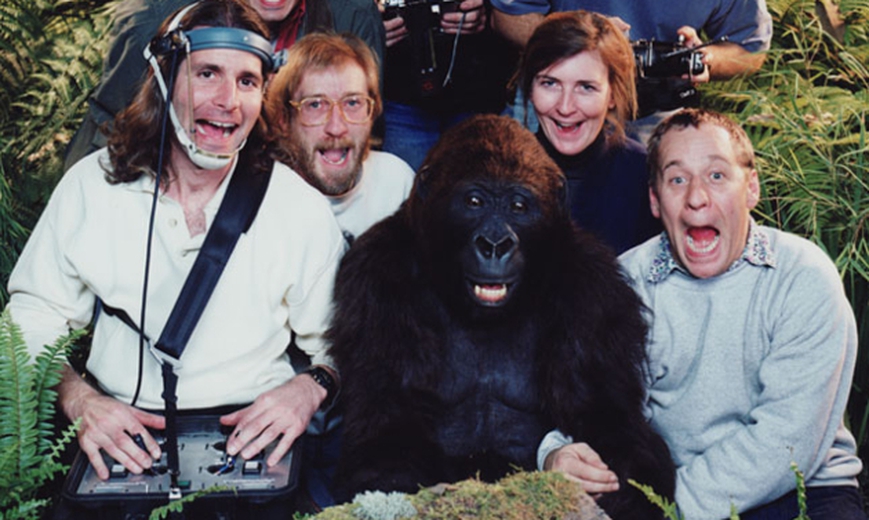
Bringing CONGO's "Amy" to Life: A Fusion of Art and Technology
The artists and technical wizards at Stan Winston Studio encountered numerous challenges on the Congo project, much like the characters in the film. These challenges arose from initial design decisions to make Amy a more visually appealing character. Rather than faithfully recreating the features of a mountain gorilla, the studio aimed to make Amy resemble the ostensibly cuter lowland gorilla.
 (One of Amy's concept artworks, created by Miles Teves for Congo.)
"We took a lot of artistic license with Amy that, in hindsight, we shouldn't have taken," Stan Winston said. "Part of that artistic license was putting a lowland gorilla face on what was supposed to be a mountain gorilla just to make her more appealing. She was cuter, but we paid a price for it because there was a sense of reality that was lost in the character."1
Jump to Section
- Silicone Technology: Enhancing Amy's Animatronic Suit
- Innovations in Amy's Animatronic Head
- Designing a Unique Eye Mechanism Layout
- Perfecting the Animatronic Expressions
- The Art of Puppeteering: Mastering the Gorilla Expressions
- Innovative Solutions for Amy's On-Set Vision for Congo
Silicone Technology: Enhancing Amy's Animatronic Suit
Winston and his team created the animatronic head and suit for Amy using the life casts of Lorene Noh and Misty Rosas, who shared performance duties inside the suit. Amy's features were sculpted in clay and cast in a specially formulated silicone that proved far superior to the foam latex that was industry standard at the time.2
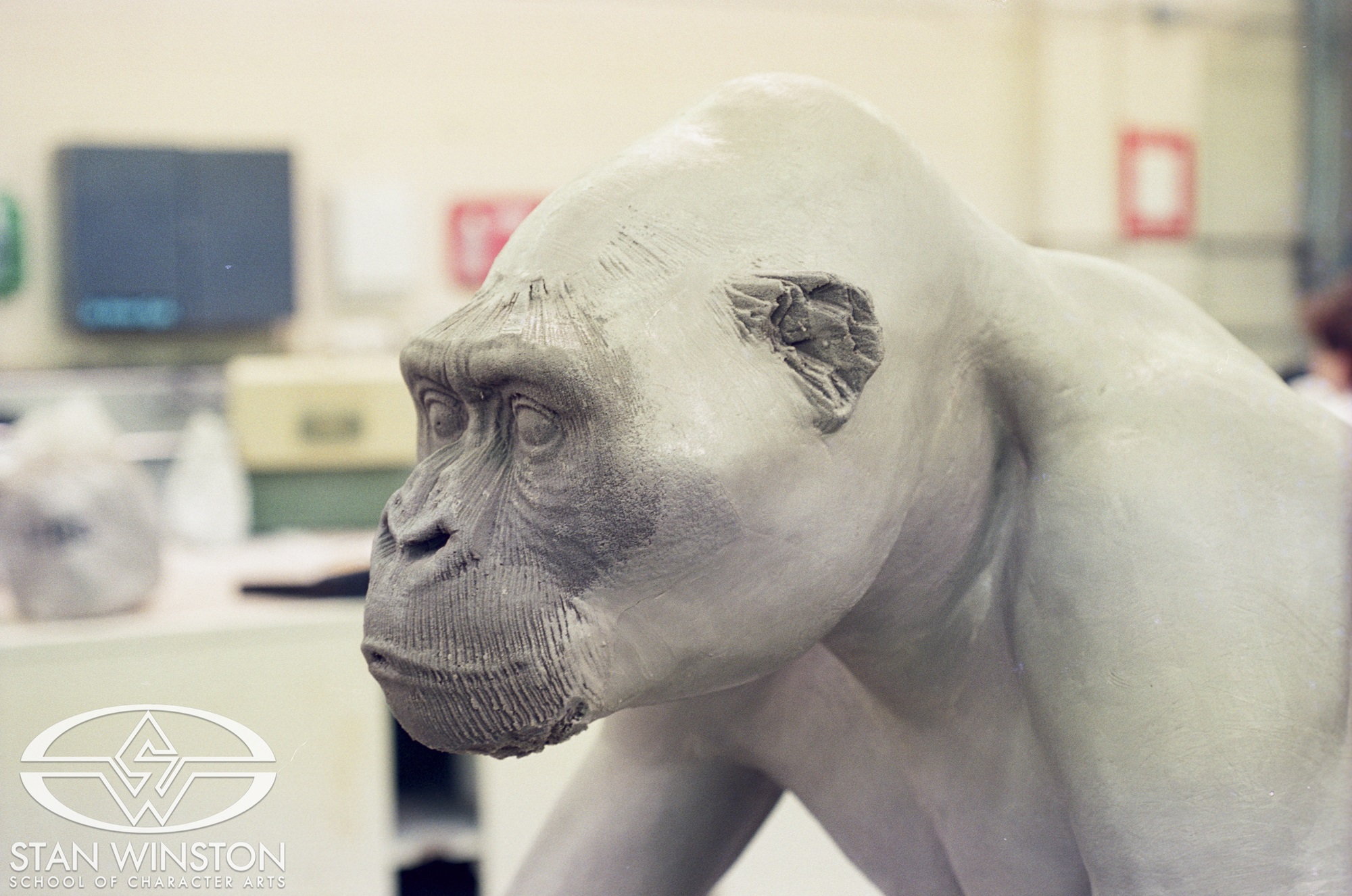 (Progress image of the Amy gorilla sculpture at Stan Winston Studio.)
 (Artist Miles Teves details the sculpture of Amy's head at Stan Winston Studio.)
"We had tried test versions of silicone skin before," mechanical supervisor Richard Landon recalled, "but we'd always had interaction problems with the molds. Certain silicones do not react well in either silicone molds or molds that have sulfur-based clays. Tom McLaughlin and Richard Davison finally came up with modifications to the silicone, developing the technology so there was no longer an inhibition problem - [the skins] always cured, and they never came out like bubblegum or peanut butter. They were very soft, yet still had full shape memory. Tom and Richard also devised repair agents that allowed us to clean seams, just as we do with foam latex."2
 (Werner Keppler, Richard Davison, Tom McLaughlin, Karen Mason, and John Calpin run a gorilla suit mold for Congo.)
Innovations in Amy's Animatronic Head
Under the silicone skin of the head, there was a carbon fiber mechanical underskull packed with twenty-three radio-controlled servo motors for facial expressions. These servos were powered by a battery pack located in the suit's stomach area.2
 (L to R: Shane Mahan, Stuart Artingstall, and Rodrick Khachatoorian help suit up Misty Rosas during an Amy test fitting at Stan Winston Studio.)
Richard Landon faced the mechanical challenge of designing a single hero head that could execute all of the facial expressions Amy needed to make in her scenes. This approach marked a significant advancement for complex animatronic characters, as prior projects often involved multiple interchangeable heads, each capable of performing only a few expressions. "The flexibility of the silicone skin, plus the advances we've made in radio technology and engineering, allowed us to create one head for Amy that could do almost everything," Winston noted. "An exception was a head we made for Amy screaming, which was used in only one or two shots."2
 (Test shots showing some of the facial expressions possible with the hero Amy head.)
An extra head was constructed for Peter Elliott, a master gorilla suit performer who wore the Amy suit for the film's demanding action scenes. "Peter's head had all of the same functions as that main Amy head," puppeteer Brock Winkless noted, "but it had to be oversized to fit him, and the larger head did not look quite as good as the more petite one. There were also a couple of stunt heads that had no mechanical work at all. We used those in long shots and when we didn't want to risk damaging the hero head."2
 (Life-casting gorilla suit performer Peter Elliott at Stan Winston Studio.)
The film's director, Frank Marshall, also requested a separate chewing head for Amy early in the construction process. "Frank said that it was essential that Amy be able to eat," Landon recalled, "because he was going to have her doing that quite a bit in the movie. So we built a head that had a sealed lip and side-to-side jaw action – which was something the hero head did not have."2
However, thanks to the puppeteering expertise of Winkless, who operated the lips of the hero head, it turned out that the chewing version was never used. "Brock was so good at operating the mouth on the hero head that he could simulate a chewing motion. We put bits of food on the edge of the lips, and Brock would manipulate them to fold the food right into the mouth. We got some wonderful shots of Amy eating bananas and celery that way."2
 (These four animatronic heads show some of Amy's expressions, including the neutral, screaming, and smiling looks. Amy's hero head was able to create every one of these expressions except screaming.)
Designing a Unique Eye Mechanism Layout
Jon Dawe, known for creating the eye mechanisms for the dinosaurs in Jurassic Park, also devised the eyes for Amy's head. Given the limited space within the gorilla head, Dawe had to design an unconventional eye mechanism layout. Servos for eye movements were placed on the head's top and temples, with the mechanisms wrapping around the performer's head like a pair of glasses.2
 (A close-up image of Amy's eyes applied to the radio-controlled head.)
"We made the artistic decision of how large the iris should be in relationship to the rest of the eye," Dawe said, "and that gave us our design parameters. Taking those parameters, I designed the entire eye mechanism on the computer. We went through a lot of tests to get just the right look. The first couple we did were okay, but the eyes tended to look a little sinister because their color was so dark. We came up with another set that was colored a deep orange, and those were just beautiful."2
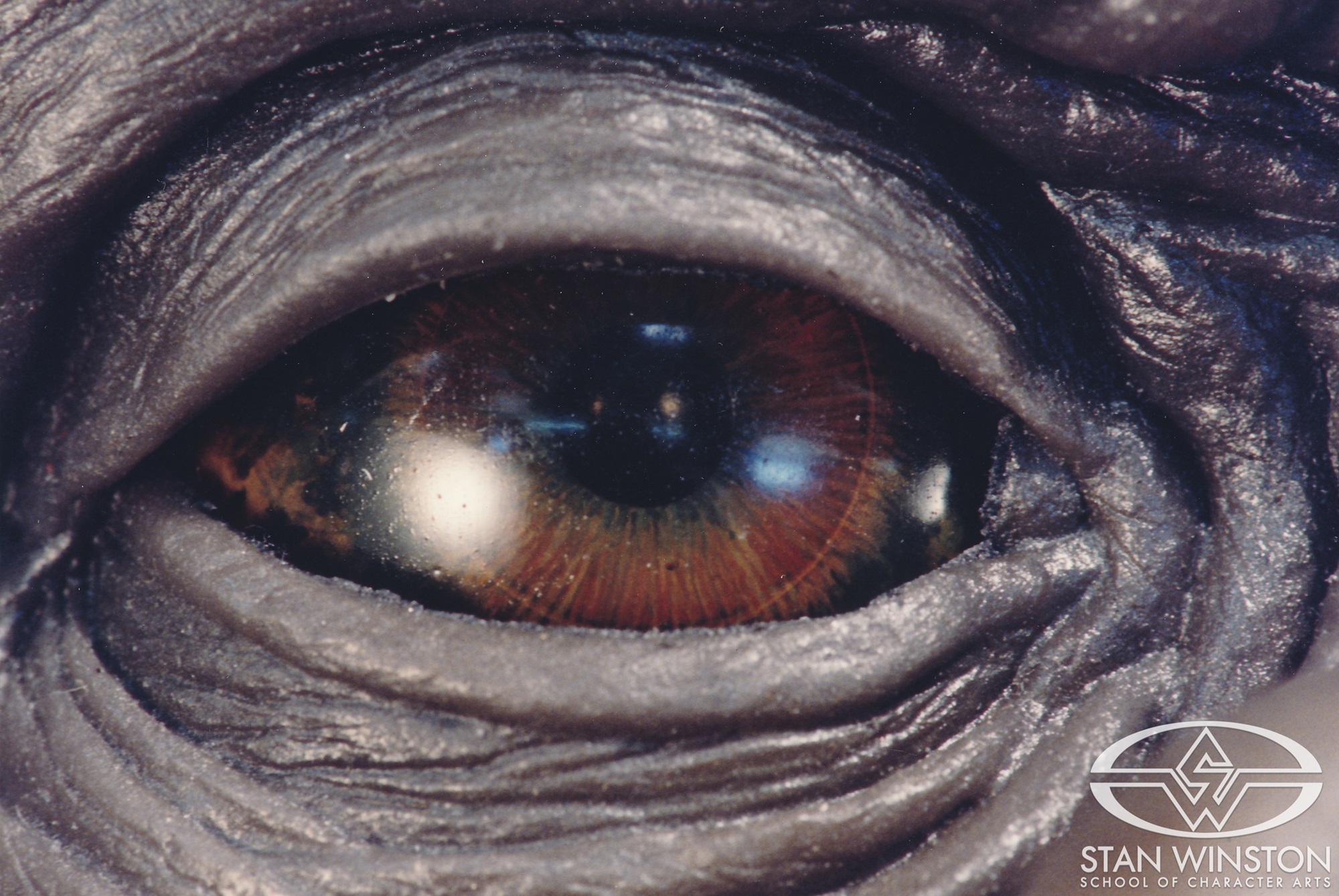 (A closer look at Amy's eye showing the detailed iris and deep orange color.)
Cast out of resin, the eyeballs were painted in layers of orange and then covered in a clear coat to create a three-dimensional lensing effect. Before each take, Windex was brushed onto the eyes to make them appear wet and alive.2
Perfecting the Animatronic Expressions
Before Amy's first on-set appearance, Winston's crew created a test version of the head. Lead Amy puppeteer Brock Winkless had a month to assess its performance, strengths, limitations, and durability with continuous use. Lessons from this testing phase led to modifications in the final hero version for filming, including adding cheek mechanisms to enhance eye expressions and using stronger servos for faster and more responsive lip movements.2
 (Richard Landon helps suit up gorilla suit performer Lorene Noh for a test at Stan Winston Studio.)
After completing the final head, puppeteers Winkless, Dawe, and Landon spent two weeks rehearsing expressions with Winston and Elliott. Landon controlled the nose, brows, and cheeks using a nine-channel radio controller, while Dawe operated the seven-channel radio for the eyes. Winkless managed the mouth, one of Amy's most expressive areas, using a custom controller created by Dawe, Landon, and Glenn Derry.2
 (Brock Winkless tests Amy’s radio-controlled mouth, jaw and lips at Stan Winston Studio.)
"We had to be able to produce the gorilla-like 'hoot,' with the lips extending forward and inward from the sides – which is a movement you can't get from an ordinary four-joystick controller," Landon stated. "So we came up with our own controller. We took two Futaba seven-channel radios out of their original housings and mounted them to a new aluminum face plate, with joysticks mounted in the four corners so that Brock's index fingers could go on the top two joysticks and his thumbs could go on the bottom two. The upper two joysticks had linear potentiometers so we could push and release straight down on the joystick and get the specific hooting actions with the lips. That gave us two additional axes that hadn't been available before."2
 (Brock Winkless, Stan Winston & John Rosengrant present Amy's radio-controlled hero head to Winston's Digital Domain co-founders James Cameron and Scott Ross.)
Winkless wore the large controller strapped to his waist, supported by a harness around his neck. To open and close Amy's jaw, he also wore a telemetry head unit that translated his jaw movements to the jaw of the animatronic head.2
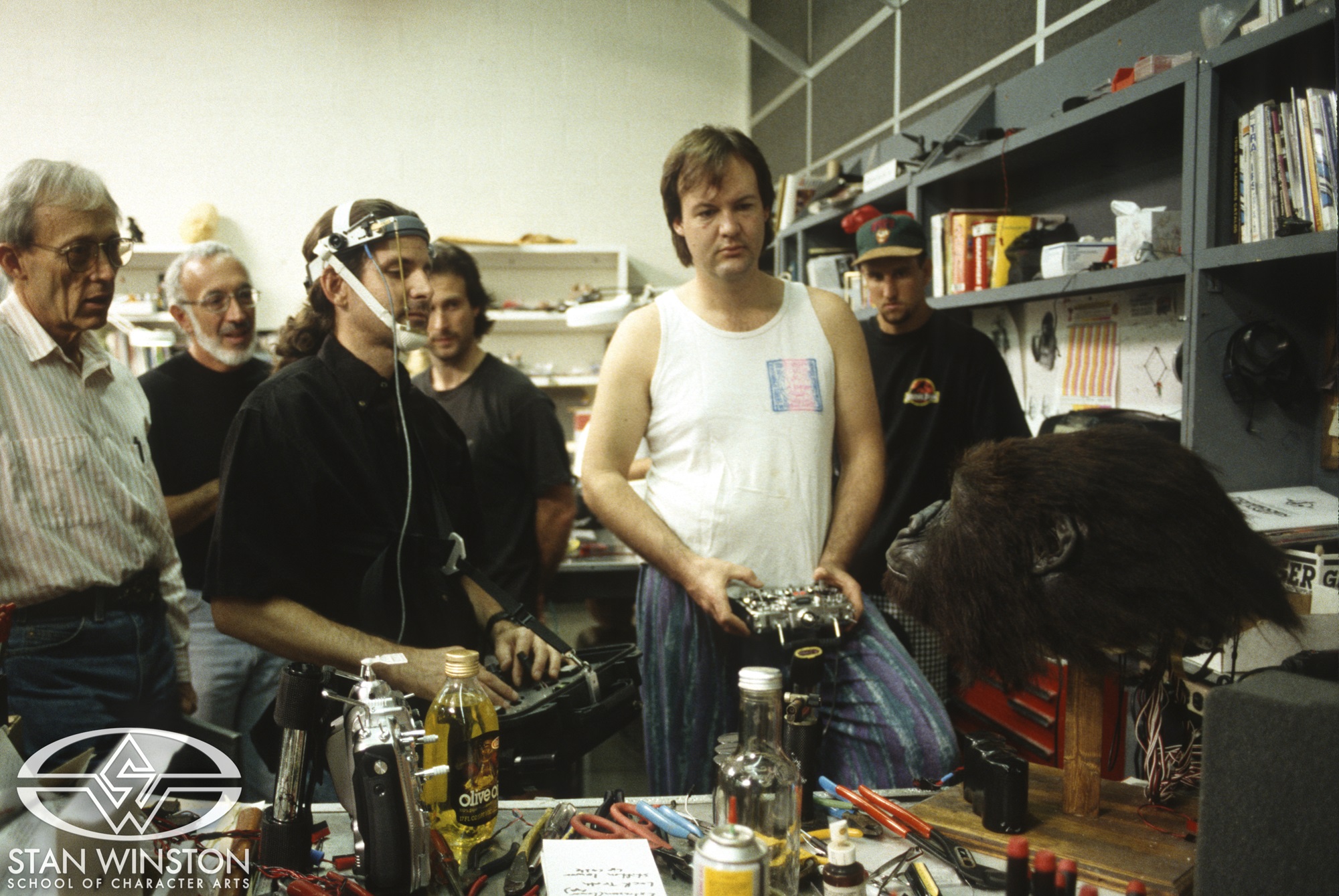 (Brock Winkless and Richard Landon demonstrate Amy’s hero head for makeup FX legend Dick Smith as Stan Winston and SWS team members John Rosengrant and Brian Namanny look on.)
The Art of Puppeteering: Mastering the Gorilla Expressions
Puppeteers analyzed gorilla videos from Charles Horton, the Curator of Primates at Zoo Atlanta as well as National Geographic specials on gorillas in order to refine Amy's behavior. They practiced facial expressions like 'fear,' 'play face,' and 'anger' until they could perform them seamlessly. Though some artistic liberties were taken in Amy's design, and similar creative freedom was exercised in her behavior, her basic repertoire came from observation of real primates.2
 (Stan Winston befriends a real chimp who visited the Stan Winston Studio as a reference for the artists working on Congo (1995).)
"Amy had to have a broad range of expression," Winkless noted, "so we gave her certain human characteristics. She had emotional reactions that were quite human – unlike real gorillas. In watching countless gorilla tapes, we learned that gorillas are predisposed to one certain expression. They do not, for example, have much eyebrow movement – but we needed that to make Amy more expressive. On the other hand, her mouth didn't have as much movement as a real gorilla, just because getting that range of movement out of something mechanical was tough. We had to discover as we went along how far we could push this humanistic aspect of Amy – and I think we pushed it a good long way. We were more concerned with creating the character of Amy than with creating a real gorilla."2
 (Gorilla mechanical designer Rich Haugen tests one of the gray gorilla heads, which contained similar radio-controlled technology to that used for Amy.)
Building on what they had learned through their stationary rehearsals, the puppeteers refined their performance in a two-day film test period with Lorene Noh inside the suit. Another full day of video tests was conducted in the lush foliage of Winston's own backyard.2
 (Amy rests during one of the performance tests at Stan Winston Studio.)
"Once we got to shooting, we refined what we had learned during the tests, deciding how emotive Amy needed to be for specific scenes and working out even more subtleties in the performance," added Landon.2
Innovative Solutions for Amy's On-Set Vision for Congo
On the set, performing Amy required a carefully orchestrated effort between Frank Marshall, Stan Winston, Peter Elliott, the three puppeteers, and the performer – Rosas or Noh – inside the suit.2
 (During the filming of Congo, Brock Winkless, Bill Basso, Stuart Artingstall, Richard Landon, Karen Mason, Jon Dawe, and Peter Elliott pose with Amy.)
Since the performers' own eyes were completely covered, the head was equipped with a small fiber optic lens positioned unobtrusively in a corner of one of Amy's nostrils. Although the lens provided the suit performers some visibility, its peephole-like quality distorted and diminished their vision considerably. Thus, they found it most helpful to rehearse scenes first without the head so that they could count and memorize their steps and acclimate themselves to their surroundings. During that first rehearsal, they would act the scene with their own faces, doing all the appropriate facial expressions – the way Peter had rehearsed them. Then, once the head was on, the puppeteers would do their best to repeat what the suit performers had done with their faces.2
 (The final hero Amy on the set of Congo. Image courtesy of The Kennedy/Marshall Company and Paramount Pictures.)
- Blog assembled by Adrienn Lingurár with selections from:
1. The Winston Effect: The Art and History of Stan Winston Studio by Jody Duncan
2. CINEFEX #62: Gorilla Warfare by Jody Duncan
Courses with the Creators of Congo
- Creature Screenwriting: How To Write Memorable Monsters with Juliet Snowden & Stiles White
- Special Effects Sequence Design with Shane Mahan
- Hybrid Characters: Blending Practical & Digital FX with John Rosengrant
- Hybrid Character Design: Practical To Digital with Christopher Swift
- Animatronics Design Basics with Richard Landon
- Cable Mechanism Basics - Tentacles with Richard Landon
- How to Make a Monster Puppet - Rods & Cables with David Monzingo
- Makeup Blood FX - Blow Your Brains Out with David Monzingo
- Creating Alien Makeups Part 1: Bald Cap & Prosthetic Makeup Application with Brad Look
- A To Z Tabletop Prosthetics Part 1: Sculpt & Mold A Wound with Brad Look
- Working with Wigs - Wig & Hair Basics with Connie Criswell
More Gorilla and Ape stuff HERE:
- Creating the Gorillas of CONGO: Behind the Scenes at Stan Winston Studio
- Instinct - Making the Mountain Gorillas
- Instinct Behind the Scenes Gorilla Suit Test with Verne Troyer (aka Mini-Me)
- Santa Gorilla celebrates Practical FX!
- From Return of the Apes to Planet of the Apes: Transforming Actors Into Believable Ape Characters
- Remote Makeup Application Part 1: Prosthetic & Kit Preparation with Andy Schoneberg
- Remote Makeup Application Part 2: Applying Prosthetics & Hairpieces with Andy Schoneberg
- Seiza by Eduardo Velayos Ortega aka Velayos Art - Artist Spotlight