

By Michael Martin
The Last of Us TV Series
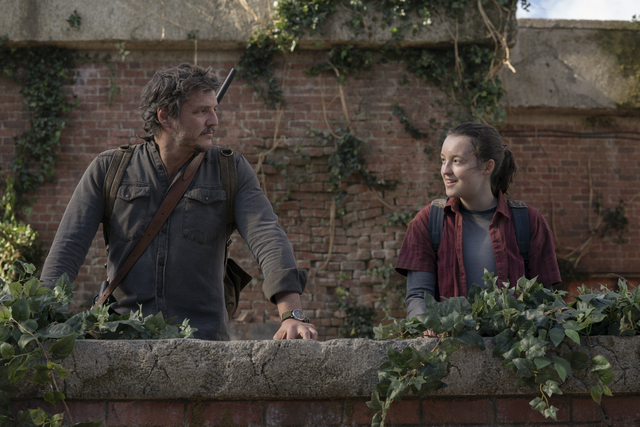
The Last of Us takes place in a post-apocalyptic America twenty years after a parasitic fungus called Cordyceps has overtaken much of the population. Society has collapsed, and survivors of the infection hide in quarantine zones while zombie-like, fungus-sprouting creatures called Runners and Clickers pursue them. Joel (Pedro Pascal, The Mandalorian) is a smuggler charged with ferrying a young teenage girl, Ellie (played by Bella Ramsey, Game of Thrones), from one zone to another. Along the way, it is discovered that her immunity may lead to a cure for the outbreak. This is the world of The Last of Us.
Jump To Section
- BGFX's Barrie Gower on joining The Last of Us
- Satisfying Fans of The Last of Us Game
- Designing The Last of Us Runners
- Creating More Stages of the Zombie Fungus Infection in The Last of Us
- Applying Makeups for a Large Number of the Infected
- Researching Spores, Molds, and Funguses for The Last of Us
- Designing The Last of Us Show's Clickers
- Working with the VFX Team to Troubleshoot the Clickers
- The Illusion of Negative Space in the Clicker's Face
- More About Those Clicker Dentures
- Creating Clicker Bodies & Paint Schemes
- Bringing the Clickers to Life with Performers In Suits
- Designing Clicker Makeups to See Beyond the Mushroom
- Making Large Groups of Clickers
- Using a Bloater Stand-in
- Using Old Age Makeup on Neighbor Nana
- Set Effects Used on The Last of Us
- Season Two of The Last of Us...
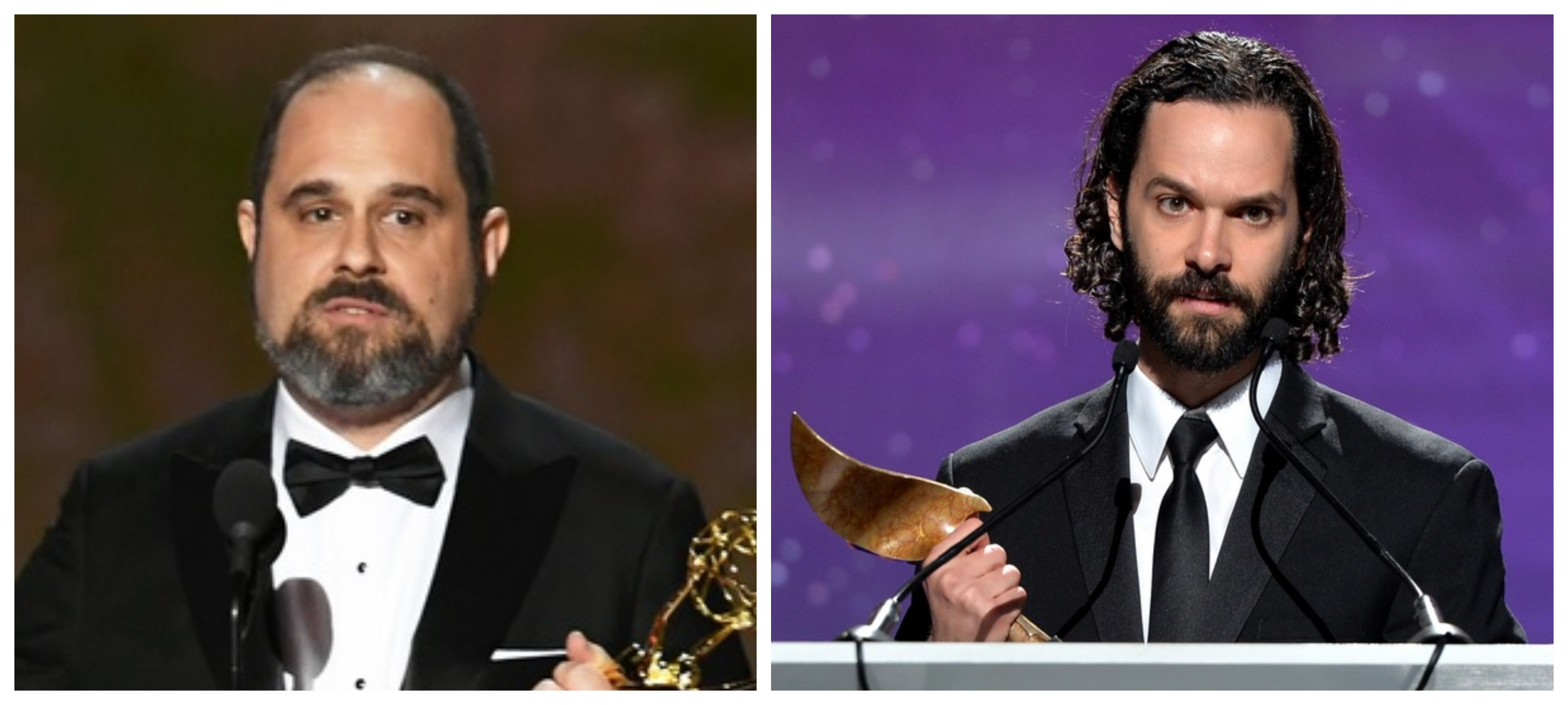 (Craig Mazin and Neil Druckmann.)
The Last of Us began life as a highly successful video game by developer Naughty Dog. The TV series was created by Craig Mazin (Chernobyl) and Neil Druckmann (currently co-president of Naughty Dog). Besides Pedro Pascal and Bella Ramsey, guest stars include Anna Torv (Fringe) and Melanie Lynskey (Heavenly Creatures).
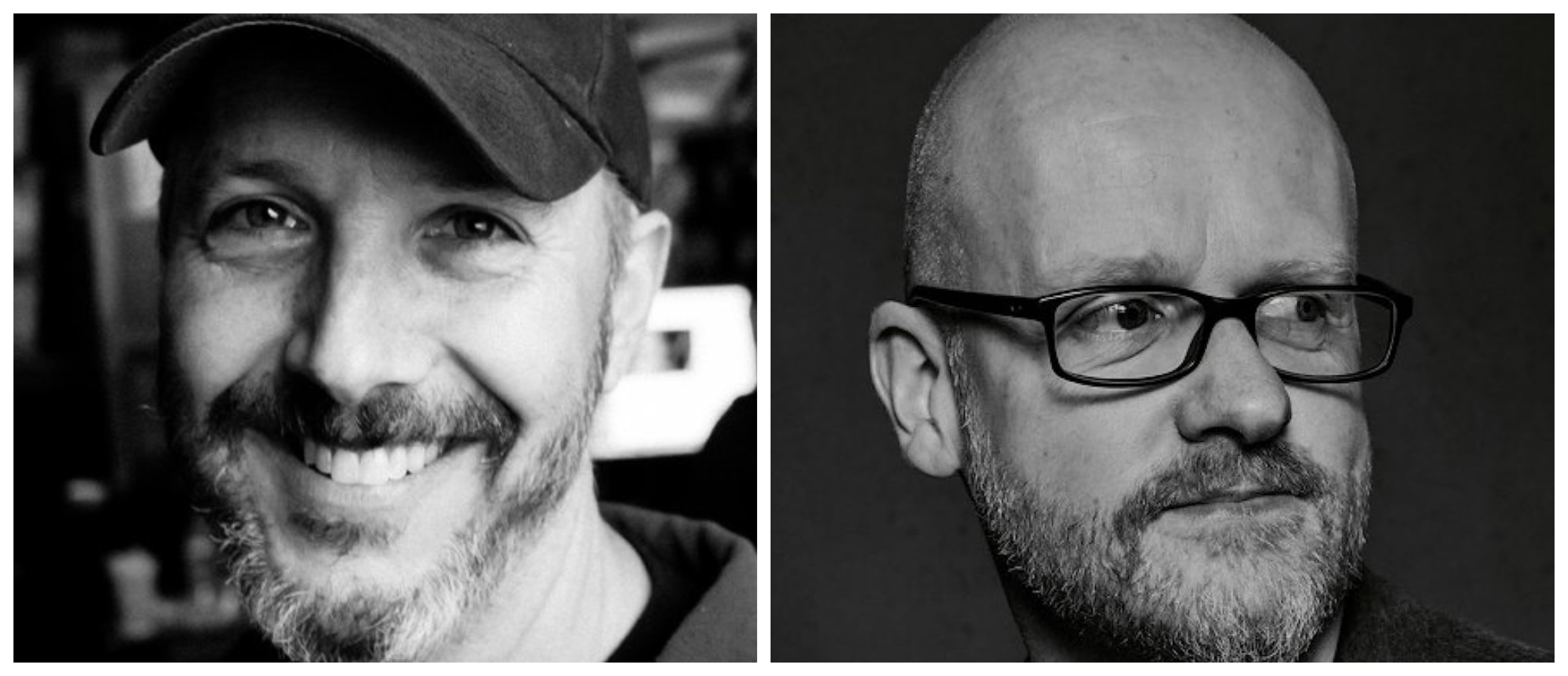 (SWSCA co-founder Matt Winston and BGFX founder Barrie Gower.)
Stan Winston School of Character Arts co-founder Matt Winston, along with a group of SWSCA students, spent more than an hour speaking with Barrie Gower (Stranger Things, Chernobyl, Doctor Strange in the Multiverse of Madness), creative director of BGFX, about the practical makeup effects work on the HBO + series The Last of Us.
BGFX's Barrie Gower on joining The Last of Us
Barrie's involvement with The Last of Us started while BGFX was finishing work on Game of Thrones and Chernobyl, which Craig Mazin was writing and producing.
"We bumped into Craig at the Emmy Awards later that year," said Barrie. "We had been nominated for both Chernobyl and Game of Thrones, and he said, 'We should keep in touch. I've got something else coming up in the pipeline, and there's a lot of stuff for you guys.'" Barrie continued, "Twelve months later, I saw the press release that Craig was gonna be adapting The Last of Us. I started stalking him for about six months or so, saying, 'What's happening?'"
At first, the HBO producers questioned whether the UK-based BGFX would be able to produce the makeup effects since the series would be shooting in Calgary, Canada. Barrie assuaged their fears. "I said, 'We're used to doing a show that's not in our country because we spent five years on Game of Thrones [which was shot in Northern Ireland]. We built everything at our studio in South London.' And I said, 'In a way, it's very similar.'" He continued, "We were doing Stranger Things at the time, which was in Atlanta. We said, 'Logistically, we could do this.' We could build the majority of the prosthetics and makeup effects in the UK and have a micro team out there in Calgary who would be there for the entire shoot. And they went for it."
When asked if he had played The Last of Us game ahead of time to prepare, Barrie laughed and admitted he still hadn't played the game. "I knew about the IP and the creature design of the game, and I knew about the Clickers and the infected characters because it's such a huge, successful property that I'd seen all these amazing designs."
Instead of playing the game, Barrie and his wife, BGFX Co-Director Sarah Gower, viewed a four-hour-long walkthrough. "We realized that this would be a dream project for any makeup effects company."
Satisfying Fans of The Last of Us Game
Joining a show like The Last of Us was different than most projects. Whereas many shows will start their designs from scratch, the creature designs for The Last of Us were already well-established; it had already been a hit game, and many of the designs were worked out and beloved by fans.
"There are two very different approaches when you join a project," said Gower. "We were very lucky with Game of Thrones. We had complete leeway. We designed all the characters from the ground up; they weren't already predetermined designs." Barrie continued, "With The Last of Us, it's a massive franchise already, with pre-designed characters and creatures. But speaking with Neil [Druckmann], even though we knew we had to pay an awful lot of fan service to the game players, he was very keen for us to put our own new spin on the creatures as well." To that end, BGFX would spend about two months working on concepts. "We hired a couple of creature concept artists, two UK guys, Rob Bliss and Simon Webber."
Designing The Last of Us Runners
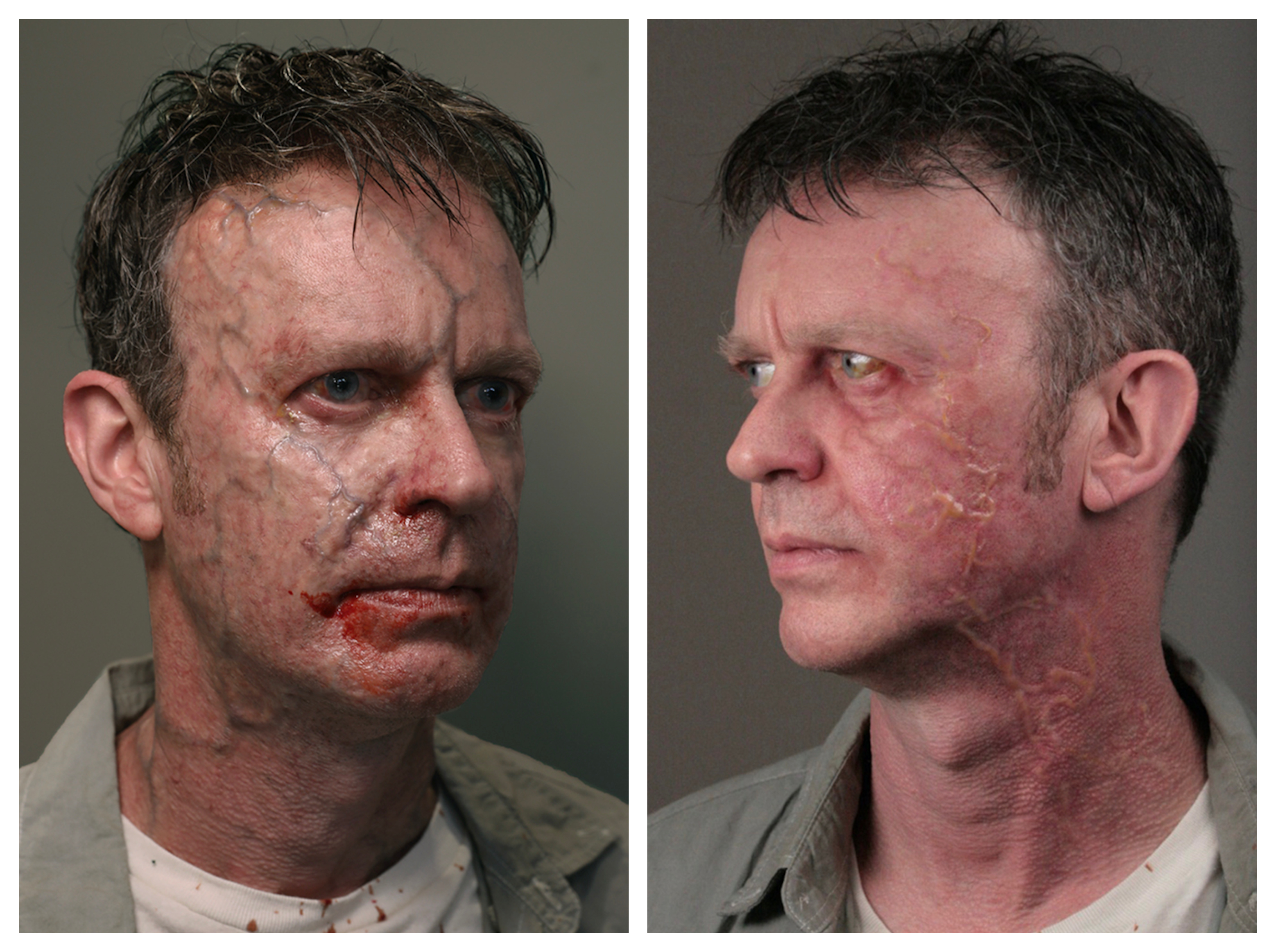 (A pair of Stage 1 test makeups for the early infected produced by BGFX. Images courtesy of BGFX/HBO.)
Initially, when infected by Cordyceps, humans develop a vein-like fungus beneath their skin. "The infected characters were the hardest characters for us to establish for the show," said Gower. "The Clickers were almost predesigned, and we could pretty much follow [those designs] to a T. With the infected, it was trying to find out how many stages we would have throughout the show." Barrie continued, "Our history with working with Craig Mazin on Chernobyl, he absolutely loves different stages. Our radiation burn victims (for Chernobyl) ended up having about six different stages of burns." For The Last of Us infected, BGFX started off with three-dimensional veins coming from eyes, noses, and other parts of the face, with inflamed makeup and glossy textures around the eyes.
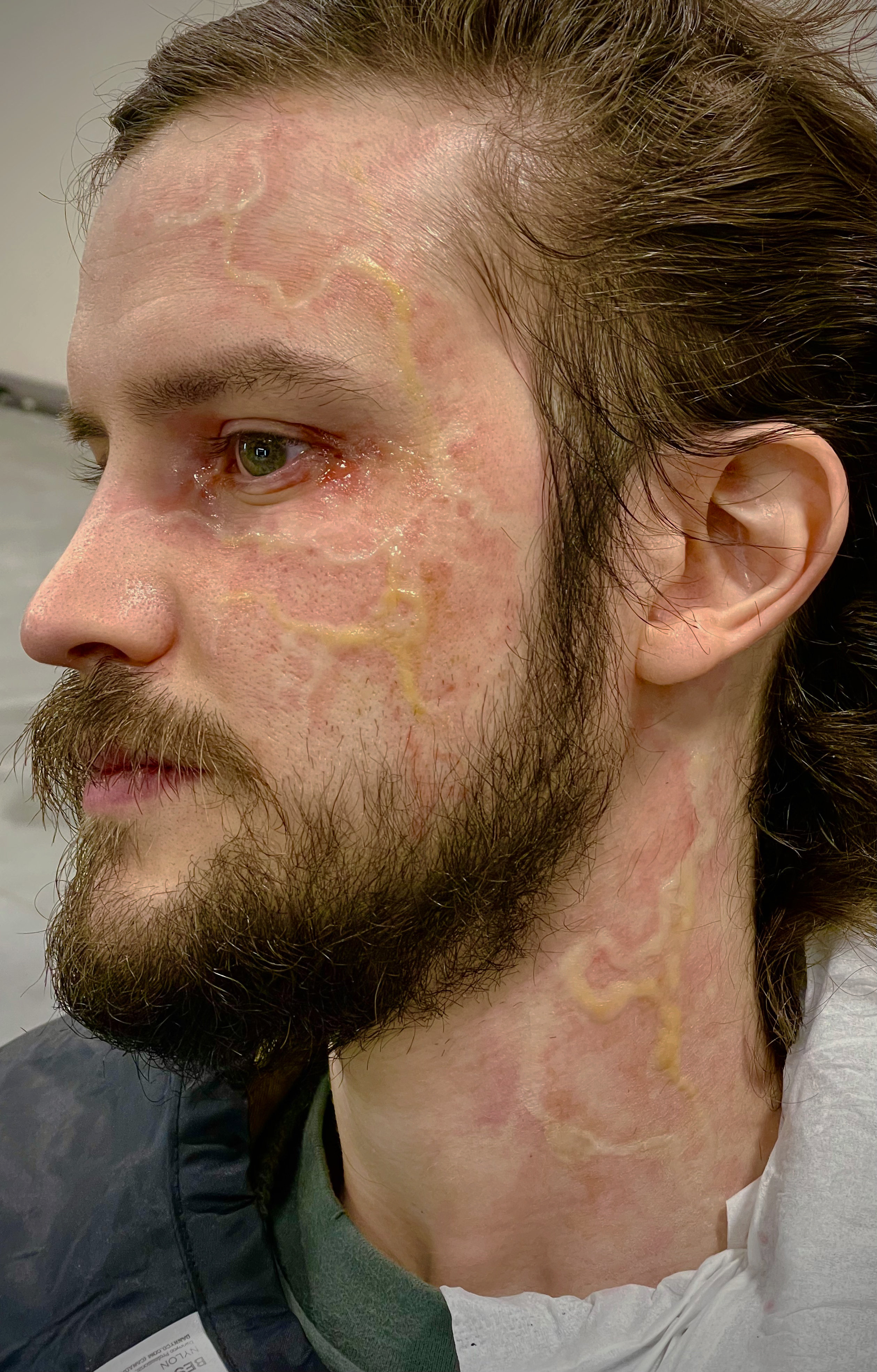 (One of the 1st stage infected makeups. Image courtesy BGFX/HBO.)
Creating More Stages of the Zombie Fungus Infection in The Last of Us
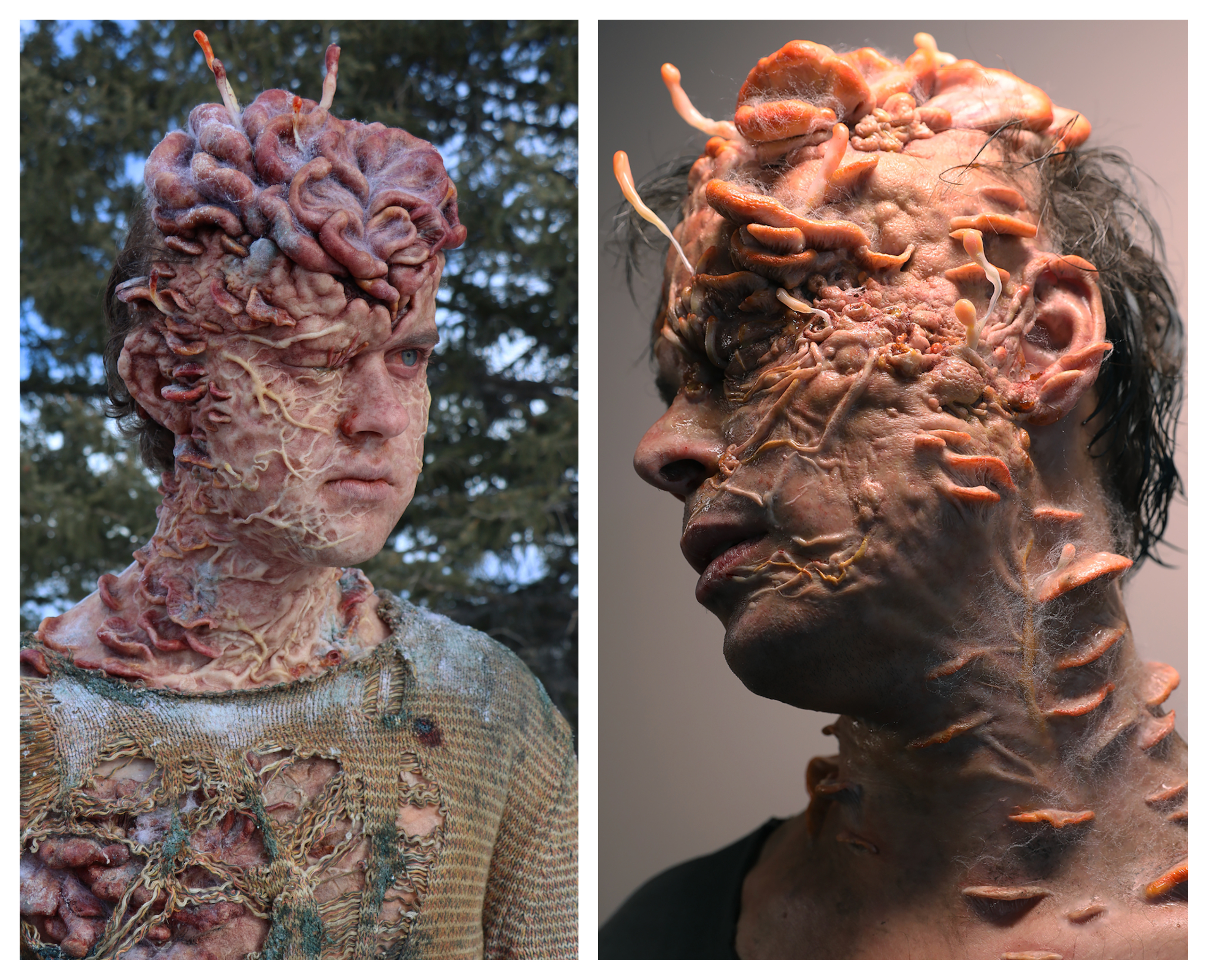
The BGFX team then created further stages of the infected. "We had a second stage, which was slightly more extensive, raised veins with small fungus starting to erupt from the skin," said Gower, "then stage three, stage four, stage five, everything was getting larger in size and scale and coverage as well, and we're starting to get more infection over the body." Along with facial appliances, this would require Gower's crew to create body appliances as well. "We had various people in lots of different costumes, some without sleeves so that we could put infection on the arms. We probably spent the best part of four to six months testing the infected stages. We were trying different materials and a lot of foam latex for the larger fungal pieces, some of which worked, some of which looked exactly like what it was, foam latex."
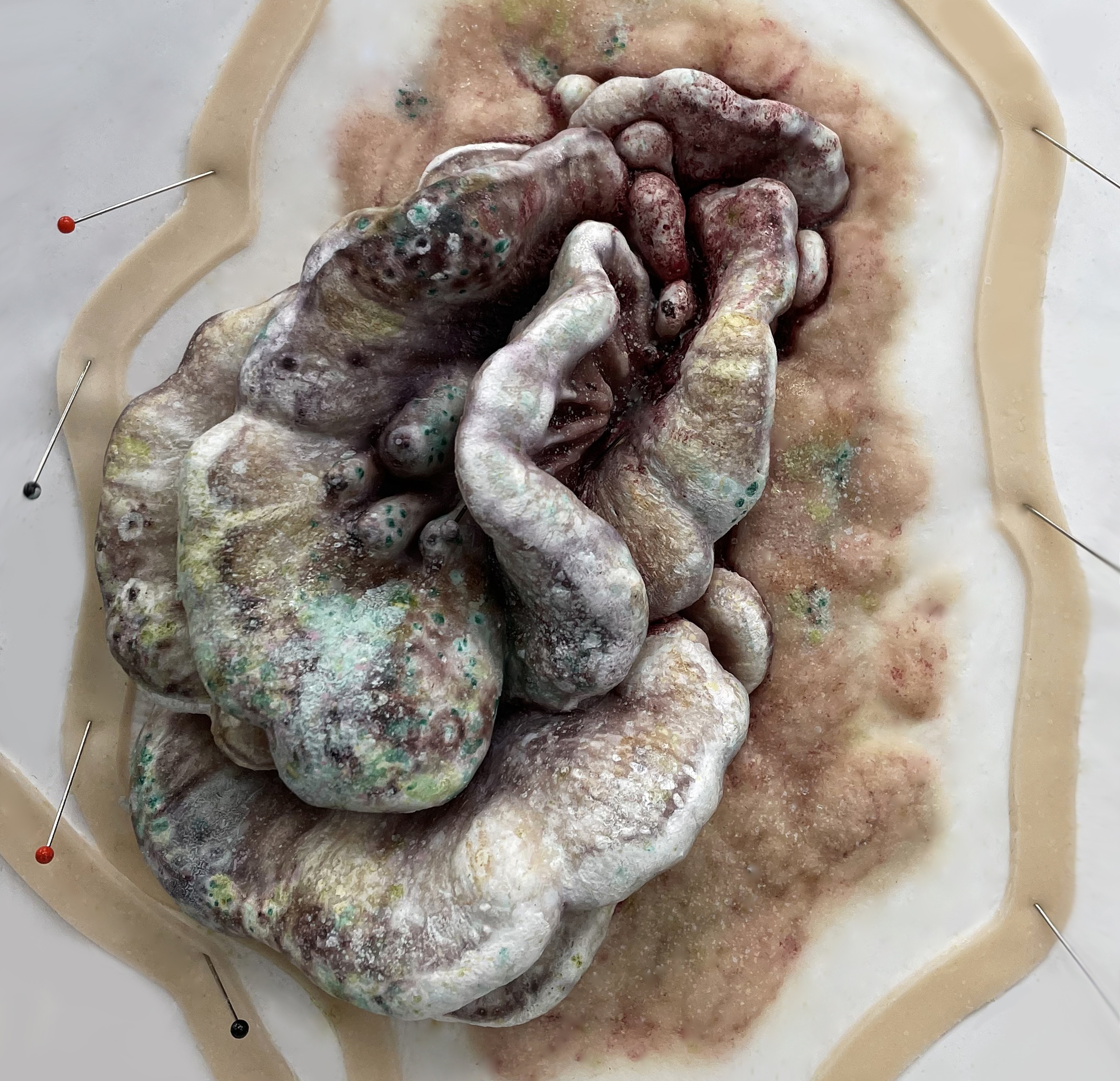 (A pre-painted appliance for one of the more extreme stages of infection. Image courtesy BGFX/HBO.)
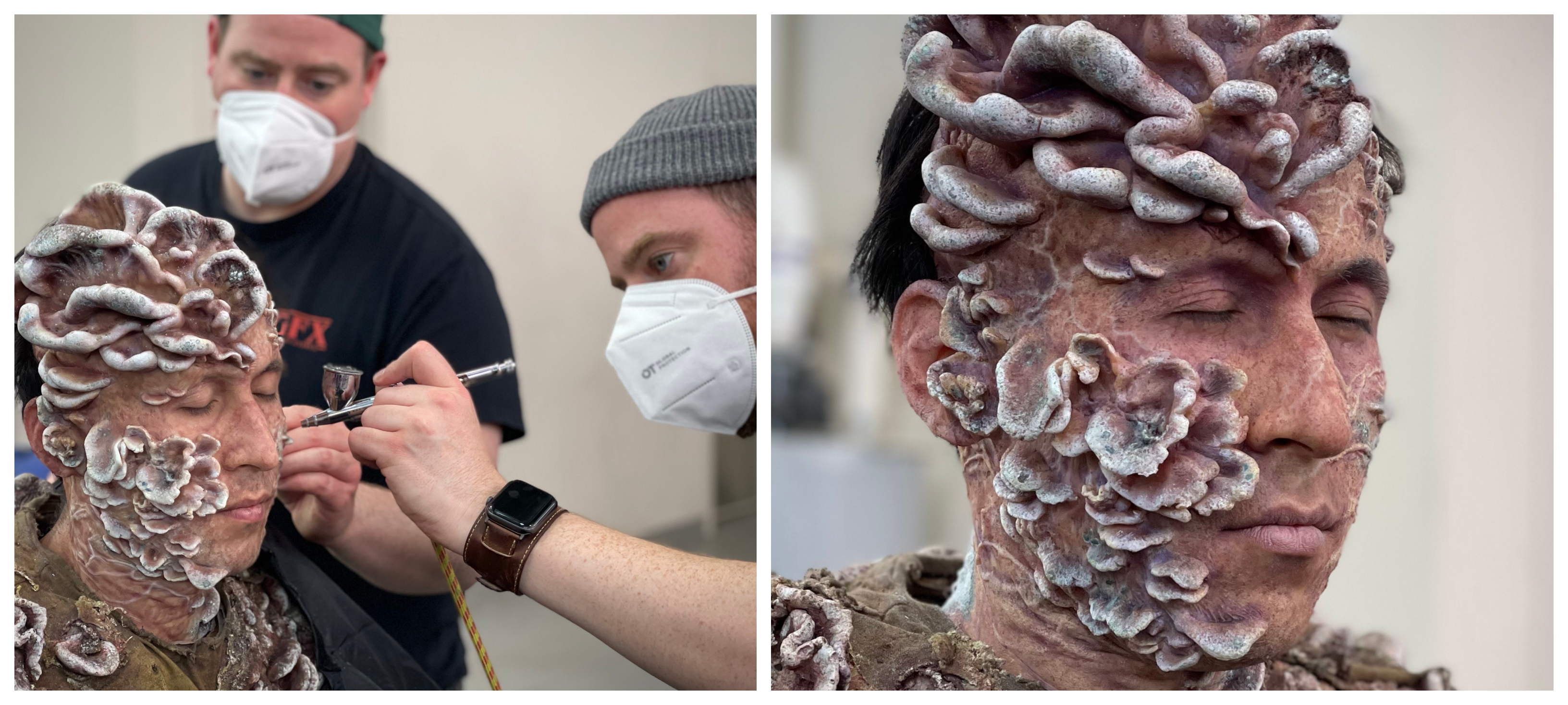 (Steve and Mike Byrne applying an infected makeup for the cul-de-sac scene in episode 5. Images courtesy BGFX/HBO.)
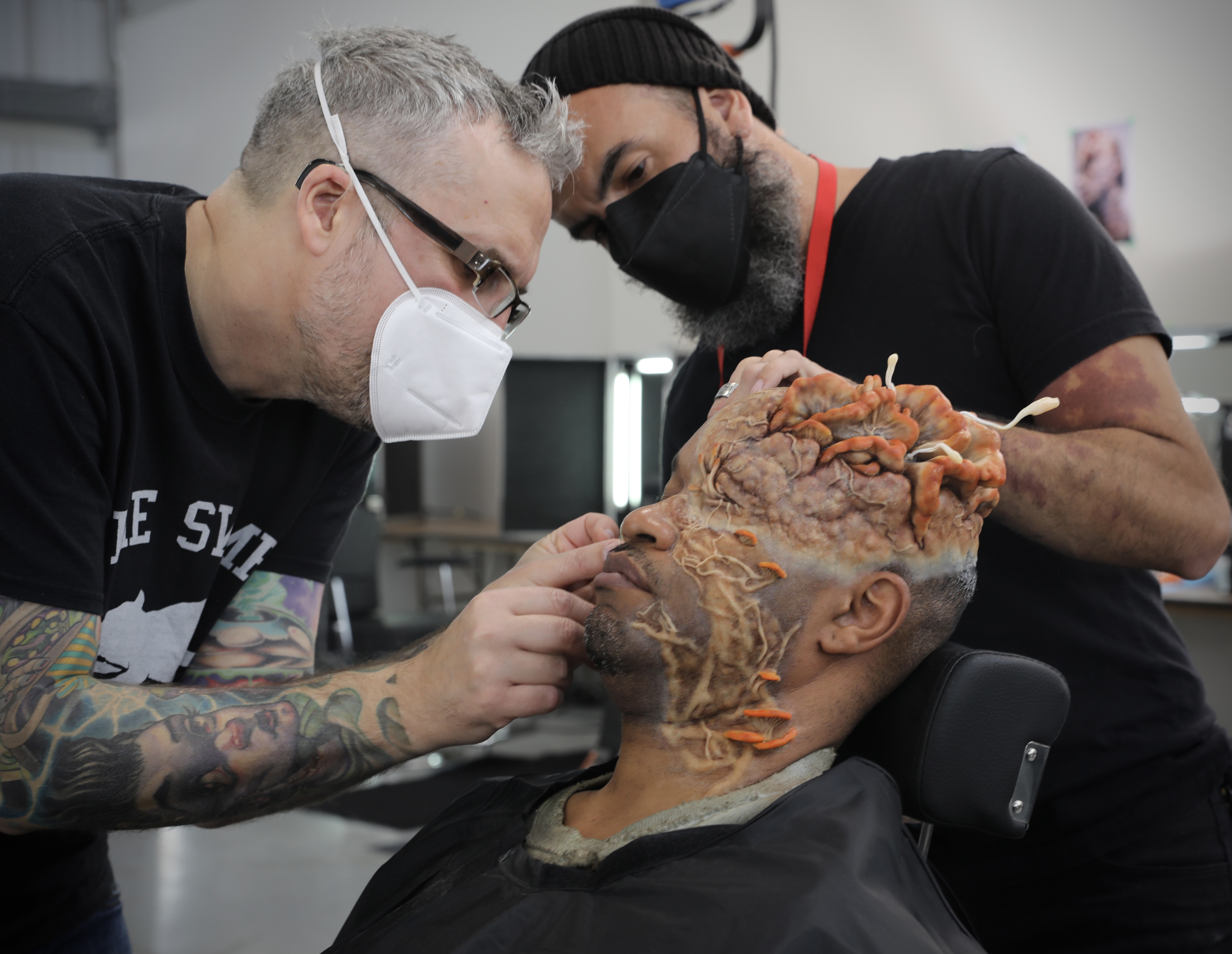 (Duncan Jarman and Nix Herrera putting appliances on a performer for the cul-de-sac scene in Episode 5. Image courtesy BGFX/HBO.)
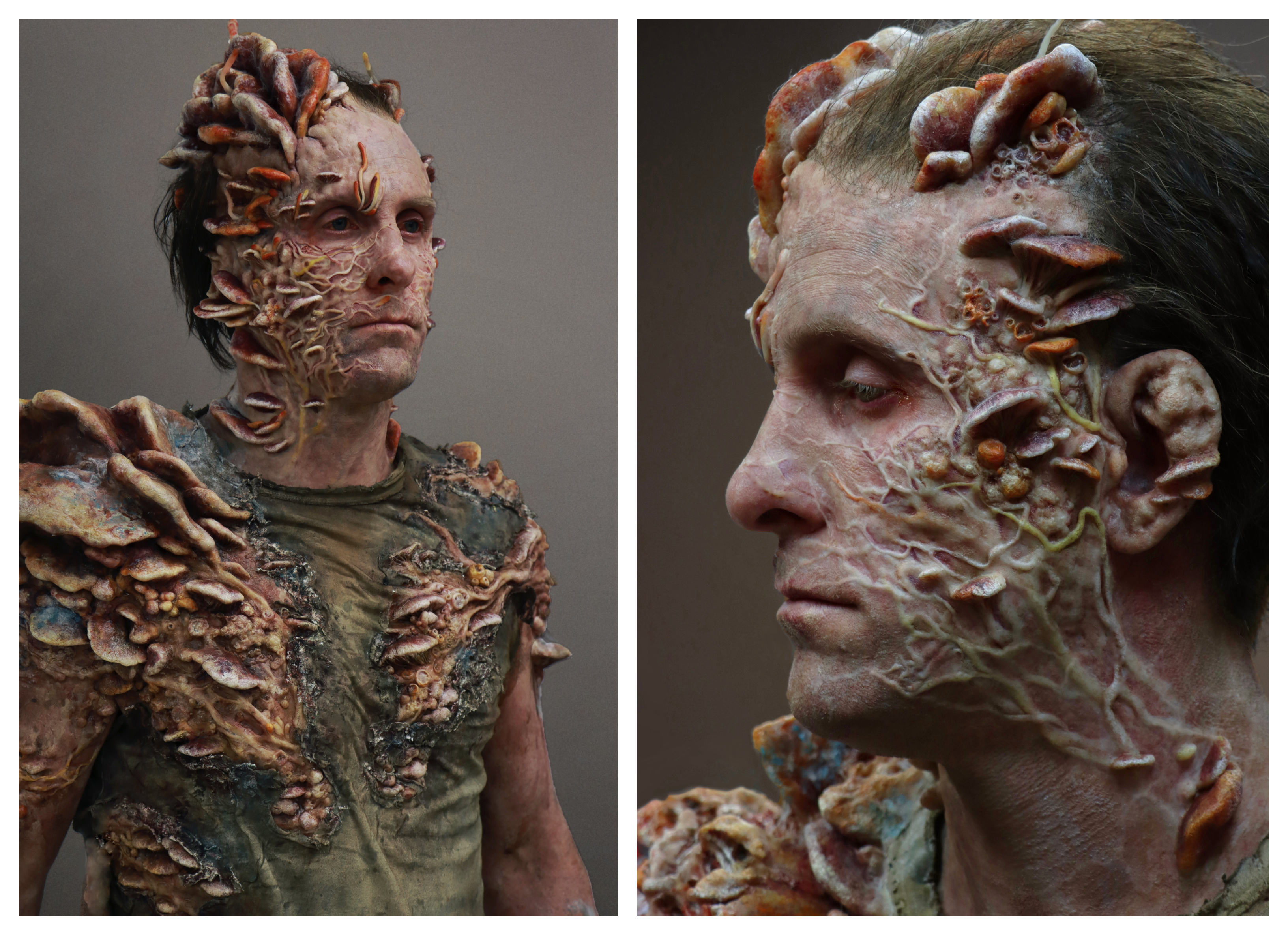 (Above and below, examples of the more advanced stages of Cordyceps infection created by BGFX. Images courtesy BGFX/HBO.)
Applying Makeups for a Large Number of the Infected
"One of the things with our huge crowd-infected days, which was always going to be a challenge, were the numbers," said Gower. "You're okay if you have a scene with two or three infected characters, but not when you have sequences with 60 to 80 characters."
BGFX collaborated closely with costume designer Cynthia Summers and her team to speed up the application time for the many infected performers. "We made these Lycra tops and bottoms," said Gower, "which had pre-glued appliances on top, so we could easily slip those on for the shoot day. It would completely reduce our application time." Summers worked with Gower's team to expose these fungal appliances coming through the wardrobe on the shoulders, the chest, and the arms of the performers.
Researching Spores, Molds, and Funguses for The Last of Us
Beyond the visual cues provided by The Last of Us video game, the BGFX team did extensive research into many varieties of fungus. "There are different types or 'breeds' of mushrooms. For all our Clickers, we were looking at reference of a mushroom called Chicken of the Woods or Chicken of the Forest. They're these huge, vibrant yellow and orange fungi you find in the forests with undulating shapes with knobby, popcorny bits on the end. They look exactly like our Clickers and like somebody's been in the forest running foam latex everywhere ‘cuz they do look like foam latex."
 (Examples of the Chicken of the Forest fungus used as reference for the Clickers head crowns. Images courtesy Flickr: Creative Commons.)
Gower continued, "The Bloater had a lot of clusters of these puffball mushrooms as well, or puffball fungus, and they were kind of like domes with these little holes where all the spores would come out. We looked at parasitic diseases, things like larvae growing under the skin. Yeah, we had a lot of favorites. A lot of favorites."
But ironically, mushrooms are far from Barrie's favorite in real life. "I hate mushrooms," Gower revealed with a laugh. "I can't stand mushrooms. I don't eat mushrooms. So, it wasn't exactly the best project to get on with the subject matter."
Designing The Last of Us Show's Clickers
As one of the most visually striking stages of infection in The Last of Us, Barrie and his team spent an enormous amount of creative energy on the Clickers. "The Clickers are one of the most extreme versions of these infected characters. The idea is that the fungus has grown so great inside the head of the host that it's broken the skull. Everything's broken out and has formed these huge petal shelf mushrooms over the head of the victim."
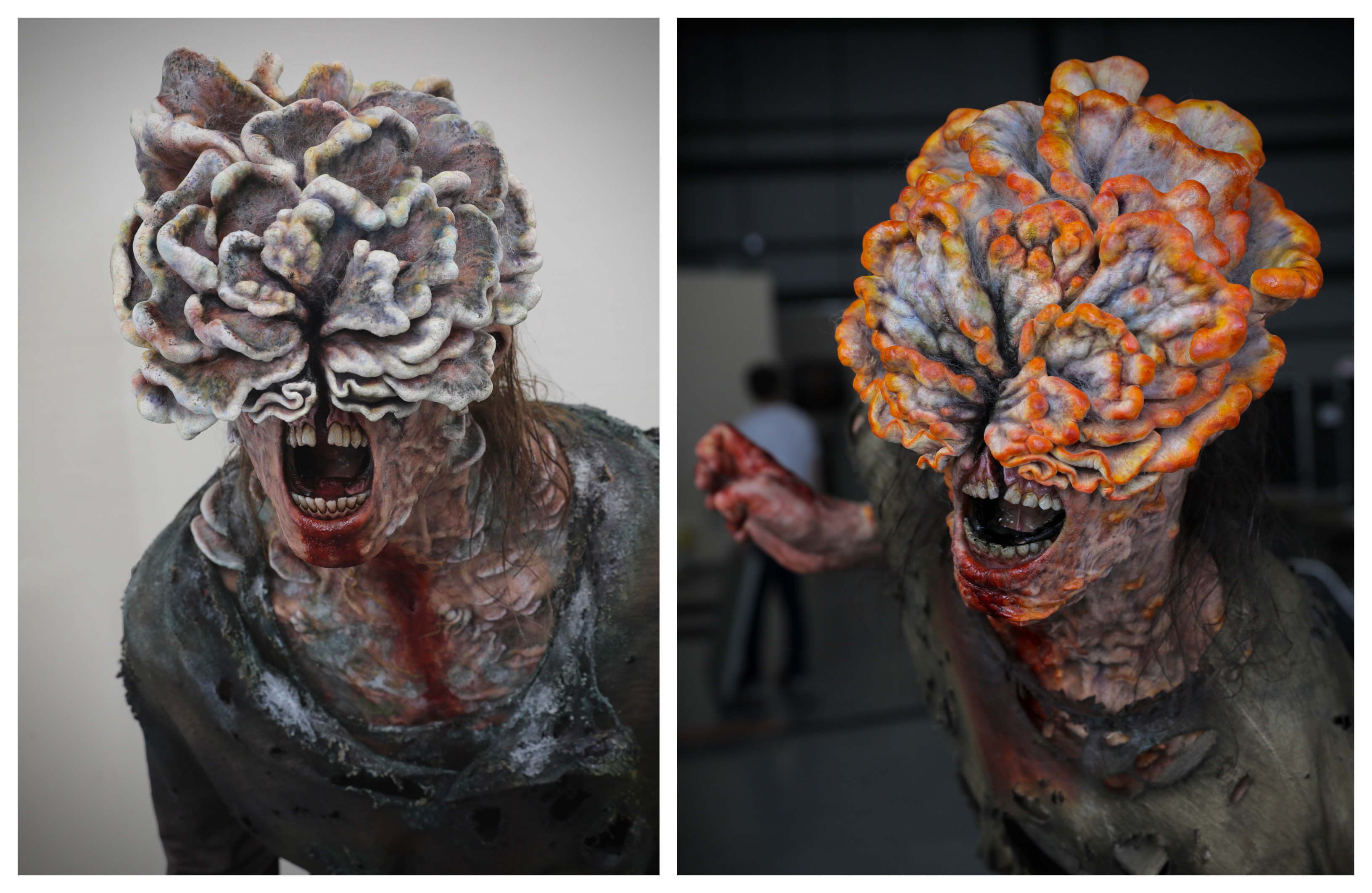 (Museum Clickers played by Olivier Ross-Parent (L) and Samuel Hoeksema (R). Images courtesy BGFX/HBO.)
While the design work that Naughty Dog had done for the games set the tone, Gower also wanted to put the BGFX spin on the creatures. "We looked at all the Naughty Dog concepts and used a lot of that as a springboard. Then we did some new designs with different shapes and forms, slightly different anatomy here and there. One of the things we discussed quite early on was trying to achieve the look of this crown, which has a very inverted sort of crevice in the center of the design, which in three-quarters of profile would almost be negative space."
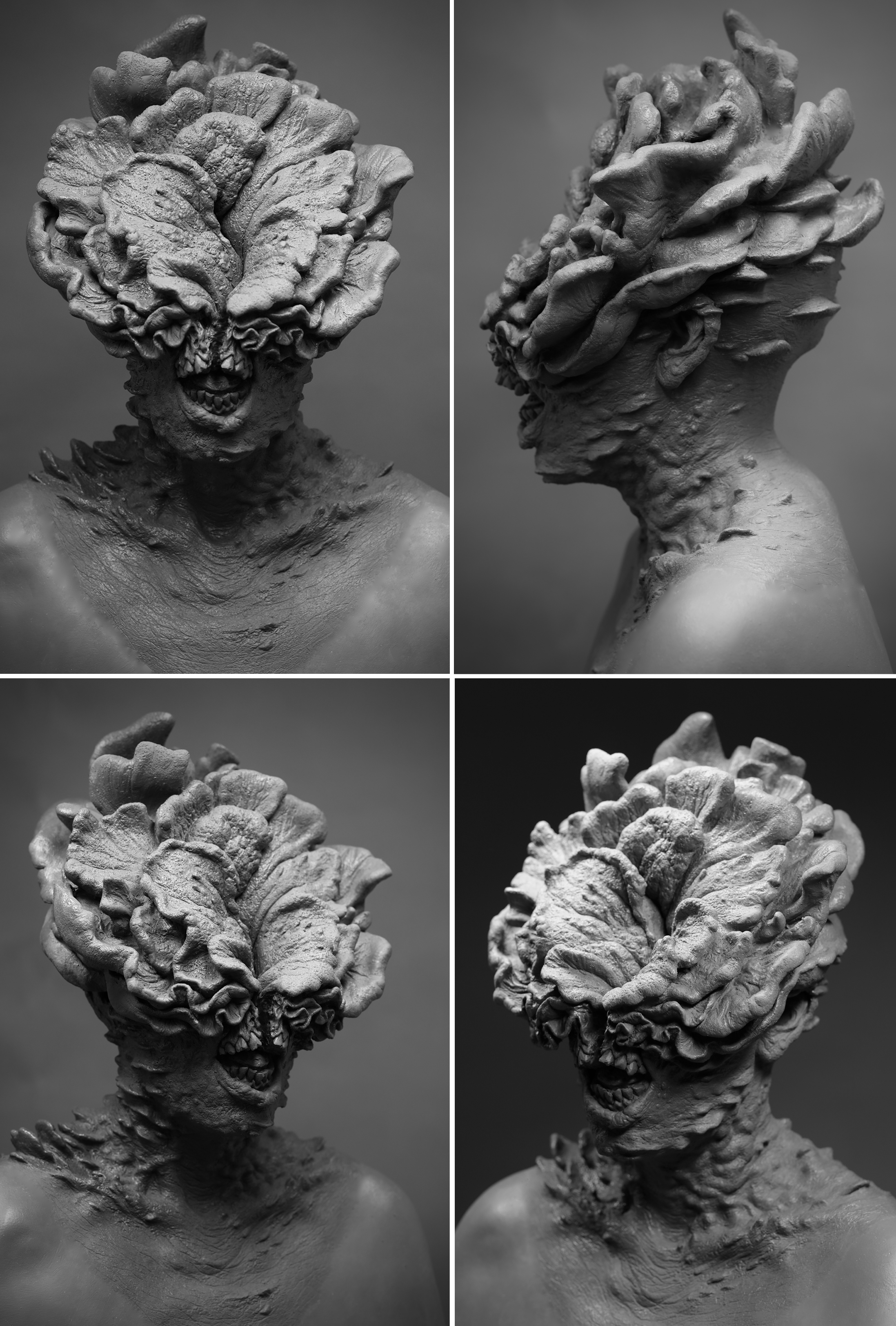 (A hero Clicker test sculpt that BGFX created for look development & VFX reference. Images courtesy BGFX/HBO.)
Working with the VFX Team to Troubleshoot the Clickers
The crew at BGFX worked very closely with Alex Wang, the visual effects supervisor at WETA. "Our first test with the Clicker makeup was to establish what would be [shot practically] on the day and what may need to be augmented digitally in post." To accommodate either approach, the BGFX team had to get creative. "In profile, we could achieve that deep crevice, but obviously, we could only go so far," said Gower. "We then cut that area of the sculpture out, floated that off the lifecast, put that to one side, and molded the whole crown with that area missing. With this removable piece, the Clickers could be shot two different ways: First, with the piece in; second, if this didn't look good, the interior piece could be removed, and the interior could be painted a chromakey green so the crevice could be added digitally. But Alex said, 'Don't worry about the green areas in the face, process it as a practical makeup, and we will shoot it on the day, and we'll see what we see, and if we need to do something, we can gently augment it in post-production.'"
The Illusion of Negative Space in the Clicker's Face
To achieve the recessed space in the crown of the Clicker skull practically, the BGFX team had to be very clever. "We split up the makeup so it had a separate crown which came over the head that was in foam latex because it was going to be a really big piece. For everything below the crown, we had a cowl piece and a neck piece, which came down to the top of the chest. We sculpted it all as if we were trying to achieve it practically, in-camera, and we cheated everything forward on the head, the crown, the nose, the dentures, we cheated everything forward."
More About Those Clicker Dentures
The work started with the two Clicker hero performers, Samuel Hoeksema and Olivier Ross-Parent, both from Canada. "We took dental casts and created a vacuform tray which fit onto their own teeth. We also sculpted dentures on the outside of their lips like a veneer, which went over the front of their lips, top and bottom. By doing that, we cheated the whole face forward, and we were able to sculpt that broken cleft in there as well. These incredible dentures sit over the actor's own lips but also clip into their own teeth and give you the illusion that part of the face is missing."
Barrie said about the possibilities this technique provides, "It is interesting. We always say putting prosthetics over somebody's face is one thing. But when you start augmenting the mouth or the eyes, it always has such a big effect on the final result. So, the dentures played a huge part in the Clicker makeup."
Creating Clicker Bodies & Paint Schemes
After all the testing and experimenting, foam latex appliances would be used to create the mushroom-like growths on the Clickers' bodies. "Anything on the body which came through the costume tended to be foam latex."
The Clicker makeups were airbrushed primarily with rubber cement paints thinned with Naptha. "It's very, very, very thin. It's different from using PAX paint on foam latex because you can do lots and lots of layers and colors. But when you stretch and move the foam, it looks like it's hardly got any product on whatsoever." On top of the PAX paint jobs, the BGFX team also used a mix of water-based inks.
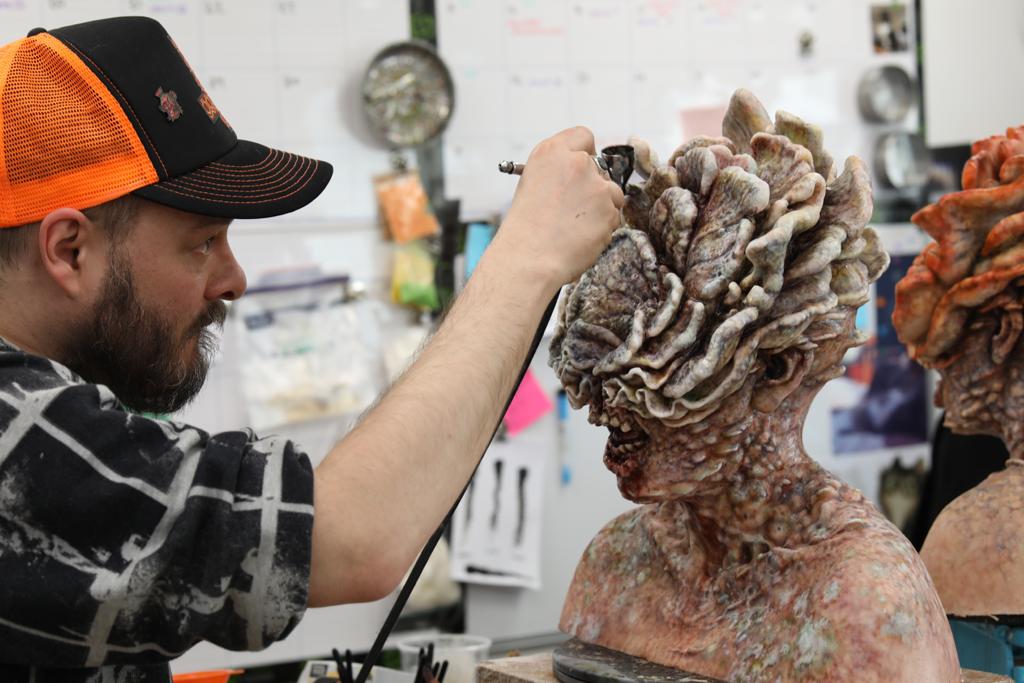 (BGFX artist Joel Hall paints a Clicker test head. Image courtesy BGFX/HBO.)
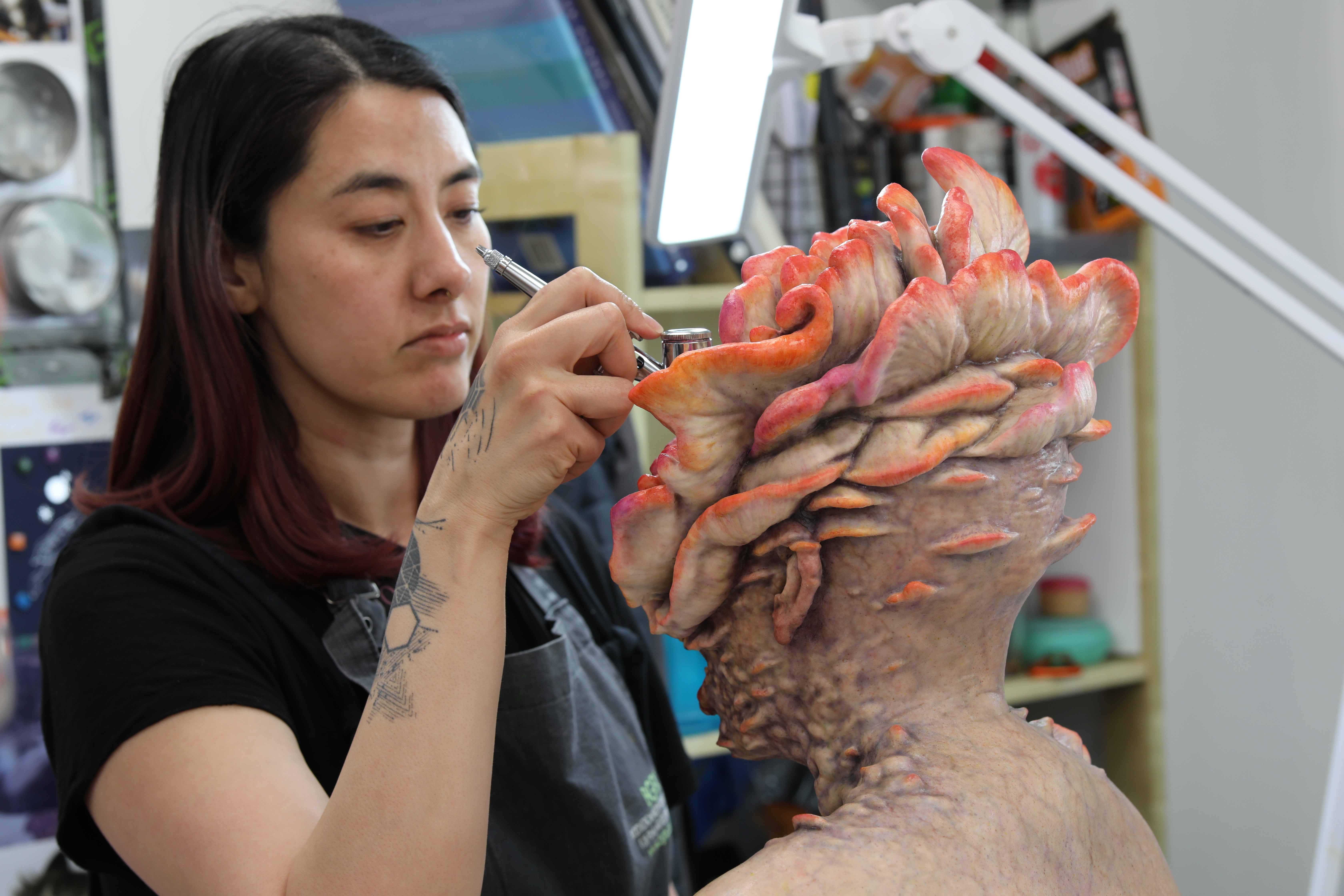 (Paula Eden airbrushes a Clicker test head. Image courtesy BGFX/HBO.)
Regarding the Clicker paint schemes, Gower said, "Something we spoke about quite early on in our build, in our testing period, were ways of deciphering the different types of infected, not only by how extensively they were covered with infection but also the colors and the finish. So, we talked about whether they would be in hot or cold environments, moist or dry environments, dark or bright environments, and that would dictate how vibrant the coloring would be on some of the Clickers."
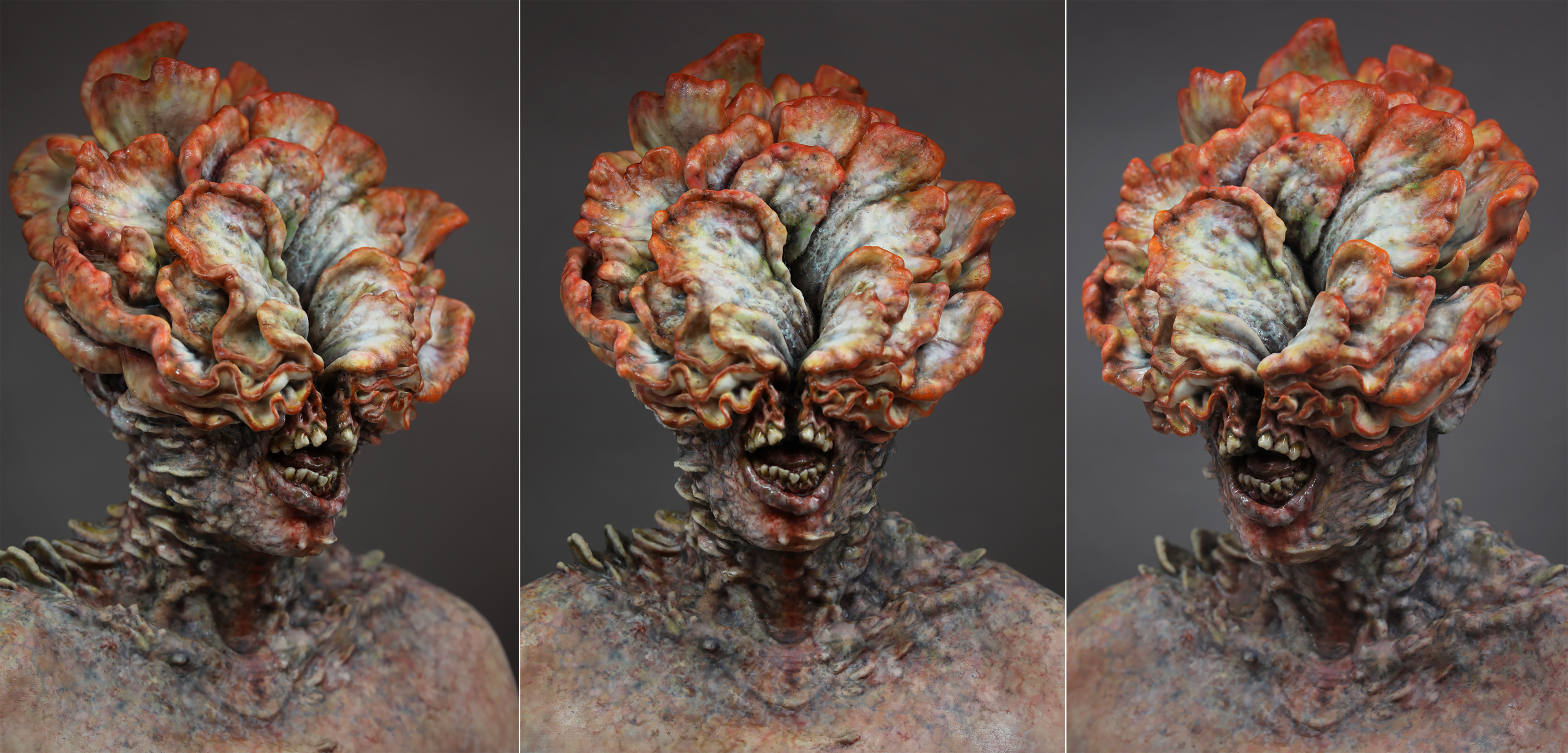
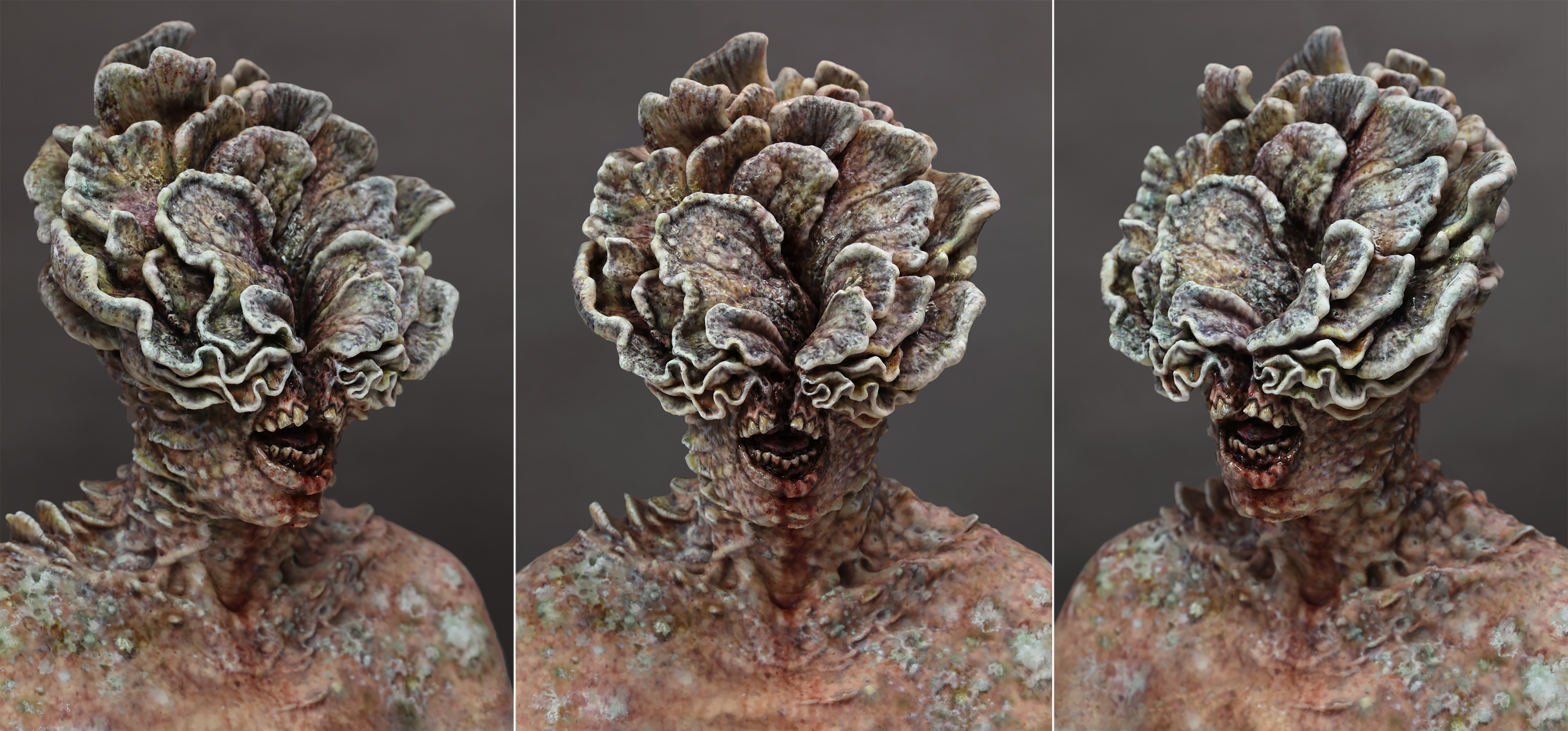 (Top and Bottom - examples of the 1st and 3rd Clicker paint schemes. Images courtesy BGFX/HBO.)
Bringing the Clickers to Life with Performers In Suits
One of the most important things to consider when designing the Clicker characters was the fact that performers would have to be put into prosthetics and body suits and deliver an excellent performance. "You could take the design from the game, but there would need to be some compromises or nuances that you would need to change to make these work physically over a performer."
Designing Clicker Makeups to See Beyond the Mushroom
Vision was one of the critical considerations for the BGFX team when devising the Clicker makeups. "To enable the performers to see out of the Clicker makeups, small gaps would be sculpted between the petals of the mushrooms exploding out of the Clicker's head," said Gower. "We put a black mesh on the interior of the foam latex so you wouldn't be able to see their eyes."
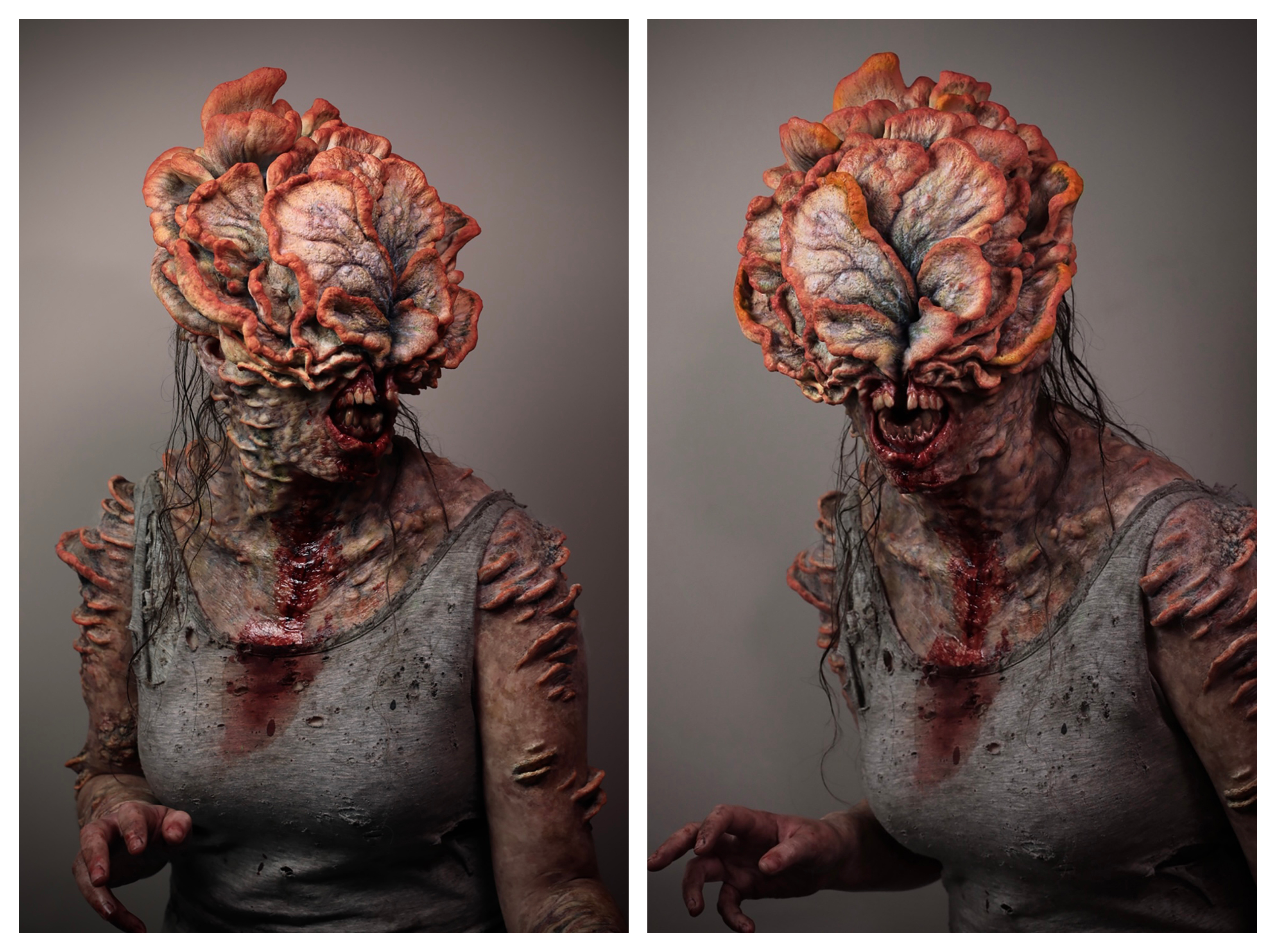 (Vision holes in this Clicker makeup are nearly impossible to detect and can be completely covered for close-up shots if necessary. Images courtesy BGFX/HBO.)
Making Large Groups of Clickers
The two hero Clicker performers, Samuel and Olivier, were called back for more fun later in the season. "We sculpted two brand new looks for each of them," said Gower. BGFX also created additional background Clickers. "We had 15 stunt performers who wore pullover Clicker hoods with removable eye sections, which were like fungal goggles they could take out, and they had Velcro inside, so we could pop them in, close them up, and then they would shoot. Then we could rip them out, and they would have their eyes exposed, and they had complete vision. The idea was when we were doing the really vigorous crazy fight sequences with all these stunt guys falling all over each other, they would have their eye areas removed, and VFX would replace anything in post-production."
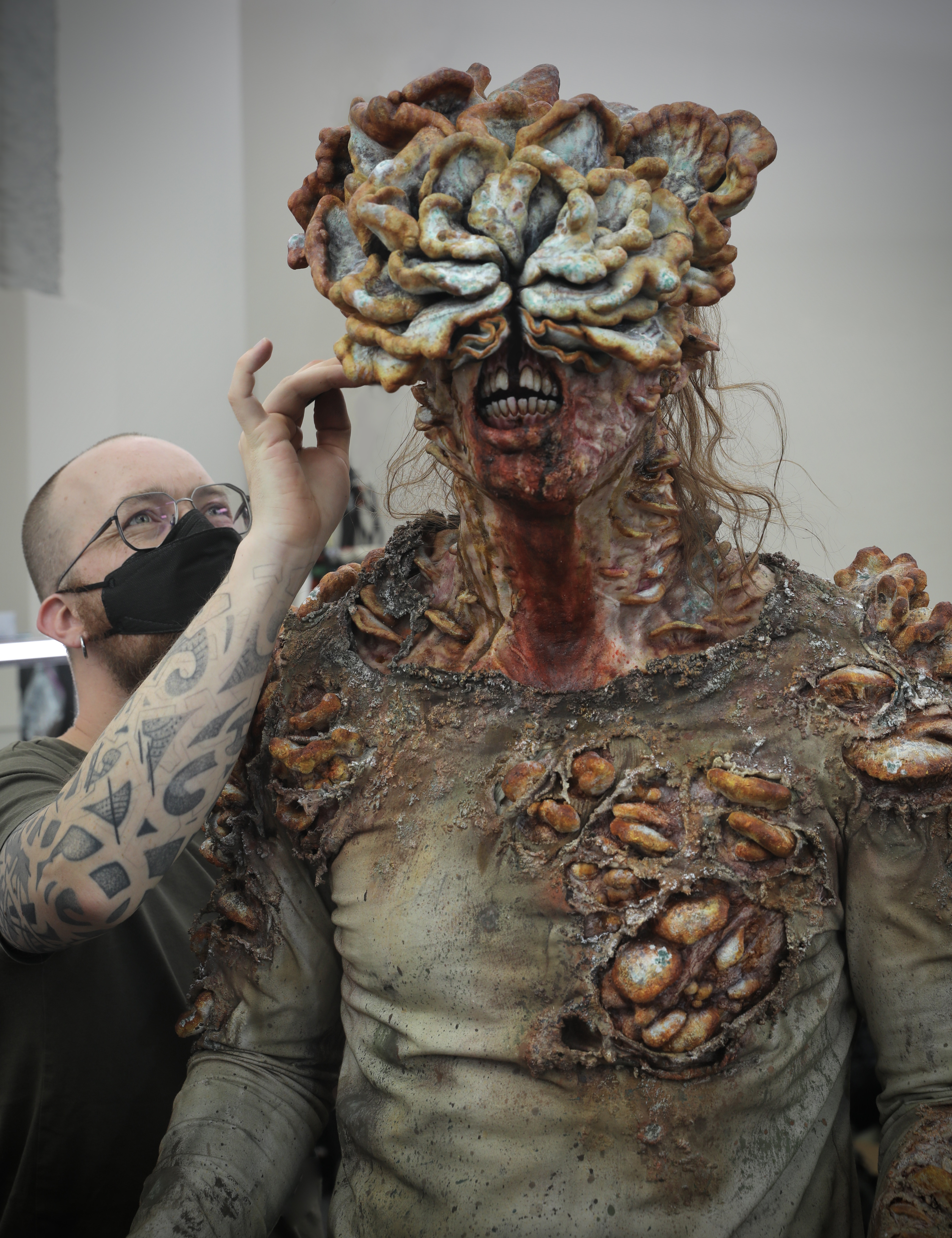 (Patt Foad touches up a second Clicker look on Samuel Hoeksema from episode 5. Image courtesy BGFX/HBO.)
Using a Bloater Stand-in
In the first season of The Last of Us, the end result of the different stages of Cordyceps-infected humans is a huge and powerful mushroom creature. Called Bloaters, these massive 'mushroom men' are covered from head to toe with explosions of fungus-y shapes.
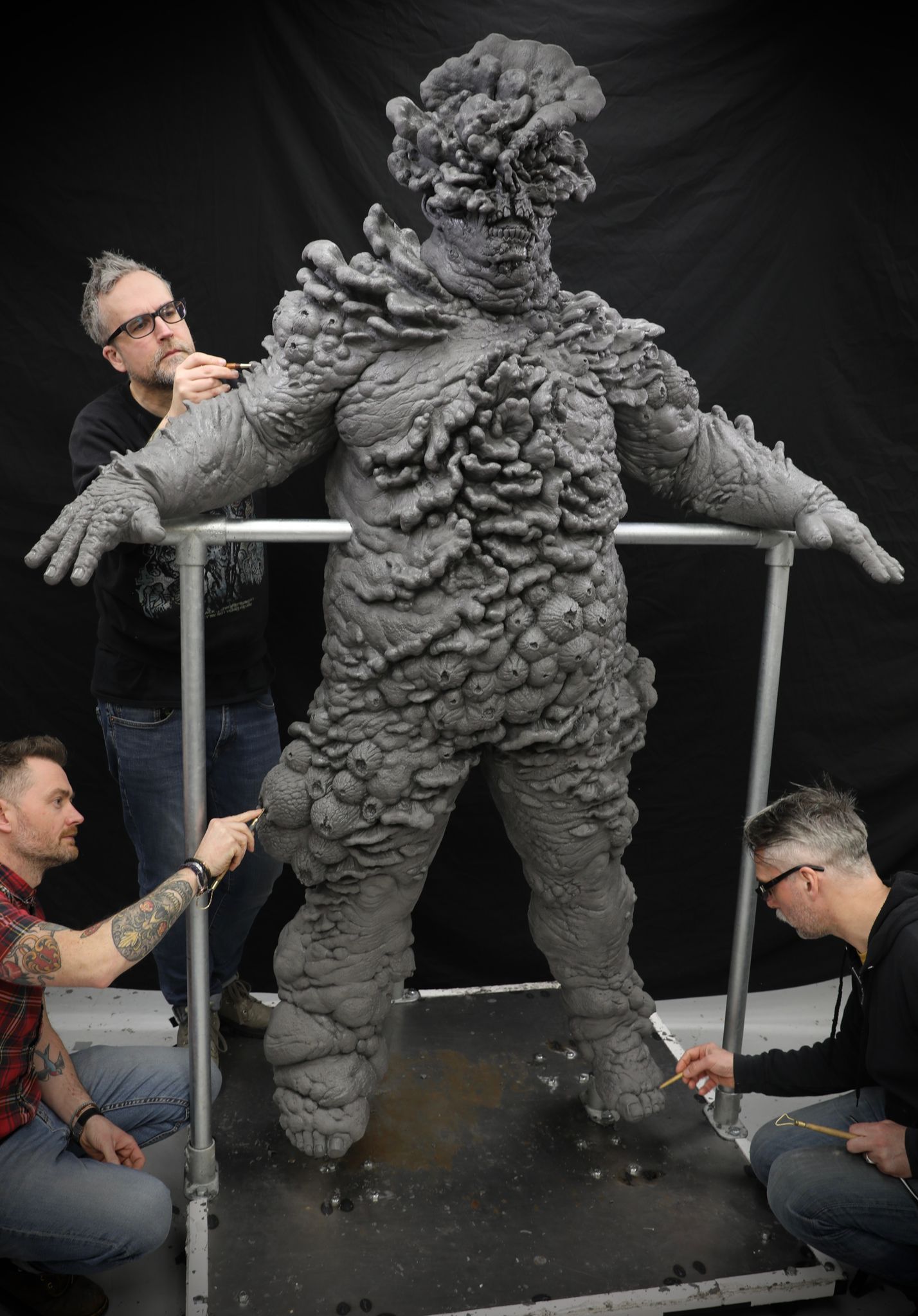 (Colin Jackman, Duncan Jarman, and Andy Hunt sculpting the Bloater suit. Image courtesy BGFX/HBO.)
While the large, deformed Bloater was brought to life digitally by WETA, BGFX was called upon to provide a highly detailed creature for VFX and on-set reference. "It's quite common that you get approached by the visual effects team to provide what's called a lighting stand-in," said Gower. "It could be a head on a pole, or it could be a complete figure you could wheel in on set, or it could just be a swatch of creature skin or something. But it gives them the perfect reference on the day in the lighting on that set for colors, textures, shapes, whether something's matte or shiny."
Although BGFX specializes in practical makeup effects, Gower embraces the interplay with visual effects departments. "We're always keen to have a very close relationship with VFX and give them as much as possible. With the Clickers and the Infected, we ended up seeing a lot of them practically in the final show. With the Bloaters, it was always said, from day one, we don't know how much will end up being practical in the show, but ideally, we want a guy in a complete rubber suit there on the shoot day who can give eye lines to the actors and can perform as this creature." BGFX enlisted an old friend, UK stunt performer Adam Basil, to perform inside the Bloater suit. "Adam stands six-foot-eight. He's huge," said Gower. "He's built like a house. He's a really muscular, very well-toned, athletic stunt performer, and he's played in a lot of creature suits before. So he knows creature suits inside and out."
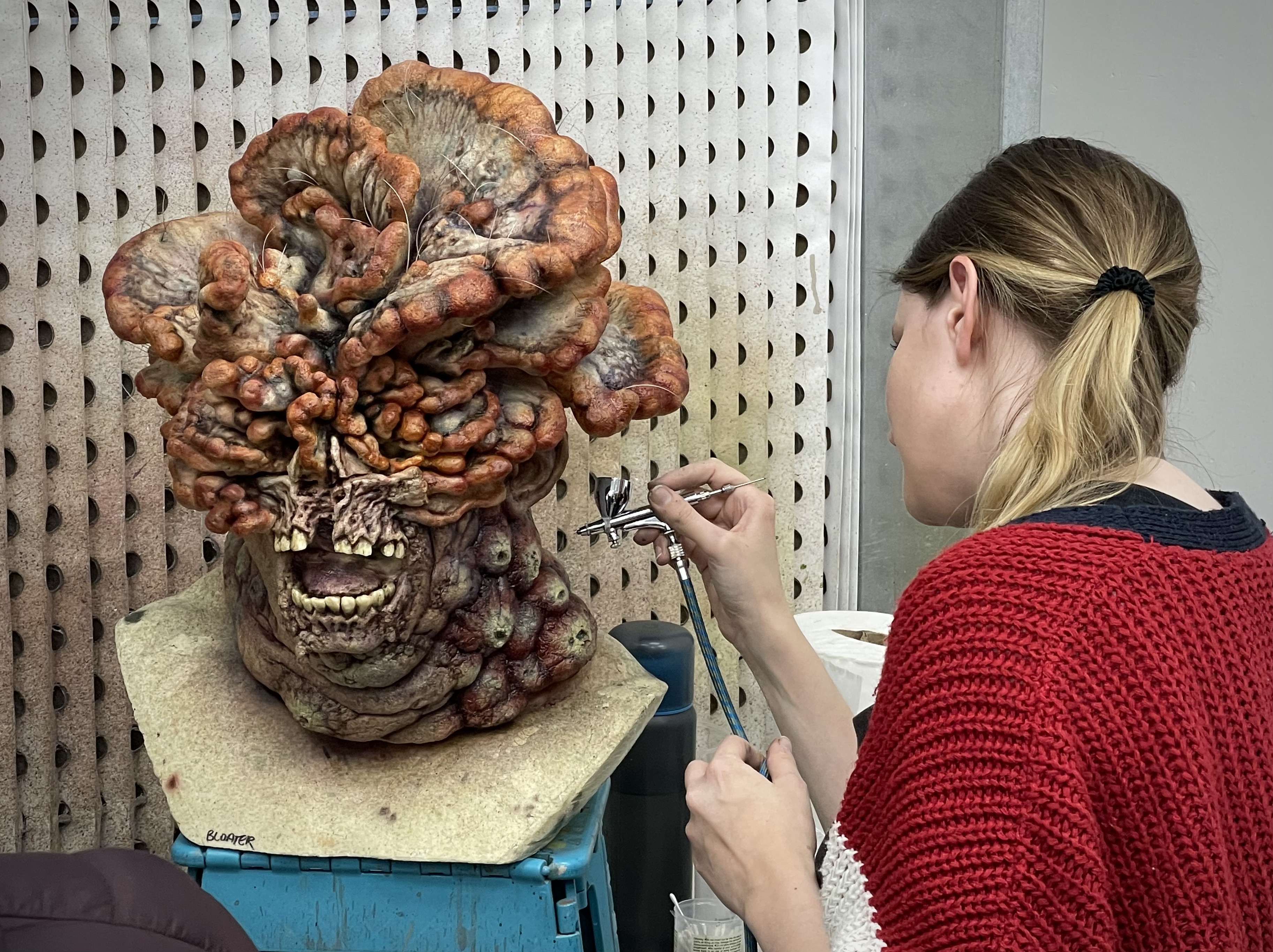 (BGFX artist Gillian Jarvis paints Bloater appliances. Image courtesy BGFX/HBO.)
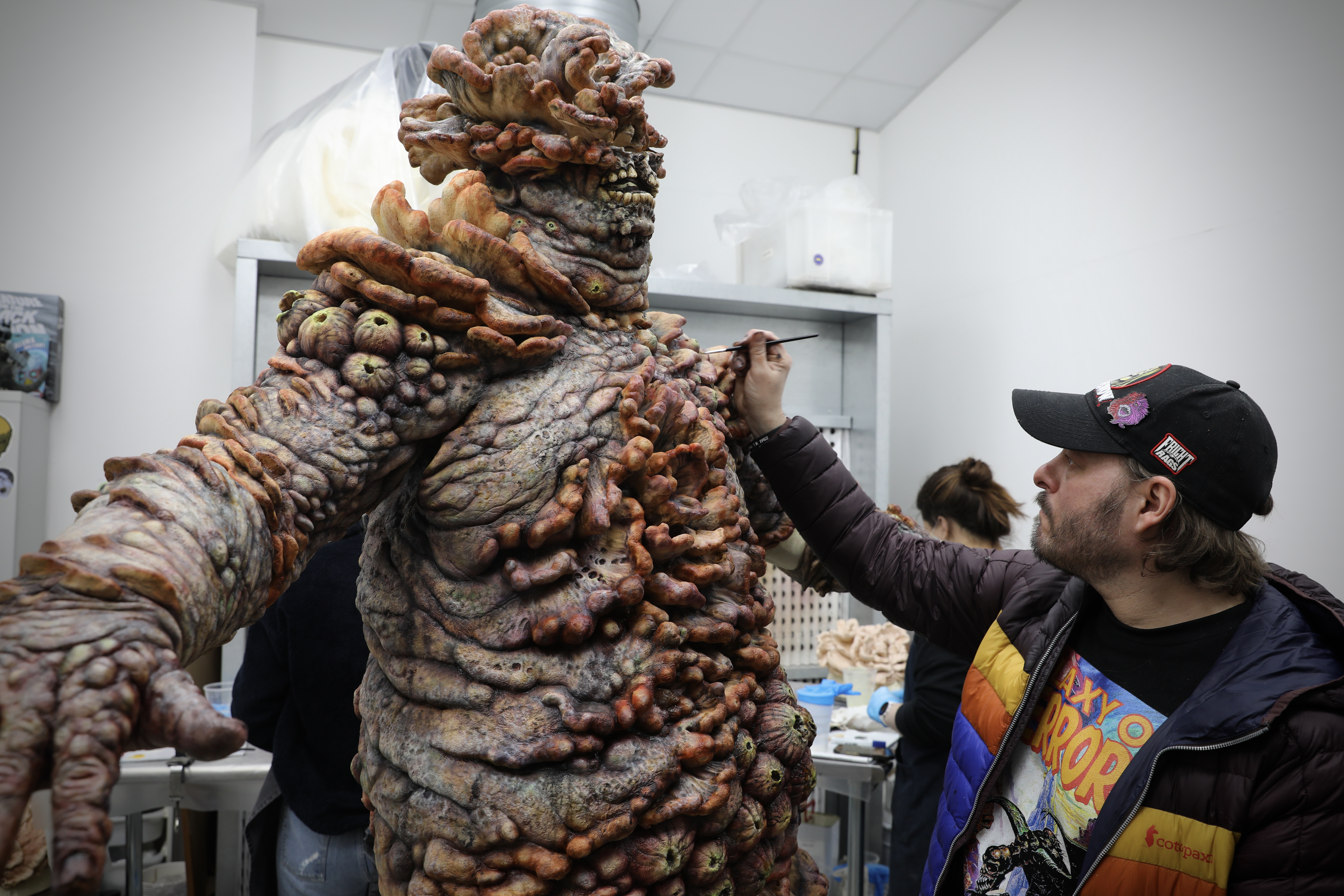 (Joel Hall paints the Bloater suit. Image courtesy BGFX/HBO.)
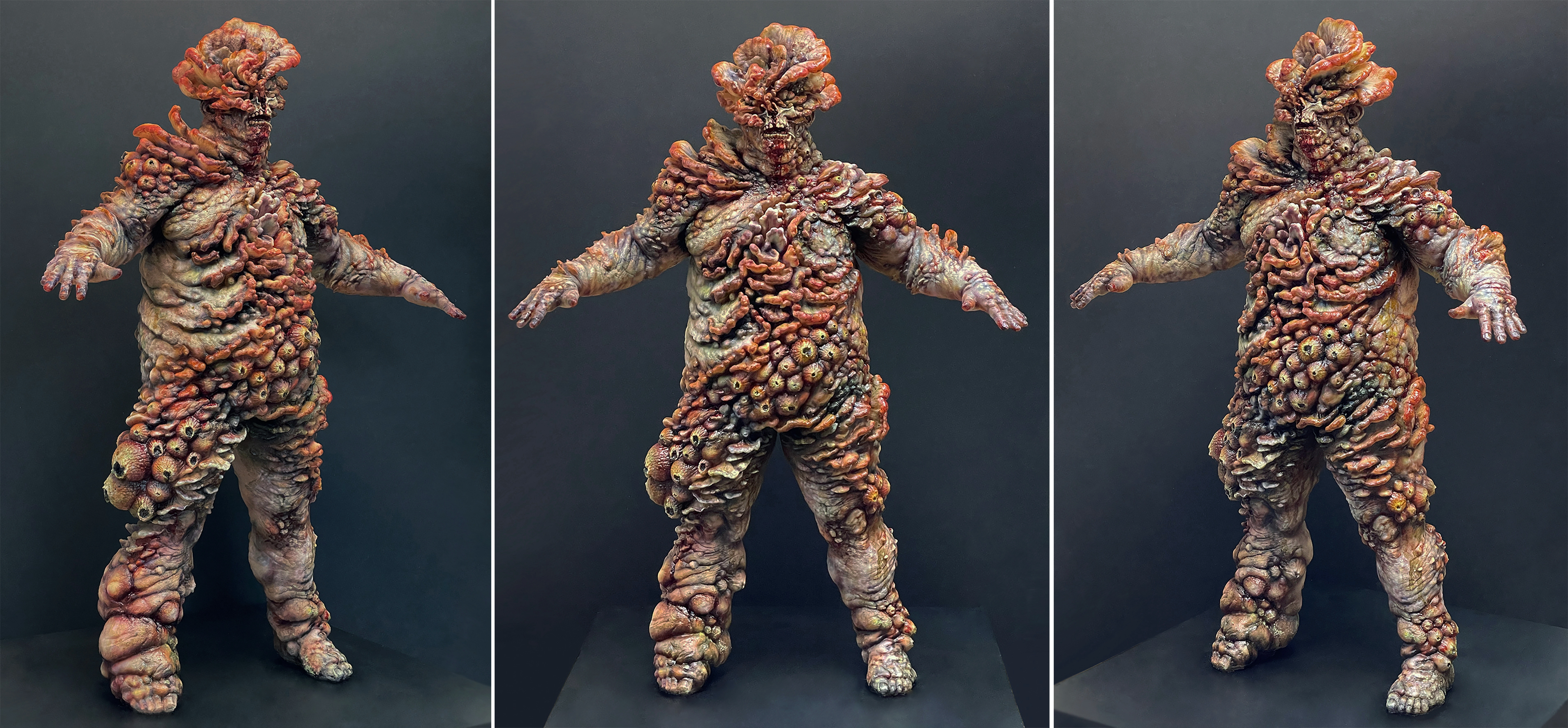 (The finished Bloater suit. Image courtesy BGFX/HBO.)
"We 3D scanned Adam's body head to toe", said Gower. BGFX then had Adam's body scan milled in rigid foam and his head and hands printed in resin. These were then combined, molded, and cast in plaster for the artists to sculpt onto. Before sculpting began, the plaster body form was painted with a mold release so the sculpture could be broken down and floated off later. "We knew that we were going to be splitting the suit up into several parts, so we treated it very much like a head and shoulders makeup and how we would normally split up a complex aging makeup."
The Bloater suit was sculpted in wax-based clay over this copy of the performer's body, then broken up into individual parts, molded, and cast in foam latex. "We have an incredible fabrication team here in the UK, a company called Stitches and Glue run by Becky Johnson and her partner Paul Vincett. They fabricated this whole Lycra suit for us, which we could foam the appliances onto. It had a zipper up the back, and we had separate arms. So, we ended up with a big, thick pair of foam rubber pants, a foam rubber top with a zipper at the back, and a foam rubber head. They all had button attachments around the neck, the back, and the waist, and everything popped together. The beauty of this was, it was a big rubber suit that we could get Adam into in about 25, 30 minutes."
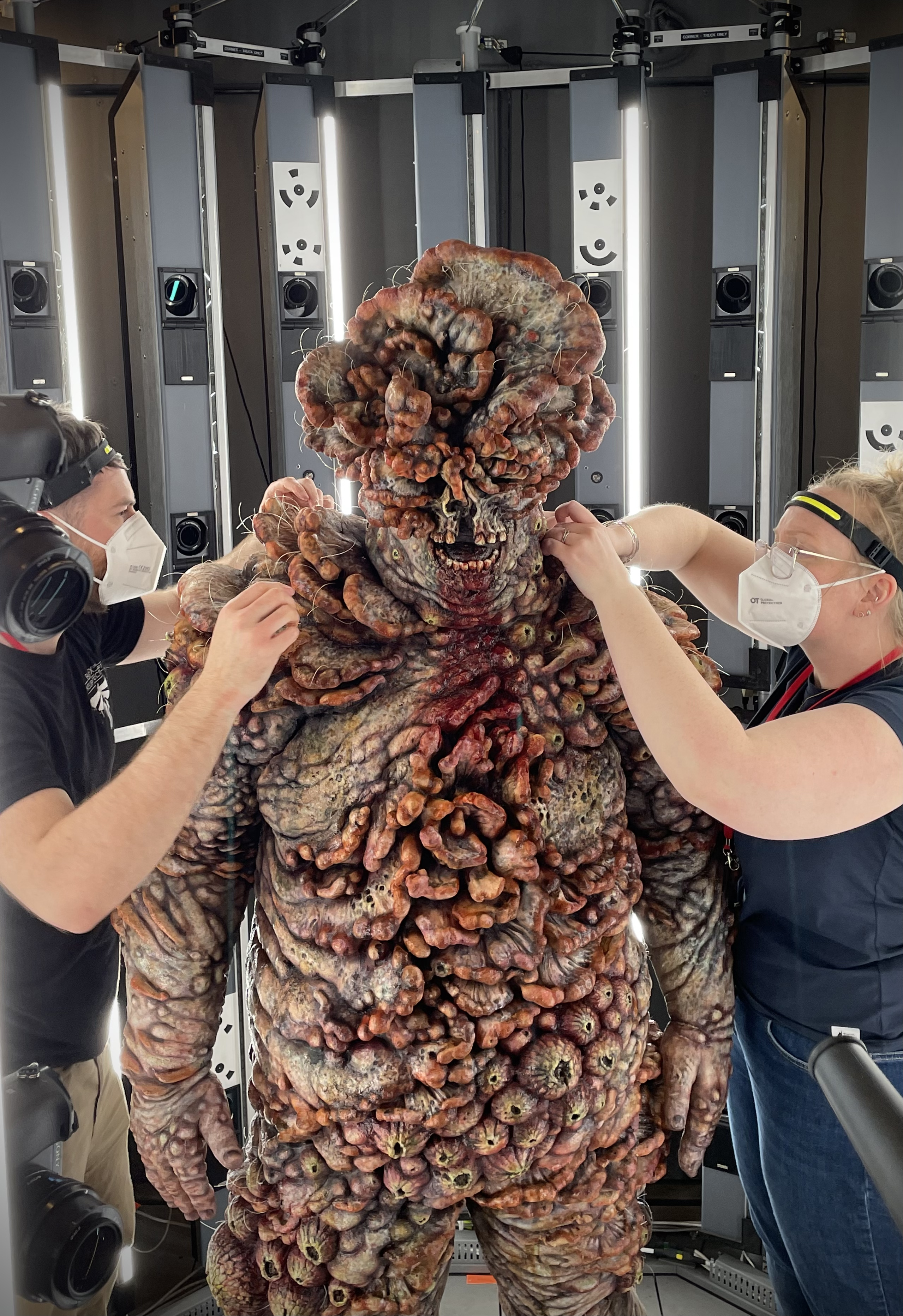 (Paul Vincett and Becky Johnson prep the Bloater suit for scanning with suit performer Adam Basil inside. Image courtesy BGFX/HBO.)
WETA would then scan the BGFX Bloater suit with the performer inside it. "They were able to use our fully painted suit with all the textures. He had all these little spines of hair punched into him as well. They scanned him when he was very glossy and when he was very matte. They had a scan of our original sculpture as well. They were able to use all of that to create their fully digital character in post-production."
Using Old Age Makeup on Neighbor Nana
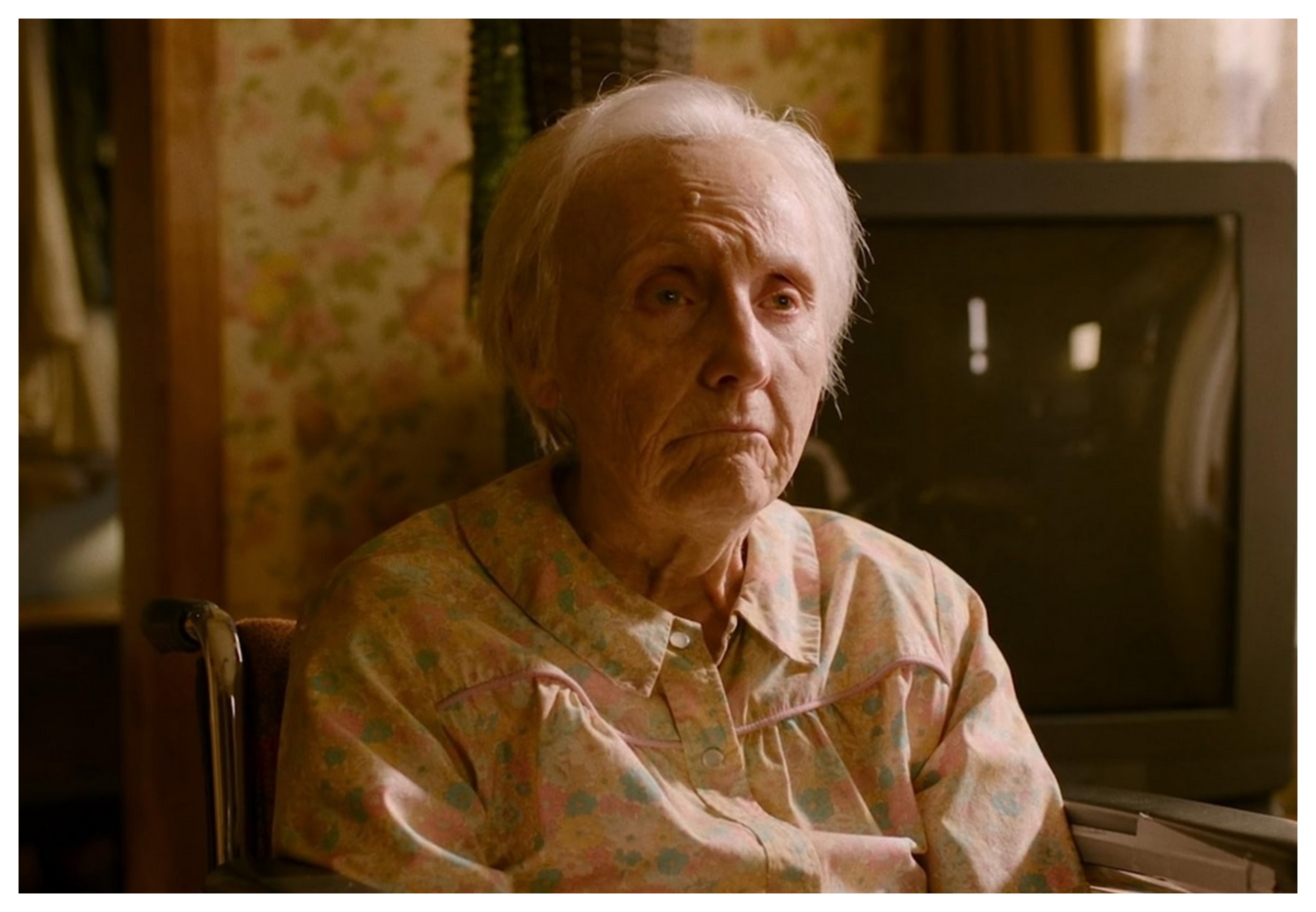 (Actress Wendy Gorling wearing BGFX's old age makeup for the infected character of Nana in The Last of Us. Image courtesy HBO.)
Early in the fungal outbreak, Joel's elderly neighbor Nana is infected and kills her family. BGFX was responsible for creating an old age makeup for the actress playing Nana, Wendy Gorling. "It's funny because I don't think we found out until really late in the day that that was going to be an old age makeup," said Gower. "We assumed reading the scripts it would be a fairly elderly person, and then it would be a stunt double who would probably be shot over the shoulder and do a lot of the frantic movement." But Barrie recalled that producer Craig Mazin was "very confident that we could do a beautiful old age makeup."
As always, time was a factor on a large and ambitious television project such as The Last of Us. "We were quite keen not to completely cover Wendy in prosthetics. So, it was a fairly subtle makeup." Wendy Gorling was 3D scanned in Canada, and the file was sent to BGFX. "We had about a week to sculpt it, mold it, and turn it around before we tested it in Calgary. She had little cheek appliances, a chin appliance, and a little triangular neck wattle appliance. Those were all silicone. And then she had some little Pros-Aide transfer lip appliances." Barrie elaborated, "The beautiful thing about using Pros-Aide transfer appliances is if you have cheek appliances and they go down just past the nasolabial folds, if you have little Pros-Aide appliances that can just pop over those edges, they save your bacon, and you don't have to worry about edges for the rest of the day. It's the same on chins as well. Any little Pros-Aide appliance is great for blending."
Because of the lack of time, the BGFX team floated the sculptures off Wendy Gorling's lifecast and flattened them onto a board rather than making conventional molds. "The cheeks, the lips, the neck, they were all flattened. The turnaround doing flat molds is so fast that we were able to do it in a week." But there would be one exception: the chin. "We made a conventional positive and negative mold for the chin because it has so many contours and forms to fold around."
Chris Harrison-Glimsdale, the hair designer on The Last of Us, had a wig made for Wendy, but the BGFX team decided to also give her a receding hairline because the actress had a very thick and youthful head of hair. "So, we put a vinyl bald cap on her, and she had this white wig, which showed her scalp through, and we just PAX painted and mottled it all up and then stuck the appliance on. I think we got the whole makeup on in about two hours."
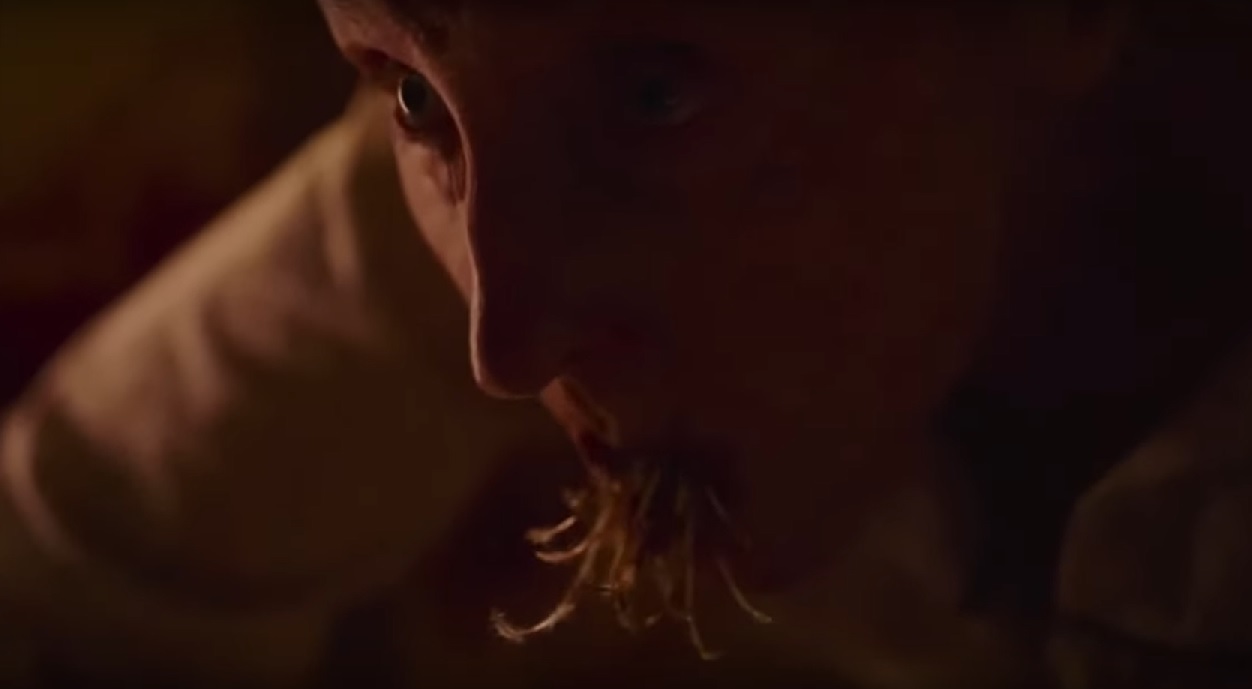 (Infected by Cordyceps, Nana feasts on her family. Image courtesy HBO.)
Set Effects Used on The Last of Us
Along with all of their infected, Clicker, and Bloater makeups, BGFX also created fungus-encrusted set effects.
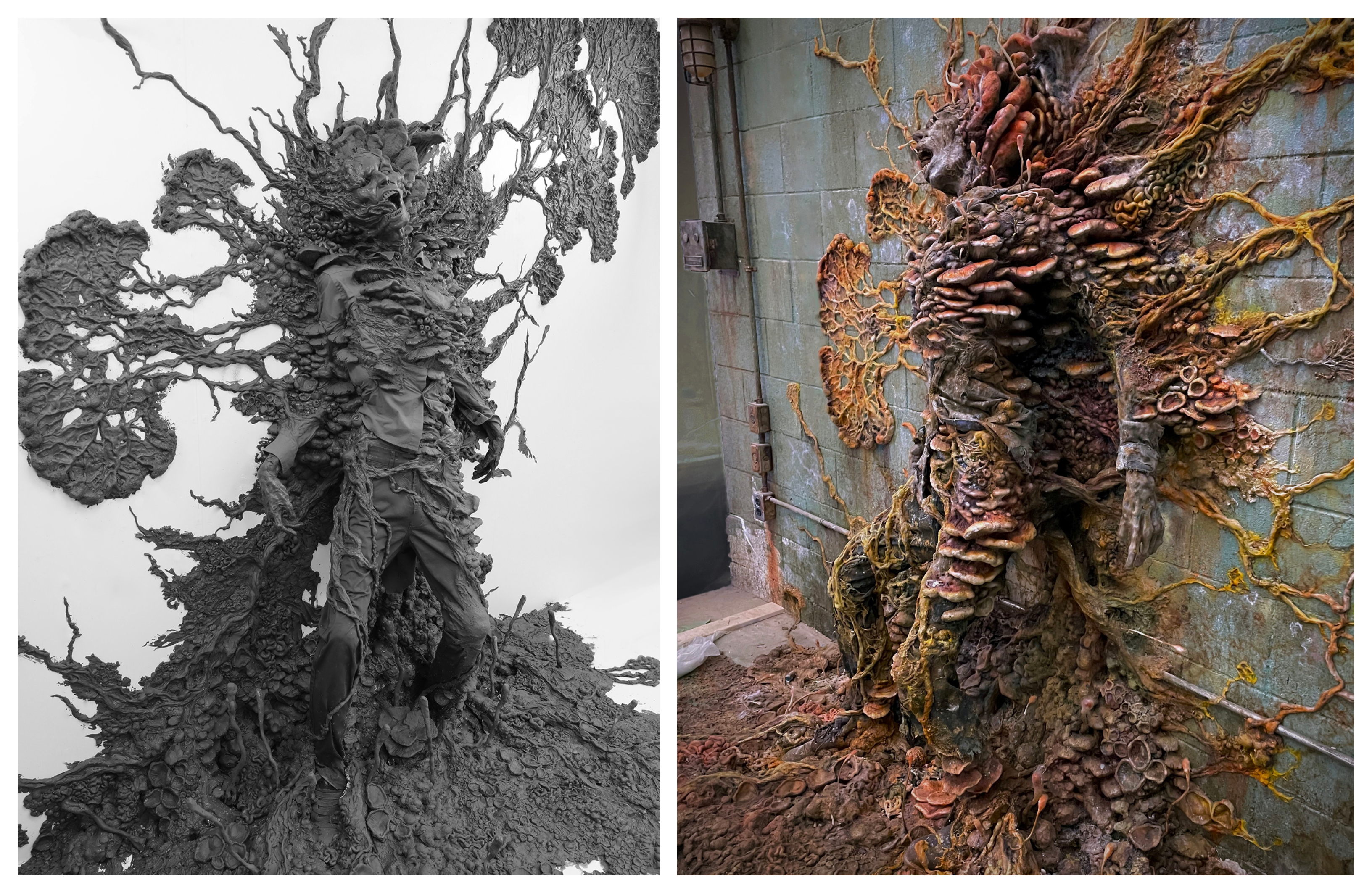
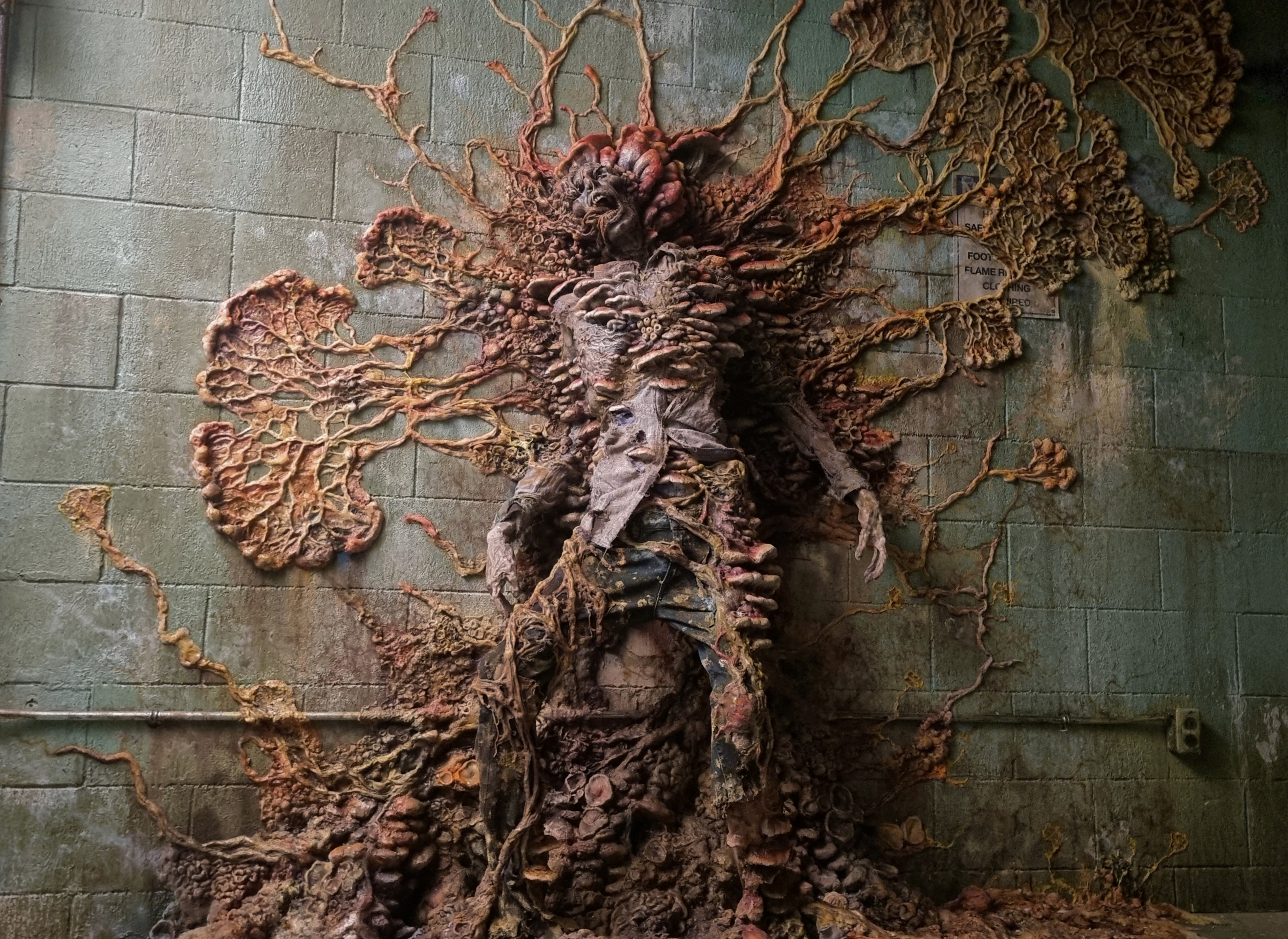 (The gruesome Utility Body is covered in mushrooms and Cordyceps tendrils. Above (L) is the original sculpture for the twisted figure. (R) and (Bottom) is the body painted and onset. Images courtesy BGFX/HBO.)
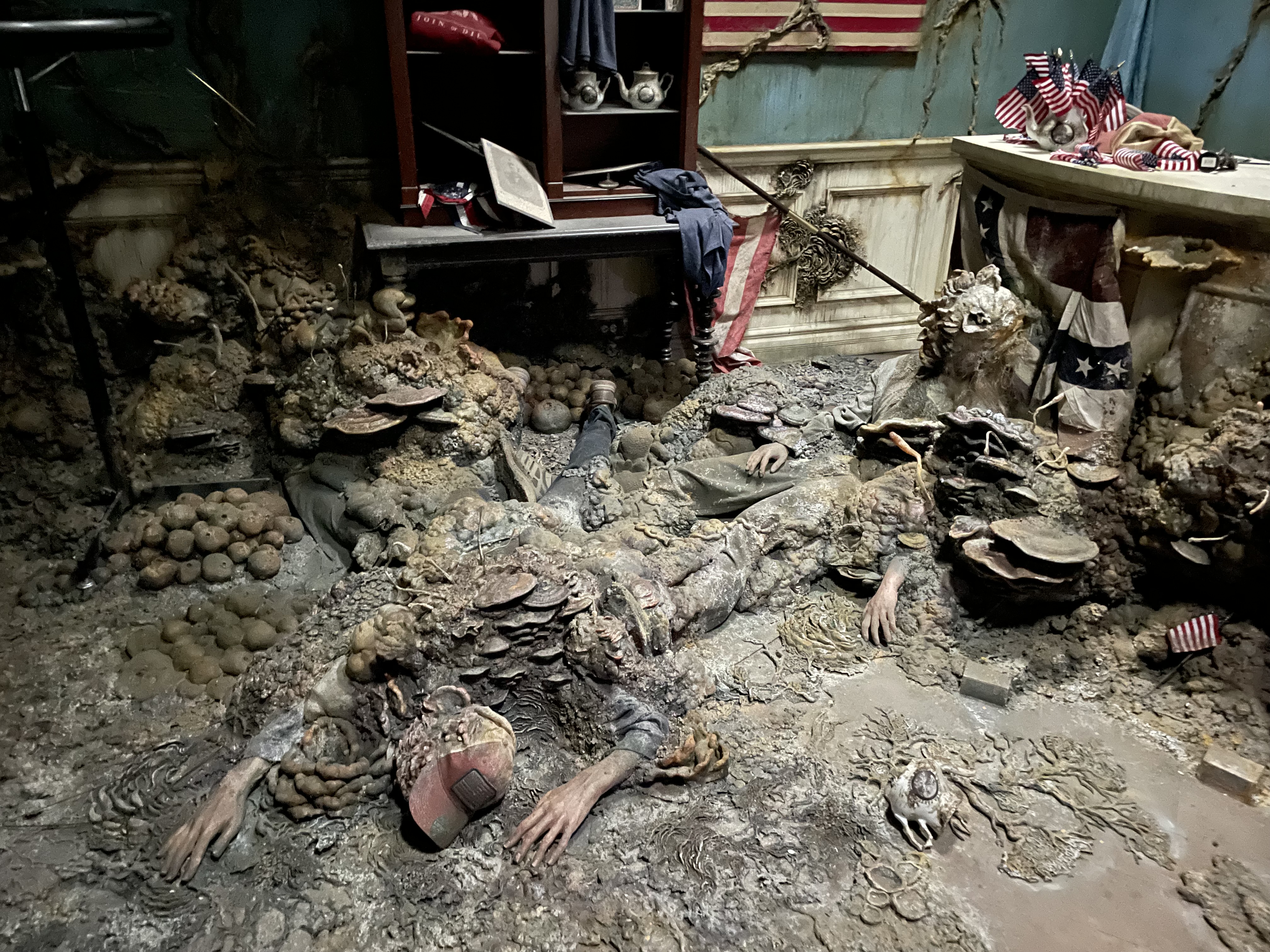 (A pair of bodies and an office with BGFX-built spores, molds, and fungi. Image courtesy BGFX/HBO.)
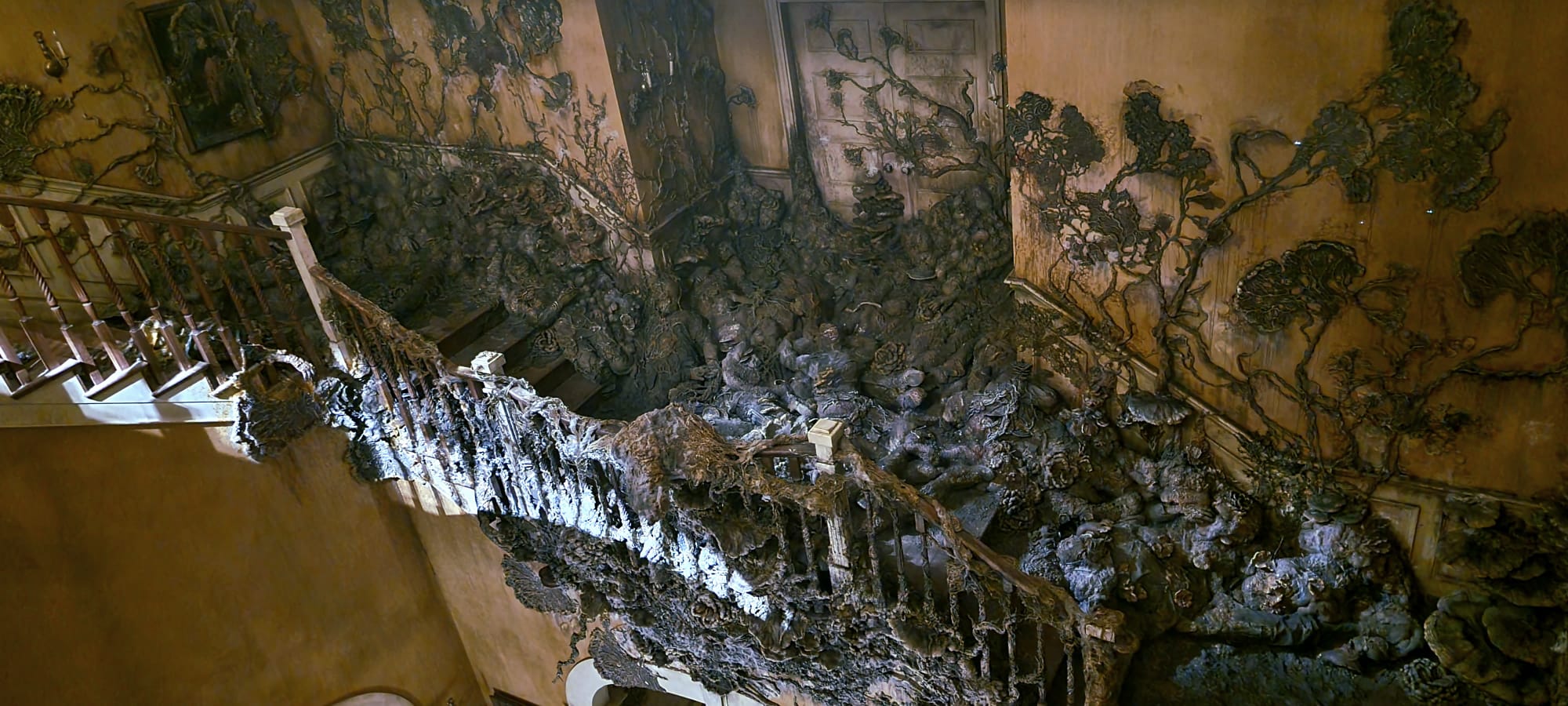
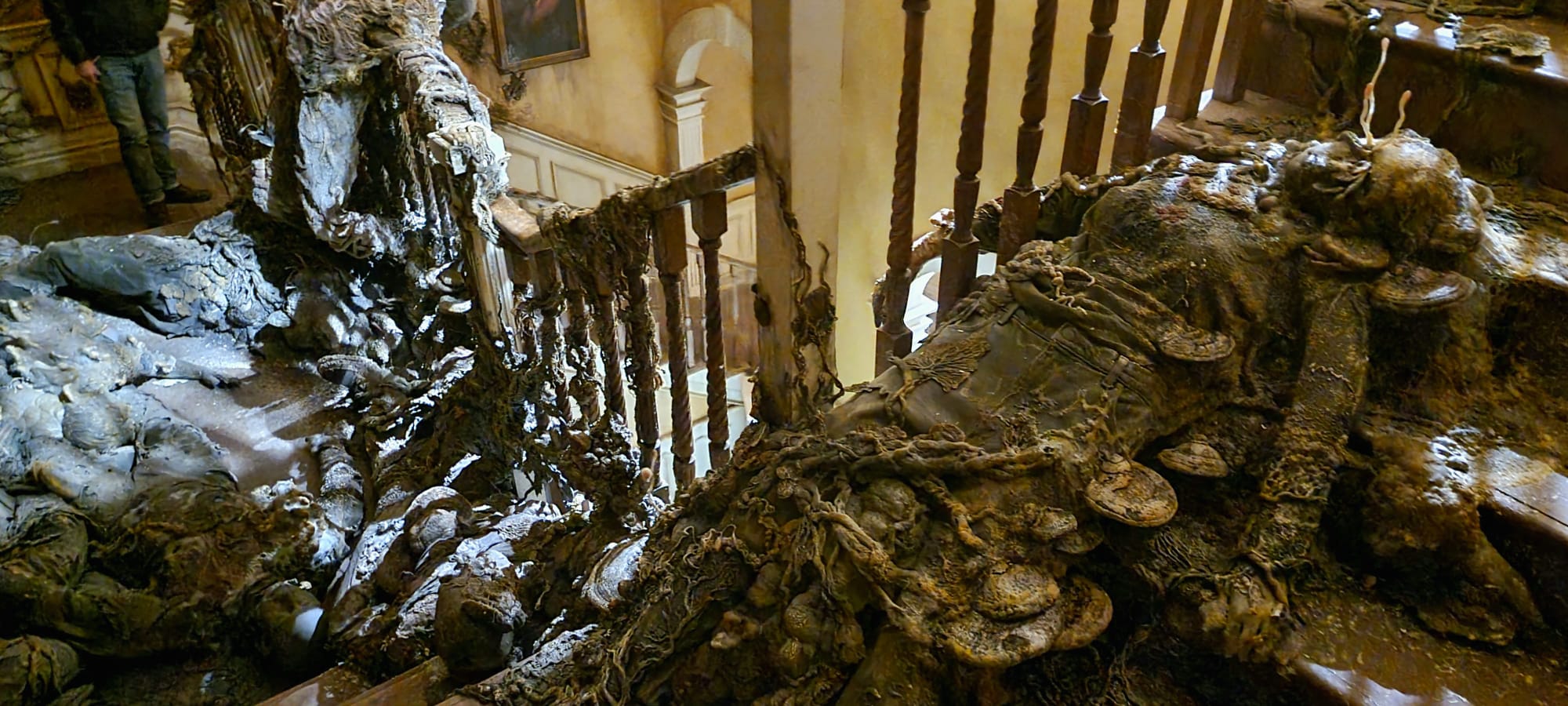
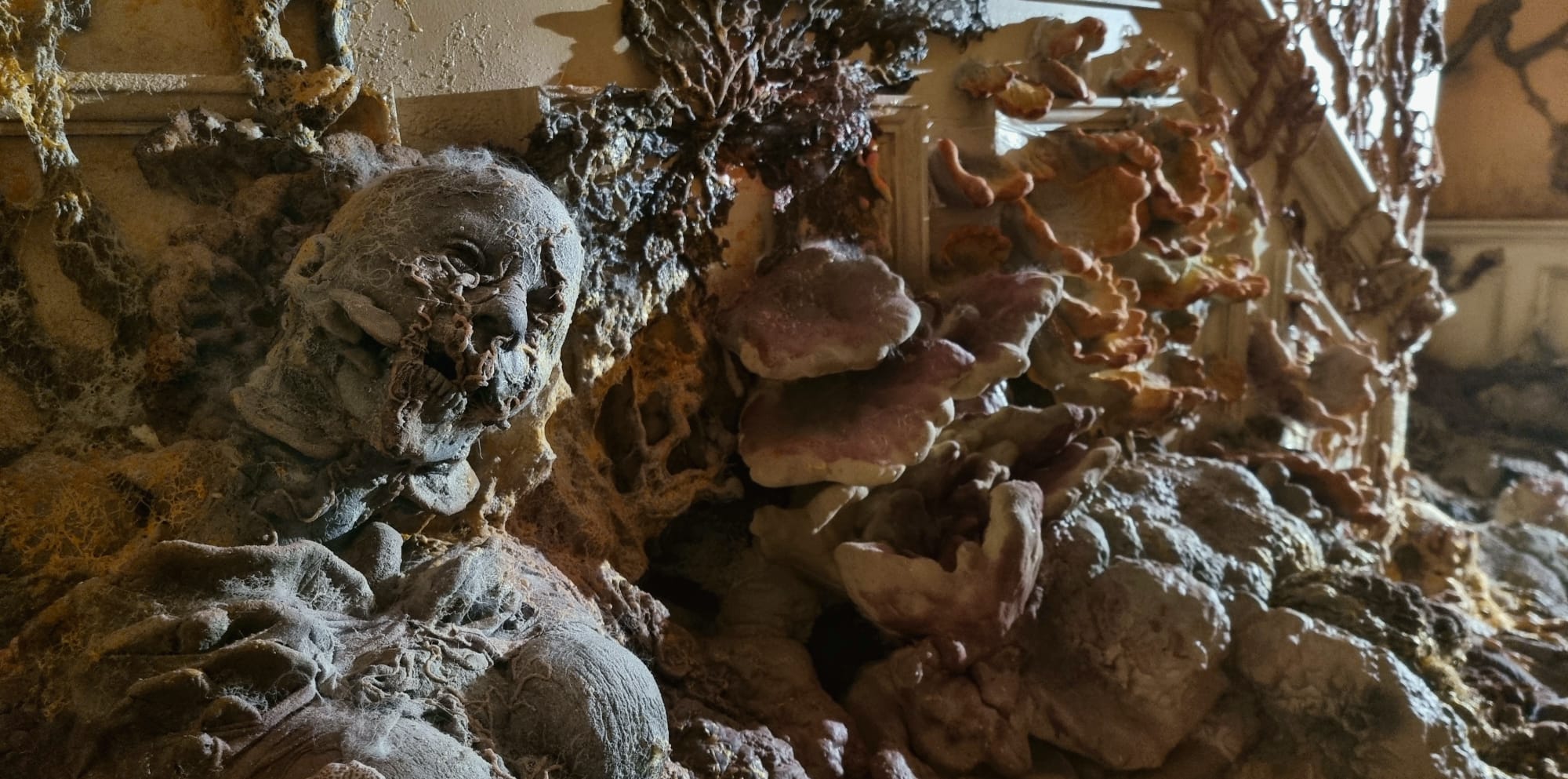 (Above, several angles of a Boston landing covered in dead fungus zombies created by BGFX. Images courtesy BGFX/HBO.)
Season Two of The Last of Us...
About season 2 of The Last of Us, Barrie is excited for the opportunity to evolve the infection even further. “We've definitely got some very new things we are going to be doing with the infected."
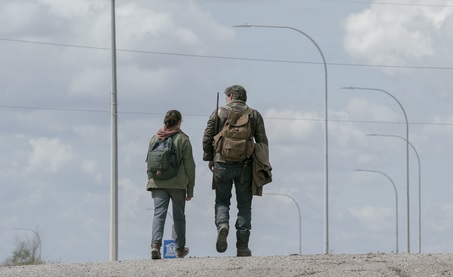 (Joel and Ellie continue on their journey. Image courtesy HBO.)
THE LAST OF US PROSTHETIC MAKEUP EFFECTS BY BGFX
Prosthetic Designer
Barrie Gower
Prosthetic Supervisor
Paul Spateri
Prosthetic Co-Department Head
Sarah Gower
Prosthetic Coordinators
- Faaria Monk
- Melissa Groome
Key Prosthetic Make-up Artists
Nelly Guimaras Sanjuan, Duncan Jarman, Joel Hall, Johnny Murphy, Patt Foad, Andy Hunt, Lucy Pittard, Paula Eden, Colin Jackman
Prosthetic Artists
Abi Harcourt-Smith, Alex Garnett, Alissa Cappelletti, Amy Ellis, Andy Garner, Barry Best, Charlotte Brock, Emma Faulkes, Harvey Smith, Jacob Kunert, Jenny Buck, Kate Wakefield, Keleigh Thomas, Laura Wood, Megan Biffin, Michelle Martin, Mike Byrne, Rachel Mao, Sophie Medhurst, Steve Byrne, Steve Painter, Ailsa Lawson
Prosthetic Fabricators
- Becky Johnson
- Paul Vincett
- Niamh Maw
Prosthetic Set Dressing
- Werner Pretorius
- Felix Fox
- Sarah Pickersgill