
by Teresa Loera
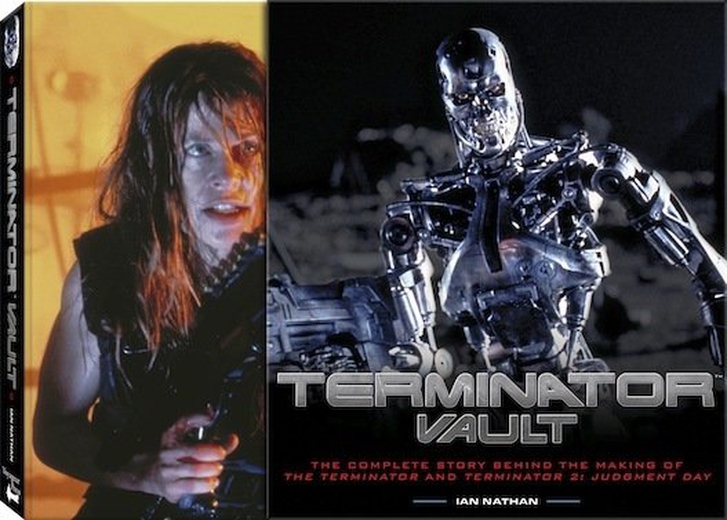
Terminator Vault: The Complete Story Behind the Making of The Terminator and Terminator 2: Judgment Day is an indispensable resource for all things Terminator. Ian Nathan's well-researched and reported book has extensive interviews with all the people involved in making the iconic franchise. Packed with annotated storyboards, copies of James Cameron’s notes, incredible behind-the-scenes stories, and photos (many from the Stan Winston Studio archives), Terminator Vault is a must for any serious fan or collector.
Order TERMINATOR VAULT from Amazon.
Jump To Section
- The Stan Winston Studio’s Involvement in the Iconic Terminator Franchise
- Practical Effects on The Terminator
- Teasing Terminator 2
- Creating Practical and Digital Effects for Terminator 2: Judgment Day
- The Success and Longevity of the Terminator Franchise
The Stan Winston Studio’s Involvement in the Iconic Terminator Franchise
 (Stan Winston airbrushes The Terminator's full-size T-800 puppet.)
Back in 1985, James Cameron needed a special effects artist for his new independent film, The Terminator. Cameron first asked Rob Bottin, but Bottin had just been offered John Carpenter's The Thing, and he couldn't do both films. Cameron then approached another effects legend, Dick Smith. Smith decided the project wasn't well-suited for him, but he offered a suggestion, “Stan does good robots.” Stan Winston was on a robot designing streak with the Tin Man from The Wiz and the robot makeups for Heartbeeps, which led to both an Academy Award nomination and designing "Mr. Roboto" for the rock band Styx. When Cameron finally asked Stan to join The Terminator, the project would lead to a professional partnership and friendship that spanned 25 years. This partnership helped both men push themselves to the limits in their careers to create some of the most iconic characters in film history.
Terminator Vault: The Complete Story Behind the Making of The Terminator and Terminator 2: Judgment Day is a comprehensive guide to the making of this most iconic film franchise. Here are a few things revealed in the book:
Practical Effects on The Terminator
In pre-production for The Terminator, Cameron's top priority was to make a believable robot. Cameron had initially conceived of a "C-3PO type" suit. But in interviews, he confided, “I didn’t want the robot to be a man in a suit.” He instinctively knew that any suit performer, however thin, would require an audience to imagine a man inside a suit, inside Schwarzenegger. It was pushing the limits of their suspension of disbelief. “But," Cameron knew, "no one had ever created a robot that wasn’t a suit.”
 (A roomful of full-scale endoskeletons ready for battle at Stan Winston Studio.)
Cameron imagined that stop-motion animation would comprise the majority of the action scenes with the fully revealed Endoskeleton. However, Winston convinced him that he and his team could achieve a huge number of shots with full-size puppetry. For the close and medium shots, Stan Winston Studio devised a wearable T-800 puppet. Puppeteer Shane Mahan wore the rig strapped to his back while individual operators took charge of controlling the head and eyes via remote control. Cameron decided that the T-800 should have a limp after it emerged from the truck crash so the puppeteers weren't required to strictly mimic Arnold Schwarzenegger's gait.
 (Shane Mahan wears an upper-torso Terminator puppet.)
A miniature T-800 was also made for the scenes that required stop-motion animation. To include all the design intricacies of the full-size puppet, model maker Doug Beswick created a two-foot-tall puppet, but accommodations for the miniature required modifications to the full-scale Endo as well. Doug had to send Stan alternations; then Stan would send alterations back to him until everyone was satisfied and the full-scale and miniature Terminators had matching designs and could function properly for their scenes.
Teasing Terminator 2
By the summer of 1990, Cameron had not yet written the script - there wasn’t even a concept, but still, an announcement was made that Terminator 2: Judgment Day would be released the following summer. The announcement came in the form of a $500,000 teaser trailer directed by Stan Winston. All the footage was original and has never been used in any of the films. It showed a Terminator assembly line and the T-800 going through the cyborg tissue generation sequence. Arnold appears after the sequence and utters his famous catchphrase, “I’ll be back.” “What Jim wanted to tell in the trailer," said Stan in an interview, "was that all Terminators look like Arnold. It was a way to justify Arnold's return after getting killed in the first movie.”
Creating Practical and Digital Effects for Terminator 2: Judgment Day
Cameron's decision to incorporate CGI to achieve TERMINATOR 2's liquid metal villain was a huge risk. Cameron’s CGI character from his previous film, The Abyss, was on screen for only 75 seconds, and it took nine months of work to complete. The team from Industrial Light and Magic, headed by Dennis Muren, was not at all convinced that they could achieve what Cameron and the script demanded. ILM categorized the effects shots as easy, moderate, difficult, and miraculous. In total, ILM created fifty effects shots, which totaled 3.5 minutes of the film. The rest of the 300 effects in the film were handled by practical effects and astounding puppetry created entirely in-camera by Stan Winston Studio.
 (Battle damage was achieved through the application of highly detailed makeup appliances.)
The practical effects created ranged from T-1000 body "wounds" and blade arms to a progressively more battle-damaged Arnold throughout the film. The most deceiving effects Stan’s team were able to create were the T-1000 puppets. The puppets helped minimize CG in a scene or eliminate the need for CG entirely. The most complex puppets all received nicknames: Splash Head, Donut Head, Cleave Man, and Pretzel Man. (Click here for more on the T-1000 effects: Terminator 2: Judgment Day - T-1000 Effects.)
 (The “Cleave Man” puppet made by Stan Winston Studio for Terminator 2.)
One effect that did not make it into the final cut was the “old Sarah” scene. In the proposed scene, a very old Sarah Connor sits on a park bench after the averted Judgment Day. A test screening received a negative response for the scene. The audience felt that this ending was "too neat," so Cameron cut the scene and reconceived the ending. Nevertheless, the makeup Stan made would no doubt have been completely convincing. On the day of filming the “old Sarah” scene Stan was leading Linda Hamilton to the set after applying her old age make-up, Cameron didn't even recognize Linda and at first believed that Stan had brought his grandmother to set.
 (Stan Winston sculpts “Old Sarah” for a scene that was ultimately cut from the final film.)
The Success and Longevity of the Terminator Franchise
As a sci-fi and fantasy icon, The Terminator has stood the test of time. In fact, 30 years after the release of the original film, Arnold Schwarzenegger has recently reunited with many of Stan Winston's former team members at Legacy Effects, who are yet again playing a critical role in bringing the killer cyborgs to life for the 5th installation in the franchise, Terminator Genisys.
Teresa Loera
Order TERMINATOR VAULT from Amazon.
Courses with the Creators of The Terminator and Terminator 2: Judgement Day
- Special Effects Sequence Design with Shane Mahan
- Animatronics Design Basics with Richard Landon
- Cable Mechanism Basics - Tentacles with Richard Landon
- Hybrid Characters: Blending Practical & Digital FX with John Rosengrant
- Hybrid Character Design: Practical To Digital with Christopher Swift
- Animation For Animatronics: Intro To Pololu, Maya & AnimServo Software with Craig Caton-Largent
- How To Build An Animatronic Head - Creating The Mechanical Underskull with Craig Caton-Largent
- Garage Monsters - How To Make Creature FX On A Budget with Shannon Shea
- The Business of Making Monsters with Shannon Shea
- Mastering Effects Disasters - Explode A Head with Andy Schoneberg
- Remote Makeup Application Part 1: Prosthetic & Kit Preparation with Andy Schoneberg
- How To Sculpt A Character Makeup with Bruce Spaulding Fuller
- Character Makeup - Multi-Piece Prosthetic Application with Bruce Spaulding Fuller