
Behind the Scenes of Swamp Thing With Justin Raleigh
By Lexi Stewart
Back in the days of the classic monster movies, technology, and monetary assets were hard to come by. Today, however, special effects makeup workshops and studios have the tools and access to modern techniques that are revolutionizing the film industry, and monsters are reaping the benefits. As technology continually improves, more filmmakers and TV producers are looking to create practical monsters for their projects and push the envelope as far as they can.
Bernie Wrightson and Len Wein's DC superhero horror comic 'Swamp Thing' has been brought back to life with a new 10-episode adaptation through DC Universe's streaming service. Executive Producer James Wan didn't want a computer-generated monster but a living, breathing organism for his vision, so he sought out one of Hollywood's leading FX artists for the job.
 (Left: Fractured FX CEO & SWS veteran Justin Raleigh pays respects to Stan at Monsterpalooza 2019. Right: Justin promotes a Westworld AMA with one of the Fractured FX 'Drone Host' suits.)
The task landed in the hands of Justin Raleigh, special effects makeup designer and creative director of Fractured FX. "Swamp Thing is a perfect example of trying to create something that is 95% an actor in a prosthetic suit, and then that 5% visual effects really kind of pushes it over the limits to where we need it. The goal was to have something that required very little visual effects."
Jump To Section
- Working With James Wan
- Taking a Practical, Organic Approach to Swamp Thing’s Design
- Combining Digital and Traditional Techniques
- Preparing for Familiar Challenges in Water
- Derek Mears Becomes Swamp Thing
- Using Puppet Effects to Create a Realistic Look and Pay Homage
- Using Visual Effects When Necessary
- Short-lived, Big Impact
- Fractured FX Swamp Thing Crew
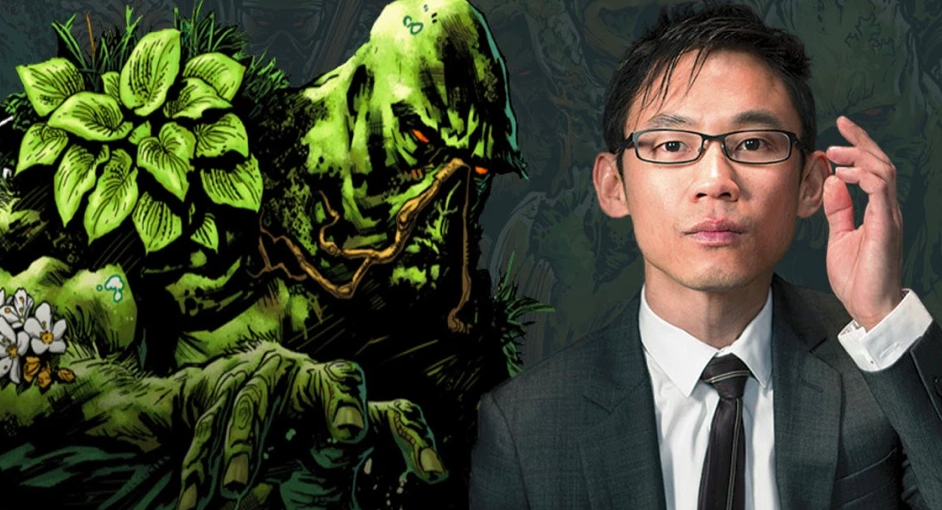 (Swamp Thing Executive Producer James Wan had previously worked with Raleigh on Aquaman, Insidious & The Conjuring films.)
Working With James Wan
Wan recently worked with Justin on Aquaman, but it's not the first time they've collaborated. "James and I actually met on the first Insidious, and we've done every Insidious project since then, and also the entire The Conjuring universe as well up until this point." Having established a working relationship with Fractured FX for over ten years, bringing Raleigh and his team on board for Swamp Thing was a no-brainer for Wan. Justin remembers, "Shortly after some reshoots on Aquaman, I got this email from James, 'Hey, what are you doing? Do you have any interest in doing Swamp Thing? It's a hard R-rated series with a full-on horror setting. Are you interested in building a physical suit for this and handling all the makeup effects?' And I said, of course! It's a huge opportunity.'"
 (The original Swamp Thing DC Comic created by Len Wein & Bernie Wrightson.)
Raleigh was immediately drawn to the project as it offered him the chance to create a classic monster with complex human emotion. "Creating a living, breathing character that has to be able to have high levels of emotion, but then also look like a walking vegetable with some human anatomy, it's a huge challenge to do it well and to make it highly functional." Justin trusted that Wan and the rest of the production team would give him what he needed to push the concept as far as possible.
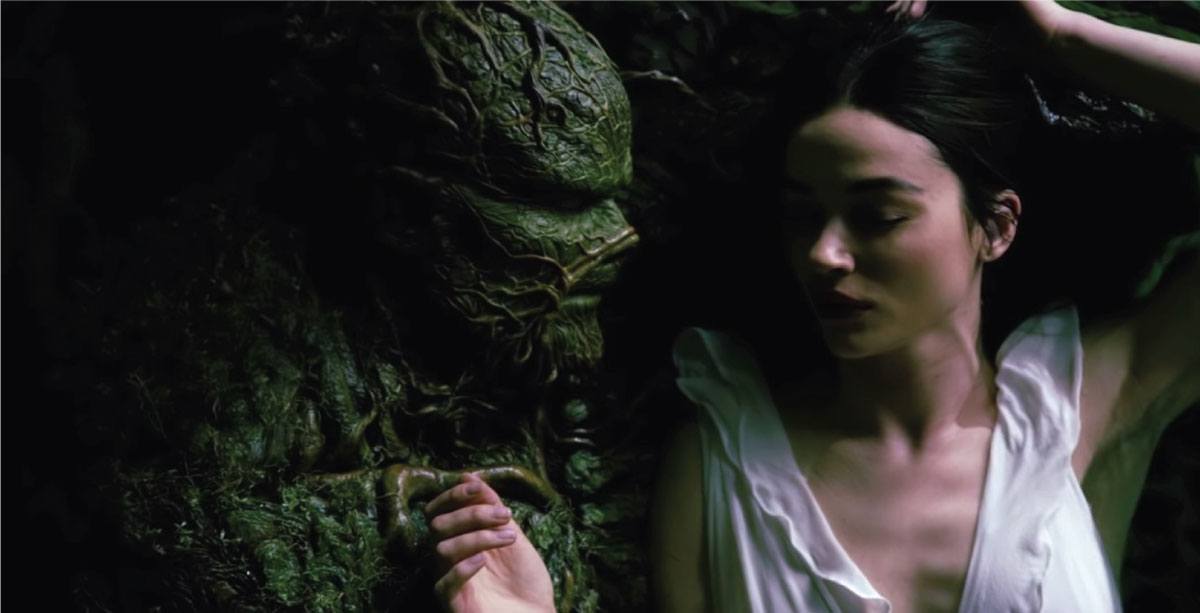 (Swamp Thing, played by Derek Mears, makes an emotional connection with Abigail "Abby" Arcane, portrayed by Crystal Reed. Image source DC Universe/Warner Bros.)
Taking a Practical, Organic Approach to Swamp Thing’s Design
Raleigh instructed his team to take an organic approach with the character design. "The mandate that I gave to all of my illustrators, modelers, sculptors, painters, and everyone involved, is that you need to think of this character almost like a potted plant. If you ripped it out of the pot, roots bound together, you would see these layers of dirt and small tendrils, little tributary roots and vines that are growing through it." The challenge was to create this effect of multiple layers within the Swamp Thing designs and sculptures.
 (The Swamp Thing suit was designed to give the illusion of depth and layers, like a rootbound potted plant. Image courtesy Fractured FX/Warner Bros.)
A lot of trial and error was required to create a suit that would look as realistically organic as possible. "We ended up molding a lot of organic materials for reference, and then we would clay pour them. Rootbound plant elements, dirt, bark, and a lot of the surfaces we molded actually became clay transfers that we could add to the suit. Something that you would be insane to try and sculpt."
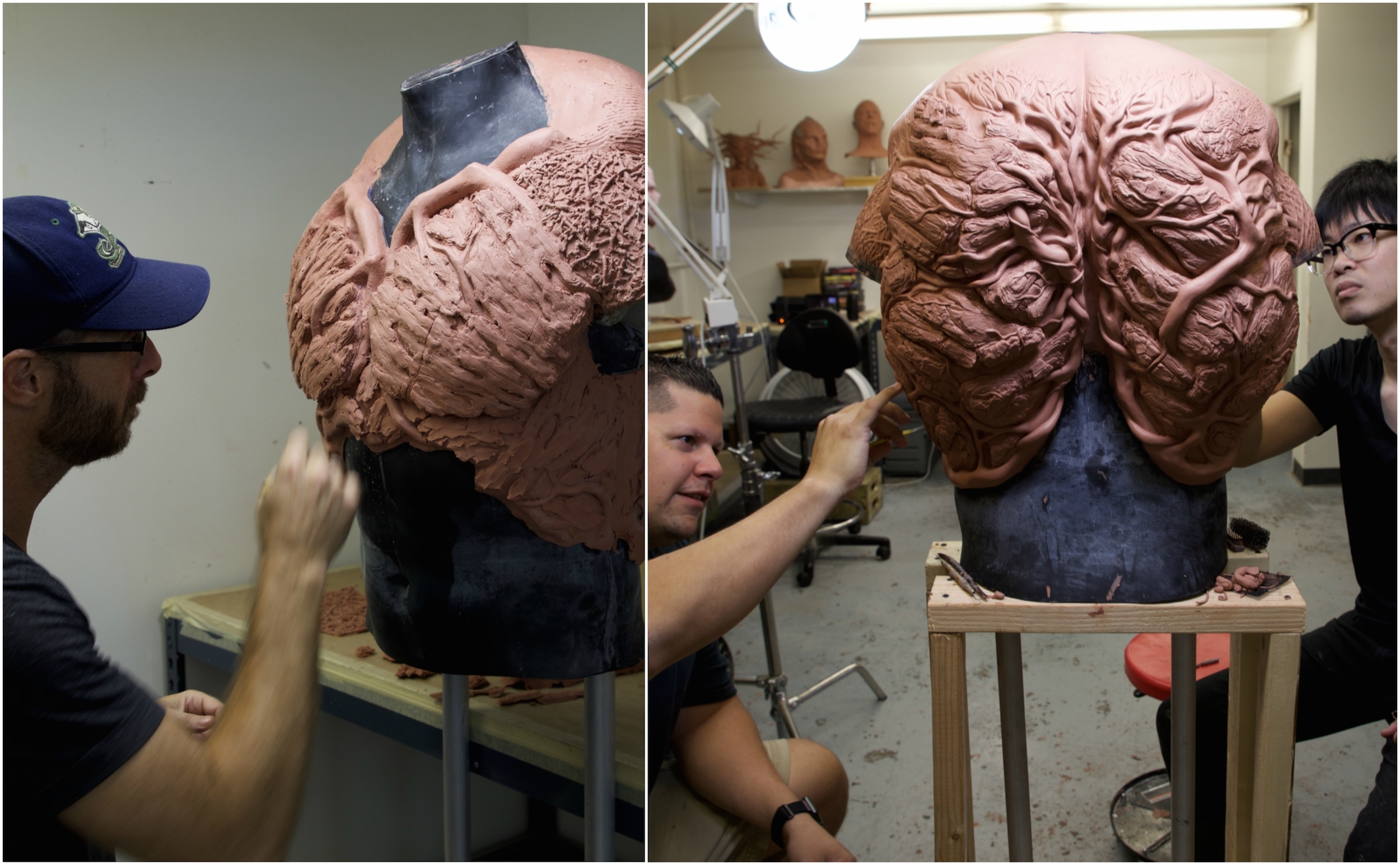 (Kelly Golden, Charlie Hernandez, and Kodai Yoshizawa sculpt organic details into Swamp Thing's torso. Images courtesy Fractured FX/Warner Bros.)
Combining Digital and Traditional Techniques
In the preliminary stages, Fractured FX used both digital and traditional techniques for concepts, designs, and models. Raleigh explains, "We built a 3D model, and part of that was to create a Swamp Thing maquette to present to DC & Warner Bros. and to everyone as our approved concept design."
 (The Swamp Thing design maquette upon which the full-size suit would be based. Images courtesy Fractured FX/Warner Bros.)
Then, once Derek Mears was cast, "we actually scanned Derek and put the digital maquette on top of him, and remodeled it again to fit his anatomy and his facial structure. We used that as our blueprint for a traditional build." With the modified maquette as their guide, the team began sculpting the full-size suit in clay.
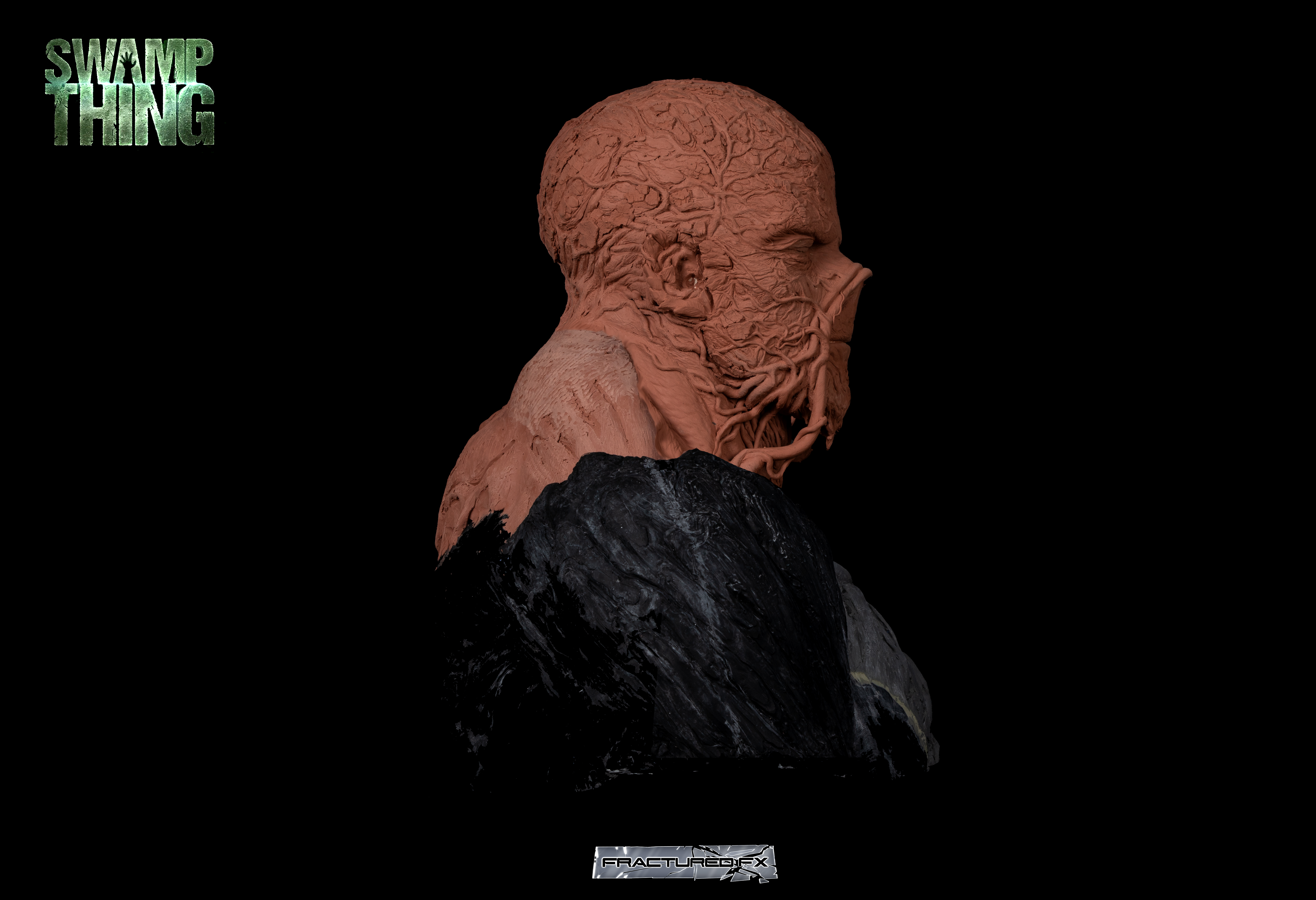 (Sculpting progress on Swamp Thing's head. Image courtesy Fractured FX/Warner Bros.)
 (The full-size Swamp Thing suit sculpture comes together. Clockwise from bottom left: sculptors Kodai Yoshizawa, Charlie Hernandez, Todd Rex, and Bernie Eichholz. Image courtesy Fractured FX/Warner Bros.)
 (Corinne Fortunato, Brian Sides, and Michael B. Williams mold Swamp Thing's hands and upper forearms. Images courtesy Fractured FX/Warner Bros.)
Preparing for Familiar Challenges in Water
Working on Aquaman in 2017 meant that Raleigh had become familiar with the challenges of filming in the water. Swamp Thing presented those same difficulties and affected how the suit was going to be designed and built. Justin and his team devised an incredibly unique way to make a foam suit that didn't absorb water like a sponge.
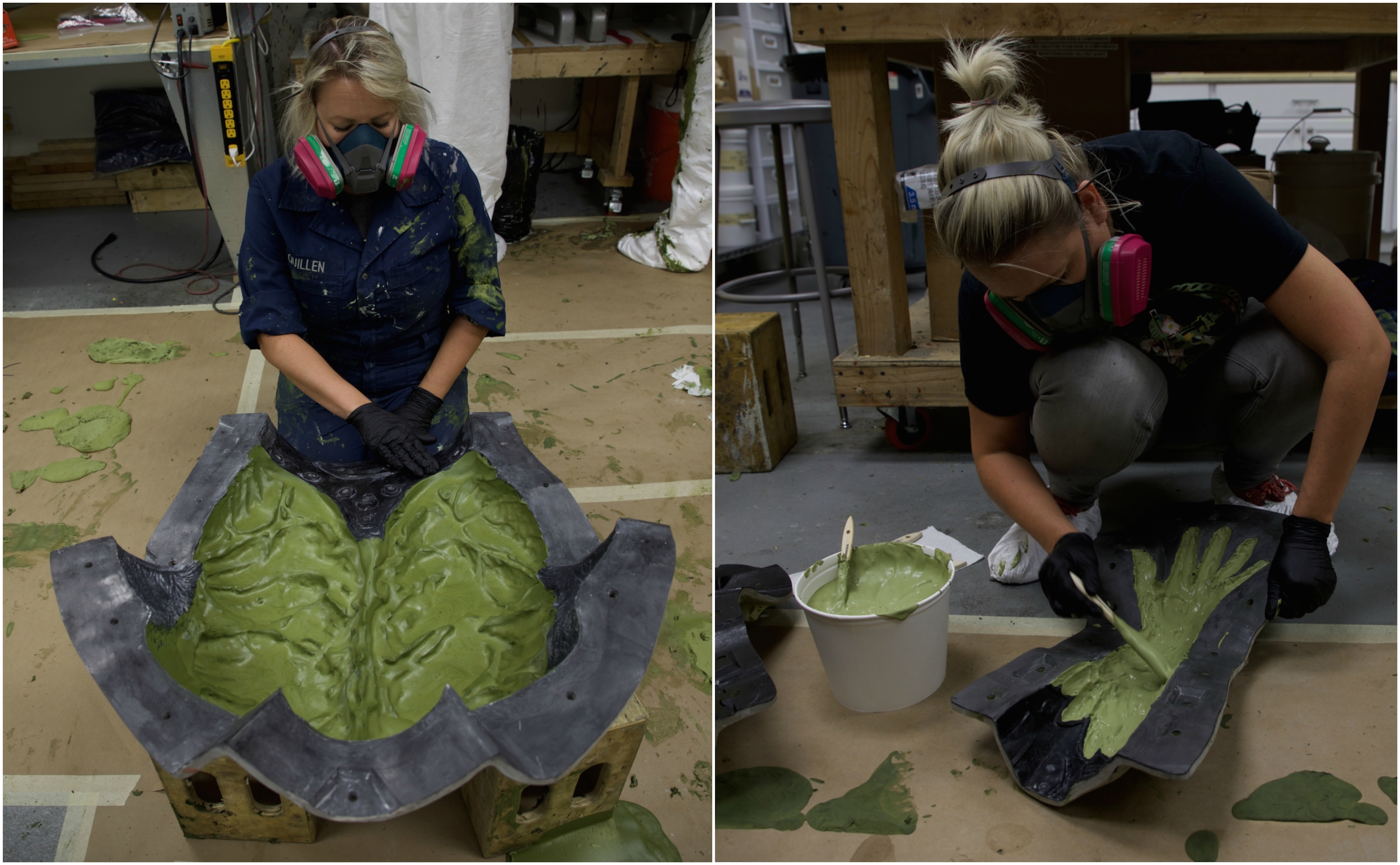 (Amber Quillen brushes a thin skin of tinted foam latex into the suit molds. Images courtesy Fractured FX/Warner Bros.)
 (Lab techs Brian Jones, Scott Holbert, and Amber Quillen run Swamp Thing molds. Images courtesy Fractured FX/Warner Bros.)
"The entire suit is actually cored, and it has perforated reticulated material inside. So only the foam surface acts like a sponge. The rest of it actually wicks water, so it drains rapidly. The entire suit is also treated like a prosthetic appliance. Many components are entirely separated and broken up so you can deal with the shrinkage aspects of it to give better function."
 (Left: Jasmine Kuzela patches Swamp Thing's foam latex cowl. Right: Steven Kuzela and Kodai Yoshizawa work on the unpainted foam suit. Images courtesy Fractured FX/Warner Bros.)
 (Julian Ledger, Charlie Hernandez, and Jacob Roanhaus paint the Swamp Thing suit components. Images courtesy Fractured FX/Warner Bros.)
Raleigh and his team planned and accounted for a new set of appliances each day as well as six hero suits to use throughout the series shoot. "We had 60 sets of appliances between Derek and his stunt double. Derek had three main hero suits, and the stunt double had three suits and facial prosthetics custom-made for him."
 (Multiple sets of pre-painted Swamp Thing facial prosthetics ready for application. Image courtesy Fractured FX/Warner Bros.)
 (Swamp Thing's custom-made prosthetic dentures. Images courtesy Fractured FX/Warner Bros.)
Fractured also built four waist-down water suits that could better withstand being fully submerged on set. "It was a necessity to have extra suits because it would take nearly 24 hours to completely dry."
 (Fabricators Brenda Scaglione, Patricia Nadershahi reinforce the Swamp Thing suit. Images courtesy Fractured FX/Warner Bros.)
 (Left: Painted and unpainted sets of Swamp Thing 'pants'. Right: Detail shot of Swamp Thing's tendril covered feet. Images courtesy Fractured FX/Warner Bros.)
 (One of the finished 'hero' Swamp Thing suits, ready for its closeup. Image courtesy Fractured FX/Warner Bros.)
The intense preparation and testing leading up to the shoot meant that on-set application was as straightforward as it could be. Daily application for the full suit and prosthetics took less than two hours, with removal taking forty minutes.
 (Derek Mears transforms into Swamp Thing. Images courtesy Fractured FX/Warner Bros.)
 (Raleigh tapped Kevin Kirkpatrick & Ozzy Alvarez to handle day to day makeup application & key prosthetics positions on set for the duration of the show.)
Derek Mears Becomes Swamp Thing
Actor and stuntman Derek Mears, who wears the suit and plays biologist Alec Holland in his swampy form, is no stranger to prosthetics or creature suits. Best known for playing Jason Voorhees in the 2009 Friday the 13th reboot, Mears spoke highly of the work Fractured FX did to create the most wearable and functional suit he's ever worn. He recently told CinemaBlend, "These guys went above and beyond, and were spending so much time – and in a sense, dipping into their own profits – to make this right. Where it's like, 'No, no, we have to pay extra. It has to be perfect.' Out of all the different suits I've worn throughout the years, this is really the Cadillac of suits."
 (Derek Mears in the finished Swamp Thing suit. Image via Warner Bros.)
Using Puppet Effects to Create a Realistic Look and Pay Homage
Fractured FX's work on Swamp Thing also involved a significant amount of puppetry, proving that traditional practical effects can still be a viable and effective option. Raleigh loved the thought of using puppets, and the producers were equally thrilled with the decision as they looked fantastic on screen but also kept the costs down versus going the all-digital route.
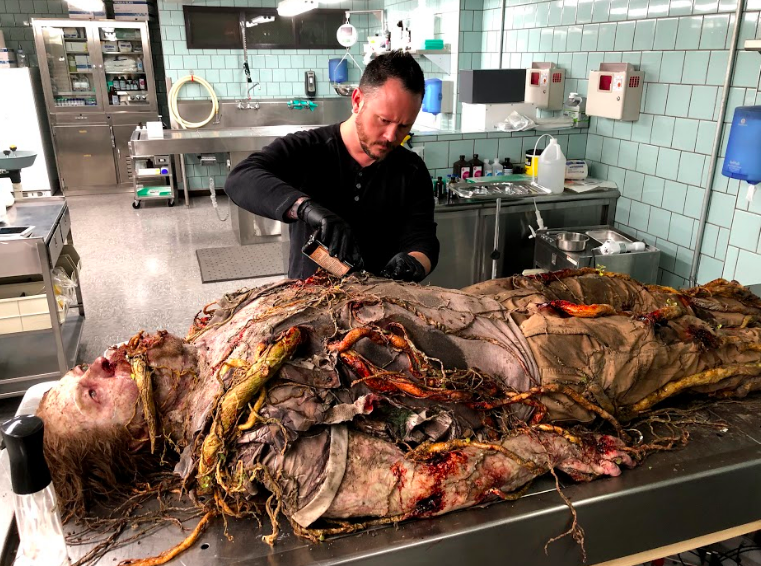 (Justin Raleigh makes a few final on set adjustments to an infected corpse puppet. Image courtesy Fractured FX/Warner Bros.)
In the first episode, there's a scene involving an infected human corpse that comes to life and evolves in horrific and spectacular ways. It's no secret that Raleigh looked to Rob Bottin's groundbreaking FX work in The Thing as his inspiration for the gag, which required five puppeteers to perform. "That was a goal. It's honestly one of the reasons I got into this industry, watching John Carpenter's The Thing. Having an opportunity to do this homage was a fun challenge that allowed us to use modern technology but still get that cool puppet vibe to it as well."
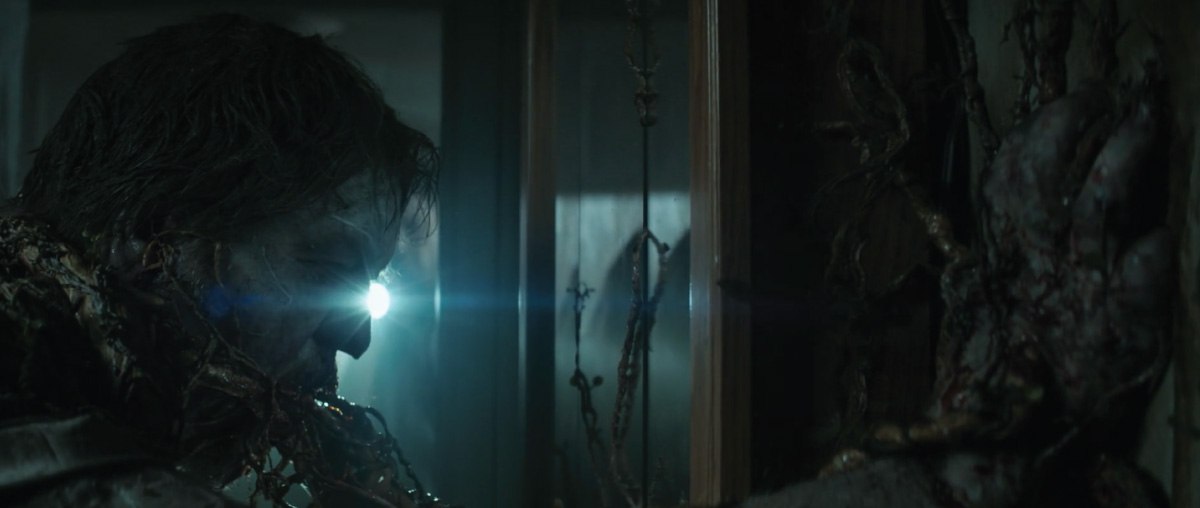 (An infected human corpse comes to life in episode 1. Image courtesy DC Entertainment/Warner Bros.)
The higher-ups were so happy with how the puppets looked in the first episode, they searched for ways to use puppet effects more and more. Raleigh recalls, "Almost every episode started getting some puppet element added, which is awesome. It's a great challenge to build these big fully animated creature elements that we don't have a lot of opportunities to do."
Using Visual Effects When Necessary
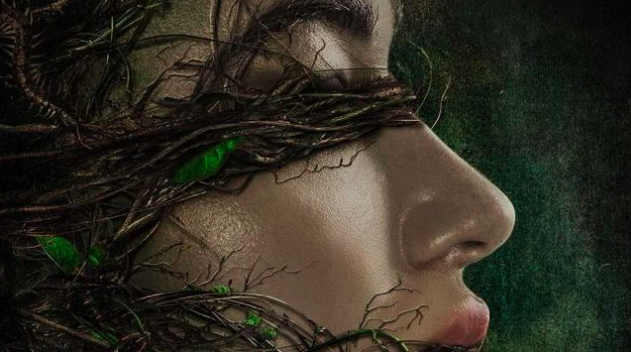
Despite Swamp Thing using a ton of practical effects, some elements of the character and environment still needed a little help from the visual effects department. The swamp material is very organic and continuously evolving, tightening around and constricting its victims. For some of those shots, it made sense to utilize VFX for textural regeneration and growth (as Raleigh calls it).
 (Swamp Thing promotional image via DC Entertainment/Warner Bros.)
Throughout the shoot, the visual effects team worked harmoniously alongside Raleigh's team at Fractured FX, the best possible scenario one could hope for on a production of this scale. "They loved us because we're a house that accepts the symbiotic relationship between a visual effects company and a physical makeup effects company."
Fractured FX is equipped with 3D scanners, 3D printing, and 3D modelers in-house, and as a result, the process becomes more effortless in the long run for the VFX house. Justin explains, "when we provide an asset to a visual effects company, we're giving them exactly what it should be because we've done the scan, we've done the color correction on it, we've done the remodeling on it, and they get a pristine asset to work with."
 (Swamp Thing promotional image via DC Entertainment/Warner Bros.)
Short-lived, Big Impact
Although Swamp Thing received great reviews, the DC Universe streaming service has decided to limit the series to one season. But while the show may not go on, at the very least, Justin Raleigh and the team at Fractured FX have created a groundbreaking creature suit and proven that innovation in the field of practical effects is still alive and well. Raleigh considers, "I think overall, the industry is shifting back, and the education level of producers and directors is shifting over to understanding how to work with practical effects again. There were about 10-15 years where it had become a little bleak in our world, but I think that is changing now."
We've come a long way from where technology was back in 1990 when the first Swamp Thing series was released, but traditional effects haven't been forgotten. It's all about balance, according to Raleigh, "I think technology is our friend and we've really embraced it. I hope we can continue to create these crazy characters and really shock producers and directors on what we can put right in front of the camera."
Fractured FX Swamp Thing Crew
