

The Suicide Squad: Behind The Scenes

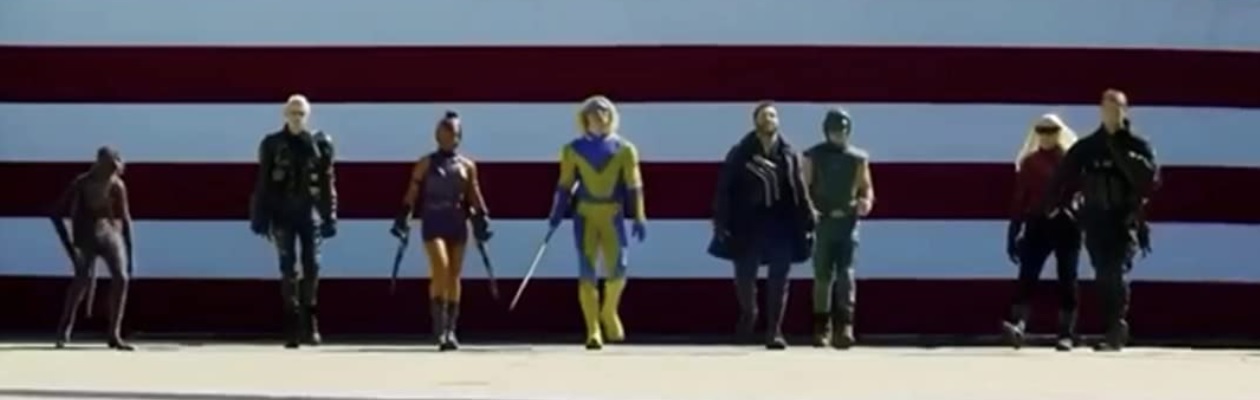
(Just some of the characters Legacy Effects worked on for The Suicide Squad. Images courtesy Warner Bros.)
By Michael Martin
The Suicide Squad features some of DC Comics' most beloved criminal superheroes. Starring Margot Robbie (Suicide Squad, Birds of Prey), Idris Elba (Avengers: Infinity War, Pacific Rim), John Cena (Peacemaker), Michael Rooker (Guardians of the Galaxy, Slither), Viola Davis (Suicide Squad, The Andromeda Strain), Saturday Night Live’s Peter Davidson, and the voice of Sylvester Stallone (the Rocky and Rambo films).
Written and directed by James Gunn (Slither, Guardians of the Galaxy) and executive produced by Zack Snyder and Deborah Snyder, the film features shooting locations from Atlanta, Georgia to Panama. Led by Bloodsport (played by Idris Elba), the team members of Task Force X are convinced, politely, by Amanda Waller (played by Viola Davis) to stealth onto the island of Corto Maltese and take out something called Operation Starfish. The Suicide Squad is part superhero movie, part action film, and part comedy, all filtered through the prism of James Gunn’s unique point of view. Which means it’s a lot of fun.
Jump To Section
- Creating an R-rated Superhero Movie
- Using Practical and Digital Effects
- Designing the Squad
- Creating Savant’s Look
- The Effects Used for Savant’s Head Explosion
- Behind Blackguard’s Death Scene
- Designing Mongal’s Alien Appearance
- Burning Mongal
- Using Prosthetics for Captain Boomerang’s Death
- The Magic Behind T.D.K. and His Detachable Arms
- Creating a Practical Weasel Replica
- Making Bloodsport’s Suit and Mask
- Designing Light Appliances for Polka-Dot Man
- The Effects Used to Achieve the Thinker’s Look
- Bringing the Starro Spores to Life with Silicone Masks
- Building a Practical Body for King Shark
- Following the Jurassic Park Theory
- Courses with The Creators of The Suicide Squad
 (SWSCA co-founder Matt Winston, The Suicide Squad co-producer Simon Hatt, and Legacy Effects co-founder Shane Mahan.)
The Suicide Squad co-producer Simon Hatt and Legacy Effects co-founder Shane Mahan spoke with SWSCA co-founder Matt Winston via Zoom about their super project.
WARNING: This Post Contains Big Spoilers!
Creating an R-rated Superhero Movie
 (Image courtesy Warner Bros.)
Co-producer Simon Hatt starts out the chat by saying that after directing the PG-13-rated Guardians of the Galaxy movies, James Gunn was really excited to make an R-rated film. Simon shares that Gunn wanted to create as much of the violence as possible in-camera with practical effects. And Legacy Effects was their first choice. Having previously worked with Legacy on the Marvel Guardians films, Simon says, “They felt like exactly the right partner.”
Simon says that James Gunn always had the support of the studio for his vision to use practical prosthetics. He says, “We, as producers, just obviously fully supported and did everything we could to execute that with our partners at Legacy.”
Using Practical and Digital Effects
The Suicide Squad features a complex blend of practical and digital effects. Legacy Effects co-founder Shane Mahan recalls the early discussions. “When we first got the call, it was sort of stated upfront that James would like to have as many in-camera moments that can be palpable and practically shot as possible.” Shane makes it clear, “Obviously, we always pitched the idea of doing hybrid effects but some things were going to be standalone.” He continues, “And I took it as a great compliment and a great challenge that you're working with a director that wants to embrace all the tools in the toolbox. It just makes it look and feel more visceral.”
Designing The Squad
Co-producer Simon Hatt says there were no rules for how strictly director Gunn wanted to stick to the source material as far as the Squad’s appearance was concerned. “His rule is, what's the best thing for the movie?” However, Simon says that “Most of the characters in this movie are pretty accurate to the comics.”
Hatt explains that the director worked with Shane and Judianna Makovsky, the costume designer, to look back at the source material/comics for inspiration. Shane reveals, “I'll be the first to admit, I have to do research on comic book movies with things that are kind of like, obscure things I may not have read years ago. So I go to the comic book store and we get old issues of things. And I started to kind of pore through and figure out what their origins were and kind of get a handle on what these characters are.”
Creating Savant’s Look
 (Michael Rooker plays Savant in The Suicide Squad. Image courtesy Warner Bros.)
The first superhero character to appear in The Suicide Squad is Savant. Introduced in a superhero homage to Steve McQueen’s character in The Great Escape, Savant is seen bouncing a ball off the walls of his cell and catching it. Only in this scene, the ball bounces off all the walls before it is caught! Played by Michael Rooker, the Savant character, features a scarred face, goggles, and long white hair. Legacy created the look for Savant by applying subtle scars on Rooker’s face to represent his violent past. The scars were realized with thin Pros-Aide transfers. Shane says, “It was basically a very subtle makeup job. He has a very distinctive voice and a very distinctive face. So you have fun working with the scars.”
Simon adds about the character’s development, “That long white, eighties-rock hair, glam-metal look is something that James decided to keep.” In the comics, Savant was seen wearing a long-sleeved red coat and the film reflects that. “That’s part of Judianna’s process when she brings the costumes in.”
The Effects Used for Savant’s Head Explosion
 (Wax Savant heads built by Legacy Effects ready to be destroyed. Image courtesy Warner Bros.)
The tiltrotor Osprey the first team rides in goes down in a fiery crash on the island of Corto Maltese. For the crash scene, an artificial beach set, backed by blue screens, was built outside in Atlanta that included sand, jungle, a water tank, and wave machines. Simon describes the difficult night shoot that would lead to Savant’s head exploding. “This is a special one because Savant’s head explodes to reveal the credit of the studio.” He continues, “We're talking three in the morning. Shane is in water up to his chest.” Shane explains further. “He (Savant) finds a piece of wreckage and he's going to start paddling on it. So we built a complete replica of his body with the ability to puppeteer the arm. That's what fools the audience in my opinion.”
The Savant heads were constructed of wax so that they could easily be blown apart by air mortars. But Shane says even though the tests in the studio worked well, the results on set were disappointing. “It didn't produce exactly the explosion that we wanted.”
 (Shane Mahan in the water tank with the exploding Savant head. Images courtesy Warner Bros.)
Legacy Effects would then enlist special effects supervisor Dan Sudick to put explosive charges in the heads. “They were very heavy at that point.” There was concern that the incoming waves produced by the water tank wave machine could smash the wax heads. Shane says it was tense. In the end, he continues, “We blasted, I think three or four of them, all from different angles, and the explosion ones were very nice.” Referring to the Savant head difficulties, Simon says, “I've never seen a challenge that Shane has shied away from.”
Legacy also produced bits and pieces of jaw, bone, and blood to represent the post-explosion for an overhead shot that would be combined to digitally reveal the start of the film’s titles.
Behind Blackguard’s Death Scene
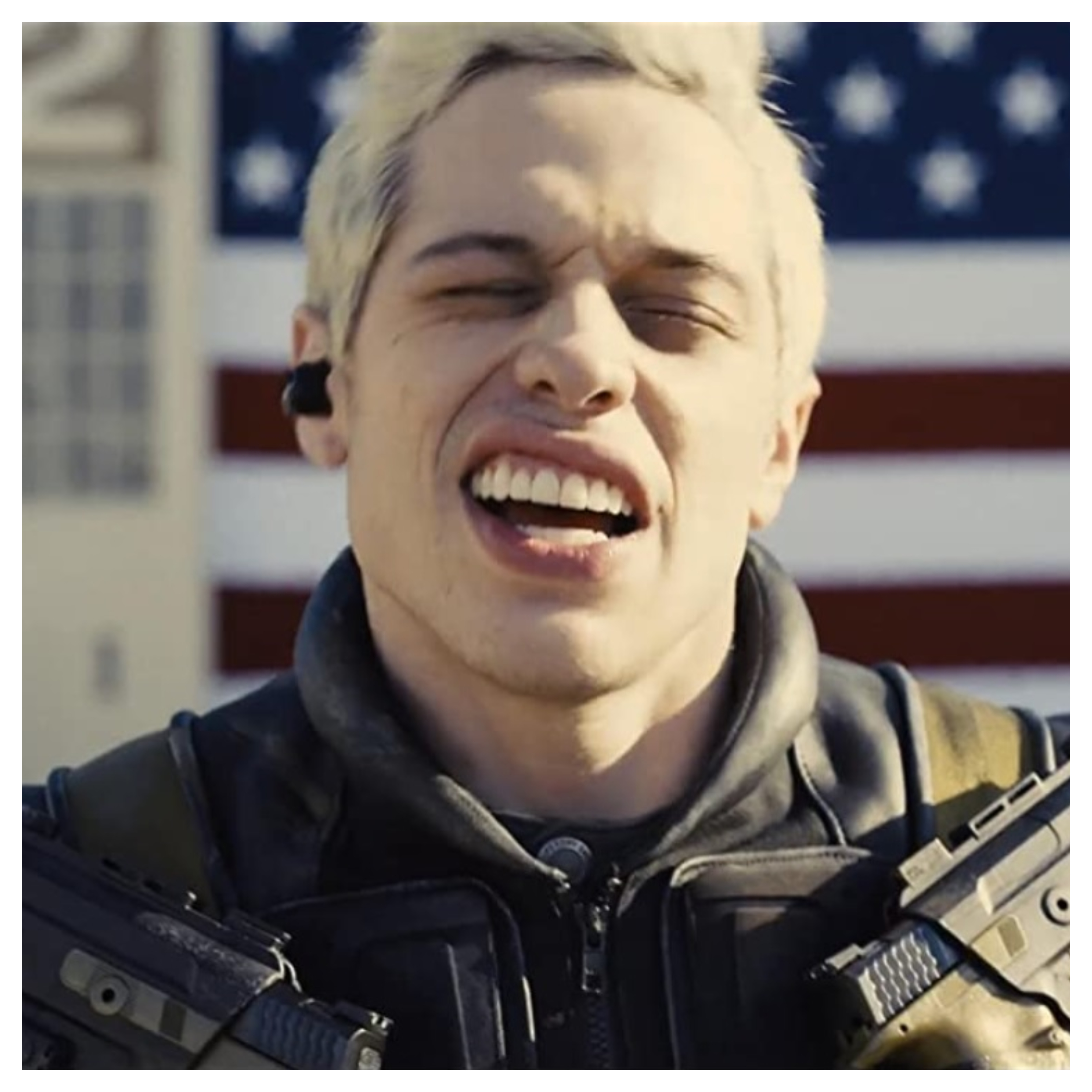 (Saturday Night Live's wisecracking Pete Davidson as Blackguard. Image courtesy Warner Bros.)
In the film, Saturday Night Live’s Pete Davidson plays Blackguard, the first Task Force X team member to bite it by getting his face machine-gunned off! The effect was designed to be both shocking and funny at the same time. Shane says, “We made a silicone head that was designed to look like he was shot with 40 machine-gun bullets, real fast, like a blur. We shot that as a reference piece for VFX.” He continues, “And then we had a full replica of him with that headpiece on the beach because he's there for the remaining scene. And there's just a closeup of like blood coming out of his face.” Dan Sudick and his special effects team made a blood dispersing rig for the Blackguard replica as well.
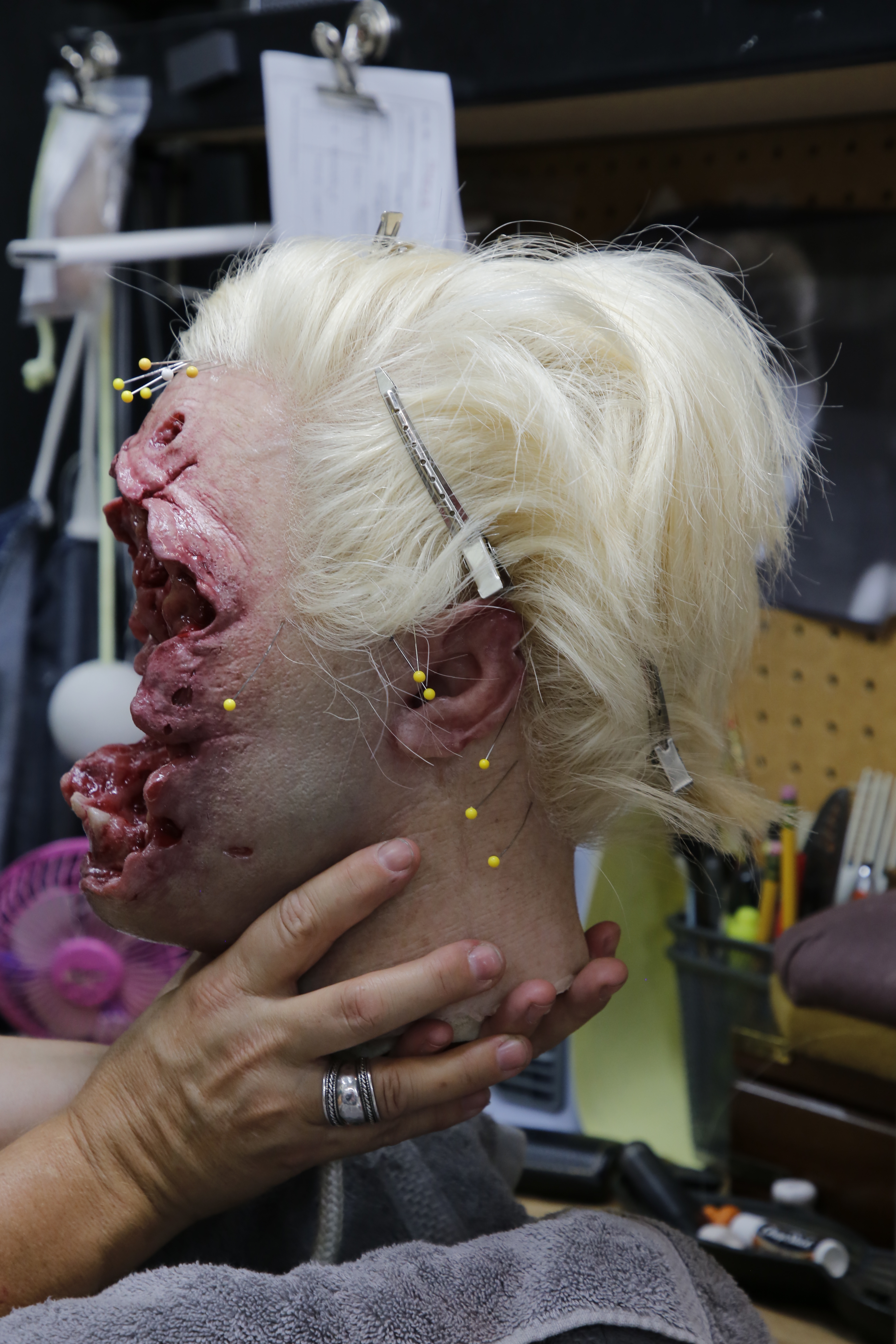 (The Blackguard machine-gunned face silicone reference head built by Legacy Effects. Image courtesy Legacy Effects/Warner Bros.)
Designing Mongal’s Alien Appearance
 (Mayling Ng in makeup as Mongal. Image courtesy Warner Bros.)
Played by Mayling Ng, the Task Force X character Mongal would sport orange prosthetics, a helmet with battle armor, and a Mowhawk hairstyle. Shane points out that Mayling, “…was an actress that could also do stunts.”
 (The in-progress Mongal helmet, forehead appliance, and Mohawk-style hairpiece. Image courtesy Legacy Effects/Warner Bros.)
 (During the beach battle, Mongal leaps onboard the skids of a crashing helicopter. Images courtesy Warner Bros.)
Shane discusses how the artists at Legacy came up with the look for Mongal. “She's pretty distinctive to some of the comic book panels.” He says Mongal, “…was meant to be some type of lizard-like alien species. She had a very unique look... we had to develop a very tight reptilian skin. And it was done mostly with a combination of silicone and Pros-Aide transfers that were painted orange.” For the costume, “We made her helmet, a couple of sections of her torso, and experimented with various techniques for her legs, whether they were like slip-on sort of things or application sort of things. And a lot of work went into her to get to that point.”
Burning Mongal
Mohawk-sporting Mongal dies in the fiery Corto Maltese helicopter crash on the beach. The Legacy Effects team built a burnt body to show the after-effects. Shane says, “Chris Swift and I put it into the actual wreckage and lit it on fire, it burned for like three hours straight and it just kept looking better and better, just kind of looking grosser and grosser. By the time the camera comes over, it's just hideous. It was just a hideous little moment.”
 (Shane Mahan dresses the burnt Mongal body at Legacy Effects. Image courtesy Legacy Effects/Warner Bros.)
Using Prosthetics for Captain Boomerang’s Death
 (Jai Courtney sports prosthetic wounds and shrapnel pieces built by Legacy Effects. Image courtesy Warner Bros.)
Also during the helicopter crash, another team member dies. The spinning rotor blades fling sharp pieces of palm tree trunks everywhere, impaling Captain Boomerang. Shane chuckles, “It's death by palm frond." Legacy created a mock-up with the palm tree shrapnel pieces coming from different directions for the director and his team to approve. Once Gunn decided on the look he wanted, Shane explains, “We recreated that as wearable pieces. So on the night of the shoot, we had a plan to take off his jacket, put on a new jacket with pre-cut holes, put all these sticks into his face, put the sticks into his body, and add blood. It's just basically a reveal of all the wood stuck into him. And then there's a false hand holding a boomerang. That's also burned down to its bones when it's stuck in the ground.”
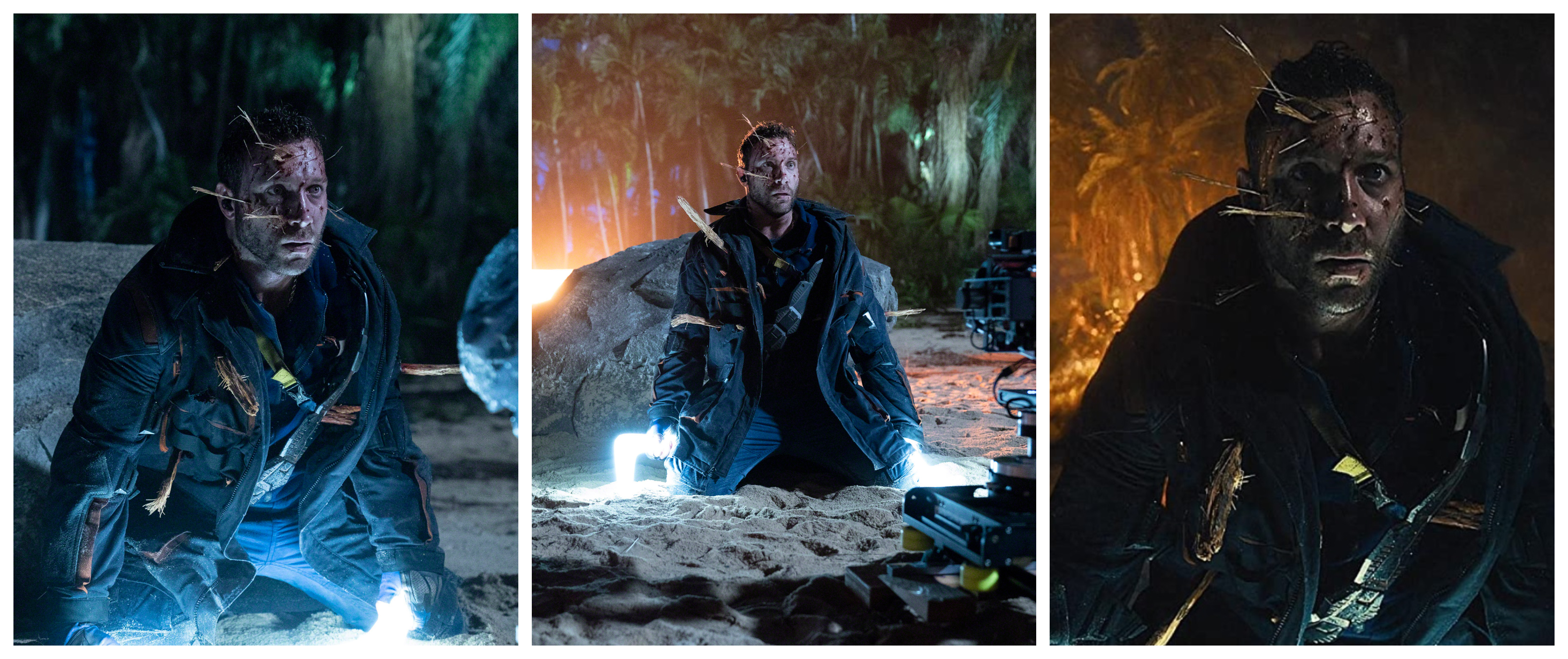 (Captain Boomerang, played by Jai Courtney, is impaled by palm tree shrapnel caused by the Corto Maltese army helicopter crash. Images courtesy Warner Bros.)
The Magic Behind T.D.K. and His Detachable Arms
 (Firefly's Nathan Fillion as T.D.K., The Detachable Kid. Image courtesy Warner Bros.)
Legacy Effects built appendages for one of the funniest superheroes in the film, T.D.K. (or The Detachable Kid). Digital arms would replace Nathan Fillion’s arms as they detach from his torso and fly through the air, smacking the Corto Maltese soldiers in their faces. To aid the digital teams, Shane says that, “Chris Swift and I were actually slow-motion walking them (the arms) across to the soldiers and slapping them in the head, which was all replaced with a digital version, but it gave them something to work with.” He continues, “And then we had them just laying on the ground detached.” Shane recalls with a chuckle, “They were really pretty groovy.”
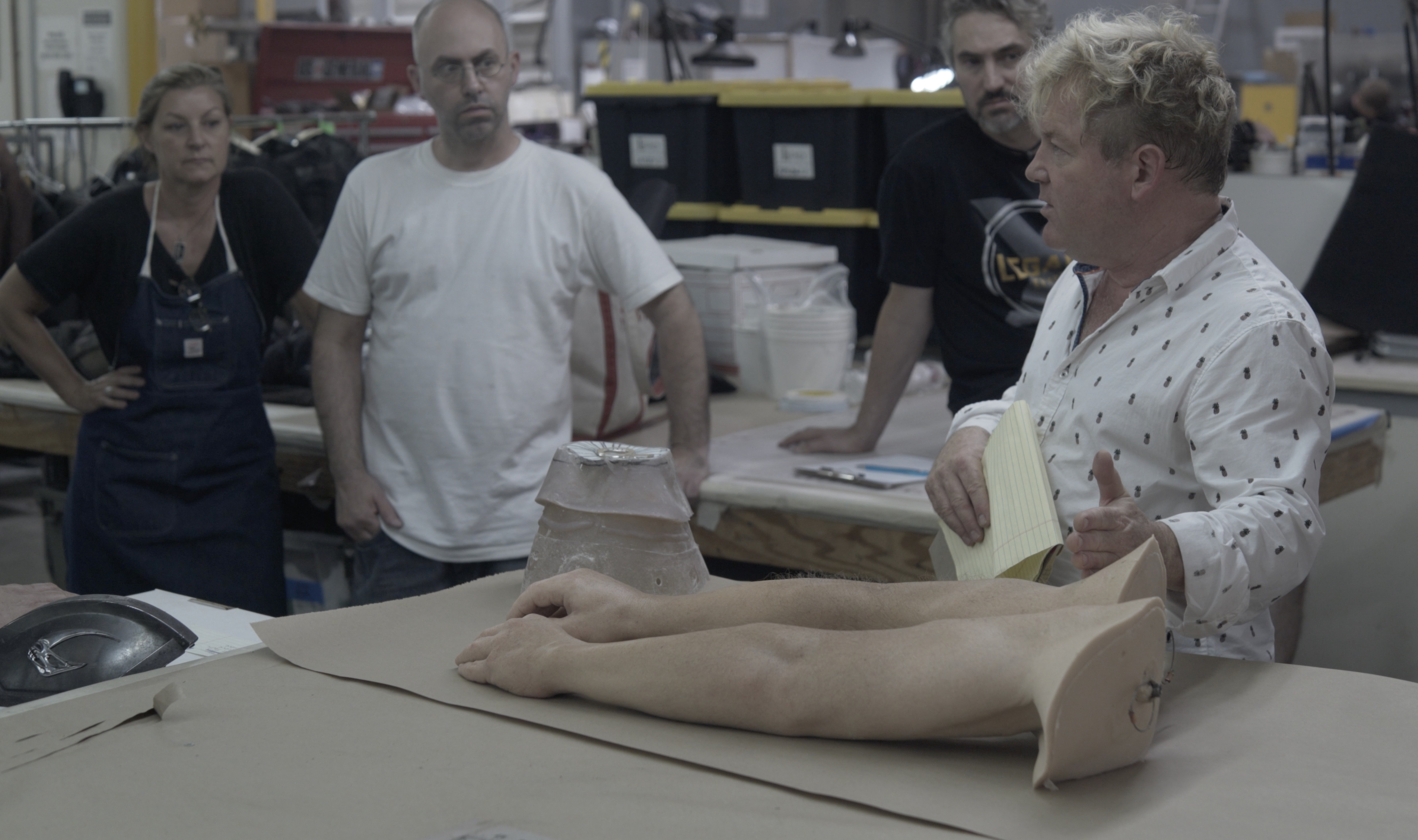 (Shane Mahan discusses Nathan Fillion's T.D.K arms at Legacy Effects with [L. to R.] Connie Grayson Criswell, Jonathan Faber and David Monzingo. Image courtesy Legacy Effects/Warner Bros.)
Creating a Practical Weasel Replica
Weasel was primarily a digital character that was performed on set by James Gunn's brother, actor Sean Gunn, wearing a performance-capture suit. Simon explains. “When Task Force X are in the back of the Osprey being transported to the island, that's Sean in a motion reference suit.” In addition, Legacy Effects was responsible for creating a full-size replica of the dead Weasel character for Michael Rooker to carry ashore after the crash.
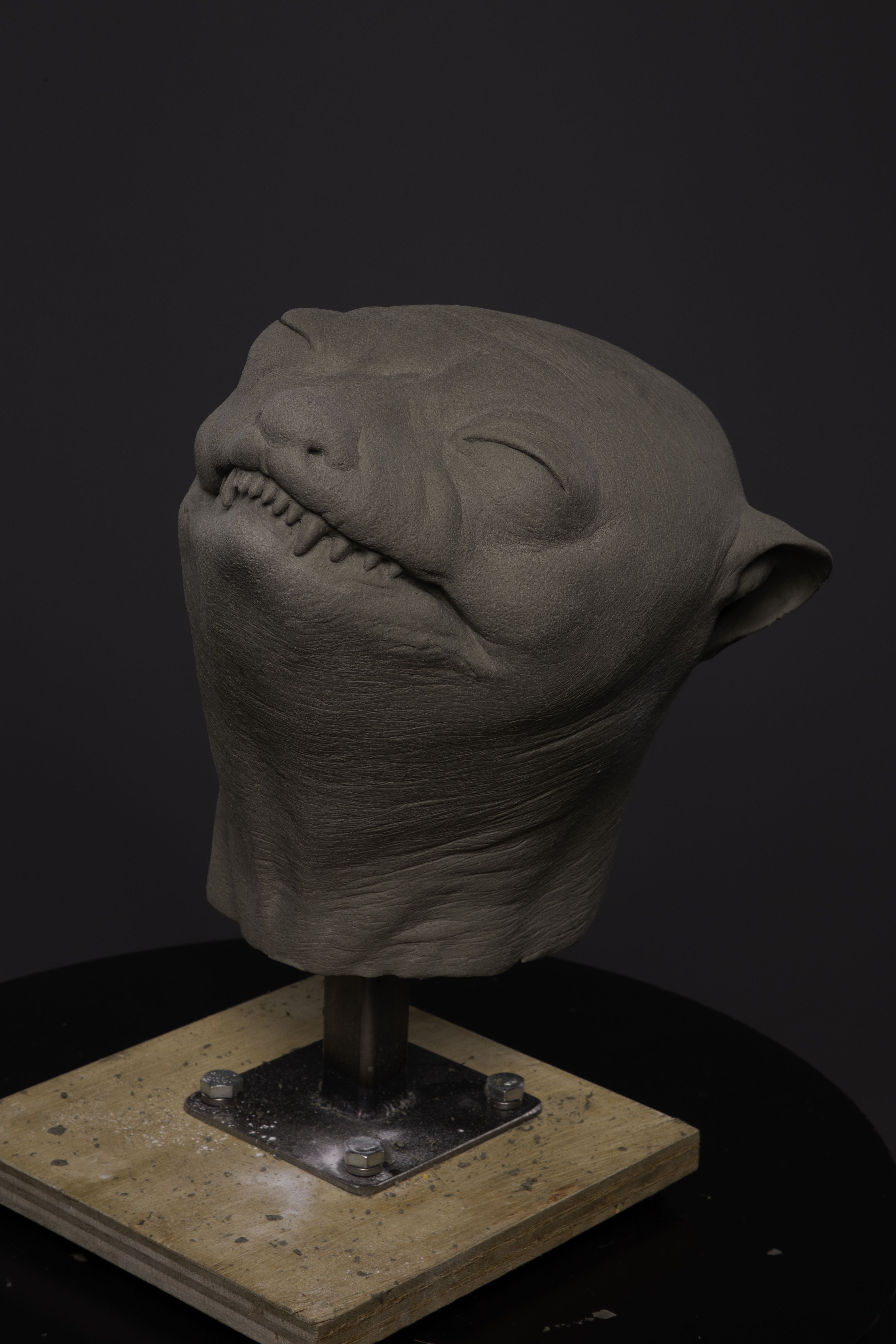 (Chris Swift's head sculpt for the 'dead' practical Weasel. Image courtesy Legacy Effects/Warner Bros.)
Shane describes the complicated process of creating the Weasel replica. “It's my job to orchestrate the team, to explain the scene to them, because only a handful of people are really allowed to read the script, but I have to disseminate that information so that it's built properly.” He continues, “We get the production art, we get a digital model, and then we get the exact scale, the right color, the amount of hair." To help finish the effect, Legacy Effects artist Chris Swift sculpted a "dead" expression on Weasel's face.
 (Legacy Effects artists Ryan Pintar and Connie Grayson Criswell work on the hair that will cover the full-size practical Weasel replica. Image courtesy Legacy Effects/Warner Bros.)
The Weasel replica was built to withstand being handled by actors and the rigors of shooting an action film. “I knew it was going to be launched and dropped into the water, real water. All the hair had to stay on. It had to have an internal skeletal structure that could actually react to water.” Shane says. A cylindrical tank was built and filled with water. “We had to rig the bottom (of the tank) to correct Weasel's buoyancy so that it would sink down and then release it as Michael Rooker swims underwater and grabs it and saves it.” He continues, “So it was a very fun thing to build because I knew we were going to use it a lot.”
 (On the beach set built in Atlanta, Michael Rooker carries the Weasel replica built by Legacy Effects. Images courtesy Warner Bros.)
Simon continues describing the scene with the replica Weasel. “Savant is swimming to shore with [Weasel]. There's an overhead cam shot, you know, so we got a lot of mileage out of that guy. Then when he was perched on the beach, reacting to the waves and he's just dead, but it's all of that stuff that's very useful and difficult to create sometimes CGI-wise.” Simon says, “It was a really impressive and creepy thing to behold.”
Making Bloodsport’s Suit and Mask
 (Idris Elba, wearing the Bloodsport costume, reviews a scene with The Suicide Squad director James Gunn. Image courtesy Warner Bros.)
During SWSCA’s chat with Shane and Simon, Matt remarks about the Bloodsport costume, “That is such a bad-ass suit and mask. What were the challenges there and what were you guys going after?”
 (Bloodsport mask built by Legacy Effects. Image courtesy Legacy Effects/Warner Bros.)
Simon responds that one of Bloodsport's "power sets in the comics is that he can pull weapons in a kind of teleportation manner. Like he can make weapons magically appear.” James Gunn’s interpretation from that, “…was that he's wearing a suit where weapons appear as if from nowhere.” Simon adds that Gunn also wanted to, “Make it look cool.”
 (Legacy Effects co-owner and The Suicide Squad project co-supervisor Lindsay MacGowan checks the progress on Bloodsport's chest armor with fabrication department head Marilyn Dozer-Chaney. Image courtesy Legacy Effects/Warner Bros.)
 (Legacy Effects fabricators Ilona Muschenetz and Michelle DeVille at work on the Bloodsport suit for Idris Elba. Image courtesy Legacy Effects/Warner Bros.)
 (A nice view of the arm and back details of the Bloodsport suit built by Legacy Effects. Image courtesy Warner Bros.)
Simon says that Bloodsport's final look was a group effort. “Shane and everyone at Legacy, Judianna on the costumes, the physical props, and then the visual effects really being the kind of grout between all the departments that really gave us those kinds of blends.”
Legacy Effects had worked with Elba before on the Thor films and Pacific Rim. Shane says, “He's just such a genuinely lovely guy, you know? He wants to help out. He's just like, 'Can I just open this for a breather once in a while, while you make accommodations?' So most of the success of that suit is actually because it's on him.” Simon echoes Shane’s sentiment. “Great job with the performance there.”
Designing Light Appliances for Polka-Dot Man
 (Polka-Dot Man, played by David Dastmalchian, with director James Gunn. Image courtesy Warner Bros.)
Shane says the colorful, glowing Polka-Dot Man appliances worn by actor David Dastmalchian were an exciting assignment for the Legacy team. “I took it as a personal challenge because there was brief talk that James would not like this to be a CGI effect unless it can't work. And I was like, I'm going to make that work because it's new. We've never seen anything like this before.” He continues, “I was determined to figure out how to make a bulbous internal, glowing skin, that's a wearable piece that can be activated and emote something.”
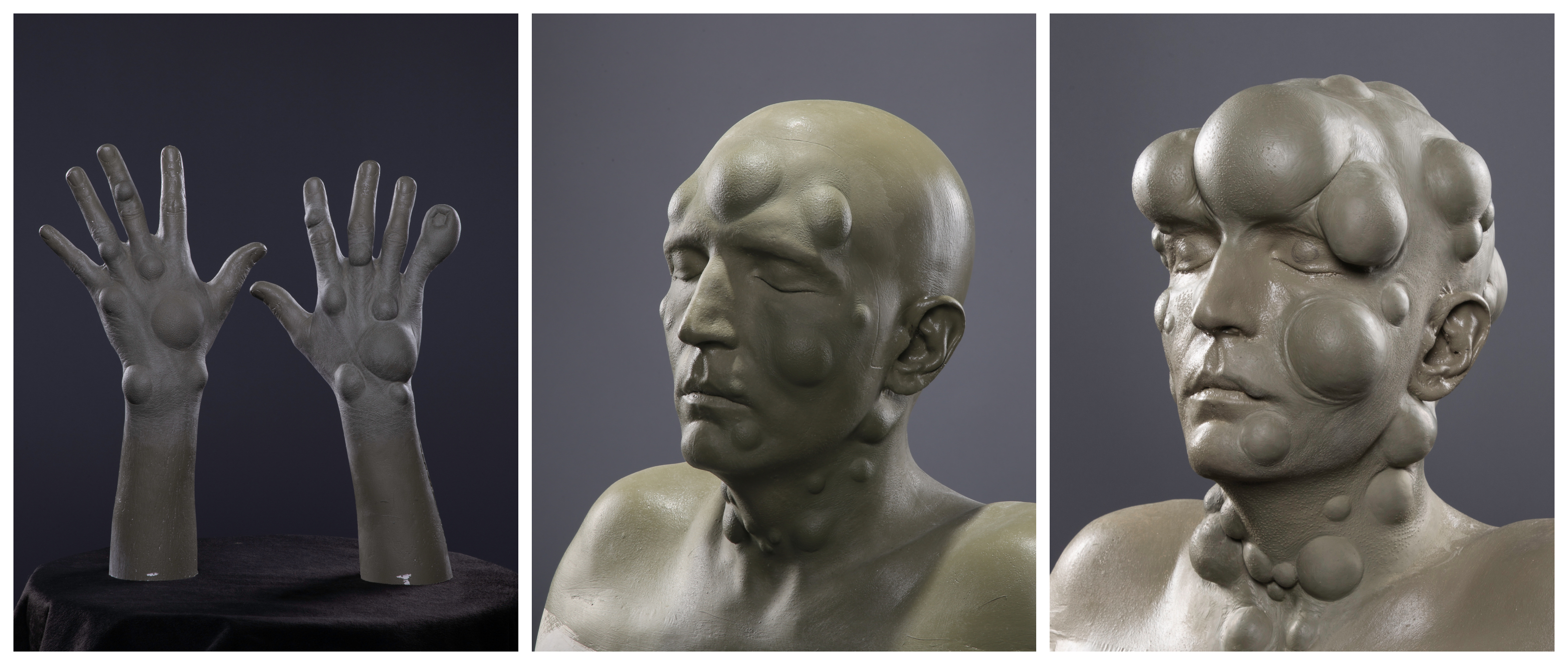 (Sculptures for the Polka-Dot Man's hands, second-level, and third-level makeups. Images courtesy Legacy Effects/Warner Bros.)
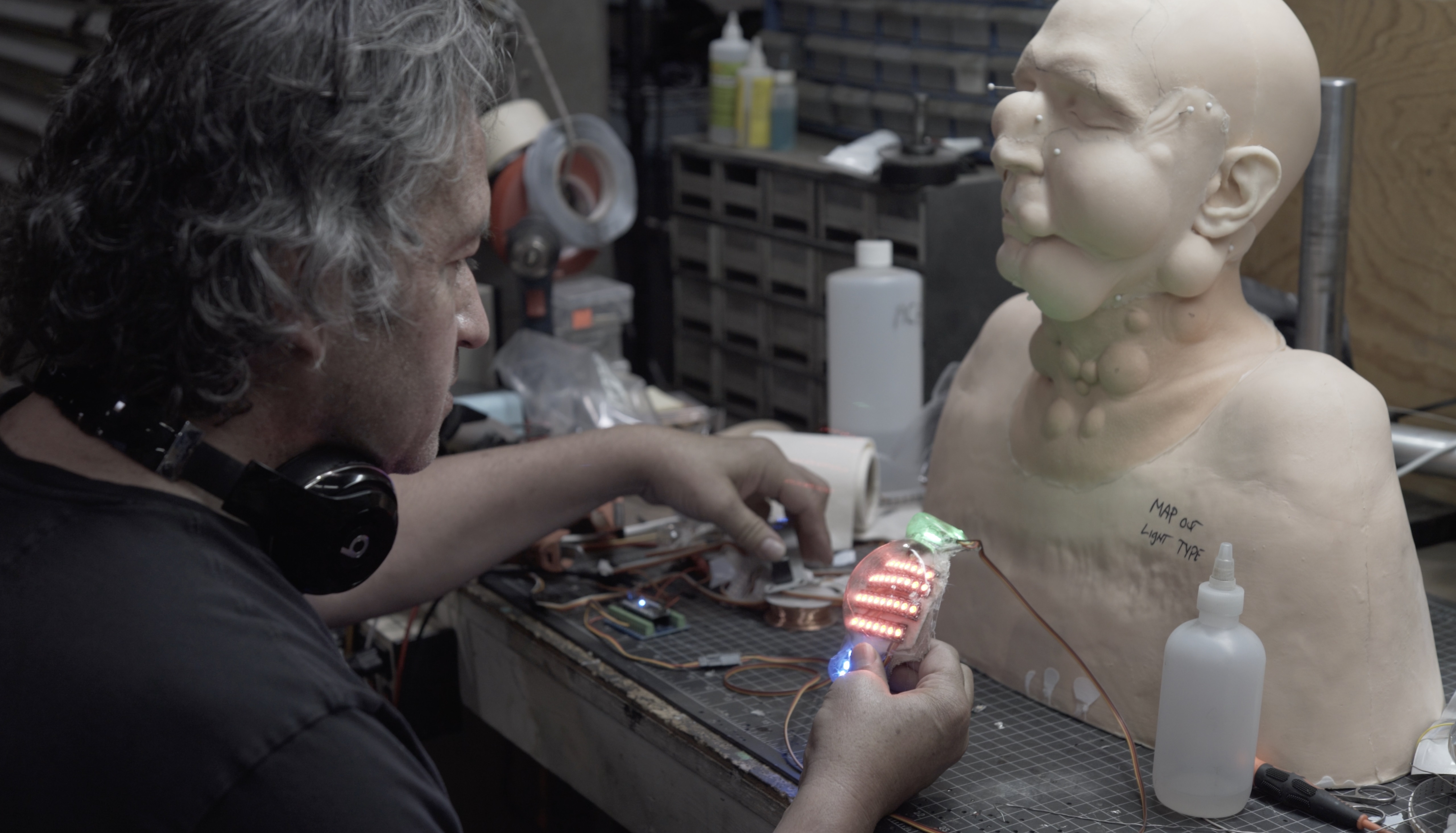 (Legacy Effects mechanic David Covarrubias testing the LED array for one of the Polka-Dot Man appliances. Image courtesy Legacy Effects/Warner Bros.)
Shane says the Legacy team were tirelessly experimenting with internal batteries and wires and diffusion and colors. “We had tablefuls of experiments, of bulbs running all weekend, seeing timing, like how long the batteries last and so on.” In the end, Shane reveals that “It was a very sophisticated little panel of lights that were actually able to dim on or off and change colors. But in the film, they just always stay on, but you could have gone from white to red, they could have changed." He says there was, “A series of wires that ran down [David Dastmalchian's] back to an intricate little computer, conveniently located in a backpack that he wore that Judianna provided for us.” The complex unit would also allow for the lights' color temperatures to be adjusted for the director of photography, Henry Braham.
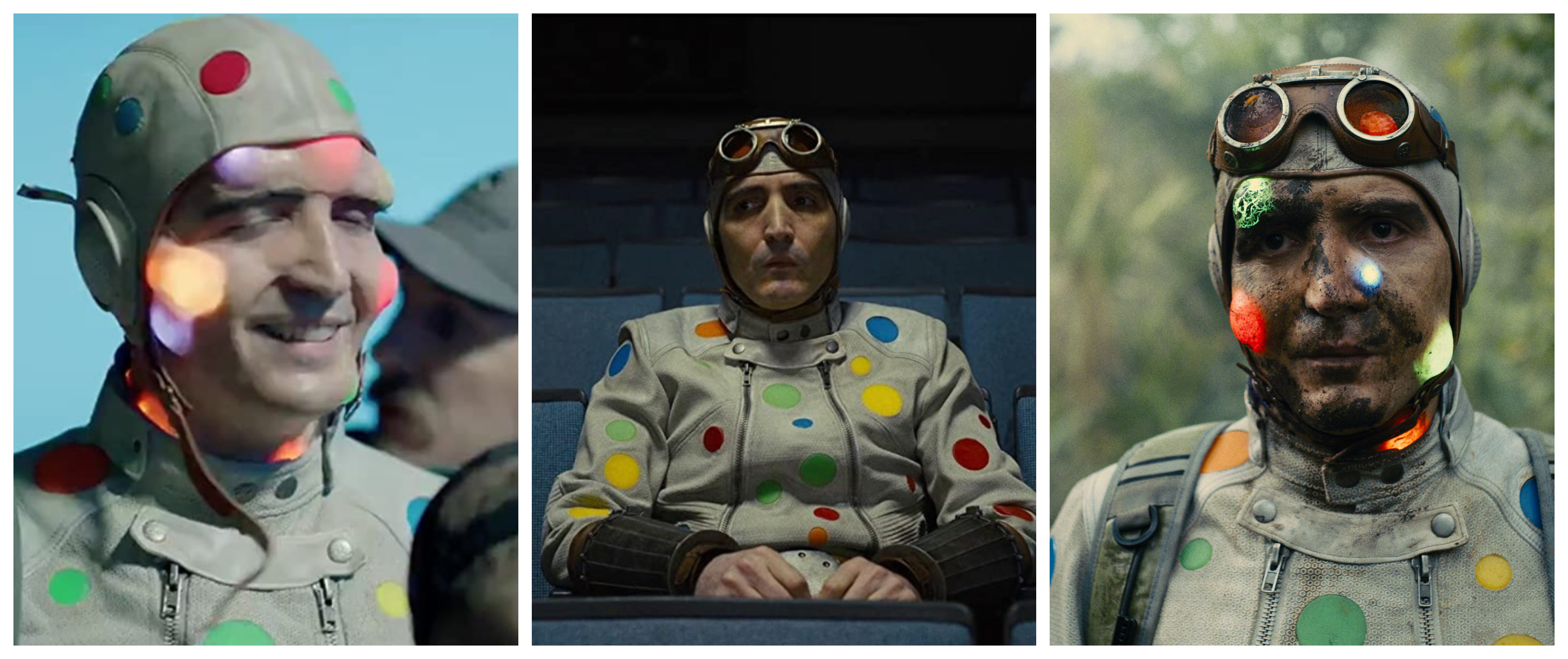 (David Dastmalchian as the Polka-Dot Man. Images courtesy Warner Bros.)
The Effects Used to Achieve the Thinker’s Look
Thinker, the Director of Project Starfish, is played by Doctor Who’s Peter Capaldi. The character had been seen for years in the comics, so the design had a basis to start from: a bulbous head with electrodes, vacuum tubes, and other devices sticking out of it. Shane says that there was a lot of discussion among the Legacy Effects team about how to achieve the character’s distinctive look. Referring to the electrodes and other head protuberances, Shane makes it clear, “You can't just shave a guy's head and glue them on and expect them not to fall off or be knocked off. It doesn't work that way.”
 (Clockwise from top left: the fiberglass skull cap to which the electrodes were attached underneath the Thinker's prosthetic makeup, the Thinker's head sculpt, and Peter Capaldi in makeup as the Thinker. Images courtesy Legacy Effects/Warner Bros.)
For the Thinker's bulbous head, a silicone prosthetic piece was created that ran across Capaldi’s eyebrows, into the crow’s feet, and above his ears. To fit under this, a rigid reusable skull cap was built. “Peter graciously cut his hair as short as possible, and we made a very thin cap for him to wear under the silicone prosthetic. Scott Patton and Greg Smith digitally modeled these multifaceted little complex lighting systems that had little screws and magnets that you could put in. Those were all mounted to the reusable skull cap through the silicone headpiece.”
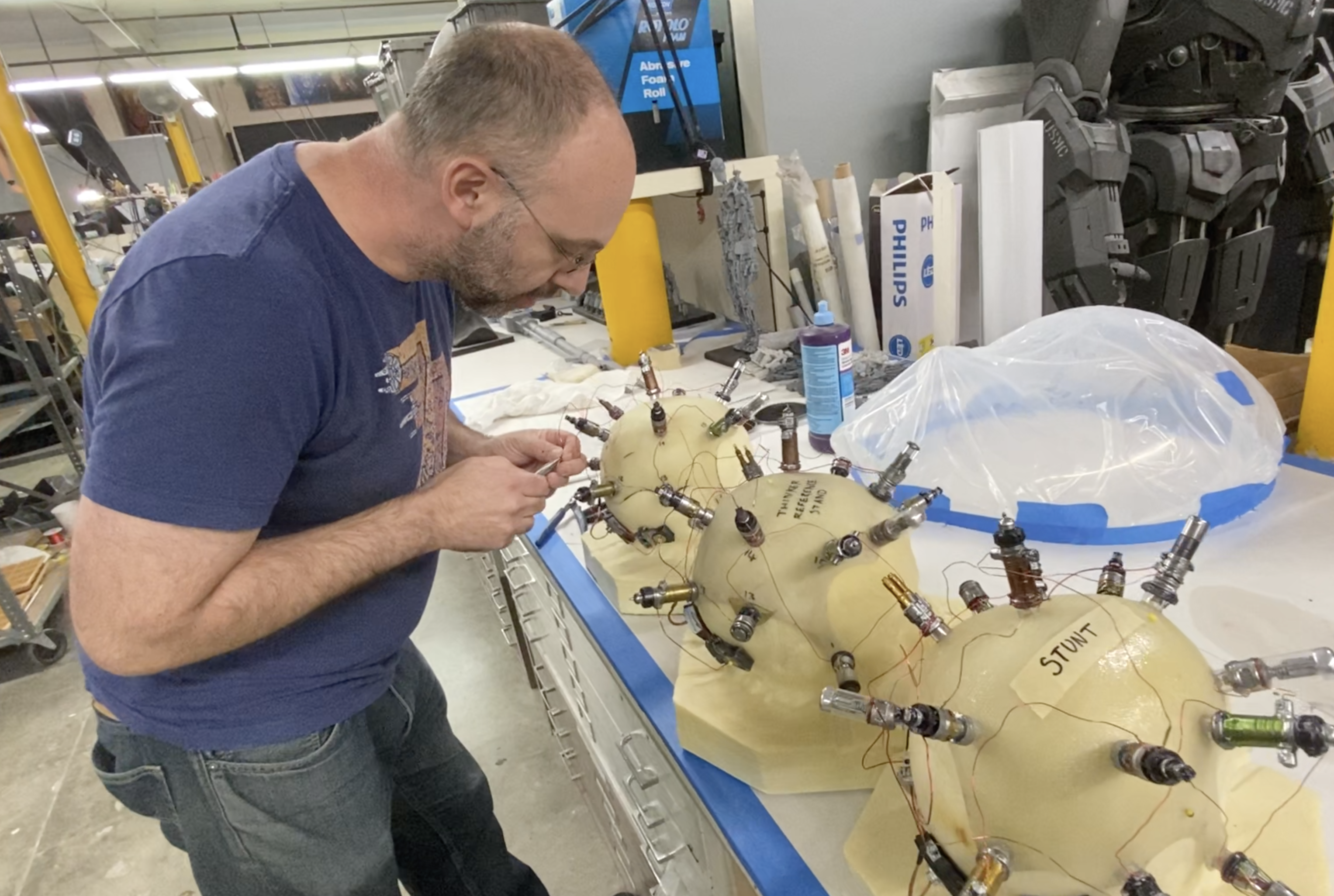 (Jonathan Faber working on a series of Thinker skull caps. Image courtesy Legacy Effects/Warner Bros.)
Shane says that hiding the power source for the Thinker's electrodes posed a challenge, “There's no place to hide a wire." In contrast, David Dastmalchian's Polka-Dot Man had shaggy hair, "so we could run wires under the skin into his backpack. But Thinker's got a clean silhouette.” He says Legacy Effects digital concept artist Scott Patton came up with a system for concealing the batteries inside the electrodes themselves to allow for easy replacement. Legacy Effects would also create a younger Thinker makeup for a flashback scene with fewer probes sticking out of his head. Shane credits Matt Sprunger and his team for applying the makeup on set.
Bringing the Starro Spores to Life with Silicone Masks
Task Force X eventually discovers that Operation Starfish is exactly what it sounds like; a giant alien starfish called Starro the Conqueror who stomps buildings and sports a single unblinking eye in the center of its colorful body. To make matters worse, the Kaiju-sized creature releases swarms of face-hugging miniatures of itself to take over the Corto Maltese soldiers.
 (The giant alien starfish Starro the Conqueror releases thousands of smaller versions of itself. Images courtesy Warner Bros.)
Legacy was tasked with the challenge: How do you dress three hundred performers in face-hugging starfish masks in under thirty minutes? In Atlanta. And in Panama. With performers that the makeup crew has never met? Shane Mahan breaks it down. “You can't glue the starfish masks on because that takes too long. People need to remove it to take breaks, which was just going to take forever. And there are not 300 makeup artists that are going to help do that.”
 (Silicone starfish masks created by Legacy Effects. Images courtesy Warner Bros.)
So the Legacy Effects team decided to keep it as simple as possible. The artists built thirty to forty silicone ‘hero’ masks for the performers closer to the camera, while the background masks were vacuformed. Legacy created a tier system for the starfish masks similar to the ones used in zombie movies for decades. Shane explains, “The closest ones were silicone. And then further back there were hundreds of vacuformed ones that, once you get a certain distance away, they look pretty good.”
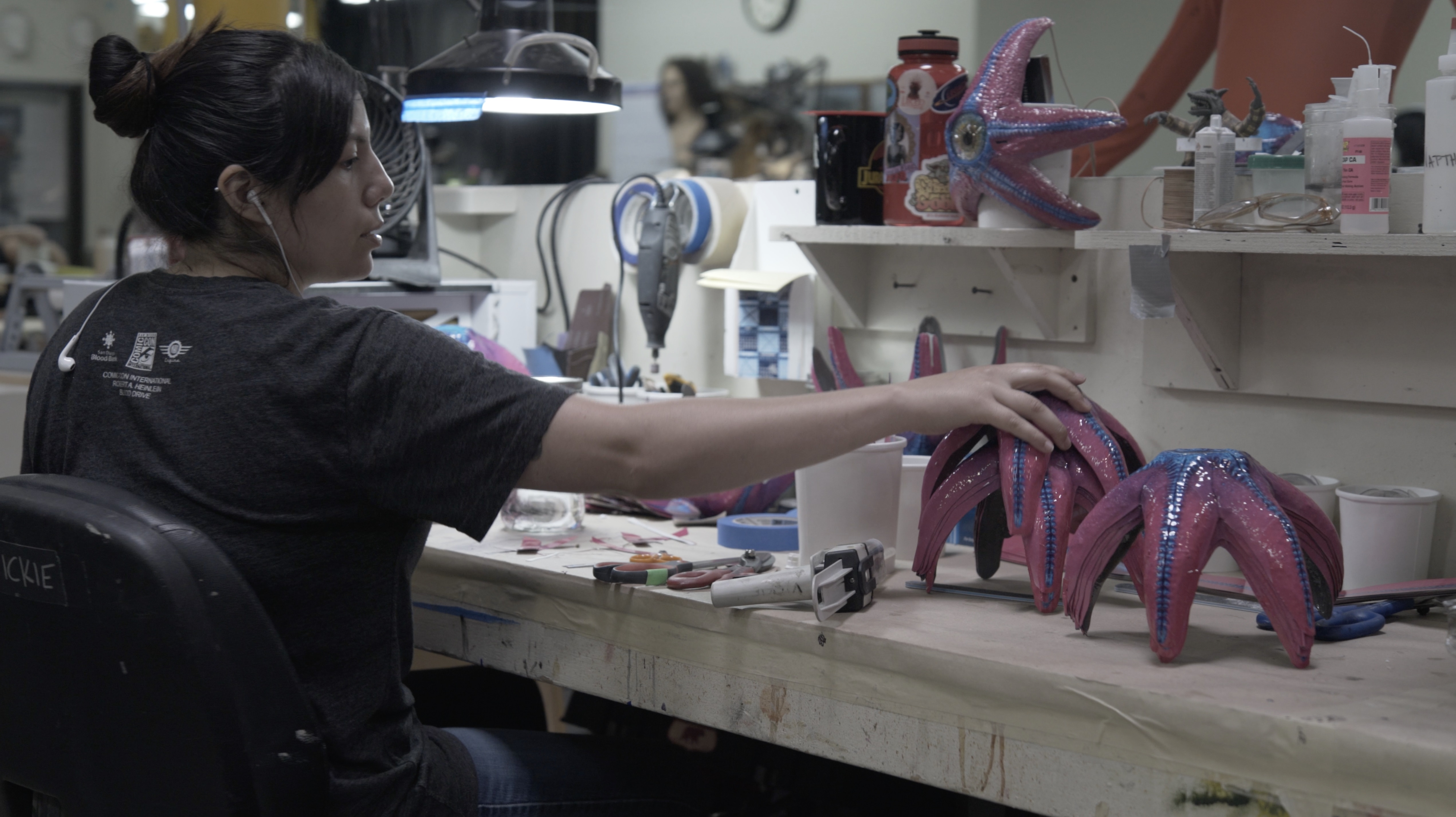 (Vickie Fernandez works on vacuformed starfish masks at Legacy Effects. Image courtesy Legacy Effects/Warner Bros.)
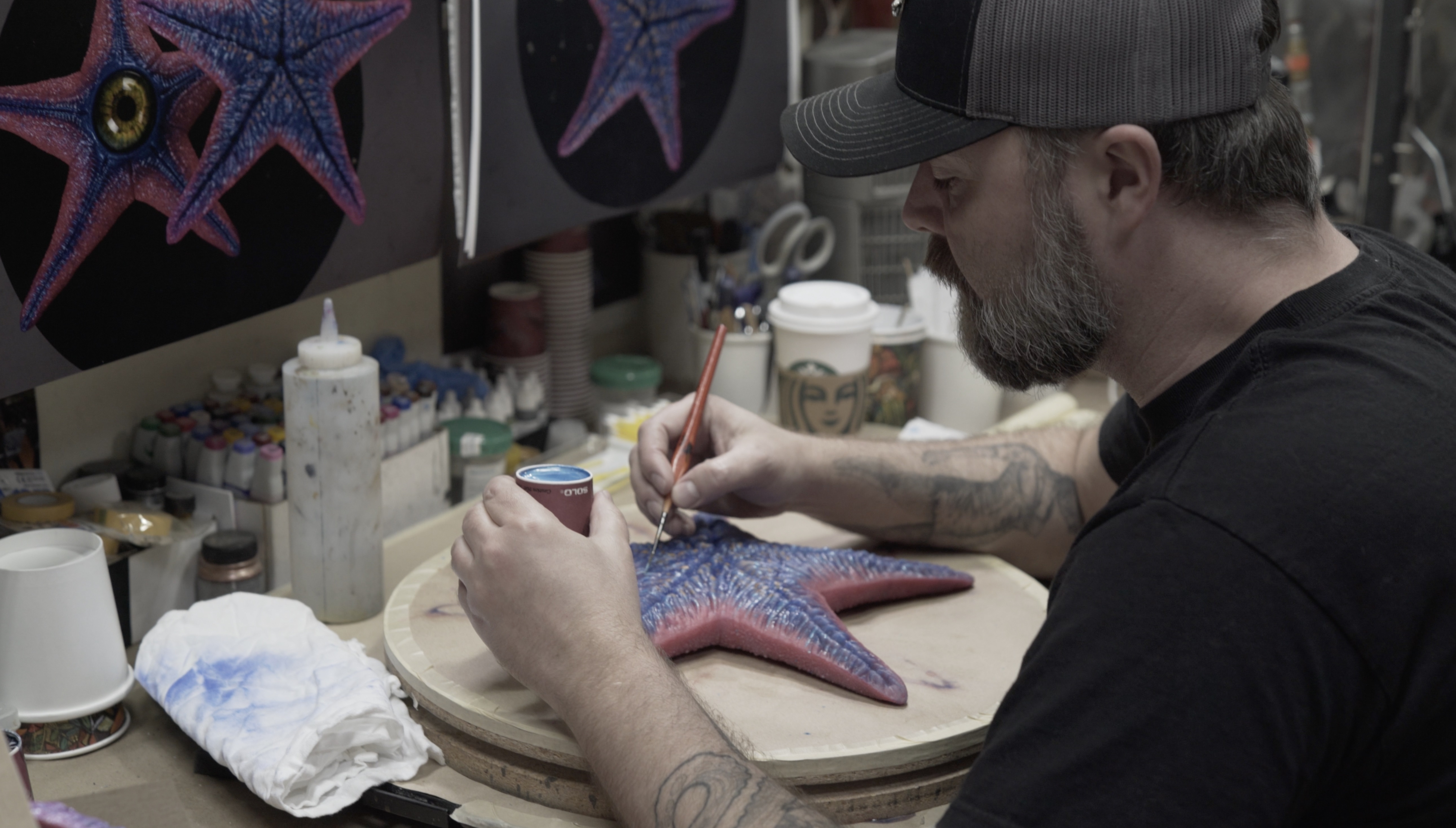 (Legacy artist Ryan Pintar paints one of the 'hero' silicone starfish masks. Note the paint reference artwork above the workbench. Image courtesy Legacy Effects/Warner Bros.)
 (Sculpture of a starfish victim. Image courtesy Legacy Effects/Warner Bros.)
 (Legacy artist Chris Swift sculpting the starfish victim head. Image courtesy Legacy Effects/Warner Bros.)
 (Chris Swift leads a starfish victim head test-fitting in the Legacy Effects workshop. Image courtesy Legacy Effects/Warner Bros.)
Another challenge posed by the starfish masks was how to secure them to the performers' faces. The team at Legacy kept it simple. “There was a string system attached to the starfish masks," reveals Shane. The strings were different colors to match the performers' hair: blonde, brown, and black. Once they put on the starfish masks, it was just a simple matter of tufting their hair around the strings to hide them.
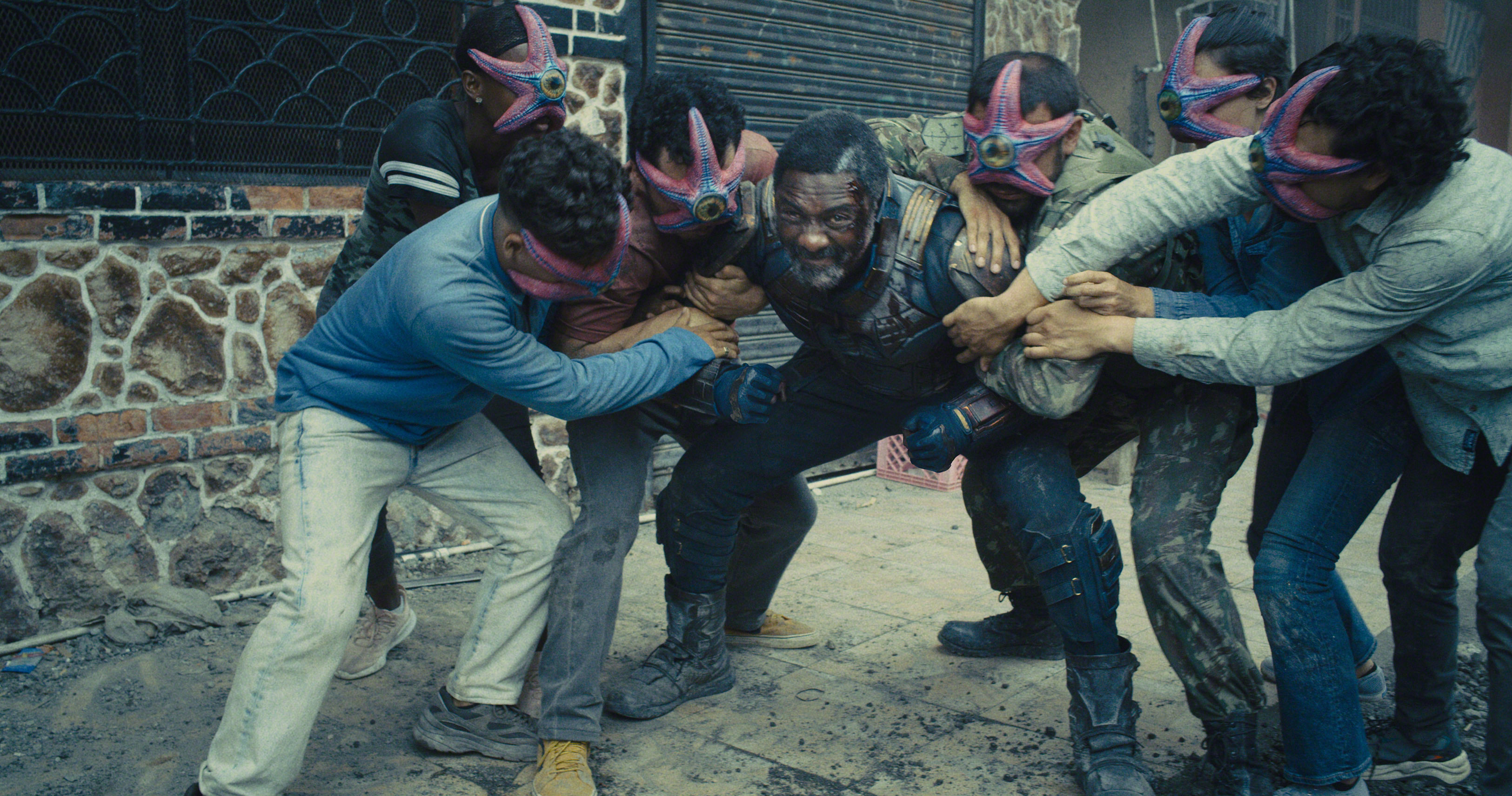 (Bloodsport, played by Idris Elba, being attacked by Starfish-masked minions on the island of Corto Maltese. Image courtesy Warner Bros.)
Shane explains how the on set crew worked with the Starfish-masked performers. “We had a team of seven or eight of us that would run around and pull people upfront, switch someone, maintaining the distance of what works. They would all learn how to put on the masks themselves and we would fix them up. And then the starfish eyes were CGI, based on the artwork that we created. That's kind of in a nutshell how those masks worked.”
Building a Practical Body for King Shark
While the Sylvester Stallone-voiced character of King Shark would be realized digitally, Legacy Effects built a practically rigged body for the shark to rip bloodily in half.
 (Legacy Effects artists Emily Fiora Parks and Beccah Barnett test the 'King Shark Ripping A Guy In Half' rig. Image courtesy Legacy Effects/Warner Bros.)
“We were asked to make a body that we could mechanically rip in half without the King Shark there.” Shane dishes the details, “It was a very complex sort of set-up. He had to lift him up and then tear him apart. And we had lots of entrails and blood and stuff.” Shane says the effective shot was a team effort between practical and visual effects crews. “Our team doing the lifting and pulling, visual effects putting King Shark in there. I'm pretty pleased with that one, too.”
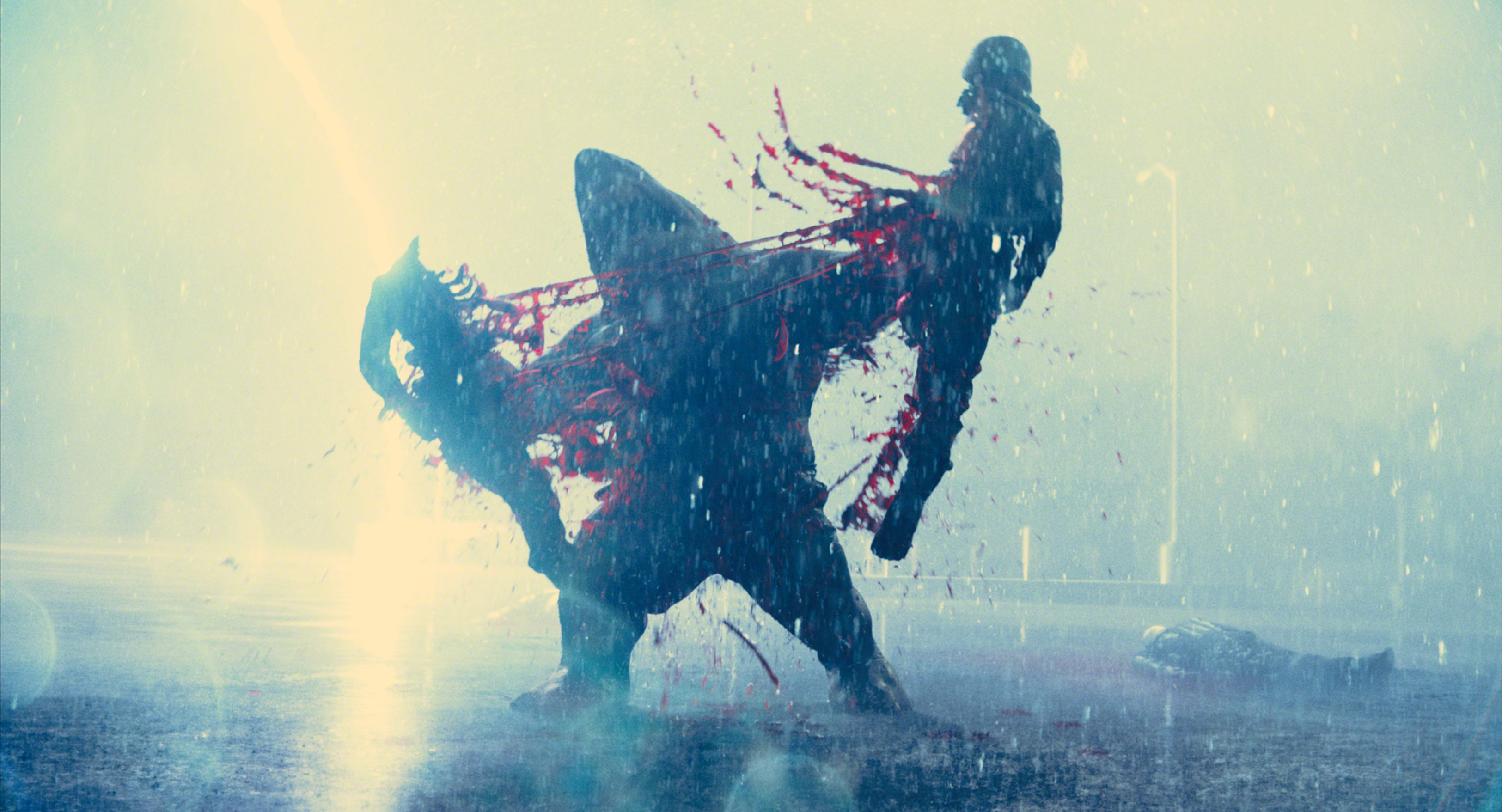 (The digital King Shark rips Legacy’s practically rigged body in half. Image courtesy Warner Bros.)
Following the Jurassic Park Theory
 (Stan Winston on set with the full-size practical T-rex from the original Jurassic Park.)
As mentioned earlier, The Suicide Squad visuals were a team effort between practical effects, the costume department, and digital effects. The Suicide Squad co-producer Simon Hatt describes how he likes to think about the combination of practical and digital effects when he is working on a film. “It falls under the umbrella of what I call the Jurassic Park Theory.” Simon explains: “You are never, ever going to believe that digital T-Rex, that it's fully real, right? Unless you have that full-sized practical foot or eye that moves, that the actor can really touch.” He says that practical effects are important, that they provide, “The kind of cinematic real estate in the audience's imagination to get away with the digital T-Rex." He uses Weasel as an example. “Sean (Gunn) is just doing this marvelous job, performing the character, you know, in such an animated way that to try and build it practically, that would be next to impossible, but, on the other hand, if you have that shot of Savant (Michael Rooker) diving under the water, sweeping his arms around the Weasel, if you did that digitally, you're never going to get the interaction between the physical actor and the character to look real. So it's really this symbiotic relationship between the digital work and the practical effect that brings a character like Weasel, who ends up being one of the favorite characters of the movie, to life.”
Shane agrees. “It's a beautiful marriage. On the first Iron Man, John Nelson was the visual effects supervisor. And we were trying to decode that one. What we came up with was a very useful trick, which I try to employ with different departments when we talk today, which is start real and end real. But the in-between sections can be digital. Audiences are very sophisticated today. Nine-year-old children know what a blue screen is. They really know technique by technique. So when you mix it up, when you mix up the magic tricks, the reveals become startling and it becomes kind of hard to pinpoint how they were achieved.”
 (The Suicide Squad director James Gunn shares a laugh with some of the Task Force X actors. Image courtesy Warner Bros.)
Legacy Effects WIP photos by Irvine Green and Matt Alavi.
Follow Legacy Effects
Website - www.legacyefx.com
Facebook - www.facebook.com/legacyeffects
Instagram - @legacyeffects

Courses with The Creators of The Suicide Squad
- Special Effects Sequence Design with Shane Mahan
- Hybrid Characters: Blending Practical & Digital FX with John Rosengrant
- Hybrid Character Design: Practical To Digital with Christopher Swift
- How To Make A Monster Puppet - Rods & Cables with David Monzingo
- Makeup Blood FX - Blow Your Brains Out with David Monzingo
- Making Creature Eyes with John Cherevka
- How To Make Eyes: Puppets, Masks & Makeups with John Cherevka
- Advanced Creature Teeth: Prosthetic Dental Appliances - Part 1 with John Cherevka
- Metallic Painting Techniques - Robot Finishes (Terminator) with Rob Ramsdell
- FX Corset Harness Fabrication with Amy Whetsel
- How To Make A Fat Suit with Dawn Dininger
- Creature Costume Basics with Dawn Dininger and Amy Whetsel
- Maquette Painting Techniques with Trevor L. Hensley
- Hairy Creatures Series - Introduction To Hair Knotting with Michael Ornelaz
- Working with Wigs - Wig & Hair Basics with Connie Criswell
- Character Hairwork: Hair Laying for Prosthetic Makeup with Aimee Macabeo
- How To Make An Eye Mechanism - Design, 3D Printing & Assembly with David Covarrubias
- Animatronic Control Systems - Arduino Programming Basics Part 1 with David Covarrubias
- Silicone Sculpting & Patching: How To Seam & Patch A Silicone Mask with Chris Grossnickle
- Silicone Sculpting & Patching: How To Patch A Prop Body with Chris Grossnickle
- Silicone Sculpting & Patching: How To Seam & Patch A Silicone Makeup with Chris Grossnickle
- Lab Work For Animatronic Characters Part 1: Making A Mechanical Core with Cory Czekaj
- Character Makeup - How To Run Foam Prosthetic Appliances with Cory Czekaj
- Character Makeup - How To Run Silicone Prosthetic Appliances with Cory Czekaj
- Making a Stone Mold with Gary Yee