The Making of Stopmotion (2024)
Written by Michael Martin
A visceral, visually stunning horror film, Stopmotion follows a young woman, Ella Blake, who tries to help her ailing mother finish a stop motion film based on The Odyssey. As Ella works, her mother’s health worsens, and the young animator is forced to move. Her boyfriend, Tom, helps Ella find an apartment where she can set up a small studio and continue working on the film. While there, a nameless little neighbor girl convinces Ella to take the animated film she is working on in an entirely new and darker direction. Ella destroys her mother’s sets and puppets and begins anew, taking the Stopmotion narrative into a new, dark, disturbing world.
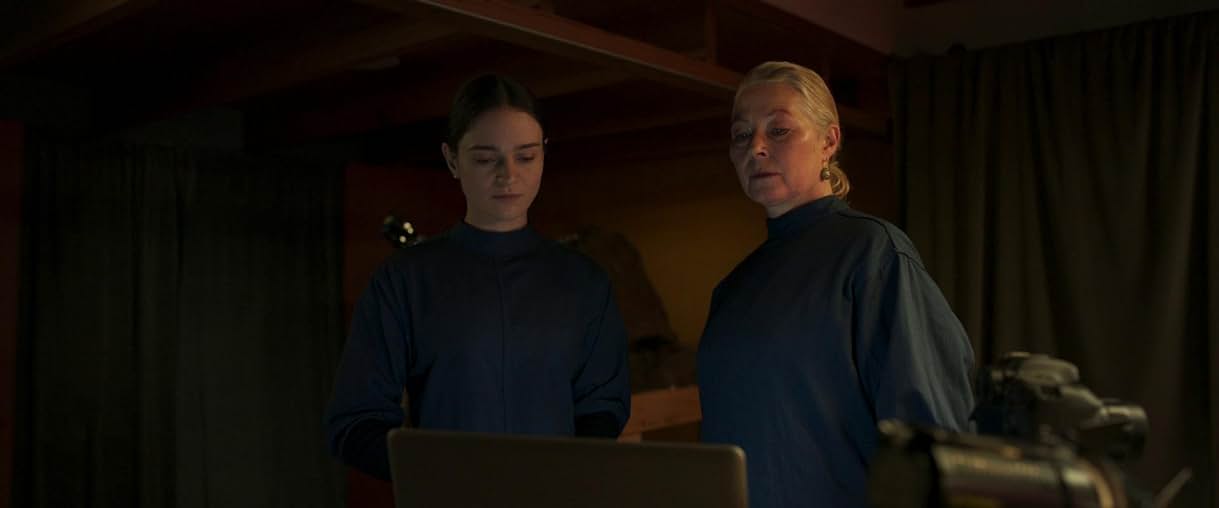 (Ella, played by Aisling Franciosi, and her mother Suzanne, played by Stella Gonet, discuss the animated film that Stella can no longer work on due to her hands being twisted by arthritis. Image courtesy IFC Films.)
 (Cyclops puppets from Stella's vision for her animated film, influenced by The Odyssey. Image courtesy IFC Films.)
Stopmotion is directed by Robert Morgan (the short films The Cat with Hands, Monsters, Bobby Yeah), which he co-wrote with Robin King. It stars Aisling Franciosi (The Last Voyage of the Demeter) as Ella Blake, Stella Gonet (The Crown) as Ella’s mother Suzanne, Tom York (American Gods, Poldark) as Tom, and Caoilinn Springall as the nameless neighbor girl.
 (Actress Aisling Franciosi listens as Stopmotion director Robert Morgan explains a shot. Image courtesy IFC Films.)
Stopmotion features disturbingly smooth life-like stop-motion animation and startling gore effects by effects artist Dan Martin (Infinity Pool, Possessor) and his shop 13 Finger FX. SWSCA co-founder Matt Winston chatted with Martin about the creation of the stop-motion, suit, and gore effects for the film.
Jump to Section
- Using Practical Techniques on Robert Morgan's Stopmotion
- Making Stop-motion Figures
- Bringing the Wax Girl Puppet to Life
- Building Animation Puppets
- Introducing the Advertising Wax Girl Puppet
- Making Lifelike Eyes for Stopmotion's Puppets
- Stopmotion's Ash Man
- Creating Realistic Teeth With a Taxidermy Set
- Using Library Body Parts for Suzanne's Corpse
- Molding Wound Appliances
- Breaking Down the Puppet in the Doorway Scene
- Using a Floating Mold Effect for the Death of Polly
- Challenges of Using Larger-scale Animation Puppets
- Making Wax Limbs
- Using a Library Mold for Ella's "Jelly Legs"
- Building a Life-size Ash Man
- The Ending of Stopmotion
- The Beauty of Practical Effects and Horror
Using Practical Techniques on Robert Morgan's Stopmotion
Ella, the main character, asks, “What happens when it takes on a life of its own?”
Stopmotion utilizes a wide variety of practical techniques to achieve its disturbing visuals, from stop-motion puppets to appliance makeups to life-size creature suits. Dan Martin said working with director Robert Morgan was like working with a kindred spirit. Morgan has directed and animated several short films that combine live-action with puppet animation, including The Cat with Hands and Bobby Yeah. Stopmotion would be Morgan’s first feature-length film.
Making Stop-motion Figures
Several stop-motion figures, such as Wax Girl and Ash Man, were designed and built for the film. Referring to the director's previous short films, such as The Cat with Hands, Martin said that Morgan had always built his own stop-motion puppets in the past. For the new designs for Stopmotion, "It was an interesting process to take, to have to adopt someone else's aesthetic," said Martin. "Dominic Helston did some concept work on this as well. He did some early sketches for the Ash Man. I did some 2D sketches myself. Another member of my team, Dan Gomer, also did some sketch work. The Wax Girl was born out of essentially me aping Rob's aesthetic. The evolution of all of them had to sort of be cohesive. And because we were making them at different scales and suit versions of some of the characters as well, we knew that we were, to some extent, bound by the physical limits of each of those different methods just because we weren't gonna be doing anything with digital effects, so everything had to work in-camera. Everything had to feel like there was a through line to it aesthetically."
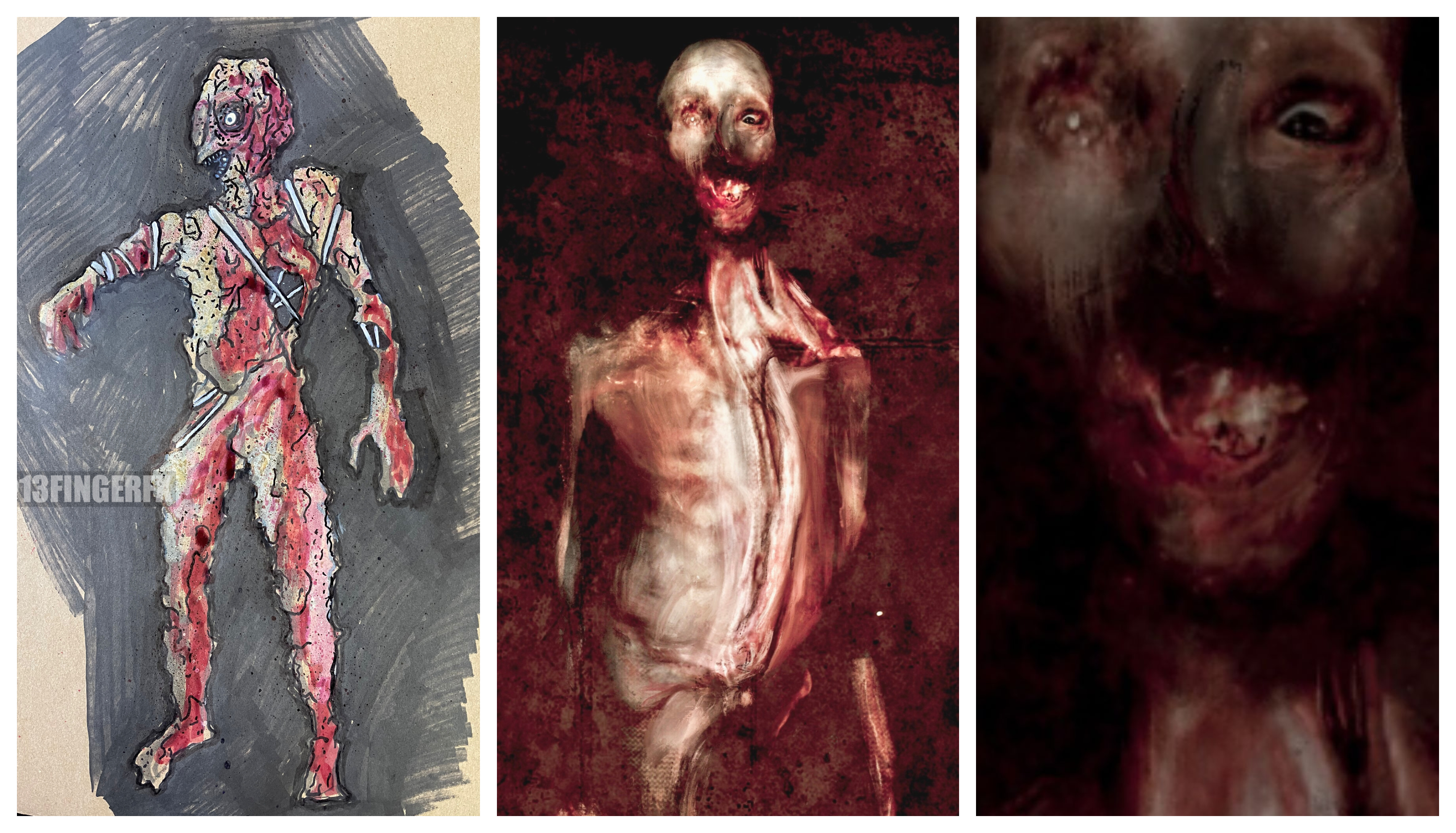 (Early concept art for the Ash Man created by Dan Martin, left, and Dominic Hailstone, middle and right. Images courtesy Dan Martin.)
Martin described working with the director on the character designs. "The very first path was to talk to him about it on a more conceptual level. It was really important to talk to Rob about why he'd made the choices that he'd made, with previous characters as well as this, to be able to make it look like it was one of his pieces, to make it look like it had come out of him."
The figures of Stopmotion share more than just a design philosophy from director Robert Morgan's earlier animated films. "Some of the internal armatures were inherited from Rob. He handed us pieces that he already had from his collection, some very nice custom-built stuff." said Martin, who revealed that many of the smaller-scale puppets use pieces and bits of Rob's armatures. "A lot of the stuff at the smaller scale is made like that."
 (A selection of stop motion armatures, provided by Robert Morgan, for inclusion in the various puppets made by 13 Finger FX. Image courtesy Dan Martin.)
While a lot of artwork had been done, things would change once the artists began working with the physical materials. “The first time we started producing physical elements, it was more material concept than character design," said Martin. "We were playing around with what was gonna work from a technical level, as in the amount of movement that was required for these figures. Also, how are we going to recreate these materials that were present in the film to sell on camera?”
When the nameless neighbor girl visits Ella in her new apartment studio, the animator explains to the child some of the materials the puppets are built out of: articulated metal armatures inside the puppets, and mortician’s wax used to build up the skin. When the child discovers that Ella is working with something morbidly called mortician’s wax and what it is typically used for, the little girl immediately demands that the Wax Girl character in the animated short be made from the material. In the film, the Wax Girl character begins to reflect both the little girl and the animator.
Bringing the Wax Girl Puppet to Life
 (The Wax Girl animation puppet crawls through the forest, scared of something chasing her. Image courtesy IFC Films.)
As Ella begins to follow the guidance given by her neighbor, she animates a short segment on a new set built with twisted trees and a cottage. The crying Wax Girl puppet crawls through the forest, something unseen chasing her, hiding in the ramshackle building.
 (The next stage of the Wax Girl, the Meat Girl, hides inside a cottage. Image courtesy IFC Films.)
Martin explained the evolution of the Wax Girl puppet, which is supposed to be made out of mortician’s wax. Since actual mortician’s wax could not stand the rigors of animation and would deform and melt, a substitute had to be found. Research into materials that could mimic the look of the wax and still hold up under the harsh animating conditions began. “I still had pots of mortician’s wax from when I was a kid starting out, playing around with all this stuff," said Martin. "I was going up into the attic and getting those out, cracking those tins open, and we were making custom pigments to be able to match the opacity, or translucency rather, and the tones of these very particular waxes.”
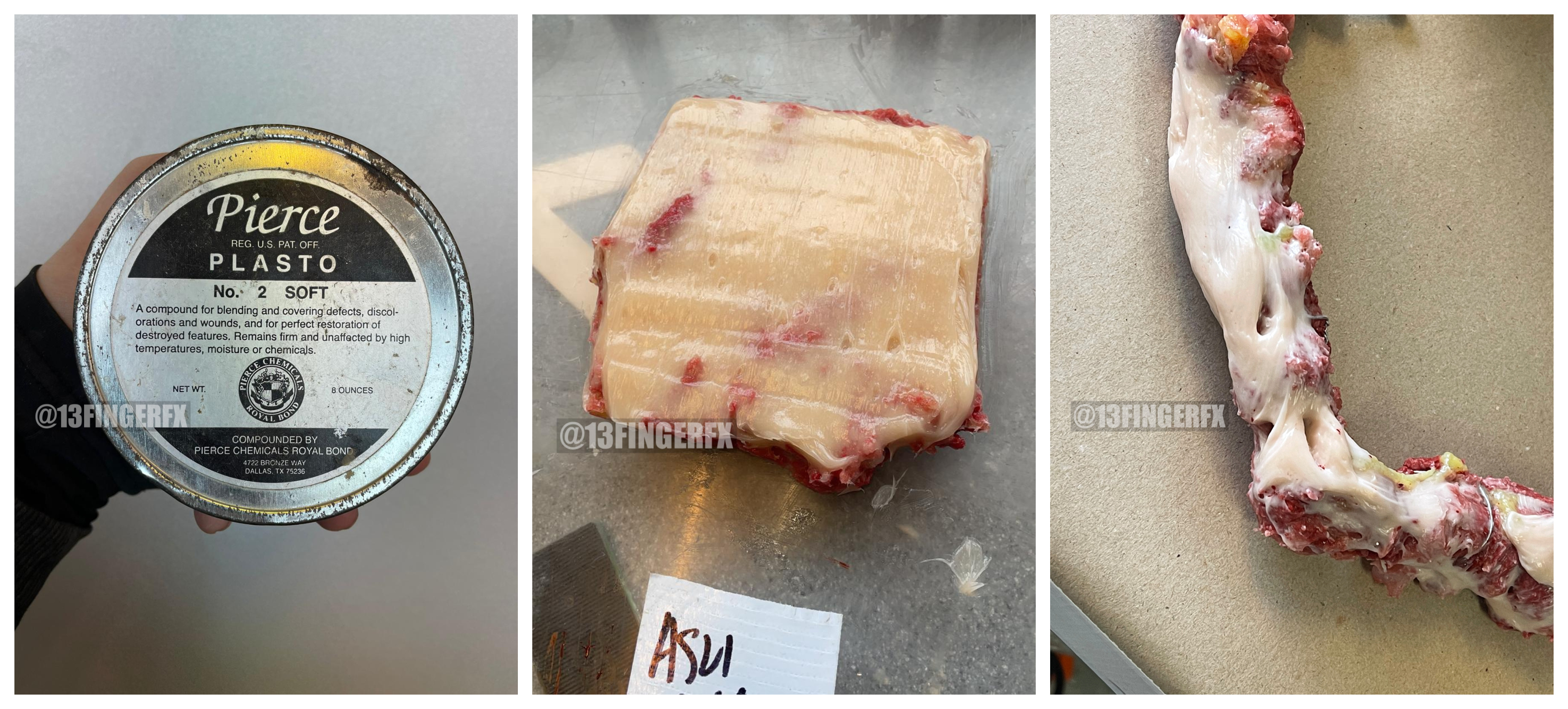 (Left, a tin of vintage morticians wax; Middle, an early material test for the 'wax over meat' that would be present in the Ash Man build; Right, material tests for the various meats and waxes being simulated for the puppets and suit. Images courtesy Dan Martin.)
"Even though we were going to be using silicone, which is a comparatively modern material, I was sort of inflicting backroom material choices on myself and my team," said Martin. "For example, the molds for Wax Girl were all dental stone because I didn't imagine that this character (Ella) would have access to fiberglass or epoxy resins or, you know, a safe laboratory space. Similarly, although some of the prototype armatures incorporated 3D printed elements, eventually, we were doing everything with metal and, again, with things that she'd have access to. We essentially made a box mold, poured a foaming silicone into the box mold around the armature, and then cut back the foam silicone. Then we started fabricating the meat and the wax over the surface and wrapping wire into it, trapping hair and dirt, fake dirt into it."
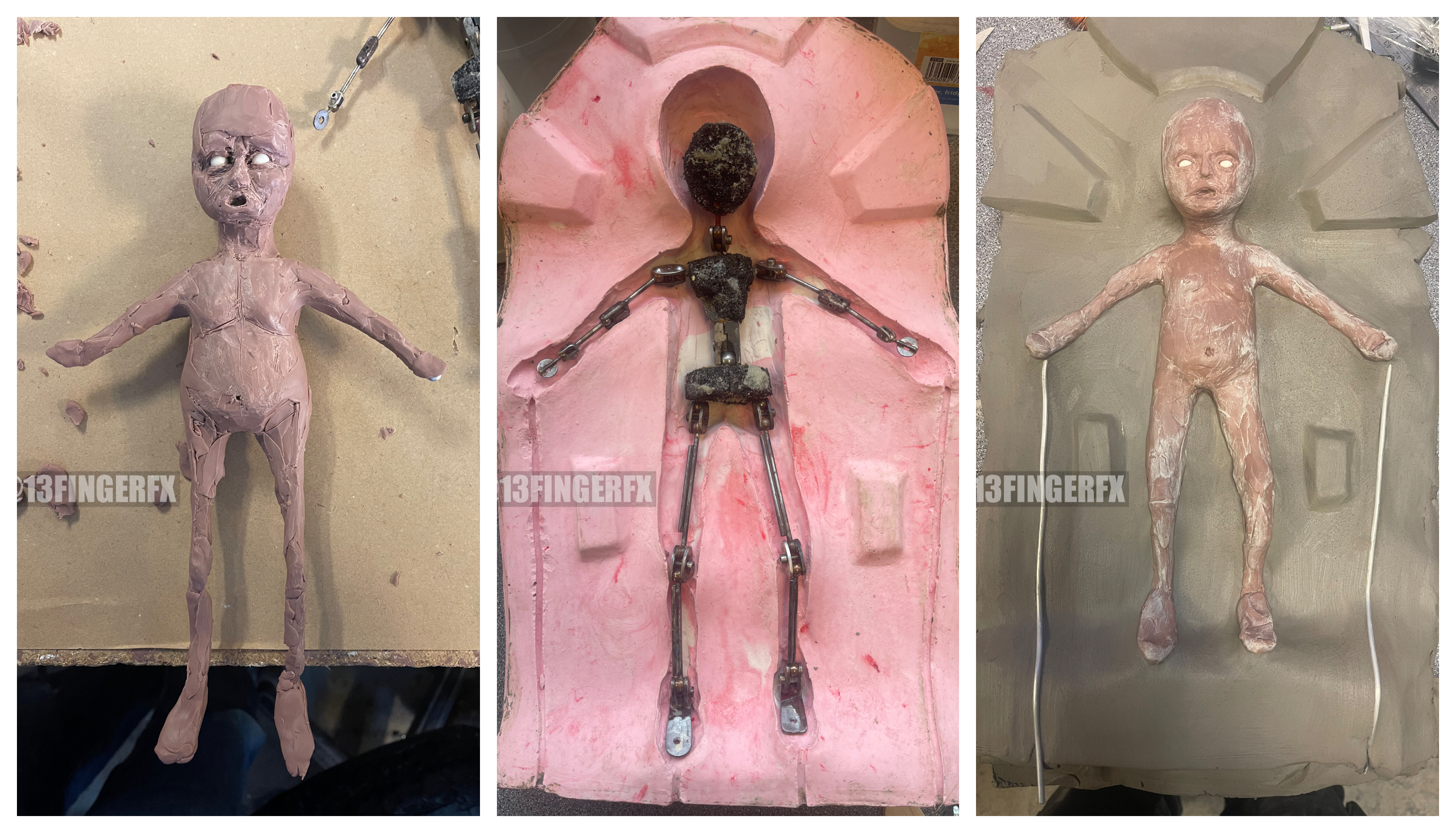 (Left, early block-out of Wax Girl, the advertising version of Meat Girl. This was the only puppet fully sculpted and molded, rather than being at least partially fabricated; Middle, the Wax Girl armature is placed in the plaster mold; Right, the cast puppet still in the mold. Images courtesy Dan Martin.)
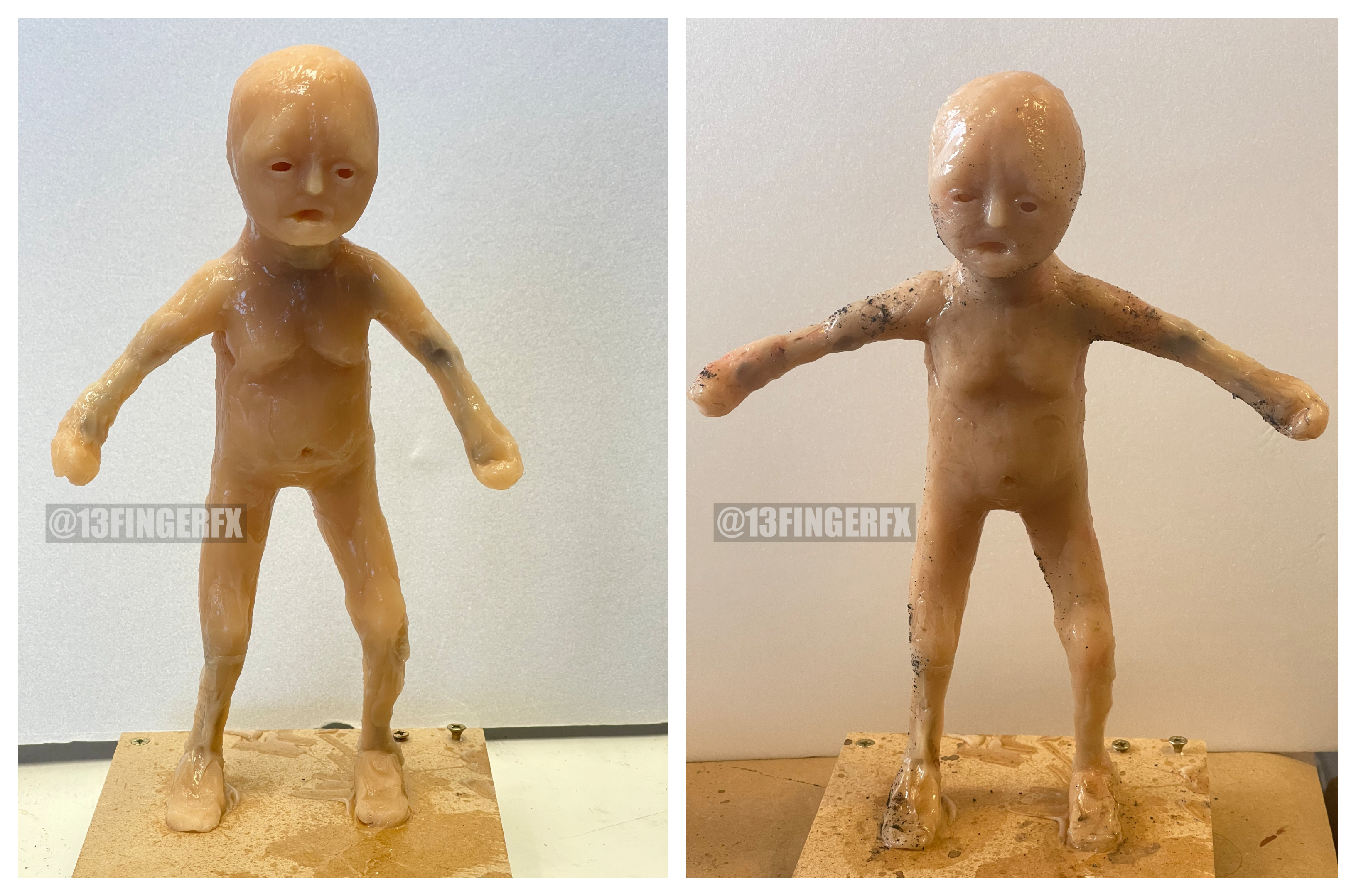 (Left, the Wax Girl animation puppet fresh out of the mold; Right, the Wax Girl made a little dirtier. Images courtesy Dan Martin.)
Martin said the effects team worked hard to create the fake dirt. "We'd put brown silicon glass through a meat grinder for our dirt, different colors, blacks and browns, to be able to get a stable version of dirt. We'd have a final layer of the dirt go over the surface so that it had that kind of crazed patternation that you get with the sort of slightly more counterculture stop motion where handprints and fingerprints and so on are sort of touching frame by frame. So, you get this almost, like a scattered grain running over the surface of the puppets. We didn't want there ever to be a point where, looking back at it, there was like a blank patch where too much had been taken off. So, we were incorporating some of that into the silicone as well."
 (Ella is led into the forest by the nameless girl, looking for a source of meat. Image courtesy IFC Films.)
When the little girl sees the first animated footage of the Wax Girl, she demands more changes be made. She suggests that Ella add something a little more organic to the puppet. Something like…meat. Martin explained that in the film, “The first iteration of Meat Girl is made from a cut of meat, like bought from a butcher. But then the second iteration of Meat Girl is made from roadkill. So, there were subtle differences within those pieces.”
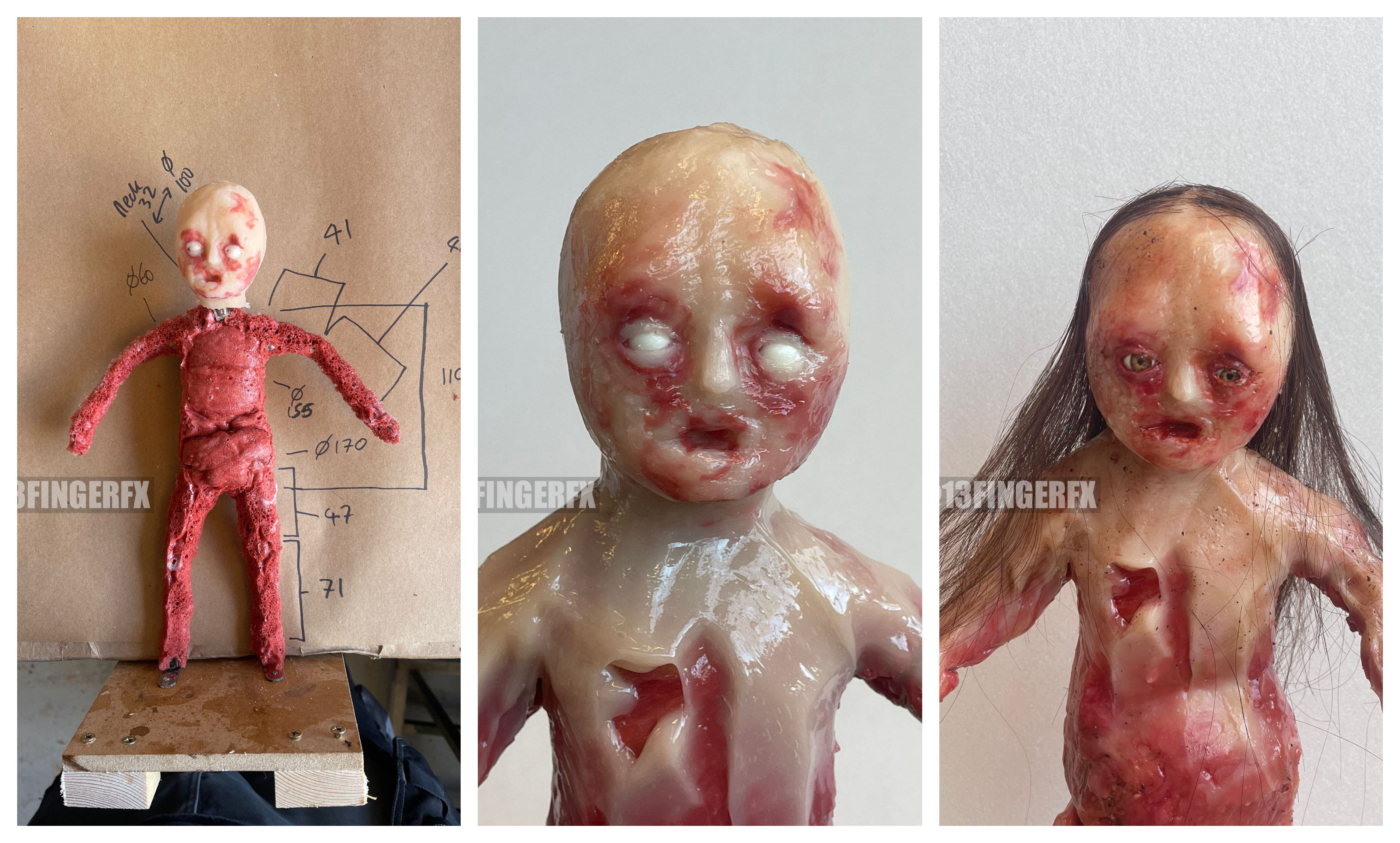 (Left, the smallest Meat Girl stop-motion puppet; Middle, early-stage Meat Girl puppet; Right, the finished stop-motion puppet for the first iteration of Meat Girl. Images courtesy of Dan Martin.)
 (Left, the final large Meat Girl puppet; Right, the largest Meat Girl puppet onset. Images courtesy Dan Martin.)
Building Animation Puppets
Martin described the process of building and detailing the animation puppets. "They're quite clean in the fabrication at the start. And then, because it's a layered process, as we build it up further and further, we start to put those levels of sort of schmutz into them. Again, that's mostly ground silicon glass. We didn't want to affect the opacity. And then, between every layer, you have to make sure that everything's still moving, and you haven't blocked any joints or anything like that. And then again, because the character (Ella) in the film world has been building these herself, she's been binding this stuff around an armature with wire. So we did use very thin aluminum wire in the manufacturer of it. But again, making sure that when we crossed joints, we weren't inhibiting movement or anything like that."
Martin said that the artists creating the puppets were forced to come up with materials that could replicate the look, texture, and movement of what the puppets were supposed to be created from. "…making sure that we could create those surfaces in a way that would read on camera, but also move as those things would move. We didn't want anything to de-laminate or split as it would if those materials were real. So, there was a mix of sculpture and fabrication all the way through. Like heads, anything with detail would be sculpted and cast, but then a lot of the bodywork would actually be fabricated into the process to be able to get that organic feel."
Introducing the Advertising Wax Girl Puppet
 (A portion of the advertising set in the studio where Ella discovers that her boyfriend's sister Polly has stolen her animation ideas. Image courtesy IFC Films.)
At one point in the film, Ella finds a job working at a commercial animation studio where her boyfriend Tom's sister works. Earlier in the movie, Tom's sister Polly visited Ella and saw her spooky forest set and wax puppets. When Ella begins working at the animation studio, she discovers that Tom's sister has stolen Ella's storyline and forest set for a commercial project. Ella tears apart the commercial set and puppets and flees.
"There's a version of Wax Girl, the precursor to Meat Girl, on the advertising set," said Martin. "When [Ella] sees her pieces, her aesthetic being stolen, we made a puppet that could be torn apart. That was on a custom armature."
Making Lifelike Eyes for Stopmotion's Puppets
As mentioned before, part of the design concept with the animation puppets was to make them look like they were made from materials that Ella would realistically have access to. This design aesthetic would realize itself in other forms. While the Wax Girl puppet would simply have holes poked into the head for eyes, the similar Advertising Wax Girl puppet that Ella sees in Polly's studio would have eyeballs. "We had very basic eyes for the advertising version, and we wanted the eyes to become more and more realistic as she continued," said Martin. "Those eyes were white spheres, hand rolled into an eye form, and then I'd hand paint them, and we'd build them up with layers of clear resin. There was no positive mold for those other than the one that we originally got the white spheres out of."
The progression of the puppet eyes from simple holes to rolled balls of clay to realistic eyes would also make its way into the design of the Ash Man character. "The idea is that by the end, Ash Man has harvested eyes. So, we were copying eyes from the performers, from the other actors, and there's a fox eye in him that sort of grows with him as well."
Stopmotion's Ash Man
The Ash Man is described in the film by the nameless neighbor girl as, “The man no one wants to meet.”
 (Two of the Ash Man animation puppets built by 13 Finger FX for the film. Image courtesy Dan Martin.)
As the little girl's story evolves and Ella's animated film continues, a creepy figure begins to move through the miniature forest outside of the Wax Girl's cottage. This is the Ash Man, a disturbing, shambling figure. "We did three Ash Mans at the smaller scale. One was essentially a spare. And then we had two different versions of him with subtle differences," said Martin. "He was much more meat-heavy and much dirtier right from the get-go. Again, as the name suggests, he's had sort of burnt matter built into him as well."
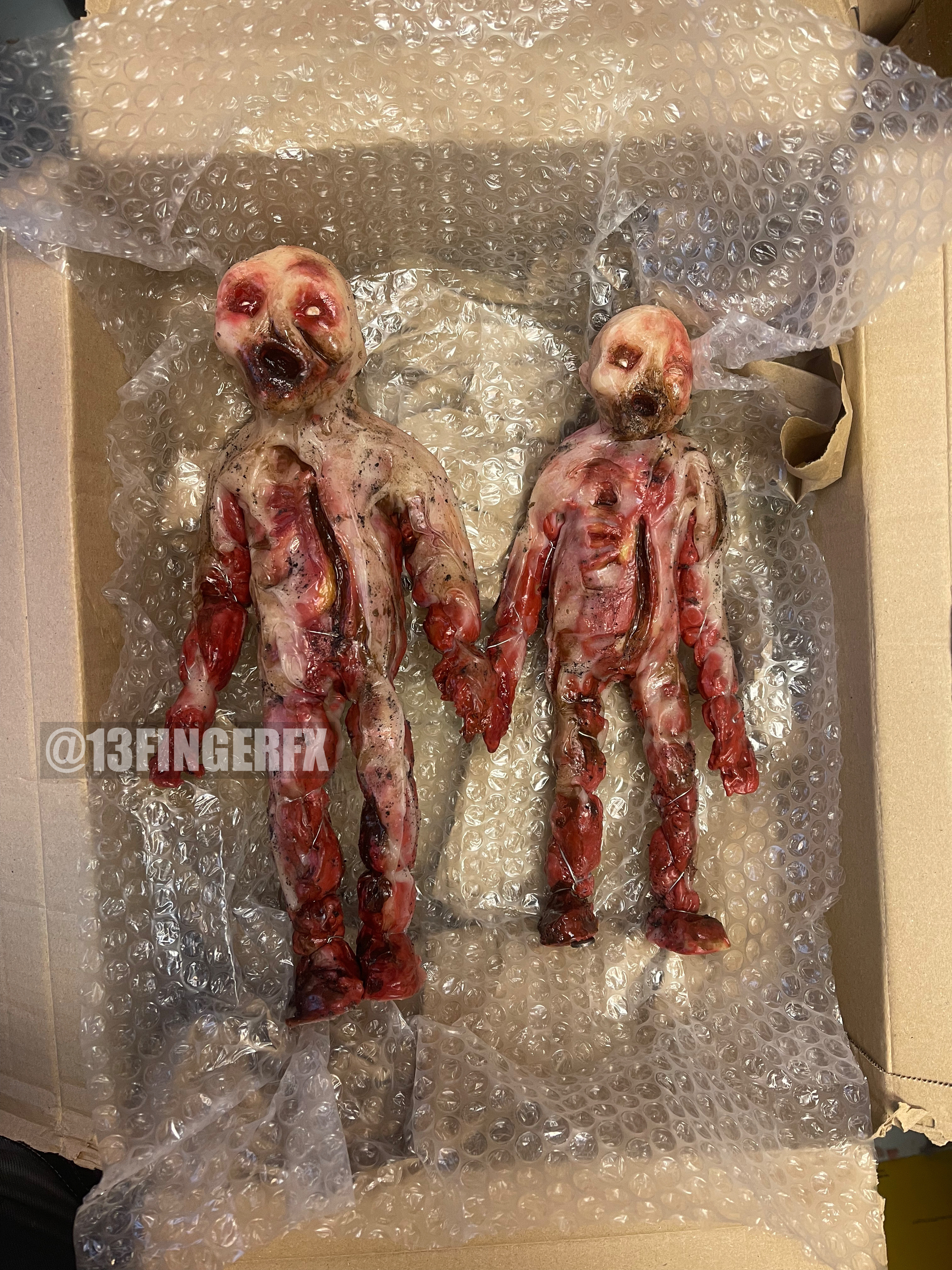 (The second and third stage Ash Man puppets. Image courtesy Dan Martin.)
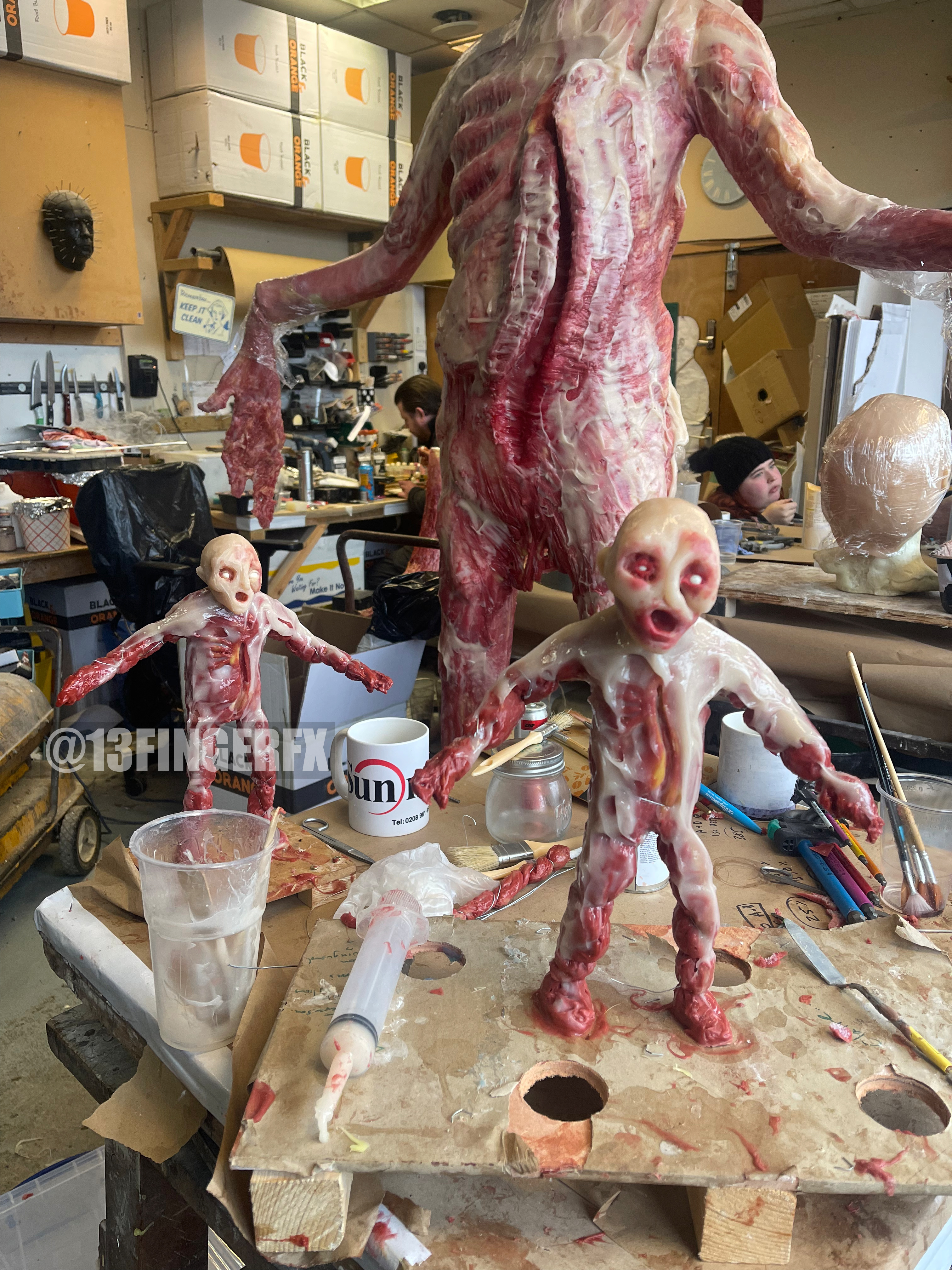 (Three versions of the Ash Man. Beth Leigh and Dan Gomer can be seen working in the background. Image courtesy Dan Martin.)
Creating Realistic Teeth With a Taxidermy Set
The puppets and the film keep evolving as the nameless little neighbor girl leads Ella into a fog-shrouded forest, where she shows her the body of a dead fox. Nameless Girl tells the animator that the Ash Man puppet needs to be built with parts from the dead animal's body. Martin revealed, "The teeth in Ash Man were actually molded from an old taxidermy set. No actual animals were used in the creation of the puppets. I used the old dental process of casting them out of acrylic and then just grinding away everything. You don't want to make individual teeth. So, we had different-sized versions because foxes have very small teeth in some areas, and then the molars are sort of fused." He continued, "At the beginning, we were using the smaller needle teeth to drop into that horrible mouth. When you get to the end, you'll see that we're using the larger fox teeth."
 (An early set of the Ash Man's teeth, made from a taxidermy set by Dan Gomer. Image courtesy Dan Martin.)
For the middle stage of the Ash Man, Martin said that part of the character design led to some discussion between the artists involved and director Robert Morgan. "We'd make something, and Rob would be like, 'This is great, let's just go with it.' But the middle stage of Ash Man... was very pivotal to how he was moving as a character. The shape of the mouth was something that we went back and forth on quite a lot until we found the version that was sort of threatening but didn't feel peculiar for it to be static because we knew we weren't going to be having jaw movement with him. So, we had to find something that worked as a still visage, without feeling like it was a fault that it wasn't moving.
Using Library Body Parts for Suzanne's Corpse
There is a scene in Stopmotion where Ella sees the body of her mother lying on the living room floor. A quick cut reveals that her mother is now a corpse that appears to be made of clay and wax body parts, like one of Ella’s animation puppets.
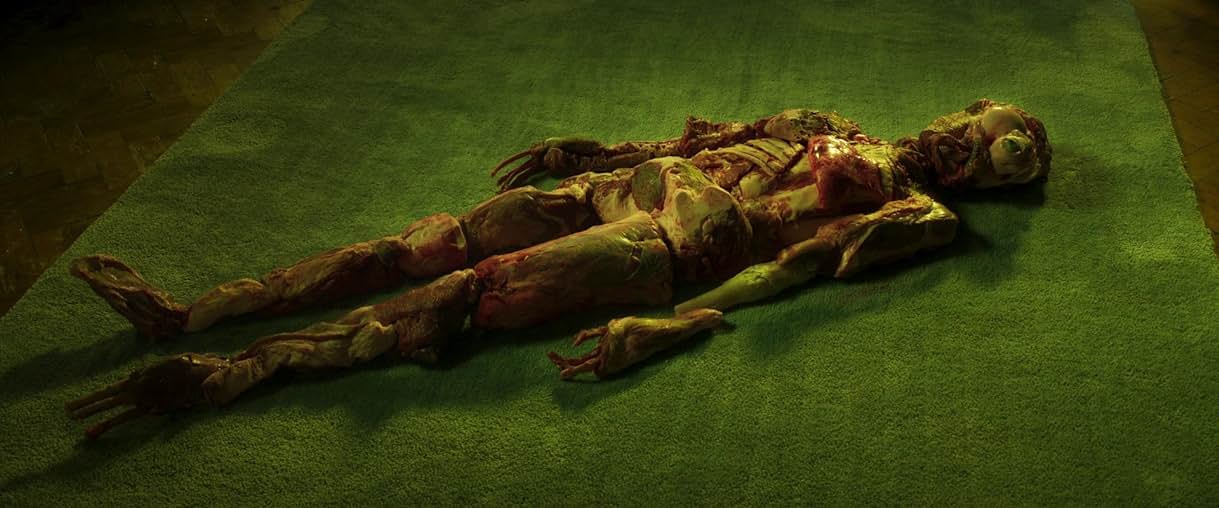 (Suzanne's corpse was made of various library body parts provided by 13 Finger FX and put together by the art department. Image courtesy IFC Films.)
The quick shot of Ella's dead mother, Suzanne, on the floor, looking like an animated puppet, was a group effort. "It's a mixture of things," said Martin. "We provided a bunch of body parts, and then Felicity Hickson, the production designer on that job, and her team were responsible for wrangling that stuff together on the day." Martin felt this was a great example of the director having an excellent eye for something that the audience will find unsettling.
Molding Wound Appliances
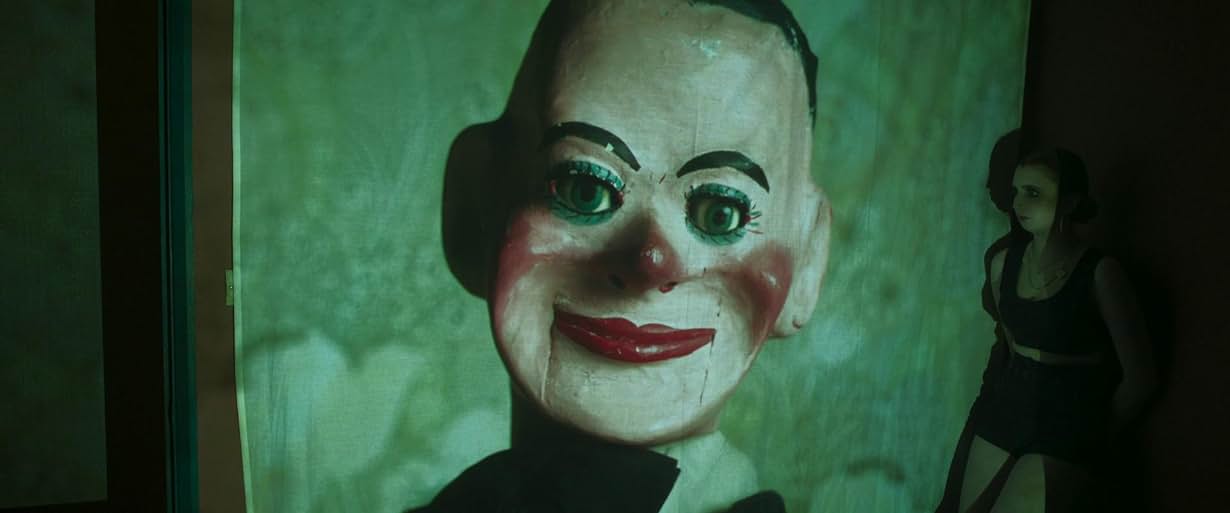 (One of the creepy masks seen by Ella in the nightclub. Image courtesy IFC Films.)
At another point in the film, Ella goes to a dark dance club filled with creepy people in makeup and masks, including a ventriloquist's dummy head. Many of the club patrons' masks, including the ventriloquist puppet head, were sourced by Felicity Hickson and the art department. Two of the club patrons begin fighting, and one smashes the other over the head with a beer bottle, leading to a disturbing gore effect. After the beer bottle victim hits the floor, Ella goes near him… and sticks her fingers into the bloody head wound.
To create the effect, Martin explained how he constructed the appliance for the head wound. "In order for there to be some depth in the wound when Ella sticks her fingers into it, the wound appliance would, in fact, be a combination of two different pieces. I tend to use little floating pieces inside the mold. When you do a flat mold like that, I'll often pre-sculpt the inner texture and have that like a leaf that can be dropped into the sculpt, and then that can pin into the mold. So, when you run the piece, it has this separate piece inside." Martin continued, "It was just an encapsulated rubber piece that was applied by Beth Leigh, who was my key for the prosthetics stuff on this. Beth's been with us for ages. She's amazing. We almost used just a library piece for that wound, but in the end, I sculpted something unique for it, just for size."
Breaking Down the Puppet in the Doorway Scene
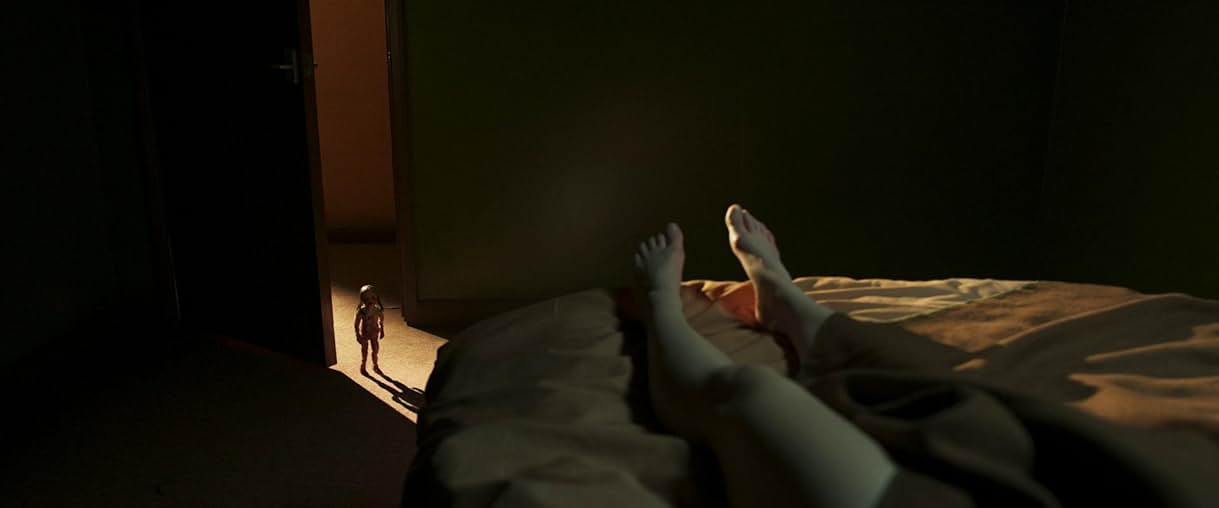 (The Meat Girl animation puppet comes for Ella. Image courtesy IFC Films.)
You know in a movie when you see a creepy puppet standing in the bedroom doorway, things are not going to end well. That scene in Stopmotion begins with Ella lying on her bed. The Meat Girl puppet stands in the doorway, its shadow stretching across the floor. The puppet walks to the bed, climbs up, and starts to dig into Ella's bare leg.
Martin explained that the shot required both live-action and animated elements. "It's a puppet leg and a composite. It was a case of locking off the shot, setting up the live-action sequence, and then handing that over to the animation team with a puppet leg with the wound already present." The live-action and animation teams would frequently work on the same sound stage. Raised versions of the sets were constructed so that animators could pop out of hatches built in the floor to do their work.
Using a Floating Mold Effect for the Death of Polly
Ella repays Tom’s plagiarizing sister Polly by murdering her with a camera tripod, jamming the leg of the camera support deep into her victim’s throat. A floating mold effect similar to the head wound was used for this. “This was quite late in the shoot. We were quite light on time," said Martin. "We had a bunch of appliances to sort of stack as the sequence went on. Beth Leigh applied those pieces for me and did a really beautiful job. It was a crazy day. The amount of time that that sequence was shot in is inhuman."
Challenges of Using Larger-scale Animation Puppets
Ella then goes on to kill her boyfriend, Tom, after she has murdered Polly. The dead siblings would then come back as animation puppets. “The way I built those was the heads were sculpted, and molded, and cast," said Martin, "and then everything else except for a few patches of body detail was fabricated.”
 (The larger-scale animation puppets confront Ella. Image courtesy IFC Films.)
For these scenes, larger-scale animation puppets were made of Tom and Polly. They were so large that they needed external support to hold them upright and steady. "They ended up being about three times bigger than the original puppet. They were about two feet tall. So, one-third scale," said Martin. "For anyone out there interested in stop-motion animation, that is a ridiculous and bad idea as far as stop-motion puppets go."
 (The largest Meat Girl and Ash Man puppets, in the middle of fabrication. Image courtesy Dan Martin.)
 (Left, another view of the large Ash Man puppet; Right, the same puppet with the Meat Girl in the background being worked on by Becca Birch. Images courtesy Dan Martin.)
"Like the thing about how giant spiders couldn't exist because they wouldn't be able to physically carry their own weight? It's very much the same with stop-motion puppets," Martin explained. "So, we did have a fair amount of rig removal done in post for some of those. Although that was always part of the workflow for the stop-motion sequences. They're very, very smooth." Martin praised the animators. "The team that did the actual stop-motion animation was absolutely fantastic." He continued, "The fluidity of movement and the fluidity of the steps that they managed to get, the walk cycles, were really, really beautiful. And obviously, that's because even with the lighter puppets that could hold their own weight, they were at all times supported by a flexible back rod that could be moved very incrementally."
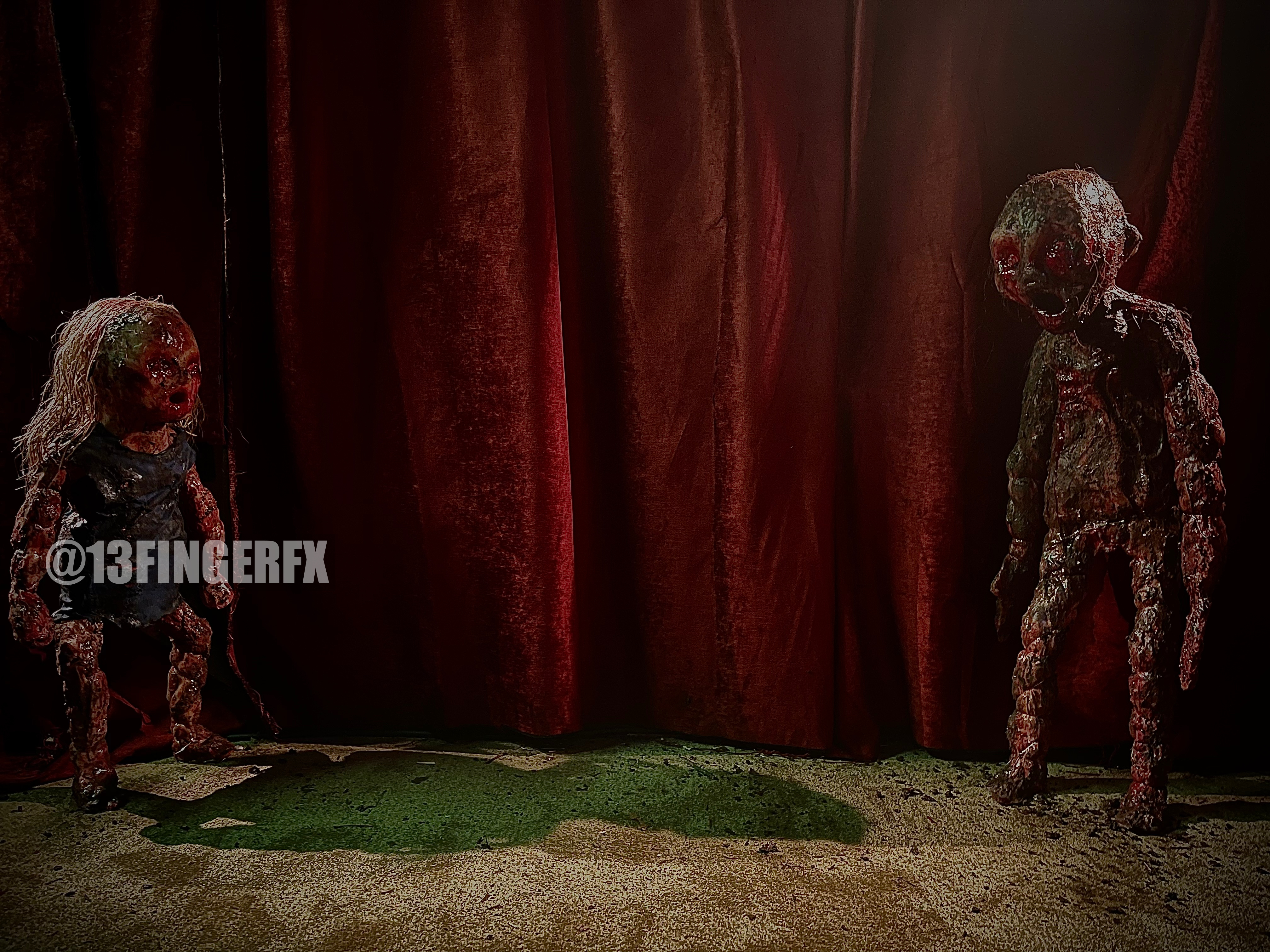 (The large-scale Meat Girl and Ash Man puppets onset. Their support rods are hidden by the curtains behind them. Image courtesy Dan Martin.)
"[The support rods] had a 20 mil, steel sphere connector coming out the back that was on a bit of 12 mil rod. And then they had another one of those in the back of the head. The main weight was taken by the one in the back. And then the one in the back of the head allowed for the head to be forced. In the end, the head was almost separate from the body. The armature was there, but we ended up having to put a separation in the rubber. And so, the necks were actually being touched up and maintained between shots. Even with that silicone foam, because of the steel for the armature and stuff, I think they ended up weighing about 11 kilos (about 20 pounds).”
Making Wax Limbs
Martin would return to his notes from his past wax projects to build the life-size body parts that Stopmotion required. The first wax effect shows Ella in the shower, rubbing her fingers across her leg. She then digs her fingers deep into her skin, which is now made of wax like her puppets. "We basically did a fake leg in the same way that you would normally. We had a life cast, tidied it up, molded it, and made a core. The mold was done in such a way that it had a much more heavily segmented fiberglass jacket than normal, so that we could have a silicone insert, and then we could take the jacket apart without damaging the wax inside." A fiberglass core inside the mold supported the wax. Martin continued, "I think we ran that wax about an inch-and-a-half thick so that however she wanted to interact with it, she wasn't going to be hitting fiberglass in the middle. But, the thicker it is, the more it shrinks. You have to find that middle ground so that it'll work. The final blend of wax for that ended up being a combination of Tussauds proprietary synthetic microcrystalline wax and then a stearic acid wax, the kind that you might use for the air gun pellets for shooting people with blood pellets." A little petroleum jelly was added as well. He says the result was a leg that "…you could dig into it, but not so soft that you couldn't get it out of the mold. And then that was just painted with alcohol palettes."
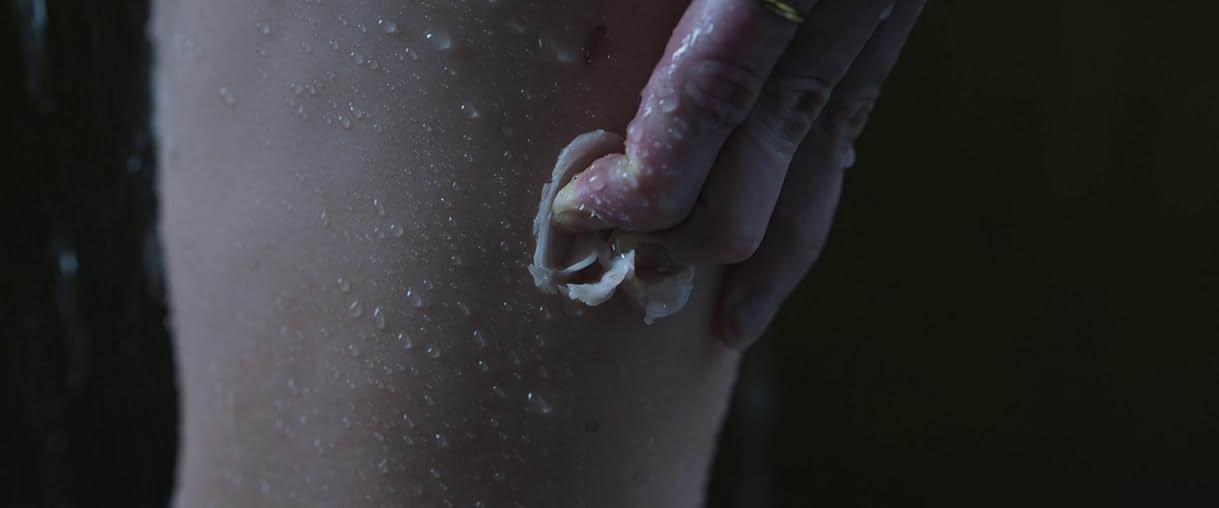 (Ella digs her fingers into a wax leg built by 13 Finger FX. Image courtesy IFC Films.)
A similar effect was used for one of the most disturbing shots in Stopmotion when Ella digs her fingers deep into her face... and it appears to be made of mortician's wax! This startling effect was created similarly to the leg effect, only using softer combinations of wax. With all of the film's disturbing focus on mortician's wax, Martin revealed, "The only instances of actual wax, and it wasn't mortician's wax, are the shots where her fingers start to dip into her leg and face."
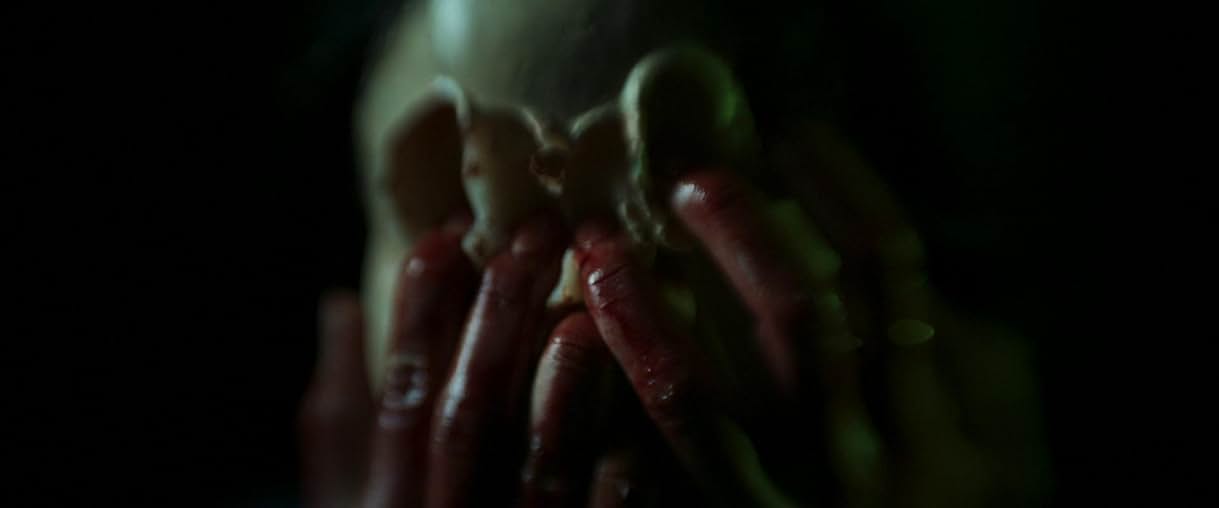 (The startling shot of Ella's wax face. Image courtesy IFC Films.)
Using a Library Mold for Ella's "Jelly Legs"
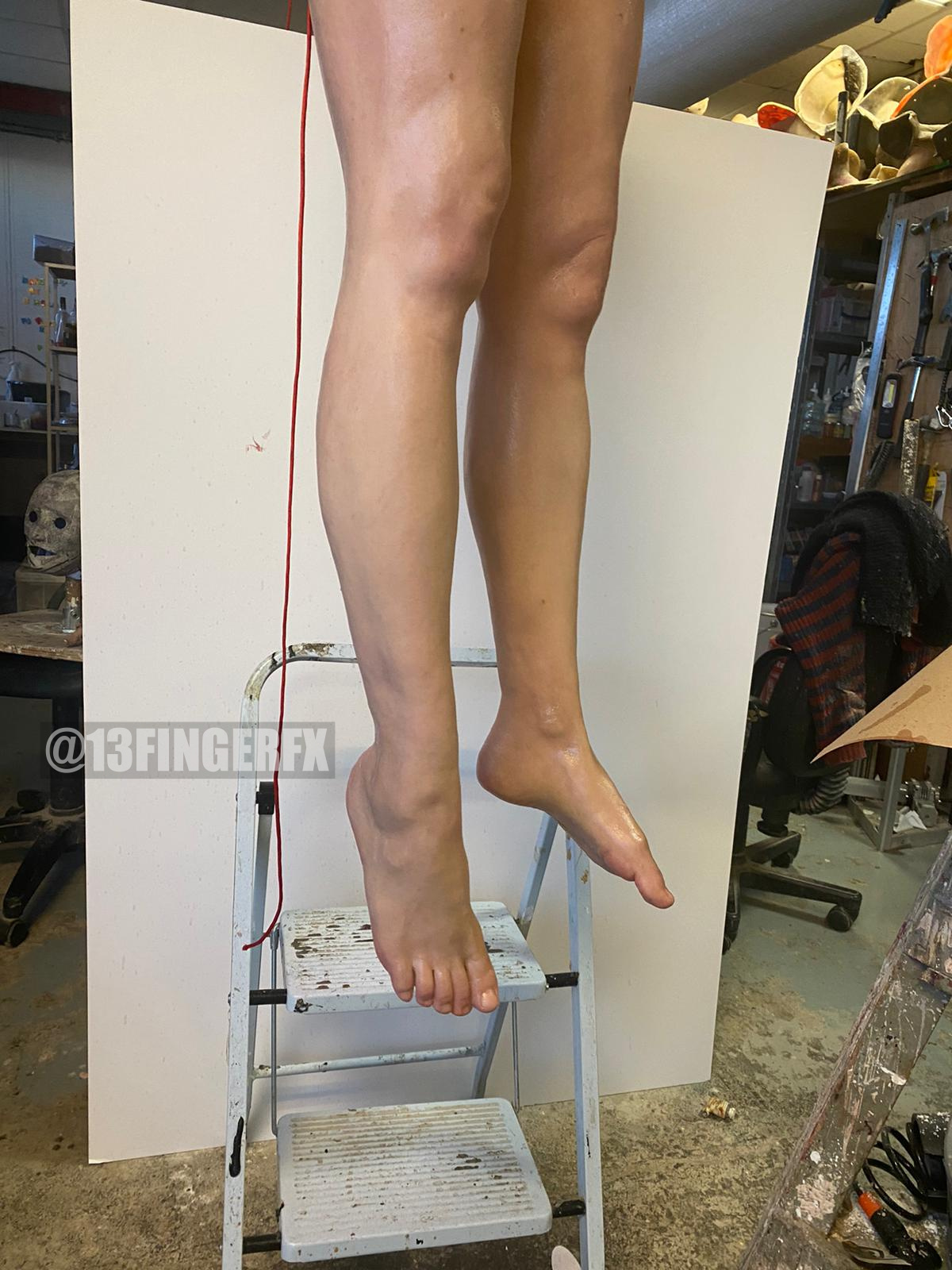 (Ella's 'Jelly Legs' are being painted in the shop. Image courtesy Dan Martin.)
Near the end of the film, a scene takes place where the human Ella is confronted in the cottage by a life-sized Ash Man. Ella tries to flee, but…her legs crumple like a loose puppet's. Martin and his team humorously referred to the effect as 'Jelly Legs.' "Jelly Legs was a library mold," said Martin. "We ran them with a silicone skin, but instead of coring, we just did a brush-up skin on the inside and then did a mechanical bond to a very soft foam interior. And then they were used like puppets. We had them on sticks like a set of insert creature legs. But they didn't have any internal structure at all, so they just folded."
Building a Life-size Ash Man
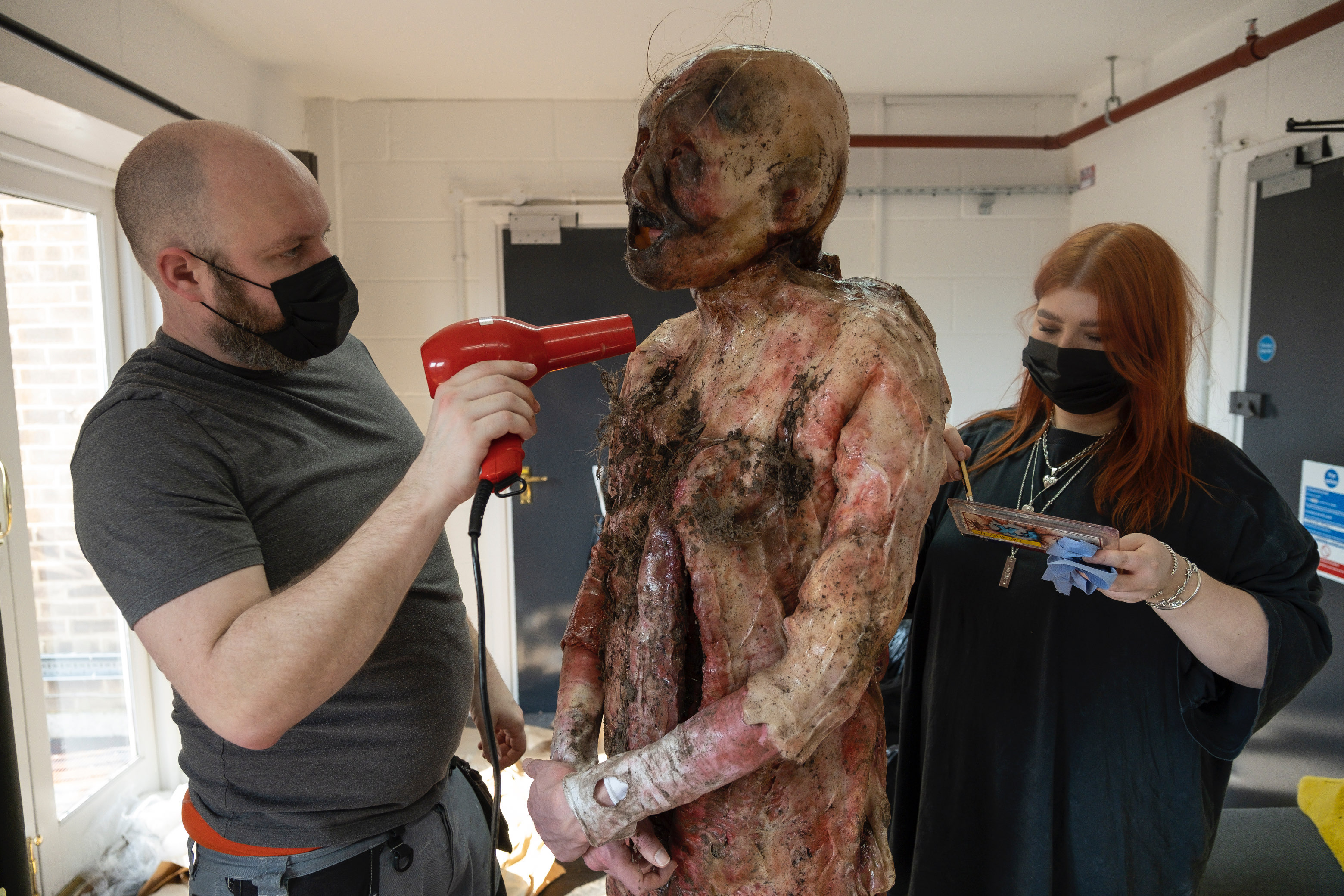
To represent the human-sized Ash Man animation puppet that attacks Ella in the cottage, Martin and his team built one suit that could accommodate different elements. Martin said this was “…partly for repair and maintenance, and then partly because we had different versions of the head as well. We had one suit, but there were different elements that we swapped in and out.”
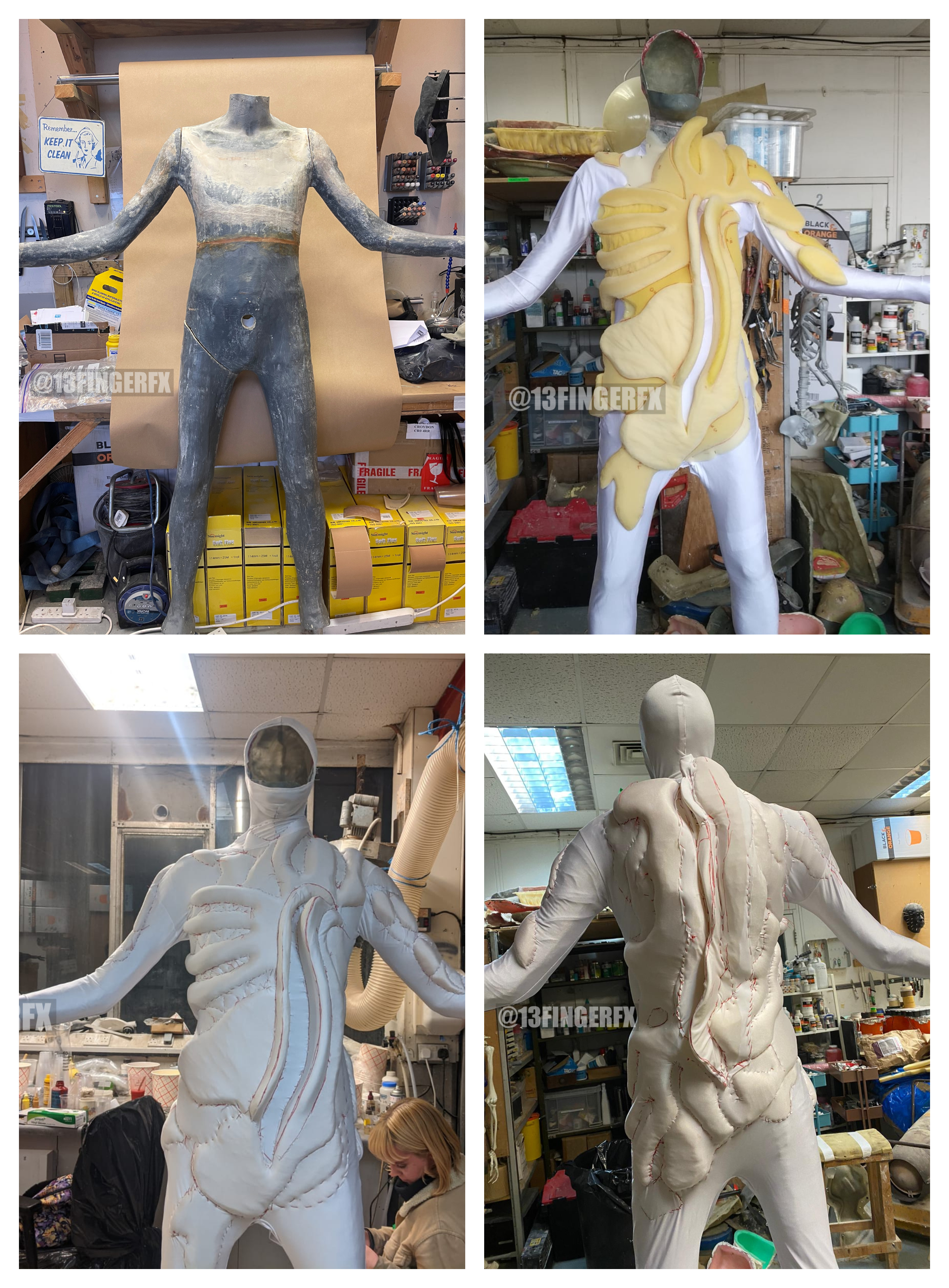 (Top Left, James Swanton lifecast; Top Right, foam forms that were built for the undersuit. Images courtesy Dan Martin.)
(Bottom Left, Charlotte Lewis works on stitching the Ash Man undersuit; Bottom Right, rear view of the Ash Man undersuit. Images courtesy Dan Martin.)
 (Top Left, Jamie Rochford stipples rubber onto the undersuit for Ash Man; Top Right, a closer look at the suit's 'meaty colors'. Images courtesy Dan Martin.)
(Bottom Left, silicone is used to continue building up the suit's features; Bottom Right, translucent silicone will be added over the yellow fatty tissue seen here. Images courtesy.)
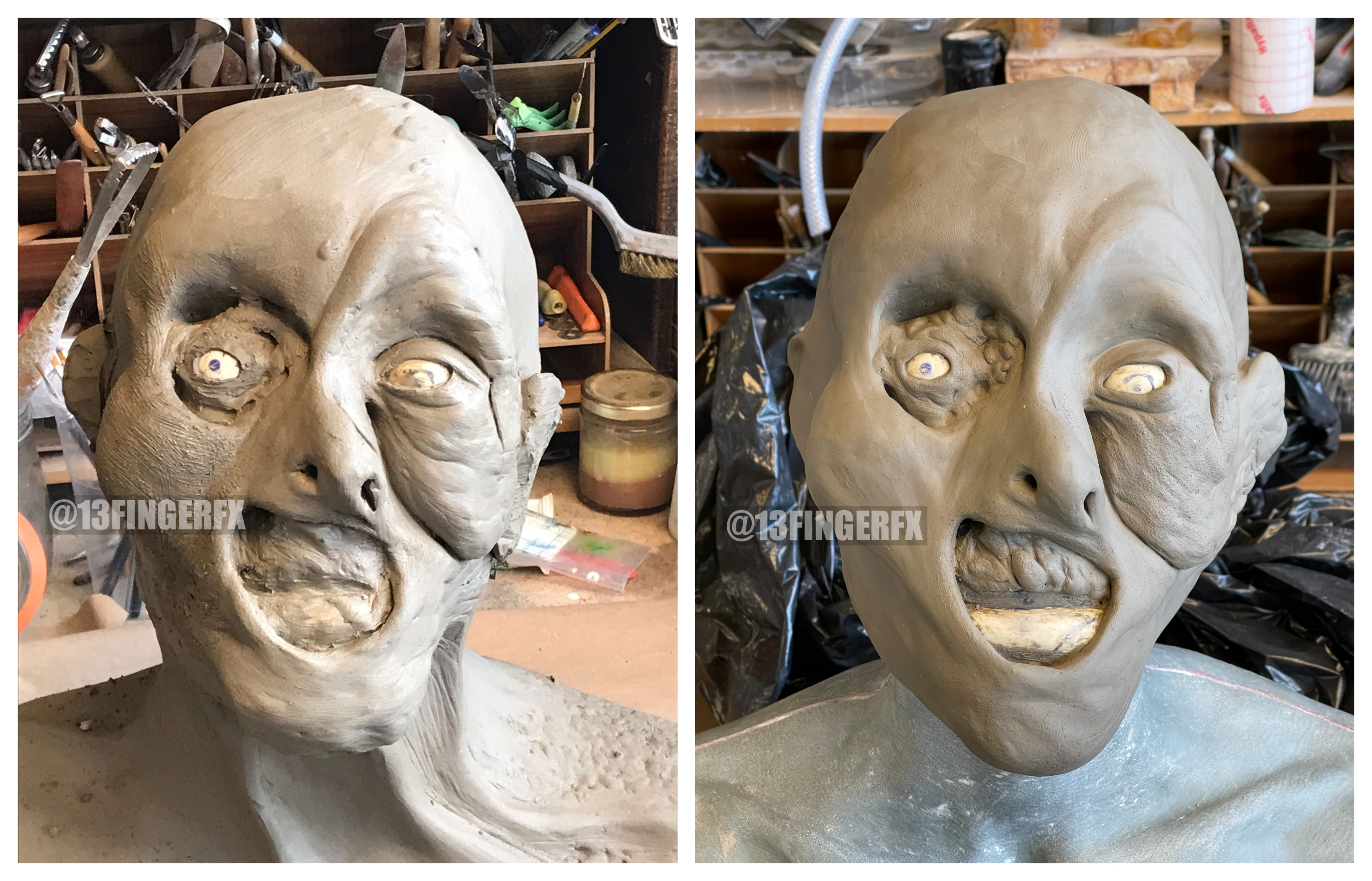 (Left, early-stage sculpt of the Ash Man mask by Jamie Rochford; Right, the final sculpt of the Ash Man mask, by Jamie Rochford and Dan Martin. Images courtesy Dan Martin.)
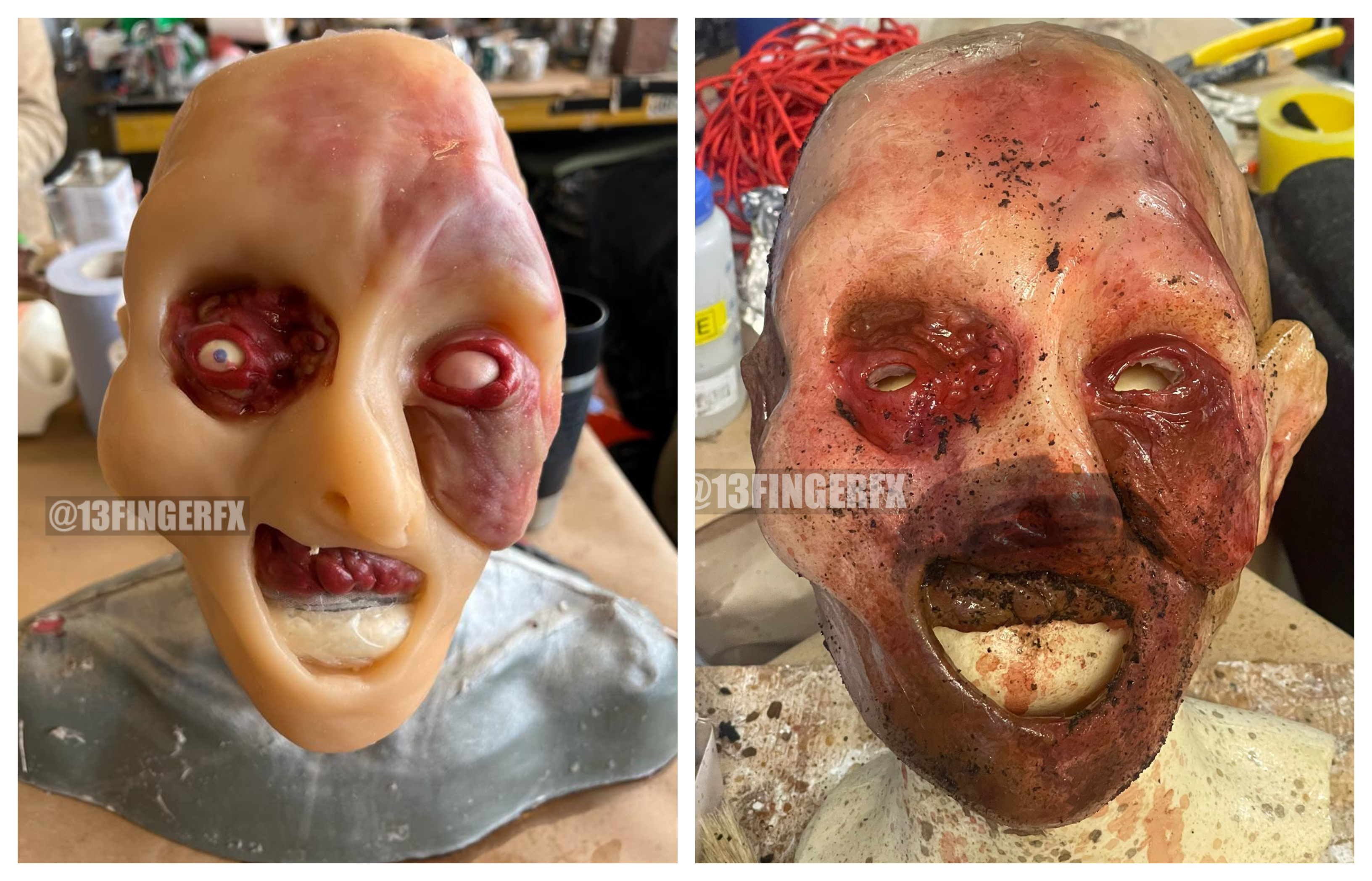 (Left, the mask for the suit version of the Ash Man, fresh out the mold; Right, the Ash Man mask with paint and dirt added. Images courtesy Dan Martin.)
 (Comparing the stop-motion puppet Ash Man head with the mask for the suit version. Image courtesy Dan Martin.)
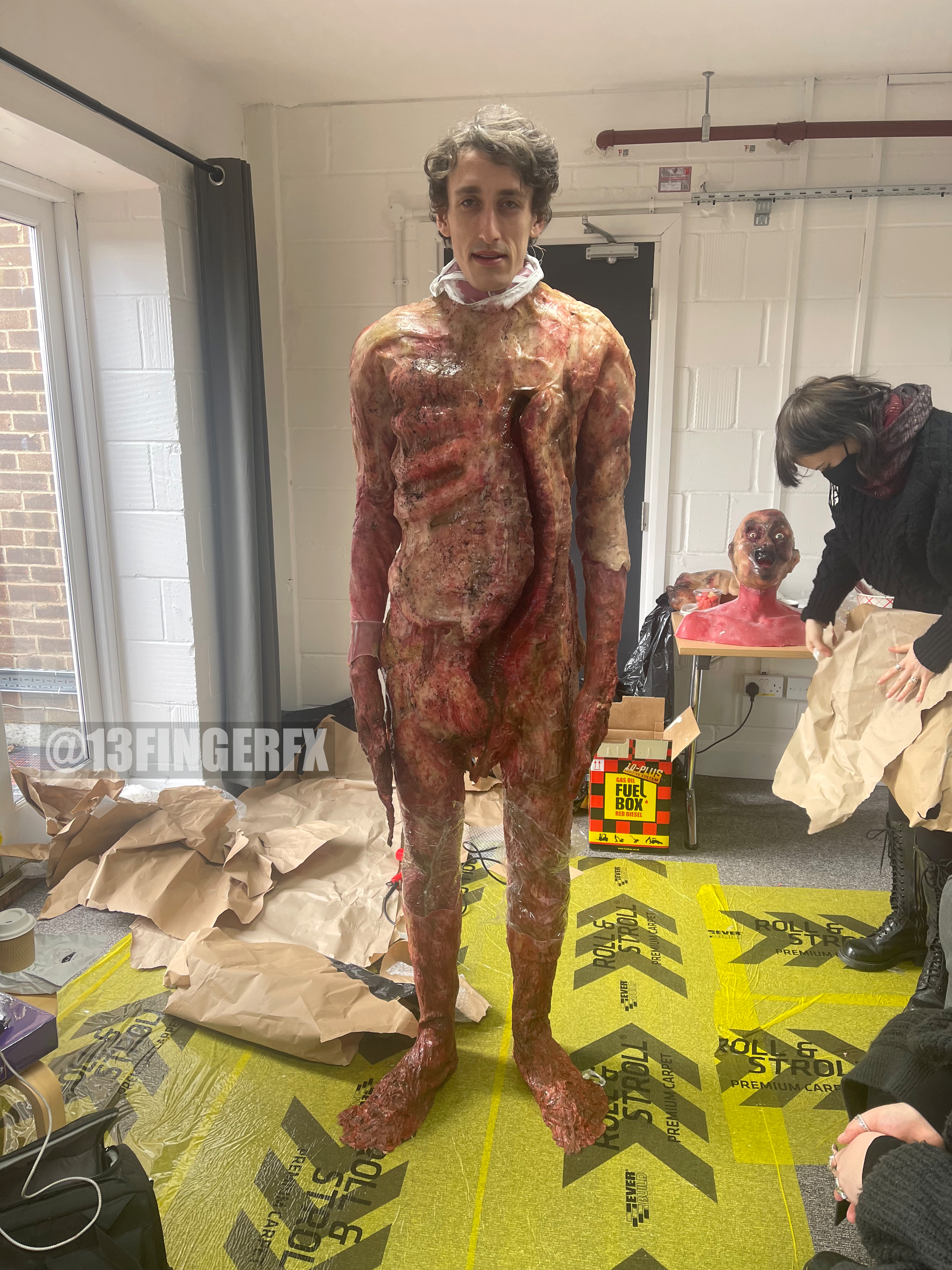 (Roz Gomersall dresses James Swanton in the Ash Man suit at Three Mills studios. Image courtesy Dan Martin.)
 (Left, Dan Martin tests the mask for the Ash Man suit; Right, James Swanton in an early fitting for the Ash Man suit. Images courtesy Dan Martin.)
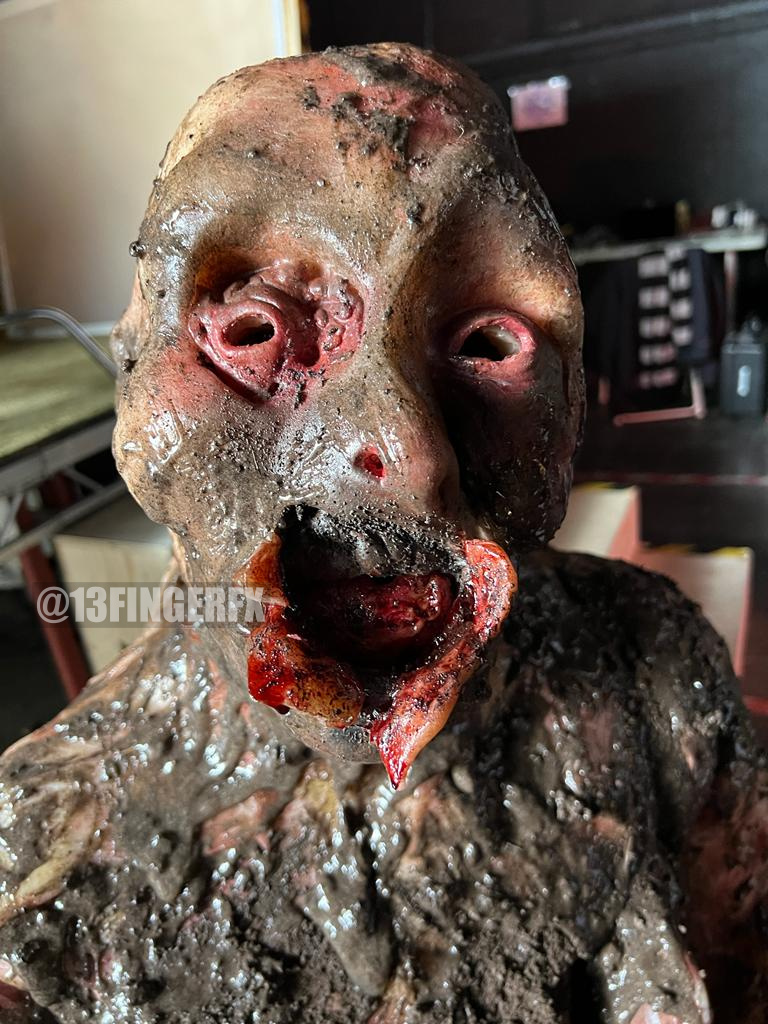 (The filthy, final stage Ash Man suit with modified mouth and no eyes. Image courtesy Dan Martin.)
 (Dan Martin and Beth Leigh dress James Swanton in the Ash Man suit. Image courtesy Dan Martin.)
Martin and his crew knew there would not be time for long makeup applications, so the Ash Man would be primarily suit-based. "[Stopmotion] is not a huge film. Time was going to be really important. We couldn't have him in the chair for eight hours. So, we knew it had to be predominantly suit-based. We contrived some of the anatomy of the back to be able to hide things like zips and so on, so that we didn't have to worry about blending stuff in." Martin said, "The performer playing the full-size Ash Man is creature performer James Swanton (Underground, Lot No. 249, The First Omen,) who I've worked with for years now. James is absolutely fantastic."
 (The Ash Man peers into the cottage where Ella is hiding. Image courtesy IFC Films.)
In the startling moment when Ella sees the Ash Man peering in at her through a hole in the cottage door, a puppet Ash Man head was used. "We had the standard head, and then we had a puppet head as well so that we could have mobile eyes inside. Otherwise, it's completely static," said Martin. "All the stuff through the peephole is the puppet head. So that's being hand-manipulated. We had a version of his mouth where he'd sort of had everything gouged out, almost like he had lips, and that was much paler, more translucent wax to be able to catch light, to have stuff coming through."
 (Creating Ash Man's human and fox eyes. Images courtesy Dan Martin.)
 (Running the human and fox eyes for the Ash Man suit. Image courtesy Dan Martin.)
Martin described how the Ash Man beginning to feed on Ella shot was accomplished. While puppeteering was used for some of the Ash Man head shots, Martin said that the mouth of the Ash Man mask was not articulated but simply very flexible for the eating scene. "Depending on which shot it is, it's either one where James is wearing it, or it's one where my hand is inside it."
The Ending of Stopmotion
 (The final Ella Wax Girl puppet pulled from the Advertising Wax Girl mold. Image courtesy IFC Films.)
Finally, Ella becomes one of her creations as she turns into the Ella Wax Girl animation puppet, similar to the original one. This version is very clean, without the meat and dirt. Martin explained that this puppet was also made of silicone and pulled out of the Advertising Wax Girl mold. The Ella Wax Girl puppet finds herself inside the miniature cottage set seen earlier with the Ash Man lurking outside. The Ella Wax Girl puppet crawls across the floor and climbs into a fabric-lined chest, a gold interior we have seen earlier in the film. To finish the film, the Ella Wax Girl pulls the chest lid closed behind her.
The Beauty of Practical Effects and Horror
Stopmotion is an artistic film with a clear vision and strong visual aesthetic. Many creative artisans worked hard to bring Robert Morgan's vision to the screen. "I don't think there was ever any consideration that any of the animation would be digital," said Martin. "There's an innate aesthetic deficit in computer-generated imagery when you're trying to do horror stuff because there's such an immediacy to practical objects. Even if a practical effect doesn't work a hundred percent, it's still a tactile object. It's still physically in the space; the same lights are hitting it. It's a real object. But if a digital effect doesn't work 100%, it's immediately, completely artificial. Whereas audiences are very forgiving about practical effects because they want to believe it and because it is just innately lending itself to being believed. No one's ever gonna believe that Wax Girl is a living creature, but the animation does that step for you. The story of the world provides that realism; all you have to believe is that she is a physical object in space."
In the end, Martin revealed his favorite part of the job. "My favorite bit of the job is coming up with stuff, problem-solving from a technical side as well as from an aesthetic side. As for working with Robert Morgan, Martin said, "I love a director with a strong vision. He was very articulate with what he wanted, but he was also very open to ideas. He was a very good collaborator, which is always fantastic. It was nice to be able to just have an idea and shoot off a text, or next time I see him just say, Hey Rob, I had this really good idea. He was very receptive to that kind of stuff." Martin also credited the film's editor and sound effects crew for helping bring the visceral characters to life.