

An Interview Creature Effects Genius Steve Wang
Today's monster maker interview features the man who Guillermo del Toro calls “an unsung, or not-often-enough-sung, genius,” creature designer, monster maker and film director Steve Wang.
CLICK on the video above to watch the FULL INTERVIEW.
In our exclusive, brief video interview with Steve, he talks about discovering latex masks at a toy store in his adopted country, the lessons he learned from his tenure with Stan Winston Studio, and finally, some advice for the too easily distracted youth coming up in the industry today.
Jump To Section
- Finding Inspiration in Ultraman
- A Rising Star Among Stars
- A Life-changing Halloween at King Norman’s Toy Store
- Making an Impression at Stan Winston Studio
- Working as a Director
- Steve Wang’s Lessons in Practical Effects
 (Steve Wang poses next to a maquette of the title character from Predator. Steve art-directed much of the paint scheme for the finished Predator for Stan Winston Studio.)
Finding Inspiration in Ultraman
Award-winning special effects character creation artist and respected monster maker Steve Wang was born in Taiwan and moved to the United States at the age of 9. His greatest inspirations were the Tokusatsu superhero TV shows Ultraman and Kamen Rider, as well as Hong Kong kung fu films, including Master of the Flying Guillotine.
 (A young Steve Wang protective of his concepts for the Predator monster suit at Stan Winston Studio.)
A Rising Star Among Stars
As a veteran special makeup effects artist and creature designer, Steve has worked with fellow veterans before him, including Stan Winston, Rick Baker, and Dick Smith. He collaborated and led makeup design on the iconic and original Abe Sapien character in Guillermo Del Toro’s Hellboy for Spectral Motion, as Art Director for Patrick Tatopolous Designs, he helped give life to the werewolves in Len Wiseman’s Underworld, and working with Miles Teves, helped design the dragons in Reign of Fire.
 (Steve Wang, art director at Spectral Motion, testing the Abe Sapien makeup from Hellboy on Doug Jones for the first time.)
A Life-changing Halloween at King Norman’s Toy Store
Coming from Taiwan, there wasn’t really a tradition of celebrating Halloween. Steve’s first exposure to the world of monsters was the Halloween display shelf of latex masks at King Norman’s Kingdom of Toys—a legendary, independent toy store in Northern California. Steve says, “Up until that time, all the masks I’d seen were cardboard…so seeing a full head in latex, I didn’t know what that was, but it changed my life.” He began collecting the masks and amassed quite a few, “but,” he continues, “that wasn’t enough for me. I had to know how they were made.”
 (Steve Wang paints his own latex mask, The Vampire King, from his custom design.)
Making an Impression at Stan Winston Studio
Steve’s first industry job was for Stan Winston Studio on Invaders from Mars. Hired initially by Studio supervisor Alec Gillis while Stan was in London on Aliens, Stan came back for the production and, impressed with Steve’s style, encouraged Steve’s work as a creature painter for the drone brains. On set, Steve learned the value of communication with the AD’s—a skill that served him well for many, many more characters he’d take to set in the years to come.
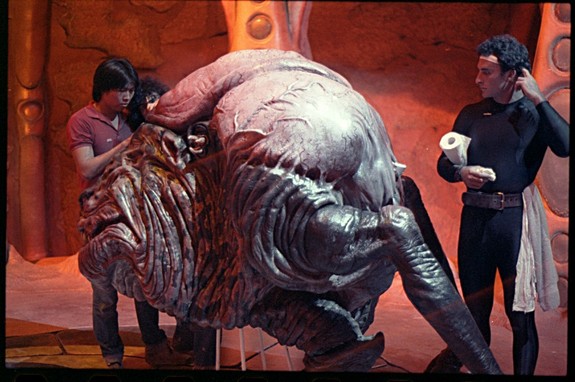 (Steve Wang on the set of Invaders From Mars painting one of the brain drones.)
It took a Halloween Costume Contest to let Stan trust Steve with the paint on one of Stan’s own designs, the Gill-Man from The Monster Squad. According to Steve, he proposed a frog-like paint scheme that Stan vetoed. It wasn’t until he won a costume contest judged by Stan, Rick Baker, and Dick Smith with a paint job much like the one he proposed for the Creature that Stan let him follow through with his scheme.
 (The Gillman from The Monster Squad, with a painting technique developed and applied by Steve Wang.)
Working as a Director
Steve has received great praise for his two film adaptations of the manga superhero Guyver (The Guyver and Guyver: Dark Hero). Another project that drew attention to him was the direct-to-video movie Drive, which starred Mark Dacascos & Kadeem Hardison. He also made independent films, such as Kung Fu Rascals, based on a series of 8mm short films he did years before. Steve and his brother Michael Wang, an award-winning commercials director, have recently been hired to work on Kamen Rider: Dragon Knight (an adaptation of Kamen Rider Ryuki), a second attempt at reviving the Kamen Rider series in the United States after Saban's Masked Rider of 1995. They write, produce, and direct as the "The Wang Brothers."
 (Suits for Kamen Rider: Dragon Knight by Steve and Michael Wang.)
Steve Wang’s Lessons in Practical Effects
“Of all the guys who were the masters when I got started,” says Steve, “Stan was really my mentor…The thing that I took away from Stan the most was how to appreciate what I do. I was more of the self-hating perfectionist, but Stan pulled me aside and said, ‘it’s okay for you to tell yourself you did good, to be proud’ and it made a lot of sense to me.”
Steve goes on to give some advice to those who might have aspirations in the effects field: “Stop texting, and pay attention!” Having the skills is important, but being a good sculptor or painter takes practice and hard work. To be good, you have to work hard. “And you have to love it. If you don’t love it, you shouldn’t do it.” He leaves us with the repeated message, “Work hard. Work hard. Work hard. Work hard. Work hard.”
 (Behind the scenes of AVP Requiem, Steve Wang adds some detail to the sculpture of an Alien/Predator Hybrid—photo courtesy of 20th Century Fox, all rights reserved.)
Steve Wang personifies passionate dedication to his craft. Wherever there are creature characters to be made, there’s a good chance you’ll find Steve Wang nearby, taking it to the next level.
CLICK on the video at the top of the page to watch the FULL VIDEO INTERVIEW.
Watch Steve’s lesson, CREATURE MASK PAINTING, a primer on how to Paint Monsters & Latex Creature Mask Painting for Special Character Effects.