
Bringing the Small Soldiers Toys To Life
For Small Soldiers (1998), Joe Dante’s film about action figures that are brought to life through high-tech military ‘smart’ chips, Stan Winston Studio designed and built two categories of characters for the film — Commando Elite soldiers and alien Gorgonites, all of which were realized as articulated puppets combined with CGI from ILM.
Jump To Section
- Making the Coolest Action Figures Ever
- The Challenge of Working Small
- Drawing From Experience
- Interacting With Actors for a Live-Action Approach
- A Puppeteer’s Dream Come True
- Creating Memorable Performances on Small Soldiers
- From Toy Lovers to Toy Makers

 (The puppet stars of Small Soldiers, the Gorgonites, and the Commando Elite.)
Making the Coolest Action Figures Ever
One of the early aesthetic issues for Stan Winston and his crew was determining whether the Commandos and Gorgonites should look and move like plastic action figures or like real, organic characters. “The question was,” said Winston, “do we design the same limitations we saw in real action figures into our characters? Or do we go beyond those limitations to give them more life? We decided that to create really great performances, we had to give our characters a greater range of motion than a real toy. Our rationale was that these weren’t just toys — they were the coolest toys ever, which had somehow come to life.”
 (Joey Orosco sculpts Small Soldiers' miniature hero, Archer, the leader of The Gorgonites.)
The Challenge of Working Small
In building these puppets, the studio that had only recently been working with twenty-foot-tall T-rexes and large-scale hydraulics suddenly found itself machining tiny, watch-sized mechanisms and fitting them into twelve-inch-tall bodies. “It was a strange thing to go from dealing with giant dinosaurs to dealing with these very tiny puppets,” remarked John Rosengrant, 25-year SWS supervisor and co-founder of Legacy Effects. “In one sense, smaller was easier because we could put all our puppets in a suitcase and carry them to the set. But what made it hard was getting puppets that small mechanized and moving right.”
 (Jim Charmatz paints his character, Slamfist.)
Drawing From Experience
Fortunately, the chicken-sized Compys built for THE LOST WORLD: JURASSIC PARK and the similarly-sized puppets built for Paulie and Mouse Hunt had taught Winston’s crew much about smaller mechanics and servos. “It was a good thing that we’d worked on those films,” added Rosengrant, “and acquired some experience with small characters by the time Small Soldiers came along.”
 (SWS Mechanic Rich Haugen works on the hero Chip Hazard puppet with the precision of a Swiss watchmaker.)
Interacting With Actors for a Live-Action Approach
The original production plan was to shoot most of the live-action toy scenes on a bluescreen stage rather than on the sets. Industrial Light & Magic would then composite those bluescreen elements into final scenes. Shortly into production, Joe Dante abandoned the idea, preferring an in-camera, live-action approach, with the toy puppets right there on his sets, interacting with the actors.
 (Stan Winston, Al Sousa, and John Rosengrant put Chip Hazard through his paces at SWS.)
A Puppeteer’s Dream Come True
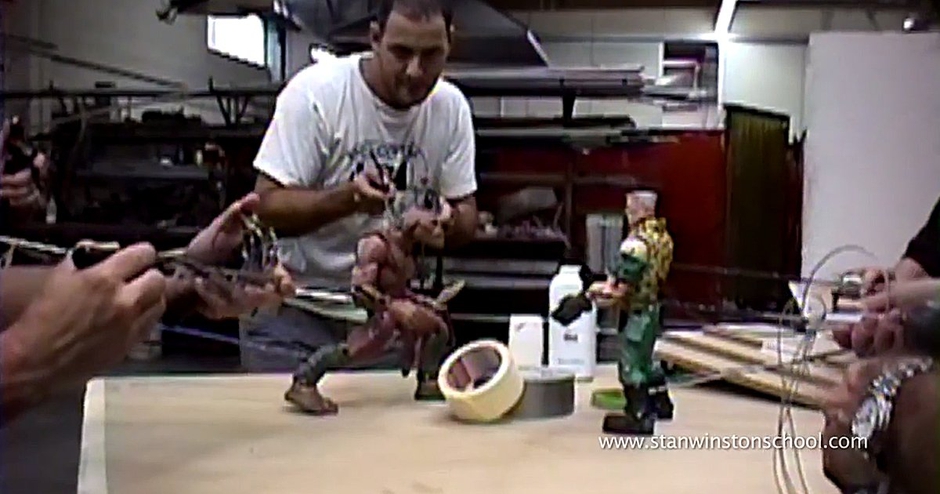
Bringing these characters to life on Dante’s set was pure joy for the show’s puppeteering team. “It's always fun for us to go to the set and spark up the radios and start puppeteering in front of the actors and the cameras,” Jim Charmatz said. “That was particularly true in this case because these characters were so much fun. I distinctly remember Phil Hartman [who played Phil Fimple] sticking his head in to watch the characters going through their moves and really enjoying it. Watching his reactions to these puppets remains one of my best memories from that show.”
 (Chip Hazard and Archer square off during rehearsal at SWS. (L to R) Bill Basso, John Rosengrant, and Chris Swift.)
Creating Memorable Performances on Small Soldiers
“What was so much fun about puppeteering on Small Soldiers,” added Joey Orosco, who designed, sculpted, painted, and puppeteered the character of Archer, “was that this movie was really about these toys. Our puppets were the stars of this movie. They had to perform like real actors, with gestures and emotion. They had to really act. I look at that movie now, and I’m amazed at how successful we were in doing that.”
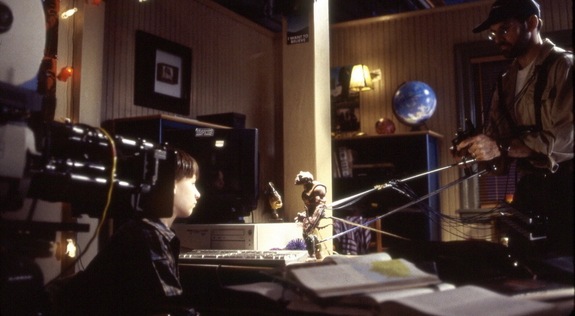 (SWS team member Alan Scott brings Archer to life on the set of Small Soldiers.)
From Toy Lovers to Toy Makers
Small Soldiers remains one of the highlight projects in the history of Stan Winston Studio because it provided Winston and his crew with an opportunity to temporarily return to their respective childhoods and play with the most amazing toys ever conceived. “Those of us who do this for a living are clearly people who don’t want to grow up,” Winston said, laughing.
 (Stan Winston poses with his living toys: the Commando Elite and the Gorgonites.)
“Some of us could have been doctors or lawyers, but we preferred to play with toys and draw pictures and push clay around. We’re all kids in men’s bodies, and we’re all toy lovers. So who among us wouldn’t want to go to work and play with cool action figures? Small Soldiers was a fantastic experience, for all of us.”
-Jody Duncan
Excerpted from THE WINSTON EFFECT: THE ART & HISTORY OF STAN WINSTON STUDIO
Courses with the Creators of Small Soldiers
- Hybrid Characters: Blending Practical & Digital FX with John Rosengrant
- Hybrid Character Design: Practical To Digital with Christopher Swift
- How To Make An Eye Mechanism - Design, 3D Printing & Assembly with David Covarrubias
- Animatronic Control Systems - Arduino Programming Basics Part 1 with David Covarrubias
- Creature Screenwriting: How To Write Memorable Monsters with Juliet Snowden & Stiles White
- How To Make A Monster Puppet - Rods & Cables with David Monzingo
- Makeup Blood FX - Blow Your Brains Out with David Monzingo
To create your own toys, check out these courses: