

(John Boyega and Scott Eastwood in Pacific Rim: Uprising. Image: Jasin Boland/Universal Pictures)
By Lexi Stewart
Jump To Section
- The Making of Pacific Rim: Uprising
- Making Up the Cast
- Bringing “Tokyo” and the Kaiju to Life
- Creating a Giant Kaiju Brain
- Designing the Jaeger Pilot Suits
- The Power of Practical and Digital Effects
The Making of Pacific Rim: Uprising
"CGI can be absolutely perfect, but it’s at the discretion of the director not to overdo it. I’m not at all anti-CGI, because some practical FX are just damn difficult to do.” - Tom Savini
More and more, audiences are seeing that both VFX and Practical FX have a place in film when it comes to visual storytelling. Both approaches can work alone, or join forces successfully as is clear when we take a closer look at the makeup and practical effects of Pacific Rim: Uprising.
The Kaiju have returned for a sequel to Guillermo Del Toro's original, with Steven DeKnight taking the helm this time out. Set ten years after the first film, the son of Stacker Pentecost, who previously abandoned his training for a life of crime, comes back to lead the fight against a new Kaiju threat that lurks on the horizon.
 (Pacific Rim: Uprising star John Boyega as "Jake Pentecost." Image: Universal Pictures.)
"Guillermo's Pacific Rim was a darker movie. It was grittier. The design aesthetic was very 'Guillermo' with a little bit of steampunk overtone to it. With Steven DeKnight's version, they were looking for a cleaner, more high-tech look. Also, there are more monsters, and you've got to up the ante for every one of them. They've got to be bigger and badder," said Legacy Effects co-owner, John Rosengrant.
While Uprising is definitely a CGI robot and monster-filled feast for the eyes, when we look deeper, we discover that a significant element of practical effects work and makeup went into the project as well.
Making Up the Cast
For this chapter of the Kaiju story, DeKnight took the production to Australia to film, where the bulk of shooting happened in Sydney. Makeup and hair designer Jennifer Lamphee was given a basic brief for the main cast. "The makeup and hair department was a full-time team of six artists," said Lamphee. "I was blessed. My artists were highly skilled and extremely strong. Many of them are designers in their own right."
 (A few of the young cast of Pacific Rim Uprising. Image: Jasin Boland/Universal Pictures.)
The focus was to give presence to a cast that was at risk of being overshadowed by giant machines and monsters. "The brief for this film was just to make sure every character looked authentic with minimal fuss. They didn’t want the looks to be too heightened with that typical science fiction look. The world is very industrial and urban, so we kept the makeup minimal.’
 (John Boyega and Scott Eastwood in Pacific Rim: Uprising. Image: Jasin Boland/Universal Pictures.)
For more complex makeup effects such as explosion wounds, burns, cuts, and other injuries, the makeup department made silicone appliances and smaller prosthetic transfer pieces for the main cast. Jennifer is proud that Australia was chosen to be the home base of this project. "Australian crews are extremely experienced and very professional. Our artists are skilled in so many different areas so that we can be across everything."
Bringing “Tokyo” and the Kaiju to Life
Part way into the shoot, the 2nd unit crew traveled north to Queensland. Transforming the city of Brisbane into Kaiju-ravaged Tokyo, streets were closed off and filled with hundreds of extras screaming and running for their lives. In the final cut, this sequence would feature Pacific Rim: Uprising's new threat, the 'Mega-Kaiju.'
New Zealand's Weta Workshop brought their diverse skillset to the film as well, fleshing out most of the design work for the ‘Mega-Kaiju’. Led by Art Director and Senior Concept Artist Leri Greer, the team were determined to inject as much story and atmosphere into their three main creature designs as they could.
'Using digital sculpting software, resident creature experts Andrew Baker and Greg Tozer developed the kinetics of the Kaiju through the design, paying close attention to the creature’s anatomy, weight, and bone structure to ensure that it would appear believable on screen.’
 (The Mega-Kaiju. Image: Legendary Pictures.)
Creating a Giant Kaiju Brain
Back in Sydney, the production required a large Kaiju brain for one of the lab scenes, so they called upon Oscar & BAFTA winning special makeup & creature effects company, ODD Studio. Co-directors Adam Johansen and Damian Martin talked to Stan Winston School about how they were approached and what the job entailed. "Towards the end of September 2016, we met with production designer Stefan Dechant and supervising art director Charlie Revai to discuss the production and construction of a full-scale section of Kaiju brain."
 (The completed Kaiju brain. Image courtesy of ODD Studio.)
However, it wasn't just one brain they needed. "There were to be two different versions of the brain section, a freshly dissected section and a 'post-autopsy' section which included six individual, separate removable pieces of the brain," said Johansen and Martin.
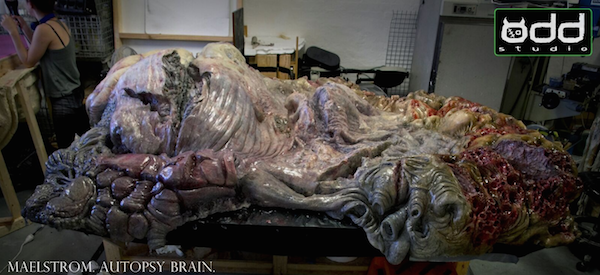 (Final paint job on the Autopsy Brain. Image courtesy of ODD Studio.)
Ideally, the team wanted to be able to produce both versions of the brain from the same mold, so they sculpted a small-scale maquette based on designs by concept artist Dane Hallet. This was used to help the planning process. The six removable pieces of the brain were sculpted and molded at the same time.
 (The finished full-size Kaiju brain sculpture with the small-scale maquette in the foreground. Image courtesy of ODD Studio.)
"The four-piece mold was constructed with an external support 'cradle' to improve accuracy and strength as multiple castings were required," explained Johansen and Martin. Once the mold was complete, two silicone and polyfoam copies were cast. The first cast was the hero piece, which was seamed and painted."
 (Molding the Kaiju Brain. Image courtesy of ODD Studio.)
"Parts of the brain were sculpted to appear scorched or burnt from the procedure, and additional details and textures were sculpted and fabricated," said Johansen and Martin. "These were used to add layers, along with massive 'tentacle-like' arteries and veins that were up to 3 meters in length!"
 (Mid-way through the painting process for both versions of the Kaiju brain. Image courtesy of ODD Studio.)
The finished Kaiju brains were over two and a half meters long and required a forklift for transportation. ODD Studio also produced a considerable amount of slime, goo, and 'Kaiju blood' for on-set dressing.
Designing the Jaeger Pilot Suits
On the other side of the world, in Southern California, leading FX studio Legacy Effects had a role to play in the film as well, starting early on in the process with the design of the main Jaeger pilot suits. Legacy Effects co-owner and supervisor John Rosengrant explained to Stan Winston School, "We had a bunch of designers jump in at the beginning, but they ended up gravitating towards Darnell Isom's designs so he became our lead designer. Darnell also designed some of the other suits that were made by Weta Workshop and the teams in Australia."
 (Darnell Isom designs pilot suit concepts. Image courtesy of Legacy Effects.)
 (Close-up of one of the cadet suits from Pacific Rim: Uprising. Image: Legendary Pictures.)
The Legacy Effects team built the two blue ‘Pilot suits’ for lead actors John Boyega and Scott Eastwood, along with eighteen green ‘Cadet suits’ for the Cadets, which were quite similar.
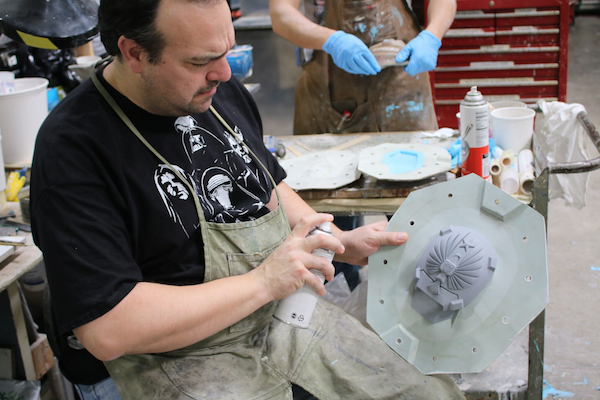 (Tom Ovenshire molds pilot suit shoulder pieces. Image courtesy of Legacy Effects.)
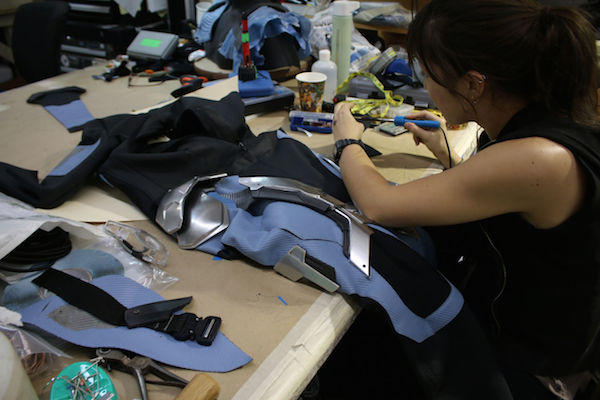 (Alanna Suen assembling the components of one of the pilot suits. Image courtesy of Legacy Effects.)
In addition to the suits, Legacy Effects also assisted with the Kaiju. ‘Scott Patton and Simon Weber ended up helping out with some of the Kaiju." said Rosengrant. "There were some previous designs that they wanted to be embellished, those three monsters that put themselves together. Scott helped sculpt and work out what that was."
The project had its challenges, such as working on a film that was being shot halfway across the world. "We had to scan most of the actors for their lifecasts," explained Rosengrant. "Some of the scans had to come in from China and Australia because we couldn't get the actors here in the United States. We were working off scans for almost everybody, but our team embraced the technology. There were some adjustments when we put the actors into the suits for the first time, but nothing major."
 (Left: Model shop and on-set crew supervisor, David Merritt test fits one of the pilot suits on a lifecast. Right: an additional armor piece. Images courtesy of Legacy Effects.)
Simultaneously, Weta Workshop's costume department was asked to create the nine pilot drone suits, which were developed based on the 3D models by Legacy Effects. Project Lead Lans Hansen worked alongside Costume Designer Lizz Wolf and Wardrobe Supervisor Alistair McDougall.
Costume Fabrication & Senior On-Set Technician Kelly Marie explains, “We worked very closely with costume and 3D to make sure everything lined up. Sometimes what works on a computer doesn’t necessarily work on a human form, so there was a lot of interaction between departments.” Kelly, Alistair, and Animatronics Technician Zoilo Abad took the finished suits to Sydney to assist with the shoot.
The Power of Practical and Digital Effects
Pacific Rim: Uprising has not been shy about spanning the globe for its production, utilizing some of the best studios and workshops worldwide to bring their practical fx knowledge on board. With the creative achievements that are coming out of the industry right now, it really does feel as though Practical effects are not going anywhere anytime soon.
 (The Jaegers of Pacific Rim:Uprising. Image: Universal Pictures.)
Adam Johansen from ODD Studio agrees. 'We are seeing a great ongoing relationship between practical and VFX on films with some beautiful results. In our opinion, a good filmmaker and a good VFX supervisor will look to both practical and CGI for options by exploring & utilizing both."