
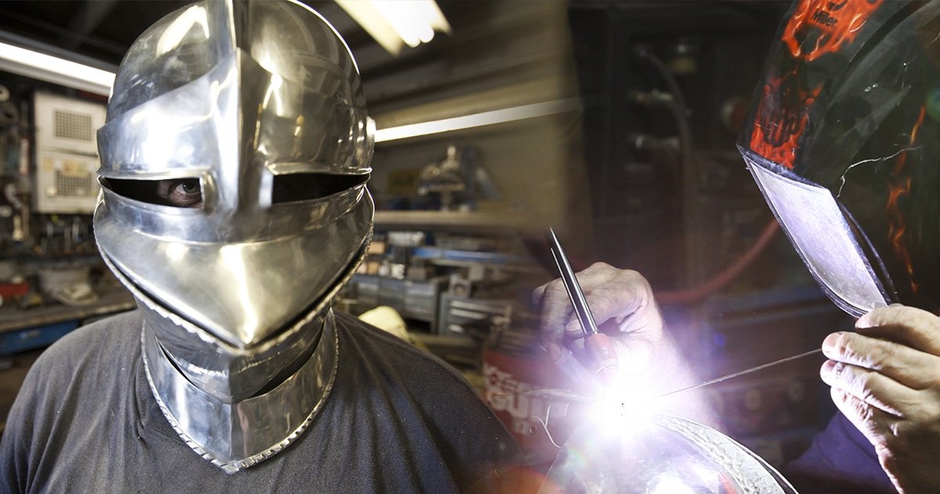
Making a Medieval Helmet With Tony Swatton
By Jeff Dixon
I’ll say this right up front. This may be the single most manly video we’ve ever done on this site.
It showcases a very manly man using very manly tools in a very manly shop to create a very manly thing. It’s primal. It’s physical. And it’s awesome.
But what’s equally incredible about this lesson is that while there is a lot of sheer manly force involved, the skill and craft behind it all is, dare I say it… beautiful.
Jump To Section
- Learning With Master Smith Tony Swatton
- Crafting a 16th Century Closed Helmet
- Working With Big Hammers, Loud Machines, and Sharp Metal
- Hammering, Bending, Welding, and Smoothing Your Helmet
- The Art of Crafting Metal Armor
 (Master Smith works his craft at Sword & Stone in Burbank, CA.)
Learning With Master Smith Tony Swatton
This lesson is all about making metal armor. And you’d be hard-pressed to find someone more skilled at this craft than Tony Swatton. Tony founded and owns Sword & Stone in Burbank, CA. Here in his workshop, he works as all the “smiths.” He’s a blacksmith, a whitesmith, a bladesmith, sometimes even a locksmith. You could say he’s a smith of all trades. He’s made armor or weapons for over 150 feature films, including Hook, Pirates of the Caribbean, Master & Commander, and The Last Samurai. Tony’s done it all, and is the perfect man to set you on your course of making your own armor.
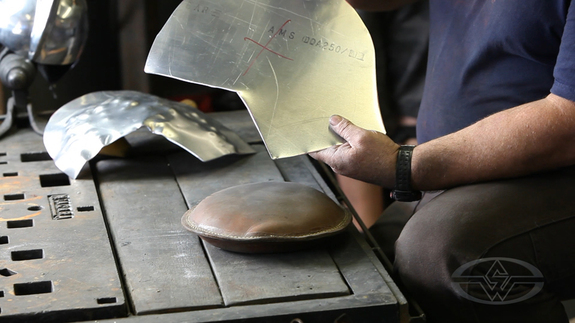 (Tony shapes sheet aluminum into the rough hemispheres of the half helmet using a leather sandbag, a plastic mallet, and Tony’s uncommon hand strength.)
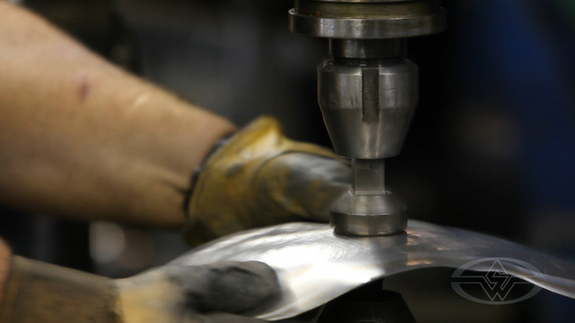 (An 8’ tall machine with awesome power vibrates at between 400 to 4000 strokes per minute in order to planish the surface of any metal placed in its path.)
Crafting a 16th Century Closed Helmet
The focus of this lesson is on recreating a 16th-century closed helmet. There are many components to it, including the headpiece, neckpiece, and a three-part visor. While much of what he will show you can definitely be done at home with nothing more than hand tools and a lot of manpower, he speeds up the process by showing you how to use larger, more efficient metal fabrication tools. He admits that, for the sake of this lesson, he was able to quickly manufacture this helmet in about six hours, but for most people, it will take weeks if not months. But when has time ever stopped an artist or craftsman from doing what they love? If you are someone with even the slightest interest in crafting armor, this will be an indispensable lesson.
 (Tony’s stretching/shrinking machine gives a desired shape and helps match the two halves of the helmet without the hardening, thinning, lumps, and bumps characteristic of the hammer shaping method.)
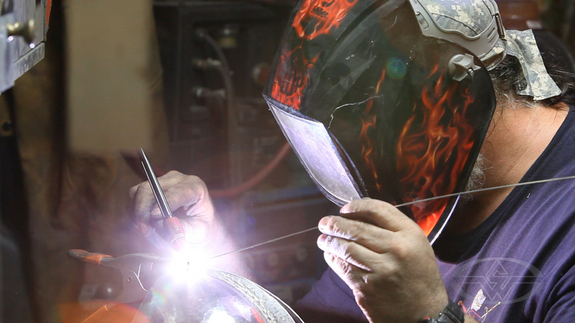 (Tony uses a TIG welder, welding rod, heavy gloves, and a flame-decorated helmet of welding wire to seam the two halves of the helmet.)
Working With Big Hammers, Loud Machines, and Sharp Metal
Tony is no-nonsense and gets right to it. He’s not one to fill you with anecdotes about metal crafting or working in the movies. Instead, he just focuses on what he’s doing. To be honest, I’m glad. With all the various (some even potentially dangerous) tools, machines, and materials he’s working with, it’s best to stay focused on the work at hand. This isn’t child’s play. This is metalwork. These are some big hammers, some large and loud machines, and some potentially sharp metal. Seeing him focus is good for the viewer as it will make them realize they should be doing exactly the same if in his position.
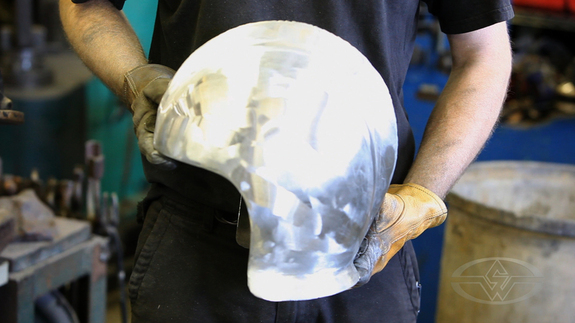 (Much of the early shaping Tony applies is to take the formerly flat metal pieces and make them deep enough to fit snugly around the head. Polishing and refinements will later even out the two sides.)
Hammering, Bending, Welding, and Smoothing Your Helmet
The steps of crafting the helmet seem to fly by. It’s actually quite amazing to see what starts out as flat sheets of metal slowly get cut, hammered, bent, formed, welded, deburred, smoothed, and eventually, before you know it, become a gorgeous helmet. In the initial steps, with the force at which he’s hammering away, you’d never believe it could become what it does, but before you know it, it’s there. And I’ll say this, even though many people at home won’t have the opportunity to use some of the larger fabrication machines that Tony uses here, just from a viewing point of view, it’s pretty amazing to watch him work with them. They vibrate at such an intensity that you’re almost hypnotized as they work. But the beauty of it all is that you don’t actually need these machines. What can be done with a Pullmax forming machine can be done by hand as well, just not as fast. The important thing is that Tony shows the process, and that’s what matters.
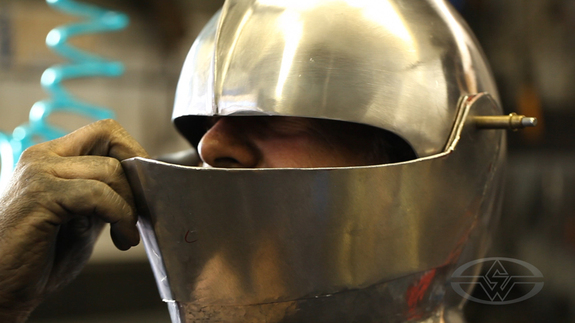 (Tony attaches the Ventail and sets it so that the center line conforms with the helm above and the Bevor below; the Ventail also raises to reveal the mouth in case the wearer has something to say.)
The Art of Crafting Metal Armor
I feel like I’m just touching the surface with what Tony pulls off here. I haven’t even talked about the detailed patterning he does in the metal or even the electrochemical etching he does on the brim. But I guess that’s why you just have to watch the video. It’s definitely one to behold. So whether you are looking for a manly lesson in manliness or an artistic lesson in a uniquely beautiful craft, Tony’s lesson on crafting armor really does have it all.
Plus, at one point, he even gives you advice on buying your own anvil. Seriously. What other video can say that?
Now that’s manly. Enjoy.
-Jeff Dixon