
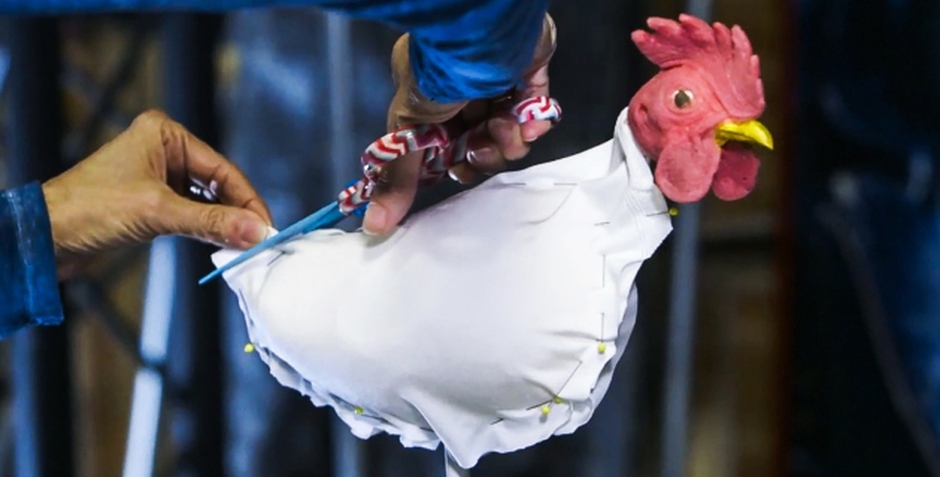
In this FREE excerpt from the Stan Winston School of Character Arts course, Feather Work Part 1: Realistic Bird Feathering Techniques, master creature FX, hair, and feather artist Deborah Galvez (Life of Pi, Where the Wild Things Are, Dr. Dolittle 2) shares egg-cellent techniques and tips on making a spandex sock to drape the form of your chicken puppet.
Jump To Section
To watch the complete instructional video, click the player above!
In this lesson, Galvez takes you step-by-step on how to drape the body form of your chicken puppet with a custom sock. When laying down a pelt for any creature, you want to have a smooth surface. The spandex sock provides an ideal solution. With this method, you can bring any feathered creature to life!

Draping the Chicken Form
The purpose of creating a body sock for your chicken form is so that your shape has a clean, smooth surface for you to work with and eventually on which to drape the chicken pelt.
 (Top: Deborah Galvez shows the chicken puppet before being draped. Bottom: She loosely drapes the spandex fabric over the foam core.)
Start by loosely draping the spandex fabric over your foam core.
Galvez uses a foam core from Bischoff's Taxidermy and Animal FX in North Hollywood, California. (Before the lesson, she shaved the form down herself from turkey to chicken size.) The chicken head was supplied by Rick Lazzarini's The Character Shop in Simi Valley.
Pro-tip: Pick a spandex color that matches your pelt color. Here, Galvez is using white spandex because the pelt is going to be white.
Spandex is the recommended fabric for this application because it’s strong, smooth, and stretchy. In general, a static puppet will use a two-way stretch since it’ll be stationary, whereas an articulated puppet will use a four-way stretch since it’s even more flexible in comparison. A suitable alternative fabric is power netting.
Next, pin the sock to fasten the fabric and create a shape.
 (Deborah Galvez begins to pin the fabric. It almost looks like a little handkerchief!)
For this lesson, Galvez is stitching the sock very quickly using pins. An alternative would be to machine-sew the sock. If you do decide to machine sew, Galvez keeps to the edge, giving a seam allowance of a quarter inch, if that.
As you continue pinning the fabric, you’ll notice the shape starting to take form.
 (Little by little, Deborah Galvez pins the spandex, creating a sock and giving form to the chicken.)
Trimming the Excess Fabric
 (Deborah Galvez continues to pin the spandex sock until she achieves her desired shape.)
Now that you have established the shape for your puppet, trim away the extra sock fabric to create a smooth body shape. Reposition the placement of the pins to secure the fabric whenever necessary.
 (Using her stylish scissors, Deborah Galvez trims the excess fabric to give her chicken a clean shape.)
While you’re cutting the fabric, keep in mind that it need not be perfect. The pelt will cover the sock later. The goal is simply to give your sock some shape.
Finalizing the Body Shape of Your Puppet
Next, begin cutting your darts to further refine the sock’s shape.
 (Deborah Galvez trims the darts in the neck area of the chicken to complete the spandex sock.)
Spandex tends to bunch up, so Galvez recommends always using your fingers to "walk" fabric--spreading it out slightly as you pin it--to prevent puckering. “It gets kind of tricky sometimes, but don’t worry about it because it’s just an under core—it doesn’t have to look fancy,” she says.
Continue pinning, trimming, and smoothing out the bunches and puckers in the fabric until you reach your desired look.
 (To prevent the spandex from bunching up, Deborah Galvez carefully "walks" the fabric using her fingers to spread the puckering fabric to keep it smooth.)
And there you have it! You’ve successfully draped your chicken form with its very own custom sock. Pretty hen-credible, right?
 (Deborah Galvez puts the final touches on the sock for her chicken puppet.)
The next step will have you stitching the bottom, top, and your darts, and then moving on to glue the puppet’s neck to the head.
WATCH THE “FEATHER WORK” COURSE WITH DEBORAH GALVEZ: