
Redesigning Your Creature With Don Lanning
And now for something completely different! In today’s lesson by veteran sculptor Don Lanning, we see how adaptable the commercial sculptor/designer must be. Don takes his maquette and the viewer in an entirely new direction and shows off some clever tricks for sculptors of all levels along the way.
This is CHARACTER DESIGN - MAQUETTE SCULPTURE TECHNIQUES (PART 2).
Jump To Section
- How To Redesign a Character Maquette
- ‘Sculpting’ Mechanical Elements
- Capturing Your Character’s Expression
- Creating an Original Design for Your Character
- Don Lanning's Design Method
- Coming Up With Your Own Character Design Process

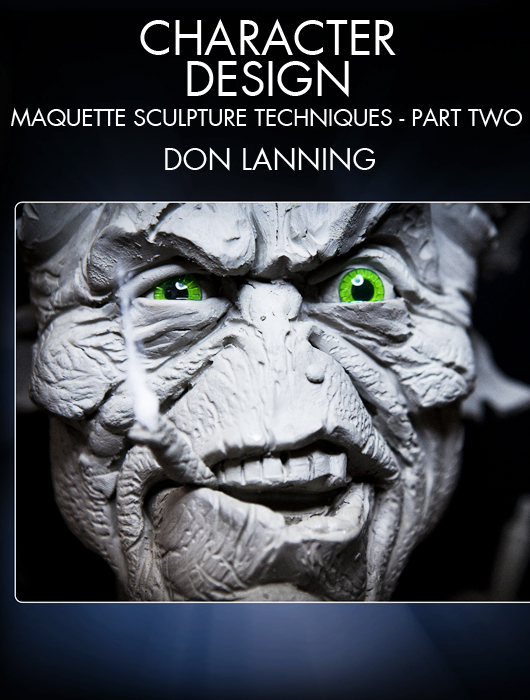 (The first two parts of the series, CHARACTER DESIGN - Maquette Sculpture Techniques.)
 (Good design is good redesign; here is the last of the Mer-Man. As changes come, Don must say goodbye to his aquatic alien friend.)
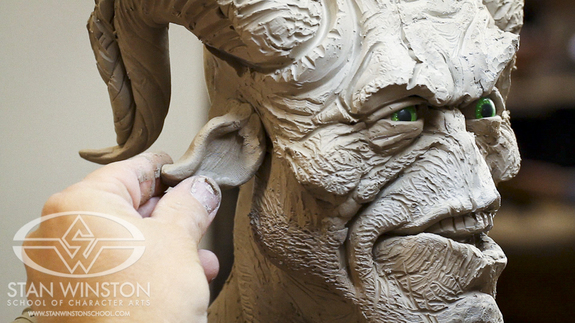 (A totally new look. The finished product? Guess again. Despite his satisfaction, there will be notes the “client” is “going in a different direction,” and that means tomorrow, so will Don.)
How To Redesign a Character Maquette
In PART TWO of his three-part character design series, Lanning covers some very clever tricks of the trade, including a nifty quick way to create organic horns and the innovative use of found objects dressed with clay paint to achieve complex machined-looking shapes without a lot of time-consuming detail sculpting. Throughout the lesson, Don takes you deep into his creative process with insights into character expression, balance, tone, and the constant communication between the artist and his subject.
 (No mercy. Don takes a carving knife to the distinctive fins that helped define yesterday’s character.)
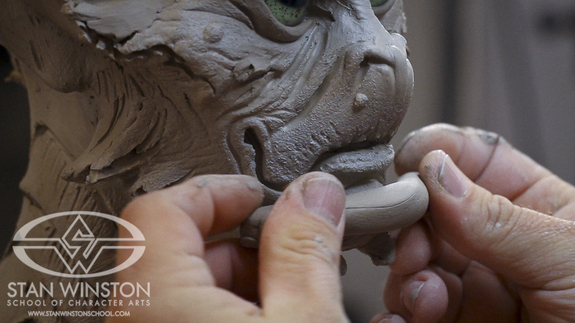 (Don applies a generous clay “worm” to the chin and lower lip of his new alien soldier, creating a massive jaw that instantly informs the character and communicates heroic strength and leadership.)
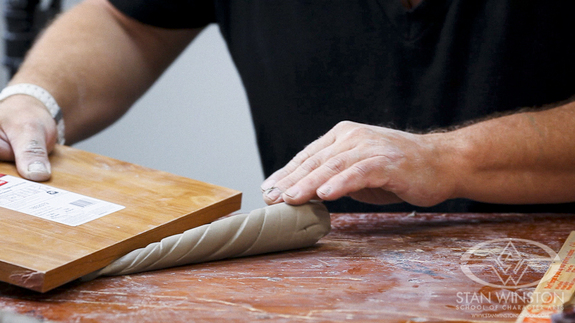 (A wooden board transforms a cone of clay into a truly organic-seeming horn.)
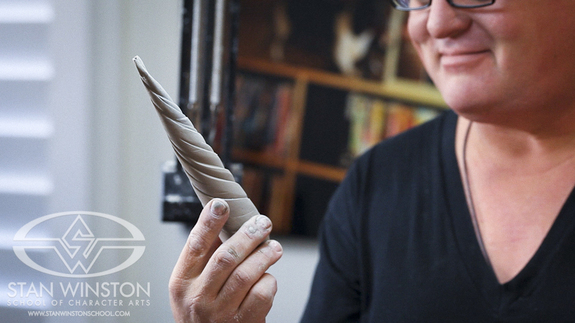 (Don regards his horn which could serve just as well as a tail or tentacle.)
‘Sculpting’ Mechanical Elements
Lanning talks about how to sculpt organically as well as mechanically. As Don explains, “The water-based clay that you think might not be so good for doing mechanical elements is actually fantastic.” The secret, he shares, “Is to let it dry up and get leathery before you can really tool it into something mechanical.” With a few choice slabs of clay, Don goes on to dress his character in heavy-duty battle armor and shows you his process every step of the way.
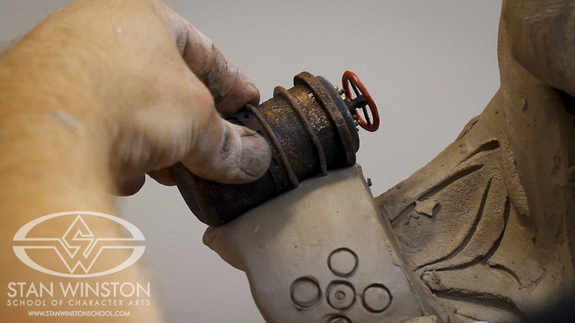 (Sharing a sculptor’s secret you’ll never forget, Don integrates found objects into his sculpture, saving time and enhancing the desired effect.)
Capturing Your Character’s Expression
Don uses his own face in a mirror to get information from the expression he wants to bring to his figure. Seeing the detail—the squint of the eye, the pull of the corner of the mouth, the ledge of the lip, and the wrinkles of the skin—tells Don exactly where he needs to adjust his shapes and forms. He shows how adding what he calls “satellite wrinkles” around those shapes actually “sells” the compression, as though something muscular and tense is occurring in the face. He’s always thinking about the mechanics of movement as all the different forms are pushing against each other.
Creating an Original Design for Your Character
Don takes steps to avoid obvious design elements of characters he’s seen before. “If you haven’t followed the career and studied the career of Stan Winston, Dick Smith, Rick Baker, and Rob Bottin, know that that is part of your education. Study their work. It’s important that you know what’s gone before so that you don’t inadvertently or accidentally repeat it. There’s a real danger in that. Sometimes something can go into our psyche, and it’s hanging out in there, and we don’t know it, and we’re working professionally as an artist, and here we go. I’ve sculpted something that looks exactly like something that was done 20 years ago. So it’s good for you; it’s part of your education to study the masters.”
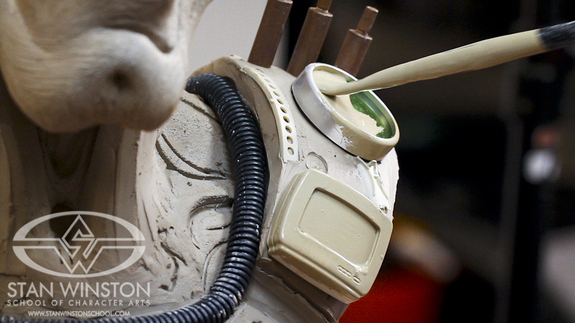 (Don paints the found objects with a paint matched exactly to the WED clay color from the paint department of a local hardware store.)
Don Lanning's Design Method
From smoothing out the surface of the maquette with water and a sponge to setting in the eyes with small clay “worms” to form eyelids, Don demonstrates each example on the path to an expressive figure with careful attention to detail and deep insights into his design process. Working with an array of sculpting tools, from serrated kidneys to rakes to rubber-tipped smoothing tools, and often with only his fingers, Don makes every step of the sculpting process a revelation and an adventure. Watching Don apply daubs of clay blindly in an effort to mimic the random variation of the natural world, Don tells you to “Do it wrong.” But, we can see, watching him that his methods are SO right!
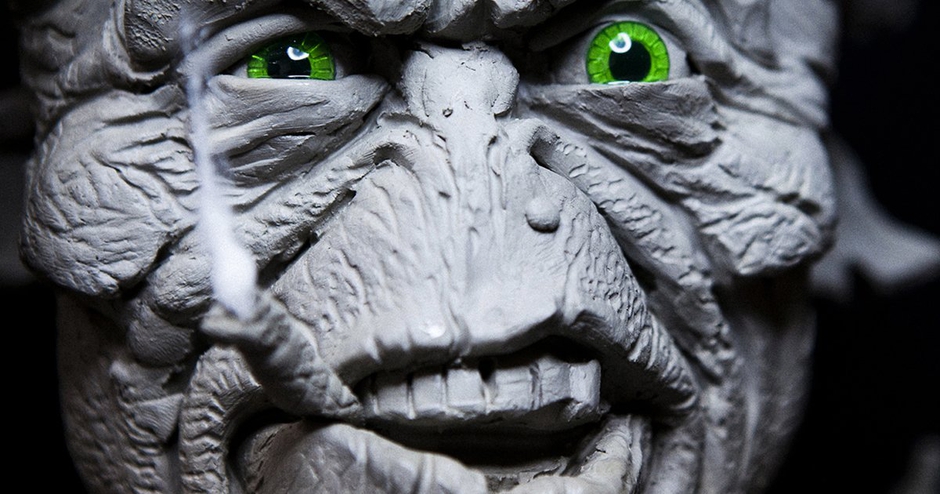
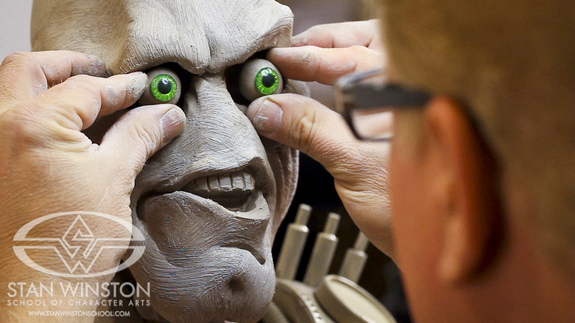 (Don test fits a pair of glass eyes into his deeply set sockets allowing the character to come momentarily to life.)
Coming Up With Your Own Character Design Process
Don reminds his students, “You’re supposed to be looking at me, and you’re supposed to be saying, ‘He did that wrong…He did that right…I like that…I didn’t like that…’ you’re supposed to be judging what you like and what your preference is, and what it is that you’re going to do on your sculpture…Nothing is better than watching a guy do it…you can just as easily turn down the sound and get quite a bit from me, just as far as my approach.”
Don wants you to try his shortcuts and techniques, “See how they fit in YOUR hand, see how they fit in your kit, and try them, both in practice at home and on the job, and see if they work for you. Chances are…you’re going to take a technique that you saw in this lesson and you’re going to ‘hybrid’ it...Your going to assemble those tools like soldiers and have them available for you to be able to render and have confidence with that toolset.”
Overall, Don wants you to see his lesson as a way to bypass the frustration he first felt as a young boy struggling to make shapes out of clay. By demonstrating his technique—helpful shortcuts, how to approach the clay, when to use reference, when not to be timid with your clay—he will elevate your process right away. “One of my big hopes,” says Don, “when you get this lesson, is that you setup your space and you get some clay together and you sculpt along with me. I try to give you as much of what’s going on in my brain as possible and try to share it with you so that you make it your own. So that you take these techniques and start modeling.”
So, rise to Don’s challenge and don’t pass up the opportunity to experience what goes on in the brain of a master sculptor!
-David Sanger
To visit DON LANNING'S PAGE, CLICK HERE
To check out the FULL LESSON, just click HERE: CHARACTER DESIGN: MAQUETTE SCULPTURE TECHNIQUES – VOLUME II