By Michael Martin
Starring Keri Russell, Jesse Plemons, Amy Madigan, Graham Greene, and Jeremy T. Thomas, Antlers is directed by Scott Hooper and produced by, among others, Guillermo del Toro. The film explores the Native American legend of the Wendigo along with the difficult family dynamics occurring in a small Northwestern town.
 (L-R, Scott Cooper, Shane Mahan, and Holland Miller.)
Matt Winston, co-founder of SWSCA, spoke with Antlers director Scott Cooper, Legacy Effects co-founder Shane Mahan, and lead special makeup effects artist Holland Miller for Lindala Schminken FX (aka LSFX) about their work on the horror film.
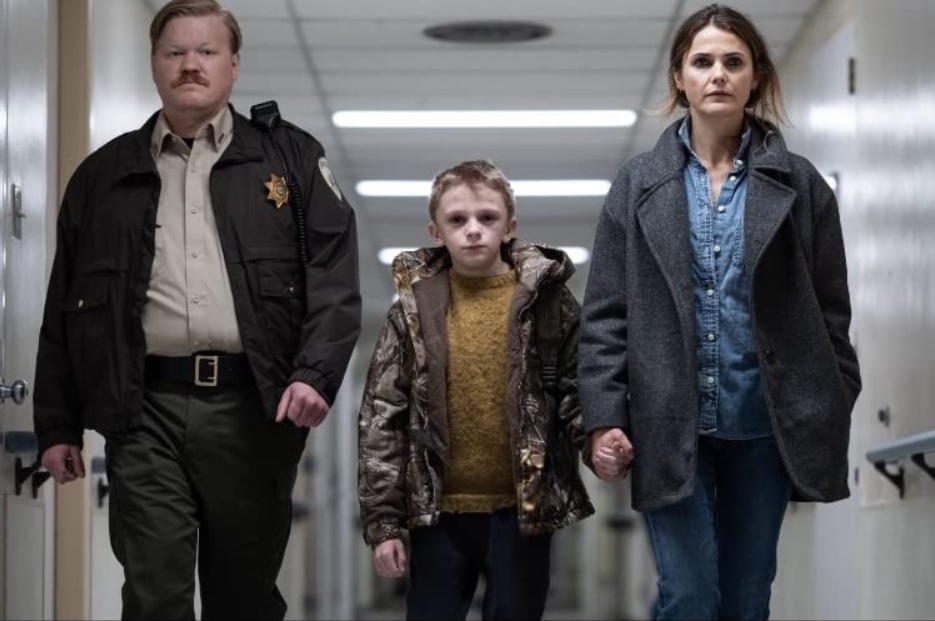 (Sheriff Meadows [Jesse Plemons], young Lucas [Jeremy T. Thomas], and Julia Meadows [Keri Russell] form an unlikely family unit in Antlers. Image courtesy Fox Searchlight.)
Jump To Section
- Staying True to the Story Behind the Wendigo
- Envisioning the Wendigo for Antlers
- Prototyping the Wendigo Monster
- Sculpting the Wendigo
- Building the Wendigo Creature
- Bringing the Wendigo to Life on Set for Antlers
- Breaking Down the Wendigo’s Attack Scenes
- The Wendigo Reveal in Antlers
- Antlers Bear Scene Effects Explained
- Killing the Wendigo
- A Team Effort Behind the Effects for Antlers
- The Wendigo’s First Victim
- The Effects Used for Principal Booth’s Death Scene
- Frank’s Transformation Into the Wendigo
- Aiden’s Infected Makeup
- Creating the Wendigo Husk
- How the Special Effects Teams Brought the Horror of the Wendigo to the Silver Screen
Note: Major Spoilers Below.
Antlers tells the story of a young boy named Lucas living in a small Oregon town whose father and little brother have gone missing after entering an abandoned mine. Strangely, the child continues to go to school where he draws the attention of both a group of bullies and one of his teachers. Lucas is drawn to roadkill and other small animals. Only, this is not a case of curiosity but one where he uses the dead animals to feed…something…or things…in the attic of his home.
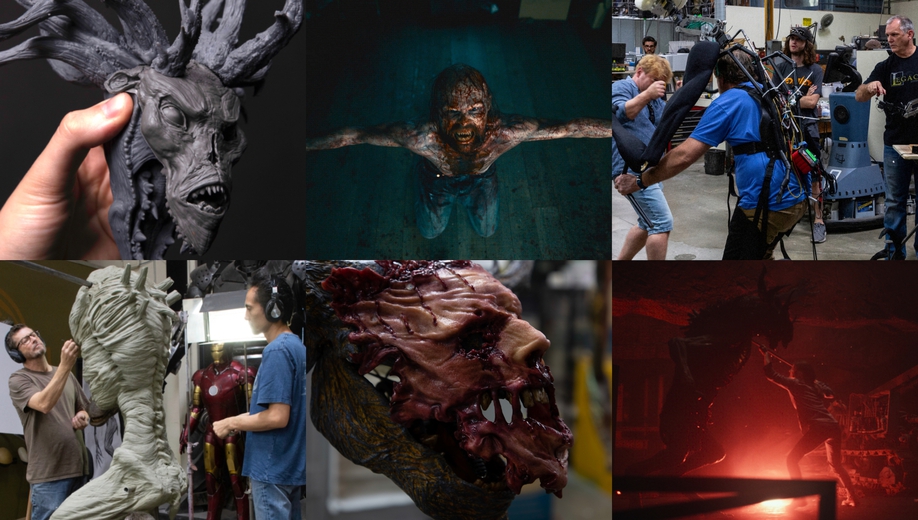
Legacy Effects was responsible for creating the practical Wendigo creature while Vancouver-based LSFX provided a number of grisly gore effects for the film.
Staying True to the Story Behind the Wendigo
Scott Cooper had previously directed Christian Bale in the western Hostiles. “Native American themes and issues are quite important to me,” Cooper says. In order to stay true to the Wendigo legend, Cooper worked with one of the foremost authorities on the mystery of the Wendigo, Grace Dillon, professor at Portland State University. “She said to me, 'Scott, the Wendigo can manifest in many ways, but it's first and foremost a spirit.' And then in reading the screenplay, she and I discussed that this is a monster or creature of God that kind of reflects our own demons and feeds off of our worst potential.” He continues, “The Wendigo represents kind of a surrogate for the issues that people would rather not confront.”
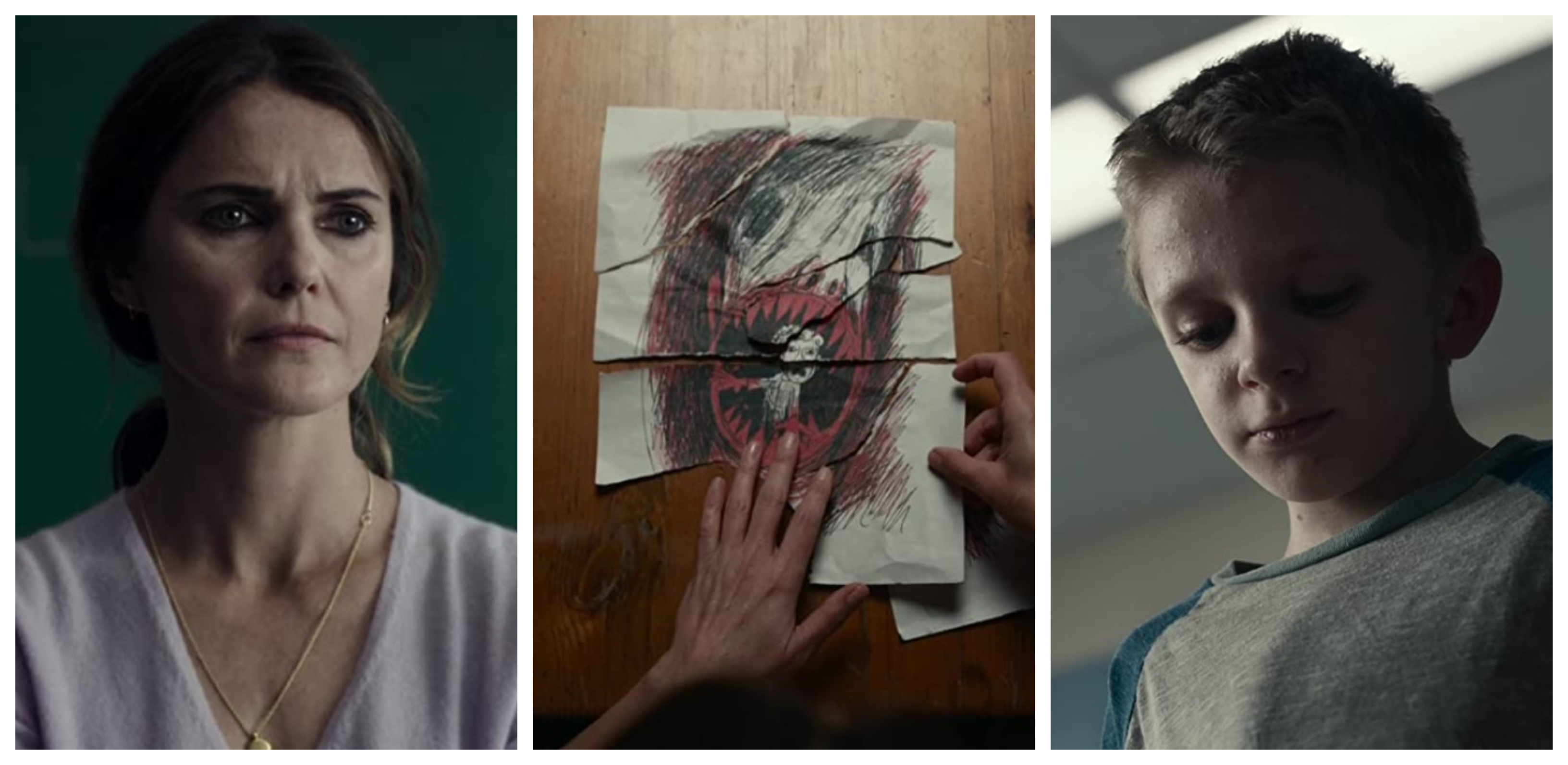 (Teacher Julia Meadows is concerned overs the nightmarish images drawn by her young pupil Lucas. Images courtesy Fox Searchlight.)
Envisioning the Wendigo for Antlers
For the physical look of the Wendigo, Cooper got together with producer Guillermo del Toro, Shane Mahan, and creature concept designer Guy Davis. “We talked about how do we make this Wendigo pay homage to the Native American folklore, which we know is a kind of deer-like creature with antlers. And we discussed that it felt like our Wendigo should come from the Earth's core, from its mantle, that it should evolve out of a coal mine or an iron ore mine,” Cooper says. “We wanted it to represent a couple of things; the destruction to our natural resources, but also a metaphor for how we're destroying, not only our bodies and our minds and our souls, but also the earth in general.”
 (Early designs by Guy Davis for the Wendigo head. Image courtesy Legacy Effects/Fox Searchlight.)
Shane Mahan shares how growing up in Michigan, “There was a very profound Native American influence there.” He says creating the Wendigo character was brand new territory for him. “I'd always known what a Wendigo was from books and things, but we [at Legacy Effects] never got a chance to do one. You can only do versions of werewolves and vampires so many times.”
 (Concept designer Jared Krichevsky's digital Wendigo sculpture. Image courtesy Legacy Effects/Fox Searchlight.)
They wanted to make something, in Mahan's words, “super eerie and frightening,” that also would serve the story. “If you're a down-and-out person and you're just a mess, you're a vulnerable vehicle for this spirit to take over.” In addition to the highly detailed 3D concepts being worked out by Legacy Effects designer Jared Krichevsky, Mahan emphasizes the importance of the color palette that drove the look of the Wendigo. “We were doing color explorations based on Guy's art, which was kind of colorful, kind of blues and reds.” Mahan continues, “At one point, Guillermo said, it's a God, it's iron ore, it's dirt from the earth. And I was like, oh, that's cool. So then we started using elements of the earth.”
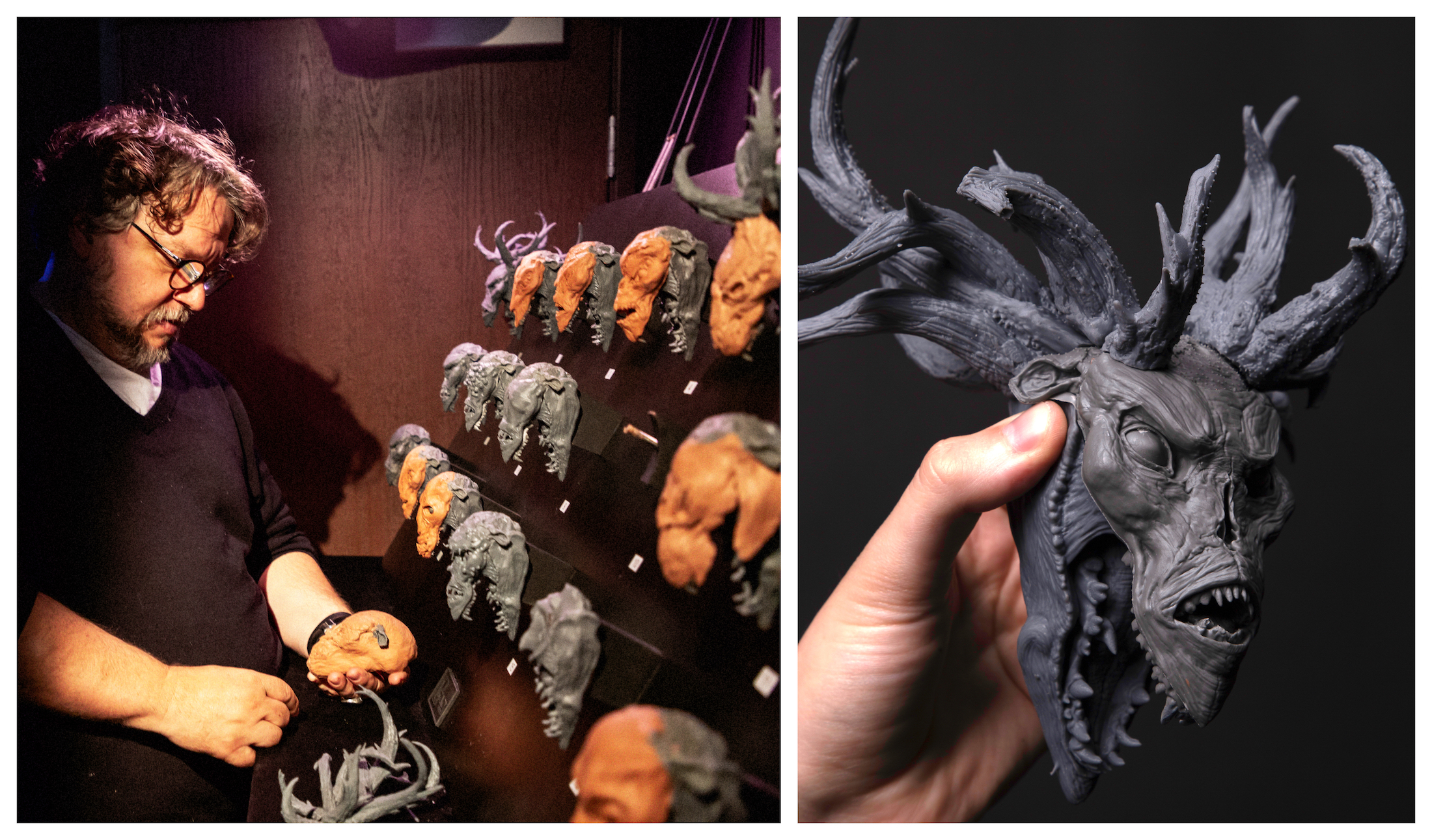 (Left: Producer Guillermo del Toro reviews Wendigo head concepts. Right: one of the miniature concept heads. Images courtesy Legacy Effects/Fox Searchlight.)
Prototyping the Wendigo Monster
Early on in the design process, Legacy Effects put together a ‘garbage bag’ proof of concept test, much like the one created at Stan Winston Studio for the Alien Queen in Aliens. Mahan says, “Guillermo and Scott came, I said, listen guys, don't panic. This is just a proposal on how we can make this work on set.” Mahan laughs. “It was carved out of foam and it was rather preposterous, but it was the essence of what we were going to do.”
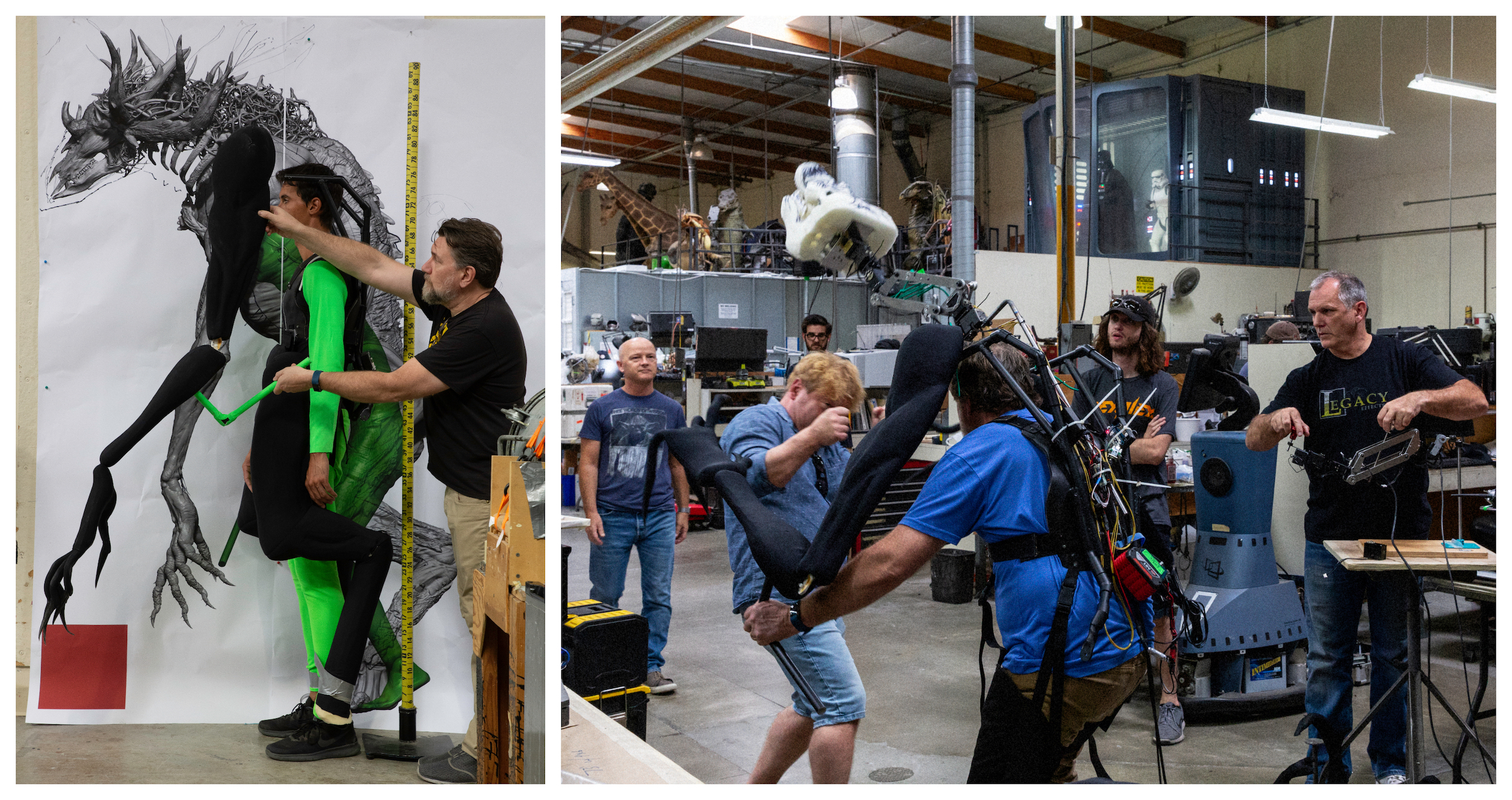 (Left: Ted Haines measures performer Dorian Kingi in the foam 'garbage bag' Wendigo suit against blown-up design. Right: Lindsay Macgowan, Shane Mahan, Ted Haines, Derek Rosengrant, and Alan Scott conduct a Wendigo 'garbage bag test.' Images courtesy Legacy Effects/Fox Searchlight.)
In creating the Wendigo beast, weight was a big concern. Mahan says, “He fights [Keri Russell] and he eats a bear and he's killing people and it can't be a big, heavy thing that can't move.” Mahan details how the artists at Legacy operated the Wendigo creature. “Basically the performer's arms come out and are attached to the [Wendigo's] arms. They'll be digitally removed and there'll be digital removal of the [performer's] legs.”
Sculpting the Wendigo
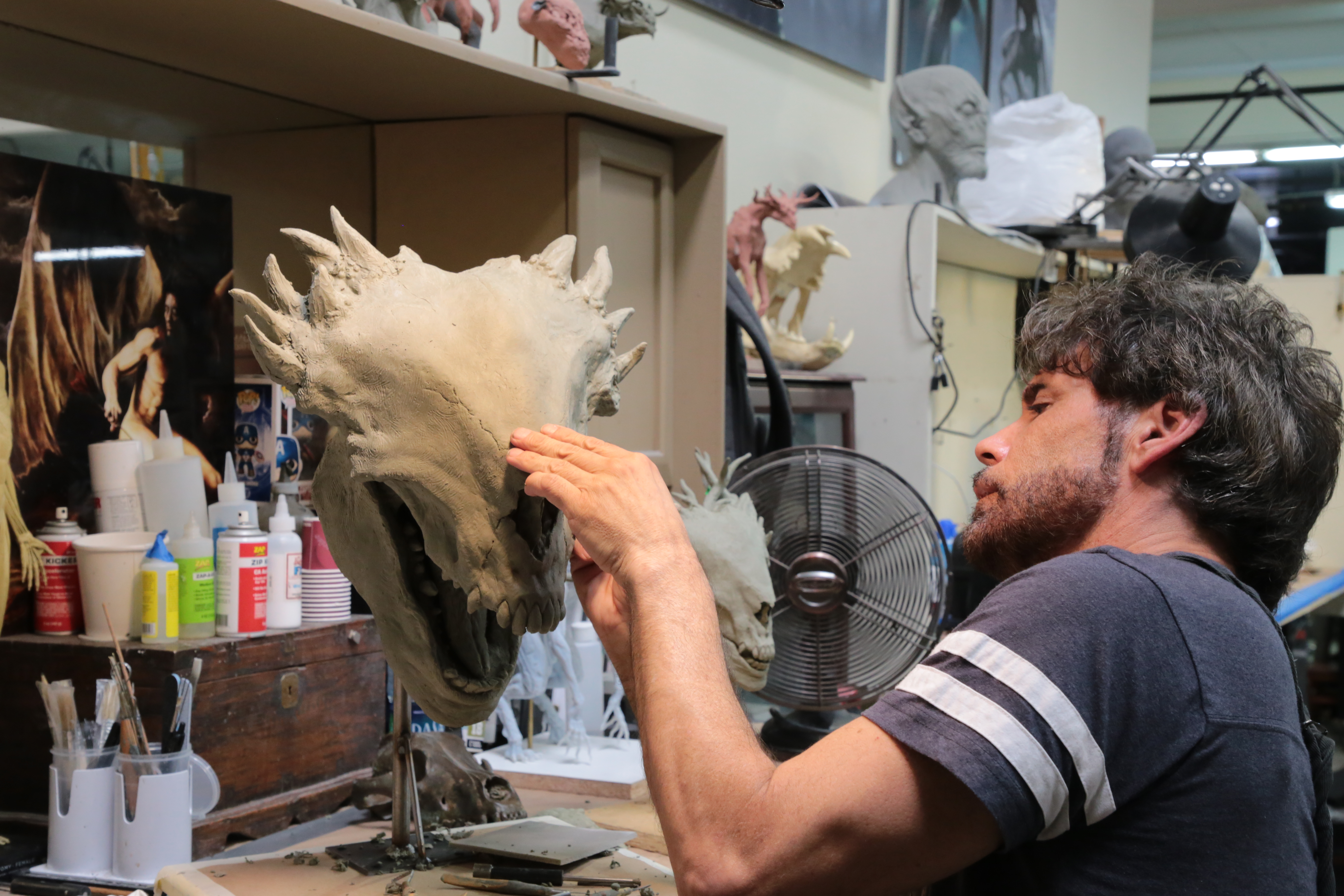 (Christopher Swift works on the Wendigo full-size head sculpture. Image courtesy Legacy Effects/Fox Searchlight.)
"As the Wendigo took shape, there were multiple meetings with Scott and Guillermo about the surfaces and the sculptural elements," says Mahan. "And it came together in a magnificent way.”
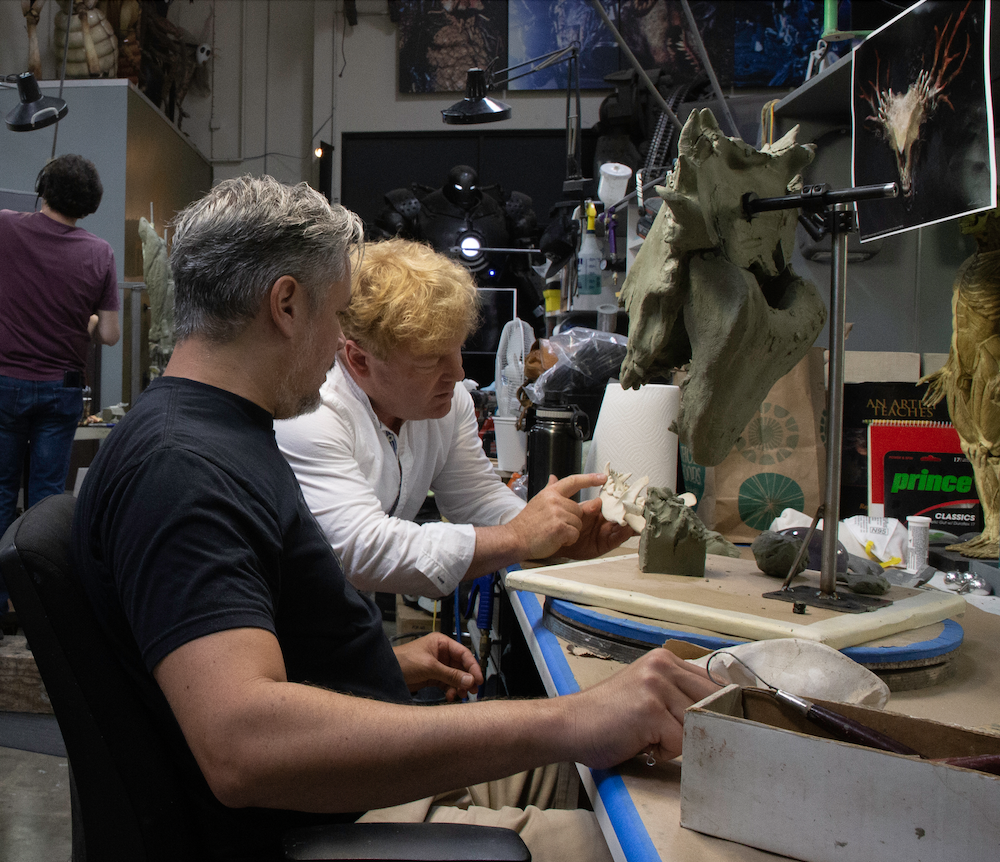 (Shane Mahan and Jason Matthews discuss the Wendigo's teeth. Image courtesy Legacy Effects/Fox Searchlight.)
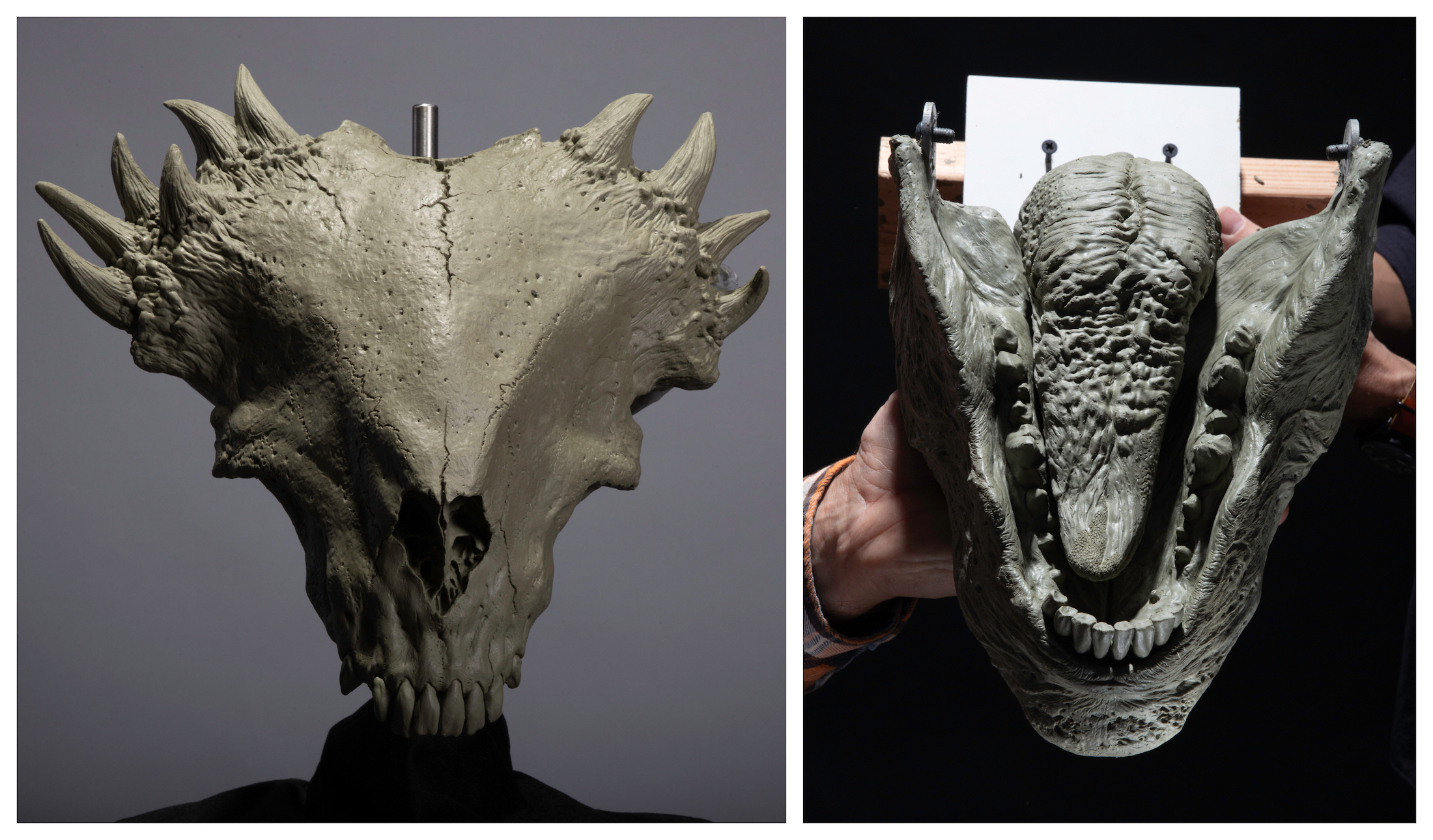 (Left: the finished Wendigo skull sculpture with cracks, pits and horns. Right: Wendigo jaw and tongue sculpture. Images courtesy Legacy Effects/Fox Searchlight.)
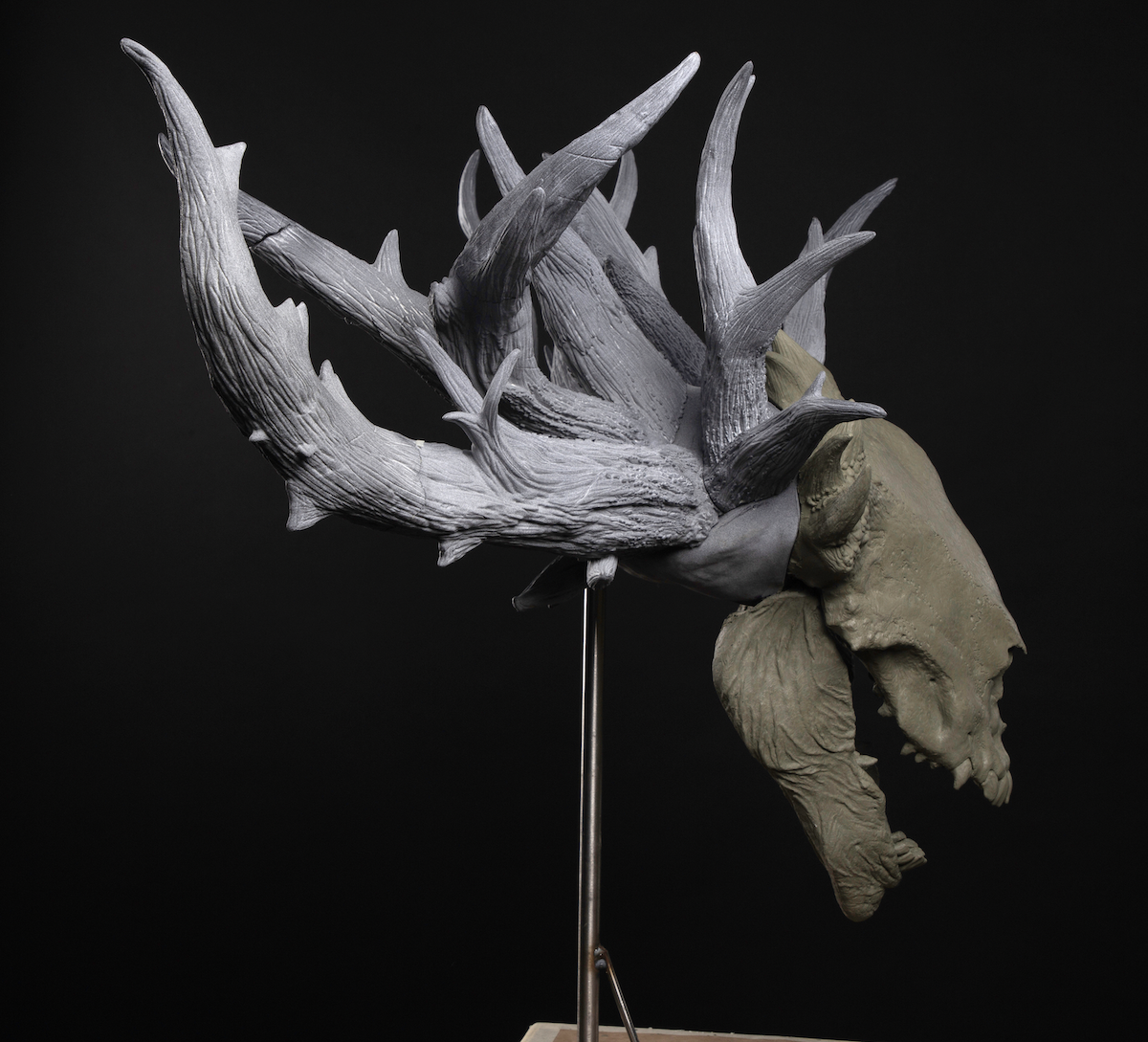 (With antlers, skull and jaw in place, the Wendigo's full-size head takes shape. Image courtesy Legacy Effects/Fox Searchlight.)
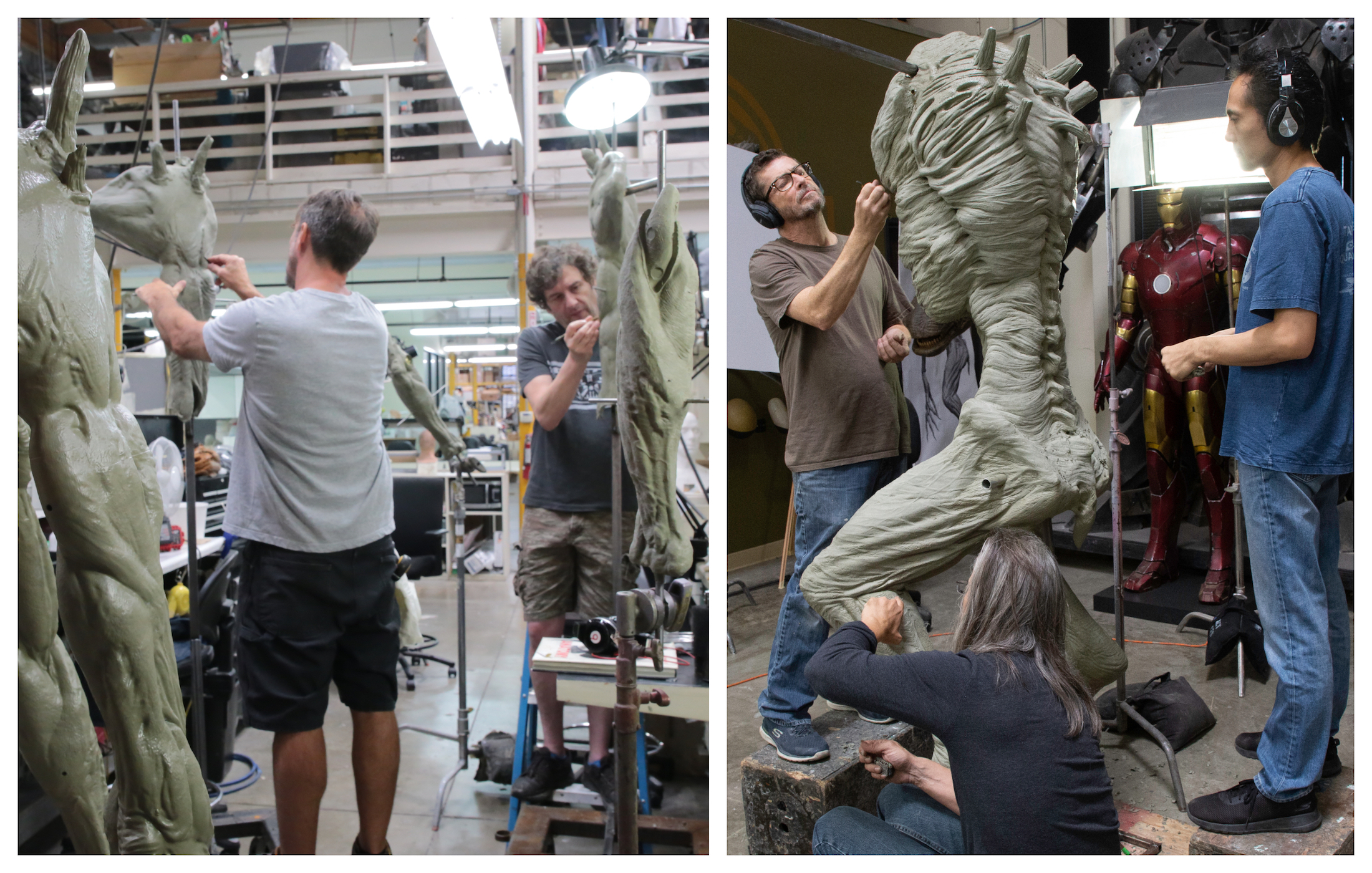 (Left: Rob Ramsdell and Glen Hanz sculpt the Wendigo's arms. Right: Mark Maitre, Hiroshi Katagari and Greg Polutanovich sculpt the torso and legs. Images courtesy Legacy Effects/Fox Searchlight.)
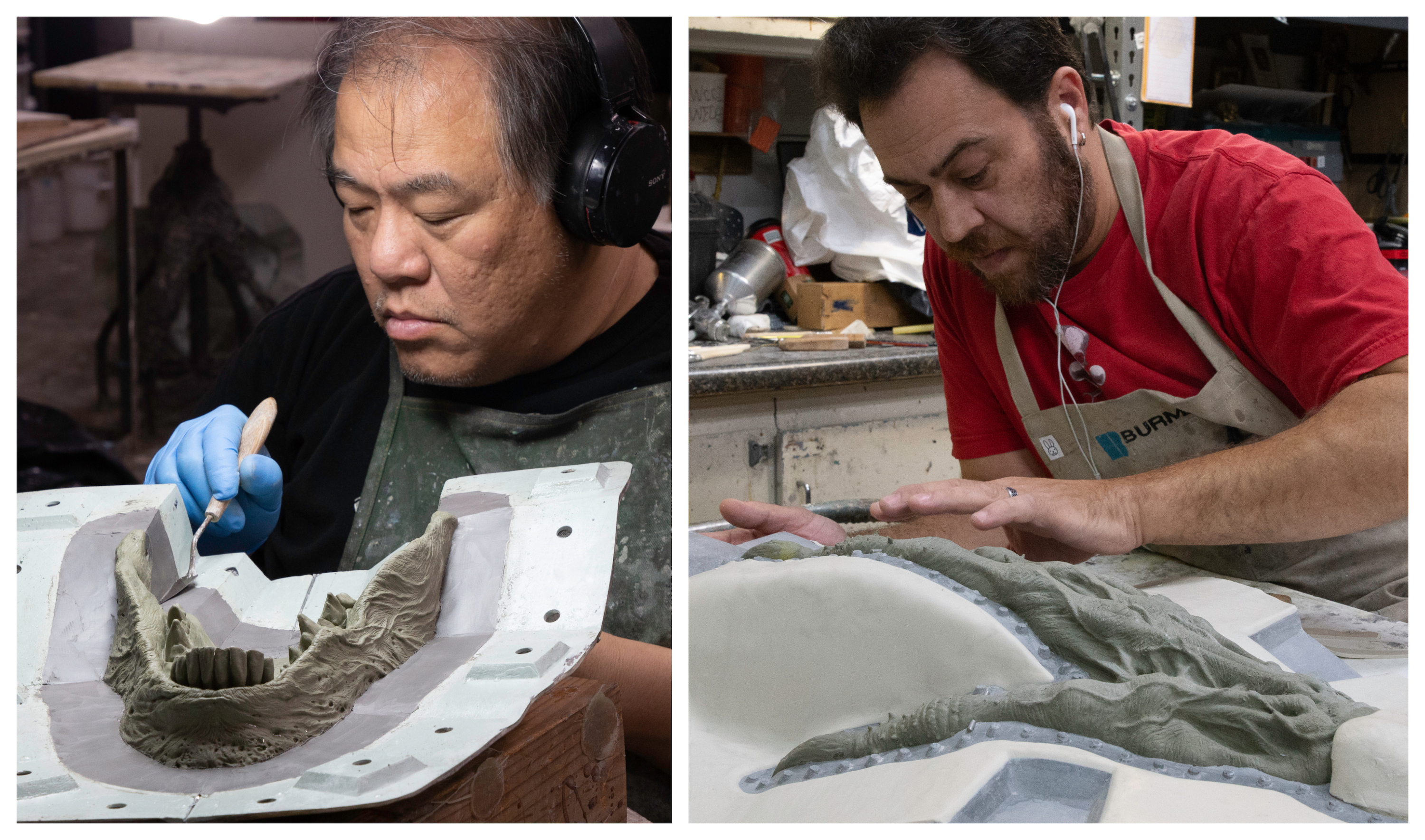 (Gary Yee and A.J. Venuto mold the lower jaw and hand of the Wendigo. Images courtesy Legacy Effects/Fox Searchlight.)
Building the Wendigo Creature
Rich Haugen mechanized the Wendigo's head and neck, which were positioned above and forward of the performer's head and mounted to a backpack rig. To demonstrate, Mahan raises his hand above his head, motioning like a dinosaur’s neck. “The neck was on a telemetry device and the whole head moved independently.” Operators would then control the head, neck and hands remotely. He says, “It was really quite graceful as a puppet but that took a while to figure out.”
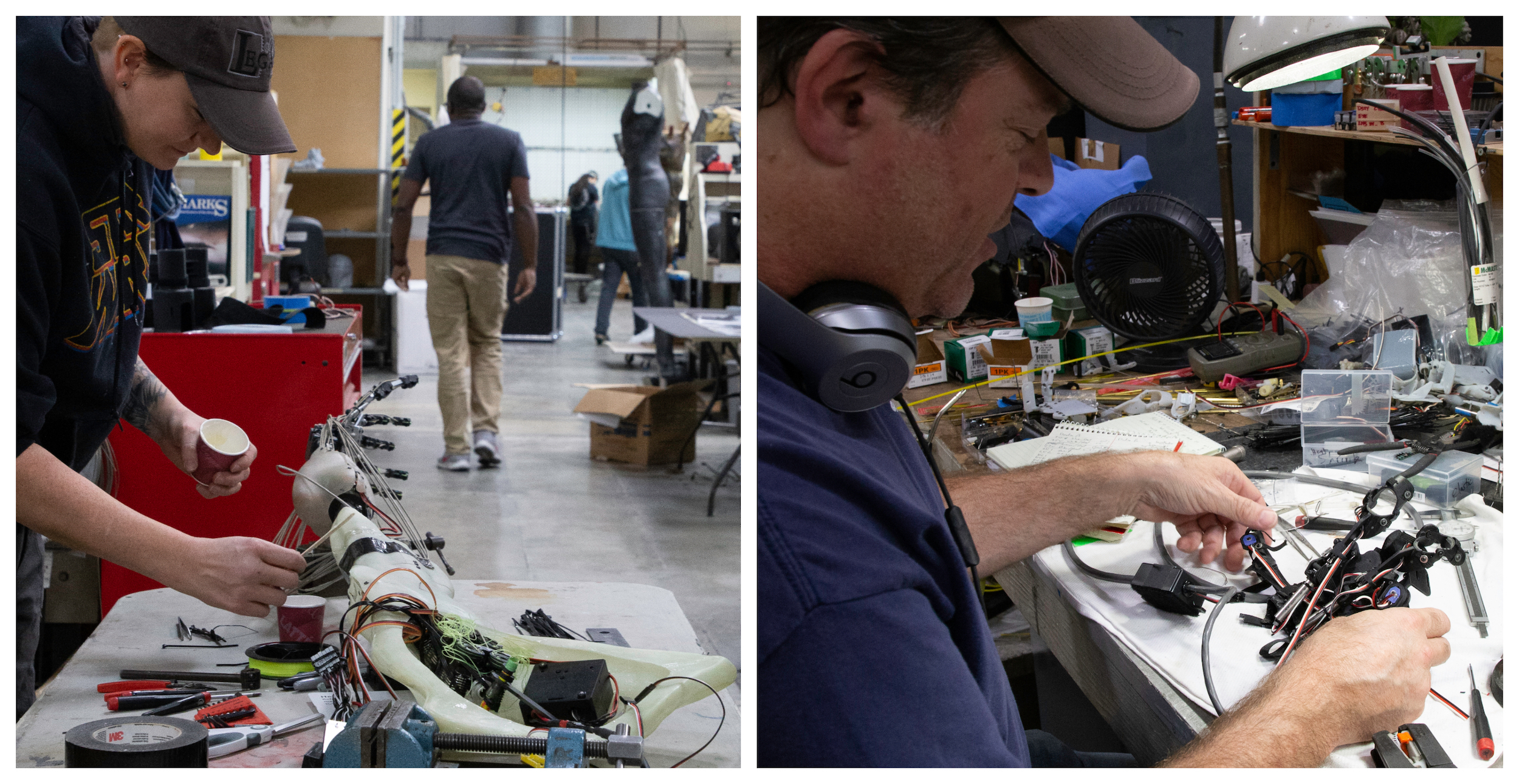 (Mechanics Stephanie Riekena and Rick Galinson work on the Wendigo's hand mechanisms and telemetry devices. Images courtesy Legacy Effects/Fox Searchlight.)
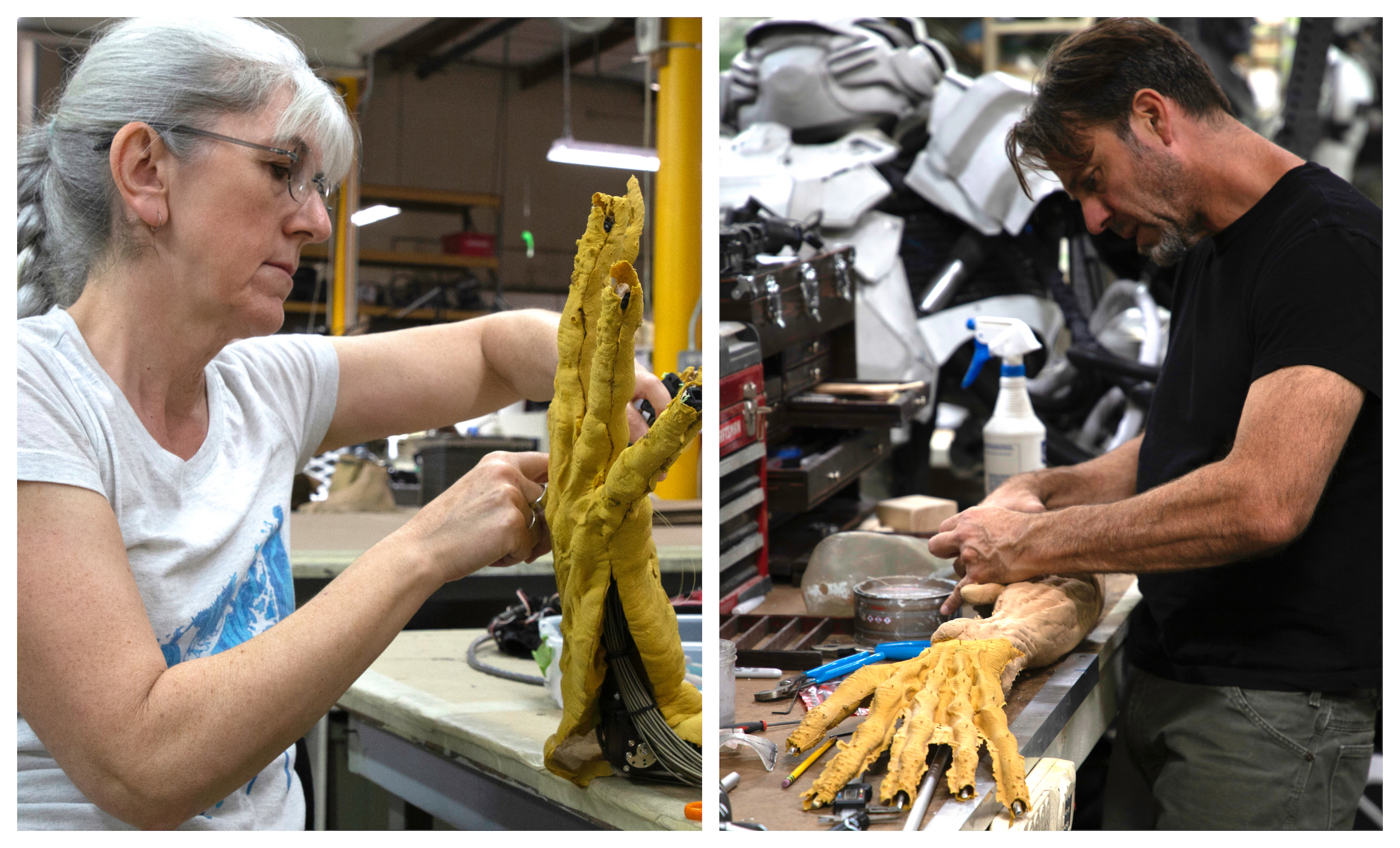 (Tracey Roberts and Rob Ramsdell fit foam latex skins onto the Wendigo's hand mechanisms. Images courtesy Legacy Effects/Fox Searchlight.)
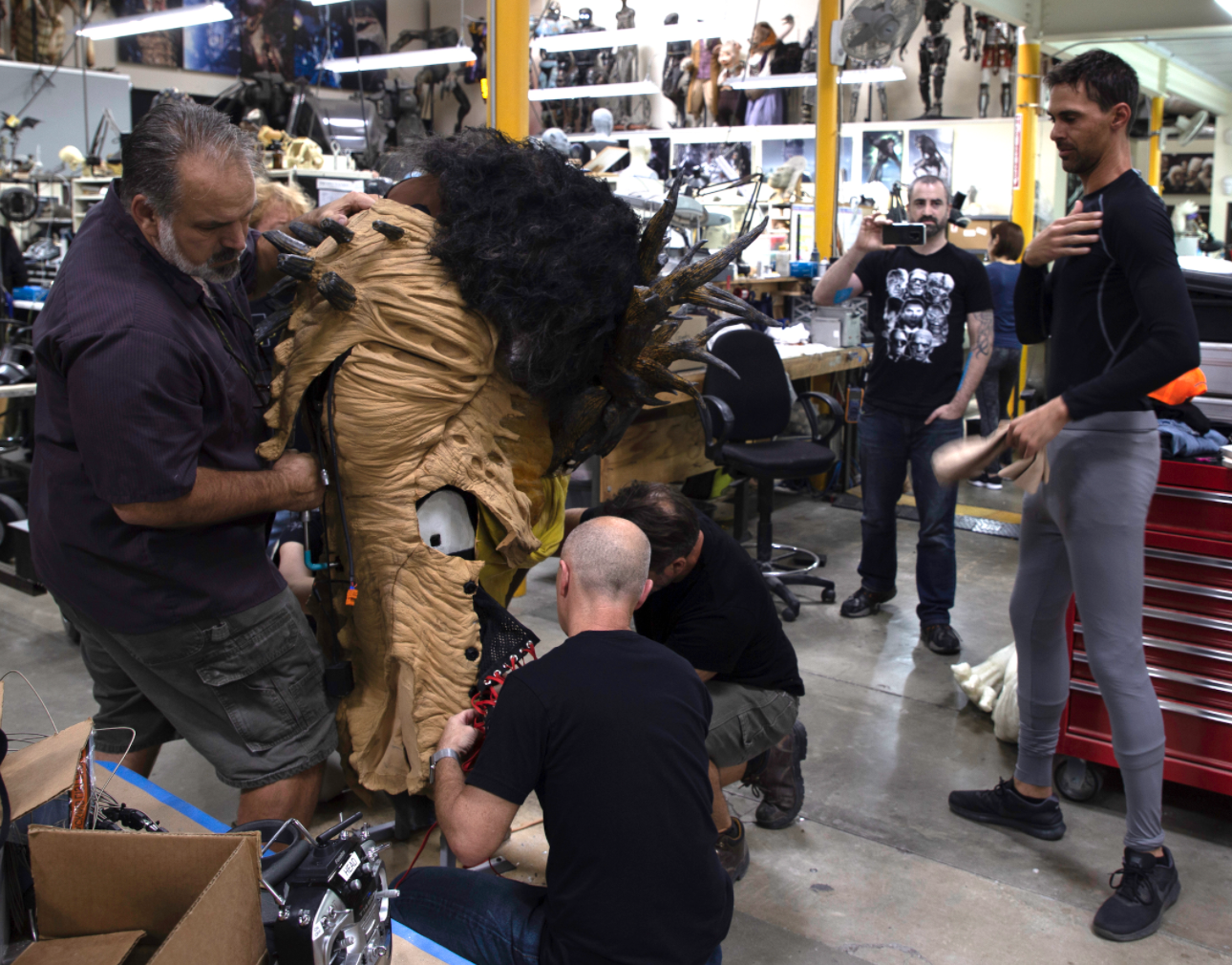 (L-R, Rich Haugen, Lindsay Macgowan, Rob Ramsdell and suit performer Dorian Kingi prepare to test the Wendigo suit. Image courtesy Legacy Effects/Fox Searchlight.)
Mahan says that the eyeless Wendigo was an element that came late. “We had lots of options with eyes. It all kept feeling kind of standard until I think [Scott] Cooper or Guillermo said, 'it's just like a skull with no eyes at all. It just senses where you are.'”
 (The completed eyeless Wendigo skull in all its antlered glory. Images courtesy Legacy Effects/Fox Searchlight.)
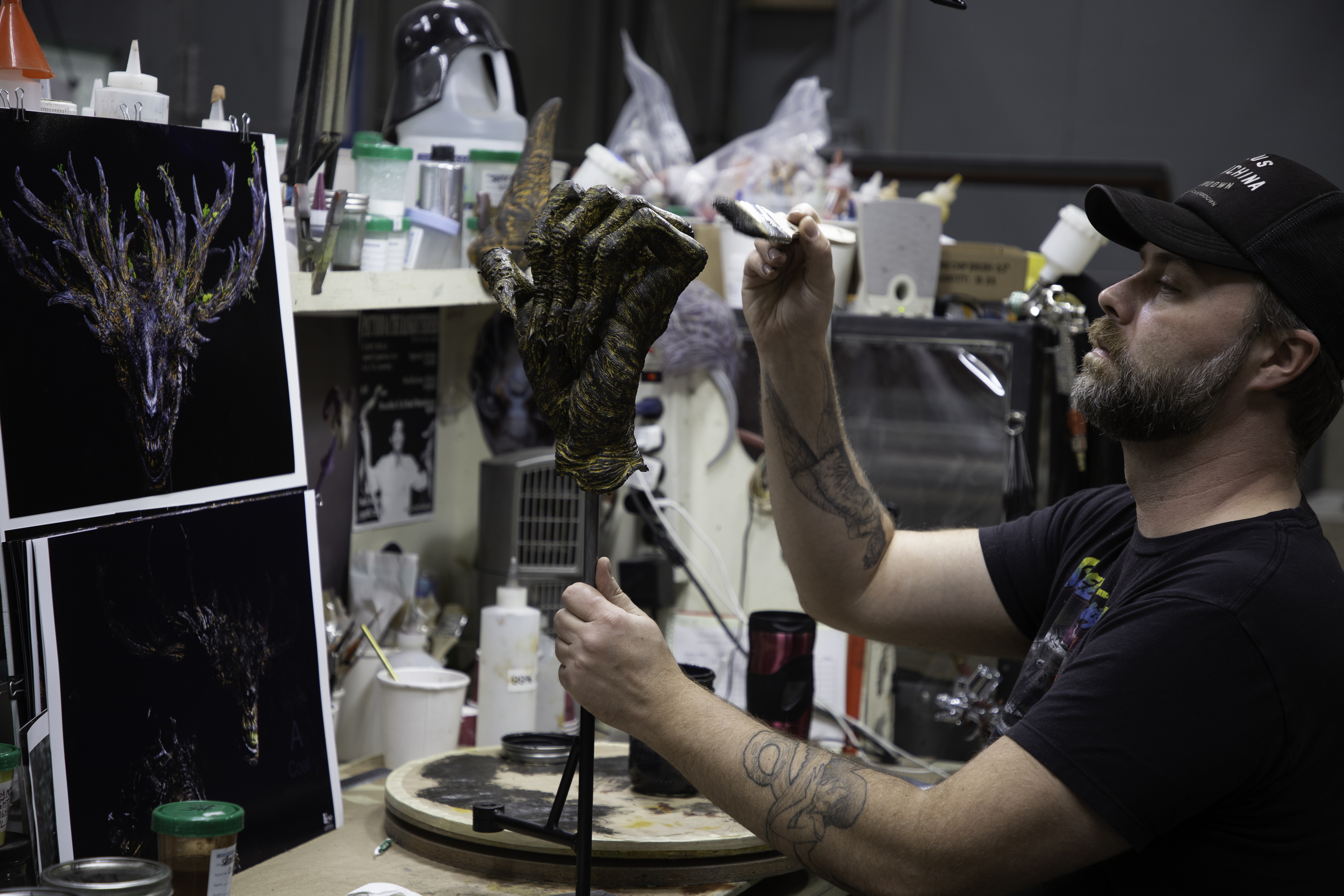 (Ryan Pintar paints a Wendigo hand. Image courtesy Legacy Effects/Fox Searchlight.)
Bringing the Wendigo to Life on Set for Antlers
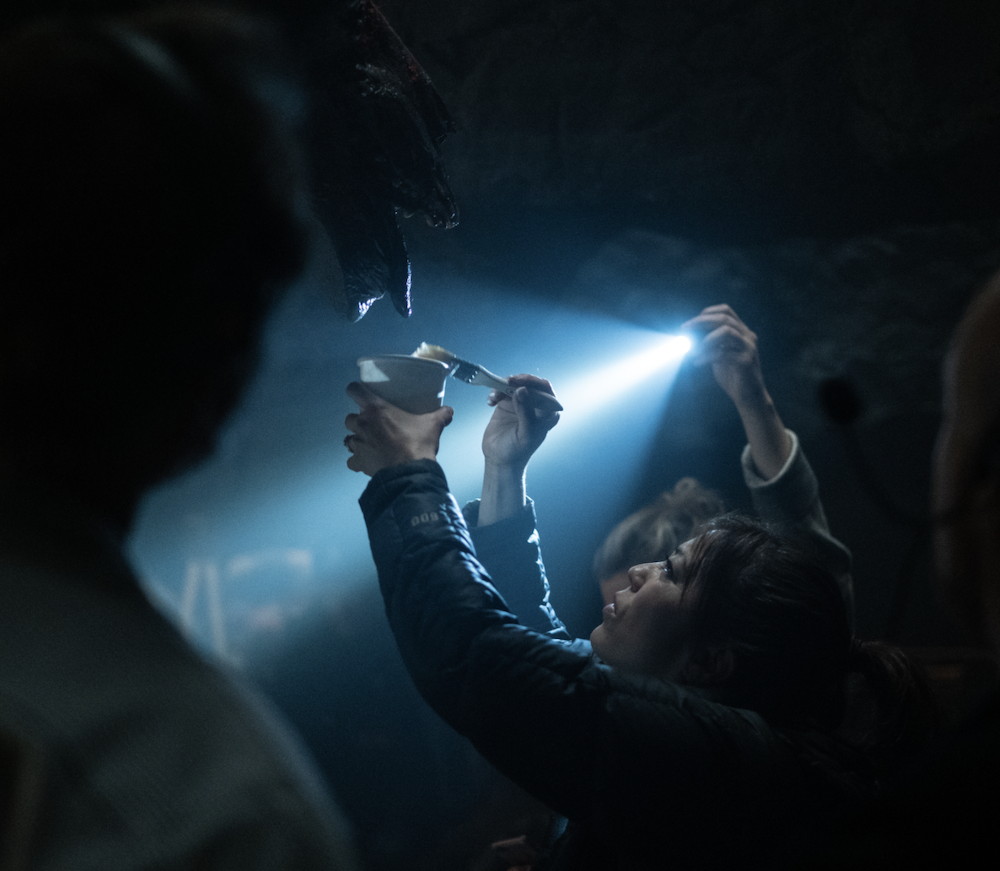 (Readying the Wendigo for its closeup on the mine set. Image courtesy Fox Searchlight.)
To achieve the Wendigo's steaming breath, Mahan says, “There was a tube in the nose that actually shot out hot steam, not smoke, but hot steam. So there was a device on the floor that followed this creature, that blew steam, that was about 300 degrees out of its nose. And after you do that, five or six times, the plastic around the nose starts to get a little soft. So I was like, 'Hey guys, you just lay off the steam, just give it a few seconds to get cold again.'”
For the Wendigo's gross brown drool, Mahan used something different than the common methylcellulose. “There were tubes that ran coffee that were constantly dripping. We made coffee by the gallons. So it was like dripping iron... like a smelting pot. This creature was like an iron ore foundry. So hopefully that comes through.”
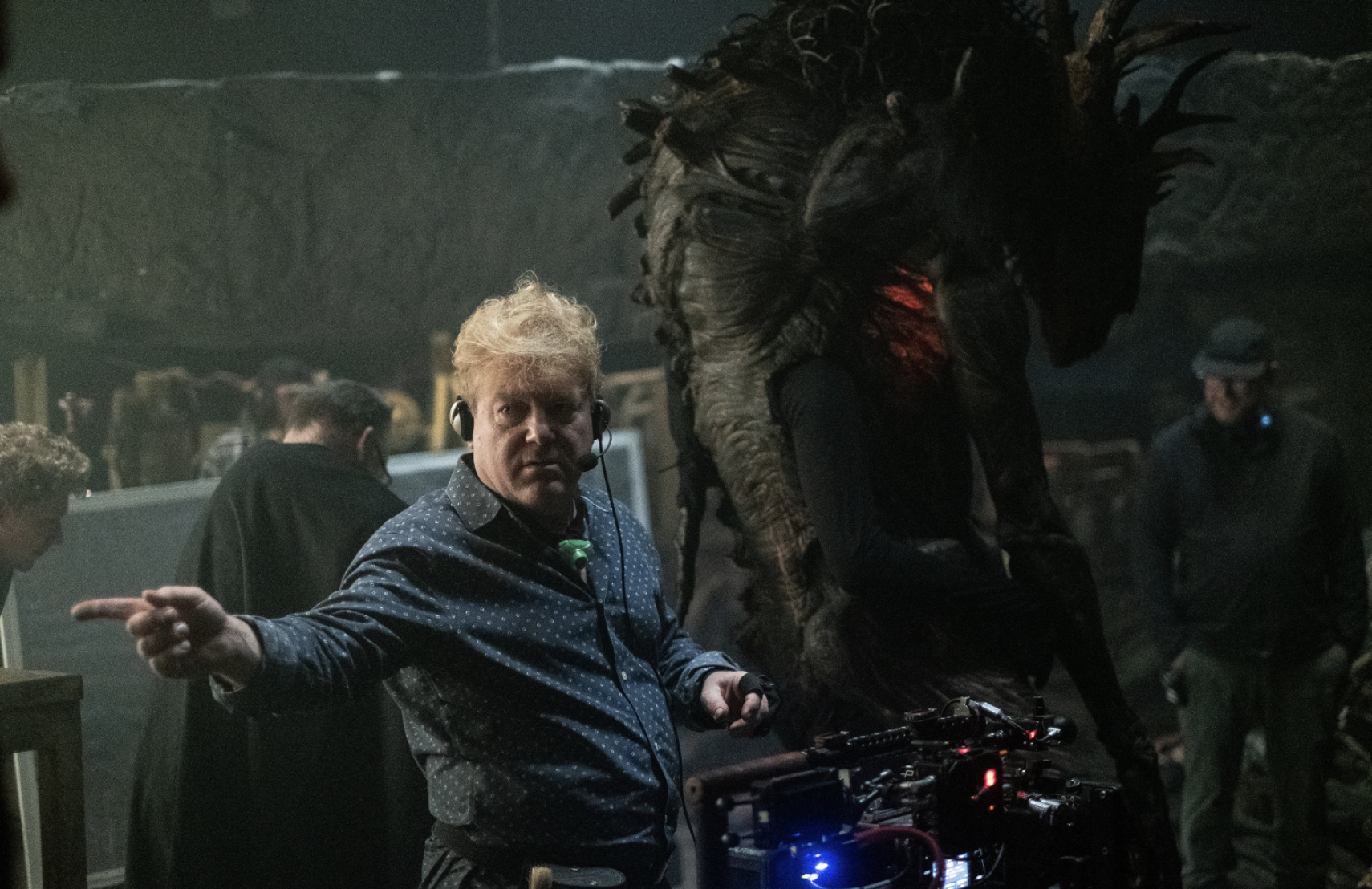 (Shane Mahan and with suit performer Dorian Kingi as the Wendigo on the mine set. Image courtesy Fox Searchlight.)
Breaking Down the Wendigo’s Attack Scenes
The first time we actually get a good look at the Wendigo creature is when it attacks one of Lucas’ bullies in the forest. Director Scott Cooper credited Shane Mahan and Legacy Effects for achieving the effect, even though some of the creature effects were digitally augmented. Cooper says, “The majority was [Legacy's] work and then we just augmented it a little bit with CGI.”
The Wendigo goes on to violently attack the sheriff’s deputy, and then Sheriff Paul Meadows himself in a wooden shed at the back of the law officer’s home. There, the Wendigo impales the deputy through the back and, later, crashes through the shed wall, attacking the sheriff.
Mahan explains that it was decided early on that Legacy Effects' practical Wendigo would be used for graceful and intimate shots, but that motions like, “falling down or jumping up fast would need to be a CGI component because there's just the physics you're fighting.” In the shed fight, for some shots, Legacy would simply put the creature head into frame for a reference pass. Mahan describes it as follows, “The effects team built a rig where the wall could smash in. The actor inside the suit was Dorian Kingi and he was giving it his all. It's a difficult costume because it's so encompassing. Sometimes we would take an arm off and it would be a CGI arm on a full body. That's why we made it a telemetry neck. So it's one performer doing most of the moves.” For the fight in the shed, this meant that the Wendigo was achieved as a hybrid combination of practical and digital. Cooper credits his editor Dylan Tichenor with making the different elements in the scene work. “Some really wonderful editing from Dylan.”
The Wendigo Reveal in Antlers
The Wendigo made its first on-screen appearance in the family’s attic as it pushes out of Frank’s mouth, leaving the man’s body behind. “That scene was really kind of on our shoulders as a reveal,” Mahan says, “So we rehearsed that a lot. [The Wendigo] bursts through, leaving the husk behind.” As the Wendigo comes out of Frank, the man’s face remains stuck to the head of the creature. Mahan explains, “The whole thing kind of came through, but remarkably, his face was gone because it was stuck on the front of the creature, which I thought was surreal.” He continues, “So it gives us rather like a Predator reveal. You think that's the [Wendigo's] face, but that's not its face, it's kind of Phantom of the Opera.”
 (The Frank 'skin face' hanging on the front of the Wendigo head. Image courtesy Legacy Effects/Fox Searchlight.)
When Frank’s face finally slips off, it's revealed that the Wendigo face is more of a cracked deer skull with jagged teeth set in a crocodile-like jaw. Director Scott Cooper says, “I thought it was a really beautifully designed creature and also terrifying. And one of the interesting design elements is the lack of eyes. Because you can't really negotiate with something that doesn't have eyes.”
 (Concept designer Jared Krichevsky's depictions of the Wendigo head with and without Frank's face hanging off of it. Images courtesy Legacy Effects/Fox Searchlight.)
Antlers Bear Scene Effects Explained
In the end, Keri Russell’s character Julia Meadows tracks the Wendigo back to where it came from; the abandoned mine. For this scene, Legacy Effects would also contribute a bear carcass discovered in the mine before the final fight of the film. The bear was meant to look as though it had been killed earlier by the Wendigo and was lying on the mine floor. Mahan says, “We made a lot of entrails for it.” The Wendigo puppeteers would spend quite a bit of time practicing the motions of the creature bending down and feasting on the bear's entrails. “I knew this was going to be very difficult because there were only two or three of us operating. So we had these hand devices [that could operate the Wendigo's hands].”
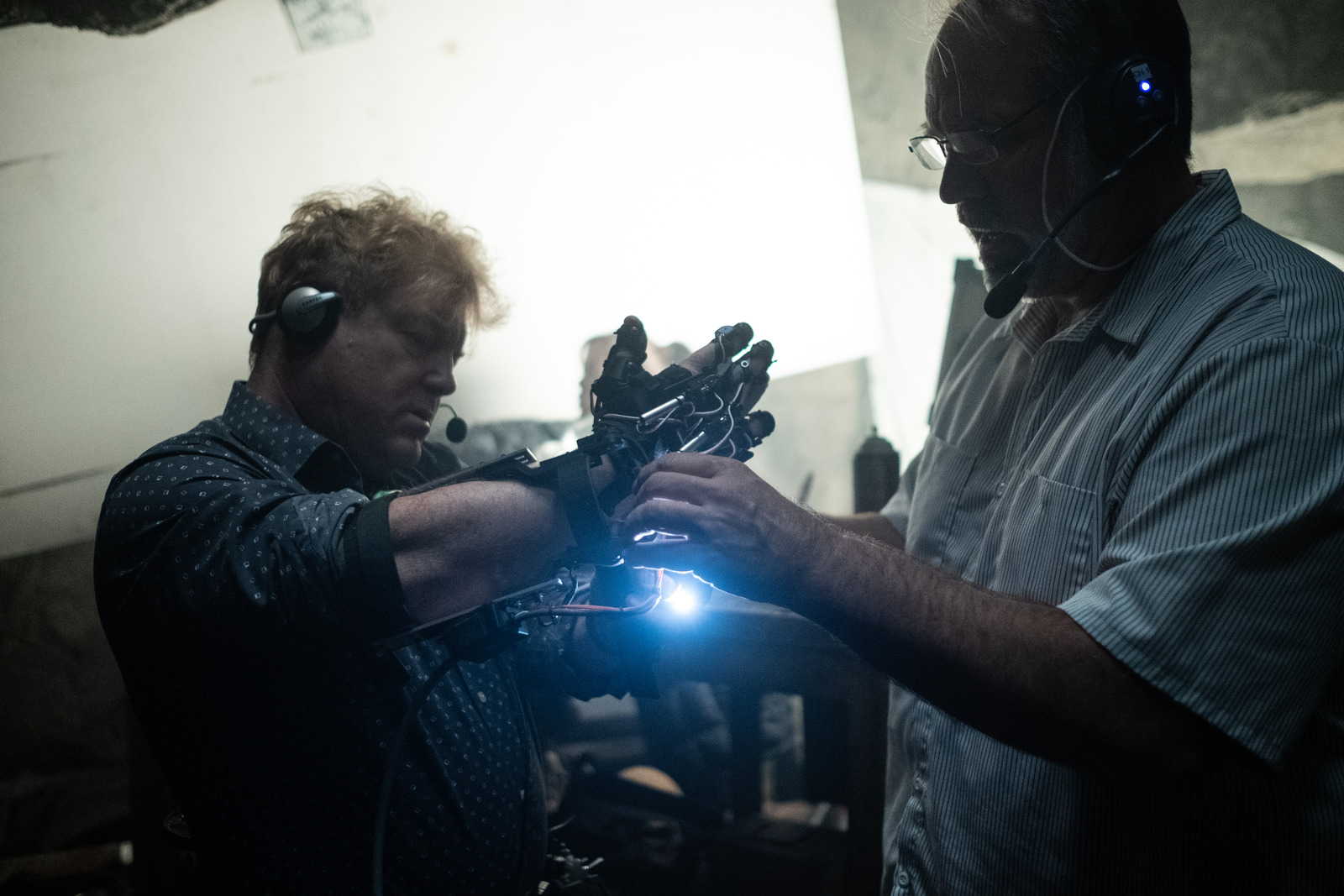 (Shane Mahan and Rich Haugen adjust the telemetry glove that controls the Wendigo's mechanical hand. Image courtesy Legacy Effects/Fox Searchlight.)
Mahan recalls how the Legacy team went about making the gore required for the bear carcass. “The night before, I went to a grocery store in Vancouver and got as much raw meat as I could. We shredded it and we put it on hooks and ran lines through the mouth so that [the Wendigo] could be eating, pulling meat, and swallowing it down.” Mahan says, “You can make synthetic flesh and stuff but it never really looks as great as I can make it look with a piece of steak.” He continues, “So you're pulling meat down its throat [as the Wendigo is] turning to reveal itself. So it was all perfectly timed... one of those great moments.”
Killing the Wendigo
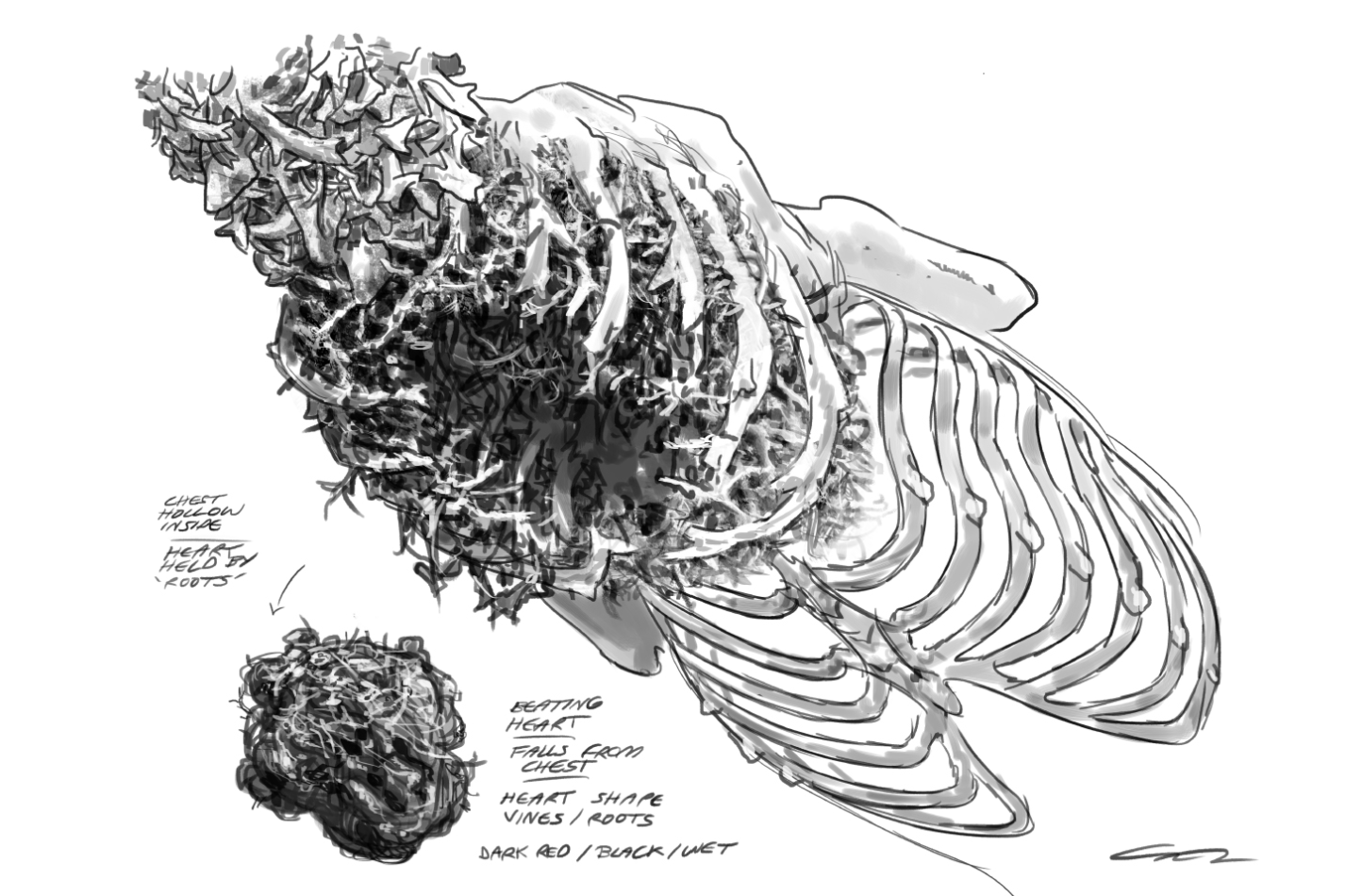 (Guy Davis artwork detailing the heart and chest cavity of the Wendigo. Image courtesy Fox Searchlight.)
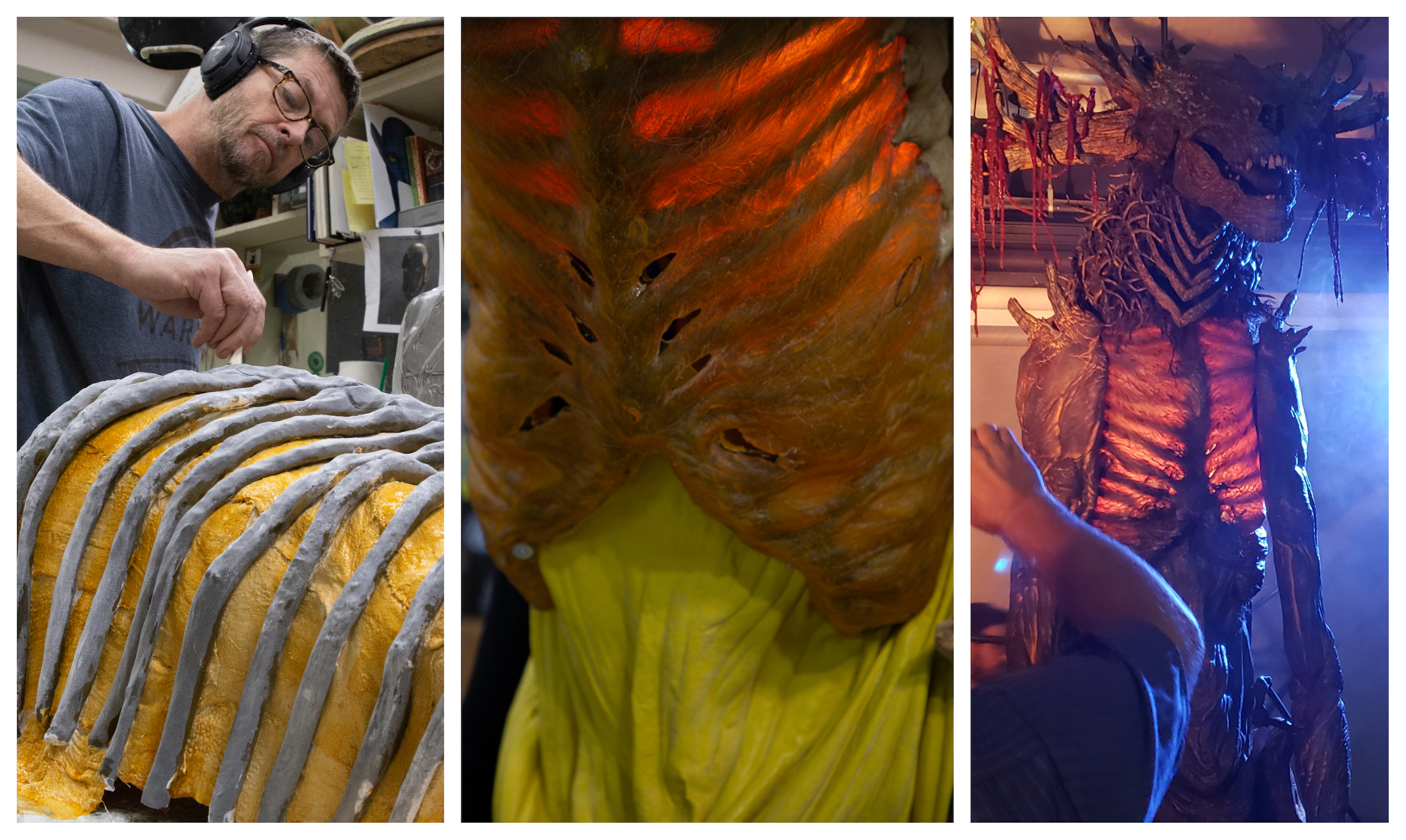 (L-R: Mark Maitre sculpts the Wendigo's rib cage; testing the glowing rib cage; a Wendigo suit test. Images courtesy Legacy Effects/Fox Searchlight.)
Julia discovers that the only way to kill the Wendigo is to cut out its glowing heart. Actress Keri Russell would actually cut into the creature’s chest to reach the organ. To accomplish this, Mahan says, “I had to put in a piece of skin that was a gelatin piece and rig it and get ready to have her cut [the gelatin] with a knife. And [then she] pulls its heart out.”
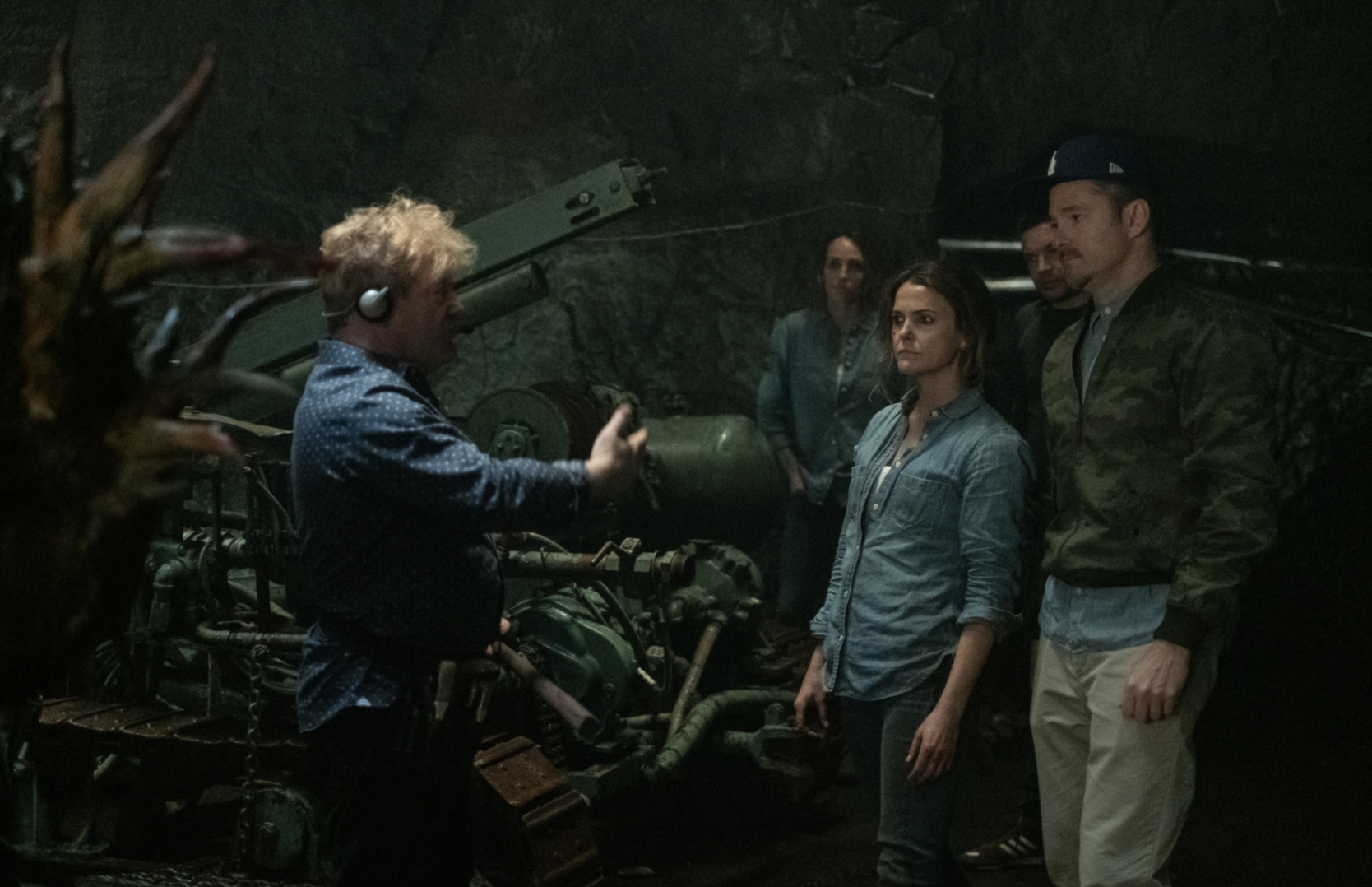 (Shane Mahan, Keri Russell and director Scott Hooper shoot the Wendigo fight sequence. Images courtesy Legacy Effects/Fox Searchlight.)
“The Wendigo doesn't really have entrails. It has brambles, thorns, and pieces of sticks and grass. That's what comes out," continues Mahan. "So the heart was in there and it had a little smoke tube in it, it had a pumping device and she could cut into the chest, pull the heart out, cut it free and hold the heart in her hand.” He says, “That was really tremendous fun to do. And then you could reset it.” After each take, the Legacy crew would have to, as Mahan describes it, “…frantically put it all back in and put all the brambles back into it. I think we did 5, 6, 7 takes of that to get it just right.”
 (Julia Meadows, played by Keri Russell, fights the Wendigo in the abandoned mine. Images courtesy Fox Searchlight.)
For some shots, digital effects would be used. Mahan gives an example, “Sometimes, like when she pierces through the heart, there are areas where you augment, which was done by Mr. X, and [visual effects supervisor] Dennis Berardi's team.”
Mahan says the Antlers shoot had a tight schedule. “We had to shoot the mine fight in, I think, three days is all.” He laughs, “Of course, you always want more time and you need more rehearsal and rigging to do whatever you can. But the crew in Vancouver were great.” He says, “The stunt team and the wiring team helped a lot.”
A Team Effort Behind the Effects for Antlers
As in many great horror movies, the creature leaves a trail of victims in its wake before we actually get to see what the beast looks like. Legacy Effects had their hands full building the Wendigo monster, so a lot of the gore effects, as well as the makeups for Lucas' father Frank and little brother Aiden, were handled by Vancouver-based Lindala Schminken FX (LSFX).
Mahan pays LSFX respect, “They were tremendous and we had to do it that way, because there was too much for us to do just to get the creature done. I have no qualms about sharing the workload, there's plenty of work for everybody.” Mahan adds, “We would interface back and forth so that there was sort of a continuity of how it was going to work. We did Scott Haze’s lifecasts and sent them to LSFX. We did Amy Madigan's scan and lifecasts. So there were some things we assisted with, but just the basics. I mean, they just did a really nice job.”
The Wendigo’s First Victim
The first Wendigo victim found in the film is discovered in the forest by retired sheriff Warren Stokes (played by Graham Greene). Later, laid out on an autopsy room table, the mutilated body can really be seen in all of its gory detail. LSFX lead special makeup effects artist Holland Miller says, “That was the first thing that we did and the amazing team at [LSFX] built the body. It was completely fabricated from a skeletal structure. The skeleton was then wrapped in silicone and sported molded pieces like the chest, legs, and arms.”
Just as with Legacy, the LSFX team were also feeling the pressure of a tight schedule on Antlers. Miller recalls, “It's kind of a funny story. The shop was running a bit behind on this project because it was huge. We had a ‘show and tell’ to do on a Friday, it was supposed to shoot Monday. I go to the shop to pick it up with one of my coworkers, Christopher Clark, who built the body. And I walk in there and there's not a stitch of paint on it. It's just, it looks like a skeleton with white fondant draped on it.” Miller continues, “I'm like, oh my god! This is going to be the first impression that I have with Scott Cooper and Guillermo?" Michael Eklund, the actor playing Kenny, showed up for the demonstration as well. "We had him in a slant board system," says Miller, "His prosthetic, he wore on one side of his face, on his neck, and overlapped onto the slant board to the fake body.”
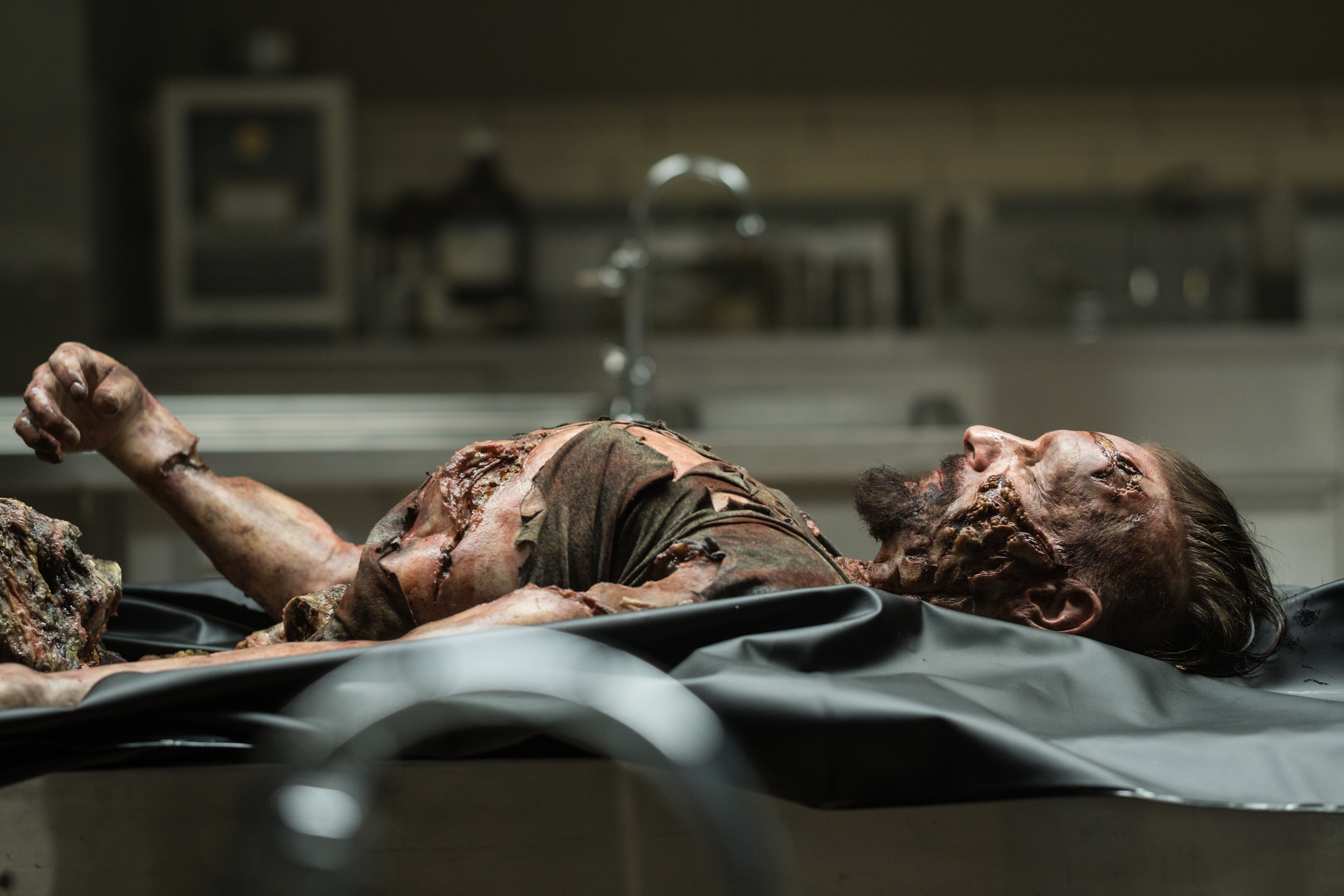 (Michael Eklund as Kenny in death makeup and fabricated upper body by LSFX. Image courtesy Fox Searchlight.)
Holland continues, “So I put the piece on him. I didn't paint it because I wanted to match the foundation that's laying on the table. We get them all set up, Scott and the first AD come by with a couple other producers and they just looked at it and gave me the side eye, like what are we looking at? And why does it look like this? And I'm like, 'we're going to paint it this weekend and it won't look anything like this.' That was my first impression. I'm [thinking], 'I hope the rest of this movie goes better.'”
 (Michael Eklund in corpse makeup on the slant board autopsy table. Image courtesy Fox Searchlight.)
Miller relates the events of the Sunday before the shoot, “I went into the shop and I painted the upper torso and pre-painted the appliances.” Other artists from the LSFX shop painted the lower torso. “Monday comes around," Miller continues, "We get there, we had to do the whole application on set, because we had to get the actor into the slant board and get everything aligned. And then Scott and the whole team came in and they were just floored by how it looked.”
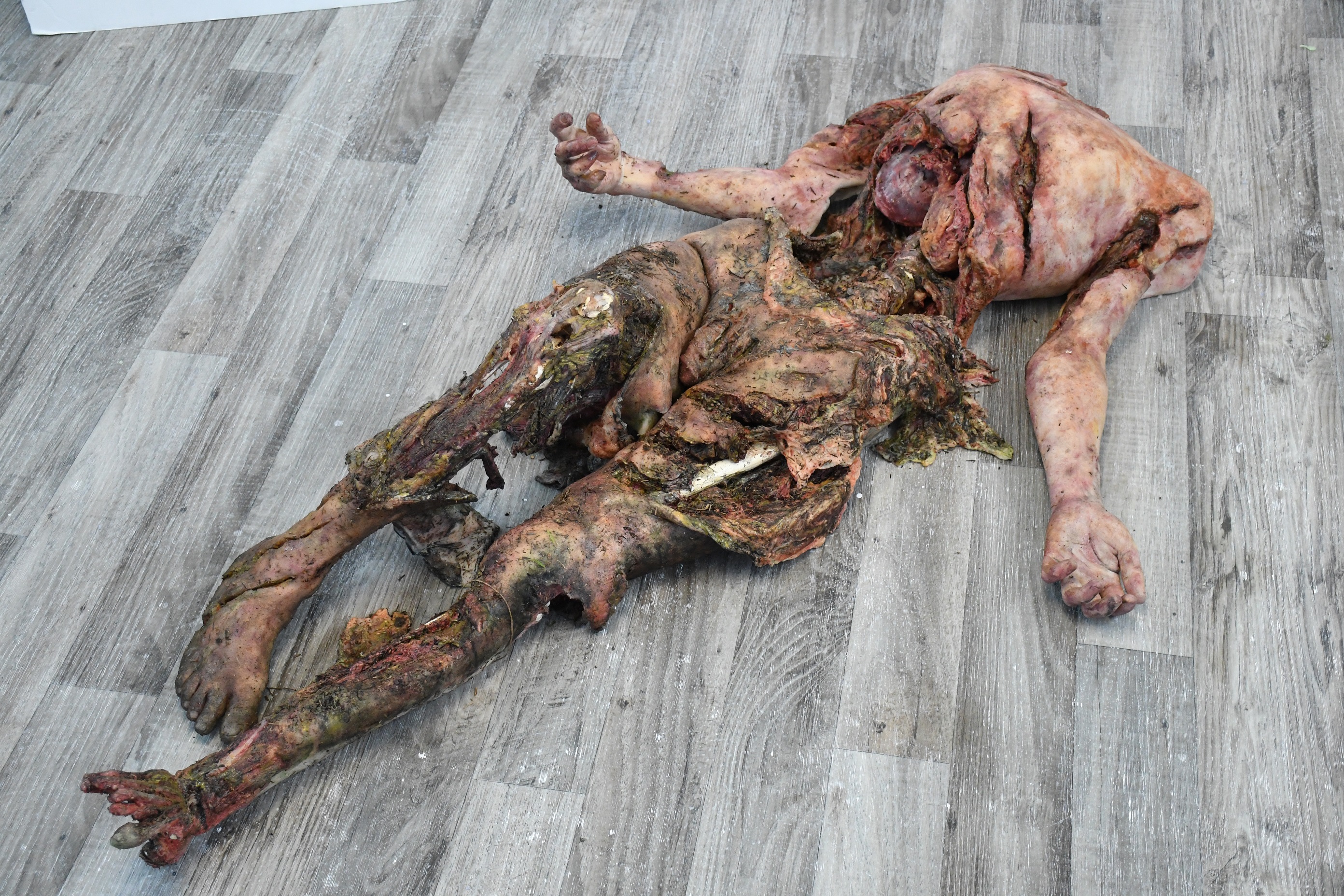 (The Kenny corpse built by Christopher Clark and Cayley Giene with paint assistance from Holland Miller. Image courtesy LSFX/Fox Searchlight.)
Adding to the impressive paint job on the corpse was the fact that it’s actually two different paint jobs. Miller says that from the waist down, “It was really discolored and gross. Greens and browns and blacks. But then the upper body was more bruised and softly discolored. The reason for that was because the torso and the head were found in the mine and the legs were found out in the elements." Miller explains, “We wanted the decomposition from exposure out in the elements to be [more extreme than] the decomposition in the chest and head, that was still in the mine, which would have been preserved a bit more.”
The Effects Used for Principal Booth’s Death Scene
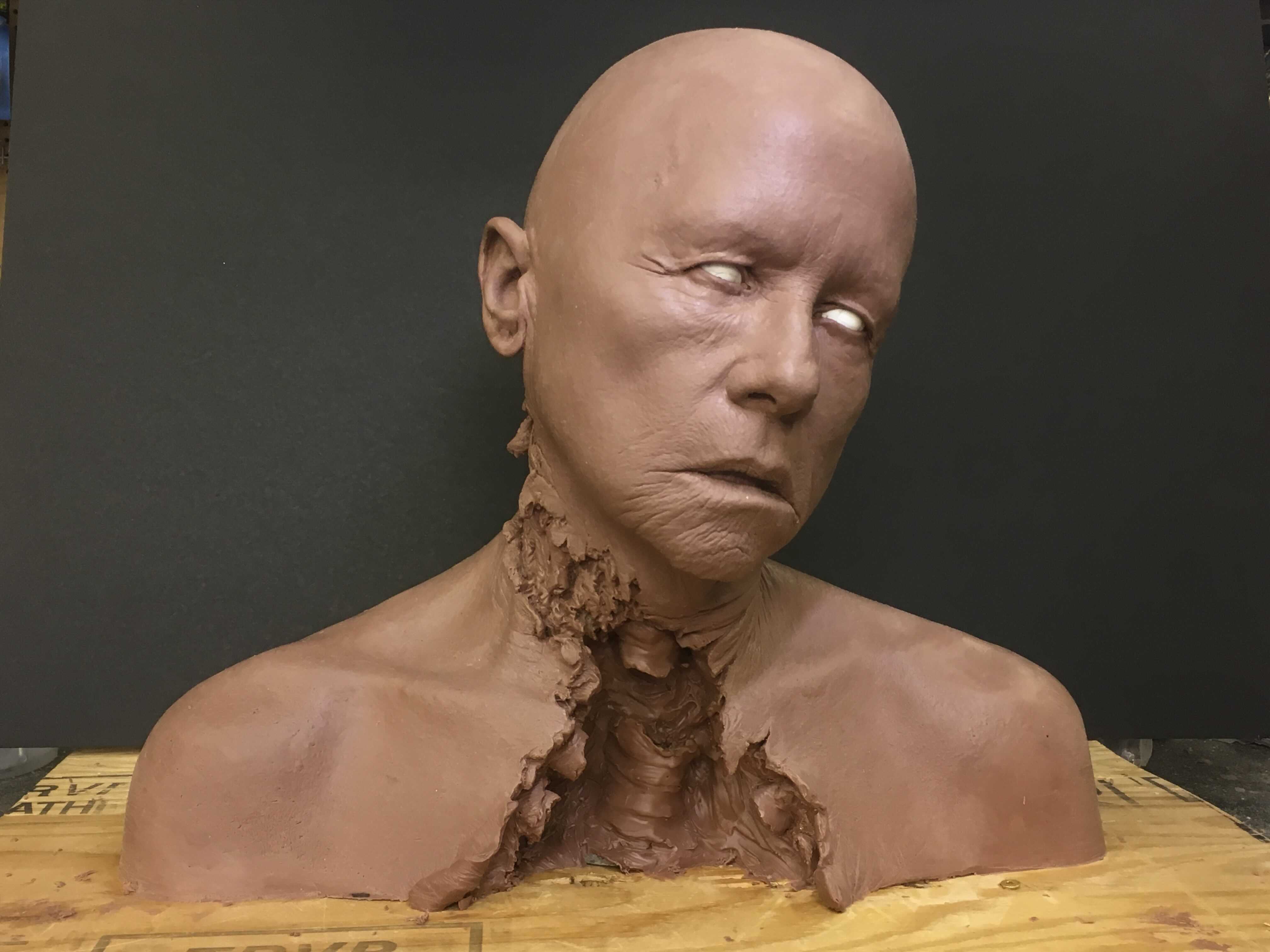 (A resculpted lifecast of Amy Madigan as Principal Booth with neck gash and gore sculpted by Jamie Salmon. Image courtesy LSFX/Fox Searchlight.)
Another of the Wendigo’s victims is the local school principal Ellen Booth (played by Amy Madigan) who makes the mistake of going to check on young Lucas. The brutal Wendigo attack on Booth was handled with straight makeup by the on-set makeup artists. The LSFX team was responsible for constructing Principal Booth's corpse. Miller says, “The shop built that. One of our painters that works at LSFX is probably the best in the city. She's incredible. Bronwyne Sloley. You may have recognized her work on the Natalia alien in Star Trek Beyond, the one with the big seashell swirls. She painted that.”
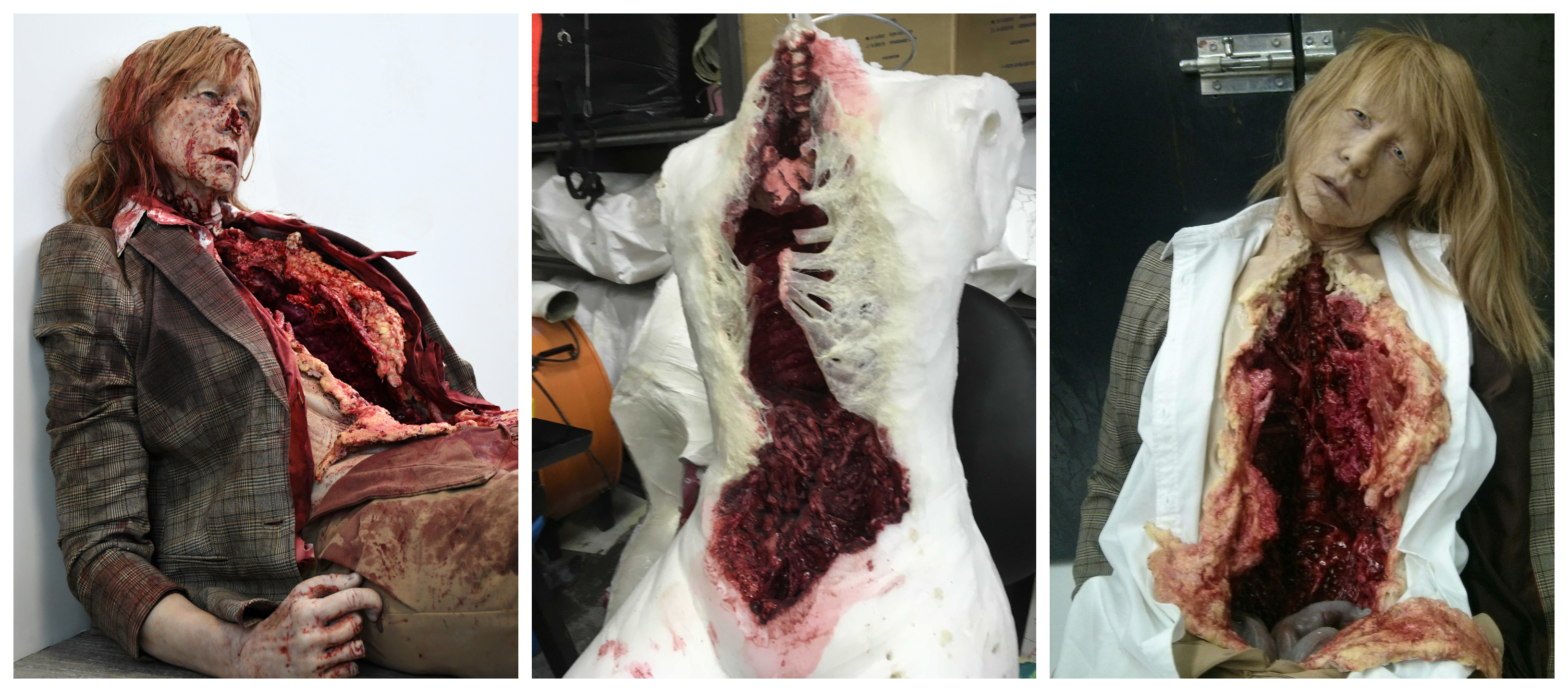 (Principal Booth's corpse with body and gore fabricated by Christopher Clark, hair work by Jackie Seo, and paint by Bronwyne Sloley. Images courtesy LSFX/Fox Searchlight.)
Miller continues discussing the prop. “She painted the body and it was handed over to me. I placed it in the attic, how they wanted it to be posed.” Scott Cooper decided that a flashlight playing across the corpse was washing out the paint job, so Miller touched it up a bit while the director watched on a monitor. “I was on radio and I just started painting. And I said over the radio, 'Scott, tell me when to stop.'" Miller punched up the bruising and marbling effects, adding intense purples, browns, and blues. “That's the only contribution I have with that body. Otherwise, that's all [the crew] at LSFX."
Frank’s Transformation Into the Wendigo
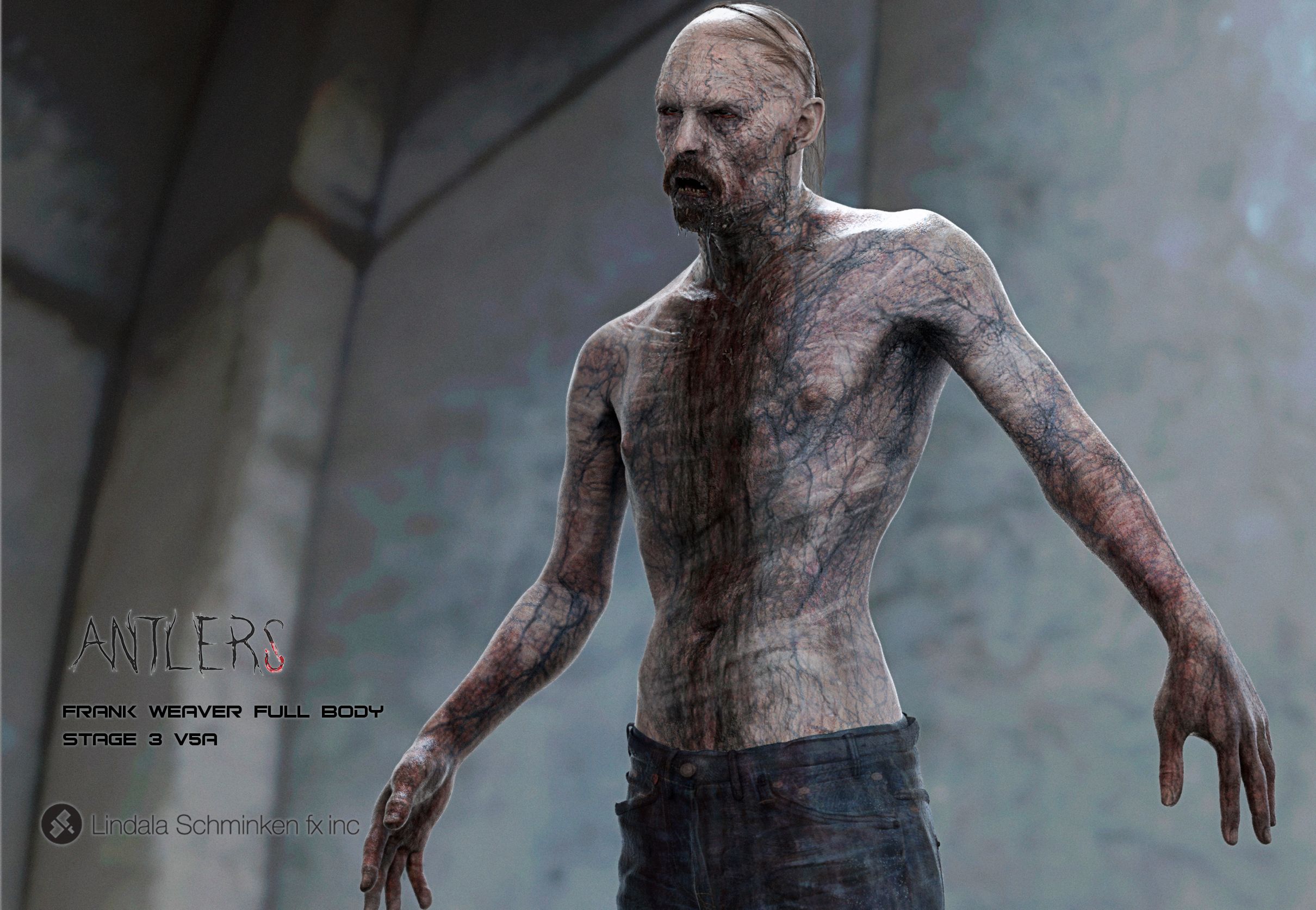 (Frank Weaver Stage 3 concept art designed by Lance Webb. Image courtesy LSFX/Fox Searchlight.)
In the abandoned mine, Lucas’ father Frank is infected by the spirit of the Wendigo, which slowly grows inside him. Frank’s journey from victim to the Wendigo's eventual emergence from his body would be done in three stages. For the first stage, actor Scott Haze was made scruffy with a set of vacuformed, nicotine-stained teeth. Miller says, “This was brilliant because it saved a lot of time and effort by not requiring tooth stains and trying to maintain that throughout the whole day.” A second pair of teeth were made for the actor to take home ahead of the shoot so that he could practice speaking with them.
For the second stage Frank makeup, Miller added a forehead appliance and wig. Miller says Haze was, “painted with a little bit of marbling and mottling and veining. Some redness around his eyes, just making him look a bit sicker.” The forehead appliance covered Frank’s brows. “We wanted the forehead appliance to start the transformation into the next stage, which was very extreme. If we hadn't used something to manipulate his skull structure, the jump from Frank's human look into that kind of mid-creature look, would have just been too jarring. So it was a subtle appliance, but it had some 3D veins sculpted into it. The brow was a bit more pronounced, temples were sunken in, and then his wig was pulled back so it looked like the hair was receded a little bit.” Again, Frank would wear the gross, discolored teeth.
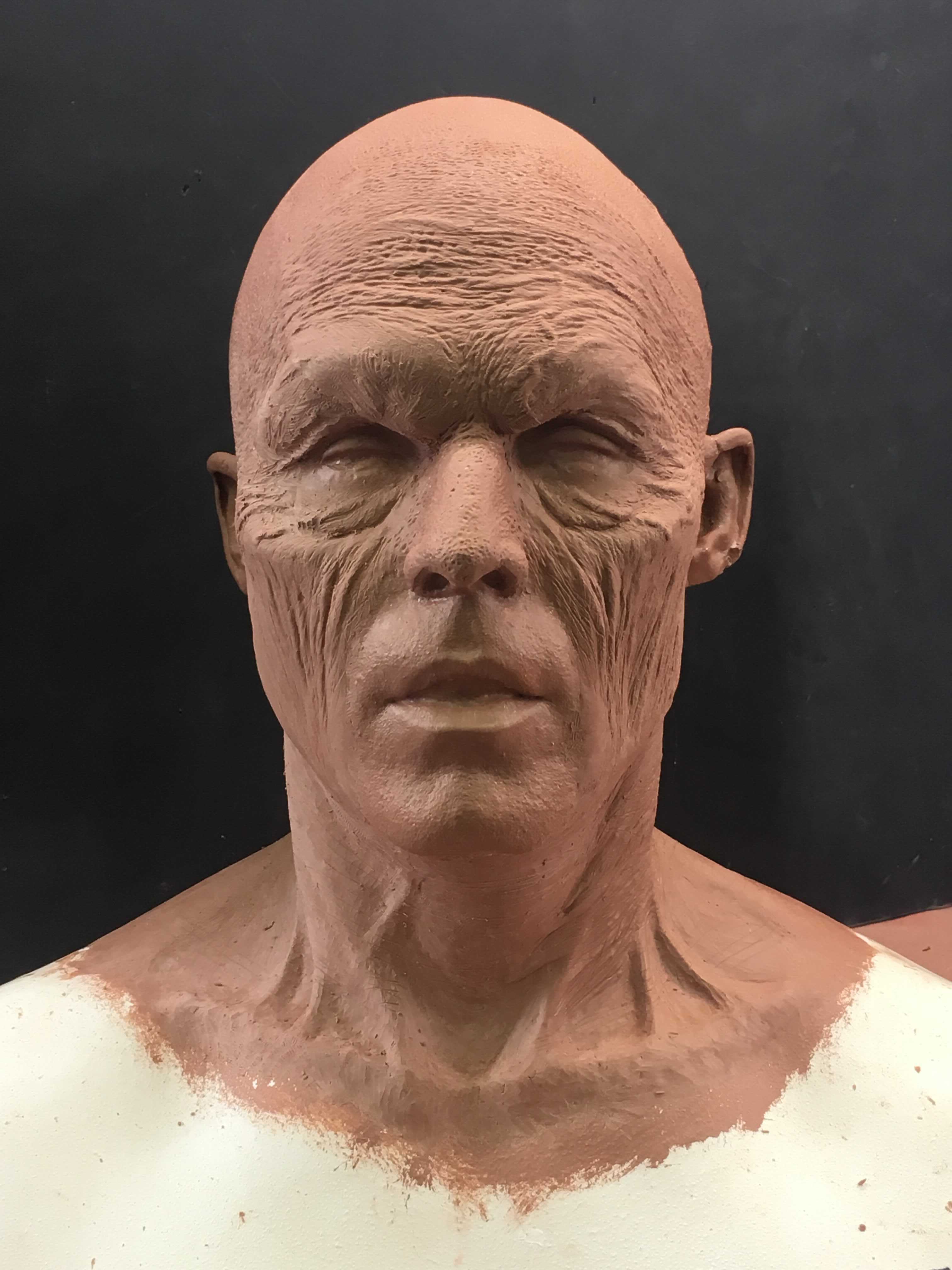 (The Frank Weaver Stage 3 sculpt before the floating off and finishing of appliances. Sculpted by Kate Jadue. Image courtesy LSFX/Fox Searchlight.)
The third stage transformation makeup included a full cowl appliance consisting of forehead, cheeks, neck, and lip. “The hair was punched into the cowl, so no wig was needed there. We wanted the hair to look really thin and wispy, like he was losing big chunks of hair.” The third stage makeup also included, as Miller describes it, “big monster teeth, contact lenses, and all the rest was paint from the neck down; below was just all painted, integrated into these silicone appliances.” Once on set, in a situation similar to the Principal Booth corpse, Miller would punch up the colors painted on the Frank appliances to register better in the attic lighting.
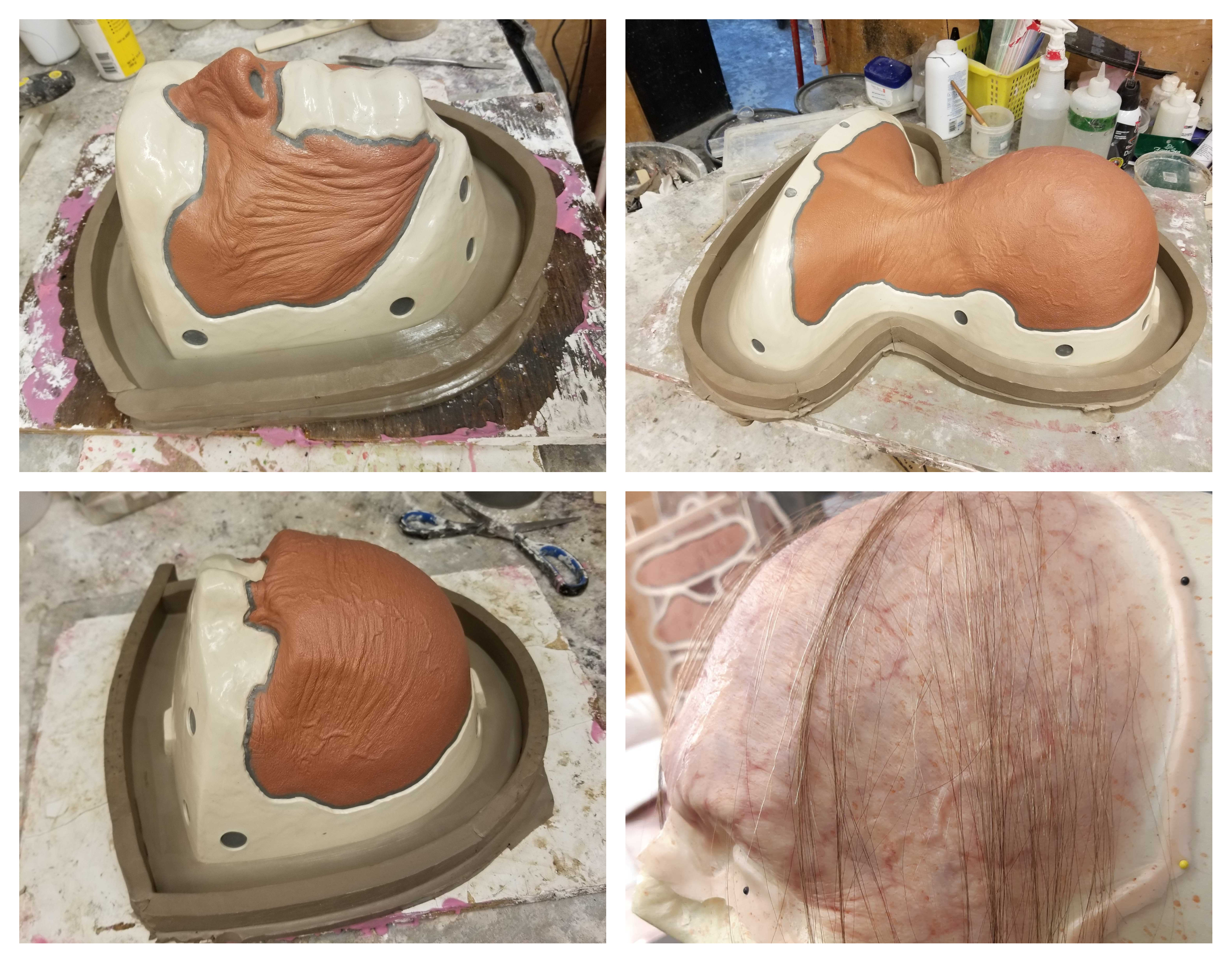 (Clockwise from lower left: forehead, nose and cheek, and back of head appliances ready for molding. All sculpted by Kate Jadue, refined and molded by Michael Nickiforek. The final forehead appliance pre-painted by Bronwyne Sloley with hair work by Jordi Eggie and Crissy Renaud. Images courtesy LSFX/Fox Searchlight.)
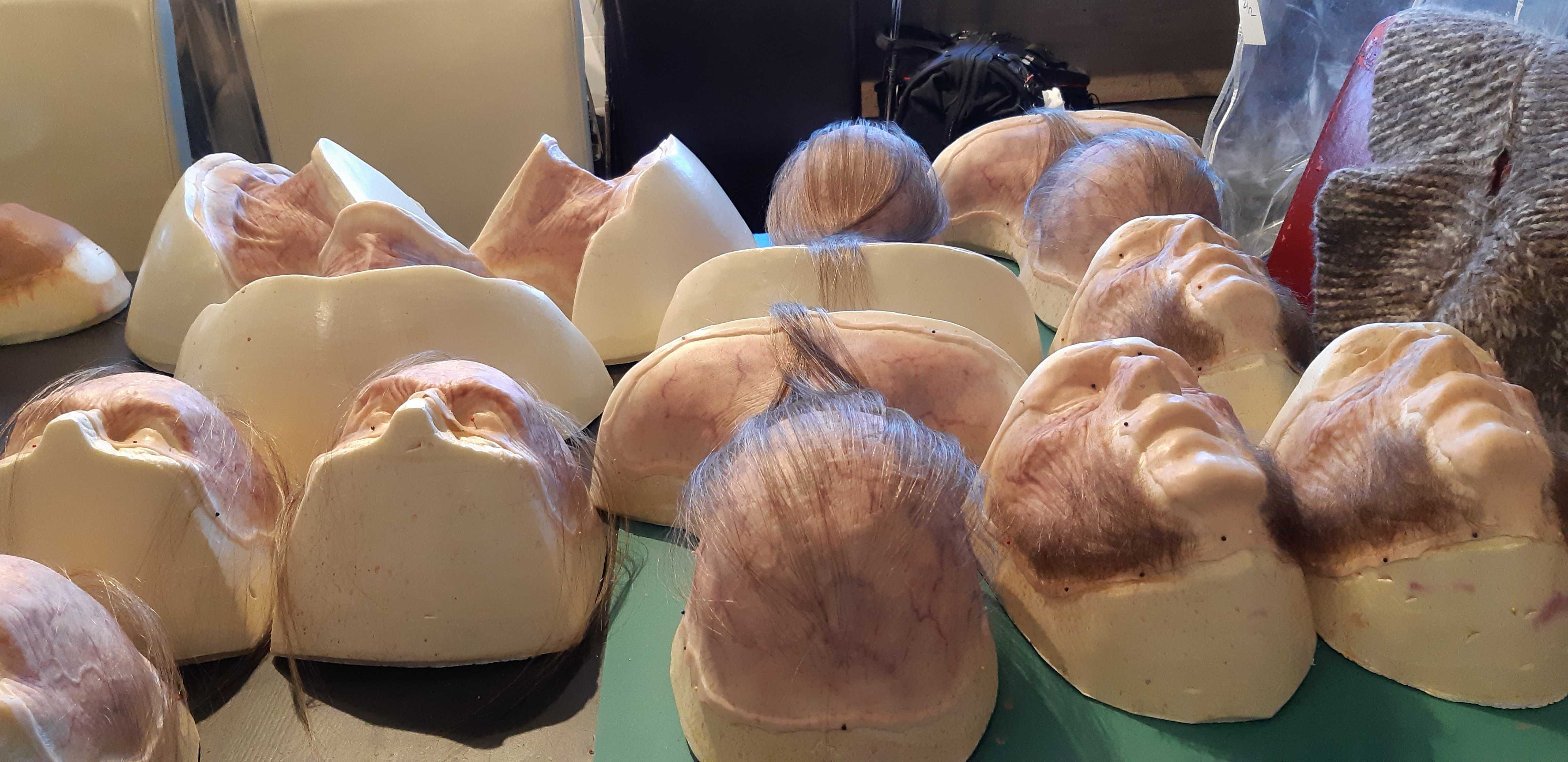 (Stage 3 Frank Weaver appliances ready to travel to the set. Image courtesy LSFX/Fox Searchlight.)
No prosthetics were used for Frank’s torso. Miller says, “Haze went through an intense weight loss program. “He lost as much weight as he could and then during his performance he would do his best to stick his chest out and suck in his stomach so we could see the ribs. We went in and exaggerated all that with highlight and shadow. So it was a marriage between his physical acting, his weight loss, and our makeup.” The eerie glow inside of Frank’s chest that represented the Wendigo’s heart would be added later by VFX.
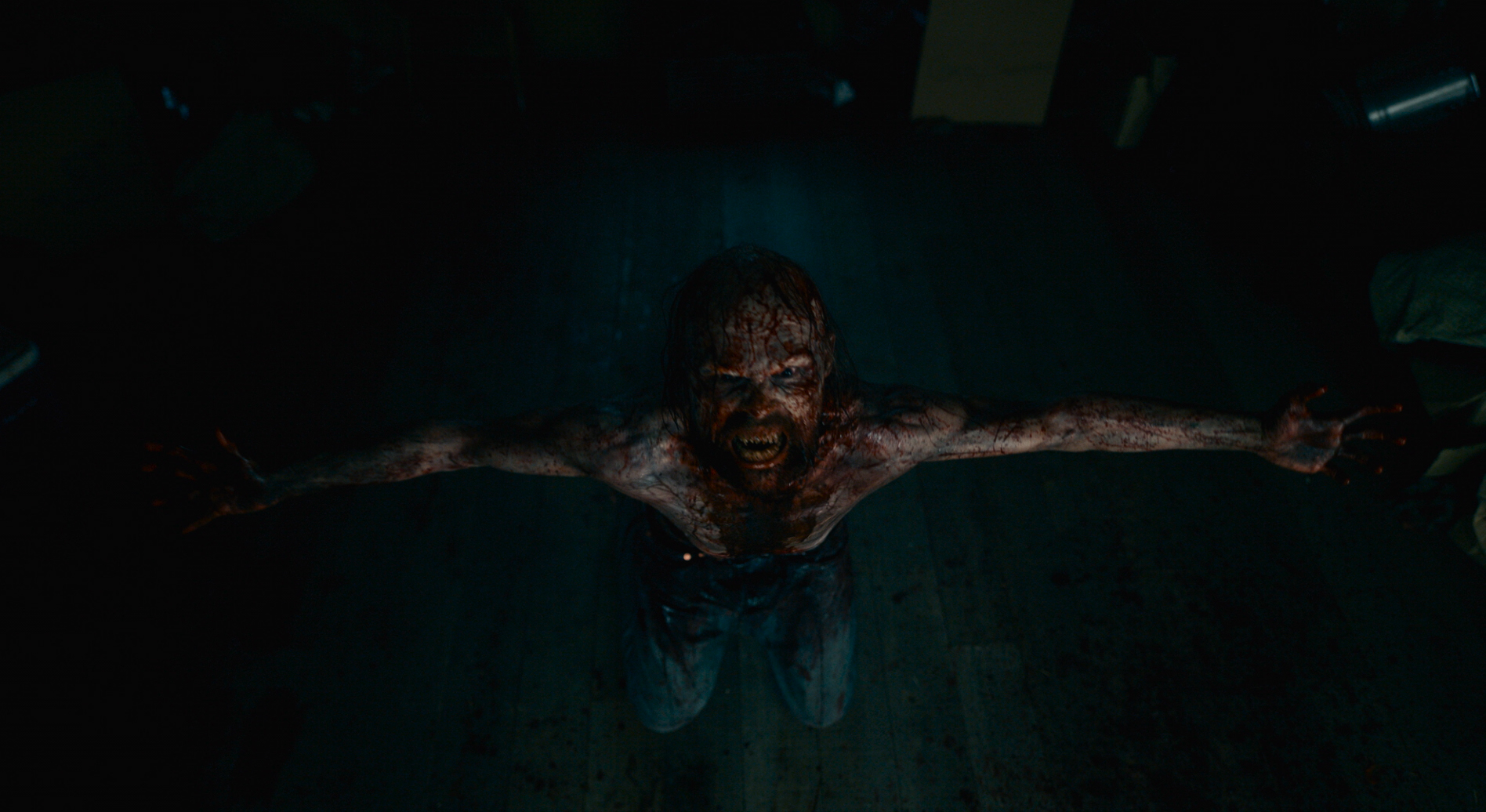 (Scott Haze in the stage 3 Frank makeup by LSFX. Image courtesy Fox Searchlight.)
Miller says LSFX only used silicone, not foam latex, for the Frank appliances. With silicone, “you can bang out more appliances daily than you can with foam because you're not waiting on the baking process. So it's quicker that way, too, for production.”
Aiden’s Infected Makeup
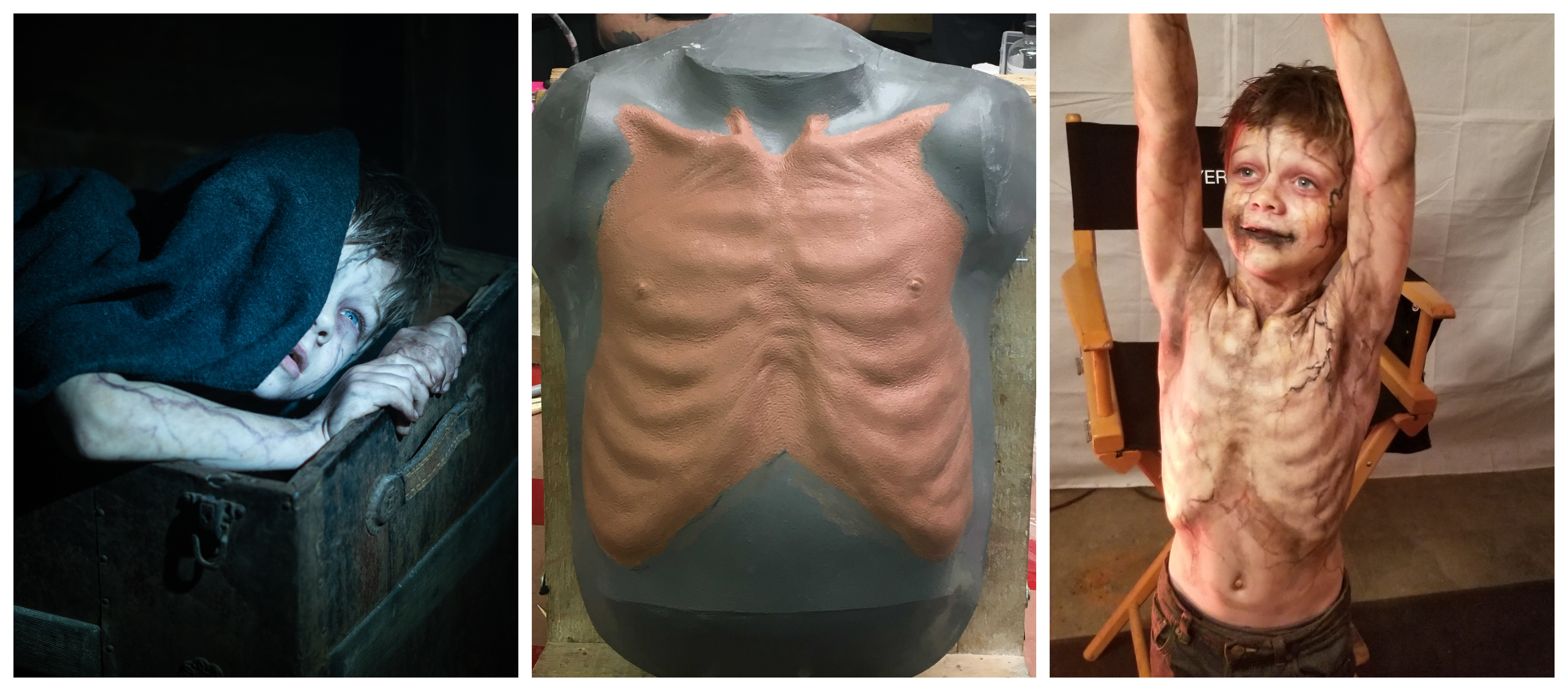 (L-R: veining makeup visible on Aiden's arm, Aiden's sculpted chest piece by Kate Jadue, and actor Sawyer Jones in makeup applied by Holland Miller and Dae Cadman with black vein bondos run by Emily Herriott and Corinne DeBerry. Images courtesy LSFX/Fox Searchlight.)
Frank’s youngest son Aiden (played by Sawyer Jones) would also be infected by the Wendigo spirit. LSFX created a small chest appliance for the boy that included wasted-looking ribs and sternum. While Miller applied the first test makeup, Cayley Giene and Caitlin Groves were responsible for Aiden’s on-set makeup. For Frank and Aiden’s appliance colors, the artists used Skin Illustrator palettes, Skin Illustrator glazing gels, and FW Inks.
Creating the Wendigo Husk
When Sheriff Meadows discovers the attic where Frank Weaver and his youngest son are kept, he also discovers what is left of Frank’s body after the Wendigo has emerged, an effect that would be handled by the team at Legacy Effects. Shane Mahan wanted to come up with an interesting look for the body. “I was looking at dried pieces of leather and translucent amber. So I thought that'd be actually a really interesting way to go. So we took a body form mold and put colored resin inside of it and pulled it out while it was [partially cured] and then tore it open and let it kind of harden and then started to put skeletal pieces into it.”
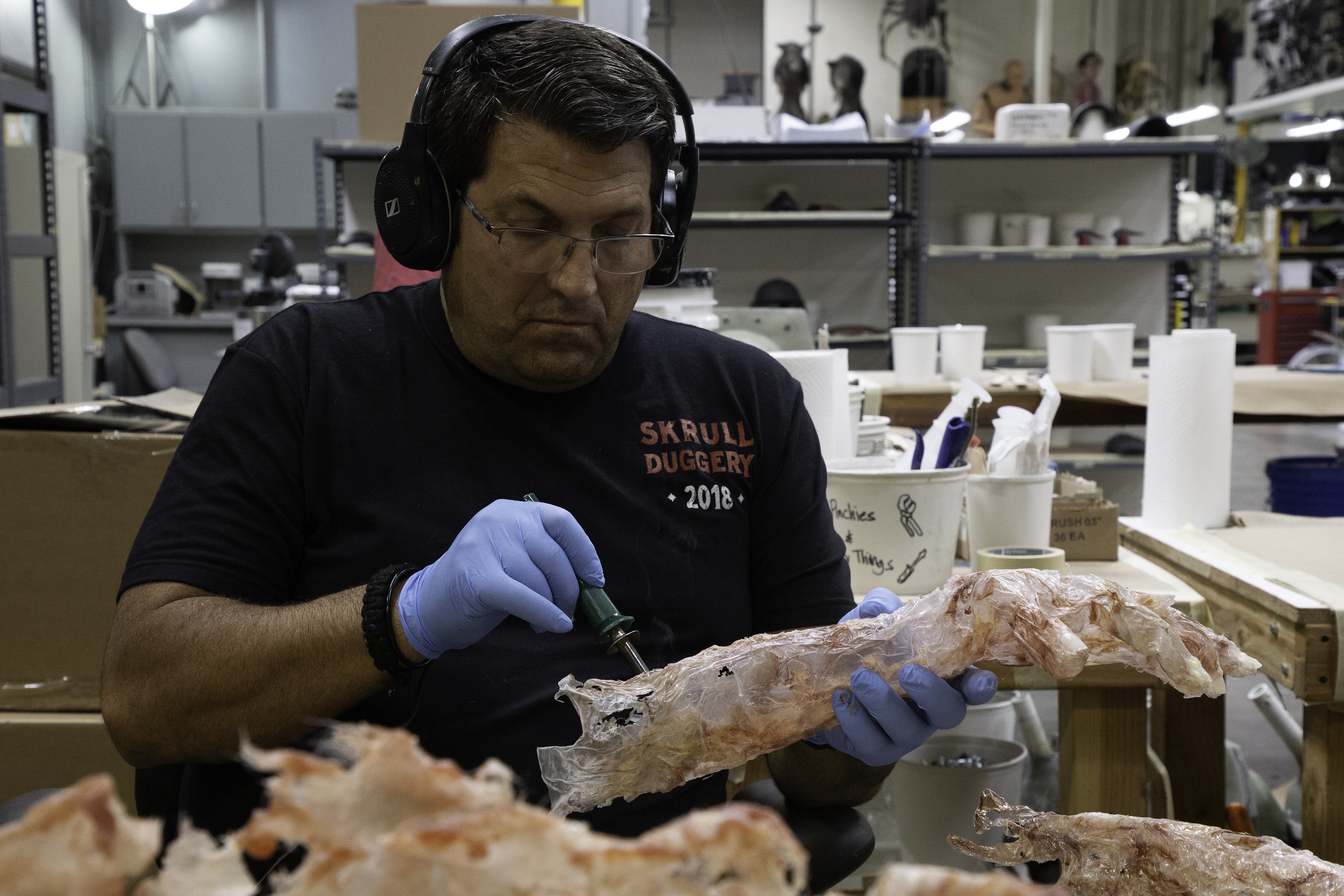 (Legacy artist Mark Killingsworth works on the limbs for the Frank husk. Image courtesy Legacy Effects/Fox Searchlight.)
This approach gave the Frank body a kind of broken and burnt look. “Mark Killingsworth worked with me a lot on it.” says Mahan. "It was not like a traditional silicone dead body but something truly strange. He marvels, “You could shine your flashlight through it.”
How the Special Effects Teams Brought the Horror of the Wendigo to the Silver Screen
Antlers was director Scott Cooper’s first film foray into the world of the supernatural. He credits Mahan and the crews at Legacy Effects and LSFX for helping him. “It certainly was a team effort.” Cooper talks about how challenging the show was. “It was really quite a difficult show for a number of reasons. Tough material, working with younger actors who aren't actors and who don't at times know the difference between reality and make-believe. And, of course, you inject in a creature that's both practical and hybrid and in difficult shooting conditions. That was difficult. I thank Shane and all the gang at Legacy and LSFX for really helping me, as a neophyte in my first immersion into the supernatural.”
Lead special makeup effects artist Holland Miller says about Cooper “I love working with Scott... he was so into everybody's input.”
Mahan says that working on the film was, “…a labor of love for me. I was so happy because it was moody and it was atmospheric and it was, more importantly, a brand-new creature. I actually loved everything about the collaboration and the overall experience.”
Mahan says, “The element of horror film and iconic horror film imagery is what made me so happy about this.” In the end, Mahan gives a shout out to all of the crew involved at Legacy. “Let me just say one last thing. You know I'm spearheading these things, but the entire crew here at Legacy Effects, I just want to thank, because everyone works so hard. All the artists, everybody. It was a real piece of hard work that paid off.”
Follow Legacy Effects
Website - www.legacyefx.com
Facebook - www.facebook.com/legacyeffects
Instagram - @legacyeffects
Follow LSFX
Website - www.lindalaschminkenfx.com
Facebook - www.facebook.com/schminkenfx
Instagram - @schminkenfx