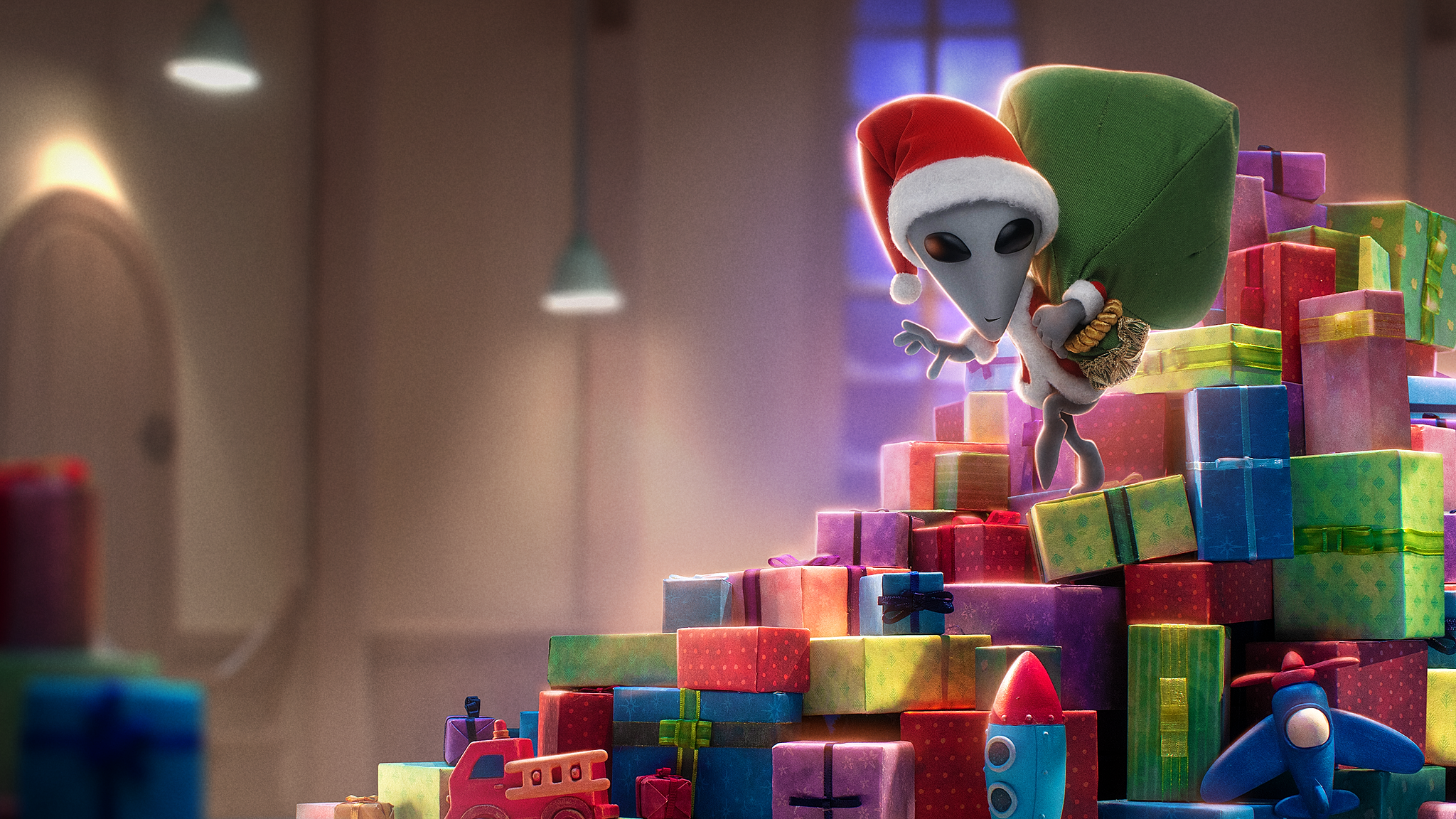
By Michael Martin
The Making of The Chiodo Brothers’ Alien Xmas (2020)
Aliens, Santa, and the Chiodo Brothers! What more could you want under the tree for Christmas?
The name Chiodo has long been synonymous with a blend of quirky and creative puppets and stop-motion animation. Their signature style has been seen in feature films ranging from Pee-wee’s Big Adventure, Critters, Team America: World Police, to their classic Killer Klowns From Outer Space.
As children, the Chiodo brothers, Charles, Edward, and Stephen, were inspired by such Rankin-Bass stop-motion classics as Rudolph the Red-Nosed Reindeer and Santa Claus is Coming to Town. The young brothers would watch these colorful stop motion Christmas programs and then go into their basement and create their own animated tests with devil and elf puppets that they made themselves, imagining their own holiday stories. Fast forward to today and, as adults, the Chiodo’s would create their own take on a stop motion animated Christmas tale, only this time, it would be imbued with that signature Chiodo style. Intro Alien Xmas.
Jump To Section
- Alien Xmas: An Alien’s Fourteen-Year Journey
- Script Development and Pre-production for Alien Xmas
- Working With Other Artists for Alien Xmas’ Sets and Characters
- Combining Practical and Digital Techniques to Build the Alien Puppets
- Determining the Puppet Scale
- Making Animation Alien Eyes
- Building Christmas Town
- Animating Christmas
- Breathing Life Into Inanimate Characters for Alien Xmas
- The Most Challenging Sequences
- Tender Moments in Alien Xmas
- A Diverse Cast of Elf Puppets
- A Contrast In the Film’s Themes
- The Future of Stop Motion Animation, According to the Chiodo Brothers
- What’s Next for the Chiodo Brothers?
Alien Xmas is the tale of a little alien named ‘X’ who is part of a race of space beings called Klepts. Led by Supreme Leader Z, the aliens greedily go around the universe stealing things from other planets. To gain favor with the larger aliens who always take his things, X volunteers to set up a device called a Gyrotron which will cancel Earth’s gravity, making it easier for the aliens to steal all of Earth’s stuff. The best location to set up the Gyrotron? The North Pole. Underneath Christmas Town. With the aid of a multi-tentacled robot named SAMTU, X attempts to carry out this grand interstellar bit of larceny. And that is when he meets a little girl named Holly, and with her help, X learns the values of love and giving.

The Chiodo brothers, surrounded by puppets and props from Alien Xmas, would talk with SWSCA co-founder Matt Winston about their latest stop motion project.
Alien Xmas: An Alien’s Fourteen-Year Journey

Alien Xmas originally began life as a feature film pitch, complete with artwork, storyline, and maquettes. While a lot of people liked the story, the film could not find funding. Stephen Chiodo remembers that they had all of these assets, designs and artwork, “So let’s turn it into a book.”
The book of Alien Xmas would be written by Stephen Chiodo and Jim Strain and illustrated by Charles Chiodo. And that is where Alien Xmas would rest for fourteen years, until…the explosion of streaming services seeking new content would open up a whole new avenue for little X.
The Chiodo brothers would meet Alien X executive producer Jon Favreau (Iron Man, The Mandalorian) while creating effects for the Will Ferrell-starring Elf. When Favreau asked if they had any interesting projects, they immediately thought of Alien Xmas.
The Chiodos say they found in Jon Favreau a kindred spirit, someone receptive to their ideas. They reveal that the executive producer would work with the brothers, focusing them on the heart of the project, the core idea of the story. No ‘B’ storylines, no ‘C’ stories, just a simple one in which a little alien attempts to steal Christmas.
And Netflix? Edward Chiodo says that Netflix was the perfect partner for the project. “They saw the passion, they loved the project, they saw the creativity.” In other words, “They let the creatives run with the project.”
Script Development and Pre-production for Alien Xmas
 (X and an early design for SAMTU creep through Christmas Town in this pre-production illustration. Image courtesy of Netlix.)
Work on the script began in late 2018 with a projected release date for fall of 2019. Using the book as a starting point, Kealan O’Rourke would work to develop an outline and the first draft of the script. Mark Simon would then begin working on storyboards and animatics.
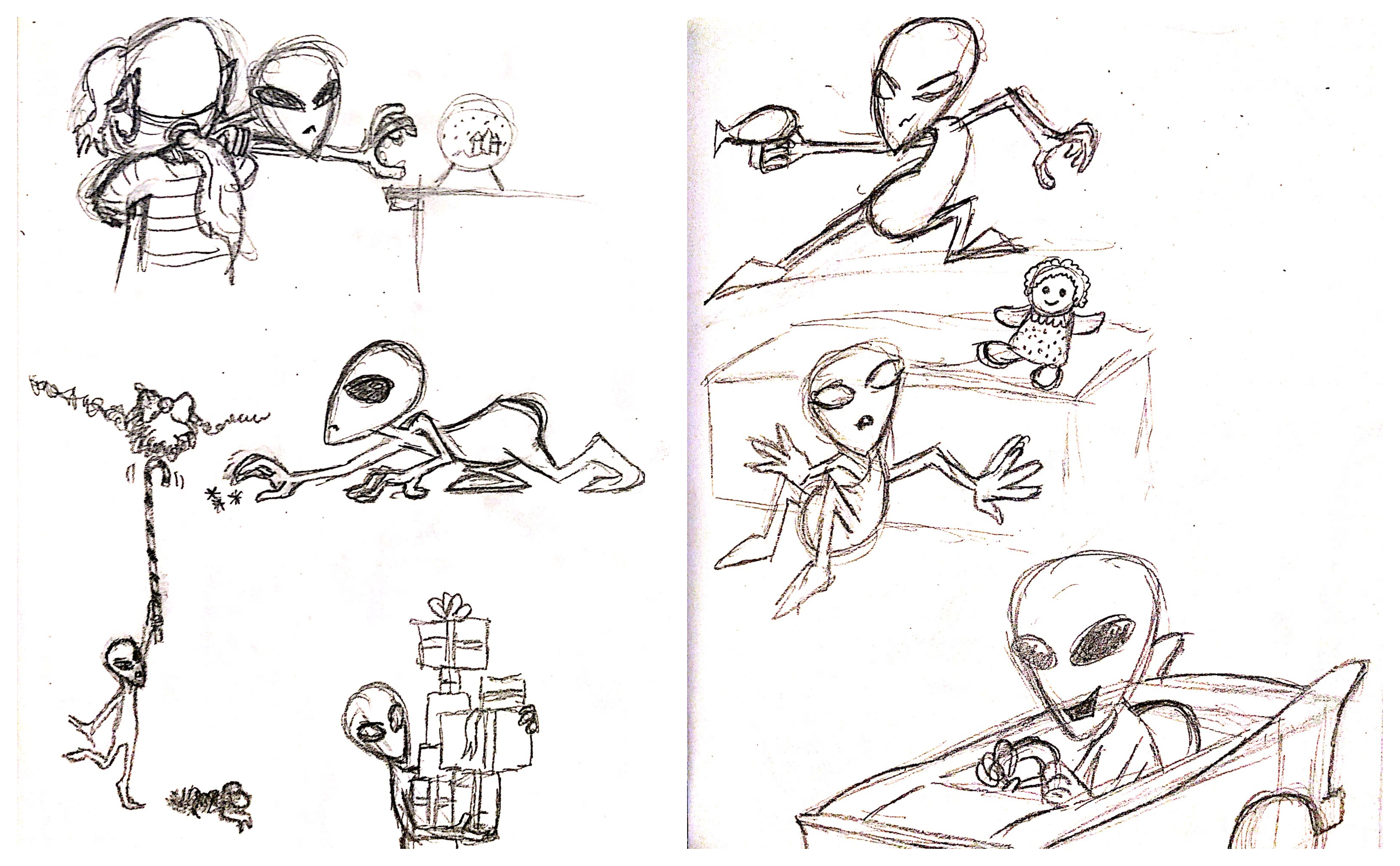 (Early sketches of X getting into trouble. Images courtesy of Netflix.)
Pre-production on Alien Xmas would start in April of 2019 and shooting would commence in June. Shooting would continue until the Christmas break of 2019 with post-production occurring in the first half of 2020 and final delivery in August. Charles says that the production is an example of how difficult a process stop motion animation is. “Everything is built from scratch and animated at one frame at a time.”
Working With Other Artists for Alien Xmas’ Sets and Characters
 (Designs for the Holly puppet. Images courtesy of Netflix.)
While many of the designs had already been developed, there was still a lot of work to be done. A creative crew was hired to design sets and characters, including Christmas Town, the many elves, and the Klept aliens along with their ships.
 (Sketches of the Gyrotron, the anti-gravity device that will be placed beneath Christmas Town. Image courtesy of Netflix.)
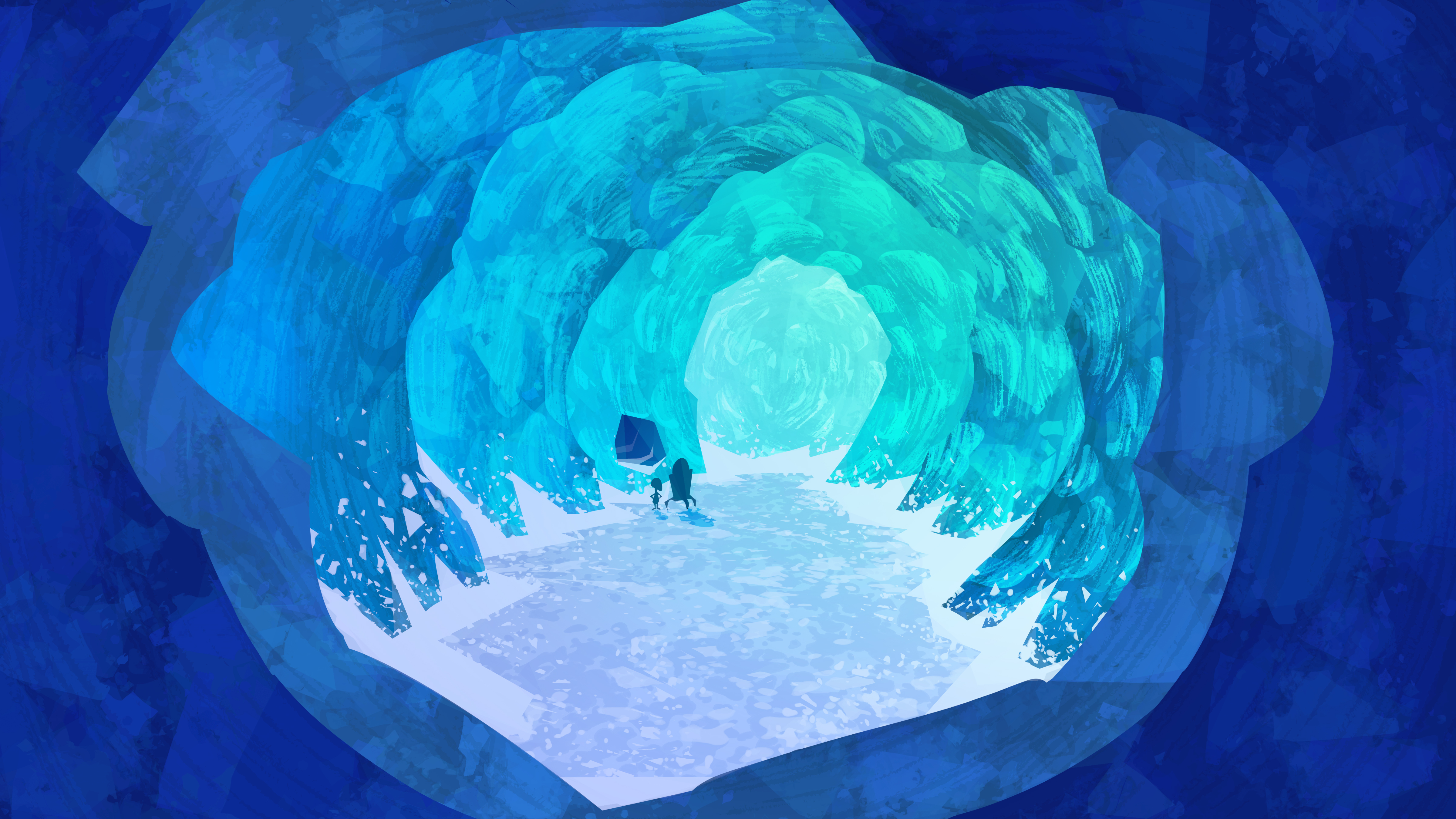 (Sketch of the ice cavern where X and SAMTU will construct the Gyrotron. Image courtesy of Netflix.)
Charles Chiodo has always been the primary visual artist of the three brothers and had illustrated the original Alien Xmas book. But for the design process of the Netflix production of Alien Xmas, the Chiodos would put together a team of very creative people for the huge undertaking. Charles says he was blown away by the work he was seeing coming from the most talented young people in the industry. Instead of micromanaging, Charles took a step back and let the artists be artists. “I’m looking at this stuff and saying, well, I have nothing to worry about here.” Chiodo laughs and says that working with the team of creative people, “…was a pleasure.”
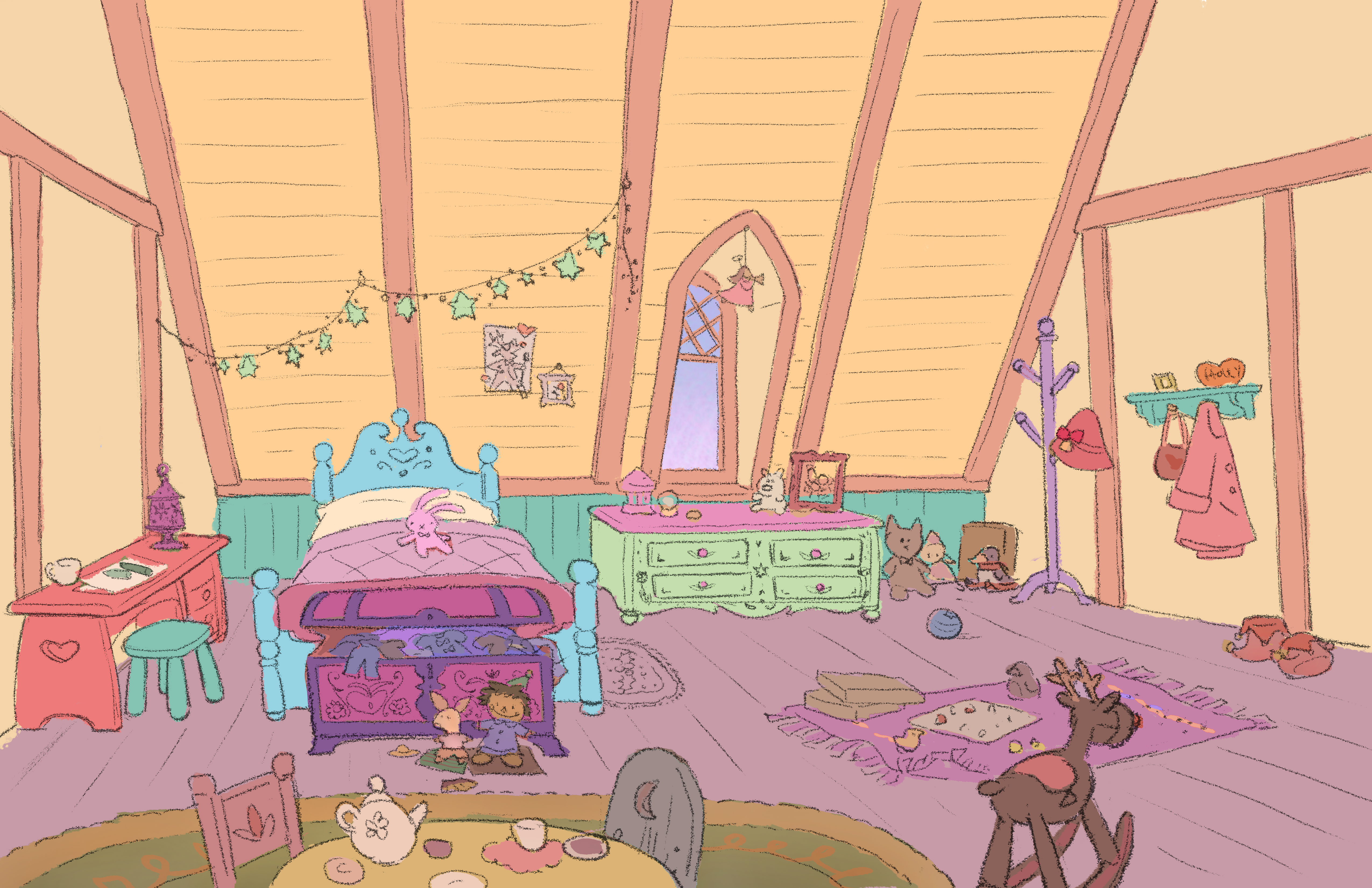 (Illustration of Holly's bedroom by Christina Yang. Image courtesy of Netflix.)
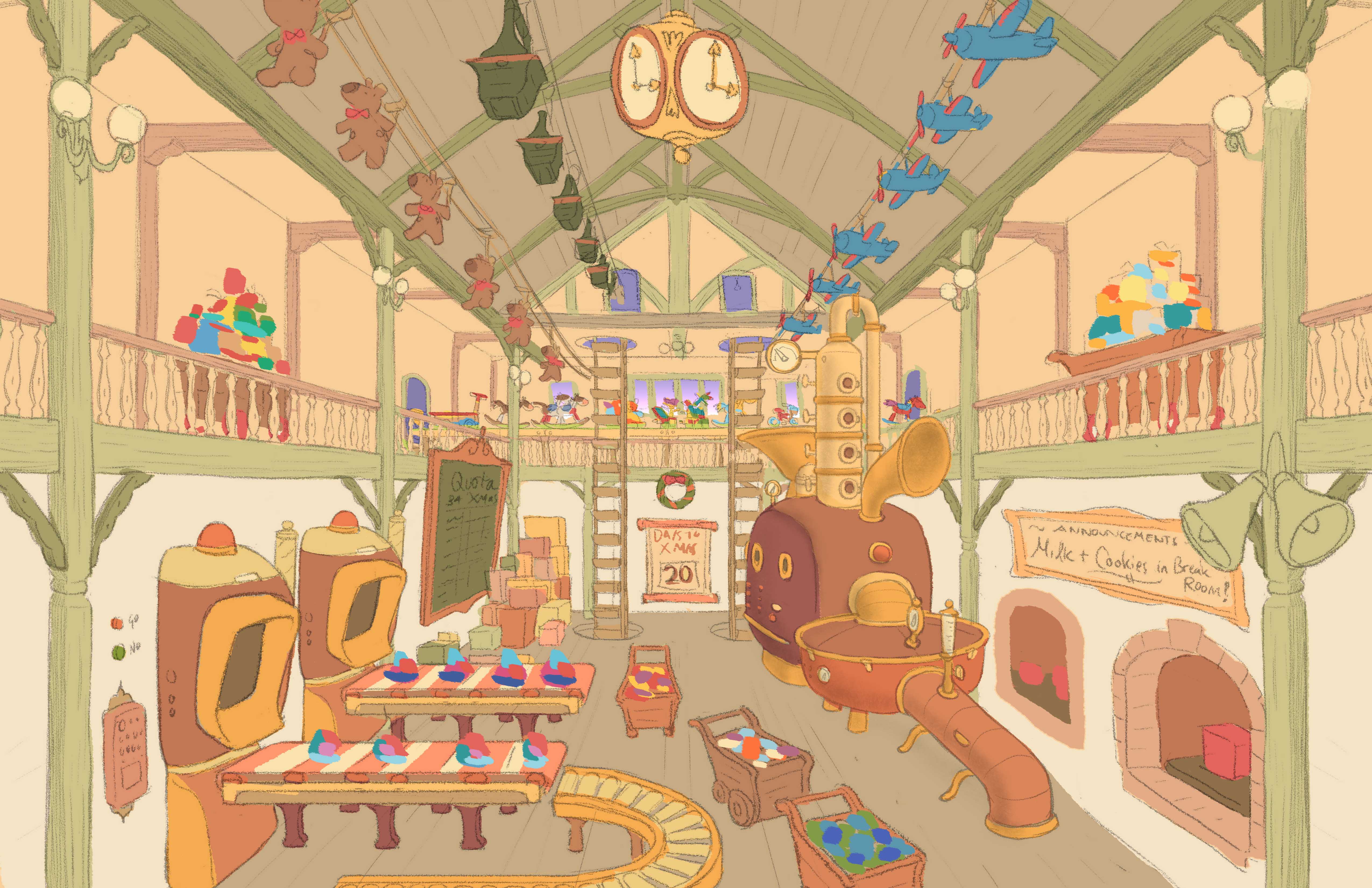 (Illustration of Santa's toy factory by Christina Yang. Image courtesy Netflix.)
Combining Practical and Digital Techniques to Build the Alien Puppets
Building the puppets for Alien Xmas would blend a combination of traditional techniques and digital ones. The initial sculpts of the puppet heads were made from Chavant clay but it took too long to make changes during the approval stages. Stephen says that to make things faster, “The character heads were sculpted in ZBrush.” Once the heads were approved, 3D printed master positives were molded and then cast in hard urethane. The puppet hands were also sculpted in ZBrush, molds were made, and then the appendages were cast in silicone. Nikki Rice was the artist responsible for digitally sculpting most of the elf heads.
 (The sculpt for Holly's puppy made from Chavant clay. Image courtesy of Netflix.)
Some of the puppets, like Z the Supreme Leader, would have traditional ball-and-socket armatures. Their body shapes were then built up with foam. But many of the stop motion puppets used in Alien Xmas, including the star of the show X, had nothing more than simple wire armatures.
Unlike repairing a ball and socket joint when it breaks, the wire armatures can’t be repaired. The brothers say thirty or forty X puppets were built, “probably more than that,” says Stephen. “Wire does work!...They were pretty durable. They did hold up.” Becky Van Cleve would serve as the head of puppet fabrication and Felicia Rose would be in charge of handmaking the puppets’ wardrobe.
Determining the Puppet Scale
“One of the biggest challenges on the project was deciding on the puppet scale,” says Charles. The main character X’s scale would determine the scale of the rest of the puppets in the show. X is the smallest primary character and he had to be small enough to be perceived as a doll by the next smallest character, the little girl Holly. X was reduced to the smallest size that the Chiodo brothers felt they could get away with as far as flexibility and durability of the wire armatures and still be animated. That came to about five inches tall.
That would mean that the Holly puppet would then need to be six to seven inches. Her parents Noelle and Obie would be eight inches and the rotund Santa Claus puppet would scale up to ten inches. That would mean that the sets got big. “They really had to watch the scale,” says Stephen. Charles would add, “All part of solving problems in the stop motion world.”
 (Animating on the large Alien Xmas sets. Images courtesy of Netflix.)
In fact, thought had been given to shooting X on a green screen with a bigger puppet, but that would have been too difficult. Charles says, “It was out of the question to even consider doing two scales.”
 (When caught at something, X 'plays dead', leading Holly to believe the diminutive alien is a doll. Images courtesy of Netflix.)
Stephen reveals that there was one scale cheat. A 100% scale X was used for most of the project but a 90% scale X was used when he was being held by the little girl Holly. He says he, “thinks it works in the context of the story.” Charles says they don’t feel too guilty about it because animator and special effects pioneer Willis O’Brien changed the scale of King Kong in the original classic from 1933. Stephen echoes this sentiment. “You do what you have to do to make the shots work and tell the story.”
Making Animation Alien Eyes
The expressive eyes of the puppets would be realized with cast replacement animation eyes. For lip sync, tracking marks were placed on the puppet’s mouths during animation and then they were made to talk in post-production with digital mouths taken from hand-drawn original elements. Many of the robot SAMTU’s features would also be created with replacement animation parts.
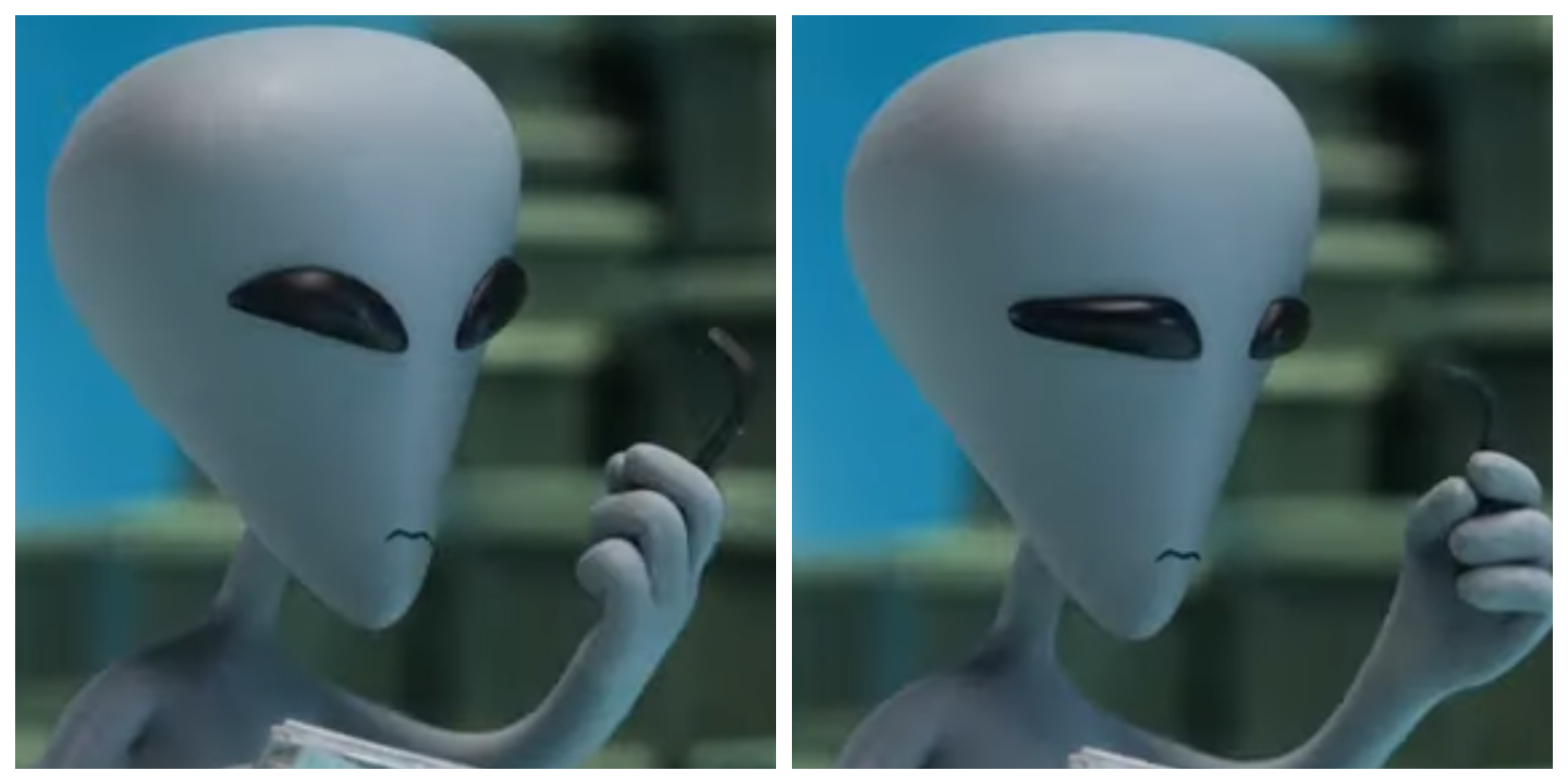 (Example of the different replacement eyes used on the X puppet. Images courtesy of Netflix.)
Building Christmas Town
 (A section of the Christmas Town set. Image courtesy of Netflix.)
Because of the size of the puppets, Christmas Town and the rest of the sets would be built to approximately seventh scale. Which, in stop motion terms, meant that, “We had to build everything” says Edward. Since the puppets were not in a typical dollhouse scale, art director Jeff White and his team would be forced to fabricate or modify every set piece and prop seen on the screen. Edward would praise the model makers on Alien Xmas for their attention to detail. He was especially amazed by the small things that they would build, such as the food on the banquet table. “I’m blown away by it.”
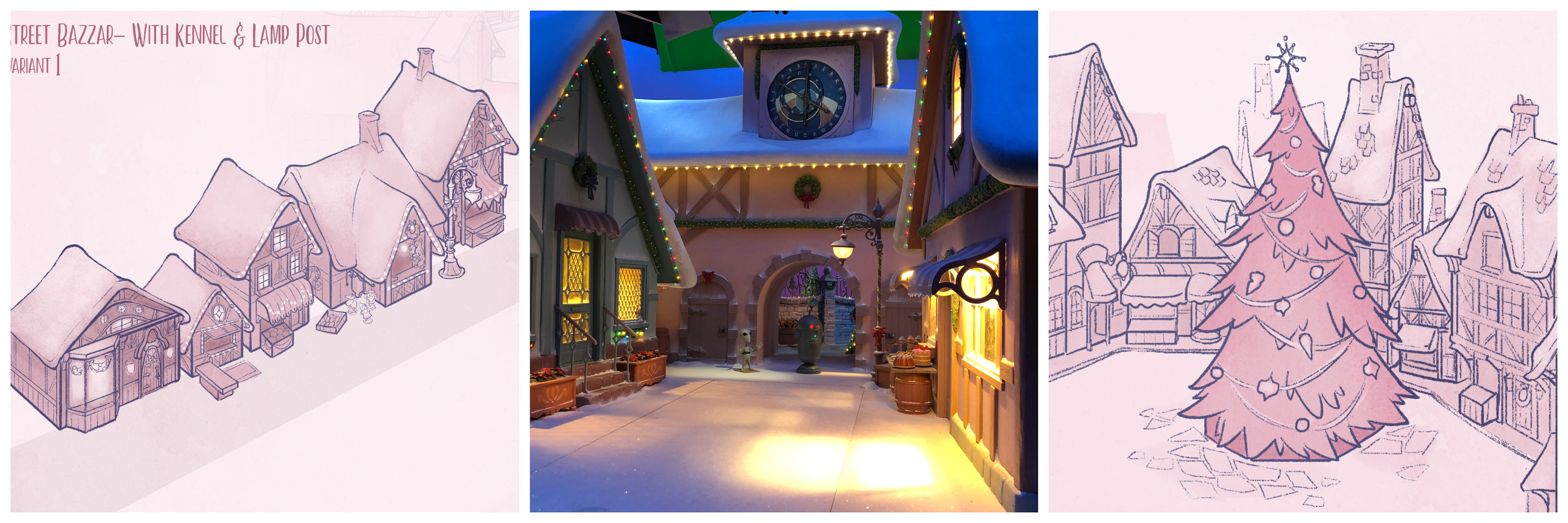 (Designs for Christmas Town and a portion of finished set built for Alien Xmas. Images courtesy of Netflix.)
Edward says, “The size of the sets was the big concern.” The larger the sets, the more studio space and lighting equipment would be required. He continues, “Actually, it was too big to do at our facility.”
While all of the pre-production, puppet, and art department building would be done at the Chiodo brothers facility, Alien Xmas would shoot at Bix Pix on an incredible sixteen stages! There, eight to twelve animators would be working at any given time on multiple sequences simultaneously.
Animating Christmas
Charles Chiodo says “the quality of stop motion is approaching CG…You have to tell people now that it’s stop motion because they can’t tell the difference.” The brothers credit Dragonframe stop motion animation software for this. The software enables animators to immediately reference their work while they are animating and smooth it out like never before. They say, “Unlike days past where an animator could spend fourteen to fifteen hours on a shot and then have to wait until the next day to see whether it worked or not in dailies.”
Breathing Life Into Inanimate Characters for Alien Xmas
When asked which character was the most challenging to bring to life, Stephen would say it was X, the star of the show, and the fact that the little alien didn’t talk. He says it was executive producer Jon Favreau's idea to not have X and SAMTU talk. Originally, the two had been conceived as a bickering couple, à la the comedy duo of Laurel and Hardy. Favreau suggested someone more like Buster Keaton, an everyman against the world. Stephen shares that Favreau then said, “Let’s not make X talk. Let’s not make SAMTU talk.” The other brothers laugh at the memory. "So I’m freakin’ out here! How are we gonna do this?” Stephen continues. But in the end, he says that Favreau’s idea was a brilliant suggestion. “He’s a great collaborator. He was right. So we took on the challenge.” And then Stephen declares, “I think he helped us make a stronger film.”
Because of this major decision, Stephen says, “The movement and the timing of the animation are what’s dominant now in X and SAMTU's performances, they're not just talking heads.” He continues, “Pose to pose expressions of character is what helps them emote.” Edward feels, “That is where the animator as actor/performer comes through….They have to embody that being and bring it out and bring it to life through the puppet…That’s what the real talent is.”
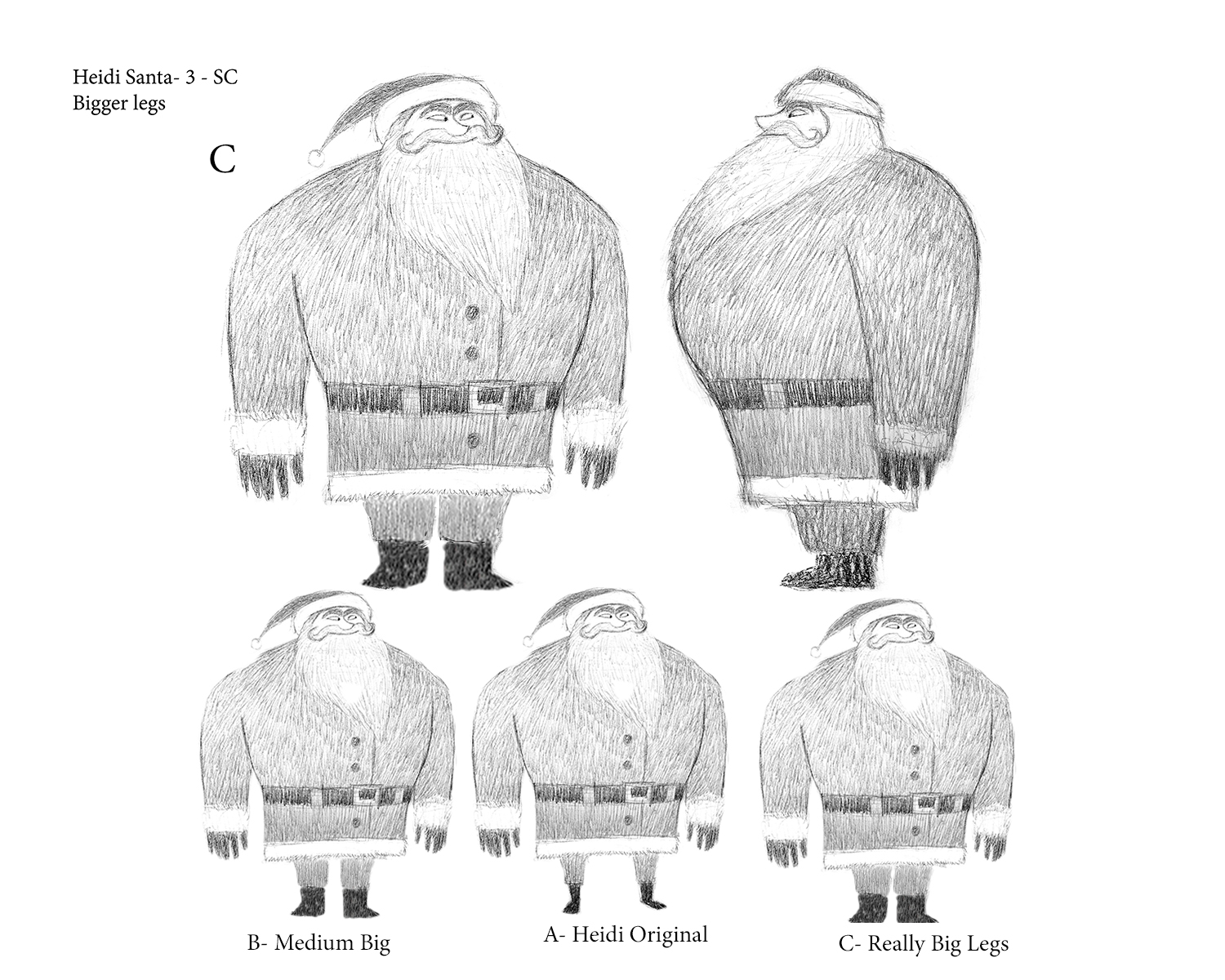 (Early designs for the Santa puppet. Images courtesy of Netflix.)
 (Santa narrates the story of Alien Xmas. Image courtesy of Netlflix.)
Stephen says, “Santa was a big challenge unto himself.” Describing him as a burly, hands-on-type boss, the ultimate optimist, happy and joyful all the time, and nothing ever gets him down. “Savannah Steiner really helped bring him to life.” Steiner would be responsible for animating most of the Santa Claus sequences.
 (Animating the Santa puppet. Images courtesy of Netflix.)
The animated Santa Claus would also serve as the story’s narrator. Charles says that it was the simplicity of Santa’s narration that kept the story from being confused with a lot of dialogue. “I think that’s a strong point.”
 (X takes it easy while the robot SAMTU works to construct the Gyrotron beneath Christmas Town. Image courtesy Netflix.)
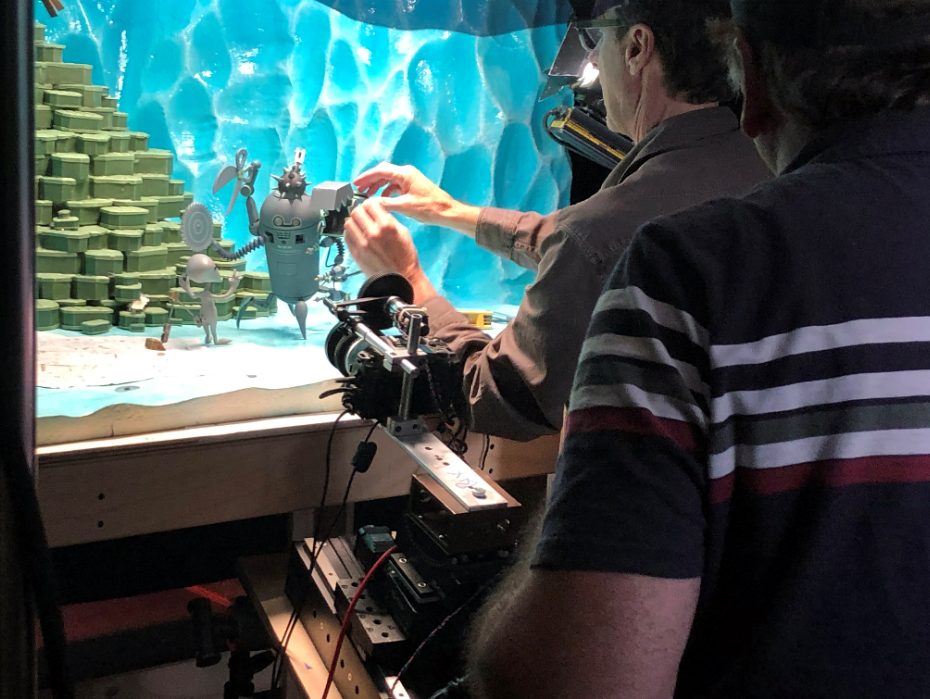 (Animating the X and SAMTU puppets in the ice cavern beneath Christmas Town. Image courtesy of Netflix.)
Stephen says SAMTU was a real challenge as well. Kim Blanchette was the key animator on the multi-tooled robot sent to help X with his plan to steal all of Earth’s stuff. As mentioned before, many of the robot’s features would be realized with replacement animation. The helpful robot would also sport waving tentacles and chomping appendages when needed. The Chiodos say Kim would make the character come alive with lots of little body and head-tilting pops and quirks.
 (Supreme Leader Z gives the Klepts their marching orders in this scene onboard the alien ship. Image courtesy of Netflix.)
The evil head of the alien Klepts would be Supreme Leader Z (voiced by Barbara Goodson). She would be primarily animated by Ian Boone.
 (During the SWSCA interview, Charles Chiodo rotates the Supreme Leader Z puppet around so that we can get a better look at her.)
The Most Challenging Sequences
 (The Klepts attack in the final battle for Christmas Town. Images courtesy of Netflix.)
As far as the most challenging sequences of Alien Xmas, Charles mentioned the battle scenes at the end of the film where the alien Klepts are invading Christmas Town. The battle with X and SAMTU that takes place during the activation of the spinning Gyrotron is also pointed out as being difficult.
Stephen Chiodo picks the scene where Holly and her parents Noelle and Obie are floating around weightless while trying to save puppies in a kennel. In this sequence, the Gyrotron has been activated, canceling out Earth's gravity and causing everyone to begin floating. Ian Boone had a big hand in animating the difficult sequence. Charles says it was, “A challenge to be able to sell the weightlessness.” Stephen adds that animating the Klepts in the kennel scene was a blast. For the scenes in the mothership, it was Johnny McHone who animated the Kelpts' antics.
Tender Moments in Alien Xmas
 (A forlorn Holly puppet sits on one of the detailed sets built for the show. Image courtesy of Netflix.)
Stephen says the tender moments in the story were a challenge too, but in a different way. He credits animators Yizhou Li and Tucker Barrie, saying they did some very sensitive work with Holly and X in the scene where she catches him stealing in the family living room and then also with X and the puppy. “Very sensitive, gently expressive animation.” During the interview, Matt Winston admits that even he was affected by the holiday message of warmth and the magic of giving. Stephen laughs. “I’m glad it affected you that way because that was what we were trying to do.”
A Diverse Cast of Elf Puppets
One of the things that makes Alien Xmas a modern-day classic is its representation of the characters. Holly is the mixed-race daughter of the bi-racial couple at the center of the story. And unlike shows of the past, the elves are all of different races.
 (Many of the diverse elf designs created for Alien Xmas. Images courtesy of Netflix.)
Alien Xmas would embrace a multi-ethnicity that reflects the world we live in, something that hadn’t originally been considered. One of Netlfix’s contributions to the world of the show would be to have a diversity expert come in to make suggestions about diversifying the cast. Stephen says, “I’m really glad they did.” and, “It feels real, now it feels contemporary.”
A Contrast In the Film’s Themes
 (Alien Xmas composer Adam Schiff from Hans Zimmer's Bleeding Fingers Music. Image courtesy of Bleeding Fingers Music.)
To create the film’s delightful music score, the brothers would work with Hans Zimmer’s company Bleeding Fingers Music and composer-in-residence Adam Schiff. The Chiodos explain that what they did visually with the show, contrasting the dull, gray, colorless world of the Klepts, and the vibrant, festive colors of Christmas Town, they wanted to create the same kind of thing with the music. Charles crashes his hands together to visually convey the idea. “Musical themes of giving versus taking.” Schiff would go with a Theremin-influenced sci-fi sound to represent the Klepts and then bells and a choir for the Christmas Town music. During the final battle, the composer would combine the two themes. X’s Klept theme would be realized with an out-of-tune piano.
The Future of Stop Motion Animation, According to the Chiodo Brothers
At the height of production, the Chiodo brothers would have 104 people working at one time. By the time they were finishing production and post, they had employed almost 300 people. Artists and craftspeople, sculptors, set builders and painters, puppet builders and wardrobe fabricators; even in normal times it would be hard to assemble a team of such size.
Stephen says, “We’re experiencing a renaissance in stop motion right now.” At the same time the Chiodos were making Alien Xmas, they say LAIKA (Missing Link) was making something, Henry Selick (Nightmare Before Christmas) was making something, and Guillermo del Toro was doing something! When asked why this was so, Edward answers that digital effects permeate our entertainment and that, because of this saturation, "I think there’s a burn-out on CG to some degree.”
Edward says because of this renaissance, "there were more people trained and more opportunities for people to learn the craft of stop motion.” He specifically credits the stop motion course the brothers did with SWSCA as having trained people. “The talent pool is larger than ever before.” Stephen worried there would be a dwindling number of stop motion animators as the brothers got older, but he says there is, “A new crop of animators that are extraordinary.” He was, “Overwhelmed with the performances they were able to provide.”
Stephen feels that viewers are attracted to stop motion animation because of the physicality and textures of inanimate objects coming to life and emoting. “It’s literally magic.”
What’s Next for the Chiodo Brothers?
Alien Xmas will clearly become a holiday classic, one that is viewed year after year. Edward says that it’s that sense of community where families are going to want to watch it together that inspired them to make X’s tale in the first place. The brothers say, “We’re hoping that’s what this becomes.”
When asked what’s next for the Chiodo brothers, Stephen teases that there was talk about an Alien X Halloween show. “That would be fun.” Charles and Edward smile at this. But they also say that they have ideas that have been percolating for years. Stephen says, “It takes so long to get any good idea off the ground, produced, funded, and on the air.” Edward says that they have many, “Passion projects that hopefully will get made.” And that it is an, “exciting time for filmmakers and creators in general…It’s a great time to be a creator.” Charles finishes by grinning and saying that there’s lots of creative stuff being made, but, “Nobody else gives it the Chiodo Brothers spin.”
We implore all SWSCA community members to immediately go and watch the Chiodo Brothers Alien Xmas on Netflix! And for more fun with the Chiodo Brothers and SWSCA co-founder Matt Winston, check out Matt’s interview with the brothers posted at the top of this article!